Showing posts sorted by relevance for query exegesis. Sort by date Show all posts

December 12, 2021

How Adam Smith messed up economics

Comment on Ken Zimmerman on 'Adam Smith’s idea is still the basis of the discipline of economics'


The history of economic thought is the history of scientific failure. The major approaches ― Walrasianism, Keynesianism, Marxianism, Austrianism, MMT ― are mutually contradictory, axiomatically false, and materially/formally inconsistent. Because of this, the whole analytical superstructure of economics is scientifically worthless. Because of this, economic policy guidance has NEVER had sound scientific foundations.

Now, the problem is this: “In order to tell the politicians and practitioners something about causes and best means, the economist needs the true theory or else he has not much more to offer than educated common sense or his personal opinion.” (Stigum)

Because economists do not have the true theory, economics boils down to brain-dead agenda-pushing. Economists are not scientists but clowns, useful idiots, and agenda pushers in the political Circus Maximus. Economics is proto-scientific garbage, and because of their scientific incompetence, economists are a hazard to their fellow citizens. #1

The mental misery can be traced back to Adam Smith: “Smith … disliked whatever went beyond plain common sense. He never moved above the heads of even the dullest readers. He led them on gently, encouraging them by trivialities and homely observations, making them feel comfortable all along.” (Schumpeter)

Or, as Ken Zimmerman spins it: “The real start of modern Western economics as a discipline is usually traced to Adam Smith (1723–1790). Beginning as a moral philosopher concerned with human motives, Smith later wrote The Wealth of Nations in 1776 as a series of lectures on public policy. The task he set for himself was that of a natural scientist, to discover the workings of a vast machine ― the economy. From this philosophical foundation, Smith builds a powerful argument that the individual’s self-interest generates the society’s best interests. Beginning with a rational individual motivated by positive natural impulses, he undertakes a series of dramatic political attacks on monopolists, corrupt governments, tariffs promoted by strong business lobbyists, guilds, colonialists, and ‘the capricious ambitions of kings and ministers’ (1937, 460). Though based on self-interest, a well-working economy, he said, should not cater to the selfish interests of a small class or group. Instead, it furthers the wealth of the nation as a whole ― and it is not a great step from here to the idea of democracy, of rule ‘of, by, and for’ the people of the nation.”

“Beginning with a rational individual”, Adam Smith inaugurated methodological individualism and led the profession straight into the Fallacy of Composition. The fact of the matter is, that NO way leads from the second-guessing of Human Nature/motives/behavior/action to the understanding of how the economic system works.

What Adam Smith did was a mixture of psychology and sociology ― PsySoc for short #2 ― including moralizing and agenda-pushing but NOT economics proper. Economics is about the behavior of the economic system and NOT the behavior of people. Adam Smith never understood the behavior of the system as a whole, i.e., “the workings of a vast machine”, and he never understood macroeconomic profit. #3 The supply-demand-equilibrium narrative that culminated in General Equilibrium Theory is a bad joke to this day. An economist who does not understand profit, i.e., the foundational concept of economics, is a laughing stock.

However, the economy is an abstract entity that defies intuitive understanding, and human behavior is something every moron claims to understand from his own personal experience. As a consequence, Adam Smith's blather about the baker and the butcher and their rational self-interest won the popular vote. The beauty of PsySoc is that one can speculate and talk and moralize about human nature/behavior without ever arriving at scientific knowledge about how the economic system works. People do not like science; they like storytelling and talk shows.

In his scientific incompetence, Adam Smith took the wrong path. He led economics away from science and helped it finally become a subcontractor of the disinfotainment industry. #4

To this day, economics has no scientific truth-value #5 but only political use-value. Politically, Smith's invisible-hand economics forwarded the illusion of Democracy and the reality of Oligarchy. And this is why “Adam Smith's idea is still the basis of the discipline of economics”.

Egmont Kakarot-Handtke


***

REPLY to mameerop, Dec 13 [not published because of comments closed]

Economics has a long tradition of the pointless exercise called exegesis: “Exegesis is a critical explanation or interpretation of a text. Traditionally, the term was used primarily for work with religious texts, especially the Bible. In modern usage, exegesis can involve critical interpretations of virtually any text, …” #1, #2

At some point in any economic discussion, the issue is no longer how the economy works but about what XYZ has said about how the economy works. In other words, folks get lost in metacommunication.

This is NOT an accident but a built-in feature of political economics.

“Another danger is that you may ‘precise everything away’ and be left with only a comparative poverty of meaning. ... Such a problem was avoided, said Keynes, by Marshall who used loose definitions but allowed the reader to infer his meaning from ‘the richness of context’.” (Coates, 2007, p. 87)

In other words, the reader is encouraged to substitute almost any meaning he likes. The result is well-known. Keynes' loose verbal reasoning triggered an enthusiastic exegesis movement that circled for some decades around the question ‘What Keynes really meant?’ Predictably, the question has never been answered. The richness of meaning only generated a wealth of blah blah.

The same holds, of course, for Adam Smith's Invisible Hand.

Take notice that every text that contains this metaphor has NO scientific content but is pure disinformation and that every author who applies this metaphor is NOT a scientist but a mentally retarded political agenda-pusher.

Adam Smith has to be buried at the Flat-Earth Cemetery together with all folks who ever tried to ‘explain’ what Smith ‘really’ meant.

Economics is a failed/fake science and needs a Paradigm Shift. This means that Adam Smith's idea is NO LONGER the “basis of the discipline of economics”.


#2 For more about exegesis, see AXECquery

***
Graphic AXEC121i
December 20, 2015

Quixotic Keynes exegesis

Comment on David Glasner on ‘Keynes on the Theory of the Rate of Interest’

Blog-Reference

Keynes was a political economist and he said many things on many occasions: “It is well known that John Maynard was born anew every morning; for this reason, his colleagues at Bretton Woods commented that he was too intelligent to be consistent.” (Valentino, 1988, p. 239)

Logical consistency — one essential criterion of science — has never been Keynes’ main concern. Just the contrary, Keynes’ natural habitat has always been the wish-wash zone where “nothing is clear and everything is possible.” (Keynes, 1973, p. 292)

Accordingly, Keynes has been the most outspoken proponent of the Cambridge School of Loose Verbal Reasoning “Another danger is that you may ‘precise everything away’ and be left with only a comparative poverty of meaning. ... Such a problem was avoided, said Keynes, by Marshall who used loose definitions but allowed the reader to infer his meaning from ‘the richness of context’.” (Coates, 2007, p. 87)

So, here you have it: the reader is allowed to infer his meaning. This invitation to free ink-blot association gave rise to the great palaver about ‘what Keynes really meant’. It should have been clear from the very beginning to every person of average wit and life experience that this palaver could never ever have a worthwhile outcome. And it has not until this very day. Nonetheless, David Glasner heroically carries on with the interpretation of Keynes’ interpretation of what the classicals could have meant.

The methodological moronism of the Cambridge School of Loose Verbal Reasoning has been carved in stone for the amusement of posterity with this statement: “Marshall followed the maxim: Better to be ambiguous and relevant than precise and irrelevant.” (Colander, 1995, p. 283)

This phony trade-off exists only in the minds of economists. Science is qua definition precise and relevant. Because Keynes and the After-Keynesians never understood this they are outside of science (2011).

There is no use to refute Keynes’ employment theory or his theory of interest or the multiplier or the ex-ante/ex-post equality of I and S or whatnot. Keynes’ profit theory is provably false, and that is enough. When the foundational concept of profit is false then the whole theoretical superstructure falls apart.#1

Because Keynes has been logically inconsistent the attempt to find out what he really meant has always been a quixotic enterprise. Keynes cannot be saved. There is one passage in the General Theory that is — in contrast to the usual verbiage — formally crystal clear and it says “Income = value of output = consumption + investment. Saving = income − consumption. Therefore saving = investment.” (Keynes, 1973, p. 63) This syllogism is provably false and no amount of interpretation and exegesis can talk this away.#2

That Keynes as a political economist produced not much of scientific value is bad but what the neoclassical maximization-and-equilibrium sect has produced then and now is worse. “I consider that Keynes had no real grasp of formal economic theorizing (and also disliked it), and that he consequently left many gaping holes in his theory. I none the less hold that his insights were several orders more profound and realistic than those of his recent critics.” (Hahn, 1982, pp. x-xi)

What Keynes and Fisher had in common was a false profit theory and this is the worst thing that can happen to an economist. In addition, they applied NONENTITIES like constrained optimization and equilibrium. More than 80 years later economists are still occupied with making sense of what had no sense right from the start. Not very efficient all this loose verbal reasoning, to say the least.

Egmont Kakarot-Handtke


References
Coates, J. (2007). The Claims of Common Sense. Moore, Wittgenstein, Keynes and the Social Sciences. Cambridge, New York, etc.: Cambridge University Press.
Colander, D. (1995). Marshallian General Equilibrium Analysis. Eastern Economic Journal, 21(3): 281–293. URL
Hahn, F. H. (1982). Money and Inflation. Oxford: Blackwell.
Kakarot-Handtke, E. (2011). Why Post Keynesianism is Not Yet a Science. SSRN Working Paper Series, 1966438: 1–20. URL
Keynes, J. M. (1973). The General Theory of Employment Interest and Money. The Collected Writings of John Maynard Keynes Vol. VII. London, Basingstoke: Macmillan.
Valentino, R. (1988). Discussion. In H. Hanusch (Ed.), Evolutionary Economics. Applications of Schumpeter’s Ideas, 238–249. Cambridge, New York, etc.: Cambridge University Press.

#1 How the intelligent non-economist can refute every economist hands down
#2 For details of the big picture see cross-references Refutation of I=S.

Related 'Dear idiots, time to get saving and investment straight' and 'Macroeconomics for retarded economists' and 'Keynes and the logical brilliance of Bedlam'. For details of the big picture see cross-references Keynesianism.

May 8, 2019

Settling the MMT―Inflation issue for good

Comment on Bill Mitchell on ‘US Congress hypocrites lose the plot’

Blog-Reference and Blog-Reference on May 9

Bill Mitchell quotes five Republican Senators in the US Congress as proclaiming it is: “the duty of the Senate to condemn Modern Monetary Theory and recognizing that the implementation of Modern Monetary Theory would lead to higher deficits and higher inflation”.

Science is something quite different from politics, and senators have NOTHING AT ALL to say in the realm of science. People forget this because they have come to think that political blather, talk shows, and scientific debates are essentially the same thing. This is partially the fault of economists themselves, who for the greater part lack a proper understanding of what science is all about.

Economic discussions suffer from the fact that both microfoundations and macrofoundations are provably false. The major approaches ― Walrasianism, Keynesianism, Marxianism, Austrianism, MMT ― are materially/formally inconsistent and mutually contradictory. This is why all economic discussions end in the bottomless swamp of cross-talk, interpretation, exegesis, second-guessing, and “what x REALLY meant” but for some mysterious reason could not clearly express.

To get out of the proto-scientific swamp requires a Paradigm Shift, i.e., the move from false Walrasian microfoundations and false Keynesian macrofoundations to true macrofoundations.#1

From the true macrofoundations follows the macroeconomic Law of Supply and Demand as shown here. #2 It says in the elementary case:


(i) An increase in the expenditure ratio ρE≡EC/Yw leads to a higher market-clearing price (the Greek letter ρ stands for ratio). An expenditure ratio ρE > 1 indicates deficit-spending/dissaving/credit-expansion, a ratio ρE less than 1 indicates saving/credit-contraction. Dissaving/saving, in turn, affects the average amount of transaction money M.

(ii) Deficit spending, i.e., the move from ρE=1 to ρE >1, causes a one-off price hike but NOT inflation† if the deficit spending is exactly repeated period after period. #3, #4, #5, #6 A steadily rising public debt is compatible with price stability after the first hike. Only successively INCREASING budget deficits produce continuous price increases.

(iii) An increase in the ratio of wage rate to productivity W/R leads to a higher market-clearing price P. If this is repeated period after period, one gets inflation depending on the rates of change of W and R in each successive period.

Roughly speaking, the macroeconomic Law of Supply and Demand explains the price level in the elementary production-consumption economy and its development over time. The equation contains but measurable variables and is therefore testable in principle.

The relationship between the average amount of fiat money M and the expenditure ratio ρE, the wage rate W, and employment L is shown here. #7

Because M is the dependent variable, it does NOT cause inflation. This puts the commonplace Quantity Theory to rest.

Conclusion: The MMT policy of deficit-spending/money-creation causes a one-off price hike but NOT inflation. The lethal effect of MMT policy is on distribution.#8, #9, #10 The Weimar/Zimbabwe/Inflation shouters suffer from incurable idiocy and cannot be admitted to a serious economic discussion. The fact is that MMT policy does NOT produce inflation, but, according to the macroeconomic Profit Law, Public Deficit = Private Profit,  the Oligarchy’s financial wealth (currently about $22 trillion and counting). This public debt is the own handiwork of nobody else than the US Congress, and all worked just fine without inflation.

Egmont Kakarot-Handtke


† "In economics, inflation refers to a general progressive increase in prices of goods and services in an economy." (Wikipedia) A price hike refers to one period; inflation means successive price hikes over two or more periods, with the rates of price changes being equal or increasing. Strictly speaking, the minimum length of inflation is two periods. The standard period length is the calendar year.

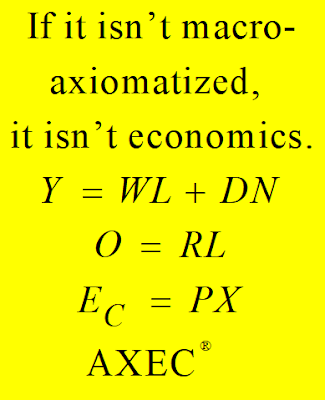
#1 This is the correct core of macroeconomic axioms: (A0) The objectively given and most elementary systemic configuration of the economy consists of the household and the business sector, which in turn consists initially of one giant fully integrated firm. (A1) Yw=WL wage income Yw is equal to wage rate W times working hours. L, (A2) O=RL output O is equal to productivity R times working hours L, (A3) EC=PX consumption expenditure EC is equal to price P times quantity bought/sold X.
For a start X=O, i.e., market-clearing holds. The ratio ρE≡EC/Yw is called the expenditure ratio; ρE=1 indicates budget-balancing of the household sector.
#2 Graphic AXEC101 Law of Supply and Demand, elementary production-consumption economy with market-clearing and zero distributed profits.
#3 Gov-Deficits do NOT cause inflation
#4 How some MMTers got inflation wrong
#5 MMT and the inflation-red-herring
#6 Economics as tireless production of proto-scientific garbage: inflation theory as an example
#7 Graphic AXEC111b Average quantity of transaction money
#8 Deficits matter for distribution
#9 MMT: Distribution is the drawback NOT Inflation
#10 Dear idiots, government deficits do NOT cause inflation

Related 'What Keynes really meant but could not really prove' and 'Quixotic Keynes exegesis' and 'Inflation: back to basics' and 'A la recherche de l'inflation perdue' and 'The unintended consequences of deficit spending' and 'MMT: fundamentally false' and 'MMT: A free lunch for the Oligarchy' and 'Links on Inflation'.


***

AXEC182a  Macroeconomic price P and profit Qm as a function of the expenditure ratio ρE (and the other variables), with ρ>1 meaning deficit spending.


***


Twitter May 29 Michael R. Strain

June 11, 2015

Sloppiness as economic methodology

Comment on Lars Syll on ‘Ditch ‘ceteris paribus’!’

Blog-Reference

Bruce Edmonds asserts “Natural language accounts get around this [drawback of formal models] by utilizing the shared knowledge of the appropriate context ....”

This brings us almost verbatim back to Keynes who was a tireless proponent of the Cambridge School of Loose Verbal Reasoning: “Another danger is that you may ‘precise everything away’ and be left with only a comparative poverty of meaning. ... Such a problem was avoided, said Keynes, by Marshall who used loose definitions but allowed the reader to infer his meaning from ‘the richness of context’.” (Coates, 2007, p. 87)

In other words, the reader is encouraged to substitute almost any meaning he likes. The result is well-known. Keynes' loose verbal reasoning triggered an enthusiastic exegesis movement that circled for some decades around the question ‘What Keynes really meant?’ Predictably, the question has never been answered. The richness of meaning only generated a wealth of blah blah.

But Keynes made also one very precise statement in his General Theory, viz. “Income = value of output = consumption + investment. Saving = income − consumption. Therefore saving = investment.” (Keynes, 1973, p. 63)

Unfortunately, this simple syllogism contains a fundamental conceptual error (2011) which makes nonsense of all I=S-models beginning with Hicks' IS-LM and straightforwardly continuing to Krugman's and Wren-Lewis' confused blogs. After 80+ years Keynes' definitional sloppiness is still with us.

Since Adam Smith, economics has never been in any danger to ‘precise everything away.’ On the contrary, sloppiness enabled senseless productivity. Neither Walrasian pseudo-rigor nor Keynesian looseness has produced anything that satisfies the scientific standards of material and formal consistency.

The call for more natural-language economics can only prolong the agony.

Egmont Kakarot-Handtke


References
Coates, J. (2007). The Claims of Common Sense. Moore, Wittgenstein, Keynes and the Social Sciences. Cambridge, New York, etc.: Cambridge University Press.
Kakarot-Handtke, E. (2011). Why Post Keynesianism is Not Yet a Science. SSRN Working Paper Series, 1966438: 1–20. URL
Keynes, J. M. (1973). The General Theory of Employment Interest and Money. The Collected Writings of John Maynard Keynes Vol. VII. London, Basingstoke: Macmillan.

June 19, 2015

Flight of ideas and the dead end of all econtalk

Comment on Lars Syll on ‘Anti-Keynesianism — in most cases a sign of ignorance’

Blog-Reference

The two-hats Keynes
There are two public Keynes'es: the practical politician and the theoretical economist. The first trouble is that the two are constantly confused. Wren-Lewis' post is a case in point.#1 The theoretical question of whether Keynes' employment theory is right/wrong is immediately confused with the question of whether state intervention is good/bad. This guarantees that the discussion ends up in some parallel universe.

Second things first
Putting political questions first is the bane of economics. It is pretty clear that when the employment theory is false (Classicals) or incomplete (Keynes) then the whole discussion of how to fix unemployment is vacuous.

What action?
Keynes, the theoretical economist, clearly said what the appropriate action was: “Yet, in truth, there is no remedy except to throw over the axiom of parallels and to work out a non-Euclidean geometry. Something similar is required to-day in economics. We need to throw over the second postulate of the classical doctrine and to work out the behaviour of a system in which involuntary unemployment in the strict sense is possible.” (See intro)

No pre-emptive labeling
Keynes started to “work out the behaviour of a system in which involuntary unemployment in the strict sense is possible” but it is fair to say that the General Theory is not in all respects satisfactory. To criticize it is, first of all, neither a sign of Anti-Keynesianism nor of ignorance (2015).

Scientific correctness
“Accordingly, scientists, in their critical discussions, do not attack the arguments which might be used to establish, or even to support, the theory under examination. They attack the theory itself, qua solution of the problem it tries to solve.” (Popper, 1994, p. 159)

Flight of ideas
Due to the complete lack of scientific focus the discussion about employment drowned in wordplay about voluntary/involuntary unemployment and unemployment equilibrium.

Post Keynesianism
The main task of Post Keynesianism is not to defend Keynes against critique or to get mired in Keynes-exegesis but to develop a theory of employment that satisfies the criteria of material and formal consistency.

The dead-end of all EconTalk
“I’m an anti-Keynesian because I want smaller government. Both of us can find evidence for our worldviews. Whose evidence is better? I’m not sure it’s a meaningful question. My empirical points about Keynesianism won’t convince Krugman. His point doesn’t convince me. I am not saying that we will never get any kind of decisive evidence on the question. I’m saying it sure isn’t here now.” (Roberts, 2011)

As they always say in Cafe Hayek: It's much too complex and nobody can do anything.

Egmont Kakarot-Handtke


References
Kakarot-Handtke, E. (2015). Essentials of Constructive Heterodoxy: Employment. SSRN Working Paper Series, 2576867: 1–11. URL
Popper, K. R. (1994). The Myth of the Framework. In Defence of Science and Rationality., chapter Models, Instruments, and Truth, 154–184. London, New York: Routledge.
Roberts, R. (2011). The evidence for Keynesian economics. Blog-post. URL

#1 See my comment on the discussion or here

February 20, 2015

Educating economists? Yes, but where is the scientific stuff?

Comment on Simon Wren-Lewis on 'Greece and educating economists'

Blog-Reference

First of all, one has to distinguish between theoretical and political economics. The goal of political economics is to push an agenda, the goal of theoretical economics is to explain how the actual economy works. From the viewpoint of science political economics as a whole is a no-go. The first problem of economics is that many economists are not scientists but agenda pushers of one sort or another.

The theoretical economist who understands his scientific mission and knows that J. S. Mill was not only an economist but a great methodologist (Popper, 1980, p. 19) simply keeps out of politics.

“A scientific observer or reasoner, merely as such, is not an adviser for practice. His part is only to show that certain consequences follow from certain causes, and that to obtain certain ends, certain means are the most effectual. Whether the ends themselves are such as ought to be pursued, and if so, in what cases and to how great a length, it is no part of his business as a cultivator of science to decide, and science alone will never qualify him for the decision.” (Mill, 2006, p. 950)

But should economists not bring in their expertise? This seems to be a question that has only one answer: “To be able to say intelligent stuff about what is going on at the moment (which you would hope an economics education would enable you to do), you need to know quite a lot of economic theory. A lot of macro of course, but quite a bit of finance, and also at least some game theory.” (see intro)

And here the problem begins because economists do not understand how the economy works.

“In order to tell the politicians and practitioners something about causes and best means, the economist needs the true theory or else he has not much more to offer than educated common sense or his personal opinion.” (Stigum, 1991, p. 30)

Economists lack true theory. And they are only dimly aware of this. Here is a simple self-test.

You apply one of these items
• supply-demand-equilibrium,
• general equilibrium,
• marginal utility,
• well-behaved production functions,
• total income = value of output,
• total income = wages + profits,
• I=S,
• behavioral axioms?
Then you are outside of science because of unnoticed material or formal inconsistency.

Make no mistake, economists have a lot of interesting things to tell, but the informative description of various economic institutions and phenomena, unsubstantiated modeling, psychologism, biologism, physicalism, sheer mathematical toolism, plain observationism, myopic empiricism, historicism, exegesis, rhetoric, or metaphor do not make a consistent and empirically valid theory. Storytelling is not science.

What, then, is the state of theoretical economics?

Neither orthodox nor heterodox economists understand the two most important phenomena in the economic universe: profit and income (2014). This is like pre-Newtonian physics before the elementary concepts of force and mass were properly defined and clearly understood.

As professionals, economists cannot be compared to doctors, they are more like the barber surgeons of the Middle Ages.

Because economists fail to capture the essence of the market economy they have not much to offer in the way of scientifically founded economic policy guidance. This is publicly known since Napoleon and there has been no real progress since then: “Late in life, moreover, he [Napoleon] claimed that he had always believed that if an empire were made of granite the ideas of economists if listened to, would suffice to reduce it to dust.” (Viner, 1963, p. 1)

Early in his academic life Greece's new Finance Minister Varoufakis, too, has said a lot of intelligent stuff about the practical irrelevance of neoclassical economics in particular (Arnsperger and Varoufakis, 2006).

Egmont Kakarot-Handtke


References
Arnsperger, C., and Varoufakis, Y. (2006). What Is Neoclassical Economics? The Three Axioms Responsible for its Theoretical Oeuvre, Practical Irrelevance and, thus, Discursive Power. Paneconomicus, 1: 5–18.
Kakarot-Handtke, E. (2014). The Three Fatal Mistakes of Yesterday Economics: Profit, I=S, Employment. SSRN Working Paper Series, 2489792: 1–13. URL
Mill, J. S. (2006). A System of Logic Ratiocinative and Inductive. Being a Connected View of the Principles of Evidence and the Methods of Scientific Investigation, Vol. 8 of Collected Works of John Stuart Mill. Indianapolis: Liberty Fund.
Popper, K. R. (1980). The Logic of Scientific Discovery. London, Melbourne, Sydney: Hutchison, 10th edition.
Stigum, B. P. (1991). Toward a Formal Science of Economics: The Axiomatic Method in Economics and Econometrics. Cambridge: MIT Press.
Viner, J. (1963). The Economist in History. American Economic Review, 53(2): pp. 1–22. URL

November 18, 2015

How economic thinkers think they think about interest

Comment on David Glasner on ‘Thinking about Interest and Irving Fisher’

Blog-Reference

“Everything can be ‘explained’ if we place no restrictions on what we mean by ‘explanation’.” (Blaug, 1994, p. 123)

David Glasner renders an exhaustive exegesis of the current state of the theory of interest. These are the highlights.

■ Keynes: “Unfortunately, Keynes imagined that by identifying and explaining the liquidity premium on cash, he had thereby explained the real yield on holding physical capital assets; he did nothing of the kind, ...” (See intro)

■ Marshall: “the... classical theory of interest, ... in which the rate of interest is supposed to be the rate that equilibrates saving and investment.”

■ Fisher: “I [Glasner] doubt that ... he ever asserted that the rate of interest is determined by equilibrating savings and investment.”

■ Wicksell: “Maybe it was Knut Wicksell who in his discussions of the determination of the rate of interest argued that the rate of interest is responsible for equalizing savings and investment, but that was not how Fisher understood what the rate of interest is all about.”

■ Robertson: “This mistaken doctrine was formalized as the loanable-funds theory of interest ... in which savings is represented as the supply of loanable funds and investment is represented as the demand for loanable funds, with the rate of interest serving as a sort of price that is determined in Marshallian fashion by the intersection of the two schedules.”

■ Glasner: “Why do I say that the loanable-funds theory is mistaken and incoherent? Simply because it is fundamentally inconsistent with the essential properties of general-equilibrium analysis. In general-equilibrium analysis, interest rates emerge not as a separate subset of prices determined in a corresponding subset of markets; they emerge from the intertemporal relationships between and across all asset markets and asset prices.”

■ Rowe: “... there is no single market in which the exchange value of money (medium of account) is determined because money is exchanged for goods in all markets, there can be no single market in which the rate of interest is determined because the value of every asset depends on the rate of interest at which the expected income or service-flow derived from the asset is discounted.”

Conclusion: “The determination of the rate of interest can’t be confined to a single market.” (See intro) In other words, everything depends on everything else, in fact, no price is determined in a single market, the economy is very complex and consists of stocks and flows, the future is uncertain, and, as Keynes always said: “We simply do not know.”

However, the determination of the many nominal and real interest rates can be referred to as General Equilibrium Theory because “my cousin Abraham Wald and subsequently ... Arrow, Debreu and McKenzie showed that Fisher’s claim could, under some more or less plausible assumptions, be proved in a mathematically rigorous way.”

It seems that the news got lost on David Glasner that General Equilibrium Theory is dead and buried since Sonnenschein/Mantel/Debreu (Ackerman et al., 2004).

Because both — Walrasian and Keynesian — approaches are fundamentally (=axiomatically) flawed the theory of interest is flawed by logical implication. In order to develop the theory of interest from scratch (2011), one has, first of all, to refer Marshall, Keynes, Wicksell, Sraffa, Robertson, Fisher, Rowe, Glasner, and some others from the set of scientific thinkers to the complementary set of confused confusers (2013).

Egmont Kakarot-Handtke


References
Ackerman, F., and Nadal, A. (Eds.) (2004). Still Dead After All These Years: Interpreting the Failure of General Equilibrium Theory. London, New York: Routledge.
Blaug, M. (1994). Why I am Not a Constructivist. Confessions of an Unrepentant Popperian. In R. E. Backhouse (Ed.), New Directions in Economic Methodology, 109–136. London, New York: Routledge.
Kakarot-Handtke, E. (2011). Reconstructing the Quantity Theory (I). SSRN Working Paper Series, 1895268: 1–28. URL
Kakarot-Handtke, E. (2013). Confused Confusers: How to Stop Thinking Like an Economist and Start Thinking Like a Scientist. SSRN Working Paper Series, 2207598: 1–16. URL

Immediately following Complementary time preferences and interest.

January 6, 2016

Buddha on the microeconomic men in the dark

Comment on Lars Syll on ‘Krugman on models (II)’

Blog-Reference

“... a group of blind men (or men in the dark) touch an elephant to learn what it is like. Each one feels a different part, but only one part, such as the side or the tusk. They then compare notes and learn that they are in complete disagreement.
The stories differ primarily in how the elephant’s body parts are described, how violent the conflict becomes and how (or if) the conflict between the men and their perspectives is resolved. ...
It [the parable] has been used to illustrate a range of truths and fallacies; broadly, the parable implies that one’s subjective experience can be true, but that such experience is inherently limited by its failure to account for other truths or a totality of truth.” (Wikipedia)

From the standpoint of economic methodology, this is a perfect description of the inherent defect of Marshallian partial analysis which has long been dominant and, for all practical/empirical purposes, still is. The fatal defect of the method is not partial analysis itself, which normally leads to quite satisfactory empirical results, but the generalization of partial results beyond the original tight limits of space and time. This methodologically inadmissible transgression is known since antiquity as the Fallacy of Composition.

Economics is a failed science, and the ultimate methodological cause is that the Fallacy of Composition is literally built into the very definition of standard economics: “It is a touchstone of accepted economics that all explanations must run in terms of the actions and reactions of individuals. Our behavior in judging economic research, in peer review of papers and research, and in promotions, includes the criterion that in principle the behavior we explain and the policies we propose are explicable in terms of individuals, not of other social categories.” (Arrow, 1994, p. 1)

Now we know from Buddha that, as a matter of principle, no way leads from the understanding of a tiny part, i.e. the behavior of the individual, to the understanding of the whole, i.e. the behavior of the economy.

The moral of the parable is that the ‘group of blind men’ is inextricably caught in what is in effect an epistemological trap. A telling example from economics is the invention of the representative agent which is the most ridiculous Fallacy of Composition in the long history of green cheese assumptionism.

As a result of their methodological incompetence, economists do not have the true theory, they merely have a heap of incoherent models. These models are partial constructs, each built upon an idiosyncratic set of premises.#1 Because of this, economic debates do not progressively solve problems but circle endlessly around indissoluble differences. Scholarship consists mainly of exegesis and comparison of theories that have never been anything other than proto-scientific garbage.

To the group of blind men that are among themselves "in complete disagreement" belong Walrasians, Keynesians, Marxians, and Austrians. What all have in common are substandard scientific abilities that manifest themselves in gross methodological blunder and confusion (2013).

“The picture that emerges is thus one of serious methodological fragmentation in mainstream economics. Theorists, experimentalists, and empiricists are all pulling in different directions, while hopes are expressed for developments which would fundamentally alter the methodological foundation of mainstream economics.” (Dow, 1997, p. 84)

It is pretty obvious that economics needs a Paradigm Shift. The crucial methodological consequence is that all of the economic analysis must start with the most elementary objective and formally consistent representation of the whole economy (2014).

When you want to understand the universe it is of no use to thoroughly examine your backyard; when you want to understand the elephant it is of no use to feel up his tusk; when you want to understand the economy it is of no use to bother with individual or social behavior, much less with constrained optimization. In technical terms, microfoundations are the wrong approach and have to be replaced with macrofoundations.

Since Jevons/Walras/Menger, the blind men of economics have not found this out. Worse, they hallucinate that it is their mission to help the blind men of politics with their advice. Worst, in their self-deception and lack of sound theoretical foundations economists, in effect, have become the very promoters of economic crises.

Egmont Kakarot-Handtke


References
Arrow, K. J. (1994). Methodological Individualism and Social Knowledge. American Economic Review, Papers and Proceedings, 84(2): 1–9. URL
Dow, S. C. (1997). Mainstream Economic Methodology. Cambridge Journal of Economics, 21: 73–93.
Kakarot-Handtke, E. (2013). Confused Confusers: How to Stop Thinking Like an Economist and Start Thinking Like a Scientist. SSRN Working Paper Series, 2207598: 1–16. URL
Kakarot-Handtke, E. (2014). Objective Principles of Economics. SSRN Working Paper Series, 2418851: 1–19. URL

#1 How economists became the scientific laughing stock

Related 'The future of economics: why you will probably not be admitted to it, and why this is a good thing' and 'How to restart economics' and 'Macro for dummies' and 'Economists, stupid or corrupt or both?' and 'New Economic Thinking: the 10 crucial points'. For details of the big picture see cross-references Failed/Fake Scientists.

May 1, 2019

Mad but true: 200+ years after Adam Smith economists still have no idea what profit is

Comment on Bill Mitchell on ‘Marxists getting all tied up’

Blog-Reference and Blog-Reference and Blog-Reference on May 2

Bill Mitchell derides neoclassical economists: “I was attracted to the writing of Karl Marx was because I considered his brilliant discussion of the differences between the superficial relationships we see in the market (so-called ‘exchange relations’) and the essential relationships that tie worker to the capitalist and create the conditions for surplus value production. A student studying neoclassical economics stays forever at the exchange relations level and can never appreciate the origins of profit. They think that somehow profit is created in the market via exchange of goods and services.”

Bill Mitchell claims that he knows how capitalism works: “A defining feature of capitalism is that the capitalist owns the productive means and the worker, while free to choose which capitalist to work for, has to work to survive. Survival requires the worker to agree to work for, say 8 hours to get the wage which might be equivalent to 2 hours of production. This is the wage form. It was a brilliant exegesis by Marx that provides a penetrating insight into the dynamics of our systems and continues to resonate. It is why class (in Marx’s terms) has to be at the forefront of the analysis. Nothing in MMT denies that status!”

Bill Mitchell is right, neoclassical economists have no idea about the origins of profit. However, neither do Marxists nor MMTers nor Bill Mitchell himself. As the Palgrave Dictionary has it: “A satisfactory theory of profits is still elusive.” (Desai, 2008)#1, #2, #3

The present generation of economists (Walrasians, Keynesians, Marxians, Austrians, MMTers) is lost and has to be written off. The following explanation of profit serves as a starting point for a more competent new generation. #4, #5

The elementary production-consumption economy is defined with this set of macroeconomic axioms: (A0) The economy consists of the household and the business sector, which, in turn, consists initially of one giant fully integrated firm. (A1) Yw=WL wage income Yw is equal to wage rate W times working hours. L, (A2) O=RL output O is equal to productivity R times working hours L, (A3) Ec=PX consumption expenditure Ec is equal to price P times quantity bought/sold X.

Under the conditions of market-clearing X=O and budget-balancing Ec=Yw in each period, the price as the dependent variable is given by P=W/R (1a). The price is determined by the wage rate W, which takes the role of the nominal numéraire, and the productivity R.

The macroeconomic Law of Supply and Demand (1a) implies W/P=R (1b), i.e., the real wage is always equal to the productivity, no matter how the wage rate W is set or how long the individual or aggregate working time L is. The workers get the whole product O.

The focus is here on the nominal/monetary balances. For the time being, real balances are excluded, i.e., it holds X=O. The condition of budget balancing, i.e., Ec=Yw, is now skipped. The monetary saving/dissaving of the household sector is defined as S≡Yw−Ec. The monetary profit/loss of the business sector is defined as Q≡Ec−Yw. Ergo Q≡−S.

The balances add up to zero. The mirror image of household sector saving S is business sector loss −Q. The mirror image of household sector dissaving (-S) is business sector profit Q. Q≡−S is the elementary version of the macroeconomic Profit Law.

The Profit Law becomes progressively more complex#6 and summarizes the interactions between household, business, and government sectors at some intermediary point as Q=(I−S)+(G−T), which reduces to Q≡(G−T), i.e., Public Deficit = Private Profit.

Conclusions: In the most elementary case of a production-consumption economy, macroeconomic profit does NOT depend on labor time or the wage rate or on exploitation or on market power or on innovation, or risk-taking but alone on the deficit-spending of the household sector. The MMT policy of government deficit-spending/money-creation pushes overall profit and benefits the Oligarchy.#7

Because Bill Mitchell and the rest of the MMT crowd do not understand what profit is, the MMT approach as a whole, including the personage consisting of scientifically incompetent academics, stupid social media trolls, corrupt political promoters, journalistic propagandists, Marxist fellow travelers, and open/hidden oligarchic sponsors, has to be expelled from the sciences.

Egmont Kakarot-Handtke


#1 Profit for Marxists
#2 Profit and the collective failure of economists
#3 For details of the big picture, see cross-references Profit
#4 True macrofoundations: the reset of economics
#5 The canonical macroeconomic model
#6 AXEC143d Profit Law (with increasing complexity) and Balances Equation

For more about the Profit Law see AXECquery.

***
AXEC109i

December 1, 2015

The Fisher Effect — a specimen of scientific incompetence

Comment on David Glasner on ‘Once Upon a Time When Keynes Endorsed the Fisher Effect’

Blog-Reference

The Fisher Effect is ultimately the result of a design flaw of the monetary order/ institutions. As a rule, the monetary order is not consciously designed but the outcome of piecemeal institutional change in historical time. As we know from biological evolution, this leads regularly to suboptimal outcomes with regard to structure/functionality, which, however, become only visible in hindsight. The cecum is a case in point, but biology is full of weird and suboptimal constructions.

The Fisher Effect should not occur in a well-designed monetary order because it violates the principle of the neutrality of money. To see this clearly, one has to change the methodological perspective.

Our analytical framework is given with the elementary production-consumption economy.* The business sector consists of two firms: one that produces the consumption good, and the other that produces money and credit, which is called the central bank. The central bank stands here for the whole banking industry (for details see 2015, Sec. 7).

For simplicity, only the limiting case of a zero-profit economy is considered. Then, in the consumption goods-producing firm, this condition holds in the most elementary case

(1) Pc X=W Lc

Price Pc times quantity sold X equals wage rate W times labor input Lc. This reduces to the case of market-clearing to

(2) Pc=W/Rc

The market-clearing price is equal to unit wage costs W/Rc, with Rc standing for the productivity in consumption good production.

For the central bank holds

(3) Jo OVD=Jd DEP+W Lb

that is, rate of interest Jo on the asset side (here current overdrafts) times overdrafts OVD equals rate of interest Jd on the liability side (here current deposits) times deposits DEP plus wage rate W times labor input in the banking industry Lb. Strictly speaking, OVD and DEP are the average stocks per period.

Both sides of the central bank's balance sheet are equal, that is, current overdrafts OVD equals current deposits DEP. Current deposits are here identical to the quantity of money. For simplicity, the rate of interest on the liability side Jd, is set to zero. This reduces (3) to

(4) Jo OVD=W Lb

All real variables (labor input, productivity, output, etc) remain unchanged for the time being. The real side is frozen.

In the next period, the wage rate W in (1) and (4), which is here identical for simplicity, is doubled. As a consequence, Pc in (2) doubles under the conditions of market clearing, zero profit, and no real changes.

When W doubles in (4) on the right-hand side, then either Jo or OVD must double on the left-hand side. The correct solution is that the interest rate Jo remains constant, and the asset side = current overdrafts = OVD is doubled. Because both sides of the central bank’s balance sheet are always equal, the liability side = current deposits = DEP = quantity of money has also to be doubled.

In real terms, the situation remains unchanged for all agents. And this is as it should be, according to the neutrality principle. In the historically given monetary order, however, neither the asset nor the liability side of the consolidated balance sheet of the banking industry is properly adapted. Only for this reason, the rate of interest, here Jo in (4), changes.

Therefore, in a well-designed monetary order, the interest rate Jo is like a real variable that remains absolutely constant no matter what the rate of inflation or deflation is. It is, so to speak, the pole star of the economic firmament. The Fisher Effect is only an artifact, a historical accident, a freak phenomenon. In their analysis, neither Fisher nor Keynes ever rises above parochial realism.

This scientific incompetence is — not a matter of ‘once upon a time’ — but the defining characteristic of the representative economist.

Egmont Kakarot-Handtke


References
Kakarot-Handtke, E. (2015). Major Defects of the Market Economy. SSRN Working Paper Series, 2624350: 1–40. URL

* Graphic AXEC31


***

ICYMI (comment on Frank Restly of Dec 1 on Dec 2)

The zero profit economy is defined by the absence of profit and loss. And this is, as I clearly stated, a ‘limiting case’ to start with. The general case is discussed in my papers. Please help yourself on SSRN.

I have excluded profit/loss in my post about the Fisher Effect in order to avoid a discussion about profit theory which is defective since Adam Smith. See the post Profit and the collective failure of economists.

I am well aware that a risk-free economy is different from a zero profit economy and that a central bank cannot set both price and quantity. But that is not the issue here. The issue is that the Fisher Effect is ultimately caused by a constructional flaw of the monetary order.

For the other defects see Major Defects of the Market Economy.


***

ICYMI (comment on Frank Restly of Dec 2 on Dec3)

The representative economist does not understand basic methodological principles. “There can be no doubt whatsoever that a problem which has not yet been solved in all its aspects under its simplest conditions will be still more difficult to tackle if other, ‘more realistic’ assumptions are being made.” (Morgenstern, 1941, p. 373)

The zero-profit condition is the simplest condition, therefore it is the correct starting point.

It is the very characteristic of the representative economist that he cannot rigorously focus on one line of argument and that he has the attention span of a goldfish.#1 In my posts you will not find the statement that ‘workers live forever, equipment does not wear out, and accidents and natural disasters do not happen.’

Could it be that you can neither read nor think but only waffle?

By the way, that science is the art of abstraction from irrelevant detail is known since J. S. Mill “Since, therefore, it is vain to hope that truth can be arrived at, either in Political Economy or in any other department of the social science, while we look at the facts in the concrete, clothed in all the complexity with which nature has surrounded them, and endeavour to elicit a general law by a process of induction from a comparison of details; there remains no other method than the à priori one, or that of ‘abstract speculation’.” (1874, V.55)


References
Mill, J. S. (1874). Essays on Some Unsettled Questions of Political Economy. On the Definition of Political Economy; and on the Method of Investigation Proper To It. Library of Economics and Liberty. URL
Morgenstern, O. (1941). Professor Hicks on Value and Capital. Journal of Political Economy, 49(3): 361–393. URL

#1 One entirely sufficient reason for the shutdown of economics.


***

ICYMI (comment on David Glasner of Dec 2 on Dec 4)

It seems, that not only Frank Restly can neither read nor think.

In eq. (3) of my post of Dec 1 the rate of interest Jd on the central bank's liability side explicitly appears and is subsequently set to zero in order to focus the argument. The rate of interest on financial assets is discussed in my papers on multiple occasions (please help yourself on SSRN).

It should be known by now that it is rather silly to argue that a lot of phenomena are missing in an extremely simplified example and thereby distract from the point at issue.

Note that the introduction of the rate Jd does not change the essential point of my argument. Every serious student can verify this by following the References.

The urgently required New Thinking in economics does not consist in the exegesis of obsolete authors (‘some defunct economist’ in Keynes’s apt terminology) and in playing old academic games. As Peirce nicely put it on a similar occasion: “[The pragmatist] is none of those overcultivated Oxford dons — I hope their day is over — whom any discovery that brought quietus to a vexed question would inevitably vex because it would end the fun of arguing around it and about it and over it.” (1931, 5.520)


References
Peirce, C. S. (1931). Collected Papers of Charles Sanders Peirce, volume I. Cambridge: Harvard University Press. URL


***

ICYMI (comment on Frank Restly of Dec 3 on Dec 4)

You ask: “Then what exactly do you mean by a zero loss economy?”

I mean exactly that profit/loss is set to zero and thereby taken out of the picture for the time being in order to streamline the argument. This means that I deal with profit/loss on another occasion#1 and by no stretch of a feeble imagination that it escaped my notice that profit/loss occurs in the real world.

What I have shown, indeed, is that the profit theory is false since Adam Smith. If you intend to educate yourself have a look at my website.#2

Did you ever realize that the original Walrasian model (ni bénéfice ni perte) and the original Keynesian model are zero profit economies? [ni bénéfice ni perte = no profit no loss]

In the general case, the overall profit of the business sector as a whole is positive according to the Profit Law Qm≡Yd+I−Sm and in this case, all your objections go up in smoke. The essential point of my post of Dec 1, though, remains unaffected.


#1 Profit and the collective failure of economists
#2 Profit is the key


***

ICYMI (comment on David Glasner of Dec 5 on Dec 7)

Let us agree that the Fisher effect is about (i) the difference between nominal and real interest rates and (ii) that there are many real interest rates because there are many types of real assets.

Here is the Wikipedia definition of the Fisher effect: “...the Fisher effect is the proposition by Irving Fisher that the real interest rate is independent of monetary measures, specifically the nominal interest rate and the expected inflation rate. The term "nominal interest rate" refers to the actual interest rate giving the amount by which a number of dollars or other unit of currency owed by a borrower to a lender grows over time; the term "real interest rate" refers to the amount by which the purchasing power of those dollars grows over time — that is, the real interest rate is the nominal interest rate adjusted for the effect of inflation on the purchasing power of the loan proceeds.

The relation between the nominal and real rates is given by the Fisher equation, which states ... that the real interest rate equals the nominal interest rate minus the expected inflation rate.”

In my example, the lender rate, the borrower rate, and the price of the consumption good appear. What I have shown is that in a well-designed monetary order the rate of interest is constant, no matter what the rate of inflation/deflation is. This means that the concept of expected inflation falls flat and with it the distinction between nominal and real interest rate. Therefore, the Fisher equation as a whole falls flat.

Your answer of Dec 3 is that my example is irrelevant because the expected future price has no effect. False. My example is relevant because it shows that the Fisher equation describes a freak phenomenon that appears because of a flaw in the monetary order.

Now, if there is something fundamentally wrong with the Fisher equation there is no need to go further and to look deeper into the concept of own rates of various real assets.

What seems to be pretty obvious is that neither Fisher nor Keynes got the fundamental economic relationship right. This refers to interest rate/inflation, interest/profit, and profit/income. So there is no need for a lengthy elaboration of the finer points of their confusion.

I agree, let things stay where they stay at the moment. It is certainly much more rewarding to go beyond refuted concepts and authors.

June 6, 2018

The Third Way: Towards the Happy Zero-Tax Economy®

Comment on Tom Hickey on ‘From Wicksell to Le Bourva and MMT’

Blog-Reference

Communism is down the drain, and the ― entirely justified #1 ― widespread feeling is that Capitalism will follow next. Quite naturally, there is a lot of discussion about what the core problem is and how the situation can be fixed. New Economic Thinking is all the rage. MMTers are one of the many politically active groups, and they have a strong selling point: (almost) all economic problems can be solved with money-creation/deficit-spending. This soapbox economics resonates well at the street level.

No doubt about it, rethinking economic theory is indispensable because Walrasianism, Keynesianism, Marxianism, and Austrianism are axiomatically false and materially/formally inconsistent. Neither right-wing nor left-wing economic policy guidance has ever had sound scientific foundations.

However, MMT is not a real breakthrough; it is bad science and bad policy just like all the rest. Bad science because it is materially/formally inconsistent and bad policy because it claims to promote the cause of the ninety-nine-percenters but in fact promotes the cause of the one-percenters.#2, #3

Yet in all their scientific and political corruption, MMTers have intuitively grasped a fruitful, transformative idea, i.e., to use fiat money for the construction of an economic system that works better than obsolete communism and capitalism.

All that is needed to make things happen is a well-informed Legitimate Sovereign. There is no use in defining the Legitimate Sovereign here in greater detail. This is not the task of economics but of political science.

The Legitimate Sovereign is in full control of the process of money creation and destruction.#4, #5 The closed economy is, for a start, in the state of full employment with the macroeconomic budgets of the household sector and the government sector all balanced. The macroeconomic Profit Law for this simplified economy translates from the general Qm≡Yd+(I−Sm)+(G−T)+(X−M) to the specific Qm≡−Sm+(G−T) with Sm=0 and G=T. Legend: Qm monetary profit/loss, Sm monetary saving/dissaving, G government spending, T taxes.

In the first step, the Legitimate Sovereign simply creates some extra money for continuously buying shares on Wall Street and successively taking over the control of all big corporations.

In the second step, the Legitimate Sovereign cuts all taxes and creates the money for government spending G out of nothing. So, T=0, and G remains unchanged.

Now, two things happen:
(i) The disposable income of the household sector, i.e., Yw−T, increases because of T=0. If the households fully spend this extra money, the price goes up a little (NO inflation) and the household sector as a whole gets the SAME total real output O under the conditions of market clearing and unchanged employment.
(ii) The profit of the business sector increases because of Qm1=C1−Yw in comparison to Qm0=C0−Yw=0, with C1 greater than C0. The difference between C1 and C0 is the amount G, i.e., the deficit-spending/money-creation of the government sector.

The real situation of the household sector remains unchanged because the price hike exactly counteracts the nominal demand increase. The situation of the business sector as a whole improves, i.e., monetary profit Qm rises from Qm0=0 to Qm1=G. In other words, Public Deficit = Private Profit.

The real situation of the household sector as a whole does NOT change at all. The whole act is called stealth taxation#6 because the price hike reduces the real quantity that wage income receivers can buy with their increased disposable income. What happens is that the former taxes T are replaced by a one-off price hike. In real terms, the household sector is taxed as before, but does not realize anything provided the price hike is small and indistinguishable from a random fluctuation.

Because the greatest misfortune in the life of most people is that they feel to are unjustly forced to pay taxes, it can be safely assumed that human happiness increases enormously with the abolition of taxes and the replacement by money-creation/deficit-spending.

Being the Legitimate Sovereign means that the money that has been created out of nothing has to be destroyed eventually. Because the Legitimate Sovereign owns all corporations in the business sector, this is an easy task. All that has to be done is to distribute the full amount of monetary profit, i.e. Qm=G, to the shareholder, which happens to be the Legitimate Sovereign. It is by profit distribution = dividend payment to the state that fiat money is again taken out of circulation and destroyed. In a formula: taxation is fully replaced with full profit distribution.

Needless to emphasize the Legitimate Sovereign decides how the total amount of government spending G is allocated to social, military, administrative, and other purposes.

There remains only one thing to do: to consolidate the existing public debt overhang. Needless to emphasize it cannot be redeemed. So it has to be converted into perpetual bonds with an interest rate just a little above zero percent or into current deposits with zero interest.

Egmont Kakarot-Handtke


#1 Mathematical Proof of the Breakdown of Capitalism
#2 MMT: The one deadly error/fraud of Warren Mosler
#3 MMT: Money-making for the one-percenters
#4 The ultimate ― analytical ― origin of money
#5 How money emerges out of nothing ― the functional account
#6 MMT, money creation, stealth taxation, and redistribution

Immediately preceding Neoclassics and MMT ― much like pest and cholera.

***

Notice: The concept of a Zero-Tax Economy is protected by Copyright © and Trademark ®.
See Economics: A pointless left-right wrestling show.

***
REPLY to Tom Hickey on Jun 7

You say: “One reason the so-called US left is not winning is lack of vision and a popular presentation of the vision and plan for actualizing it that is clear, concise and precise enough to avoid the usual objections. … Ultimately, the goal has to be get buy-in by both enough voters to pass the legislation and politicians that understand the plan well enough to present it coherently and convincingly and defend it against objections.”

The subject matter of economics is to figure out how the economy works. Period. Nothing else. Period. The subject matter of economics is NOT to sell MMT to voters and lawmakers.

What the public has, first of all, to clearly recognize is that there are TWO economixes: the real thing and the look-alike. There are theoretical economics and political economics. The main differences are: (i) The goal of political economics is to successfully push an agenda; the goal of theoretical economics is to successfully explain how the actual economy works. (ii) In political economics, anything goes; in theoretical economics, the scientific standards of material and formal consistency are observed.

Political economics has produced NOTHING of scientific value since Adam Smith/Karl Marx. What the Classicals have to be credited for is naive honesty. They called themselves Political Economists; that is, they presented themselves as agenda pushers. Naive honesty was the historical epoch before the War Ministry renamed itself to the Defense Ministry, and a military offensive was re-framed as pre-emptive self-defense. It was the epoch before Orwellian newspeak became the norm.

The fact of the matter is that economics defined itself 150+ years ago as a science, but it is still political agenda pushing. The clear separation of the political and the scientific spheres never happened.

Economics consists of the main approaches ― Walrasianism, Keynesianism, Marxianism, and Austrianism ― which are mutually contradictory, axiomatically false, materially/formally inconsistent, and which got the foundational concept of the subject matter ― profit ― wrong. What we actually have is the pluralism of provably false theories.

MMT is just another instantiation of political economics, a.k.a. agenda pushing. Note well: it does NOT matter whether one pushes a right-wing or a left-wing agenda. From the scientific standpoint, it is roughly the same proto-scientific garbage, only dressed up for different target groups. The whole right-left discourse is a ridiculous Zombie wrestling show of useful political idiots in Circus Maximus.

All that comes under the label of economics is scientifically unacceptable. Because of this, economics has nothing to offer in the way of scientifically well-founded advice: “In order to tell the politicians and practitioners something about causes and best means, the economist needs the true theory or else he has not much more to offer than educated common sense or his personal opinion.” (Stigum)

The fact is that MMT is NOT the true theory but just another political fraud.

The most pressing problem of economics is how to clean the Augean Stable of the gigantic heaps of axiomatically false models, how to get rid of all failed/fake scientists, and how to advance from a 200+ years old cargo cult science to genuine science.

Make no mistake, Dante’s famous motto above the Gate of Hell, "Lasciate ogni speranza, voi ch’entrate" [Abandon all hope, you who enter here], applies to the political economics of ALL denominations and also to MMT.

***
REPLY to Andrew Anderson on Jun 7

You say, “In the Bible, profit is good but profit taking (and usury) isn’t good.”

Your exegesis is not up to date. What the Bible really says is that profit distribution to private persons is bad, profit distribution to the Legitimate Sovereign is good.

The Bible never ever contradicts the axiomatically correct macroeconomic theory. Believers should know this.

***
REPLY to ANC Driver on Jul 8

You say: “This is probably the reason why economics will never be treated as a science because it will reveal the truth.”

Economics is not a science because Walrasianism, Keynesianism, Marxianism, Austrianism, MMT, etc. are mutually contradictory, axiomatically false, and materially/formally inconsistent ― in two words: provably false.#1

As long as economists do not realize this, they are stupid. As far as they realize it and spread their crappy stuff nonetheless, they are corrupt. To this day, economics is a cargo cult science. The “Bank of Sweden Prize in Economic Sciences in Memory of Alfred Nobel” is a deception of the general public.#2

The policy guidance of economists NEVER had sound scientific foundations.#3 The stupidity and fraud of economists are destructive to society. This is known since Napoleon: “Late in life, …, he claimed that he had always believed that if an empire were made of granite the ideas of economists if listened to, would suffice to reduce it to dust.” (Viner)#4

All this is not a question of right-wing or left-wing. Economists in general and MMTers, in particular, will never be accepted as scientists but forever be regarded as stupid/corrupt useful political idiots.#5


#1 Economics: 200+ years of scientific incompetence and fraud
#2 The real problem with the economics Nobel
#3 Economics: a hereditary mental disease with scientific incompetence as father and political fraud as mother
#4 Economists and the destructive power of stupidity
#5 For details of the big picture, see cross-references PoliticalEconomics


***

Twitter/X, February 4, 2025  A Wealth Fund could be a practical way of establishing a Zero-Tax Economy®: print money ― buy all shares ― put them in the Fund ― distribute all profits/dividends first to the Fund and then to the State ― because of public deficit = profit = distributed profit, the budget is automatically balanced


Twitter/X, Aug 26, 2025  "In the first step, the Legitimate Sovereign simply creates some extra money for continuously buying shares on Wall Street and successively taking over the control of all big corporations." see above


Twitter/X Aug 26, 2025

November 30, 2015

Scientific Incompetence: cross-references

Posts
  • Your economics is refuted on all counts: here is the real thing   here
  • Clear thinking in economics: hahaha!   here
  • Economists’ foundational conceptual blunder   here
  • The GDP death blow for the economics profession   here
  • Advancing humanity. Really?   here
  • In the grand scheme of things, Lord Keynes was only a small-time crook   here
  • Not all academic pursuits are science   here
  • Psychologism: how morons explain the world   here
  • Let's bury economics now   here
  • Bang — the representative economist and supply-demand-equilibrium are dead   here
  • The tragedy of economics: stupid/corrupt economists   here
  • No False-Hero Memorials (II)   here
  • All behavior-based economic textbooks are false   here
  • Disgrace again ― is economics really that bad?   here
  • Economists can hardly wait for their burial at the Flat-Earth Cemetery   here
  • Economics is a disgrace ― now more than ever   here
  • Wikipedia, economics, scientific knowledge, or political agenda pushing?   here
  • Profit   here
  • Mainstream vs MMT ― another clown show   here
  • Microfoundations are dead for 150+ years: high time to move on   here
  • Mission accomplished: Economists as useful idiots of the Oligarchy   here
  • Trust in science? Yes, but economics is NOT a science   here
  • Economics ― the science that never was   here
  • Get it econ suckers: behavioral microfoundations ⇒ false, systemic macrofoundations ⇒ true   here
  • New Economic Thinking ― the definitive results   here
  • Ending the pluralism of provably false economic theories with the long-overdue Paradigm Shift   here
  • Economics, philosophy, and the crapification of science   here
  • Marx and Marxists ― too stupid for the elementary algebra of profit   here
  • Econogenics: economists pose a hazard to their fellow citizens   here
  • The sectoral balances obfuscation: stupidity or corruption?   here
  • Scrap the EconNobel   here
  • Keynes ― the poster boy for the weakness of the economist’s mind   here
  • Homo oeconomicus: the never-ending folk-psychological shitshow   here
  • Economics, math, pluralism, and corruption   here
  • What’s wrong with DSGE models is the axiom set   here
  • The end of Mankiw and his Phillips Curve   here
  • Links on the Economics Nobel   here
  • Deficit cheerleaders ― the Oligarchy’s useful idiots   here
  • Economics: No method to the madness   here
  • Economics ― not science, not ideology, just useful idiocy   here
  • The apocalypse of stupidity   here
  • After 200+ years even economics becomes a science   here
  • Circus Maximus: Economics as entertainment, personality gossip, virtue signaling, and lifestyle promotion   here
  • Profit analysis ― another exercise in economic deception   here
  • The only thing we can learn from economic models is what proto-scientific garbage looks like   here
  • How incompetent are economic methodologists? Very!   here
  • The Palgrave Dictionary ― a comprehensive collection of False-Hero-Memorials   here
  • Econ 101: Economists flunk the intelligence test at the first hurdle   here
  • Are economics professors really that incompetent? Yes!   here
  • Links on ‘Keynes: socialist, liberal, or conservative?’   here
  • Finally, the embarrassment of economics is over   here
  • You know you are in the political Circus Maximus when economists talk about Democracy/Liberty/Freedom   here
  • Economics debate ― just another variant of hardcore wrestling   here
  • Economics a science? Surely you are joking, Mr. Cochrane   here
  • Economics ― nothing but claptrap, twaddle, drivel, slip-slop, wish-wash, waffle, and proto-scientific garbage   here
  • Economics: The greatest scientific hoax in modern times   here
  • Mad but true: 200+ years after Adam Smith economists still have no idea what profit is   here
  • Macroeconomics: Economists are too stupid for science   here
  • The CCC ― a monument of economists’ utter scientific incompetence   here
  • Yes, economists are really that stupid   here
  • From Keynes’ fatal blunder to the true economic model   here
  • Dear idiots, MMTers are Wall Street’s agenda pushers   here
  • Economists: “a bevy of camp-following whores”   here
  • The public-debt and private-profit pushers   here
  • To this day, economists have produced NOT ONE textbook that satisfies scientific standards   here
  • Links on capital-T Truth, stupidity, corruption   here
  • Refuting MMT’s Macroeconomics Textbook   here
  • The clock runs down on economics   here
  • Economists: Either stupid or corrupt or both   here
  • Economists: Trolls with a mortarboard   here
  • Dear idiots, time to get saving and investment straight (I)   here
  • Economics as a cover for agenda-pushing   here
  • What it takes to become a great economist   here
  • Dear idiots, Marx got profit and exploitation wrong   here
  • Still beyond the reach of economists: The Holy Grail of Science   here
  • Who is really a scientist?   here
  • Economists/MMTers: agenda pushers, distractors, blockers, muters, censors   here
  • Socialism and scientific incompetence   here
  • What and where is profit?   here
  • If religion is opium of the people, economics is crack of the people   here
  • Economics as storytelling and entertainment for the masses   here
  • Here is the long-overdue scientific death certificate for Marx and Marxists   here
  • There is NO such thing as “smart, honest, honorable economists”   here
  • Profit and macrofoundations   here
  • False economic theory makes bad economic policy   here
  • Econogenics in action   here
  • Economics: A failed/fake science for 200+ years   here
  • The end of political economics (II)   here
  • Trust in economics as a science?   here
  • #DrainTheScientificSwamp   here
  • The failure of Post-Keynesianism   here
  • MMT sucks   here
  • Economics should never be a substitute for thinking   here
  • “I never learned maths, so I had to think” ― another False-Hero-Memorial   here
  • You don’t see what you don’t see: censorship in the econblogosphere   here
  • The economist as useful political idiot   here
  • Whatever this is, it is NOT economics   here
  • The inexorable Paradigm Shift in economics   here
  • Wikipedia and the promotion of economists’ idiotism (II)   here
  • And the answer is NCND ― economics after 200+ years of Glomarization   here
  • The miracle cure of economists’ micro-macro schizo   here
  • Hooray! The formalization issue is finally settled   here
  • Both orthodox and heterodox economists are cargo cult scientists   here
  • Why is economics a total scientific failure?   here
  • Overreach: Economists have their fingers in every pie except real economics   here
  • Knowledge is attainable ― even in economics   here
  • Forget Keynes   here
  • Economics: a comedy of errors full of intrigue and aberration   here
  • Time to retire political economists   here
  • Down with idiocy!   here
  • Again and again: economists are incompetent scientists   here
  • Economics: Defending the indefensible   here
  • Freedom for fake scientists?   here
  • The economist as amateur journalist   here
  • Lethal criticism of economics? Here it is!   here
  • Economics: stories, narratives, and disinformation   here
  • How the representative economist gets it wrong big-time   here
  • Economists understand neither Capitalism nor Socialism   here
  • Fact of life: Your econ prof is scientifically incompetent   here
  • Mission impossible: economists join WeThePeople here
  • Legitimacy lost   here
  • Heterodox economics: When stupidity becomes a public danger   here
  • Stephanie and Noah ― economics at the intellectual zero lower bound   here
  • Economics as tireless production of proto-scientific garbage: inflation theory as an example   here
  • Why the MMT benefactors of humanity never talk about profit   here
  • MMT = Modern Monetary Trash   here
  • Both Mainstreamer and MMTer are either stupid or corrupt or both   here
  • Forget mainstream economics, scrap MMT, move on to the new paradigm   here
  • Both mainstream economics and MMT are axiomatically false   here
  • MMT and the single most stupid physicist   here
  • Go! ― test the Profit and Employment Law   here
  • Economists simply don’t get it   here
  • Lock them up   here
  • The biggest scientific mistake of the last centuries, and it has much to do with academic economists   here
  • The economist as useful political idiot   here
  • MMT, Bill Mitchell, and the lack of basic scientific integrity   here
  • #DeleteKeynes #ExpelAllKeynesians   here
  • Economics, too, is pre-truth   here
  • Economics: Math is NOT the problem, scientific incompetence is   here
  • The Magic Money Tree is real ― too bad that the magic is fraud   here
  • The present non-existence of economics   here
  • What’s the use of economists?   here
  • The inexorable paradigm shift in economics   here
  • There is no soft science only soft brains   here
  • Wikipedia and the promotion of economists’ idiotism (II)   here
  • And the answer is NCND ― economics after 200+ years of Glomarization   here
  • The Theory of Value and the worthlessness of economics   here
  • The miracle cure of economists’ micro-macro schizo   here
  • Hooray! The formalization issue is finally settled   here
  • Beware of the moralizing economist   here
  • Profit: after 200+ years, economists are still in the woods   here
  • Do first your macroeconomic homework!   here
  • Employment theory as an example of proto-scientific soapbubbling   here
  • How economists missed out on the essential relationship of economics   here
  • The demise of phony experts: macroeconomics is provably false   here
  • Both orthodox and heterodox economists are cargo cult scientists   here
  • Marx’s bicentennial ― nothing to discuss, nothing to celebrate   here
  • Did economics fail? No! Yes, and everybody knows it!   here
  • Why is economics a total scientific failure?   here
  • Profit: after 200+ years still elusive   here
  • Neoclassical growth theory: modeling gone nuts   here
  • Infantile model bricolage, or, How many economists can dance on a non-existing pinpoint?   here
  • Overreach: Economists have their fingers in every pie except real economics   here
  • Stop beating mainstream economics ― it is long dead   here
  • Knowledge is attainable ― even in economics   here
  • MMT: Just another political fraud   here
  • New insight from Meta-Learning: delete economics   here
  • Economists ― standing on the shoulders of dwarfs   here
  • Capitalism, poverty, exploitation, and cross-over exploitation   here
  • Economics has arrived at the bottom of the proto-scientific shithole   here
  • Behavioral economics ― forever stuck at the proto-scientific level   here
  • Economics: When the scientifically unfit blather about science   here
  • Economists: political trolls for 200+ years   here
  • Economics: communication without content   here
  • Fiscal policy and the Humpty Dumpty Fallacy   here
  • Economists never understood how the price mechanism works   here
  • Macro for retarded economists   here
  • Silly criticism of economics: 11 signs that you are the imbecile   here
  • Again and again: economists are incompetent scientists   here
  • False models and true incompetence   here
  • Mr. Corbyn and the perils of political economics   here
  • Keynes, Lerner, MMT, Trump and exploding profit   here
  • Economics: Defending the indefensible   here
  • Deficit-spending/money-creation is ALWAYS a bad deal for WeThePeople   here
  • Dilettantes at the end of the coal-pit   here
  • Yes, economics is a bogus science   here
  • How to make economics a science   here
  • Lethal criticism of economics? Here it is!   here
  • Everything you know about MMT is wrong   here
  • How the representative economist gets it wrong big-time   here
  • Joan Robinson and the early death of Behavioral Economics   here
  • Why does Heterodoxy not abolish the fake Nobel?   here
  • A social science is NOT a science but a sitcom   here
  • Setting the history of economic non-thought right   here
  • The ethics of science is consistency ― economics is inconsistent   here
  • 10 steps to leave cargo cult economics behind for good   here
  • Solving Mill’s starting problem   here
  • The new macroeconomic paradigm   here
  • New Economic Thinking = old scientific garbage   here
  • Why is economics such a scientific embarrassment?   here
  • CORE: more lipstick on the dead economics pig   here
  • Economics: the emancipation of science from politics   here
  • What makes economics a failed science?    here
  • Post-Keynesianism, too, is indefensible   here
  • The flat-earth realism of economists   here
  • Why economists don’t know what profit is   here
  • Hunting down the economics body snatchers   here
  • Robert Solow and Lars Syll, fake scientists   here
  • Economics: a ‘science’ from suckers for suckers   here
  • Barkley Rosser, fake scientist   here
  • In search of new economists   here
  • The five pathetic blunders of Roger Farmer   here
  • Fact of life: your econ prof is scientifically incompetent   here
  • Economics, philosophy, and mathematics   here
  • Milton Friedman, fake scientist   here
  • After-Keynesian zombie interbreeding   here
  • Economists: just too stupid for counting   here
  • Macro for dummies   here
  • Economics is not a science, not a religion, but proto-scientific rubbish   here
  • We are not yet out of the wood; in fact, we are not yet in it   here
  • Keynesianism ― the economists’ senile dementia   here
  • Economists: scientists or political clowns?   here
  • The minimum wage debate: a showpiece of economists’ hereditary idiocy   here
  • Empiricism, or looking through the microscope at the universe   here
  • Economics and the Fallacy of Insufficient Abstraction   here
  • Have we reached the bottom of gossip economics?   here
  • Morons on math   here
  • The long genealogical tree of economic storytelling   here
  • Economics: 200+ years of scientific incompetence and fraud   here
  • Simpleminded losers   here
  • Needed: The Worst of the Worst of economics blogs   here
  • Think deeper   here
  • Textbooks and the mental cloning of dumb economists   here
  • Just another wreck   here
  • Just revealed: IS-LM is dead for 80+ years   here
  • Soapbox economics   here
  • Garbage economics   here
  • Hijackers, agenda pushers, PsySocs, and other morons   here
  • Equilibrium and the violation of a fundamental principle of science   here
  • Post Keynesianism, too, is proto-scientific garbage   here
  • Needed: the Top Ten of substandard economics blogs   here
  • Getting out of the economics swamp   here
  • Economists ― blinded by political balloons   here
  • Make econ true   here
  • Economics’ lack of scientific legitimacy   here
  • Failed critique of failed economics   here
  • Economics ― a doctor worse than the disease   here
  • The stupidity of Heterodoxy is the life insurance of Orthodoxy   here
  • Ditch scientific incompetence!   here
  • Media-fake-farce-fraud-storytelling-macro   here
  • Toward the New Academy   here
  • How to overcome the manifest silliness of Econ 101 and save the economy   here
  • The Law of Economists’ Increasing Stupidity   here
  • Redefining economics   here
  • What is REALLY wrong with macro   here
  • From the pluralism of false models to the true economic theory   here
  • The fundamental problem of economics: scientific incompetence aka stupidity   here
  • The non-existence of economics   here
  • Bad economics, futile critique, and illusive new thinking   here
  • In economics, the scientific breakthrough is always just around the next corner   here
  • Where economics went wrong   here
  • There is no scientific elite in economics   here
  • Economics between mathiness, dyscalculia and idiocy   here
  • Schizonomics   here
  • Modern macro moronism   here
  • Pants kicking is over, let’s do serious economics now   here
  • The methodological blunders of fake scientists   here
  • If it isn’t macro-axiomatized, it isn’t economics   here
  • Economics is a science? You must be joking!   here
  • Why not simply throw all economists under the bus?   here
  • Economics, methodology, morals ― a creepy freak-show   here
  • New economic thinking, or, let’s put lipstick on the dead pig   here
  • Paul the Menace   here
  • Economists and the destructive power of stupidity   here
  • Macroeconomics without Keynes   here
  • Friedman and the cluelessness of fake scientists   here
  • Economism, vulgar economics, and the curse of goofy critics   here
  • Traditional Heterodoxy’s paradigmatic impotence   here
  • Economists: Incompetent? Stupid? Corrupt?   here
  • Gossip economics   here
  • Delusions of useful idiots   here
  • Mass unemployment: The joint failure of orthodox and heterodox economics   here
  • Economics ― worse than fake   here
  • Ideology? Incompetence? Fake? Or all this together?   here
  • Strange noise in the graveyard of economics   here
  • Economics: Poor philosophy, poor psychology, poor science   here
  • Economics is indefensible   here
  • The united tribe of the scientifically incompetent   here
  • Inequality: Market failure or theory failure?   here
  • Narrative economics and the imperatives of the sitcom   here
  • Failed economics: The losers’ long list of lame excuses   here
  • Complexity and stupidity   here
  • When fake scientists call out on fake politicians   here
  • How to finally hammer down the nails in the coffin of Monty Python economics   here
  • Economics: The pluralism of false theories is over   here
  • The futile synthesis of neoclassical rubbish and Keynesian garbage   here
  • Economists and their silly excuses   here
  • The one stone that kills orthodox and heterodox employment theory   here
  • Economics: The pathetic story of two failures   here
  • The IS-LM macro imbeciles   here
  • Economic policy advice has never had sound scientific foundations   here
  • Macroeconomics ― dead since Keynes   here
  • Economics ― a Zombie wrestling show   here
  • Economics, methodology, and the Molehill Impossibility   here
  • Economics is not post-truth but pre-truth   here
  • Ground Control to David Glasner   here
  • Heterodoxy and the re-invention of science   here
  • Nick Rowe: Bury me at the end of coal-pit   here
  • Economists: the Trumps of science   here
  • Why economists know nothing   here
  • The economist as standup comedian   here
  • Economists: Jacks of all trades ― except economics   here
  • A new curriculum for swampies?   here
  • How to end the futile economics zombie ping-pong   here
  • Political economics: a deadhead sitcom   here
  • It is better to be precisely right than roughly wrong   here
  • There is NO such thing as an economic expert   here
  • The father of modern economics and his imbecile kids   here
  • Unemployment is high because economics is false   here
  • Economics: the simple logic of failure   here
  • How economists murdered the economy and got away with it   here
  • The final implosion of MMT   here
  • How the mainstream vanished in the gutter   here
  • Not big news: political economics is a failure   here
  • The truth about truth in economics   here
  • Orthodoxy vs. Heterodoxy: the squabbling of quacks   here
  • Economics: a science without scientists   here
  • Heterodoxy ― a new paradigm or just another political sect?   here
  • Economics between physics and psychiatry   here
  • New economic thinking ― false promises and hopes   here
  • A new episode of one of the worst blunders of economics   here
  • Keynesian macrofoundations are defective   here
  • Stuck with the economics prisoner’s dilemma   here
  • NAIRU ― a folk psychological hallucination   here
  • The Cambridge crap curriculum   here
  • The very serious blunders of very serious people   here
  • Feeble thinkers, feeble rethinkers: the perennial misery of economics   here
  • Cheerleading the cargo cult   here
  • Just for the record: economics is dead   here
  • ICYMI Prediction/Forecasting   here
  • It’s in the hardcore, stupid   here
  • When proto-scientific Heterodoxy calls Orthodoxy pseudo-scientific   here
  • The general theory of scientific incompetence   here
  • The real problem with the economics Nobel   here
  • How Keynes got macro wrong and Allais got it right   here
  • All models are false because all economists are stupid   here
  • Kick out the king and don’t forget the jesters   here
  • Outside of science   here
  • Dead men tweeting   here
  • Scientists and science actors   here
  • No future for axiomatically false economics   here
  • Micro and macro inconsistency   here
  • Marshall and the Cambridge school of plain economic gibberish   here
  • Keynesianism: The triumph of blathering over thinking   here
  • Clueless about money and profit   here
  • Economists: No legitimacy whatever   here
  • Causa finita: the end of I=S/IS-LM   here
  • Turning the bananatization of economics around   here
  • Demystifying employment theory and policy   here
  • Nothing to choose between Orthodoxy and traditional Heterodoxy   here
  • Failed institutions   here
  • How to get rid of an obsolete theory   here
  • Economics and Project Augean Stable   here
  • A heap of scientific rubbish   here
  • Eclecticism, anything goes, and the pluralism of false theories   here
  • Economics is NOT a social science   here
  • Economists’ full-scale retreat   here
  • Heterodoxy’s scientific self-burial   here
  • Post Keynesianism, science, and universal idiocy   here
  • The unfinished Keynes (III)   here
  • Economics: The chief demerit is inconsistency   here
  • Economic policy guidance out of the scientific kindergarten   here
  • Substandard reasoners   here
  • Making the economy the focus of the economists’ dialogue   here
  • Why J. S. Mill had no friendly word for the bigots and votaries of common sense   here
  • The bigots of common sense   here
  • Misled by ordinary intuition and common sense   here
  • Appearances and evidence   here
  • Economics, too, has been almost ruined by the bigots of common sense   here
  • Low-IQ economics: the beginner’s guide   here
  • Common sense is worse than misleading   here
  • Common non-sense   here
  • Yeah, it makes sense   here
  • Krugman is not an economist   here
  • Economists and the economy ― a nonstarter since 200 years   here
  • Sumner’s proto-scientific garbage   here
  • Nothing to choose between Orthodoxy and traditional Heterodoxy   here
  • Failed institutions   here
  • A heap of scientific rubbish   here
  • Post Keynesianism, science, and universal idiocy   here
  • Economics: The chief demerit is inconsistency   here
  • Substandard reasoners   here
  • Feeble minds, shaky assumptions, and the inevitable failure of economics   here
  • Enough! Economists, retire now!   here
  • What is dead certain in an uncertain world: economists’ abysmal incompetence   here
  • Not a question of simplicity but of stupidity   here
  • What’s wrong with Econ 101? Economists, of course!   here
  • Economics is locked in idiocy: How could this happen?   here
  • Economics: A cargo cult science from the very beginning   here
  • Forget Chicago, and also Cambridge   here
  • When substandard thinkers dabble in science it is called economics   here
  • Methodological wrong-way drivers   here
  • Cranks? What cranks? That’s economics!   here
  • Econ 101: Dull teachers and dull students in the endless loop   here
  • Neo-Paleo-Stupidicism   here
  • Economics: From proto-science to freak show   here
  • A science without scientists   here
  • The economist as storyteller   here
  • Why don’t economists simply shut up for a while?   here
  • The economic Sisyphus: Forever kicking the can down the wrong road   here
  • Marginalism is the landmark of scientific incompetence   here
  • Mathiness is NOT the problem — scientific incompetence is   here
  • Econ 101 or How to train morons   here
  • Economics: ‘a tale told by an idiot ... signifying nothing’   here
  • The monstrous utility-supply-demand-equilibrium failure   here
  • As Napoleon said: don’t listen to economists   here
  • Stanley Fischer: Rewarding scientific incompetence   here
  • Economics: neither craft nor science   here
  • Macro of and for the scientifically blind and deaf   here
  • Quixotic Keynes exegesis   here
  • How the intelligent non-economist can refute every economist hands down   here
  • How economists became the scientific laughing stock   here
  • The ur-blunder of economics and its rectification   here
  • The Fisher Effect — a specimen of scientific incompetence   here
  • The tragedy of Heterodoxy   here
  • Profit and the collective failure of economists   here
  • Still behind the curve   here
  • Humpty Dumpty is back again   here
  • Getting out of moronomics   here
  • Stop knowing nothing, start knowing something   here
  • Moronomics   here
  • Is Keynes acceptable?   here
  • The irrelevance of economics   here
  • How to be a good scientist   here
  • Exponentially growing garbage   here
  • Trapped in false alternatives   here
  • Disoriented and lost in folk psychology   here
  • The philosophy of know-nothingers   here
  • Whatever it is, let's call it conservatism   here
  • Much change, no progress   here
  • How to stop idiot-breeding   here
  • No future for the representative economist   here
  • Secular intellectual stagnation   here
  • Economics: the honeypot for know-nothingers   here
  • Worthwhile Canadian filibuster?   here
  • Economics as scientific South Seas   here
  • The Hicks drive   here
  • The Phillips curve as intelligence test   here
  • Modern Moronomic Theory   here
  • Back at Keynes' problem    here
  • How to save the economy from storytelling economists   here
  • Oh no! How could this happen?   here
  • The end of storytelling    here and here
  • Stubbornly in the wrong research program    here
  • How to consistently start off on the wrong foot   here
  • Cartoon science    here
  • Mental messies and loose losers    here
  • All economists together now: Solow’s Swan Song   here
  • More than two centuries of waffling in the dark    here
  • Flight of ideas and the dead end of all econtalk    here
  • McCloskey and the lizard's tail    here
  • Sloppiness as economic methodology    here
  • Ditch it all    here
  • Methiness    here
  • Sitcom economics    here
  • From one roadside ditch straight into the other    here
  • The science that never was    here
  • Market blunder    here 
  • No license for drivel    here 
  • Science and travesty    here
  • What economics is not about    here 
  • The epic ping-pong of empty problem and vacuous solution    here 
  • Economics is not what most economists think it is    here
  • Walrasian double-blunder    here 
  • Unfit in all dimensions    here
  • Mortifying scientific headstands    here 
  • Science or Circus Maximus?    here
  • The intelligent student's predicament    here
  • Methodology as Force Majeure    here
  • Bygones are bygones    here 
  • Angels-on-a-pinpoint scholasticism    here
  • MIT dilettantes    here  

"... we know little more now about ‘how the economy works,’ or about the modus operandi of the invisible hand than we knew in 1790, after Adam Smith completed the last revision of The Wealth of Nations."  (Clower)

"Economics of the last 200+ years is the most embarrassing failure in the history of modern science." For explanation and proof see here