Showing posts with label zUE. Show all posts

August 9, 2020

Disgrace again ― is economics really that bad?

Comment on David Glasner on ‘Why The Wall Street Journal Editorial Page is a Disgrace’

Blog-Reference

There is a lot of talk about the disgrace of economics these days. #1, #2, #3, #4 Now, David Glasner is pouring petrol on the fire by characterizing The Wall Street Journal’s editorial page as “a self-parody of obnoxious, philistine anti-intellectualism.”

What is the rage all about? It is about Mr Moore’s claim, “Because too often economic theories defy common sense.” This, indeed, is a recurring issue since J. S. Mill debunked the “bigots of common sense” a long time ago. #5 Obviously, there has not been much progress in the meantime.

The fact of the matter is that economists lack the true theory for 200+ years now and therefore regress periodically to common sense: “In order to tell the politicians and practitioners something about causes and best means, the economist needs the true theory or else he has not much more to offer than educated common sense or his personal opinion.” (Stigum)

David Glasner argues: “But Keynesian ideas are also rooted in certain common-sense notions, for example, the idea that income and expenditure are mutually interdependent, the income of one person being derived from the expenditure of another.”

Yes, Keynes famously stated in the General Theory: “Income = value of output = consumption + investment. Saving = income − consumption. Therefore saving = investment.” (p. 63)

This elementary syllogism is false because the premise is false. It is quite commonsensical but nonetheless false that “Income = value of output”. The value of output is normally greater than income, and the difference is macroeconomic profit. Profit, though, is a balance of flows and not a flow like wage income. Against common sense: profit is NOT income. A balance and a flow are different things.

Keynes NEVER understood profit: “His Collected Writings show that he wrestled to solve the Profit Puzzle up till the semi-final versions of his GT but in the end he gave up and discarded the draft chapter dealing with it.” (Tómasson et al.)

What did Keynes do? “In the early thirties he confessed to Roy Harrod that he was ‘returning to an age-long tradition of common sense’.” #6

A fatal move, but after-Keynesians did not spot the blunder to this day.

Economists got macroeconomic profit wrong. Because of this foundational blunder, the whole of economics is proto-scientific garbage. See Ch. 13, The indelible scientific disgrace of economics, in Sovereign Economics. #7

Common sense naively assumes that so many economists can not be wrong for such a long time. As always, common sense is mistaken.

Egmont Kakarot-Handtke


July 12, 2020

MMT ― a Wall Street myth

Comment on Chris Dillow on ‘The Deficit Myth: A Review’

Blog-Review and Blog-Reference and Blog-Reference

Chris Dillow’s main point of critique is “For me, Kelton is ― albeit very lucidly ― reinventing the wheel.”

This is, in fact, a spurious compliment because MMT is proto-scientific garbage and Stephanie Kelton is academic fraud. #1

MMT’s macroeconomics is provably false since Keynes, Kalecki, Lerner, etc. So, MMT policy guidance has no sound scientific foundations.

The macroeconomic Profit Law implies Public Deficit = Private Profit. This means that the greater part of the profit in the United States is actually produced by the state. The US economy has been hanging for a long time already on the state ventilator for its survival.

Among all that academic garbage, MMT has the right message for Wall Street. Who is MMT’s first apostle? Right, Warren Mossler, ex-Wall Street. But Stephanie Kelton is, without doubt, the more attractive salesperson. Economics has become part of the entertainment industry long ago, and the casting is done in Hollywood, where they know best what sells.

The rest is marketing/PR routine. Interviews, book, media hype, No. 1 on the best-seller list, and then, of course, trolling on social media. This is where Chris Dillow comes in: “Dr Kelton explains these ideas wonderfully clearly, so I recommend this book to all non-economists interested in government finances.”

MMT is itself a myth. MMT policy is NOT for the benefit of WeThePeople. MMT is the issuance of counterfeit currency in the form of deficit spending/money creation for the benefit of the one-percenters. Because PublicDeficit = PrivateProfit, MMT is the biggest redistribution program ever. MMT is a political fraud.

“Chris Dillow is a Marxian economist,” says Tom Hickey at Mike Norman Economics. There are historians who claim that Marx was already on the payroll of the financial Oligarchy.

Egmont Kakarot-Handtke


#1 More details

Related 'Wikipedia, economics, scientific knowledge, or political agenda pushing?' and 'Your economics is refuted on all counts: here is the real thing' and 'Dear idiots, MMTers are Wall Street’s agenda pushers' and 'How MMT enlightens Washington' and 'Very busy these days: Wall Street’s agents' and 'Hype does not help: MMT is toast' and 'Mr. Wray goes to Washington' and '#PublicDeficitIsPrivateProfit #MMT #JustAnotherFraud' and 'Links on Liza N. Burby‘s ‘Cutting-Edge Economist Stephanie Kelton Delivers Presidential Lecture’' and 'MMT, Warren Mosler, and the little helpers from Wall Street and Academia' and 'Stephanie Kelton: MMT’s public farce' and 'Occasional Tweets No 201215: The mental collapse of MMT'.

***
COMMENT on aragon on Jul 14

You say, “Every unit of currency gets a vote in economics, resulting in efficiency of the transfer of wealth to the top 0.01%.”

And how does this happen practically? This is due to the macroeconomic Profit Law, which implies Public Deficit = Private Profit.#1 As a logical consequence, the public debt of WeThePeople is roughly equal to the financial assets of the one-percenters.

You are an economist, and this happens right before your eyes! And you don't see that the MMT policy of deficit spending/money creation is the biggest financial hoax of all time ($3.7 trillion)? And you do not wonder that the “Marxian economist” Chris Dillow applauds the Wall Street agenda pusher Stephanie Kelton? And all you can think of is this Anatole France kitsch?


#1 Profit

***
REPLY to aragon on Jul 15

You quote approvingly, “It will be a very long time before the process of creative destruction unleashes fresh growth.”

It is pretty obvious that you have NO idea of how the monetary economy works.

The underlying problem is that the monetary economy (capitalism or communism does not matter) is NOT a self-optimizing equilibrium system but will eventually break down. #1

The Profit Law#3 Qm≡I−Sm tells one that macroeconomic profit is positive in a growing economy as long as the business sector’s investment is greater than the household sector’s saving. If this fails, macroeconomic profit turns into a loss, and the economy breaks down. This must eventually happen; what is unknown is the exact date. #2

However, there is a way to postpone the breakdown. The Profit Law #3, including the state sector, reads Qm≡(I−Sm)+(G−T), that is, the second component of macroeconomic profit is the state sector’s deficit.  It holds Public Deficit = Private Profit.

This tells one that the greater part of profit in the United States is actually produced by the state. The US economy has been hanging for a long time already on the state ventilator for its survival.

The MMT policy of deficit spending/money creation is ultimately a means of postponing the breakdown of the US economy. From a political standpoint, the COVID pandemic provides a good rationale to mute the budget-balancers (Kelton ukase on Twitter: Learn MMT ― shout down the critics) and to blow the deficit up to hitherto unknown proportions.

The volume of the deficit and the popularity of MMT #4 are good metrics for the acceleration of the breakdown. #5 This breakdown has nothing at all to do with creative destruction; it is destructive destruction. And it is very improbable that it “unleashes fresh growth” somewhere in the future.

If you intend to learn economics, I recommend the new textbook Sovereign Economics.#6


#1 Major Defects of the Market Economy
#2 Mathematical Proof of the Breakdown of Capitalism
#3 AXEC143f
#4 Keynes, Lerner, MMT, Trump, etc. and exploding profit
#5 Criminals and the monetary order
#6 Amazon.de or BoD

July 10, 2020

What Is MMT? (II) ― Short Version

Comment on Brian Romanchuk on ‘What Is MMT? (Short Version)’

Blog-Reference and Blog-Reference and Blog-Reference on Sep 23 and Blog-Reference Sep 24

  • MMT is the issuance of counterfeit currency in the form of deficit spending/ money creation for the benefit of the one-percenters.
  • Genuine currency and counterfeit currency are indistinguishable because they originate from the same source: the Fed. It all depends on whether additional fiat money is injected on the supply or the demand side.
  • MMTers are not scientists but political agenda pushers. MMT policy is to the disadvantage of the ninety-nine-percenters. The counterfeiter steals from the rest of society via the anonymous price mechanism.
  • It is the ninety-nine-percenters who owes the public debt. And it is the one-percenters who own the corresponding financial assets. Interest on public debt works like a regressive tax as long as the debt is rolled over.
  • Because #PublicDeficitIsPrivateProfit, MMT is the biggest redistribution program ever.
  • MMT is a political fraud.#1

Egmont Kakarot-Handtke


#1 More details

Related 'What is MMT?' and 'Keynes, Lerner, MMT, Trump, etc. and exploding profit' and 'MMT Basics' and 'Wikipedia, economics, scientific knowledge, or political agenda pushing?' and 'From the debt economy to the gift economy: how America is brainwashed to love budget deficits'. For the full-spectrum refutation, see cross-references MMT.

***
AXEC165b


***

REPLY to Asad Zaman

You say: “One of the key insights of MMT is that NOBODY ‘owes’ the public debt.”

This is not a key insight but a key deception of MMTers in order to sell the deficit-spending/money-creation program to a naive public.

Note that

• The macroeconomic Profit Law implies Public Deficit = Private Profit.#1 MMT policy is a free lunch for the Oligarchy.

• Public debt grows in lockstep with deficit-spending/money-creation. It holds that WeThePeople owe the debt, and the Oligarchy owns the corresponding financial assets. The state manages the public debt on behalf of WeThePeople.

• The Oligarchy appreciates this very much because the taxman collects interest from WeThePeople in the form of taxes and hands the full amount in time over to the Oligarchy. The state is considered the best debtor because of its unlimited taxing power.

• Taxing power replaces the bone-breaking of private debt collection, which the Oligarchy considers as inefficient/expensive.

• Thus, the debt-slavery of WeThePeople is established by pretending that nobody owes the debt and nobody pays interest. As Lerner's Lie goes: We owe the debt to ourselves and pay interest to ourselves. The lie is the fake collective We.

MMTers are the academic agenda-pushers of Wall Street. They deceive WeThePeople. Asad Zaman and the rest of the self-styled Progressives are complicit in the greatest financial fraud in history.#3


***
REPLY to Yoshinori Shiozawa on Sep 28

The lethal defect of the MMT policy of deficit-spending/money-creation is on distribution, not on inflation. The observable distribution of income and financial wealth between the 1% and the 99% is the outcome of MMT policy.#1

The inflation discussion is a smokescreen.#2

The macroeconomic price formula states for the elementary case P=ρW/R. ρ>1 represents private/public deficit-spending/money-creation, and this implies that a period deficit produces a one-off price hike and NOT inflation.#3


#2 Gosh! The One Percent have gotten $21 trillion richer Links on Distribution

***
REPLY to Asad Zaman on Sep 29

The MMT textbook gets the foundational macroeconomics sectoral balances equation wrong. For details, see Refuting MMT’s Macroeconomics Textbook.

Because of this, the analytical superstructure (inflation, employment, etc.) is provably false.

July 2, 2020

The value of money and the worthlessness of economics

Comment on David Glasner on ‘What’s Right and not so Right with Modern Monetary Theory’

Blog-Reference and Blog-Reference

David Glasner sets the frame: “In writing the paper, it occurred to me that it might be worthwhile to include a comment on Modern Monetary Theory inasmuch as the proposition that the value of fiat money is derived from the acceptability of fiat money for discharging the tax liabilities imposed by the governments issuing those fiat moneys, which is a proposition that Modern Monetary Theorists have adopted from the chartalist school of thought associated with the work of G. F. Knapp.”

Of course, other economists have said other things, and in the end, nobody has any idea what the value of money is. Economic reality is complex, you know, and economics ends always in the swamp where “nothing is clear and everything is possible.” (Keynes)

Walrasian microfoundations and Keynesian macrofoundations are provably false. Because economics is a failed science, it has to be reconstructed from scratch. This has already been done elsewhere #1, #2, #3, so here is the bare-bones version.

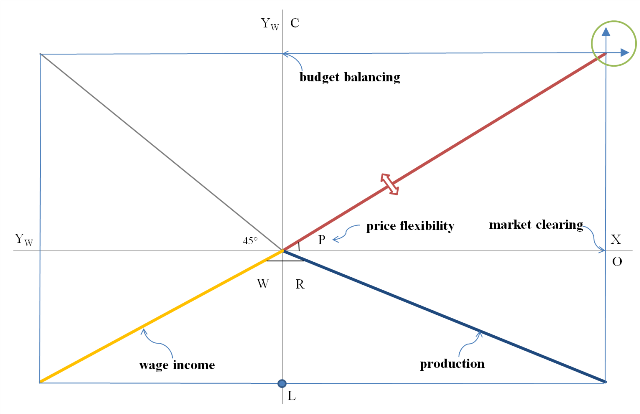
The elementary production-consumption economy is defined with this set of macroeconomic axioms: (A0) The objectively given and most elementary configuration of the economy consists of the household sector and the business sector, which in turn consists initially of one giant fully integrated firm. (A1) Yw=WL wage income Yw is equal to wage rate W times working hours. L, (A2) O=RL output O is equal to productivity R times working hours L, (A3) C=PX consumption expenditure C is equal to price P times quantity bought/sold X.

Under the conditions of market-clearing X=O and budget-balancing C=Yw in each period, the price is given by P=W/R (1), i.e., the market-clearing price is equal to unit wage costs. This is the most elementary form of the macroeconomic Law of Supply and Demand. For the graphical representation, see AXEC31a. #4

The price is determined by the wage rate, which takes the role of the nominal numéraire, and productivity. The quantity of money is NOT among the price determinants. This puts the commonplace quantity theory to rest.

The real value of money is ultimately given by productivity. From (1) follows W/P=R, i.e., real wage = productivity. The value of money has nothing at all to do with the taxing power of the state.

Transaction money is zero at the beginning and the end of the period under consideration, see Graphic AXEC98. #5 All transactions are handled by the central bank, which continuously creates and destroys fiat money (= deposits and overdrafts) on its balance sheet. There is NO such thing as a fixed quantity of money. The central bank plays an ACCOMMODATIVE role and simply supports the AUTONOMOUS market transactions between the household and the business sector. The economy never runs out of money. Money comes into the economy on the supply side.

Monetary profit for the economy as a whole is defined as Qm≡C−Yw, and monetary saving as Sm≡Yw−C. It always holds Qm≡−Sm, in other words, the business sector’s surplus = profit (deficit = loss) equals the household sector’s deficit = dissaving (surplus = saving). This is the most elementary form of the macroeconomic Profit Law.

The problem with MMT is that it is bad theory #6 and bad policy #7, more specifically: MMT is a plain political fraud. #8

The Profit Law for the 3-sector case (household, business, state sector) reads Qm≡(G−T)−Sm, which says that the business sector's profit/loss is given by the state sector's budget deficit/surplus and the household sector's dissaving/saving. For Sm=0, this boils down to (G−T)=Qm, i.e., public deficit equals private profit. The profit of the monetary economy is, in this analytical limiting case, produced entirely by the state sector. In other words, deficit-spending/money-creation is a free lunch for the Oligarchy. Financial wealth grows in lockstep with public debt.

MMT is not a scientifically valid monetary theory but brain-dead propaganda for the benefit of Wall Street. The question is whether David Glasner does not understand how the monetary economy works or whether he is complicit in the fraud.

Egmont Kakarot-Handtke


#1 The creation and value of money and near-monies
#2 The objective value of money
#3 Sovereign Economics, Sec. 1.3, 4.6
#4 Graphic AXEC31a  Elementary production-consumption economy
#5 Graphic AXEC98 Idealized transaction pattern, household sector, balanced budget
#6 Wikipedia, economics, scientific knowledge, or political agenda pushing?
#7 MMT, money printing, stealth taxation, and redistribution
#8 Deficit-spending/money-creation is ALWAYS a bad deal for WeThePeople

Related 'MMT, money, value, and transcendental Capitalism' and 'The value of money and the worthlessness of economics' and 'The Dark-Matter Theory of Fiat Money {78a}'.

***
REPLY to Matt Franko on Jul 3

I said, “The quantity of money is NOT among the price determinants. This puts the commonplace quantity theory to rest.”

You say “LOL! not for the Monetarists it’s not... Just had Bill Dudley in Bloomberg op-ed saying “banks will lend out the Reserves!” last week... QT is certainly not put to rest... it’s being used right now by policy people.”

Right, but this proves only what everybody knows by now, i.e., that policy people are IQ-wise well below room temperature. The fact that there are still flat-earthers around does not prove anything against heliocentrism. Get it, the quantity theory and monetarism are scientifically dead.

What Bill Dudley or Bloomberg or any other clown in the political Circus Maximus says is just irrelevant.

If you still take these folks seriously, better loosen the straps on your facemask. Your last brain cell is dying for lack of oxygen.

***
REPLY to Matt Franko on Jul 5

You say “I submit that there are max 1,000 of us on planet earth that understand this.,. Out of 7.5 billion people.”

You are in the wrong reference frame. In science, the opinions and votes and clicks and likes of 7.5 billion people count exactly for zero.

MMT is provably false; that is what counts in science.

***

REPLY to LAL, Frank Restly, Henry Rech, ralph47 on Jul 5

You constantly argue: MMTers say this and MMTers say that. It is a matter of indifference to what MMTers say because MMT is provably false. MMTers are too stupid for the elementary algebra that underlies macroeconomics. For proof, see the section 'Scientific blunder from Keynes to MMT' in #1

So, there is no need at all to listen to what MMTers say, except for the political fact that MMTers betray the general populace.

Because of the macroeconomic Profit Law, it holds that Public Deficit = Private Profit. Therefore, public deficit spending is a free lunch for the ten percenters and amounts in real terms to stealth taxation of the ninety percenters.

This, though, is only the beginning. The business sector distributes profit to the ten-percenters. The ten percenters, in turn, buy the bonds that are issued in order to consolidate the short-term liabilities of the government sector.

Then, the ninety percenters are taxed in order to pay the interest on government bonds that are in the possession of the ten percenters. This goes as long as the public debt is rolled over. This is fine for the ten-percenters as long as the central bank keeps the interest rate above zero.

All in all, public deficit spending/money creation amounts to a fourfold fraud for the benefit of the ten percenters and the detriment of the ninety percenters.

MMT is the biggest redistribution program in the history of humankind. Private financial wealth is roughly equal to public debt. MMTers are currently the worst disgrace of academic economics, which has run for 200+ years now on a very high level of scientific incompetence, stupidity, and corruption.

Your comments are beside the point and absolutely irrelevant.


#1 Profit
***

REPLY to Frank Restly, Henry Rech on Jul 8

You still do not get the crucial point of monetary policy. Roughly speaking, when fiat money is brought into the economy in order to pay a growing wage bill, it is a good thing; when fiat money is brought into the economy for deficit spending, it is a criminal thing because it amounts to counterfeiting. This puts the MMT talking points into a new perspective.
  • The counterfeiter never runs out of money.
  • The counterfeiter never stops stealing stuff from the rest of society.
  • The counterfeiter increases the profit of the business sector with his additional demand.
  • The counterfeiter says that he is good for the economy and employment.
  • When the economy breaks down, the counterfeiter increases deficit spending/ money creation.
  • The counterfeiter 'solves' any problem from unemployment to pandemics to global warming with deficit spending/money creation.
  • The counterfeiter continuously increases the public debt but says that it does not matter.
  • The counterfeiter is a criminal, but never gets caught because he games the fiat money system from within.
  • The counterfeiter gets valuable PR support from academia, in particular from the MMT fake science trolls.
With your ignorance and scientific incompetence, you are practically — intentionally or unintentionally does not matter — part of a gigantic political fraud.

***
REPLY to Frank Restly on Jul 9

You are in the wrong reference frame. Economics is about how the monetary economy works and NOT what the Constitution says. Economics is, according to its explicit self-definition #1, a science, and the Constitution is politics. It is the foundational principle of science that both spheres must be kept apart. It is a well-known fact that politics corrupts everything it touches. It is the story of Midas, but instead of turning everything into gold, politics turns everything into shit. So, the principle of the strict separation of science and politics is constitutional for science.

The macroeconomic profit law implies Public Deficit = Private Profit. So, the MMT policy of deficit spending/money creation is clearly a free lunch for the one-percenters. #2 MMT claims that MMT policy benefits the ninety-nine percenters, while the exact opposite is true. So MMT is a political fraud. It is academics like Stephanie Kelton who promote the greatest redistribution of income and financial wealth in history. #3 The current distribution is, in the main, the result of the growth of public debt over the last 200+ years. Make no mistake, it is WeThePeople who owes the debt. And it is the one-percenters who own the financial assets.

By blowing smoke about the Constitution, you are covering the political fraud of MMT. This may be okay according to the Constitution, but it is not okay according to the principles of science.

The scientific fact of the matter is that MMT goes down the scientific toilet and you with it.


#1 “Bank of Sweden Prize in Economic Sciences in Memory of Alfred Nobel”.
#2 Keynes, Lerner, MMT, Trump, etc. and exploding profit
#3 MMT: For the record

***
REPLY on Jul 10

What Is MMT? (Short Version)

MMT is the issuance of counterfeit currency in the form of deficit spending/money creation for the benefit of the one-percenters.

Genuine currency and counterfeit currency are indistinguishable because they originate from the same source: the FED. It all depends on whether additional fiat money is injected on the supply or the demand side.

MMTers are not scientists but political agenda pushers. MMT policy is to the disadvantage of the ninety-nine percenters. The counterfeiter steals from the rest of society via the anonymous price mechanism.

It is the ninety-nine percenters who owe the public debt. And it is the one-percenters who own the corresponding financial assets. Interest on public debt works like a regressive tax as long as the debt is rolled over.

Because #PublicDeficitIsPrivateProfit, MMT is the biggest redistribution program ever.

MMT is a political fraud.

***
CROSS-POSTING on Jul 12

MMT – a Wall Street myth
Comment on Chris Dillow on ‘The Deficit Myth: A Review’

Chris Dillow’s main point of critique is “For me, Kelton is – albeit very lucidly – reinventing the wheel.”

This is, in fact, a compliment because MMT is proto-scientific garbage and Kelton is academic fraud. #1

MMT’s macroeconomics is provably false since Keynes, Kalecki, Lerner, etc. So, MMT policy guidance has no sound scientific foundations.

The macroeconomic Profit Law implies Public Deficit = Private Profit. This means that the greater part of the profit in the United States is actually produced by the state. The US economy has been hanging for a long time already on the state ventilator for its survival.

Among all that academic crap, MMT has the right message for Wall Street. Who is MMT’s first apostle? Right, Warren Mossler, ex-Wall Street. But Stephanie Kelton is, without a doubt, the more attractive salesperson. Economics has become part of the entertainment industry long ago, and the casting is done in Hollywood, where they know best what sells.

The rest is marketing/PR routine. Interviews, book, media hype, No. 1 on the best-seller list, and then, of course, trolling on social media. This is where Chris Dillow comes in: “Dr Kelton explain these ideas wonderfully clearly, so I recommend this book to all non-economists interested in government finances.”

MMT is itself a myth. MMT policy is NOT for the benefit of WeThePeople. MMT is the issuance of counterfeit currency in the form of deficit spending/money creation for the benefit of the one-percenters. Because PublicDeficit = PrivateProfit, MMT is the biggest redistribution program ever. MMT is a political fraud.

“Chris Dillow is a Marxian economist,” says Tom Hickey at Mike Norman Economics. There are historians who claim that Marx was already on the payroll of the financial Oligarchy.


#1 More details

***

REPLY to David Glasner, Frank Restly, Henry Rech on Jul 15

It is pretty obvious that you have NO idea of how the monetary economy works. Because of this, you cannot properly assess MMT.

The underlying problem is that the monetary economy (capitalism or communism does not matter) is NOT a self-optimizing equilibrium system but eventually breaks down. #1

The Profit Law No 3 Qm≡I−Sm tells one that macroeconomic profit is positive in a growing economy as long as the business sector’s investment is greater than the household sector’s saving. If this fails, macroeconomic profit turns into a loss, and the economy breaks down. This must eventually happen; what is unknown is the exact date. #2

However, there is a way to postpone the breakdown. The Profit Law, including the state sector, reads Qm≡(I−Sm)+(G−T), that is, the second component of macroeconomic profit is the state sector’s deficit. It holds Public Deficit = Private Profit. #3

The MMT policy of deficit spending/money creation is ultimately a means of postponing the breakdown of the US economy. From a political standpoint, the COVID pandemic provides a good rationale to mute the budget balancers and to blow the deficit up to hitherto unknown proportions.

The volume of the deficit and the popularity of MMT #4 are good metrics for the acceleration of the breakdown.

If you intend to learn economics, I recommend the new textbook Sovereign Economics. #5


#1 Major Defects of the Market Economy
#2 Mathematical Proof of the Breakdown of Capitalism
#3 Graphic AXEC143d
#4 Keynes, Lerner, MMT, Trump and exploding profit
#5 Amazon or BoD

***
#PointOfProof
before Jul 16
after Jul 16

***


October 5, 2019

Keynes ― the poster boy for the weakness of the economist’s mind

Comment on David Glasner on ‘Jack Schwartz on the Weaknesses of the Mathematical Mind’

Blog-Reference

David Glasner quotes Jack Schwartz approvingly: “In a psychological description of the computer intelligence, three related adjectives push themselves forward: single-mindedness, literal-mindedness, simple-mindedness. Recognizing this, we should at the same time recognize that this single-mindedness, literal-mindedness, simple-mindedness also characterizes theoretical mathematics, though to a lesser extent.”

This worn-off cliche of the small-minded mathematician is contrasted with the flamboyant artistic scientist: “Part of what goes into the making of a good scientist is a kind of artistic feeling for how to adjust or interpret a mathematical model to take into account what the bare mathematics cannot describe in a manageable way.”

This echoes Keynes’ hallucinatory self-description of the master economist: “The paradox finds its explanation, perhaps, in that the master-economist must possess a rare combination of gifts. He must be mathematician, historian, statesman, philosopher ― in some degree. He must understand symbols and speak in words. He must contemplate the particular in terms of the general and touch abstract and concrete in the same flight of thought. He must study the present in the light of the past for the purposes of the future. No part of man’s nature or his institutions must lie entirely outside his regard. He must be purposeful and disinterested in a simultaneous mood; as aloof and incorruptible as an artist, yet sometimes as near to earth as a politician.”

Never has scientific incompetence advertised itself better. The fact is that Keynes was too stupid for the elementary algebra that underlies macroeconomics. #1

Keynes ― the trained mathematician ― stated in his General Theory: “Income = value of output = consumption + investment. Saving = income − consumption. Therefore saving = investment.” (p. 63) This is provably false. The mathematically correct relationship reads Q≡I−S with Q as macroeconomic profit. #2, #3

Let this sink in, the master-economist Keynes had NO idea of profit: “His Collected Writings show that he wrestled to solve the Profit Puzzle up till the semi-final versions of his GT but in the end he gave up and discarded the draft chapter dealing with it.” (Tómasson et al.) Now it holds: when the foundational concepts are false, the whole analytical superstructure is false. In other words, Keynes’ General Theory is scientifically worthless. #4

That is bad enough, but it gets worse: After-Keynesians did NOT spot Keynes’ blunder to this day. For example, Paul Krugman still applies IS-LM. So, not only Keynes but Post- and Anti-Keynesians alike have been too stupid for the elementary algebra that underlies macroeconomics.

Economics (Walrasian, Keynesian, Marxian, Austrian) is mathematically flawed. As Georgescu-Roegen put it: “It is difficult to contemplate the evolution of the economic science over the last hundred years without reaching the conclusion that its mathematization was a rather hurried job.” This means that economic policy guidance NEVER had valid scientific foundations. Note that the fault lies NOT with mathematics but with economists. Their proven mathematical/scientific incompetence notwithstanding, the pathetic master economists award themselves the “Bank of Sweden Prize in Economic Sciences in Memory of Alfred Nobel”. #5

Egmont Kakarot-Handtke


#1 Economics, math, pluralism, and corruption
#2 How Keynes got macro wrong and Allais got it right
#3 Graphic AXEC143: Macroeconomic Profit Law with increasing complexity of the economy
#4 For details of the big picture, see cross-references Keynesianism
#5 Economics: The greatest scientific fraud in modern times

Related 'What it takes to become a great economist' and 'Who or what exactly did Keynes save?' and 'The unfinished Keynes (III)' and 'Keynes, the methodologist' and 'Hooray! The formalization issue is finally settled' and 'Marshall and the Cambridge School of plain economic gibberish' and 'Links on ‘Keynes: socialist, liberal, or conservative?’' and 'Forget Keynes' and 'Why Post Keynesianism Is Not Yet a Science' and 'Keynesianism is broken: Get over it!' and 'From Keynes’ fatal blunder to the true economic model' and 'Economics as storytelling and entertainment for the masses' and 'The economist as storyteller' and 'The real problem with the economics Nobel' and 'The canonical macroeconomic model' and 'Your economics is refuted on all counts: here is the real thing'.


***

Twitter/FRED The correlation of profit and investment

September 21, 2019

What’s wrong with DSGE models is the axiom set

Comment on David Glasner on ‘What’s Wrong with DSGE Models Is Not Representative Agency’

Blog-Reference

“When the premises are certain, true, and primary, and the conclusion formally follows from them, this is demonstration, and produces scientific knowledge of a thing.” (Aristotle)

Standard microeconomics is based on these hardcore propositions, i.e., verbalized axioms: “HC1 economic agents have preferences over outcomes; HC2 agents individually optimize subject to constraints; HC3 agent choice is manifest in interrelated markets; HC4 agents have full relevant knowledge; HC5 observable outcomes are coordinated, and must be discussed with reference to equilibrium states.” (Weintraub)

Because this set of hardcore propositions is shock-full of NONENTITIES, all models that are based upon it are proto-scientific garbage. The whole of Marginalism derives ultimately from the core behavioral assumption HC2, i.e., constrained optimization, which is a NONENTITY like the Tooth Fairy or the Easter Bunny. From the Walrasian axioms, the triad SS-function―DD-function―equilibrium is derived. All ends up eventually in General Equilibrium Theory.

Because the behavioral axioms are false, the whole of mainstream economics is false. This includes DSGE because it is just a variant of HC1 to HC5. The common denominator is that the axioms are behavioral. For deeper methodological reasons, which have been discussed elsewhere, macroeconomics has to be based on objective, behavior/agency-free, systemic axioms.

This is the correct core of premises: (A0) The objectively given and most elementary systemic configuration of the economy consists of the household and the business sector, which in turn consists initially of one giant fully integrated firm. (A1) Yw=WL wage income Yw is equal to wage rate W times working hours. L, (A2) O=RL output O is equal to productivity R times working hours L, (A3) C=PX consumption expenditure C is equal to price P times quantity bought/sold X.

These premises are “certain, true, and primary” and therefore satisfy all methodological requirements. The set is minimalistic; that is, Occam’s Razor has been applied, and the set cannot be reduced further, only expanded. The set contains no NONENTITIES like maximization or equilibrium and no normative assertions. All variables are measurable with the precision of two decimal places. Testability is built into the premises.

The price P follows as the dependent variable under the conditions of budget-balancing, i.e., C=Yw, and market-clearing, i.e., X=O, as P=W/R. This is the most elementary form of the macroeconomic Law of Supply and Demand. Accordingly, the real wage is W/P=R. The graphical representation of the macro-economy is given with AXEC31.

Elementary production-consumption economy

The monetary saving/dissaving of the household sector is defined as S≡Yw−C. The monetary profit/loss of the business sector is defined as Q≡C−Yw. It always holds Q≡−S, in other words, the balances of the business and the household sector always add up to zero. This is the Fundamental Law of Macroeconomic Accounting.

The mirror image of household sector saving S is business sector loss (-Q). The mirror image of household sector dissaving (-S) is business sector profit Q. Q≡−S is the elementary version of the macroeconomic Profit Law.

Given the minimalist core propositions (A0) to (A3), one has to proceed top-down by successive DIFFERENTIATION of sectors and firms until one arrives at the individual agent. The bottom-up approach, also called microfoundations, is methodologically false because it is (i) behavioral, and (ii) runs with necessity into the Fallacy of Composition. (A0) to (A3) fully replaces HC1 to HC5.

Economics is in need of a Paradigm Shift from false Walrasian microfoundations and false Keynesian macrofoundations to “certain, true, and primary” macrofoundations. Or as the Financial Times has it, “Time for a reset.” #1

Egmont Kakarot-Handtke


#1 Links on “Capitalism. Time for a reset.”

Related 'DSGE and profit―forget it! MMT and profit―forget it!' and 'The Ur-Blunder of economics and its rectification' and 'Economics: How to stop mental pollution and global dumbing' and 'The curious non-existence of profit in economics' and 'Where economics went wrong (II)' and 'The GDP-death-blow for the economics profession'. For details of the big picture, see cross-references Axiomatization.

For more on DSGE, see AXECquery

***
Mike Norman Economics Sep 23

Source: Mike Norman Economics

***

AXEC137b  Axioms/Macrofoundations


***

Twitter Feb 12  “The problem lies ... with its core axioms.”

Source: Twitter

***

INET Mar 8, 2021  Servaas Storm, The Standard Economic Paradigm is Based on Bad Modeling

September 5, 2019

The end of Mankiw and his Phillips Curve

Comment on David Glasner on ‘Mankiw’s Phillips-Curve Agonistes’

Blog-Reference and Blog-Reference and Blog-Reference

Gregory Mankiw starts his history of the Phillips Curve with gossiping and name-dropping: “The economist George Akerlof, a Nobel laureate and the husband of the former Federal Reserve chair Janet Yellen, once called the Phillips curve ‘probably the single most important macroeconomic relationship.’ So it is worth recalling what the Phillips curve is, why it plays a central role in mainstream economics and why it has so many critics. The story begins in 1958, when the economist A. W. Phillips published an article reporting an inverse relationship between unemployment and inflation in Britain. He reasoned that when unemployment is high, workers are easy to find, so employers hardly raise wages, if they do so at all. But when unemployment is low, employers have trouble attracting workers, so they raise wages faster. Inflation in wages soon turns into inflation in the prices of goods and services.”

David Glasner immediately spots the fatal mistake of Mankiw’s account: “I must note parenthetically that, as I have written recently, a supply-demand framework (aka partial equilibrium analysis) is not really the appropriate way to think about unemployment, because the equilibrium level of wages and the rates of unemployment must be analyzed, as, using different terminology, Keynes argued, in a general equilibrium, not a partial equilibrium, framework.” Unfortunately, David Glasner then gets lost in supply-demand-equilibrium blather.

The Phillips Curve (better: bastard or NAIRU Phillips Curve) is the centerpiece of standard employment theory. Economists have gotten employment theory wrong for 200+ years. #1-#5

The materially/formally inconsistent NAIRU Phillips Curve has to be replaced by the correct macroeconomic Employment Law, which is shown here. #6


From this equation follows:
(i) An increase in the expenditure ratio ρE leads to higher employment L (the Greek letter ρ stands for ratio). An expenditure ratio ρE greater than 1 indicates a budget deficit = credit expansion, a ratio ρE less than 1 indicates credit contraction.
(ii) Increasing investment expenditures I exert a positive influence on employment.
(iii) An increase in the factor cost ratio ρF≡W/PR leads to higher employment.

The complete Employment Law contains, in addition profit, distribution, the public sector, and foreign trade.

Items (i) and (ii) cover Keynes’ familiar arguments about aggregate demand. The factor cost ratio ρF, as defined in (iii), embodies the macroeconomic price mechanism. The fact of the matter is that overall employment L INCREASES if the AVERAGE wage rate W INCREASES relative to the average price P and productivity R. Roughly speaking, price inflation is bad for employment, and wage inflation is good. This is the exact opposite of what microfounded supply-demand-equilibrium economics teaches.

The testable macrofounded Employment Law tells one that the best policy to stabilize employment on a high level is price inflation of zero and wage inflation equal to productivity increases. The 2 percent inflation target has always been political idiocy based on defective theory.

Egmont Kakarot-Handtke


#1 NAIRU, wage-led growth, and Samuelson’s Dyscalculia
#2 Keynes’ Employment Function and the Gratuitous Phillips Curve Disaster
#3 NAIRU and the scientific incompetence of Orthodoxy and Heterodoxy
#4 Full employment, the Phillips Curve, and the end of Gaganomics
#5 For more details of the big picture, see cross-references Employment/Phillips Curve
#6 Graphic AXEC62 Employment Law

***
REPLY to David Glasner on Sep 9 and Blog-Reference on Sep 10

You say “… a supply-demand framework (aka partial equilibrium analysis) is not really the appropriate way to think about unemployment, because the equilibrium level of wages and the rates of unemployment must be analyzed, as, using different terminology, Keynes argued, in a general equilibrium, not a partial equilibrium, framework.”

In methodological terms, this means that economics has to perform a Paradigm Shift. However, a move from partial to total equilibrium analysis is NOT the right thing to do. Economic analysis has to advance from microfoundations to macrofoundations. This is what Keynes attempted 80 years ago. He failed, and the exact point of failure is in the GT on p. 63: “Income = value of output = consumption + investment. Saving = income − consumption. Therefore saving = investment.” Keynes moved to false macrofoundations, but economists have not realized it to this day.

In order to go back to basics, the elementary production-consumption economy is, for a star,t defined by three macroeconomic axioms (Yw=WL, O=RL, C=PX), two conditions (X=O, C=Yw), and two definitions (profit/loss Q≡C−Yw, saving/dissaving S≡Yw−C).

Money is needed by the business sector to pay the workers who receive the wage income Yw per period. The workers spend C per period. Given the two conditions, the market-clearing price is derived as P=W/R (1) for any level of employment L. So, the macroeconomic price P is, under the condition of market-clearing X=O, determined by the wage rate W, which has to be fixed as a numéraire, and the productivity R. This is the most elementary case of the macroeconomic Law of Supply and Demand.

The average stock of transaction money follows for a start as M=κYw, with κ determined by the payment pattern. In other words, the average quantity of money M is determined by the AUTONOMOUS transactions of the household and business sector and created out of nothing by the Central Bank. This, to begin with, refutes the commonplace Quantity Theory because M is NOT among the determinants of P in (1).

In the general case, consumption expenditures C are not equal to wage income Yw. Accordingly, the market-clearing price is now given by P=ρEW/R (2), with ρE≡C/Yw.#1 An expenditure ratio ρE greater than 1 indicates credit expansion = dissaving, a ratio ρE less than 1 indicates the opposite. The ratio ρE establishes the link between the product market and the money/capital market.

Now we have deficit-spending, i.e., ρE greater than 1, which yields a one-off price hike. If deficit-spending is repeated period after period, the price remains at the elevated level, and there is NO inflation. No matter how long the household sector’s debt increases, there is NO further price increase. The same holds for the government sector. A constant government deficit does NOT cause inflation. Because macroeconomic profit is given by Q=(G−T)−S, the financial wealth of the Oligarchy grows in lockstep with the public debt, if S is set to 0 for a moment. So, the negative effect of private/public deficit spending is NOT on inflation but on distribution.

The macroeconomic Law of Supply and Demand makes it clear that inflation only occurs if the wage rate W increases in successive periods faster than productivity R. As a matter of principle, this can happen at ANY employment level. It is NOT a precondition that employment is close to the capacity limit. This is merely a false interpretation of the original Phillips Curve.

Methodologically, it is NOT the case that economic analysis has to apply general equilibrium instead of partial equilibrium. Microfoundations in any shape or form are a lethal methodological blunder. Economics has to move from false Marshallian/Walrasian microfoundations and false Keynesian macrofoundations to true macrofoundations. Both Keynes and Hawtrey have to be buried for good at the Flat-Earth-Cemetery.


#1 Graphic AXEC101b  Macroeconomic Law of Supply and Demand


March 23, 2019

Economists: “a bevy of camp-following whores”

Comment on David Glasner on ‘James Buchanan Calling the Kettle Black’

Blog-Reference and Blog-Reference on Mar 30

David Glasner cites James Buchanan: “The inverse relationship between quantity demanded and price is the core proposition in economic science, … Just as no physicist would claim that ‘water runs uphill,’ no self-respecting economist would claim that increases in the minimum wage increase employment. Such a claim, if seriously advanced, becomes equivalent to a denial that there is even minimal scientific content in economics, and that, in consequence, economists can do nothing but write as advocates for ideological interests. Fortunately, only a handful of economists are willing to throw over the teachings of two centuries; we have not yet become a bevy of camp-following whores.”

The fact is that economists are since the founding fathers “a bevy of camp-following whores”. It is of utmost importance to distinguish between political and theoretical economics. The main differences are: (i) The goal of political economics is to successfully push an agenda, the goal of theoretical economics is to successfully explain how the actual economy works. (ii) In political economics anything goes; in theoretical economics, the scientific standards of material and formal consistency are observed.

Theoretical economics has to be judged according to the criteria true/false and NOTHING else. The history of political economics from Adam Smith onward can be summarized as an utter scientific failure. Theoretical economics had been hijacked from the very beginning by the agenda pushers of political economics. The different camps of political economics have produced NOTHING of scientific value in the last 200+ years. The major approaches ― Walrasianism, Keynesianism, Marxianism, Austrianism ― are mutually contradictory, axiomatically false, materially/formally inconsistent and all got the pivotal concept of the subject matter ― profit ― wrong.

One of the most consequential failures is employment theory. From microfounded economics follows an inverse relationship between wage rate and employment. However, microfoundations are methodologically unacceptable. From the correct macrofoundations,#1 follows that there is a positive relationship between (average) wage rate and employment.#2, #3, #4, #5, #6

False theory leads to false policy guidance. With their defective microfounded employment theory, economists bear for 150+ years now the political responsibility for the social devastation of mass unemployment.

David Glasner concludes: “Buchanan was implicitly applying an inappropriate paradigm of price adjustment in a single market to the analysis of how wages adjust in the real world. The truth is we don’t have a good understanding of how wages adjust, and so we don’t have a good understanding of the effects of minimum wages. But in arrogantly and insultingly dismissing Krueger’s empirical research on the effects of minimum wage laws, Buchanan was unwittingly exposing not Krueger’s ideological advocacy but his own.”

Not quite right. Buchanan was exposing himself and his academic colleagues as incompetent scientists. Contrary to naive common sense, this is not at all a sorry fate. There are always excellent employment opportunities in the political sphere for failed/fake scientists. Lenin called them useful idiots.#7 False theories have great use-value in the political Circus Maximus where nobody cares much for scientific validity. Political economics does not work according to the principles of science. Fake scientists like Buchanan are sponsored by billionaires.#8 False theories are NOT eliminated in the peer-review process, just the opposite, they are eventually rewarded with the faux Nobel.

Since Adam Smith/Karl Marx economics claims to be a science. It is NOT. James Buchanan is not an example of an incompetent/corrupt outlier but the proof that economics has never been anything else than brain-dead political agenda-pushing.#9

Egmont Kakarot-Handtke


#1 From false microfoundations to true macrofoundations
#2 More on economists’ sticky brains
#3 Full employment through the price mechanism
#4 Employment theory as an example of proto-scientific soapbubbling
#5 Full employment, the Phillips Curve, and the end of Gaganomics
#6 Go! ― test the Profit and Employment Law
#7 The economist as stand-up comedian
#8 Lynn Parramore, Meet the Economist Behind the One Percent’s Stealth Takeover of America
#9 For details of the big picture see cross-references Political Economics/Stupidity/Corruption

Related 'Equilibrium and the violation of a fundamental principle of science' and 'Ground Control to David Glasner' and 'How economic thinkers think they think about interest' and 'Economics ― from attention and reputation management to science' and 'What’s wrong with Econ 101? Economists, of course!' and 'Equilirium' and 'The prime primer on equilibrium' and 'The Krugman curse' and 'NAIRU and economists’ lethal swampiness' and 'Modern macro moronism' and 'Sticky prices or sticky brains?' and 'Beware of the moralizing economist' and 'What is so great about cargo cult science? or, How economists learned to stop worrying about failure' and 'Econogenics in action' and 'Your economics is refuted on all counts: here is the real thing'.

***
Twitter Feb 18, 2021


Twitter Jun 24, 2021 The default presumption is that economists are either directly or indirectly on the payroll of the Oligarchy.


Twitter Jul 1, Serge Benest, The Politics of Funding: The Rockefeller Foundation and French Economics, 1945-1955


Twitter 4 Jul Dark money


Jacobin 6 Jul, Doug Henwood, Take Me to Your Leader: The Rot of the American Ruling Class


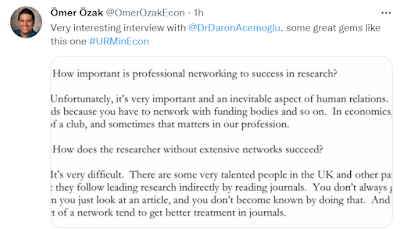
Twitter Jan 19, 2022  One can also call it networking


Twitter Mar 28, 2020 Austrian Economists, the Rockefeller Foundation, and International Economics


Twitter/X Jan 24, 2024 One nitty-gritty example about funding in economics


Twitter/X Feb 13, 2026 Funding in the Humanities


Twitter/X Apr 1, 2026

October 29, 2018

More on economists’ sticky brains

Comment on David Glasner on ‘More on Sticky Wages’

Blog-Reference and Blog-Reference on Oct 31

Economics is one of the most embarrassing failures in the history of modern science. The biggest blunders are profit theory and employment theory. Keynes saw the defects of employment theory but could not rectify them. #1 Eventually, the analysis got stuck in inconclusive blather about sticky wages. #2, #3, #4

David Glasner clearly recognizes that standard economics is one big Fallacy of Composition: “Keynes’s criticism here is entirely correct. But I would restate slightly differently. Standard microeconomic reasoning about preferences, demand, cost, and supply is partial-equilibrium analysis.” And: “… Keynes was certainly correct to reject the naïve transfer of partial equilibrium theorizing … to macroeconomic theorizing about economy-wide disturbances in which the assumptions underlying the comparative-statics analysis used in microeconomics are clearly not satisfied.”

Obviously, a Paradigm Shift is needed: “The search for that different kind of theorizing is the challenge that has always faced macroeconomics. Despite heroic attempts to avoid facing that challenge and pretend that macroeconomics can be built as if it were microeconomics, the search for a different kind of theorizing will continue; it must continue.”

David Glasner is too late. What escaped his attention is that the paradigm shift from false microfoundations to true macrofoundations is a done deal. #5

From the axiomatically correct macrofoundations, #6 follows the elementary version of the objective-systemic Employment Law as shown under the Label Graphic. #7


From this equation follows inter alia
(i) An increase in the expenditure ratio ρE leads to higher employment L (the Greek letter ρ stands for ratio). An expenditure ratio ρE greater than 1 indicates a budget deficit = credit expansion, a ratio ρE less than 1 indicates credit contraction.
(ii) Increasing investment expenditures I exert a positive influence on employment.
(iii) An increase in the factor cost ratio ρF≡W/PR leads to higher employment.

The complete Employment Law contains, in addition, profit distribution, the public sector, and foreign trade.

Items (i) and (ii) cover Keynes’ familiar arguments about aggregate demand. The factor cost ratio ρF, as defined in (iii), embodies the macroeconomic price mechanism. The fact of the matter is that overall employment INCREASES if the AVERAGE wage rate W INCREASES relative to average price P and productivity R. This is the OPPOSITE of what microfounded economics teaches.

The macroeconomic price mechanism, which is formally embodied in ρF, tells everyone that downward stickiness of wages has NEVER been the problem, but upward stickiness.

False theory leads to false policy guidance. With their defective microfounded employment theory, economists bear for 150+ years the political responsibility for the social devastation of mass unemployment.#8

Egmont Kakarot-Handtke


#1 Keynes saw the problems but did not solve them
#2 Employment theory as an example of proto-scientific soapbubbling
#3 Full employment, the Phillips Curve, and the end of Gaganomics
#4 Go! ― test the Profit and Employment Law
#5 From false microfoundations to true macrofoundations
#6 The macrofoundations approach starts with three axioms: (A0) The objectively given and most elementary configuration of the economy consists of the household and the business sector which in turn consists initially of one giant fully integrated firm. (A1) Yw=WL wage income Yw is equal to wage rate W times working hours. L, (A2) O=RL output O is equal to productivity R times working hours L, (A3) C=PX consumption expenditure C is equal to price P times quantity bought/sold X. For a start, it holds X=O.
#7 Graphic, AXEC62 Employment Law
#8 For details of the big picture, see cross-references Employment

***
AXEC113o