#Economics#FailedFakeScience#Walrasianism, #Keynesianism, #Marxianism, #Austrianism are axiomatically false & materially/formally inconsistent & ALL got #Profit wrong. About time to stop thinking like an #Economist & start thinking like a #Scientist. pic.twitter.com/Tl5fOQeHBr
— E.K-H (@AXECorg) April 21, 2023
Showing posts sorted by relevance for query title:thinking. Sort by date Show all posts
Showing posts sorted by relevance for query title:thinking. Sort by date Show all posts
April 21, 2023
Occasional Tweets: Stop thinking like an economist, start thinking like a scientist

January 28, 2013
Confused confusers: how to stop thinking like an economist and start thinking like a scientist {37}
Working paper at SSRN
Working paper at ARCHIVE
Abstract The present paper takes it as an indisputable fact that subjective-behavioral thinking leads, for deeper methodological reasons, to inconclusive filibustering about the agents' economic conduct and therefore has to be replaced by something fundamentally different. The key argument runs as follows: (a) the subjective-behavioral approach cannot, as a matter of principle, afford a correct profit theory, (b) without a correct profit theory it is impossible to comprehend how the monetary economy works, (c) without this knowledge economic policy proposals are unjustifiable, (d) thinking like an economist may be hazardous to the economy.
Abstract The present paper takes it as an indisputable fact that subjective-behavioral thinking leads, for deeper methodological reasons, to inconclusive filibustering about the agents' economic conduct and therefore has to be replaced by something fundamentally different. The key argument runs as follows: (a) the subjective-behavioral approach cannot, as a matter of principle, afford a correct profit theory, (b) without a correct profit theory it is impossible to comprehend how the monetary economy works, (c) without this knowledge economic policy proposals are unjustifiable, (d) thinking like an economist may be hazardous to the economy.
April 25, 2023
Occasional Tweets: Stop thinking like an agenda pusher, start thinking like a scientist
#Economics#FailedFakeScience
— E.K-H (@AXECorg) April 25, 2023
The history of economic thought is the history of scientific failure. Therefore, #Economists should stop thinking like a #Capitalist/#Socialist and start thinking like a #Scientist.
October 13, 2015
New thinking, new teaching
Comment on Maria Alejandra Madi on ‘Real world economists and the economics curriculum’
Blog-Reference
Keynes' great merit was to speak out clearly that something was deeply wrong with economics. In this, he was far ahead of his fellow economists. However, he did not succeed in developing a satisfactory alternative. “But Keynes, too, sometimes gave the impression of not having fully grasped the logic of his own system.” (Laidler, 1999, p. 281)
The deeper reason is that Keynes — just like his predecessors and fellows — did not come to grips with profit (2014). What is worse, neither did the Post Keynesians (2011) nor Heterodoxy (including Minsky) until this very day.#1
Because neither Keynes nor his followers nor his opponents understood that deficit spending has a one-to-one positive side-effect on the overall profit of the business sector Keynesian policy is ultimately responsible for the extreme distortion of income and wealth distribution that we see today.#2
Because they lack the correct economic theory, economists in effect produce the problems they are supposed to solve.
The most important tasks of Heterodoxy are (i) to develop the materially and formally consistent economic theory, (ii) to develop the appropriate curriculum,#3 (iii) to fully replace Orthodoxy in academic and non-academic teaching.
At the moment, scientifically incompetent orthodox and heterodox economists are probably the greatest menace to their fellow men.
Egmont Kakarot-Handtke
References
Kakarot-Handtke, E. (2011). Why Post Keynesianism is Not Yet a Science. SSRN Working Paper Series, 1966438: 1–20. URL
Kakarot-Handtke, E. (2014). The Three Fatal Mistakes of Yesterday Economics: Profit, I=S, Employment. SSRN Working Paper Series, 2489792: 1–13. URL
Laidler, D. (1999). Fabricating the Keynesian Revolution. Cambridge: Cambridge University Press.
#1 Heterodoxy, too, is proto-scientific garbage
#2 Keynesianism as ultimate profit machine
#3 For a start see cross-references New Curriculum

Blog-Reference
Keynes' great merit was to speak out clearly that something was deeply wrong with economics. In this, he was far ahead of his fellow economists. However, he did not succeed in developing a satisfactory alternative. “But Keynes, too, sometimes gave the impression of not having fully grasped the logic of his own system.” (Laidler, 1999, p. 281)
The deeper reason is that Keynes — just like his predecessors and fellows — did not come to grips with profit (2014). What is worse, neither did the Post Keynesians (2011) nor Heterodoxy (including Minsky) until this very day.#1
Because neither Keynes nor his followers nor his opponents understood that deficit spending has a one-to-one positive side-effect on the overall profit of the business sector Keynesian policy is ultimately responsible for the extreme distortion of income and wealth distribution that we see today.#2
Because they lack the correct economic theory, economists in effect produce the problems they are supposed to solve.
The most important tasks of Heterodoxy are (i) to develop the materially and formally consistent economic theory, (ii) to develop the appropriate curriculum,#3 (iii) to fully replace Orthodoxy in academic and non-academic teaching.
At the moment, scientifically incompetent orthodox and heterodox economists are probably the greatest menace to their fellow men.
Egmont Kakarot-Handtke
References
Kakarot-Handtke, E. (2011). Why Post Keynesianism is Not Yet a Science. SSRN Working Paper Series, 1966438: 1–20. URL
Kakarot-Handtke, E. (2014). The Three Fatal Mistakes of Yesterday Economics: Profit, I=S, Employment. SSRN Working Paper Series, 2489792: 1–13. URL
Laidler, D. (1999). Fabricating the Keynesian Revolution. Cambridge: Cambridge University Press.
#1 Heterodoxy, too, is proto-scientific garbage
#2 Keynesianism as ultimate profit machine
#3 For a start see cross-references New Curriculum
***
AXEC117

September 18, 2017
New Economic Thinking = old scientific garbage
Comment on David Orrell on ‘Economyths: The Five Stages of Economic Grief’
Blog-Reference and Blog-Reference
Myth, well told, is still the most convincing way to explain how the world and humankind came to be in their present form. To recall, Zeus was the god of sky and thunder. He oversaw the universe, assigned the various gods their roles, and was known for his erotic escapades. Zeus was emotional, spontaneous and had a lot of trouble with other gods, goddesses, and humans. To handle his problems, Zeus regularly fell back to chicanery, force, and violence.#1 Since antiquity, everybody “understands” Zeus and his actions.
Not much has changed since the ancient Greeks. Ninety-nine percent of human communication still consists of myth, storytelling, and psychologism. Storytelling and psychologism are scientifically worthless. The “explanation” consists of connecting phenomenological dots by simply imputing a plausible emotional motive (anger, greed, fear, jealousy, hubris, revenge, etcetera) to an assumed actor with extraordinary capabilities.
The characteristic of science is the rejection of storytelling and the insistence on material and formal consistency: “Research is, in fact, a continuous discussion of the consistency of theories: formal consistency insofar as the discussion relates to the logical cohesion of what is asserted in joint theories; material consistency insofar as the agreement of observations with theories is concerned.” (Klant)
The goal of science is the true theory. The true theory is the humanly best mental representation of reality. Economics is a failed science. The major approaches ― Walrasianism, Keynesianism, Marxianism, Austrianism ― are mutually contradictory, axiomatically false, materially/formally inconsistent and all got the foundational economic concepts profit and income wrong. Neither orthodox nor heterodox economists can explain how the economy works and why crises happen.
The methodologically proper measure to overcome scientific failure is a paradigm shift. This, though, is NOT what David Orrell proposes. Instead, he reinterprets the manifest scientific mess as a psychological problem and advocates therapy: “I’m sure there are plenty of sociologists and psychologists (even grief counsellors probably) who can help.”
Needless to emphasize that David Orrell’s story of sickness and healing appeals very much to the ninety-nine percenters who can only understand what is presented in the accustomed sitcom format. Psychologism is the mode of explanation of morons for other morons. Psychology, to recall, is a so-called social science and the so-called social sciences have been debunked by Richard Feynman as cargo cult science.
Economics is a systems science and the functioning of the economic system has to be explained without recourse to psychological concepts like utility or greed.#2
Economics is a failure ― NOT a psychological or communicative failure but a scientific failure ― and the ultimate cause is not some mysterious psychological disorder but plain scientific incompetence. Both orthodox and heterodox economics has never been more than storytelling. There is neither material or formal consistency. The representative economist can until this very day not tell what profit is.#3 This is like medieval physics before the concept of energy was properly understood.
Economists have no mysterious psychological disorder, they are fake scientists.#4 This scourge cannot be overcome with therapy but only with the immediate expulsion of economists from the sciences.
Egmont Kakarot-Handtke
#1 Wikipedia, Zeus
#2 First Lecture in New Economic Thinking
#3 Why economists don’t know what profit is
#4 CORE: more lipstick on the dead economics pig
Related 'Why is economics such a scientific embarrassment?' and 'Economics: the emancipation of science from politics' and 'What makes economics a failed science?' and 'Hunting down the economics body snatchers' and 'In search of new economists' and 'The myth of economics knowledge' and 'How the representative economist gets it wrong big-time' and 'New Economic Thinking: the 10 crucial points'. For details of the bigger picture see cross-references Paradigm Shift.

Blog-Reference and Blog-Reference
Myth, well told, is still the most convincing way to explain how the world and humankind came to be in their present form. To recall, Zeus was the god of sky and thunder. He oversaw the universe, assigned the various gods their roles, and was known for his erotic escapades. Zeus was emotional, spontaneous and had a lot of trouble with other gods, goddesses, and humans. To handle his problems, Zeus regularly fell back to chicanery, force, and violence.#1 Since antiquity, everybody “understands” Zeus and his actions.
Not much has changed since the ancient Greeks. Ninety-nine percent of human communication still consists of myth, storytelling, and psychologism. Storytelling and psychologism are scientifically worthless. The “explanation” consists of connecting phenomenological dots by simply imputing a plausible emotional motive (anger, greed, fear, jealousy, hubris, revenge, etcetera) to an assumed actor with extraordinary capabilities.
The characteristic of science is the rejection of storytelling and the insistence on material and formal consistency: “Research is, in fact, a continuous discussion of the consistency of theories: formal consistency insofar as the discussion relates to the logical cohesion of what is asserted in joint theories; material consistency insofar as the agreement of observations with theories is concerned.” (Klant)
The goal of science is the true theory. The true theory is the humanly best mental representation of reality. Economics is a failed science. The major approaches ― Walrasianism, Keynesianism, Marxianism, Austrianism ― are mutually contradictory, axiomatically false, materially/formally inconsistent and all got the foundational economic concepts profit and income wrong. Neither orthodox nor heterodox economists can explain how the economy works and why crises happen.
The methodologically proper measure to overcome scientific failure is a paradigm shift. This, though, is NOT what David Orrell proposes. Instead, he reinterprets the manifest scientific mess as a psychological problem and advocates therapy: “I’m sure there are plenty of sociologists and psychologists (even grief counsellors probably) who can help.”
Needless to emphasize that David Orrell’s story of sickness and healing appeals very much to the ninety-nine percenters who can only understand what is presented in the accustomed sitcom format. Psychologism is the mode of explanation of morons for other morons. Psychology, to recall, is a so-called social science and the so-called social sciences have been debunked by Richard Feynman as cargo cult science.
Economics is a systems science and the functioning of the economic system has to be explained without recourse to psychological concepts like utility or greed.#2
Economics is a failure ― NOT a psychological or communicative failure but a scientific failure ― and the ultimate cause is not some mysterious psychological disorder but plain scientific incompetence. Both orthodox and heterodox economics has never been more than storytelling. There is neither material or formal consistency. The representative economist can until this very day not tell what profit is.#3 This is like medieval physics before the concept of energy was properly understood.
Economists have no mysterious psychological disorder, they are fake scientists.#4 This scourge cannot be overcome with therapy but only with the immediate expulsion of economists from the sciences.
Egmont Kakarot-Handtke
#1 Wikipedia, Zeus
#2 First Lecture in New Economic Thinking
#3 Why economists don’t know what profit is
#4 CORE: more lipstick on the dead economics pig
Related 'Why is economics such a scientific embarrassment?' and 'Economics: the emancipation of science from politics' and 'What makes economics a failed science?' and 'Hunting down the economics body snatchers' and 'In search of new economists' and 'The myth of economics knowledge' and 'How the representative economist gets it wrong big-time' and 'New Economic Thinking: the 10 crucial points'. For details of the bigger picture see cross-references Paradigm Shift.
***
FACT: The comment above vanished within minutes from the Evonomics blog.
FICTION: This is how the New Economic Thinkers advertise themselves.

May 27, 2017
What is the fuss with New Economic Thinking all about?
Comment on Barkley Rosser on ‘Fighting Zombies with Zombies’
Blog-Reference
I said: ‘It is obvious from your posts that you never had a proper understanding of what axiomatization, equilibrium, or profit is all about, and in this all-inclusive scientific incompetence you are the very personification of the representative economist.’
You answered: “… I actually read your papers on why Keynesian economics is incomplete, wrong, and so on.”
So, let us see whether you understood what you read.
The whole point of axiomatization is known since J. S. Mill: “What are the propositions which may reasonably be received without proof? That there must be some such propositions all are agreed, since there cannot be an infinite series of proof, a chain suspended from nothing. But to determine what these propositions are is the opus magnum of the more recondite mental philosophy.”
Or, as Aristotle put it: “When the premises are certain, true, and primary, and the conclusion formally follows from them, this is demonstration, and produces scientific knowledge of a thing.”
By consequence, when the premises are false, the whole analytical superstructure is false even if the intermediary logical steps are all correct. This is the case with the four main approaches. From this follows that the Walrasian-Keynesian-Marxian-Austrian premises have to be fully REPLACED. This is what paradigm shift means. Because economics is a failed science, the paradigm shift is the PRIMARY task for ALL economists. This is what the much-touted New Economic Thinking means.
What can actually be observed, though, is that the representative economist messes up new thinking just as he messed up old thinking.
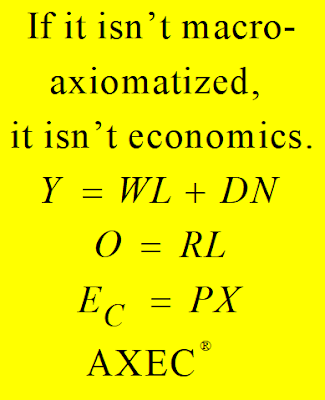
You say the first axiom [total income is wage rate times hours worked (WL) plus dividend times the number of shares (DN)] is false because there is interest, royalties, land rent, etc. Yes, there are many other phenomena in the economy, but this is NOT the point. The point of axiomatization is to consistently formulate the MINIMUM set of premises and then to successively derive all other economic phenomena from the axioms. It holds: “A theory is the more impressive the greater the simplicity of its premises, the more different kinds of things it relates, and the more extended is its area of applicability.” (Einstein)
Schumpeter understood this: “The highest ambition an economist can entertain who believes in the scientific character of economics would be fulfilled as soon as he succeeded in constructing a simple model displaying all the essential features of the economic process by means of a reasonably small number of equations connecting a reasonably small number of variables. Work on this line is laying the foundations of the economics of the future.” In economics, the most elementary systemic configuration is the elementary production-consumption economy. So, ALL of economics has to start here.
The immediately obvious point of the first axiom is that it does NOT state that total income is the sum of wage income and profit but that total income is the sum of wage income and DISTRIBUTED profit.
The crucial point of the first axiom is that it replaces the hitherto false concept of total income with the correct concept. From the first axiom then follows profit as Qm≡DN−Sm. In methodological terms: the Profit Law follows as a theorem; profit is NOT in the axioms.
The idiocy of the representative economist consists of starting with the superficial assumption that profit is just another form of income. #1 This is dead wrong. It is distributed profit that is just another form of income. #2 To treat profit as income is a category mistake.
The significance of the first axiom is that it brings the foundational concepts of income, profit, and distributed profit into the logically correct relationship. This is something the founding fathers should have done 200+ years ago. Their inexcusable sloppiness has not been rectified by their equally incompetent heirs to this day. The first axiom is sufficient to send Walrasianism-Keynesianism-Marxianism-Austrianism directly into the scientific wastebasket.
You say: “somehow he does not notice that output involves inputs besides labor.”
The second axiom replaces the unacceptable concept of a production function. The formal representation of the relationship between output, productivity, and various inputs comes with the DIFFERENTIATION of the second axiom. #3 According to the methodological minimum principle ― also known as Occam’s Razor ― the axioms contain one output and one input. #4
You say: “The problem is that the X or ‘quantity sold’ is completely meaningless. It is an aggregation that makes aggregating capital look like child’s play.”
Given the axioms, which refer explicitly to ONE giant firm, one has to proceed top-down by successive DIFFERENTIATION until one arrives at the individual agent. Differentiation is the inverse of bottom-up or aggregation. It is microfoundations and bottom-up that are the defining idiocy of Walrasianism, which literally PRODUCES the aggregation problem. With macrofoundations, there is NO aggregation problem.
Your statement “X or ‘quantity sold’ is completely meaningless” is the ultimate proof of your illiteracy. The enumeration of the macrofoundational axioms starts with: “(A0) The objectively given and most elementary configuration of the (world-) economy consists of the household and the business sector which in turn consists initially of one giant fully integrated firm.” So X unambiguously refers to ONE firm and ONE product and is NOT an aggregate.
Economics is a failed science because economists are incompetent scientists. Their lethal blunder consists of the Fallacy of Insufficient Abstraction. The old sloppy micro-thinking of the representative economist has, for all to see, finally crashed against the wall at the end of the cul-de-sac. New thinking requires first of all the replacement of the premises of the old thinking. As Hutchison put it: “For it can fairly be insisted that no advance in the elegance and comprehensiveness of the theoretical superstructure can make up for the vague and uncritical formulation of the basic concepts and postulates, and sooner or later ... attention will have to return to the foundations.”
The axiomatic foundations of economics have been false for 200+ years. The representative economist has proved beyond doubt that he is incapable of thinking, so new thinking is forever beyond his means. NOT ONE of Barkley Rosser’s arguments holds water.
New Economic Thinking starts with a new axiom set, or it is just another futile variant of the same old proto-scientific Walrasian-Keynesian-Marxian-Austrian-Rosserian garbage. The methodological rule of New Economic Thinking is: If it isn’t macro-axiomatized, it isn’t economics.
Egmont Kakarot-Handtke
#1 How the Intelligent Non-Economist Can Refute Every Economist Hands Down
#2 For the correct treatment of interest, land rent, and nonmonetary profit, see the papers on SSRN.
#3 See Section 4 of Matter Matters: Productivity, Profit, and Non-Marginal Factor Prices.
#4 For the introduction of capital, see Squaring the Investment Cycle.
Immediately preceding Productivity and the zombie apocalypse.
Related 'New economic thinking, or, let’s put lipstick on the dead pig' and 'The thinking economist' and 'Smart young empirically-minded economists: another vain hope' and 'The stupidity of Heterodoxy is the life insurance of Orthodoxy' and 'Media-fake-farce-fraud-storytelling-macro' and 'Economics between cargo cult, farce, and fraud' and 'Confused Confusers: How to Stop Thinking Like an Economist and Start Thinking Like a Scientist'
Related 'First Lecture in New Economic Thinking'.
Blog-Reference
I said: ‘It is obvious from your posts that you never had a proper understanding of what axiomatization, equilibrium, or profit is all about, and in this all-inclusive scientific incompetence you are the very personification of the representative economist.’
You answered: “… I actually read your papers on why Keynesian economics is incomplete, wrong, and so on.”
So, let us see whether you understood what you read.
The whole point of axiomatization is known since J. S. Mill: “What are the propositions which may reasonably be received without proof? That there must be some such propositions all are agreed, since there cannot be an infinite series of proof, a chain suspended from nothing. But to determine what these propositions are is the opus magnum of the more recondite mental philosophy.”
Or, as Aristotle put it: “When the premises are certain, true, and primary, and the conclusion formally follows from them, this is demonstration, and produces scientific knowledge of a thing.”
By consequence, when the premises are false, the whole analytical superstructure is false even if the intermediary logical steps are all correct. This is the case with the four main approaches. From this follows that the Walrasian-Keynesian-Marxian-Austrian premises have to be fully REPLACED. This is what paradigm shift means. Because economics is a failed science, the paradigm shift is the PRIMARY task for ALL economists. This is what the much-touted New Economic Thinking means.
What can actually be observed, though, is that the representative economist messes up new thinking just as he messed up old thinking.
You say the first axiom [total income is wage rate times hours worked (WL) plus dividend times the number of shares (DN)] is false because there is interest, royalties, land rent, etc. Yes, there are many other phenomena in the economy, but this is NOT the point. The point of axiomatization is to consistently formulate the MINIMUM set of premises and then to successively derive all other economic phenomena from the axioms. It holds: “A theory is the more impressive the greater the simplicity of its premises, the more different kinds of things it relates, and the more extended is its area of applicability.” (Einstein)
Schumpeter understood this: “The highest ambition an economist can entertain who believes in the scientific character of economics would be fulfilled as soon as he succeeded in constructing a simple model displaying all the essential features of the economic process by means of a reasonably small number of equations connecting a reasonably small number of variables. Work on this line is laying the foundations of the economics of the future.” In economics, the most elementary systemic configuration is the elementary production-consumption economy. So, ALL of economics has to start here.
The immediately obvious point of the first axiom is that it does NOT state that total income is the sum of wage income and profit but that total income is the sum of wage income and DISTRIBUTED profit.
The crucial point of the first axiom is that it replaces the hitherto false concept of total income with the correct concept. From the first axiom then follows profit as Qm≡DN−Sm. In methodological terms: the Profit Law follows as a theorem; profit is NOT in the axioms.
The idiocy of the representative economist consists of starting with the superficial assumption that profit is just another form of income. #1 This is dead wrong. It is distributed profit that is just another form of income. #2 To treat profit as income is a category mistake.
The significance of the first axiom is that it brings the foundational concepts of income, profit, and distributed profit into the logically correct relationship. This is something the founding fathers should have done 200+ years ago. Their inexcusable sloppiness has not been rectified by their equally incompetent heirs to this day. The first axiom is sufficient to send Walrasianism-Keynesianism-Marxianism-Austrianism directly into the scientific wastebasket.
You say: “somehow he does not notice that output involves inputs besides labor.”
The second axiom replaces the unacceptable concept of a production function. The formal representation of the relationship between output, productivity, and various inputs comes with the DIFFERENTIATION of the second axiom. #3 According to the methodological minimum principle ― also known as Occam’s Razor ― the axioms contain one output and one input. #4
You say: “The problem is that the X or ‘quantity sold’ is completely meaningless. It is an aggregation that makes aggregating capital look like child’s play.”
Given the axioms, which refer explicitly to ONE giant firm, one has to proceed top-down by successive DIFFERENTIATION until one arrives at the individual agent. Differentiation is the inverse of bottom-up or aggregation. It is microfoundations and bottom-up that are the defining idiocy of Walrasianism, which literally PRODUCES the aggregation problem. With macrofoundations, there is NO aggregation problem.
Your statement “X or ‘quantity sold’ is completely meaningless” is the ultimate proof of your illiteracy. The enumeration of the macrofoundational axioms starts with: “(A0) The objectively given and most elementary configuration of the (world-) economy consists of the household and the business sector which in turn consists initially of one giant fully integrated firm.” So X unambiguously refers to ONE firm and ONE product and is NOT an aggregate.
Economics is a failed science because economists are incompetent scientists. Their lethal blunder consists of the Fallacy of Insufficient Abstraction. The old sloppy micro-thinking of the representative economist has, for all to see, finally crashed against the wall at the end of the cul-de-sac. New thinking requires first of all the replacement of the premises of the old thinking. As Hutchison put it: “For it can fairly be insisted that no advance in the elegance and comprehensiveness of the theoretical superstructure can make up for the vague and uncritical formulation of the basic concepts and postulates, and sooner or later ... attention will have to return to the foundations.”
The axiomatic foundations of economics have been false for 200+ years. The representative economist has proved beyond doubt that he is incapable of thinking, so new thinking is forever beyond his means. NOT ONE of Barkley Rosser’s arguments holds water.
New Economic Thinking starts with a new axiom set, or it is just another futile variant of the same old proto-scientific Walrasian-Keynesian-Marxian-Austrian-Rosserian garbage. The methodological rule of New Economic Thinking is: If it isn’t macro-axiomatized, it isn’t economics.
Egmont Kakarot-Handtke
#1 How the Intelligent Non-Economist Can Refute Every Economist Hands Down
#2 For the correct treatment of interest, land rent, and nonmonetary profit, see the papers on SSRN.
#3 See Section 4 of Matter Matters: Productivity, Profit, and Non-Marginal Factor Prices.
#4 For the introduction of capital, see Squaring the Investment Cycle.
Immediately preceding Productivity and the zombie apocalypse.
Related 'New economic thinking, or, let’s put lipstick on the dead pig' and 'The thinking economist' and 'Smart young empirically-minded economists: another vain hope' and 'The stupidity of Heterodoxy is the life insurance of Orthodoxy' and 'Media-fake-farce-fraud-storytelling-macro' and 'Economics between cargo cult, farce, and fraud' and 'Confused Confusers: How to Stop Thinking Like an Economist and Start Thinking Like a Scientist'
Related 'First Lecture in New Economic Thinking'.
September 13, 2016
Keynesianism: The triumph of blathering over thinking
Comment on Lars Syll on ‘Dark age of macroeconomics’
Blog-Reference
Walrasianism in all shapes and forms (DSGE, RBC, AD/AS, etc.) argues from unacceptable microfoundations, and Keynesianism in all shapes and forms argues from false macrofoundations. To get out of failed economics requires nothing less than a Paradigm Shift to true macrofoundations. For the roadmap, see Graphic AXEC85.
Keynes founded macroeconomics on logically and conceptually defective foundations, and neither Post Keynesians nor New Keynesians nor Anti-Keynesians have realized Keynes’ foundational blunder in 80+ years (2014).
Keynes defined the formal core of the General Theory as follows “Income = value of output = consumption + investment. Saving = income − consumption. Therefore saving = investment.” (1973, p. 63)
This syllogism is defective because Keynes never came to grips with profit “His Collected Writings show that he wrestled to solve the Profit Puzzle up till the semi-final versions of his GT but in the end he gave up and discarded the draft chapter dealing with it.” (Tómasson et al., 2010, p. 12)
Let this sink in, Keynes had NO idea of the fundamental concepts of economics, viz., profit and income. Because profit is ill-defined, the whole theoretical superstructure of macroeconomics is false, in particular, ALL I=S/IS-LM models (2011; 2013).
The axiomatically correct macroeconomic Profit Law reads Qm≡Yd+I−Sm (2014, p. 8, eq. (18)). Legend: Qm monetary profit, Yd distributed profit, Sm monetary saving, I investment expenditures. It is pretty obvious from this equation that investment I and saving Sm are NEVER equal, neither ex-ante nor ex-post, and this has NOTHING to do with the question of how investment is financed. The argument that I=S is merely an accounting identity proves only that economists are too stupid to understand the elementary mathematics of accounting (2012).
The Profit Law gets a bit longer when import/export and government are included.
Bottom line: Saving Sm and investment I develop INDEPENDENTLY. There is NO such thing as an interest mechanism that equalizes investment and saving. It is neither true that saving ‘causes’ investment as the Classicals claimed nor that investment determines saving via the multiplier as Keynes claimed. The perpetual difference between investment I and saving Sm is the main determinant of profit Qm. BOTH the Classicals and Keynes got the profit theory wrong. Nothing is more disqualifying for an economist.
Egmont Kakarot-Handtke
References
Kakarot-Handtke, E. (2011). Squaring the Investment Cycle. SSRN Working Paper Series, 1911796: 1–25. URL
Kakarot-Handtke, E. (2012). The Common Error of Common Sense: An Essential Rectification of the Accounting Approach. SSRN Working Paper Series, 2124415: 1–23. URL
Kakarot-Handtke, E. (2013). Settling the Theory of Saving. SSRN Working Paper Series, 2220651: 1–23. URL
Kakarot-Handtke, E. (2014). The Three Fatal Mistakes of Yesterday Economics: Profit, I=S, Employment. SSRN Working Paper Series, 2489792: 1–13. URL
Keynes, J. M. (1973). The General Theory of Employment Interest and Money. London, Basingstoke: Macmillan.
Tómasson, G., and Bezemer, D. J. (2010). What is the Source of Profit and Interest? A Classical Conundrum Reconsidered. MPRA Paper, 20557: 1–34. URL
Related ‘I=S: Mark of the Incompetent’ and 'I is never equal S and even Nick Rowe will eventually grasp it' and 'Wikipedia and the promotion of economists’ idiotism (II)' and 'Macroeconomics: Economists are too stupid for science'.
Blog-Reference
Walrasianism in all shapes and forms (DSGE, RBC, AD/AS, etc.) argues from unacceptable microfoundations, and Keynesianism in all shapes and forms argues from false macrofoundations. To get out of failed economics requires nothing less than a Paradigm Shift to true macrofoundations. For the roadmap, see Graphic AXEC85.
Keynes founded macroeconomics on logically and conceptually defective foundations, and neither Post Keynesians nor New Keynesians nor Anti-Keynesians have realized Keynes’ foundational blunder in 80+ years (2014).
Keynes defined the formal core of the General Theory as follows “Income = value of output = consumption + investment. Saving = income − consumption. Therefore saving = investment.” (1973, p. 63)
This syllogism is defective because Keynes never came to grips with profit “His Collected Writings show that he wrestled to solve the Profit Puzzle up till the semi-final versions of his GT but in the end he gave up and discarded the draft chapter dealing with it.” (Tómasson et al., 2010, p. 12)
Let this sink in, Keynes had NO idea of the fundamental concepts of economics, viz., profit and income. Because profit is ill-defined, the whole theoretical superstructure of macroeconomics is false, in particular, ALL I=S/IS-LM models (2011; 2013).
The axiomatically correct macroeconomic Profit Law reads Qm≡Yd+I−Sm (2014, p. 8, eq. (18)). Legend: Qm monetary profit, Yd distributed profit, Sm monetary saving, I investment expenditures. It is pretty obvious from this equation that investment I and saving Sm are NEVER equal, neither ex-ante nor ex-post, and this has NOTHING to do with the question of how investment is financed. The argument that I=S is merely an accounting identity proves only that economists are too stupid to understand the elementary mathematics of accounting (2012).
The Profit Law gets a bit longer when import/export and government are included.
Bottom line: Saving Sm and investment I develop INDEPENDENTLY. There is NO such thing as an interest mechanism that equalizes investment and saving. It is neither true that saving ‘causes’ investment as the Classicals claimed nor that investment determines saving via the multiplier as Keynes claimed. The perpetual difference between investment I and saving Sm is the main determinant of profit Qm. BOTH the Classicals and Keynes got the profit theory wrong. Nothing is more disqualifying for an economist.
Egmont Kakarot-Handtke
References
Kakarot-Handtke, E. (2011). Squaring the Investment Cycle. SSRN Working Paper Series, 1911796: 1–25. URL
Kakarot-Handtke, E. (2012). The Common Error of Common Sense: An Essential Rectification of the Accounting Approach. SSRN Working Paper Series, 2124415: 1–23. URL
Kakarot-Handtke, E. (2013). Settling the Theory of Saving. SSRN Working Paper Series, 2220651: 1–23. URL
Kakarot-Handtke, E. (2014). The Three Fatal Mistakes of Yesterday Economics: Profit, I=S, Employment. SSRN Working Paper Series, 2489792: 1–13. URL
Keynes, J. M. (1973). The General Theory of Employment Interest and Money. London, Basingstoke: Macmillan.
Tómasson, G., and Bezemer, D. J. (2010). What is the Source of Profit and Interest? A Classical Conundrum Reconsidered. MPRA Paper, 20557: 1–34. URL
Related ‘I=S: Mark of the Incompetent’ and 'I is never equal S and even Nick Rowe will eventually grasp it' and 'Wikipedia and the promotion of economists’ idiotism (II)' and 'Macroeconomics: Economists are too stupid for science'.
***
Graphic AXEC121i

May 24, 2017
Full employment: thinking like the macro-boss
Comment on Sandwichman on ‘Output Optimum and the Roller Coaster of Immiseration’
Blog-Reference
The lethal mistake of your analysis of optimal employment/output is that it is partial. This mistake is widespread and ancient, so let us call this the Marshall Fallacy.
Marshallians are methodologically committed to microfoundations, that is, to the perspective of the individual firm owner. This is the wrong perspective for dealing with the employment of the economy as a whole. So the first methodological thing to do is to let the micro-boss go and to switch to the perspective of the macro-boss. In other words, the economy consists of one firm, you are the boss, and you are supposed to determine employment and output, such that the firm can exist in future periods.
Accordingly, your parameters are defined with this axiom set:
(A0) The objectively given and most elementary systemic configuration of the economy consists of the household and the business sector, which in turn consists initially of one giant fully integrated firm.
(A1) Yw=WL wage income Yw is equal to wage rate W times working hours L,
(A2) O=RL output O is equal to productivity R times working hours L,
(A3) C=PX consumption expenditure C is equal to price P times quantity bought/sold X.
These premises define the elementary production-consumption economy; they are certain, true, and primary, and therefore satisfy all methodological requirements. The graphical representation is given on Graphic AXEC31.

At any given level of employment L, the wage income Yw that is generated in the consolidated business sector follows by multiplication with the wage rate W. On the real side, output O follows by multiplication with the productivity R. Finally, the price P follows as the dependent variable under the conditions of budget balancing, i.e., C=Yw, and market clearing, i.e., X=O. Note that the ray in the southeastern quadrant is NOT a linear production function; the ray tracks ANY underlying production function. Note also that the wage rate W is an AVERAGE if the individual wage rates are different among the employees, which is normally the case.
Under the conditions of market-clearing and budget-balancing in each period, the price is given by P=W/R (1), i.e., the market-clearing price is always equal to unit wage costs. This is the MOST ELEMENTARY form of the macroeconomic price theorem, also called the Law of Supply and Demand.
If the wage rate W is lowered, the market-clearing price P falls. If the number of working hours L is increased, the price remains constant, provided productivity R does not change. If productivity decreases, the price P rises. If productivity increases, the price falls. In any case, labor gets the whole product, the real wage W/P is invariably equal to the productivity R according to (1), and profit for the business sector as a whole is zero. All changes in the system are reflected by the market-clearing price. The elementary market economy is indefinitely reproducible under the condition of no external/physical limitations like space, raw materials, etc., which ALL have to be introduced later in the course of an ever more detailed analysis.
This has been the first step. With the second step, the conditions of market-clearing and budget-balancing have to be lifted. This GENERALIZATION produces the phenomena of inventory changes (O−X greater than 0 or less than 0) and of saving/dissaving (Sm≡Yw−C greater than 0 or less than 0) and of monetary profit/loss (Qm≡C−Yw greater than 0 or less than 0).
It always holds Qm≡−Sm, in other words, the business sector’s surplus (deficit) equals the household sector’s deficit (surplus). Profit is the counterpart of dissaving, and loss is the counterpart of saving. This is the most elementary form of the macroeconomic Profit Law. Profit for the economy as a WHOLE has NOTHING to do with productivity, the wage rate, the working hours, exploitation, competition, or the smartness of the macro-boss. Overall profit/loss is determined by the change of the household sector’s debt.
Given the axioms (A0) to (A3), one has to proceed top-down by successive DIFFERENTIATION until one arrives at the INDIVIDUAL agent. Differentiation is the opposite of bottom-up or aggregation.
The first thing to notice is that the macro-boss can realize any level of employment L under the condition of market-clearing and budget balancing. The macro-boss is indifferent with regard to the employment level because monetary profit Qm is zero at all employment levels. The real wage is given with W/P=R (1), and to simplify matters here, it is assumed that the productivity R is equal on all levels of employment.
Now, total employment is given as the sum over the number n of workers L= L1+ ... +Li+ ... +Ln. The individual labor time can be formally split into the norm time U, e.g., 8 hours per day times working days per period, and an individual factor l1, l2, etc., such that Li=Uli. A value of li=1 means that the i-th worker works full-time, li=0.5 means half-time, and li greater than 1 means overtime. This gives the relationship between total labor input L, the number of workers n, and individual labor input li as shown on Graphic AXEC93
 The macro-boss is indifferent between all employment levels L and (practical organizational problems put aside for the moment) as a matter of principle also indifferent between the possible combinations of number of workers n and individual labor time Li. So, to begin with, there is NO optimization problem, only an organizational problem.
Conclusion: In the pure production-consumption economy with market-clearing and budget-balancing, the real wage is determined by the actual production conditions. Given the productivity (= real wage), each worker chooses his individual input factor li, which is equal to or less than 1. The norm time U is defined by law according to average health standards. The macro-boss is indifferent between all levels of employment L and all combinations of n, U, li. As a result, there is NO conflict between labor and the macro-boss with regard to the realization of full employment.
Egmont Kakarot-Handtke
There are concepts that are both economic and measurable, e.g., wage rate, labor time, output, price, consumption expenditures, profit, etc. It seems to be a rather straightforward idea for economists to show how their foundational concepts are logically interrelated. This is the very precondition of coherent talk about the economy. It is a fact, though, that economists have not managed to define their basic concepts consistently. In marked contrast, every physics student knows how the basic concepts of their subject matter, e.g., mass, force, energy, velocity, acceleration, fit logically together, and relate to reality.
As a result, we have after 200+ years of brain-dead blather that neither Walrasians, Keynesians, Marxians, Austrians, nor Pluralists have any idea what profit is and how the price- and profit mechanism works. Not only this, the know-nothings of economics pester the world with economic policy proposals.
You, for example, talk about immiseration and that ‘the farm is run for the benefit of farmers’. What do you think this is? Economics?
It is pretty obvious that whatever this is, it is NOT economics. Hence, the title of this blog is misleading. What is taking place here is the pollution of the scientific atmosphere and severe damage to the intellectual/spiritual environment. The time has come to stop this.
This comment has been removed by a blog administrator.
Blog capture May 26
Blog-Reference
The lethal mistake of your analysis of optimal employment/output is that it is partial. This mistake is widespread and ancient, so let us call this the Marshall Fallacy.
Marshallians are methodologically committed to microfoundations, that is, to the perspective of the individual firm owner. This is the wrong perspective for dealing with the employment of the economy as a whole. So the first methodological thing to do is to let the micro-boss go and to switch to the perspective of the macro-boss. In other words, the economy consists of one firm, you are the boss, and you are supposed to determine employment and output, such that the firm can exist in future periods.
Accordingly, your parameters are defined with this axiom set:
(A0) The objectively given and most elementary systemic configuration of the economy consists of the household and the business sector, which in turn consists initially of one giant fully integrated firm.
(A1) Yw=WL wage income Yw is equal to wage rate W times working hours L,
(A2) O=RL output O is equal to productivity R times working hours L,
(A3) C=PX consumption expenditure C is equal to price P times quantity bought/sold X.
These premises define the elementary production-consumption economy; they are certain, true, and primary, and therefore satisfy all methodological requirements. The graphical representation is given on Graphic AXEC31.

At any given level of employment L, the wage income Yw that is generated in the consolidated business sector follows by multiplication with the wage rate W. On the real side, output O follows by multiplication with the productivity R. Finally, the price P follows as the dependent variable under the conditions of budget balancing, i.e., C=Yw, and market clearing, i.e., X=O. Note that the ray in the southeastern quadrant is NOT a linear production function; the ray tracks ANY underlying production function. Note also that the wage rate W is an AVERAGE if the individual wage rates are different among the employees, which is normally the case.
Under the conditions of market-clearing and budget-balancing in each period, the price is given by P=W/R (1), i.e., the market-clearing price is always equal to unit wage costs. This is the MOST ELEMENTARY form of the macroeconomic price theorem, also called the Law of Supply and Demand.
If the wage rate W is lowered, the market-clearing price P falls. If the number of working hours L is increased, the price remains constant, provided productivity R does not change. If productivity decreases, the price P rises. If productivity increases, the price falls. In any case, labor gets the whole product, the real wage W/P is invariably equal to the productivity R according to (1), and profit for the business sector as a whole is zero. All changes in the system are reflected by the market-clearing price. The elementary market economy is indefinitely reproducible under the condition of no external/physical limitations like space, raw materials, etc., which ALL have to be introduced later in the course of an ever more detailed analysis.
This has been the first step. With the second step, the conditions of market-clearing and budget-balancing have to be lifted. This GENERALIZATION produces the phenomena of inventory changes (O−X greater than 0 or less than 0) and of saving/dissaving (Sm≡Yw−C greater than 0 or less than 0) and of monetary profit/loss (Qm≡C−Yw greater than 0 or less than 0).
It always holds Qm≡−Sm, in other words, the business sector’s surplus (deficit) equals the household sector’s deficit (surplus). Profit is the counterpart of dissaving, and loss is the counterpart of saving. This is the most elementary form of the macroeconomic Profit Law. Profit for the economy as a WHOLE has NOTHING to do with productivity, the wage rate, the working hours, exploitation, competition, or the smartness of the macro-boss. Overall profit/loss is determined by the change of the household sector’s debt.
Given the axioms (A0) to (A3), one has to proceed top-down by successive DIFFERENTIATION until one arrives at the INDIVIDUAL agent. Differentiation is the opposite of bottom-up or aggregation.
The first thing to notice is that the macro-boss can realize any level of employment L under the condition of market-clearing and budget balancing. The macro-boss is indifferent with regard to the employment level because monetary profit Qm is zero at all employment levels. The real wage is given with W/P=R (1), and to simplify matters here, it is assumed that the productivity R is equal on all levels of employment.
Now, total employment is given as the sum over the number n of workers L= L1+ ... +Li+ ... +Ln. The individual labor time can be formally split into the norm time U, e.g., 8 hours per day times working days per period, and an individual factor l1, l2, etc., such that Li=Uli. A value of li=1 means that the i-th worker works full-time, li=0.5 means half-time, and li greater than 1 means overtime. This gives the relationship between total labor input L, the number of workers n, and individual labor input li as shown on Graphic AXEC93

Conclusion: In the pure production-consumption economy with market-clearing and budget-balancing, the real wage is determined by the actual production conditions. Given the productivity (= real wage), each worker chooses his individual input factor li, which is equal to or less than 1. The norm time U is defined by law according to average health standards. The macro-boss is indifferent between all levels of employment L and all combinations of n, U, li. As a result, there is NO conflict between labor and the macro-boss with regard to the realization of full employment.
Egmont Kakarot-Handtke
***
REPLY to Sandwichman, Blissex on May 25There are concepts that are both economic and measurable, e.g., wage rate, labor time, output, price, consumption expenditures, profit, etc. It seems to be a rather straightforward idea for economists to show how their foundational concepts are logically interrelated. This is the very precondition of coherent talk about the economy. It is a fact, though, that economists have not managed to define their basic concepts consistently. In marked contrast, every physics student knows how the basic concepts of their subject matter, e.g., mass, force, energy, velocity, acceleration, fit logically together, and relate to reality.
As a result, we have after 200+ years of brain-dead blather that neither Walrasians, Keynesians, Marxians, Austrians, nor Pluralists have any idea what profit is and how the price- and profit mechanism works. Not only this, the know-nothings of economics pester the world with economic policy proposals.
You, for example, talk about immiseration and that ‘the farm is run for the benefit of farmers’. What do you think this is? Economics?
It is pretty obvious that whatever this is, it is NOT economics. Hence, the title of this blog is misleading. What is taking place here is the pollution of the scientific atmosphere and severe damage to the intellectual/spiritual environment. The time has come to stop this.
***
Answer of an EconoSpeak admin
***
January 11, 2020
Lars Syll, MMT, and the other failures of New Economic Thinking
Comment on Lars Syll/Tom Hickey on ‘Does it — really — take a model to beat a model?’*
Blog-Reference and Blog-Reference
Lars Syll is in a trap. He is known as a sharp refuter of orthodox economics and one tends to think that if he knows what is wrong with Orthodoxy he would eventually come up with something better. This is NOT the case. During his whole career, Lars Syll never came up with any insights into how the actual economy works. He does not even acknowledge that this is his duty as a scientist and academic teacher.
“A critique yours truly sometimes encounters is that as long as I cannot come up with some own alternative model to the failing mainstream models, I shouldn’t expect people to pay attention. This is, however, to totally and utterly misunderstand the role of philosophy and methodology of economics!”
No, dear critics of Heterodoxy, Lars Syll does not suffer from the hubris to create a superior economic theory, he is merely a humble under-labourer like John Locke: “’tis Ambition enough to be employed as an Under-Labourer in clearing Ground a little, and removing some of the Rubbish, that lies in the way to Knowledge.”
How can anyone be so absurd as to think that the self-defined task of scientists is to contribute to the growth of scientific knowledge? In fact, it comes from methodologists, Lars Syll’s colleagues: “The moral of the story is simply this: it takes a new theory, and not just the destructive exposure of assumptions or the collection of new facts, to beat an old theory.” (Blaug)#1-#4
And this is the trap the under-labourer is in: he has no new theory. However, Lars Syll cannot admit failure and so he quotes Jo Michell approvingly: “It takes a model to beat a model has to be one of the stupider things, in a pretty crowded field, to come out of economics. … I don’t get it. If a model is demonstrably wrong, that should surely be sufficient for rejection. I’m thinking of bridge engineers: ‘look I know they keep falling down but I’m gonna keep building em like this until you come up with a better way, OK?’”
NO, dear methodological imbeciles, surely you can waste your own and everybody else’s time by endlessly repeating that neoclassical economics is rubbish, but take notice that this is known already for a long time and NOT any longer the key issue: “There is another alternative: to formulate a completely new research program and conceptual approach. As we have seen, this is often spoken of, but there is still no indication of what it might mean.” (Ingrao et al., 1990)
Here is the real crux of the matter: “... we may say that the ... omnipresence of a certain point of view is not a sign of excellence or an indication that the truth or part of the truth has at last been found. It is, rather, the indication of a failure of reason to find suitable alternatives ...” (Feyerabend)#5, #6
What gets entirely lost in the Syll/Michell smoke-blowing exercise is that Heterodoxy, too, is rubbish. Lars Syll is a proponent of Keynes and the Post-Keynesians including MMT. He has not realized to this day that Keynes messed up the Paradigm Shift from microfoundations to macrofoundations.#7 So, Lars Syll is NOT merely a humble under-labourer but an active participant in the scientific failure of economics.
Nobody believes in earnest that folks like Lars Syll, Tom Hickey, Jo Michell, Stephanie Kelton, Bill Mitchell, etcetera have any ambition to come up with a scientifically valid new economic theory/model.#8 What they have produced this far proves that they are stupid/corrupt under-labourers of the Oligarchy or, in the metaphor of John Locke “Rubbish, that lies in the way to Knowledge”.#9
Egmont Kakarot-Handtke
* Lars P. Syll Blog
#1 Caught in secular intellectual stagnation
#2 Unfit in all dimensions
#3 Throwing soap bubbles at time wasters
#4 Complexity, scientific incompetence, and the art of asking the right questions
#5 How Heterodoxy keeps the Naked-Emperor-Zombie alive
#6 Economics is a scientific zombie waiting to be put down
#7 Get it econ suckers: behavioral microfoundations ⇒ false, systemic macrofoundations ⇒ true
#8 “The highest ambition an economist can entertain who believes in the scientific character of economics would be fulfilled as soon as he succeeded in constructing a simple model displaying all the essential features of the economic process by means of a reasonably small number of equations connecting a reasonably small number of variables. Work on this line is laying the foundations of the economics of the future …” (Schumpeter, 1946)
#9 Economists: scientists or political clowns?
Blog-Reference and Blog-Reference
Lars Syll is in a trap. He is known as a sharp refuter of orthodox economics and one tends to think that if he knows what is wrong with Orthodoxy he would eventually come up with something better. This is NOT the case. During his whole career, Lars Syll never came up with any insights into how the actual economy works. He does not even acknowledge that this is his duty as a scientist and academic teacher.
“A critique yours truly sometimes encounters is that as long as I cannot come up with some own alternative model to the failing mainstream models, I shouldn’t expect people to pay attention. This is, however, to totally and utterly misunderstand the role of philosophy and methodology of economics!”
No, dear critics of Heterodoxy, Lars Syll does not suffer from the hubris to create a superior economic theory, he is merely a humble under-labourer like John Locke: “’tis Ambition enough to be employed as an Under-Labourer in clearing Ground a little, and removing some of the Rubbish, that lies in the way to Knowledge.”
How can anyone be so absurd as to think that the self-defined task of scientists is to contribute to the growth of scientific knowledge? In fact, it comes from methodologists, Lars Syll’s colleagues: “The moral of the story is simply this: it takes a new theory, and not just the destructive exposure of assumptions or the collection of new facts, to beat an old theory.” (Blaug)#1-#4
And this is the trap the under-labourer is in: he has no new theory. However, Lars Syll cannot admit failure and so he quotes Jo Michell approvingly: “It takes a model to beat a model has to be one of the stupider things, in a pretty crowded field, to come out of economics. … I don’t get it. If a model is demonstrably wrong, that should surely be sufficient for rejection. I’m thinking of bridge engineers: ‘look I know they keep falling down but I’m gonna keep building em like this until you come up with a better way, OK?’”
NO, dear methodological imbeciles, surely you can waste your own and everybody else’s time by endlessly repeating that neoclassical economics is rubbish, but take notice that this is known already for a long time and NOT any longer the key issue: “There is another alternative: to formulate a completely new research program and conceptual approach. As we have seen, this is often spoken of, but there is still no indication of what it might mean.” (Ingrao et al., 1990)
Here is the real crux of the matter: “... we may say that the ... omnipresence of a certain point of view is not a sign of excellence or an indication that the truth or part of the truth has at last been found. It is, rather, the indication of a failure of reason to find suitable alternatives ...” (Feyerabend)#5, #6
What gets entirely lost in the Syll/Michell smoke-blowing exercise is that Heterodoxy, too, is rubbish. Lars Syll is a proponent of Keynes and the Post-Keynesians including MMT. He has not realized to this day that Keynes messed up the Paradigm Shift from microfoundations to macrofoundations.#7 So, Lars Syll is NOT merely a humble under-labourer but an active participant in the scientific failure of economics.
Nobody believes in earnest that folks like Lars Syll, Tom Hickey, Jo Michell, Stephanie Kelton, Bill Mitchell, etcetera have any ambition to come up with a scientifically valid new economic theory/model.#8 What they have produced this far proves that they are stupid/corrupt under-labourers of the Oligarchy or, in the metaphor of John Locke “Rubbish, that lies in the way to Knowledge”.#9
Egmont Kakarot-Handtke
* Lars P. Syll Blog
#1 Caught in secular intellectual stagnation
#2 Unfit in all dimensions
#3 Throwing soap bubbles at time wasters
#4 Complexity, scientific incompetence, and the art of asking the right questions
#5 How Heterodoxy keeps the Naked-Emperor-Zombie alive
#6 Economics is a scientific zombie waiting to be put down
#7 Get it econ suckers: behavioral microfoundations ⇒ false, systemic macrofoundations ⇒ true
#8 “The highest ambition an economist can entertain who believes in the scientific character of economics would be fulfilled as soon as he succeeded in constructing a simple model displaying all the essential features of the economic process by means of a reasonably small number of equations connecting a reasonably small number of variables. Work on this line is laying the foundations of the economics of the future …” (Schumpeter, 1946)
#9 Economists: scientists or political clowns?
March 6, 2023
Occasional Tweets: There is nothing new about new economic thinking ― it's just failed/fake science
#Economics is NOT #Science. NEVER has been. The representative #Economist is NOT a #Scientist but an #AgendaPusher / #Clown is the political #CircusMaximus. #EconomicPolicyGuidance NEVER has had sound scientific foundations. #NewEconomicThinking means just #NewPoliticalAgenda. pic.twitter.com/CezMGdydkO
— E.K-H (@AXECorg) March 6, 2023
For more about New Economic Thinking see AXECquery.
January 25, 2016
Every thinking economist is heterodox by default, but how do we proceed from here?
Comment on Asad Zaman on ‘Is there a core of heterodox economics that we can all believe in?’
Blog-Reference
Economists do not understand how the market system works. Every interested non-economist gets this intuitively by reading one of the popular textbooks: “What is now taught as standard economic theory will eventually disappear, no trace of it will remain in the universities or boardrooms because it simply doesn’t work: were it engineering, the bridge would collapse.” (McCauley, 2006, p. 17)
Because of this, every thinking economist finds himself by default in the heterodox camp. But here only one obvious fact is agreed upon, the rest is blank “As will become evident, there is more agreement on the defects of orthodox theory than there is on what theory is to replace it: but all agreed that the point of the criticism is to clear the ground for construction.” (Nell, 1980, p. 1)
Construction, though, never happened. What we have is an incoherent multitude of individual approaches. Heterodoxy never rose above naive empirical/historical/partial/ sociological commonsense analysis and never formulated anything in the way of a general theory of how the monetary economy works.
Asad Zaman poses the all-decisive question ‘What is the core of Heterodoxy?’ and he gives tentative answers. Asad Zaman is right, Heterodoxy is at a crossroads and has to define itself and its future.
Therefore, it is of the utmost importance to distinguish between political and theoretical economics. The main differences are: (i) The goal of political economics is to push an agenda; the goal of theoretical economics is to explain how the actual economy works. (ii) In political economics, anything goes; in theoretical economics, scientific standards are observed.
Theoretical economics has to be judged according to the criteria true/false and nothing else. What the fundamental decision between theoretical and political economics implies is well-known since the founding fathers: “Mill had grasped clearly in the Logic the distinction between positive and normative propositions, writing that ‘a scientific observer or reasoner, merely as such, is not an adviser for practice. His part is only to show that certain consequences follow from certain causes, and that to obtain certain ends, certain means are the most effectual. Whether the ends themselves are such as ought to be pursued, and if so, in what cases and to how great a length, it is no part of his business as a cultivator of science to decide, and science alone will never qualify him for the decision’.” (Whitaker, 1975, p. 1047)
What Mill and all methodologists say is that there is a fundamental difference between politics and science and that, by consequence, both should be kept apart. This separation is analogous to the separation of church and state, or the separation of legislative, judiciary, and executive, or the separation of state and economy.
The classicals defined themselves as Political Economists and their task as: “The fundamental problem, therefore, of the social science, is to find the laws according to which any state of society produces the state which succeeds it and takes its place.” (J. S. Mill, 2006, p. 912)
Now, this is the definition of sociology and political science but not of economics. The task of economics is to find out how the actual economy works. Economics is not a social science but a systems science. The current state of economics is that of a failed science.
The core problem of economics as a science is, of course, that it is traditionally closely entangled with politics. The biggest threat to theoretical economics is that it gets hijacked by those with a political agenda. It does not matter whether this agenda is good or bad in predetermined moral terms. Science is committed to its own criteria, or it ceases to be science.
“In order to tell the politicians and practitioners something about causes and best means, the economist needs the true theory or else he has not much more to offer than educated common sense or his personal opinion.” (Stigum, 1991, p. 30)
Since the classicals, economics has failed to develop the true theory. This means in concrete terms that the economic policy proposals of Walrasians, Keynesians, Marxians, and Austrians have no valid scientific foundations. This is (i) a violation of scientific standards and ethics, and (ii) explains why economic problems cannot, as a rule, be solved but only shifted.
In sum: Zaman’s proposals remain in the sphere of political economics and amount to the replacement of Agenda O by Agenda H. My proposal is to leave the sphere of political economics altogether, to focus on theoretical economics, and to make economics a science.
The proper task of economics is to develop the true theory. Whatever the political goals are, without the true theory, economic policy is pointless, i.e., ineffective or even counter-productive. The separation of politics and economics implies that the overarching economic goals are determined in the political sphere according to agreed-upon rules. The economist qua economist is not legitimized to determine the overarching economic goals.
There is neither a political nor moral justification for an economist to give economic policy advice without valid scientific foundations. Economists owe society the true theory, not less, not more. As long as they do not have the true theory, the political sects of Walrasians, Keynesians, Marxians, Austrians, or Orthodoxy/Heterodoxy better shut up.
At the moment, neither orthodox nor heterodox economists have a core of scientific knowledge they can rely upon. They are loosely held together by political opinion. This is neither an acceptable nor tenable situation.
Egmont Kakarot-Handtke
References
McCauley, J. L. (2006). Response to "Worrying Trends in EconoPhysics". EconoPhysics Forum, 0601001: 1–26. URL
Mill, J. S. (2006). A System of Logic Ratiocinative and Inductive. Being a Connected View of the Principles of Evidence and the Methods of Scientific Investigation, Vol. 8 of Collected Works of John Stuart Mill. Indianapolis: Liberty Fund.
Nell, E. J. (1980). Growth, Profits, and Property, chapter Cracks in the Neoclassical Mirror: On the Break-Up of a Vision, 1–16. Cambridge, New York, Melbourne: Cambridge University Press.
Stigum, B. P. (1991). Toward a Formal Science of Economics: The Axiomatic Method in Economics and Econometrics. Cambridge: MIT Press.
Whitaker, J. K. (1975). John Stuart Mill’s Methodology. Chicago Journals, 83(5): 1033–1050. URL
Blog-Reference
Economists do not understand how the market system works. Every interested non-economist gets this intuitively by reading one of the popular textbooks: “What is now taught as standard economic theory will eventually disappear, no trace of it will remain in the universities or boardrooms because it simply doesn’t work: were it engineering, the bridge would collapse.” (McCauley, 2006, p. 17)
Because of this, every thinking economist finds himself by default in the heterodox camp. But here only one obvious fact is agreed upon, the rest is blank “As will become evident, there is more agreement on the defects of orthodox theory than there is on what theory is to replace it: but all agreed that the point of the criticism is to clear the ground for construction.” (Nell, 1980, p. 1)
Construction, though, never happened. What we have is an incoherent multitude of individual approaches. Heterodoxy never rose above naive empirical/historical/partial/ sociological commonsense analysis and never formulated anything in the way of a general theory of how the monetary economy works.
Asad Zaman poses the all-decisive question ‘What is the core of Heterodoxy?’ and he gives tentative answers. Asad Zaman is right, Heterodoxy is at a crossroads and has to define itself and its future.
Therefore, it is of the utmost importance to distinguish between political and theoretical economics. The main differences are: (i) The goal of political economics is to push an agenda; the goal of theoretical economics is to explain how the actual economy works. (ii) In political economics, anything goes; in theoretical economics, scientific standards are observed.
Theoretical economics has to be judged according to the criteria true/false and nothing else. What the fundamental decision between theoretical and political economics implies is well-known since the founding fathers: “Mill had grasped clearly in the Logic the distinction between positive and normative propositions, writing that ‘a scientific observer or reasoner, merely as such, is not an adviser for practice. His part is only to show that certain consequences follow from certain causes, and that to obtain certain ends, certain means are the most effectual. Whether the ends themselves are such as ought to be pursued, and if so, in what cases and to how great a length, it is no part of his business as a cultivator of science to decide, and science alone will never qualify him for the decision’.” (Whitaker, 1975, p. 1047)
What Mill and all methodologists say is that there is a fundamental difference between politics and science and that, by consequence, both should be kept apart. This separation is analogous to the separation of church and state, or the separation of legislative, judiciary, and executive, or the separation of state and economy.
The classicals defined themselves as Political Economists and their task as: “The fundamental problem, therefore, of the social science, is to find the laws according to which any state of society produces the state which succeeds it and takes its place.” (J. S. Mill, 2006, p. 912)
Now, this is the definition of sociology and political science but not of economics. The task of economics is to find out how the actual economy works. Economics is not a social science but a systems science. The current state of economics is that of a failed science.
The core problem of economics as a science is, of course, that it is traditionally closely entangled with politics. The biggest threat to theoretical economics is that it gets hijacked by those with a political agenda. It does not matter whether this agenda is good or bad in predetermined moral terms. Science is committed to its own criteria, or it ceases to be science.
“In order to tell the politicians and practitioners something about causes and best means, the economist needs the true theory or else he has not much more to offer than educated common sense or his personal opinion.” (Stigum, 1991, p. 30)
Since the classicals, economics has failed to develop the true theory. This means in concrete terms that the economic policy proposals of Walrasians, Keynesians, Marxians, and Austrians have no valid scientific foundations. This is (i) a violation of scientific standards and ethics, and (ii) explains why economic problems cannot, as a rule, be solved but only shifted.
In sum: Zaman’s proposals remain in the sphere of political economics and amount to the replacement of Agenda O by Agenda H. My proposal is to leave the sphere of political economics altogether, to focus on theoretical economics, and to make economics a science.
The proper task of economics is to develop the true theory. Whatever the political goals are, without the true theory, economic policy is pointless, i.e., ineffective or even counter-productive. The separation of politics and economics implies that the overarching economic goals are determined in the political sphere according to agreed-upon rules. The economist qua economist is not legitimized to determine the overarching economic goals.
There is neither a political nor moral justification for an economist to give economic policy advice without valid scientific foundations. Economists owe society the true theory, not less, not more. As long as they do not have the true theory, the political sects of Walrasians, Keynesians, Marxians, Austrians, or Orthodoxy/Heterodoxy better shut up.
At the moment, neither orthodox nor heterodox economists have a core of scientific knowledge they can rely upon. They are loosely held together by political opinion. This is neither an acceptable nor tenable situation.
Egmont Kakarot-Handtke
References
McCauley, J. L. (2006). Response to "Worrying Trends in EconoPhysics". EconoPhysics Forum, 0601001: 1–26. URL
Mill, J. S. (2006). A System of Logic Ratiocinative and Inductive. Being a Connected View of the Principles of Evidence and the Methods of Scientific Investigation, Vol. 8 of Collected Works of John Stuart Mill. Indianapolis: Liberty Fund.
Nell, E. J. (1980). Growth, Profits, and Property, chapter Cracks in the Neoclassical Mirror: On the Break-Up of a Vision, 1–16. Cambridge, New York, Melbourne: Cambridge University Press.
Stigum, B. P. (1991). Toward a Formal Science of Economics: The Axiomatic Method in Economics and Econometrics. Cambridge: MIT Press.
Whitaker, J. K. (1975). John Stuart Mill’s Methodology. Chicago Journals, 83(5): 1033–1050. URL
November 30, 2015
New Economic Thinking: cross-references
Posts
Working papers

- Sovereign Economics
- New Economic Thinking ― the definitive results
- Ending the pluralism of provably false economic theories with the long-overdue Paradigm Shift
- Swimming naked: economists and the Paradigm Shift
- Macroeconomics and the fake History of Economic Thought
- The state of MMT? Stone-dead!
- Homo oeconomicus: the never-ending folk-psychological shitshow
- The dirty secret of Capitalism: Economists have NO idea how Capitalism works
- Circus Maximus: Economics as entertainment, personality gossip, virtue signaling, and lifestyle promotion
- Economic policy and the skirmishes of failed/fake scientists
- Economics: The greatest scientific fraud in modern times
- If religion is opium of the people, economics is crack of the people
- There is NO such thing as “smart, honest, honorable economists”
- Throw them out! Orthodox and heterodox economists are unfit for science
- From false microfoundations to true macrofoundations (I)
- How to make economics a science
- This is New Economic Thinking? Give me a break!
- Joan Robinson and the early death of Behavioral Economics
- When non-thinkers rethink
- Why does Heterodoxy not abolish the fake Nobel?
- The ethics of science is consistency ― economics is inconsistent
- 10 steps to leave cargo cult economics behind for good
- New Economic Thinking = old scientific garbage
- CORE: more lipstick on the dead economics pig
- Hunting down the economics body snatchers
- Scientists do NOT predict the future
- Rectification of MMT macro accounting
- The moralizing economist is not a good guy but a fake scientist
- Walrasian micro and Keynesian macro need to be flushed away
- In search of new economists
- The myth of economics knowledge
- New Economic Thinking: the 10 crucial points
- How economists habitually mess it up
- Don Lars and the axiomatic windmill
- Macro for dummies
- Note on Amy Willis ‘Can majoring in philosophy make you a better person?’
- Economics is not a science, not a religion, but proto-scientific rubbish
- Zero-sum capitalism
- We are not yet out of the wood; in fact, we are not yet in it
- Laying the bastard Phillips Curve to rest
- Keynesianism ― the economists’ senile dementia
- A crash course in macro accounting
- Just another cargo cultic exercise
- Profit theory in less than 5 minutes
- Macrofounded labor market theory
- Marginal madness
- Economics and the Fallacy of Insufficient Abstraction
- Rethinking the Phillips Curve
- Think deeper
- Profit and distribution: a primer
- First Lecture in New Economic Thinking
- What is the fuss with New Economic Thinking all about?
- True macrofoundations: the reset of economics
- What is REALLY wrong with macro
- Schizonomics
- Modern macro moronism
- Rectification and generalization of MMT
- New Economic Thinking, or, let’s put lipstick on the dead pig
- Paul the Menace
- Economists and the destructive power of stupidity
- Going beyond Wicksell, Keynes, and MMT
- Macroeconomics without Keynes
- Rethinking MMT
- Rethinking the Profit Law
- Rethinking deficit spending
- Rethinking the multiplier
- There is NO such thing as an economic expert
- How economists murdered the economy and got away with it
- New Economic Thinking ― false promises and hopes
- Stuck with the economics prisoner’s dilemma
- Feeble thinkers, feeble rethinkers: The perennial misery of economics
- All models are false because all economists are stupid
- Kick out the king and don’t forget the jesters
- How to get rid of an obsolete theory
- Economic policy has gone wrong because economic theory has gone wrong
- From Orthodoxy to Heterodoxy to Metadoxy
- Caught in secular intellectual stagnation
- How the intelligent non-economist can refute every economist hands down
Working papers
Graphic AXEC83a

November 8, 2018
Economics should never be a substitute for thinking
Comment on Lars Syll on ‘Econometrics: The Keynes―Tinbergen controversy’
Blog-Reference and Blog-Reference
Lars Syll’s fatal blunder consists of maintaining that economics is a social science while, in fact, it is a systems science. #1 And while there is, of course, no such thing as a behavioral law, there are systemic laws.
Walrasian economics is based on behavioral axioms. #2 Because these axioms are provably false, the whole theoretical superstructure of mainstream economics is false. Therefore, it comes as no surprise that econometrics does not yield valid results. This, though, does not support the conclusion that the statistical methods/tools of econometrics are worthless, but confirms the long-known fact that economic theory in all variants from Walrasianism, Keynesianism, Marxianism, to Austrianism is worthless.
Economists have not figured out the systemic laws to this day. In fact, they are too stupid for the elementary mathematics that underlies macroeconomics.
Keynes’ scientific incompetence can be exactly located in the GT: “Income = value of output = consumption + investment. Saving = income − consumption. Therefore saving = investment.” (p. 63)
Keynes got macroeconomic profit wrong: “His Collected Writings show that he wrestled to solve the Profit Puzzle up till the semi-final versions of his GT but in the end he gave up and discarded the draft chapter dealing with it.” (Tómasson et al.)
Let this sink in: the economist Keynes NEVER understood the foundational concept of his subject matter. Because profit is ill-defined, the complete theoretical superstructure of Keynesianism is false. Keynesian policy guidance NEVER had valid scientific foundations.
The elementary version of the axiomatically correct macroeconomic Profit Law, which is measurable with the precision of two decimal places, reads Qm≡I−Sm, with Qm as monetary profit and Sm as monetary saving. And this means that since Keynes/Hicks ALL I=S/IS-LM models are false.#3 Macroeconomics is proto-scientific garbage. Microeconomics is even worse.
Lars Syll summarizes Keynes’ critique of Tinbergen’s econometrics in great detail. Keynes argues: “The fallacy, of which ignorance of organic unity is a particular instance, may perhaps be mathematically represented thus: suppose f(x) is the goodness of x and f(y) is the goodness of y. It is then assumed that the goodness of x and y together is f(x) + f(y) when it is clearly f(x + y), and only in special cases will it be true that f(x + y) = f(x) + f(y).”
This, of course, is pure idiocy because goodness is a NONENTITY just like utility or equilibrium. The example proves that Keynes had no idea what economics is all about. He never understood the foundational concept of profit, and he was obviously too stupid for the elementary mathematics that underlies macroeconomics.
Trivially true: “Econometric modelling should never be a substitute for thinking.” and, because there is, to begin with, no substitute for thinking, this applies also to Keynesianism. Nobody, except cargo cult scientists, can take seriously what Keynes has said about probability or econometrics or, for that matter, about profit or employment theory.#4
After 80+ years of storytelling/blather, Keynesians, Post-Keynesians, Anti-Keynesians, New Keynesians, MMTers, heterodox and pluralist retards, Lars Syll and the rest of stupid/ corrupt political agenda pushers, together with all their peer-reviewed articles/textbooks/blog-posts, have finally to be flushed down the scientific toilet.
Egmont Kakarot-Handtke
#1 Economics is NOT a social science
#2 Where economics went wrong
#3 Mr. Keynes, Prof. Krugman, IS-LM, and the End of Economics as We Know It
#4 Go! ― test the Profit and Employment Law
LINKS on Lars Syll's 'P-values are no substitute for thinking' on Nov 26
#DrainTheScientificSwamp
Scientists do NOT manipulate research with P-value, only the stupid/corrupt agenda pushers of orthodox and heterodox economics.
► Stop beating mainstream economics ― it is long dead
► The stupidity of Heterodoxy is the life insurance of Orthodoxy
► How Heterodoxy became the venue for science’s scum
► Lars Syll, fake scientist
Blog-Reference and Blog-Reference
Lars Syll’s fatal blunder consists of maintaining that economics is a social science while, in fact, it is a systems science. #1 And while there is, of course, no such thing as a behavioral law, there are systemic laws.
Walrasian economics is based on behavioral axioms. #2 Because these axioms are provably false, the whole theoretical superstructure of mainstream economics is false. Therefore, it comes as no surprise that econometrics does not yield valid results. This, though, does not support the conclusion that the statistical methods/tools of econometrics are worthless, but confirms the long-known fact that economic theory in all variants from Walrasianism, Keynesianism, Marxianism, to Austrianism is worthless.
Economists have not figured out the systemic laws to this day. In fact, they are too stupid for the elementary mathematics that underlies macroeconomics.
Keynes’ scientific incompetence can be exactly located in the GT: “Income = value of output = consumption + investment. Saving = income − consumption. Therefore saving = investment.” (p. 63)
Keynes got macroeconomic profit wrong: “His Collected Writings show that he wrestled to solve the Profit Puzzle up till the semi-final versions of his GT but in the end he gave up and discarded the draft chapter dealing with it.” (Tómasson et al.)
Let this sink in: the economist Keynes NEVER understood the foundational concept of his subject matter. Because profit is ill-defined, the complete theoretical superstructure of Keynesianism is false. Keynesian policy guidance NEVER had valid scientific foundations.
The elementary version of the axiomatically correct macroeconomic Profit Law, which is measurable with the precision of two decimal places, reads Qm≡I−Sm, with Qm as monetary profit and Sm as monetary saving. And this means that since Keynes/Hicks ALL I=S/IS-LM models are false.#3 Macroeconomics is proto-scientific garbage. Microeconomics is even worse.
Lars Syll summarizes Keynes’ critique of Tinbergen’s econometrics in great detail. Keynes argues: “The fallacy, of which ignorance of organic unity is a particular instance, may perhaps be mathematically represented thus: suppose f(x) is the goodness of x and f(y) is the goodness of y. It is then assumed that the goodness of x and y together is f(x) + f(y) when it is clearly f(x + y), and only in special cases will it be true that f(x + y) = f(x) + f(y).”
This, of course, is pure idiocy because goodness is a NONENTITY just like utility or equilibrium. The example proves that Keynes had no idea what economics is all about. He never understood the foundational concept of profit, and he was obviously too stupid for the elementary mathematics that underlies macroeconomics.
Trivially true: “Econometric modelling should never be a substitute for thinking.” and, because there is, to begin with, no substitute for thinking, this applies also to Keynesianism. Nobody, except cargo cult scientists, can take seriously what Keynes has said about probability or econometrics or, for that matter, about profit or employment theory.#4
After 80+ years of storytelling/blather, Keynesians, Post-Keynesians, Anti-Keynesians, New Keynesians, MMTers, heterodox and pluralist retards, Lars Syll and the rest of stupid/ corrupt political agenda pushers, together with all their peer-reviewed articles/textbooks/blog-posts, have finally to be flushed down the scientific toilet.
Egmont Kakarot-Handtke
#1 Economics is NOT a social science
#2 Where economics went wrong
#3 Mr. Keynes, Prof. Krugman, IS-LM, and the End of Economics as We Know It
#4 Go! ― test the Profit and Employment Law
***
#DrainTheScientificSwamp
Scientists do NOT manipulate research with P-value, only the stupid/corrupt agenda pushers of orthodox and heterodox economics.
► Stop beating mainstream economics ― it is long dead
► The stupidity of Heterodoxy is the life insurance of Orthodoxy
► How Heterodoxy became the venue for science’s scum
► Lars Syll, fake scientist
September 1, 2022
Occasional Tweets: How to stop thinking like an economist
#Economics#Walrasianism, #Keynesianism, #Marxianism, #Austrianism, #MMT are mutually contradictory, axiomatically false, and materially/formally inconsistent.
— E.K-H (@AXECorg) September 1, 2022
Confused Confusers: How to Stop Thinking Like an Economist and Start Thinking Like a Scientisthttps://t.co/TFBLLcMHx3 pic.twitter.com/XgFzGRmEZ6
March 20, 2017
Bad economics, futile critique, and illusive new thinking
Comment on Peter Dorman on ‘Review of Economism: Bad Economics and the Rise of Inequality by James Kwak’
Blog-Reference
Economics claims since Adam Smith/Karl Marx to be a science. Yet, everybody who looks closer into the matter comes to the conclusion that economics is a failed science. The four main approaches ― Walrasianism, Keynesianism, Marxianism, Austrianism ― are mutually contradictory, axiomatically false, materially/formally inconsistent, and all got the pivotal concept of the subject matter, i.e. profit, wrong.
In this hopeless situation, critique is futile: “There is another alternative: to formulate a completely new research program and conceptual approach. As we have seen, this is often spoken of, but there is still no indication of what it might mean.” (Ingrao et al., 1990)
James Kwak, too, has not the slightest idea what a paradigm shift means: “To wrap up, Kwak points out that, whatever its faults, economism delivers by having a simple, all-purpose, easy-to-grasp message and then asks, ‘What’s our message?’ His answer is that wealthy economies don’t need economic growth or even economic efficiency as they used to, and we should all turn away from economic concerns and embrace happiness instead.”#1
Instead of coming up with a ‘completely new research program and conceptual approach’ as a replacement for the standard approach, which is known to be false on all methodological counts, Kwak dishes out cheap advice from the self-help workshop: don’t worry, be happy. To top it all, this abortive pseudo-critical exercise is advertised as new economic thinking.
Egmont Kakarot-Handtke
#1 The economist’s pick: liar, moron or what?
Blog-Reference
Economics claims since Adam Smith/Karl Marx to be a science. Yet, everybody who looks closer into the matter comes to the conclusion that economics is a failed science. The four main approaches ― Walrasianism, Keynesianism, Marxianism, Austrianism ― are mutually contradictory, axiomatically false, materially/formally inconsistent, and all got the pivotal concept of the subject matter, i.e. profit, wrong.
In this hopeless situation, critique is futile: “There is another alternative: to formulate a completely new research program and conceptual approach. As we have seen, this is often spoken of, but there is still no indication of what it might mean.” (Ingrao et al., 1990)
James Kwak, too, has not the slightest idea what a paradigm shift means: “To wrap up, Kwak points out that, whatever its faults, economism delivers by having a simple, all-purpose, easy-to-grasp message and then asks, ‘What’s our message?’ His answer is that wealthy economies don’t need economic growth or even economic efficiency as they used to, and we should all turn away from economic concerns and embrace happiness instead.”#1
Instead of coming up with a ‘completely new research program and conceptual approach’ as a replacement for the standard approach, which is known to be false on all methodological counts, Kwak dishes out cheap advice from the self-help workshop: don’t worry, be happy. To top it all, this abortive pseudo-critical exercise is advertised as new economic thinking.
Egmont Kakarot-Handtke
#1 The economist’s pick: liar, moron or what?
December 2, 2019
New Economic Thinking ― the definitive results
Links on Lars Syll on ‘Rethinking economics in Copenhagen’
Blog-Reference
From the standpoint of science, economics is a heap of proto-scientific garbage. Both Orthodoxy and traditional Heterodoxy are outside of science, both are political agenda-pushing in the cloak of science. Because of this, economics needs a Paradigm Shift. This is long known: “There is another alternative: to formulate a completely new research program and conceptual approach. As we have seen, this is often spoken of, but there is still no indication of what it might mean.” (Ingrao et al. 1990)
Rethinking Economics or New Economic Thinking means performing what is called a Paradigm Shift in methodology. New Economic Thinking does NOT mean to push a new political agenda or to put lipstick on the dead pig. Economists have NO idea what a Paradigm Shift is all about.
► Feeble thinkers, feeble rethinkers: the perennial misery of economics
► This is New Economic Thinking? Give me a break!
► When non-thinkers rethink
► How Keynesians, Lernerians, MMTers make the oligarchy great
► Throw them out! Orthodox and heterodox economists are unfit for science
► Funny folks in the big omnibus
► Ending the pluralism of provably false economic theories with the long-overdue Paradigm Shift
► Rethinking macro
► Rethinking deficit-spending
► Rethinking Distribution
► Rethinking the Phillips Curve (II)
► Rethinking the multiplier
► Macroeconomics: Economists are too stupid for science
► The economist as storyteller
► First Lecture in New Economic Thinking
► From false micro to true macro: the new economic Paradigm
► 10 steps to leave cargo cult economics behind for good
Blog-Reference
From the standpoint of science, economics is a heap of proto-scientific garbage. Both Orthodoxy and traditional Heterodoxy are outside of science, both are political agenda-pushing in the cloak of science. Because of this, economics needs a Paradigm Shift. This is long known: “There is another alternative: to formulate a completely new research program and conceptual approach. As we have seen, this is often spoken of, but there is still no indication of what it might mean.” (Ingrao et al. 1990)
Rethinking Economics or New Economic Thinking means performing what is called a Paradigm Shift in methodology. New Economic Thinking does NOT mean to push a new political agenda or to put lipstick on the dead pig. Economists have NO idea what a Paradigm Shift is all about.
► Feeble thinkers, feeble rethinkers: the perennial misery of economics
► This is New Economic Thinking? Give me a break!
► When non-thinkers rethink
► How Keynesians, Lernerians, MMTers make the oligarchy great
► Throw them out! Orthodox and heterodox economists are unfit for science
► Funny folks in the big omnibus
► Ending the pluralism of provably false economic theories with the long-overdue Paradigm Shift
► Rethinking macro
► Rethinking deficit-spending
► Rethinking Distribution
► Rethinking the Phillips Curve (II)
► Rethinking the multiplier
► Macroeconomics: Economists are too stupid for science
► The economist as storyteller
► First Lecture in New Economic Thinking
► From false micro to true macro: the new economic Paradigm
► 10 steps to leave cargo cult economics behind for good
► Your economics is refuted on all counts: here is the real thing
► For more details of the big picture see cross-references New Economic Thinking
Egmont Kakarot-Handtke
Related 'Circus Maximus: Economics as entertainment, personality gossip, virtue signaling, and lifestyle promotion' and 'CORE: more lipstick on the dead economics pig' and 'ASSA2020 has been a success ― sorta kinda. For details of the big picture see cross-references Paradigm Shift and cross-references Axiomatization.

► For more details of the big picture see cross-references New Economic Thinking
Egmont Kakarot-Handtke
Related 'Circus Maximus: Economics as entertainment, personality gossip, virtue signaling, and lifestyle promotion' and 'CORE: more lipstick on the dead economics pig' and 'ASSA2020 has been a success ― sorta kinda. For details of the big picture see cross-references Paradigm Shift and cross-references Axiomatization.
***
Twitter Dec 2 New economic thinkers are just as stupid/corrupt as old economic thinkers
April 5, 2019
MMTers: too much thought-reading, too little thinking
Comment on Bill Mitchell/Tom Hickey on ‘ECB denial is just embarrassing’
Blog-Reference and Blog-Reference
Tom Hickey recounts the highlights of his spiritual development: “There as been a running debate for some time here in the comments over whether the drivel about about MMT that appears in the corporate media from so-called experts in economics and finance is owing to ignorance or a desire to malign and marginalize MMT, or perhaps a combination thereof. I have taken the position that experts are expected to know better, so the presumption is bad faith and malicious intent. However, I have had to change my mind on this. Now it seems to me that what I have been reading is a matter of ignorance and that the supposedly top people in economics and finance, who should know the realities of what they dealing with, e.g., the relevant institutional arrangements and accounting, don’t. They are almost uniformly clueless. Worse, many don’t want to know, since their minds are already made up.”
This follows immediately Bill Mitchell’s lengthy psychological study about groupthink among mainstream economists.#1 And somebody recently asked Why does everyone hate MMT?#2 Not surprisingly, as shrewd psychologists, MMTers put forward a plausible explanation: MMT is rejected because of “ignorance or a desire to malign and marginalize MMT, ….” This exemplary psycho-social diarrhea is the main constituent of economic debates since time immemorial.#3
True, there is a lot of BS in the media about MMT but this does NOT justify answering it with counter-BS. What one has to realize is that the whole Mainstream vs MMT blather is way beside the point. As Schumpeter admonished his mentally retarded co-economists long ago: “Remember: occasionally, it may be an interesting question to ask why a man says what he says; but whatever the answer, it does not tell us anything about whether what he says is true or false.”
The point is NOT whether MMT is loved or hated but whether it is true or false. This whole psychological/motivational mind-reading exercise is nothing but a distraction from the scandal that both Mainstream and MMT are proto-scientific garbage.
The fact is that MMT has been refuted on all counts.#4, #5, #6, #7, #8 More specifically, it is a mathematical fact that the MMT sectoral balances equation is false.#9 Because the foundations are false the whole analytical superstructure and the economic policy guidance are false.
It is a curious fact that MMTers do not answer to the proof of material/formal inconsistency. Instead, they do what they accuse the Mainstream of denial, PsySoc filibuster, blocking, and censoring. Applying Tom Hickey’s mind-reading to MMT itself: “Most of the these people are heavily invested reputationally in a wrong paradigm and admitting this would be disastrous for them. So at least some self-protection is also likely involved.”
In combination with the proven material/formal inconsistency of the MMT approach, this leaves but one psycho-social conclusion: MMTers are stupid or corrupt or both.
Egmont Kakarot-Handtke
#1 Fake surveys and Groupthink in the economics profession
#2 Love and hate in economics: the PsySoc shell game
#3 The economist as second-guesser, mind reader, and folk psychologist
#4 The final implosion of MMT
#5 Refuting MMT’s Macroeconomics Textbook
#6 MMT: fundamentally false
#7 The canonical macroeconomic model
#8 For the full-spectrum refutation of MMT see cross-references MMT
#9 The MMT equation (I−S)+(G−T)+(X−M)=0 is false, the AXEC equation (I−S)+(G−T)+(X−M)−(Q−Yd)=0 is true. The equations are testable with the precision of two decimal places.
Related 'Economics: the honeypot for know-nothingers' and 'Ditch scientific incompetence!' and 'Economics is NOT a social science' and 'Social science is NOT a science but a sitcom' and 'Economics is NOT about Human Nature but the economic system' and 'Overreach: Economists have their fingers in every pie except real economics' and 'How to get rid of the silly Queen' and 'New economic thinking = old political fake' and 'PsySoc — the scourge of economics' and 'Disoriented and lost in folk psychology' and 'How economists became the scientific laughing stock' and 'Opinion, conversation, interpretation, blather: the economist’s major immunizing stratagems' and 'The economics Cargo Cult Prize' and 'Failed economics: The losers’ long list of lame excuses' and 'Meet the MMT smart arses' and 'Economists/MMTers: agenda pushers, distractors, blockers, muters, censors'.
Blog-Reference and Blog-Reference
Tom Hickey recounts the highlights of his spiritual development: “There as been a running debate for some time here in the comments over whether the drivel about about MMT that appears in the corporate media from so-called experts in economics and finance is owing to ignorance or a desire to malign and marginalize MMT, or perhaps a combination thereof. I have taken the position that experts are expected to know better, so the presumption is bad faith and malicious intent. However, I have had to change my mind on this. Now it seems to me that what I have been reading is a matter of ignorance and that the supposedly top people in economics and finance, who should know the realities of what they dealing with, e.g., the relevant institutional arrangements and accounting, don’t. They are almost uniformly clueless. Worse, many don’t want to know, since their minds are already made up.”
This follows immediately Bill Mitchell’s lengthy psychological study about groupthink among mainstream economists.#1 And somebody recently asked Why does everyone hate MMT?#2 Not surprisingly, as shrewd psychologists, MMTers put forward a plausible explanation: MMT is rejected because of “ignorance or a desire to malign and marginalize MMT, ….” This exemplary psycho-social diarrhea is the main constituent of economic debates since time immemorial.#3
True, there is a lot of BS in the media about MMT but this does NOT justify answering it with counter-BS. What one has to realize is that the whole Mainstream vs MMT blather is way beside the point. As Schumpeter admonished his mentally retarded co-economists long ago: “Remember: occasionally, it may be an interesting question to ask why a man says what he says; but whatever the answer, it does not tell us anything about whether what he says is true or false.”
The point is NOT whether MMT is loved or hated but whether it is true or false. This whole psychological/motivational mind-reading exercise is nothing but a distraction from the scandal that both Mainstream and MMT are proto-scientific garbage.
The fact is that MMT has been refuted on all counts.#4, #5, #6, #7, #8 More specifically, it is a mathematical fact that the MMT sectoral balances equation is false.#9 Because the foundations are false the whole analytical superstructure and the economic policy guidance are false.
It is a curious fact that MMTers do not answer to the proof of material/formal inconsistency. Instead, they do what they accuse the Mainstream of denial, PsySoc filibuster, blocking, and censoring. Applying Tom Hickey’s mind-reading to MMT itself: “Most of the these people are heavily invested reputationally in a wrong paradigm and admitting this would be disastrous for them. So at least some self-protection is also likely involved.”
In combination with the proven material/formal inconsistency of the MMT approach, this leaves but one psycho-social conclusion: MMTers are stupid or corrupt or both.
Egmont Kakarot-Handtke
#1 Fake surveys and Groupthink in the economics profession
#2 Love and hate in economics: the PsySoc shell game
#3 The economist as second-guesser, mind reader, and folk psychologist
#4 The final implosion of MMT
#5 Refuting MMT’s Macroeconomics Textbook
#6 MMT: fundamentally false
#7 The canonical macroeconomic model
#8 For the full-spectrum refutation of MMT see cross-references MMT
#9 The MMT equation (I−S)+(G−T)+(X−M)=0 is false, the AXEC equation (I−S)+(G−T)+(X−M)−(Q−Yd)=0 is true. The equations are testable with the precision of two decimal places.
Related 'Economics: the honeypot for know-nothingers' and 'Ditch scientific incompetence!' and 'Economics is NOT a social science' and 'Social science is NOT a science but a sitcom' and 'Economics is NOT about Human Nature but the economic system' and 'Overreach: Economists have their fingers in every pie except real economics' and 'How to get rid of the silly Queen' and 'New economic thinking = old political fake' and 'PsySoc — the scourge of economics' and 'Disoriented and lost in folk psychology' and 'How economists became the scientific laughing stock' and 'Opinion, conversation, interpretation, blather: the economist’s major immunizing stratagems' and 'The economics Cargo Cult Prize' and 'Failed economics: The losers’ long list of lame excuses' and 'Meet the MMT smart arses' and 'Economists/MMTers: agenda pushers, distractors, blockers, muters, censors'.
November 15, 2015
A new fall back into old thinking
Comment on Lars Syll on ‘Methodological foundations of heterodox economics’
Blog-Reference
Marc Lavoie starts his new textbook with methodology and what he puts into the foreground as his most important concept is uncertainty. Now we know that uncertainty has been Keynes’ eureka insight and that he famously summarized it with “We simply do not know.” (1937, p. 214)
Do Post Keynsians not realize that after 80+ years it becomes a bit boring to hear that refrain? Is it not the very definition of science to produce knowledge? Is it not the essence of new thinking to produce new knowledge? To start a textbook with a worn-out excuse of why economics has failed is not exactly new thinking.
But matters get worse. There are things that Post-Keynesians claim to know, e.g. that the sum of the sectoral balances is zero (see around 10:40 min). Yet, this is inherent in the elementary mathematics of accounting and does not exactly constitute a new insight. What is devastating for all After-Keynesians is that Keynes had messed up the sectoral balances approach and that his logical blunder has not been detected and rectified in the sequel.
Genuine new thinking starts with the realization that Keynes got the formal foundations of macro wrong. And this two-liner provides the starting point: “Income = value of output = consumption + investment. Saving = income − consumption. Therefore saving = investment” (1973, p. 63). For the rigorous formal refutation see (2011; 2012).#1
New economic thinking presupposes the insight that the methodology of both Orthodoxy and Heterodoxy has been defective and, more specifically, that the representative economist got the foundational concepts of economics — income and profit — wrong. It is well-known from methodology that an inconsistency in the conceptual foundations explodes the whole theoretical superstructure.
“In fact, the history of every science, including that of economics, teaches us that the elementary is the hotbed of the errors that count most.” (Georgescu-Roegen, 1970, p. 9)
After the exact identification of the core methodological blunder, the next step consists of formulating the axiomatic foundations of the new economic paradigm. New heterodox economics has to constitute itself with an entirely new set of foundational propositions.#2 This is what a paradigm shift is all about.
A methodological curriculum that starts with ‘We simply do not know’ is self-debunking.
Egmont Kakarot-Handtke
References
Georgescu-Roegen, N. (1970). The Economics of Production. American Economic Review, Papers and Proceedings, 60(2): 1–9. URL
Kakarot-Handtke, E. (2011). Why Post Keynesianism is Not Yet a Science. SSRN Working Paper Series, 1966438: 1–20. URL
Kakarot-Handtke, E. (2012). The Common Error of Common Sense: An Essential Rectification of the Accounting Approach. SSRN Working Paper Series, 2124415: 1–23. URL
Keynes, J. M. (1937). The General Theory of Employment. Quarterly Journal of Economics, 51(2): 209–223. URL
Keynes, J. M. (1973). The General Theory of Employment Interest and Money. The Collected Writings of John Maynard Keynes Vol. VII. London, Basingstoke: Macmillan.
#1 For an entry point into the detailed discussion, which has recently taken place on
the blog Uneasy Money, see the Debunking the natural rate of interest.
#2 For details of the big picture see the cross-references New Curriculum.
Blog-Reference
Marc Lavoie starts his new textbook with methodology and what he puts into the foreground as his most important concept is uncertainty. Now we know that uncertainty has been Keynes’ eureka insight and that he famously summarized it with “We simply do not know.” (1937, p. 214)
Do Post Keynsians not realize that after 80+ years it becomes a bit boring to hear that refrain? Is it not the very definition of science to produce knowledge? Is it not the essence of new thinking to produce new knowledge? To start a textbook with a worn-out excuse of why economics has failed is not exactly new thinking.
But matters get worse. There are things that Post-Keynesians claim to know, e.g. that the sum of the sectoral balances is zero (see around 10:40 min). Yet, this is inherent in the elementary mathematics of accounting and does not exactly constitute a new insight. What is devastating for all After-Keynesians is that Keynes had messed up the sectoral balances approach and that his logical blunder has not been detected and rectified in the sequel.
Genuine new thinking starts with the realization that Keynes got the formal foundations of macro wrong. And this two-liner provides the starting point: “Income = value of output = consumption + investment. Saving = income − consumption. Therefore saving = investment” (1973, p. 63). For the rigorous formal refutation see (2011; 2012).#1
New economic thinking presupposes the insight that the methodology of both Orthodoxy and Heterodoxy has been defective and, more specifically, that the representative economist got the foundational concepts of economics — income and profit — wrong. It is well-known from methodology that an inconsistency in the conceptual foundations explodes the whole theoretical superstructure.
“In fact, the history of every science, including that of economics, teaches us that the elementary is the hotbed of the errors that count most.” (Georgescu-Roegen, 1970, p. 9)
After the exact identification of the core methodological blunder, the next step consists of formulating the axiomatic foundations of the new economic paradigm. New heterodox economics has to constitute itself with an entirely new set of foundational propositions.#2 This is what a paradigm shift is all about.
A methodological curriculum that starts with ‘We simply do not know’ is self-debunking.
Egmont Kakarot-Handtke
References
Georgescu-Roegen, N. (1970). The Economics of Production. American Economic Review, Papers and Proceedings, 60(2): 1–9. URL
Kakarot-Handtke, E. (2011). Why Post Keynesianism is Not Yet a Science. SSRN Working Paper Series, 1966438: 1–20. URL
Kakarot-Handtke, E. (2012). The Common Error of Common Sense: An Essential Rectification of the Accounting Approach. SSRN Working Paper Series, 2124415: 1–23. URL
Keynes, J. M. (1937). The General Theory of Employment. Quarterly Journal of Economics, 51(2): 209–223. URL
Keynes, J. M. (1973). The General Theory of Employment Interest and Money. The Collected Writings of John Maynard Keynes Vol. VII. London, Basingstoke: Macmillan.
#1 For an entry point into the detailed discussion, which has recently taken place on
the blog Uneasy Money, see the Debunking the natural rate of interest.
#2 For details of the big picture see the cross-references New Curriculum.
February 7, 2019
Thinking about economic policy for future PM Corbyn
Comment on Richard Murphy on ‘The political economy of Labour’s fiscal rule’
Blog-Reference
What is the unique selling proposition of MMT vis-a-vis good old Keynesianism? Keynesianism stands for temporary deficit spending with budget-balancing over the business cycle, MMT stands for permanent deficit-spending/money-creation.
However, with regard to the current situation in the UK with the interest rate close to the ZLB, this amounts to the same anti-Austerity policy. In practical policy terms, the fuss between Simon Wren-Lewis/Jonathan Portes and Richard Murphy over the relative merits of monetary and fiscal policy seems a bit overblown.
So let us look at politics. For political planers, the main issue is to make provisions for their worst-case scenario that Jeremy Corbyn becomes the next PM. There are two groups who compete for the role of Mr. Corbyn’s economic policy adviser. The Wren-Lewis/Portes group attempts to keep Mr. Corbyn on the old path of monetary/fiscal policy albeit with more active employment and social policy, the Murphy group tries to get a handle on the Treasury/Central Bank for a permanent MMT deficit policy that spends on everything from employment to the NHS to a Green New Deal. The common denominator, though, is to prevent a potential PM Corbyn from pursuing a genuine socialist policy.
Because of Public Deficit = Private Profit, there is some perverse humor in the idea that Mr. Corbyn either adopts a temporary or a permanent free-lunch program for the Oligarchy.#1
Egmont Kakarot-Handtke
#1 Keynes, Lerner, MMT, Trump and exploding profit
Related 'MMT Progressives: The knife in the back of WeThePeople' and 'How Bill Mitchell stalks Jeremy Corbyn' and 'Richard Murphy: the MMT fraudster dressed up as realist' and 'Economics has arrived at the bottom of the proto-scientific shithole' and 'Mr. Corbyn and the perils of political economics' and 'Endtime for soapbox economists' and 'MMT and grassroots movements' and 'MMTers are NOT Friends-of-the-People' and 'Why the British Labour Party should NOT adopt MMT' and 'Economics as a cover for agenda pushing' and 'MMT: A Trojan Horse for Labour courtesy of the Oligarchy' and 'MMTers are false Progressives and false Friends-of-the-People' and 'MMT and the promotion of Wall Street's idea of social policy' and 'How to spot economics trolls' and 'Prophet Stephanie divines the seizure of the means of production of currency' and 'How Bill Mitchell stalks Jeremy Corbyn' and 'Economic backstabbing: Bill Mitchell hits again' and 'Bill Mitchell’s pure MMT teachings for British Labour' and 'The economist as useful political idiot' and 'Links on MMTers push Wall Street’s agenda' and 'Links on Austerity' and 'Political economics and intellectual corruption' and 'The retirement of a fake scientist and real agenda pusher' and 'Mission accomplished: Economists as useful idiots of the Oligarchy'.
For details of the big picture see cross-references Political Economics/Stupidity/Corruption.

***
Twitter After the election


Twitter Oct 29, 2020
Blog-Reference
What is the unique selling proposition of MMT vis-a-vis good old Keynesianism? Keynesianism stands for temporary deficit spending with budget-balancing over the business cycle, MMT stands for permanent deficit-spending/money-creation.
However, with regard to the current situation in the UK with the interest rate close to the ZLB, this amounts to the same anti-Austerity policy. In practical policy terms, the fuss between Simon Wren-Lewis/Jonathan Portes and Richard Murphy over the relative merits of monetary and fiscal policy seems a bit overblown.
So let us look at politics. For political planers, the main issue is to make provisions for their worst-case scenario that Jeremy Corbyn becomes the next PM. There are two groups who compete for the role of Mr. Corbyn’s economic policy adviser. The Wren-Lewis/Portes group attempts to keep Mr. Corbyn on the old path of monetary/fiscal policy albeit with more active employment and social policy, the Murphy group tries to get a handle on the Treasury/Central Bank for a permanent MMT deficit policy that spends on everything from employment to the NHS to a Green New Deal. The common denominator, though, is to prevent a potential PM Corbyn from pursuing a genuine socialist policy.
Because of Public Deficit = Private Profit, there is some perverse humor in the idea that Mr. Corbyn either adopts a temporary or a permanent free-lunch program for the Oligarchy.#1
Egmont Kakarot-Handtke
#1 Keynes, Lerner, MMT, Trump and exploding profit
Related 'MMT Progressives: The knife in the back of WeThePeople' and 'How Bill Mitchell stalks Jeremy Corbyn' and 'Richard Murphy: the MMT fraudster dressed up as realist' and 'Economics has arrived at the bottom of the proto-scientific shithole' and 'Mr. Corbyn and the perils of political economics' and 'Endtime for soapbox economists' and 'MMT and grassroots movements' and 'MMTers are NOT Friends-of-the-People' and 'Why the British Labour Party should NOT adopt MMT' and 'Economics as a cover for agenda pushing' and 'MMT: A Trojan Horse for Labour courtesy of the Oligarchy' and 'MMTers are false Progressives and false Friends-of-the-People' and 'MMT and the promotion of Wall Street's idea of social policy' and 'How to spot economics trolls' and 'Prophet Stephanie divines the seizure of the means of production of currency' and 'How Bill Mitchell stalks Jeremy Corbyn' and 'Economic backstabbing: Bill Mitchell hits again' and 'Bill Mitchell’s pure MMT teachings for British Labour' and 'The economist as useful political idiot' and 'Links on MMTers push Wall Street’s agenda' and 'Links on Austerity' and 'Political economics and intellectual corruption' and 'The retirement of a fake scientist and real agenda pusher' and 'Mission accomplished: Economists as useful idiots of the Oligarchy'.
For details of the big picture see cross-references Political Economics/Stupidity/Corruption.
***
mainly macro Feb 5
***
Twitter Feb 18, The splitting comes faster than signaled
 |
| Source: Twitter |
***
Twitter Feb 23, According to the Financial Times, Britain needs no "Corbynism"
 |
| Source: Twitter |
***
Twitter Feb 24
 |
| Source: Twitter |

***
Twitter Feb 26
 |
| Source: Twitter |
***
Twitter Apr 8
 |
| Source: Twitter |
***
Twitter May 12
 |
| Source: Twitter |
***
 |
| Source: Twitter |
***
 |
| Source: mainly macro |
***
Twitter Aug 1
 |
| Source: Twitter |
***
mainly macro Aug 11
 |
| Source: mainly macro |
***
Twitter Aug 15
 |
| Source: Twitter |
***
Twitter Aug 28
 |
| Source: Twitter |
***
Twitter Sep 5
 |
| Source: Twitter |
***
Twitter Oct 29
 |
| Source: Twitter |
 |
| Source: Twitter |
Twitter Dec 7
 |
| Source: Twitter |
 |
| Source: Skwawkbox |
Twitter Dec 9
 |
| Source: Twitter |
Twitter After the election


 |
| Source: mainly macro |
Twitter Oct 29, 2020
 |
| Source: Twitter |
Twitter Oct 29, 2020


Subscribe to:
Posts (Atom)