Showing posts sorted by relevance for query Totem. Sort by date Show all posts

January 20, 2017

Macro poultry entrails reading

Comment on Nick Rowe on ‘AD/AS: a suggested interpretation’

Blog-Reference

Economists think they can answer any question by painting the triad SS-function―DD-function―equilibrium. Leijonhufvud called this analytical tool the totem of the micro/totem of the macro. What economists do not understand to this day is that there is NO such thing as an economic equilibrium and NO such thing as SS and DD functions. The totem of micro/macro is a NONENTITY like the Tooth Fairy or the Easter Bunny. This means in turn that the AD/AS analysis is a perfect instantiation of economists’ bad habit of confused interpretation of silly charts, an exercise which is in no way different from the poultry entrails reading of the old Roman haruspex.

Nick Rowe claims: “If you explain the AD/AS framework my way, you will see that it portrays a deep and realistic understanding of macroeconomics that is lost in more ‘sophisticated’ models. If you don’t start with the AD/AS framework you are doing it wrong.”

The plain fact of the matter is that Nick Rowe is in a state of manifest and incurable self-delusion. Keynesian macro in general, and AD/AS in particular, has always been methodologically unacceptable, and its proper place is the wastebasket. #1

What economists’ in their innate scientific incompetence fail to realize is that the economy as a system is defined by the interrelationship of a number of elementary variables. Every model, no matter how differentiated, must contain these OBJECTIVE SYSTEMIC interrelationships as its formal hardcore. This is an imperative methodological necessity.

The false Walrasian microfoundations and the false Keynesian macrofoundations have to be replaced by the true macrofoundations. This is achieved by taking Keynes’ idea of a ‘monetary theory of production’ as the starting point.

(A0) The objectively given and most elementary configuration of the (world-) economy consists of the household and the business sector, which in turn consists initially of one giant fully integrated firm.
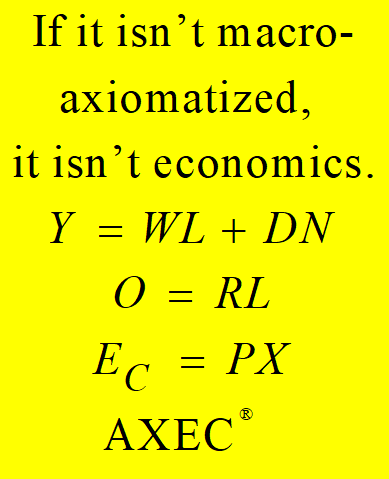
(A1) Yw=WL wage income Yw is equal to wage rate W times working hours. L,
(A2) O=RL output O is equal to productivity R times working hours L,
(A3) C=PX consumption expenditure C is equal to price P times quantity bought/sold X.

The graphical representation of this absolute formal minimum is given under the label Graphic AXEC31


This chart replaces the hare-brained totem of SS-function―DD-function―equilibrium (S-D-E). A detailed description of the elementary macroeconomic relationships has been given elsewhere. #2

The systemic macro axiom set (A1) to (A3) is the one stone that kills, for a start, the Keynesian multiplier, ALL IS-LM models from Hicks onward, ALL AD/AS models, the stickiness argument, and the (Bastard-) Phillips curve, including the natural rate hypothesis. #3

This, though, is forever beyond the horizon of the representative economist who flunked the intelligence test already by accepting the totems of micro and macro. If you don’t start macro with (A1) to (A3), you are doing it wrong.

Egmont Kakarot-Handtke


#1 Keynesianism is broken: Get over it!
#2 Getting out of IS-LM = Getting out of despair
#3 For details of the big picture, see cross-references Paradigm Shift

***
Graphic AXEC121i

January 26, 2017

Traditional Heterodoxy’s paradigmatic impotence

Comment on Editor on ‘The static analysis of the supply and demand model’

Blog-Reference

Editor quotes Stuart Birks’s critique: “Note that the supply and demand model is, like much of economics, based on static analysis. Consequently, the focus will be on the market equilibrium. It is based on the idea that you have a scenario within which you can have as much costless adjustment as required to achieve some final end state which will be the equilibrium (issues of existence and uniqueness aside). This does not reflect the real world. In reality, there is a starting point, A. This is more than just an initial resource endowment. It also specifies an application of those resources, for example producing and consuming goods and services at some rate of output (as we are actually moving through time). There is also a path to be taken to the endpoint.”

This critique is absolutely correct. Economists think they can answer any question by painting the triad SS-function―DD-function―equilibrium. Leijonhufvud called this analytical tool Totem of the Micro/Totem of the Macro. What the representative economist does not understand to this day is that there is NO such thing as an economic equilibrium and NO such thing as SS and DD functions. The Totem of Micro/Macro is a NONENTITY like the Tooth Fairy or the Easter Bunny.

While traditional Heterodoxy has correctly identified the core of every economic textbook as proto-scientific garbage, it has failed to provide the methodologically correct replacement of the methodologically unacceptable supply-demand-equilibrium construct. This is the methodological imperative: "The problem is not just to say that something might be wrong, but to replace it by something — and that is not so easy." (Feynman)  In other words, traditional Heterodoxy failed at its mission to bring about the necessary Paradigm Shift.

The Paradigm Shift has been accomplished by Constructive Heterodoxy/Metadoxy, see
► Essentials of Constructive Heterodoxy: The Market
► The Law of Supply and Demand: Here It Is Finally
► How to Get Rid of Supply-Demand-Equilibrium

What both orthodox and heterodox economists, in their innate scientific incompetence, have failed to realize is that the economy as a system is defined by the interrelationship of a number of elementary variables. Every model, no matter how differentiated, must contain these objective SYSTEMIC interrelationships as its formal hardcore. This is an imperative methodological necessity.

The false Walrasian microfoundations and the false Keynesian macrofoundations have to be replaced with the true macrofoundations. The graphical representation of this absolute formal minimum is given on Graphic AXEC31


This chart replaces the hare-brained Totem of SS-function―DD-function―equilibrium. A detailed description of the elementary macro relationships has been given in the papers referenced above.

It is time now for traditional Heterodoxy, which has exhausted itself in repetitive critique, to get out of the way and no longer hamper Constructive Heterodoxy.

Egmont Kakarot-Handtke


For details of the big picture, see cross-references Paradigm Shift.

For more about Heterodoxy, see AXECquery.

***

Graphic AXEC121i

December 20, 2016

The IS-LM macro imbeciles

Comment on Lars Syll on ‘The non-existence of Paul Krugman’s Keynes/Hicks macroeconomic theory’

Blog-Reference and Blog-Reference and Blog-Reference on Dec 21

Economists think they can solve any problem by painting the triad SS-function―DD-function―equilibrium. Leijonhufvud called this analytical tool the totem of the micro/totem of the macro. What economists do not understand is that there is NO such thing as an economic equilibrium and NO such thing as SS and DD functions. #1 The totem of micro/macro is a NONENTITY. And this means that the history of IS-LM from Keynes to Hicks to Davidson to Krugman and beyond is a perfect example of economists’ absolutely vacuous model bricolage. #2

Keynesianism in general, and IS-LM, in particular, has always been methodologically unacceptable, and its proper place for 80+ years is the wastebasket. #3

What economists’ in their innate scientific incompetence fail to realize is that the economy as a system is defined by the interrelationship of a number of elementary variables. Every model, no matter how differentiated, must contain these OBJECTIVE interrelationships as its hardcore. This is an imperative methodological necessity.

The false Walrasian microfoundations and the false Keynesian macrofoundations have to be replaced with the true macrofoundations. This is achieved as follows
(A0) The objectively given and most elementary configuration of the (world-) economy consists of the household and the business sector, which in turn consists initially of one giant fully integrated firm.
(A1) Yw=WL wage income Yw is equal to wage rate W times working hours. L,
(A2) O=RL output O is equal to productivity R times working hours L,
(A3) C=PX consumption expenditure C is equal to price P times quantity bought/sold X.

The graphical representation of this absolute formal minimum is given with Graphic AXEC31


This chart replaces the hare-brained totem of SS-function―DD-function―equilibrium. A detailed description of the elementary macro relationships has been given elsewhere. #4

The systemic macro axiom set (A1) to (A3) is the one stone that kills, for a start, the Keynesian multiplier, ALL IS-LM models from Hicks onward, the stickiness argument, and the (bastard-) Phillips Curve, including the natural rate hypothesis. #5

This, though, is forever beyond the horizon of the representative economist who flunked the intelligence test already by accepting the totems of micro and macro.

Egmont Kakarot-Handtke


#1 Ground Control to David Glasner
#2 Mr. Keynes, Prof. Krugman, IS-LM, and the End of Economics as We Know It
#3 Keynesianism is broken: Get over it!
#4 Getting out of IS-LM = Getting out of despair
#5 The final smackdown of blahblah-Keynesianism

For details of the big picture, see cross-references Refutation of I=S.

August 8, 2015

How markets work

Comment on axdouglas on ‘Macroeconomic Theory and Operational Reality’

Blog-Reference

“I often wonder whether other subjects suffer as much from textbook writers.” (Hahn, 1980, p. 127)

Economists think they can explain economic phenomena by painting a supply-demand-equilibrium cross or what Leijonhufvud has ironically called the totem of the micro/macro. However, already Schumpeter found it necessary to diffuse doubts about the scientific content of the whole exercise.

“The primitive apparatus of the theory of supply and demand is scientific. But the scientific achievement is so modest, and common sense and scientific knowledge are logically such close neighbors in this case, that any assertion about the precise point at which the one turned into the other must of necessity remain arbitrary.” (Schumpeter, 1994, p. 9)

As a matter of fact, the ‘primitive apparatus of the theory of supply and demand’ is a thoroughly faulty construct: “There is little or nothing in existing micro- or macroeconomics texts that is of value for understanding real markets. Economists have not understood how to model markets mathematically in an empirically correct way.” (McCauley, 2006, p. 16)

The familiar microeconomic SS-DD cross is built on NONENTITIES like utility, equilibrium, well-behaved production functions, decreasing returns, rational expectations, simultaneous adaptation, etcetera, and consequently, has to go out of the window. The same holds for macroeconomic versions like IS-LM. For the refutation of Krugman’s silly model see (2014): “What is now taught as standard economic theory will eventually disappear, no trace of it will remain in the universities or boardrooms because it simply doesn’t work: were it engineering, the bridge would collapse.” (McCauley, 2006, p. 17)

Because the textbooks are wrong, it is one of the first tasks of Constructive Heterodoxy to deliver the correct formal depiction of a market (2015). It is high time that economists learn how the market system works.

Egmont Kakarot-Handtke


References
Hahn, F. H. (1980). General Equilibrium Theory. Public Interest. Special Issue: The Crisis in Economic Theory, 123–138.
Kakarot-Handtke, E. (2014). Mr. Keynes, Prof. Krugman, IS-LM, and the End of Economics as We Know It. SSRN Working Paper Series, 2392856: 1–19. URL
Kakarot-Handtke, E. (2015). Essentials of Constructive Heterodoxy: The Market. SSRN Working Paper Series, 2547098: 1–10. URL
McCauley, J. L. (2006). Response to "Worrying Trends in EconoPhysics". EconoPhysics Forum, 0601001: 1–26. URL
Schumpeter, J. A. (1994). History of Economic Analysis. New York: Oxford University Press.

For more about the economic totem see AXECquery.
For more about Constructive Heterodoxy see AXECquery.


***
Twitter/X 21 Aug 2023 Long obsolete, the silly totem of economics

June 2, 2015

Totem, voodoo, and tabu

Comment on Lars Syll on ‘Loanable funds’

Blog-Reference see also Blog-Reference

“Economic models that integrate banking with macroeconomics are clearly of the greatest practical relevance at the present time.” (See intro)

This is certainly a point we all can agree upon. The challenge for theoretical economics is, first of all, to explain how the undifferentiated product market, the labor market, the secondary market, and the financial market (including money) fit together.

Economists habitually think they can solve any problem by painting supply-demand-equilibrium and taking Walras's Law into account. In the apt characterization of Leijonhufvud economists either summon up the spirits of the ‘totem of the micro’ or the ‘totem of the macro’ with the mantra of market forces.

All this has nothing to do with a scientific explanation because (i) supply function, demand function, and equilibrium are NONENTITIES, and (ii) the markets are in intricate ways interlocked (the quantitative volume of the financial market is the numerical integral of flow-differences in the product market; the real wage is uno actu determined in the product market; etcetera).

The loanable funds theory is a case in point for the failure of supply-demand-equilibrium economics. The argument in the intro is a telling example of the actual state of theoretical ignorance and confusion.

What first has to be done is tabooing supply-demand-equilibrium. All equilibrium models are false. A set of equations is not a suitable mathematical tool, but a stochastic simulation is. Second, both Walrasian and Keynesian approaches have to be put aside as useless and misleading.

This clears the ground for Constructive Heterodoxy and the consistent and comprehensive theory of how the various financial markets emerge as integral parts of the monetary circuit which links all markets (2015).

Egmont Kakarot-Handtke


References
Kakarot-Handtke, E. (2015). Essentials of Constructive Heterodoxy: Financial Markets. SSRN Working Paper Series, 2607032: 1–31. URL

[The title alludes to the fallacy of animistic thinking which underlies all market force explanations.]

February 17, 2017

Why you should NEVER use supply-demand-equilibrium

Comment on Peter Dorman on ‘Why You Should Never Use a Supply and Demand Diagram for Labor Markets’

Blog-Reference and Blog-Reference

As can be seen in every textbook, economists answer any question by painting the triad SS-function―DD-function―equilibrium. Leijonhufvud called this analytical tool Totem of the Micro/Totem of the Macro. What economists do not understand until this day is that there is NO such thing as an economic equilibrium and NO such thing as SS and DD functions. The S-D-E Totem of Micro/Macro is a NONENTITY like the Tooth Fairy or the Easter Bunny.

After economists have applied their standard analytical workhorse supply-demand-equilibrium for more than a century, self-doubts arise, at least with regard to the labor-market: “S&D is simply the wrong model, based on a failure to distinguish between offers and transactions.” (see intro)

But economists never bury one self-delusion without advertising the next: “Fortunately, there’s a better model out there, search theory, with fairly straightforward intuitions and tons of available data.”

What the representative economist fails to realize is that the foundational error/mistake/ blunder of the supply-demand-equilibrium approach lies in the microfoundations. #1 The lethal methodological blunder can be stated as an impossibility theorem: NO way leads from the explanation of individual behavior to the explanation of how the economic system works. Because of this, the microfoundations approach has already been dead in the cradle 150+ years ago.

What the representative economist fails to realize is that the economy as a system is defined by the interrelationship of a number of elementary variables. Every model, no matter how differentiated, must contain these objective SYSTEMIC interrelationships as its formal hardcore. In other words, false microfoundations have to be replaced by true macrofoundations. This, in turn, leads to an objective systemic theory of the labor market. #2

All this is forever beyond the horizon of the representative economist who can easily drop what he sold as the true model yesterday, but not methodological individualism because: “It is a touchstone of accepted economics that all explanations must run in terms of the actions and reactions of individuals.” (Arrow)

The commitment to microfoundations is the ultimate reason why economics in general and labor market theory, in particular, is false. The search theory of the labor market is no exception.


Egmont Kakarot-Handtke


#1 The microfoundations approach is defined with these hardcore propositions, a.k.a. axioms: “HC1 economic agents have preferences over outcomes; HC2 agents individually optimize subject to constraints; HC3 agent choice is manifest in interrelated markets; HC4 agents have full relevant knowledge; HC5 observable outcomes are coordinated, and must be discussed with reference to equilibrium states.” (Weintraub)
#2 The one stone that kills orthodox and heterodox employment theory

Related 'Essentials of Constructive Heterodoxy: The Market' and 'The Law of Supply and Demand: Here It Is Finally' and 'How to Get Rid of Supply-Demand-Equilibrium'

***

REPLY to Stephen Williamson on Feb 17

Already Schumpeter found it necessary to diffuse doubts about the scientific content of the supply-demand-equilibrium approach: “The primitive apparatus of the theory of supply and demand is scientific. But the scientific achievement is so modest, and common sense and scientific knowledge are logically such close neighbors in this case, that any assertion about the precise point at which the one turned into the other must of necessity remain arbitrary.”

As a matter of fact, the ‘primitive apparatus of the theory of supply and demand’ is a thoroughly faulty construct: “There is little or nothing in existing micro- or macroeconomics texts that is of value for understanding real markets. Economists have not understood how to model markets mathematically in an empirically correct way.” (McCauley, 2006)

For the methodologically correct approach, see Essentials of Constructive Heterodoxy: The Market

***

REPLY to ProGrowthLiberal on Feb 19

You say: “In my Brooklyn neighborhood, there are competing stores a few blocks apart. So if I cannot buy milk in one I go to the other.”

That is rather smart, but it escaped your attention that this thread is about the LABOR market and neither about the goods market in general nor the Brooklyn milk market in particular.

The SS-function―DD-function―equilibrium approach is false for BOTH the goods and the labor market because ALL microfounded approaches are methodologically false. The macrofounded approach delivers the following testable macroeconomic Employment Law = true Phillips Curve, see Graphic AXEC46.

August 31, 2019

No false-hero memorials (II)

Comment on Barkley Rosser on ‘Martin Weitzman RIP’

Blog-Reference and Blog-Reference

The failed scientist and applause troll, attention/reputation manager, political agenda pusher, crime hunter, academic busybody, storyteller, and falsifier of the history of economic thought, Barkley Rosser takes the opportunity to erect the next false-hero memorial.

These are Barkley Rosser’s quality criteria: “But he was always further out on the edge of respectability, even though his career always looked respectable on the surface: a PhD from MIT under Robert Solow and holding positions at Yale, MIT, and Harvard since 1989, as well as regularly publishing in top journals from 1965 on.”

This translates into: During his academic career, he was most of the time either indirectly or directly on the payroll of billionaire-sponsors. #1

What about the contributions of real scientific worth?

“This famous paper reasonably argued that in a world of non-certainty regarding costs and benefits of environmental policies, the use of a tax versus a quantity control, such as cap and trade depended on the relative slopes of the marginal cost and marginal damage functions. If the former is steeper then a price-oriented policy such as a tax is preferred whereas if the marginal damage function is steeper than a quantity-oriented policy such as cap and trade would be preferred.”

This translates into Martin Weitzman never realizing that Marginalism and the Totem-of-the-Micro are proto-scientific garbage since Jevons/Walras/Menger. #2

With all these credentials, Martin Weitzman was, of course, a worthy candidate for the faux Nobel: “Several of us here had long advocated that he share the first Nobel Prize to be given for environmental economics.” #3

Yes, obituaries have always been the best place to plant myths. And nobody does this better than Barkley Rosser, the promoter of fake science and suppressor of genuine science.

For the scientific community, it holds vis-à-vis all cargo cult scientists: RIP at the Flat-Earth Cemetery.

Egmont Kakarot-Handtke


#1 “MIT is giving Jeffrey Epstein’s tainted donation to a charity, but Harvard says it won’t do the same”. Twitter
#2 What is so great about cargo cult science? or, How economists learned to stop worrying about failure
#3 Links on the Economics Nobel

Related 'The Palgrave Dictionary ― a comprehensive collection of false-hero memorials' and 'Economics textbooks ― tombstones at the Flat-Earth-Cemetery' and '“I never learned maths, so I had to think” ― another false-hero memorial' and 'What comes first: eco-self-destruction or oeco-self-destruction?'.

***
REPLY to Barkley Rosser on Sep 1

You say: “Egmont, your vacuous profit law is completely irrelevant to whether or not marginal social cost curves or marginal social damage curves regarding environmental problems are useful or meaningful concepts.”

The Profit Law is not at issue in the given context. What is at issue is the irrelevance of Marginalism, which is already dead for 150+ years because it consists of plain NONENTITIES. So, the question “whether global warming is better addressed by using taxes or some kind of quantity control” is at the same level as How many angels can dance on a pinpoint?

Standard economics is based on these hardcore propositions: “HC1 economic agents have preferences over outcomes; HC2 agents individually optimize subject to constraints; HC3 agent choice is manifest in interrelated markets; HC4 agents have full relevant knowledge; HC5 observable outcomes are coordinated, and must be discussed with reference to equilibrium states.” (Weintraub)

This set is chock-full of NONENTITIES. The whole of Marginalism derives from the core behavioral assumption HC2, which is a NONENTITY like the Tooth Fairy or the Easter Bunny. From the Walrasian axioms, the triad SS-function―DD-function―equilibrium is derived. Leijonhufvud called this defective analytical tool the Totem of the Micro/Totem of the Macro. Because there is NO such thing as supply-demand-equilibrium the whole of economics is vacuous.

It is plain to every person with more than two brain cells that any analysis that crosses an upward-sloping and a downward-sloping curve is proto-scientific idiocy. So, every economist who blunders about “relative slopes of the marginal cost and marginal damage functions” is either stupid or corrupt or both.

Global warming is an issue for scientists. It is generally known by now that economists are fake scientists, so they have NOTHING to contribute to the discussion. Actually, global warming is used by academic economists under the label of the Green New Deal to deceive WeThePeople. #1, #2 Instead of defunct microfoundations, MMTers apply macrofoundations that are dead since Keynes. Both microfoundations and macrofoundations are provably false, so economists have NOTHING to add to a scientific discussion.

If you were a scientist, you would not push for the erection of false-hero memorials but instead, push for the end of the 200+ years of mob rule of incompetent scientists and political fraudsters.


#1 MMT and the Green New Deal: Where is the snag? (I)+(II)
#2 Bill Mitchell’s dishonorable discharge from the sciences

***
REPLY to Barkley Rosser on Sep 2

“In order to tell the politicians and practitioners something about causes and best means, the economist needs the true theory or else he has not much more to offer than educated common sense or his personal opinion.” (Stigum)

The fact is that both microfounded and macrofounded economics are provably false. Economists do not know how the monetary economy works. There is no valid Employment-, Profit-, Distribution-, or Money Theory. So, economic policy guidance has NEVER had sound scientific foundations since the days of Adam Smith.

The fact is that the so-called free market economy is on the life support of the State, and Wall Street is on the life support of the Central Bank. Macroeconomic profit is, in the main, produced by public deficits. Financial wealth grows in lockstep with public debt. The Oligarchy, in turn, uses the opulent free lunches to corrupt what remains of the State’s legislative, executive, and judiciary institutions.

The proof has been given that economists are too stupid for the elementary math that underlies macroeconomics. #1 Because macroeconomics and microeconomics are materially/formally inconsistent, economists have NOTHING to contribute to the solution of any problems between unemployment and global warming.

So, what is lacking in economics is the true theory. Economics is a scientific failure. This is bad enough. But then comes the absurdity on top of all the proto-scientific garbage, which consists of rewarding fake scientists with the faux Nobel. #2


#1 Deficit cheerleaders ― the Oligarchy’s useful idiots, Aug 27
#2 Links on the Economics Nobel

***
REPLY to Barkley Rosser on Sep 5

You say: “Let us get real. There is a very serious problem known as global warming. Do you deny that it exists?”

I say: Let us get real. There is a very serious problem in economics of scientific failure/fake/fraud. Do you deny that it exists?

You abuse an obituary to distract from the fact that economists have to this day no valid theory about how the economy works, and that they are too stupid for the elementary math that underlies macroeconomics, and that their policy guidance has no sound scientific foundations since Adam Smith. Instead, you portray economists as saviors of the planet and humanity.

Economics is not a science. Economists are incompetent scientists. Martin Weitzman was part of an institutional system that is rigged from textbooks to peer reviews to the faux Nobel. Do you deny that it exists and that you, too, are part of it?

August 9, 2017

There is NO such thing as supply-demand-equilibrium

Comment on Gavin Kennedy on ‘Paul Samuelson’s awesome error’

Blog-Reference and Blog-Reference on Aug 10

Gavin Kennedy summarizes: “I don’t think that anything Smith wrote can be credited to his anticipation of Nash Equilibrium ― thought some modern economists (post-Samuelson) appear to think he did, even beyond Nash Equ. 1 to Nash Equ, 2. I am not sure that outside the models, Equilibria exist in the real world. I have long been suspicious about the basic Supply and Demand equilibrium exemplified in the Marshallian Supply and Demand diagram. I understand its construction, of course, but when I try to envisage its operation in a real market-stall, I am flummoxed!”

Everybody with one iota of scientific instinct immediately realizes that there is something fundamentally wrong with supply-demand-equilibrium and the SS-curve―DD-curve― intersection, which is the analytical workhorse of standard economics. Leijonhufvud lampooned this construct as Totem of the Micro/Totem of the Macro. And already Schumpeter found it necessary to diffuse doubts about the scientific content of the supply-demand-equilibrium approach: “The primitive apparatus of the theory of supply and demand is scientific. But the scientific achievement is so modest, and common sense and scientific knowledge are logically such close neighbors in this case, that any assertion about the precise point at which the one turned into the other must of necessity remain arbitrary.”

Orthodoxy is for 150+ years built upon false premises. The microfoundations approach is defined with these hardcore propositions, a.k.a. axioms: “HC1 economic agents have preferences over outcomes; HC2 agents individually optimize subject to constraints; HC3 agent choice is manifest in interrelated markets; HC4 agents have full relevant knowledge; HC5 observable outcomes are coordinated, and must be discussed with reference to equilibrium states.” (Weintraub)

The Walrasian hardcore contains three NONENTITIES: (i) constrained optimization (HC2), (ii) rational expectations (HC4), and (iii) equilibrium (HC5). To take equilibrium into the premises and then establish and discuss the properties of general equilibrium is a methodological blunder that has been known since antiquity as petitio principii.

Because the axioms of orthodox economics are false, the whole analytical superstructure, including supply-demand-equilibrium, is false. What has to be done is to replace false microfoundations with true macrofoundations. This Paradigm Shift fundamentally changes the depiction of the market. The prototype of the macroeconomic Law of Supply and Demand, which replaces the SS-curve―DD-curve― equilibrium, is shown under the label Graphic. #1, #2


Loosely speaking, Orthodoxy defines itself as follows: “most of what I and many others do is sorta-kinda neoclassical because it takes the maximization-and-equilibrium world as a starting point.” (Krugman) #3 This is bad enough, but that Heterodoxy could not refute and replace this plain proto-scientific garbage in 150+ years shows the abyss of scientific incompetence in its bottomless depth.

Egmont Kakarot-Handtke


#1 Graphic AXEC104 The market prototype
#2 Essentials of Constructive Heterodoxy: The Market
#3 The father of modern economics and his imbecile kids

Related 'Ground Control to David Glasner' and 'Petitio principii — economists’ biggest methodological mistake' and 'Why you should NEVER use supply-demand-equilibrium' and 'Traditional Heterodoxy’s paradigmatic impotence' and 'All models are false because all economists are stupid' and 'The Law of Supply and Demand: Here It Is Finally' and 'How to Get Rid of Supply-Demand-Equilibrium' and 'How to overcome the manifest silliness of Econ 101 and save the economy' and 'MMT’s two shots in the head' and 'Bang — the representative economist and supply-demand-equilibrium are dead'.

For more about supply-demand-equilibrium see AXECquery.


***

Graphic AXEC121i

September 24, 2016

Outside science

Comment on Lars Syll on David Ruccio on ‘Phlogiston, the identification problem, and the state of macroeconomics’

Blog-Reference

In his recent paper, ‘The Trouble With Macroeconomics’#1 Paul Romer puts DSGE and its main proponents (Lucas, Sargent, Prescott) to rest. In the final section ‘The Trouble Ahead For All of Economics’ he appeals to emotions: “It is sad to recognize that economists who made such important scientific contributions in the early stages of their careers followed a trajectory that took them away from science. It is painful to say this so when they are people I know and like and when so many other people that I know and like idolize these leaders.”

While it is true that DSGE and its proponents are out of science it is NOT correct to give the impression that an accident happened at some point on the way which led from science to non-science. The fact of the matter is that DSGE has always been out of science because economics has always been out of science. The leaders of the DSGE/RBC program have done exactly what they were supposed to do: “It is a touchstone of accepted economics that all explanations must run in terms of the actions and reactions of individuals. Our behavior in judging economic research, in peer review of papers and research, and in promotions, includes the criterion that in principle the behavior we explain and the policies we propose are explicable in terms of individuals, not of other social categories.” (Arrow, 1994, p. 1)

This definition of the subject matter translates into the following set of hardcore propositions/axioms: “HC1 economic agents have preferences over outcomes; HC2 agents individually optimize subject to constraints; HC3 agent choice is manifest in interrelated markets; HC4 agents have full relevant knowledge; HC5 observable outcomes are coordinated, and must be discussed with reference to equilibrium states.” (Weintraub, 1985, p. 147)

The critical axioms are HC2 and HC5. Krugman put it nicely: “... most of what I and many others do is sorta-kinda neoclassical because it takes the maximization-and-equilibrium world as a starting point.”

It is obvious to anyone with a modicum of scientific instinct that the axiomatic starting point of orthodox economics is methodologically forever unacceptable. The axiom set consists of blatant NONENTITIES but each student generation has swallowed it without turning an eyelid. Lucas, Sargent, Prescott certainly did. This is scientifically disqualifying.

In order to be applicable HC3, which translates formally into calculus, requires a lot of auxiliary assumptions, most prominently a well-behaved production function.#3 Taken together, all axioms and auxiliary assumptions crystallize to SS-DD-equilibrium or what Leijonhufvud famously called the Totem of Micro/Macro.

Needless to stress that ALL THREE elements of the standard tool (SS-function, DD-function, equilibrium) are NONENTITIES. The usual concept of a function is NOT applicable in economics. It was the heterodox economist Georgescu-Roegen who raised some methodological doubts long ago: “But why should economic laws ... be expressed by analytical functions?” (1966, p. 123)

The fact that neither SS/DD functions nor equilibrium exist leads with an inescapable consequence to the identification problem in Econometrics (see Romer Sec. 4).#2 Romer takes this insurmountable technical difficulty as a methodological silver bullet in order to finish off DSGE/RBC. It should be noted, though, that the identification problem has its roots in the Walrasian axiom set HC1/HC5 which is the accepted common ground of orthodox economics.

The real and ultimate scientific error/mistake of Lucas, Sargent, Prescott, et al. consists of accepting the very definition of economics. The failure of DSGE, therefore, calls (i) for a paradigm shift, i.e. a new definition of the subject matter, and (ii), the replacement of the silly supply-demand-equilibrium totem of economics (2013; 2014).

To throw DSGE/RBC now unceremoniously out of science is only the first step because textbook supply-demand-equilibrium, which is built upon the same maximization-and-equilibrium axioms, is rubbish since Jevons/Walras/Menger. By sticking to the post-real microfoundations HC1/HC5 economists are since 140 years out of science. Romer is right: there is trouble ahead for ALL of the economics.

Egmont Kakarot-Handtke


References
Arrow, K. J. (1994). Methodological Individualism and Social Knowledge. American Economic Review, Papers and Proceedings, 84(2): 1–9. URL
Georgescu-Roegen, N. (1966). Analytical Economics, chapter General Conclusions for the Economist, pages 92–129. Cambridge: Harvard University Press.
Kakarot-Handtke, E. (2013). How to Get Rid of Supply-Demand-Equilibrium. SSRN Working Paper Series, 2263172: 1–24. URL
Kakarot-Handtke, E. (2014). The Law of Supply and Demand: Here it is Finally. SSRN Working Paper Series, 2481840: 1–17. URL
Weintraub, E. R. (1985). Joan Robinson’s Critique of Equilibrium: An Appraisal. American Economic Review, Papers and Proceedings, 75(2): 146–149. URL

#1 Paper of Sep 14, 2016
#2 See also Wikipedia
#3 Putting the production function back on its feet

Preceding The identification problem and the dumping of the old guard

August 27, 2020

Price theory — more than beating the dead horse again and again

Comment on Blair Fix on ‘Supply and demand deconstructed’

Blog-Reference and Blog-Reference

Blair Fix summarizes “… Jonathan Nitzan demolishes the neoclassical theory of prices. It’s a master lesson in how to deconstruct a theory.”

Mainstream economics, though, does not need another deconstruction. #1, #2, #3 Mainstreamers have admitted failure long ago. “There is another alternative: to formulate a completely new research program and conceptual approach. As we have seen, this is often spoken of, but there is still no indication of what it might mean.” (Ingrao et al., 1990)

Clearly, everybody knows by now for sure that supply-demand-equilibrium is proto-scientific garbage. Back in 1954, Schumpeter found it still necessary to diffuse doubts about the scientific status of the supply-demand-equilibrium approach “The primitive apparatus of the theory of supply and demand is scientific. But the scientific achievement is so modest, and common sense and scientific knowledge are logically such close neighbors in this case, that any assertion about the precise point at which the one turned into the other must of necessity remain arbitrary.”

So, the right thing to do is to bury and forget the “Totem of the Micro”: “If neoclassical theory is bunk, then what explains prices? Jonathan Nitzan, together with Shimshon Bichler, argues that prices are inseparable from power.” #4

With this, though, everything remains in the old economics-is-a-social-science paradigm. The behavioral assumption of price-taking is replaced by the assumption of price-setting. To remain in the psycho-sociological sphere is the lethal blunder of the power approach because economics is a systems science. #5

Here are the basics of the macrofoundations approach. The elementary production-consumption economy is defined with this set of macroeconomic axioms: (A0) The economy consists of the household and the business sector, which, in turn, consists initially of one giant fully integrated firm. (A1) Yw=WL wage income Yw is equal to wage rate W times working hours. L, (A2) O=RL output O is equal to productivity R times working hours L, (A3) C=PX consumption expenditure C is equal to price P times quantity bought/sold X.

Under the conditions of market-clearing X=O and budget-balancing C=Yw in each period, the price as the dependent variable is given by P=W/R (1a). The price is determined by the wage rate W, which takes the role of the nominal numéraire, and the productivity R. This is the most elementary case; i.e., when the economy gets more complex, the price equation becomes longer.*

The macroeconomic Law of Supply and Demand (1a) implies W/P=R (1b), i.e., the real wage is always equal to the productivity, no matter how the wage rate W is set or how long the individual or aggregate working time L is. Full employment is possible; the workers always get the whole product O. The workers' living standard depends ultimately on productivity.

The logical next steps are (i) to skip the conditions of market-clearing and budget-balancing and to allow for price-setting, (ii) to differentiate the business sector into multiple firms and markets, and to determine the price structure. #6

Egmont Kakarot-Handtke


#1 There is NO such thing as supply-demand-equilibrium
#2 How to Get Rid of Supply-Demand-Equilibrium
#3 The Law of Supply and Demand: Here It Is Finally
#4 This echoes Macht und ökonomisches Gesetz (Power and Economic Law), Schriften des Vereins für Socialpolitik, 1972.
#5 Your economics is refuted on all counts: here is the real thing
#6 See Ch. 3 Market interdependence in Sovereign Economics

Related 'Economists never understood how the price mechanism works' and '10 steps to leave cargo cult economics behind for good' and 'Primary and Secondary Markets' and 'Hayek and other informationally retarded proto-economists' and 'How to overcome the manifest silliness of Econ 101 and save the economy' and 'Why you should NEVER use supply-demand-equilibrium' and 'Traditional Heterodoxy’s paradigmatic impotence' and 'Essentials of Constructive Heterodoxy: The Market' and 'Understanding Profit and the Markets: The Canonical Model' and 'Major Defects of the Market Economy' and 'How to finally hammer down the nails in the coffin of Monty Python economics' and 'Get it econ suckers: behavioral microfoundations ⇒ false, systemic macrofoundations ⇒ true' and 'Econ 101: Economists flunk the intelligence test at the first hurdle' and 'The monstrous utility-supply-demand-equilibrium failure' and 'To this day, economists have produced NOT ONE textbook that satisfies scientific standards' and 'Ch. 9, Price mechanism vs quantity mechanism in Sovereign Economics, BoD'.

“Totem of the Micro” has been coined by Axel Leijonhufvud.

* E.g. AXEC64


***
#PointOfProof
Aug 29

August 21, 2015

No foundations

Comment on Lars Syll on ‘Lucas’ caricature of economic science’

Blog-Reference

You cite: “As Lucas himself wrote ... he was bewitched by the beauty and power of Samuelson’s Foundations of Economic Analysis ...” (See intro)

The first thing every economics student encountered in Samuelson's textbook was the ‘totem of the micro’, that is, supply-demand-equilibrium. And nothing has changed since then. “Supply and demand are at the heart of how market economies work.” (Mankiw, 1998, p. 519)

Then and now, this first encounter is the all-deciding moment. From a student who accepts supply-demand-equilibrium as an explanation for the functioning of the market system, nothing of scientific value can be expected in the future.

“There is little or nothing in existing micro- or macroeconomics texts that is of value for understanding real markets. Economists have not understood how to model markets mathematically in an empirically correct way.” (McCauley, 2006, p. 16) #1

Nobody with a modicum of scientific instinct can accept the shallow explanations and the superficial formalization of Samuelson's textbook.

On the next higher level, nobody with his logical apparatus intact can accept the following behavioral assumptions as foundations of economic research. “As with any Lakatosian research program, the neo-Walrasian program is characterized by its hard core, heuristics, and protective belts. Without asserting that the following characterization is definitive, I have argued that the program is organized around the following propositions: HC1 economic agents have preferences over outcomes; HC2 agents individually optimize subject to constraints; HC3 agent choice is manifest in interrelated markets; HC4 agents have full relevant knowledge; HC5 observable outcomes are coordinated, and must be discussed with reference to equilibrium states. By definition, the hard-core propositions are taken to be true and irrefutable by those who adhere to the program.” (Weintraub, 1985, p. 147)

What should be almost self-evident is that HC1 is vacuous and that HC2 to HC5 are simply green cheese assumptions. This holds independently from and prior to any formalization.

The only conclusion one can draw from Samuelson's Foundations of Economic Analysis and the neo-Walrasian hardcore propositions is that these foundations are unacceptable. If the foundations are unsound, then in the course of time nothing remains standing. This is what Heterodoxy can learn from Lucas' epic failure.

“For it can fairly be insisted that no advance in the elegance and comprehensiveness of the theoretical superstructure can make up for the vague and uncritical formulation of the basic concepts and postulates, and sooner or later ... attention will have to return to the foundations.” (Hutchison, 1960, p. 5)

Eventually, Heterodoxy has to come up with the correct set of foundational propositions.

Egmont Kakarot-Handtke


References
Hutchison, T.W. (1960). The Significance and Basic Postulates of Economic Theory. New York: Kelley.
Mankiw, N. G. (1998). Teaching the Principles of Economics. Eastern Economic Journal, 24(4): 519–524. URL
McCauley, J. L. (2006). Response to "Worrying Trends in EconoPhysics". EconoPhysics Forum, 0601001: 1–26. URL
Weintraub, E. R. (1985). Joan Robinson’s Critique of Equilibrium: An Appraisal. American Economic Review, Papers and Proceedings, 75(2): 146–149. URL

#1 For the correct way see Essentials of Constructive Heterodoxy: The Market and How to Get Rid of Supply-Demand-Equilibrium.

April 29, 2019

Econ 101: Supply-Demand-Equilibrium is dead for 150+ years

Comment on Dirk Ehnts on ‘The problem with the supply curve’

Blog-Reference and Blog-Reference

Dirk Ehnts reports: “Steve Keen uses a 1952 paper to make a very important point about neoclassical economics: There is a problem with the supply curve.” and concludes: “Microeconomics, the behavior of firms and households, is very important. Starting the subject by repeating theories that should have long been discarded blocks more relevant approaches from being taught. These new approaches could provide proper foundations of the behavior of firms and households if they are not based on ‘economic laws’ that are refuted by reality.”

All this is true, of course, but ultimately not very helpful: “The moral of the story is simply this: it takes a new theory, and not just the destructive exposure of assumptions or the collection of new facts, to beat an old theory.” (Blaug)

Because traditional Heterodoxy consistently failed at this methodological barrier, economics students are still taught the ‘Totem of the Micro’, i.e. supply-demand-equilibrium. #1

The lethal blunder of microeconomics, though, does not start with the supply curve but with the neo-Walrasian axiom set: “HC1 There exist economic agents. HC2 Agents have preferences over outcomes. HC3 Agents independently optimize subject to constraints. HC4 Choices are made in interrelated markets. HC5 Agents have full relevant knowledge. HC6 Observable economic outcomes are coordinated, so they must be discussed with reference to equilibrium states.” (Weintraub, 1985)

The pivotal propositions are HC3 and HC6. Methodologically, they are NONENTITIES like the Easter Bunny and Spiderman. The behavioral axiom HC3 makes economics marginalistic. #2, #3 In order to make constrained optimization work, a well-behaved production function is required. The production function is NOT the result of real-world observations but is implied by HC3. #4, #5, #6 The supply curve, in turn, follows from the assumed production function. So HC3 is the ultimate reason why there “is a problem with the supply curve”.

From this follows that the microfoundations HC1/HC6 have to be discarded. And this is the end of Econ 101 as we know it. Economics textbooks have been worthless since Samuelson’s first edition in 1948. #7

The end of proto-scientific economics, though, is the beginning of scientific economics, which is no longer based on false microfoundations but on true macrofoundations. #8, #9, #10

From the devastating critique of supply-demand-equilibrium follows the necessity of a Paradigm Shift. Traditional Heterodoxy never performed the Paradigm Shift but was content with the endless repetition of how “unrealistic” Orthodoxy is.

Because of this, both Orthodoxy and traditional Heterodoxy go down the scientific drain.

Egmont Kakarot-Handtke


#1 Where advanced Heterodoxy — represented by Steve Keen — took the wrong turn
#2 The solemn burial of marginalism
#3 Marginalism is the landmark of scientific incompetence
#4 Putting the production function back on its feet
#5 Infantile model bricolage, or, How many economists can dance on a non-existing pinpoint?
#6 Mathiness and the Ur-Blunder
#7 The father of modern economics and his imbecile kids
#8 Essentials of Constructive Heterodoxy: The Market
#9 How to Get Rid of Supply-Demand-Equilibrium
#10 The Law of Supply and Demand: Here It Is Finally

Related 'There is NO such thing as supply-demand-equilibrium' and 'How the Intelligent Non-Economist Can Refute Every Economist Hands Down' and 'Why you should NEVER use supply-demand-equilibrium' and 'The monstrous utility-supply-demand-equilibrium failure'. For details of the big picture, see cross-references Econ 101/Old Curriculum/New Curriculum and cross-references Paradigm Shift and the textbook Sovereign Economics. The macroeconomic Law of Supply and Demand is shown under the label of Graphic AXEC64


For more about supply-demand-equilibrium see AXECquery.


***

Graphic AXEC121i

January 5, 2017

How to finally hammer down the nails in the coffin of Monty Python economics

Comment on Peter Radford on ‘Tectonics and Growth’

Blog-Reference

Peter Radford puts his enduring perplexity about economics on record: “The description of human behavior that underpins modern economics is so bizarre that my first thought was that it must be some form of Monty Pythonesque satire. Surely, I thought, this is a joke and in a few pages all will be revealed. But no. Economics really is built on a foundation that to outside eyes is not just odd, but what appears to be a deliberate spoof.”

All this, of course, is obviously true. But then, how could it happen and, much more important, how can we ― after 150+ years ― stop wondering and finally get out of Monty Python economics?

The inevitable failure of economics started with this fundamental methodological blunder: “It is a touchstone of accepted economics that all explanations must run in terms of the actions and reactions of individuals. Our behavior in judging economic research, in peer review of papers and research, and in promotions, includes the criterion that in principle the behavior we explain and the policies we propose are explicable in terms of individuals, not of other social categories.” (Arrow, 1994)

The definition of the subject matter translates into the following hardcore propositions, a.k.a. axioms: “HC1 economic agents have preferences over outcomes; HC2 agents individually optimize subject to constraints; HC3 agent choice is manifest in interrelated markets; HC4 agents have full relevant knowledge; HC5 observable outcomes are coordinated, and must be discussed with reference to equilibrium states.” (Weintraub, 1985)

From these premises follows what Leijonhufvud famously called the Totem of Micro/Macro, that is, SS-curve―DD-curve―equilibrium. This construct is the analytical workhorse of economics and the one-size-fits-all explanation of how markets work.

For every person with keen scientific instincts, this construct is immediately and forever unacceptable. Economists, to their disgrace, have no scientific instincts at all. They simply swallow any garbage. Obviously, the Walrasian axiom set contains THREE NONENTITIES: (i) constrained optimization (HC2), (ii) rational expectations (HC4), (iii) equilibrium (HC5). Every theory/model that contains a nonentity is A PRIORI false. By consequence, economics from Jevons/Walras/Menger to DSGE/RBC is false.

The microfoundations speak about human behavior. Now, human behavior is the subject matter of psychology, sociology, anthropology, etcetera, and NOT of economics. What is worse, NO way leads from the understanding of human behavior to the understanding of how the monetary economy works.

So, the definition of the subject matter has to be changed from Arrow’s methodological individualism to economics is the science that studies how the monetary economy works. Or, as Victor Beker puts it: “Economics deals with the study of the economic system. Why not start by studying the economy as a system?” #1

First of all, the behavioral axioms HC1/HC5 have to be replaced by objective systemic axioms. The most elementary configuration of the economy consists of the household and the business sector which in turn consists initially of one giant fully integrated firm and is given by these three axioms: (A1) Yw=WL wage income Yw is equal to wage rate W times working hours L. (A2) O=RL output O is equal to productivity R times working hours L. (A3) C=PX consumption expenditure C is equal to price P times quantity bought/sold X. #2

(A1) to (A3) define the elementary production-consumption economy. Note that the set of foundational equations is entirely FREE of green cheese behavioral assumptions, i.e., the axiom set is purely SYSTEMIC. #3

From macroeconomics, one arrives at micro by successive DIFFERENTIATION. Differentiation is top-down; aggregation is bottom-up. The methodologically correct way is to start with macrofoundations and then to differentiate.

The TRUE systemic macrofoundations (A1)/(A3) replace the false behavioral microfoundations HC1/HC5 and Keynes’s false systemic macrofoundations. #4 From the true macrofoundations, the WHOLE superstructure of economics has to be rebuilt. #5

To paraphrase a summary of Blaug: ‘At long last, it can be said that the history of general theory from Walras to Arrow-Debreu and on to DSGE has been a journey down a blind alley, and it is the set (A1)/(A3) to have finally hammered down the nails in the coffin.’

Egmont Kakarot-Handtke


#1 Source
#2 From microfoundations to macrofoundations
#3 For details, see How the Intelligent Non-Economist Can Refute Every Economist Hands Down
#4 How Keynes got macro wrong and Allais got it right
#5 See cross-references Paradigm Shift

***

NOTE on Lars Syll on Macroeconomic Challenges, RWER-blog, Jan 5

For those who are dissatisfied with the time-wasting heterodox blubbering about the countless challenges of Orthodoxy, it will be most welcome to learn that the whole microfoundations issue has already been solved. See How to finally hammer down the nails in the coffin of Monty Python economics

November 19, 2016

Economists: The Trumps of science

Comment on David Glasner on ‘OMG! The Age of Trump Is upon Us’

Blog-Reference

You say “The American voters, in their wisdom, have elected a mountebank (OED: “A false pretender to skill or knowledge, a charlatan: a person incurring contempt or ridicule through efforts to acquire something, esp. social distinction or glamour.”), a narcissistic sociopath, as their chief executive and head of state.“

This happened recently in the political realm. In the scientific realm, something similar happened 150+ years ago when Jevons/Walras/Menger took over economics. They made a banana science out of it but people are enthusiastic about it to this very day. #1

David Glasner had his epiphany 50 years ago: “When I took my first economics course almost a half-century ago and read the greatest economics textbook ever written, University Economics by Armen Alchian and William Allen, I was blown away by their ability to show how much sloppy and muddled thinking there was about how markets work ... I have been a fan of free markets ever since.” (See intro)

The trouble with the Alchian/Allen textbook is the same as with all other economics textbooks, that is, it is proto-scientific garbage. #2

The standard definition of the subject matter is given with the following hardcore propositions, a.k.a. axioms: “HC1 economic agents have preferences over outcomes; HC2 agents individually optimize subject to constraints; HC3 agent choice is manifest in interrelated markets; HC4 agents have full relevant knowledge; HC5 observable outcomes are coordinated, and must be discussed with reference to equilibrium states.” (Weintraub)

From these premises follows what Leijonhufvud famously called the Totem of Micro/Macro, that is, SS-curve―DD-curve―equilibrium. This construct is the one-size-fits-all analytical workhorse of economics.

For every person with some scientific instincts, this construct is immediately and forever unacceptable. Economists, to their disgrace, have no scientific instincts at all. They simply swallow every junk hook, line, and sinker. Obviously, the Walrasian axiom set contains THREE NONENTITIES: (i) constrained optimization HC2, (ii) rational expectations HC4, (iii) equilibrium HC5. Every theory/model that contains a nonentity is A PRIORI false. As a consequence, economics from Jevons/Walras/Menger to DSGE/RBC/New Keynesianism is false.

Economists do not know how the actual economy works. They lack the true theory. Instead, they senselessly speculate about NONENTITIES and hallucinate about the marvelous feats of the Invisible Hand. 

The worst thing, though, is that economists in their loose talk about markets have not realized to this day that an elementary market system that consists of a consolidated product market and a consolidated labor market is UNSTABLE. This means that, as a matter of principle, there is NO such thing as an overall equilibrium in the market system. The system is NOT self-regulating and self-optimizing; there is NO such thing as an Invisible Hand, and this has NOTHING to do with market imperfections or rigidities or information asymmetry. This is a STRUCTURAL feature that is built right into the core of the market system. #3

It is important to realize that economic policy guidance has NEVER had sound scientific foundations. Because economists never captured the essence of the market economy, whatever they have said for or against capitalism, communism, or socialism has been based upon provably false theories about how the monetary economy works. #4

For 150+ years, economists have been the Trumps of science, that is, "false pretenders to skill or knowledge".

Egmont Kakarot-Handtke


#1 Turning the bananatization of economics around
#2 The father of modern economics and his imbecile kids
#3 There is no such thing as THE market
#4 Secular intellectual stagnation

Related 'A new curriculum for swampies?' and 'Could we, please, all focus on the key question of economics? and 'The economist as stand-up comedian' and 'Wikipedia and the promotion of economists’ idiotism' and 'Economists' real job problem' and 'Economists: scientists or political clowns?' and 'To this day, economists have produced NOT ONE textbook that satisfies scientific standards' and 'Clueless economists / Profit'

April 24, 2018

Infantile model bricolage, or, How many economists can dance on a non-existing pinpoint?

Comment on Brian Romanchuk on ‘Forecastability And Economic Modelling’

Blog-Reference and Blog-Reference

“The highest ambition an economist can entertain who believes in the scientific character of economics would be fulfilled as soon as he succeeded in constructing a simple model displaying all the essential features of the economic process by means of a reasonably small number of equations connecting a reasonably small number of variables. Work on this line is laying the foundations of the economics of the future . . .” (Schumpeter, 1946)

The future is now, and economists still do NOT have the paradigmatic simple core model but a heap of incommensurable and contradicting constructions. Pluralism may have its merits elsewhere, but it is the worst thing that can happen in science. As the ancient Greeks already observed: “There are always many different opinions and conventions concerning any one problem or subject-matter…. This shows that they are not all true. For if they conflict, then at best only one of them can be true.” (Popper)

The fact is that, in economics, ALL models are axiomatically false. It holds: “When the premises are certain, true, and primary, and the conclusion formally follows from them, this is demonstration, and produces scientific knowledge of a thing.” (Aristotle, 300 BC) The fact is that the premises of current models are neither certain, true, nor primary.

Brian Romanchuk’s SIM model is a case in point. He enumerates his key premises as follows.
  • The model is a straightforward three-sector model, with a household sector, business sector, and government. 
  • The household consumption function is defined in terms of a pair of propensity to consume parameters (out of income, out of wealth). …
  • The business sector is constrained to break even, …
  • Government policy is specified in terms of government consumption and a fixed tax rate.
Brian Romanchuk starts with macrofoundations, which is correct. But then he assumes a consumption function, which is a NONENTITY, and break-even for the business sector, which kills the model already at this early stage because a zero profit economy is the most idiotic NONENTITY of them all.

Let us contrast this with the standard microfoundations approach. The whole analytical superstructure of Orthodoxy is based upon this set of hardcore propositions a.k.a. axioms:
  • HC1 There exist economic agents.
  • HC2 Agents have preferences over outcomes.
  • HC3 Agents independently optimize subject to constraints.
  • HC4 Choices are made in interrelated markets.
  • HC5 Agents have full relevant knowledge.
  • HC6 Observable economic outcomes are coordinated, so they must be discussed with reference to equilibrium states. (Weintraub)
HC3 introduces marginalism, which is the all-pervasive principle of Orthodoxy. HC3, though, and HC5 and HC6 are plain NONENTITIES. #1

In order to be applicable HC3, requires a lot of auxiliary assumptions, most prominently a well-behaved/differentiable production function. #2 Taken together, all axioms and auxiliary assumptions then crystallize to supply-function/demand-function/equilibrium or what Leijonhufvud famously called the Totem of Micro. #3

The methodological fact of the matter is that ALL models that take just one NONENTITY into the premises are a priori false. #4

So, because these premises are NOT “certain, true, and primary” they cannot be used for model building: expected utility, rationality/bounded rationality/animal spirits, constrained optimization, well-behaved production functions, supply/demand functions, simultaneous adaptation, equilibrium, first/second derivatives, total income=value of output, I=S, real-number quantities/prices, ergodicity. Every theory/model that contains just one NONENTITY goes straight into the wastebasket.

The standard microfoundations approach, with all its variants and derivatives up to DSGE, is methodologically false. The same holds for Keynes’ macrofoundations and all After-Keynesian variants.

To put NONENTITIES into the premises is the defining characteristic of fairy tales, science fiction, theology, Hollywood movies, politics, proto-science, and the senseless model bricolage of scientifically incompetent economists. #5

Egmont Kakarot-Handtke


#1 The solemn burial of marginalism
#2 Putting the production function back on its feet
#3 Equilibrium and the violation of a fundamental principle of science
#4 The future of economics: why you will probably not be admitted to it, and why this is a good thing
#5 How to restart economics

***

Graphic AXEC121e

June 6, 2026

Occasional X: Clueless economists / Science (CCCXXXVII)


For more about the Totem of the Micro, see AXECquery. 

February 3, 2015

Economists — sloppy, stupid, or scientifically incompetent?

Comment on Lars Syll on 'Greg Mankiw on loanable funds — so wrong, so wrong'

Blog-Reference and parallel Blog-Reference

"The loanable funds theory is in many regards nothing but an approach where the ruling rate of interest in society is — pure and simple — conceived as nothing else than the price of loans or credit, determined by supply and demand — as Bertil Ohlin put it — ‘in the same way as the price of eggs and strawberries on a village market.'” (See intro)

Economists think they have explained something when they paint a supply-demand-equilibrium cross or what Leijonhufvud called the Totem of the Micro. However, already Schumpeter found it necessary to diffuse doubts about the scientific content of the whole exercise: “The primitive apparatus of the theory of supply and demand is scientific. But the scientific achievement is so modest, and common sense and scientific knowledge are logically such close neighbors in this case, that any assertion about the precise point at which the one turned into the other must of necessity remain arbitrary.” (Schumpeter, 1994, p. 9)

As a matter of fact, the ‘primitive apparatus of the theory of supply and demand’ is a thoroughly faulty construct: “There is little or nothing in existing micro- or macroeconomics texts that is of value for understanding real markets. Economists have not understood how to model markets mathematically in an empirically correct way.” (McCauley, 2006, p. 16), see also (2014a; 2015)

Because the generic supply-demand-equilibrium apparatus has to be rejected, the specific loanable funds application also goes out of the window. Keynes was right in this respect (see intro and 2014b).

However, Keynes also got it wrong. The formal core of the General Theory is given with:
“Income = value of output = consumption + investment. Saving = income − consumption. Therefore saving = investment.” (Keynes, 1973, p. 63)

This is rather elementary mathematics and pure conceptual sloppiness. Keynesians and the rest of the profession simply cannot tell the fundamental difference between income and profit (2011). As can be seen from the intro, Kalecki too got it wrong: “It should be emphasized that the equality between savings and investment … will be valid under all circumstances.”

As a matter of fact, the IS-equality is invalid under all circumstances. The correct relationship for the 2-sector economy is given with the equation GHraphic AXEC09


It says: the business sector's monetary profit Qm is equal to distributed profit Yd plus investment expenditure I minus the household sector's monetary saving Sm (2014c, Sec. 3). Alternatively: The business sector's retained profit Qm−Yd is equal to the difference between investment and saving. Seen from the business sector as a whole, with retained profit investment ‘finances itself.’ What has to be clearly seen, though, is that the firm with retained profit is normally not the same firm that finances investment. This establishes a direct or indirect financing relationship within the business sector. This is something quite different from financing relationships between the business and the household sector.

The representative economist has always argued that this is all a matter of definition and everybody is free to define whatever seems convenient. This anything-goes mentality fully explains the failure of economics. The representative economist has always been a scientific write-off.

Egmont Kakarot-Handtke


References
Kakarot-Handtke, E. (2011). Why Post Keynesianism is Not Yet a Science. SSRN Working Paper Series, 1966438: 1–15. URL
Kakarot-Handtke, E. (2014a). Economics for Economists. SSRN Working Paper Series, 2517242: 1–29. URL
Kakarot-Handtke, E. (2014b). Loanable Funds vs. Endogenous Money: Krugman is Wrong, Keen is Right. SSRN Working Paper Series, 2389341: 1–17. URL
Kakarot-Handtke, E. (2014c). The Three Fatal Mistakes of Yesterday Economics: Profit, I=S, Employment. SSRN Working Paper Series, 2489792: 1–13. URL
Kakarot-Handtke, E. (2015). Essentials of Constructive Heterodoxy: The Market. SSRN Working Paper Series, 2547098: 1–10. URL
Keynes, J. M. (1973). The General Theory of Employment Interest and Money. The Collected Writings of John Maynard Keynes Vol. VII. London, Basingstoke: Macmillan. (1936).
McCauley, J. L. (2006). Response to "Worrying Trends in Econophysics". EconoPhysics Forum, 0601001: 1–26. URL
Schumpeter, J. A. (1994). History of Economic Analysis. New York: Oxford University Press.

For details of the big picture, see cross-references Refutation of I=S


***

Graphic AXEC172