Showing posts with label zE101. Show all posts

April 29, 2019

Econ 101: Supply-Demand-Equilibrium is dead for 150+ years

Comment on Dirk Ehnts on ‘The problem with the supply curve’

Blog-Reference and Blog-Reference

Dirk Ehnts reports: “Steve Keen uses a 1952 paper to make a very important point about neoclassical economics: There is a problem with the supply curve.” and concludes: “Microeconomics, the behavior of firms and households, is very important. Starting the subject by repeating theories that should have long been discarded blocks more relevant approaches from being taught. These new approaches could provide proper foundations of the behavior of firms and households if they are not based on ‘economic laws’ that are refuted by reality.”

All this is true, of course, but ultimately not very helpful: “The moral of the story is simply this: it takes a new theory, and not just the destructive exposure of assumptions or the collection of new facts, to beat an old theory.” (Blaug)

Because traditional Heterodoxy consistently failed at this methodological barrier, economics students are still taught the ‘Totem of the Micro’, i.e. supply-demand-equilibrium. #1

The lethal blunder of microeconomics, though, does not start with the supply curve but with the neo-Walrasian axiom set: “HC1 There exist economic agents. HC2 Agents have preferences over outcomes. HC3 Agents independently optimize subject to constraints. HC4 Choices are made in interrelated markets. HC5 Agents have full relevant knowledge. HC6 Observable economic outcomes are coordinated, so they must be discussed with reference to equilibrium states.” (Weintraub, 1985)

The pivotal propositions are HC3 and HC6. Methodologically, they are NONENTITIES like the Easter Bunny and Spiderman. The behavioral axiom HC3 makes economics marginalistic. #2, #3 In order to make constrained optimization work, a well-behaved production function is required. The production function is NOT the result of real-world observations but is implied by HC3. #4, #5, #6 The supply curve, in turn, follows from the assumed production function. So HC3 is the ultimate reason why there “is a problem with the supply curve”.

From this follows that the microfoundations HC1/HC6 have to be discarded. And this is the end of Econ 101 as we know it. Economics textbooks have been worthless since Samuelson’s first edition in 1948. #7

The end of proto-scientific economics, though, is the beginning of scientific economics, which is no longer based on false microfoundations but on true macrofoundations. #8, #9, #10

From the devastating critique of supply-demand-equilibrium follows the necessity of a Paradigm Shift. Traditional Heterodoxy never performed the Paradigm Shift but was content with the endless repetition of how “unrealistic” Orthodoxy is.

Because of this, both Orthodoxy and traditional Heterodoxy go down the scientific drain.

Egmont Kakarot-Handtke


#1 Where advanced Heterodoxy — represented by Steve Keen — took the wrong turn
#2 The solemn burial of marginalism
#3 Marginalism is the landmark of scientific incompetence
#4 Putting the production function back on its feet
#5 Infantile model bricolage, or, How many economists can dance on a non-existing pinpoint?
#6 Mathiness and the Ur-Blunder
#7 The father of modern economics and his imbecile kids
#8 Essentials of Constructive Heterodoxy: The Market
#9 How to Get Rid of Supply-Demand-Equilibrium
#10 The Law of Supply and Demand: Here It Is Finally

Related 'There is NO such thing as supply-demand-equilibrium' and 'How the Intelligent Non-Economist Can Refute Every Economist Hands Down' and 'Why you should NEVER use supply-demand-equilibrium' and 'The monstrous utility-supply-demand-equilibrium failure'. For details of the big picture, see cross-references Econ 101/Old Curriculum/New Curriculum and cross-references Paradigm Shift and the textbook Sovereign Economics. The macroeconomic Law of Supply and Demand is shown under the label of Graphic AXEC64


For more about supply-demand-equilibrium see AXECquery.


***

Graphic AXEC121i

February 18, 2019

Misrepresenting MMT

Comment on Dirk Ehnts on ‘The Economist misrepresents MMT’

Blog-Reference and Blog-Reference

Dirk Ehnts complains about The Economist: “I am not happy with the reporting, which includes false statements in general and also misrepresentations of what MMT is.” and then continues: “In my own book on ‘Modern Monetary Theory and European Macroeconomics’, which was published by Routledge in 2017, I discuss the balance sheet approach to macroeconomics that MMT truly is.”

On page 151 under the heading Sectoral balances one reads (Sp−I)+(T−G)+(IM−EX)=0. This sectoral balances equation is false because it lacks the most important balance of the market economy, i.e. the profit of the business sector.#1, #2, #3

The false MMT balances equation can be traced back to Keynes. Keynes NEVER understood the foundational magnitude of economics, i.e. profit: “His Collected Writings show that he wrestled to solve the Profit Puzzle up till the semi-final versions of his GT but in the end he gave up and discarded the draft chapter dealing with it.” (Tómasson et al.)

The correct balances equation reads (S−I)+(T−G)+(IM−EX)−(Yd−Q)=0 with Q as monetary profit and Yd as distributed profit income.

Neither Post-Keynesians nor Anti-Keynesians nor MMTers, though, have realized/rectified Keynes’ foundational blunder to this day.#4 Economists are simply too stupid for the elementary mathematics that underlies macroeconomics.

In his self-delusion, Dirk Ehnts cites John Maynard Keynes approvingly: “I give you the toast of the Royal Economic Society, of economics and economists, who are the trustees not of civilization, but of the possibility of civilization”.

This contrasts with historical reality as summarized by Napoleon: “Late in life … he claimed that he had always believed that if an empire were made of granite the ideas of economists if listened to, would suffice to reduce it to dust.” (Viner)

In their utter scientific incompetence, economists are the demolition men of civilization.#5

Egmont Kakarot-Handtke


#1 Rectification of MMT macro accounting
#2 Wikipedia and the promotion of economists’ idiotism (II)
#3 MMT and the magical profit disappearance
#4 Keynesians ― terminally stupid or worse?
#5 Econogenics in action

Related 'Free academia from economics' and 'Trust in economics as a science?' and 'MMT: The fusion of Wall Street and Academia' and 'MMT: A free lunch for the Oligarchy' and 'Refuting MMT’s  Macroeconomics Textbook' and 'Trump and MMT: Make profits great again'. For the full-spectrum refutation of MMT see cross-references MMT.

August 30, 2017

Keynesians ― terminally stupid or worse?

Comment on Dirk Ehnts on ‘Keynes on Savings and Investment’

Blog-Reference and Blog-Reference

Eighty years ago, Keynes got macro wrong and Keynesians did not notice it until this very day.

Dirk Ehnts cites Keynes: “S=I at all rates of investment.” and comments enthusiastically: “This is very enlightening. The ‘General Theory’ also contained the issue of savings and investment, but the quote above nails it. There is no ‘supply’ and ‘demand’ for capital, hence savings and investment do not need anything to move so that there can be equilibrium.”

There is no better proof of the abysmal scientific incompetence of economists in general and of Keynesians in particular than S=I.

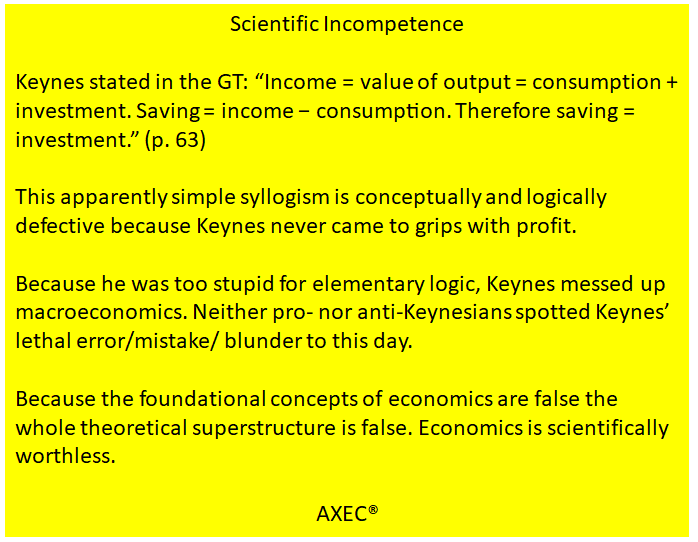
Here is the evidence from the General Theory: “Income = value of output = consumption + investment. Saving = income − consumption. Therefore saving = investment.” (p. 63)

This syllogism is conceptually and logically defective because Keynes did not come to grips with profit. “His Collected Writings show that he wrestled to solve the Profit Puzzle up till the semi-final versions of his GT but in the end he gave up and discarded the draft chapter dealing with it.” (Tómasson et al.)

Because profit is ill-defined, the whole theoretical superstructure of Keynesianism is false. #1 Let this sink in: Keynes had NO idea of the fundamental concepts of economics, viz., profit and income. Keynes, though, was not alone: “... one of the most convoluted and muddled areas in economic theory: the theory of profit.” (Mirowski) The fact is, the profit theory is false since Adam Smith. Economics is scientifically worthless for 200+ years.

What has to be done is to replace Keynes’s false macrofoundations with true macrofoundations. The elementary production-consumption economy is, for a start, defined by three macro axioms (Yw=WL, O=RL, C=PX), two conditions (X=O, C=Yw), and two definitions (monetary profit Qm≡C−Yw, monetary saving Sm≡Yw−C). The graphical representation is shown on Graphic. #2, #3


It always holds Qm≡−Sm, in other words, at the heart of the monetary economy is an identity: The business sector’s deficit equals the household sector’s surplus and vice versa. Put bluntly, the business sector's loss is the counterpart of the household sector's saving, and vice versa, profit is the counterpart of dissaving. This is the most elementary form of the macroeconomic Profit Law. It follows directly from the definition of the business sector’s monetary profit Qm≡C−Yw and the definition of the household sector’s monetary saving Sm≡Yw−C. From this immediately follows that Keynes’ foundational identity “Income = value of output” is false, and After-Keynesians have not realized it to this day.

For the investment economy, the Profit Law reads Qm≡I−Sm. Legend: Qm monetary profit, I investment expenditures, Sm monetary saving/dissaving. The business sector’s investment expenditures and the household sector’s saving/dissaving are completely INDEPENDENT and NEVER equal.

There is NO such thing as equality of investment and saving, neither ex-ante nor ex-post, and there is NO such thing as an equilibrium of I, and S. Keynes was too stupid to understand this, and After-Keynesians are even worse. #4

Egmont Kakarot-Handtke


#1 Why Post Keynesianism Is Not Yet a Science
#2 Graphic AXEC31 The elementary production-consumption economy
#3 How the intelligent non-economist can refute every economist hands down
#4 For details of the big picture, see cross-references Refutation of I=S and cross-references Keynesianism.

***
REPLY to Dirk Ehnts on Sep 1,3 see also here

You say: “I don’t understand your claim because it comes without any argument.”

The proof has been given that Qm≡−Sm in the pure production-consumption economy and Qm≡I−Sm in the elementary investment economy. In plain text, the proof says that saving and investment are NEVER equal. #1

You say: “Regarding wording, how about: ‘saving is the accounting record of investment’? I find it immensely useful!”

In their pathetic incompetence, economists got even the elementary mathematics of accounting wrong. #2 The wording ‘saving is the accounting record of investment’ is the very proof that economists cannot even put 2 and 2 together.

You say: “What I don’t find useful is the inclusion of profits in macroeconomic models.”

Macroeconomic profit exists, and economists should know and tell what it is. Neither orthodox nor heterodox economists do it, though, because they have no idea what the pivotal concept of their subject matter is. #3

You say: “Of course, the question of what drives investment needs to be attacked using the concept of profit, but that is a different question from what determines the level of unemployment, which was Keynes’ question in the GT!”

Keynes’ employment theory is false because I=S ― and, by implication, the multiplier ― is false, which, in turn, is false because Keynes never understood what profit is. #4

Because Keynes’ premise Income = value of output is false, ALL I=S/IS-LM models from Keynes/Hicks to Krugman/Ehnts are provably false. #5, #6

After-Keynesians are light-years behind the curve. The scientific level of economists in general and Dirk Ehnts, in particular, is worse than zero.

#1 How Keynes got macro wrong and Allais got it right and
The Three Fatal Mistakes of Yesterday Economics: Profit, I=S, Employment
#2 A tale of three accountants and cross-references Accounting
#3 Heterodoxy, too, is proto-scientific garbage
#4 Keynes’ Employment Function and the Gratuitous Phillips Curve Disaster
#5 Getting out of IS-LM = Getting out of despair
#6 Mr. Keynes, Prof. Krugman, IS-LM, and the End of Economics as We Know It

***
Graphic AXEC172


***

COMMENT on Nick Edmonds, Dirk Ehnts on Sep 5, see also here

Dirk Ehnts subscribes to: “S = I at all rates of investment. Y either definable as C+S or as C+I. S and I were opposite facets of the same phenomenon they did not need a rate of interest to bring them into equilibrium for they were at all times and in all conditions in equilibrium.”

Nick Edmonds maintains: “The expected real rate of interest is in some sense the price of savings and so, in principle, changes in this expected rate might be able to reconcile desired saving and desired investment. In a barter economy, goods for current delivery can be traded for promises of the same goods for future delivery.”

Keynes was right on two points: (i) he has to be credited for realizing that the economics of Jevons/Walras/Menger/Marshall was false at its core and that nothing less than a paradigm shift was needed, (ii) that economic analysis has to start with the ‘monetary theory of production’ and NOT with some silly barter economy of the Sraffa type. #1

From the analysis of the most elementary economic configuration, the pure production-consumption economy, follows for the balances Qm≡−Sm, in other words, at the heart of the monetary economy is an identity: the business sector’s deficit = loss (surplus = profit) equals the household sector’s surplus = saving (deficit = dissaving). Loss is the counterpart of saving, and profit is the counterpart of dissaving. This is the most elementary form of the macroeconomic Profit Law. #2

This, first of all, tells one that the profit theory is false since Smith and Ricardo. #3 And, secondly, this tells one that the theory of saving and investment is false by implication. It always holds Qm≡I−Sm, that is, investment and saving are NEVER equal, neither in accounting nor in reality. #4

All I=S/IS-LM models are provably false from Wicksell/Keynes/Hicks onward. Because MMT is built upon the false Keynesian balances equations it is false, too. #5


#1 The futile attempt to recycle Sraffa
#2 How the intelligent non-economist can refute every economist hands down
#3 When Ricardo Saw Profit, He Called It Rent: On the Vice of Parochial Realism
#4 Rectification of MMT macro accounting
#5 For the full-spectrum refutation of MMT, see cross-references MMT

April 4, 2017

The fundamental problem of economics: scientific incompetence aka stupidity

Comment on Dirk Ehnts on ‘Structuralist Macroeconomics’

Blog-Reference and Blog-Reference

The major approaches ― Walrasianism, Keynesianism, Marxianism, Austrianism ― are mutually contradictory, axiomatically false, materially/formally inconsistent, and all got the pivotal concept of the subject matter, i.e. profit, wrong. So, what we actually have is the pluralism of false theories.

The one thing that is common to all these failed approaches is that they do not get the fundamental economic concepts of profit and income right. This is like medieval physics before the concepts of force, mass, energy, etcetera were properly defined and understood.#1

Here is the point where economists go collectively over the cliff: “MACROECONOMICS begins with the notion that the value of saving generated by all participants in the economy must by one means or another come into equality with the value of investment in the short run.” (Lance Taylor, see intro)

The IS equality/equilibrium is false since the classics but Dirk Ehnts, too, does not get it: “I know from many conversations I had with students that the investment-savings inequality is very difficult to grasp and had my own problems in the context of planned investment / planned saving, but by now I am very certain.”

The fact of the matter is that the representative economist does not understand the pivotal concept of his subject matter and the elementary mathematics of accounting.

For the determination of monetary profit of the economy as a whole one has to start with the most elementary case of a pure consumption economy without investment, government, and foreign trade.#2 In this elementary economy three configurations are logically possible: (i) consumption expenditures are equal to wage income C=Yw, (ii) C is less than Yw, (iii) C is greater than Yw.

In case (i) the monetary saving of the household sector Sm≡Yw−C is zero and the monetary profit of the business sector Qm≡C−Yw, too, is zero.
In case (ii) monetary saving Sm is positive and the business sector makes a loss, i.e. Qm is negative.
In case (iii) monetary saving Sm is negative, i.e. the household sector dissaves, and the business sector makes a profit, i.e. Qm is positive.

It always holds Qm≡−Sm, in other words, loss is the counterpart of saving and profit is the counterpart of dissaving. This is the most elementary form of the macroeconomic Profit Law, which quite obviously satisfies the zero-sum requirement Qm+Sm=0 of macroeconomic accounting.

When distributed profits Yd and investment I are added the correct profit equation reads Qm≡Yd+I−Sm. Deficit spending of the household sector and profit distribution of the business sector are the determinants of total monetary profit in the market economy (ex government and foreign trade). Saving is NEVER equal to investment, neither ex-ante nor ex-post nor otherwise.#3

Failed economics has to fully replace false Walrasian microfoundations and false Keynesian macrofoundations by the true macrofoundations.

Egmont Kakarot-Handtke


#1 The Profit Theory is False Since Adam Smith
#2 The macrofoundations approach starts with three systemic (= behavior-free) axioms: (A0) The objectively given and most elementary configuration of the economy consists of the household and the business sector which in turn consists initially of one giant fully integrated firm. (A1) Yw=WL wage income Yw is equal to wage rate W times working hours. L, (A2) O=RL output O is equal to productivity R times working hours L, (A3) C=PX consumption expenditure C is equal to price P times quantity bought/sold X.
#3 For details of the big picture see cross-references Refutation of I=S