#Economics#FailedScience#Walrasianism, #Keynesianism, #Marxianism, #Austrianism, #MMT, are mutually contradictory, axiomatically false, materially/formally inconsistent, and all get #Profit wrong.
— E.K-H (@AXECorg) October 22, 2021
All models are false because all economists are stupidhttps://t.co/qC1uagmUdP pic.twitter.com/IajZHzO1H1
Showing posts sorted by relevance for query title:models. Sort by date Show all posts
Showing posts sorted by relevance for query title:models. Sort by date Show all posts
October 22, 2021
Occasional Tweets: Economic models are provably false

September 21, 2019
What’s wrong with DSGE models is the axiom set
Comment on David Glasner on ‘What’s Wrong with DSGE Models Is Not Representative Agency’
Blog-Reference
“When the premises are certain, true, and primary, and the conclusion formally follows from them, this is demonstration, and produces scientific knowledge of a thing.” (Aristotle)
Standard microeconomics is based on these hardcore propositions, i.e., verbalized axioms: “HC1 economic agents have preferences over outcomes; HC2 agents individually optimize subject to constraints; HC3 agent choice is manifest in interrelated markets; HC4 agents have full relevant knowledge; HC5 observable outcomes are coordinated, and must be discussed with reference to equilibrium states.” (Weintraub)
Because this set of hardcore propositions is shock-full of NONENTITIES, all models that are based upon it are proto-scientific garbage. The whole of Marginalism derives ultimately from the core behavioral assumption HC2, i.e., constrained optimization, which is a NONENTITY like the Tooth Fairy or the Easter Bunny. From the Walrasian axioms, the triad SS-function―DD-function―equilibrium is derived. All ends up eventually in General Equilibrium Theory.
Because the behavioral axioms are false, the whole of mainstream economics is false. This includes DSGE because it is just a variant of HC1 to HC5. The common denominator is that the axioms are behavioral. For deeper methodological reasons, which have been discussed elsewhere, macroeconomics has to be based on objective, behavior/agency-free, systemic axioms.
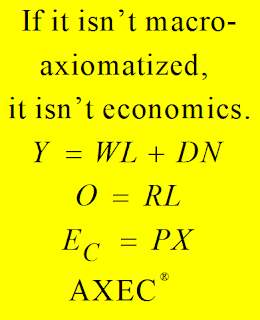
This is the correct core of premises: (A0) The objectively given and most elementary systemic configuration of the economy consists of the household and the business sector, which in turn consists initially of one giant fully integrated firm. (A1) Yw=WL wage income Yw is equal to wage rate W times working hours. L, (A2) O=RL output O is equal to productivity R times working hours L, (A3) C=PX consumption expenditure C is equal to price P times quantity bought/sold X.
These premises are “certain, true, and primary” and therefore satisfy all methodological requirements. The set is minimalistic; that is, Occam’s Razor has been applied, and the set cannot be reduced further, only expanded. The set contains no NONENTITIES like maximization or equilibrium and no normative assertions. All variables are measurable with the precision of two decimal places. Testability is built into the premises.
The price P follows as the dependent variable under the conditions of budget-balancing, i.e., C=Yw, and market-clearing, i.e., X=O, as P=W/R. This is the most elementary form of the macroeconomic Law of Supply and Demand. Accordingly, the real wage is W/P=R. The graphical representation of the macro-economy is given with AXEC31.
The monetary saving/dissaving of the household sector is defined as S≡Yw−C. The monetary profit/loss of the business sector is defined as Q≡C−Yw. It always holds Q≡−S, in other words, the balances of the business and the household sector always add up to zero. This is the Fundamental Law of Macroeconomic Accounting.
The mirror image of household sector saving S is business sector loss (-Q). The mirror image of household sector dissaving (-S) is business sector profit Q. Q≡−S is the elementary version of the macroeconomic Profit Law.
Given the minimalist core propositions (A0) to (A3), one has to proceed top-down by successive DIFFERENTIATION of sectors and firms until one arrives at the individual agent. The bottom-up approach, also called microfoundations, is methodologically false because it is (i) behavioral, and (ii) runs with necessity into the Fallacy of Composition. (A0) to (A3) fully replaces HC1 to HC5.
Economics is in need of a Paradigm Shift from false Walrasian microfoundations and false Keynesian macrofoundations to “certain, true, and primary” macrofoundations. Or as the Financial Times has it, “Time for a reset.” #1
Egmont Kakarot-Handtke
#1 Links on “Capitalism. Time for a reset.”
Related 'DSGE and profit―forget it! MMT and profit―forget it!' and 'The Ur-Blunder of economics and its rectification' and 'Economics: How to stop mental pollution and global dumbing' and 'The curious non-existence of profit in economics' and 'Where economics went wrong (II)' and 'The GDP-death-blow for the economics profession'. For details of the big picture, see cross-references Axiomatization.

Blog-Reference
“When the premises are certain, true, and primary, and the conclusion formally follows from them, this is demonstration, and produces scientific knowledge of a thing.” (Aristotle)
Standard microeconomics is based on these hardcore propositions, i.e., verbalized axioms: “HC1 economic agents have preferences over outcomes; HC2 agents individually optimize subject to constraints; HC3 agent choice is manifest in interrelated markets; HC4 agents have full relevant knowledge; HC5 observable outcomes are coordinated, and must be discussed with reference to equilibrium states.” (Weintraub)
Because this set of hardcore propositions is shock-full of NONENTITIES, all models that are based upon it are proto-scientific garbage. The whole of Marginalism derives ultimately from the core behavioral assumption HC2, i.e., constrained optimization, which is a NONENTITY like the Tooth Fairy or the Easter Bunny. From the Walrasian axioms, the triad SS-function―DD-function―equilibrium is derived. All ends up eventually in General Equilibrium Theory.
Because the behavioral axioms are false, the whole of mainstream economics is false. This includes DSGE because it is just a variant of HC1 to HC5. The common denominator is that the axioms are behavioral. For deeper methodological reasons, which have been discussed elsewhere, macroeconomics has to be based on objective, behavior/agency-free, systemic axioms.
This is the correct core of premises: (A0) The objectively given and most elementary systemic configuration of the economy consists of the household and the business sector, which in turn consists initially of one giant fully integrated firm. (A1) Yw=WL wage income Yw is equal to wage rate W times working hours. L, (A2) O=RL output O is equal to productivity R times working hours L, (A3) C=PX consumption expenditure C is equal to price P times quantity bought/sold X.
These premises are “certain, true, and primary” and therefore satisfy all methodological requirements. The set is minimalistic; that is, Occam’s Razor has been applied, and the set cannot be reduced further, only expanded. The set contains no NONENTITIES like maximization or equilibrium and no normative assertions. All variables are measurable with the precision of two decimal places. Testability is built into the premises.
The price P follows as the dependent variable under the conditions of budget-balancing, i.e., C=Yw, and market-clearing, i.e., X=O, as P=W/R. This is the most elementary form of the macroeconomic Law of Supply and Demand. Accordingly, the real wage is W/P=R. The graphical representation of the macro-economy is given with AXEC31.
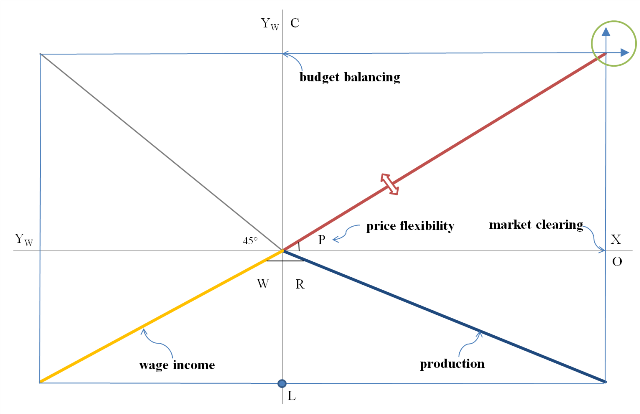 |
| Elementary production-consumption economy |
The monetary saving/dissaving of the household sector is defined as S≡Yw−C. The monetary profit/loss of the business sector is defined as Q≡C−Yw. It always holds Q≡−S, in other words, the balances of the business and the household sector always add up to zero. This is the Fundamental Law of Macroeconomic Accounting.
The mirror image of household sector saving S is business sector loss (-Q). The mirror image of household sector dissaving (-S) is business sector profit Q. Q≡−S is the elementary version of the macroeconomic Profit Law.
Given the minimalist core propositions (A0) to (A3), one has to proceed top-down by successive DIFFERENTIATION of sectors and firms until one arrives at the individual agent. The bottom-up approach, also called microfoundations, is methodologically false because it is (i) behavioral, and (ii) runs with necessity into the Fallacy of Composition. (A0) to (A3) fully replaces HC1 to HC5.
Economics is in need of a Paradigm Shift from false Walrasian microfoundations and false Keynesian macrofoundations to “certain, true, and primary” macrofoundations. Or as the Financial Times has it, “Time for a reset.” #1
Egmont Kakarot-Handtke
#1 Links on “Capitalism. Time for a reset.”
Related 'DSGE and profit―forget it! MMT and profit―forget it!' and 'The Ur-Blunder of economics and its rectification' and 'Economics: How to stop mental pollution and global dumbing' and 'The curious non-existence of profit in economics' and 'Where economics went wrong (II)' and 'The GDP-death-blow for the economics profession'. For details of the big picture, see cross-references Axiomatization.
For more on DSGE, see AXECquery

***
Mike Norman Economics Sep 23 |
| Source: Mike Norman Economics |
***
AXEC137b Axioms/Macrofoundations

***
Twitter Feb 12 “The problem lies ... with its core axioms.”
 |
| Source: Twitter |
***
INET Mar 8, 2021 Servaas Storm, The Standard Economic Paradigm is Based on Bad Modeling

July 6, 2019
The only thing we can learn from economic models is what proto-scientific garbage looks like
Comment on Lars Syll on ‘What can we learn from economic models?’
Blog-Reference
Economists in general and Lars Syll, in particular, are in a desperate struggle with scientific methodology: “Some economic methodologists have lately been arguing that economic models may well be considered ‘minimal models’ that portray ‘credible worlds’ without having to care about things like similarity, isomorphism, simplified representationality or resemblance to the real world. These models are said to resemble ‘realistic novels’ that portray ‘possible worlds’. And sure: economists constructing and working with that kind of models learn things about what might happen in those ‘possible worlds’. But is that really the stuff real science is made of? I think not.” and “Science has to be something more than just more or less realistic ‘story-telling’ or ‘explanatory fictionalism’. One has to provide decisive empirical evidence that what can be inferred in a model also helps us to uncover what actually goes on in the real world.”
Science consists of two essential elements: “Research is, in fact, a continuous discussion of the consistency of theories: formal consistency insofar as the discussion relates to the logical cohesion of what is asserted in joint theories; material consistency insofar as the agreement of observations with theories is concerned.” (Klant) Logical consistency is secured by applying the axiomatic-deductive method and empirical consistency is secured by applying state-of-art testing. Or, as Aristotle put it pack in 400 BC: “When the premises are certain, true, and primary, and the conclusion formally follows from them, this is demonstration, and produces scientific knowledge of a thing.”
So, it is well-known for a long time what scientific methodology is except among economists. The major approaches ― Walrasianism, Keynesianism, Marxianism, Austrianism, MMT ― are mutually contradictory, axiomatically false, materially/formally inconsistent, and all got profit ― the foundational concept of the subject matter ― wrong.
Of all imbeciles that open their mouths in economics, methodologists are the worst. They have consistently failed to spot elementary methodological blunders.#1 Economics is bad science but the economic methodology is even worse. This applies to Orthodoxy and Heterodoxy.#2, #3, #4, #5
Lars Syll’s critique is trivially true: “As long as one doesn’t come up with credible export warrants to real-world target systems and show how those models ― often building on idealizations with known to be false assumptions ― enhance our understanding or explanations about the real world, well, then they are just nothing more than just novels.” However, the heterodox methodologist Lars Syll NEVER came up with something better which, in turn, is acceptable because he is only a self-declared humble Humean Under-Labourer who is satisfied with “clearing Ground a little, and removing some of the Rubbish, that lies in the way to Knowledge.”
This is a bit unambitious because the premises of Orthodoxy are obviously idiotic. The hardcore propositions of microeconomics are given: “HC1 economic agents have preferences over outcomes; HC2 agents individually optimize subject to constraints; HC3 agent choice is manifest in interrelated markets; HC4 agents have full relevant knowledge; HC5 observable outcomes are coordinated, and must be discussed with reference to equilibrium states.” (Weintraub)
It is pretty obvious that this (verbalized) axiom set consists of multiple NONENTITIES and does NOT satisfy Aristotle’s criteria, viz. “certain, true, and primary”. Von Neumann identified the Walrasian approach as given with HC1 to HC5 as petitio principii, that is, as methodologically unacceptable. (TOG p. 15)#6 Keynes tried to replace microfoundations with macrofoundations, however, Keynesian macrofoundations are also materially/formally inconsistent.
So, what can we learn from economic models? All models that contain a NONENTITY are a priori false. In practical terms: as soon as one of the axioms HC1 to HC5 appears in an economics paper it can be thrown into the wastebasket. The same applies to all macroeconomic models that contain I=S. What we learn is that the greater part of peer-reviewed models that appear in flagship journals and in textbooks#7 is proto-scientific garbage and that both orthodox and heterodox economists have to be expelled from the sciences because of proven incompetence. Economists themselves are the “Rubbish, that lies in the way to Knowledge”.
Egmont Kakarot-Handtke
#1 How incompetent are economic methodologists? Very!
#2 Still in the proto-scientific wood
#3 The economist as storyteller
#4 Are economics professors really that incompetent? Yes!
#5 How to spot economics trolls
#6 The Palgrave Dictionary ― a comprehensive collection of False-Hero Memorials
#7 To this day*, economists have produced NOT ONE textbook that satisfies scientific standards
Related 'False models and true incompetence' and 'All models are false because all economists are stupid' and 'The Ur-Blunder of economics and its rectification' and 'From Keynes’ fatal blunder to the true economic model' and 'Infantile model bricolage, or, How many economists can dance on a non-existing pinpoint?' and 'Summary on ‘Musings on Whether We Consciously Know More or Less than What Is in Our Models…’' and 'Neoclassical growth theory: modeling gone nuts' and 'Failed economics: The losers’ long list of lame excuses' and 'From the pluralism of false models to the true economic theory' and 'Yes, orthodox economics is poor science, but can Heterodoxy raise hope?' and 'The canonical macroeconomic model'. For details of the big picture see cross-references Methodology.
Blog-Reference
Economists in general and Lars Syll, in particular, are in a desperate struggle with scientific methodology: “Some economic methodologists have lately been arguing that economic models may well be considered ‘minimal models’ that portray ‘credible worlds’ without having to care about things like similarity, isomorphism, simplified representationality or resemblance to the real world. These models are said to resemble ‘realistic novels’ that portray ‘possible worlds’. And sure: economists constructing and working with that kind of models learn things about what might happen in those ‘possible worlds’. But is that really the stuff real science is made of? I think not.” and “Science has to be something more than just more or less realistic ‘story-telling’ or ‘explanatory fictionalism’. One has to provide decisive empirical evidence that what can be inferred in a model also helps us to uncover what actually goes on in the real world.”
Science consists of two essential elements: “Research is, in fact, a continuous discussion of the consistency of theories: formal consistency insofar as the discussion relates to the logical cohesion of what is asserted in joint theories; material consistency insofar as the agreement of observations with theories is concerned.” (Klant) Logical consistency is secured by applying the axiomatic-deductive method and empirical consistency is secured by applying state-of-art testing. Or, as Aristotle put it pack in 400 BC: “When the premises are certain, true, and primary, and the conclusion formally follows from them, this is demonstration, and produces scientific knowledge of a thing.”
So, it is well-known for a long time what scientific methodology is except among economists. The major approaches ― Walrasianism, Keynesianism, Marxianism, Austrianism, MMT ― are mutually contradictory, axiomatically false, materially/formally inconsistent, and all got profit ― the foundational concept of the subject matter ― wrong.
Of all imbeciles that open their mouths in economics, methodologists are the worst. They have consistently failed to spot elementary methodological blunders.#1 Economics is bad science but the economic methodology is even worse. This applies to Orthodoxy and Heterodoxy.#2, #3, #4, #5
Lars Syll’s critique is trivially true: “As long as one doesn’t come up with credible export warrants to real-world target systems and show how those models ― often building on idealizations with known to be false assumptions ― enhance our understanding or explanations about the real world, well, then they are just nothing more than just novels.” However, the heterodox methodologist Lars Syll NEVER came up with something better which, in turn, is acceptable because he is only a self-declared humble Humean Under-Labourer who is satisfied with “clearing Ground a little, and removing some of the Rubbish, that lies in the way to Knowledge.”
This is a bit unambitious because the premises of Orthodoxy are obviously idiotic. The hardcore propositions of microeconomics are given: “HC1 economic agents have preferences over outcomes; HC2 agents individually optimize subject to constraints; HC3 agent choice is manifest in interrelated markets; HC4 agents have full relevant knowledge; HC5 observable outcomes are coordinated, and must be discussed with reference to equilibrium states.” (Weintraub)
It is pretty obvious that this (verbalized) axiom set consists of multiple NONENTITIES and does NOT satisfy Aristotle’s criteria, viz. “certain, true, and primary”. Von Neumann identified the Walrasian approach as given with HC1 to HC5 as petitio principii, that is, as methodologically unacceptable. (TOG p. 15)#6 Keynes tried to replace microfoundations with macrofoundations, however, Keynesian macrofoundations are also materially/formally inconsistent.
So, what can we learn from economic models? All models that contain a NONENTITY are a priori false. In practical terms: as soon as one of the axioms HC1 to HC5 appears in an economics paper it can be thrown into the wastebasket. The same applies to all macroeconomic models that contain I=S. What we learn is that the greater part of peer-reviewed models that appear in flagship journals and in textbooks#7 is proto-scientific garbage and that both orthodox and heterodox economists have to be expelled from the sciences because of proven incompetence. Economists themselves are the “Rubbish, that lies in the way to Knowledge”.
Egmont Kakarot-Handtke
#1 How incompetent are economic methodologists? Very!
#2 Still in the proto-scientific wood
#3 The economist as storyteller
#4 Are economics professors really that incompetent? Yes!
#5 How to spot economics trolls
#6 The Palgrave Dictionary ― a comprehensive collection of False-Hero Memorials
#7 To this day*, economists have produced NOT ONE textbook that satisfies scientific standards
Related 'False models and true incompetence' and 'All models are false because all economists are stupid' and 'The Ur-Blunder of economics and its rectification' and 'From Keynes’ fatal blunder to the true economic model' and 'Infantile model bricolage, or, How many economists can dance on a non-existing pinpoint?' and 'Summary on ‘Musings on Whether We Consciously Know More or Less than What Is in Our Models…’' and 'Neoclassical growth theory: modeling gone nuts' and 'Failed economics: The losers’ long list of lame excuses' and 'From the pluralism of false models to the true economic theory' and 'Yes, orthodox economics is poor science, but can Heterodoxy raise hope?' and 'The canonical macroeconomic model'. For details of the big picture see cross-references Methodology.
***
#PointOfProof
Jul 7
September 23, 2023
Occasional Xs: Clueless economists / Models (I)
#Economics#FailedFakeScience#ScientificIncompetence#Walrasianism, #Keynesianism, #Marxianism, #Austrianism etc. are axiomatically false & materially/formally inconsistent & ALL got #Profit wrong.
— E.K-H (@AXECorg) September 23, 2023
All models are false because all economists are stupidhttps://t.co/Uk1gI7FfD4
February 23, 2022
Occasion Tweets: The futile attempt to recycle New-Keynesian models
Folks who are ‘fans of flowcharts’ do NOT get the macroeconomic #Flows right and have NOT realized that #Economics suffers from #FlowBalanceInconsistency since Keynes messed up #MacroFoundations. For the 3-sector case holds for macro #Profit Q≡(I−S)+(G−T)+Yd. Where is it? pic.twitter.com/P7UhTehpMT
— E.K-H (@AXECorg) February 23, 2022
Macroeconomic #Profit is Q≡Ec−Yw≡(PR−W)L≡(P−W/R)RL for the case of market-clearing X=O. This follows from the correct set of #MacroFoundations. New-Keynesianism is methodologically indefensible. ⇒https://t.co/3x9c31peUB pic.twitter.com/2SHiWnzV7L
— E.K-H (@AXECorg) February 23, 2022
April 11, 2017
From the pluralism of false models to the true economic theory
Comment on Olivier Blanchard on ‘On the Need for (At Least) Five Classes of Macro Models’ #1
Blog-Reference
It is pretty obvious that economics is a failed science, and the main reason is the scientific incompetence of economists. After 200+ years, economists still do not understand what science is all about. The holy grail of science is the true theory: “In order to tell the politicians and practitioners something about causes and best means, the economist needs the true theory or else he has not much more to offer than educated common sense or his personal opinion.” (Stigum)
Scientific truth is well-defined as material and formal consistency. Progress is methodologically driven by the minimum principle, otherwise known as the economic principle. This was already perfectly clear to the great economist and methodologist J. S. Mill: “They [Einstein and Dirac] agreed that science was fundamentally about explaining more and more phenomena in terms of fewer and fewer theories, a view they had read in Mill’s A System of Logic.” (Farmelo)
Or, in Einstein’s words: “A theory is the more impressive the greater the simplicity of its premises, the more different kinds of things it relates, and the more extended is its area of applicability.”
Clueless economists run exactly in the OPPOSITE direction: “If you read Dani Rodrik’s book Economics Rules … you will see that economists have a large number of distinct models, and the problem that many economists spend their time solving is which model is most applicable to the problem they have been asked to solve.” (Simon Wren-Lewis)
The ‘large number of distinct models’ is NOT a virtue but the result of confused ad-hocism. The methodological degeneration of present-day economists finds its expression in Olivier Blanchard’s advocacy for at least five classes of macro models.
The first thing to notice is that current economics consists of microeconomics and macroeconomics, and both are based on inconsistent and incompatible foundations. #2 In methodological terms, economics lacks the consistent axiomatic core.
Walrasian microfoundations are given with: “HC1 economic agents have preferences over outcomes; HC2 agents individually optimize subject to constraints; HC3 agent choice is manifest in interrelated markets; HC4 agents have full relevant knowledge; HC5 observable outcomes are coordinated, and must be discussed with reference to equilibrium states.” (Weintraub, 1985)
Keynesian macrofoundations are given with: “Income = value of output = consumption + investment. Saving = income − consumption. Therefore saving = investment.” (GT, p. 63)
Walrasian microfoundations and Keynesian macrofoundations are forever unacceptable and have to be replaced by true macrofoundations. #3 For one, Blanchard is right, what is needed is an “alternative core from which to start”. In methodology, this is called a Paradigm Shift: “There is another alternative: to formulate a completely new research program and conceptual approach. As we have seen, this is often spoken of, but there is still no indication of what it might mean.” (Ingrao et al.)
In more detail, this means that methodological individualism, behavioral axioms, equilibrium, DSGE, RBC, IS-LM, New Keynesian models, and all the rest have to be thrown on the heap of proto-scientific garbage because the iron methodological rule says: If it isn’t macro-axiomatized, it isn’t economics.
Egmont Kakarot-Handtke
#1 See PIIE
#2 The futile synthesis of neoclassical rubbish and Keynesian garbage
#3 How to restart economics and From false micro to true macro: the new economic Paradigm
Related 'Economics: The pluralism of false theories is over' and 'Does Asad Zaman fly with POL or SCI Airlines?' and '10 steps to leave cargo cult economics behind for good' and 'Wikipedia, economics, scientific knowledge, or political agenda pushing?'. For details of the big picture, see cross-references Pluralism and cross-references Paradigm Shift and cross-references New Curriculum.

Blog-Reference
It is pretty obvious that economics is a failed science, and the main reason is the scientific incompetence of economists. After 200+ years, economists still do not understand what science is all about. The holy grail of science is the true theory: “In order to tell the politicians and practitioners something about causes and best means, the economist needs the true theory or else he has not much more to offer than educated common sense or his personal opinion.” (Stigum)
Scientific truth is well-defined as material and formal consistency. Progress is methodologically driven by the minimum principle, otherwise known as the economic principle. This was already perfectly clear to the great economist and methodologist J. S. Mill: “They [Einstein and Dirac] agreed that science was fundamentally about explaining more and more phenomena in terms of fewer and fewer theories, a view they had read in Mill’s A System of Logic.” (Farmelo)
Or, in Einstein’s words: “A theory is the more impressive the greater the simplicity of its premises, the more different kinds of things it relates, and the more extended is its area of applicability.”
Clueless economists run exactly in the OPPOSITE direction: “If you read Dani Rodrik’s book Economics Rules … you will see that economists have a large number of distinct models, and the problem that many economists spend their time solving is which model is most applicable to the problem they have been asked to solve.” (Simon Wren-Lewis)
The ‘large number of distinct models’ is NOT a virtue but the result of confused ad-hocism. The methodological degeneration of present-day economists finds its expression in Olivier Blanchard’s advocacy for at least five classes of macro models.
The first thing to notice is that current economics consists of microeconomics and macroeconomics, and both are based on inconsistent and incompatible foundations. #2 In methodological terms, economics lacks the consistent axiomatic core.
Walrasian microfoundations are given with: “HC1 economic agents have preferences over outcomes; HC2 agents individually optimize subject to constraints; HC3 agent choice is manifest in interrelated markets; HC4 agents have full relevant knowledge; HC5 observable outcomes are coordinated, and must be discussed with reference to equilibrium states.” (Weintraub, 1985)
Keynesian macrofoundations are given with: “Income = value of output = consumption + investment. Saving = income − consumption. Therefore saving = investment.” (GT, p. 63)
Walrasian microfoundations and Keynesian macrofoundations are forever unacceptable and have to be replaced by true macrofoundations. #3 For one, Blanchard is right, what is needed is an “alternative core from which to start”. In methodology, this is called a Paradigm Shift: “There is another alternative: to formulate a completely new research program and conceptual approach. As we have seen, this is often spoken of, but there is still no indication of what it might mean.” (Ingrao et al.)
In more detail, this means that methodological individualism, behavioral axioms, equilibrium, DSGE, RBC, IS-LM, New Keynesian models, and all the rest have to be thrown on the heap of proto-scientific garbage because the iron methodological rule says: If it isn’t macro-axiomatized, it isn’t economics.
Egmont Kakarot-Handtke
#1 See PIIE
#2 The futile synthesis of neoclassical rubbish and Keynesian garbage
#3 How to restart economics and From false micro to true macro: the new economic Paradigm
Related 'Economics: The pluralism of false theories is over' and 'Does Asad Zaman fly with POL or SCI Airlines?' and '10 steps to leave cargo cult economics behind for good' and 'Wikipedia, economics, scientific knowledge, or political agenda pushing?'. For details of the big picture, see cross-references Pluralism and cross-references Paradigm Shift and cross-references New Curriculum.
***
Graphic AXEC121g
November 9, 2015
The irreparable unreality of all ‘real’ models
Comment on David Glasner on ‘The Well-Defined, but Nearly Useless, Natural Rate of Interest’
Blog-Reference
Keynes had a great methodological insight: “In 1933, Keynes wrote a short contribution to a Festschrift for the German economist Arthur Spiethoff. He there attacked classical economists for not providing an adequate monetary theory. He then embarked upon the development of what he termed a monetary theory of production, a theory in which the interdependence of money and uncertainty, and their effects on economic behavior, could be properly investigated.” (Fontana, 2000, p. 40)
Keynes’ insight has been that the proper subject matter of economics is the monetary economy. Many economists have not got this point until today but still maintain that the ‘real’ economy is the real economy. It is definitively not.
And for one simple reason: the phenomenon of profit cannot appear at all in a ‘real’ economy (2011b). Because of this all ‘real’ models miss the essence of the market economy and are a priori worthless. This includes approaches like Ricardo, Sraffa, or RBC. This is Keynes’ lasting contribution to the advancement of theoretical economics: all ‘real’ models have to go out of the window because they are deeply and irreparably flawed.
The real-world economy manifests itself in the interaction of real and nominal variables. Because of this, the theory of saving, investment, and interest have to be developed within the framework of what Keynes called the ‘monetary theory of production’.
The real time travel, i.e. inventory accumulation/decumulation, is entirely disconnected from nominal time travel, i.e. saving/dissaving (2013). The same holds for capital accumulation/decumulation and saving/dissaving. And, most important of all, saving/dissaving is intimately connected with loss/profit. This connection is obviously important, yet it is entirely missing in the familiar theories of interest.
The crucial point is that the representative economist needs to understand what profit is (2011a). Because of this, the theory of interest is false by implication. The worst blunder consists of conceptualizing the natural rate as a real magnitude and in the futile attempt to derive interest from an apples-now-apples-later time preference model.
Egmont Kakarot-Handtke
References
Fontana, G. (2000). Post Keynesians and Circuitists on Money and Uncertainty: An Attempt at Generality. Journal of Post Keynesian Economics, 23(1): 27–48. URL
Kakarot-Handtke, E. (2011a). The Emergence of Profit and Interest in the Monetary
Circuit. SSRN Working Paper Series, 1973952: 1–22. URL
Kakarot-Handtke, E. (2011b). When Ricardo Saw Profit, He Called it Rent: On the Vice of Parochial Realism. SSRN Working Paper Series, 1932119: 1–19. URL
Kakarot-Handtke, E. (2013). Settling the Theory of Saving. SSRN Working Paper Series, 2220651: 1–23. URL
Related 'Debunking the natural rate of interest' and 'Are economists methodological retards?'.
Blog-Reference
Keynes had a great methodological insight: “In 1933, Keynes wrote a short contribution to a Festschrift for the German economist Arthur Spiethoff. He there attacked classical economists for not providing an adequate monetary theory. He then embarked upon the development of what he termed a monetary theory of production, a theory in which the interdependence of money and uncertainty, and their effects on economic behavior, could be properly investigated.” (Fontana, 2000, p. 40)
Keynes’ insight has been that the proper subject matter of economics is the monetary economy. Many economists have not got this point until today but still maintain that the ‘real’ economy is the real economy. It is definitively not.
And for one simple reason: the phenomenon of profit cannot appear at all in a ‘real’ economy (2011b). Because of this all ‘real’ models miss the essence of the market economy and are a priori worthless. This includes approaches like Ricardo, Sraffa, or RBC. This is Keynes’ lasting contribution to the advancement of theoretical economics: all ‘real’ models have to go out of the window because they are deeply and irreparably flawed.
The real-world economy manifests itself in the interaction of real and nominal variables. Because of this, the theory of saving, investment, and interest have to be developed within the framework of what Keynes called the ‘monetary theory of production’.
The real time travel, i.e. inventory accumulation/decumulation, is entirely disconnected from nominal time travel, i.e. saving/dissaving (2013). The same holds for capital accumulation/decumulation and saving/dissaving. And, most important of all, saving/dissaving is intimately connected with loss/profit. This connection is obviously important, yet it is entirely missing in the familiar theories of interest.
The crucial point is that the representative economist needs to understand what profit is (2011a). Because of this, the theory of interest is false by implication. The worst blunder consists of conceptualizing the natural rate as a real magnitude and in the futile attempt to derive interest from an apples-now-apples-later time preference model.
Egmont Kakarot-Handtke
References
Fontana, G. (2000). Post Keynesians and Circuitists on Money and Uncertainty: An Attempt at Generality. Journal of Post Keynesian Economics, 23(1): 27–48. URL
Kakarot-Handtke, E. (2011a). The Emergence of Profit and Interest in the Monetary
Circuit. SSRN Working Paper Series, 1973952: 1–22. URL
Kakarot-Handtke, E. (2011b). When Ricardo Saw Profit, He Called it Rent: On the Vice of Parochial Realism. SSRN Working Paper Series, 1932119: 1–19. URL
Kakarot-Handtke, E. (2013). Settling the Theory of Saving. SSRN Working Paper Series, 2220651: 1–23. URL
Related 'Debunking the natural rate of interest' and 'Are economists methodological retards?'.
February 27, 2026
Occasional X: Clueless economists / Models (III)
“Moreover, economic models are not intended as literal descriptions of reality. Lots of R2=1 predictions in them. So calibration and evaluation lets you focus on economically interesting moments, and ignore uninteresting rejections (R2=0.99).” (John Cochrane, answering to Jon…
— AXEC (@EgmontHandtke) February 27, 2026
September 26, 2016
All models are false because all economists are stupid
Comment on David Glasner on ‘Paul Romer on Modern Macroeconomics, Or, the “All Models Are False” Dodge’
Blog-Reference
Theoretical economics is science, and science is digital=binary=true/false and NOTHING in between. Political economics is the very opposite of science and it resides in the bottomless swamp between true/false where “... nothing is clear and everything is possible.” (Keynes, 1973, p. 292). One will invariably find that political economists adhere to the freak methodology of anything goes/nothing matters. #1
What David Glasner does not seem to realize in his laudable refutation of the silly ‘All models are wrong’ excuse is that with regard to simplification and abstraction and the deductive method, ALL has been said by the founding fathers:
In his recent paper, ‘The Trouble With Macroeconomics’ #2, Paul Romer puts DSGE and its main proponents ― Lucas, Sargent, Prescott ― to rest. In the final section ‘The Trouble Ahead For All of Economics’ he appeals to emotions: “It is sad to recognize that economists who made such important scientific contributions in the early stages of their careers followed a trajectory that took them away from science.”
While it is true that DSGE and its proponents are outside of science, it is NOT correct to give the impression that an accident happened at some point on the way that led from science to non-science. The fact of the matter is that DSGE has ALWAYS been outside of science because economics has ALWAYS been outside of science. The adherents to the DSGE/RBC program have done exactly what they were supposed to do: “It is a touchstone of accepted economics that all explanations must run in terms of the actions and reactions of individuals. Our behavior in judging economic research, in peer review of papers and research, and in promotions, includes the criterion that, in principle, the behavior we explain and the policies we propose are explicable in terms of individuals, not of other social categories.” (Arrow, 1994, p. 1)
This definition of the subject matter translates into the following set of hardcore propositions/axioms: “HC1 economic agents have preferences over outcomes; HC2 agents individually optimize subject to constraints; HC3 agent choice is manifest in interrelated markets; HC4 agents have full relevant knowledge; HC5 observable outcomes are coordinated, and must be discussed with reference to equilibrium states.” (Weintraub, 1985, p. 147)
The critical axioms are HC2 and HC5. Krugman put it nicely: “... most of what I and many others do is sorta-kinda neoclassical because it takes the maximization-and-equilibrium world as a starting point.”
It is obvious to anyone with a modicum of scientific instinct that the axiomatic starting point of orthodox economics is methodologically forever unacceptable. The axiom set consists of blatant NONENTITIES, but each student generation has swallowed it without turning an eyelid. Lucas, Sargent, and Prescott certainly did. This is scientifically disqualifying.
In order to be applicable, HC2, which translates formally into calculus, requires a lot of auxiliary assumptions, most prominently a well-behaved production function. Taken together, all axioms and auxiliary assumptions crystallize into SS-DD-equilibrium or what Leijonhufvud famously called the Totem of Micro/Macro.
Needless to stress that ALL THREE elements of the standard tool (SS-function, DD-function, equilibrium) are NONENTITIES. The fact that neither SS/DD functions nor an equilibrium exists leads with inescapable consequence to the identification problem in Econometrics (see Romer Sec. 4). Romer takes this insurmountable technical difficulty as a methodological silver bullet in order to finish off DSGE/RBC. It should be noted, though, that the identification problem has its roots in the Walrasian axiom set HC1/HC5, which is the accepted common ground of orthodox economics.
To throw DSGE/RBC unceremoniously out of science is only the first step because textbook supply-demand-equilibrium, which is built upon the same maximization-and-equilibrium axioms, is proto-scientific garbage since Jevons/Walras/Menger.
This is the current state of economics: Walrasian microfoundations are false for 150+ years, and Keynesian macrofoundations are false for 80+ years. As a consequence, roughly 90 percent of the content of peer-reviewed economic quality journals and 100 percent of textbooks is false.
To rise above the proto-scientific level requires a Paradigm Shift from Walrasian microfoundations and Keynes’ flawed macrofoundations to entirely new macrofoundations (2015). In methodological terms, rethinking macroeconomics requires the replacement of false axioms with true axioms and the dishonorable discharge of the Walrasian, Keynesian, Marxian, and Austrian crowd from science.
Egmont Kakarot-Handtke
References
Arrow, K. J. (1994). Methodological Individualism and Social Knowledge. American Economic Review, Papers and Proceedings, 84(2): 1–9. URL
Kakarot-Handtke, E. (2015). Major Defects of the Market Economy. SSRN Working Paper Series, 2624350: 1–40. URL
Keynes, J. M. (1973). The General Theory of Employment Interest and Money. London, Basingstoke: Macmillan.
Mill, J. S. (1874). Essays on Some Unsettled Questions of Political Economy. On the Definition of Political Economy; and on the Method of Investigation Proper To It. Library of Economics and Liberty. URL
Mill, J. S. (2006). A System of Logic Ratiocinative and Inductive. Being a Connected View of the Principles of Evidence and the Methods of Scientific Investigation, Vol. 8 of Collected Works of John Stuart Mill. Indianapolis: Liberty Fund.
Walras, L. (2010). Elements of Pure Economics. London, New York: Routledge.
Weintraub, E. R. (1985). Joan Robinson’s Critique of Equilibrium: An Appraisal. American Economic Review, Papers and Proceedings, 75(2): 146–149. URL
#1 Eclecticism, anything goes, and the pluralism of false theories
#2 The Trouble With Macroeconomics, Paul Romer, Paper of Sep 14, 2016
Related 'Economics between mathiness, dyscalculia and idiocy' and 'Schizonomics' and 'Modern macro moronism' and 'The methodological blunders of fake scientists' and 'If it isn’t macro-axiomatized, it isn’t economics' and 'Economics is a science? You must be joking!' and 'New economic thinking, or, let’s put lipstick on the dead pig' and 'Economists and the destructive power of stupidity' and 'Failed economics: The losers’ long list of lame excuses' and 'Economists: scientists or political clowns?' and 'There is no soft science only soft brains' and 'Wikipedia and the promotion of economists’ idiotism (II) ad 'Macroeconomics: Economists are too stupid for science' and 'The economist as storyteller' and 'Economists: Time to say goodbye' and 'Your economics is refuted on all counts: here is the real thing'.

Marie I. George Aristotle on Paideia of Principles
Blog-Reference
Theoretical economics is science, and science is digital=binary=true/false and NOTHING in between. Political economics is the very opposite of science and it resides in the bottomless swamp between true/false where “... nothing is clear and everything is possible.” (Keynes, 1973, p. 292). One will invariably find that political economists adhere to the freak methodology of anything goes/nothing matters. #1
What David Glasner does not seem to realize in his laudable refutation of the silly ‘All models are wrong’ excuse is that with regard to simplification and abstraction and the deductive method, ALL has been said by the founding fathers:
- “Any order of phenomena, however complicated, may be studied scientifically provided the rule of proceeding from the simple to the complex is always observed.” (Walras, 2010, p. 211)
- “The conclusions of geometry are not strictly true of such lines, angles, and figures, as human hands can construct. But no one, therefore, contends that the conclusions of geometry are of no utility, or that it would be better to shut up Euclid’s Elements, and content ourselves with ‘practice’ and ‘experience’.” (J. S. Mill, 1874, V.48)
- “The ground of confidence in any concrete deductive science is not the à priori reasoning itself, but the accordance between its results and those of observation à posteriori.” (Mill, 2006, p. 896)
In his recent paper, ‘The Trouble With Macroeconomics’ #2, Paul Romer puts DSGE and its main proponents ― Lucas, Sargent, Prescott ― to rest. In the final section ‘The Trouble Ahead For All of Economics’ he appeals to emotions: “It is sad to recognize that economists who made such important scientific contributions in the early stages of their careers followed a trajectory that took them away from science.”
While it is true that DSGE and its proponents are outside of science, it is NOT correct to give the impression that an accident happened at some point on the way that led from science to non-science. The fact of the matter is that DSGE has ALWAYS been outside of science because economics has ALWAYS been outside of science. The adherents to the DSGE/RBC program have done exactly what they were supposed to do: “It is a touchstone of accepted economics that all explanations must run in terms of the actions and reactions of individuals. Our behavior in judging economic research, in peer review of papers and research, and in promotions, includes the criterion that, in principle, the behavior we explain and the policies we propose are explicable in terms of individuals, not of other social categories.” (Arrow, 1994, p. 1)
This definition of the subject matter translates into the following set of hardcore propositions/axioms: “HC1 economic agents have preferences over outcomes; HC2 agents individually optimize subject to constraints; HC3 agent choice is manifest in interrelated markets; HC4 agents have full relevant knowledge; HC5 observable outcomes are coordinated, and must be discussed with reference to equilibrium states.” (Weintraub, 1985, p. 147)
The critical axioms are HC2 and HC5. Krugman put it nicely: “... most of what I and many others do is sorta-kinda neoclassical because it takes the maximization-and-equilibrium world as a starting point.”
It is obvious to anyone with a modicum of scientific instinct that the axiomatic starting point of orthodox economics is methodologically forever unacceptable. The axiom set consists of blatant NONENTITIES, but each student generation has swallowed it without turning an eyelid. Lucas, Sargent, and Prescott certainly did. This is scientifically disqualifying.
In order to be applicable, HC2, which translates formally into calculus, requires a lot of auxiliary assumptions, most prominently a well-behaved production function. Taken together, all axioms and auxiliary assumptions crystallize into SS-DD-equilibrium or what Leijonhufvud famously called the Totem of Micro/Macro.
Needless to stress that ALL THREE elements of the standard tool (SS-function, DD-function, equilibrium) are NONENTITIES. The fact that neither SS/DD functions nor an equilibrium exists leads with inescapable consequence to the identification problem in Econometrics (see Romer Sec. 4). Romer takes this insurmountable technical difficulty as a methodological silver bullet in order to finish off DSGE/RBC. It should be noted, though, that the identification problem has its roots in the Walrasian axiom set HC1/HC5, which is the accepted common ground of orthodox economics.
To throw DSGE/RBC unceremoniously out of science is only the first step because textbook supply-demand-equilibrium, which is built upon the same maximization-and-equilibrium axioms, is proto-scientific garbage since Jevons/Walras/Menger.
This is the current state of economics: Walrasian microfoundations are false for 150+ years, and Keynesian macrofoundations are false for 80+ years. As a consequence, roughly 90 percent of the content of peer-reviewed economic quality journals and 100 percent of textbooks is false.
To rise above the proto-scientific level requires a Paradigm Shift from Walrasian microfoundations and Keynes’ flawed macrofoundations to entirely new macrofoundations (2015). In methodological terms, rethinking macroeconomics requires the replacement of false axioms with true axioms and the dishonorable discharge of the Walrasian, Keynesian, Marxian, and Austrian crowd from science.
Egmont Kakarot-Handtke
References
Arrow, K. J. (1994). Methodological Individualism and Social Knowledge. American Economic Review, Papers and Proceedings, 84(2): 1–9. URL
Kakarot-Handtke, E. (2015). Major Defects of the Market Economy. SSRN Working Paper Series, 2624350: 1–40. URL
Keynes, J. M. (1973). The General Theory of Employment Interest and Money. London, Basingstoke: Macmillan.
Mill, J. S. (1874). Essays on Some Unsettled Questions of Political Economy. On the Definition of Political Economy; and on the Method of Investigation Proper To It. Library of Economics and Liberty. URL
Mill, J. S. (2006). A System of Logic Ratiocinative and Inductive. Being a Connected View of the Principles of Evidence and the Methods of Scientific Investigation, Vol. 8 of Collected Works of John Stuart Mill. Indianapolis: Liberty Fund.
Walras, L. (2010). Elements of Pure Economics. London, New York: Routledge.
Weintraub, E. R. (1985). Joan Robinson’s Critique of Equilibrium: An Appraisal. American Economic Review, Papers and Proceedings, 75(2): 146–149. URL
#1 Eclecticism, anything goes, and the pluralism of false theories
#2 The Trouble With Macroeconomics, Paul Romer, Paper of Sep 14, 2016
Related 'Economics between mathiness, dyscalculia and idiocy' and 'Schizonomics' and 'Modern macro moronism' and 'The methodological blunders of fake scientists' and 'If it isn’t macro-axiomatized, it isn’t economics' and 'Economics is a science? You must be joking!' and 'New economic thinking, or, let’s put lipstick on the dead pig' and 'Economists and the destructive power of stupidity' and 'Failed economics: The losers’ long list of lame excuses' and 'Economists: scientists or political clowns?' and 'There is no soft science only soft brains' and 'Wikipedia and the promotion of economists’ idiotism (II) ad 'Macroeconomics: Economists are too stupid for science' and 'The economist as storyteller' and 'Economists: Time to say goodbye' and 'Your economics is refuted on all counts: here is the real thing'.
Graphic AXEC121i

***
 |
| Source: Marie I. George |
June 22, 2022
Occasional Tweets: There are still folks around who have not realized that DSGE models are proto-scientific garbage
#Econ#Walrasianism, #Keynesianism, #Marxianism, #Austrianism, #MMT are mutually contradictory, axiomatically false, materially/formally inconsistent. And there are still folks around who have not realized that DSGE models are proto-scientific garbage. ⇒https://t.co/wUZPePdQFM pic.twitter.com/oKrlynYSps
— E.K-H (@AXECorg) June 22, 2022
January 8, 2016
Addendum to ‘Musings on Whether We Consciously Know More or Less than What Is in Our Models’
Blog-Reference (adapted from Blog-Reference) and Blog-Reference Economic hallucinations, comment on ‘DeLong, Summers & Krugman on models’
In the Middle Ages, savants were heavily occupied with questions like had Adam had a navel? or how many angels can dance on the head of a pin? Methodologically economics is roughly at the same stage. For more than 150 years economists are senselessly employed with the two major NONENTITIES equilibrium and constrained optimization.
As a loudspeaker of the profession, Krugman recently confirmed on his blog “most of what I and many others do is sorta-kinda neoclassical because it takes the maximization-and-equilibrium world as a starting point ...”.
This starting point has been properly codified as an axiom set “The [neo-Walrasian] program is organized around the following hardcore propositions:
HC1 There exist economic agents.
HC2 Agents have preferences over outcomes.
HC3 Agents independently optimize subject to constraints.
HC4 Choices are made in interrelated markets.
HC5 Agents have full relevant knowledge.
HC6 Observable economic outcomes are coordinated, so they must be discussed with reference to equilibrium states.” (Weintraub, 1985, p. 109)
The fact of the matter is that there is no such thing as an equilibrium in the economy. Methodologically, HC6 is what has been known since antiquity as petitio principii. This is quite a primitive methodological blunder. In 1990 equilibrium has been declared dead and the historians of economic thought ‘have finally hammered down the nails in this coffin’ (Blaug, 2001, p. 160).
Clearly, when one axiom fails the whole formal basis breaks apart, and with it the whole analytical superstructure.
There is no other way out of the calamity than to reconstruct economics without the concept of equilibrium. In methodology this is called a paradigm shift “There is another alternative: to formulate a completely new research program and conceptual approach. As we have seen, this is often spoken of, but there is still no indication of what it might mean.” (Ingrao et al., 1990, p. 362)
Obviously, there is until this very day ‘no indication of what it might mean’ to do economics without the NONENTITY equilibrium and the green cheese behavioral assumptions of constrained optimization and rational expectations.
The problem is not at all located where Krugman erroneously assumes: “The trouble is that the macroeconomic evidence can’t tell us when and where maximization-and-equilibrium goes wrong, ...”. The point is that these assumptions are not admissible in the first place. To admit nonentities to the set of economic axioms is even more bloodcurdling than to admit the Easter Bunny to the founding fathers of the United States.
A competent methodologist recognizes a petitio principii or a Fallacy of Composition or a NONENTITY when he sees one. And Popper did so “Now the rationality principle, which in the social sciences plays a role somewhat analogous to the universal laws of the natural sciences, is false, and if in addition the situational models are also false, then both the constituent elements of social theory are false.” (Popper, 1994, p. 173)
For the competent methodologist, there is only one logical consequence: he has to see to it that no economics paper that applies the rationality principle, constrained optimization, or equilibrium is accepted in the peer review process, or else he compromises the integrity of science which he is supposed to protect.
How Popper could throw away his own methodology and praise utility-maximizing economics on another occasion (1994, p. 154) is a question worthy of the further scrutiny of methodologists like Rosenberg who correctly assessed the cognitive status of economics.
“Economics is a perplexing subject. Though I have spent the better part of my academic career thinking about its aims and methods, I have never been confident that I or anyone else for that matter really understand its cognitive status. ... Without assurance about the cognitive status of the theory, there is no basis of confidence in it.” (1994, pp. 216-217)
The cognitive status of a theory that is axiomatically based on NONENTITIES is roughly the same as a hallucination.
That Krugman as ‘sorta-kinda maximization-and-equilibrium guy’ is still accepted as a scientist is scary enough but that the majority of economic methodologists let this happen without much comment is the ultimate proof of the professional implosion of economics.
Egmont Kakarot-Handtke
References
Blaug, M. (2001). No History of Ideas, Please, We’re Economists. Journal of Economic Perspectives, 15(1): 145–164.
Ingrao, B., and Israel, G. (1990). The Invisible Hand. Economic Equilibrium in the History of Science. Cambridge, London: MIT Press.
Popper, K. R. (1994). The Myth of the Framework. In Defence of Science and Rationality. London, New York: Routledge.
Rosenberg, A. (1994). What is the Cognitive Status of Economic Theory? In R. E. Backhouse (Ed.), New Directions in Economic Methodology, 216–235. London, New York: Routledge.
Weintraub, E. R. (1985). General Equilibrium Analysis. Cambridge, London, New York, etc.: Cambridge University Press.
Related Summary on ‘Musings on Whether We Consciously Know More or Less than What Is in Our Models…
In the Middle Ages, savants were heavily occupied with questions like had Adam had a navel? or how many angels can dance on the head of a pin? Methodologically economics is roughly at the same stage. For more than 150 years economists are senselessly employed with the two major NONENTITIES equilibrium and constrained optimization.
As a loudspeaker of the profession, Krugman recently confirmed on his blog “most of what I and many others do is sorta-kinda neoclassical because it takes the maximization-and-equilibrium world as a starting point ...”.
This starting point has been properly codified as an axiom set “The [neo-Walrasian] program is organized around the following hardcore propositions:
HC1 There exist economic agents.
HC2 Agents have preferences over outcomes.
HC3 Agents independently optimize subject to constraints.
HC4 Choices are made in interrelated markets.
HC5 Agents have full relevant knowledge.
HC6 Observable economic outcomes are coordinated, so they must be discussed with reference to equilibrium states.” (Weintraub, 1985, p. 109)
The fact of the matter is that there is no such thing as an equilibrium in the economy. Methodologically, HC6 is what has been known since antiquity as petitio principii. This is quite a primitive methodological blunder. In 1990 equilibrium has been declared dead and the historians of economic thought ‘have finally hammered down the nails in this coffin’ (Blaug, 2001, p. 160).
Clearly, when one axiom fails the whole formal basis breaks apart, and with it the whole analytical superstructure.
There is no other way out of the calamity than to reconstruct economics without the concept of equilibrium. In methodology this is called a paradigm shift “There is another alternative: to formulate a completely new research program and conceptual approach. As we have seen, this is often spoken of, but there is still no indication of what it might mean.” (Ingrao et al., 1990, p. 362)
Obviously, there is until this very day ‘no indication of what it might mean’ to do economics without the NONENTITY equilibrium and the green cheese behavioral assumptions of constrained optimization and rational expectations.
The problem is not at all located where Krugman erroneously assumes: “The trouble is that the macroeconomic evidence can’t tell us when and where maximization-and-equilibrium goes wrong, ...”. The point is that these assumptions are not admissible in the first place. To admit nonentities to the set of economic axioms is even more bloodcurdling than to admit the Easter Bunny to the founding fathers of the United States.
A competent methodologist recognizes a petitio principii or a Fallacy of Composition or a NONENTITY when he sees one. And Popper did so “Now the rationality principle, which in the social sciences plays a role somewhat analogous to the universal laws of the natural sciences, is false, and if in addition the situational models are also false, then both the constituent elements of social theory are false.” (Popper, 1994, p. 173)
For the competent methodologist, there is only one logical consequence: he has to see to it that no economics paper that applies the rationality principle, constrained optimization, or equilibrium is accepted in the peer review process, or else he compromises the integrity of science which he is supposed to protect.
How Popper could throw away his own methodology and praise utility-maximizing economics on another occasion (1994, p. 154) is a question worthy of the further scrutiny of methodologists like Rosenberg who correctly assessed the cognitive status of economics.
“Economics is a perplexing subject. Though I have spent the better part of my academic career thinking about its aims and methods, I have never been confident that I or anyone else for that matter really understand its cognitive status. ... Without assurance about the cognitive status of the theory, there is no basis of confidence in it.” (1994, pp. 216-217)
The cognitive status of a theory that is axiomatically based on NONENTITIES is roughly the same as a hallucination.
That Krugman as ‘sorta-kinda maximization-and-equilibrium guy’ is still accepted as a scientist is scary enough but that the majority of economic methodologists let this happen without much comment is the ultimate proof of the professional implosion of economics.
Egmont Kakarot-Handtke
References
Blaug, M. (2001). No History of Ideas, Please, We’re Economists. Journal of Economic Perspectives, 15(1): 145–164.
Ingrao, B., and Israel, G. (1990). The Invisible Hand. Economic Equilibrium in the History of Science. Cambridge, London: MIT Press.
Popper, K. R. (1994). The Myth of the Framework. In Defence of Science and Rationality. London, New York: Routledge.
Rosenberg, A. (1994). What is the Cognitive Status of Economic Theory? In R. E. Backhouse (Ed.), New Directions in Economic Methodology, 216–235. London, New York: Routledge.
Weintraub, E. R. (1985). General Equilibrium Analysis. Cambridge, London, New York, etc.: Cambridge University Press.
Related Summary on ‘Musings on Whether We Consciously Know More or Less than What Is in Our Models…
December 13, 2022
Occasional Tweets: Because all models are axiomatically false, economics is scientifically worthless
#Economics#FailedFakeScience#MicroFoundations
— E.K-H (@AXECorg) December 13, 2022
In his methodological incompetence, Roy Weintraub never realized that General Equilibrium Theory is axiomatically false and therefore scientifically worthless.
Don’t blame the model, blame the modelerhttps://t.co/txpyQx261N pic.twitter.com/UjW21EHkXA
For details of the big picture see cross-references Axiomatization.
December 27, 2017
False models and true incompetence
Comment on Chris Auld on ‘Derek Zoolander, spherical cows, the Guardian, and econophysics’
Blog-Reference and Blog-Reference
Economics is a failed science. The major approaches ― Walrasianism, Keynesianism, Marxianism, Austrianism ― are mutually contradictory, axiomatically false, materially/ formally inconsistent, and all got the foundational concept of the subject matter ― profit ― wrong.
Quite naturally, there are a lot of explanations/lame excuses swirling around. #1 One of them relates to the use of models: “Pop critics such as John Rapley should at least understand why economists use models with obviously false assumptions, they should understand why such models can be useful even they are wrong, and they should be aware that all sciences, not just economics, routinely use models with false assumptions.” (Chris Auld)
This is true, but the argument is nonetheless idiotic.
A chimpanzee can solve problems. For example, he can put chairs and boxes on top of each other and use a stick in order to get the bananas that the experimenter has fixed on the ceiling. Other chimpanzees then imitate the problem-solving strategy. This works fine until the problem situation changes such that the hitherto successful strategy fails and a new solution is required.
Let us call the creative problem solver a scientist. Economists, unfortunately, are only imitators/epigones/look-alikes: “They’re doing everything right. The form is perfect. ... But it doesn’t work. ... So I call these things cargo cult science because they follow all the apparent precepts and forms of scientific investigation, but they’re missing something essential.” (Feynman)
It is pretty obvious that economists fall into the category of cargo cult scientists; they lack genuine problem-solving capacity. The problem is NOT that they apply models and abstractions and simplifications and ‘unrealistic’ assumptions and mathematics, the problem is that they do not apply these scientific tools properly. They are incompetent imitators and do not really understand what science is all about. #2
One example suffices. Walrasian Orthodoxy is defined by these verbalized axioms: “HC1 economic agents have preferences over outcomes; HC2 agents individually optimize subject to constraints; HC3 agent choice is manifest in interrelated markets; HC4 agents have full relevant knowledge; HC5 observable outcomes are coordinated, and must be discussed with reference to equilibrium states.” (Weintraub)
The Walrasian hardcore contains three NONENTITIES ― HC2, HC4, HC5. To take equilibrium into the premises and then establish the properties of general equilibrium is a methodological blunder known since antiquity as petitio principii.
The basic question of economics is whether “the existing economic system is, in any significant sense, self-adjusting.” (Keynes) One simply cannot put the unknown answer into the premises. This is a primitive methodological blunder. Because of this, ALL equilibrium models are a priori false.
All this is known for 2300+ years: “When the premises are certain, true, and primary, and the conclusion formally follows from them, this is demonstration, and produces scientific knowledge of a thing.” (Aristotle)
But instead, this happened in economics: orthodox microfoundations, as well as Keynesian macrofoundations, are provably false. Economics has no valid axiomatic foundations; because of this, the whole analytical superstructure is false, and because of this, economic policy guidance NEVER has had valid scientific foundations.
Economists are simply scientifically incompetent.#3 Their striking mental deficiency is the Fallacy of Insufficient Abstraction. #4
Egmont Kakarot-Handtke
#1 Failed economics: The losers’ long list of lame excuses
#2 All models are false because all economists are stupid
#3 Throw them out! Orthodox and heterodox economists are unfit for science
#4 “The highest ambition an economist can entertain who believes in the scientific character of economics would be fulfilled as soon as he succeeded in constructing a simple model displaying all the essential features of the economic process by means of a reasonably small number of equations connecting a reasonably small number of variables. (Schumpeter, 1946)
Related 'Economics and the Fallacy of Insufficient Abstraction' and 'Petitio principii — economists’ biggest methodological mistake' and 'Replacing the neoclassical axioms' and 'Economists’ proto-scientific methodology' and 'Cranks? What cranks? That’s economics!' and 'Toolism! A Critique of EconoPhysics' and 'Dilettantes at the end of the coal-pit' and 'Macro for dummies'. For more details of the big picture, see cross-references Scientific Incompetence.
Blog-Reference and Blog-Reference
Economics is a failed science. The major approaches ― Walrasianism, Keynesianism, Marxianism, Austrianism ― are mutually contradictory, axiomatically false, materially/ formally inconsistent, and all got the foundational concept of the subject matter ― profit ― wrong.
Quite naturally, there are a lot of explanations/lame excuses swirling around. #1 One of them relates to the use of models: “Pop critics such as John Rapley should at least understand why economists use models with obviously false assumptions, they should understand why such models can be useful even they are wrong, and they should be aware that all sciences, not just economics, routinely use models with false assumptions.” (Chris Auld)
This is true, but the argument is nonetheless idiotic.
A chimpanzee can solve problems. For example, he can put chairs and boxes on top of each other and use a stick in order to get the bananas that the experimenter has fixed on the ceiling. Other chimpanzees then imitate the problem-solving strategy. This works fine until the problem situation changes such that the hitherto successful strategy fails and a new solution is required.
Let us call the creative problem solver a scientist. Economists, unfortunately, are only imitators/epigones/look-alikes: “They’re doing everything right. The form is perfect. ... But it doesn’t work. ... So I call these things cargo cult science because they follow all the apparent precepts and forms of scientific investigation, but they’re missing something essential.” (Feynman)
It is pretty obvious that economists fall into the category of cargo cult scientists; they lack genuine problem-solving capacity. The problem is NOT that they apply models and abstractions and simplifications and ‘unrealistic’ assumptions and mathematics, the problem is that they do not apply these scientific tools properly. They are incompetent imitators and do not really understand what science is all about. #2
One example suffices. Walrasian Orthodoxy is defined by these verbalized axioms: “HC1 economic agents have preferences over outcomes; HC2 agents individually optimize subject to constraints; HC3 agent choice is manifest in interrelated markets; HC4 agents have full relevant knowledge; HC5 observable outcomes are coordinated, and must be discussed with reference to equilibrium states.” (Weintraub)
The Walrasian hardcore contains three NONENTITIES ― HC2, HC4, HC5. To take equilibrium into the premises and then establish the properties of general equilibrium is a methodological blunder known since antiquity as petitio principii.
The basic question of economics is whether “the existing economic system is, in any significant sense, self-adjusting.” (Keynes) One simply cannot put the unknown answer into the premises. This is a primitive methodological blunder. Because of this, ALL equilibrium models are a priori false.
All this is known for 2300+ years: “When the premises are certain, true, and primary, and the conclusion formally follows from them, this is demonstration, and produces scientific knowledge of a thing.” (Aristotle)
But instead, this happened in economics: orthodox microfoundations, as well as Keynesian macrofoundations, are provably false. Economics has no valid axiomatic foundations; because of this, the whole analytical superstructure is false, and because of this, economic policy guidance NEVER has had valid scientific foundations.
Economists are simply scientifically incompetent.#3 Their striking mental deficiency is the Fallacy of Insufficient Abstraction. #4
Egmont Kakarot-Handtke
#1 Failed economics: The losers’ long list of lame excuses
#2 All models are false because all economists are stupid
#3 Throw them out! Orthodox and heterodox economists are unfit for science
#4 “The highest ambition an economist can entertain who believes in the scientific character of economics would be fulfilled as soon as he succeeded in constructing a simple model displaying all the essential features of the economic process by means of a reasonably small number of equations connecting a reasonably small number of variables. (Schumpeter, 1946)
Related 'Economics and the Fallacy of Insufficient Abstraction' and 'Petitio principii — economists’ biggest methodological mistake' and 'Replacing the neoclassical axioms' and 'Economists’ proto-scientific methodology' and 'Cranks? What cranks? That’s economics!' and 'Toolism! A Critique of EconoPhysics' and 'Dilettantes at the end of the coal-pit' and 'Macro for dummies'. For more details of the big picture, see cross-references Scientific Incompetence.
***
Graphic AXEC121i

August 30, 2015
Note on Old-Post-New Keynesian models
Blog-Reference
The conclusion “‘New Keynesian’ models are not too simple. They are just wrong” is beyond a reasonable doubt, but this applies also to ‘Old Keynesian’ models. See Why Post Keynesianism is not yet a science and Mr. Keynes, Prof. Krugman, IS-LM, and the end of economics as we know it.
For the summary on Wren-Lewis' DSGE models see Much change, no progress.
The conclusion “‘New Keynesian’ models are not too simple. They are just wrong” is beyond a reasonable doubt, but this applies also to ‘Old Keynesian’ models. See Why Post Keynesianism is not yet a science and Mr. Keynes, Prof. Krugman, IS-LM, and the end of economics as we know it.
For the summary on Wren-Lewis' DSGE models see Much change, no progress.
November 25, 2023
Occasional X: Clueless economists / Models (II)
#Econ#Walrasianism, #Keynesianism, #Marxianism, #Austrianism etc. are axiomatically false & materially/formally inconsistent & ALL got #Profit wrong. #Economics is scientifically worthless.
— E.K-H (@AXECorg) November 25, 2023
All models are false because all economists are stupidhttps://t.co/Uk1gI7FfD4
For more about models see AXECquery.
January 5, 2016
Summary on ‘Musings on Whether We Consciously Know More or Less than What Is in Our Models…’
Blog-Reference and Blog-Reference and Blog-Reference (Dec 6, slightly adapted)
“In order to tell the politicians and practitioners something about causes and best means, the economist needs the true theory or else he has not much more to offer than educated common sense or his personal opinion.” (Stigum, 1991, p. 30)
Economists do not have the true theory, they merely have a heap of incoherent models. These models are stand-alone constructs that are not held together by an overarching theory. To begin with, the relationship between theory (e.g. gravitation) and model (e.g. solar system) is poorly understood. In economics one has models but no theory.
The models, in turn, are built upon premises that are methodologically unacceptable. As a rule, economists do not know what is in their models, see The future of economics: why you will probably not be admitted to it, and why this is a good thing.
The common logical blunder of Walrasians, Keynesians, Marxians, and Austrians is that the elementary concepts of profit and income are incorrectly defined. Yet, profit is the pivotal concept for the analysis of how the economy works. Without a correct profit theory, economics is vacuous. Conventional profit theory is logically indefensible and because of this, the familiar economic models fail to capture the essence of the market economy. There are many opinions but no scientific understanding of how the economy works.
In general, it holds that the representative economist is at best dimly aware of the crucial distinction between opinion and knowledge which constitutes science since Aristotle: “There cannot be both opinion and knowledge of the same thing at the same time.” (Posterior Analytics, Wikipedia)
The discussion of Paul Krugman, Larry Summers, and Brad DeLong about methodology is roughly on the level of medieval witch hunters who exchange their opinions about whether the incubus or the succubus is a greater threat to humanity.
The scientific embarrassment of this sitcom consists of the plain fact that economists have no idea of what is in their logically defective, i.e. provable false, models.
Egmont Kakarot-Handtke
References
Stigum, B. P. (1991). Toward a Formal Science of Economics: The Axiomatic Method in Economics and Econometrics. Cambridge: MIT Press.
Related 'Economics is NOT a science of behavior' and 'Towards the true economic theory' and 'How economists became the scientific laughing stock' and 'The Ur-Blunder of economics and its rectification' and 'One entirely sufficient reason for the shutdown of economics'.
“In order to tell the politicians and practitioners something about causes and best means, the economist needs the true theory or else he has not much more to offer than educated common sense or his personal opinion.” (Stigum, 1991, p. 30)
Economists do not have the true theory, they merely have a heap of incoherent models. These models are stand-alone constructs that are not held together by an overarching theory. To begin with, the relationship between theory (e.g. gravitation) and model (e.g. solar system) is poorly understood. In economics one has models but no theory.
The models, in turn, are built upon premises that are methodologically unacceptable. As a rule, economists do not know what is in their models, see The future of economics: why you will probably not be admitted to it, and why this is a good thing.
The common logical blunder of Walrasians, Keynesians, Marxians, and Austrians is that the elementary concepts of profit and income are incorrectly defined. Yet, profit is the pivotal concept for the analysis of how the economy works. Without a correct profit theory, economics is vacuous. Conventional profit theory is logically indefensible and because of this, the familiar economic models fail to capture the essence of the market economy. There are many opinions but no scientific understanding of how the economy works.
In general, it holds that the representative economist is at best dimly aware of the crucial distinction between opinion and knowledge which constitutes science since Aristotle: “There cannot be both opinion and knowledge of the same thing at the same time.” (Posterior Analytics, Wikipedia)
The discussion of Paul Krugman, Larry Summers, and Brad DeLong about methodology is roughly on the level of medieval witch hunters who exchange their opinions about whether the incubus or the succubus is a greater threat to humanity.
The scientific embarrassment of this sitcom consists of the plain fact that economists have no idea of what is in their logically defective, i.e. provable false, models.
Egmont Kakarot-Handtke
References
Stigum, B. P. (1991). Toward a Formal Science of Economics: The Axiomatic Method in Economics and Econometrics. Cambridge: MIT Press.
Related 'Economics is NOT a science of behavior' and 'Towards the true economic theory' and 'How economists became the scientific laughing stock' and 'The Ur-Blunder of economics and its rectification' and 'One entirely sufficient reason for the shutdown of economics'.
April 27, 2018
Neoclassical growth theory: modeling gone nuts
Comment on Lars Syll on ‘Solow’s Nobel Prize lecture’
Blog-Reference
Solow summarizes: “The end result is a construction in which the whole economy is assumed to be solving a Ramsey optimal-growth problem through time, disturbed only by stationary stochastic shocks to tastes and technology. To these, the economy adapts optimally. Inseparable from this habit of thought is the automatic presumption that observed paths are equilibrium paths. So we are asked to regard the construction I have just described as a model of the actual capitalist world.”
Standard economics is based on this verbalized set of hardcore propositions a.k.a. axioms
What economists in their bottomless scientific incompetence have not realized in 150+ years is that HC3, HC5, and HC6 are plain NONENTITIES. The methodological point is this: every model that contains just one NONENTITY is a priori false. Methodologically, it holds that if the set of premises is false, the whole analytical superstructure is false.
Neoclassical growth theory applies a barrage of NONENTITIES. Among others #1
Economics has to move from microfoundations to macrofoundations. #3
Here is the correct starter set: (A0) The objectively given and most elementary systemic configuration of the (world-) economy consists of the household and the business sector, which in turn consists initially of one giant fully integrated firm.
Under the conditions of market-clearing X=O and budget-balancing C=Yw in each period, the price is given by P=W/R (1), i.e., the market-clearing price is equal to unit wage costs. This is the most elementary form of the macroeconomic Law of Supply and Demand.
Monetary profit for the economy as a whole is defined as Qm≡C−Yw, and monetary saving as Sm≡Yw−C. It always holds Qm≡−Sm, in other words, the business sector’s surplus = profit is equal to the household sector’s deficit = dissaving. Vice versa, the business sector’s deficit = loss equals the household sector’s surplus = saving. This is the most elementary form of the macroeconomic Profit Law. Under the condition of budget balancing, total monetary profit is zero.
Under the condition of market clearing and budget balancing, the elementary economy reduces to three independent variables, i.e., W, R, L, and the price P as the dependent variable. The changes from period to period are formally given by

In the next step, the condition of budget balancing has to be lifted. This brings saving/dissaving and profit/loss into existence. Note that in the Wikipedia article #1, the word profit does not appear once. For this reason alone, neoclassical growth models are NO representation of the “actual capitalist world”. #6 There is NO such thing as a capitalist world without profit/loss. Economists should know this.
To make matters short, the axiomatically correct macroeconomic Profit Law for an evolving economy is given here without further explanation. It holds, with Qm monetary profit/loss, Sm monetary saving/dissaving, I investment expenditures, G government spending, T taxes, X export, M import, Yd distributed profit
Egmont Kakarot-Handtke
#1 Wikipedia Ramsey–Cass–Koopmans model
#2 Equilirium
#3 True macrofoundations: the reset of economics
#4 How Keynes got macro wrong and Allais got it right
#5 Graphic AXEC25 Time evolution of the elementary production-consumption economy including profit distribution
#6 Profit and the collective failure of economists
#7 Infantile model bricolage, or, How many economists can dance on a non-existing pinpoint?
Related 'Squaring the Investment Cycle'.
Blog-Reference
Solow summarizes: “The end result is a construction in which the whole economy is assumed to be solving a Ramsey optimal-growth problem through time, disturbed only by stationary stochastic shocks to tastes and technology. To these, the economy adapts optimally. Inseparable from this habit of thought is the automatic presumption that observed paths are equilibrium paths. So we are asked to regard the construction I have just described as a model of the actual capitalist world.”
Standard economics is based on this verbalized set of hardcore propositions a.k.a. axioms
- HC1 There exist economic agents.
- HC2 Agents have preferences over outcomes.
- HC3 Agents independently optimize subject to constraints.
- HC4 Choices are made in interrelated markets.
- HC5 Agents have full relevant knowledge.
- HC6 Observable economic outcomes are coordinated, so they must be discussed with reference to equilibrium states. (Weintraub)
What economists in their bottomless scientific incompetence have not realized in 150+ years is that HC3, HC5, and HC6 are plain NONENTITIES. The methodological point is this: every model that contains just one NONENTITY is a priori false. Methodologically, it holds that if the set of premises is false, the whole analytical superstructure is false.
Neoclassical growth theory applies a barrage of NONENTITIES. Among others #1
- The representative consumer is supposed to solve an infinite-time utility-maximization problem. This is a priori false because utility and HC3 are NONENTITIES.
- Neoclassical growth models consist of real variables. This is false because the economy constitutes itself through the interaction of real AND nominal variables. There is no such thing as a ‘real’ economy; in other words, ALL ‘real’ models are a priori false.
- There is no such thing as an equilibrium or disequilibrium. In other words, ALL equilibrium models are a priori false. #2
- Profit is a nominal variable and cannot appear in a real model. The neoclassical profit theory is false.
- Economics has to be macrofounded because there is no way that leads from behavioral microfoundations to an understanding of how the economic system works.
Economics has to move from microfoundations to macrofoundations. #3
Here is the correct starter set: (A0) The objectively given and most elementary systemic configuration of the (world-) economy consists of the household and the business sector, which in turn consists initially of one giant fully integrated firm.
- (A1) Yw=WL wage income Yw is equal to wage rate W times working hours. L,
- (A2) O=RL output O is equal to productivity R times working hours L,
- (A3) C=PX consumption expenditure C is equal to price P times quantity bought/sold X.
Under the conditions of market-clearing X=O and budget-balancing C=Yw in each period, the price is given by P=W/R (1), i.e., the market-clearing price is equal to unit wage costs. This is the most elementary form of the macroeconomic Law of Supply and Demand.
Monetary profit for the economy as a whole is defined as Qm≡C−Yw, and monetary saving as Sm≡Yw−C. It always holds Qm≡−Sm, in other words, the business sector’s surplus = profit is equal to the household sector’s deficit = dissaving. Vice versa, the business sector’s deficit = loss equals the household sector’s surplus = saving. This is the most elementary form of the macroeconomic Profit Law. Under the condition of budget balancing, total monetary profit is zero.
Under the condition of market clearing and budget balancing, the elementary economy reduces to three independent variables, i.e., W, R, L, and the price P as the dependent variable. The changes from period to period are formally given by
- Wt=Wt-1(1+wt) The wage rate in period Wt is given by the wage rate in the previous period Wt-1 and the rate of change for the current period wt.
- Rt=Rt-1(1+rt) Analogous to the productivity.
- Lt=Lt-1(1+lt) Analogous for labor input.

For this equation, Computational Irreducibility in the sense of Stephen Wolfram, A New Kind of Science, Wolfram Media, 1959, pp. 737 ff. holds.
In the next step, the condition of budget balancing has to be lifted. This brings saving/dissaving and profit/loss into existence. Note that in the Wikipedia article #1, the word profit does not appear once. For this reason alone, neoclassical growth models are NO representation of the “actual capitalist world”. #6 There is NO such thing as a capitalist world without profit/loss. Economists should know this.
To make matters short, the axiomatically correct macroeconomic Profit Law for an evolving economy is given here without further explanation. It holds, with Qm monetary profit/loss, Sm monetary saving/dissaving, I investment expenditures, G government spending, T taxes, X export, M import, Yd distributed profit
- Qm≡−Sm in the elementary production-consumption economy,
- Qm≡I−Sm in the elementary investment economy (note I is NEVER equal Sm),
- Qm≡(G−T)+(I−Sm) in the investment economy with government deficit/surplus,
- Qm≡Yd+(X−M)+(G−T)+(I−Sm) in the open economy with distributed profit.
Egmont Kakarot-Handtke
#1 Wikipedia Ramsey–Cass–Koopmans model
#2 Equilirium
#3 True macrofoundations: the reset of economics
#4 How Keynes got macro wrong and Allais got it right
#5 Graphic AXEC25 Time evolution of the elementary production-consumption economy including profit distribution
#6 Profit and the collective failure of economists
#7 Infantile model bricolage, or, How many economists can dance on a non-existing pinpoint?
Related 'Squaring the Investment Cycle'.
April 30, 2016
Don’t blame the model, blame the modeler
Comment Lars Syll on ‘Krugman’s modeling flim flam’
Blog-Reference and Blog-Reference on May 3
You can make a model with the Earth in the center and the planets circling around, or you can make a model with the Sun in the center and the planets circling around. The model is just a realization of the underlying theory. The underlying theory in this example is the theory of gravitation, which is formally encapsulated in the inverse square law. This law has NOT been found by simple observation; it has been a mental construct. Gravitation can not be seen with the two natural eyes, only with the third eye of theory.
Model building is NOT the crucial part. It is the underlying theory that is decisive. Because a well-designed theory consists of premises as foundations and the theoretical superstructure as a logical consequence, the crucial part is ultimately the premises.
Standard economics is built upon this set of foundational propositions, a.k.a. axioms: “HC1 economic agents have preferences over outcomes; HC2 agents individually optimize subject to constraints; HC3 agent choice is manifest in interrelated markets; HC4 agents have full relevant knowledge; HC5 observable outcomes are coordinated, and must be discussed with reference to equilibrium states.” (Weintraub, 1985, p. 147)
Methodologically, these premises are forever unacceptable, but economists swallowed them hook, line, and sinker from Jevons/Walras/Menger onward to DSGE. The failure of methodological individualism is indisputable. The ultimate reason can be stated as an impossibility theorem: NO way leads from the explanation of individual behavior to the explanation of how the economic system works. The Fallacy of Composition is the lethal blunder of microfoundations.
Because of this, the microfoundations approach has already been dead in the cradle. This leaves only one option. As Joan Robinson put it: “Scrap the lot and start again.”
Keynes started the macrofoundations research program in the General Theory formally as follows: “Income = value of output = consumption + investment. Saving = income − consumption. Therefore saving = investment.” (1973, p. 63)
These formal foundations are conceptually and logically defective because Keynes never came to grips with profit and therefore “discarded the draft chapter dealing with it.” (Tómasson et al., 2010, p. 12).
Keynes’ original blunder kicked off a chain reaction of errors/mistakes:
• All I=S/IS-LM models are false since Keynes and Hicks (2011).
• Keynes’s profit conundrum has not been solved by After-Keynesians.
• Keynes got the Employment Law/Phillips curve wrong (2012).
So, for Keynesianism holds also: “Scrap the lot and start again.”
The situation is this: ALL models that have been built and are still being built on either the Walrasian or the Keynesian axioms are false.
What is Krugman doing? He writes on his blog: “most of what I and many others do is sorta-kinda neoclassical because it takes the maximization-and-equilibrium world as a starting point”.
From this, we can be sure that anything that Krugman ever said or will say has NO sound scientific foundation. ALL his models are defective because the Iron Methodological Law says: garbage in, garbage out. The quality of a model is determined by the scientific competence of its creator. No scientist will ever accept ‘maximization-and-equilibrium’ as a starting point for building an economic model. No scientist will ever accept Krugman.
Egmont Kakarot-Handtke
References
Kakarot-Handtke, E. (2011). Why Post Keynesianism is Not Yet a Science. SSRN Working Paper Series, 1966438: 1–20. URL
Kakarot-Handtke, E. (2012). Keynes’s Employment Function and the Gratuitous Phillips Curve Disaster. SSRN Working Paper Series, 2130421: 1–19. URL
Keynes, J. M. (1973). The General Theory of Employment Interest and Money. London, Basingstoke: Macmillan.
Tómasson, G., and Bezemer, D. J. (2010). What is the Source of Profit and Interest? A Classical Conundrum Reconsidered. MPRA Paper, 20557: 1–34. URL
Weintraub, E. R. (1985). Joan Robinson’s Critique of Equilibrium: An Appraisal. American Economic Review, Papers and Proceedings, 75(2): 146–149. URL
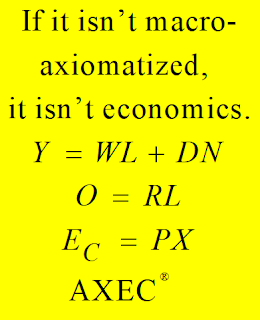
Blog-Reference and Blog-Reference on May 3
You can make a model with the Earth in the center and the planets circling around, or you can make a model with the Sun in the center and the planets circling around. The model is just a realization of the underlying theory. The underlying theory in this example is the theory of gravitation, which is formally encapsulated in the inverse square law. This law has NOT been found by simple observation; it has been a mental construct. Gravitation can not be seen with the two natural eyes, only with the third eye of theory.
Model building is NOT the crucial part. It is the underlying theory that is decisive. Because a well-designed theory consists of premises as foundations and the theoretical superstructure as a logical consequence, the crucial part is ultimately the premises.
Standard economics is built upon this set of foundational propositions, a.k.a. axioms: “HC1 economic agents have preferences over outcomes; HC2 agents individually optimize subject to constraints; HC3 agent choice is manifest in interrelated markets; HC4 agents have full relevant knowledge; HC5 observable outcomes are coordinated, and must be discussed with reference to equilibrium states.” (Weintraub, 1985, p. 147)
Methodologically, these premises are forever unacceptable, but economists swallowed them hook, line, and sinker from Jevons/Walras/Menger onward to DSGE. The failure of methodological individualism is indisputable. The ultimate reason can be stated as an impossibility theorem: NO way leads from the explanation of individual behavior to the explanation of how the economic system works. The Fallacy of Composition is the lethal blunder of microfoundations.
Because of this, the microfoundations approach has already been dead in the cradle. This leaves only one option. As Joan Robinson put it: “Scrap the lot and start again.”
Keynes started the macrofoundations research program in the General Theory formally as follows: “Income = value of output = consumption + investment. Saving = income − consumption. Therefore saving = investment.” (1973, p. 63)
These formal foundations are conceptually and logically defective because Keynes never came to grips with profit and therefore “discarded the draft chapter dealing with it.” (Tómasson et al., 2010, p. 12).
Keynes’ original blunder kicked off a chain reaction of errors/mistakes:
• All I=S/IS-LM models are false since Keynes and Hicks (2011).
• Keynes’s profit conundrum has not been solved by After-Keynesians.
• Keynes got the Employment Law/Phillips curve wrong (2012).
So, for Keynesianism holds also: “Scrap the lot and start again.”
The situation is this: ALL models that have been built and are still being built on either the Walrasian or the Keynesian axioms are false.
What is Krugman doing? He writes on his blog: “most of what I and many others do is sorta-kinda neoclassical because it takes the maximization-and-equilibrium world as a starting point”.
From this, we can be sure that anything that Krugman ever said or will say has NO sound scientific foundation. ALL his models are defective because the Iron Methodological Law says: garbage in, garbage out. The quality of a model is determined by the scientific competence of its creator. No scientist will ever accept ‘maximization-and-equilibrium’ as a starting point for building an economic model. No scientist will ever accept Krugman.
Egmont Kakarot-Handtke
References
Kakarot-Handtke, E. (2011). Why Post Keynesianism is Not Yet a Science. SSRN Working Paper Series, 1966438: 1–20. URL
Kakarot-Handtke, E. (2012). Keynes’s Employment Function and the Gratuitous Phillips Curve Disaster. SSRN Working Paper Series, 2130421: 1–19. URL
Keynes, J. M. (1973). The General Theory of Employment Interest and Money. London, Basingstoke: Macmillan.
Tómasson, G., and Bezemer, D. J. (2010). What is the Source of Profit and Interest? A Classical Conundrum Reconsidered. MPRA Paper, 20557: 1–34. URL
Weintraub, E. R. (1985). Joan Robinson’s Critique of Equilibrium: An Appraisal. American Economic Review, Papers and Proceedings, 75(2): 146–149. URL
***
Graphic AXEC121i
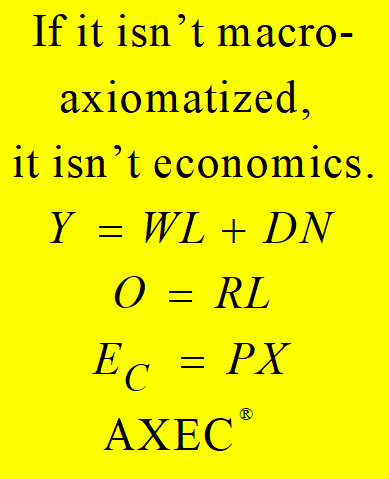
April 24, 2018
Infantile model bricolage, or, How many economists can dance on a non-existing pinpoint?
Comment on Brian Romanchuk on ‘Forecastability And Economic Modelling’
Blog-Reference and Blog-Reference
“The highest ambition an economist can entertain who believes in the scientific character of economics would be fulfilled as soon as he succeeded in constructing a simple model displaying all the essential features of the economic process by means of a reasonably small number of equations connecting a reasonably small number of variables. Work on this line is laying the foundations of the economics of the future . . .” (Schumpeter, 1946)
The future is now, and economists still do NOT have the paradigmatic simple core model but a heap of incommensurable and contradicting constructions. Pluralism may have its merits elsewhere, but it is the worst thing that can happen in science. As the ancient Greeks already observed: “There are always many different opinions and conventions concerning any one problem or subject-matter…. This shows that they are not all true. For if they conflict, then at best only one of them can be true.” (Popper)
The fact is that, in economics, ALL models are axiomatically false. It holds: “When the premises are certain, true, and primary, and the conclusion formally follows from them, this is demonstration, and produces scientific knowledge of a thing.” (Aristotle, 300 BC) The fact is that the premises of current models are neither certain, true, nor primary.
Brian Romanchuk’s SIM model is a case in point. He enumerates his key premises as follows.
Let us contrast this with the standard microfoundations approach. The whole analytical superstructure of Orthodoxy is based upon this set of hardcore propositions a.k.a. axioms:
In order to be applicable HC3, requires a lot of auxiliary assumptions, most prominently a well-behaved/differentiable production function. #2 Taken together, all axioms and auxiliary assumptions then crystallize to supply-function/demand-function/equilibrium or what Leijonhufvud famously called the Totem of Micro. #3
The methodological fact of the matter is that ALL models that take just one NONENTITY into the premises are a priori false. #4
So, because these premises are NOT “certain, true, and primary” they cannot be used for model building: expected utility, rationality/bounded rationality/animal spirits, constrained optimization, well-behaved production functions, supply/demand functions, simultaneous adaptation, equilibrium, first/second derivatives, total income=value of output, I=S, real-number quantities/prices, ergodicity. Every theory/model that contains just one NONENTITY goes straight into the wastebasket.
The standard microfoundations approach, with all its variants and derivatives up to DSGE, is methodologically false. The same holds for Keynes’ macrofoundations and all After-Keynesian variants.
To put NONENTITIES into the premises is the defining characteristic of fairy tales, science fiction, theology, Hollywood movies, politics, proto-science, and the senseless model bricolage of scientifically incompetent economists. #5
Egmont Kakarot-Handtke
#1 The solemn burial of marginalism
#2 Putting the production function back on its feet
#3 Equilibrium and the violation of a fundamental principle of science
#4 The future of economics: why you will probably not be admitted to it, and why this is a good thing
#5 How to restart economics
Graphic AXEC121e

Blog-Reference and Blog-Reference
“The highest ambition an economist can entertain who believes in the scientific character of economics would be fulfilled as soon as he succeeded in constructing a simple model displaying all the essential features of the economic process by means of a reasonably small number of equations connecting a reasonably small number of variables. Work on this line is laying the foundations of the economics of the future . . .” (Schumpeter, 1946)
The future is now, and economists still do NOT have the paradigmatic simple core model but a heap of incommensurable and contradicting constructions. Pluralism may have its merits elsewhere, but it is the worst thing that can happen in science. As the ancient Greeks already observed: “There are always many different opinions and conventions concerning any one problem or subject-matter…. This shows that they are not all true. For if they conflict, then at best only one of them can be true.” (Popper)
The fact is that, in economics, ALL models are axiomatically false. It holds: “When the premises are certain, true, and primary, and the conclusion formally follows from them, this is demonstration, and produces scientific knowledge of a thing.” (Aristotle, 300 BC) The fact is that the premises of current models are neither certain, true, nor primary.
Brian Romanchuk’s SIM model is a case in point. He enumerates his key premises as follows.
- The model is a straightforward three-sector model, with a household sector, business sector, and government.
- The household consumption function is defined in terms of a pair of propensity to consume parameters (out of income, out of wealth). …
- The business sector is constrained to break even, …
- Government policy is specified in terms of government consumption and a fixed tax rate.
Let us contrast this with the standard microfoundations approach. The whole analytical superstructure of Orthodoxy is based upon this set of hardcore propositions a.k.a. axioms:
- HC1 There exist economic agents.
- HC2 Agents have preferences over outcomes.
- HC3 Agents independently optimize subject to constraints.
- HC4 Choices are made in interrelated markets.
- HC5 Agents have full relevant knowledge.
- HC6 Observable economic outcomes are coordinated, so they must be discussed with reference to equilibrium states. (Weintraub)
In order to be applicable HC3, requires a lot of auxiliary assumptions, most prominently a well-behaved/differentiable production function. #2 Taken together, all axioms and auxiliary assumptions then crystallize to supply-function/demand-function/equilibrium or what Leijonhufvud famously called the Totem of Micro. #3
The methodological fact of the matter is that ALL models that take just one NONENTITY into the premises are a priori false. #4
So, because these premises are NOT “certain, true, and primary” they cannot be used for model building: expected utility, rationality/bounded rationality/animal spirits, constrained optimization, well-behaved production functions, supply/demand functions, simultaneous adaptation, equilibrium, first/second derivatives, total income=value of output, I=S, real-number quantities/prices, ergodicity. Every theory/model that contains just one NONENTITY goes straight into the wastebasket.
The standard microfoundations approach, with all its variants and derivatives up to DSGE, is methodologically false. The same holds for Keynes’ macrofoundations and all After-Keynesian variants.
To put NONENTITIES into the premises is the defining characteristic of fairy tales, science fiction, theology, Hollywood movies, politics, proto-science, and the senseless model bricolage of scientifically incompetent economists. #5
Egmont Kakarot-Handtke
#1 The solemn burial of marginalism
#2 Putting the production function back on its feet
#3 Equilibrium and the violation of a fundamental principle of science
#4 The future of economics: why you will probably not be admitted to it, and why this is a good thing
#5 How to restart economics
***
Graphic AXEC121e

February 3, 2021
Occasional Tweets: A new business model for science
New therapies/vaccines are invented/developed by #Scientists and NOT by #Markets.#NapoleonRule: “When there are scientific problems to solve, keep #Economists out of the way.”
— E.K-H (@AXECorg) February 3, 2021
Economists are #Clowns and #UsefulIdiots in the political #CircusMaximus. ⇒https://t.co/SyFCKMbDmx pic.twitter.com/Ly5ZEqNnTM
That scientists work for firms is a historical accident and in NO way intrinsic to #Science. Genuine scientists are fed up with working under the direction of a stupid/corrupt #Management and with funding by the #Oligarchy. Time for a new business model.⇒https://t.co/27nihlYGSu
— E.K-H (@AXECorg) February 3, 2021
Subscribe to:
Posts (Atom)