#Economics#AllYouNeedToKnow
— AXEC (@EgmontHandtke) May 2, 2025
Since the founding fathers, economics has been failed/fake science. To this day, economists have been unable to apply the proper mathematical tool to their subject matter. Unfortunately, they are even too stupid for the elementary algebra that… pic.twitter.com/TjD1cVkfkG
Showing posts sorted by relevance for query title:math. Sort by date Show all posts
Showing posts sorted by relevance for query title:math. Sort by date Show all posts
May 2, 2025
Occasional X: Economics and math ― they just can't get it together (VI)

January 31, 2016
Economists cannot do the simple math of profit — better keep them out of politics
Comment on Dean Baker on ‘Paul Krugman, Bernie Sanders, and the Experts’
Blog-Reference and Blog-Reference and Blog-Reference on Feb 3
Economists are supposed to be experts on the economy. So it is quite natural to think that they know what profit is; after all, this is the foundational concept of their subject matter. Yet, this is definitely not the case. This means that economists give economic policy advice without having a true understanding of the market economy. This holds for Walrasians, Keynesians, Marxians, and Austrians.
This is not to say, of course, that economists know nothing. In fact, they know some easy-to-grasp practical, institutional, or historical details. This, though, is not what science is all about. When the task is to explain how the universe works, and the astronomer goes on describing in great detail how his kitchen works, then one is inclined to think that this expert is a moron.
The situation is analogous in economics. You have many experts talk about whether the Fed should or should not lower the interest rate, but all these guys have no idea of how the market system works because they have not figured out since Econ 101 what the crucial difference between profit and income is.
All this is by no means new or some hidden secret of the profession. Every economist knows or can know because it is in the Palgrave Dictionary that “A satisfactory theory of profits is still elusive.” (Desai, 2008, p. 10)
So, the simple fact is that economists do not know what profit is, and this means that they do not know how the market system works, and this, in turn, means that their economic policy advice has NO valid scientific foundations.
When economists talk about the economy, this is storytelling decorated with some charts of crossing curves and exemplified with some actual numbers. It looks more scientific than tea leaves reading, clearly, an economic model that is based on nonentities and inconsistent concepts is not different in principle from a cup of tea leaves.
The fact of the matter is that economists are incompetent scientists who fail already at the level of elementary math. This assertion, of course, needs formal proof.
This is the set of premises to start with (each step of the argument can be checked on the back of an envelope by inserting arbitrary numbers for L, W, R)
(A0) The objectively given and most elementary configuration of the (world-) economy consists of the household and the business sector, which in turn consists initially of one giant fully integrated firm.
(A1) Yw=WL wage income Yw is equal to wage rate W times working hours. L,
(A2) O=RL output O is equal to productivity R times working hours L,
(A3) C=PX consumption expenditure C is equal to price P times quantity bought/sold X.
These premises are certain, true, and primary, and therefore satisfy all methodological requirements. The set of premises is minimal, that is, it cannot be reduced further, only expanded. The set contains no nonentities like maximization or equilibrium and no normative assertions. For the graphical representation, see Graphic AXEC31

At any given level of employment L, the wage income Yw that is generated in the consolidated business sector follows by multiplication with the wage rate W. On the real side, output O follows by multiplication with the productivity R. Finally, the price P follows as the dependent variable under the conditions of budget balancing, i.e., C=Yw, and market clearing, i.e., X=O. Note that the ray in the southeastern quadrant is not a linear production function; the ray tracks any underlying production function. Note also that the wage rate W is an average when the individual wage rates are different among the employees, which is normally the case.
Under the conditions of market-clearing and budget-balancing in each period, the price is derived as P=W/R (1), i.e., the market-clearing price is always equal to unit wage costs. This is the most elementary form of the macroeconomic Law of Supply and Demand.
If the wage rate W is lowered, the market-clearing price P falls. If the number of working hours L is increased, the price remains constant, provided productivity R does not change. If productivity decreases, the price P rises. If productivity increases, the price falls. In any case, labor gets the whole product, the real wage W/P is invariably equal to the productivity R according to (1), and profit for the business sector as a whole is zero. All changes in the system are reflected by the market-clearing price. The most elementary economy is reproducible for an indefinite number of periods. For the inclusion of money, see (2014).
Defining a reproducible minimal economy and making its properties absolutely transparent has been the first step. With the second step, the conditions of market clearing and budget balancing have to be lifted. This produces the phenomena of inventory changes (O−X>0 or <0) and of saving/dissaving (Yw−C>0 or <0) and of profit/loss (C−Yw>0 or <0).
One has three logical cases for the household sector Sm≡ Yw−C>0, <0, =0, that is, the household sector either saves Sm>0, dissaves Sm<0, or balances the budget Sm=0.
One has three logical cases for the business sector Qm≡C−Yw>0, <0, =0, that is, the business sector either makes a profit Qm>0, a loss Qm<0 or breaks even Qm=0.
The balances of the two sectors add up to zero Sm+Qm=0. This follows directly from the definition of saving/dissaving Sm and profit/loss Qm.
This gives one the most elementary version of the macroeconomic Profit Law: profit is positive if the households dissave (increase debt/decrease financial assets) and negative if the households save, that is, Qm≡−Sm. So profit for the economy as a whole has nothing to do with productivity, the wage rate, risk, or any other of the usual explanations that stem from the observation of a single firm among many others. In fact, exactly here is where error/mistake comes in because what is true for a single firm is not true for the economy as a whole. This logical blunder of the representative economist is well-known as the Fallacy of Composition.
In science, there is no need at all to believe in anything. Science is not about credibility or an expert opinion, or whether the scientist is simpatico, but alone about proof, that is, logical and empirical consistency.
Imagine a simple experiment for the ongoing election campaigns. Ask every economist who comes along with a proposal on how to fix the economy about their underlying model. Check what this model says about profit. Admit only those economists to a public discussion whose profit theory is correct — the silence will be deafening.
Egmont Kakarot-Handtke
References
Desai, M. (2008). Profit and Profit Theory. In S. N. Durlauf, and L. E. Blume (Eds.), The New Palgrave Dictionary of Economics Online, 1–11. Palgrave Macmillan, 2nd edition. URL
Kakarot-Handtke, E. (2014). Economics for Economists. SSRN Working Paper Series, 2517242: 1–29. URL
Blog-Reference and Blog-Reference and Blog-Reference on Feb 3
Economists are supposed to be experts on the economy. So it is quite natural to think that they know what profit is; after all, this is the foundational concept of their subject matter. Yet, this is definitely not the case. This means that economists give economic policy advice without having a true understanding of the market economy. This holds for Walrasians, Keynesians, Marxians, and Austrians.
This is not to say, of course, that economists know nothing. In fact, they know some easy-to-grasp practical, institutional, or historical details. This, though, is not what science is all about. When the task is to explain how the universe works, and the astronomer goes on describing in great detail how his kitchen works, then one is inclined to think that this expert is a moron.
The situation is analogous in economics. You have many experts talk about whether the Fed should or should not lower the interest rate, but all these guys have no idea of how the market system works because they have not figured out since Econ 101 what the crucial difference between profit and income is.
All this is by no means new or some hidden secret of the profession. Every economist knows or can know because it is in the Palgrave Dictionary that “A satisfactory theory of profits is still elusive.” (Desai, 2008, p. 10)
So, the simple fact is that economists do not know what profit is, and this means that they do not know how the market system works, and this, in turn, means that their economic policy advice has NO valid scientific foundations.
When economists talk about the economy, this is storytelling decorated with some charts of crossing curves and exemplified with some actual numbers. It looks more scientific than tea leaves reading, clearly, an economic model that is based on nonentities and inconsistent concepts is not different in principle from a cup of tea leaves.
The fact of the matter is that economists are incompetent scientists who fail already at the level of elementary math. This assertion, of course, needs formal proof.
This is the set of premises to start with (each step of the argument can be checked on the back of an envelope by inserting arbitrary numbers for L, W, R)
(A0) The objectively given and most elementary configuration of the (world-) economy consists of the household and the business sector, which in turn consists initially of one giant fully integrated firm.
(A1) Yw=WL wage income Yw is equal to wage rate W times working hours. L,
(A2) O=RL output O is equal to productivity R times working hours L,
(A3) C=PX consumption expenditure C is equal to price P times quantity bought/sold X.
These premises are certain, true, and primary, and therefore satisfy all methodological requirements. The set of premises is minimal, that is, it cannot be reduced further, only expanded. The set contains no nonentities like maximization or equilibrium and no normative assertions. For the graphical representation, see Graphic AXEC31

At any given level of employment L, the wage income Yw that is generated in the consolidated business sector follows by multiplication with the wage rate W. On the real side, output O follows by multiplication with the productivity R. Finally, the price P follows as the dependent variable under the conditions of budget balancing, i.e., C=Yw, and market clearing, i.e., X=O. Note that the ray in the southeastern quadrant is not a linear production function; the ray tracks any underlying production function. Note also that the wage rate W is an average when the individual wage rates are different among the employees, which is normally the case.
Under the conditions of market-clearing and budget-balancing in each period, the price is derived as P=W/R (1), i.e., the market-clearing price is always equal to unit wage costs. This is the most elementary form of the macroeconomic Law of Supply and Demand.
If the wage rate W is lowered, the market-clearing price P falls. If the number of working hours L is increased, the price remains constant, provided productivity R does not change. If productivity decreases, the price P rises. If productivity increases, the price falls. In any case, labor gets the whole product, the real wage W/P is invariably equal to the productivity R according to (1), and profit for the business sector as a whole is zero. All changes in the system are reflected by the market-clearing price. The most elementary economy is reproducible for an indefinite number of periods. For the inclusion of money, see (2014).
Defining a reproducible minimal economy and making its properties absolutely transparent has been the first step. With the second step, the conditions of market clearing and budget balancing have to be lifted. This produces the phenomena of inventory changes (O−X>0 or <0) and of saving/dissaving (Yw−C>0 or <0) and of profit/loss (C−Yw>0 or <0).
One has three logical cases for the household sector Sm≡ Yw−C>0, <0, =0, that is, the household sector either saves Sm>0, dissaves Sm<0, or balances the budget Sm=0.
One has three logical cases for the business sector Qm≡C−Yw>0, <0, =0, that is, the business sector either makes a profit Qm>0, a loss Qm<0 or breaks even Qm=0.
The balances of the two sectors add up to zero Sm+Qm=0. This follows directly from the definition of saving/dissaving Sm and profit/loss Qm.
This gives one the most elementary version of the macroeconomic Profit Law: profit is positive if the households dissave (increase debt/decrease financial assets) and negative if the households save, that is, Qm≡−Sm. So profit for the economy as a whole has nothing to do with productivity, the wage rate, risk, or any other of the usual explanations that stem from the observation of a single firm among many others. In fact, exactly here is where error/mistake comes in because what is true for a single firm is not true for the economy as a whole. This logical blunder of the representative economist is well-known as the Fallacy of Composition.
In science, there is no need at all to believe in anything. Science is not about credibility or an expert opinion, or whether the scientist is simpatico, but alone about proof, that is, logical and empirical consistency.
Imagine a simple experiment for the ongoing election campaigns. Ask every economist who comes along with a proposal on how to fix the economy about their underlying model. Check what this model says about profit. Admit only those economists to a public discussion whose profit theory is correct — the silence will be deafening.
Egmont Kakarot-Handtke
References
Desai, M. (2008). Profit and Profit Theory. In S. N. Durlauf, and L. E. Blume (Eds.), The New Palgrave Dictionary of Economics Online, 1–11. Palgrave Macmillan, 2nd edition. URL
Kakarot-Handtke, E. (2014). Economics for Economists. SSRN Working Paper Series, 2517242: 1–29. URL
Related 'Economics: failure, fake, fraud' and 'Why is economics a total scientific failure?' and 'Profit'.
I summarized “The fact of the matter is that economists are incompetent scientists who fail already at the level of elementary math. Because of this, their economic policy advice has no sound scientific foundation.” This summary is based on the shortest possible formal proof.
You say, “Beyond this confusing criticism I have no idea what the essay is about and suggest a clear and simple summary. Unless a clear and simple summary is set down, I at least will never again read a sentence by this writer.”
This makes my point that economists (including anne) cannot grasp an elementary proof, much less formulate a consistent economic theory/model.
(i) You know pretty well that it is a silly game to ask for a two-line summary of an argument that rectifies the conceptual foundations of economics.
(ii) It is well known that it takes more words to correct/explain a faulty proposition than to make one. To say ‘the sun goes up’ is short and immediately convincing, to explain why this is an optical illusion takes a whole book at minimum.
(iii) Marginalism had more than 140 years and a lot of manpower to fully develop an axiomatically ill-founded approach [“most of what I and many others do is sorta-kinda neoclassical because it takes the maximization-and-equilibrium world as a starting point” (Krugman)]. Fairness alone demands that you grant more than a two-liner for the refutation of entrenched neoclassical junk. #1
(iv) To demand a catchy summary and then to complain that a lot has been left out, which unfortunately makes the argument incomprehensible, is an outworn catch-22.
(v) If you need more information for understanding new economics, you will surely find it. If you “will never again read a sentence by this writer” that is perfectly in order and the inalienable privilege of all irredeemable proto-scientific economists.
#1 Economists and methodology: the horror of all horrors
(i) My post has been cut off in the middle. For the intact text, see here.
(ii) My key point is “So, the simple fact is, that economists do not know what profit is, and this means that they do not know how the market system works, and this, in turn, means, that their economic policy advice has no sound scientific foundation.”
(iii) I give a formal proof of the known fact that profit theory has been false since Adam Smith (2014). Every intelligent non-economist can check this proof.#1
(iv) From this proof follows: neither you nor any of the expert economists you quote/defend/support has realized to this very day that their underlying model is logically and empirically defective and therefore unacceptable (2015).
(v) Now you ask me “Again and finally, discuss a single tangible economic problem with feeble me and I will bother reading another line. Structural change in the Chinese economy? Growth in India? Dependence on commodity exports in Africa? I am waiting.”
(vi) Clearly, there is no point in discussing these issues with an economist who cannot tell the difference between profit and income. But it would be a good idea to inform yourself first about the correct employment theory.#2 Then we can together answer the question of why the Fed’s 2 percent inflation target is the stupidest idea that so-called expert economists have ever come up with.
(vii) Incompetent economists are a menace to their fellow citizens.
References
Kakarot-Handtke, E. (2014). The Profit Theory is False Since Adam Smith. What About the True Distribution Theory? SSRN Working Paper Series, 2511741: 1–23. URL
Kakarot-Handtke, E. (2015). Major Defects of the Market Economy. SSRN Working Paper Series, 2624350: 1–40. URL
#1 How the intelligent non-economist can refute every economist hands down
#2 How to save the economy from storytelling economists
The price mechanism does not work as standard economics imagines. As a matter of fact, overall employment increases if the average wage rate increases relative to the average price and productivity. This gives one the lever to improve the employment situation all over the world and to fend off deflation without rising debt and without artificial capacity growth. Increasing the average price relative to the average wage rate and productivity increases unemployment. This is the current Fed policy.
You say: “If scientists didn’t believe there was something to observe, there are ways to do those observations that will help the scientist understand the observed, and that all the work of observing would lead to better understanding why they would waste the time doing it? Science itself is just one big belief, on big faith.”
You are a bit behind the curve as far as the relationship between theory and observation is concerned. And, worse, you have not yet gotten the fundamental distinction between belief (= religion) and knowledge (= science).
What commonsensers and naive empiricists have never understood is that science starts where their myopic common sense ends. Here is a classic example.
Roughly speaking, Aristotle put the Law of Motion thus: every body moves to its natural place of rest. Then he took a stone and threw it skywards. The stone came down some meters away. Never in the history of mankind had a law been empirically tested and confirmed without exception.
Against this, Galileo said, roughly, every body moves in a straight line until eternity. An empirical proof could not be given until space flight was possible.
Nevertheless, this counterintuitive assertion reappears as the first axiom of motion in Newton’s Principia. (Axiomata Sive Leges Motus, Wikipedia)
And this is what Galileo told naive empiricists, commonsensers, and brain-dead realists about the essence of science: “I shall never be able to express strongly enough my admiration for the greatness of mind of these men who conceived this [heliocentric] hypothesis and held it to be true. In violent opposition to the evidence of their own senses and by sheer force of intellect, they preferred what reason told them to that which sense experience plainly showed them ... I repeat, there is no limit to my astonishment when I reflect how Aristarchus and Copernicus were able to let conquer sense, and in defiance of sense make reason the mistress of their belief.” (quoted in Popper, 1994, p. 84)
The only thing scientists believe in is formal and empirical proof. Economics is a failed science. It has been logically and empirically refuted. There is no such thing as an economic expert. Peer review does not work in economics because the author and reviewer share the same false belief (2013).
References
Kakarot-Handtke, E. (2013). Confused Confusers: How to Stop Thinking Like an Economist and Start Thinking Like a Scientist. SSRN Working Paper Series, 2207598: 1–16. URL
Popper, K. R. (1994). The Myth of the Framework. In Defence of Science and Rationality, Ch. Science: Problems, Aims, Responsibilities, 82–111. London, New York: Routledge.
You certainly have to take Georgescu-Roegen off the list because he and I are of one mind: “Knight lamented that there are many members of the economic profession who are ‘mathematicians first and economists afterwards.’ The situation since Knights' time has become much worse. There are endeavors that now pass for the most desirable kind of economic contributions, although they are just plain mathematical exercises, not only without any economic substance but also without mathematical value. Their authors are not something first and something else afterwards; they are neither mathematicians nor economists.” (Georgescu-Roegen, 1979, p. 317)
So, yes, I think and even prove that economists are “incompetent scientists who fail at the level of elementary math.” #1
References
Georgescu-Roegen, N. (1979). Methods in Economic Science. Journal of Economic Issues, 13(2): 317–328. URL
#1 How the intelligent non-economist can refute every economist hands down
In methodology, there is a distinction between the context of discovery and the context of justification. What Kuhn and others have put forth is a sociology/history of how major paradigm shifts have happened. Mirowski did the same in the field of economics, e.g., (2009). With rare exceptions, though, economic methodology has entirely degenerated to storytelling and gossiping “Much of the work in methodology over the last ten years has thus consisted of methodological analysis of what economists do and how they argue.” (Dow, 1997, p. 78)
The context of discovery appeals very much to so-called social scientists. This is because the only way they can understand the world is in the form of a narrative, i.e., Galileo said the earth moves, the Pope did not like it, he mobilized the Inquisition, Galileo was put on trial, he did not recant, after his conviction, he said the historical words ‘Eppur si muove’. This is the stuff Hollywood then makes a sitcom about.
With regard to the context of justification, Kuhn stated: “First, a theory should be accurate within its domain, that is, consequences deducible from a theory should be in demonstrated agreement with the results of existing experiments and observations. (quoted in Redman, 1993, p. 3)
This is pretty much in accordance with what I said, isn’t it?
The unbridgeable difference between genuine scientists and so-called social scientists is that the former seek a clear decision between true or false, while the latter are happy with storytelling in the vast realm between true/false where “nothing is clear, and everything is possible.” (Keynes, 1973, p. 292). #1
To see the crucial point, it suffices to compare the scientist Newton and the economist Adam Smith: “But he [A. Smith] had no such ambitions; in fact he disliked whatever went beyond plain common sense. He never moved above the heads of even the dullest readers. He led them on gently, encouraging them by trivialities and homely observations, making them feel comfortable all along.” (Schumpeter, 1994, p. 185)
Economics never moved above the heads of the dullest readers to this day.
References
Dow, S. C. (1997). Mainstream Economic Methodology. Cambridge Journal of Economics, 21: 73–93.
Keynes, J. M. (1973). The General Theory of Employment Interest and Money. The Collected Writings of John Maynard Keynes Vol. VII. London, Basingstoke: Macmillan.
Mirowski, P., and Plehwe, D. (2009). The Road From Mont Pelerin. The Making of the Neoliberal Thought Collective. Cambridge, London: Harvard University Press.
Redman, D. A. (1993). Economics and the Philosophy of Science. New York, Oxford: Oxford University Press.
Schumpeter, J. A. (1994). History of Economic Analysis. New York: Oxford University Press.
#1 Economics as fool’s paradise
REPLY comment on Ken Zimmerman of Feb 6
Economics claims to be a science: “Starting with Adam Smith’s history of astronomy, the main theorists of classical economics sought to capture the essence of the scientific method in order to employ in the sphere of economic research.” (Mirowski, 1995, p. 198)
What is the essence of science? “Research is in fact a continuous discussion of the consistency of theories: formal consistency insofar as the discussion relates to the logical cohesion of what is asserted in joint theories; material consistency insofar as the agreement of observations with theories is concerned.” (Klant, 1994, p. 31)
In more than 200 years, economists have not produced much scientific value but have been very much of silly storytelling.
In view of obvious scientific failure, economists have to make up their minds: (i) to stick to storytelling and to voluntarily get out of science, or (ii) to comply with the methodology and ethics of science and to come up eventually with the true theory of how the economy works.
As Eichner put it more specifically: “Economics as a discipline therefore has a choice: It can retain the neoclassical core of its theory or, alternatively, it can one day become a science. It cannot have it both ways.” (1983, p. 518)
Make no mistake, when the dust is settled, and the history of science becomes written, neither an orthodox nor a heterodox economist of the last 200 years will appear in the index under the heading Scientists.
References
Eichner, A. S. (1983). Why Economics Is Not Yet a Science. Journal of Economic Issues, 17(2): 507–520. URL
Klant, J. J. (1994). The Nature of Economic Thought. Aldershot, Brookfield: Edward Elgar.
Mirowski, P. (1995). More Heat than Light. Cambridge: Cambridge University Press.
Entertainment is about like/dislike, science is about true/false.
The problem with Krugman is that his economic policy arguments have no sound theoretical foundation. He, for example, uses still IS-LM or a variant thereof. Because the IS-LM model is provably false, since Keynes/Hicks, this is a reliable indicator of logical incompetence (2014).
Whatever Krugman argues for or against is his personal opinion. Having disqualified himself, he has no legitimacy to speak in the name of science.
References
Kakarot-Handtke, E. (2014). Mr. Keynes, Prof. Krugman, IS-LM, and the End of Economics as We Know It. SSRN Working Paper Series, 2392856: 1–19. URL
***
REPLY comment on anne of Jan 31I summarized “The fact of the matter is that economists are incompetent scientists who fail already at the level of elementary math. Because of this, their economic policy advice has no sound scientific foundation.” This summary is based on the shortest possible formal proof.
You say, “Beyond this confusing criticism I have no idea what the essay is about and suggest a clear and simple summary. Unless a clear and simple summary is set down, I at least will never again read a sentence by this writer.”
This makes my point that economists (including anne) cannot grasp an elementary proof, much less formulate a consistent economic theory/model.
***
REPLY comment on anne of Jan 31(i) You know pretty well that it is a silly game to ask for a two-line summary of an argument that rectifies the conceptual foundations of economics.
(ii) It is well known that it takes more words to correct/explain a faulty proposition than to make one. To say ‘the sun goes up’ is short and immediately convincing, to explain why this is an optical illusion takes a whole book at minimum.
(iii) Marginalism had more than 140 years and a lot of manpower to fully develop an axiomatically ill-founded approach [“most of what I and many others do is sorta-kinda neoclassical because it takes the maximization-and-equilibrium world as a starting point” (Krugman)]. Fairness alone demands that you grant more than a two-liner for the refutation of entrenched neoclassical junk. #1
(iv) To demand a catchy summary and then to complain that a lot has been left out, which unfortunately makes the argument incomprehensible, is an outworn catch-22.
(v) If you need more information for understanding new economics, you will surely find it. If you “will never again read a sentence by this writer” that is perfectly in order and the inalienable privilege of all irredeemable proto-scientific economists.
#1 Economists and methodology: the horror of all horrors
***
REPLY comment on anne of Jan 31 on Feb 1(i) My post has been cut off in the middle. For the intact text, see here.
(ii) My key point is “So, the simple fact is, that economists do not know what profit is, and this means that they do not know how the market system works, and this, in turn, means, that their economic policy advice has no sound scientific foundation.”
(iii) I give a formal proof of the known fact that profit theory has been false since Adam Smith (2014). Every intelligent non-economist can check this proof.#1
(iv) From this proof follows: neither you nor any of the expert economists you quote/defend/support has realized to this very day that their underlying model is logically and empirically defective and therefore unacceptable (2015).
(v) Now you ask me “Again and finally, discuss a single tangible economic problem with feeble me and I will bother reading another line. Structural change in the Chinese economy? Growth in India? Dependence on commodity exports in Africa? I am waiting.”
(vi) Clearly, there is no point in discussing these issues with an economist who cannot tell the difference between profit and income. But it would be a good idea to inform yourself first about the correct employment theory.#2 Then we can together answer the question of why the Fed’s 2 percent inflation target is the stupidest idea that so-called expert economists have ever come up with.
(vii) Incompetent economists are a menace to their fellow citizens.
References
Kakarot-Handtke, E. (2014). The Profit Theory is False Since Adam Smith. What About the True Distribution Theory? SSRN Working Paper Series, 2511741: 1–23. URL
Kakarot-Handtke, E. (2015). Major Defects of the Market Economy. SSRN Working Paper Series, 2624350: 1–40. URL
#1 How the intelligent non-economist can refute every economist hands down
#2 How to save the economy from storytelling economists
***
REPLY comment on anne of Feb 1 on Feb 2, summary of the correct Employment LawThe price mechanism does not work as standard economics imagines. As a matter of fact, overall employment increases if the average wage rate increases relative to the average price and productivity. This gives one the lever to improve the employment situation all over the world and to fend off deflation without rising debt and without artificial capacity growth. Increasing the average price relative to the average wage rate and productivity increases unemployment. This is the current Fed policy.
***
REPLY comment on Ken Zimmerman of Feb 4You say: “If scientists didn’t believe there was something to observe, there are ways to do those observations that will help the scientist understand the observed, and that all the work of observing would lead to better understanding why they would waste the time doing it? Science itself is just one big belief, on big faith.”
You are a bit behind the curve as far as the relationship between theory and observation is concerned. And, worse, you have not yet gotten the fundamental distinction between belief (= religion) and knowledge (= science).
What commonsensers and naive empiricists have never understood is that science starts where their myopic common sense ends. Here is a classic example.
Roughly speaking, Aristotle put the Law of Motion thus: every body moves to its natural place of rest. Then he took a stone and threw it skywards. The stone came down some meters away. Never in the history of mankind had a law been empirically tested and confirmed without exception.
Against this, Galileo said, roughly, every body moves in a straight line until eternity. An empirical proof could not be given until space flight was possible.
Nevertheless, this counterintuitive assertion reappears as the first axiom of motion in Newton’s Principia. (Axiomata Sive Leges Motus, Wikipedia)
And this is what Galileo told naive empiricists, commonsensers, and brain-dead realists about the essence of science: “I shall never be able to express strongly enough my admiration for the greatness of mind of these men who conceived this [heliocentric] hypothesis and held it to be true. In violent opposition to the evidence of their own senses and by sheer force of intellect, they preferred what reason told them to that which sense experience plainly showed them ... I repeat, there is no limit to my astonishment when I reflect how Aristarchus and Copernicus were able to let conquer sense, and in defiance of sense make reason the mistress of their belief.” (quoted in Popper, 1994, p. 84)
The only thing scientists believe in is formal and empirical proof. Economics is a failed science. It has been logically and empirically refuted. There is no such thing as an economic expert. Peer review does not work in economics because the author and reviewer share the same false belief (2013).
References
Kakarot-Handtke, E. (2013). Confused Confusers: How to Stop Thinking Like an Economist and Start Thinking Like a Scientist. SSRN Working Paper Series, 2207598: 1–16. URL
Popper, K. R. (1994). The Myth of the Framework. In Defence of Science and Rationality, Ch. Science: Problems, Aims, Responsibilities, 82–111. London, New York: Routledge.
***
REPLY comment on Norman L. Roth on Feb 4You certainly have to take Georgescu-Roegen off the list because he and I are of one mind: “Knight lamented that there are many members of the economic profession who are ‘mathematicians first and economists afterwards.’ The situation since Knights' time has become much worse. There are endeavors that now pass for the most desirable kind of economic contributions, although they are just plain mathematical exercises, not only without any economic substance but also without mathematical value. Their authors are not something first and something else afterwards; they are neither mathematicians nor economists.” (Georgescu-Roegen, 1979, p. 317)
So, yes, I think and even prove that economists are “incompetent scientists who fail at the level of elementary math.” #1
References
Georgescu-Roegen, N. (1979). Methods in Economic Science. Journal of Economic Issues, 13(2): 317–328. URL
#1 How the intelligent non-economist can refute every economist hands down
***
REPLY comment on Ken Zimmerman of Feb 5In methodology, there is a distinction between the context of discovery and the context of justification. What Kuhn and others have put forth is a sociology/history of how major paradigm shifts have happened. Mirowski did the same in the field of economics, e.g., (2009). With rare exceptions, though, economic methodology has entirely degenerated to storytelling and gossiping “Much of the work in methodology over the last ten years has thus consisted of methodological analysis of what economists do and how they argue.” (Dow, 1997, p. 78)
The context of discovery appeals very much to so-called social scientists. This is because the only way they can understand the world is in the form of a narrative, i.e., Galileo said the earth moves, the Pope did not like it, he mobilized the Inquisition, Galileo was put on trial, he did not recant, after his conviction, he said the historical words ‘Eppur si muove’. This is the stuff Hollywood then makes a sitcom about.
With regard to the context of justification, Kuhn stated: “First, a theory should be accurate within its domain, that is, consequences deducible from a theory should be in demonstrated agreement with the results of existing experiments and observations. (quoted in Redman, 1993, p. 3)
This is pretty much in accordance with what I said, isn’t it?
The unbridgeable difference between genuine scientists and so-called social scientists is that the former seek a clear decision between true or false, while the latter are happy with storytelling in the vast realm between true/false where “nothing is clear, and everything is possible.” (Keynes, 1973, p. 292). #1
To see the crucial point, it suffices to compare the scientist Newton and the economist Adam Smith: “But he [A. Smith] had no such ambitions; in fact he disliked whatever went beyond plain common sense. He never moved above the heads of even the dullest readers. He led them on gently, encouraging them by trivialities and homely observations, making them feel comfortable all along.” (Schumpeter, 1994, p. 185)
Economics never moved above the heads of the dullest readers to this day.
References
Dow, S. C. (1997). Mainstream Economic Methodology. Cambridge Journal of Economics, 21: 73–93.
Keynes, J. M. (1973). The General Theory of Employment Interest and Money. The Collected Writings of John Maynard Keynes Vol. VII. London, Basingstoke: Macmillan.
Mirowski, P., and Plehwe, D. (2009). The Road From Mont Pelerin. The Making of the Neoliberal Thought Collective. Cambridge, London: Harvard University Press.
Redman, D. A. (1993). Economics and the Philosophy of Science. New York, Oxford: Oxford University Press.
Schumpeter, J. A. (1994). History of Economic Analysis. New York: Oxford University Press.
#1 Economics as fool’s paradise
***
Economics claims to be a science: “Starting with Adam Smith’s history of astronomy, the main theorists of classical economics sought to capture the essence of the scientific method in order to employ in the sphere of economic research.” (Mirowski, 1995, p. 198)
What is the essence of science? “Research is in fact a continuous discussion of the consistency of theories: formal consistency insofar as the discussion relates to the logical cohesion of what is asserted in joint theories; material consistency insofar as the agreement of observations with theories is concerned.” (Klant, 1994, p. 31)
In more than 200 years, economists have not produced much scientific value but have been very much of silly storytelling.
In view of obvious scientific failure, economists have to make up their minds: (i) to stick to storytelling and to voluntarily get out of science, or (ii) to comply with the methodology and ethics of science and to come up eventually with the true theory of how the economy works.
As Eichner put it more specifically: “Economics as a discipline therefore has a choice: It can retain the neoclassical core of its theory or, alternatively, it can one day become a science. It cannot have it both ways.” (1983, p. 518)
Make no mistake, when the dust is settled, and the history of science becomes written, neither an orthodox nor a heterodox economist of the last 200 years will appear in the index under the heading Scientists.
References
Eichner, A. S. (1983). Why Economics Is Not Yet a Science. Journal of Economic Issues, 17(2): 507–520. URL
Klant, J. J. (1994). The Nature of Economic Thought. Aldershot, Brookfield: Edward Elgar.
Mirowski, P. (1995). More Heat than Light. Cambridge: Cambridge University Press.
***
REPLY comment on Jon Cloke of Feb 6Entertainment is about like/dislike, science is about true/false.
The problem with Krugman is that his economic policy arguments have no sound theoretical foundation. He, for example, uses still IS-LM or a variant thereof. Because the IS-LM model is provably false, since Keynes/Hicks, this is a reliable indicator of logical incompetence (2014).
Whatever Krugman argues for or against is his personal opinion. Having disqualified himself, he has no legitimacy to speak in the name of science.
References
Kakarot-Handtke, E. (2014). Mr. Keynes, Prof. Krugman, IS-LM, and the End of Economics as We Know It. SSRN Working Paper Series, 2392856: 1–19. URL
July 20, 2017
Economics: math-adorned incoherent blather
Comment on Jason Smith on ‘What mathematical theory is for’
Blog-Reference
Jason Smith asserts: “The primary purpose of mathematical theory is to provide equations that illustrate relationships between sets of numerical data.”
This is a bit shallow and does not reach the level of Wikipedia: “Mathematics is the study of topics such as quantity (numbers), structure, space, and change. … Rigorous arguments first appeared in Greek mathematics, most notably in Euclid’s Elements. Since the pioneering work of Giuseppe Peano, David Hilbert, and others on axiomatic systems in the late 19th century, it has become customary to view mathematical research as establishing truth by rigorous deduction from appropriately chosen axioms and definitions.”#1
Why mathematics is so admirably appropriate to the objects of reality is not fully understood: “I find it quite amazing that it is possible to predict what will happen by mathematics, which is simply following rules which really have nothing to do with what is going on in the original thing.” (Feynman) see also (Wigner) and (Velupillai)
How does this relate to economics? Walrasian economics, too, is axiomatized, the hardcore premises are verbally given as follows: “HC1 economic agents have preferences over outcomes; HC2 agents individually optimize subject to constraints; HC3 agent choice is manifest in interrelated markets; HC4 agents have full relevant knowledge; HC5 observable outcomes are coordinated, and must be discussed with reference to equilibrium states.” (Weintraub)
It should be pretty obvious that the Walrasian axiom set contains THREE NONENTITIES: (i) constrained optimization (HC2), (ii) rational expectations (HC4), (iii) equilibrium (HC5). Every model that contains a nonentity is A PRIORI false. And this is why mathematics does not work in economics and why economics is a failed science, or what Feynman famously called a cargo cult science.
In practical terms, it follows immediately: as soon as the word equilibrium/disequilibrium appears in an economic paper or textbook, it can be thrown into the wastebasket. The same holds for all other nonentities. Note well that this also holds for Jason Smith’s information equilibrium.
The decisive insight for the role of mathematics in economics is: “If it isn’t macro-axiomatized, it isn’t economics.”
The natural math of economics is the elementary math of accounting. This is the formalism to start with and NOT SS-function-DD-function-solution.#2 The problem with economists is that they grab a piece of math from the math department and apply it without a deeper understanding.
The cargo cultic methodologist Jason Smith asserts: “A big step in using math to understand the world is when you’ve collected several different empirically successful models into a single paradigm or framework. That’s what Newton did in the seventeenth century. He collected Kepler’s, Galileo’s, and others’ empirical successes into a framework we call Newtonian mechanics.”
And how does Newtonian mechanics start? Yes, with the axioms of motion, see Axiomata Sive Leges Motus at the very beginning of Principia. #3
Physicists got the axioms right, and this is why math works; economists messed up the axioms (first and foremost with HC5, i.e., equilibrium), and this is why the representative economist became a scientific laughing stock. The economist-turned-physicist Jason Smith is no exception.#4
Egmont Kakarot-Handtke
#1 Wikipedia Mathematics
#2 Macro for dummies
#3 Wikipedia Newton’s laws of motion
#4 You are fired!
For details of the bigger picture, see cross-references Math/Mathiness
You say: “Physics envy again. … Changing the framework in physics doesn’t fundamentally alter the behaviour of the elements studied ― even in quantum physics. It does in social sciences and economics ― because they involve people with brains and emotions that change their mind.”
This is not a case of physics envy but of social science delusion. Economics is a systems science, i.e., about the structure/behavior of the economy, and NOT a social science, i.e., about Human Nature/motives/behavior action. This is the subject matter of psychology, sociology, political science, etcetera.
Economists are simply at the wrong party and have not realized it since the founding fathers.
Standard economics is based on behavioral axioms (constrained optimization, rational expectations, equilibrium) and mathematics simply does NOT work with nonentities. The calculation that when three angels and four angels dance on a pinpoint then the total is seven angels is not applied arithmetic but brain-dead crap.
It is well-known among mathematicians, but not among economists, that not all mathematical structures incorporate “certain aspect of empirical reality”, which means that there is a “... whole crop of monster-structures, entirely without application.” (Bourbaki)
Standard economics, i.e., supply-demand-equilibrium, is such a monster-structure, entirely without application. This is NOT the fault of mathematics but of abysmally incompetent economists. Count Jason Smith and yourself among them.*
* Incompetence — the original sin in economics
You quote: “Newton’s law of gravity hasn’t changed for eons, Derman said, but human behavior in markets changes all the time, wreaking havoc on even the best models made by scientists.”
WOW, what a revelation! Guess what, this has been known to scientists of all ages except, of course, to retarded economists: “The bifurcation of motion into two fundamentally different types, one for natural motions of non-living objects and another for acts of human volition … is obviously related to the issue of free will, and demonstrates the strong tendency of scientists in all ages to exempt human behavior from the natural laws of physics, and to regard motions resulting from human actions as original, in the sense that they need not be attributed to other motions.” (Brown)#1
Economists, in their ignorance, built economics on a set of BEHAVIORAL axioms with utility maximization at the core. This was 150+ years ago, and neither has Orthodoxy abandoned this proto-scientific rubbish nor has Heterodoxy come forward with something better. Economics has never risen above the level of folk psychology and folk sociology and second-guessing other people’s expectations.
Of course, there is NO such thing as a behavioral law or regularity or stable functional relationship, never was, never will be. Being axiomatically false, economics has to be abandoned and fully replaced.
There is no use in criticizing Walrasianism, Keynesianism, Marxianism, Austrianism. It is ALL proto-scientific sitcom blather. The only question is how to replace these failed approaches as fast as possible.
The first step to a Paradigm Shift is to understand that economics is not a so-called social science like psychology/sociology, and not a natural science like physics, but a systems science. The economist’s proper task is to look for objective systemic laws and to empirically verify/falsify them. Science is about the invariants beneath changes on the surface and not a commonsensical description of what happens here and now. There are NO BEHAVIORAL laws, but there are SYSTEMIC laws, and they are as objective, certain, mathematically exact, and eternal as physical laws.#2
#1 The existence of economic laws and the nonexistence of behavioral laws
#2 New Economic Thinking: the 10 crucial points
Everybody can climb on a soapbox and make an economic proposal ― except an economist. In the political realm, anything goes, and no qualification is needed, only an emotionally backed opinion and some rhetorical talent. An economist, on the other hand, is supposed to be a scientist and to know what he is speaking about, that is, to know how the economy works.
Economists who have no scientific knowledge are at the same level as political cranks and these morons thrive when the economy is sluggish or worse: “A sure sign of a crisis is the prevalence of cranks. It is characteristic of a crisis in theory that cranks get a hearing from the public which orthodoxy is failing to satisfy. In the thirties we had Major Douglas, and social credit — it can all be done with a fountain pen — and Warren and Pearson who convinced President Roosevelt that raising the dollar price of gold would raise the price of everything else and bring the slump to an end. The cranks are to be preferred to the orthodox because they see that there is a problem. Nowadays we have plenty of cranks taking up the problems that the economists overlook.” (Joan Robinson)
The difference between a crank and an economist is NOT in the political orientation but in the necessity that the proposal of the economist must have a valid theoretical foundation. That is, the economist must have the true theory: “In order to tell the politicians and practitioners something about causes and best means, the economist needs the true theory or else he has not much more to offer than educated common sense or his personal opinion.” (Stigum)
Now, scientific truth is defined by material and formal consistency, and the problem of economics is that we know for sure that economics is false: the four main approaches — Walrasianism, Keynesianism, Marxianism, Austrianism — are materially and logically inconsistent.
So, people like Krugman have to be opposed NOT because they are liberal or conservative but because they are scientific fraudsters: they speak in the name of economic science, but there is NO such thing as economic science.
How is scientific knowledge established? “Research is in fact a continuous discussion of the consistency of theories: formal consistency insofar as the discussion relates to the logical cohesion of what is asserted in joint theories; material consistency insofar as the agreement of observations with theories is concerned.” (Klant)
And this is the point where math comes in. Math is simply the best available means to establish logical cohesion. And here, in turn, is where the problem of economists with math comes in: as natural-born muddleheads and cranks, they abhor nothing more than logic. The fact is that economists do not even get the elementary mathematics of accounting right.#1 Where things become comical is when these folks cover their stupidity by posing as philosophers.
#1 Macro for dummies
The curriculum at British schools is the business of the British people. Likewise for the US. No economist has to tell these or other countries how to organize their education and what to teach. The business of economists is to figure out how the economy = world economy works. The fact is that economists are failed/fake scientists. They do not even know the elementary mathematics of accounting, which, if anything, is the minimum condition of doing economics.*
Economists are a public nuisance because they have an opinion on everything but knowledge of nothing.
* See also ‘A new curriculum for swampies?’
Jason Smith is NOT a random physicist but a random blatherer. Take notice that his proto-scientific drivel has been debunked in all dimensions:
Economics: math-adorned incoherent blather
Feynman Integrity, fake science, and the econblogosphere
True macrofoundations: the reset of economics
Macro imbeciles
IS-LM ― a crash course for EconoPhysicists
What genuine scientists believe about economics
Hayek and other informationally retarded proto-economists
Economics between cargo cult, farce, and fraud
The key to macro and Keen's debt-employment model
Blog-Reference
Jason Smith asserts: “The primary purpose of mathematical theory is to provide equations that illustrate relationships between sets of numerical data.”
This is a bit shallow and does not reach the level of Wikipedia: “Mathematics is the study of topics such as quantity (numbers), structure, space, and change. … Rigorous arguments first appeared in Greek mathematics, most notably in Euclid’s Elements. Since the pioneering work of Giuseppe Peano, David Hilbert, and others on axiomatic systems in the late 19th century, it has become customary to view mathematical research as establishing truth by rigorous deduction from appropriately chosen axioms and definitions.”#1
Why mathematics is so admirably appropriate to the objects of reality is not fully understood: “I find it quite amazing that it is possible to predict what will happen by mathematics, which is simply following rules which really have nothing to do with what is going on in the original thing.” (Feynman) see also (Wigner) and (Velupillai)
How does this relate to economics? Walrasian economics, too, is axiomatized, the hardcore premises are verbally given as follows: “HC1 economic agents have preferences over outcomes; HC2 agents individually optimize subject to constraints; HC3 agent choice is manifest in interrelated markets; HC4 agents have full relevant knowledge; HC5 observable outcomes are coordinated, and must be discussed with reference to equilibrium states.” (Weintraub)
It should be pretty obvious that the Walrasian axiom set contains THREE NONENTITIES: (i) constrained optimization (HC2), (ii) rational expectations (HC4), (iii) equilibrium (HC5). Every model that contains a nonentity is A PRIORI false. And this is why mathematics does not work in economics and why economics is a failed science, or what Feynman famously called a cargo cult science.
In practical terms, it follows immediately: as soon as the word equilibrium/disequilibrium appears in an economic paper or textbook, it can be thrown into the wastebasket. The same holds for all other nonentities. Note well that this also holds for Jason Smith’s information equilibrium.
The decisive insight for the role of mathematics in economics is: “If it isn’t macro-axiomatized, it isn’t economics.”
The natural math of economics is the elementary math of accounting. This is the formalism to start with and NOT SS-function-DD-function-solution.#2 The problem with economists is that they grab a piece of math from the math department and apply it without a deeper understanding.
The cargo cultic methodologist Jason Smith asserts: “A big step in using math to understand the world is when you’ve collected several different empirically successful models into a single paradigm or framework. That’s what Newton did in the seventeenth century. He collected Kepler’s, Galileo’s, and others’ empirical successes into a framework we call Newtonian mechanics.”
And how does Newtonian mechanics start? Yes, with the axioms of motion, see Axiomata Sive Leges Motus at the very beginning of Principia. #3
Physicists got the axioms right, and this is why math works; economists messed up the axioms (first and foremost with HC5, i.e., equilibrium), and this is why the representative economist became a scientific laughing stock. The economist-turned-physicist Jason Smith is no exception.#4
Egmont Kakarot-Handtke
#1 Wikipedia Mathematics
#2 Macro for dummies
#3 Wikipedia Newton’s laws of motion
#4 You are fired!
For details of the bigger picture, see cross-references Math/Mathiness
***
REPLY to Neil Wilson on Jul 21You say: “Physics envy again. … Changing the framework in physics doesn’t fundamentally alter the behaviour of the elements studied ― even in quantum physics. It does in social sciences and economics ― because they involve people with brains and emotions that change their mind.”
This is not a case of physics envy but of social science delusion. Economics is a systems science, i.e., about the structure/behavior of the economy, and NOT a social science, i.e., about Human Nature/motives/behavior action. This is the subject matter of psychology, sociology, political science, etcetera.
Economists are simply at the wrong party and have not realized it since the founding fathers.
Standard economics is based on behavioral axioms (constrained optimization, rational expectations, equilibrium) and mathematics simply does NOT work with nonentities. The calculation that when three angels and four angels dance on a pinpoint then the total is seven angels is not applied arithmetic but brain-dead crap.
It is well-known among mathematicians, but not among economists, that not all mathematical structures incorporate “certain aspect of empirical reality”, which means that there is a “... whole crop of monster-structures, entirely without application.” (Bourbaki)
Standard economics, i.e., supply-demand-equilibrium, is such a monster-structure, entirely without application. This is NOT the fault of mathematics but of abysmally incompetent economists. Count Jason Smith and yourself among them.*
* Incompetence — the original sin in economics
***
REPLY to Neil Wilson on Jul 21You quote: “Newton’s law of gravity hasn’t changed for eons, Derman said, but human behavior in markets changes all the time, wreaking havoc on even the best models made by scientists.”
WOW, what a revelation! Guess what, this has been known to scientists of all ages except, of course, to retarded economists: “The bifurcation of motion into two fundamentally different types, one for natural motions of non-living objects and another for acts of human volition … is obviously related to the issue of free will, and demonstrates the strong tendency of scientists in all ages to exempt human behavior from the natural laws of physics, and to regard motions resulting from human actions as original, in the sense that they need not be attributed to other motions.” (Brown)#1
Economists, in their ignorance, built economics on a set of BEHAVIORAL axioms with utility maximization at the core. This was 150+ years ago, and neither has Orthodoxy abandoned this proto-scientific rubbish nor has Heterodoxy come forward with something better. Economics has never risen above the level of folk psychology and folk sociology and second-guessing other people’s expectations.
Of course, there is NO such thing as a behavioral law or regularity or stable functional relationship, never was, never will be. Being axiomatically false, economics has to be abandoned and fully replaced.
There is no use in criticizing Walrasianism, Keynesianism, Marxianism, Austrianism. It is ALL proto-scientific sitcom blather. The only question is how to replace these failed approaches as fast as possible.
The first step to a Paradigm Shift is to understand that economics is not a so-called social science like psychology/sociology, and not a natural science like physics, but a systems science. The economist’s proper task is to look for objective systemic laws and to empirically verify/falsify them. Science is about the invariants beneath changes on the surface and not a commonsensical description of what happens here and now. There are NO BEHAVIORAL laws, but there are SYSTEMIC laws, and they are as objective, certain, mathematically exact, and eternal as physical laws.#2
#1 The existence of economic laws and the nonexistence of behavioral laws
#2 New Economic Thinking: the 10 crucial points
***
REPLY to Matt Franko, Six, Tom Hickey on Jul 22Everybody can climb on a soapbox and make an economic proposal ― except an economist. In the political realm, anything goes, and no qualification is needed, only an emotionally backed opinion and some rhetorical talent. An economist, on the other hand, is supposed to be a scientist and to know what he is speaking about, that is, to know how the economy works.
Economists who have no scientific knowledge are at the same level as political cranks and these morons thrive when the economy is sluggish or worse: “A sure sign of a crisis is the prevalence of cranks. It is characteristic of a crisis in theory that cranks get a hearing from the public which orthodoxy is failing to satisfy. In the thirties we had Major Douglas, and social credit — it can all be done with a fountain pen — and Warren and Pearson who convinced President Roosevelt that raising the dollar price of gold would raise the price of everything else and bring the slump to an end. The cranks are to be preferred to the orthodox because they see that there is a problem. Nowadays we have plenty of cranks taking up the problems that the economists overlook.” (Joan Robinson)
The difference between a crank and an economist is NOT in the political orientation but in the necessity that the proposal of the economist must have a valid theoretical foundation. That is, the economist must have the true theory: “In order to tell the politicians and practitioners something about causes and best means, the economist needs the true theory or else he has not much more to offer than educated common sense or his personal opinion.” (Stigum)
Now, scientific truth is defined by material and formal consistency, and the problem of economics is that we know for sure that economics is false: the four main approaches — Walrasianism, Keynesianism, Marxianism, Austrianism — are materially and logically inconsistent.
So, people like Krugman have to be opposed NOT because they are liberal or conservative but because they are scientific fraudsters: they speak in the name of economic science, but there is NO such thing as economic science.
How is scientific knowledge established? “Research is in fact a continuous discussion of the consistency of theories: formal consistency insofar as the discussion relates to the logical cohesion of what is asserted in joint theories; material consistency insofar as the agreement of observations with theories is concerned.” (Klant)
And this is the point where math comes in. Math is simply the best available means to establish logical cohesion. And here, in turn, is where the problem of economists with math comes in: as natural-born muddleheads and cranks, they abhor nothing more than logic. The fact is that economists do not even get the elementary mathematics of accounting right.#1 Where things become comical is when these folks cover their stupidity by posing as philosophers.
#1 Macro for dummies
***
REPLY to Neil Wilson on Jul 22The curriculum at British schools is the business of the British people. Likewise for the US. No economist has to tell these or other countries how to organize their education and what to teach. The business of economists is to figure out how the economy = world economy works. The fact is that economists are failed/fake scientists. They do not even know the elementary mathematics of accounting, which, if anything, is the minimum condition of doing economics.*
Economists are a public nuisance because they have an opinion on everything but knowledge of nothing.
* See also ‘A new curriculum for swampies?’
***
NOTE NOTE NOTE on Cameron K. Murray’s ‘A random physicist takes on economics’ on Aug 28Jason Smith is NOT a random physicist but a random blatherer. Take notice that his proto-scientific drivel has been debunked in all dimensions:
Economics: math-adorned incoherent blather
Feynman Integrity, fake science, and the econblogosphere
True macrofoundations: the reset of economics
Macro imbeciles
IS-LM ― a crash course for EconoPhysicists
What genuine scientists believe about economics
Hayek and other informationally retarded proto-economists
Economics between cargo cult, farce, and fraud
The key to macro and Keen's debt-employment model
***
#PointOfProof
#PointOfProof
October 5, 2010

April 27, 2015
The synthesis of institution and math
Comment on Lars Syll on ‘Wicksell on the use of mathematics in economics’
Blog-Reference
Heterodoxy is not merely critical of Orthodoxy but regards it — applying the scientific true/false code — as false. This implies that Heterodoxy is not a corrective that improves Orthodoxy at the margin or an alternative view that can coexist in an anything-goes pluralism, but that Heterodoxy replaces Orthodoxy just as heliocentrism has replaced geocentrism.
This was also the original goal of Institutionalism as formulated by Veblen (1961). Now, when one can safely conclude that Orthodoxy is a failure, then, by the same token, one has to admit that not much of real scientific value has come from the Institutionalists.
One reason is that Heterodoxy has always clearly seen the numerous abuses of mathematics (including statistics) in standard economics, but has never figured out how to apply it correctly and with good effect to its own cause. As a result, Heterodoxy somehow landed in the Cambridge School of Loose Verbal Reasoning, which has Marshall's silly slogan Burn the mathematics above its entrance.
This slogan has been updated by the Post Keynesians to "it is better to be roughly right than precisely wrong!" (Davidson, 1984, p. 574)
This slogan sounds plausible in political economics, but it is not acceptable in theoretical economics because it amounts to abandoning scientific standards.
For Heterodoxy, it is high time to get out of the populist anti-math camp and, at long last, to accomplish the synthesis of Institutionalism and formalization (see 2015).
"I mean by this that formalization eliminates provincial and inessential features of the way in which a scientific theory has been thought about. ... Formalization is a way of setting off from the forest of implicit assumptions and the surrounding thickness of confusion, the ground that is required for the theory being considered. ... In areas of science where great controversy exists about even the most elementary concepts, the value of such formalization can be substantial." (Suppes, 1968, pp. 654-655)
Heterodoxy either becomes a science or goes down the drain arm in arm with Orthodoxy.
Egmont Kakarot-Handtke
References
Davidson, P. (1984). Reviving Keynes’s Revolution. Journal of Post Keynesian Economics, 6(4): 561–575. URL
Kakarot-Handtke, E. (2015). Essentials of Constructive Heterodoxy: Institutions. SSRN Working Paper Series, 2598721: 1–18. URL
Suppes, P. (1968). The Desirability of Formalization in Science. Journal of Philosophy, 65(20): 651–664.
Veblen, T. (1961). The Place of Science in Modern Civilisation, chapter Why is Economics Not an Evolutionary Science? 56–81. New York: Russel and Russel. (1898).
Blog-Reference
Heterodoxy is not merely critical of Orthodoxy but regards it — applying the scientific true/false code — as false. This implies that Heterodoxy is not a corrective that improves Orthodoxy at the margin or an alternative view that can coexist in an anything-goes pluralism, but that Heterodoxy replaces Orthodoxy just as heliocentrism has replaced geocentrism.
This was also the original goal of Institutionalism as formulated by Veblen (1961). Now, when one can safely conclude that Orthodoxy is a failure, then, by the same token, one has to admit that not much of real scientific value has come from the Institutionalists.
One reason is that Heterodoxy has always clearly seen the numerous abuses of mathematics (including statistics) in standard economics, but has never figured out how to apply it correctly and with good effect to its own cause. As a result, Heterodoxy somehow landed in the Cambridge School of Loose Verbal Reasoning, which has Marshall's silly slogan Burn the mathematics above its entrance.
This slogan has been updated by the Post Keynesians to "it is better to be roughly right than precisely wrong!" (Davidson, 1984, p. 574)
This slogan sounds plausible in political economics, but it is not acceptable in theoretical economics because it amounts to abandoning scientific standards.
For Heterodoxy, it is high time to get out of the populist anti-math camp and, at long last, to accomplish the synthesis of Institutionalism and formalization (see 2015).
"I mean by this that formalization eliminates provincial and inessential features of the way in which a scientific theory has been thought about. ... Formalization is a way of setting off from the forest of implicit assumptions and the surrounding thickness of confusion, the ground that is required for the theory being considered. ... In areas of science where great controversy exists about even the most elementary concepts, the value of such formalization can be substantial." (Suppes, 1968, pp. 654-655)
Heterodoxy either becomes a science or goes down the drain arm in arm with Orthodoxy.
Egmont Kakarot-Handtke
References
Davidson, P. (1984). Reviving Keynes’s Revolution. Journal of Post Keynesian Economics, 6(4): 561–575. URL
Kakarot-Handtke, E. (2015). Essentials of Constructive Heterodoxy: Institutions. SSRN Working Paper Series, 2598721: 1–18. URL
Suppes, P. (1968). The Desirability of Formalization in Science. Journal of Philosophy, 65(20): 651–664.
Veblen, T. (1961). The Place of Science in Modern Civilisation, chapter Why is Economics Not an Evolutionary Science? 56–81. New York: Russel and Russel. (1898).
June 30, 2015
Economics, Gödel, and a would-be field day for math-Luddites
Comment Lars Syll on ‘It’s all over — Gödel’s incompleteness theorems’
Blog-Reference
“But lots of people have misused Gödel's theory.” (Tony Mann, Gödel's incompleteness theorem, youtube, 5:01)
There have always been lots of people who had considerable trouble with the clear-cut truth claim of mathematics. For one reason or another, they prefer the realm of vagueness, ambivalence, indeterminism, fogginess, wish-wash, inconclusiveness, twilight, uncertainty, where “... nothing is clear and everything is possible.” (Keynes, 1973, p. 292)
For these people, who are at least mildly anti-scientific, science itself offered two god-sents: Heisenberg's uncertainty principle and Gödel's incompleteness theorem. These masterpieces of pure logic seemed to establish an ecological niche where true and false overlap, where contradictions can peacefully coexist, and where opinion and knowledge are equal. Tortured souls hailed von Neumann's “It's all over” as the end of their nightmare and the license for anything goes.
What von Neumann, who was for a time member of the most ambitious program in mathematics, meant was that Hilbert's goal of a complete proof of all mathematical truths was unattainable. What Gödel had shown was that there are true propositions that cannot be proved within a given consistent formal system. This was by no stretch of the imagination the end of mathematics because there are many, many propositions that can be proved. And this invalidated none of the propositions that had already been proved since the days of Euclid. So Pythagoras' theorem and 2+2=4 still stand after Gödel.
Gödel had used Hilbert's axiomatic-deductive method to demonstrate that the axiomatic-deductive method has limits. To conclude from this demonstration that the method is inapplicable in economics is a gross logical blunder of the math-Luddites.
To tell the logically handicapped majority of economists of the limits of logic and mathematics is to warn a snail that it will encounter an absolute limit when it approaches the speed of light.
“In hindsight, the basic idea at the heart of the incompleteness theorem is rather simple. Gödel essentially constructed a formula that claims that it is unprovable in a given formal system. ... Thus there will always be at least one true but unprovable statement.” (Wikipedia)
The problem of economics is not that there is one true but unprovable statement. On the contrary, the problem is that there is no one true and provable statement.
The curious thing is that there are so many economists who are quite content with this deplorable state of affairs.#1
Egmont Kakarot-Handtke
References
Keynes, J. M. (1973). The General Theory of Employment Interest and Money. The Collected Writings of John Maynard Keynes Vol. VII. London, Basingstoke: Macmillan.
#1 For details see also here and here
Blog-Reference
“But lots of people have misused Gödel's theory.” (Tony Mann, Gödel's incompleteness theorem, youtube, 5:01)
There have always been lots of people who had considerable trouble with the clear-cut truth claim of mathematics. For one reason or another, they prefer the realm of vagueness, ambivalence, indeterminism, fogginess, wish-wash, inconclusiveness, twilight, uncertainty, where “... nothing is clear and everything is possible.” (Keynes, 1973, p. 292)
For these people, who are at least mildly anti-scientific, science itself offered two god-sents: Heisenberg's uncertainty principle and Gödel's incompleteness theorem. These masterpieces of pure logic seemed to establish an ecological niche where true and false overlap, where contradictions can peacefully coexist, and where opinion and knowledge are equal. Tortured souls hailed von Neumann's “It's all over” as the end of their nightmare and the license for anything goes.
What von Neumann, who was for a time member of the most ambitious program in mathematics, meant was that Hilbert's goal of a complete proof of all mathematical truths was unattainable. What Gödel had shown was that there are true propositions that cannot be proved within a given consistent formal system. This was by no stretch of the imagination the end of mathematics because there are many, many propositions that can be proved. And this invalidated none of the propositions that had already been proved since the days of Euclid. So Pythagoras' theorem and 2+2=4 still stand after Gödel.
Gödel had used Hilbert's axiomatic-deductive method to demonstrate that the axiomatic-deductive method has limits. To conclude from this demonstration that the method is inapplicable in economics is a gross logical blunder of the math-Luddites.
To tell the logically handicapped majority of economists of the limits of logic and mathematics is to warn a snail that it will encounter an absolute limit when it approaches the speed of light.
“In hindsight, the basic idea at the heart of the incompleteness theorem is rather simple. Gödel essentially constructed a formula that claims that it is unprovable in a given formal system. ... Thus there will always be at least one true but unprovable statement.” (Wikipedia)
The problem of economics is not that there is one true but unprovable statement. On the contrary, the problem is that there is no one true and provable statement.
The curious thing is that there are so many economists who are quite content with this deplorable state of affairs.#1
Egmont Kakarot-Handtke
References
Keynes, J. M. (1973). The General Theory of Employment Interest and Money. The Collected Writings of John Maynard Keynes Vol. VII. London, Basingstoke: Macmillan.
#1 For details see also here and here
March 13, 2026
Occasional X: Economics and math ― they just can't get it together (X)
“Utility; for an entrepreneur, ― profit; for a player, gain or loss.” (Theory of Games and Economic Behavior, p. 33, fn. 2) von Neumann/Morgenstern got profit wrong. ⇓ Profit is the foundational economic concept. Because of this, Game Theory has always been irrelevant to… pic.twitter.com/aeZEJKpvIr
— AXEC (@EgmontHandtke) March 13, 2026
February 15, 2020
MMTers: too stupid for simple math
Comment on Peter Cooper on “Politicians Who Want Us to Live Beyond Our Means” #1
Blog-References
Peter Cooper asserts: “Here is a simple accounting relationship. It is an identity, true by definition: Government Balance + Domestic Private Sector Balance + Foreign Balance = 0.
This identity divides a nation’s economy into three broad sectors. The government sector spends and taxes. The domestic private sector spends (households consume, businesses invest) and receives income. The foreign sector receives payments from and makes payments to domestic residents.
A sector is in surplus (its financial balance is positive) when its total spending is less than its income or revenue. Conversely, a sector is in deficit (its balance is negative) when its total spending exceeds its income or revenue. The accounting identity shows that the balances of the three sectors must sum to zero. If one sector maintains a surplus, at least one of the other sectors must be in deficit.”
Matt Franko echoes: “‘Here is a simple accounting relationship. It is an identity, true by definition: Government Balance + Domestic Private Sector Balance + Foreign Balance = 0’ if it was that ‘simple!’ then everybody would understand it …”.
Good point. MMTers definitely do NOT understand it. Neither do the rest of the basket of deplorables who have completed Econ 101 with an academic degree.
Eric Tymoigne, for example, asserts #2: “First, regarding the identity itself, for a domestic economy, we have, in terms of economic flows: GFB + PDFB + RWFB ≡ 0.
With PDFB, the private domestic financial balance, RWFB, the financial balance of the Rest of the World, and GFB, the government financial balance. This identity holds all the time, in any domestic economy (in a world economy, RWFB disappears). For economic analysis, it is insightful to arrange this identity differently in function of the type of monetary regime. In a country that is monetarily sovereign, the federal government has full financial flexibility. By monetary sovereignty, one means that there is a stable and operative federal/national government that is the monopoly supplier of the currency used as ultimate means of payment in the domestic economy, and that the domestic currency is not tied to any asset (like gold) or foreign currency.” and “This means that, for a monetarily sovereign country, the most insightful way to arrange the national accounting identity is: −GFB ≡ PDFB + RWFB or −GFB ≡ NGFB.
Where NGFB is the non-government financial balance (the sum of the financial balance of the private domestic sector and the Rest of the World). This way of arranging the identity shows well that the government sector (through its federal branch) is the ultimate provider/holder of domestic currency: government fiscal deficit (surplus) is always equal to non-government financial surplus (deficit).”
All this is provably false. #3-#8
Blog-References
Peter Cooper asserts: “Here is a simple accounting relationship. It is an identity, true by definition: Government Balance + Domestic Private Sector Balance + Foreign Balance = 0.
This identity divides a nation’s economy into three broad sectors. The government sector spends and taxes. The domestic private sector spends (households consume, businesses invest) and receives income. The foreign sector receives payments from and makes payments to domestic residents.
A sector is in surplus (its financial balance is positive) when its total spending is less than its income or revenue. Conversely, a sector is in deficit (its balance is negative) when its total spending exceeds its income or revenue. The accounting identity shows that the balances of the three sectors must sum to zero. If one sector maintains a surplus, at least one of the other sectors must be in deficit.”
Matt Franko echoes: “‘Here is a simple accounting relationship. It is an identity, true by definition: Government Balance + Domestic Private Sector Balance + Foreign Balance = 0’ if it was that ‘simple!’ then everybody would understand it …”.
Good point. MMTers definitely do NOT understand it. Neither do the rest of the basket of deplorables who have completed Econ 101 with an academic degree.
Eric Tymoigne, for example, asserts #2: “First, regarding the identity itself, for a domestic economy, we have, in terms of economic flows: GFB + PDFB + RWFB ≡ 0.
With PDFB, the private domestic financial balance, RWFB, the financial balance of the Rest of the World, and GFB, the government financial balance. This identity holds all the time, in any domestic economy (in a world economy, RWFB disappears). For economic analysis, it is insightful to arrange this identity differently in function of the type of monetary regime. In a country that is monetarily sovereign, the federal government has full financial flexibility. By monetary sovereignty, one means that there is a stable and operative federal/national government that is the monopoly supplier of the currency used as ultimate means of payment in the domestic economy, and that the domestic currency is not tied to any asset (like gold) or foreign currency.” and “This means that, for a monetarily sovereign country, the most insightful way to arrange the national accounting identity is: −GFB ≡ PDFB + RWFB or −GFB ≡ NGFB.
Where NGFB is the non-government financial balance (the sum of the financial balance of the private domestic sector and the Rest of the World). This way of arranging the identity shows well that the government sector (through its federal branch) is the ultimate provider/holder of domestic currency: government fiscal deficit (surplus) is always equal to non-government financial surplus (deficit).”
All this is provably false. #3-#8
To begin with, the number of sectors is four: the household sector, the business sector, the government sector, and the Rest of the World. Accordingly, the axiomatically correct balances equation reads (X−M)+(G−T)+(I−S)−(Q−Yd)=0. Legend: Q macroeconomic profit, S household sector saving, G government expenditures, T taxes.
The sectoral balances equation reduces to −S≡Q (i.e., Q+S=0) when the economy is reduced to the household and business sector. And it reduces to (G−T)≡Q when the economy is reduced to the government and business sector, that is, Public Deficit = Private Profit.
Note that neither Peter Copper nor Eric Tymoigne ever tells one anything about macroeconomic profit Q, which is the balance of the business sector. One would think that this balance plays a central role in any description of the monetary economy. Obviously, it does NOT, and this tells one something important about economics and economists: economics is failed/fake science, and economists are either stupid or corrupt or both.
Egmont Kakarot-Handtke
#1 heteconomist
#2 New Economic Perspectives, Another Take on the Financial Balances
#3 The sectoral balances obfuscation: stupidity or corruption?
#4 Wikipedia and the promotion of economists’ idiotism (I)
#5 Wikipedia and the promotion of economists’ idiotism (II)
#6 Rectification of MMT macro accounting
#7 Economists cannot do the simple math of profit — better keep them out of politics
#8 Truth by definition? The Profit Theory has been axiomatically false for 200+ years
Related 'Deficit cheerleaders ― the Oligarchy’s useful idiots' and 'Wikipedia, economics, scientific knowledge or political agenda pushing?'
The sectoral balances equation reduces to −S≡Q (i.e., Q+S=0) when the economy is reduced to the household and business sector. And it reduces to (G−T)≡Q when the economy is reduced to the government and business sector, that is, Public Deficit = Private Profit.
Note that neither Peter Copper nor Eric Tymoigne ever tells one anything about macroeconomic profit Q, which is the balance of the business sector. One would think that this balance plays a central role in any description of the monetary economy. Obviously, it does NOT, and this tells one something important about economics and economists: economics is failed/fake science, and economists are either stupid or corrupt or both.
Egmont Kakarot-Handtke
#1 heteconomist
#2 New Economic Perspectives, Another Take on the Financial Balances
#3 The sectoral balances obfuscation: stupidity or corruption?
#4 Wikipedia and the promotion of economists’ idiotism (I)
#5 Wikipedia and the promotion of economists’ idiotism (II)
#6 Rectification of MMT macro accounting
#7 Economists cannot do the simple math of profit — better keep them out of politics
#8 Truth by definition? The Profit Theory has been axiomatically false for 200+ years
Related 'Deficit cheerleaders ― the Oligarchy’s useful idiots' and 'Wikipedia, economics, scientific knowledge or political agenda pushing?'
For more about sectoral balances, see AXECquery.
You say: “‘that is Public Deficit = Private Profit.’ Egmont the libertarians will N_E_V_E_R accept that... they just will not....”
Economics is a science according to its self-definition since the founding fathers. Science runs on the criterion true/false, with true/false defined by material/formal consistency and NOTHING else. In science, it is a matter of indifference to what libertarians think or accept, or do not accept. Libertarians are political agenda pushers and NOT scientists. The opinions of anti-scientists/politicians/trolls are irrelevant in science. Science is about knowledge, and politics is about opinions. Opinions are worthless, and politicians are known to be utterly stupid creatures.
Money does NOT originally come into the economy by government deficit-spending. Imagine that the balances of the government and the household sector are zero for a start, that is, all sectoral balances are zero. Does this mean that no money comes into the economy? NO! It is the Central Bank that issues the transaction money, i.e., finances the wage bill Yw with C=Yw and G=T and Q=0. #1-#5
Scientists listen to what the math says and NOT to what political agenda pushers say. And the math says that the MMT sectoral balances equation is false. MMT is refuted on all counts.
#1 The ultimate ― analytical ― origin of money
#2 How money emerges out of nothing ― the functional account
#3 Basics of monetary theory: the two monies
#4 The right and the wrong way to bring money into the economy
#5 Criminals and the monetary order

***
REPLY to Matt Franko on Feb 16You say: “‘that is Public Deficit = Private Profit.’ Egmont the libertarians will N_E_V_E_R accept that... they just will not....”
Economics is a science according to its self-definition since the founding fathers. Science runs on the criterion true/false, with true/false defined by material/formal consistency and NOTHING else. In science, it is a matter of indifference to what libertarians think or accept, or do not accept. Libertarians are political agenda pushers and NOT scientists. The opinions of anti-scientists/politicians/trolls are irrelevant in science. Science is about knowledge, and politics is about opinions. Opinions are worthless, and politicians are known to be utterly stupid creatures.
Money does NOT originally come into the economy by government deficit-spending. Imagine that the balances of the government and the household sector are zero for a start, that is, all sectoral balances are zero. Does this mean that no money comes into the economy? NO! It is the Central Bank that issues the transaction money, i.e., finances the wage bill Yw with C=Yw and G=T and Q=0. #1-#5
Scientists listen to what the math says and NOT to what political agenda pushers say. And the math says that the MMT sectoral balances equation is false. MMT is refuted on all counts.
#1 The ultimate ― analytical ― origin of money
#2 How money emerges out of nothing ― the functional account
#3 Basics of monetary theory: the two monies
#4 The right and the wrong way to bring money into the economy
#5 Criminals and the monetary order
***
***
July 10, 2023
Occasional Tweets: Economics and math ― they just can't get it together (II)
#FailedFakeScience#Keynes got macroeconomic #Profit wrong because he was too stupid for elementary #Algebra. Bc the foundational concepts are mathematically false, #Economics is scientifically worthless to this day.
— E.K-H (@AXECorg) July 10, 2023
Profit (not mathematics) is the keyhttps://t.co/9nQoNwvzHn pic.twitter.com/1R1IzUHDRY
Related 'Economists’ three-layered scientific incompetence' and 'The GDP death blow for the economics profession'.
For more about math see AXECquery.
May 9, 2022
Occasional Tweets: Economists and math ― they just don't get it
#Economists are too stupid for the elementary #Algebra of #MacroFoundations and macro #Profit. They are NOT #Scientists but #Clowns / #UsefulIdiots / #AgendaPushers in the political #CircusMaximus. Economic policy guidance NEVER has had sound scientific foundations. pic.twitter.com/H58kp4rFzU
— E.K-H (@AXECorg) May 9, 2022
For details of the big picture see cross-references Math/Mathiness.
November 30, 2015
Math/Mathiness: cross-references
Posts
- Wikipedia, economics, scientific knowledge, or political agenda pushing? here
- Profit here
- Economics and Logic ― an empty set to this day here
- Economists cannot properly apply scientific tools here
- Economists are too stupid for elementary logic ― the final proof here
- The MMT fraud in slow motion, so that even economists can get it here
- The unassailable formal refutation of MMT here
- MMTers: too stupid for simple math here
- There are NO crank scientists in economics because economics is NOT a science here
- The problem with economics as a discipline here
- Lars Syll ― a particularly stupid/corrupt fake scientist here
- Heterodox economics ― stupidity, masochism, or disinformation? here
- Blowing smoke about bipartisan failure here
- Understanding socialism presupposes understanding profit here
- Ending the pluralism of provably false economic theories with the long-overdue Paradigm Shift here
- How Randall Wray takes the piss out of the House Budget Committee here
- Marx and Marxists ― too stupid for the elementary algebra of profit here
- Why economists always seem to lose the fight against inequality here
- The sectoral balances obfuscation: stupidity or corruption? here
- Keynes ― the poster boy for the weakness of the economist’s mind here
- Economics, math, pluralism, and corruption here
- Bill Mitchell’s dishonorable discharge from the sciences here
- Deficit cheerleaders ― the Oligarchy’s useful idiots here
- Links on Alfred Marshall here
- After 200+ years even economics becomes a science here
- The worthlessness of Value Theory here
- How incompetent are economic methodologists? Very! here
- Are economics professors really that incompetent? Yes! here
- Controlled demolition of MMT ― an exercise in elementary logic here
- Quick MMT 101 refutation here
- Economists’ silly kindergarten games here
- Economics: failure, fake, fraud here
- Macroeconomics: Economists are too stupid for science here
- Dear idiots, it is deficit spending that creates the distribution people complain about here
- Misrepresenting MMT here
- Still beyond the reach of economists: The Holy Grail of Science here
- “But economics is not pure mathematics or logic” No, it is pure blather here
- Ontological uncertainty is NOT the problem but economists’ ontological stupidity here
- Heterodox economics: When stupidity becomes a public danger here
- “I never learned maths, so I had to think” ― another False-Hero-Memorial here
- Economics: Math is NOT the problem, scientific incompetence is here
- The present non-existence of economics here
- Wikipedia and the promotion of economists’ idiotism (II) here
- Hooray! The formalization issue is finally settled here
- Profit and the Private-Property-Irrelevance Theorem here
- Deficit-spending/money-creation is ALWAYS a bad deal for WeThePeople here
- Rectification of MMT macro accounting here
- Economics, philosophy, and mathematics here
- Economists: just too stupid for counting here
- Why economists have not been effective in economics here
- Economics: math-adorned incoherent blather here
- We are not yet out of the wood; in fact, we are not yet in it here
- Morons on math here
- Note on Lars Syll on ‘Cauchy logic’ in economics here
- Math, Einstein, and the bottomless incompetence of economists here
- Economics between mathiness, dyscalculia, and idiocy here
- Heterodoxy’s popular but silly math denial here
- A new curriculum for swampies? here
- Wicksell’s misplaced critique of mathematics here
- New economic thinking ― false promises and hopes here
- Marshall and the Cambridge school of plain economic gibberish here
- The tiny little problem with economics here
- The great economic equations here
- Econ and math: Forever talking at cross purposes? here
- Mathiness is NOT the problem — scientific incompetence is here
- Coming to terms with formalization (II) here
- At last, mathiness problem settled here
- Economics, Gödel, and a would-be field day for math-Luddites here
- Hold the handle, not the blade here
- Mathiness and the Ur-blunder here
- Profit (not mathematics) is the key here
- The science that never was here
- Neither truth nor beauty here
- Rubberneck's reality here
- The synthesis of institution and math here
- The insignificance of Gödel's theorem for economics here
- Marshall's "Burn the mathematics": cross-references here
- Beauty or horseshit? here
- From obscurity to enlightenment here
- Total scientific Dadaism here
- Economists do not solve problems, they are the problem here
- The axiomatic method is impeccable here
- Failure: method or incompetence? here
- Marshall: a monument of scientific incompetence here
- Marshall and some skewed arguments here
- From Marshall to Georgescu-Roegen here
- What engine? here
- Over the cliff here
- Who is afraid of axioms? here
- Still in the woods here
Related
- Axiomatization: cross-references
- Accounting: cross-references
- Don't blame the method: cross references
May 6, 2026
Occasional X: Economics and math ― they just can't get it together (XI)
“That’s what I do in my undergrad advanced macro course. We then solve the log-linearized model by hand and use Excel for numerical examples.” (Fabio Ghironi, quoting Alvares Chaves)
— AXEC (@EgmontHandtke) May 6, 2026
Keynes, too, misunderstood the concept of profit because he was too stupid for elementary…
I forgot the appendix. Here it is.

February 28, 2022
Occasional Tweets: The fatal methodological flaws of economics have always been brain-dead storytelling and misapplication of math
#Economics#FailedScience#FakeScience#Economists#StupidOrCorruptOrBoth
— E.K-H (@AXECorg) February 28, 2022
The economist as storytellerhttps://t.co/Lroo52OWDQ
For more about math see AXECquery.
For more about storytelling see AXECquery.
December 14, 2022
Occasional Tweets: Economics is failed/fake science because economists never understood the simple math that underlies accounting
#Economics#FailedFakeScience#Economists#StupidOrCorruptOrBoth
— E.K-H (@AXECorg) December 14, 2022
Economists are too stupid for the elementary #Algebra that underlies macroeconomic #Accounting.
National Accounting: scientific incompetence or political fraud?https://t.co/0t1vz3XnEB#DefundEconomics
For details of the big picture see cross-references Accounting.
August 4, 2018
Economics: Math is NOT the problem, scientific incompetence is
Comment on David Ruccio on ‘Utopia and mathematics’
Blog-Reference
Economists fall into two groups: those who apply math and those who don’t. Both have failed. After 200+ years, economics is still at the proto-scientific level.
The fact is that economists have messed up
• profit theory, for 200+ years,
• microfoundations, for 150+ years,
• macrofoundations, for 80+ years,
• the application of elementary logic and mathematics since the founding fathers.
To this day, neither orthodox nor heterodox economists have developed the true (= materially/formally consistent) theory. More precisely, economists do not know how the price and profit mechanism works and whether the monetary economy is inherently stable/unstable. The four main approaches ― Walrasianism, Keynesianism, Marxianism, Austrianism ― are mutually contradictory, axiomatically false, materially/formally inconsistent, and all got the foundational concept of the subject matter ― profit ― wrong. What has been achieved is the pluralism of provably false theories.
Heterodoxy does not get tired of pointing out that Orthodoxy misapplies math. This, of course, is true. But this cannot obscure the fact that heterodox storytelling, too, has NOT achieved anything of scientific value.
The fact of the matter is that both orthodox and heterodox economists are too stupid to even understand the elementary mathematics that underlies National Accounting. #1, #2, #3 Because economists failed already at the first rung of the mathematical ladder, they never could get out of their dark proto-scientific hole and beyond brain-dead political blather.
Both orthodox and heterodox economists are responsible for the worst embarrassment in the history of modern science, and both have to be expelled from the sciences.#4, #5
Egmont Kakarot-Handtke
#1 Economists: just too stupid for counting
#2 For details of the big picture, see cross-references Accounting and cross-references Math/Mathiness
#3 Hooray! The formalization issue is finally settled
#4 Lying for money: a generalization
#5 Throw them out! Orthodox and heterodox economists are unfit for science
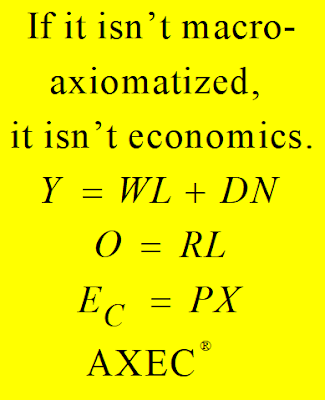
Blog-Reference
Economists fall into two groups: those who apply math and those who don’t. Both have failed. After 200+ years, economics is still at the proto-scientific level.
The fact is that economists have messed up
• profit theory, for 200+ years,
• microfoundations, for 150+ years,
• macrofoundations, for 80+ years,
• the application of elementary logic and mathematics since the founding fathers.
To this day, neither orthodox nor heterodox economists have developed the true (= materially/formally consistent) theory. More precisely, economists do not know how the price and profit mechanism works and whether the monetary economy is inherently stable/unstable. The four main approaches ― Walrasianism, Keynesianism, Marxianism, Austrianism ― are mutually contradictory, axiomatically false, materially/formally inconsistent, and all got the foundational concept of the subject matter ― profit ― wrong. What has been achieved is the pluralism of provably false theories.
Heterodoxy does not get tired of pointing out that Orthodoxy misapplies math. This, of course, is true. But this cannot obscure the fact that heterodox storytelling, too, has NOT achieved anything of scientific value.
The fact of the matter is that both orthodox and heterodox economists are too stupid to even understand the elementary mathematics that underlies National Accounting. #1, #2, #3 Because economists failed already at the first rung of the mathematical ladder, they never could get out of their dark proto-scientific hole and beyond brain-dead political blather.
Both orthodox and heterodox economists are responsible for the worst embarrassment in the history of modern science, and both have to be expelled from the sciences.#4, #5
Egmont Kakarot-Handtke
#1 Economists: just too stupid for counting
#2 For details of the big picture, see cross-references Accounting and cross-references Math/Mathiness
#3 Hooray! The formalization issue is finally settled
#4 Lying for money: a generalization
#5 Throw them out! Orthodox and heterodox economists are unfit for science
Related 'MMTers: too stupid for simple math' and 'Economics, math, pluralism, and corruption' and '“But economics is not pure mathematics or logic” No, it is pure blather'
For more about math, see AXECquery.
***
AXEC121i

April 17, 2023
Occasional Tweets: Because of math illiteracy economics is failed/fake science to this day
#Econ#Math#Economists are too stupid for the elementary #Algebra of #MacroFoundations and #Profit. They are NOT #Scientists but #Clowns / #UsefulIdiots / #AgendaPushers in the political #CircusMaximus. Because of #MathIlliteracy, #Economics is #FailedFakeScience to this day. pic.twitter.com/9tC9MOaCq2
— E.K-H (@AXECorg) April 17, 2023
For more about math in economics see AXECquery.
July 8, 2026
Occasional X: Economics and math ― they just can't get it together (XIII)
“GDP(GNI/GNP) accounting is just a necessary evil, as other baseline measurement methods are worse.” (Stefan Demetz)
— AXEC (@EgmontHandtke) July 8, 2026
I do NOT say that GDP accounting is unnecessary; I say that it is done wrong because the representative economist is too stupid for elementary algebra. It is not…
September 29, 2019
Economics, math, pluralism, and corruption
Comment on Barkley Rosser on ‘Computable economics’
Blog-Reference and Blog-Reference
Barkley Rosser summarizes: “Regarding the Horgan piece on pluralistic math, he is not up on the deeper aspects of this, which have been around for a long time, ….” and “This actually has spilled over into economics with the group calling themselves ‘computable economists’ …, whose leader has long been Kumaraswamy Vela Velupillai. He and his followers think basic economic theorems should be proven using constructivist methods, …” and “This is certainly very esoteric theoretical stuff without obvious direct implications for current policy disputes. It is also true that even within the world of pure economic theory, it may well be that this constructivist computable program may simply lead to the theory being harder to do or prove.”
The simple fact of the matter is that science is about true/false, but about 99 percent of any population are not scientists but live in the swamp between true/false, where “nothing is clear and everything is possible.” (Keynes) This applies, in particular, to economists. The major approaches ― Walrasianism, Keynesianism, Marxianism, Austrianism, MMT ― are mutually contradictory, axiomatically false, materially/formally inconsistent, and ALL got the foundational concept of the subject matter ― profit ― wrong. What we actually have is the pluralism of provably false theories.
This, of course, is absolutely at odds with the very essence of science: “In order to tell the politicians and practitioners something about causes and best means, the economist needs the true theory or else he has not much more to offer than educated common sense or his personal opinion.” (Stigum)
Economists do not have the true theory to this day. Because of this, the “Bank of Sweden Prize in Economic Sciences in Memory of Alfred Nobel” is plain fraud.
Economists, of course, do not admit that they are stupid or corrupt or both but simply try to redefine science: “The first distinction you draw is that the old paradigm (OPE) is anti-pluralist (as in classical physics), while the new paradigm (NPE) is pluralist (as in modern physics).” (Fullbrook) #1, #2, #3
To cover their scientific failure and to justify swampiness, economists love to cite stuff they do not understand, like Heisenberg’s Uncertainty Principle, Gödel’s Incompleteness Theorems, or the alleged pluralism of mathematics. #4
The point to grasp is that pluralism is a political principle that can be traced back to the Peace of Westphalia, which ended the European wars of religion in 1648. The guiding idea since then has been the peaceful coexistence of incompatible religious beliefs and the end of attempts to prove hallucinatory religious truths by victory in battle.
This laudable political principle, though, does not carry over to science, where truth comes in the singular and NOT as pluralism of provably false theories. The very characteristic of science is to replace the pluralism of opinions with certain knowledge. #5 Scientific truth is well-defined: “Research is, in fact, a continuous discussion of the consistency of theories: formal consistency insofar as the discussion relates to the logical cohesion of what is asserted in joint theories; material consistency insofar as the agreement of observations with theories is concerned.” (Klant)
According to this criterion, economics is a failed science. Economists, of course, try to evade this conclusion. Since Adam Smith/Karl Marx, they insist on doing science. What they have been doing, though, is political agenda-pushing in the cloak of science.
The dismal scientific fact of the “dismal science” is that economists are too stupid for the elementary algebra that underlies macroeconomics. Logical consistency, as it is embodied in the corpus of mathematics, has always been the weak point of economics.
This weakness did not escape mathematicians: “Walras approached Poincaré for his approval. ... But Poincaré was devoutly committed to applied mathematics and did not fail to notice that utility is a nonmeasurable magnitude. ... He also wondered about the premises of Walras’s mathematics: It might be reasonable, as a first approximation, to regard men as completely self-interested, but the assumption of perfect foreknowledge ‘perhaps requires a certain reserve’.” (Porter)
Later on, von Neumann started in earnest to rectify the formalism of Walrasian economics: “You know, Oskar, if those books are unearthed sometime a few hundred years hence, people will not believe they were written in our time. Rather, they will think that they are about contemporary with Newton, so primitive is their mathematics. Economics is simply still a million miles away from the state in which an advanced science is, such as physics.” (quoted in Ingrao et al.) The final result of von Neumann’s intervention was General Equilibrium Theory. Von Neumann and others rectified the mathematical formalism; however, they retained the Walrasian axioms (methodological individualism, constrained optimization, equilibrium, etc.).#6
Moreover, GE has been established by an existence proof. The fixpoint theorem, though, does not tell the coordinates of the equilibrium nor whether and how it can be reached. This is where the critique of Kumaraswamy Velupillai and the concept of computable economics kicks in. However, as the ToC of Computable Economics shows (e.g., Computable Rationality, Adaptive Behavior, Learning in a Computable Setting, etc.), Velupillai sticks to the old Walrasian behavioral concepts. What Velupillai does NOT realize is that economics cannot be based on behavioral microfoundations.
Standard economics is false because it is based on false microeconomic axioms. Keynesian economics is false because it is based on false macroeconomic axioms. Velupillai’s shift from set theory to recursion theory is pointless because he makes the same mistake as von Neumann, i.e., he does not realize that economics is axiomatically defective. A computable equilibrium is pointless, to begin with, because equilibrium is a petitio principii since Jevons/Walras/Menger.
What is straightforwardly computable in economics is, for example, profit. Curiously, the promoter of computable economics has never computed the key variable macroeconomic profit. Worse, he has not even realized that Keynesian macroeconomics is utter algebraic garbage.
Proof: “Income = value of output = consumption + investment. Saving = income − consumption. Therefore saving = investment.” (Keynes, GT, p. 63) is false. Instead of I=S, Q≡I−S holds in the most elementary case with Q as macroeconomic profit. #7, #8
The balance of the business sector, i.e., macroeconomic profit, is computable; however, the champion of computable economics has failed to this day to compute the pivotal variable of all of economics. The mathematical incompetence of economists is the ultimate reason why economics is nothing more than the forever unacceptable pluralism of false theories. This, in turn, means that economic policy guidance NEVER had sound scientific foundations. #9 Computable economics has NOT rectified this lethal defect and, given scientifically incompetent promoters like Kumaraswamy Velupillai, never will.
Egmont Kakarot-Handtke
#1 How Heterodoxy became the venue for science’s scum
#2 Failed economics: The losers’ long list of lame excuses
#3 A political stench is in the air
#4 Scientific American, Is Mathematics, like Science, Pluralistic? Mathematicians disagree over whether their fundamental assumptions, or axioms, are true
#5 “There are always many different opinions and conventions concerning any one problem or subject-matter... This shows that they are not all true. For if they conflict, then at best only one of them can be true. Thus it appears that Parmenides ... was the first to distinguish clearly between truth or reality on the one hand, and convention or conventional opinion (hearsay, plausible myth) on the other ...” (Popper)
#6 “But this [establishing the analytic mother-structure] required one very crucial maneuver that was nowhere stated explicitly: namely, that the model of Walrasian general equilibrium was the root structure from which all further work in economics would eventuate.” (Weintraub)
#7 How Keynes got macro wrong and Allais got it right
#8 Knowledge is attainable ― even in economics
#9 For details, see cross-references Methodology
Related 'How economists shoot themselves non-stop in the methodological foot'
Since Sonnenschein/Mantel/Debreu, it is generally known that General Equilibrium Theory = mainstream economics is a failed approach. This means (i) that economic policy guidance has NO valid scientific foundations, (ii) that economics needs a Paradigm Shift: “There is another alternative: to formulate a completely new research program and conceptual approach. As we have seen, this is often spoken of, but there is still no indication of what it might mean.” (Ingrao et al., 1990)
Obviously, there is to this very day ‘no indication of what it might mean’ to perform the indispensable Paradigm Shift.
In his formal rectification of Walrasian economics, von Neumann applied set theory. This was state-of-the-art concerning mathematics, but was not such a good idea concerning economics: “Thus not all axiomatic theories need to be phrased in terms of set theory but much more conveniently and intelligibly rather in terms of some advanced mathematical structures.” (Schmiechen)
Therefore, Velupillai’s shift from set theory to recursion theory is certainly a promising move to get out of von Neumann’s set-theoretical dead end. The irony is that economists fail to this day at the simple algebra of macroeconomic accounting. #1
The remark: “At the end of his life von Neumann eseentially sided with Velupillai in pointing to greater use of computers, …” shows that you are still deep in the woods. Computable economics is a methodological issue for economists, the greater use of computers is a practical issue for all walks of life.
Right policy depends on true theory. Because economic theory is axiomatically false, economic policy can only make matters worse.
#1 For details of the big picture, see cross-references Accounting
Brouwer, Gödel, et al., and all the questions about the foundations of mathematics are irrelevant for economics. Economics needs only elementary algebra for a start. And neither Brouwer nor Gödel contested the validity of algebra. The fact of the matter is that the representative economist is too stupid for algebra.
Von Neumann’s lethal blunder was to adopt the concept of utility/preferences from Neoclassics (see The Notion of Utility, ToG, p. 15ff). For deeper methodological reasons, which have been given elsewhere, economics cannot be built upon the behavioral assumption of (cardinal/ordinal) utility maximization.
Von Neumann axiomatized game theory, which is absolutely irrelevant to economics. Game theory deals with zero-sum games and “payouts” and it should be obvious to every economist that the economy is NOT a zero-sum game and that profit is NOT a “payout”. Macroeconomic profit is for 200+ years now greater than zero, which tells one that von Neumann had NO idea what profit ― the foundational magnitude of economics ― is.
Neither has the applause-troll Barkley Rosser ― whose main business is the self-congratulation of failed economics, the erection of false-hero memorials, the bestowal of fake Nobels, and the deception of the general public about the proto-scientific state of economics ― nor the rest of scientifically incompetent economists. Fact is: the Profit Theory is false from Adam Smith to von Neumann to Barkley Rosser, and this has NOTHING to do with constructive or intuitionist math.
Barkley Rosser claims “… but these days one cannot even get into a grad econ program without having a near perfect score on the quant GRE, at least in the US. Pretty much everybody going through econ grad school has a reasonably decent knowledge of algebra.”
EK-H claims: The representative economist is too stupid for the elementary algebra that underlies macroeconomics.
Proof: Keynes was a trained mathematician. He stated in his General Theory: “Income = value of output = consumption + investment. Saving = income − consumption. Therefore saving = investment.” (p. 63) This is provably false. The mathematically correct relationship reads Q≡I−S with Q as macroeconomic profit.
After-Keynesians who have allegedly “a reasonably decent knowledge of algebra” have NOT spotted Keynes’s blunder to this day. For example, Paul Krugman still applies IS-LM.
Conclusion: Mathematically trained economists are too stupid for the elementary algebra that underlies macroeconomics. Their utter scientific incompetence notwithstanding, they are awarded “Nobels”.
Political implication: Economics is mathematically flawed to this day. Economic policy guidance has NEVER had valid scientific foundations. Economists (left-center-right does NOT matter) are either stupid or corrupt or both, and a hazard to their fellow citizens.
Barkley Rosser re-frames the point at issue: “Most of what he [Mark Thoma] links to are things with policy implications. But occasionally, he posts oddball stuff that he thinks has some intellectual interest that is not directly policy-related. This was one of those links, about ‘pluralistic math,’ something not many people know anything about.”
Nothing could be further from the truth. Mathematics, like economics long before, is now also politically weaponized. To recall, Walrasian General Equilibrium Theory claims that the market economy is a spontaneous, self-optimizing, stable system. Walras knew quite well that in the Age of Science, he had to prove this claim. He failed, and the mathematicians von Neumann/Wald kicked off the formal rectification, which ended with Arrow/Debreu/ McKenzie/Nash’s existence theorem. This theorem amounts politically to the scientific legitimization of Capitalism. Arrow/Debreu et al. were on the payroll of the Cowles Commission, which is named after its founder and funder, the “businessman and economist Alfred Cowles” (Wikipedia).
As it became increasingly clear that GET is proto-scientific garbage and the existence proof had been a contract job on behalf of the Oligarchy, Walrasian economics had to give up its claim to scientific truth. Strictly speaking, it had to bury itself at the Flat-Earth-Cemetery #1, but instead, it remained firmly in academic place and merely performed an orderly withdrawal. This move comes under the euphemism of Pluralism or Anything-Goes. People love Pluralism because it gives them the license to choose their subjective truth and to ignore the taxing demand for material/formal consistency that has defined science for 2300+ years. Pluralism/Anything-Goes is anti-scientific but has some political merits. Economists busily produce many “truths”, and the Oligarchy picks the one that fits the actual circumstances best. Thus, academic economists add some scientific legitimacy to economic policy. For their valuable propaganda services, economists are rewarded with the “Bank of Sweden Prize in Economic Sciences in Memory of Alfred Nobel”. Pluralism is nothing but the methodological smoke screen of richly rewarded useful political idiots.
Remains one problem. Mathematics is binary true/false. Political creatures, though, thrive in the swampy zone of the excluded middle between true/false, where “nothing is clear and everything is possible” (Keynes). Political agenda pushers try to keep everything open to interpretation and negotiation. #2 In the eyes of political agenda pushers, science/ mathematics, with its insistence on consistency and proof, is just a nuisance.
What Mark Thoma tells his fellow economists is NOT some oddball stuff about some remote “intellectual frisson” but that mathematics, too, is in the process of Pluralization. This is good news for all fake scientists and, contrary to the assertions of Barkley Rosser, it has enormous policy implications.
To replace the idea of scientific/mathematical truth with Pluralism is nothing else than the ultimate political corruption of science.
#1 “In economics we should strive to proceed, wherever we can, exactly according to the standards of the other, more advanced, sciences, where it is not possible, once an issue has been decided, to continue to write about it as if nothing had happened.” (Morgenstern)
#2 And the answer is NCND ― economics after 200+ years of Glomarization

Blog-Reference and Blog-Reference
Barkley Rosser summarizes: “Regarding the Horgan piece on pluralistic math, he is not up on the deeper aspects of this, which have been around for a long time, ….” and “This actually has spilled over into economics with the group calling themselves ‘computable economists’ …, whose leader has long been Kumaraswamy Vela Velupillai. He and his followers think basic economic theorems should be proven using constructivist methods, …” and “This is certainly very esoteric theoretical stuff without obvious direct implications for current policy disputes. It is also true that even within the world of pure economic theory, it may well be that this constructivist computable program may simply lead to the theory being harder to do or prove.”
The simple fact of the matter is that science is about true/false, but about 99 percent of any population are not scientists but live in the swamp between true/false, where “nothing is clear and everything is possible.” (Keynes) This applies, in particular, to economists. The major approaches ― Walrasianism, Keynesianism, Marxianism, Austrianism, MMT ― are mutually contradictory, axiomatically false, materially/formally inconsistent, and ALL got the foundational concept of the subject matter ― profit ― wrong. What we actually have is the pluralism of provably false theories.
This, of course, is absolutely at odds with the very essence of science: “In order to tell the politicians and practitioners something about causes and best means, the economist needs the true theory or else he has not much more to offer than educated common sense or his personal opinion.” (Stigum)
Economists do not have the true theory to this day. Because of this, the “Bank of Sweden Prize in Economic Sciences in Memory of Alfred Nobel” is plain fraud.
Economists, of course, do not admit that they are stupid or corrupt or both but simply try to redefine science: “The first distinction you draw is that the old paradigm (OPE) is anti-pluralist (as in classical physics), while the new paradigm (NPE) is pluralist (as in modern physics).” (Fullbrook) #1, #2, #3
To cover their scientific failure and to justify swampiness, economists love to cite stuff they do not understand, like Heisenberg’s Uncertainty Principle, Gödel’s Incompleteness Theorems, or the alleged pluralism of mathematics. #4
The point to grasp is that pluralism is a political principle that can be traced back to the Peace of Westphalia, which ended the European wars of religion in 1648. The guiding idea since then has been the peaceful coexistence of incompatible religious beliefs and the end of attempts to prove hallucinatory religious truths by victory in battle.
This laudable political principle, though, does not carry over to science, where truth comes in the singular and NOT as pluralism of provably false theories. The very characteristic of science is to replace the pluralism of opinions with certain knowledge. #5 Scientific truth is well-defined: “Research is, in fact, a continuous discussion of the consistency of theories: formal consistency insofar as the discussion relates to the logical cohesion of what is asserted in joint theories; material consistency insofar as the agreement of observations with theories is concerned.” (Klant)
According to this criterion, economics is a failed science. Economists, of course, try to evade this conclusion. Since Adam Smith/Karl Marx, they insist on doing science. What they have been doing, though, is political agenda-pushing in the cloak of science.
The dismal scientific fact of the “dismal science” is that economists are too stupid for the elementary algebra that underlies macroeconomics. Logical consistency, as it is embodied in the corpus of mathematics, has always been the weak point of economics.
This weakness did not escape mathematicians: “Walras approached Poincaré for his approval. ... But Poincaré was devoutly committed to applied mathematics and did not fail to notice that utility is a nonmeasurable magnitude. ... He also wondered about the premises of Walras’s mathematics: It might be reasonable, as a first approximation, to regard men as completely self-interested, but the assumption of perfect foreknowledge ‘perhaps requires a certain reserve’.” (Porter)
Later on, von Neumann started in earnest to rectify the formalism of Walrasian economics: “You know, Oskar, if those books are unearthed sometime a few hundred years hence, people will not believe they were written in our time. Rather, they will think that they are about contemporary with Newton, so primitive is their mathematics. Economics is simply still a million miles away from the state in which an advanced science is, such as physics.” (quoted in Ingrao et al.) The final result of von Neumann’s intervention was General Equilibrium Theory. Von Neumann and others rectified the mathematical formalism; however, they retained the Walrasian axioms (methodological individualism, constrained optimization, equilibrium, etc.).#6
Moreover, GE has been established by an existence proof. The fixpoint theorem, though, does not tell the coordinates of the equilibrium nor whether and how it can be reached. This is where the critique of Kumaraswamy Velupillai and the concept of computable economics kicks in. However, as the ToC of Computable Economics shows (e.g., Computable Rationality, Adaptive Behavior, Learning in a Computable Setting, etc.), Velupillai sticks to the old Walrasian behavioral concepts. What Velupillai does NOT realize is that economics cannot be based on behavioral microfoundations.
Standard economics is false because it is based on false microeconomic axioms. Keynesian economics is false because it is based on false macroeconomic axioms. Velupillai’s shift from set theory to recursion theory is pointless because he makes the same mistake as von Neumann, i.e., he does not realize that economics is axiomatically defective. A computable equilibrium is pointless, to begin with, because equilibrium is a petitio principii since Jevons/Walras/Menger.
What is straightforwardly computable in economics is, for example, profit. Curiously, the promoter of computable economics has never computed the key variable macroeconomic profit. Worse, he has not even realized that Keynesian macroeconomics is utter algebraic garbage.
Proof: “Income = value of output = consumption + investment. Saving = income − consumption. Therefore saving = investment.” (Keynes, GT, p. 63) is false. Instead of I=S, Q≡I−S holds in the most elementary case with Q as macroeconomic profit. #7, #8
The balance of the business sector, i.e., macroeconomic profit, is computable; however, the champion of computable economics has failed to this day to compute the pivotal variable of all of economics. The mathematical incompetence of economists is the ultimate reason why economics is nothing more than the forever unacceptable pluralism of false theories. This, in turn, means that economic policy guidance NEVER had sound scientific foundations. #9 Computable economics has NOT rectified this lethal defect and, given scientifically incompetent promoters like Kumaraswamy Velupillai, never will.
Egmont Kakarot-Handtke
#1 How Heterodoxy became the venue for science’s scum
#2 Failed economics: The losers’ long list of lame excuses
#3 A political stench is in the air
#4 Scientific American, Is Mathematics, like Science, Pluralistic? Mathematicians disagree over whether their fundamental assumptions, or axioms, are true
#5 “There are always many different opinions and conventions concerning any one problem or subject-matter... This shows that they are not all true. For if they conflict, then at best only one of them can be true. Thus it appears that Parmenides ... was the first to distinguish clearly between truth or reality on the one hand, and convention or conventional opinion (hearsay, plausible myth) on the other ...” (Popper)
#6 “But this [establishing the analytic mother-structure] required one very crucial maneuver that was nowhere stated explicitly: namely, that the model of Walrasian general equilibrium was the root structure from which all further work in economics would eventuate.” (Weintraub)
#7 How Keynes got macro wrong and Allais got it right
#8 Knowledge is attainable ― even in economics
#9 For details, see cross-references Methodology
Related 'How economists shoot themselves non-stop in the methodological foot'
***
REPLY to Barkley Rosser, anne on Oct 1Since Sonnenschein/Mantel/Debreu, it is generally known that General Equilibrium Theory = mainstream economics is a failed approach. This means (i) that economic policy guidance has NO valid scientific foundations, (ii) that economics needs a Paradigm Shift: “There is another alternative: to formulate a completely new research program and conceptual approach. As we have seen, this is often spoken of, but there is still no indication of what it might mean.” (Ingrao et al., 1990)
Obviously, there is to this very day ‘no indication of what it might mean’ to perform the indispensable Paradigm Shift.
In his formal rectification of Walrasian economics, von Neumann applied set theory. This was state-of-the-art concerning mathematics, but was not such a good idea concerning economics: “Thus not all axiomatic theories need to be phrased in terms of set theory but much more conveniently and intelligibly rather in terms of some advanced mathematical structures.” (Schmiechen)
Therefore, Velupillai’s shift from set theory to recursion theory is certainly a promising move to get out of von Neumann’s set-theoretical dead end. The irony is that economists fail to this day at the simple algebra of macroeconomic accounting. #1
The remark: “At the end of his life von Neumann eseentially sided with Velupillai in pointing to greater use of computers, …” shows that you are still deep in the woods. Computable economics is a methodological issue for economists, the greater use of computers is a practical issue for all walks of life.
Right policy depends on true theory. Because economic theory is axiomatically false, economic policy can only make matters worse.
#1 For details of the big picture, see cross-references Accounting
***
REPLY to Barkley Rosser, anne on Oct 2Brouwer, Gödel, et al., and all the questions about the foundations of mathematics are irrelevant for economics. Economics needs only elementary algebra for a start. And neither Brouwer nor Gödel contested the validity of algebra. The fact of the matter is that the representative economist is too stupid for algebra.
Von Neumann’s lethal blunder was to adopt the concept of utility/preferences from Neoclassics (see The Notion of Utility, ToG, p. 15ff). For deeper methodological reasons, which have been given elsewhere, economics cannot be built upon the behavioral assumption of (cardinal/ordinal) utility maximization.
Von Neumann axiomatized game theory, which is absolutely irrelevant to economics. Game theory deals with zero-sum games and “payouts” and it should be obvious to every economist that the economy is NOT a zero-sum game and that profit is NOT a “payout”. Macroeconomic profit is for 200+ years now greater than zero, which tells one that von Neumann had NO idea what profit ― the foundational magnitude of economics ― is.
Neither has the applause-troll Barkley Rosser ― whose main business is the self-congratulation of failed economics, the erection of false-hero memorials, the bestowal of fake Nobels, and the deception of the general public about the proto-scientific state of economics ― nor the rest of scientifically incompetent economists. Fact is: the Profit Theory is false from Adam Smith to von Neumann to Barkley Rosser, and this has NOTHING to do with constructive or intuitionist math.
***
REPLY to Barkley Rosser, anne on Oct 3Barkley Rosser claims “… but these days one cannot even get into a grad econ program without having a near perfect score on the quant GRE, at least in the US. Pretty much everybody going through econ grad school has a reasonably decent knowledge of algebra.”
EK-H claims: The representative economist is too stupid for the elementary algebra that underlies macroeconomics.
Proof: Keynes was a trained mathematician. He stated in his General Theory: “Income = value of output = consumption + investment. Saving = income − consumption. Therefore saving = investment.” (p. 63) This is provably false. The mathematically correct relationship reads Q≡I−S with Q as macroeconomic profit.
After-Keynesians who have allegedly “a reasonably decent knowledge of algebra” have NOT spotted Keynes’s blunder to this day. For example, Paul Krugman still applies IS-LM.
Conclusion: Mathematically trained economists are too stupid for the elementary algebra that underlies macroeconomics. Their utter scientific incompetence notwithstanding, they are awarded “Nobels”.
Political implication: Economics is mathematically flawed to this day. Economic policy guidance has NEVER had valid scientific foundations. Economists (left-center-right does NOT matter) are either stupid or corrupt or both, and a hazard to their fellow citizens.
***
REPLY to Barkley Rosser, anne on Oct 4Barkley Rosser re-frames the point at issue: “Most of what he [Mark Thoma] links to are things with policy implications. But occasionally, he posts oddball stuff that he thinks has some intellectual interest that is not directly policy-related. This was one of those links, about ‘pluralistic math,’ something not many people know anything about.”
Nothing could be further from the truth. Mathematics, like economics long before, is now also politically weaponized. To recall, Walrasian General Equilibrium Theory claims that the market economy is a spontaneous, self-optimizing, stable system. Walras knew quite well that in the Age of Science, he had to prove this claim. He failed, and the mathematicians von Neumann/Wald kicked off the formal rectification, which ended with Arrow/Debreu/ McKenzie/Nash’s existence theorem. This theorem amounts politically to the scientific legitimization of Capitalism. Arrow/Debreu et al. were on the payroll of the Cowles Commission, which is named after its founder and funder, the “businessman and economist Alfred Cowles” (Wikipedia).
As it became increasingly clear that GET is proto-scientific garbage and the existence proof had been a contract job on behalf of the Oligarchy, Walrasian economics had to give up its claim to scientific truth. Strictly speaking, it had to bury itself at the Flat-Earth-Cemetery #1, but instead, it remained firmly in academic place and merely performed an orderly withdrawal. This move comes under the euphemism of Pluralism or Anything-Goes. People love Pluralism because it gives them the license to choose their subjective truth and to ignore the taxing demand for material/formal consistency that has defined science for 2300+ years. Pluralism/Anything-Goes is anti-scientific but has some political merits. Economists busily produce many “truths”, and the Oligarchy picks the one that fits the actual circumstances best. Thus, academic economists add some scientific legitimacy to economic policy. For their valuable propaganda services, economists are rewarded with the “Bank of Sweden Prize in Economic Sciences in Memory of Alfred Nobel”. Pluralism is nothing but the methodological smoke screen of richly rewarded useful political idiots.
Remains one problem. Mathematics is binary true/false. Political creatures, though, thrive in the swampy zone of the excluded middle between true/false, where “nothing is clear and everything is possible” (Keynes). Political agenda pushers try to keep everything open to interpretation and negotiation. #2 In the eyes of political agenda pushers, science/ mathematics, with its insistence on consistency and proof, is just a nuisance.
What Mark Thoma tells his fellow economists is NOT some oddball stuff about some remote “intellectual frisson” but that mathematics, too, is in the process of Pluralization. This is good news for all fake scientists and, contrary to the assertions of Barkley Rosser, it has enormous policy implications.
To replace the idea of scientific/mathematical truth with Pluralism is nothing else than the ultimate political corruption of science.
#1 “In economics we should strive to proceed, wherever we can, exactly according to the standards of the other, more advanced, sciences, where it is not possible, once an issue has been decided, to continue to write about it as if nothing had happened.” (Morgenstern)
#2 And the answer is NCND ― economics after 200+ years of Glomarization
***
Graphic AXEC121i
***
Enlightening external link to Miles Mathis’ Gödel’s Incompleteness Theorems. Among others: “I am not concerned that Russell was against the bomb or the war or anything else. Just as I am not concerned that Einstein was against the bomb or the war. I am concerned that mathematicians and physicists cannot do algebra.”
Subscribe to:
Posts (Atom)