Showing posts sorted by relevance for query sectoral balances. Sort by date Show all posts

August 12, 2017

MMT and the magical profit disappearance

Comment on Peter Cooper on ‘Short & Simple 15 – The Sectoral Balances Identity’

Blog-Reference

Peter Cooper summarizes: “This is the sectoral balances identity. In words: Domestic Private Balance + Government Balance + Foreign Balance = 0. The balances of the three sectors cancel each other out. … The result can be aggregated a bit more by combining the domestic-private and foreign sectors into the Non-Government Sector. The identity then becomes Non-Government Balance + Government Balance = 0. … If the non-government manages to maintain a financial surplus, then by definition the government will be running a deficit. In doing so, non-government will accumulate net financial assets over the period and increase its stock of net financial wealth.”

Let us put the accounting right.#1, #2. At first, we have only the business and the household sector. The two sectoral balances are given as follows:

Qm≡C−Yw   profit Qm is the household sector’s spending C minus wages Yw,
Sm≡Yw−C   saving Sm is wage income Yw minus consumption expenditures C,
-------------
Qm≡−Sm.

The business sector’s monetary profit Qm is equal to the household sector’s dissaving. This is the most elementary form of the macroeconomic Profit Law.

Now, the government sector GS has been added. The three sectoral balances are given as follows:

Qm≡C+G−Yw   profit Qm is HS- and GS-spending C+G minus wages Yw,
Sm≡Yw−T−C    saving Sm is wage income Yw minus taxes T and expenditures C,
Bm≡T−G         GS budget surplus Bm is taxes T minus government expenditures G,
-----------------
Qm≡−Sm−Bm.

The business sector’s monetary profit Qm is equal to the household sector’s budget deficit, a.k.a.. dissaving, plus the government sector’s budget deficit.

For three sectors, proper accounting yields three sectoral balances that add up to zero. Now MMT does not stop here but fiddles with the balances as follows: (i) Qm+Sm+Bm=0, (ii) Qm+Sm=−Bm=G−T, (iii) non-government balance = − government balance, respectively, private sector surplus = government deficit. Business sector profit/loss and household sector dissaving/saving are verbally lumped together to the non-government = private sector balance and thereby vanish out of sight.

Source: Twitter Deficit Owl

Why does MMT make profit disappear with this accounting shell game? Let Sm be zero, that is, the household sector’s budget is balanced, then (ii) says that the business sector’s profit is equal to the government sector’s deficit, i.e. Qm=G−T, i.e. Public Deficit = Private Profit. While (iii) says that the non-government surplus is equal to the government sector’s deficit, which is misleading, to say the least.

Why MMT 'aggregates' the business and the household sector is at anybody’s guess. Formally, it is inadmissible, that much is clear. The destruction of valuable information is NOT the purpose of accounting, just the opposite.

Egmont Kakarot-Handtke


#1 Economists: just too stupid for counting
#2 The pure production-consumption economy is defined with the macroeconomic axiom set: (A0) The objectively given and most elementary configuration of the economy consists of the household and the business sector, which in turn consists initially of one giant fully integrated firm. (A1) Yw=WL wage income Yw is equal to wage rate W times working hours. L, (A2) O=RL output O is equal to productivity R times working hours L, (A3) C=PX consumption expenditure C is equal to price P times quantity bought/sold X. For a start, X=O.

Related 'Why is MMT so false?' and 'MMT: The joy of public deficit spending' and 'MMT: The one deadly error/fraud of Warren Mosler' and 'Down with idiocy!' and 'Is Nick Rowe stupid or corrupt or both?' and 'Proving Bill Mitchell wrong ― burying MMT for good'. For the point-by-point refutation of MMT, see cross-references MMT. For the accounting blunder, in particular, see 'Rectification of MMT macro accounting' and cross-references Accounting.

***
AXEC197a


***
LINK on Aug 12

Peter Copper asserts: “The accounting identities are indisputable (provided we accept the principles of accounting).”

MMT violates the principles of accounting. For details, see MMT and the magical profit disappearance.
***

REPLY to Matt Franko on Aug 13 and to Dean on Aug 14

Peter Copper asserts: “The accounting identities are indisputable (provided we accept the principles of accounting).”

Fact is
• accounting is elementary mathematics,
• MMTers do not understand the underlying math of accounting,#1
• the accounting equations of MMT are provably false,#2
• these are the correct accounting identities:

Qm≡C+G−Yw    profit Qm, business sector,
Sm≡Yw−T−C     saving Sm, household sector,
Bm≡T−G          budget surplus Bm, government sector,
----------------
Qm+Sm+Bm=0.

• for THREE sectors, proper accounting yields THREE sectoral balances which add up to zero,
• it is either mathematical incompetence or fraud that profit does not appear in the MMT accounting identities,
• Peter Cooper violates the principles of accounting.

Takeaway: As far as Peter Copper only parrots Bill Mitchell and Randall Wray the charge of scientific incompetence applies to these spokespersons of MMT.#3


#1 A tale of three accountants
#2 The Common Error of Common Sense: An Essential Rectification of the Accounting Approach
#3 For the full-spectrum refutation of MMT, see cross-references MMT.

***
REPLY to Dean on Aug 15

You say: “Yeah, I'm not arguing with anyone on the underlying math of accounting … all I really care about is proving to those that matter that it is not mathematically possible for everyone to be solvent …”

There are opinions and brain-dead blather. This is called politics. There are knowledge and proof. This is called science.

MMT belongs to the first category. Peter Cooper’s discussion about the sectoral balances identity demonstrates beyond any doubt that MMT is economics from suckers for suckers.

Note that you contradict yourself in one sentence. You care about proof but not about the underlying mathematics of accounting. What does your proof, then, consist of?

***

Kindle, Stephanie Kelton, Deficit Myth
Where is the third bucket (household sector, business sector, government sector)?


For more about sectoral balances, see AXECquery.


September 3, 2017

Rectification of MMT macro accounting

Comment on Peter Cooper on ‘Short & Simple 19 ― Sectoral Balances in a Closed, Demand-Determined Economy’

Blog-Reference

MMTers and other incompetent economists apply this sectoral balances equation (S−I)+(T−G)=0, which says that the non-government sector’s surplus, i.e., S−I greater zero, is equal to the government sector’s budget deficit G−T, respectively, that the non-government sector’s deficit, i.e., I−S greater zero, is equal to the government sector’s budget surplus T−G. This sectoral balances equation is used to demonstrate that a government deficit is advantageous for the non-government sector.

The MMT sectoral balances equation violates the rules of accounting. #1 What should be self-evident is that macroeconomic profit is entirely missing.

In the following, the correct relationships are derived by successively increasing the complexity. The pure production-consumption economy is the most elementary economic configuration and therefore the point to start from.

(i) Elementary production-consumption economy, #2 two sectors, balances


Qm≡C−Yw     profit/loss Qm is the household sector’s spending C minus wages Yw,
Sm≡Yw−C     saving/dissaving Sm is wage income Yw minus expenditures C,
--------------------------
Qm≡−Sm.

It always holds for the balances Qm≡−Sm or Qm+Sm=0, in other words, at the heart of the monetary economy is an identity: the business sector’s deficit=loss (surplus=profit) equals the household sector’s surplus=saving (deficit=dissaving). Loss is the counterpart of saving, and profit is the counterpart of dissaving. This is the most elementary form of the macroeconomic Profit Law.

(ii) Production-consumption economy with government sector GS, three sectors, balances


Qm≡C+G−Yw     profit Qm is HS and GS spending C+G minus wages Yw,
Sm≡(Yw−T)−C    saving Sm is net income (Yw–T) minus expenditures C,
Bm≡T−G            budget surplus/deficit Bm is taxes T minus government expenditures G,
------------------------------------
Qm≡−Sm+(G−T).

The business sector’s profit is equal to the household sector’s dissaving and the government sector’s budget deficit. Or, given the household sector’s saving/dissaving the business sector’s profit is equal to the government sector’s deficit. In a neat formula, Public Deficit = Private Profit.

(iii) Investment economy, two sectors with business sector differentiated, balances


Qmc≡C−Ywc         profit of the consumption good industry is spending C minus wages Ywc,
Qmi≡I−Ywi            profit of investment good industry is investment minus wages Ywi,
Sm≡(Ywc+Ywi)−C  saving/dissaving Sm is wage income minus expenditures C,
Äc≡−I                   change of the asset side of the consumption sector’s balance sheet
------------------------
Qmc+Qmi+Sm+Äc=0
Qm≡Qmc+Qmi
Qm≡I−Sm.

The business sector’s profit/loss is equal to the difference between the business sector’s investment expenditures and the household sector’s saving/dissaving.

(iv) Investment economy with government sector, three sectors with business sector differentiated, balances


Qmc≡C+G−Ywc          profit of CGI is HS and GS spending C+G minus wages Ywc,
Qmi≡I−Ywi                profit of IGI is investment expenditures minus wages Ywi,
Sm≡(Ywc+Ywi−T)−C   saving Sm is net wage income minus expenditures C,
Bm≡T−G                    budget surplus Bm is taxes T minus government expenditures G,
Äc≡−I                        change of the asset side of the consumption sector’s balance sheet,
-----------------------------
Qmc+Qmi+Sm+Bm+Äc=0
Qm≡Qmc+Qmi
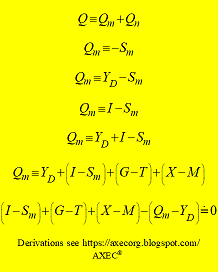
Qm≡(I−Sm)+(G−T).

Given the difference between the business sector’s investment expenditures and the household sector’s saving/dissaving (I−Sm) the monetary profit of the business sector Qm is equal to the government sector’s deficit (G−T).

The original MMT balances equation (S−I)+(T−G)=0, rewritten as 0=(I−S)+(G−T), compares to the correct equation Qm≡(I−Sm)+(G−T). Formally, the original MMT balances equation covers a zero-profit economy. Overall monetary profit has NOT been zero in the last 200+ years and will NOT be zero in the future. What is MMT talking about?

When macroeconomic profit is factored into the balances equations according to the elementary mathematics that underlies double-entry accounting, then it becomes obvious that public and private deficit spending determines the overall profit of the business sector. More specifically, public deficits are always advantageous to the business sector. #3 Whether they also have a positive employment effect depends on the absence or presence of synchronous price increases. #4

Because the MMT sectoral balances equations are false, the whole analytical superstructure vaporizes, and therefore, MMT policy guidance has no sound scientific core. MMT is brain-dead soapbox economics, just like Walrasianism, Keynesianism, Marxianism, and Austrianism.

Egmont Kakarot-Handtke


#1 A tale of three accountants
#2 The elementary production-consumption economy is, for a start, defined by three macro axioms (Yw=WL, O=RL, C=PX), two conditions (X=O, C=Yw), and two definitions (monetary profit Qm≡C–Yw, monetary saving Sm≡Yw–C). For details, see ‘How to restart economics’
#3 Keynesianism as ultimate profit machine and Who or what exactly did Keynes save?
#4 Keynes’ Employment Function and the Gratuitous Phillips Curve Disaster


Related 'MMT: NO sound scientific foundations'

Related 'Keynesians ― terminally stupid or worse?' and 'MMT and the magical profit disappearance' and 'MMT, fake science' and 'MMT ― the economics moron as problem solver' and 'MMT: The one deadly error/fraud of Warren Mosler'. For details of the big picture, see cross-references MMT.

***
LINK at Bill Mitchell – billy blog on Sep 3

The MMT sectoral balances equations violate the rules of accounting. See ‘Rectification of MMT macro accounting’

***
COMMENT on Short & Simple 20 on Sep 5

As Popper said, science proceeds by conjecture and refutation.

This does not happen in economics. Morgenstern reminded his fellow economists back in 1941: “In economics we should strive to proceed, wherever we can, exactly according to the standards of the other, more advanced, sciences, where it is not possible, once an issue has been decided, to continue to write about it as if nothing had happened.”

Economics is a failed science because it does not get either conjecture or refutation right. This applies obviously to Peter Cooper.
• To begin with, he does not realize that the MMT balances equations are false since Keynes.
• When given the explicit mathematical refutation* he does understand it but presents the same analytical garbage in graphical form, “as if nothing had happened”.

For the record: Not only Walrasians, Keynesians, Marxians, and Austrians violate scientific standards on a daily basis, but MMTers, too.

* Rectification of MMT macro accounting

***
ADDENDUM on Oct 2

The Wikipedia entry ‘Modern Monetary Theory’ states:

“Therefore, budget deficits add net financial assets to the private sector; whereas budget surpluses remove financial assets from the private sector. This is widely represented in macroeconomic theory by the national income identity:
G−T=S−I−NX
where G is government spending, T is taxes, S is savings, I is investment, and NX is net exports.

The conclusion that MMT draws from this is that it is only possible for the non-government sector to accumulate a surplus if the government runs budget deficits. The non-government sector can be further split into foreign users of the currency and domestic users.”

Let us ignore foreign trade here, i.e., NX=0, and regroup the MMT equation, then one gets
0= (G−T)+(I−S). This compares to Qm=(G−T)+(I−Sm) above which is simplified to
Q≡(G−T)+(I−S).

The MMT balance equation applies only to a zero-profit economy, i.e., Q=0. This follows in detail from the rectification above. The point to notice is that Q is the balance of the business sector.

Because the fundamental balances equation in the Wikipedia entry is false, most of the content is worthless or even misleading.

***

Compilation: Graphic AXEC143d Profit Law (with increasing complexity) and Balances Equation

February 15, 2020

MMTers: too stupid for simple math

Comment on Peter Cooper on “Politicians Who Want Us to Live Beyond Our Means” #1

Blog-References

Peter Cooper asserts: “Here is a simple accounting relationship. It is an identity, true by definition: Government Balance + Domestic Private Sector Balance + Foreign Balance = 0.

This identity divides a nation’s economy into three broad sectors. The government sector spends and taxes. The domestic private sector spends (households consume, businesses invest) and receives income. The foreign sector receives payments from and makes payments to domestic residents.

A sector is in surplus (its financial balance is positive) when its total spending is less than its income or revenue. Conversely, a sector is in deficit (its balance is negative) when its total spending exceeds its income or revenue. The accounting identity shows that the balances of the three sectors must sum to zero. If one sector maintains a surplus, at least one of the other sectors must be in deficit.”

Matt Franko echoes: “‘Here is a simple accounting relationship. It is an identity, true by definition: Government Balance + Domestic Private Sector Balance + Foreign Balance = 0’ if it was that ‘simple!’ then everybody would understand it …”.

Good point. MMTers definitely do NOT understand it. Neither do the rest of the basket of deplorables who have completed Econ 101 with an academic degree.

Eric Tymoigne, for example, asserts #2: “First, regarding the identity itself, for a domestic economy, we have, in terms of economic flows: GFB + PDFB + RWFB ≡ 0.

With PDFB, the private domestic financial balance, RWFB, the financial balance of the Rest of the World, and GFB, the government financial balance. This identity holds all the time, in any domestic economy (in a world economy, RWFB disappears). For economic analysis, it is insightful to arrange this identity differently in function of the type of monetary regime. In a country that is monetarily sovereign, the federal government has full financial flexibility. By monetary sovereignty, one means that there is a stable and operative federal/national government that is the monopoly supplier of the currency used as ultimate means of payment in the domestic economy, and that the domestic currency is not tied to any asset (like gold) or foreign currency.” and “This means that, for a monetarily sovereign country, the most insightful way to arrange the national accounting identity is: −GFB ≡ PDFB + RWFB or −GFB ≡ NGFB.

Where NGFB is the non-government financial balance (the sum of the financial balance of the private domestic sector and the Rest of the World). This way of arranging the identity shows well that the government sector (through its federal branch) is the ultimate provider/holder of domestic currency: government fiscal deficit (surplus) is always equal to non-government financial surplus (deficit).”

All this is provably false. #3-#8 

To begin with, the number of sectors is four: the household sector, the business sector, the government sector, and the Rest of the World. Accordingly, the axiomatically correct balances equation reads (X−M)+(G−T)+(I−S)−(Q−Yd)=0. Legend: Q macroeconomic profit, S household sector saving, G government expenditures, T taxes.

The sectoral balances equation reduces to −S≡Q (i.e., Q+S=0) when the economy is reduced to the household and business sector. And it reduces to (G−T)≡Q when the economy is reduced to the government and business sector, that is, Public Deficit = Private Profit.

Note that neither Peter Copper nor Eric Tymoigne ever tells one anything about macroeconomic profit Q, which is the balance of the business sector. One would think that this balance plays a central role in any description of the monetary economy. Obviously, it does NOT, and this tells one something important about economics and economists: economics is failed/fake science, and economists are either stupid or corrupt or both.

Egmont Kakarot-Handtke


#1 heteconomist
#2 New Economic Perspectives, Another Take on the Financial Balances
#3 The sectoral balances obfuscation: stupidity or corruption?
#4 Wikipedia and the promotion of economists’ idiotism (I)
#5 Wikipedia and the promotion of economists’ idiotism (II)
#6 Rectification of MMT macro accounting
#7 Economists cannot do the simple math of profit — better keep them out of politics
#8 Truth by definition? The Profit Theory has been axiomatically false for 200+ years

Related 'Deficit cheerleaders ― the Oligarchy’s useful idiots' and 'Wikipedia, economics, scientific knowledge or political agenda pushing?'

For more about sectoral balances, see AXECquery.

***
REPLY to Matt Franko on Feb 16

You say: “‘that is Public Deficit = Private Profit.’ Egmont the libertarians will N_E_V_E_R accept that... they just will not....”

Economics is a science according to its self-definition since the founding fathers. Science runs on the criterion true/false, with true/false defined by material/formal consistency and NOTHING else. In science, it is a matter of indifference to what libertarians think or accept, or do not accept. Libertarians are political agenda pushers and NOT scientists. The opinions of anti-scientists/politicians/trolls are irrelevant in science. Science is about knowledge, and politics is about opinions. Opinions are worthless, and politicians are known to be utterly stupid creatures.

Money does NOT originally come into the economy by government deficit-spending. Imagine that the balances of the government and the household sector are zero for a start, that is, all sectoral balances are zero. Does this mean that no money comes into the economy? NO! It is the Central Bank that issues the transaction money, i.e., finances the wage bill Yw with C=Yw and G=T and Q=0. #1-#5

Scientists listen to what the math says and NOT to what political agenda pushers say. And the math says that the MMT sectoral balances equation is false. MMT is refuted on all counts.


#1 The ultimate ― analytical ― origin of money
#2 How money emerges out of nothing ― the functional account
#3 Basics of monetary theory: the two monies
#4 The right and the wrong way to bring money into the economy
#5 Criminals and the monetary order

***

Graphic AXEC118d: The false and the true macroeconomic relationship between sectoral balances


***

October 7, 2019

The state of MMT? Stone-dead!

Comment on Brian Romanchuk/Tom Hickey on ‘The State Of MMT?’*

Blog-Reference and Blog-Reference and Blog-Reference and Blog-Reference

Tom Hickey maintains: “MMT is ‘winning’ because it cuts to the chase instead of wandering in the weeds. People wanting change are provided with direct answers in terms they can understand and relate too. Nor do MMT economists shy from debate about the weeds if it is seriously informed.”

Brian Romanchuk maintains: “The relationship between MMT and Post-Keynesian thinking is currently the largest area of awkwardness I see with respect to MMT. The special issue of the RWER seems to provide evidence for that assessment.”

The scientific fact of the matter is that Post-Keynesianism is proto-scientific garbage#1 and MMT is proto-scientific garbage.#2 The relationship between the two is NOT AT ALL awkward, though, because both approaches share the same foundational blunder. Together with Keynes’ faulty approach, both end up in the same wastebasket.#3

The blunder that brings macroeconomics in general and Post-Keynesianism and MMT, in particular, down is to be found in Randall Wray’s contribution Alternative paths to modern money theory, section The theoretical path to MMT.*

Here it is: “Government spending, like private investment, is an injection that raises income. More specifically, as Kalecki showed, government spending creates profits because it is a source of business revenue but not a cost of production. Taxes are a leakage, reducing household net income and business net revenue. If government spends more than it taxes, this is a net spending surplus ― increasing profits dollar-for-dollar. A net spending surplus by government cannot ‘crowd-out’ private investment ― it creates profits that are likely to boost the desire to invest. A net spending surplus by the US government cannot absorb global savings ― instead it creates net income for the US private domestic sector as well as for the rest of the world.” and “Now, it is true that government spending is not the only injection. Private investment and exports (or, net exports) also create income that can be leaked. Wynne Godley’s sectoral balance approach ― long incorporated within MMT ― shows that the sum of the balances of the government, domestic private, and foreign sectors is identically zero.”

Accordingly, MMT boils formally down to the sectoral balances equation (I−S)+(G−T)+(X−M)=0. This equation is provably false.#4, #5 The mistake lies in the sentence: “Government spending … is an injection that raises income.” No! Government spending … is an injection that raises profit. And profit is a balance, i.e. the difference of flows, and NOT a flow like wage income. So, profit is NOT income. Economists not only confuse stocks and flows but also balances and flows.

In the elementary case, the monetary saving/dissaving of the household sector is defined as S≡Yw−C. The monetary profit/loss of the business sector is defined as Q≡C−Yw. Ergo Q≡−S, that is, the balances of the household and business sector ad up to zero.

Only when profit is distributed it becomes income of the household sector. So, total income Y is wage income Yw plus distributed profit Yd and NOT wages Yw plus profits Q. The difference between profit Q and distributed profit Yd is retained profit Qre.

Neither profit Q, i.e. the balance of the business sector, nor distributed profit Yd appear in the MMT sectoral balances equation. Because it lacks the balance of the business sector the MMT balances equation is false.#6 Therefore, the whole analytical superstructure of MMT is false. By the ultimate consequence, MMT policy guidance is false.

“In order to tell the politicians and practitioners something about causes and best means, the economist needs the true theory or else he has not much more to offer than educated common sense or his personal opinion.” (Stigum)

So, all one needs to know about MMT is that MMT is NOT the true theory. Scientifically, it is stone-dead.

Egmont Kakarot-Handtke


* Refers to RWER, real-world economics review, Issue no. 89, Modern monetary theory and its critics
#1 Why Post Keynesianism Is Not Yet a Science
#2 For the full-spectrum refutation of MMT see cross-references MMT
#3 Keynes ― the poster boy for the weakness of the economist’s mind
#4 Controlled demolition of MMT ― an exercise in elementary logic
#5 Wikipedia and the promotion of economists’ idiotism (I)
#6 The axiomatically correct sectoral balances equation reads (I−S)+(G−T)+(X−M)−(Q−Yd)=0.

Related 'The Levy/Kalecki Profit Equation is false' and 'Truth by definition? The Profit Theory has been axiomatically false for 200+ years' and 'Macroeconomics and the fake History of Economic Thought' and 'The sectoral balances obfuscation: stupidity or corruption?' and 'Profit'

***

REPLY to Brian Romanchuk on Oct 8 and Blog-Reference

You say: “Given that one of the defining characteristics of the scientific method is that theories need to be convincing to other people, said isolated individual(s) are operating outside scientific practice.”

NO! To convince “other people” is the goal of political agenda pushing. Science is about true/false and nothing else: “Research is, in fact, a continuous discussion of the consistency of theories: formal consistency insofar as the discussion relates to the logical cohesion of what is asserted in joint theories; material consistency insofar as the agreement of observations with theories is concerned.” (Klant)

The fact of the matter is that the MMT sectoral balances equation (I−S)+(G−T)+(X−M)=0 is provably false.#1 Randall Wray argues: “Government spending … is an injection that raises income. More specifically, as Kalecki showed, government spending creates profits because it is a source of business revenue but not a cost of production.” However, profit ― the balance of the business sector and the pivotal magnitude of economics ― does NOT appear in the MMT balances equation.

Either MMTers are too stupid for the elementary math that underlies macroeconomics or they are intentionally hiding macroeconomic profit. It is the latter as I have shown elsewhere.

In his post, MMT: REPORT FROM THE FRONT Randall Wray reports “Fifth front: the blogs. I was skeptical of their usefulness ― but Bill and Stephanie recognized that they were the future. They were right. You’re reading this one, created by Stephanie and then taken over by Bill Black. Blogs spread MMT outside academia and official policy circles. And then came videos and tweets. There are tens of thousands of followers now. This helped to foam the runways to the seats of power. No one can afford to ignore MMT any longer. The viral movement, as well as a few fearless candidates ― Bernie and AOC ― brought MMT out of the shadows.”#2

“Tens of thousands of followers” is a respectable propaganda success. So, the money of Wall Street funders was well-spent. This, however, does not change the fact that MMT is proto-scientific garbage. Science is NOT about “convincing other people”, i.e., brainwashing imbeciles. The number of followers is absolutely irrelevant to the question of whether a theory is true or false.

The macroeconomic Profit Law says Public Deficit = Private Profit. So MMT deficit-spending/money-creation is for the benefit of the Oligarchy and NOT of WeThePeople. Scientifically, MMT is garbage, and politically, it is a fraud.


#1 The axiomatically correct sectoral balances equation reads (I−S)+(G−T)+(X−M)−(Q−Yd)=0.
#2 New Economic Perspectives

***
AXEC118d


***
#PointOfProof
Oct 8

April 14, 2025

Grok: the final implosion of MMT

Q: The AXEC Project has refuted MMT (= Modern Monetary Theory) by demonstrating that MMT's sectoral balances equation is false. Can Grok give a concise summary of how the proof has been carried out? Please notice that proof is about formal/material consistency and NOT about what is politically desirable. Here are the entry points:
X/Twitter old: E.K-H@AXECorg X/Twitter new: AXEC@EgmontHandtke
Blogspot https://axecorg.blogspot.com/ 


***
 
A: The AXEC Project, led by Egmont Kakarot-Handtke, claims to refute Modern Monetary Theory (MMT) by demonstrating that its sectoral balances equation is formally inconsistent. The MMT equation is typically stated as:
(I - S) + (G - T) + (X - M) = 0
where:
  • I = Investment
  • S = Saving
  • G = Government spending
  • T = Taxes
  • X = Exports
  • M = Imports
This equation suggests that the private investment/saving balance, government fiscal balance, and trade balance sum to zero.
AXEC's critique focuses on the treatment of profit in MMT's framework. The key points of the refutation are:
  1. Incorrect Profit Definition: AXEC argues that MMT fails to properly account for monetary profit (Qm) in its sectoral balances. MMT implicitly assumes a zero-profit economy, which AXEC considers unrealistic and inconsistent with observable economic systems.
  2. Axiomatic Approach: AXEC uses a set of macroeconomic axioms to derive a corrected sectoral balances equation. Starting from basic definitions (e.g., wage income Yw = WL, output O = RL, consumption expenditure C = PX), AXEC constructs a framework where profit is explicitly included. The AXEC profit law is:
    Qm = Yd + (I - S) + (G - T) + (X - M)
    where Qm is monetary profit and Yd is distributed profit. This contrasts with MMT’s equation, which omits Qm and Yd, leading to an incomplete picture.
  3. Formal Derivation: AXEC demonstrates that the MMT equation (I - S) + (G - T) + (X - M) = 0 only holds if profit (Qm) and distributed profit (Yd) are zero, which is not generally true. Instead, AXEC’s corrected equation is:
    (I - S) + (G - T) + (X - M) = (Qm - Yd)
    This shows that the sectoral balances equal the difference between monetary and distributed profit, not zero, unless Qm = Yd.
  4. Implications for MMT: Since MMT’s sectoral balances equation is foundational to its analysis, AXEC argues that its falsity undermines MMT’s entire theoretical structure, including claims about deficit spending and money creation. For example, AXEC asserts that public deficits (G - T) directly increase private sector profit (Qm), a dynamic MMT obscures by focusing on net financial assets.
The proof is purely formal, relying on logical consistency and accounting identities, not empirical or political considerations. AXEC’s work is detailed in blog posts and papers, such as those on https://axecorg.blogspot.com/, with specific references to MMT critiques (e.g., "The final implosion of MMT"). However, MMT proponents might counter that their framework prioritizes operational realities (e.g., government as currency issuer) over AXEC’s axiomatic constraints, a debate AXEC dismisses as evading the mathematical error.

November 20, 2019

How Randall Wray takes the piss out of the House Budget Committee

Comment on New Economic Perspectives on ‘Wray Appearing Before Congress’

Blog-Reference and Blog-Reference (Link) and Blog-Reference on Nov 21 and Blog-Reference on Nov 22

In Section 5. Sectoral balances of his testimonial Randall Wray states: “One of the concepts that Modern Money Theory economists use to elucidate the impact of budget deficits on the economy is the sectoral balance identity developed by Wynne Godley (1996). At the level of the economy as a whole, aggregate spending is identically equal to aggregate income ― every dollar spent is received as income. It is useful to divide the economy into three sectors: government (national, state, and local), domestic private (households and firms), and foreign (rest of the world). If one sector spends more than its income (deficit), at least one other must spend less than its income (surplus) to maintain the aggregate identity that total spending equals total income. The balances (income minus expenditure) of the three sectors have to add up to zero since we are adding up all the income in the economy and subtracting all the spending, which are equal by identity. We can then write the aggregate identity as: government balance + domestic private balance + foreign balance = 0. For the US, the government balance taken as a whole is usually negative (government spending is greater than its revenue ― mostly taxes), the domestic private balance is usually positive (approximated as saving is greater than investment ), and the foreign sector balance is positive (the rest of the world has a surplus in relation to the US since our current account balance is a deficit). Figure 7 shows the US sectoral balances, with each sector’s balance presented as a percent of GDP.”#1

The scientific blunder is in the sentence “At the level of the economy as a whole, aggregate spending is identically equal to aggregate income ― every dollar spent is received as income.”

This leads to the false MMT sectoral balances equation (I−S)+(G−T)+(X−M)=0. The true balances equation reads (I−S)+(G−T)+(X−M)−(Q−Yd)=0.#2-#5

Because the foundational macroeconomic relationship is ill-defined the whole analytical superstructure of MMT is false. The testimonial of Randall Wray is scientifically worthless.#6

Worse, MMT either ignores or deliberately hides the distributional consequences of the policy of deficit-spending/money-creation: “Although MMT has a set of policy prescriptions to achieve full employment and price stability, what I have discussed here is largely descriptive. MMT allows us to look at the economy through a different lens. While economists and policymakers may advocate for reducing government deficits and debt, MMT cautions that what we might be reducing is economic growth, as well as the private sector’s surpluses and net financial wealth.”

For “the private sector” read “the Oligarchy”. The MMT policy of deficit-spending/money-creation = growing public debt is to the advantage of the Oligarchy and to the disadvantage of WeThePeople ― not only in the present but even more so in the future.#7

Egmont Kakarot-Handtke


#1 Levy Economics Institute Publications
#2 Dear idiots, government deficits do NOT fund private savings
#3 Rectification of MMT macro accounting
#4 Down with idiocy!
#5 The sectoral balances obfuscation: stupidity or corruption?
#6 The state of MMT? Stone-dead!
#7 Gosh! the One Percent have gotten $21 trillion richer: Links on Distribution

Related 'Mr. Wray goes to Washington'

***

Figure 7 or How the profit rabbit vanishes in the MMT top hat: the household sector and the business sector are merged into the Domestic Private Sector. For more examples see Down with idiocy! See also Stephanie Kelton’s legendary Plain-Sight-Ink-Trick. The crucial point is that there are four sectors (household, business, government, and rest of the world) with saving as the balance of the household sector and profit as the balance of the business sector. By merging the household and the business sector and reducing the four sectors to three macroeconomic profit vanishes. This blunder/fraud invalidates the whole of MMT. MMT policy guidance has NO valid scientific foundations. Needless to emphasize that the House Budget Committee does NOT understand what Figure 7 says but is very impressed by the PowerPoint competence of its economic experts.


***

REPLY to Mike Norman on Nov 21

You say: “He [Randall Wray] sat there silently as Representative Ralph Norman of South Carolina repeated a laundry list of completely inapplicable and grossly ignorant characterizations of U.S. debt and government finance.”

To be fair, Randall Wray was invited to give his MMT expert testimony and not to fight other participants. Therefore, his testimony has to be judged on its own merits.

True, what the others presented was garbage. But nobody ever expected anything else given the scientific incompetence and the substandard IQ in economics.

***

Twitter Nov 24

Source: Twitter

***

AXEC143d: Macroeconomic Profit Law (with increasing complexity) and Balances Equation