Showing posts sorted by relevance for query quantity theory. Sort by date Show all posts

February 15, 2019

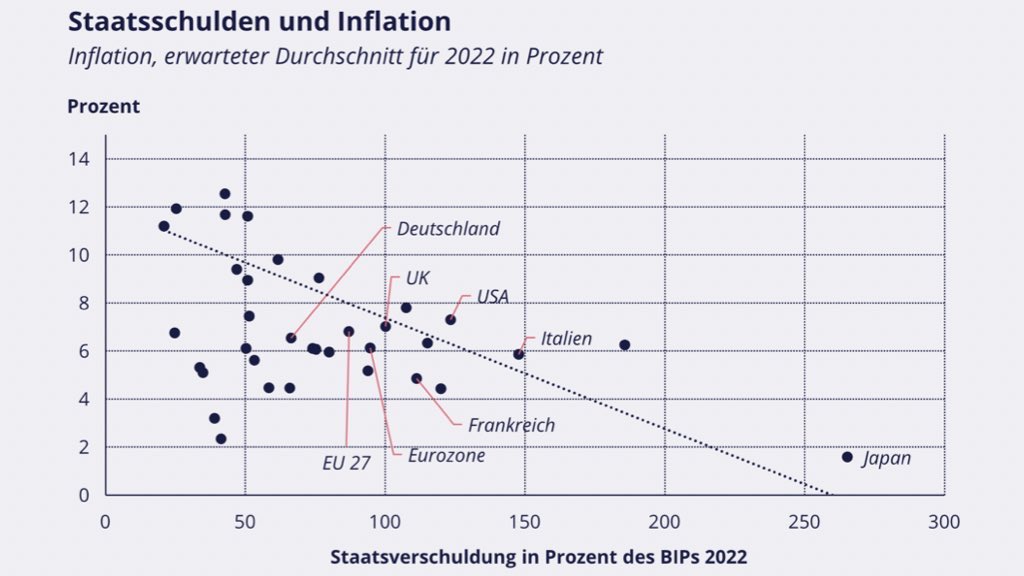
Dear idiots, government deficits do NOT cause inflation

Comment on Michael Lebowitz on ‘Modern Monetary Theory and its Fictional Discipline’*

Blog-Reference and Blog-Reference

It’s a Pavlovian Reflex among economists and laypersons alike: when they hear an MMTer talking about deficit-spending/money-creation, some cretin shouts Weimar or Zimbabwe. This reflex is as old as the Quantity Theory of Money.#1

The problem is, of course, that economists and laypersons alike have no idea how the monetary economy works. This is excusable for laypersons but not for economists. The fact is, in methodological terms, economists lack the true theory. The fact is that economists do not know after 200+ years what profit is.

Because the Profit Theory is false, the whole analytical superstructure is false, including, of course, Money Theory, Distribution Theory, and Employment Theory. This prevents, to this day, the understanding of the effects of public deficit-spending/money-creation.

The process goes schematically as follows: #2, #3

(i) The initial economic configuration is the elementary production-consumption economy. The initial state is characterized by market clearing and budget-balancing of the household sector C=Yw, i.e., the households fully spend their wage income Yw on consumption goods, and zero profit of the business sector Q≡C−Yw=0.

(ii) Now, the government deficit spends. Deficit D is defined as public spending G minus taxes T, i.e. D≡G−T. T is set to 0. Deficit spending on current output causes a price hike and the business sector ends up with macroeconomic profit Q=G. Note well, a one-off price hike is NOT inflation.

(iii) The business sector fully distributes profit. The distributed profit Yd goes to the Oligarchy and takes initially the form of deposits at the central bank. The CB’s balance sheet shows government overdrafts on the asset side and the Oligarchy’s deposits on the liability side. Both sides are equal to the penny. In a fiat money regime, deposits at the CB are money. Government deficit spending increases the quantity of money.

(iv) The government consolidates overdrafts by selling interest-bearing bonds. The bonds are bought by the Oligarchy and paid for with deposits. The CB’s balance sheet shrinks. The Oligarchy’s portfolio consists of bonds and money. In the limiting case, both overdrafts and deposits reduce to zero, that is, the quantity of money is back at its initial level.

(v) This process can be repeated identically again and again. There is no further price hike and NO inflation. What happens is that the financial wealth of the Oligarchy grows in lockstep with the public debt ($22 trillion and counting), with the quantity of money remaining roughly at the same level. And this is an observable fact.* All relevant economic magnitudes are measurable with the precision of two decimal places.

Dear Quantity Theory retards, get it: The lethal effect of MMT deficit-spending/money-creation policy is NOT on inflation but on distribution.

Egmont Kakarot-Handtke


* SEE IT market
#1 Wikipedia Quantity theory of money
#2 From MMT misunderstandings to the true Theory of Money
#3 Deficit-spending, public debt, and macroeconomic profit/loss

Related 'MMT: Distribution is the drawback NOT Inflation' and 'Economics as tireless production of proto-scientific garbage: inflation theory as an example' and 'Links on Inflation' and 'Money and time' and 'Gov-Deficits do NOT cause inflation' and 'Settling the MMT―Inflation issue for good' and 'The Dark-Matter Theory of Fiat Money'

***
*  Twitter Mar2

Source: Twitter


REPLY to Noah Way on Feb 16

You say: “Sectoral balances assume that money is a limited physical resource and as such are complexity irrelevant.”

Sectoral balances “assume” nothing about money. Q+S=0, for instance, says that the balance of the business sector Q and the balance of the household sector S always add up to zero. This simple fact, though, is beyond the comprehension of people who call themselves economists.

You can assume that I have demonstrated the relationship between balances and money somewhere, and I assume that you know how to google it.


Twitter Jul 3, 2022 What holds for deficits and inflation holds mutatis mutandis for debt and inflation


Twitter Oct 27, 2022 Increasing the public deficit causes a one-off price hike (under the condition of market-clearing and budget-balancing)


August 26, 2015

Common non-sense

Comment on Tim Worstall on ‘On not understanding the quantity theory of money’

Blog-Reference

The current economic situation is a clear refutation of both the commonplace employment and the Quantity Theory. When things get tough, everyone can see that economists have no idea how the economy works.

The Quantity Theory falls into the class of flat-earth theories, which are immediately convincing to common sense. The first thing an economist has to realize, though, is that common sense is not the best guide in economic matters. This is known since J. S. Mill: “People fancied they saw the sun rise and set, the stars revolve in circles round the pole. We now know that they saw no such thing; what they really saw was a set of appearances, equally reconcilable with the theory they held and with a totally different one. It seems strange that such an instance as this, ..., should not have opened the eyes of the bigots of common sense, and inspired them with a more modest distrust of the competency of mere ignorance to judge the conclusions of cultivated thought.” (Mill, 2006, p. 783)

The MV=PQ equation provides one of the silliest of the numerous common-sense explanations. The correct equation for the determination of the price level is given with Graphic AXEC64
Note well: the quantity of money does NOT appear as an independent variable in this equation. For the rectification of the commonplace Quantity Theory, see (2011a; 2011b).

There is not much use in discussing defunct theories any further. In particular, it should be evident after 100+ years that from all scientifically incompetent economists, the worst are assembled in Mises’s Austrian school.

Egmont Kakarot-Handtke


References
Kakarot-Handtke, E. (2011a). Reconstructing the Quantity Theory (I). SSRN Working Paper Series, 1895268: 1–28. URL
Kakarot-Handtke, E. (2011b). Reconstructing the Quantity Theory (II). SSRN Working Paper Series, 1903663: 1–20. URL
Mill, J. S. (2006). A System of Logic Ratiocinative and Inductive. Being a Connected View of the Principles of Evidence and the Methods of Scientific Investigation, volume 8 of Collected Works of John Stuart Mill. Indianapolis: Liberty Fund.

September 22, 2017

Forget Friedman, forget the Quantity Theory

Comment on David Glasner on ‘Milton Friedman and the Chicago School of Debating’

Blog-Reference

In economics, there are two starting points: microfoundations and macrofoundations. Both are provably false. Orthodoxy went micro: “… most of what I and many others do is sorta-kinda neoclassical because it takes the maximization-and-equilibrium world as a starting point” (Krugman). Keynes went macro: “Income = value of output = consumption + investment. Saving = income − consumption. Therefore saving = investment.” (GT, p. 63)

Because both the axiomatic foundations of Walrasianism and Keynesianism are provably false, their analytical superstructures are also false. This means inter alia that profit theory, price theory, employment theory, and money theory are false. Friedman never realized the necessity of a Paradigm Shift but remained faithful to a paradigm that had, strictly speaking, already been dead in the cradle 100+ years ago. As a spokesperson for Monetarism, he incarnated the central tenet “that money causes prices”.

Because economics is a failed science, it has to undergo a Paradigm Shift. Economic analysis has to be based on entirely new macrofoundations, and the fundamental questions have to be put again at the top of the agenda.

Economics has to be reconstructed from scratch. As a new analytical starting point, the elementary production-consumption economy is defined with this set of macro axioms: (A0) The objectively given and most elementary configuration of the economy consists of the household and the business sector which in turn consists initially of one giant fully integrated firm. (A1) Yw=WL wage income Yw is equal to wage rate W times working hours. L, (A2) O=RL output O is equal to productivity R times working hours L, (A3) C=PX consumption expenditure C is equal to price P times quantity bought/sold X.

Under the conditions of market-clearing X=O and budget-balancing C=Yw in each period, the price is given by P=W/R, i.e., the market-clearing price is equal to unit wage costs. This is the most elementary form of the macroeconomic Law of Supply and Demand. For the graphical representation, see Figure 1. #1


The price is determined by the wage rate, which takes the role of the nominal numéraire, and the productivity. The quantity of money is NOT among the price determinants. This puts Friedman’s Quantity Theory to rest.

Monetary profit for the economy as a whole is defined as Qm≡C−Yw, and monetary saving as Sm≡Yw−C. It always holds Qm≡−Sm, in other words, the business sector’s deficit=loss (surplus=profit) equals the household sector’s surplus=saving (deficit=dissaving). This is the most elementary form of the macroeconomic Profit Law. Under the condition of budget-balancing, the total monetary profit is zero.

What is needed for a start is two things: (i) a central bank that creates money on its balance sheet in the form of deposits, and (ii) a legitimate sovereign who declares the central bank’s deposits as legal tender.

Deposit money is needed by the business sector to pay the workers who receive the wage income Yw per period. The need is only temporary because the business sector gets the money back if the workers fully spend their income, i.e., if C=Yw.

Overdrafts are needed by the household sector for consumption expenditures if the households want to spend before they get their income. This time sequence is no problem for the central bank because the temporary overdrafts vanish with wage payments.

For the case of a balanced budget C=Yw, the idealized transaction sequence of deposits/ overdrafts of the household sector at the central bank over the course of one period is shown in Figure 2. #2


The household sector’s deposits/overdrafts are zero at the beginning and end of the period. The business sector’s transaction pattern is the exact mirror image. Money, that is, deposits at the central bank, is continually created and destroyed during the period under consideration. There is NO such thing as a fixed quantity of money. The central bank plays an accommodative role and simply supports the autonomous market transactions between the household and the business sector.

From this follows the average stock of transaction money as M=κYw, with k determined by the transaction pattern. In other words, the average stock of money M is determined by the autonomous transactions of the household and business sector and created out of nothing by the central bank. As a matter of principle, the production-consumption economy NEVER runs out of money.

The transaction equation reads M=κPX=κRL P in the case of budget-balancing C=Yw and market-clearing X=O, and this yields the commonplace correlation between the average stock of money M and price P for given employment and productivity level, except for the fact that M is the DEPENDENT variable. If P doubles, M doubles. The commonplace correlation does NOT hold if L doubles and M doubles, and P remains constant.

Inflation ensues under the condition of market-clearing and budget-balancing if the wage rate rises over several periods faster than productivity, and deflation ensues in the opposite case. Under the condition of L, R → const., one always gets the commonplace correlation between the average stock of money M and price P, with the causality running from P to M.

This axiomatically correct kernel of the theory of money #3 ― which immediately makes it clear why the Fed cannot reach the inflation target ― fully replaces Friedman’s proto-scientific garbage.

Egmont Kakarot-Handtke


#1 Graphic AXEC31 Elementary production-consumption economy
#2 Graphic AXEC98 Transaction pattern, household sector, balanced budget
#3 For more details, see Reconstructing the Quantity Theory (I). The New Quantity Theory formula is shown under the label of Graphic AXEC111a.

Related 'Fact of life: your econ prof is scientifically incompetent' and 'Milton Friedman, fake scientist' and 'Forget Friedman, forget Keynes' and 'NAIRU and the scientific incompetence of Orthodoxy and Heterodoxy' and 'Friedman and the cluelessness of fake scientists' and 'Will economics ever become a science?' and 'Common non-sense' and 'How money emerges out of nothing ― the functional account' and 'Indeed, Keynesianism and Monetarism are basically the same proto-scientific rubbish' and 'Clueless about money and profit' and 'Objective determinants of profit and interest' and 'Going beyond Wicksell, Keynes, and MMT' and 'Interest and profit' and 'How MMT got inflation wrong' and 'Inflation: back to basics' and 'Attention: there are THREE types of inflation' and 'Basics of monetary theory: the two monies' and 'Criminals and the Monetary Order'.

***

Graphic AXEC210

July 2, 2020

The value of money and the worthlessness of economics

Comment on David Glasner on ‘What’s Right and not so Right with Modern Monetary Theory’

Blog-Reference and Blog-Reference

David Glasner sets the frame: “In writing the paper, it occurred to me that it might be worthwhile to include a comment on Modern Monetary Theory inasmuch as the proposition that the value of fiat money is derived from the acceptability of fiat money for discharging the tax liabilities imposed by the governments issuing those fiat moneys, which is a proposition that Modern Monetary Theorists have adopted from the chartalist school of thought associated with the work of G. F. Knapp.”

Of course, other economists have said other things, and in the end, nobody has any idea what the value of money is. Economic reality is complex, you know, and economics ends always in the swamp where “nothing is clear and everything is possible.” (Keynes)

Walrasian microfoundations and Keynesian macrofoundations are provably false. Because economics is a failed science, it has to be reconstructed from scratch. This has already been done elsewhere #1, #2, #3, so here is the bare-bones version.

The elementary production-consumption economy is defined with this set of macroeconomic axioms: (A0) The objectively given and most elementary configuration of the economy consists of the household sector and the business sector, which in turn consists initially of one giant fully integrated firm. (A1) Yw=WL wage income Yw is equal to wage rate W times working hours. L, (A2) O=RL output O is equal to productivity R times working hours L, (A3) C=PX consumption expenditure C is equal to price P times quantity bought/sold X.

Under the conditions of market-clearing X=O and budget-balancing C=Yw in each period, the price is given by P=W/R (1), i.e., the market-clearing price is equal to unit wage costs. This is the most elementary form of the macroeconomic Law of Supply and Demand. For the graphical representation, see AXEC31a. #4

The price is determined by the wage rate, which takes the role of the nominal numéraire, and productivity. The quantity of money is NOT among the price determinants. This puts the commonplace quantity theory to rest.

The real value of money is ultimately given by productivity. From (1) follows W/P=R, i.e., real wage = productivity. The value of money has nothing at all to do with the taxing power of the state.

Transaction money is zero at the beginning and the end of the period under consideration, see Graphic AXEC98. #5 All transactions are handled by the central bank, which continuously creates and destroys fiat money (= deposits and overdrafts) on its balance sheet. There is NO such thing as a fixed quantity of money. The central bank plays an ACCOMMODATIVE role and simply supports the AUTONOMOUS market transactions between the household and the business sector. The economy never runs out of money. Money comes into the economy on the supply side.

Monetary profit for the economy as a whole is defined as Qm≡C−Yw, and monetary saving as Sm≡Yw−C. It always holds Qm≡−Sm, in other words, the business sector’s surplus = profit (deficit = loss) equals the household sector’s deficit = dissaving (surplus = saving). This is the most elementary form of the macroeconomic Profit Law.

The problem with MMT is that it is bad theory #6 and bad policy #7, more specifically: MMT is a plain political fraud. #8

The Profit Law for the 3-sector case (household, business, state sector) reads Qm≡(G−T)−Sm, which says that the business sector's profit/loss is given by the state sector's budget deficit/surplus and the household sector's dissaving/saving. For Sm=0, this boils down to (G−T)=Qm, i.e., public deficit equals private profit. The profit of the monetary economy is, in this analytical limiting case, produced entirely by the state sector. In other words, deficit-spending/money-creation is a free lunch for the Oligarchy. Financial wealth grows in lockstep with public debt.

MMT is not a scientifically valid monetary theory but brain-dead propaganda for the benefit of Wall Street. The question is whether David Glasner does not understand how the monetary economy works or whether he is complicit in the fraud.

Egmont Kakarot-Handtke


#1 The creation and value of money and near-monies
#2 The objective value of money
#3 Sovereign Economics, Sec. 1.3, 4.6
#4 Graphic AXEC31a  Elementary production-consumption economy
#5 Graphic AXEC98 Idealized transaction pattern, household sector, balanced budget
#6 Wikipedia, economics, scientific knowledge, or political agenda pushing?
#7 MMT, money printing, stealth taxation, and redistribution
#8 Deficit-spending/money-creation is ALWAYS a bad deal for WeThePeople

Related 'MMT, money, value, and transcendental Capitalism' and 'The value of money and the worthlessness of economics' and 'The Dark-Matter Theory of Fiat Money {78a}'.

***
REPLY to Matt Franko on Jul 3

I said, “The quantity of money is NOT among the price determinants. This puts the commonplace quantity theory to rest.”

You say “LOL! not for the Monetarists it’s not... Just had Bill Dudley in Bloomberg op-ed saying “banks will lend out the Reserves!” last week... QT is certainly not put to rest... it’s being used right now by policy people.”

Right, but this proves only what everybody knows by now, i.e., that policy people are IQ-wise well below room temperature. The fact that there are still flat-earthers around does not prove anything against heliocentrism. Get it, the quantity theory and monetarism are scientifically dead.

What Bill Dudley or Bloomberg or any other clown in the political Circus Maximus says is just irrelevant.

If you still take these folks seriously, better loosen the straps on your facemask. Your last brain cell is dying for lack of oxygen.

***
REPLY to Matt Franko on Jul 5

You say “I submit that there are max 1,000 of us on planet earth that understand this.,. Out of 7.5 billion people.”

You are in the wrong reference frame. In science, the opinions and votes and clicks and likes of 7.5 billion people count exactly for zero.

MMT is provably false; that is what counts in science.

***

REPLY to LAL, Frank Restly, Henry Rech, ralph47 on Jul 5

You constantly argue: MMTers say this and MMTers say that. It is a matter of indifference to what MMTers say because MMT is provably false. MMTers are too stupid for the elementary algebra that underlies macroeconomics. For proof, see the section 'Scientific blunder from Keynes to MMT' in #1

So, there is no need at all to listen to what MMTers say, except for the political fact that MMTers betray the general populace.

Because of the macroeconomic Profit Law, it holds that Public Deficit = Private Profit. Therefore, public deficit spending is a free lunch for the ten percenters and amounts in real terms to stealth taxation of the ninety percenters.

This, though, is only the beginning. The business sector distributes profit to the ten-percenters. The ten percenters, in turn, buy the bonds that are issued in order to consolidate the short-term liabilities of the government sector.

Then, the ninety percenters are taxed in order to pay the interest on government bonds that are in the possession of the ten percenters. This goes as long as the public debt is rolled over. This is fine for the ten-percenters as long as the central bank keeps the interest rate above zero.

All in all, public deficit spending/money creation amounts to a fourfold fraud for the benefit of the ten percenters and the detriment of the ninety percenters.

MMT is the biggest redistribution program in the history of humankind. Private financial wealth is roughly equal to public debt. MMTers are currently the worst disgrace of academic economics, which has run for 200+ years now on a very high level of scientific incompetence, stupidity, and corruption.

Your comments are beside the point and absolutely irrelevant.


#1 Profit
***

REPLY to Frank Restly, Henry Rech on Jul 8

You still do not get the crucial point of monetary policy. Roughly speaking, when fiat money is brought into the economy in order to pay a growing wage bill, it is a good thing; when fiat money is brought into the economy for deficit spending, it is a criminal thing because it amounts to counterfeiting. This puts the MMT talking points into a new perspective.
  • The counterfeiter never runs out of money.
  • The counterfeiter never stops stealing stuff from the rest of society.
  • The counterfeiter increases the profit of the business sector with his additional demand.
  • The counterfeiter says that he is good for the economy and employment.
  • When the economy breaks down, the counterfeiter increases deficit spending/ money creation.
  • The counterfeiter 'solves' any problem from unemployment to pandemics to global warming with deficit spending/money creation.
  • The counterfeiter continuously increases the public debt but says that it does not matter.
  • The counterfeiter is a criminal, but never gets caught because he games the fiat money system from within.
  • The counterfeiter gets valuable PR support from academia, in particular from the MMT fake science trolls.
With your ignorance and scientific incompetence, you are practically — intentionally or unintentionally does not matter — part of a gigantic political fraud.

***
REPLY to Frank Restly on Jul 9

You are in the wrong reference frame. Economics is about how the monetary economy works and NOT what the Constitution says. Economics is, according to its explicit self-definition #1, a science, and the Constitution is politics. It is the foundational principle of science that both spheres must be kept apart. It is a well-known fact that politics corrupts everything it touches. It is the story of Midas, but instead of turning everything into gold, politics turns everything into shit. So, the principle of the strict separation of science and politics is constitutional for science.

The macroeconomic profit law implies Public Deficit = Private Profit. So, the MMT policy of deficit spending/money creation is clearly a free lunch for the one-percenters. #2 MMT claims that MMT policy benefits the ninety-nine percenters, while the exact opposite is true. So MMT is a political fraud. It is academics like Stephanie Kelton who promote the greatest redistribution of income and financial wealth in history. #3 The current distribution is, in the main, the result of the growth of public debt over the last 200+ years. Make no mistake, it is WeThePeople who owes the debt. And it is the one-percenters who own the financial assets.

By blowing smoke about the Constitution, you are covering the political fraud of MMT. This may be okay according to the Constitution, but it is not okay according to the principles of science.

The scientific fact of the matter is that MMT goes down the scientific toilet and you with it.


#1 “Bank of Sweden Prize in Economic Sciences in Memory of Alfred Nobel”.
#2 Keynes, Lerner, MMT, Trump, etc. and exploding profit
#3 MMT: For the record

***
REPLY on Jul 10

What Is MMT? (Short Version)

MMT is the issuance of counterfeit currency in the form of deficit spending/money creation for the benefit of the one-percenters.

Genuine currency and counterfeit currency are indistinguishable because they originate from the same source: the FED. It all depends on whether additional fiat money is injected on the supply or the demand side.

MMTers are not scientists but political agenda pushers. MMT policy is to the disadvantage of the ninety-nine percenters. The counterfeiter steals from the rest of society via the anonymous price mechanism.

It is the ninety-nine percenters who owe the public debt. And it is the one-percenters who own the corresponding financial assets. Interest on public debt works like a regressive tax as long as the debt is rolled over.

Because #PublicDeficitIsPrivateProfit, MMT is the biggest redistribution program ever.

MMT is a political fraud.

***
CROSS-POSTING on Jul 12

MMT – a Wall Street myth
Comment on Chris Dillow on ‘The Deficit Myth: A Review’

Chris Dillow’s main point of critique is “For me, Kelton is – albeit very lucidly – reinventing the wheel.”

This is, in fact, a compliment because MMT is proto-scientific garbage and Kelton is academic fraud. #1

MMT’s macroeconomics is provably false since Keynes, Kalecki, Lerner, etc. So, MMT policy guidance has no sound scientific foundations.

The macroeconomic Profit Law implies Public Deficit = Private Profit. This means that the greater part of the profit in the United States is actually produced by the state. The US economy has been hanging for a long time already on the state ventilator for its survival.

Among all that academic crap, MMT has the right message for Wall Street. Who is MMT’s first apostle? Right, Warren Mossler, ex-Wall Street. But Stephanie Kelton is, without a doubt, the more attractive salesperson. Economics has become part of the entertainment industry long ago, and the casting is done in Hollywood, where they know best what sells.

The rest is marketing/PR routine. Interviews, book, media hype, No. 1 on the best-seller list, and then, of course, trolling on social media. This is where Chris Dillow comes in: “Dr Kelton explain these ideas wonderfully clearly, so I recommend this book to all non-economists interested in government finances.”

MMT is itself a myth. MMT policy is NOT for the benefit of WeThePeople. MMT is the issuance of counterfeit currency in the form of deficit spending/money creation for the benefit of the one-percenters. Because PublicDeficit = PrivateProfit, MMT is the biggest redistribution program ever. MMT is a political fraud.

“Chris Dillow is a Marxian economist,” says Tom Hickey at Mike Norman Economics. There are historians who claim that Marx was already on the payroll of the financial Oligarchy.


#1 More details

***

REPLY to David Glasner, Frank Restly, Henry Rech on Jul 15

It is pretty obvious that you have NO idea of how the monetary economy works. Because of this, you cannot properly assess MMT.

The underlying problem is that the monetary economy (capitalism or communism does not matter) is NOT a self-optimizing equilibrium system but eventually breaks down. #1

The Profit Law No 3 Qm≡I−Sm tells one that macroeconomic profit is positive in a growing economy as long as the business sector’s investment is greater than the household sector’s saving. If this fails, macroeconomic profit turns into a loss, and the economy breaks down. This must eventually happen; what is unknown is the exact date. #2

However, there is a way to postpone the breakdown. The Profit Law, including the state sector, reads Qm≡(I−Sm)+(G−T), that is, the second component of macroeconomic profit is the state sector’s deficit. It holds Public Deficit = Private Profit. #3

The MMT policy of deficit spending/money creation is ultimately a means of postponing the breakdown of the US economy. From a political standpoint, the COVID pandemic provides a good rationale to mute the budget balancers and to blow the deficit up to hitherto unknown proportions.

The volume of the deficit and the popularity of MMT #4 are good metrics for the acceleration of the breakdown.

If you intend to learn economics, I recommend the new textbook Sovereign Economics. #5


#1 Major Defects of the Market Economy
#2 Mathematical Proof of the Breakdown of Capitalism
#3 Graphic AXEC143d
#4 Keynes, Lerner, MMT, Trump and exploding profit
#5 Amazon or BoD

***
#PointOfProof
before Jul 16
after Jul 16

***


June 25, 2018

It has been said before but economists still don’t get it

Comment on Nick Rowe on ‘Hydraulic Monetarism’

Blog-Reference and Blog-Reference

Nick Rowe concludes: “I’ve said all this before (and it’s all in Yeager and Clower and others). But maybe I’ve said it clearer this time.”

It has been said before: microfounded economics from utility maximization to supply-demand-equilibrium is false for 150+ years but one fraction of economists do not grasp it (= Orthodoxy) and the other fraction has never come forward with a superior alternative (= Heterodoxy). The theory of money circles in the endless loop of repetition ― except for MMT.

MMT has made the valid point that orthodox monetary theory is stuck with ridiculous barter stories and entirely misses the reality of fiat money. Fiat money does not circulate but is permanently created and destroyed. So, there is no fixed stock of money, to begin with. Let us call this lethal blunder of Orthodoxy the Moneybag Fallacy.

The Moneybag Fallacy was rectified by Wicksell and his giro system but for some reason, the news never illuminated the mental darkness of the Quantity Theory folks.

In the monetary economy, there is no direct barter, i.e. part of the stock of good 1 against part of the stock of good 2, but indirect barter, i.e. flow of labor time against the flow of goods. Money is created by wage payments and destroyed by consumption expenditures. In the most elementary case C=Yw, that is, consumption expenditures are equal to wage income, that is, money is zero at the beginning of the period under consideration, is then created and destroyed through the transactions between the business and the household sector, and is zero at the end of the period. NO moneybag there! No circulation there! NO hydraulics there!

In the elementary production-consumption economy, three configurations are logically possible: (i) consumption expenditures are equal to wage income C=Yw, (ii) C is less than Yw, (iii) C is greater than Yw.
  • In case (i) the monetary saving of the household sector Sm≡Yw−C is zero and the monetary profit of the business sector Qm≡C−Yw, too, is zero. The product market is cleared, i.e. X=O, in all three cases.
  • In case (ii) monetary saving Sm is positive and the business sector makes a loss, i.e. Qm is negative.
  • In case (iii) monetary saving Sm is negative, i.e. the household sector dissaves, and the business sector makes a profit, i.e. Qm is positive.#1
It always holds Qm≡−Sm, in other words, at the heart of the monetary economy is an identity: the business sector’s deficit (surplus) equals the household sector’s surplus (deficit). Put bluntly, loss is the counterpart of saving and profit is the counterpart of dissaving. This is the most elementary form of the macroeconomic Profit Law.

In case (ii)
  • the household sector ends up with a stock of money = deposits at the central bank and the business sector ends up with overdrafts,
  • the change of the household sector’s stock is given by ΔM=Yw−C,
  • the economy falls into recession.
In case (iii) it is just the other way round.

The household sector’s stock at the end of period t is given as the discrete numerical integral Mt=∑ΔM+M0 with M0=0.

Both the commonplace Quantity Theory and Hydraulic Monetarism is proto-scientific garbage.

Egmont Kakarot-Handtke


#1 Money and time

Related 'MMT: Richard Murphy’s battle-for-money hoax' and 'Nick Rowe’s soapbubbling about money' and 'Money: from silly stories to the true theory' and 'Rectification and generalization of MMT' and 'MMT sucks'.

***
REPLY to Nick Rowe on Jun 26

You said in the intro: “If everyone wants to increase their stock of land, and the aggregate stock of land does not increase to satisfy their desire, there is nothing they can do in aggregate, and there is nothing they can do as individuals.”

To compare money with land is as gaga as it gets. MMTers don’t get tired of shouting from every rooftop that money is produced out of nothing at almost no cost. As a matter of principle, the economy NEVER runs out of transaction money if the central bank understands what their primary task is.#1, #2

The apparatus of supply-demand-equilibrium is inapplicable to fiat money. To speak of a money “supply” is the Moneybag Fallacy all over again.

If every household “wants to increase their stock of money” they reduce their consumption expenditures. In this case, C is less than Yw and the deposits of the household sector (= money) increase and the overdrafts of the business sector increase also because the business sector makes a loss and both sides of the central bank’s balance sheet are always equal.

The same holds for a gold-coin economy. If the business sector pays the workers in gold coins and they fully spend their income, i.e. C=Yw, then the coins return to the business sector. If the households save, i.e. C less than Yw, then the household sector’s stock of coins increases until the end of the period under consideration and the business sector’s stock decreases. The business sector makes a macroeconomic loss and this triggers a recession.

In the elementary production-consumption economy, nobody can stop the households from increasing their stocks of money as long as they receive a wage income. The form of money, fiat money or gold coins, is irrelevant.

The household sector’s stock of money develops according to the discrete numerical integral Mt=∑ΔM+M0, and the business sector’s stock is the exact mirror image except for the initial stock which, however, is zero in a fiat money system.#3

Economists never got the relationship between macroeconomic flows, differences of flows, change of stocks, and stocks straight.


#1 The creation and value of money and near-monies
#2 MMT: Richard Murphy’s battle-for-money hoax
#3 Reconstructing the Quantity Theory

***

REPLY to Benjamin Cole, louis, Majromax, Jeremy Fox, Frank Restly, Roger Sparks on Jun 27

The history of money from the cowrie shell to bullion to coins to notes and to the credit card shows a clear tendency of progressive abstraction. The conclusion of the history of money is that money is information and that the concrete forms of monies are nothing but different data carriers. In the monetary economy of the digital age, the ultimate data carrier is the server at the central bank.

The pathetic blunder of monetary theory is the Fallacy of Insufficient Abstraction. Your idiocy consists of getting caught by the numerous outer forms of money. The abstract essence of the phenomenon is this: Money = Information. There is no ambiguity about money. Money is deposits at the central bank. Bank deposits are near money, not money.#2 And all other historical forms have to be treated as surrogates/substitutes/prefigurations of the real thing.

The theory of money is macro. Some people have realized this: “However, Post Keynesians and Circuitists both hold strongly to the view that the orthodox approach of firstly analyzing a barter economy, and then adding on money as an afterthought, is unhelpful as a foundation for any economic analysis.” (Fontana)

So, you are way behind the curve. The theory of money has to be built upon macrofoundations and not upon silly microeconomic barter or casino stories. The analytical framework is given by the ‘monetary theory of production’. (Keynes)

The remark “I have seen casino chips used for cash in Las Vegas” is not a contribution to the theory of money but proof that the representative economist has no idea about how the monetary economy works and how money functions. It is a wonder of Nature that a dead brain does not impair the faculty of blathering in the econblogosphere.


#1 Money: from silly stories to the true theory
#2 Basics of monetary theory: the two monies

***
REPLY to Frank Restly on Jun 28

You say: “Simplistic stripped down models can aid in understanding ― it all depends on your audience.”

Because economics is a science the primary audience is the scientific community. The scientific community never had any problems with stripped down models but with FALSE models.

The story of how Zeus threw his thunderbolt at Typhon is NOT a stripped down model of how electricity works but a false model. The same holds for all barter stories. The defining characteristic of the economy is that labor time is exchanged for IOUs/money and money is exchanged for goods. The subject matter of economics is NOT barter or barter with a money-good but the ‘monetary theory of production’ (Keynes).

So, the most simplistic stripped down model in economics has to be a macro model. The ultimate methodological blunder of economics is microfoundations.

The scientific failure of economics is due to economists clinging to microfoundations. A scientist needs to read the microeconomic axioms#1 only once and knows for sure that they are proto-scientific garbage. And methodology tells us that if the axiomatic foundations are false the whole analytical superstructure is false.

Not to see that monetary theory has to be macrofounded is the disqualifying scientific blunder of Nick Rowe. It is not the only one.#3


#1 “HC1 economic agents have preferences over outcomes; HC2 agents individually optimize subject to constraints; HC3 agent choice is manifest in interrelated markets; HC4 agents have full relevant knowledge; HC5 observable outcomes are coordinated, and must be discussed with reference to equilibrium states.” (Weintraub)
#2 Buddha on the microeconomic men in the dark
#3 Nick Rowe’s soapbubbling about money
► Is Nick Rowe stupid or corrupt or both?
► I is never equal S and even Nick Rowe will eventually grasp it
► Cryptoeconomics ― the best of Nick Rowe’s spam folder
► Getting out of IS-LM = Getting out of despair
► Nick Rowe: Bury me at the end of coal-pit
► Macro poultry entrails reading
► Worthless Canadian model bricolage
► The Humpty Dumpty methodology

***
REPLY to Jacques René Giguère on Jul 4

You say: “Money, cowrie shells or script, was formalized when the village grew too big and exceeded the Dunbar limit.”

You confound historical storytelling with scientific theory. A historical account of the various forms of money is NO substitute for the theory of money, just as the history of the burning of Rome, London, San Francisco etcetera is no substitute for the theory of thermodynamics.

The theory of money has to be embedded in a consistent macroeconomic framework or in what Keynes called the ‘monetary theory of production’.#1, #2

The subject matter of economics is how the actual monetary economy works and NOT historical storytelling.#3


#1 The ultimate ― analytical ― origin of money
#2 How money emerges out of nothing ― the functional account
#3 It has been said before but economists still don’t get it

July 24, 2017

How money emerges out of nothing ― the functional account

Comment on Peter Cooper on ‘Short & Simple 10’

Blog-Reference

“Money is historically an emergent market phenomenon establishing a commodity money, but nearly all contemporary money systems are based on fiat money.” #1

“In MMT, ‘vertical’ money enters circulation through government spending. Taxation and its legal tender power to discharge debt establish the fiat money as currency, giving it value by creating demand for it in the form of a private tax obligation that must be met.” #2

Economists are storytellers, not scientists, and because of this, they explain economic phenomena historically. This is a bit dilettantish, just like physicists trying to derive the phenomena and laws of thermodynamics by recounting the history of major events from the Great Fire of Rome in AD 64 to the Great Fire of London in AD 1666. The methodological fact is that the historical approach does NOT work in science. Usually, it explains NOTHING.

Therefore, money has to be derived FUNCTIONALLY within an analytical framework that is defined in detail by
(i) Macrofoundations. #3
(ii) National Accounting, which determines the relationship between the nominal flows (wage income, consumption expenditures) and balances = differences of flows (saving/dissaving, loss/profit). #4
(iii) The relationship between the flows and balances of National Accounting and the changes in the stock of money/credit at the central bank.

Thus, stock-flow consistency is secured. The pivot between stocks and flows is the positive or negative nominal balances.

In order to reduce the monetary phenomena to the essentials, it is supposed that all financial transactions are carried out (at first without costs) by the central bank. The stock of money then takes the form of current deposits or current overdrafts. From this follows: quantity of money = debit side of the central bank’s balance sheet = current deposits.

In the initial period, the conditions of market-clearing and budget-balancing hold. The central bank provides the transaction medium and creates money out of nothing. Loosely speaking, it finances the business sector’s payroll, whatever it is. The economy NEVER runs out of money.

By sequencing the initially given period length of one year into months, the idealized transaction pattern that is displayed on Graphic AXEC86 #5 results.

It is assumed that the monthly income Yw/12 is paid out at mid-month. In the first half of the month, the daily spending of Yw/360 increases the current overdrafts of the households. At mid-month, the households change to the positive side and have current deposits of Yw/24 at their disposal. This amount reduces continuously towards the end of the month. This pattern is exactly repeated over the rest of the year. At the end of each sub-period, and therefore also at the end of the year, both the stock of money and the quantity of money are ZERO. Money is present and absent depending on the time frame of observation.

In period 2, the wage rate and the price are doubled. Since no cash balances are carried forward from one period to the next,  no real balance effect happens provided the doubling takes place exactly at the beginning of period 2.

The transaction pattern looks the SAME if employment L is doubled and productivity R, wage rate W, and price P remain unchanged. So, only the REAL variables employment L and output O double, but the transaction pattern is identical with a doubling of the NOMINAL variables wage rate W and price P. This tells one immediately that the commonplace Quantity Theory of Money is false.

From the perspective of the central bank, it is a matter of indifference whether the household or the business sector owns current deposits. The pattern of transaction #5 translates into the AVERAGE amount of current deposits. This average stock of transaction money depends on income according to the transaction equation M=κYw.

The variable M is a straightforward period average that results from the AUTONOMOUS transactions between the business and the household sector in the elementary production-consumption economy. The central bank enables the average stock of transaction money to expand or contract with the development of wage income. Analytically (not historically), money emerges from autonomous market transactions. In order for money to come into the world, a central bank is needed that issues transaction money in parallel with expanding/contracting wage income. #6 There is NO commodity like gold, and no government deficit spending is needed.

Both the Quantity Theory of Money and the Chartalist Theory of Money are figments of the historical imagination.

Egmont Kakarot-Handtke


#1 Wikipedia Money
#2 Wikipedia MMT
#3 Macrofoundations are given by (A0) The objectively given and most elementary configuration of the economy consists of the household and the business sector, which in turn consists initially of one giant fully integrated firm. (A1) Yw=WL wage income Yw is equal to wage rate W times working hours. L, (A2) O=RL output O is equal to productivity R times working hours L, (A3) C=PX consumption expenditure C is equal to price P times quantity bought/sold X. The nominal variables Yw and C reappear in National Accounting.
#4 See Graphic National accounts (a) Graphic AXEC94 balanced budget, (b) Graphic AXEC96 saving/loss, (c) Graphic AXEC95 dissaving/profit
#5 Graphic AXEC86 Idealized transaction pattern
#6 For more details, see Essentials of Constructive Heterodoxy: Money, Credit, Interest and Reconstructing the Quantity Theory (I).

Related 'Macro for dummies' and 'A crash course in macro accounting' and 'Where MMT got macro wrong' and 'A tale of three accountants' and 'Money and debt in six elementary steps' and 'Money and time' and 'The ultimate ― analytical ― origin of money' and 'Macro for dummies' and ' Money: from silly stories to the true theory' and 'Money is information'.

***
REPLY to Peter Cooper on Jul 25

One way to explain the actual state of the world is the historico-genetic (K. Mannheim) approach. And this is how the development from barter to fiat money is usually presented. This history is quite interesting, but history is not science. From the history of the practical use of levers among animals and humans, one will never arrive at the Law of the Lever as put down by Archimedes.

Take notice that economics is defined as a science, and science is well-defined by material and formal consistency. Your series Short & Simple has been inconsistent in storytelling.

First of all, the theory of money/debt cannot stand alone but must be embedded in what Keynes called the 'monetary theory of production', which in turn must be based on macrofoundations.

The fact is that your macrofoundations are ill-defined. More specifically, your profit theory is provably false. As a consequence, your theory of money is false, too, no matter how many plausible pieces of history it contains.

This is lethal: you cannot show how, in principle, the flows of a simple monetary economy (which are measurable) affect the stock of money (which is also measurable). This cannot be compensated by stories like ‘how government’s position of strength’ had been used ‘in getting its own IOU widely accepted’.

Take notice that MMT has been thoroughly refuted. Here are all the proofs and arguments for your convenience, collected

To continue your series, Short & Simple is pointless.

***
REPLY to Peter Cooper

Money has taken various historical forms (token, coin, note, deposit, etc.), and the banking system in each country is the outcome of a murky historical process. Therefore, the first thing to do is to abstract from the historical detail and to define a clear-cut analytical frame of reference. This frame has been called by Keynes the 'monetary theory of production'.

(i) The pure production-consumption economy consists of the business and the household sector. The household sector provides the labor input to the business sector, which consists initially of one firm. The product of the firm is sold to the household sector. Example: the wage income per period (e.g., year) is 100 [thousand/million/billion, euro/dollar/yen]. So, in a period of defined length, the households put in their work, and the firm owes a total of 100 monetary units to the household sector.

(ii) The firm issues IOUs, and these are used in turn by the households to buy the output. For simplicity, the wage income of 100 monetary units is fully spent on consumption goods. Starting from zero at the beginning of each period, IOUs are created by the firm and vanish completely until the end of the period. Clearly, IOUs are debt, and they are used exclusively for transactions between the business and the household sector.

(iii) IOUs work fine with one firm but not with many firms. If the business sector consists of many firms, the need for a general IOU arises. This general IOU is produced by the central bank and is called money. The central bank gives the firm money in the form of current deposits, and the firm owes overdrafts to the central bank. The firm pays the workers by transferring the deposits instead of IOUs. The workers spend their income, and the deposits return to the business sector, which reduces the overdrafts. At the end of the period, all deposits and overdrafts are again ZERO. So money is created out of nothing and vanishes into nothing until the end of each period. This process can continue in principle for all eternity, no matter how big or small the economy is. There is no such thing as a fixed quantity of money.

(iv) Only deposits are money, but, clearly, deposits are always exactly equal to overdrafts. Hence, money is the central bank’s half of what is essentially a credit relationship. Both sides of the central bank’s balance sheet are equal at any point in time by logical necessity. So, there is no such thing as debt-free money. But note that deposit/overdraft money as a TRANSACTION medium is entirely different from CREDIT for houses and cars, or for financing real investment of the business sector or for financing public deficits. Not keeping these things properly apart is a recipe for messing up the theory of money.

The fact that money is debt does NOT mean that it should be spent into existence by government deficits. The proper way of creating money is to finance an expanding wage bill. To bring money into the world by financing government deficits is a program for increasing the profit of the business sector. So, either MMTers in their scientific incompetence do not understand how the economy works, or MMT is a pseudo-scientific veil for a free-lunch program for the one-percenters.


***

Graphic AXEC198a

August 11, 2024

Occasional X: How it works (CCXXXIII)


July 17, 2019

The right and the wrong way to bring money into the economy

Comment on Dirk Ehnts/Skender Fani on ‘Modern Monetary Theory’s promise’*

Blog-Reference

“Politicians seem ill-equipped to put scientific findings into practice,” says the MMT propagandist Dirk Ehnts. The problem is that MMT has no sound scientific foundations, to begin with, but is political agenda-pushing in the bluff package of science. Dirk Ehnts, for example, has not realized to this day that Keynesian macroeconomics is proto-scientific garbage. #1

The fact that economists, i.e., Walrasians, Keynesians, Marxians, Austrians, MMTers, lack the true scientific theory has never hindered them from giving economic policy advice. Economists have always been a menace to their fellow citizens. #2

Dirk Ehnts repeats the MMT mantra: “The state is the originator of currency as it puts money into circulation through its spending. If we have to pay our taxes in euros, the state has to spend a sufficient amount beforehand. That is the only chance we have of getting the right amount of money.” This assertion is false because MMT’s macroeconomic foundations are false.

There are two ways to bring money into the economy: (i) by financing the wage bill, and (ii), by deficit-spending.

To get economics right, it has to be consistently reconstructed from scratch. #3 As the correct analytical starting point, the elementary production-consumption economy is defined with this set of macroeconomic axioms: (A0) The objectively given and most elementary configuration of the economy consists of the household and the business sector, which in turn consists initially of one giant fully integrated firm. (A1) Yw=WL wage income Yw is equal to wage rate W times working hours L, (A2) O=RL output O is equal to productivity R times working hours L, (A3) C=PX consumption expenditure C is equal to price P times quantity bought/sold X.

Under the conditions of market-clearing X=O and budget-balancing C=Yw in each period, the price is given by P=W/R (1), i.e. the market-clearing price is equal to unit wage costs. This is the most elementary form of the macroeconomic Law of Supply and Demand. For the graphical representation, see Figure 1. #4

What is needed for a start is two things: (i) a central bank which creates money on its balance sheet in the form of deposits, and (ii) a legal system which declares the central bank’s deposits as legal tender. These conditions define a fiat money system without commercial banks as intermediaries.

Deposit money, which is a generalized IOU, is needed by the business sector to pay the workers who receive the wage income Yw per period. The need is only temporary because the business sector gets the money back if the workers fully spend their income, i.e., if C=Yw.

Overdrafts are needed by the household sector for consumption expenditures if the households want to spend before they get their income. This time sequence is no problem for the central bank because the temporary overdrafts vanish with wage payments.

For the case of a balanced budget C=Yw, the idealized transaction sequence of deposits/overdrafts of the household sector at the central bank over the course of one period is shown in Figure 2. #5

The household sector’s deposits/overdrafts are zero at the beginning and end of the period. The business sector’s transaction pattern is the exact mirror image. Money, that is, deposits at the central bank, is continually created and destroyed during the period under consideration. There is NO such thing as a fixed quantity of money. The central bank plays an accommodative role and simply supports the autonomous market transactions between the household and the business sector.

From this follows the average stock of transaction money as M=κYw, with κ determined by the transaction pattern. In other words, the average stock of money M is determined by the autonomous transactions of the household and business sector and created out of nothing by the central bank. The economy NEVER runs out of money. If employment is doubled, the average stock of transaction money M doubles. Because the central bank plays an accommodative role, there is, as a matter of principle, NO MONETARY obstacle to full employment in the elementary production-consumption economy.

As long as the central bank finances a growing wage bill with money created out of thin air and with wage rate W and productivity R fixed, the price P does NOT move one iota according to (1). As a matter of principle, the average quantity of money M increases/ decreases according to (2), but there is NO inflation/deflation.

Obviously, this is the correct way of bringing money into the economy. However, this is NOT the MMT way. MMT injects money into the economy through government deficit spending. This has an immediate effect on macroeconomic profit.

Monetary profit for the economy as a whole is defined as Qm≡C−Yw, and monetary saving as Sm≡Yw−C. It always holds Qm≡−Sm, in other words, the business sector’s surplus = profit equals the household sector’s deficit = dissaving. Vice versa, the business sector’s deficit = loss equals the household sector’s surplus = saving. This is the most elementary form of the macroeconomic Profit Law.

The 4-sector Profit Law reads Qm≡Yd+(I−Sm)+(G−T)+(X−M) and reduces to Qm≡G−T for Yd, I, Sm, X, M = 0. Legend: Qm monetary profit/loss, G government spending, T taxes. In other words: Public Deficit = Private Profit. This way of money creation is NOT neutral with regard to distribution but is clearly for the benefit of the Oligarchy.

Conclusion: MMT academics in general and Dirk Ehnts, in particular, are not scientists but political agenda pushers, i.e., Wall Street’s useful idiots. #6 Dirk Ehnts’s claim: “As a theoretical basis, Modern Monetary Theory provides a stable scientific foundation to underpin new political instruments and policy measures” is an empty promise. MMT is plain proto-scientific garbage.

Egmont Kakarot-Handtke


* International Politics and Society Modern Monetary Theory’s promise
#1 Keynesians ― terminally stupid or worse?
#2 Econogenics in action
#3 The canonical macroeconomic model
#4 Graphic AXEC31 Elementary production-consumption economy


#5 Graphic AXEC98 Transaction pattern, household sector, balanced budget


#6 How counterfeiters save America with an extra profit and make WeThePeople pay for it

Related 'From MMT misunderstandings to the true Theory of Money' and 'MMT: fundamentally false' and 'The MMT-Yawner: Government is not a household' and 'It has been said before but economists still don’t get it' and 'Money: from silly stories to the true theory' and 'How money emerges out of nothing ― the functional account' and 'Money and debt in six elementary steps' and 'The ultimate ― analytical ― origin of money' and 'Money and time' and 'Nick Rowe’s soapbubbling about money' and 'MMT: Richard Murphy’s battle-for-money hoax' and 'The objective value of money' and 'The creation and value of money and near-monies' and 'MMT, money creation, stealth taxation, and redistribution' and 'Basics of monetary theory: the two monies' and 'Forget Friedman, forget the Quantity Theory' and 'Criminals and the monetary order' and 'Putting the Quantity Theory of inflation to rest'.

For more about money, see AXECquery.

July 16, 2013

Anything goes — for a while (II)

Comment on Fred Zaman on 'Rethinking Keynes’ non-Euclidian theory of the economy'

Blog-Reference

The analytical starting point determines the course of a theoretical investigation and ultimately the productiveness of an approach. The Classics took production and accumulation as their point of departure, the Neoclassicals exchange. Exchange implies behavioral assumptions and notions like rationality, optimization, and equilibrium. This approach has led into a blind alley. Why?

“For if orthodox economics is at fault, the error is to be found not in the superstructure, which has been erected with great care for logical consistency, but in a lack of clearness and of generality in the premises.” (Keynes, 1973, p. xxi)

To change a theory, therefore, means to change its premises or, in Keynes’ words, to ‘throw over’ the axioms. One can take this figuratively or literally. I take it literally and this means that the subjective-behavioral axioms of standard economics are fully replaced by objective-structural axioms. In Keynes' metaphor: we move from Euclidean to non-Euclidean axioms. To recall, Keynes preserved part of the foundational assumptions of orthodoxy. This halfway construction is unsatisfactory.

(2a) Axiomatization is indispensable because the methodological anything-goes mentality among economists is the proximate reason for the proto-scientific condition of theoretical economics. Because of conceptual sloppiness, neither orthodoxy nor heterodoxy has a clear idea of the fundamental economic concepts of income and profit. Doing economics without a clear idea of income and profit is like doing physics without a clear idea of force and mass — it cannot yield practical results, and it has not.

(2b) I have demonstrated that Keynes' formal basis is a limiting case of the structural axiom set. This means that there is no contradiction between the two formalisms, the latter is only more general (see Set and Subset, 2011, Sec. 20).

(2c) This implies that the concept of saving is also more general. Total saving is given axiomatically as monetary and nonmonetary saving. Monetary saving is identical to Keynes' definition. Nonmonetary saving is identical to Friedman's notion (see Primary and Secondary Markets, 2011, Sec. 4.2). The structural axiomatic approach consistently integrates Keynes and Friedman, although only with regard to consumption/saving.

(2d) The relation between monetary saving, liquidity, and interest rate has been dealt with in (2011, Sec. 9). The structural axiom set formally underpins Keynes' conception of liquidity preference. The commonplace quantity theory is refuted.

(2e) A summary of the structural-systemic axiomatic theory of saving has been given in Settling the Theory of Saving (2013). The classical notion of saving/time preference, which reappears in DSGE, is refuted.

(2f) The structural axiom set consists exclusively of measurable variables and yields testable propositions.

Egmont Kakarot-Handtke


References
Kakarot-Handtke, E. (2011a). Keynes’ Missing Axioms. SSRN Working Paper Series, 1841408: 1–33. URL
Kakarot-Handtke, E. (2011b). Primary and Secondary Markets. SSRN Working Paper Series, 1917012: 1–26. URL
Kakarot-Handtke, E. (2011c). Reconstructing the Quantity Theory (I). SSRN Working Paper Series, 1895268: 1–26. URL
Kakarot-Handtke, E. (2013). Settling the Theory of Saving. SSRN Working Paper Series, 2220651: 1–23. URL
Keynes, J. M. (1973). The General Theory of Employment Interest and Money. The Collected Writings of John Maynard Keynes Vol. VII. London, Basingstoke: Macmillan. (1936).