“Moreover, economic models are not intended as literal descriptions of reality. Lots of R2=1 predictions in them. So calibration and evaluation lets you focus on economically interesting moments, and ignore uninteresting rejections (R2=0.99).” (John Cochrane, answering to Jon…
— AXEC (@EgmontHandtke) February 27, 2026
Showing posts sorted by date for query title:models. Sort by relevance Show all posts
Showing posts sorted by date for query title:models. Sort by relevance Show all posts
February 27, 2026
Occasional X: Clueless economists / Models (III)

November 25, 2023
Occasional X: Clueless economists / Models (II)
#Econ#Walrasianism, #Keynesianism, #Marxianism, #Austrianism etc. are axiomatically false & materially/formally inconsistent & ALL got #Profit wrong. #Economics is scientifically worthless.
— E.K-H (@AXECorg) November 25, 2023
All models are false because all economists are stupidhttps://t.co/Uk1gI7FfD4
For more about models see AXECquery.
September 23, 2023
Occasional Xs: Clueless economists / Models (I)
#Economics#FailedFakeScience#ScientificIncompetence#Walrasianism, #Keynesianism, #Marxianism, #Austrianism etc. are axiomatically false & materially/formally inconsistent & ALL got #Profit wrong.
— E.K-H (@AXECorg) September 23, 2023
All models are false because all economists are stupidhttps://t.co/Uk1gI7FfD4
May 10, 2023
Occasional Tweets: Never change a winning business model
The 3-sector #ProfitLaw Q≡(G−T)+(I−S)+Yd implies #PublicDeficitIsPrivateProfit. So, the policy of #DeficitSpendingMoneyCreation i.e. growing #PublicDebt is a #FreeLunch for the #Oligarchy. Therefore, “The United States is not going to default. It never has and it never will.” pic.twitter.com/LVySrUb15F
— E.K-H (@AXECorg) May 10, 2023
For details of the big picture see cross-references MMT.
December 13, 2022
Occasional Tweets: Because all models are axiomatically false, economics is scientifically worthless
#Economics#FailedFakeScience#MicroFoundations
— E.K-H (@AXECorg) December 13, 2022
In his methodological incompetence, Roy Weintraub never realized that General Equilibrium Theory is axiomatically false and therefore scientifically worthless.
Don’t blame the model, blame the modelerhttps://t.co/txpyQx261N pic.twitter.com/UjW21EHkXA
For details of the big picture see cross-references Axiomatization.
June 22, 2022
Occasional Tweets: There are still folks around who have not realized that DSGE models are proto-scientific garbage
#Econ#Walrasianism, #Keynesianism, #Marxianism, #Austrianism, #MMT are mutually contradictory, axiomatically false, materially/formally inconsistent. And there are still folks around who have not realized that DSGE models are proto-scientific garbage. ⇒https://t.co/wUZPePdQFM pic.twitter.com/oKrlynYSps
— E.K-H (@AXECorg) June 22, 2022
February 23, 2022
Occasion Tweets: The futile attempt to recycle New-Keynesian models
Folks who are ‘fans of flowcharts’ do NOT get the macroeconomic #Flows right and have NOT realized that #Economics suffers from #FlowBalanceInconsistency since Keynes messed up #MacroFoundations. For the 3-sector case holds for macro #Profit Q≡(I−S)+(G−T)+Yd. Where is it? pic.twitter.com/P7UhTehpMT
— E.K-H (@AXECorg) February 23, 2022
Macroeconomic #Profit is Q≡Ec−Yw≡(PR−W)L≡(P−W/R)RL for the case of market-clearing X=O. This follows from the correct set of #MacroFoundations. New-Keynesianism is methodologically indefensible. ⇒https://t.co/3x9c31peUB pic.twitter.com/2SHiWnzV7L
— E.K-H (@AXECorg) February 23, 2022
October 22, 2021
Occasional Tweets: Economic models are provably false
#Economics#FailedScience#Walrasianism, #Keynesianism, #Marxianism, #Austrianism, #MMT, are mutually contradictory, axiomatically false, materially/formally inconsistent, and all get #Profit wrong.
— E.K-H (@AXECorg) October 22, 2021
All models are false because all economists are stupidhttps://t.co/qC1uagmUdP pic.twitter.com/IajZHzO1H1
February 3, 2021
Occasional Tweets: A new business model for science
New therapies/vaccines are invented/developed by #Scientists and NOT by #Markets.#NapoleonRule: “When there are scientific problems to solve, keep #Economists out of the way.”
— E.K-H (@AXECorg) February 3, 2021
Economists are #Clowns and #UsefulIdiots in the political #CircusMaximus. ⇒https://t.co/SyFCKMbDmx pic.twitter.com/Ly5ZEqNnTM
That scientists work for firms is a historical accident and in NO way intrinsic to #Science. Genuine scientists are fed up with working under the direction of a stupid/corrupt #Management and with funding by the #Oligarchy. Time for a new business model.⇒https://t.co/27nihlYGSu
— E.K-H (@AXECorg) February 3, 2021
September 21, 2019
What’s wrong with DSGE models is the axiom set
Comment on David Glasner on ‘What’s Wrong with DSGE Models Is Not Representative Agency’
Blog-Reference
“When the premises are certain, true, and primary, and the conclusion formally follows from them, this is demonstration, and produces scientific knowledge of a thing.” (Aristotle)
Standard microeconomics is based on these hardcore propositions, i.e., verbalized axioms: “HC1 economic agents have preferences over outcomes; HC2 agents individually optimize subject to constraints; HC3 agent choice is manifest in interrelated markets; HC4 agents have full relevant knowledge; HC5 observable outcomes are coordinated, and must be discussed with reference to equilibrium states.” (Weintraub)
Because this set of hardcore propositions is shock-full of NONENTITIES, all models that are based upon it are proto-scientific garbage. The whole of Marginalism derives ultimately from the core behavioral assumption HC2, i.e., constrained optimization, which is a NONENTITY like the Tooth Fairy or the Easter Bunny. From the Walrasian axioms, the triad SS-function―DD-function―equilibrium is derived. All ends up eventually in General Equilibrium Theory.
Because the behavioral axioms are false, the whole of mainstream economics is false. This includes DSGE because it is just a variant of HC1 to HC5. The common denominator is that the axioms are behavioral. For deeper methodological reasons, which have been discussed elsewhere, macroeconomics has to be based on objective, behavior/agency-free, systemic axioms.
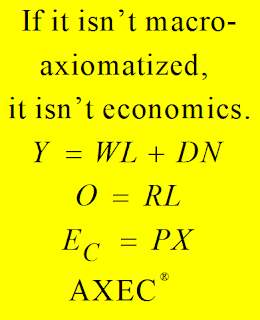
This is the correct core of premises: (A0) The objectively given and most elementary systemic configuration of the economy consists of the household and the business sector, which in turn consists initially of one giant fully integrated firm. (A1) Yw=WL wage income Yw is equal to wage rate W times working hours. L, (A2) O=RL output O is equal to productivity R times working hours L, (A3) C=PX consumption expenditure C is equal to price P times quantity bought/sold X.
These premises are “certain, true, and primary” and therefore satisfy all methodological requirements. The set is minimalistic; that is, Occam’s Razor has been applied, and the set cannot be reduced further, only expanded. The set contains no NONENTITIES like maximization or equilibrium and no normative assertions. All variables are measurable with the precision of two decimal places. Testability is built into the premises.
The price P follows as the dependent variable under the conditions of budget-balancing, i.e., C=Yw, and market-clearing, i.e., X=O, as P=W/R. This is the most elementary form of the macroeconomic Law of Supply and Demand. Accordingly, the real wage is W/P=R. The graphical representation of the macro-economy is given with AXEC31.
The monetary saving/dissaving of the household sector is defined as S≡Yw−C. The monetary profit/loss of the business sector is defined as Q≡C−Yw. It always holds Q≡−S, in other words, the balances of the business and the household sector always add up to zero. This is the Fundamental Law of Macroeconomic Accounting.
The mirror image of household sector saving S is business sector loss (-Q). The mirror image of household sector dissaving (-S) is business sector profit Q. Q≡−S is the elementary version of the macroeconomic Profit Law.
Given the minimalist core propositions (A0) to (A3), one has to proceed top-down by successive DIFFERENTIATION of sectors and firms until one arrives at the individual agent. The bottom-up approach, also called microfoundations, is methodologically false because it is (i) behavioral, and (ii) runs with necessity into the Fallacy of Composition. (A0) to (A3) fully replaces HC1 to HC5.
Economics is in need of a Paradigm Shift from false Walrasian microfoundations and false Keynesian macrofoundations to “certain, true, and primary” macrofoundations. Or as the Financial Times has it, “Time for a reset.” #1
Egmont Kakarot-Handtke
#1 Links on “Capitalism. Time for a reset.”
Related 'DSGE and profit―forget it! MMT and profit―forget it!' and 'The Ur-Blunder of economics and its rectification' and 'Economics: How to stop mental pollution and global dumbing' and 'The curious non-existence of profit in economics' and 'Where economics went wrong (II)' and 'The GDP-death-blow for the economics profession'. For details of the big picture, see cross-references Axiomatization.

Blog-Reference
“When the premises are certain, true, and primary, and the conclusion formally follows from them, this is demonstration, and produces scientific knowledge of a thing.” (Aristotle)
Standard microeconomics is based on these hardcore propositions, i.e., verbalized axioms: “HC1 economic agents have preferences over outcomes; HC2 agents individually optimize subject to constraints; HC3 agent choice is manifest in interrelated markets; HC4 agents have full relevant knowledge; HC5 observable outcomes are coordinated, and must be discussed with reference to equilibrium states.” (Weintraub)
Because this set of hardcore propositions is shock-full of NONENTITIES, all models that are based upon it are proto-scientific garbage. The whole of Marginalism derives ultimately from the core behavioral assumption HC2, i.e., constrained optimization, which is a NONENTITY like the Tooth Fairy or the Easter Bunny. From the Walrasian axioms, the triad SS-function―DD-function―equilibrium is derived. All ends up eventually in General Equilibrium Theory.
Because the behavioral axioms are false, the whole of mainstream economics is false. This includes DSGE because it is just a variant of HC1 to HC5. The common denominator is that the axioms are behavioral. For deeper methodological reasons, which have been discussed elsewhere, macroeconomics has to be based on objective, behavior/agency-free, systemic axioms.
This is the correct core of premises: (A0) The objectively given and most elementary systemic configuration of the economy consists of the household and the business sector, which in turn consists initially of one giant fully integrated firm. (A1) Yw=WL wage income Yw is equal to wage rate W times working hours. L, (A2) O=RL output O is equal to productivity R times working hours L, (A3) C=PX consumption expenditure C is equal to price P times quantity bought/sold X.
These premises are “certain, true, and primary” and therefore satisfy all methodological requirements. The set is minimalistic; that is, Occam’s Razor has been applied, and the set cannot be reduced further, only expanded. The set contains no NONENTITIES like maximization or equilibrium and no normative assertions. All variables are measurable with the precision of two decimal places. Testability is built into the premises.
The price P follows as the dependent variable under the conditions of budget-balancing, i.e., C=Yw, and market-clearing, i.e., X=O, as P=W/R. This is the most elementary form of the macroeconomic Law of Supply and Demand. Accordingly, the real wage is W/P=R. The graphical representation of the macro-economy is given with AXEC31.
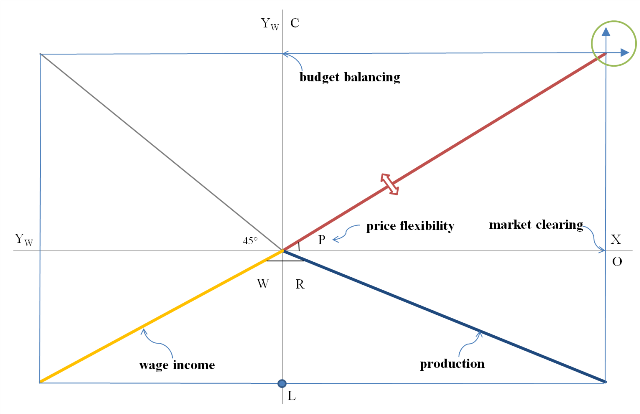 |
| Elementary production-consumption economy |
The monetary saving/dissaving of the household sector is defined as S≡Yw−C. The monetary profit/loss of the business sector is defined as Q≡C−Yw. It always holds Q≡−S, in other words, the balances of the business and the household sector always add up to zero. This is the Fundamental Law of Macroeconomic Accounting.
The mirror image of household sector saving S is business sector loss (-Q). The mirror image of household sector dissaving (-S) is business sector profit Q. Q≡−S is the elementary version of the macroeconomic Profit Law.
Given the minimalist core propositions (A0) to (A3), one has to proceed top-down by successive DIFFERENTIATION of sectors and firms until one arrives at the individual agent. The bottom-up approach, also called microfoundations, is methodologically false because it is (i) behavioral, and (ii) runs with necessity into the Fallacy of Composition. (A0) to (A3) fully replaces HC1 to HC5.
Economics is in need of a Paradigm Shift from false Walrasian microfoundations and false Keynesian macrofoundations to “certain, true, and primary” macrofoundations. Or as the Financial Times has it, “Time for a reset.” #1
Egmont Kakarot-Handtke
#1 Links on “Capitalism. Time for a reset.”
Related 'DSGE and profit―forget it! MMT and profit―forget it!' and 'The Ur-Blunder of economics and its rectification' and 'Economics: How to stop mental pollution and global dumbing' and 'The curious non-existence of profit in economics' and 'Where economics went wrong (II)' and 'The GDP-death-blow for the economics profession'. For details of the big picture, see cross-references Axiomatization.
For more on DSGE, see AXECquery

***
Mike Norman Economics Sep 23 |
| Source: Mike Norman Economics |
***
AXEC137b Axioms/Macrofoundations

***
Twitter Feb 12 “The problem lies ... with its core axioms.”
 |
| Source: Twitter |
***
INET Mar 8, 2021 Servaas Storm, The Standard Economic Paradigm is Based on Bad Modeling

July 6, 2019
The only thing we can learn from economic models is what proto-scientific garbage looks like
Comment on Lars Syll on ‘What can we learn from economic models?’
Blog-Reference
Economists in general and Lars Syll, in particular, are in a desperate struggle with scientific methodology: “Some economic methodologists have lately been arguing that economic models may well be considered ‘minimal models’ that portray ‘credible worlds’ without having to care about things like similarity, isomorphism, simplified representationality or resemblance to the real world. These models are said to resemble ‘realistic novels’ that portray ‘possible worlds’. And sure: economists constructing and working with that kind of models learn things about what might happen in those ‘possible worlds’. But is that really the stuff real science is made of? I think not.” and “Science has to be something more than just more or less realistic ‘story-telling’ or ‘explanatory fictionalism’. One has to provide decisive empirical evidence that what can be inferred in a model also helps us to uncover what actually goes on in the real world.”
Science consists of two essential elements: “Research is, in fact, a continuous discussion of the consistency of theories: formal consistency insofar as the discussion relates to the logical cohesion of what is asserted in joint theories; material consistency insofar as the agreement of observations with theories is concerned.” (Klant) Logical consistency is secured by applying the axiomatic-deductive method and empirical consistency is secured by applying state-of-art testing. Or, as Aristotle put it pack in 400 BC: “When the premises are certain, true, and primary, and the conclusion formally follows from them, this is demonstration, and produces scientific knowledge of a thing.”
So, it is well-known for a long time what scientific methodology is except among economists. The major approaches ― Walrasianism, Keynesianism, Marxianism, Austrianism, MMT ― are mutually contradictory, axiomatically false, materially/formally inconsistent, and all got profit ― the foundational concept of the subject matter ― wrong.
Of all imbeciles that open their mouths in economics, methodologists are the worst. They have consistently failed to spot elementary methodological blunders.#1 Economics is bad science but the economic methodology is even worse. This applies to Orthodoxy and Heterodoxy.#2, #3, #4, #5
Lars Syll’s critique is trivially true: “As long as one doesn’t come up with credible export warrants to real-world target systems and show how those models ― often building on idealizations with known to be false assumptions ― enhance our understanding or explanations about the real world, well, then they are just nothing more than just novels.” However, the heterodox methodologist Lars Syll NEVER came up with something better which, in turn, is acceptable because he is only a self-declared humble Humean Under-Labourer who is satisfied with “clearing Ground a little, and removing some of the Rubbish, that lies in the way to Knowledge.”
This is a bit unambitious because the premises of Orthodoxy are obviously idiotic. The hardcore propositions of microeconomics are given: “HC1 economic agents have preferences over outcomes; HC2 agents individually optimize subject to constraints; HC3 agent choice is manifest in interrelated markets; HC4 agents have full relevant knowledge; HC5 observable outcomes are coordinated, and must be discussed with reference to equilibrium states.” (Weintraub)
It is pretty obvious that this (verbalized) axiom set consists of multiple NONENTITIES and does NOT satisfy Aristotle’s criteria, viz. “certain, true, and primary”. Von Neumann identified the Walrasian approach as given with HC1 to HC5 as petitio principii, that is, as methodologically unacceptable. (TOG p. 15)#6 Keynes tried to replace microfoundations with macrofoundations, however, Keynesian macrofoundations are also materially/formally inconsistent.
So, what can we learn from economic models? All models that contain a NONENTITY are a priori false. In practical terms: as soon as one of the axioms HC1 to HC5 appears in an economics paper it can be thrown into the wastebasket. The same applies to all macroeconomic models that contain I=S. What we learn is that the greater part of peer-reviewed models that appear in flagship journals and in textbooks#7 is proto-scientific garbage and that both orthodox and heterodox economists have to be expelled from the sciences because of proven incompetence. Economists themselves are the “Rubbish, that lies in the way to Knowledge”.
Egmont Kakarot-Handtke
#1 How incompetent are economic methodologists? Very!
#2 Still in the proto-scientific wood
#3 The economist as storyteller
#4 Are economics professors really that incompetent? Yes!
#5 How to spot economics trolls
#6 The Palgrave Dictionary ― a comprehensive collection of False-Hero Memorials
#7 To this day*, economists have produced NOT ONE textbook that satisfies scientific standards
Related 'False models and true incompetence' and 'All models are false because all economists are stupid' and 'The Ur-Blunder of economics and its rectification' and 'From Keynes’ fatal blunder to the true economic model' and 'Infantile model bricolage, or, How many economists can dance on a non-existing pinpoint?' and 'Summary on ‘Musings on Whether We Consciously Know More or Less than What Is in Our Models…’' and 'Neoclassical growth theory: modeling gone nuts' and 'Failed economics: The losers’ long list of lame excuses' and 'From the pluralism of false models to the true economic theory' and 'Yes, orthodox economics is poor science, but can Heterodoxy raise hope?' and 'The canonical macroeconomic model'. For details of the big picture see cross-references Methodology.
Blog-Reference
Economists in general and Lars Syll, in particular, are in a desperate struggle with scientific methodology: “Some economic methodologists have lately been arguing that economic models may well be considered ‘minimal models’ that portray ‘credible worlds’ without having to care about things like similarity, isomorphism, simplified representationality or resemblance to the real world. These models are said to resemble ‘realistic novels’ that portray ‘possible worlds’. And sure: economists constructing and working with that kind of models learn things about what might happen in those ‘possible worlds’. But is that really the stuff real science is made of? I think not.” and “Science has to be something more than just more or less realistic ‘story-telling’ or ‘explanatory fictionalism’. One has to provide decisive empirical evidence that what can be inferred in a model also helps us to uncover what actually goes on in the real world.”
Science consists of two essential elements: “Research is, in fact, a continuous discussion of the consistency of theories: formal consistency insofar as the discussion relates to the logical cohesion of what is asserted in joint theories; material consistency insofar as the agreement of observations with theories is concerned.” (Klant) Logical consistency is secured by applying the axiomatic-deductive method and empirical consistency is secured by applying state-of-art testing. Or, as Aristotle put it pack in 400 BC: “When the premises are certain, true, and primary, and the conclusion formally follows from them, this is demonstration, and produces scientific knowledge of a thing.”
So, it is well-known for a long time what scientific methodology is except among economists. The major approaches ― Walrasianism, Keynesianism, Marxianism, Austrianism, MMT ― are mutually contradictory, axiomatically false, materially/formally inconsistent, and all got profit ― the foundational concept of the subject matter ― wrong.
Of all imbeciles that open their mouths in economics, methodologists are the worst. They have consistently failed to spot elementary methodological blunders.#1 Economics is bad science but the economic methodology is even worse. This applies to Orthodoxy and Heterodoxy.#2, #3, #4, #5
Lars Syll’s critique is trivially true: “As long as one doesn’t come up with credible export warrants to real-world target systems and show how those models ― often building on idealizations with known to be false assumptions ― enhance our understanding or explanations about the real world, well, then they are just nothing more than just novels.” However, the heterodox methodologist Lars Syll NEVER came up with something better which, in turn, is acceptable because he is only a self-declared humble Humean Under-Labourer who is satisfied with “clearing Ground a little, and removing some of the Rubbish, that lies in the way to Knowledge.”
This is a bit unambitious because the premises of Orthodoxy are obviously idiotic. The hardcore propositions of microeconomics are given: “HC1 economic agents have preferences over outcomes; HC2 agents individually optimize subject to constraints; HC3 agent choice is manifest in interrelated markets; HC4 agents have full relevant knowledge; HC5 observable outcomes are coordinated, and must be discussed with reference to equilibrium states.” (Weintraub)
It is pretty obvious that this (verbalized) axiom set consists of multiple NONENTITIES and does NOT satisfy Aristotle’s criteria, viz. “certain, true, and primary”. Von Neumann identified the Walrasian approach as given with HC1 to HC5 as petitio principii, that is, as methodologically unacceptable. (TOG p. 15)#6 Keynes tried to replace microfoundations with macrofoundations, however, Keynesian macrofoundations are also materially/formally inconsistent.
So, what can we learn from economic models? All models that contain a NONENTITY are a priori false. In practical terms: as soon as one of the axioms HC1 to HC5 appears in an economics paper it can be thrown into the wastebasket. The same applies to all macroeconomic models that contain I=S. What we learn is that the greater part of peer-reviewed models that appear in flagship journals and in textbooks#7 is proto-scientific garbage and that both orthodox and heterodox economists have to be expelled from the sciences because of proven incompetence. Economists themselves are the “Rubbish, that lies in the way to Knowledge”.
Egmont Kakarot-Handtke
#1 How incompetent are economic methodologists? Very!
#2 Still in the proto-scientific wood
#3 The economist as storyteller
#4 Are economics professors really that incompetent? Yes!
#5 How to spot economics trolls
#6 The Palgrave Dictionary ― a comprehensive collection of False-Hero Memorials
#7 To this day*, economists have produced NOT ONE textbook that satisfies scientific standards
Related 'False models and true incompetence' and 'All models are false because all economists are stupid' and 'The Ur-Blunder of economics and its rectification' and 'From Keynes’ fatal blunder to the true economic model' and 'Infantile model bricolage, or, How many economists can dance on a non-existing pinpoint?' and 'Summary on ‘Musings on Whether We Consciously Know More or Less than What Is in Our Models…’' and 'Neoclassical growth theory: modeling gone nuts' and 'Failed economics: The losers’ long list of lame excuses' and 'From the pluralism of false models to the true economic theory' and 'Yes, orthodox economics is poor science, but can Heterodoxy raise hope?' and 'The canonical macroeconomic model'. For details of the big picture see cross-references Methodology.
***
#PointOfProof
Jul 7
April 7, 2019
From Keynes’ fatal blunder to the true economic model
Comment on Merijn Knibbe on ‘What’s in a model … (an economic one, that is)’
Blog-Reference
Merijn Knibbe refers to a post of Noah Smith: “This time he however stated: ‘accounting is not a model of the economy’. Which is wrong. The national accounts are a model of the economy. And economists have to learn it is. The way the entities are conceptually defined matters as this also defines the monetary relations we see.”
Under the heading Formal Models vs. Guru-Based Theories Noah Smith demanded: “These days, most economic theories are collections of mathematical models. If you want to know what the theory says, you can parse out the models and see for yourself. You don’t have to go ask Mike Woodford what New Keynesian theory says. You don’t have to go ask Ed Prescott what RBC theory says. You can go read a New Keynesian model or a Real Business Cycle model and figure it out on your own. MMT is different. There are many wordy explainers and videos that will explain some of the concepts behind MMT, or tell you some of MMT’s policy recommendations. But that’s different than having a formal model of the economy.”#1
The problem with economics is this: microfoundations are false and because of this, ALL microeconomic models are false. Supply-demand-equilibrium is proto-scientific garbage. However, macrofoundations are also false and because of this, ALL macroeconomic models are false since Keynes. Proofs have been given elsewhere.#2
The question of correct macrofoundations is closely related to macroeconomic accounting. Merijn Knibbe is spot on: “National accounts do use a model of the economy, the accounting identities are based on the fundamental social properties of money and monetary transactions but for the way we measure them a conceptual model is key.”
The problem with both orthodox and heterodox economists is that they are too stupid for the elementary mathematics that underlies macroeconomic accounting.#3, #4, #5
From the overall failure of economics follows that a new theory has to be macrofounded but not Keynesian because Keynes messed things up. What is required is the Paradigm Shift from false microfoundations and false Keynesian macrofoundations to true macrofoundations.
From true macrofoundations follows the macroeconomic Profit Law as Q≡Yd+(I−S)+(G−T)+(X−M). The Profit Law, in turn, yields the correct macroeconomic sectoral balances equation (I−S)+(G−T)+(X−M)−(Q−Yd)=0 which compares to the false Keynesian/Post-Keynesian/MMT equation (I−S)+(G−T)+(X−M)=0. The equations are testable with the precision of two decimal places. Exactly here, macroeconomic accounting is needed in order to settle matters empirically.
Because neither orthodox nor heterodox economists got the foundational concepts, the elementary math, and the basic accounting identities right, ALL macroeconomic models are provably false from Keynes onward to this day.#6
Egmont Kakarot-Handtke
#1 Noah Smith Examining an MMT model in detail
#2 The miracle cure of economists’ micro-macro schizo
#3 Wikipedia and the promotion of economists’ idiotism (II)
#4 The Common Error of Common Sense: An Essential Rectification of the Accounting Approach
#5 For details of the big picture see cross-references Accounting
#6 The canonical macroeconomic model
Blog-Reference
Merijn Knibbe refers to a post of Noah Smith: “This time he however stated: ‘accounting is not a model of the economy’. Which is wrong. The national accounts are a model of the economy. And economists have to learn it is. The way the entities are conceptually defined matters as this also defines the monetary relations we see.”
Under the heading Formal Models vs. Guru-Based Theories Noah Smith demanded: “These days, most economic theories are collections of mathematical models. If you want to know what the theory says, you can parse out the models and see for yourself. You don’t have to go ask Mike Woodford what New Keynesian theory says. You don’t have to go ask Ed Prescott what RBC theory says. You can go read a New Keynesian model or a Real Business Cycle model and figure it out on your own. MMT is different. There are many wordy explainers and videos that will explain some of the concepts behind MMT, or tell you some of MMT’s policy recommendations. But that’s different than having a formal model of the economy.”#1
The problem with economics is this: microfoundations are false and because of this, ALL microeconomic models are false. Supply-demand-equilibrium is proto-scientific garbage. However, macrofoundations are also false and because of this, ALL macroeconomic models are false since Keynes. Proofs have been given elsewhere.#2
The question of correct macrofoundations is closely related to macroeconomic accounting. Merijn Knibbe is spot on: “National accounts do use a model of the economy, the accounting identities are based on the fundamental social properties of money and monetary transactions but for the way we measure them a conceptual model is key.”
The problem with both orthodox and heterodox economists is that they are too stupid for the elementary mathematics that underlies macroeconomic accounting.#3, #4, #5
From the overall failure of economics follows that a new theory has to be macrofounded but not Keynesian because Keynes messed things up. What is required is the Paradigm Shift from false microfoundations and false Keynesian macrofoundations to true macrofoundations.
From true macrofoundations follows the macroeconomic Profit Law as Q≡Yd+(I−S)+(G−T)+(X−M). The Profit Law, in turn, yields the correct macroeconomic sectoral balances equation (I−S)+(G−T)+(X−M)−(Q−Yd)=0 which compares to the false Keynesian/Post-Keynesian/MMT equation (I−S)+(G−T)+(X−M)=0. The equations are testable with the precision of two decimal places. Exactly here, macroeconomic accounting is needed in order to settle matters empirically.
Because neither orthodox nor heterodox economists got the foundational concepts, the elementary math, and the basic accounting identities right, ALL macroeconomic models are provably false from Keynes onward to this day.#6
Egmont Kakarot-Handtke
#1 Noah Smith Examining an MMT model in detail
#2 The miracle cure of economists’ micro-macro schizo
#3 Wikipedia and the promotion of economists’ idiotism (II)
#4 The Common Error of Common Sense: An Essential Rectification of the Accounting Approach
#5 For details of the big picture see cross-references Accounting
#6 The canonical macroeconomic model
April 4, 2019
The canonical macroeconomic model
Comment on Noah Smith on ‘Examining an MMT model in detail’
Blog-Reference (Link) and Blog-Reference
Under the heading Formal Models vs. Guru-Based Theories Noah Smith demands: “These days, most economic theories are collections of mathematical models. If you want to know what the theory says, you can parse out the models and see for yourself. You don’t have to go ask Mike Woodford what New Keynesian theory says. You don’t have to go ask Ed Prescott what RBC theory says. You can go read a New Keynesian model or a Real Business Cycle model and figure it out on your own. MMT is different. There are many wordy explainers and videos that will explain some of the concepts behind MMT, or tell you some of MMT’s policy recommendations. But that’s different than having a formal model of the economy.” and “I want to be able to read a concrete, formal, well-specified model like the Tcherneva model above, and answer these questions myself.”
The problem with economics is this: microfoundations are false, and because of this, ALL microeconomic models are false. Supply-demand-equilibrium is proto-scientific garbage. However, macrofoundations are also false, and because of this, ALL macroeconomic models are false since Keynes, including MMT. Proofs have been given elsewhere.
However, critique of Mainstream or MMT has run its course: “The moral of the story is simply this: it takes a new theory, and not just the destructive exposure of assumptions or the collection of new facts, to beat an old theory.” (Blaug)
From the overall failure of economics follows that a new theory has to be macrofounded but not Keynesian because Keynes messed things up. What is required is the Paradigm Shift from false microfoundations and false Keynesian macrofoundations to true macrofoundations.
So, let us forget methodological individualism and kick off the “concrete, formal, well-specified” macrofounded approach. The elementary production-consumption economy is defined with this set of macroeconomic axioms: (A0) The economy consists of the household and the business sector, which, in turn, consists initially of one giant fully integrated firm. (A1) Yw=WL wage income Yw is equal to wage rate W times working hours. L, (A2) O=RL output O is equal to productivity R times working hours L, (A3) C=PX consumption expenditure C is equal to price P times quantity bought/sold X.
Under the conditions of market-clearing X=O and budget-balancing C=Yw in each period, the price as the dependent variable is given by P=W/R (1a). The price is determined by the wage rate W, which takes the role of the nominal numéraire, and the productivity R. The elementary production-consumption economy is shown under the label Graphic. #1

What is needed for a start is two things: (i) a central bank which creates money on its balance sheet in the form of deposits, and (ii) a legal system which declares the central bank’s deposits as legal tender.
Deposit money is needed by the business sector to pay the workers who receive the wage income Yw per period. The need is only temporary because the business sector gets the money back if the workers fully spend their income, i.e., if C=Yw. Overdrafts are needed by the household sector for consumption expenditures if the households want to spend before they get their income.
For the case of a balanced budget C=Yw, the idealized transaction pattern of deposits/overdrafts of the household sector at the Central Bank over the course of one period is shown under Graphic. #2

The household sector’s deposits/overdrafts are zero at the beginning and end of the period. Money is continually created and destroyed during the period under consideration. There is NO such thing as a fixed quantity of money. The central bank plays an accommodative role and supports the autonomous market transactions between the household and the business sector. From this follows the average stock of transaction money as M=κYw, with κ determined by the transaction pattern.
If employment L is doubled, the average stock of transaction money M doubles. In a well-designed fiat money economy, growth is not hampered by a lack of a transaction medium. Money is endogenous and neutral.
The general price level P can be anchored by setting the wage rate W. In order to avoid both inflation and deflation, the rate of change of W has always to be equal to the rate of change of R. The Quantity Theory is dead because M is not a price determinant.
The macroeconomic Law of Supply and Demand (1a) implies W/P=R (1b), i.e., the real wage is always equal to the productivity, no matter how the wage rate W is set.
Ramifications: (i) The State is needed for the institutional setup of the monetary order, (ii) the State is NOT needed for injecting money into the economy, (iii) what is needed is an accommodative Central Bank, (iv) neither the State nor the Central Bank interferes with the autonomous transactions of the household and business sector, (v) money is a generalized IOU, (vi) money is created and destroyed by the transactions between the household and the business sector, (vii) the value of money is given by W/P=R (1b), i.e. is equal to the productivity, (viii) the value of money does NOT depend on the (average) stock of money M, (ix) the functionality of monetary institutions and the value of money does NOT depend on the taxing power of the State.
The focus is here on the nominal/monetary balances. For the time being, real balances are excluded, i.e. it holds X=O. The condition of budget balancing, i.e., C=Yw, is now skipped. The monetary saving/dissaving of the household sector is defined as S≡Yw−C. The monetary profit/loss of the business sector is defined as Q≡C−Yw. Ergo Q≡−S.
The balances add up to zero. The mirror image of household sector saving S is the business sector loss −Q. The mirror image of household sector dissaving (-S) is business sector profit Q. Q≡−S is the elementary version of the macroeconomic Profit Law.
Ramifications: (i) Because the mirror image of saving is loss, Keynes’ I=S is false, (ii) ALL IS-LM models are false, (iii) Post Keynesianism in ALL variants is false.
Now, additional sectors can be introduced. The complete macroeconomic Profit Law is given by Q≡Yd+(I−S)+(G−T)+(X−M). #3, #4 In order to focus on the interactions between the household, business, and government sector, it is here reduced to Q≡−S+(G−T). Legend: Q macroeconomic profit, S household sector saving, G government expenditures, T taxes, (G−T)>0 government deficit.
If the government’s budget is balanced, i.e., G=T, and if the households dissave, then the business sector makes a profit, i.e., Q is positive.
If the government’s budget is balanced and the households save, i.e., S≡Yw−C>0, then the business sector makes a loss, i.e., Q is negative.
If the government’s budget deficit, i.e., (G−T)>0, is equal to the household sector’s saving, i.e., (G−T)=S, then macroeconomic profit Q is zero.
If the government’s deficit is greater than household sector saving, then the business sector makes a profit.
If the household sector’s saving is zero, i.e., S=0, and the government deficit is greater than zero, i.e., (G−T)>0, then it holds Q=(G−T), i.e., the business sector’s profit equals the government sector’s deficit. So, if the State deficit-spends in the elementary production-consumption economy, it follows (i) a one-off price hike (NO inflation) under the condition of market clearing, (ii) Public Deficit = Private Profit. Bringing money into the economy by public deficit spending is NOT distributionally neutral, just the opposite: it is a free lunch for the Oligarchy.
MMT’s sectoral balances equation is false. Because of this, the whole analytical superstructure is false. MMT policy guidance has no sound scientific foundations and is harmful to the ninety-nine-percenters. MMT is refuted on all counts.
Any model that lacks true macrofoundations is scientifically worthless. Axioms (A0) to (A3) define the canonical macroeconomic model. The rest of microfounded and macrofounded economics goes down the scientific drain.
Egmont Kakarot-Handtke
#1 Graphic AXEC31 Elementary production-consumption economy
#2 Graphic AXEC98 Idealized transaction pattern
#3 The Profit Law yields the correct macroeconomic sectoral balances equation (I−S)+(G−T)+(X−M)−(Q−Yd)=0, which compares to the false MMT equation (I−S)+(G−T)+(X−M)=0. The equations are testable with the precision of two decimal places.
#4 Refuting MMT’s Macroeconomics Textbook
Related 'MMT vs Mainstream: examining proto-scientific garbage in detail' and 'The Law of Supply and Demand: Here It Is Finally' and 'How to Get Rid of Supply-Demand-Equilibrium' and 'The real trouble with Econ 101' and 'MMT sucks' and 'Where MMT got macroeconomics wrong' and 'Mr. Keynes, Prof. Krugman, IS-LM, and the End of Economics as We Know It' and 'Why Post Keynesianism Is Not Yet a Science' and 'MMT: A free lunch for the Oligarchy' and 'New Economic Thinking: The 10 crucial points' and 'Economics for Economists'. For details of the big picture, see Paradigm Shift, and for the full-spectrum refutation of MMT, see cross-references MMT.


Blog-Reference (Link) and Blog-Reference
Under the heading Formal Models vs. Guru-Based Theories Noah Smith demands: “These days, most economic theories are collections of mathematical models. If you want to know what the theory says, you can parse out the models and see for yourself. You don’t have to go ask Mike Woodford what New Keynesian theory says. You don’t have to go ask Ed Prescott what RBC theory says. You can go read a New Keynesian model or a Real Business Cycle model and figure it out on your own. MMT is different. There are many wordy explainers and videos that will explain some of the concepts behind MMT, or tell you some of MMT’s policy recommendations. But that’s different than having a formal model of the economy.” and “I want to be able to read a concrete, formal, well-specified model like the Tcherneva model above, and answer these questions myself.”
The problem with economics is this: microfoundations are false, and because of this, ALL microeconomic models are false. Supply-demand-equilibrium is proto-scientific garbage. However, macrofoundations are also false, and because of this, ALL macroeconomic models are false since Keynes, including MMT. Proofs have been given elsewhere.
However, critique of Mainstream or MMT has run its course: “The moral of the story is simply this: it takes a new theory, and not just the destructive exposure of assumptions or the collection of new facts, to beat an old theory.” (Blaug)
From the overall failure of economics follows that a new theory has to be macrofounded but not Keynesian because Keynes messed things up. What is required is the Paradigm Shift from false microfoundations and false Keynesian macrofoundations to true macrofoundations.
So, let us forget methodological individualism and kick off the “concrete, formal, well-specified” macrofounded approach. The elementary production-consumption economy is defined with this set of macroeconomic axioms: (A0) The economy consists of the household and the business sector, which, in turn, consists initially of one giant fully integrated firm. (A1) Yw=WL wage income Yw is equal to wage rate W times working hours. L, (A2) O=RL output O is equal to productivity R times working hours L, (A3) C=PX consumption expenditure C is equal to price P times quantity bought/sold X.
Under the conditions of market-clearing X=O and budget-balancing C=Yw in each period, the price as the dependent variable is given by P=W/R (1a). The price is determined by the wage rate W, which takes the role of the nominal numéraire, and the productivity R. The elementary production-consumption economy is shown under the label Graphic. #1

What is needed for a start is two things: (i) a central bank which creates money on its balance sheet in the form of deposits, and (ii) a legal system which declares the central bank’s deposits as legal tender.
Deposit money is needed by the business sector to pay the workers who receive the wage income Yw per period. The need is only temporary because the business sector gets the money back if the workers fully spend their income, i.e., if C=Yw. Overdrafts are needed by the household sector for consumption expenditures if the households want to spend before they get their income.
For the case of a balanced budget C=Yw, the idealized transaction pattern of deposits/overdrafts of the household sector at the Central Bank over the course of one period is shown under Graphic. #2

The household sector’s deposits/overdrafts are zero at the beginning and end of the period. Money is continually created and destroyed during the period under consideration. There is NO such thing as a fixed quantity of money. The central bank plays an accommodative role and supports the autonomous market transactions between the household and the business sector. From this follows the average stock of transaction money as M=κYw, with κ determined by the transaction pattern.
If employment L is doubled, the average stock of transaction money M doubles. In a well-designed fiat money economy, growth is not hampered by a lack of a transaction medium. Money is endogenous and neutral.
The general price level P can be anchored by setting the wage rate W. In order to avoid both inflation and deflation, the rate of change of W has always to be equal to the rate of change of R. The Quantity Theory is dead because M is not a price determinant.
The macroeconomic Law of Supply and Demand (1a) implies W/P=R (1b), i.e., the real wage is always equal to the productivity, no matter how the wage rate W is set.
Ramifications: (i) The State is needed for the institutional setup of the monetary order, (ii) the State is NOT needed for injecting money into the economy, (iii) what is needed is an accommodative Central Bank, (iv) neither the State nor the Central Bank interferes with the autonomous transactions of the household and business sector, (v) money is a generalized IOU, (vi) money is created and destroyed by the transactions between the household and the business sector, (vii) the value of money is given by W/P=R (1b), i.e. is equal to the productivity, (viii) the value of money does NOT depend on the (average) stock of money M, (ix) the functionality of monetary institutions and the value of money does NOT depend on the taxing power of the State.
The focus is here on the nominal/monetary balances. For the time being, real balances are excluded, i.e. it holds X=O. The condition of budget balancing, i.e., C=Yw, is now skipped. The monetary saving/dissaving of the household sector is defined as S≡Yw−C. The monetary profit/loss of the business sector is defined as Q≡C−Yw. Ergo Q≡−S.
The balances add up to zero. The mirror image of household sector saving S is the business sector loss −Q. The mirror image of household sector dissaving (-S) is business sector profit Q. Q≡−S is the elementary version of the macroeconomic Profit Law.
Ramifications: (i) Because the mirror image of saving is loss, Keynes’ I=S is false, (ii) ALL IS-LM models are false, (iii) Post Keynesianism in ALL variants is false.
Now, additional sectors can be introduced. The complete macroeconomic Profit Law is given by Q≡Yd+(I−S)+(G−T)+(X−M). #3, #4 In order to focus on the interactions between the household, business, and government sector, it is here reduced to Q≡−S+(G−T). Legend: Q macroeconomic profit, S household sector saving, G government expenditures, T taxes, (G−T)>0 government deficit.
If the government’s budget is balanced, i.e., G=T, and if the households dissave, then the business sector makes a profit, i.e., Q is positive.
If the government’s budget is balanced and the households save, i.e., S≡Yw−C>0, then the business sector makes a loss, i.e., Q is negative.
If the government’s budget deficit, i.e., (G−T)>0, is equal to the household sector’s saving, i.e., (G−T)=S, then macroeconomic profit Q is zero.
If the government’s deficit is greater than household sector saving, then the business sector makes a profit.
If the household sector’s saving is zero, i.e., S=0, and the government deficit is greater than zero, i.e., (G−T)>0, then it holds Q=(G−T), i.e., the business sector’s profit equals the government sector’s deficit. So, if the State deficit-spends in the elementary production-consumption economy, it follows (i) a one-off price hike (NO inflation) under the condition of market clearing, (ii) Public Deficit = Private Profit. Bringing money into the economy by public deficit spending is NOT distributionally neutral, just the opposite: it is a free lunch for the Oligarchy.
MMT’s sectoral balances equation is false. Because of this, the whole analytical superstructure is false. MMT policy guidance has no sound scientific foundations and is harmful to the ninety-nine-percenters. MMT is refuted on all counts.
Any model that lacks true macrofoundations is scientifically worthless. Axioms (A0) to (A3) define the canonical macroeconomic model. The rest of microfounded and macrofounded economics goes down the scientific drain.
Egmont Kakarot-Handtke
#1 Graphic AXEC31 Elementary production-consumption economy
#2 Graphic AXEC98 Idealized transaction pattern
#3 The Profit Law yields the correct macroeconomic sectoral balances equation (I−S)+(G−T)+(X−M)−(Q−Yd)=0, which compares to the false MMT equation (I−S)+(G−T)+(X−M)=0. The equations are testable with the precision of two decimal places.
#4 Refuting MMT’s Macroeconomics Textbook
Related 'MMT vs Mainstream: examining proto-scientific garbage in detail' and 'The Law of Supply and Demand: Here It Is Finally' and 'How to Get Rid of Supply-Demand-Equilibrium' and 'The real trouble with Econ 101' and 'MMT sucks' and 'Where MMT got macroeconomics wrong' and 'Mr. Keynes, Prof. Krugman, IS-LM, and the End of Economics as We Know It' and 'Why Post Keynesianism Is Not Yet a Science' and 'MMT: A free lunch for the Oligarchy' and 'New Economic Thinking: The 10 crucial points' and 'Economics for Economists'. For details of the big picture, see Paradigm Shift, and for the full-spectrum refutation of MMT, see cross-references MMT.
***
Graphic AXEC121i
***
LINKS on Pavlina Tcherneva’s ‘MMT, Models, Multidisciplinarity’ on Apr 8 and Blog-Reference
Pavlina Tcherneva’s model is NOT false because of some behavioral assumptions but because her macroeconomics is provably false. The model is built upon this defective accounting identity G+I=T+S. For details see
***
REPLY to André on Apr 9
You say: “To understand finance or economics, you need first to understand what currency is (a tax credit). It is a prerequisite. You can’t move one step without it.” and “Send an email to any of them (Bill Mitchell, Warren Mosler, Randall Wray, Stephanie Kelton, Scot Fullwiler, etc) and they will tell that ‘taxes drive money’ is the pillar and integral part of MMT. Also, everything you read in MMT is a direct or indirect consequence of ‘taxes drive money’,
Take notice that the assertion that taxes drive money is false and has been refuted.
***

April 27, 2018
Neoclassical growth theory: modeling gone nuts
Comment on Lars Syll on ‘Solow’s Nobel Prize lecture’
Blog-Reference
Solow summarizes: “The end result is a construction in which the whole economy is assumed to be solving a Ramsey optimal-growth problem through time, disturbed only by stationary stochastic shocks to tastes and technology. To these, the economy adapts optimally. Inseparable from this habit of thought is the automatic presumption that observed paths are equilibrium paths. So we are asked to regard the construction I have just described as a model of the actual capitalist world.”
Standard economics is based on this verbalized set of hardcore propositions a.k.a. axioms
What economists in their bottomless scientific incompetence have not realized in 150+ years is that HC3, HC5, and HC6 are plain NONENTITIES. The methodological point is this: every model that contains just one NONENTITY is a priori false. Methodologically, it holds that if the set of premises is false, the whole analytical superstructure is false.
Neoclassical growth theory applies a barrage of NONENTITIES. Among others #1
Economics has to move from microfoundations to macrofoundations. #3
Here is the correct starter set: (A0) The objectively given and most elementary systemic configuration of the (world-) economy consists of the household and the business sector, which in turn consists initially of one giant fully integrated firm.
Under the conditions of market-clearing X=O and budget-balancing C=Yw in each period, the price is given by P=W/R (1), i.e., the market-clearing price is equal to unit wage costs. This is the most elementary form of the macroeconomic Law of Supply and Demand.
Monetary profit for the economy as a whole is defined as Qm≡C−Yw, and monetary saving as Sm≡Yw−C. It always holds Qm≡−Sm, in other words, the business sector’s surplus = profit is equal to the household sector’s deficit = dissaving. Vice versa, the business sector’s deficit = loss equals the household sector’s surplus = saving. This is the most elementary form of the macroeconomic Profit Law. Under the condition of budget balancing, total monetary profit is zero.
Under the condition of market clearing and budget balancing, the elementary economy reduces to three independent variables, i.e., W, R, L, and the price P as the dependent variable. The changes from period to period are formally given by

In the next step, the condition of budget balancing has to be lifted. This brings saving/dissaving and profit/loss into existence. Note that in the Wikipedia article #1, the word profit does not appear once. For this reason alone, neoclassical growth models are NO representation of the “actual capitalist world”. #6 There is NO such thing as a capitalist world without profit/loss. Economists should know this.
To make matters short, the axiomatically correct macroeconomic Profit Law for an evolving economy is given here without further explanation. It holds, with Qm monetary profit/loss, Sm monetary saving/dissaving, I investment expenditures, G government spending, T taxes, X export, M import, Yd distributed profit
Egmont Kakarot-Handtke
#1 Wikipedia Ramsey–Cass–Koopmans model
#2 Equilirium
#3 True macrofoundations: the reset of economics
#4 How Keynes got macro wrong and Allais got it right
#5 Graphic AXEC25 Time evolution of the elementary production-consumption economy including profit distribution
#6 Profit and the collective failure of economists
#7 Infantile model bricolage, or, How many economists can dance on a non-existing pinpoint?
Related 'Squaring the Investment Cycle'.
Blog-Reference
Solow summarizes: “The end result is a construction in which the whole economy is assumed to be solving a Ramsey optimal-growth problem through time, disturbed only by stationary stochastic shocks to tastes and technology. To these, the economy adapts optimally. Inseparable from this habit of thought is the automatic presumption that observed paths are equilibrium paths. So we are asked to regard the construction I have just described as a model of the actual capitalist world.”
Standard economics is based on this verbalized set of hardcore propositions a.k.a. axioms
- HC1 There exist economic agents.
- HC2 Agents have preferences over outcomes.
- HC3 Agents independently optimize subject to constraints.
- HC4 Choices are made in interrelated markets.
- HC5 Agents have full relevant knowledge.
- HC6 Observable economic outcomes are coordinated, so they must be discussed with reference to equilibrium states. (Weintraub)
What economists in their bottomless scientific incompetence have not realized in 150+ years is that HC3, HC5, and HC6 are plain NONENTITIES. The methodological point is this: every model that contains just one NONENTITY is a priori false. Methodologically, it holds that if the set of premises is false, the whole analytical superstructure is false.
Neoclassical growth theory applies a barrage of NONENTITIES. Among others #1
- The representative consumer is supposed to solve an infinite-time utility-maximization problem. This is a priori false because utility and HC3 are NONENTITIES.
- Neoclassical growth models consist of real variables. This is false because the economy constitutes itself through the interaction of real AND nominal variables. There is no such thing as a ‘real’ economy; in other words, ALL ‘real’ models are a priori false.
- There is no such thing as an equilibrium or disequilibrium. In other words, ALL equilibrium models are a priori false. #2
- Profit is a nominal variable and cannot appear in a real model. The neoclassical profit theory is false.
- Economics has to be macrofounded because there is no way that leads from behavioral microfoundations to an understanding of how the economic system works.
Economics has to move from microfoundations to macrofoundations. #3
Here is the correct starter set: (A0) The objectively given and most elementary systemic configuration of the (world-) economy consists of the household and the business sector, which in turn consists initially of one giant fully integrated firm.
- (A1) Yw=WL wage income Yw is equal to wage rate W times working hours. L,
- (A2) O=RL output O is equal to productivity R times working hours L,
- (A3) C=PX consumption expenditure C is equal to price P times quantity bought/sold X.
Under the conditions of market-clearing X=O and budget-balancing C=Yw in each period, the price is given by P=W/R (1), i.e., the market-clearing price is equal to unit wage costs. This is the most elementary form of the macroeconomic Law of Supply and Demand.
Monetary profit for the economy as a whole is defined as Qm≡C−Yw, and monetary saving as Sm≡Yw−C. It always holds Qm≡−Sm, in other words, the business sector’s surplus = profit is equal to the household sector’s deficit = dissaving. Vice versa, the business sector’s deficit = loss equals the household sector’s surplus = saving. This is the most elementary form of the macroeconomic Profit Law. Under the condition of budget balancing, total monetary profit is zero.
Under the condition of market clearing and budget balancing, the elementary economy reduces to three independent variables, i.e., W, R, L, and the price P as the dependent variable. The changes from period to period are formally given by
- Wt=Wt-1(1+wt) The wage rate in period Wt is given by the wage rate in the previous period Wt-1 and the rate of change for the current period wt.
- Rt=Rt-1(1+rt) Analogous to the productivity.
- Lt=Lt-1(1+lt) Analogous for labor input.

For this equation, Computational Irreducibility in the sense of Stephen Wolfram, A New Kind of Science, Wolfram Media, 1959, pp. 737 ff. holds.
In the next step, the condition of budget balancing has to be lifted. This brings saving/dissaving and profit/loss into existence. Note that in the Wikipedia article #1, the word profit does not appear once. For this reason alone, neoclassical growth models are NO representation of the “actual capitalist world”. #6 There is NO such thing as a capitalist world without profit/loss. Economists should know this.
To make matters short, the axiomatically correct macroeconomic Profit Law for an evolving economy is given here without further explanation. It holds, with Qm monetary profit/loss, Sm monetary saving/dissaving, I investment expenditures, G government spending, T taxes, X export, M import, Yd distributed profit
- Qm≡−Sm in the elementary production-consumption economy,
- Qm≡I−Sm in the elementary investment economy (note I is NEVER equal Sm),
- Qm≡(G−T)+(I−Sm) in the investment economy with government deficit/surplus,
- Qm≡Yd+(X−M)+(G−T)+(I−Sm) in the open economy with distributed profit.
Egmont Kakarot-Handtke
#1 Wikipedia Ramsey–Cass–Koopmans model
#2 Equilirium
#3 True macrofoundations: the reset of economics
#4 How Keynes got macro wrong and Allais got it right
#5 Graphic AXEC25 Time evolution of the elementary production-consumption economy including profit distribution
#6 Profit and the collective failure of economists
#7 Infantile model bricolage, or, How many economists can dance on a non-existing pinpoint?
Related 'Squaring the Investment Cycle'.
April 24, 2018
Infantile model bricolage, or, How many economists can dance on a non-existing pinpoint?
Comment on Brian Romanchuk on ‘Forecastability And Economic Modelling’
Blog-Reference and Blog-Reference
“The highest ambition an economist can entertain who believes in the scientific character of economics would be fulfilled as soon as he succeeded in constructing a simple model displaying all the essential features of the economic process by means of a reasonably small number of equations connecting a reasonably small number of variables. Work on this line is laying the foundations of the economics of the future . . .” (Schumpeter, 1946)
The future is now, and economists still do NOT have the paradigmatic simple core model but a heap of incommensurable and contradicting constructions. Pluralism may have its merits elsewhere, but it is the worst thing that can happen in science. As the ancient Greeks already observed: “There are always many different opinions and conventions concerning any one problem or subject-matter…. This shows that they are not all true. For if they conflict, then at best only one of them can be true.” (Popper)
The fact is that, in economics, ALL models are axiomatically false. It holds: “When the premises are certain, true, and primary, and the conclusion formally follows from them, this is demonstration, and produces scientific knowledge of a thing.” (Aristotle, 300 BC) The fact is that the premises of current models are neither certain, true, nor primary.
Brian Romanchuk’s SIM model is a case in point. He enumerates his key premises as follows.
Let us contrast this with the standard microfoundations approach. The whole analytical superstructure of Orthodoxy is based upon this set of hardcore propositions a.k.a. axioms:
In order to be applicable HC3, requires a lot of auxiliary assumptions, most prominently a well-behaved/differentiable production function. #2 Taken together, all axioms and auxiliary assumptions then crystallize to supply-function/demand-function/equilibrium or what Leijonhufvud famously called the Totem of Micro. #3
The methodological fact of the matter is that ALL models that take just one NONENTITY into the premises are a priori false. #4
So, because these premises are NOT “certain, true, and primary” they cannot be used for model building: expected utility, rationality/bounded rationality/animal spirits, constrained optimization, well-behaved production functions, supply/demand functions, simultaneous adaptation, equilibrium, first/second derivatives, total income=value of output, I=S, real-number quantities/prices, ergodicity. Every theory/model that contains just one NONENTITY goes straight into the wastebasket.
The standard microfoundations approach, with all its variants and derivatives up to DSGE, is methodologically false. The same holds for Keynes’ macrofoundations and all After-Keynesian variants.
To put NONENTITIES into the premises is the defining characteristic of fairy tales, science fiction, theology, Hollywood movies, politics, proto-science, and the senseless model bricolage of scientifically incompetent economists. #5
Egmont Kakarot-Handtke
#1 The solemn burial of marginalism
#2 Putting the production function back on its feet
#3 Equilibrium and the violation of a fundamental principle of science
#4 The future of economics: why you will probably not be admitted to it, and why this is a good thing
#5 How to restart economics
Graphic AXEC121e

Blog-Reference and Blog-Reference
“The highest ambition an economist can entertain who believes in the scientific character of economics would be fulfilled as soon as he succeeded in constructing a simple model displaying all the essential features of the economic process by means of a reasonably small number of equations connecting a reasonably small number of variables. Work on this line is laying the foundations of the economics of the future . . .” (Schumpeter, 1946)
The future is now, and economists still do NOT have the paradigmatic simple core model but a heap of incommensurable and contradicting constructions. Pluralism may have its merits elsewhere, but it is the worst thing that can happen in science. As the ancient Greeks already observed: “There are always many different opinions and conventions concerning any one problem or subject-matter…. This shows that they are not all true. For if they conflict, then at best only one of them can be true.” (Popper)
The fact is that, in economics, ALL models are axiomatically false. It holds: “When the premises are certain, true, and primary, and the conclusion formally follows from them, this is demonstration, and produces scientific knowledge of a thing.” (Aristotle, 300 BC) The fact is that the premises of current models are neither certain, true, nor primary.
Brian Romanchuk’s SIM model is a case in point. He enumerates his key premises as follows.
- The model is a straightforward three-sector model, with a household sector, business sector, and government.
- The household consumption function is defined in terms of a pair of propensity to consume parameters (out of income, out of wealth). …
- The business sector is constrained to break even, …
- Government policy is specified in terms of government consumption and a fixed tax rate.
Let us contrast this with the standard microfoundations approach. The whole analytical superstructure of Orthodoxy is based upon this set of hardcore propositions a.k.a. axioms:
- HC1 There exist economic agents.
- HC2 Agents have preferences over outcomes.
- HC3 Agents independently optimize subject to constraints.
- HC4 Choices are made in interrelated markets.
- HC5 Agents have full relevant knowledge.
- HC6 Observable economic outcomes are coordinated, so they must be discussed with reference to equilibrium states. (Weintraub)
In order to be applicable HC3, requires a lot of auxiliary assumptions, most prominently a well-behaved/differentiable production function. #2 Taken together, all axioms and auxiliary assumptions then crystallize to supply-function/demand-function/equilibrium or what Leijonhufvud famously called the Totem of Micro. #3
The methodological fact of the matter is that ALL models that take just one NONENTITY into the premises are a priori false. #4
So, because these premises are NOT “certain, true, and primary” they cannot be used for model building: expected utility, rationality/bounded rationality/animal spirits, constrained optimization, well-behaved production functions, supply/demand functions, simultaneous adaptation, equilibrium, first/second derivatives, total income=value of output, I=S, real-number quantities/prices, ergodicity. Every theory/model that contains just one NONENTITY goes straight into the wastebasket.
The standard microfoundations approach, with all its variants and derivatives up to DSGE, is methodologically false. The same holds for Keynes’ macrofoundations and all After-Keynesian variants.
To put NONENTITIES into the premises is the defining characteristic of fairy tales, science fiction, theology, Hollywood movies, politics, proto-science, and the senseless model bricolage of scientifically incompetent economists. #5
Egmont Kakarot-Handtke
#1 The solemn burial of marginalism
#2 Putting the production function back on its feet
#3 Equilibrium and the violation of a fundamental principle of science
#4 The future of economics: why you will probably not be admitted to it, and why this is a good thing
#5 How to restart economics
***
Graphic AXEC121e

December 27, 2017
False models and true incompetence
Comment on Chris Auld on ‘Derek Zoolander, spherical cows, the Guardian, and econophysics’
Blog-Reference and Blog-Reference
Economics is a failed science. The major approaches ― Walrasianism, Keynesianism, Marxianism, Austrianism ― are mutually contradictory, axiomatically false, materially/ formally inconsistent, and all got the foundational concept of the subject matter ― profit ― wrong.
Quite naturally, there are a lot of explanations/lame excuses swirling around. #1 One of them relates to the use of models: “Pop critics such as John Rapley should at least understand why economists use models with obviously false assumptions, they should understand why such models can be useful even they are wrong, and they should be aware that all sciences, not just economics, routinely use models with false assumptions.” (Chris Auld)
This is true, but the argument is nonetheless idiotic.
A chimpanzee can solve problems. For example, he can put chairs and boxes on top of each other and use a stick in order to get the bananas that the experimenter has fixed on the ceiling. Other chimpanzees then imitate the problem-solving strategy. This works fine until the problem situation changes such that the hitherto successful strategy fails and a new solution is required.
Let us call the creative problem solver a scientist. Economists, unfortunately, are only imitators/epigones/look-alikes: “They’re doing everything right. The form is perfect. ... But it doesn’t work. ... So I call these things cargo cult science because they follow all the apparent precepts and forms of scientific investigation, but they’re missing something essential.” (Feynman)
It is pretty obvious that economists fall into the category of cargo cult scientists; they lack genuine problem-solving capacity. The problem is NOT that they apply models and abstractions and simplifications and ‘unrealistic’ assumptions and mathematics, the problem is that they do not apply these scientific tools properly. They are incompetent imitators and do not really understand what science is all about. #2
One example suffices. Walrasian Orthodoxy is defined by these verbalized axioms: “HC1 economic agents have preferences over outcomes; HC2 agents individually optimize subject to constraints; HC3 agent choice is manifest in interrelated markets; HC4 agents have full relevant knowledge; HC5 observable outcomes are coordinated, and must be discussed with reference to equilibrium states.” (Weintraub)
The Walrasian hardcore contains three NONENTITIES ― HC2, HC4, HC5. To take equilibrium into the premises and then establish the properties of general equilibrium is a methodological blunder known since antiquity as petitio principii.
The basic question of economics is whether “the existing economic system is, in any significant sense, self-adjusting.” (Keynes) One simply cannot put the unknown answer into the premises. This is a primitive methodological blunder. Because of this, ALL equilibrium models are a priori false.
All this is known for 2300+ years: “When the premises are certain, true, and primary, and the conclusion formally follows from them, this is demonstration, and produces scientific knowledge of a thing.” (Aristotle)
But instead, this happened in economics: orthodox microfoundations, as well as Keynesian macrofoundations, are provably false. Economics has no valid axiomatic foundations; because of this, the whole analytical superstructure is false, and because of this, economic policy guidance NEVER has had valid scientific foundations.
Economists are simply scientifically incompetent.#3 Their striking mental deficiency is the Fallacy of Insufficient Abstraction. #4
Egmont Kakarot-Handtke
#1 Failed economics: The losers’ long list of lame excuses
#2 All models are false because all economists are stupid
#3 Throw them out! Orthodox and heterodox economists are unfit for science
#4 “The highest ambition an economist can entertain who believes in the scientific character of economics would be fulfilled as soon as he succeeded in constructing a simple model displaying all the essential features of the economic process by means of a reasonably small number of equations connecting a reasonably small number of variables. (Schumpeter, 1946)
Related 'Economics and the Fallacy of Insufficient Abstraction' and 'Petitio principii — economists’ biggest methodological mistake' and 'Replacing the neoclassical axioms' and 'Economists’ proto-scientific methodology' and 'Cranks? What cranks? That’s economics!' and 'Toolism! A Critique of EconoPhysics' and 'Dilettantes at the end of the coal-pit' and 'Macro for dummies'. For more details of the big picture, see cross-references Scientific Incompetence.
Blog-Reference and Blog-Reference
Economics is a failed science. The major approaches ― Walrasianism, Keynesianism, Marxianism, Austrianism ― are mutually contradictory, axiomatically false, materially/ formally inconsistent, and all got the foundational concept of the subject matter ― profit ― wrong.
Quite naturally, there are a lot of explanations/lame excuses swirling around. #1 One of them relates to the use of models: “Pop critics such as John Rapley should at least understand why economists use models with obviously false assumptions, they should understand why such models can be useful even they are wrong, and they should be aware that all sciences, not just economics, routinely use models with false assumptions.” (Chris Auld)
This is true, but the argument is nonetheless idiotic.
A chimpanzee can solve problems. For example, he can put chairs and boxes on top of each other and use a stick in order to get the bananas that the experimenter has fixed on the ceiling. Other chimpanzees then imitate the problem-solving strategy. This works fine until the problem situation changes such that the hitherto successful strategy fails and a new solution is required.
Let us call the creative problem solver a scientist. Economists, unfortunately, are only imitators/epigones/look-alikes: “They’re doing everything right. The form is perfect. ... But it doesn’t work. ... So I call these things cargo cult science because they follow all the apparent precepts and forms of scientific investigation, but they’re missing something essential.” (Feynman)
It is pretty obvious that economists fall into the category of cargo cult scientists; they lack genuine problem-solving capacity. The problem is NOT that they apply models and abstractions and simplifications and ‘unrealistic’ assumptions and mathematics, the problem is that they do not apply these scientific tools properly. They are incompetent imitators and do not really understand what science is all about. #2
One example suffices. Walrasian Orthodoxy is defined by these verbalized axioms: “HC1 economic agents have preferences over outcomes; HC2 agents individually optimize subject to constraints; HC3 agent choice is manifest in interrelated markets; HC4 agents have full relevant knowledge; HC5 observable outcomes are coordinated, and must be discussed with reference to equilibrium states.” (Weintraub)
The Walrasian hardcore contains three NONENTITIES ― HC2, HC4, HC5. To take equilibrium into the premises and then establish the properties of general equilibrium is a methodological blunder known since antiquity as petitio principii.
The basic question of economics is whether “the existing economic system is, in any significant sense, self-adjusting.” (Keynes) One simply cannot put the unknown answer into the premises. This is a primitive methodological blunder. Because of this, ALL equilibrium models are a priori false.
All this is known for 2300+ years: “When the premises are certain, true, and primary, and the conclusion formally follows from them, this is demonstration, and produces scientific knowledge of a thing.” (Aristotle)
But instead, this happened in economics: orthodox microfoundations, as well as Keynesian macrofoundations, are provably false. Economics has no valid axiomatic foundations; because of this, the whole analytical superstructure is false, and because of this, economic policy guidance NEVER has had valid scientific foundations.
Economists are simply scientifically incompetent.#3 Their striking mental deficiency is the Fallacy of Insufficient Abstraction. #4
Egmont Kakarot-Handtke
#1 Failed economics: The losers’ long list of lame excuses
#2 All models are false because all economists are stupid
#3 Throw them out! Orthodox and heterodox economists are unfit for science
#4 “The highest ambition an economist can entertain who believes in the scientific character of economics would be fulfilled as soon as he succeeded in constructing a simple model displaying all the essential features of the economic process by means of a reasonably small number of equations connecting a reasonably small number of variables. (Schumpeter, 1946)
Related 'Economics and the Fallacy of Insufficient Abstraction' and 'Petitio principii — economists’ biggest methodological mistake' and 'Replacing the neoclassical axioms' and 'Economists’ proto-scientific methodology' and 'Cranks? What cranks? That’s economics!' and 'Toolism! A Critique of EconoPhysics' and 'Dilettantes at the end of the coal-pit' and 'Macro for dummies'. For more details of the big picture, see cross-references Scientific Incompetence.
***
Graphic AXEC121i

August 25, 2017
Debunking MMT’s hallucinatory income-expenditure model
Comment on Peter Cooper on ‘Short & Simple 18 ― Income Determination in a Closed Economy’
Blog-Reference and Blog-Reference
Peter Cooper discusses income determination in a closed economy; curiously, neither the word profit nor distributed profit appears once in his article. But equilibrium appears, which is known to be a NONENTITY. Hence, the reality content of his standard MMT model is zero or even less.
In the following, a sketch of the formally and empirically correct price, employment, profit, and income theory is given. #1 The elementary version of the objective-structural macroeconomic Employment Law (Graphic AXEC62) reads

From this equation follows:
(i) An increase in the expenditure ratio ρE leads to higher employment (the Greek letter ρ stands for ratio). An expenditure ratio ρE greater than 1 means dissaving=credit expansion, a ratio ρE less than 1 means saving. The expenditure ratio fully replaces the consumption function.
(ii) Increasing investment expenditures I exert a positive influence on employment.
(iii) An increase in the factor cost ratio ρF≡W/PR leads to higher employment.
The complete AND testable Employment Law is a bit longer and contains, in addition, profit distribution, public deficit spending, and import/export.
Items (i) and (ii) cover Keynes’ arguments about aggregate demand. The factor cost ratio ρF, as defined in (iii), embodies the price mechanism which, however, does not work as the representative economist hallucinates. As a matter of fact, overall employment INCREASES if the average wage rate W INCREASES relative to average price P and productivity R. THIS is the key to full employment policy.
The axiomatically correct Profit Law reads Qm≡I−Sm. Legend: Qm monetary profit/loss, I investment expenditure, Sm monetary saving/dissaving. The business sector’s investment expenditures and the household sector’s saving/dissaving are completely independent and NEVER equal.
The Profit Law gets a bit longer when distributed profit import/export and government are included.
Note that overall profit and, by consequence, the income distribution have nothing to do with productivity or low wages, or market power. These and other factors affect only the DISTRIBUTION of overall profit BETWEEN firms. What holds on the firms’ level does NOT hold for the economy as a WHOLE. Note also that Keynes, Marx, Kalecki, Keen, Minsky, and other heterodox economists got profit PROVABLY wrong. #2
Keynes’s approach is macrofounded but incomplete because he had no deeper understanding of the profit and price mechanism. MMT builds on Keynes’ defective income and profit definitions, and this yields, of course, a materially and formally inconsistent income-expenditure-equilibrium model.
Egmont Kakarot-Handtke
#1 For the comprehensive treatment, see Keynes’ Employment Function and the Gratuitous Phillips Curve Disaster.
#2 Heterodoxy, too, is proto-scientific garbage
For the full-spectrum refutation of MMT, see cross-references MMT.
Blog-Reference and Blog-Reference
Peter Cooper discusses income determination in a closed economy; curiously, neither the word profit nor distributed profit appears once in his article. But equilibrium appears, which is known to be a NONENTITY. Hence, the reality content of his standard MMT model is zero or even less.
In the following, a sketch of the formally and empirically correct price, employment, profit, and income theory is given. #1 The elementary version of the objective-structural macroeconomic Employment Law (Graphic AXEC62) reads

(i) An increase in the expenditure ratio ρE leads to higher employment (the Greek letter ρ stands for ratio). An expenditure ratio ρE greater than 1 means dissaving=credit expansion, a ratio ρE less than 1 means saving. The expenditure ratio fully replaces the consumption function.
(ii) Increasing investment expenditures I exert a positive influence on employment.
(iii) An increase in the factor cost ratio ρF≡W/PR leads to higher employment.
The complete AND testable Employment Law is a bit longer and contains, in addition, profit distribution, public deficit spending, and import/export.
Items (i) and (ii) cover Keynes’ arguments about aggregate demand. The factor cost ratio ρF, as defined in (iii), embodies the price mechanism which, however, does not work as the representative economist hallucinates. As a matter of fact, overall employment INCREASES if the average wage rate W INCREASES relative to average price P and productivity R. THIS is the key to full employment policy.
The axiomatically correct Profit Law reads Qm≡I−Sm. Legend: Qm monetary profit/loss, I investment expenditure, Sm monetary saving/dissaving. The business sector’s investment expenditures and the household sector’s saving/dissaving are completely independent and NEVER equal.
The Profit Law gets a bit longer when distributed profit import/export and government are included.
Note that overall profit and, by consequence, the income distribution have nothing to do with productivity or low wages, or market power. These and other factors affect only the DISTRIBUTION of overall profit BETWEEN firms. What holds on the firms’ level does NOT hold for the economy as a WHOLE. Note also that Keynes, Marx, Kalecki, Keen, Minsky, and other heterodox economists got profit PROVABLY wrong. #2
Keynes’s approach is macrofounded but incomplete because he had no deeper understanding of the profit and price mechanism. MMT builds on Keynes’ defective income and profit definitions, and this yields, of course, a materially and formally inconsistent income-expenditure-equilibrium model.
Egmont Kakarot-Handtke
#1 For the comprehensive treatment, see Keynes’ Employment Function and the Gratuitous Phillips Curve Disaster.
#2 Heterodoxy, too, is proto-scientific garbage
For the full-spectrum refutation of MMT, see cross-references MMT.
August 10, 2017
Sending Solow’s growth model to the dump of proto-scientific history
Comment on Luis C. Corchón on ‘A Malthus-Swan Model of Economic Growth’
Blog-Reference
Economics fits Feynman’s definition of cargo cult science: “They’re doing everything right. The form is perfect. ... But it doesn’t work. ... So I call these things cargo cult science because they follow all the apparent precepts and forms of scientific investigation, but they’re missing something essential.”
Orthodox economics messed up the theory of production. Georgescu-Roegen was quite clear about “… the completely faulty form by which standard economics represents a production process”. As a consequence, all growth models of the Solow-type since the QJE paper of 1956 are worthless. But the problem goes deeper. ALL microfounded models are worthless.
The whole theoretical superstructure of Orthodoxy is based upon this set of hardcore propositions a.k.a. axioms: “HC1 economic agents have preferences over outcomes; HC2 agents individually optimize subject to constraints; HC3 agent choice is manifest in interrelated markets; HC4 agents have full relevant knowledge; HC5 observable outcomes are coordinated, and must be discussed with reference to equilibrium states.” (Weintraub)
In order to be applicable, HC2, which translates formally into calculus, requires a lot of auxiliary assumptions, most prominently a well-behaved production function. The compelling reason for the introduction of out-of-thin-air auxiliary assumptions is that without these specifications, the axiom HC2 does NOT work, and the whole of Marginalism, which hinges on HC2, falls apart.
It should be pretty obvious that the axiomatic core of Orthodoxy contains THREE NONENTITIES: (i) constrained optimization HC2, (ii) rational expectations HC4, (iii) equilibrium HC5. Every theory/model that contains a NONENTITY is a priori false. This includes all Solow-type models.
Economics has to start — NOT with behavioral assumptions — but with the ‘monetary theory of production’ (Keynes). The elementary production-consumption economy is defined with systemic (= behavior-free) axioms: (A0) The objectively given and most elementary configuration of the economy consists of the household and the business sector, which in turn consists initially of one giant fully integrated firm. (A1) Yw=WL wage income Yw is equal to wage rate W times working hours. L, (A2) O=RL output O is equal to productivity R times working hours L, (A3) C=PX consumption expenditure C is equal to price P times quantity bought/sold X.
These premises are certain, true, and primary, and therefore satisfy all methodological requirements. The set of premises is minimal, that is, it cannot be reduced further, only expanded. The set contains no nonentities like maximization or equilibrium and no normative assertions. Note that all variables are measurable.
For a start, it holds market-clearing X=O and budget-balancing C=Yw.
Monetary profit is defined as Qm≡C−Yw, and monetary saving is defined as Sm≡Yw−C. It always holds Qm≡−Sm, which is the most elementary form of the macroeconomic Profit Law.
Under the conditions of market-clearing and budget-balancing in each period, the price follows as P=W/R, i.e., the market-clearing price is equal to unit wage costs. This is the most elementary form of the macroeconomic Law of Supply and Demand. It translates into W/P=R, i.e., the real wage is equal to the productivity.
The changes in the wage rate from period to period are formally given by Wt=Wt-1(1+wt). Analogous to all other independent variables. The rates of change for future periods are, for a start, taken to be random variables.
With this, the formal framework of the elementary growth model for the elementary production-consumption economy is defined. The systemic formal framework#2, which combines the nominal and real key variables, fully replaces all Solow-type real models.
It does not matter how employment develops, that is, whether the labor force grows or shrinks over time. If the productivity remains constant with growing (shrinking) employment, the real wage does not change. If productivity increases, so does the real wage. Labor always gets its full product. Monetary profit is zero. If the productivity declines, the real wage heads towards the subsistence level. This, though, has nothing to do with exploitation. Needless to say, at the subsistence level, all further expansion comes to a halt. This is the Malthusian outcome. The ultimate driver of real affluence is increasing returns.
This was the first step. In the second step, investment and capital have to be added. #3
Egmont Kakarot-Handtke
#1 The future of economics: why you will probably not be admitted to it, and why this is a good thing
#2 The Economics God Equation (including distribution) is shown under the label Graphic AXEC25
For this equation, Computational Irreducibility in the sense of Stephen Wolfram, A New Kind of Science, Wolfram Media, 1959, pp. 737 ff. holds.
#3 Squaring the Investment Cycle
Related 'Saving NEVER equals investment' and 'Is Nick Rowe stupid or corrupt or both?' and 'Macro for dummies' and 'Do first your macroeconomic homework!' and 'Settling the Theory of Saving' and 'Solow and the ludicrousness of economics' and 'Robert Solow and Lars Syll, fake scientists' and 'Solow and the ludicrousness of economics' and 'The moral of the story' and 'No future for the representative economist' and 'All economists together now: Solow’s Swan Song' and 'When substandard thinkers dabble in science it is called economics' and 'When substandard thinkers dabble in science it is called economics' and 'High profits and low economics' For details of the big picture see cross-references Failed/Fake Scientists and cross-references Paradigm Shift and cross-references Refutation of I=S.
Blog-Reference
Economics fits Feynman’s definition of cargo cult science: “They’re doing everything right. The form is perfect. ... But it doesn’t work. ... So I call these things cargo cult science because they follow all the apparent precepts and forms of scientific investigation, but they’re missing something essential.”
Orthodox economics messed up the theory of production. Georgescu-Roegen was quite clear about “… the completely faulty form by which standard economics represents a production process”. As a consequence, all growth models of the Solow-type since the QJE paper of 1956 are worthless. But the problem goes deeper. ALL microfounded models are worthless.
The whole theoretical superstructure of Orthodoxy is based upon this set of hardcore propositions a.k.a. axioms: “HC1 economic agents have preferences over outcomes; HC2 agents individually optimize subject to constraints; HC3 agent choice is manifest in interrelated markets; HC4 agents have full relevant knowledge; HC5 observable outcomes are coordinated, and must be discussed with reference to equilibrium states.” (Weintraub)
In order to be applicable, HC2, which translates formally into calculus, requires a lot of auxiliary assumptions, most prominently a well-behaved production function. The compelling reason for the introduction of out-of-thin-air auxiliary assumptions is that without these specifications, the axiom HC2 does NOT work, and the whole of Marginalism, which hinges on HC2, falls apart.
It should be pretty obvious that the axiomatic core of Orthodoxy contains THREE NONENTITIES: (i) constrained optimization HC2, (ii) rational expectations HC4, (iii) equilibrium HC5. Every theory/model that contains a NONENTITY is a priori false. This includes all Solow-type models.
Economics has to start — NOT with behavioral assumptions — but with the ‘monetary theory of production’ (Keynes). The elementary production-consumption economy is defined with systemic (= behavior-free) axioms: (A0) The objectively given and most elementary configuration of the economy consists of the household and the business sector, which in turn consists initially of one giant fully integrated firm. (A1) Yw=WL wage income Yw is equal to wage rate W times working hours. L, (A2) O=RL output O is equal to productivity R times working hours L, (A3) C=PX consumption expenditure C is equal to price P times quantity bought/sold X.
These premises are certain, true, and primary, and therefore satisfy all methodological requirements. The set of premises is minimal, that is, it cannot be reduced further, only expanded. The set contains no nonentities like maximization or equilibrium and no normative assertions. Note that all variables are measurable.
For a start, it holds market-clearing X=O and budget-balancing C=Yw.
Monetary profit is defined as Qm≡C−Yw, and monetary saving is defined as Sm≡Yw−C. It always holds Qm≡−Sm, which is the most elementary form of the macroeconomic Profit Law.
Under the conditions of market-clearing and budget-balancing in each period, the price follows as P=W/R, i.e., the market-clearing price is equal to unit wage costs. This is the most elementary form of the macroeconomic Law of Supply and Demand. It translates into W/P=R, i.e., the real wage is equal to the productivity.
The changes in the wage rate from period to period are formally given by Wt=Wt-1(1+wt). Analogous to all other independent variables. The rates of change for future periods are, for a start, taken to be random variables.
With this, the formal framework of the elementary growth model for the elementary production-consumption economy is defined. The systemic formal framework#2, which combines the nominal and real key variables, fully replaces all Solow-type real models.
It does not matter how employment develops, that is, whether the labor force grows or shrinks over time. If the productivity remains constant with growing (shrinking) employment, the real wage does not change. If productivity increases, so does the real wage. Labor always gets its full product. Monetary profit is zero. If the productivity declines, the real wage heads towards the subsistence level. This, though, has nothing to do with exploitation. Needless to say, at the subsistence level, all further expansion comes to a halt. This is the Malthusian outcome. The ultimate driver of real affluence is increasing returns.
This was the first step. In the second step, investment and capital have to be added. #3
Egmont Kakarot-Handtke
#1 The future of economics: why you will probably not be admitted to it, and why this is a good thing
#2 The Economics God Equation (including distribution) is shown under the label Graphic AXEC25
 |
| The Economics God Equation ® |
For this equation, Computational Irreducibility in the sense of Stephen Wolfram, A New Kind of Science, Wolfram Media, 1959, pp. 737 ff. holds.
Related 'Saving NEVER equals investment' and 'Is Nick Rowe stupid or corrupt or both?' and 'Macro for dummies' and 'Do first your macroeconomic homework!' and 'Settling the Theory of Saving' and 'Solow and the ludicrousness of economics' and 'Robert Solow and Lars Syll, fake scientists' and 'Solow and the ludicrousness of economics' and 'The moral of the story' and 'No future for the representative economist' and 'All economists together now: Solow’s Swan Song' and 'When substandard thinkers dabble in science it is called economics' and 'When substandard thinkers dabble in science it is called economics' and 'High profits and low economics' For details of the big picture see cross-references Failed/Fake Scientists and cross-references Paradigm Shift and cross-references Refutation of I=S.
April 11, 2017
From the pluralism of false models to the true economic theory
Comment on Olivier Blanchard on ‘On the Need for (At Least) Five Classes of Macro Models’ #1
Blog-Reference
It is pretty obvious that economics is a failed science, and the main reason is the scientific incompetence of economists. After 200+ years, economists still do not understand what science is all about. The holy grail of science is the true theory: “In order to tell the politicians and practitioners something about causes and best means, the economist needs the true theory or else he has not much more to offer than educated common sense or his personal opinion.” (Stigum)
Scientific truth is well-defined as material and formal consistency. Progress is methodologically driven by the minimum principle, otherwise known as the economic principle. This was already perfectly clear to the great economist and methodologist J. S. Mill: “They [Einstein and Dirac] agreed that science was fundamentally about explaining more and more phenomena in terms of fewer and fewer theories, a view they had read in Mill’s A System of Logic.” (Farmelo)
Or, in Einstein’s words: “A theory is the more impressive the greater the simplicity of its premises, the more different kinds of things it relates, and the more extended is its area of applicability.”
Clueless economists run exactly in the OPPOSITE direction: “If you read Dani Rodrik’s book Economics Rules … you will see that economists have a large number of distinct models, and the problem that many economists spend their time solving is which model is most applicable to the problem they have been asked to solve.” (Simon Wren-Lewis)
The ‘large number of distinct models’ is NOT a virtue but the result of confused ad-hocism. The methodological degeneration of present-day economists finds its expression in Olivier Blanchard’s advocacy for at least five classes of macro models.
The first thing to notice is that current economics consists of microeconomics and macroeconomics, and both are based on inconsistent and incompatible foundations. #2 In methodological terms, economics lacks the consistent axiomatic core.
Walrasian microfoundations are given with: “HC1 economic agents have preferences over outcomes; HC2 agents individually optimize subject to constraints; HC3 agent choice is manifest in interrelated markets; HC4 agents have full relevant knowledge; HC5 observable outcomes are coordinated, and must be discussed with reference to equilibrium states.” (Weintraub, 1985)
Keynesian macrofoundations are given with: “Income = value of output = consumption + investment. Saving = income − consumption. Therefore saving = investment.” (GT, p. 63)
Walrasian microfoundations and Keynesian macrofoundations are forever unacceptable and have to be replaced by true macrofoundations. #3 For one, Blanchard is right, what is needed is an “alternative core from which to start”. In methodology, this is called a Paradigm Shift: “There is another alternative: to formulate a completely new research program and conceptual approach. As we have seen, this is often spoken of, but there is still no indication of what it might mean.” (Ingrao et al.)
In more detail, this means that methodological individualism, behavioral axioms, equilibrium, DSGE, RBC, IS-LM, New Keynesian models, and all the rest have to be thrown on the heap of proto-scientific garbage because the iron methodological rule says: If it isn’t macro-axiomatized, it isn’t economics.
Egmont Kakarot-Handtke
#1 See PIIE
#2 The futile synthesis of neoclassical rubbish and Keynesian garbage
#3 How to restart economics and From false micro to true macro: the new economic Paradigm
Related 'Economics: The pluralism of false theories is over' and 'Does Asad Zaman fly with POL or SCI Airlines?' and '10 steps to leave cargo cult economics behind for good' and 'Wikipedia, economics, scientific knowledge, or political agenda pushing?'. For details of the big picture, see cross-references Pluralism and cross-references Paradigm Shift and cross-references New Curriculum.

Blog-Reference
It is pretty obvious that economics is a failed science, and the main reason is the scientific incompetence of economists. After 200+ years, economists still do not understand what science is all about. The holy grail of science is the true theory: “In order to tell the politicians and practitioners something about causes and best means, the economist needs the true theory or else he has not much more to offer than educated common sense or his personal opinion.” (Stigum)
Scientific truth is well-defined as material and formal consistency. Progress is methodologically driven by the minimum principle, otherwise known as the economic principle. This was already perfectly clear to the great economist and methodologist J. S. Mill: “They [Einstein and Dirac] agreed that science was fundamentally about explaining more and more phenomena in terms of fewer and fewer theories, a view they had read in Mill’s A System of Logic.” (Farmelo)
Or, in Einstein’s words: “A theory is the more impressive the greater the simplicity of its premises, the more different kinds of things it relates, and the more extended is its area of applicability.”
Clueless economists run exactly in the OPPOSITE direction: “If you read Dani Rodrik’s book Economics Rules … you will see that economists have a large number of distinct models, and the problem that many economists spend their time solving is which model is most applicable to the problem they have been asked to solve.” (Simon Wren-Lewis)
The ‘large number of distinct models’ is NOT a virtue but the result of confused ad-hocism. The methodological degeneration of present-day economists finds its expression in Olivier Blanchard’s advocacy for at least five classes of macro models.
The first thing to notice is that current economics consists of microeconomics and macroeconomics, and both are based on inconsistent and incompatible foundations. #2 In methodological terms, economics lacks the consistent axiomatic core.
Walrasian microfoundations are given with: “HC1 economic agents have preferences over outcomes; HC2 agents individually optimize subject to constraints; HC3 agent choice is manifest in interrelated markets; HC4 agents have full relevant knowledge; HC5 observable outcomes are coordinated, and must be discussed with reference to equilibrium states.” (Weintraub, 1985)
Keynesian macrofoundations are given with: “Income = value of output = consumption + investment. Saving = income − consumption. Therefore saving = investment.” (GT, p. 63)
Walrasian microfoundations and Keynesian macrofoundations are forever unacceptable and have to be replaced by true macrofoundations. #3 For one, Blanchard is right, what is needed is an “alternative core from which to start”. In methodology, this is called a Paradigm Shift: “There is another alternative: to formulate a completely new research program and conceptual approach. As we have seen, this is often spoken of, but there is still no indication of what it might mean.” (Ingrao et al.)
In more detail, this means that methodological individualism, behavioral axioms, equilibrium, DSGE, RBC, IS-LM, New Keynesian models, and all the rest have to be thrown on the heap of proto-scientific garbage because the iron methodological rule says: If it isn’t macro-axiomatized, it isn’t economics.
Egmont Kakarot-Handtke
#1 See PIIE
#2 The futile synthesis of neoclassical rubbish and Keynesian garbage
#3 How to restart economics and From false micro to true macro: the new economic Paradigm
Related 'Economics: The pluralism of false theories is over' and 'Does Asad Zaman fly with POL or SCI Airlines?' and '10 steps to leave cargo cult economics behind for good' and 'Wikipedia, economics, scientific knowledge, or political agenda pushing?'. For details of the big picture, see cross-references Pluralism and cross-references Paradigm Shift and cross-references New Curriculum.
***
Graphic AXEC121g
Subscribe to:
Posts (Atom)