“As Adam Smith recognized more than 230 years ago, economic freedom and the economic prosperity it brings work to the advantage of the poor.” ( Robert Lawson, quoted by Foundation for Economic Education)
— AXEC (@EgmontHandtke) April 14, 2026
Economists claim that they have scientifically discovered the mysteries of…
Showing posts sorted by date for query Lawson. Sort by relevance Show all posts
Showing posts sorted by date for query Lawson. Sort by relevance Show all posts
April 14, 2026
Occasional X: Clueless economists / Science (CCXCXVII)

November 3, 2025
Occasional X: Economists’ eternal problem with methodology (X)
#Economics#AllYouNeedToKnow
— AXEC (@EgmontHandtke) November 3, 2025
“In this paper, we focus on the semantics and relevance of ideology in economics. Correctly conceived, we argue, ideology is a distinct, irreplaceable category, which should not be identified, for instance, with value judgements.” (Cambridge Journal,… pic.twitter.com/FWtzTwHcZ5
For more about Lawson, see AXECquery.
February 8, 2021
Occasional Tweets: Economists and philosophers ― creatures from the scientific swamp
#Economics#FailedScience#Economists#StupidOrCorruptOrBoth
— E.K-H (@AXECorg) February 8, 2021
Lawson’s fundamental methodological error and the failure of Heterodoxyhttps://t.co/PcoqB9Xh3B#DefundEconomics #FireEconomists #ScrapTheLot
Economics and Philosophy
“The moral of the story is simply this: it takes a new theory, and not just the destructive exposure of assumptions or the collection of new facts, to beat an old theory.” (Blaug)
- Bye, bye economic philosophers
- Dear philosophers, economics is a systems science
- Economics for philosophers
- Lawson’s fundamental methodological error and the failure of Heterodoxy
- The trouble with truth
- If religion is opium of the people, economics is crack of the people
- What’s the use of economists?
- Economics is NOT about what Happiness is but about what Profit is
- Economics, philosophy, and mathematics
- Note on Amy Willis ‘Can majoring in philosophy make you a better person?’
- The economist as moralist
- Economics: Poor philosophy, poor psychology, poor science
- How to stop idiot-breeding
- Poor philosophy, poor science, poor job
- Mental messies and loose losers
- Hijackers, agenda pushers, PsySocs and other morons
- Habermas, Albert, Robinson, Syll are right — now scrap the crap
- Economics — the fly that cannot see the glass
- Beauty or horseshit?
- Economists: scientists or political clowns?
- The indelible scientific disgrace of economics, see Ch. 13 of Sovereign Economics
February 26, 2017
NAIRU and the scientific incompetence of Orthodoxy and Heterodoxy
Comment on Simon Wren-Lewis on ‘The NAIRU: a response to critics’ and Lars Syll on ‘Simon Wren-Lewis — flimflam defender of economic orthodoxy’
Blog-Reference and Blog-Reference and Blog-Reference and Blog-Reference on Mar 4
The NAIRU-Phillips Curve is an explicit formal description of the functioning of the macroeconomic labor market. Formal description means that one has a number of variables and their relationships, which summarize the current knowledge of how the economy or some part of it works. Scientific knowledge is embodied in the true theory.
Right policy depends on true theory: “In order to tell the politicians and practitioners something about causes and best means, the economist needs the true theory or else he has not much more to offer than educated common sense or his personal opinion.” (Stigum)
The two questions that arise with any description are: (i) is it conceptually/logically consistent, and (ii) is it materially consistent? The second question involves the measurability of variables, the practical problem of measurement, data gathering, and statistical methodology. From a description that is either formally inconsistent or materially inconsistent, ANY economic policy conclusions can be drawn. Put the other way round, policy proposals that are not based on a materially/formally consistent theory are at the same level as sitcom blather, storytelling, or soapbox agenda pushing.
Economic policy guidance that is not based on the true theory is pretty much the same as reading ancient Roman poultry entrails.
The NAIRU-Phillips Curve is scientifically worthless because it is conceptually inconsistent. #1 So, any discussion about measurement problems or the economic policy implications of a NAIRU is pointless. Needless to emphasize that most of the discussion circles around these distracting side issues.
The NAIRU-Phillips Curve is an integral part of standard economics: “The concept of the NAIRU, or equivalently the Phillips Curve, is very basic to macroeconomics. It is hard to teach about inflation, unemployment, and demand management without it.” #2
Standard economics is built upon this set of foundational propositions, a.k.a. axioms: “HC1 economic agents have preferences over outcomes; HC2 agents individually optimize subject to constraints; HC3 agent choice is manifest in interrelated markets; HC4 agents have full relevant knowledge; HC5 observable outcomes are coordinated, and must be discussed with reference to equilibrium states.” (Weintraub)
It should be pretty obvious that the standard axiom set contains THREE NONENTITIES: (i) constrained optimization HC2, (ii) rational expectations HC4, and (iii) equilibrium HC5.
Methodologically, the neo-Walrasian axioms are forever unacceptable, but scientifically incompetent economists from Jevons/Walras/Menger onward accepted them as defining the ‘language of economics’: “Accepting the concept of the NAIRU does not mean you have to agree with their judgments. But if you want to argue that they could be doing something better, you need to use the language of macroeconomics.” #2
Not at all! The neo-Walrasian language of macroeconomics is composed of NONENTITIES, and this leads quite naturally to measurement problems, material inconsistency, and vacuous political blather. So Heterodoxy is right in saying that “the NAIRU has to be bashed, smashed, and trashed”.
The problem of traditional Heterodoxy is that it has nothing better to offer. #3 The standard microfoundations HC1/HC5 are false, but Keynesian macrofoundations are also false. So, both orthodox and traditional heterodox labor market theories are proto-scientific rubbish. #4 As an inevitable consequence, the whole discussion about NAIRU has degenerated to the squabble of political sects. Wren-Lewis tries in vain to deny this plain fact: “Economics is certainly not a religion, where all you have to do is choose which sect you belong to and then follow great works.“
What has to be done to get out of the confused sectarian squabble is to fix the labor market theory by putting it on consistent macrofoundations.
Two factors determine macroeconomic employment: overall demand and the price mechanism, or more specifically, the actual configuration of average wage rate, price, and productivity. As a consequence, economic policy is about private/public demand management AND wage/price management.
The correct theory of the macroeconomic price mechanism tells us that ― for purely SYSTEMIC reasons ― the average wage rate has in the current situation to rise faster than the average price. THIS opens the way out of mass unemployment, deflation, and stagnation and NOT the blather of scientifically incompetent orthodox and heterodox agenda pushers. #4
Egmont Kakarot-Handtke
#1 NAIRU, wage-led growth, and Samuelson’s Dyscalculia
#2 See SWL ‘The NAIRU: a response to critics’
#3 See LPS ‘Simon Wren-Lewis — flimflam defender of economic orthodoxy’
#4 Mass unemployment: The joint failure of orthodox and heterodox economics
Related 'Why is economics a total scientific failure?'. For details of the big picture, see cross-references Employment/Phillips Curve.

REPLY to Tom Hickey on Feb 28
You say: “The relationship between employment and inflation appears to be contingent and based on a number of factors, including institutional factors, that result in dynamic conditions involving uncertainty.”
This is an entirely vacuous econ-waffle. Imagine, as a contrast, a physics teacher tells his students about gravitation: “The relationship between velocity and mass appears to be contingent and based on a number of factors, including history-specific factors, that result in dynamic conditions involving uncertainty.”
It is pretty obvious that economists have NOTHING of substance to say. Why do they not simply shut up?
The elementary dependency between employment and inflation, and a number of other factors, is given with this objective systemic equation that is composed of MEASURABLE variables.
This equation is the economic equivalent of Galileo’s Law of Fall and thus the ultimate econ-waffle stopper.
REPLY to Auburn Parks on Feb 28
You say: “There is a simple reason why physics like precision and predictability is inapplicable to economics, and it's because of the reasons Tom provided.”
The simple reason is scientific incompetence. For details, see Failed economics: The losers’ long list of lame excuses.
REPLY to Ralph Musgrave on Feb 28
You say: “You make the naïve mistake many people make of thinking the because something cannot be measured accurately that therefore it does not have a precise value.”
You make the same mistake as all illiterate persons, that is, you cannot read. What I have clearly stated is: “NAIRU is dead, not because of measurement problems, but because the underlying employment theory is false.” #1 The measurement problem is a side issue. #2
#1 NAIRU: an exhaustive dancing-angels-on-a-pinpoint blather
#2 NAIRU and the scientific incompetence of Orthodoxy and Heterodoxy
The moronic part of economists, i.e., the vast majority, maintains that economics is a social science. Time to wake up to the fact that economics is a systems science. #1
Economics is NOT a science of individual/social/political behavior — this is the social science delusion — but of the behavior of the monetary economy. All Human-Nature issues are the subject matter of other disciplines (psychology, sociology, anthropology, biology/ Darwinism, political science, social philosophy, history, etcetera) and are taken in from these by way of multi-disciplinary cooperation. #2
The economic system is subject to precise and measurable systemic laws. #3
#1 Lawson’s fundamental methodological error and the failure of Heterodoxy
#2 Economics and the social science delusion
#3 The three fundamental economic laws
REPLY to Noah Way on Mar 1
You say: “’Economic science’ is an oxymoron.”
It is, first of all, of utmost importance to distinguish between political and theoretical economics. The main differences are: (i) The goal of political economics is to successfully push an agenda; the goal of theoretical economics is to successfully explain how the actual economy works. (ii) In political economics, anything goes; in theoretical economics, the scientific standards of material and formal consistency are observed.
Political economics has produced NOTHING of scientific value in the last 200+ years. The four major approaches — Walrasianism, Keynesianism, Marxianism, Austrianism — are mutually contradictory, axiomatically false, and materially/formally inconsistent.
A closer look at the history of economic thought shows that theoretical economics (= science) had been hijacked from the very beginning by the agenda pushers of political economics. These folks never rose above the level of vacuous econ-waffle. The whole discussion from Samuelson/Solow’s unemployment-inflation trade-off to Friedman/Phelps’s natural rate to the rational expectation NAIRU is a case in point.
The NAIRU-Phillips Curve has zero scientific content. It is a plaything of retarded political economists. Samuelson, Solow, Friedman, Phelps, and the rest of the participants in the NAIRU discussion up to Wren-Lewis are fake scientists. #1
#1 Modern macro moronism
REPLY to Ralph Musgrave on Mar 1
It would be fine if you could first learn to read, and to think, and to do your economics homework.
The point at issue is the labor market theory, and the remarkable fact of the matter is that economists have, after 200+ years NO valid labor market theory. The proof is in the NAIRU-Phillips Curve. So what these failures are in effect doing is giving policy advice without sound theoretical foundations. Scientists don’t do this.
What is known since the founding fathers about the separation of politics and science is this “A scientific observer or reasoner, merely as such, is not an adviser for practice. His part is only to show that certain consequences follow from certain causes, and that to obtain certain ends, certain means are the most effectual. Whether the ends themselves are such as ought to be pursued, and if so, in what cases and to how great a length, it is no part of his business as a cultivator of science to decide, and science alone will never qualify him for the decision.” (J. S. Mill)
The first point is that economists violate the separation of politics and science on a daily basis. #1 The second point is that their unwarranted advice is utter rubbish because they have NO idea how the economy works. The problem society has with economists is that it would be much better off without these clowns.
You ask me: “Why then don’t you advocate a massive increase in demand. Think of the economic benefits and social problems solved.!!”
Answer: The business of the economist is the true theory about how the economic system works and NOT the solution to social problems. This is the proper business of politicians. In addition, an economist who understands how the price and profit mechanism works does not make such a silly proposal; only brain-dead political agenda pushers do. #2
What I am indeed advocating is that retarded econ-wafflers are thrown out of economics and that economics gets finally out of what Feynman aptly called cargo cult science. #3
Economists have claimed for more than 200 years that they are doing science, and this is celebrated each year with the ‘Bank of Sweden Prize in Economic Sciences in Memory of Alfred Nobel’. Time to make this claim come true.
The only thing economists like you can actively do to contribute to the progress of economics is switch on the TV and watching 24/365.
#1 Scientific suicide in the revolving door
#2 Rethinking deficit spending
#3 Economists and the destructive power of stupidity
REPLY to Ralph Musgrave on Mar 1
You say: “Ergo economics have a duty to give the best advice they can in the circumstances.”
The only duty of scientifically incompetent economists is to throw themselves under the bus. Economists are a menace to their fellow citizens as Napoleon already knew: “Late in life, moreover, he claimed that he had always believed that if an empire were made of granite the ideas of economists if listened to, would suffice to reduce it to dust.” (Viner)
Economists do NOT solve social problems; they ARE a social problem.
You repeat your silly question: “So why are you so reluctant to solve those social problems by advocating a huge increase in demand. It’s blindingly obvious.”
Yes, it is blindingly obvious that deficit spending does NOT solve social problems but CREATES the social problem of an insanely unequal distribution (see the references above).
This follows from the true labor market theory, which is given with the systemic Employment Law. #1 “The correct theory of the macroeconomic price mechanism tells us that ― for purely SYSTEMIC reasons ― the average wage rate has in the current situation to rise faster than the average price. THIS opens the way out of mass unemployment, deflation, and stagnation and NOT the blather of scientifically incompetent orthodox and heterodox agenda pushers.” #2
Right policy depends on true theory: “In order to tell the politicians and practitioners something about causes and best means, the economist needs the true theory or else he has not much more to offer than educated common sense or his personal opinion.” (Stigum)
Economists do not have the true theory. They have NOTHING to offer. The NAIRU-Phillips Curve is provably false. Because of this, ALL economic policy conclusions drawn from it are counterproductive, that is, they WORSEN the situation. So, Samuelson, Solow, Friedman, Phelps, and the other NAIRU-Phillips Curve proponents bear the responsibility for mass unemployment and the social devastation that comes with it.
From the fact that the NAIRU labor market theory is false follows that economists are incompetent scientists and that ALL their economic policy proposals are scientifically worthless.
#1 NAIRU: an exhaustive dancing-angels-on-a-pinpoint blather
#2 NAIRU and the scientific incompetence of Orthodoxy and Heterodoxy
REPLY to Anonymous on Mar 05
For the final word on NAIRU, see the comment on David Glasner’s recycling of dead but not yet buried Phillips Curve stuff, NAIRU and economists’ lethal swampiness.
You are certainly right in stressing that economics is not a religion: actually, it is fake science. This applies to Walrasianism, Keynesianism, Marxianism, and Austrianism.
Related 'NAIRU: an exhaustive dancing-angels-on-a-pinpoint blather' and 'NAIRU does not exist because equilibrium does not exist' and 'If it isn’t macro-axiomatized, it isn’t economics'
Blog-Reference and Blog-Reference and Blog-Reference and Blog-Reference on Mar 4
The NAIRU-Phillips Curve is an explicit formal description of the functioning of the macroeconomic labor market. Formal description means that one has a number of variables and their relationships, which summarize the current knowledge of how the economy or some part of it works. Scientific knowledge is embodied in the true theory.
Right policy depends on true theory: “In order to tell the politicians and practitioners something about causes and best means, the economist needs the true theory or else he has not much more to offer than educated common sense or his personal opinion.” (Stigum)
The two questions that arise with any description are: (i) is it conceptually/logically consistent, and (ii) is it materially consistent? The second question involves the measurability of variables, the practical problem of measurement, data gathering, and statistical methodology. From a description that is either formally inconsistent or materially inconsistent, ANY economic policy conclusions can be drawn. Put the other way round, policy proposals that are not based on a materially/formally consistent theory are at the same level as sitcom blather, storytelling, or soapbox agenda pushing.
Economic policy guidance that is not based on the true theory is pretty much the same as reading ancient Roman poultry entrails.
The NAIRU-Phillips Curve is scientifically worthless because it is conceptually inconsistent. #1 So, any discussion about measurement problems or the economic policy implications of a NAIRU is pointless. Needless to emphasize that most of the discussion circles around these distracting side issues.
The NAIRU-Phillips Curve is an integral part of standard economics: “The concept of the NAIRU, or equivalently the Phillips Curve, is very basic to macroeconomics. It is hard to teach about inflation, unemployment, and demand management without it.” #2
Standard economics is built upon this set of foundational propositions, a.k.a. axioms: “HC1 economic agents have preferences over outcomes; HC2 agents individually optimize subject to constraints; HC3 agent choice is manifest in interrelated markets; HC4 agents have full relevant knowledge; HC5 observable outcomes are coordinated, and must be discussed with reference to equilibrium states.” (Weintraub)
It should be pretty obvious that the standard axiom set contains THREE NONENTITIES: (i) constrained optimization HC2, (ii) rational expectations HC4, and (iii) equilibrium HC5.
Methodologically, the neo-Walrasian axioms are forever unacceptable, but scientifically incompetent economists from Jevons/Walras/Menger onward accepted them as defining the ‘language of economics’: “Accepting the concept of the NAIRU does not mean you have to agree with their judgments. But if you want to argue that they could be doing something better, you need to use the language of macroeconomics.” #2
Not at all! The neo-Walrasian language of macroeconomics is composed of NONENTITIES, and this leads quite naturally to measurement problems, material inconsistency, and vacuous political blather. So Heterodoxy is right in saying that “the NAIRU has to be bashed, smashed, and trashed”.
The problem of traditional Heterodoxy is that it has nothing better to offer. #3 The standard microfoundations HC1/HC5 are false, but Keynesian macrofoundations are also false. So, both orthodox and traditional heterodox labor market theories are proto-scientific rubbish. #4 As an inevitable consequence, the whole discussion about NAIRU has degenerated to the squabble of political sects. Wren-Lewis tries in vain to deny this plain fact: “Economics is certainly not a religion, where all you have to do is choose which sect you belong to and then follow great works.“
What has to be done to get out of the confused sectarian squabble is to fix the labor market theory by putting it on consistent macrofoundations.
Two factors determine macroeconomic employment: overall demand and the price mechanism, or more specifically, the actual configuration of average wage rate, price, and productivity. As a consequence, economic policy is about private/public demand management AND wage/price management.
The correct theory of the macroeconomic price mechanism tells us that ― for purely SYSTEMIC reasons ― the average wage rate has in the current situation to rise faster than the average price. THIS opens the way out of mass unemployment, deflation, and stagnation and NOT the blather of scientifically incompetent orthodox and heterodox agenda pushers. #4
Egmont Kakarot-Handtke
#1 NAIRU, wage-led growth, and Samuelson’s Dyscalculia
#2 See SWL ‘The NAIRU: a response to critics’
#3 See LPS ‘Simon Wren-Lewis — flimflam defender of economic orthodoxy’
#4 Mass unemployment: The joint failure of orthodox and heterodox economics
Related 'Why is economics a total scientific failure?'. For details of the big picture, see cross-references Employment/Phillips Curve.
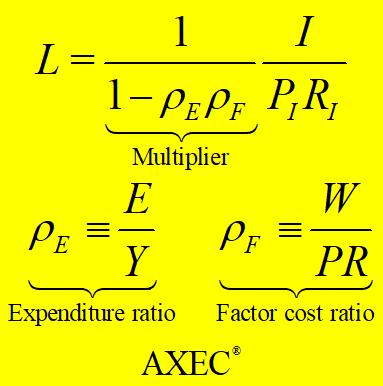
Graphic AXEC170
Legend: employment L, Wage rate W, price P, productivity R, expenditures E, income Y
***
The fatal mistake of the discussion is to accept the NAIRU-Phillips Curve (with the well-known disclaimers) and to focus on the economic policy implications with regard to the given situation in the US/UK/etc. But there is NO use in discussing policy if the underlying theory is defective.
The fact of the matter is that the Phillips Curve is misspecified since Samuelson/Solow.#1 Because there is NO such thing as a NAIRU-Phillips Curve, all political discussion is vacuous.
***
REPLY to Tom Hickey on Feb 28
You say: “The relationship between employment and inflation appears to be contingent and based on a number of factors, including institutional factors, that result in dynamic conditions involving uncertainty.”
This is an entirely vacuous econ-waffle. Imagine, as a contrast, a physics teacher tells his students about gravitation: “The relationship between velocity and mass appears to be contingent and based on a number of factors, including history-specific factors, that result in dynamic conditions involving uncertainty.”
It is pretty obvious that economists have NOTHING of substance to say. Why do they not simply shut up?
The elementary dependency between employment and inflation, and a number of other factors, is given with this objective systemic equation that is composed of MEASURABLE variables.
This equation is the economic equivalent of Galileo’s Law of Fall and thus the ultimate econ-waffle stopper.
***
REPLY to Auburn Parks on Feb 28
You say: “There is a simple reason why physics like precision and predictability is inapplicable to economics, and it's because of the reasons Tom provided.”
The simple reason is scientific incompetence. For details, see Failed economics: The losers’ long list of lame excuses.
***
REPLY to Ralph Musgrave on Feb 28
You say: “You make the naïve mistake many people make of thinking the because something cannot be measured accurately that therefore it does not have a precise value.”
You make the same mistake as all illiterate persons, that is, you cannot read. What I have clearly stated is: “NAIRU is dead, not because of measurement problems, but because the underlying employment theory is false.” #1 The measurement problem is a side issue. #2
#1 NAIRU: an exhaustive dancing-angels-on-a-pinpoint blather
#2 NAIRU and the scientific incompetence of Orthodoxy and Heterodoxy
***
REPLY to Auburn Parks on Feb 28The moronic part of economists, i.e., the vast majority, maintains that economics is a social science. Time to wake up to the fact that economics is a systems science. #1
Economics is NOT a science of individual/social/political behavior — this is the social science delusion — but of the behavior of the monetary economy. All Human-Nature issues are the subject matter of other disciplines (psychology, sociology, anthropology, biology/ Darwinism, political science, social philosophy, history, etcetera) and are taken in from these by way of multi-disciplinary cooperation. #2
The economic system is subject to precise and measurable systemic laws. #3
#1 Lawson’s fundamental methodological error and the failure of Heterodoxy
#2 Economics and the social science delusion
#3 The three fundamental economic laws
***
REPLY to Noah Way on Mar 1
You say: “’Economic science’ is an oxymoron.”
It is, first of all, of utmost importance to distinguish between political and theoretical economics. The main differences are: (i) The goal of political economics is to successfully push an agenda; the goal of theoretical economics is to successfully explain how the actual economy works. (ii) In political economics, anything goes; in theoretical economics, the scientific standards of material and formal consistency are observed.
Political economics has produced NOTHING of scientific value in the last 200+ years. The four major approaches — Walrasianism, Keynesianism, Marxianism, Austrianism — are mutually contradictory, axiomatically false, and materially/formally inconsistent.
A closer look at the history of economic thought shows that theoretical economics (= science) had been hijacked from the very beginning by the agenda pushers of political economics. These folks never rose above the level of vacuous econ-waffle. The whole discussion from Samuelson/Solow’s unemployment-inflation trade-off to Friedman/Phelps’s natural rate to the rational expectation NAIRU is a case in point.
The NAIRU-Phillips Curve has zero scientific content. It is a plaything of retarded political economists. Samuelson, Solow, Friedman, Phelps, and the rest of the participants in the NAIRU discussion up to Wren-Lewis are fake scientists. #1
#1 Modern macro moronism
***
REPLY to Ralph Musgrave on Mar 1
It would be fine if you could first learn to read, and to think, and to do your economics homework.
The point at issue is the labor market theory, and the remarkable fact of the matter is that economists have, after 200+ years NO valid labor market theory. The proof is in the NAIRU-Phillips Curve. So what these failures are in effect doing is giving policy advice without sound theoretical foundations. Scientists don’t do this.
What is known since the founding fathers about the separation of politics and science is this “A scientific observer or reasoner, merely as such, is not an adviser for practice. His part is only to show that certain consequences follow from certain causes, and that to obtain certain ends, certain means are the most effectual. Whether the ends themselves are such as ought to be pursued, and if so, in what cases and to how great a length, it is no part of his business as a cultivator of science to decide, and science alone will never qualify him for the decision.” (J. S. Mill)
The first point is that economists violate the separation of politics and science on a daily basis. #1 The second point is that their unwarranted advice is utter rubbish because they have NO idea how the economy works. The problem society has with economists is that it would be much better off without these clowns.
You ask me: “Why then don’t you advocate a massive increase in demand. Think of the economic benefits and social problems solved.!!”
Answer: The business of the economist is the true theory about how the economic system works and NOT the solution to social problems. This is the proper business of politicians. In addition, an economist who understands how the price and profit mechanism works does not make such a silly proposal; only brain-dead political agenda pushers do. #2
What I am indeed advocating is that retarded econ-wafflers are thrown out of economics and that economics gets finally out of what Feynman aptly called cargo cult science. #3
Economists have claimed for more than 200 years that they are doing science, and this is celebrated each year with the ‘Bank of Sweden Prize in Economic Sciences in Memory of Alfred Nobel’. Time to make this claim come true.
The only thing economists like you can actively do to contribute to the progress of economics is switch on the TV and watching 24/365.
#1 Scientific suicide in the revolving door
#2 Rethinking deficit spending
#3 Economists and the destructive power of stupidity
***
REPLY to Ralph Musgrave on Mar 1
You say: “Ergo economics have a duty to give the best advice they can in the circumstances.”
The only duty of scientifically incompetent economists is to throw themselves under the bus. Economists are a menace to their fellow citizens as Napoleon already knew: “Late in life, moreover, he claimed that he had always believed that if an empire were made of granite the ideas of economists if listened to, would suffice to reduce it to dust.” (Viner)
Economists do NOT solve social problems; they ARE a social problem.
You repeat your silly question: “So why are you so reluctant to solve those social problems by advocating a huge increase in demand. It’s blindingly obvious.”
Yes, it is blindingly obvious that deficit spending does NOT solve social problems but CREATES the social problem of an insanely unequal distribution (see the references above).
This follows from the true labor market theory, which is given with the systemic Employment Law. #1 “The correct theory of the macroeconomic price mechanism tells us that ― for purely SYSTEMIC reasons ― the average wage rate has in the current situation to rise faster than the average price. THIS opens the way out of mass unemployment, deflation, and stagnation and NOT the blather of scientifically incompetent orthodox and heterodox agenda pushers.” #2
Right policy depends on true theory: “In order to tell the politicians and practitioners something about causes and best means, the economist needs the true theory or else he has not much more to offer than educated common sense or his personal opinion.” (Stigum)
Economists do not have the true theory. They have NOTHING to offer. The NAIRU-Phillips Curve is provably false. Because of this, ALL economic policy conclusions drawn from it are counterproductive, that is, they WORSEN the situation. So, Samuelson, Solow, Friedman, Phelps, and the other NAIRU-Phillips Curve proponents bear the responsibility for mass unemployment and the social devastation that comes with it.
From the fact that the NAIRU labor market theory is false follows that economists are incompetent scientists and that ALL their economic policy proposals are scientifically worthless.
#1 NAIRU: an exhaustive dancing-angels-on-a-pinpoint blather
#2 NAIRU and the scientific incompetence of Orthodoxy and Heterodoxy
***
REPLY to Anonymous on Mar 05
For the final word on NAIRU, see the comment on David Glasner’s recycling of dead but not yet buried Phillips Curve stuff, NAIRU and economists’ lethal swampiness.
You are certainly right in stressing that economics is not a religion: actually, it is fake science. This applies to Walrasianism, Keynesianism, Marxianism, and Austrianism.
Related 'NAIRU: an exhaustive dancing-angels-on-a-pinpoint blather' and 'NAIRU does not exist because equilibrium does not exist' and 'If it isn’t macro-axiomatized, it isn’t economics'
February 7, 2017
Economics, methodology, morals ― a creepy freak-show
Comment on Sheila Dow on ‘People Have Had Enough of Experts’
Blog-Reference
After 80+ years, everybody can ― nay, must ― know that Keynes was an incompetent scientist and that his General Theory does not satisfy the well-defined scientific criteria of material and formal consistency. #1 Sheila Dow, though, does not seem to know this and advertises Keynes as an exemplary master-economist. In Keynes’ own words: “[T]he master-economist must possess a rare combination of gifts. He must be mathematician, historian, statesman, philosopher — in some degree. He must understand symbols and speak in words. He must contemplate the particular in terms of the general and touch abstract and concrete in the same flight of thought. He must study the present in the light of the past for the purposes of the future. No part of man’s nature or his institutions must lie entirely outside his regard. He must be purposeful and disinterested in a simultaneous mood; as aloof and incorruptible as an artist, yet sometimes as near to earth as a politician.”
No, not at all, it suffices that the economist comes forward with the true theory of how the market economy works. Or, in Keynes’ own words: “If economists could manage to get themselves thought of as humble, competent people, on a level with dentists, that would be splendid!”
During his lifetime, Keynes held every position and the very opposite of it, and because of this, he is eminently quotable but cannot be taken seriously.
Keynes’ self-description of the master-economist is as delusional as one can get because he never even understood what profit is: “His Collected Writings show that he wrestled to solve the Profit Puzzle up till the semi-final versions of his GT but in the end, he gave up and discarded the draft chapter dealing with it.” (Tómasson et al.)
Can there be anything more ridiculous than an economist who has no idea of the foundational concept of his subject matter? Yes, worse than an incompetent economist is an incompetent methodologist who has not realized until this very day the lethal conceptual flaw of Keynesianism, or, for that matter, of Walrasianism, Marxianism, and Austrianism. #2
An economic methodologist whose first and last sentence is not ‘Economics is a failed science and urgently needs a Paradigm Shift’ is an unwitting but effective promoter of ignorance and confusion.
There is politics, and there is economics, and both must be strictly separated because politics cannot do anything other than corrupt science. Accordingly, every methodological discussion has to start with the distinction between political and theoretical economics. The main differences are: (i) The goal of political economics is to successfully push an agenda, and the goal of theoretical economics is to successfully explain how the actual economy works. (ii) In political economics, anything goes; in theoretical economics, the scientific standards of material and formal consistency are observed.
Theoretical economics has to be judged according to the criteria true/false and NOTHING else. The criteria like/dislike or good/bad or good/evil or useful/useless do NOT apply. They apply in the political sphere but not in the scientific sphere.
The history of political economics from Adam Smith to Keynes and beyond can be summarized as an utter scientific failure. #3 Economics had been hijacked from the very beginning by the agenda pushers of political economics. Can there be the slightest doubt that Smith, Ricardo, Malthus, Marx, Keynes, Hayek, Friedman, Krugman, Lucas, and almost everybody in between falls into the category of a political economist or fake scientist?
However, in economics, too, newspeak prevails. Just like the former ministries of war have been all over the world renamed to ministries of defense, the Political Economy of the founding fathers has been renamed to economics, with the understanding that economics is a science. The change of name, though, did not change the practice.
What should have happened was the strict separation of politics and science. In the words of John Stuart Mill: “A scientific observer or reasoner, merely as such, is not an adviser for practice. His part is only to show that certain consequences follow from certain causes, and that to obtain certain ends, certain means are the most effectual. Whether the ends themselves are such as ought to be pursued, and if so, in what cases and to how great a length, it is no part of his business as a cultivator of science to decide, and science alone will never qualify him for the decision.”
Because the separation never happened, economics is still at the proto-scientific level of political economics. Political economics has produced NOTHING of scientific value in the last 200+ years. Neither Orthodoxy nor Heterodoxy has to offer anything in the way of a materially and formally consistent theory, only storytelling and agenda-pushing. What we have is the pluralism of false theories.
What Sheila Dow has not realized is that not only orthodox economics is an abysmal scientific failure but Heterodoxy, too: “... we may say that the ... omnipresence of a certain point of view is not a sign of excellence or an indication that the truth or part of the truth has at last been found. It is, rather, the indication of a failure of reason to find suitable alternatives which might be used to transcend an accidental intermediate stage of our knowledge.” (Feyerabend)
Let us briefly address the worst of Sheila Dow’s red herrings.
― ‘Voters have become contemptuous of economic experts.’ This is absolutely irrelevant because, firstly, voters cannot tell the difference between a scientific expert and a doorpost. Secondly, there is NO such thing as an economic expert because the representative economist lacks the true theory. #4
― The prediction/forecast/prophesy competition, which is the great attraction in the Circus Maximus, is pointless because all four political sects, that is, Walrasians, Keynesians, Marxians, and Austrians, lack the true theory. #5 The problem with forecasts is not a lack of pluralist methodology but the lack of true theory.
― Keynes’ and Friedman’s musings about methodology cannot be taken seriously because both were political economists, that is, scientifically incompetent.
― The problem of economic models is not that they are unduly mathematical but that they are axiomatically false. Economics has to move from false Walrasian microfoundations and false Keynesian macrofoundations to true macrofoundations. #6
― ‘There is no escaping the fact that economics continues to be a moral science.’ This is the self-delusion of political economists. The fact of the matter is: economics is neither a moral nor a social science but a systems science. #7
― ‘Knowledge about the economy is uncertain, severely limiting the scope for classical logic.’ False. Lack of knowledge is due to the scientific incompetence of economists for 200+ years. #8
― Economists are not expected to utter their opinion about the Good Society and to dabble in psychology, sociology, history, political science, etc., but to eventually come forward with a scientifically valid explanation of how the market economy works.
The current state of economics proves beyond any doubt that political economists have done a lousy job, and so have political methodologists. The representative economist cannot even tell the difference between profit and income until this very day. Hence, new economic thinking means, in very concrete terms, to leave political economists and methodologists like Sheila Dow where they have always been: behind the curve. #9 People have enough of scientifically incompetent agenda pushers.
Egmont Kakarot-Handtke
#1 How Keynes got macro wrong and Allais got it right
#2 Axiomatized NONENTITIES and the failure of methodologists
#3 Cross-references Political Economics
#4 There is NO such thing as an economic expert
#5 Science does NOT predict the future
#6 Cross-references Paradigm Shift
#7 Lawson’s fundamental methodological error and the failure of Heterodoxy
#8 Failed economics: The losers’ long list of lame excuses
#9 New economic thinking, or, let’s put lipstick on the dead pig
Related 'The economist as moralist' and 'Ditch scientific incompetence!' and 'The thinking economist' and 'Making the economy the focus of the economists’ dialogue' and 'Swedish muddle' and 'Eclecticism, anything goes, and the pluralism of false theories' and 'A brief history of soapbox economics' and 'Macroeconomics ― dead since Keynes' and 'In the grand scheme of things, Lord Keynes was only a small-time crook' and 'Your economics is refuted on all counts: here is the real thing'.
Blog-Reference
After 80+ years, everybody can ― nay, must ― know that Keynes was an incompetent scientist and that his General Theory does not satisfy the well-defined scientific criteria of material and formal consistency. #1 Sheila Dow, though, does not seem to know this and advertises Keynes as an exemplary master-economist. In Keynes’ own words: “[T]he master-economist must possess a rare combination of gifts. He must be mathematician, historian, statesman, philosopher — in some degree. He must understand symbols and speak in words. He must contemplate the particular in terms of the general and touch abstract and concrete in the same flight of thought. He must study the present in the light of the past for the purposes of the future. No part of man’s nature or his institutions must lie entirely outside his regard. He must be purposeful and disinterested in a simultaneous mood; as aloof and incorruptible as an artist, yet sometimes as near to earth as a politician.”
No, not at all, it suffices that the economist comes forward with the true theory of how the market economy works. Or, in Keynes’ own words: “If economists could manage to get themselves thought of as humble, competent people, on a level with dentists, that would be splendid!”
During his lifetime, Keynes held every position and the very opposite of it, and because of this, he is eminently quotable but cannot be taken seriously.
Keynes’ self-description of the master-economist is as delusional as one can get because he never even understood what profit is: “His Collected Writings show that he wrestled to solve the Profit Puzzle up till the semi-final versions of his GT but in the end, he gave up and discarded the draft chapter dealing with it.” (Tómasson et al.)
Can there be anything more ridiculous than an economist who has no idea of the foundational concept of his subject matter? Yes, worse than an incompetent economist is an incompetent methodologist who has not realized until this very day the lethal conceptual flaw of Keynesianism, or, for that matter, of Walrasianism, Marxianism, and Austrianism. #2
An economic methodologist whose first and last sentence is not ‘Economics is a failed science and urgently needs a Paradigm Shift’ is an unwitting but effective promoter of ignorance and confusion.
There is politics, and there is economics, and both must be strictly separated because politics cannot do anything other than corrupt science. Accordingly, every methodological discussion has to start with the distinction between political and theoretical economics. The main differences are: (i) The goal of political economics is to successfully push an agenda, and the goal of theoretical economics is to successfully explain how the actual economy works. (ii) In political economics, anything goes; in theoretical economics, the scientific standards of material and formal consistency are observed.
Theoretical economics has to be judged according to the criteria true/false and NOTHING else. The criteria like/dislike or good/bad or good/evil or useful/useless do NOT apply. They apply in the political sphere but not in the scientific sphere.
The history of political economics from Adam Smith to Keynes and beyond can be summarized as an utter scientific failure. #3 Economics had been hijacked from the very beginning by the agenda pushers of political economics. Can there be the slightest doubt that Smith, Ricardo, Malthus, Marx, Keynes, Hayek, Friedman, Krugman, Lucas, and almost everybody in between falls into the category of a political economist or fake scientist?
However, in economics, too, newspeak prevails. Just like the former ministries of war have been all over the world renamed to ministries of defense, the Political Economy of the founding fathers has been renamed to economics, with the understanding that economics is a science. The change of name, though, did not change the practice.
What should have happened was the strict separation of politics and science. In the words of John Stuart Mill: “A scientific observer or reasoner, merely as such, is not an adviser for practice. His part is only to show that certain consequences follow from certain causes, and that to obtain certain ends, certain means are the most effectual. Whether the ends themselves are such as ought to be pursued, and if so, in what cases and to how great a length, it is no part of his business as a cultivator of science to decide, and science alone will never qualify him for the decision.”
Because the separation never happened, economics is still at the proto-scientific level of political economics. Political economics has produced NOTHING of scientific value in the last 200+ years. Neither Orthodoxy nor Heterodoxy has to offer anything in the way of a materially and formally consistent theory, only storytelling and agenda-pushing. What we have is the pluralism of false theories.
What Sheila Dow has not realized is that not only orthodox economics is an abysmal scientific failure but Heterodoxy, too: “... we may say that the ... omnipresence of a certain point of view is not a sign of excellence or an indication that the truth or part of the truth has at last been found. It is, rather, the indication of a failure of reason to find suitable alternatives which might be used to transcend an accidental intermediate stage of our knowledge.” (Feyerabend)
Let us briefly address the worst of Sheila Dow’s red herrings.
― ‘Voters have become contemptuous of economic experts.’ This is absolutely irrelevant because, firstly, voters cannot tell the difference between a scientific expert and a doorpost. Secondly, there is NO such thing as an economic expert because the representative economist lacks the true theory. #4
― The prediction/forecast/prophesy competition, which is the great attraction in the Circus Maximus, is pointless because all four political sects, that is, Walrasians, Keynesians, Marxians, and Austrians, lack the true theory. #5 The problem with forecasts is not a lack of pluralist methodology but the lack of true theory.
― Keynes’ and Friedman’s musings about methodology cannot be taken seriously because both were political economists, that is, scientifically incompetent.
― The problem of economic models is not that they are unduly mathematical but that they are axiomatically false. Economics has to move from false Walrasian microfoundations and false Keynesian macrofoundations to true macrofoundations. #6
― ‘There is no escaping the fact that economics continues to be a moral science.’ This is the self-delusion of political economists. The fact of the matter is: economics is neither a moral nor a social science but a systems science. #7
― ‘Knowledge about the economy is uncertain, severely limiting the scope for classical logic.’ False. Lack of knowledge is due to the scientific incompetence of economists for 200+ years. #8
― Economists are not expected to utter their opinion about the Good Society and to dabble in psychology, sociology, history, political science, etc., but to eventually come forward with a scientifically valid explanation of how the market economy works.
The current state of economics proves beyond any doubt that political economists have done a lousy job, and so have political methodologists. The representative economist cannot even tell the difference between profit and income until this very day. Hence, new economic thinking means, in very concrete terms, to leave political economists and methodologists like Sheila Dow where they have always been: behind the curve. #9 People have enough of scientifically incompetent agenda pushers.
Egmont Kakarot-Handtke
#1 How Keynes got macro wrong and Allais got it right
#2 Axiomatized NONENTITIES and the failure of methodologists
#3 Cross-references Political Economics
#4 There is NO such thing as an economic expert
#5 Science does NOT predict the future
#6 Cross-references Paradigm Shift
#7 Lawson’s fundamental methodological error and the failure of Heterodoxy
#8 Failed economics: The losers’ long list of lame excuses
#9 New economic thinking, or, let’s put lipstick on the dead pig
Related 'The economist as moralist' and 'Ditch scientific incompetence!' and 'The thinking economist' and 'Making the economy the focus of the economists’ dialogue' and 'Swedish muddle' and 'Eclecticism, anything goes, and the pluralism of false theories' and 'A brief history of soapbox economics' and 'Macroeconomics ― dead since Keynes' and 'In the grand scheme of things, Lord Keynes was only a small-time crook' and 'Your economics is refuted on all counts: here is the real thing'.
July 6, 2016
Ending the economic Froschmäusekrieg a.k.a. Batrachomyomachia
Comment on Lars Syll on ‘Paul Krugman — nothing but a die-hard neoclassical economist’
Blog-Reference
The Battle of Frogs and Mice, a.k.a. Orthodoxy vs. Heterodoxy, has become rather stagnant, so let us shorten the agony with some clear-cut arbitral awards.
Syll: “Despite all his radical rhetoric, Krugman is — where it really counts — nothing but a die-hard neoclassical economist.”
Krugman says on his blog, “most of what I and many others do is sorta-kinda neoclassical because it takes the maximization-and-equilibrium world as a starting point.”
Judgment :#1 Krugman is a neoclassical economist, always was, and always said so, and everybody got it. Stop being surprised, Lars Syll. The point at issue is NOT that Krugman is a Neoclassical but that his starting point, i.e., the neoclassical axiom set, is false.
Krugman: “... this is exactly the kind of situation in which words alone can create an illusion of logical coherence that dissipates when you try to do the math.” In other words, formalization and modeling can be helpful to clarify the issue.
Georgescu-Roegen: “Lest this position is misinterpreted again by some casual reader, let me repeat that my point is not that arithmetization of science is undesirable. Whenever arithmetization can be worked out, its merits are above all words of praise. My point is that wholesale arithmetization is impossible, that there is valid knowledge even without arithmetization, and that mock arithmetization is dangerous if peddled as genuine.”
Syll: “That’s a methodological reductionist straightjacket.”
Judgment: Krugman and Georgescu-Roegen are right. Lars Syll is wrong.
Syll: “The only economic analysis that Krugman and other mainstream economists accept is the one that takes place within the analytic-formalistic modeling strategy that makes up the core of mainstream economics.”
Krugman on several occasions: “where’s your model?” and “what’s your alternative?”
Lewis: “There is no example, not even a vague outline, of what Prof. Syll might regard as a satisfactory economic analysis of 'an open system where complex and relational structures and agents interact'. Because it is devoid of any such substance, Prof. Syll’s argument provides no understanding of how Krugman’s many errors could have been avoided.
Judgment: Lars Syll has never presented an alternative. His advice: “I would rather suggest you read Keynes, Minsky, Polanyi, Galbraith, Myrdal, Hodgson, Keen, Mirowski, Lawson, Davidson, Kalecki, Chick, Dow” is hand waving and does not count as an alternative because Keynes’, Minsky’s, Kalecki’s, Keen’s, Davidson’s and other heterodox economists’ models are also defective, i.e. provably false. Lawson, Chick, Dow are failed methodologists because they cannot even spot elementary logical blunders, which are entirely sufficient for the refutation of a theory/model.
Syll: “That isn’t pluralism.”
Judgment: Science is about clear-cut true/false and the very opposite of the pluralism of false theories. Either Orthodoxy is true, or Heterodoxy is true; then either Orthodoxy is thrown out of science or Heterodoxy. Except that both are false, then both are thrown out of science.
Syll: “Validly deducing things from patently unreal assumptions — that we all know are purely fictional — makes most of the modeling exercises pursued by mainstream economists rather pointless. It’s simply not the stuff that real understanding and explanation in science is made of.”
Aristotle: “When the premises are certain, true, and primary, and the conclusion formally follows from them, this is demonstration, and produces scientific knowledge of a thing.”
Judgment: Lars Syll and Aristotle are right. Economics is currently based on false axioms. Both Walrasian and Keynesian axioms have to be fully replaced in order to produce scientific knowledge of the economy. After more than 200 years of producing scientific garbage, this task has top priority. Concrete proposals are urgently needed. Lars Syll has none.
Hickey: “There is nothing wrong with using a simple IS-LM approach in some cases as a gadget.”
Judgment: IS-LM has already died in the cradle (2014a). You are way behind the curve.
Pontus: “Banks are only intermediary in a certain sense: Any loan that is granted implies that someone’s spending exceeds his or her income. That does necessarily imply that someone else’s spending must fall short of his or her income.”
Judgment: You are way behind the curve (2014b).
Wilder: “National income accounting identifies a category it calls 'saving' that it opposes in its double‑entry scheme to 'investment'. Honestly, I have to say it does not make a lot of sense: while investment is spending and transactional, saving is not.”
Judgment: This matter has already been settled (2012). You are way behind the curve.
Nanikore: “Samuelson’s project has ultimately reached its inevitable end — but the subject which has invested so much in it is finding reality hard to swallow. I don’t know what it is going to take to finally kill the beast.”
Judgment: Yes, you are in dire straits. But could you now stop repeating it over and over again and proceed to the inescapable Paradigm Shift?
Mellechman: “True, setting out such a model would imply accepting the core assumptions of what you call the ur-model.”
Judgment: Nonsense of the worst sort. Nobody is obliged to accept the core assumptions, a.k.a. neoclassical axioms. Just the opposite, as Keynes told his fellow economists long ago: “The classical theorists resemble Euclidean geometers in a non-Euclidean world who, discovering that in experience straight lines apparently parallel often meet, rebuke the lines for not keeping straight — as the only remedy for the unfortunate collisions which are occurring. Yet, in truth, there is no remedy except to throw over the axiom of parallels and to work out a non-Euclidean geometry. Something similar is required to-day in economics.”
So, let us end the Froschmäusekrieg and start doing real science.
Egmont Kakarot-Handtke
References
Kakarot-Handtke, E. (2012). The Common Error of Common Sense: An Essential Rectification of the Accounting Approach. SSRN Working Paper Series, 2124415: 1–23. URL
Kakarot-Handtke, E. (2014a). Loanable Funds vs. Endogenous Money: Krugman is Wrong, Keen is Right. SSRN Working Paper Series, 2389341: 1–17. URL
Kakarot-Handtke, E. (2014b). Mr. Keynes, Prof. Krugman, IS-LM, and the End of Economics as We Know It. SSRN Working Paper Series, 2392856: 1–19. URL
#1 All judgments are backed in greater detail, see blog or working papers before jumping to silly conclusions.
For the details about the definitive resolution of the I=S/IS-LM issue, see cross-references.
Blog-Reference
The Battle of Frogs and Mice, a.k.a. Orthodoxy vs. Heterodoxy, has become rather stagnant, so let us shorten the agony with some clear-cut arbitral awards.
Syll: “Despite all his radical rhetoric, Krugman is — where it really counts — nothing but a die-hard neoclassical economist.”
Krugman says on his blog, “most of what I and many others do is sorta-kinda neoclassical because it takes the maximization-and-equilibrium world as a starting point.”
Judgment :#1 Krugman is a neoclassical economist, always was, and always said so, and everybody got it. Stop being surprised, Lars Syll. The point at issue is NOT that Krugman is a Neoclassical but that his starting point, i.e., the neoclassical axiom set, is false.
Krugman: “... this is exactly the kind of situation in which words alone can create an illusion of logical coherence that dissipates when you try to do the math.” In other words, formalization and modeling can be helpful to clarify the issue.
Georgescu-Roegen: “Lest this position is misinterpreted again by some casual reader, let me repeat that my point is not that arithmetization of science is undesirable. Whenever arithmetization can be worked out, its merits are above all words of praise. My point is that wholesale arithmetization is impossible, that there is valid knowledge even without arithmetization, and that mock arithmetization is dangerous if peddled as genuine.”
Syll: “That’s a methodological reductionist straightjacket.”
Judgment: Krugman and Georgescu-Roegen are right. Lars Syll is wrong.
Syll: “The only economic analysis that Krugman and other mainstream economists accept is the one that takes place within the analytic-formalistic modeling strategy that makes up the core of mainstream economics.”
Krugman on several occasions: “where’s your model?” and “what’s your alternative?”
Lewis: “There is no example, not even a vague outline, of what Prof. Syll might regard as a satisfactory economic analysis of 'an open system where complex and relational structures and agents interact'. Because it is devoid of any such substance, Prof. Syll’s argument provides no understanding of how Krugman’s many errors could have been avoided.
Judgment: Lars Syll has never presented an alternative. His advice: “I would rather suggest you read Keynes, Minsky, Polanyi, Galbraith, Myrdal, Hodgson, Keen, Mirowski, Lawson, Davidson, Kalecki, Chick, Dow” is hand waving and does not count as an alternative because Keynes’, Minsky’s, Kalecki’s, Keen’s, Davidson’s and other heterodox economists’ models are also defective, i.e. provably false. Lawson, Chick, Dow are failed methodologists because they cannot even spot elementary logical blunders, which are entirely sufficient for the refutation of a theory/model.
Syll: “That isn’t pluralism.”
Judgment: Science is about clear-cut true/false and the very opposite of the pluralism of false theories. Either Orthodoxy is true, or Heterodoxy is true; then either Orthodoxy is thrown out of science or Heterodoxy. Except that both are false, then both are thrown out of science.
Syll: “Validly deducing things from patently unreal assumptions — that we all know are purely fictional — makes most of the modeling exercises pursued by mainstream economists rather pointless. It’s simply not the stuff that real understanding and explanation in science is made of.”
Aristotle: “When the premises are certain, true, and primary, and the conclusion formally follows from them, this is demonstration, and produces scientific knowledge of a thing.”
Judgment: Lars Syll and Aristotle are right. Economics is currently based on false axioms. Both Walrasian and Keynesian axioms have to be fully replaced in order to produce scientific knowledge of the economy. After more than 200 years of producing scientific garbage, this task has top priority. Concrete proposals are urgently needed. Lars Syll has none.
Hickey: “There is nothing wrong with using a simple IS-LM approach in some cases as a gadget.”
Judgment: IS-LM has already died in the cradle (2014a). You are way behind the curve.
Pontus: “Banks are only intermediary in a certain sense: Any loan that is granted implies that someone’s spending exceeds his or her income. That does necessarily imply that someone else’s spending must fall short of his or her income.”
Judgment: You are way behind the curve (2014b).
Wilder: “National income accounting identifies a category it calls 'saving' that it opposes in its double‑entry scheme to 'investment'. Honestly, I have to say it does not make a lot of sense: while investment is spending and transactional, saving is not.”
Judgment: This matter has already been settled (2012). You are way behind the curve.
Nanikore: “Samuelson’s project has ultimately reached its inevitable end — but the subject which has invested so much in it is finding reality hard to swallow. I don’t know what it is going to take to finally kill the beast.”
Judgment: Yes, you are in dire straits. But could you now stop repeating it over and over again and proceed to the inescapable Paradigm Shift?
Mellechman: “True, setting out such a model would imply accepting the core assumptions of what you call the ur-model.”
Judgment: Nonsense of the worst sort. Nobody is obliged to accept the core assumptions, a.k.a. neoclassical axioms. Just the opposite, as Keynes told his fellow economists long ago: “The classical theorists resemble Euclidean geometers in a non-Euclidean world who, discovering that in experience straight lines apparently parallel often meet, rebuke the lines for not keeping straight — as the only remedy for the unfortunate collisions which are occurring. Yet, in truth, there is no remedy except to throw over the axiom of parallels and to work out a non-Euclidean geometry. Something similar is required to-day in economics.”
So, let us end the Froschmäusekrieg and start doing real science.
Egmont Kakarot-Handtke
References
Kakarot-Handtke, E. (2012). The Common Error of Common Sense: An Essential Rectification of the Accounting Approach. SSRN Working Paper Series, 2124415: 1–23. URL
Kakarot-Handtke, E. (2014a). Loanable Funds vs. Endogenous Money: Krugman is Wrong, Keen is Right. SSRN Working Paper Series, 2389341: 1–17. URL
Kakarot-Handtke, E. (2014b). Mr. Keynes, Prof. Krugman, IS-LM, and the End of Economics as We Know It. SSRN Working Paper Series, 2392856: 1–19. URL
#1 All judgments are backed in greater detail, see blog or working papers before jumping to silly conclusions.
For the details about the definitive resolution of the I=S/IS-LM issue, see cross-references.
March 4, 2016
Lawson’s fundamental methodological error and the failure of Heterodoxy
Comment on Lars Syll on ‘Critical realism and scientific explanation’
Blog-Reference and Blog-Reference on Mar 5
As far as the critique of orthodox economics is concerned, critical realism is correct. Yet, the fundamental error of critical realism is to assume that economics is about ‘how society works’. No! This is the subject matter of sociology. Economics is about ‘how the economy works.’ Society and economy are intertwined but must be separated analytically.
Since Adam Smith, economics claims to be a science. Methodologically, it started as a mixture of sociology and political science: “The science which traces the laws of such of the phenomena of society as arise from the combined operations of mankind for the production of wealth, in so far as those phenomena are not modified by the pursuit of any other object.” (Mill, 1874, V.39)
With respect to the subject matter, there is no difference between Mill and Marx: “My stand-point, from which the evolution of the economic formation of society is viewed as a process of natural history, ...” (Marx, 1906, M.9)
With Jevons/Walras/Menger, the focus shifted to methodological individualism, and economics became a mixture of dilettantish psychology, sociology, and political science. This approach has failed abysmally.
Economics is NOT a science of individual/social/political behavior but of the behavior of the monetary economy. Accordingly, the correct definition of the subject matter is objective/ structural/systemic: “Economics is the science which studies how the monetary economy works.”
As a consequence, the long-overdue Copernican turn in economics consists of the methodological switch from behavior-centered bottom-up, i.e., subjective microfoundation, to structure-centered top-down, i.e., objective macrofoundations. All Human-Nature issues are the subject matter of other disciplines (psychology, sociology, anthropology, biology/Darwinism, political science, history, philosophy, etcetera) and are taken in from these by way of multidisciplinary cooperation. To paraphrase J. S. Mill: ‘Economics as a systems science presupposes all the physical and social sciences; it takes for granted all such of the truths of those sciences as are concerned with the working of the economic system.’ (cf. Mill 1874, V.29)
Lars Syll summarizes Tony Lawson: “We have to maintain the Enlightenment tradition of thinking of reality as principally independent of our views of it and of the main task of science as studying the structure of this reality. Perhaps the most important contribution a researcher can make is reveal what this reality that is the object of science actually looks like.”
Exactly so.
Therefore, economics has to drop these axioms/microfoundations:
HC1 There exist economic agents.
HC2 Agents have preferences over outcomes.
HC3 Agents independently optimize subject to constraints.
HC4 Choices are made in interrelated markets.
HC5 Agents have full relevant knowledge.
HC6 Observable economic outcomes are coordinated, so they must be discussed with reference to equilibrium states.” (Weintraub, 1985, p. 109)
Lawson’s critique fully applies to the theoretical superstructure that has been built upon HC1 (= methodological individualism) to HC6 (= closure).
The proper object of economics is neither the individual nor society but the economy. So we have to move on and, first of all, describe the structure of the monetary economy.
(A0) The most elementary configuration of the (world-) economy consists of the household and the business sector, which in turn consists initially of one giant fully integrated firm and is given by three objective structural axioms/macrofoundations:
(A1) Yw=WL wage income Yw is equal to wage rate W times working hours L,
(A2) O=RL output O is equal to productivity R times working hours L,
(A3) C=PX consumption expenditure C is equal to price P times quantity bought/sold X.
These premises are certain, true, and primary, and therefore satisfy all methodological requirements (2014). In the words of Lars Syll: “Science is made possible by the fact that there are structures that are durable and are independent of our knowledge or beliefs about them. There exists a reality beyond our theories and concepts of it. It is this independent reality that our theories in some way deal with.”
Society has no durable structures, but the monetary economy has, and they are given in the most elementary case by (A1) to (A3). Economics is not a social science but a systems science, and it deals not with the defects of society but with systemic defects that produce what every superficial observer can see but not understand (2015).
The fundamental flaw of Lawson’s methodology is that he defines economics as a social science.
Egmont Kakarot-Handtke
References
Kakarot-Handtke, E. (2014). Objective Principles of Economics. SSRN Working Paper Series, 2418851: 1–19. URL
Kakarot-Handtke, E. (2015). Major Defects of the Market Economy. SSRN Working Paper Series, 2624350: 1–40. URL
Marx, K. (1906). Capital: A Critique of Political Economy, Vol. I. The Process of Capitalist Production. Library of Economics and Liberty. URL
Mill, J. S. (1874). Essays on Some Unsettled Questions of Political Economy. On the Definition of Political Economy; and on the Method of Investigation Proper To It. Library of Economics and Liberty. URL
Weintraub, E. R. (1985). General Equilibrium Analysis. Cambridge, London, New York, etc.: Cambridge University Press.
Related 'Economists’ three-layered scientific incompetence'. For details of the big picture, see cross-references Heterodoxy and cross-references Paradigm Shift and cross-references Axiomatization.
Blog-Reference and Blog-Reference on Mar 5
As far as the critique of orthodox economics is concerned, critical realism is correct. Yet, the fundamental error of critical realism is to assume that economics is about ‘how society works’. No! This is the subject matter of sociology. Economics is about ‘how the economy works.’ Society and economy are intertwined but must be separated analytically.
Since Adam Smith, economics claims to be a science. Methodologically, it started as a mixture of sociology and political science: “The science which traces the laws of such of the phenomena of society as arise from the combined operations of mankind for the production of wealth, in so far as those phenomena are not modified by the pursuit of any other object.” (Mill, 1874, V.39)
With respect to the subject matter, there is no difference between Mill and Marx: “My stand-point, from which the evolution of the economic formation of society is viewed as a process of natural history, ...” (Marx, 1906, M.9)
With Jevons/Walras/Menger, the focus shifted to methodological individualism, and economics became a mixture of dilettantish psychology, sociology, and political science. This approach has failed abysmally.
Economics is NOT a science of individual/social/political behavior but of the behavior of the monetary economy. Accordingly, the correct definition of the subject matter is objective/ structural/systemic: “Economics is the science which studies how the monetary economy works.”
As a consequence, the long-overdue Copernican turn in economics consists of the methodological switch from behavior-centered bottom-up, i.e., subjective microfoundation, to structure-centered top-down, i.e., objective macrofoundations. All Human-Nature issues are the subject matter of other disciplines (psychology, sociology, anthropology, biology/Darwinism, political science, history, philosophy, etcetera) and are taken in from these by way of multidisciplinary cooperation. To paraphrase J. S. Mill: ‘Economics as a systems science presupposes all the physical and social sciences; it takes for granted all such of the truths of those sciences as are concerned with the working of the economic system.’ (cf. Mill 1874, V.29)
Lars Syll summarizes Tony Lawson: “We have to maintain the Enlightenment tradition of thinking of reality as principally independent of our views of it and of the main task of science as studying the structure of this reality. Perhaps the most important contribution a researcher can make is reveal what this reality that is the object of science actually looks like.”
Exactly so.
Therefore, economics has to drop these axioms/microfoundations:
HC1 There exist economic agents.
HC2 Agents have preferences over outcomes.
HC3 Agents independently optimize subject to constraints.
HC4 Choices are made in interrelated markets.
HC5 Agents have full relevant knowledge.
HC6 Observable economic outcomes are coordinated, so they must be discussed with reference to equilibrium states.” (Weintraub, 1985, p. 109)
Lawson’s critique fully applies to the theoretical superstructure that has been built upon HC1 (= methodological individualism) to HC6 (= closure).
The proper object of economics is neither the individual nor society but the economy. So we have to move on and, first of all, describe the structure of the monetary economy.
(A0) The most elementary configuration of the (world-) economy consists of the household and the business sector, which in turn consists initially of one giant fully integrated firm and is given by three objective structural axioms/macrofoundations:
(A1) Yw=WL wage income Yw is equal to wage rate W times working hours L,
(A2) O=RL output O is equal to productivity R times working hours L,
(A3) C=PX consumption expenditure C is equal to price P times quantity bought/sold X.
These premises are certain, true, and primary, and therefore satisfy all methodological requirements (2014). In the words of Lars Syll: “Science is made possible by the fact that there are structures that are durable and are independent of our knowledge or beliefs about them. There exists a reality beyond our theories and concepts of it. It is this independent reality that our theories in some way deal with.”
Society has no durable structures, but the monetary economy has, and they are given in the most elementary case by (A1) to (A3). Economics is not a social science but a systems science, and it deals not with the defects of society but with systemic defects that produce what every superficial observer can see but not understand (2015).
The fundamental flaw of Lawson’s methodology is that he defines economics as a social science.
Egmont Kakarot-Handtke
References
Kakarot-Handtke, E. (2014). Objective Principles of Economics. SSRN Working Paper Series, 2418851: 1–19. URL
Kakarot-Handtke, E. (2015). Major Defects of the Market Economy. SSRN Working Paper Series, 2624350: 1–40. URL
Marx, K. (1906). Capital: A Critique of Political Economy, Vol. I. The Process of Capitalist Production. Library of Economics and Liberty. URL
Mill, J. S. (1874). Essays on Some Unsettled Questions of Political Economy. On the Definition of Political Economy; and on the Method of Investigation Proper To It. Library of Economics and Liberty. URL
Weintraub, E. R. (1985). General Equilibrium Analysis. Cambridge, London, New York, etc.: Cambridge University Press.
Related 'Economists’ three-layered scientific incompetence'. For details of the big picture, see cross-references Heterodoxy and cross-references Paradigm Shift and cross-references Axiomatization.
For more about Lawson, see AXECquery.
February 2, 2016
Incompetence — the original sin in economics
Comment on Lars Syll on ‘Deductivism — the original sin in economics’
Blog-Reference and Blog-Reference on Feb 5 and Blog-Reference on Jul 23, 2019
Tony Lawson summarizes: “This emergence of the axiomatic method removed at a stroke various hitherto insurmountable constraints facing those who would mathematise the discipline of economics.”
This is not quite accurate, the mathematization of economics started before Hilbert’s general axiomatization of mathematics: “... economists have long been mathematicians without being aware of the fact. The unfortunate result is that they have generally been bad mathematicians, and their works must fall. Hence the explicit recognition of the mathematical character of the science was an almost necessary condition of any real improvement of the theory.” (Jevons, 1871, PS. 13)
The axiomatization of economics started even earlier: “To Senior belongs the signal honor of having been the first to make the attempt to state, consciously and explicitly, the postulates that are necessary and sufficient in order to build up … that little analytic apparatus commonly known as economic theory, or to put it differently, to provide for it an axiomatic basis.” (Schumpeter, 1994, p. 575)
Where Tony Lawson is right is that economists messed the whole thing up, and this resulted in the ongoing ridiculous mathiness discussion.
The key to formalization, axiomatics, or mathiness is “Formal axiomatic systems must be interpreted in some domain ... to become an empirical science.” (Boylan et al., 1995, p. 198)
Now, Debreu did explicitly the very opposite, that is, he disconnected “Allegiance to rigor dictates the axiomatic form of the analysis where the theory, in the strict sense, is logically entirely disconnected from its interpretations.” (Debreu, 1959, p. x)
It is well-known from where Debreu got his methodological inspiration “It seems clear that Debreu intended his Theory of Value to serve as the direct analog of Bourbaki’s Theory of Sets, right down to the title.” (Weintraub, 2002, p. 121)
Now, it is pretty obvious that Debreu missed the crucial point of Bourbaki’s axiomatic: “From the axiomatic point of view, mathematics appears thus as a storehouse of abstract forms — the mathematical structures; and it so happens — without our knowing why — that certain aspects of empirical reality fit themselves into these forms, as if through a kind of preadaptation. ... It is only in this sense of the word ‘form’ that one can call the axiomatic method a ‘formalism’.” (Bourbaki, 2005, p. 1276)
It was quite clear to Bourbaki that not all mathematical structures incorporate ‘certain aspect of empirical reality’, which means, that there is a “... whole crop of monster-structures, entirely without application.” (Bourbaki, 2005, p. 1275, fn. 9)
Hence, Debreu’s axiomatization of Walrasian General Equilibrium is a monster-structure that is due to Debreu’s misunderstanding of Bourbaki. It is not the axiomatic-deductive method that is wrong, it is neoclassical economics that is wrong.
Generally, it can be said that the so-called social scientists cannot get their heads around the essentials of the scientific method. Tony Lawson is one of them. It is quite obvious that no genuine scientist ever abused the axiomatic-deductive method by declaring green-cheese assumptions like constrained optimization and equilibrium as axioms. In marked contrast, economists never had any scruples to make fools of themselves: “most of what I and many others do is sorta-kinda neoclassical because it takes the maximization-and-equilibrium world as a starting point.” (Krugman).
Einstein explained in a short paragraph what the so-called social scientists do not understand to this very day “The basic concepts and laws which are not logically further reducible constitute the indispensable and not rationally deducible part of the theory [= axioms]. It can scarcely be denied that the supreme goal of all theory is to make the irreducible basic elements as simple and as few as possible without having to surrender the adequate representation of a single datum of experience.” (Einstein, 1934, p. 165)
Note that Einstein treats axioms and experience as two sides of the same coin — just like Bourbaki — no disconnect here!
The fact of the matter is that both orthodox and heterodox economists have not been very skilled users of the scientific method to this day. This explains why economics is a failed science for more than 200 years.
Egmont Kakarot-Handtke
References
Bourbaki, N. (2005). The Architecture of Mathematics. In W. Ewald (Ed.), From Kant to Hilbert. A Source Book in the Foundations of Mathematics, Volume II, 1265–1276. Oxford, New York: Oxford University Press. (1948).
Boylan, T. A., and O’Gorman, P. F. (1995). Beyond Rhetoric and Realism in Economics. Towards a Reformulation of Economic Methodology. London: Routledge.
Debreu, G. (1959). Theory of Value. An Axiomatic Analysis of Economic Equilibrium. New Haven, London: Yale University Press.
Einstein, A. (1934). On the Method of Theoretical Physics. Philosophy of Science, 1(2): 163–169. URL
Jevons, W. S. (1871). The Theory of Political Economy. Library of Economics and Liberty. URL
Schumpeter, J. A. (1994). History of Economic Analysis. New York: Oxford University Press.
Weintraub, E. R. (2002). How Economics Became a Mathematical Science. Durham, London: Duke University Press.
You say: “The logical faintness of these damns amounts to praise of neoclassical economics. So they have nothing to worry about from this kind of both overblown and inadequate critique.”
Frank Hahn was always very happy with the incompetent critics of the neoclassical research program: “The enemies, on the other hand, have proved curiously ineffective and they have very often aimed their arrows at the wrong targets.”
Related 'The stupidity of Heterodoxy is the life insurance of Orthodoxy.'

Blog-Reference and Blog-Reference on Feb 5 and Blog-Reference on Jul 23, 2019
Tony Lawson summarizes: “This emergence of the axiomatic method removed at a stroke various hitherto insurmountable constraints facing those who would mathematise the discipline of economics.”
This is not quite accurate, the mathematization of economics started before Hilbert’s general axiomatization of mathematics: “... economists have long been mathematicians without being aware of the fact. The unfortunate result is that they have generally been bad mathematicians, and their works must fall. Hence the explicit recognition of the mathematical character of the science was an almost necessary condition of any real improvement of the theory.” (Jevons, 1871, PS. 13)
The axiomatization of economics started even earlier: “To Senior belongs the signal honor of having been the first to make the attempt to state, consciously and explicitly, the postulates that are necessary and sufficient in order to build up … that little analytic apparatus commonly known as economic theory, or to put it differently, to provide for it an axiomatic basis.” (Schumpeter, 1994, p. 575)
Where Tony Lawson is right is that economists messed the whole thing up, and this resulted in the ongoing ridiculous mathiness discussion.
The key to formalization, axiomatics, or mathiness is “Formal axiomatic systems must be interpreted in some domain ... to become an empirical science.” (Boylan et al., 1995, p. 198)
Now, Debreu did explicitly the very opposite, that is, he disconnected “Allegiance to rigor dictates the axiomatic form of the analysis where the theory, in the strict sense, is logically entirely disconnected from its interpretations.” (Debreu, 1959, p. x)
It is well-known from where Debreu got his methodological inspiration “It seems clear that Debreu intended his Theory of Value to serve as the direct analog of Bourbaki’s Theory of Sets, right down to the title.” (Weintraub, 2002, p. 121)
Now, it is pretty obvious that Debreu missed the crucial point of Bourbaki’s axiomatic: “From the axiomatic point of view, mathematics appears thus as a storehouse of abstract forms — the mathematical structures; and it so happens — without our knowing why — that certain aspects of empirical reality fit themselves into these forms, as if through a kind of preadaptation. ... It is only in this sense of the word ‘form’ that one can call the axiomatic method a ‘formalism’.” (Bourbaki, 2005, p. 1276)
It was quite clear to Bourbaki that not all mathematical structures incorporate ‘certain aspect of empirical reality’, which means, that there is a “... whole crop of monster-structures, entirely without application.” (Bourbaki, 2005, p. 1275, fn. 9)
Hence, Debreu’s axiomatization of Walrasian General Equilibrium is a monster-structure that is due to Debreu’s misunderstanding of Bourbaki. It is not the axiomatic-deductive method that is wrong, it is neoclassical economics that is wrong.
Generally, it can be said that the so-called social scientists cannot get their heads around the essentials of the scientific method. Tony Lawson is one of them. It is quite obvious that no genuine scientist ever abused the axiomatic-deductive method by declaring green-cheese assumptions like constrained optimization and equilibrium as axioms. In marked contrast, economists never had any scruples to make fools of themselves: “most of what I and many others do is sorta-kinda neoclassical because it takes the maximization-and-equilibrium world as a starting point.” (Krugman).
Einstein explained in a short paragraph what the so-called social scientists do not understand to this very day “The basic concepts and laws which are not logically further reducible constitute the indispensable and not rationally deducible part of the theory [= axioms]. It can scarcely be denied that the supreme goal of all theory is to make the irreducible basic elements as simple and as few as possible without having to surrender the adequate representation of a single datum of experience.” (Einstein, 1934, p. 165)
Note that Einstein treats axioms and experience as two sides of the same coin — just like Bourbaki — no disconnect here!
The fact of the matter is that both orthodox and heterodox economists have not been very skilled users of the scientific method to this day. This explains why economics is a failed science for more than 200 years.
Egmont Kakarot-Handtke
References
Bourbaki, N. (2005). The Architecture of Mathematics. In W. Ewald (Ed.), From Kant to Hilbert. A Source Book in the Foundations of Mathematics, Volume II, 1265–1276. Oxford, New York: Oxford University Press. (1948).
Boylan, T. A., and O’Gorman, P. F. (1995). Beyond Rhetoric and Realism in Economics. Towards a Reformulation of Economic Methodology. London: Routledge.
Debreu, G. (1959). Theory of Value. An Axiomatic Analysis of Economic Equilibrium. New Haven, London: Yale University Press.
Einstein, A. (1934). On the Method of Theoretical Physics. Philosophy of Science, 1(2): 163–169. URL
Jevons, W. S. (1871). The Theory of Political Economy. Library of Economics and Liberty. URL
Schumpeter, J. A. (1994). History of Economic Analysis. New York: Oxford University Press.
Weintraub, E. R. (2002). How Economics Became a Mathematical Science. Durham, London: Duke University Press.
***
REPLY to Calgacus on Jul 23, 2019You say: “The logical faintness of these damns amounts to praise of neoclassical economics. So they have nothing to worry about from this kind of both overblown and inadequate critique.”
Frank Hahn was always very happy with the incompetent critics of the neoclassical research program: “The enemies, on the other hand, have proved curiously ineffective and they have very often aimed their arrows at the wrong targets.”
Related 'The stupidity of Heterodoxy is the life insurance of Orthodoxy.'
***
AXEC121i

November 30, 2015
Failed/Fake Scientists: cross-references
Posts


- The GDP-death-blow for the economics profession
- The tragedy of economics: stupid/corrupt economists
- No False-Hero-Memorials (II)
- MMT: fraudsters united
- All behavior-based economic textbooks are false
- Disgrace again ― is economics really that bad?
- Economists can hardly wait for their burial at the Flat-Earth-Cemetery
- Economics is a disgrace ― now more than ever
- Economics is a disgrace
- The question economists could not answer for 200+ years
- #HallOfScientificShame
- Economists: at the end of the wrong track
- Failed economics and the losers’ closed circle of mutual promotion
- Wikipedia, economics, scientific knowledge, or political agenda pushing?
- Your economics is refuted on all counts: here is the real thing
- MMTers: too stupid for simple math
- Mindfuck or the Eternal Return of dead economic theories
- There are NO crank scientists in economics because economics is NOT a science
- Economics: Not a pretty story
- Economics, MMT, and the corruption of science
- Mainstream vs MMT ― another clown show
- Mission accomplished: Economists as useful idiots of the Oligarchy
- Economics ― the science that never was
- Get it econ suckers: behavioral microfoundations ⇒ false, systemic macrofoundations ⇒ true
- Economics, philosophy, and the crapification of science
- Econogenics: economists pose a hazard to their fellow citizens
- Scrap the EconNobel
- Keynes ― the poster boy for the weakness of the economist’s mind
- Links on Karl Marx
- No False-Hero-Memorials (I)
- Bill Mitchell’s dishonorable discharge from the sciences
- Links on Diane Coyle
- Links on Alfred Marshall
- Stephanie Kelton: MMT’s public farce
- The apocalypse of stupidity
- Bill Mitchell ― Wall Street’s hitman keeps an eye on MMT defeatists
- The right and the wrong way to bring money into the economy
- Profit analysis ― another exercise in economic deception
- Lars Syll ― a particularly stupid/corrupt fake scientist
- Asad Zaman marches with the Zeitgeist down a blind alley
- How to spot economics trolls
- How incompetent are economic methodologists? Very!
- MMT and the woes of useful political idiots
- Econ 101: Economists flunk the intelligence test at the first hurdle
- Macro ignorance: Why Simon Wren-Lewis does not come to grips with the plain MMT-fraud
- Are economics professors really that incompetent? Yes!
- G. L. S. Shackle: Not such a #GreatThinker
- Thomas Sargent, fake scientist
- Links on Michael Roberts’ ‘Keynes: socialist, liberal, or conservative?’
- Stephanie Kelton sells children into debt slavery
- Finally, the embarrassment of economics is over
- Links on McKinsey’s ‘A new look at the declining labor share of income in the United States’
- You know you are in the political Circus Maximus when economists talk about Democracy or Liberty
- Economists’ silly kindergarten games
- Economics debate ― just another variant of hardcore wrestling
- Economics a science? Surely you are joking, Mr. Cochrane
- Economics ― nothing but claptrap, twaddle, drivel, slip-slop, wish-wash, waffle, and proto-scientific garbage
- Economics: The greatest scientific fraud in modern times
- Mad but true: 200+ years after Adam Smith economists still have no idea what profit is
- Links on ‘Who are You Calling Chumps?’
- Macroeconomics: Economists are too stupid for science
- Heterodox economics ― stupidity, masochism, or disinformation?
- The CCC ― a monument of economists’ utter scientific incompetence
- Yes, economists are really that stupid
- How a Swedish professor cares about the Oligarchy’s financial well-being
- From Keynes’ fatal blunder to the true economic model
- Dear idiots, MMTers are Wall Street’s agenda pushers
- Dear idiots, government deficits do NOT fund private savings
- Economists: “a bevy of camp-following whores”
- The public-debt and private-profit pushers
- To this day, economists have produced NOT ONE textbook that satisfies scientific standards
- Economics: The proto-scientific mob embroiled in just another gang war
- The retirement of a fake scientist and real agenda pusher
- Links on capital-T Truth, stupidity, corruption
- Refuting MMT’s Macroeconomics Textbook
- The clock runs down on economics
- Austrians, too, are either stupid or corrupt or both
- Paul’s and Stephanie’s economic delirium talk
- Economists: Either stupid or corrupt or both
- Dear idiots, time to get saving and investment straight (II)
- Economists: Trolls with a mortarboard
- Economics as a cover for agenda pushing
- What it takes to become a great economist
- Dear idiots, Marx got profit and exploitation wrong
- Still beyond the reach of economists: The Holy Grail of Science
- Who is really a scientist?
- Economists/MMTers: agenda pushers, distractors, blockers, muters, censors
- Fraud comes always in the cloak of charity, salvation, or threat of doom
- What and where is profit?
- A clueless MMTer explains macroeconomics to clueless beginners
- Economics as storytelling and entertainment for the masses
- Here is the long overdue scientific death certificate for Marx and Marxists
- There is NO such thing as “smart, honest, honorable economists”
- Profit and macrofoundations
- What is wrong with MMT? and What is wrong with Brad DeLong?
- MMT: From science to agenda-pushing to story-telling to fraud
- Warren Mosler: scientific dilettante and political fraudster
- False economic theory makes bad economic policy
- Stephanie Kelton’s legendary Plain-Sight-Ink-Trick
- Econogenics in action
- Economics: A failed/fake science for 200+ years
- The end of political economics (II)
- Trust in economics as a science?
- #DrainTheScientificSwamp
- The failure of Post-Keynesianism
- MMT sucks
- MMT Progressives: The knife in the back of WeThePeople
- Economists: Time to say goodbye
- Economics: A pointless left-right wrestling show
- Fake religion, fake science, fake news, and false complaints
- Macroeconomics: Drain the scientific swamp
- MMT: A free lunch for the Oligarchy
- Kalecki and Keynes: The double macroeconomic false start
- Keynes, Kalecki, MMT, and the accidental invention of the perpetual profit machine
- Economics should never be a substitute for thinking
- More on economists’ sticky brains
- Oxford economics — still at the proto-scientific level
- MMT and the overall political corruption of economics
- Where economics went wrong (II)
- If we only had classes
- Legitimacy lost
- Heterodox economics: When stupidity becomes a public danger
- Why the MMT benefactors of humanity never talk about profit
- Both Mainstreamer and MMTer are either stupid or corrupt or both
- MMT and the single most stupid physicist
- Economists simply don’t get it
- Lock them up
- The biggest scientific mistake of the last centuries, and it has much to do with academic economists
- The economist as useful political idiot
- MMT, Bill Mitchell, and the lack of basic scientific integrity
- Economics, too, is pre-truth
- Economics: Math is NOT the problem, scientific incompetence is
- The Magic Money Tree is real ― too bad that the magic is fraud
- The present non-existence of economics
- What’s the use of economists?
- The inexorable paradigm shift in economics
- There is no soft science only soft brains
- Wikipedia and the promotion of economists’ idiotism (II)
- And the answer is NCND ― economics after 200+ years of Glomarization
- MMT: How mathematical incompetence helps the Kelton-Fraud
- The Kelton-Fraud
- Hooray! The formalization issue is finally settled
- Wrapping up the MMT narrative
- Nick Rowe’s soapbubbling about money
- Richard Murphy: the MMT fraudster dressed up as realist
- Is Lars Syll’s stupidity really infinite?
- The demise of phony experts: macroeconomics is provably false
- Austerity and the political games Progressives play
- Both orthodox and heterodox economists are cargo cult scientists
- How MMT enlightens Washington
- Marx’s bicentennial ― nothing to discuss, nothing to celebrate
- 200 years in the dark ― how Marx got it wrong
- Did economics fail? No! Yes, and everybody knows it!
- Why is economics a total scientific failure?
- Profit and the Private-Property-Irrelevance Theorem
- Profit: after 200+ years still elusive
- Neoclassical growth theory: modeling gone nuts
- Economics between misguided and lethal critique
- Overreach: Economists have their fingers in every pie except real economics
- Knowledge is attainable ― even in economics
- Economics is NOT about what Happiness is but about what Profit is
- Economics has arrived at the bottom of the proto-scientific shithole
- MMT is dead: An unfriendly critique of Bill Mitchell
- Bill Mitchell, MMT’s fake scientist
- Paul Krugman and economic poultry entrails reading
- Forget Keynes
- Ricardo and the invention of class war
- Ricardo, too, got profit theory wrong
- Economics: a comedy of errors full of intrigue and aberration
- Econblogosphere: The flawed Top 101
- Cryptoeconomics ― the best of Lars Syll’s spam folder
- Cryptoeconomics ― the best of Bill Mitchell’s spam folder
- Cryptoeconomics ― the best of Real-World Economics Review’s spam folder
- Cryptoeconomics ― the best of Mark Thoma’s spam folder
- Cryptoeconomics ― the best of Nick Rowe’s spam folder
- Time to retire political economists
- Lars Syll, fake scientist
- MMT = proto-scientific garbage + deception of the 99-percenters
- Keynes’ intellectual nonexistence
- Dani Rodrik, fake scientist
- The economist as amateur journalist
- Rethinking the Phillips curve (II)
- Lethal criticism of economics? Here it is!
- Economics: stories, narratives, and disinformation
- Everything you know about MMT is wrong
- Economists understand neither Capitalism nor Socialism
- Why does Heterodoxy not abolish the fake Nobel?
- The economics Cargo Cult Prize
- Saving NEVER equals investment
- Gov-Deficits do NOT cause inflation
- John Hicks, fake scientist
- Forget Friedman, forget the Quantity Theory
- The Death of Keynesianism
- Robert Solow and Lars Syll, fake scientists
- Karl Marx, fake scientist
- Barkley Rosser, fake scientist
- Sending Solow’s growth model to the dump of proto-scientific history
- The five pathetic blunders of Roger Farmer
- Fact of life: your econ prof is scientifically incompetent
- Milton Friedman, fake scientist
- Refutation of Asad Zaman’s heterodox methodology
- Forget Friedman, forget Keynes
- Forget Hayek
- You are fired!
- Don Lars and the axiomatic windmill
- Marginal madness
- Marx, the moron
- Note on Marshall's Magic Wand
- Macro imbeciles
- Hayek and other informationally retarded proto-economists
- The Krugman curse
- How Arrow pushed economics over the cliff
- Leaving Lucas behind for good
- Walras, Keynes, Samuelson, DSGE, IS-LM ― R.I.P.
- The key to macro and Keen's debt-employment model
- Paul the Menace
- Macroeconomics without Keynes
- Friedman and the cluelessness of fake scientists
- Delusions of useful idiots
- Say hello to Lars Syll, Keynes’s last parrot
- Will economics ever become a science?
- Let Keynes rest in peace
- Why Hayek was not a scientist
- The futile attempt to recycle Sraffa
- Macroeconomics ― dead since Keynes
- Ground Control to David Glasner
- Nick Rowe: Bury me at the end of coal pit
- Who or what exactly did Keynes save?
- Economists: The Trumps of science
- The economist as standup comedian
- There is NO such thing as an economic expert
- The father of modern economics and his imbecile kids
- Tobin, the tragedy of After-Keynesians, and the indelible mark of incompetence
- How economists murdered the economy and got away with it
- Economics: a science without scientists
- Hobson got full employment policy almost right
- Wicksell’s misplaced critique of mathematics
- New Economic Thinking ― false promises and hopes
- The bigots of common sense
- A basket of scientific deplorables
- The choice between Friedmanian pest and Keynesian cholera
- How Keynes got macro wrong and Allais got it right
- Solow and the ludicrousness of economics
- Out of science
- Scientists and science actors
- Soapbox economics
- Marshall and the Cambridge school of plain economic gibberish
- The end of traditional Heterodoxy in the Malmö coal pit
- Economists: No legitimacy whatever
- Krugman is not an economist
- Sumner’s proto-scientific garbage
- Samuelson or Who is the smartest smartie?
- Post Keynesianism, science, and universal idiocy
- The unfinished Keynes (III)
- Economics: The chief demerit is inconsistency
- Enough! Economists, retire now!
- What’s wrong with Econ 101? Economists, of course!
- Economics is locked in idiocy: How could this happen?
- Forget Chicago, and also Cambridge
- Keynes, the methodologist
- The scientific self-elimination of Heterodoxy
- False theory makes wrong policy: economics as loose cannon
- The mad flip-floppers
- Cranks? What cranks? That’s economics!
- What Keynes really meant but could not really prove
- Hayek, or, How economists miss their subject matter for 200+ years
- Keynes, too, got the general theory of employment wrong
- A science without scientists
- Mathiness is NOT the problem — scientific incompetence is
- Indeed, Keynesianism and Monetarism are basically the same proto-scientific garbage
- Austrian blather
- Stanley Fischer: Rewarding scientific incompetence
- Hayek was not an economist
- Lucas: Confession of a scientific write-off
- Finalizing the Keynesian Revolution
- Lawson’s fundamental methodological error and the failure of Heterodoxy
- Krugman and the scientific implosion of economics
- Wren-Lewis’s methodological double whammy
- Incompetence — the original sin in economics
- End of a storyteller
- Lousy scientists
- Is Paul Krugman necessary?
- Economics as a fool’s paradise
- Fundamentally flawed
- Heterodoxy, too, is proto-scientific garbage
Related Cross-references Political Economics/Stupidity/Corruption and cross-references Paradigm Shift.
***
AXEC123d

***
Twitter Dec 10, 2020

Subscribe to:
Posts (Atom)