Showing posts sorted by relevance for query Steve Keen. Sort by date Show all posts

February 27, 2018

Economists: political trolls for 200+ years

Comment on Kaivey on ‘Steve Keen ― Debunking Mainstream economics: equilibrium barter models for a far-from-equilibrium monetary economy’

Blog-Reference

When an economist talks these days about barter models and equilibrium you know immediately that he is not right in his head. This is the actual state of economics: provably false
• profit theory, for 200+ years,
• Walrasian microfoundations (including equilibrium), for 150+ years,
• Keynesian macrofoundations (including I=S/IS-LM), for 80+ years.

So, the only interesting question for every economist is how to get out of the self-created proto-scientific black hole. Obviously, economists have done a bad job. More specifically, both orthodox and heterodox economists have messed up science because they were too occupied with political agenda pushing.

Imagine, 150 years ago some physicists and engineers were given the task to build a machine that can fly. But instead of figuring out the laws of aerodynamics and thermodynamics and finding suitable materials, they discuss whether it is better to fly eastwards or westwards and whether tomato juice or coffee should be served during the flight. No question, these folks would not have gotten anything off the ground to this day.

Just the same with economists. They have not figured out the laws that govern the monetary economy but they had a lot to say about political issues like liberty, democracy, capitalism, and communism. To this day, they have no clue how the price- and profit mechanism works. The major approaches ― Walrasianism, Keynesianism, Marxianism, Austrianism ― are mutually contradictory, axiomatically false, materially/formally inconsistent and all got the foundational economic concept of profit wrong.

And Steve Keen is still debunking barter and equilibrium models ― how sick is this?#1

Note that politics and science are spheres that run on entirely different principles and have therefore to be kept strictly apart. Political issues are discussed in the political sphere and are ultimately decided by the legitimate sovereign. The economist qua scientist has not more to say in the political sphere than any other citizen. All the more so, as he has not done his scientific homework and figured out how the economy works. To this day, economic policy guidance has NO valid scientific foundations but is plucked out of the thin air of political populism.

What is called political economics is a flagrant abuse of the prestige and authority of science for agenda pushing. Make no mistake, anybody is entitled to push any agenda. But to push a political agenda in the bluff package of science is the worst fraud of all.

You ask: “What do you think of Sweden’s failure of privatising schools. It seems that Milton Friedman hadn’t factored into his theories that schools would cheat, or that policing privatized schools would make them two to three times more expensive.”

I think that this is the business of the Swedish people to discuss and decide. And if the Swedish people are smart the last thing they would do is follow incompetent scientists and brain-dead agenda pushers like Milton Friedman.#2

Needless to say, Steve Keen and you have also to be counted among the trolls.

Egmont Kakarot-Handtke


#1 Economics: communication without content
#2 For details of the big picture see cross-references Failed/Fake Scientists

Related 'How to spot economics trolls'.


***

ICYMI on Feb 26
See also the Twitter hashtags #Economics #FailedScience #FakeScience #CargoCultScience #BogusScience #ScientificIncompetence #Economists #StupidOrCorruptOrBoth #MicroFoundations #MacroEconomics #OrthodoxEconomics #HeterodoxEconomics #Pluralism #PoliticalEconomics #NewEconomicThinking #ParadigmShift #Science #Macrofoundations #Axiomatization

***
Kaivey on Feb 26

You say “So you’re saying, Egmont, that your economic system would also work in socialist economies where the government supplies the health care and the National Insurance schemes.”

No, I am saying that Steve Keen’s approach is faulty and therefore NO alternative to orthodox economics. The essential point is that Steve Keen’s profit theory is false. See Debunking Squared.

It should be obvious that an economist who does not know the Profit Law is a laughing stock just like somebody who calls himself an engineer and does not know the Law of the Lever.

***
Kaivey on Feb 26

Steve Keen is busy with “Debunking Mainstream economics: equilibrium barter models for a far-from-equilibrium monetary economy.”

Mainstream economics needs NO repetitive debunking. It has been dead for 150+ years and everyone with two brain cells has gotten it by now. The point is to move on: “The moral of the story is simply this: it takes a new theory, and not just the destructive exposure of assumptions or the collection of new facts, to beat an old theory.” (Blaug)

Heterodoxy in general, and Steve Keen, in particular, have failed on this score.#1, #2


#1 The stupidity of Heterodoxy is the life insurance of Orthodoxy
#2 Economics: communication without content


***

Twitter/X Dec 11, 2023 The separation of science and politics is gaining ground

March 22, 2019

Meet the MMT smart-arses

Comment on Kaivey on ‘Richard Murphy ― Steve Keen on MMT’*

Blog-Reference

The applause troll Richard Murphy introduces Steve Keen: “I think it fair to say that at a technical level you are quite right that Steve Keen is a smart arse: he is an incredibly intelligent man. … I don’t know Steve well, but I know well enough to be aware that what happens to the people and planet the matter to him, a great deal.”

The applause troll Kaivey introduces MMT: “MMT is a fantastic system for producing a fairer and wealthier society. Social democracy and capitalism can work together, strengthening both. We end up with far less suffering, a safer society, a well educated workforce producing wealth, less crime ― so less money spent on crime prevention ― more people in work, so the tax burden is spread more widely, less ill health ― because people are happier and less stressed ― and excellent infrastructure, etc. The job guarantee can get help people back into work, which won’t be a grind but an enjoyable social, work experience, and a way of meeting new people instead of being stuck at home with nothing to do. And the old and people with disabilities can get the help they require, and need never be lonely either. The countryside can be managed better, with any litter being cleaned up. …”

These, of course, are merely talking points for the MMT sales team. MMT claims to be a superior economic theory and therefore has to be seen against the background of present-day economics. The four major approaches ― Walrasianism, Keynesianism, Marxianism, Austrianism ― are mutually contradictory, axiomatically false, materially/formally inconsistent, and all got the pivotal concept of the subject matter ― profit ― wrong.#1 Economics is a failed science, and MMT, as a relatively young approach, fits in this pattern. MMT is NOT a scientifically valid theory, but a political agenda pushing for the Oligarchy in a scientific/social bluff package. #2, #3, #4

Accordingly, MMTers and their supporters cannot be taken seriously. These folks are not so much smart-arses but either stupid or corrupt or both. For details about this motley crew of proto-scientific con artists, see Stephanie Kelton, #5, #6 Richard Murphy, #7 Warren Mosler, #8 Ellis Winningham, #9 Bill Mitchell, #10 Lars Syll/Dirk Ehnts, #11 Clint Ballinger, #12 Brian Romanchuk, #13 Steve Keen, #14.

Needless to emphasize that scientific standards do not exist for economists in general and MMTers, in particular. #15, #16, #17

Egmont Kakarot-Handtke


* Tax Research UK
#1 To this day, economists have produced NOT ONE textbook that satisfies scientific standards
#2 MMT is better than mainstream economics but still not good enough
#3 Refuting MMT’s Macroeconomics Textbook
#4 For the full-spectrum refutation of MMT, see cross-references MMT
#5 The Kelton-Fraud
#6 Stephanie Kelton’s legendary Plain-Sight-Ink-Trick
#7 Richard Murphy: the MMT fraudster dressed up as realist
#8 MMT: The one deadly error/fraud of Warren Mosler
#9 A clueless MMTer explains macroeconomics to clueless beginners
#10 Bill Mitchell, MMT’s fake scientist
#11 The public-debt and private-profit pushers
#12 What and where is profit?
#13 Economics: How to stop mental pollution and global dumbing
#14 Where advanced Heterodoxy — represented by Steve Keen — took the wrong turn
#15 Economists/MMTers: agenda pushers, distractors, blockers, muters, censors
#16 Economics: The proto-scientific mob embroiled in just another gang war
#17 Economics: 200+ years of scientific incompetence and fraud

***
REPLY to Kaivey on Mar 23

You say: “Let’s assume all Businesses make 5% profit.”

That is your problem: you have no macroeconomic theory, to begin with, and therefore you have no idea how a 5% profit comes about.

The first question of economics is this: “How can they [the capitalists] continually draw 600 p. st. out of circulation, when they continually throw only 500 p. st. into it? From nothing comes nothing. The capitalist class as a whole cannot draw out of circulation what was not previously in it.” (Marx)

Marx did not answer the question correctly, and neither did Walrasians, Keynesians, Austrians, and MMTers.#1 What all these fake scientists lack for a proper analysis are the correct macrofoundations.

The correct macrofoundations are given with this axiom set: (A1) Yw=WL wage income Yw is equal to wage rate W times working hours. L, (A2) O=RL output O is equal to productivity R times working hours L, (A3) C=PX consumption expenditure C is equal to price P times quantity bought/sold X.

So, if the total wage income of the household sector Yw is 100 in a given period and the household sector spends all on consumption C=Yw, then the macroeconomic profit of the business sector Q≡C−Yw is zero. It does not matter whether there is full employment or unemployment. Profit is zero at any employment level.#2

If the total wage income of the household sector is 100 and the household sector spends C=105 on consumption, then there is a one-off price hike and the profit of the business sector is 5. This is how the business sector makes a 5% profit. Profit comes from deficit-spending/dissaving of the household sector. The macroeconomic Profit Law says Q≡−S for the most elementary case.

This is, in essence, how the monetary economy works. And economists, including MMTers, don’t get it to this day. #3

If the total wage income of the household sector is 100, and the household sector spends all on consumption, and the government sector applies deficit-spending/money-creation of 5, then there is a one-off price hike, and the profit of the business sector is 5.

If the total wage income of the household sector is 100 and the household sector spends all on consumption and if the government sector puts hitherto unemployed to work for cleaning up the environment and pays them 5 and these additional workers fully spend their income on the unchanged output O of consumer goods, then there is a one-off price hike and the profit of the business sector is 5.

Note well that this deficit-spending/money-creation has to be repeated in subsequent periods; otherwise, employment and profit fall back to their initial levels. This has the effect that public debt grows continuously. The mirror image of growing public debt is the growing financial wealth of the Oligarchy. This is what the smart-arse MMT policy of deficit-spending/money-creation amounts to. #4, #5

There is a better way to achieve full employment. #6


#1 The Profit Theory is False Since Adam Smith
#2 Essentials of Constructive Heterodoxy: Employment
#3 Refuting MMT’s Macroeconomics Textbook
#4 Keynes, Lerner, MMT, Trump, Biden, and exploding profit
#5 MMTers make Capitalism work
#6 Full employment through the price mechanism

***
REPLY to Kaivey on Mar 23

You say: “Richard Wolff says the capitalists have to mark up prices more than they cost to produce, and so the wages of the wages will never be enough to buy all the products they make, and this leads to unemployment and poverty.”

To recall, the elementary production-consumption economy is, for a star,t defined by three macro axioms (Yw=WL, O=RL, C=PX), two conditions (X=O, C=Yw), and two definitions (Q≡C−Yw, S≡Yw−C).

Given the two conditions, (i) the market-clearing price is P=W/R (= macroeconomic Law of Supply and Demand), and (ii) monetary profit Q is zero because of C=Yw (= macroeconomic Profit Law).

The Law of Supply and Demand says that the price P is the dependent variable. On the other hand: “Richard Wolff says the capitalists have to mark up prices …”

In this case, the price is NOT the dependent variable but the independent variable. As a consequence, the quantity variable has to adapt. So, the condition of market-clearing X=O has to be skipped. With a markup price P>W/R, the business sector obviously can no longer sell the whole output, i.e. X<O, and the stock of unsold output accumulates. Profit, though, is still zero because of C=Yw.

Markup pricing does NOT produce a higher profit, only a higher inventory. This, of course, is not a stable situation. If the business sector reduces employment, this only slows down the growth of inventory. The economy is in a death spiral.

The methodological point is that economists cannot make up their minds between two incompatible models: (i) market-clearing and price as dependent variable, (ii) markup price-setting and change of inventory as dependent variable. Supply-demand-equilibrium Walrasians and markup Keynesians simply blather past each other in all eternity.

The upshot, however, is that all this has no bearing on profit because profit Q depends alone on deficit spending, i.e., on C>Yw.

MMTers, though, have not realized anything. The proof is in the MMT sectoral balances equation, which reads (I−S)+(G−T)+(X−M)=0. In this equation, the balance of the business sector Q ― the key variable of Capitalism ― is missing. Not so smart, the MMT smart-arses.

***
REPLY to Calgacus on Mar 24

You say: “As the Robinson-Kalecki saying goes, Workers spend what they get. Capitalists get what they spend. And the last includes capitalist, rentier spending on taxes. The tax take has to be put back into the economy or there will be unsustainable surpluses and depressions.”

The first point to notice is that the Kalecki profit equation is provably false.#1, #2

Secondly, you do not properly differentiate between wage income Yw, and distributed profit income Yd. Roughly speaking, wage income goes to the ninety-nine-percenters, and distributed profit income goes to the one-percenters.

It is generally agreed since Kalecki that the spending out of wage income is proportionally higher than spending out of distributed profit income. So, let us assume that the taxation of wage income is reduced and the taxation of distributed profit is increased by the same amount such that total taxes remain unchanged.

Because of the different spending propensities, the increase in spending of the ninety-nine-percenters is higher than the reduction of spending of the one-percenters, and the net effect is an increase of overall demand, which has a positive employment effect. So there will NOT be “unsustainable surpluses and depressions”.

The fact that tax-the-rich has, before AOC, not been a prominent element of MMT economic policy guidance #3 is another indicator that MMTers are, contrary to their social rhetoric, agenda pushers for the Oligarchy.

Your attempt to psychologically defuse the tax-the-rich issue is not very convincing: “Sure progressive taxation is good, but what is really important is the job guarantee, the spending on the non-rentiers. That is what the rentiers hate above all, above progressive taxation.”

You are in line with Bill Mitchell: “The ‘tax the rich’ call bestows unwarranted importance on them.” So MMTers, let’s forget taxation and return to our main job, i.e., to crank up deficit-spending/money-creation and thereby profit.

You say: “The rentiers and the MMTers are the only ones who understand what’s going on.” Yes, these smart-arses are well aware that Public Deficit = Private Profit.


#1 Truth by definition? The Profit Theory has been axiomatically false for 200+ years
#2 The axiomatically correct macroeconomic Profit Law is given by Q≡Yd+(I−S)+(G−T)+(X−M) with Q as monetary profit and Yd as distributed profit income.
#3 MMT: Distribution is the drawback NOT Inflation

September 19, 2021

Australia, here we come

Comment on Tom Hickey on ‘Steve Keen ― Australia: MMT Runs for Office’


Steve Keen is too stupid for elementary algebra. Because of this, he got macroeconomic profit wrong: Debunking Squared

So, he is publicly known to be scientifically incompetent since 2013. This is not a big deal, though, because economics as a whole is failed/fake science. Economics never had scientific truth-value but only some political use-value.

And so it came that economists are for 200+ years now clowns and useful idiots in the political Circus Maximus. Steve Keen is just the latest example. He
  • never understood how the economy works,
  • recently teamed up with MMTers who promote a free-lunch agenda for the Oligarchy and the seizure of the means of production of currency,
  • is an #EconBlocker. These folks violate the Code of Professional Conduct with the silent consent of their national economic societies who set up these codes but never enforce them.#1

After playing the role of “one of the world's leading economists” (V. Kline on Twitter) for some years, Steve Keen now gets a new assignment: “Australia, you are going to be in a very good hand”.

Egmont Kakarot-Handtke


For more about Steve Keen see AXECquery.


***

Twitter, Sep 23

April 19, 2016

Where advanced Heterodoxy — represented by Steve Keen — took the wrong turn

Comment on Lars Syll on ‘Physics and economics’

Blog-Reference and Blog-Reference

“... economics is a big omnibus which contains many passengers of incommensurable interests and abilities.” (Schumpeter, 1994, p. 827)

Roughly speaking, the economic omnibus contains four sects: (i) Walrasians, (ii) Keynesians, (iii) Marxians, and (iv) Austrians/Others. Because they contradict each other, as a matter of logic, only one can be true, yet all can be false.

Heterodoxy comes in different flavors, but normally it means approaches (ii) to (iv) in opposition to Orthodoxy (i). Constructive Heterodoxy goes one step further and proves that all four approaches are false, that is, traditional Heterodoxy (ii) to (iv) also. In other words, after more than 200 years, there is NO scientifically valid economic theory. Economics is a failed science. Economic policy guidance is worthless or even counterproductive.

A false theory is never obviously false but contains propositions that are partially true, commonsensical, descriptively correct, realistic, or plausible. Moreover, a false theory is corroborated by selected evidence/examples and is rhetorically fortified with widely accepted platitudes or tautologies. False theories contain many elements that are convincing at first sight. This is the main reason why they can survive for a long time: “The truth is, most persons, not excepting professional economists, are satisfied with very hazy notions.” (Fisher, quoted in Mirowski, 1995, p. 86). This is why social reality consists of 99 percent storytelling and 1 percent scientific knowledge.

The common denominator of Heterodoxy is that Orthodoxy is unacceptable. Starting with this broad consensus, there are different ways to proceed. Here we follow the path of Steve Keen. His approach is one of the most advanced in the heterodox camp. He has gone through extensive debunking of Orthodoxy, and he has correctly identified the methodological root cause of obvious failure.

Orthodoxy is committed to methodological individualism. This is the foundational error/mistake. After more than 140 years since Jevons/Walras/Menger, the representative economist still has not gotten the point that the formal foundations of Orthodoxy are defective. The microfoundations approach is defined by six axioms (Weintraub, 1985, p. 109), which have been loosely summarized by Krugman as “most of what I and many others do is sorta-kinda neoclassical because it takes the maximization-and-equilibrium world as a starting point”.

This must be taken as the confession of a confused mind (2013) because the starting point is provably false, and this requires a paradigm shift from microfoundations to macrofoundations (see link #1).

Each theory/model is built upon a set of foundational propositions, a.k.a. axioms. Steve Keen follows the example of Goodwin and chooses ‘a logically incontestable starting point’ which consists of three elementary definitions. Then he goes on to build a complex simulation upon these foundations by adding variables and functions. #2

Keen’s approach is methodologically correct, except for the fact that his definitions are still not elementary enough. Because of this, they have to be replaced by deeper macrofoundations as follows.
(A0) The objectively given and most elementary configuration of the (world-) economy consists of the household and the business sector, which in turn consists initially of one giant fully integrated firm.
(A1) Yw=WL wage income Yw is equal to wage rate W times working hours. L,
(A2) O=RL output O is equal to productivity R times working hours L,
(A3) C=PX consumption expenditure C is equal to price P times quantity bought/sold X.

These premises are certain, true, and primary, and therefore satisfy ALL methodological requirements. The new axiom set contains NO NONENTITIES like utility, maximization, or equilibrium. The graphical representation of the absolute formal minimum set is given under the label Graphic. #3


At any given level of employment L, the wage income Yw that is generated in the consolidated business sector follows by multiplication with the wage rate W. On the real side, output O follows by multiplication with the productivity R. Finally, the price P follows as the dependent variable under the conditions of budget balancing, i.e., C=Yw, and market clearing, i.e., X=O. Note that the ray in the southeastern quadrant is NOT a linear production function; the ray tracks ANY underlying production function. Note also that the wage rate W is an AVERAGE if the individual wage rates are different among the employees, which is normally the case. These details are not needed at the beginning.

Under the conditions of (i) market-clearing and (ii) budget-balancing in each period, the price is derived as P=W/R (1), i.e., the market-clearing price is, in the most elementary case, equal to unit wage costs. This is the elementary form of the macroeconomic Law of Supply and Demand, which, in a second step, has to be generalized for an arbitrary number of markets.

If the wage rate W is lowered, the market-clearing price P falls. If the number of working hours L is increased, the price remains constant, provided productivity R does not change. If productivity decreases, the price P rises. If productivity increases, the price falls. In any case, labor gets the whole product, the real wage W/P is invariably equal to the productivity R according to (1), and profit for the business sector as a whole is invariably zero. So, the next question is, where does profit come from?

All changes in the system are reflected by the market-clearing price. The most elementary economy is REPRODUCIBLE for an indefinite number of periods under the interim condition of no external limitations.

The time evolution of any variable is formally given by the 4th axiom (see link #4), which is nothing other than the familiar mathematical growth formula (the three dots indicate a DISCRETE rate of change, e.g., 3,7 %, in contradistinction to the first derivative, which is usually symbolized with one dot).

With the final step, we again depart from Keen as we do NOT introduce deterministic functions (like the Phillips curve) because, at this early stage of the analysis, we do not possess such functions. What has to be strictly avoided is the usual assumptionism.

At this stage, there is only one legitimate assumption about the rates of change of the independent variables: “The simplest hypothesis is that variation is random until the contrary is shown, the onus of the proof resting on the advocate of the more complicated hypothesis (...).” (Kreuzenkamp et al., 1995, p. 12)

Now, the minimal set of premises is complete. The four axioms and the random rates of change constitute the simulation of the elementary production-consumption economy (see link #5), which is the formally correct starting point of ALL economic analysis. The exemplary outcome of a simulation is shown in #6.

Note that NONE of the ridiculous behavioral assumptions (utility, maximization, bounded rationality, rational expectation, equilibrium, etc.) is applied. For a start, the simulation yields a drifting production-consumption economy that neither collapses nor explodes nor approaches an equilibrium. The elementary production-consumption economy simply evolves stochastically with a balanced budget and a cleared product market. Note in passing that the dynamic properties of Keen’s simulation of the capitalist economy are ultimately determined by his assumptions of deterministic functional relationships. These assumptions are methodologically inadmissible.

For more details about the axiomatically correct and stock-flow consistent price, profit, money, and market theory, see (2015).

Conclusion: Orthodoxy is a failed approach. Constructive Heterodoxy goes beyond debunking and dead-horse beating. The paradigm shift consists of the move from microfoundations to macrofoundations. The correct macrofoundations are given with the structural axioms (A1) to (A3). Strictly speaking, current economics consists of Constructive Heterodoxy (#7). Orthodoxy and traditional Heterodoxy, and Keen's advanced heterodox approach, are manifest proto-scientific garbage.

Egmont Kakarot-Handtke


References
Kakarot-Handtke, E. (2013). Confused Confusers: How to Stop Thinking Like an Economist and Start Thinking Like a Scientist. SSRN Working Paper Series, 2207598: 1–16. URL
Kakarot-Handtke, E. (2015). Major Defects of the Market Economy. SSRN Working Paper Series, 2624350: 1–40. URL
Kreuzenkamp, H. A., and McAleer, M. (1995). Simplicity, Scientific Inference, and Econometric Modeling. Economic Journal, 105: 1–21. URL
Mirowski, P. (1995). More Heat than Light. Cambridge: Cambridge University Press.
Schumpeter, J. A. (1994). History of Economic Analysis. New York: Oxford University Press.
Weintraub, E. R. (1985). General Equilibrium Analysis. Cambridge, London, New York, etc.: Cambridge University Press.

#1 From microfoundations to macrofoundations
#2 YouTube, Steve Keen, Transcending the Lucas Critique with Minsky
#3 Graphic AXEC31 Elementary production-consumption economy with market-clearing and budget balancing
#4 Graphic AXEC10a Discrete-time evolution and Graphic AXEC25 Economics God Equation
#5 Simulation, Download of the Excel spreadsheet from Dropbox
#6 Graphic AXEC76 Exemplary depiction of the drifting production-consumption economy
#7 See New Curriculum

Related 'Keenonomics, aggregate demand/change of debt, and some misleading critique' and 'Putting the production function back on its feet' and 'The key relationship between employment and growing/shrinking debt' and 'The key to macro and Keen's debt-employment model' and 'When numbers don't add up' and 'Nothing to choose between Orthodoxy and traditional Heterodoxy'. For details of the big picture, see cross-references Failure of Heterodoxy and cross-references Failed/Fake Scientists and cross-references Paradigm Shift.

***
REPLY to Ken Zimmerman on Apr 20

(i) The core of your methodological blather is the Baconian research program: “Bacon, the philosopher of science, was, quite consistently, an enemy of the Copernican hypothesis. Don’t theorize, he said, but open your eyes and observe without prejudice, and you cannot doubt that the Sun moves and that the Earth is at rest.” (Popper)

Note that observationism was dead in the cradle back in 1600.

(ii) The proof of a method is in the application. Apply your own advice and show results that fit the scientific criteria of material and formal consistency.

(iii) Economics is neither physics nor psychology/sociology/history but a systems science. Because of this, Steve Keen’s approach is way ahead of Ken Zimmerman’s observationism of 1600.

February 19, 2016

Economists’ perennial trouble with accounting

Comment on Steve Keen on ‘Hey Joe, banks can’t lend out reserves’

Blog-Reference

Steve Keen says: “... the useful stuff accountants know is double-entry bookkeeping. Why don’t economists know this themselves? Today’s economists simply don’t study it ... Economists of Joe’s generation often did learn accounting as undergraduates ... but very few of them ever integrated accounting concepts with their economics.”

Accounting is elementary mathematics, and, true, it is regularly beyond the capacities of economists (2012). Unfortunately, also heterodox economists. This includes Steve Keen.

The matrix is not the best tool to present the accounting interrelationships, so I present my refutation of Keen’s argument in an alternative format under the label Graphic AXEC68.


1. In the beginning, there is only the central bank that creates overdrafts and deposits uno actu out of nothing. Overdrafts stand here for all forms of direct loans to the household or the business sector. The deposits of the central bank are money and are used for transactions between the household and the business sector. Other forms of money are kept out of the picture.

2. The banking sector is now split between the central bank and commercial banks. The central bank creates 10 monetary units (million, billion, trillion, Euro, Dollar, Yuan) of overdrafts and deposits for the commercial banks only.

3. The commercial banks start their lending business and create 100 monetary units of overdrafts and deposits for the business sector. The deposits of the commercial banks are the transaction money used by the business sector to pay wages and by the household sector to buy consumption goods. The ratio of central bank deposits (= reserves) to business overdrafts is here 10 %, i.e., 10/100 units) and it is assumed that this is the maximal ratio. So, the commercial banks have here reached their limit of money creation. It is the central bank’s turn to act.

4. In the course of quantitative easing, the central bank takes over 5 monetary units of business sector overdrafts (= loans) from the commercial banks. The ratio of central bank deposits to business overdrafts is now 15.8 %, i.e., 15/95. So the commercial banks have excess reserves. With regard to the 10 % limit, they need 9.5 units of central bank deposits but have 15.

5. The commercial banks now again take up their lending business and increase overdrafts to the business sector by 55 units. Of course, the same increase takes place on the debit side (= business deposits +55). The ratio of central bank deposits to business overdrafts is now again 10 %, i.e., 15/150).

In a strict sense, it is misleading to say that commercial banks lend out reserves. In an elementary credit economy, the commercial banks create overdrafts and deposits uno actu out of nothing. The reserve ratio is not a practical but a legal limit.

So, literally, it is right to say that commercial banks do not lend out reserves. But it is obvious that between step 4 and step 5, the banks have excess reserves and therefore are in the position to create money in the form of bank deposits for the business and the household sector. Between steps 4 and 5, the credit multiplier is indeed greater than 0. Steve Keen’s conclusion, “Therefore, the $1.4 trillion of excess reserves that QE has created in the USA alone has added precisely $0 to the lending power of banks” is false.

The lending power is there, but of no use if the household and business sectors prefer to deleverage (Koo, 2009).

The real problem of QE is that the central bank takes toxic loans off the commercial/ investment banks' balance sheets and thus protects them from losses.

Egmont Kakarot-Handtke


References
Kakarot-Handtke, E. (2012). The Common Error of Common Sense: An Essential Rectification of the Accounting Approach. SSRN Working Paper Series, 2124415: 1–23. URL
Koo, R. C. (2009). The Holy Grail of Macroeconomics. Lessons from Japan’s Great Recession. Singapore: Wiley.

Related 'Accounting for dummies'  and 'Accounting basics' and 'End of confusion' and 'Either stupid or duplicitous' and 'Unaccountable' and cross-references Accounting

***

COMMENT on Asad Zaman and John Hermann on Feb 21

The two criteria of science are formal and material consistency (Klant, 1994, p. 31). The latter is established by empirical testing. How important this is for genuine scientists, one may glean from the fact that physicists have built ‘the world’s most expensive and complex experimental facilities to date’ (CERN, Wikipedia) in order to test a hypothesis that was put forth around 1964 by six theoretical physicists.

This vividly contrasts with the silly methodological motto of most economists, i.e., “it is better to be roughly right than precisely wrong!” (Davidson, 1984, p. 574)

The analog to the physicists’ fervor of measurement would be to install a giant facility that records every economic transaction in real-time according to the principles of accounting. This facility then delivers the exact numbers (two digits) of total income per period, consumption expenditures, saving, and so on. And these numbers are the rock-solid foundation of empirical testing.

Curiously, economists have never shown any ambition to build such a facility. Worse, economic theory is not even built upon concepts that correspond with what could actually be produced with such a gigantic bookkeeping machine. Just the contrary, economic theory has been built upon concepts like utility or equilibrium, and it should have been evident from the very start that there is no testable correspondence to these green cheese concepts in the real world. Thus, the scientific failure of economics was methodologically pre-programmed 150 years ago.

What most economists have not realized to this day is that accounting is pivotal to their discipline. Their manifest incompetence consists of not understanding the elementary mathematics that underlies accounting (2012). This is the real mathiness problem.

“Somewhere between the Political Arithmetician, alias the National Income Accountant, and the Financial Analyst, alias the Accountant, lies the task of the quantitative economist’s analytical role and none of the theoretical or applied tasks of these two pragmatic and paradigmatic figures requires anything more than arithmetic, statistics, and the rules of compound interest. These, in turn, require nothing more than an understanding of the conditions under which systems of equations can and cannot be solved. But what kind of quantities do these equations encapsulate as parameters, constants, and variables? Surely, the kind of quantities that enter the equations of the Political Arithmetician and the Accountant cannot be other than rational or natural numbers — negative and non-negative? Eminent theorists, working in core areas of economic theory — price theory and monetary theory — have made this point in interesting ways over the past half a century.” (Velupillai, 2005, pp. 866-867)

To be sure, accounting is not all of economics. But make no mistake, above the entrance to economics as a science is inscribed the phrase: “Let None But Those Who Mastered The Elementary Mathematics of Accounting Enter Here.”


References
Davidson, P. (1984). Reviving Keynes’s Revolution. Journal of Post Keynesian Economics, 6(4): 561–575. URL
Kakarot-Handtke, E. (2012). The Common Error of Common Sense: An Essential Rectification of the Accounting Approach. SSRN Working Paper Series, 2124415: 1–23. URL
Klant, J. J. (1994). The Nature of Economic Thought. Aldershot, Brookfield: Edward Elgar.
Velupillai, K. (2005). The Unreasonable Ineffectiveness of Mathematics in Economics. Cambridge Journal of Economics, 29: 849–872.

June 17, 2015

Keenonomics, aggregate demand/change of debt, and some misleading critique

Thread on RWER

Blog-Reference

In a recent critique of Steve Keen's approach, Severin Reissl announces: “It is also shown that many weaknesses in Keen's argument stem from a lack of terminological clarity which originates in his interpretation of the works of Hyman Minsky.” (Reissl, 2015, Abstract)

This is true as I have shown with regard to Keen's definition of profit (2013), but Reissl argues from an unacceptable reference point, that is, from Stützel's version of balance mechanics. It has to be emphasized that balance mechanics is an indispensable tool of economic analysis; the crucial point is that Stützel got it not exactly right. For a start, a succinct summary of the different strands that treat the interconnection between the circular flow, the creation of credit/money, and balance mechanics is to be found in (Schmitt and Greppi, 1996).

Reissl summarizes Stützel's key methodological insight as follows “Partial statements are valid for groups, while global statements are valid for the aggregate economy. The application of a partial statement to the aggregate economy is very often only possible through the addition of highly restrictive assumptions; otherwise, it is an outright fallacy of composition.” (2015, p. 7)

In fact, the crippling methodological defect of the microeconomic approach is that partial truths are habitually but illegitimately generalized. Most conclusions of the standard supply-demand-equilibrium analysis are false when generalized. Stützel was correct and far ahead of his time on this score.

The socially most deleterious Fallacy of Composition is what has become known as Ricardo's principle. “... profits would be high or low in proportion as wages were low or high.” (Ricardo, 1981, p. 110) This is true for a single firm but not for the economy as a whole. Hence, it is not a great exaggeration to define the microfoundations-Orthodoxy as the proto-science that confuses logic and the Fallacy of Composition.

Reissl first correctly points out that it is important to distinguish between flows like consumption expenditures and income, which, in turn, affect the net worth, on the one hand, and receipts and payment,s which affect the household/business sector's stocks of money, on the other hand.

But then, directly after eq. (6), the fatal blunder occurs: “Saving here denotes the difference between all additions and all reductions in net worth during a period. Investment (that is, by definition, a change of the quantity of tangible assets) is hence only a subcategory of saving for any subset of economic actors.”

This misleads Reissl in the course of the argument, finally to: “These relations imply that, in a macroeconomic sense, investment is saving, but also that saving is investment.” (2015, p. 17)

And this, of course, is analytical garbage, but one that Reissl shares with the majority of economists. Keynes stated in his General Theory: “Income = value of output = consumption + investment. Saving = income − consumption. Therefore saving = investment.” (1973, p. 63)

Just like Reissl's balance mechanics, this elementary syllogism contains a fundamental conceptual error/mistake (2011) that invalidates all I=S-models without exception (see also the post E.K-H, 2015).

Where is the flaw in Reissl's critique of Keen? Reissl — just like Keen, Minsky, Keynes, Krugman, Wren-Lewis, Glasner, and the rest — got the foundational distinction between income and profit wrong. So, welcome to the party: “... one of the most convoluted and muddled areas in economic theory: the theory of profit.” (Mirowski, 1986, p. 234)

The correct relationship between the key variables is given by Qre≡I−S (2015, eq. (49)), that is, the business sector's investment expenditures are never equal to the household sector's saving, and their difference is always equal to the business sector's retained profit. Balance mechanics cannot possibly yield a different result.

While Keen's approach is formally deficient, his assertion that there is a straightforward connection between aggregate demand and the change of the household sector's debt is absolutely correct for the elementary production-consumption economy. For every economist, including Reissl, this is the firm ground in the conceptual swamp. The First Law of Balance Mechanics says saving = loss and NOT saving = investment.

Not to have realized this in more than 200 years is the scientific opprobrium of economics.

Egmont Kakarot-Handtke


References
E.K-H (2015). Tricky business. Blog post. URL
Kakarot-Handtke, E. (2011). Why Post Keynesianism is Not Yet a Science. SSRN Working Paper Series, 1966438: 1–20. URL
Kakarot-Handtke, E. (2013). Debunking Squared. SSRN Working Paper Series, 2357902: 1–5. URL
Kakarot-Handtke, E. (2015). Essentials of Constructive Heterodoxy: Financial Markets. SSRN Working Paper Series, 2607032: 1–33. URL
Keynes, J. M. (1973). The General Theory of Employment Interest and Money. The Collected Writings of John Maynard Keynes Vol. VII. London, Basingstoke: Macmillan.
Mirowski, P. (1986). Mathematical Formalism and Economic Explanation. In P. Mirowski (Ed.), The Reconstruction of Economic Theory, 179–240. Boston, Dordrecht, Lancaster: Kluwer-Nijhoff.
Reissl, S. (2015). The Return of Black Box Economics - a Critique of Keen on Effective Demand and Changes in Debt. IMK Working Paper, (149): 1–24. URL
Ricardo, D. (1981). On the Principles of Political Economy and Taxation. The Works and Correspondence of David Ricardo. Cambridge, New York, etc.: Cambridge University Press. URL
Schmitt, B., and Greppi, S. (1996). The National Economy Studied as a Whole: Aspects of Circular Flow Analysis in the German Language. In G. Deleplace and E. J. Nell (Eds.), Money in Motion, 341–364. Houndmills, Basingstoke, London: Macmillan. With reference to Föhl C. (1955), Geldschöpfung und Wirtschaftskreislauf, Berlin: Duncker & Humblot.

For more on Steve Keen, see AXECquery.

***

Graphic AXEC143d Macroeconomic Profit Law (with increasing complexity)


***

Twitter Oct 18, 2019  Balances mechanics


***

Twitter Oct 18, 2019 Stützel got the profit balance wrong


Wikipedia Oct 24 Saldenmechanik/Balances mechanics

Note that in the whole article, the word Profit/Gewinn does not appear once. Because profit/loss is the balance of the business sector, it is a foundational element of balances mechanics. The complementary element is the balance of the household sector, i.e., dissaving/saving. The fundamental law of balance mechanics says that all balances add up to zero. Therefrom follows for the elementary case of the 2-sector production-consumption economy (without profit distribution) that profit equals dissaving and loss equals saving. In the case of household sector dissaving, the business sector ends up with deposits at the Central Bank (= money) and the household sector with overdrafts. Both sides of the Central Bank's balance sheet are equal. Financial assets are equal to financial liabilities, and the net worth of the economy as a whole is zero.

May 19, 2023

Key issues: Debunking squared

What enabled me to break away from that delusional analysis was what the Australians call ‘a good bullshit detector.’ (Keen, 2011, p. 268)
Steve Keen has, with the help of his fabulous detector, divined a lot of analytical blunders and debunked a good part of standard economics. Rightly so, because to clear the heads is the indispensable preparatory task of heterodox economics. However, Keen has left standing the theory of profit. This is unfortunate because the theory of profit is the pivot of all of theoretical economics. What deserves the first and foremost attention is, in any case, the factual relation of profit and income.

Steve Keen has stated the definition of income in two prominent places as: “Total income = Wages plus Profits” (2011, p. 366) and “... national income resolves
itself into wages and profits” (2010, p. 12). This, of course, is what we have heard often from middle-of-the-road economists but also from Keynes (1973, p. 23).

This definition seems to be plain common sense, yet, like most common sense since Aristotle, it is demonstrably false (2012). Therefore, what is required for the advancement of Heterodoxy is to debunk the naive definition of total income.

This is done in the following, with a straightforward graphical demonstration. For the rigorous formal underpinning and the full implications, see (2013b, 2011). Figure 1 shows the simplest possible configuration of the elementary production-consumption economy.


Figure 1: The price in period t=1 is objectively determined by the conditions of market clearing and budget balancing. Legend: P price, L employment, W wage rate, YW wage income, C consumption expenditure, R productivity, O output, X quantity bought

At any given level of employment L, the wage income YW that is generated in the consolidated business sector is obtained by multiplying the wage rate W. On the real side, output follows by multiplication with the productivity. Finally, the price follows as the dependent variable under the conditions of budget balancing, i.e., C=YW, and market clearing, i.e., X=O. Note that the ray in the southeastern quadrant is not a linear production function; the ray tracks any underlying production function. The same holds for the distribution of wage incomes in the southwestern quadrant. All these details are not needed at the moment.

It can be directly read off from the 4-quadrant scheme that the real wage W/P is always equal to the productivity R, that is, labor gets the whole product, no matter what. If the wage rate is lowered, the market-clearing price falls. If the number of working hours is increased, the price remains constant, provided productivity does not change. If productivity decreases, the price rises. In any case, labor gets the whole product and profit is zero, or in Walras’s terms, there is ‘ni bénéfice ni perte’, neither profit nor loss. So far, all agree:
The consensus to date has been that it is mathematically impossible for capitalists in the aggregate to make profits. (Keen, 2010, p. 2)
There is also explicit assent from economics methodology.
... since it is impossible to have an economy where everyone is making profits. Aggregate profit for an entire (closed) economy must be zero, hence if any firm is making profits, some other firm must be making losses. (Boland, 1992, p. 80)
The weak spot in the otherwise impeccable zero-profit argument is that aggregate profit has been greater than zero for most of the time in most of the known market economies up to the present. Hence, Figure 1 is the first but not the last word in the theory of profit.

The crucial point is this: there exists no such thing as an immutable law of budget balancing in the same period. Just the contrary. Logically, we have three possible cases in the next period: C2<YW2, C2=YW2, C2>YW2. The first case means loss, the second zero profit, and the third profit. Figure 2 shows an example of the third case, which has, compared to the others, the best evolutionary prospects in the real world.


Figure 2: Monetary profit in period t=2 is objectively determined by the difference between consumption expenditure and wage income under the condition of market clearing, irrespective of what the agents optimize

In the elementary production-consumption economy, profit can at first only be greater than zero if consumption expenditures are greater than wage income. This configuration has historically been realized in various ways; the ordinary way is that the household sector takes up credit from the banking industry (for details, see 2013, Sec. 18). One pertinent example is the purchase of long-lived consumption goods like cars or homes on credit. The relation between credit expansion of the household sector as a whole and profit for the business sector as a whole is measurable in principle (Keen, 2011, pp. 337-353). The only open question is how long Figure 2 can be reproduced. After all, credit has to be redeemed someday. This eventuality is not at issue here (see 2013a).

In the case of Figure 2, monetary profit is given as Q2≡C2−YW2 in the northeastern quadrant. Profit takes the form of money in the bank and remains in the business sector in the period under consideration, i.e. profit is retained (this incidentally answers the old chestnut M―C―M' or M―C―M+, see Keen, 2011, p. 217). Due to the higher market-clearing price, the real wage is now lower than the productivity.

In the next period, profit is distributed, and the household sector’s total income is accordingly: Y3=YW3+YD3. If profit is fully distributed, we have YD3=Q2, i.e., distributed profit in period t=3 is equal to profit in period t=2. Profit in period t=3 is in the general case: Q3≡C3−YW3+YD3. This solves the long-standing profit puzzle. The Profit Law is the first of the far-reaching implications of Figure 2. Note that profit and distributed profit are not the same thing, and that both are never equal in reality. Note also that the Profit Law, when augmented with investment, foreign trade, and government, is directly testable.

Resume: Total income is the sum of wage income and distributed profit, and not of wage income and profit. This distinction makes all the difference between good and bad economics. Steve Keen has debunked a large part of Orthodoxy, yet with regard to the foundational concepts of income and profit, Heterodoxy still subscribes to the conventional error.


References
Boland, L. A. (1992). The Principles of Economics. Some Lies My Teacher Told Me. London, New York: Routledge.
Kakarot-Handtke, E. (2011). The Emergence of Profit and Interest in the Monetary Circuit. SSRN Working Paper Series, 1973952: 1–23. URL
Kakarot-Handtke, E. (2012). The Common Error of Common Sense: An Essential Rectification of the Accounting Approach. SSRN Working Paper Series, 2124415:
1–23. URL
Kakarot-Handtke, E. (2013a). Redemption and Depression. SSRN Working Paper Series, 2343561: 1–28. URL
Kakarot-Handtke, E. (2013b). Understanding Profit and the Markets: The Canonical Model. SSRN Working Paper Series, 2298974: 1–55. URL
Keen, S. (2010). Solving the Paradox of Monetary Profits. Economics E-Journal, 4(2010-31). URL
Keen, S. (2011). Debunking Economics. London, New York: Zed Books, rev. edition.
Keynes, J. M. (1973). The General Theory of Employment Interest and Money. The Collected Writings of John Maynard Keynes Vol. VII. London: Macmillan.


Related 'Objective Principles of Economics'.


© 2013_11 EKH, except original quotes

August 30, 2020

MMT: fraudsters united

Comment on Richard Murphy on ‘Steve Keen’s lightbulb moment on modern monetary theory’*


Richard Murphy, Steve Keen, and Stephanie Kelton have been refuted individually some time ago. #1, #2, #3

According to Richard Murphy, the big MMT lightbulb consists of “the deficit creates money”. This is not quite correct because the public deficit creates counterfeit currency. #4 And because of the Profit Law ⇒ Public Deficit = Private Profit, this mode of money creation is NOT neutral with regard to distribution but a massive free lunch for the Oligarchy.

Needless to emphasize that distribution is not an issue for the MMT sales team that poses as progressive friends of WeThePeople.

These are the facts
• MMT policy is NOT in the interest of the WeThePeople.
• MMT policy amounts to an abuse of the fiat money system.
• The profit effect of MMT money-creation/deficit-spending strengthens the Oligarchy.
• Politically, MMT is a fraud, and scientifically, it is garbage. #5

Axiomatic macroeconomics tells one that late capitalism can only survive with ever-increasing public deficit-spending. COVID has made this clear to even the dullest person as deficit-spending explodes around the world. This is why Steve Keen jumped on the MMT bandwagon. His Minsky model now confirms Stephanie Kelton’s new sales brochure. What a happy coincidence!

Egmont Kakarot-Handtke


#5 For the full-spectrum refutation of MMT, see cross-references MMT

April 8, 2015

MIT dilettantes (I)

Comment on Steve Keen on ‘The inbred Bernanke-Summers debate on secular stagnation’

Blog-Reference

Steve Keen correctly observed: “So the textbooks are wrong.” (2011, p. 19)

The mess started with Samuelson's textbook of 1948. The pivotal point is that Samuelson's profit theory is logically defective and this invalidates the greater part of the theoretical superstructure.

Here is the smoking gun: “GDP, or gross domestic product, can be measured in two different ways: (1) as the flow of final products, or (2) as the total costs or earnings of inputs producing output. Because profit is a residual, both approaches will yield exactly the same total GDP.” (Samuelson and Nordhaus, 1998, p. 392)

This quote is paradigmatic for the flimsy logic and the loose verbal reasoning that is endemic in economics. The fundamental mistake/error lies in the premise that total income is equal to the value of output (2012, Sec. 1.6).

The scientific incompetence of the MIT crowd does not consist in sharing the same approach but in sharing the same logical defect for more than 50 years.

The sad fact of the matter is that not only MIT cannot tell the difference between income and profit but critical Heterodoxy also. Steve Keen and others of the heterodox camp still think that total income is the sum of wages and profits (2013).

The final debunking of MIT economics from Samuelson to Summers consists of the rigorous proof that their profit theory is false (2014).

The scientific embarrassment of both Orthodoxy and Heterodoxy is that the representative economist fails to capture the essence of the market economy. The idea that economists understand how the economy works and therefore can help to steer it is ludicrous. What we have at the moment is the pluralistic inbreeding of provably false theories.

Egmont Kakarot-Handtke


References
Kakarot-Handtke, E. (2012). The Common Error of Common Sense: An Essential Rectification of the Accounting Approach. SSRN Working Paper Series, 2124415: 1–23. URL
Kakarot-Handtke, E. (2013). Debunking Squared. SSRN Working Paper Series, 2357902: 1–5. URL
Kakarot-Handtke, E. (2014). The Three Fatal Mistakes of Yesterday Economics: Profit, I=S, Employment. SSRN Working Paper Series, 2489792: 1–13. URL
Keen, S. (2011). Debunking Economics. London, New York: Zed Books, rev. edition.
Samuelson, P. A., and Nordhaus, W. D. (1998). Economics. Boston, Burr Ridge, etc.: Irwin, McGraw-Hill, 16th edition.

November 12, 2019

Swimming naked: economists and the Paradigm Shift

Comment and links on Lars Syll on ‘The essence of neoliberalism’

Blog-Reference and Blog-Reference and Blog-Reference Nov 25 adapted to context

Craig says: “Steve Keen recently gave a presentation to the shifting paradigms conference at the Aberdeen Political Economy Group he called The Incredible Inertness of Paradigm Changes in Economics.”

As Warren Buffett once remarked: “Only when the tide goes out do you discover who’s been swimming naked.”

The tide has gone out, the Paradigm Shift has happened, and one discovers that not only Orthodoxy but also Steve Keen, Lars Syll, the basket of RWER deplorables, and Heterodoxy as a whole has been swimming naked.

► For details of the big picture, see cross-references Paradigm Shift
► CORE: more lipstick on the dead economics pig
► The inexorable Paradigm Shift in economics
► Reverse Alchemy: from scientific gold to political shit
► Real-World Economics: The sanctuary of stupidity and corruption
► Links on Neoliberalism
► Where advanced Heterodoxy — represented by Steve Keen — took the wrong turn
► Scrap the EconNobel
► First Lecture in New Economic Thinking
► New Economic Thinking: The 10 crucial points

Egmont Kakarot-Handtke

***
AXEC106l


***
#PointOfProof
Nov 14
#EconBlocker

October 30, 2015

The key relationship between employment and growing/shrinking debt

Comment on Steve Keen on ‘The unnatural rate of interest’

Blog-Reference

Orthodox economists know it, heterodox economists know it, and Marx, too, knew it: economics is a failed science. Economists have no idea how the monetary economy works. The ultimate reason is that the representative economist cannot tell the difference between profit and income, or as the Palgrave Dictionary summarized “A satisfactory theory of profits is still elusive.” (Desai, 2008, p. 10)

In simple words, Economists fail to capture the essence of the market economy.

That is particularly embarrassing in Marx’s case because profit is the core concept of the whole approach. For the overdue rectification, see (2014a).

Unfortunately, Keen’s approach also rests on a false profit definition. For the overdue rectification, see (2013).

Needless to emphasize that the standard approach is wanting. For the overdue rectification, see (2014b).

When the profit theory is false, then, by logical necessity, employment theory is affected. To cut a meticulous formal derivation short, the most elementary version of the macroeconomic Employment Law is given with Graphic AXEC62


From this equation follows inter alia
(i) An increase in the expenditure ratio ρE leads to higher employment. An expenditure ratio ρE>1 indicates credit expansion, a ratio ρE<1 indicates credit contraction/debt repayment of private households.
(ii) Increasing investment expenditures I exert a positive influence on employment; a slowdown in growth does the opposite.
(iii) An increase in the factor cost ratio ρF≡W/PR leads to higher employment.
(iv) The complete Employment Law is a bit longer and contains, in addition, profit distribution, public deficit spending, and the trade balance with the rest of the world. As a matter of principle, the Employment Law contains only measurable variables and is testable.

Points (i) and (ii) are well-known Keynesian stuff. What is missing in the original Keynesian employment multiplier is the factor cost ratio ρF as defined in (iii). This variable embodies the price mechanism, which, however, does not work as the representative economist hallucinates. As a matter of fact, overall employment increases if the average wage rate W increases relative to the average price P and productivity R. This is the key to solving the employment problem.

The second important property of the Employment Law is that it establishes an explicit formal link between credit expansion/contraction and employment via the expenditure ratio ρE.

Conclusion: the Employment Law delivers the testable formal underpinning of the empirical correlations found by Keen. Both elements support each other nicely.

The relationship between employment and the interest rate is indirect and needs the formal inclusion of the consolidated banking sector. As a first approximation, this harmonizes with Keen’s empirical findings. For the actual discussion, see the thread ‘Keynes on the Theory of Interest’ on David Glasner’s blog Uneasy Money.

Standard interest theory suffers from the traditional delusion that there is a mechanism — interest rate or multiplier — that equalizes saving and investment. The provable fact of the matter is that there is no such thing as equilibrium/identity of saving and investment. What has to be realized first is that saving and investment are never equal. Because of this, traditional interest theory (including Bernanke and Krugman) is completely hanging in the air.

It is absolutely necessary to develop — as Keen attempts — a superior alternative to the defunct approaches. This requires, first of al,l the rectification of profit theory. This is the primary task of Constructive Heterodoxy (2015). Without the correct profit theory, the theory of employment and the theory of interest is a priori false.

Egmont Kakarot-Handtke


References
Desai, M. (2008). Profit and Profit Theory. In S. N. Durlauf, and L. E. Blume (Eds.), The New Palgrave Dictionary of Economics Online, 1–11. Palgrave Macmillan, 2nd edition. URL
Kakarot-Handtke, E. (2013). Debunking Squared. SSRN Working Paper Series, 2357902: 1–5. URL
Kakarot-Handtke, E. (2014a). Profit for Marxists. SSRN Working Paper Series, 2414301: 1–25. URL
Kakarot-Handtke, E. (2014b). The Three Fatal Mistakes of Yesterday Economics: Profit, I=S, Employment. SSRN Working Paper Series, 2489792: 1–13. URL
Kakarot-Handtke, E. (2015). Essentials of Constructive Heterodoxy: Profit. SSRN Working Paper Series, 2575110: 1–18. URL

December 10, 2018

MMT: Time to say goodbye

Comment on Clint Ballinger on ‘Tim Worstall ― The End Game Of Modern Monetary Theory’

Blog-Reference

The case against MMT is settled. MMT does NOT satisfy the scientific criteria of material and formal consistency. It is faulty macroeconomics and, as a consequence, bad politics.

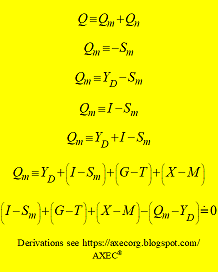
The macroeconomic Profit Law reads Qm≡Yd+(I−Sm)+(G−T)+(X−M) and has been derived from consistent macrofoundations a.k.a. axioms. The Law is testable with the precision of two decimal places. With regard to the government’s budget, the Profit Law boils down to Public Deficit = Private Profit. This piece of pure economic analysis translates into the scientific insight that the MMT sectoral balances equation is false and into the political insight that MMT’s policy of deficit-spending/money-creation is nothing but a free lunch for the Oligarchy. In other words, that “progressive” MMT policy is a political fraud.

Conclusion: Because MMT is provably false and its proponents are either stupid or corrupt or both, MMT has to be expelled from science/academia. Its proper habitat is the political swamp.

More is not to say about MMT, but Clint Ballinger cannot understand or accept this unassailable conclusion. So, he goes off-topic.

(i) “Egmont’s entire tower of babble (his own) is built around his ‘pure consumption economy’. This model is (extremely) simplified …”

In fact, the elementary production-consumption economy is the simplest possible macroeconomic configuration. ALL economic analysis has to start from the absolute analytical minimum and then proceed with ever-increasing complexity. This methodological procedure  is standard for more than 2300 years: “When the premises are certain, true, and primary, and the conclusion formally follows from them, this is demonstration, and produces scientific knowledge of a thing.” (Aristotle)

The elementary production-consumption economy is SUFFICIENT to prove that the MMT sectoral balances equation is false. #1, #2 This means that MMT is scientifically dead already at the most elementary level.

From methodology, everyone could know: “In fact, the history of every science, including that of economics, teaches us that the elementary is the hotbed of the errors that count most.” (Georgescu-Roegen)

Because MMT is axiomatically false, the whole analytical superstructure is false. So, there is NO NEED to refute every MMT argument individually. If the premises are false, the whole theory is dead. Simple.

(ii) “Egmont states (regarding banking) that “These practical details are not forgotten but can be reintroduced at any time”. And yet he of course never does this.”

This is provably false. Money and banking have been treated extensively in working papers and blog posts, e.g., #3, #4 Any kindergartner can google this.

(iii) “Good economics has gone about as far as is possible in that direction, E.g., (Monetary Economics An Integrated Approach to Credit, Money, Income, Production and Wealth. Godley W., Lavoie, M. ) By far the most sophisticated and realistic effort in that direction is the ongoing Minsky Project by Steve Keen.”

Godley/Lavoie and Keen have been treated elsewhere and refuted. #5, #6 Any kindergartner can google this.

(iv) “He is better than the neoclassicals here, but only succeeds in creating a simplistic view of the monetary system that does not begin to approach the accuracy of MMT and circuit theory in this regard. He doesn’t seem to fully understand the role and importance of credit-money in the economy, and also believes there is a ‘fractional reserve system’ (there is not), which further implies a belief in loanable funds (another fallacy).

This is provably false. I “believe” neither in the fractional reserve system nor the loanable funds theory. #7, #8 Any kindergartner can google this.

In this style, it goes on. In the main, Clint Ballinger plays the silly rhetorical game of abstraction vs realism. This does not work. #9, #10 With their description of operational details, which MMT’s chief realist Warren Mosler trumpets as MMT’s chief merit, MMTers never got above the level of an information brochure of the FED’s PR department. Monetary Theory, though, deals with the function and effects of money in the economy as a whole. Monetary theory presupposes macroeconomics. And the fact of the matter is that MMT gets the foundational macroeconomic relations wrong. The lengthy description of the organizational details of Treasury/Central Bank operations cannot make up for the theoretical blunders. MMT blindly repeats the Fallacy of Insufficient Abstraction. #11

When Clint Ballinger’s smokescreen of irrelevant arguments is taken away, the whole issue reduces to the all-decisive question of which of the two macroeconomic relations, a.k.a. sectoral balances equations, is true/false:
(i) (I−S)+(G−T)+(X−M)=0 (MMT)
(ii) (I−S)+(G−T)+(X−M)−(Qm−Yd)=0 (AXEC).


This question can be empirically decided. So, why does the MMT community, which certainly does not lack academics with free access to macroeconomic data and generous support/funding from the ultimate beneficiaries of MMT policy, not carry out this econometric study?

The obvious answer is that the MMT community’s real business is NOT science but quite ordinary political agenda-pushing. THIS is the point at issue, but Clint Ballinger tries to filibuster away the fact that the “End Game Of Modern Monetary Theory” has already been lost.

So, there is nothing left for MMTers in general, and Clint Ballinger, in particular, other than to say goodbye.

Egmont Kakarot-Handtke


#1 Macro for dummies
#2 Wikipedia and the promotion of economists’ idiotism
#3 Essentials of Constructive Heterodoxy: Money, Credit, Interest
#4 Reconstructing the Quantity Theory
#5 The Emergence of Profit and Interest in the Monetary Circuit
#6 Where advanced Heterodoxy — represented by Steve Keen — took the wrong turn
#7 Basics of monetary theory: the two monies
#8 Fixing the loanable funds blunder
#9 Richard Murphy: the MMT fraudster dressed up as realist
#10 Bagehot’s wisdom and the silliness of modern economists
#11 Economics and the Fallacy of Insufficient Abstraction

Immediately preceding Economics: A pointless left-right wrestling show

***

AXEC121f