Showing posts sorted by relevance for query Solow. Sort by date Show all posts

September 25, 2016

Solow and the ludicrousness of economics

Comment on Lars Syll on ‘Solow on post-real Chicago economics’

Blog-Reference

From the fact that DSGE/RBC is a failed research program does not follow that the available alternatives can be taken more seriously.

Solow’s critique of Orthodoxy is spot on: “Since I find that fundamental framework ludicrous, I respond by treating it as ludicrous ― that is, by laughing at it ― so as not to fall into the trap of taking it seriously and passing on to matters of technique.” (See intro)

But Solow, too, has been moving in the wrong direction for the last three decades. He promoted the utterly silly and post-real concept of a production function, which is part and parcel of failed Orthodoxy’s fundamental framework.#1

The ludicrousness of economics begins already with supply-demand-equilibrium and Solow has always been a member of this broad church of scientific retards.

Egmont Kakarot-Handtke


#1 Putting the production function back on its feet

Related 'Sending Solow’s growth model to the dump of proto-scientific history' and 'Robert Solow and Lars Syll, fake scientists' and 'The moral of the story' and 'No future for the representative economist' and 'All economists together now: Solow’s Swan Song' and 'When substandard thinkers dabble in science it is called economics' and 'High profits and low economics' and 'Scrap the EconNobel'. For details of the big picture see cross-references Failed/Fake Scientists.

For more on Solow see AXECquery.

***

ADDENDUM Jun 6, 2020

For detailed proof of Solow's utter scientific incompetence see The State of Macroeconomics, Journal of Economic Perspectives—Volume 22, Number 1—Winter 2008—pp. 243–249

August 10, 2017

Sending Solow’s growth model to the dump of proto-scientific history

Comment on Luis C. Corchón on ‘A Malthus-Swan Model of Economic Growth’

Blog-Reference

Economics fits Feynman’s definition of cargo cult science: “They’re doing everything right. The form is perfect. ... But it doesn’t work. ... So I call these things cargo cult science because they follow all the apparent precepts and forms of scientific investigation, but they’re missing something essential.”

Orthodox economics messed up the theory of production. Georgescu-Roegen was quite clear about “… the completely faulty form by which standard economics represents a production process”. As a consequence, all growth models of the Solow-type since the QJE paper of 1956 are worthless. But the problem goes deeper. ALL microfounded models are worthless.

The whole theoretical superstructure of Orthodoxy is based upon this set of hardcore propositions a.k.a. axioms: “HC1 economic agents have preferences over outcomes; HC2 agents individually optimize subject to constraints; HC3 agent choice is manifest in interrelated markets; HC4 agents have full relevant knowledge; HC5 observable outcomes are coordinated, and must be discussed with reference to equilibrium states.” (Weintraub)

In order to be applicable, HC2, which translates formally into calculus, requires a lot of auxiliary assumptions, most prominently a well-behaved production function. The compelling reason for the introduction of out-of-thin-air auxiliary assumptions is that without these specifications, the axiom HC2 does NOT work, and the whole of Marginalism, which hinges on HC2, falls apart.

It should be pretty obvious that the axiomatic core of Orthodoxy contains THREE NONENTITIES: (i) constrained optimization HC2, (ii) rational expectations HC4, (iii) equilibrium HC5. Every theory/model that contains a NONENTITY is a priori false. This includes all Solow-type models.

Economics has to start — NOT with behavioral assumptions — but with the ‘monetary theory of production’ (Keynes). The elementary production-consumption economy is defined with systemic (= behavior-free) axioms: (A0) The objectively given and most elementary configuration of the economy consists of the household and the business sector, which in turn consists initially of one giant fully integrated firm. (A1) Yw=WL wage income Yw is equal to wage rate W times working hours. L, (A2) O=RL output O is equal to productivity R times working hours L, (A3) C=PX consumption expenditure C is equal to price P times quantity bought/sold X.

These premises are certain, true, and primary, and therefore satisfy all methodological requirements. The set of premises is minimal, that is, it cannot be reduced further, only expanded. The set contains no nonentities like maximization or equilibrium and no normative assertions. Note that all variables are measurable.

For a start, it holds market-clearing X=O and budget-balancing C=Yw.

Monetary profit is defined as Qm≡C−Yw, and monetary saving is defined as Sm≡Yw−C. It always holds Qm≡−Sm, which is the most elementary form of the macroeconomic Profit Law.

Under the conditions of market-clearing and budget-balancing in each period, the price follows as P=W/R, i.e., the market-clearing price is equal to unit wage costs. This is the most elementary form of the macroeconomic Law of Supply and Demand. It translates into W/P=R, i.e., the real wage is equal to the productivity.

The changes in the wage rate from period to period are formally given by Wt=Wt-1(1+wt). Analogous to all other independent variables. The rates of change for future periods are, for a start, taken to be random variables.

With this, the formal framework of the elementary growth model for the elementary production-consumption economy is defined. The systemic formal framework#2, which combines the nominal and real key variables, fully replaces all Solow-type real models.

It does not matter how employment develops, that is, whether the labor force grows or shrinks over time. If the productivity remains constant with growing (shrinking) employment, the real wage does not change. If productivity increases, so does the real wage. Labor always gets its full product. Monetary profit is zero. If the productivity declines, the real wage heads towards the subsistence level. This, though, has nothing to do with exploitation. Needless to say, at the subsistence level, all further expansion comes to a halt. This is the Malthusian outcome. The ultimate driver of real affluence is increasing returns.

This was the first step. In the second step, investment and capital have to be added. #3

Egmont Kakarot-Handtke


#1 The future of economics: why you will probably not be admitted to it, and why this is a good thing
#2 The Economics God Equation (including distribution) is shown under the label Graphic AXEC25

The Economics God Equation ®

For this equation, Computational Irreducibility in the sense of Stephen Wolfram, A New Kind of Science, Wolfram Media, 1959, pp. 737 ff. holds.

#3 Squaring the Investment Cycle

Related 'Saving NEVER equals investment' and 'Is Nick Rowe stupid or corrupt or both?' and 'Macro for dummies' and 'Do first your macroeconomic homework!' and 'Settling the Theory of Saving' and  'Solow and the ludicrousness of economics' and 'Robert Solow and Lars Syll, fake scientists' and 'Solow and the ludicrousness of economics' and 'The moral of the story' and 'No future for the representative economist' and 'All economists together now: Solow’s Swan Song' and 'When substandard thinkers dabble in science it is called economics' and 'When substandard thinkers dabble in science it is called economics' and 'High profits and low economics' For details of the big picture see cross-references Failed/Fake Scientists and cross-references Paradigm Shift and cross-references Refutation of I=S.

August 31, 2017

Robert Solow and Lars Syll, fake scientists

Comment on Lars Syll on ‘Damon Runyon’s Law’

Blog-Reference and Blog-Reference

It is always surrealistic when an incompetent heterodox economist cites an incompetent orthodox economists approvingly. Fact is that Walrasianism, Keynesianism, Marxianism, Austrianism are mutually contradictory and provably false, i.e. materially and formally inconsistent. And both, the orthodox economist Solow#1 and the heterodox economist Syll#2 play an active role in this overall scientific bankruptcy.

Failure is not the only commonality between Orthodoxy and Heterodoxy, both subscribe also to the same excuses. Here is Solow’s comprehensive list: “Economics is a strange sort of discipline. The booby traps I mentioned often make it sound as it is all just a matter of opinion. That is not so. Economics is not a Science with a capital S. It lacks the experimental method as a way of testing hypotheses. . . . There are always differences of opinion at the cutting edge of a science, . . . . But they last longer in economics . . . and there are reasons for that. As already mentioned, rival theories cannot be put to an experimental test. All there is to observe is history, and history does not conduct experiments: too many things are always happening at once. The inferences that can be made from history are always uncertain, always disputable, . . . You can’t even count on a long and undisturbed run of history, because the ‘laws’ of behavior change and evolve.”#3

All this reveals only a complete misunderstanding of what science and economics are all about. This double incompetence manifests itself in two statements: “Unfortunately, however, economics is a social science.” and “… I suspect that the attempt to construct economics as an axiomatically based hard science is doomed to fail.”

Science consists of two essential elements: “Research is, in fact, a continuous discussion of the consistency of theories: formal consistency insofar as the discussion relates to the logical cohesion of what is asserted in joint theories; material consistency insofar as the agreement of observations with theories is concerned.” (Klant) Logical consistency is secured by applying the axiomatic-deductive method and empirical consistency is secured by applying state-of-the-art testing.#4

What both Orthodoxy and Heterodoxy fail to understand is that economics is neither a social science nor a natural science but a systems science. The evident scientific incompetence of the representative economist consists of not having figured out until this very day what profit ― the pivotal concept of his subject matter ― is.

The methodological blunder of economists consists of applying either Walrasian microfoundations or Keynesian macrofoundations. Because both these axiomatic foundations are provably false economics has to move on to the correct macrofoundations. This move is called a Paradigm Shift.#5

The current state of economics is that of a fake science or what Feynman famously called cargo cult science. This intolerable state is due to the scientific incompetence of economists and NOT to the alleged fact that there are not testable economics laws. These laws, though, refer to the economy as a system and NOT to human behavior.

In order to get out of the cul-de-sac, economics has to be redefined: Economics is the science that studies how the monetary economy works. The study of Human Nature/motives/behavior/action is the subject matter of psychology, sociology, history, biology, political science, anthropology, social philosophy, and NOT the economist’s business.

It should be plain that Walrasians, Keynesians, Marxians, and Austrians in general and Robert Solow and Lars Syll, in particular, will never make it into the history of scientific thought except perhaps as a cautionary example for the unsurpassable idiocy of fake scientists.

Egmont Kakarot-Handtke


#1
► Sending Solow’s growth model to the dump of proto-scientific history
► Pants kicking is over, let’s do serious economics now
Solow and the ludicrousness of economics
When substandard thinkers dabble in science it is called economics
#2 Say hello to Lars Syll, Keynes’ last parrot
#3 Failed economics: The losers’ long list of lame excuses
#4 Quantum Theory Rebuilt From Simple Physical Principles
#5 First Lecture in New Economic Thinking


October 14, 2019

Scrap the EconNobel

Comment on Alex Tabarrok on ‘The Nobel Prize in Economic Science Goes to Banerjee, Duflo, and Kremer’

Blog-Reference

Economists are NOT scientists but clowns and useful idiots in the political Circus Maximus. The EconNobel is a fraud. For details, see here.

Egmont Kakarot-Handtke

***

Comment on Peter Dorman on ‘A Nobel for the Randomistas’

Blog-Reference and Blog-Reference and Blog-Reference

Peter Dorman comments: “I don’t think anyone was surprised by this year’s ‘Nobel’ prize in economics, which went to three American-based specialists in the design of on-the-ground experiments in low income countries, Abhijit Banerjee, Esther Duflo and Michael Kremer.”

Indeed, the EconNobel has been criticized on various grounds: (i) male predominance, (ii) theory-predominance, (iii) rich-western-capitalism-focused, (iv) geriatric-predominance, (v) white-predominance, (vi) University of Chicago bias. All these biases have been addressed and solved to everybody’s satisfaction with the team of young/bi-gender/ poverty-concerned/empirical/multicultural Cambridge-MA prize winners.

One problem, though, has been carefully avoided, i.e., that economics is NOT a science to this day. The major approaches — Walrasianism, Keynesianism, Marxianism, Austrianism, MMT — are mutually contradictory, axiomatically false, materially/formally inconsistent, and all got the foundational economic concept of profit wrong. Economics is a failed science.

Economics has NEVER been a science but a smokescreen for political agenda-pushing. Both orthodox and heterodox economists are NOT scientists but clowns and useful idiots in the political Circus Maximus. The “Bank of Sweden Prize in Economic Sciences” has been a fraud for 50 years. #1

Peter Dorman wonders, “Carefully controlled social experiments can be very expensive! When I read the work of the prize-winners and their coauthors, I often find myself wondering how much did it cost to do this research, and who paid for it? This is a form of Big Science, and it requires big support.”

This is an easy question. Economics departments, chairs, institutions, and pre-selected individuals are traditionally funded by the Oligarchy. Rockefeller called the university ‘the best investment’ he ever made. In our days, though, the quality of sponsors/funders/ agenda-pushers has considerably deteriorated. The active players are not at all secret; the New York Times shows a meeting photo of well-known billionaire Jeffrey Epstein and well-known Harvard economist and political busybody Larry Summers. #2

From all this, one can conclude with a high degree of probability that the EconNobel is a well-calculated, Oligarchy-sponsored, aristocracy-decorated PR stunt that has much to do with the deception of the general public and NOTHING at all with science.


#1 For details, see Links on the Economics Nobel
#2 New York Times

***
REPLY to Barkley Rosser on Oct 17

You say: “To a large degree the Nobel for Chinese growth was given a long time ago to Robert Solow. A nation that invests more grows more. That is pretty much it, …” and “Look, Nobel prizes, including even the ‘fake’ economics one given out by the Sveriges Riksbank for the last half century, focus on people who generate new ideas, not policymakers who may have achieved successful outcomes. You suggest that ‘a poverty-oriented Chinese economist’ deserves the prize, but somehow you do not provide a name. And I would suggest you will not be able to because no Chinese economist has generated any important new ideas on this.”

Solow criticized the DSGE-Orthodoxy: “Since I find that fundamental framework ludicrous, I respond by treating it as ludicrous ― that is, by laughing at it ― so as not to fall into the trap of taking it seriously and passing on to matters of technique.” #1

The same holds, though, for Solow’s own growth model. #2

Nevertheless, the EconNobel “was given a long time ago to Robert Solow”.

It is obvious why the EconNobel will not be given to a Chinese economist. The EconNobel is a Hollywood production for the Western audience initiated and sponsored by the US Oligarchy to reward US economists for their propaganda services to “scientifically” prove the superiority of the US version of self-optimizing supply-demand-equilibrium.

The EconNobel had NO scientific significance 50 years ago and has none this year. And this is NOT because “no Chinese economist has generated any important new ideas” but because no US economist has generated any important new ideas. Walrasianism, Keynesianism, Marxianism, Austrianism, and MMT are ludicrous proto-scientific garbage to this day.


#1 Solow and the ludicrousness of economics
#2 Sending Solow’s growth model to the dump of proto-scientific history

***

REPLY to Barkley Rosser on Oct 18 and Blog-Reference

You say: “Look, Nobel prizes, including even the ‘fake’ economics one given out by the Sveriges Riksbank for the last half century, focus on people who generate new ideas, not policymakers who may have achieved successful outcomes.”

This, of course, is absolutely correct. But then, is your discussion about whether China or the Massachusetts team has been more successful in alleviating poverty not a bit beside the point?

What you are constantly doing is confounding science and politics. This is a hereditary mental and moral disease among economists since Adam Smith. However, the founding fathers were at least honest people and called themselves Political Economists. The denomination “political” was later scrapped by Jevons. This was roughly at the same time when the War Ministries were renamed Defense Ministries.

What the general public does not understand is that there are political economics and theoretical economics. The main differences are: (i) The goal of political economics is to successfully push an agenda, and the goal of theoretical economics is to successfully explain how the actual economy works. (ii) In political economics, anything goes; in theoretical economics, the scientific standards of material and formal consistency are observed.

The fraud of economists consists of telling the public that they are doing science while, in fact, they are doing agenda-pushing. The fraud is in the title “Bank of Sweden Prize in Economic Sciences in Memory of Alfred Nobel”. There would be no problem at all if the title were “Bank of Sweden Prize in Economic Propaganda on Behalf of the US Oligarchy”.

With regard to ‘Economic Sciences’, economists are still behind the curve:
• Science manifests itself in the form of the true theory.
• Truth is well-defined by material and formal consistency.
• Logical consistency is secured by applying the axiomatic-deductive method, and material consistency is secured by applying state-of-the-art testing.
• The true theory/model is the humanly best mental representation of reality.
• The major approaches ― Walrasianism, Keynesianism, Marxianism, Austrianism, MMT ― are axiomatically false, materially/formally inconsistent, and mutually contradictory.
• Orthodox and heterodox economics are failed/fake/cargo-cult science, i.e,. political agenda-pushing without valid scientific foundations.

The “alleviation of global poverty” by the Massachusetts team is politically fictitious and scientifically worthless.

The political reality is that MMT academics claim on the basis of an algebraically false sectoral balances equation that public deficits are beneficial for WeThePeople and that they increase “private wealth” while the analytically correct balances equation says that Public Deficit = Private Profit, which is obviously beneficial only for the Oligarchy.

So, while academic economists pretend with this year’s EconNobel to care about the alleviation of poverty, they politically accept/promote the explosion of the Oligarchy’s financial wealth by exploding the public debt.

Clearly, economists have to be expelled from the scientific community.

***
REPLY to Ken Zimmerman on Oct 24

You say: “Anthropologists and government policy designers went down this road, fruitlessly 50 years ago. The culture of poverty is a notion in social theory asserting that the values of people experiencing poverty play a significant role in perpetuating their impoverished condition, sustaining a cycle of poverty across generations.” and “If economists were educated beyond economic theories and mathematics and had at least a modicum of curiosity about events around them, they’d know that the work for which these folks [Abhijit Banerjee, Esther Duflo, Michael Kremer] were awarded a Noble Prize is not either innovative or new.”

Yes, indeed, the culture of poverty is the subject matter of Anthropology/Sociology/ Psychology and other so-called social sciences. No, Psychology, Sociology, etcetera ― PsySoc for short ― is NOT the subject matter of economics. The subject matter of economics is how the economic system works. Economics is a systems science and NOT a social science. #1, #2

The fact is that economics is a failed science. The major approaches ― Walrasianism, Keynesianism, Marxianism, Austrianism, MMT ― are mutually contradictory, axiomatically false, materially/formally inconsistent, and ALL got the foundational economic concept ― profit ― wrong. Economists have NO valid theory about how the actual economy works, but this does not prevent them from taking part in the political Circus Maximus and giving economic policy advice. #3

There have always been two economixes, political economics, and theoretical economics. The main differences are: (i) The goal of political economics is to successfully push an agenda, and the goal of theoretical economics is to successfully explain how the actual economy works (= true theory). (ii) In political economics, anything goes; in theoretical economics, scientific standards are observed.

The fact is that (i) theoretical economics (= science) had been hijacked from the very beginning by political economists (= agenda pushers), and (ii), political economics has produced NOTHING of scientific value in the last 200+ years. #4

Because economics is NOT a science but an oligarchy-sponsored political agenda-pushing, the “Bank of Sweden Prize in Economic Sciences in Memory of Alfred Nobel” is a deception of the general public since the first EconNobel 50 years ago. #5

It is time to sue the Bank of Sweden for damages and waste of the Swedish people’s money.


#1 Economics is NOT about Human Nature but the economic system
#2 PsySoc — the scourge of economics
#3 Econogenics in action
#4 Economists: scientists or political clowns?
#5 Links on the Economics Nobel

***

REPLY to Ken Zimmerman on Oct 28

You say, “Egmont, thanks for your comments. You’re correct that economists today spend little time or effort studying poverty. But anthropologists and sociologists do.”

In fact, I said that economists spend TOO MUCH time with PsySoc. The subject matter of economics is NOT Human Nature/motives/behavior/action, but how the economic system works.

Economists are known to have dabbled in virtually every discipline: Psychology, Sociology, Political Sciences, Geopolitics, Law, History, Anthropology, Social Philosophy, Philosophy, Theology, Pedagogy, Biology/Evolution, and whatnot. This somewhat perverse habit has been called Economics Imperialism. The perversity consists of the fact that economists have utterly failed in their own discipline. Walrasianism, Keynesianism, Marxianism, Austrianism, and MMT are mutually contradictory, axiomatically false, and materially/formally inconsistent.

In 200+ years, economics has not risen above the proto-scientific level. For details, see Economists: Jacks-of-all-trades ― except economics.

***

Graphic AXEC136g

August 17, 2015

The moral of the story (II)

Comment Lars Syll on ‘Robert Solow kicking Lucas and Sargent in the pants’

Blog-Reference

Lucas et al. diagnosed the ruling paradigm of the 1970s with a crushing curse “wildly incorrect, fundamentally flawed, wreckage, failure, fatal, of no value, dire implications, failure on a grand scale, spectacular recent failure, no hope.”

This is roughly what Keynes said about the ruling paradigm of the 1930s.

Both diagnoses were spot on. Now Solow tells us roughly the same about the New Classical paradigm. He, too, is spot on.

Let us synthesize the recurring small lightbulb moments over the last 200 years to one gigantic light bulb moment. All theories/models that contain at least one of the following concepts fall under the Lucas curse: utility, expected utility, rationality/bounded rationality, equilibrium, constrained optimization, well-behaved production functions/ fixation on decreasing returns, supply/demand functions, simultaneous adaptation, rational expectation, total income=value of output/I=S, and ergodicity. All these items are NONENTITIES like the perpetual motion machine, unicorns, or dancing-angels-on-a-pinpoint.

The first thing to notice is that Solow himself employed NONENTITIES. Therefore, his growth theory falls also under the Lucas curse. Let us make it short: economics is a failed science, there is nothing to choose. This is the situation: the critique of the at any one time ruling paradigm has always been spot on, but the proposed alternative has not been much better or even worse. This explains the secular stagnation of economics.

“The moral of the story is simply this: it takes a new theory, and not just the destructive exposure of assumptions or the collection of new facts, to beat an old theory.” (Blaug, 1998, p. 703)

The new economic paradigm must not contain any of the cursed NONENTITIES enumerated above (2014). That much is clear: in the history of economic thought pants kicking has never led to real progress. Solow is a case in point.

Egmont Kakarot-Handtke


References
Blaug, M. (1998). Economic Theory in Retrospect. Cambridge: Cambridge University Press, 5th edition.
Kakarot-Handtke, E. (2014). Economics for Economists. SSRN Working Paper Series, 2517242: 1–29. URL

Related 'Secular intellectual stagnation' and 'Robert Solow and Lars Syll, fake scientists'. For details of the big picture see cross-references Incompetence and cross-references Proto-Science.

August 13, 2015

No future for the representative economist

Comment on Robert Solow on ‘The Future of Work: Why Wages Aren't Keeping Up’

Blog-Reference

Orthodox economists know it, heterodox economists know it, and Solow knows it: economics is a failed science. The market economy does not work as economic theory says. This holds — with damaging consequences — in particular for the labor market.

The core of labor market theory, purified from the myriad of idiosyncratic variants, goes as follows. “We economists have all learned, and many of us teach, that the remedy for excess supply in any market is a reduction in price. If this is prevented by combinations in restraint of trade or by government regulations, then those impediments to competition should be removed. Applied to economy-wide unemployment, this doctrine places the blame on trade unions and governments, not on any failure of competitive markets.” (Tobin, 1997, p. 11)

Until this day, the representative economist has not realized that the overall systemic interdependencies establish a positive feedback loop between ‘the’ product and ‘the’ labor market, that is, wage rate down—employment down—wage rate down—and so on. Vice versa with an increasing average wage rate.

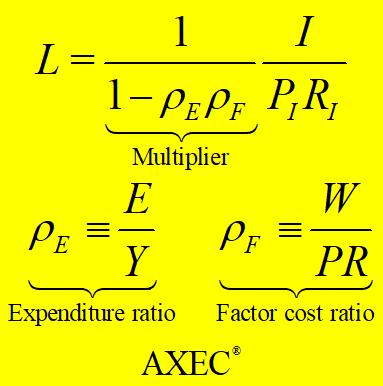
Solow’s piece contains at least three errors/mistakes. They relate to employment, distribution, and profit theory. Let us go straight to the heart of the matter. The most elementary version of the axiomatically correct Employment Law reads (Graphic AXEC62)


From this equation follows inter alia:
(i) An increase in the expenditure ratio ρE leads to higher employment. An expenditure ratio ρE>1 indicates credit expansion, a ratio ρE<1 indicates credit contraction/debt repayment.
(ii) Increasing investment expenditures I exert a positive influence on employment; a slowdown of growth does the opposite.
(iii) An increase in the factor cost ratio ρF≡W/PR leads to higher employment. This implies that a higher average wage rate W leads to higher employment. This is, of course, contrary to conventional economic wisdom. It is, though, easy to prove that conventional wisdom is a mere Fallacy of Composition (2015). The factor cost ratio is formally inverse to the profit ratio.
(iv) The complete Employment Law is a bit longer and contains, in addition, profit distribution, public deficit spending, and the trade balance with the rest of the world. As a matter of principle, the structural Employment Law contains only measurable variables and is testable. Hence, matters can be settled once and for all.

Points (i) and (ii) are old Keynesian stuff. Let us focus here alone on the factor cost ratio ρF as defined in (iii). This variable embodies the price mechanism, which, however, does not work as the representative economist hallucinates. As a matter of fact, overall employment increases if the average wage rate W increases relative to the average price P and the average productivity R.

The correct employment theory states that the average wage rate must rise in order to prevent unemployment and deflation. For the relationship between real wage, productivity, profit, and real shares, see (2015, Sec. 10)

The ultimate cause of unemployment is the scientific incompetence of the representative economist.

Egmont Kakarot-Handtke


References
Kakarot-Handtke, E. (2015). Major Defects of the Market Economy. SSRN Working Paper Series, 2624350: 1–40. URL
Tobin, J. (1997). An Overview of the General Theory. In G. C. Harcourt and P. A. Riach (Eds.), The ’Second Edition’ of The General Theory, Vol. 2, 3–27. Oxon: Routledge.

Thread-summary
The representative economist cannot tell the difference between income and profit. Solow is part of the crowd. His piece is defective with regard to profit, distribution, and employment theory. As Joan Robinson put it: "Scrap the lot and start again."

***

Graphic AXEC144c

July 4, 2015

All economists together now: Solow’s Swan Song

Comment on Bruce Edmond on ‘Economic Value is NOT Price’

Blog-Reference

The wonderful thing about economists of all shades is that the only fact they can convincingly explain is why they know nothing.

“Economics is a strange sort of discipline. The booby traps I mentioned often make it sound as it is all just a matter of opinion. That is not so. Economics is not a Science with a capital S. It lacks the experimental method as a way of testing hypotheses. . . . There are always differences of opinion at the cutting edge of a science, . . . . But they last longer in economics . . . and there are reasons for that. As already mentioned, rival theories cannot be put to an experimental test. All there is to observe is history, and history does not conduct experiments: too many things are always happening at once. The inferences that can be made from history are always uncertain, always disputable, . . . You can’t even count on a long and undisturbed run of history, because the “laws” of behavior change and evolve. Excuses, excuses. But the point is not to provide excuses.” (Solow, 1998, pp. x-xi)

Those who hallucinate being at the cutting edge of science, please take notice: “... suppose they [the economists] did reject all theories that were empirically falsified ... Nothing would be left standing; there would be no economics.” (Hands, 2001, p. 404)

By the way, the exchange value in the pure production/consumption economy is fully determined by the objective factors market clearing, budget balancing, and zero profit (2011). Utility drops completely out of the equation. All subjective approaches since Jevons have predictably ended in folk-psychological blather.

Pace Solow: there is no such thing as ‘laws of behavior.’ Orthodoxy started on the wrong foot. “But the point is not to provide excuses.” Yes, and today is the perfect day to start with it.

Egmont Kakarot-Handtke


References
Hands, D.W. (2001). Reflection without Rules. Economic Methodology and Contemporary
Science Theory. Cambridge, New York, NY, etc: Cambridge University Press.
Kakarot-Handtke, E. (2011). The Pure Logic of Value, Profit, Interest. SSRN Working Paper Series, 1838203: 1–27. URL
Solow, R. M. (1998). Foreword, volume William Breit and Roger L. Ranson: The Academic Scribblers. Princeton, NJ: Princeton University Press, 3rd edition.

January 23, 2024

Occasional Xs: Clueless economists / Phillips Curve (IX)


April 22, 2016

High profits and low economics

Comment on Robert Solow on ‘Why Wages Aren’t Keeping Up’

Blog-Reference

Distribution theory suffers from the known fact that, after more than 200 years, economists still cannot tell the difference between income, profit, distributed profit, and retained profit. As the Palgrave Dictionary summarizes: “A satisfactory theory of profits is still elusive.” (Desai, 2008)

Therefore, the defenders and attackers of the market economy have one property in common: they have no idea of what they are talking about. Distribution theory has come down to superficial observation, psychologism, sociologism, moralizing, and political blather.

Political economics is beside the point because overall monetary profit is determined by OBJECTIVE structural factors. The total profit of an investment economy is given by the formula shown on Graphic AXEC42
The profit ratio Qm/Y increases with the expenditure ratio of the household sector, the investment ratio of the business sector, and the distributed profit ratio. An expenditure ratio greater than 1 means that the debt of the household sector grows. Household sector and government sector deficits are the main driving forces of the business sector’s overall profit. Productivity plays NO role.

The crucial point is that bargaining power plays NO role at all for overall profit; it plays only a role in the distribution of total profit AMONG firms and the distribution of total output AMONG households. Roughly speaking, this means that the familiar concepts of exploitation and class are superficial and misleading, see Profit for Marxists.

The relationship between wage and profit, too, is not well understood. A fall in the average wage rate has a deflationary effect but does NOT affect the profit ratio (if the expenditure, the investment, and the distributed profit ratio in the formula above are kept constant for the moment).

The pivotal point is that familiar distribution theories are false. For details, see The Profit Theory is False Since Adam Smith. What About the True Distribution Theory?.

Conclusion: Solow’s post combines superficial observations with a provably false distribution theory.

Egmont Kakarot-Handtke


For details of the big picture, see cross-references Profit/Distribution


***
COMMENT on don on Apr 22

Imagine for a moment that the economy consists of two firms that produce the same good and are initially identical. The wage income of both firms is fully spent on the consumption good, so the overall profit in this simplified economy is initially zero, and the market-clearing price is P=W/R, i.e., equal to unit wage costs.

Now the wage rate in firm A is halved, and that in firm B remains unaltered because of a strong union. Profit in firm A increases. Because total wage income falls, total consumption expenditures fall, and the market-clearing price falls. This leaves firm B with a loss. The profit of firm A is equal to the loss of firm B, and the TOTAL profit in the economy is still ZERO.

So what, in effect, happens is a REDISTRIBUTION of profit among firms. The union power in firm B has NO effect on the OVERALL profit of the business sector; it has only an effect upon the REDISTRIBUTION of total output among the households, i.e., the real wage of firm B employees rises and falls for firm A employees.

If firms A and B belong to different countries, the same argument applies to the world economy.

Your mistake is to look at one sector, and then to generalize what can be observed there, e.g., wage down/profit up, for the whole economy. This is the Fallacy of Composition. The total analysis shows: wage A down/profit A up/total profit UNCHANGED/price down/deflation. And this is roughly what you can observe if you take the world economy as a whole.

The elementary mistake of distribution theory is to generalize the effects of partial analysis. And this is why you cannot explain the OVERALL relation of profit and wage income, and why the measured profit share has risen in the US.

The problem, though, is not that you and anne don’t get the point; the problem is that Solow reiterates a distribution theory that has been false since Ricardo.

May 27, 2016

When substandard thinkers dabble in science it is called economics

Comment on Lars Syll on ‘Solow and Damon Runyon’s Law’

Blog-Reference

Tell an economist that economics is a failed science and he will come up with a barrage of excuses: “Economics is a strange sort of discipline. The booby traps I mentioned often make it sound as it is all just a matter of opinion. That is not so. Economics is not a Science with a capital S. It lacks the experimental method as a way of testing hypotheses. . . . There are always differences of opinion at the cutting edge of a science, . . . . But they last longer in economics . . . and there are reasons for that. As already mentioned, rival theories cannot be put to an experimental test. All there is to observe is history, and history does not conduct experiments: too many things are always happening at once. The inferences that can be made from history are always uncertain, always disputable, . . . You can’t even count on a long and undisturbed run of history, because the ‘laws’ of behavior change and evolve. Excuses, excuses. But the point is not to provide excuses.” (Solow, 1998, pp. x-xi)

So, there are no behavioral laws in economics? No, but there is a law that there is no law: “Unfortunately, however, economics is a social science. It is subject to Damon Runyon’s Law that nothing between human beings is more than three to one. To express the point more formally, much of what we observe cannot be treated as the realization of a stationary stochastic process without straining credulity.” (See intro)

This raises two questions: (i) Why are obviously false propositions like “agents individually optimize subject to constraints; agents have full relevant knowledge; observable outcomes ... must be discussed with reference to equilibrium states” given the status of axioms? (Weintraub, 1985, p. 147). And (ii), why do members of a “strange sort of discipline” insist on the term “Economic Sciences” in the title “Bank of Sweden Prize in Economic Sciences in Memory of Alfred Nobel”?

The ontological error of economics lies in this sentence: “Unfortunately, however, economics is a social science.” Not at all, economics is a systems science. Yet, most economists have not realized that economics is NOT a science of human nature/behavior/ action — not of individual behavior, not of social behavior, not of rational behavior, not of irrational behavior, not of sincerity, not of corruption. All these issues belong entirely to the realms of Psychology, Sociology, Anthropology, Political Science, History, Criminology, Philosophy, etcetera.

So let us replace Damon Runyon’s Law by the Ontological Impossibility Law: NO way leads from the explanation of individual/social human behavior to the explanation of how the monetary economy works. In other words, the microfoundations approach has already been dead in the cradle.

There is no such thing as a behavioral/social/historical law but there are systemic laws (2014). Economists are digging since Jevons/Walras/Menger in the wrong place. Neither Orthodoxy nor Heterodoxy has figured out until this day what profit is, that is, economists have no idea of the pivotal phenomenon of their subject matter since Adam Smith. Unfortunately, they have been too much occupied with making fools of themselves with folk psychology, folk sociology, and folk politics.

Egmont Kakarot-Handtke


References
Kakarot-Handtke, E. (2014). The Synthesis of Economic Law, Evolution, and History. SSRN Working Paper Series, 2500696: 1–22. URL
Solow, R. M. (1998). Foreword, volume William Breit and Roger L. Ranson: The Academic Scribblers. Princeton: Princeton University Press, 3rd edition.
Weintraub, E. R. (1985). Joan Robinson’s Critique of Equilibrium: An Appraisal. American Economic Review, Papers and Proceedings, 75(2): 146–149. URL

Related 'The consistent ancients and the confused moderns' and 'The stupidity of Heterodoxy is the life insurance of Orthodoxy'. For details of the big picture see cross-references Methodology.

***
COMMENT on The Arthurian on May 29

You say: “Because you cannot understand the present if you misunderstand the past.”

This assertion holds perhaps for politics but certainly not for science: “The next scheme, the new discovery, is going to be made in a completely different way. So history does not help much.” (Feynman)

Could it be that you have not yet grasped the difference between storytelling and theory? The history of falling apples is one thing and the Law of Falling Bodies is quite another thing.

Science is about general and invariant features of reality (= deep structure), history/ evolution is about unique event configurations on the surface that never repeat themselves. This is known since Heraclitus and “That is why Descartes said that history was not a science — because there were no general laws which could be applied to history.” (Berlin)

Economics is about the underlying structural laws of the economic system. If you do not understand these (e.g. the Profit Law) you neither understand the past nor the present.

February 26, 2017

NAIRU and the scientific incompetence of Orthodoxy and Heterodoxy

Comment on Simon Wren-Lewis on ‘The NAIRU: a response to critics’ and Lars Syll on ‘Simon Wren-Lewis — flimflam defender of economic orthodoxy’

Blog-Reference and Blog-Reference and Blog-Reference and Blog-Reference on Mar 4

The NAIRU-Phillips Curve is an explicit formal description of the functioning of the macroeconomic labor market. Formal description means that one has a number of variables and their relationships, which summarize the current knowledge of how the economy or some part of it works. Scientific knowledge is embodied in the true theory.

Right policy depends on true theory: “In order to tell the politicians and practitioners something about causes and best means, the economist needs the true theory or else he has not much more to offer than educated common sense or his personal opinion.” (Stigum)

The two questions that arise with any description are: (i) is it conceptually/logically consistent, and (ii) is it materially consistent? The second question involves the measurability of variables, the practical problem of measurement, data gathering, and statistical methodology. From a description that is either formally inconsistent or materially inconsistent, ANY economic policy conclusions can be drawn. Put the other way round, policy proposals that are not based on a materially/formally consistent theory are at the same level as sitcom blather, storytelling, or soapbox agenda pushing.

Economic policy guidance that is not based on the true theory is pretty much the same as reading ancient Roman poultry entrails.

The NAIRU-Phillips Curve is scientifically worthless because it is conceptually inconsistent. #1 So, any discussion about measurement problems or the economic policy implications of a NAIRU is pointless. Needless to emphasize that most of the discussion circles around these distracting side issues.

The NAIRU-Phillips Curve is an integral part of standard economics: “The concept of the NAIRU, or equivalently the Phillips Curve, is very basic to macroeconomics. It is hard to teach about inflation, unemployment, and demand management without it.” #2

Standard economics is built upon this set of foundational propositions, a.k.a. axioms: “HC1 economic agents have preferences over outcomes; HC2 agents individually optimize subject to constraints; HC3 agent choice is manifest in interrelated markets; HC4 agents have full relevant knowledge; HC5 observable outcomes are coordinated, and must be discussed with reference to equilibrium states.” (Weintraub)

It should be pretty obvious that the standard axiom set contains THREE NONENTITIES: (i) constrained optimization HC2, (ii) rational expectations HC4, and (iii) equilibrium HC5.

Methodologically, the neo-Walrasian axioms are forever unacceptable, but scientifically incompetent economists from Jevons/Walras/Menger onward accepted them as defining the ‘language of economics’: “Accepting the concept of the NAIRU does not mean you have to agree with their judgments. But if you want to argue that they could be doing something better, you need to use the language of macroeconomics.” #2

Not at all! The neo-Walrasian language of macroeconomics is composed of NONENTITIES, and this leads quite naturally to measurement problems, material inconsistency, and vacuous political blather. So Heterodoxy is right in saying that “the NAIRU has to be bashed, smashed, and trashed”.

The problem of traditional Heterodoxy is that it has nothing better to offer. #3 The standard microfoundations HC1/HC5 are false, but Keynesian macrofoundations are also false. So, both orthodox and traditional heterodox labor market theories are proto-scientific rubbish. #4 As an inevitable consequence, the whole discussion about NAIRU has degenerated to the squabble of political sects. Wren-Lewis tries in vain to deny this plain fact: “Economics is certainly not a religion, where all you have to do is choose which sect you belong to and then follow great works.“

What has to be done to get out of the confused sectarian squabble is to fix the labor market theory by putting it on consistent macrofoundations.

Two factors determine macroeconomic employment: overall demand and the price mechanism, or more specifically, the actual configuration of average wage rate, price, and productivity. As a consequence, economic policy is about private/public demand management AND wage/price management.

The correct theory of the macroeconomic price mechanism tells us that ― for purely SYSTEMIC reasons ― the average wage rate has in the current situation to rise faster than the average price. THIS opens the way out of mass unemployment, deflation, and stagnation and NOT the blather of scientifically incompetent orthodox and heterodox agenda pushers. #4

Egmont Kakarot-Handtke


#1 NAIRU, wage-led growth, and Samuelson’s Dyscalculia
#2 See SWL ‘The NAIRU: a response to critics
#3 See LPS ‘Simon Wren-Lewis — flimflam defender of economic orthodoxy
#4 Mass unemployment: The joint failure of orthodox and heterodox economics

Related 'Why is economics a total scientific failure?'. For details of the big picture, see cross-references Employment/Phillips Curve.

Graphic AXEC170
Legend: employment L, Wage rate W, price P, productivity R, expenditures E, income Y 


Variants Graphic AXEC48AXEC36AXEC35, AXEC07

***


The fatal mistake of the discussion is to accept the NAIRU-Phillips Curve (with the well-known disclaimers) and to focus on the economic policy implications with regard to the given situation in the US/UK/etc. But there is NO use in discussing policy if the underlying theory is defective.

The fact of the matter is that the Phillips Curve is misspecified since Samuelson/Solow.#1 Because there is NO such thing as a NAIRU-Phillips Curve, all political discussion is vacuous.


***

REPLY to Tom Hickey on Feb 28

You say: “The relationship between employment and inflation appears to be contingent and based on a number of factors, including institutional factors, that result in dynamic conditions involving uncertainty.”

This is an entirely vacuous econ-waffle. Imagine, as a contrast, a physics teacher tells his students about gravitation: “The relationship between velocity and mass appears to be contingent and based on a number of factors, including history-specific factors, that result in dynamic conditions involving uncertainty.”

It is pretty obvious that economists have NOTHING of substance to say. Why do they not simply shut up?

The elementary dependency between employment and inflation, and a number of other factors, is given with this objective systemic equation that is composed of MEASURABLE variables.

This equation is the economic equivalent of Galileo’s Law of Fall and thus the ultimate econ-waffle stopper.

***

REPLY to Auburn Parks on Feb 28

You say: “There is a simple reason why physics like precision and predictability is inapplicable to economics, and it's because of the reasons Tom provided.”

The simple reason is scientific incompetence. For details, see Failed economics: The losers’ long list of lame excuses.

***

REPLY to Ralph Musgrave on Feb 28

You say: “You make the naïve mistake many people make of thinking the because something cannot be measured accurately that therefore it does not have a precise value.”

You make the same mistake as all illiterate persons, that is, you cannot read. What I have clearly stated is: “NAIRU is dead, not because of measurement problems, but because the underlying employment theory is false.” #1 The measurement problem is a side issue. #2


#1 NAIRU: an exhaustive dancing-angels-on-a-pinpoint blather
#2 NAIRU and the scientific incompetence of Orthodoxy and Heterodoxy

***
REPLY to Auburn Parks on Feb 28

The moronic part of economists, i.e., the vast majority, maintains that economics is a social science. Time to wake up to the fact that economics is a systems science. #1

Economics is NOT a science of individual/social/political behavior — this is the social science delusion — but of the behavior of the monetary economy. All Human-Nature issues are the subject matter of other disciplines (psychology, sociology, anthropology, biology/ Darwinism, political science, social philosophy, history, etcetera) and are taken in from these by way of multi-disciplinary cooperation. #2

The economic system is subject to precise and measurable systemic laws. #3


#1 Lawson’s fundamental methodological error and the failure of Heterodoxy
#2 Economics and the social science delusion
#3 The three fundamental economic laws

***

REPLY to Noah Way on Mar 1

You say: “’Economic science’ is an oxymoron.”

It is, first of all, of utmost importance to distinguish between political and theoretical economics. The main differences are: (i) The goal of political economics is to successfully push an agenda; the goal of theoretical economics is to successfully explain how the actual economy works. (ii) In political economics, anything goes; in theoretical economics, the scientific standards of material and formal consistency are observed.

Political economics has produced NOTHING of scientific value in the last 200+ years. The four major approaches — Walrasianism, Keynesianism, Marxianism, Austrianism — are mutually contradictory, axiomatically false, and materially/formally inconsistent.

A closer look at the history of economic thought shows that theoretical economics (= science) had been hijacked from the very beginning by the agenda pushers of political economics. These folks never rose above the level of vacuous econ-waffle. The whole discussion from Samuelson/Solow’s unemployment-inflation trade-off to Friedman/Phelps’s natural rate to the rational expectation NAIRU is a case in point.

The NAIRU-Phillips Curve has zero scientific content. It is a plaything of retarded political economists. Samuelson, Solow, Friedman, Phelps, and the rest of the participants in the NAIRU discussion up to Wren-Lewis are fake scientists. #1


#1 Modern macro moronism

***

REPLY to Ralph Musgrave on Mar 1

It would be fine if you could first learn to read, and to think, and to do your economics homework.

The point at issue is the labor market theory, and the remarkable fact of the matter is that economists have, after 200+ years NO valid labor market theory. The proof is in the NAIRU-Phillips Curve. So what these failures are in effect doing is giving policy advice without sound theoretical foundations. Scientists don’t do this.

What is known since the founding fathers about the separation of politics and science is this “A scientific observer or reasoner, merely as such, is not an adviser for practice. His part is only to show that certain consequences follow from certain causes, and that to obtain certain ends, certain means are the most effectual. Whether the ends themselves are such as ought to be pursued, and if so, in what cases and to how great a length, it is no part of his business as a cultivator of science to decide, and science alone will never qualify him for the decision.” (J. S. Mill)

The first point is that economists violate the separation of politics and science on a daily basis. #1 The second point is that their unwarranted advice is utter rubbish because they have NO idea how the economy works. The problem society has with economists is that it would be much better off without these clowns.

You ask me: “Why then don’t you advocate a massive increase in demand. Think of the economic benefits and social problems solved.!!”

Answer: The business of the economist is the true theory about how the economic system works and NOT the solution to social problems. This is the proper business of politicians. In addition, an economist who understands how the price and profit mechanism works does not make such a silly proposal; only brain-dead political agenda pushers do. #2

What I am indeed advocating is that retarded econ-wafflers are thrown out of economics and that economics gets finally out of what Feynman aptly called cargo cult science. #3

Economists have claimed for more than 200 years that they are doing science, and this is celebrated each year with the ‘Bank of Sweden Prize in Economic Sciences in Memory of Alfred Nobel’. Time to make this claim come true.

The only thing economists like you can actively do to contribute to the progress of economics is switch on the TV and watching 24/365.


#1 Scientific suicide in the revolving door
#2 Rethinking deficit spending
#3 Economists and the destructive power of stupidity

***

REPLY to Ralph Musgrave on Mar 1

You say: “Ergo economics have a duty to give the best advice they can in the circumstances.”

The only duty of scientifically incompetent economists is to throw themselves under the bus. Economists are a menace to their fellow citizens as Napoleon already knew: “Late in life, moreover, he claimed that he had always believed that if an empire were made of granite the ideas of economists if listened to, would suffice to reduce it to dust.” (Viner)

Economists do NOT solve social problems; they ARE a social problem.

You repeat your silly question: “So why are you so reluctant to solve those social problems by advocating a huge increase in demand. It’s blindingly obvious.”

Yes, it is blindingly obvious that deficit spending does NOT solve social problems but CREATES the social problem of an insanely unequal distribution (see the references above).

This follows from the true labor market theory, which is given with the systemic Employment Law. #1 “The correct theory of the macroeconomic price mechanism tells us that ― for purely SYSTEMIC reasons ― the average wage rate has in the current situation to rise faster than the average price. THIS opens the way out of mass unemployment, deflation, and stagnation and NOT the blather of scientifically incompetent orthodox and heterodox agenda pushers.” #2

Right policy depends on true theory: “In order to tell the politicians and practitioners something about causes and best means, the economist needs the true theory or else he has not much more to offer than educated common sense or his personal opinion.” (Stigum)

Economists do not have the true theory. They have NOTHING to offer. The NAIRU-Phillips Curve is provably false. Because of this, ALL economic policy conclusions drawn from it are counterproductive, that is, they WORSEN the situation. So, Samuelson, Solow, Friedman, Phelps, and the other NAIRU-Phillips Curve proponents bear the responsibility for mass unemployment and the social devastation that comes with it.

From the fact that the NAIRU labor market theory is false follows that economists are incompetent scientists and that ALL their economic policy proposals are scientifically worthless.


#1 NAIRU: an exhaustive dancing-angels-on-a-pinpoint blather
#2 NAIRU and the scientific incompetence of Orthodoxy and Heterodoxy


***

REPLY to Anonymous on Mar 05

For the final word on NAIRU, see the comment on David Glasner’s recycling of dead but not yet buried Phillips Curve stuff, NAIRU and economists’ lethal swampiness.

You are certainly right in stressing that economics is not a religion: actually, it is fake science. This applies to Walrasianism, Keynesianism, Marxianism, and Austrianism.


Related 'NAIRU: an exhaustive dancing-angels-on-a-pinpoint blather' and 'NAIRU does not exist because equilibrium does not exist' and 'If it isn’t macro-axiomatized, it isn’t economics'

December 30, 2014

From anything goes to nothing goes right ― economists' silly excuses

Comment on Lars Syll on 'Mainstream macroeconomics distorts our understanding of economic reality'

Blog-Reference

Economists owe the world the true economic theory, that is, a theory that satisfies the scientific standards of material and formal consistency and that explains how the economy works.

Economists have not delivered. But they have delivered a lot of reasons why they have not delivered. Complexity is number one. Hypotheses-testing-is-not-possible is number two. Duhem-Quine comes next. Very popular is also the solidarity of ignorance: “There is no objective truth in economics,” “Nobody understands the whole picture. Everybody gets a piece of it.” (Roosevelt)

Here is the mother of all excuses: “Economics is a strange sort of discipline. The booby traps I mentioned often make it sound as if it is all just a matter of opinion. That is not so. Economics is not a Science with a capital S. It lacks the experimental method as a way of testing hypotheses. . . . There are always differences of opinion at the cutting edge of a science, . . . . But they last longer in economics . . . and there are reasons for that. As already mentioned, rival theories cannot be put to an experimental test. All there is to observe is history, and history does not conduct experiments: too many things are always happening at once. The inferences that can be made from history are always uncertain, always disputable, . . . You can’t even count on a long and undisturbed run of history, because the “laws” of behavior change and evolve. Excuses, excuses. But the point is not to provide excuses.” (Solow, 1998, pp. x-xi)

Indeed.

When we turn to Heterodoxy things seem to get better at first, but then they become abysmal.

Tony Lawson has properly identified the methodological blunder of green cheese assumptionism. In short, it is inadmissible to put assumptions like optimization, equilibrium, decreasing returns, perfect competition etcetera into the premises. This mistake is known as petitio principii and J. S. Mill, the founder of economic methodology, dealt with it at length in his System of Logic (see also 2014).

The crucial point is that standard economics is based on behavioral axioms (McKenzie, 2008) and this is not a solid enough foundation: “. . . if we wish to place economic science upon a solid basis, we must make it completely independent of psychological assumptions and philosophical hypotheses.” (Slutzky, cited in Mirowski, 1995, p. 362)

Axel Leijonhufvud sees this quite clearly: “Our axioms are, after all, a good deal shakier than Euclid’s.” Indeed, but then comes the Great Heterodox Methodological Horror.

Instead of replacing the shaky behavioral axioms with something objective and solid, Heterodoxy rejects the axiomatic-deductive method (2012). Does it really come as a surprise that since Lawson has written about open systems Heterodoxy has not produced much scientific value? Instead, it has become the most outspoken proponent of the pluralism of wish-wash.

Note that the profit theory of Keynes, Kalecki, or Keen, for example, is as far away from reality as any mainstream profit theory, “... surely, therefore, they fail to capture the essence of a capitalist market economy.” (Obrinsky, 1981, p. 495)

Each paradigm stands or falls with its premises. For the scientific beginners among economists it is all in Wikipedia: “When the premises are certain, true, and primary, and the conclusion formally follows from them, this is demonstration, and produces scientific knowledge of a thing.” (Aristotle, Analytica)

For the correct axiomatic foundations of the open market system see (2014). Seventeen years of methodological distortion are over for Lars Syll ― thank Heaven and Euclid.

Egmont Kakarot-Handtke


References
Kakarot-Handtke, E. (2012). Crisis and Methodology: Some Heterodox Misunderstandings. SSRN Working Paper Series, 2083519: 1–22. URL
Kakarot-Handtke, E. (2014a). Economics for Economists. SSRN Working Paper Series, 2517242: 1–29. URL
Kakarot-Handtke, E. (2014b). Objective Principles of Economics. SSRN Working Paper Series, 2418851: 1–19. URL
McKenzie, L. W. (2008). General Equilibrium. In S. N. Durlauf, and L. E. Blume (Eds.), The New Palgrave Dictionary of Economics Online, 1–18. Palgrave Macmillan, 2nd edition. URL
Mirowski, P. (1995). More Heat than Light. Cambridge: Cambridge University Press.
Obrinsky, M. (1981). The Profit Prophets. Journal of Post Keynesian Economics, 3(4): 491–502. URL
Solow, R. M. (1998). Foreword, volume William Breit and Roger L. Ranson: The Academic Scribblers. Princeton: Princeton University Press, 3rd edition.

For more about excuses see AXECquery.
For more about science see AXECquery.

July 29, 2015

Storytelling and facts

Comment on Blissex on ‘The F story about the Great Inflation’

Blog-Reference

You write: “His [Phillips's] original graph was essentially a hunch based on a very small dataset that in some cases there is a tradeoff between labour market pressure and accelerating inflation, ...” This is inaccurate.

(i) “The original Phillips Curve is about the relation of the rate of unemployment and the rate of change of the wage rate. Phillips studied more than a century's worth of data and established the stable inverse relation for the United Kingdom. Phillips's original curve was a remarkable empirical finding.” (2012, Sec. 6)
(ii) It is the bastard Phillips Curve of Samuelson/Solow which initiated the ensuing discussion and it is this dilettante construction that was later found wanting.

If the Phillips Curve debate proves one crucial fact beyond reasonable doubt it is that the representative economist is an utterly confused confuser. This goes down the line from Samuelson/Solow to Friedman, to Wren-Lewis, and finally to Blissex.


References
Kakarot-Handtke, E. (2012). Keynes’s Employment Function and the Gratuitous Phillips Curve Disaster. SSRN Working Paper Series, 2130421: 1–19. URL

Related 'The end of storytelling'. See also 'Mental messies and loose losers'. For details of the big picture see cross-references Incompetence

August 13, 2016

A heap of proto-scientific garbage

Comment on J. W. Mason on ‘There Isn’t Really a ‘Mainstream’ at All’

Blog-Reference

Since Smith and Marx, economics claims to be a science. And this claim is officially enshrined in the title: “Bank of Sweden Prize in Economic Sciences in Memory of Alfred Nobel”.

In fact, Walrasianism, Keynesianism, Marxianism, and Austrianism are provably false, i.e. materially/formally inconsistent. When this is pointed out economics simply turns into an optical illusion: “Economics is not the study of the economy. Economics is just what economists do.” (See intro)

Economists know that what they do is NOT science: “Economics is a strange sort of discipline. The booby traps I mentioned often make it sound as it is all just a matter of opinion. That is not so. Economics is not a Science with a capital S. It lacks the experimental method as a way of testing hypotheses. . . . There are always differences of opinion at the cutting edge of a science, . . . . But they last longer in economics . . . and there are reasons for that. As already mentioned, rival theories cannot be put to an experimental test. All there is to observe is history, and history does not conduct experiments: too many things are always happening at once. . . . Excuses, excuses. But the point is not to provide excuses.” (Solow, 1998, pp. x-xi)

Note well, that none of these arguments holds water, except for “Economics is not a Science with a capital S” which translates into the correct short variant “Economics is not a science” which in turn contradicts all claims from Adam Smith onward.

More than 2300 years ago science had been defined as episteme = knowledge in contradistinction to doxa = opinion and it was well-understood that opinion is worthless: “In order to tell the politicians and practitioners something about causes and best means, the economist needs the true theory or else he has not much more to offer than educated common sense or his personal opinion. (Stigum, 1991, p. 30)

Economists do not have the true theory. Their economic policy advice never has had sound scientific foundations. Worse, economists feel quite comfortable behind their heap of scientific rubbish: “I think there is a mix of common-sense opinions, political prejudices, conventional business practice, and pragmatic rules of thumb, supported in an ad hoc, opportunistic way by bits and pieces of economic theory. It’s not possible to knock over the whole tottering pile by pulling out a few foundational texts.”

This, though, is a gross error. All variants of Orthodoxy are built upon this set of hardcore propositions, a.k.a. axioms: “HC1 economic agents have preferences over outcomes; HC2 agents individually optimize subject to constraints; HC3 agent choice is manifest in interrelated markets; HC4 agents have full relevant knowledge; HC5 observable outcomes are coordinated, and must be discussed with reference to equilibrium states.” (Weintraub, 1985, p. 147)

Methodologically, this axiom set is false, and therefore the whole analytical superstructure is false, yet the representative economist has always swallowed this garbage with a straight face. It should be obvious that economics cannot be built upon green cheese behavioral assumptions and NONENTITIES like constrained optimization and equilibrium. All models that contain these concepts are a priori false.

The failure of the microfoundations approach is indisputable. Keynes’ macrofoundations approach suffers from other inconsistencies. The same holds for Marxianism and Austrianism.

After more than 200 years there is proof enough that economists are incompetent scientists. From Smith, Ricardo, Marx, Keynes, Hayek, Samuelson to the present economists have not figured out how the monetary economy works. We know this for sure because the profit theory is provably false until this day, and without the correct profit theory, the economist has no clue of how the market economy works (2014).

Economics is a failed science or, in Mason’s words: there isn’t really a ‘mainstream’. What we have instead is a heap of proto-scientific garbage and a bunch of scientifically retarded blatherers.

Egmont Kakarot-Handtke


References
Kakarot-Handtke, E. (2014). The Profit Theory is False Since Adam Smith. What About the True Distribution Theory? SSRN Working Paper Series, 2511741: 1–23. URL
Solow, R. M. (1998). Foreword, volume William Breit and Roger L. Ranson: The Academic Scribblers. Princeton, NJ: Princeton University Press, 3rd edition.
Stigum, B. P. (1991). Toward a Formal Science of Economics: The Axiomatic Method in Economics and Econometrics. Cambridge: MIT Press.
Weintraub, E. R. (1985). Joan Robinson’s Critique of Equilibrium: An Appraisal. American Economic Review, Papers and Proceedings, 75(2): 146–149. URL

Related 'Failed economics: The losers’ long list of lame excuses' and 'Economics and Project Augean Stable' and 'Economists’ full-scale retreat' and  'Economics: The chief demerit is inconsistency' and 'Feeble minds, shaky assumptions, and the inevitable failure of economics' and 'Enough! Economists, retire now!' and 'New Economic Thinking: the 10 crucial points'. For details of the big picture see cross-references Failed/Fake Scientists and cross-references The Representative Economist.