Showing posts sorted by relevance for query Paul Krugman. Sort by date Show all posts

February 28, 2018

Paul Krugman and economic poultry entrails reading

Comment on Brad DeLong on ‘Paul Krugman Looks Back at the Last Twenty Years of the Macroeconomic Policy Debate’

Blog-Reference and Blog-Reference and Blog-Reference on Mar 1

A theory must satisfy TWO criteria ― material AND formal consistency. Logical consistency is secured by applying the axiomatic-deductive method, and empirical consistency is secured by applying state-of-the-art testing. This is known for 2300+ years: “When the premises are certain, true, and primary, and the conclusion formally follows from them, this is demonstration, and produces scientific knowledge of a thing.” (Aristotle Wikipedia)

Paul Krugman, for one, is quite explicit about how he has solved the Starting Problem: “most of what I and many others do is sorta-kinda neoclassical because it takes the maximization-and-equilibrium world as a starting point.”

Paul Krugman has not realized since his student days that neoclassical economics has been dead in the cradle 150+ years ago. In other words, the neoclassical premises are NOT certain, true, and primary. In still other words, neoclassical economics is axiomatically false. And when the axiomatic foundations are false, the whole analytical superstructure is false. #1 As a result, the microfoundations approach from Jevons/Walras/ Menger onward to DSGE is scientifically worthless.

But Paul Krugman is also a Keynesian, sorta-kinda. Keynes built macro on these premises: “Income = value of output = consumption + investment. Saving = income − consumption. Therefore saving = investment.” (GT, p. 63)

Unfortunately, Keynes got macroeconomic profit wrong: “His Collected Writings show that he wrestled to solve the Profit Puzzle up till the semi-final versions of his GT but in the end he gave up and discarded the draft chapter dealing with it.” (Tómasson et al.)

Because profit is ill-defined, the whole theoretical superstructure of Keynesianism is false, in particular, all I=S/IS-LM models. #2

Paul Krugman, of course, realized nothing and used and praised IS-LM as a superior tool for macroeconomic analysis. #3

Needless to emphasize that Walrasian microfoundations and Keynesian macrofoundations do not fit together. Therefore, a synthesis of the two has been methodological madness since Samuelson’s 1948 textbook.

To this day, Paul Krugman’s economic policy guidance has NO sound scientific foundations but is plucked out of the thin air of political populism. Because both Walrasianism and Keynesianism are axiomatically false, economic policy advice is to this day no different from the poultry entrails reading of the old Roman haruspex.

Egmont Kakarot-Handtke


#1 For details of the big picture, see cross-references Axiomatization.
#2 For details of the big picture, see cross-references Keynesianism.
#3 Mr. Keynes, Prof. Krugman, IS-LM, and the End of Economics as We Know It

Related 'Krugman and the scientific implosion of economics' and 'The Krugman curse' and 'Paul the Menace'. For details of the big picture, see cross-references Failed/Fake Scientists.

***

Graphic AXEC128c The Humpty Dumpty Fallacy

May 31, 2019

MMT: doom or survival?

Comment on Stephanie Kelton on ‘Modern Monetary Theory Is Not a Recipe for Doom’*

Blog-Reference and Blog-Reference

Stephanie Kelton introduces her rebuttal of Paul Krugman thusly: “Although he’s had almost a decade to come to terms with the approach, he is still getting some of the basic ideas wrong. This matters for two reasons: one, because people listen to Paul Krugman, who won the Nobel economics prize in 2008, and, two, because the approach he is discussing is at the heart of how to design economic policies that affect millions of Americans. I’d like to try to move the conversation forward by addressing his concerns.”

The conversation is pointless for the simple reason that both Paul Krugman and Stephanie Kelton are failed/fake scientists. Paul Krugman never understood how the economy works, #1 he is an agenda-pushing journalist on a large fake-news platform, and the economics “Nobel” signifies nothing because economics is a failed science.#2 Stephanie Kelton, on the other hand, promotes the profit-boosting MMT policy of deficit-spending/money-creation in a social/environmental bluff package.#3, #4, #5, #6

Stephanie Kelton’s critique of Paul Krugman’s policy blather hits the point: mainstream economics is a scientific Zombie ― dead but not buried. But Paul Krugman’s critique of MMT is entirely beside the point. The lethal effect of MMT policy is NOT on inflation or crowding out or on the monetary-fiscal tradeoff, but on distribution.

The macroeconomic Profit Law entails Public Deficit = Private Profit which means that the Oligarchy’s financial wealth and public debt (currently $22 trillion) grow in lockstep. Hence the MMTers’ arguments for permanent deficit-spending/money-creation have a tangible use-value for the Oligarchy. The so-called free-market economy hangs already for a long time on the full life-support of the state, i.e. on a smoothly growing public debt.

On closer inspection, both Stephanie Kelton and Paul Krugman are in the same business, i.e., of helping the Oligarchy to survive for another day by brainwashing WeThePeople with academic snake oil.#8

Egmont Kakarot-Handtke


* BloombergOpinion
#1 Mr. Keynes, Prof. Krugman, IS-LM, and the End of Economics as We Know It
#2 Krugman and the scientific implosion of economics
#3 The Kelton-Fraud
#4 Stephanie Kelton’s legendary Plain-Sight-Ink-Trick
#5 Down with idiocy!
#6 No MMT illusions! YOU are going to pay for it
#7 The canonical macroeconomic model
#8 Just one more day: How deficit-spending postpones the breakdown of Capitalism

Related 'Paul’s and Stephanie’s economic delirium talk' and 'The clock runs down on economics' and 'Mission impossible: economists join WeThePeople'.

March 7, 2019

The clock runs down on economics

Comment on Stephanie Kelton on ‘The Clock Runs Down on Mainstream Keynesianism’*

Blog-Reference

Almost everybody knows by now that mainstream economics is dead. As a matter of fact, mainstream economics was already dead in the cradle 150+ years ago. The real wonder is why it is still around and why failed scientists like Paul Krugman are still producing proto-scientific garbage. For some reason, the basic methodological principle of science, i.e., to discard falsified theories, does not work in economics. The simple idea of scientific progress is that theories that have been proven materially/formally inconsistent are unceremoniously buried at the Flat-Earth-Cemetery and the attention turns to a more promising research program.

Applied to economics, this means that mainstream folks like Krugman are done. #1 However, there is a snag: “… it takes a new theory, and not just the destructive exposure of assumptions or the collection of new facts, to beat an old theory.” (Blaug)

Stephanie Kelton claims that MMT is the new theory that hammers the final nail in Paul Krugman’s coffin: “No economist is going to get everything right. But the odds of getting things right improve dramatically when you’re working with a macro framework that doesn’t lead you astray. The IS-LM framework is a gadget that will often align with sensible real-world analysis. It may perform better than a stopped clock, but it is no match for MMT.” and “The [IS-LM] model remains the workhorse for many mainstream Keynesians. MMT considers it fundamentally flawed.” #2

On this point, Stephanie Kelton is absolutely right: IS-LM is refuted on all counts #3, and only stupid or corrupt economists still apply it.

However, therefrom this does not follow that MMT is the long-awaited replacement for mainstream economics. Although MMT is way better than IS-LM it is still flawed. The curious thing is that IS-LM and MMT share the same foundational blunder, which can be traced back to Keynes’ General Theory. #4

From the methodological standpoint, both New Keynesianism and MMT are empirically/ logically inconsistent and not much more than commonsensical storytelling. Neither Paul Krugman’s nor Stephanie Kelton’s policy guidance has sound scientific foundations.

In order to make her point, Stephanie Kelton cites Galbraith: “There are two ways to get the increase in total spending that we call ‘economic growth.’ One way is for the government to [deficit] spend. The other is for banks to lend. For ordinary people, public budget deficits, despite their bad reputation, are much better than private loans. Deficits put money in private pockets…This is called an increase in ‘net financial wealth’… In contrast, when a bank makes a loan, the cash is not owned free and clear.”

This is a hard-to-disentangle analytical half-truth and a full political fraud. Because it holds Public Deficit = Private Profit, MMT deficit-spending/money-creation puts money in the pockets of the Oligarchy. The fundamental law of Capitalism is the macroeconomic Profit Law, and it says Q≡Yd+(I−S)+(G−T)+(X−M), which boils down to Q≡(G−T), i.e., profit Q is equal to the government’s deficit spending G>T.

The claim that MMT policy is for the benefit of WeThePeople is provably false. Because MMT gets the foundational concept of profit wrong, the whole theory is scientifically worthless. Politically, MMT is for the benefit of the Oligarchy. #5, #6 In the final analysis, MMTers are either stupid or corrupt ― just like mainstream economists. #7, #8, #9

The clock runs down not only on Paul Krugman’s New Keynesianism but also on Stephanie Kelton’s MMT.

Egmont Kakarot-Handtke


* BloombergOpinion, The clock runs down and BloombergOpinion, 4 Answers
#1 Enough! Economists, retire now!
#2 How to finally hammer down the nails in the coffin of Monty Python economics
#3 Mr. Keynes, Prof. Krugman, IS-LM, and the End of Economics as We Know It
#4 Krugman vs MMT ― like the blind talking about colors
#5 Keynes, Lerner, MMT, Trump, Biden, and exploding profit
#6 MMTers make Capitalism work
#7 The Kelton-Fraud
#8 MMT: The one deadly error/fraud of Warren Mosler
#9 Bill Mitchell, MMT’s fake scientist

Related 'Paul’s and Stephanie’s economic delirium talk'

***

Short version: The clock runs down on economics

Blog-Reference Mar 8

Almost everybody knows by now that mainstream economics is dead. As a matter of fact, mainstream economics was already dead in the cradle 150+ years ago. The real wonder is why it is still around and why failed scientists like Paul Krugman are still producing proto-scientific garbage. For some reason, the basic methodological principle of science, i.e., to discard falsified theories, does not work in economics. The simple idea of scientific progress is that theories that have been proven materially/formally inconsistent are unceremoniously buried at the Flat-Earth-Cemetery and the attention turns to a more promising research program.

Applied to economics, this means that mainstream folks like Krugman are done. However, there is a snag: “… it takes a new theory, and not just the destructive exposure of assumptions or the collection of new facts, to beat an old theory.” (Blaug)

Stephanie Kelton claims that MMT is the new theory that hammers the final nail in Paul Krugman’s coffin.
…
For the full 3618-character post, see here
…
The claim that MMT policy is for the benefit of WeThePeople is provably false. Because MMT gets the foundational concept of profit wrong, the whole theory is scientifically worthless.

The clock runs down not only on Paul Krugman’s New Keynesianism but also on Stephanie Kelton’s MMT.

***

LINKS on Mario Seccareccia/Marc Lavoie’s ‘Sir John and Maynard Would Have Rejected the IS-LM Framework for Conducting Macroeconomic Analysis’ on Mar 11

Keynes messed up macroeconomics. IS-LM is proto-scientific garbage for 80+ years. For details see
► How Keynes got macro wrong and Allais got it right
► Dear idiots, time to get saving and investment straight
► Mr. Keynes, Prof. Krugman, IS-LM, and the End of Economics as We Know It
► Getting out of IS-LM = Getting out of despair
► Where modern macroeconomics went wrong
► John Hicks, fake scientist

March 2, 2019

Paul’s and Stephanie’s economic delirium talk

Links on Stephanie Kelton’s ‘Paul Krugman Asked Me About Modern Monetary Theory. Here Are 4 Answers.’

Blog-Reference and Blog-Reference on Mar 5

First answer: “Fiscal policy works by driving income into people’s pockets.”
False. Instead: “MMT deficit-spending/money-creation works by driving profit into rich people’s pockets.”

Stephanie Kelton is a scientifically incompetent agenda pusher for the Oligarchy:
► Stephanie Kelton’s legendary Plain-Sight-Ink-Trick
► The Kelton-Fraud
► Down with idiocy!
► Economists: Either stupid or corrupt or both
► How counterfeiters save America with an extra profit and make WeThePeople pay for it
► MMT for beginners

Paul Krugman, of course, is already a little longer known as a failed/fake scientist (see Related).

Egmont Kakarot-Handtke


Related 'Mr. Keynes, Prof. Krugman, IS-LM, and the End of Economics as We Know It' and 'Krugman vs MMT ― like the blind talking about colors' and 'Economics: A pointless left-right wrestling show' and 'Krugman and the scientific implosion of economics' and 'Paul Krugman and economic poultry entrails reading' and 'Enough! Economists, retire now!' and 'Just another wreck' and 'The Krugman curse' and 'Krugman is not an economist' and 'Not a question of simplicity but of stupidity' and 'The general theory of scientific incompetence' and 'Is Paul Krugman necessary?' and 'When fake scientists call out on fake politicians' and 'On economists’ stupidity' and 'Paul the Menace' and 'Economics and corruption' and 'Forget Krugman, forget Keynes, forget economists' and 'Hooray! The formalization issue is finally settled' and 'Dear idiots, government deficits do NOT cause inflation' and 'MMT-Refutation for Dummies' and 'The clock runs down on economics'.

For more on Kelton see AXECquery.

***

REPLY to Noah Way, Konrad, Detroit Dan, Ralph Musgrave, S400 on Mar 2

The notation of the sectoral balances equations is as follows
MMT (I−S)+(G−T)+(X−M)=0
AXEC (I−S)+(G−T)+(X−M)−(Q−Yd)=0
.

Because the MMT equation is provably false (it describes a zero-profit economy), the whole of MMT is false. As a consequence, MMT and its proponents are flushed down the scientific toilet. This is how mental hygiene works. And this is how science has worked for 2300+ years.

Genuine scientists settle matters by material/formal refutation and then move on to a superior approach. To this day, economists are unable to get out of their proto-scientific delirium. #1 Paul Krugman, Stephanie Kelton, and you are the living proof.


#1 Economists: Either stupid or corrupt or both

***
REPLY to Calgacus on Mar 2

People who invoke Jesus in an economic argument have disqualified themselves and are NOT allowed to utter any methodological pronouncements.#1

Obviously, you cannot stop making a fool of yourself: “Egmont, people are trying to make a point I have made in vain to you. These equations are meaningless if you don’t define your terms.”

Guess what, Calgacus and other people who invoke Jesus and cannot put 2 and 2 together: the variables in the AXEC sectoral balances equations are axiomatically well-defined, identical with the subset of the MMT equation, and measurable with the precision of two decimal places. #2, #3, #4, #5

So, if the subset of variables in the MMT equation is correctly defined, then the same set of variables in the AXEC equation is also correctly defined. The AXEC set contains, in addition, the well-defined variables profit Q and distributed profit Yd that are missing in the MMT equation.

The problem with MMTers is that they do not even understand what their own balances equation actually says. It actually says that macroeconomic profit is zero.#6 Note that a zero-profit economy is a NONENTITY like the Easter Bunny or Spiderman or the Tooth Fairy, or an intelligent MMTer.


#1 How counterfeiters save America with an extra profit and make WeThePeople pay for it, post of Feb 27
#2 From false micro to true macro: the new economic paradigm
#3 A crash course in macro accounting
#4 Wikipedia and the promotion of economists’ idiotism (II)
#5 The final implosion of MMT
#6 Dear idiots, time to get saving and investment straight (II)

***

REPLY to Bob Roddis, Andrew Anderson, Konrad, Noah Way

Your talk about greed and violence is folk psychology/sociology, or PsySoc for short. It may surprise you to learn that economics is NOT AT ALL about Human Nature/motives/ behavior/action.#1, #2

Economics is about how the economic system works. More precisely, economics deals with the objective systemic laws that govern the behavior of the monetary economy.

Economists, in an analogy, are like scientists/engineers who figure out the laws of aerodynamics, thermodynamics, etc., and manage in the end to get something heavier than air off the ground and safely to some distant destination. Except that economists have NOT figured out anything about how the economy works. Instead, they have had for 200+ years now a brain-dead palaver about utility maximization, rational expectations, animal spirits, supply-demand-equilibrium, greed, and other PsySoc BS.

To this day, neither MMTers nor Austrians nor Walrasians nor Keynesians nor Marxians get the interaction of the macroeconomic balances right.#3 So, economics is at a level analogous to physics before Archimedes had figured out the Law of the Lever about 2300 years ago.

Society is cursed with the fact that economic policy has, to this day, NO sound scientific foundations. What society got instead is incessant PsySoc blather at the intellectual zero lower bound.


#1 Economics is NOT about Human Nature but the economic system
#2 PsySoc — the scourge of economics
#3 MMT-Refutation for Dummies

***
AXEC144b

April 4, 2016

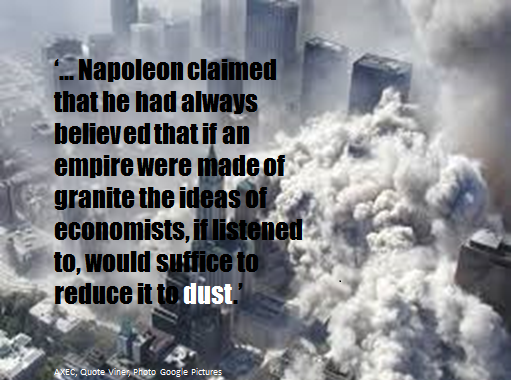
As Napoleon said: don’t listen to economists

Comment on Robert Waldmann on ‘Brad DeLong Marks His Beliefs about "The Return of Depression Economics" to Market’

Blog-Reference and Blog-Reference on Apr 5

Before starting the discussion of several model variants, you say: “I am going to be dumb (I am not playing dumb — I just worked through each step) and consider different less elegant models of aggregate supply.” (See intro)

The futility of the whole exercise derives from the fact that the models of Krugman and DeLong to which you refer are flawed since Keynes. Not to have realized this is indeed the manifest dimwittedness of Paul, Brad, and Robert. No need to play dumb.

Keynes defined the formal foundations of the General Theory as follows: “Income = value of output = consumption + investment. Saving = income − consumption. Therefore saving = investment.” (1973, p. 63)

This elementary syllogism is conceptually and logically defective because Keynes never came to grips with profit and therefore “discarded the draft chapter dealing with it.” (Tómasson et al., 2010, p. 12).

The three main points of the correct approach are:
• All I=S/IS-LM models are false since Hicks (2011; 2014b). The refutation of Krugman is to be found here (2014a), and the refutation of DeLong is to be found in It’s the price mechanism, stupid!
• The axiomatically correct Profit Law for the investment economy reads Qm≡Yd+I−Sm (2014b, p. 8, eq. (18)). Legend: Qm monetary profit, Yd distributed profit, I investment expenditures, Sm monetary saving. Sm establishes the connection to the money/credit market.
• The correct Employment Law/Phillips Curve is given here (2012).

To cut the meticulous formal derivation short, the most elementary version of the correct Employment Law for the economy as a whole is shown with Graphic AXEC62
From this equation follows:
(i) An increase in the expenditure ratio ρE leads to higher employment L (the letter ρ stands for the ratio). An expenditure ratio ρE>1 indicates credit expansion, a ratio ρE<1 indicates credit contraction of the household sector.
(ii) Increasing investment expenditures I exert a positive influence on employment; a slowdown of growth does the opposite.
(iii) An increase in the factor cost ratio ρF≡W/PR leads to higher employment.

The complete Employment Law is a bit longer and contains, in addition, profit distribution, public deficit spending, and import/export. The Employment Law contains only measurable real and nominal variables (and NO expectations and other nonentities).

Items (i) and (ii) are familiar since Keynes. What is new is the ratio ρF as defined in (iii). This variable embodies the price mechanism. It works such that overall employment INCREASES if the average wage rate W INCREASES relative to the average price P and productivity R.

This translates into the recipe: if the central bank wants an inflation rate of, say, 2 percent and the actual productivity growth is, say, 1.5 percent, then the AVERAGE wage rate must rise by 3.5 percent. The crucial point is that the price mechanism does NOT work as standard economics hallucinates.

The bottom line is that the models you use are defective; therefore, your whole supply-demand equilibrium exercise falls flat. It is to be hoped that politicians remember Napoleon and do not take Paul, Brad, and Robert seriously: “Late in life, moreover, he [Napoleon] claimed that he had always believed that if an empire were made of granite the ideas of economists if listened to, would suffice to reduce it to dust.” (Viner, 1963, p. 1)

Egmont Kakarot-Handtke


References
Kakarot-Handtke, E. (2011). Why Post Keynesianism is Not Yet a Science. SSRN Working Paper Series, 1966438: 1–20. URL
Kakarot-Handtke, E. (2012). Keynes’ Employment Function and the Gratuitous Phillips Curve Disaster. SSRN Working Paper Series, 2130421: 1–19. URL
Kakarot-Handtke, E. (2014a). Mr. Keynes, Prof. Krugman, IS-LM, and the End of Economics as We Know It. SSRN Working Paper Series, 2392856: 1–19. URL
Kakarot-Handtke, E. (2014b). The Three Fatal Mistakes of Yesterday Economics: Profit, I=S, Employment. SSRN Working Paper Series, 2489792: 1–13. URL
Keynes, J. M. (1973). The General Theory of Employment Interest and Money. London, Basingstoke: Macmillan.
Tómasson, G., and Bezemer, D. J. (2010). What is the Source of Profit and Interest? A Classical Conundrum Reconsidered. MPRA Paper, 20557: 1–34. URL
Viner, J. (1963). The Economist in History. American Economic Review, 53(2): 1–22. URL

Related 'Econogenics in action' and 'Learn economics ― but not from scientific losers'.

***
COMMENT on anne on Apr 5

Krugman says: “The idea that inflation promises might go directly into prices is a hope, not a worry.”

Rising prices (relative to wages and productivity) INCREASE unemployment. Because of this, every policy that aims directly at price increases WORSENS the employment situation.

Krugman’s underlying model of the price mechanism is provably false. For details, see the comment on Waldmann As Napoleon said: don’t listen to economists.

***
COMMENT on Paul Krugman NYT on Apr 5

Paul Krugman argues: “The idea that inflation promises might go directly into prices is a hope, not a worry.”

Rising prices (relative to wages and productivity) INCREASE unemployment. Because of this, every policy that aims DIRECTLY at price increases WORSENS the overall situation.

Krugman’s underlying model of the price mechanism is provably false. The formal proof is not sloganizable and outsizes a succinct post. For more details and wonkish references, see the comment on Waldmann As Napoleon said: don’t listen to economists.

***
COMMENT on Paul Krugman NYT on Apr 6

The correct economic model yields the elementary Employment Law, i.e., Graphic AXEC62.

In simple terms, it says:
(i) An increase in the expenditure ratio leads to higher employment. An expenditure ratio >1 indicates credit expansion, a ratio <1 indicates credit contraction.
(ii) Increasing investment expenditures exert a positive influence on employment; a slowdown of growth does the opposite.
(iii) An increase in the factor cost ratio ρF≡W/PR leads to higher employment.

The factor-cost ratio embodies the price mechanism. It works such that overall employment INCREASES if the average wage rate INCREASES relative to the average price and productivity. The standard models of the price mechanism are PROVABLY false.

If Japan applies Krugman’s advice she commits economic hara-kiri.

***

COMMENT on Paul Krugman NYT on Apr 7

The problem is not at all located at the level of economic policy. Hence, it does not matter much what Paul Krugman, Greg Mankiw, Brad DeLong, Larry Summers, or Robert Waldmann propose.

The problem is located at the level of economic theory. Because economists lack the true theory/model, ALL policy proposals are hanging in midair. Without sound scientific foundations, what Paul and Greg and Brad and Larry and Robert say is not different from old Roman haruspicy, i.e., the reading of poultry entrails.

***
Graphic AXEC117


The New Republic, October 25, 2022, Timothy Noah, May God Save Us From Economists

October 23, 2019

Links on Paul Krugman, proto-scientific impresario

Comment on Lars Syll on ‘Paul Krugman ― finally ― admits he was wrong!’

Blog-Reference and Blog-Reference and Blog-Reference on Oct 25

Paul Krugman has always been a clown and useful idiot in the political Circus Maximus. But Lars Syll has NOT been one iota better. Both, Krugmanian Orthodoxy and Syllian Heterodoxy are proto-scientific garbage.

► Krugman and the scientific implosion of economics
► Krugman is not an economist
► Paul the Menace
► Mr. Keynes, Prof. Krugman, IS-LM, and the End of Economics as We Know It
► Forget Krugman, forget Keynes, forget economists
► Profit and Distribution Theory is false for 200+ years
► Hooray! The formalization issue is finally settled
► Economics: a comedy of errors full of intrigue and aberration
► Paul’s and Stephanie’s economic delirium talk
► The stupidity of Heterodoxy is the life insurance of Orthodoxy

June 22, 2016

Not a question of simplicity but of stupidity

Comment on Paul Krugman on ‘Tl;dr and Modern Macroeconomics’

Blog-Reference and Blog-Reference

Krugman defends the simplicity of IS-LM against more elaborate modeling approaches: “What worries me is the effective prohibition on simple, ad hoc models that sometimes yield most of the insight ... in a form that is much more useful for real-world policy discussion.”

The core issue, though, is NOT about simple or elaborate but about true or false. And the crucial point is that IS-LM is provably false. What is worse, it is false since Keynes/Hicks and neither the After-Keynesians in general nor Krugman, in particular, have realized this until this day (2014).

Keynes formulated the formal core of the General Theory as follows: “Income = value of output = consumption + investment. Saving = income − consumption. Therefore saving = investment.” (1973, p. 63)

This elementary syllogism is conceptually defective because Keynes never came to grips with profit (Tómasson et al., 2010, p. 12). As a result, all I=S/IS-LM models and the Keynesian multiplier and Post-Keynesianism and New Keynesianism are false (2011).

Because neither IS-LMers nor DSGEers have the true theory their economic policy advice has NO scientific foundation whatsoever but is at the same level as poultry entrails reading. Hence, Paul Krugman has ONE valid point: to read from simple entrails is for all communicative purposes better than to read from more elaborate entrails. This, though, should not distract from the fact that simple scientific garbage is still garbage. To do economics without an idea of what profit is is a hopeless undertaking and a reliable indicator of utter scientific incompetence of economists in general and Paul Krugman, in particular.#1

Egmont Kakarot-Handtke


References
Kakarot-Handtke, E. (2011). Why Post Keynesianism is Not Yet a Science. SSRN Working Paper Series, 1966438: 1–20. URL
Kakarot-Handtke, E. (2014). Mr. Keynes, Prof. Krugman, IS-LM, and the End of Economics as We Know It. SSRN Working Paper Series, 2392856: 1–19. URL
Keynes, J. M. (1973). The General Theory of Employment Interest and Money.  London, Basingstoke: Macmillan.
Tómasson, G., and Bezemer, D. J. (2010). What is the Source of Profit and Interest? A Classical Conundrum Reconsidered. MPRA Paper, 20557: 1–34. URL

#1 I=S: Mark of the Incompetent

***
REPLY to Paul Mathis on Jun 22

Your examples relate to microeconomic profit. Keynes, of course, mentioned profit in the General Theory but never understood it: “His Collected Writings show that he wrestled to solve the Profit Puzzle up till the semi-final versions of his GT but in the end he gave up and discarded the draft chapter dealing with it.” (Tómasson et al., 2010, pp. 12-13, 16)

Keynes, though, is not alone as one can glean from the Palgrave Dictionary: “A satisfactory theory of profits is still elusive.” (Desai, 2008, p. 10)

The fact of the matter is that economists have no idea since Adam Smith what profit is (2014). This includes Paul Krugman and this is why his IS-LM based economic policy analysis is scientifically worthless.#1


References
Desai, M. (2008). Profit and Profit Theory. In S. N. Durlauf, and L. E. Blume (Eds.), The New Palgrave Dictionary of Economics Online, pp. 1–11. Palgrave Macmillan, 2nd edition. URL
Kakarot-Handtke, E. (2014). The Profit Theory is False Since Adam Smith. What About the True Distribution Theory? SSRN Working Paper Series, 2511741: 1–23. URL
Tómasson, G., and Bezemer, D. J. (2010). What is the Source of Profit and Interest? A Classical Conundrum Reconsidered. MPRA Paper, 20557: pp. 1–34. URL

#1 Profit and the collective failure of economists.

***
REPLY to Peter on Jun 23

Compared to IS-LM the quantity of credit theory of Werner is clearly superior. See also Loanable Funds vs. Endogenous Money: Krugman is Wrong, Keen is Right.

***
REPLY to nastyboy on Jun 23

The idea that wages and profits are antagonists quite naturally emerges from the observation of a single firm but is patently false when generalized for the economy as a whole. This elementary logical blunder (Fallacy of Composition) started with Smith, Mill, Ricardo, Marx and is still alive in modern macroeconomics. See also Profit for Marxists.

June 9, 2017

Just another wreck

Comment on Paul Krugman on ‘Wrecking the Ship of State’

Blog-Reference

Donald Trump may be wrecking the state but only after Paul Krugman has wrecked economics.#1

Egmont Kakarot-Handtke


#1 See Krugman and the scientific implosion of economics and Mr. Keynes, Prof. Krugman, IS-LM, and the End of Economics as We Know It and Krugman is not an economist and The Krugman curse.

Related 'First Lecture in New Economic Thinking' and 'Economics: The Battle of Frogs and Mice is over' and 'Enough! Economists, retire now!' and 'Not a question of simplicity but of stupidity' and 'Don’t tell me that Krugman’s economics is false, tell me instead what is true' and 'End of a storyteller' and 'What is dead certain in an uncertain world: economists’ abysmal incompetence' and 'The general theory of scientific incompetence' and 'Is Paul Krugman necessary?' and 'When fake scientists call out on fake politicians' and 'Economics: From proto-science to freak show' and 'On economists’ stupidity' and 'Economists for all seasons or just confused confusers?' and 'Paul the Menace' and 'Economics and corruption' and 'Soapbox economics' and 'Forget Krugman, forget Keynes, forget economists' and 'Why don’t economists simply shut up for a while?' and 'Low-IQ economics: the beginner’s guide' and 'Will economics ever become a science?' and 'Don’t blame the model, blame the modeler' and 'Scientific suicide in the revolving door'

April 25, 2017

The Krugman curse

Comment on David Glasner on ‘A Tale of Three Posts’

Blog-Reference

Humans are gregarious animals and therefore take reassurance from being part of the larger crowd and from a casual friendly pat of their leader. Accordingly, David Glasner is overjoyed to report that: “A number of my posts have achieved a fair amount of popularity, … Many, though not all, of my most widely viewed posts were mentioned by Paul Krugman in his blog. Whenever I noticed an unusually large uptick in the number of viewers visiting the blog, I usually found Krugman had linked to my post, causing a surge of viewers to my blog.”

This is a fine success according to the criteria of media-, public relations-, attention-, and reputation management. At second sight it is a comical attempt of two failed economists to mutually beef up their reputation.

David Glasner readily admits all the inconsistencies of standard economics but he is content with supply-demand-equilibrium as an explanation of how the market system works and does not feel any urge for a paradigm shift: “… most economists neither seek alternative theories nor believe that they can be found.” (Hausman) This is self-disqualifying.

Krugman, too, is unwaveringly committed to the orthodox paradigm: “… most of what I and many others do is sorta-kinda neoclassical because it takes the maximization-and-equilibrium world as a starting point.” This, too, is self-disqualifying.

Krugman has not realized that both the neoclassical axioms and the Keynesian I=S are false on all methodological counts but applies an inconsistent synthesis of these two inconsistent approaches in order to explain current economic events.#1, #2 But, of course, Krugman is a well-respected loudspeaker of the profession.

What David Glasner has not realized is that economics is what Feynman called a cargo cult science#3 and in this topsy-turvy world holds Shakespeare’s ‘fair is foul, and foul is fair’. This means (i) that any Top-Ten chart tells one what NOT to touch under any circumstances, and (ii), that the approval of Paul Krugman amounts to a confirmation of utter scientific failure.

So, a link from Paul Krugman, Mark Thoma, Brad DeLong, and other ‘hearts and souls of the econ blogosphere’ is not a reason to feel elated and indebted but a curse that follows one beyond the grave. The curse says: We, the mutually interlinked leaders and followers of cargo-cult economics will never be accepted in the community of scientists.

Egmont Kakarot-Handtke


#1 Mr. Keynes, Prof. Krugman, IS-LM, and the End of Economics as We Know It
#2 The father of modern economics and his imbecile kids
#3 See Wikipedia

Related 'Paul the Menace' and 'Scientific suicide in the revolving door'

January 15, 2016

Is Paul Krugman necessary?

Comment on Paul Krugman on ‘Is Vast Inequality Necessary?’

Blog-Reference

Economists do not understand their proper task to this very day. J. S. Mill once told them: “A scientific observer or reasoner, merely as such, is not an adviser for practice. His part is only to show that certain consequences follow from certain causes, and that to obtain certain ends, certain means are the most effectual. Whether the ends themselves are such as ought to be pursued, and if so, in what cases and to how great a length, it is no part of his business as a cultivator of science to decide, and science alone will never qualify him for the decision.” (2006, p. 950)

Economists were, from the very beginning, torn between science and politics. As scientific dilettantes, they preferred politics. This explains why economics never rose above the level of proto-scientific garbage: “In this and many analogous cases, of which modern economics is another deplorable example, economists indulged their strong propensity to dabble in politics, to peddle political recipes, to offer themselves as philosophers of economic life, and in doing so neglected the duty of stating explicitly the value judgments that they introduced into their reasoning.” (Schumpeter, 1994, p. 19)

Economists are addicted to political economics, and this is why they have not produced anything of scientific value: “In order to tell the politicians and practitioners something about causes and best means, the economist needs the true theory or else he has not much more to offer than educated common sense or his personal opinion.” (Stigum, 1991, p. 30)

Paul Krugman does not have the true theory. As he summarized on his blog, “most of what I and many others do is sorta-kinda neoclassical because it takes the maximization-and-equilibrium world as a starting point ...”

This starting point is provably false. #1 Because of this, Krugman’s arguments and proposals have no sound scientific foundations (2014).

It is high time for the separation of science and politics in economics. The task of theoretical economics is to figure out how the economy works. Economists owe society the true theory. Political economists can no longer be allowed to speak in the name of science.

Egmont Kakarot-Handtke


References
Kakarot-Handtke, E. (2014). The Profit Theory is False Since Adam Smith. What About the True Distribution Theory? SSRN Working Paper Series, 2511741: 1–23. URL
Mill, J. S. (2006). A System of Logic Ratiocinative and Inductive. Being a Connected View of the Principles of Evidence and the Methods of Scientific Investigation, volume 8 of Collected Works of John Stuart Mill. Indianapolis: Liberty Fund.
Schumpeter, J. A. (1994). History of Economic Analysis. New York: Oxford University Press.
Stigum, B. P. (1991). Toward a Formal Science of Economics: The Axiomatic Method in Economics and Econometrics. Cambridge: MIT Press.

#1 Addendum to “Musings on Whether We Consciously Know More or Less than What Is in Our Models”


***

Graphic AXEC108l


***

REPLY  Wrong question, wrong answers

Most of the preceding posts fall into the Human-Nature category, and the contributors are obviously not aware that all questions about human behavior/motivation/aspiration/ intention/ etc belong to psychology, sociology, anthropology, political science, etcetera, but not to economics. It is not the task of economics to explain how humans behave; the task is to explain how the economy behaves. Second-guessing human behavior and waffling about utility maximization is not science but — as confirmed by more than 100 years of failure — a senseless exercise.

The first thing an economist with a modicum of scientific instinct understands is that “if we wish to place economic science upon a solid basis, we must make it completely independent of psychological assumptions and philosophical hypotheses.” (Slutzky, quoted in Mirowski, 1995, p. 362)

Does the world expect economists to find out how people behave? No. Does the world expect economists to figure out what profit is? Yes, of course, no philosopher, psychologist, anthropologist, biologist, or sociologist will ever try to figure this out. Have economists done their proper job? No. The Palgrave Dictionary summarizes “A satisfactory theory of profits is still elusive.” (Desai, 2008, p. 10)

Did Keynes have any idea about what profit is? No. “His Collected Writings show that he wrestled to solve the Profit Puzzle up till the semi-final versions of his GT but in the end he gave up and discarded the draft chapter dealing with it.” (Tómasson et al., 2010, pp. 12-13, 16). This, obviously, could not hinder Keynes from philosophizing and sociologizing about the end of laissez-faire and third-generation men.

Does Krugman have any idea about what profit is? NO! (2014).

Does income distribution have something to do with wages and profits? These two concepts are obviously fundamental for distribution theory.

It is known since Hume that there is a categorical difference between ‘Is’ and ‘Ought’ and that science is exclusively concerned with ‘Is’. ‘Ought’ is the realm of philosophy, morals, ethics, and politics. ‘Is’ is the proper realm of science. Political economics is outside of science.

Krugman’s first mistake is to trespass on the line between ‘Is’ and ‘Ought’. It is pretty obvious that Ought-questions cannot, as a matter of principle, have a scientific answer. His second mistake is to answer the question without knowing the difference between profit and income, which is the worst thing that can happen to an economist.

The actual fact of the matter is that economists have no clear idea about the fundamental concepts of their discipline. This is like medieval physics before the concept of energy was fully understood.

Distribution theory is where economics reaches its lowest scientific ebb.

References
Desai, M. (2008). Profit and Profit Theory. In S. N. Durlauf, and L. E. Blume (Eds.), The New Palgrave Dictionary of Economics Online, 1–11. Palgrave Macmillan, 2nd edition. URL
Kakarot-Handtke, E. (2014). Mr. Keynes, Prof. Krugman, IS-LM, and the End of Economics as We Know It. SSRN Working Paper Series, 2392856: 1–19. URL
Mirowski, P. (1995). More Heat than Light. Cambridge: Cambridge University Press.
Tómasson, G., and Bezemer, D. J. (2010). What is the Source of Profit and Interest? A Classical Conundrum Reconsidered. MPRA Paper, 20557: 1–34. URL

January 7, 2017

When fake scientists call out on fake politicians

Comment on Paul Krugman on ‘The Age of Fake Policy’

Blog-Reference

Paul Krugman as a private person has ― under the general license of freedom of opinion/ speech ― the right to call out on Mr. Trump’s illusory promises and his slapstick policy stunts. Paul Krugman as a scientist does NOT have this privilege because a scientist does not deal with opinion (= doxa) but with knowledge (= episteme).#1 The fact of the matter is that Paul Krugman does not have scientific knowledge, he has not even realized that economics is NOT a science.#2

The current state of economics is that of a cargo cult or fake science. Walrasianism, Keynesianism, Marxianism, Austrianism is mutually contradictory and does NOT satisfy the scientific criteria of formal and material consistency. The four major approaches are PROVABLY false.

It is pathetic showmanship when a failed scientist and card-carrying member of a fake science like Krugman calls out on a fake politician.#3

Egmont Kakarot-Handtke


#1 Will economics ever become a science? and Scientific suicide in the revolving door
#2 The economist as stand-up comedian and Krugman is not an economist
#3 Economists: The Trumps of science

Related 'Heterodoxy’s scientific self-burial' and 'Why should people trust failed scientists?' and 'Economics: neither craft nor science' and 'How to get out of the swamp of ignorance' and 'Economic recommendations out of the swamp between true and false' and 'Nothing to choose between Orthodoxy and traditional Heterodoxy' and 'Economics is not post-truth but pre-truth' and 'Heterodoxy, too, is proto-scientific garbage'

February 22, 2016

Krugman and the scientific implosion of economics

Comment on Peter Radford on ‘Krugman versus Sanders’

Blog-Reference

Krugman is accused of supporting ‘political figures he likes, notably Hillary Clinton,’ and attacking Bernie Sanders. What could possibly be wrong with that? Nothing, of course, except that Krugman is an economist. What is indeed wrong is that economics is a science, and as a scientist, Krugman has no political mandate at all. Most people do not get the point because they have come to believe that science is just another sitcom format. And that is not wrong as far as economics is concerned.

Long before the hijacking of economics by morons, J. S. Mill, the economist and methodologist, was well aware that there is a categorical difference between politics and science: “A scientific observer or reasoner, merely as such, is not an adviser for practice. His part is only to show that certain consequences follow from certain causes, and that to obtain certain ends, certain means are the most effectual. Whether the ends themselves are such as ought to be pursued, and if so, in what cases and to how great a length, it is no part of his business as a cultivator of science ....”  (2006, p. 950)

In no uncertain terms, Mill told his fellow economists: politics and science have to be separated, and there is no revolving door between the two. The first thing to notice is that this message was obviously wasted on Krugman.

To speak of economics tout court is always misleading because there is political and theoretical economics, and there are storytelling and something like the true theory. The crucial distinction is this:
(i) The objective of political economics is to push an agenda; the objective of theoretical economics is to explain how the actual economy works.
(ii) In political economics, anything goes; in theoretical economics, scientific standards are observed. The standards are well-defined in terms of material and formal consistency.

Theoretical economics has to be judged according to the criteria true/false and nothing else. The criteria of political economics are good/bad or like/dislike. Political economics has produced NOTHING of scientific value since Adam Smith.

Accordingly, Krugman has to be criticized for having made the wrong choice between political economics (= agenda-pushing and storytelling) and theoretical economics (= science) and for trespassing the line between the two. He has to be criticized for being an incompetent scientist (2014) and thrown out of the scientific community.

Being outside of science, Krugman can no longer be criticized for preferring one politician over the other or talking economic nonsense. After all, he is then among equals at the lowest possible intellectual level.

There is neither a political nor a moral justification for an economist to give economic policy advice without sound scientific foundations. Economists owe society the true theory, not less, not more. Krugman lacks the true theory, and with him all who subscribe to sorta-kinda maximization-and-equilibrium.

For Krugman in particular and the political sects of Walrasians, Keynesians, Marxians, Austrians, and other scientific failures in general, there is only one honorable option left in this election campaign: to shut up.

Egmont Kakarot-Handtke


References
Kakarot-Handtke, E. (2014). Mr. Keynes, Prof. Krugman, IS-LM, and the End of Economics as We Know It. SSRN Working Paper Series, 2392856: 1–19. URL
Mill, J. S. (2006). A System of Logic Ratiocinative and Inductive. Being a Connected View of the Principles of Evidence and the Methods of Scientific Investigation, Vol. 8 of Collected Works of John Stuart Mill. Indianapolis: Liberty Fund.

Related 'Krugman is not an economist' and 'Scientists and science actors' and 'A science without scientists' and 'Economists, stupid or corrupt or both?' and 'New Economic Thinking: the 10 crucial points' and 'Economists’ three-layered scientific incompetence' and 'Economics: 200+ years of scientific incompetence and fraud' and 'Economics: The Battle of Frogs and Mice is over' and 'Enough! Economists, retire now!' and 'The real problem with the economics Nobel' and 'Econ 101: Economists flunk the intelligence test at the first hurdle' and 'Paul’s and Stephanie’s economic delirium talk' and 'Finally, the embarrassment of economics is over' and 'The economist as storyteller' and 'Economics: The greatest scientific fraud in modern times' and 'There is NO such thing as “smart, honest, honorable economists”' and 'Scientists and science actors' and 'Links on the Economics Nobel' and 'Circus Maximus: Economics as entertainment, personality gossip, virtue signaling, and lifestyle promotion' and 'Links on Paul Krugman, proto-scientific impresario' and 'Wikipedia, economics, scientific knowledge, or political agenda pushing?'. For details of the big picture, see cross-references Political Economics/Stupidity/Corruption and cross-references Failed/Fake Scientists.

***
Graphic AXEC144c


April 28, 2019

Economics: failure, fake, fraud

Comment on Michael Roberts on ‘Progressive capitalism ― an oxymoron’*

Blog-Reference and Blog-Reference

On the back cover of People, Power, and Profits, the applause troll Paul Krugman is cited under the heading Praise for Joseph E. Stiglitz: “[Joseph Stiglitz] is an insanely great economist.”

The first thing to notice is that Paul Krugman is an insanely little economist because he proudly presents himself as ‘sorta-kinda maximization-and-equilibrium guy’, that is, he has not realized to this day that maximization-and-equilibrium is dead for 150+ years. #1, #2

From Adam Smith/Karl Marx onward to the Bank of Sweden Prize in Economic Sciences in Memory of Alfred Nobel, economics claims to be science but has never been anything else than brain-dead political agenda-pushing. The major approaches ― Walrasianism, Keynesianism, Marxianism, Austrianism ― are mutually contradictory, axiomatically false, materially/formally inconsistent, and all got the foundational concept of the subject matter ― profit ― wrong. #3, #4

There are political economics and theoretical economics. The main differences are: (i) The goal of political economics is to successfully push an agenda; the goal of theoretical economics is to successfully explain how the actual economy works. (ii) In political economics, anything goes; in theoretical economics, the scientific standards of material and formal consistency are observed.

Theoretical economics (= science) had been hijacked from the very beginning by political economists (= agenda pushers). Political economics has produced NOTHING of scientific value in the last 200+ years. Economics is a failed science.#5 Because all variants of theoretical economics are provably false, economic policy guidance NEVER has had sound scientific foundations.

Because both microeconomics and macroeconomics are based on inconsistent concepts, the respective models are scientifically worthless, and economic policy guidance is not different from reading tea leaves.

What, then, are Joseph E. Stiglitz’s policy proposals? “The prescription follows from the diagnosis: It begins by recognizing the vital role that the state plays in making markets serve society. We need regulations that ensure strong competition without abusive exploitation, realigning the relationship between corporations and the workers they employ and the customers they are supposed to serve. We must be as resolute in combating market power as the corporate sector is in increasing it.”

Those prescriptions are (i) the stock of the left in the US and elsewhere, (ii) miss the point because the underlying profit/distribution theory is false.

Roughly speaking, Joseph E. Stiglitz believes that profit comes from market power. This is proto-scientific common sense. In other words, the economist Joseph E. Stiglitz does not know what profit is. This he has in common with his academic colleagues.

To make matters short here, the macroeconomic Profit Law is given as Q≡Yd+(I−S)+(G−T)+(X−M). In the elementary case of a pure production-consumption economy, this reduces to Q≡−S, i.e., the mirror image of household sector saving S is business sector loss (−Q). The mirror image of household sector dissaving (−S) is business sector profit Q. The point to grasp is that profit for the business sector as a whole depends on deficit spending and nothing else. With regard to the state, the Profit Law boils down to Q≡(G−T), i.e., Public Deficit = Private Profit. Obviously, macroeconomic profit has NOTHING to do with exploitation.#6

The reduced macroeconomic Profit Law Q≡(I−S)+(G−T) tells one that profit in the monetary economy is positive (i) if business sector investment I is greater than household sector saving S, and (ii), if the state runs a deficit, i.e., (G−T)>0.

Case (i) is characteristic of early Capitalism, and case (ii) is characteristic of late Capitalism. Currently, the so-called free-market economy is on the full life support of the state. The macroeconomic Profit Law boils down to Public Deficit = Private Profit, and thus the Oligarchy’s financial wealth and public debt grow in lockstep.

This distribution problem can not be solved by increasing wages or by reducing market power because these factors affect only the distribution of profit between firms, while the profit for the business sector as a whole is determined by deficit spending.

Joseph E. Stiglitz titles his new book People, Power, and Profits, and does not know what profit is or how it is determined. Because of scientific failure, his policy proposals are at best useless. This he has in common with the rest of the academic economists. #7

The fact of the matter is, so-called free-market economies like the USA have long been on full life-support of the state. The continuous creation of financial wealth has become the first and foremost economic task of the state. The Oligarchy is continuously fed by deficit-spending/money-creation. Roughly speaking, the Oligarchy’s financial wealth is equal to accumulated Public Debt (with WeThePeople as ultimate bagholders).

Capitalism and Socialism are both monetary economies. The macroeconomic Profit Law is the same for both. #8 Economists like Paul Krugman and Joseph E. Stiglitz have not realized it to this day, and this tells one that they are insanely stupid.

Egmont Kakarot-Handtke


* Michael Roberts Blog
#1 Paul Krugman and economic poultry entrails reading
#2 Mr. Keynes, Prof. Krugman, IS-LM, and the End of Economics as We Know It
#3 The Profit Theory is False Since Adam Smith
#4 Dear idiots, Marx got profit and exploitation wrong
#5 Macroeconomics: Economists are too stupid for science
#6 Capitalism, poverty, exploitation, and cross-over exploitation
#7 Econogenics in action
#8 No future for Socialism and Capitalism

Related 'There is no like/dislike button in science' and 'Here is the long-overdue scientific death certificate for Marx and Marxists' and 'Profit for Marxists' and 'Economists cannot do the simple math of profit — better keep them out of politics' and 'Wikipedia, economics, scientific knowledge, or political agenda pushing?'. For details of the big picture, see cross-references Methodology.

***

Twitter Apr 28, 2017

Source: Twitter

***
#PointOfProof
Apr 29
before
after

***
REPLY to Kaivey on Apr 29

You ask: “… how do you fit countering global warming into your equations, or reducing poverty?”

You obviously do not understand the essential difference between science and politics. Scientists/engineers, for example, figure out the laws of motion and of aerodynamics and of thermodynamics and all the rest, and eventually get an aircraft off the ground. The characteristic of scientific knowledge is that it is public and freely accessible to every smart and interested person.

The practical use of scientific knowledge is an entirely different matter. In principle, it is the decision of the Legitimate Sovereign. The Legitimate Sovereign decides whether an aircraft is used to deliver food and medicine to the victims of a natural disaster or to throw bombs on a wedding party in a faraway country.

Analogously, the task of the economist as a scientist is to figure out the laws that govern the monetary economy. It is NOT his task to dabble in politics. Most economists do not understand this, although it is known since J. S. Mill: “A scientific observer or reasoner, merely as such, is not an adviser for practice. His part is only to show that certain consequences follow from certain causes, and that to obtain certain ends, certain means are the most effectual. Whether the ends themselves are such as ought to be pursued, and if so, in what cases and to how great a length, it is no part of his business as a cultivator of science to decide, and science alone will never qualify him for the decision.”

Economists, though, have NEVER been cultivators of science but only stupid/corrupt agenda pushers. This is the indelible scientific disgrace of economists. The designation economist includes Walrasians, Keynesians, Marxians, Austrians, MMTers, and, of course, you.

The reduced macroeconomic Profit Law Q≡(G−T) tells one that profit in the monetary economy is positive if the state runs a deficit, i.e., (G−T)>0. Economically, i.e. with regard to overall profit, it is a matter of indifference whether the deficit results from military or from environmental spending. It is the deficit as such that feeds the Oligarchy and NOT the political purpose of the deficit. Because of this, a Green New Deal is just as good for Wall Street as a war in the Middle East, provided it is financed by the Central Bank.

The indelible moral disgrace of MMT consists of telling people that deficit-spending/money-creation is for their or their children’s benefit, while it is uniquely and exclusively for the benefit of the Oligarchy.

The indelible moral disgrace of economists in general consists of the claim that they are contributing to the growth of scientific knowledge, while in fact, they are producing nothing but political BS.

***
REPLY to Kaivey on Apr 30

You ask, “… if it turns out that the Scandinavian system is the most efficient, could that be proven with your equations?”

Before you can prove anything, you need an accurate formal representation of the system in question. The usual economic squabbling is pointless; it proves nothing.

The macroeconomic Profit Law is ONE element of the scientifically valid description of the monetary economy. There are more elements, to be sure. #1 Because the Scandinavian economies are monetary economies, the Profit Law also holds for them.

Needless to emphasize that the general equation has to be specified for the national economy under consideration. This is the step from theory to model. For example, if government expenditures G are differentiated into military spending Gm and social spending Gs, i.e., G=Gm+Gs, then one gets wildly different numbers for the USA and for Norway, but, of course, this does NOT affect the general Profit Law in any way. It’s just like putting different masses into the Law of Gravity.

Again, the macroeconomic laws are the same for Capitalism and Socialism, and anything in between. Only the values of the variables differ.


#1 Go! ― test the Profit and Employment Law