Comment on Lars Syll on ‘Krugman on models (II)’
Blog-Reference
“... a group of blind men (or men in the dark) touch an elephant to learn what it is like. Each one feels a different part, but only one part, such as the side or the tusk. They then compare notes and learn that they are in complete disagreement.
The stories differ primarily in how the elephant’s body parts are described, how violent the conflict becomes and how (or if) the conflict between the men and their perspectives is resolved. ...
It [the parable] has been used to illustrate a range of truths and fallacies; broadly, the parable implies that one’s subjective experience can be true, but that such experience is inherently limited by its failure to account for other truths or a totality of truth.” (Wikipedia)
From the standpoint of economic methodology, this is a perfect description of the inherent defect of Marshallian partial analysis which has long been dominant and, for all practical/empirical purposes, still is. The fatal defect of the method is not partial analysis itself, which normally leads to quite satisfactory empirical results, but the generalization of partial results beyond the original tight limits of space and time. This methodologically inadmissible transgression is known since antiquity as the Fallacy of Composition.
Economics is a failed science, and the ultimate methodological cause is that the Fallacy of Composition is literally built into the very definition of standard economics: “It is a touchstone of accepted economics that all explanations must run in terms of the actions and reactions of individuals. Our behavior in judging economic research, in peer review of papers and research, and in promotions, includes the criterion that in principle the behavior we explain and the policies we propose are explicable in terms of individuals, not of other social categories.” (Arrow, 1994, p. 1)
Now we know from Buddha that, as a matter of principle, no way leads from the understanding of a tiny part, i.e. the behavior of the individual, to the understanding of the whole, i.e. the behavior of the economy.
The moral of the parable is that the ‘group of blind men’ is inextricably caught in what is in effect an epistemological trap. A telling example from economics is the invention of the representative agent which is the most ridiculous Fallacy of Composition in the long history of green cheese assumptionism.
As a result of their methodological incompetence, economists do not have the true theory, they merely have a heap of incoherent models. These models are partial constructs, each built upon an idiosyncratic set of premises.#1 Because of this, economic debates do not progressively solve problems but circle endlessly around indissoluble differences. Scholarship consists mainly of exegesis and comparison of theories that have never been anything other than proto-scientific garbage.
To the group of blind men that are among themselves "in complete disagreement" belong Walrasians, Keynesians, Marxians, and Austrians. What all have in common are substandard scientific abilities that manifest themselves in gross methodological blunder and confusion (2013).
“The picture that emerges is thus one of serious methodological fragmentation in mainstream economics. Theorists, experimentalists, and empiricists are all pulling in different directions, while hopes are expressed for developments which would fundamentally alter the methodological foundation of mainstream economics.” (Dow, 1997, p. 84)
It is pretty obvious that economics needs a Paradigm Shift. The crucial methodological consequence is that all of the economic analysis must start with the most elementary objective and formally consistent representation of the whole economy (2014).
When you want to understand the universe it is of no use to thoroughly examine your backyard; when you want to understand the elephant it is of no use to feel up his tusk; when you want to understand the economy it is of no use to bother with individual or social behavior, much less with constrained optimization. In technical terms, microfoundations are the wrong approach and have to be replaced with macrofoundations.
Since Jevons/Walras/Menger, the blind men of economics have not found this out. Worse, they hallucinate that it is their mission to help the blind men of politics with their advice. Worst, in their self-deception and lack of sound theoretical foundations economists, in effect, have become the very promoters of economic crises.
Egmont Kakarot-Handtke
References
Arrow, K. J. (1994). Methodological Individualism and Social Knowledge. American Economic Review, Papers and Proceedings, 84(2): 1–9. URL
Dow, S. C. (1997). Mainstream Economic Methodology. Cambridge Journal of Economics, 21: 73–93.
Kakarot-Handtke, E. (2013). Confused Confusers: How to Stop Thinking Like an Economist and Start Thinking Like a Scientist. SSRN Working Paper Series, 2207598: 1–16. URL
Kakarot-Handtke, E. (2014). Objective Principles of Economics. SSRN Working Paper Series, 2418851: 1–19. URL
#1 How economists became the scientific laughing stock
Related 'The future of economics: why you will probably not be admitted to it, and why this is a good thing' and 'How to restart economics' and 'Macro for dummies' and 'Economists, stupid or corrupt or both?' and 'New Economic Thinking: the 10 crucial points'. For details of the big picture see cross-references Failed/Fake Scientists.
Showing posts sorted by relevance for query "Fallacy of Composition". Sort by date Show all posts
Showing posts sorted by relevance for query "Fallacy of Composition". Sort by date Show all posts
January 6, 2016
June 17, 2015
Keenonomics, aggregate demand/change of debt, and some misleading critique
Thread on RWER
In a recent critique of Steve Keen's approach, Severin Reissl announces: “It is also shown that many weaknesses in Keen's argument stem from a lack of terminological clarity which originates in his interpretation of the works of Hyman Minsky.” (Reissl, 2015, Abstract)
This is true as I have shown with regard to Keen's definition of profit (2013), but Reissl argues from an unacceptable reference point, that is, from Stützel's version of balance mechanics. It has to be emphasized that balance mechanics is an indispensable tool of economic analysis; the crucial point is that Stützel got it not exactly right. For a start, a succinct summary of the different strands that treat the interconnection between the circular flow, the creation of credit/money, and balance mechanics is to be found in (Schmitt and Greppi, 1996).
Reissl summarizes Stützel's key methodological insight as follows “Partial statements are valid for groups, while global statements are valid for the aggregate economy. The application of a partial statement to the aggregate economy is very often only possible through the addition of highly restrictive assumptions; otherwise, it is an outright fallacy of composition.” (2015, p. 7)
In fact, the crippling methodological defect of the microeconomic approach is that partial truths are habitually but illegitimately generalized. Most conclusions of the standard supply-demand-equilibrium analysis are false when generalized. Stützel was correct and far ahead of his time on this score.
The socially most deleterious Fallacy of Composition is what has become known as Ricardo's principle. “... profits would be high or low in proportion as wages were low or high.” (Ricardo, 1981, p. 110) This is true for a single firm but not for the economy as a whole. Hence, it is not a great exaggeration to define the microfoundations-Orthodoxy as the proto-science that confuses logic and the Fallacy of Composition.
Reissl first correctly points out that it is important to distinguish between flows like consumption expenditures and income, which, in turn, affect the net worth, on the one hand, and receipts and payment,s which affect the household/business sector's stocks of money, on the other hand.
But then, directly after eq. (6), the fatal blunder occurs: “Saving here denotes the difference between all additions and all reductions in net worth during a period. Investment (that is, by definition, a change of the quantity of tangible assets) is hence only a subcategory of saving for any subset of economic actors.”
This misleads Reissl in the course of the argument, finally to: “These relations imply that, in a macroeconomic sense, investment is saving, but also that saving is investment.” (2015, p. 17)
And this, of course, is analytical garbage, but one that Reissl shares with the majority of economists. Keynes stated in his General Theory: “Income = value of output = consumption + investment. Saving = income − consumption. Therefore saving = investment.” (1973, p. 63)
Just like Reissl's balance mechanics, this elementary syllogism contains a fundamental conceptual error/mistake (2011) that invalidates all I=S-models without exception (see also the post E.K-H, 2015).
Where is the flaw in Reissl's critique of Keen? Reissl — just like Keen, Minsky, Keynes, Krugman, Wren-Lewis, Glasner, and the rest — got the foundational distinction between income and profit wrong. So, welcome to the party: “... one of the most convoluted and muddled areas in economic theory: the theory of profit.” (Mirowski, 1986, p. 234)
The correct relationship between the key variables is given by Qre≡I−S (2015, eq. (49)), that is, the business sector's investment expenditures are never equal to the household sector's saving, and their difference is always equal to the business sector's retained profit. Balance mechanics cannot possibly yield a different result.
While Keen's approach is formally deficient, his assertion that there is a straightforward connection between aggregate demand and the change of the household sector's debt is absolutely correct for the elementary production-consumption economy. For every economist, including Reissl, this is the firm ground in the conceptual swamp. The First Law of Balance Mechanics says saving = loss and NOT saving = investment.
Not to have realized this in more than 200 years is the scientific opprobrium of economics.
Egmont Kakarot-Handtke
References
E.K-H (2015). Tricky business. Blog post. URL
Kakarot-Handtke, E. (2011). Why Post Keynesianism is Not Yet a Science. SSRN Working Paper Series, 1966438: 1–20. URL
Kakarot-Handtke, E. (2013). Debunking Squared. SSRN Working Paper Series, 2357902: 1–5. URL
Kakarot-Handtke, E. (2015). Essentials of Constructive Heterodoxy: Financial Markets. SSRN Working Paper Series, 2607032: 1–33. URL
Keynes, J. M. (1973). The General Theory of Employment Interest and Money. The Collected Writings of John Maynard Keynes Vol. VII. London, Basingstoke: Macmillan.
Mirowski, P. (1986). Mathematical Formalism and Economic Explanation. In P. Mirowski (Ed.), The Reconstruction of Economic Theory, 179–240. Boston, Dordrecht, Lancaster: Kluwer-Nijhoff.
Reissl, S. (2015). The Return of Black Box Economics - a Critique of Keen on Effective Demand and Changes in Debt. IMK Working Paper, (149): 1–24. URL
Ricardo, D. (1981). On the Principles of Political Economy and Taxation. The Works and Correspondence of David Ricardo. Cambridge, New York, etc.: Cambridge University Press. URL
Schmitt, B., and Greppi, S. (1996). The National Economy Studied as a Whole: Aspects of Circular Flow Analysis in the German Language. In G. Deleplace and E. J. Nell (Eds.), Money in Motion, 341–364. Houndmills, Basingstoke, London: Macmillan. With reference to Föhl C. (1955), Geldschöpfung und Wirtschaftskreislauf, Berlin: Duncker & Humblot.
Related 'Where advanced Heterodoxy — represented by Steve Keen — took the wrong turn' and 'Heterodoxy, too, is proto-scientific garbage'. For details of the big picture, see cross-references Refutation of I=S and cross-references Profit and cross-references Accounting.
For more on Steve Keen, see AXECquery.
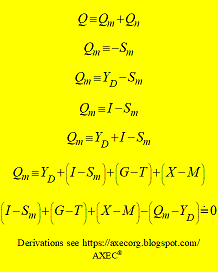
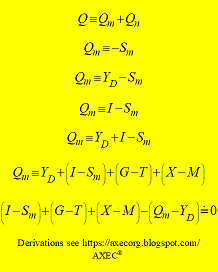
Graphic AXEC143d Macroeconomic Profit Law (with increasing complexity)


***
***
Twitter Oct 18, 2019 Balances mechanics

***
Twitter Oct 18, 2019 Stützel got the profit balance wrong

Wikipedia Oct 24 Saldenmechanik/Balances mechanics
Note that in the whole article, the word Profit/Gewinn does not appear once. Because profit/loss is the balance of the business sector, it is a foundational element of balances mechanics. The complementary element is the balance of the household sector, i.e., dissaving/saving. The fundamental law of balance mechanics says that all balances add up to zero. Therefrom follows for the elementary case of the 2-sector production-consumption economy (without profit distribution) that profit equals dissaving and loss equals saving. In the case of household sector dissaving, the business sector ends up with deposits at the Central Bank (= money) and the household sector with overdrafts. Both sides of the Central Bank's balance sheet are equal. Financial assets are equal to financial liabilities, and the net worth of the economy as a whole is zero.

November 26, 2016
The thing with profit and exploitation
Comment on Peter Dorman on ‘It’s Red Friday and Time to Discuss the Role of Exploitation in Profit’
Blog-Reference and Blog-Reference on Nov 28
The Palgrave Dictionary summarizes: “A satisfactory theory of profits is still elusive.” (Desai, 2008)
This perhaps surprises the general public: economists do not know to this day what profit is. As a consequence, they have NO idea about how the monetary economy works. More specifically, economics consists of four main approaches, Walrasianism, Keynesianism, Marxianism, and Austrianism, and NONE of them gets profit right. #1
As a consequence, economic policy guidance has never had sound scientific foundations. Because economists never captured the essence of the market economy, whatever they have said for or against capitalism, communism, or socialism has been based upon provably false theories about how the monetary economy works.
Since Ricardo and Marx, both orthodox and heterodox economists believe that there is a fundamental antagonism between the firm’s owners (= capitalists) and the employees/workers.
The idea that antagonism between classes is built into the economic system, though, rests on an optical illusion. And this optical illusion ultimately derives from the theory of the firm. It is obviously true that an individual firm can increase profit by lowering the wage rate. But this is NOT true for the economy as a whole. To generalize what is true for an isolated part of a system is known in methodology as the Fallacy of Composition.
In the most elementary case, the interdependencies of the economic system have the unintended effect that if firm A makes a profit by lowering the wage rate, firm B (= the rest of the economy) makes a loss under the initial macroeconomic condition that total consumption expenditure is equal to total wage income. #2 And, by the same token, the real wage of the workers of firm A decreases and that of the workers of firm B increases. So, what happens is that a redistribution of profit between firms and a redistribution of output between households takes place.
In political terms, this means that there are NO CLASSES with a common interest. Put differently, what appears as an exploitation of the workers of firm A is only part of the complete picture of a REDISTRIBUTION of profits WITHIN the business sector and a REDISTRIBUTION of output WITHIN the household sector. In other words, the exploitation of workers in firm A benefits the workers in firm B. And the profit increase of firm A’s capitalists comes from firm B’s capitalists. Taking all capitalists together, their profit does not change. Taking all workers together, their real share of output does not change.
Conclusion: the naive concept of exploitation has to be replaced by the concept of crossover exploitation.
Economists are supposed to be experts on the economy. So it is quite natural to think that they know how the profit mechanism works; after all, this is the foundational phenomenon of their subject matter. Yet, this is definitely not the case. Economists are incompetent scientists, and after 200+ years, they are still stuck in the Fallacy of Composition. So, economists have NOTHING to contribute to the discussion about how the economy, markets, and firms should be organized.
Economists have discussed the role of exploitation and profit without ever coming to the core of the matter. It is Red Friday, and time for them to retire now for good.
Egmont Kakarot-Handtke
#1 How the Intelligent Non-Economist Can Refute Every Economist Hands Down and
The Profit Theory is False Since Adam Smith. What About the True Distribution Theory? and Profit for Marxists.
#2 Essentials of Constructive Heterodoxy: Profit
Related 'How to end the Punch and Judy show about profit'
There are three things that are intertwined but have to be analytically kept apart: (i) Theory of Value, (ii) Theory of Profit for the economy as a whole, (iii) Distribution of overall profit between sub-sectors (production, banking, land use, etc.) and individual firms.
The Law of Value says that relative prices are inverse to productivities. #1 This Law replaces the Labour Theory of Value.
The Profit Law for the pure consumption economy says that OVERALL profit depends on the expenditure ratio and the distributed profit ratio. #2
It holds in particular:
• Overall profit does neither depend upon the agents’ personal qualities, motives, their ideas about what profit is, nor on profit-maximizing behavior.
• In order that profit comes into existence for the first time in the elementary production-consumption economy, the household sector must run a deficit for at least in one period.
• Profit is, in the simplest case, determined by the increase and decrease of the household sector’s debt. There is a close relation between profit/loss and the expansion/contraction of credit for the economy as a whole.
• Wage income is the factor remuneration of labor input. Profit is NOT a factor income. Since capital is nonexistent in the elementary production-consumption economy, profit is not functionally attributable to capital.
• There is no relation at all between profit, capital, marginal, or average productivity.
• Profit has no real counterpart in the form of a piece of the output cake. Profit has a monetary counterpart.
• The existence and magnitude of overall profit do not depend on the ownership of the firms that comprise the business sector.
• The value of output is, in the general case, different from the sum of factor incomes. This is the defining property of the monetary economy.
• Profit is a factor-independent residual and qualitatively different from wage income. Therefore, it is an elementary mistake to maintain that total income is the sum of wages and profits. #3
• There is no antagonism between total wages and total profits, and the distribution of consumption goods output has nothing at all to do with profit.
• Innovation and efficiency are irrelevant for the profit of the business sector as a WHOLE. It is a Fallacy of Composition to trivially generalize what can be observed in an individual firm.
In sum, the classical/neoclassical and Keynesian/Post-Keynesian Theories of Value/Profit are provably false.
#1 The Pure Logic of Value, Profit, Interest
#2 Essentials of Constructive Heterodoxy: Profit
#3 When Ricardo Saw Profit, He Called It Rent: On the Vice of Parochial Realism
You say: “A very interesting thing to me is that in the Bible profit is good but profit taking ISN’T(!) good ...”
It is common knowledge that the Bible belongs to the sphere of religion/belief/storytelling and that economics belongs to the sphere of science/knowledge/proof.
Both spheres do not mix, never have, and never will. Your post is out of place.
It is common knowledge that the content and level of economic discussion are far below zero. There is NO need for you or anybody else to deliver more examples.
For details, see FakeNews, FakeScience: economics in the information age.
You say: “I do have an issue with ‘trust me, I’m a scientist’.”
There is NO issue at all; there is only your abysmal ignorance and confusion. Science is NOT about trust or credibility or belief or authority, but only about proof, more specifically, about the logical and empirical consistency of a theory. A theory, in turn, is the best humanly possible mental representation of reality.
Since the ancient Greeks introduced the distinction between opinion (= doxa) and knowledge (= episteme), NO scientist has ever said Believe me. As Popper put it: “... a critical discussion is well-conducted if it is entirely devoted to one aim: to find a flaw in the claim that a certain theory presents a solution to a certain problem.”
So, there is NO issue at all. I have given you the Profit Law, and if you have qualms about it, you are invited to refute it. Of course, you cannot. But you can endlessly waffle about Love, the Divine, your Australian aboriginal brothers, and all the other good vibration stuff.
Here is the ultimate test to practically find out the difference between doxa and episteme for yourself: You have the choice to board an aircraft that has been designed/constructed by your good vibration folks and one that has been designed/constructed by scientists/ engineers. Who do you REALLY trust?
OK, and now get out of economics.
Blog-Reference and Blog-Reference on Nov 28
The Palgrave Dictionary summarizes: “A satisfactory theory of profits is still elusive.” (Desai, 2008)
This perhaps surprises the general public: economists do not know to this day what profit is. As a consequence, they have NO idea about how the monetary economy works. More specifically, economics consists of four main approaches, Walrasianism, Keynesianism, Marxianism, and Austrianism, and NONE of them gets profit right. #1
As a consequence, economic policy guidance has never had sound scientific foundations. Because economists never captured the essence of the market economy, whatever they have said for or against capitalism, communism, or socialism has been based upon provably false theories about how the monetary economy works.
Since Ricardo and Marx, both orthodox and heterodox economists believe that there is a fundamental antagonism between the firm’s owners (= capitalists) and the employees/workers.
The idea that antagonism between classes is built into the economic system, though, rests on an optical illusion. And this optical illusion ultimately derives from the theory of the firm. It is obviously true that an individual firm can increase profit by lowering the wage rate. But this is NOT true for the economy as a whole. To generalize what is true for an isolated part of a system is known in methodology as the Fallacy of Composition.
In the most elementary case, the interdependencies of the economic system have the unintended effect that if firm A makes a profit by lowering the wage rate, firm B (= the rest of the economy) makes a loss under the initial macroeconomic condition that total consumption expenditure is equal to total wage income. #2 And, by the same token, the real wage of the workers of firm A decreases and that of the workers of firm B increases. So, what happens is that a redistribution of profit between firms and a redistribution of output between households takes place.
In political terms, this means that there are NO CLASSES with a common interest. Put differently, what appears as an exploitation of the workers of firm A is only part of the complete picture of a REDISTRIBUTION of profits WITHIN the business sector and a REDISTRIBUTION of output WITHIN the household sector. In other words, the exploitation of workers in firm A benefits the workers in firm B. And the profit increase of firm A’s capitalists comes from firm B’s capitalists. Taking all capitalists together, their profit does not change. Taking all workers together, their real share of output does not change.
Conclusion: the naive concept of exploitation has to be replaced by the concept of crossover exploitation.
Economists are supposed to be experts on the economy. So it is quite natural to think that they know how the profit mechanism works; after all, this is the foundational phenomenon of their subject matter. Yet, this is definitely not the case. Economists are incompetent scientists, and after 200+ years, they are still stuck in the Fallacy of Composition. So, economists have NOTHING to contribute to the discussion about how the economy, markets, and firms should be organized.
Economists have discussed the role of exploitation and profit without ever coming to the core of the matter. It is Red Friday, and time for them to retire now for good.
Egmont Kakarot-Handtke
#1 How the Intelligent Non-Economist Can Refute Every Economist Hands Down and
The Profit Theory is False Since Adam Smith. What About the True Distribution Theory? and Profit for Marxists.
#2 Essentials of Constructive Heterodoxy: Profit
Related 'How to end the Punch and Judy show about profit'
***
REPLY to Tom Hickey on Nov 27There are three things that are intertwined but have to be analytically kept apart: (i) Theory of Value, (ii) Theory of Profit for the economy as a whole, (iii) Distribution of overall profit between sub-sectors (production, banking, land use, etc.) and individual firms.
The Law of Value says that relative prices are inverse to productivities. #1 This Law replaces the Labour Theory of Value.
The Profit Law for the pure consumption economy says that OVERALL profit depends on the expenditure ratio and the distributed profit ratio. #2
It holds in particular:
• Overall profit does neither depend upon the agents’ personal qualities, motives, their ideas about what profit is, nor on profit-maximizing behavior.
• In order that profit comes into existence for the first time in the elementary production-consumption economy, the household sector must run a deficit for at least in one period.
• Profit is, in the simplest case, determined by the increase and decrease of the household sector’s debt. There is a close relation between profit/loss and the expansion/contraction of credit for the economy as a whole.
• Wage income is the factor remuneration of labor input. Profit is NOT a factor income. Since capital is nonexistent in the elementary production-consumption economy, profit is not functionally attributable to capital.
• There is no relation at all between profit, capital, marginal, or average productivity.
• Profit has no real counterpart in the form of a piece of the output cake. Profit has a monetary counterpart.
• The existence and magnitude of overall profit do not depend on the ownership of the firms that comprise the business sector.
• The value of output is, in the general case, different from the sum of factor incomes. This is the defining property of the monetary economy.
• Profit is a factor-independent residual and qualitatively different from wage income. Therefore, it is an elementary mistake to maintain that total income is the sum of wages and profits. #3
• There is no antagonism between total wages and total profits, and the distribution of consumption goods output has nothing at all to do with profit.
• Innovation and efficiency are irrelevant for the profit of the business sector as a WHOLE. It is a Fallacy of Composition to trivially generalize what can be observed in an individual firm.
In sum, the classical/neoclassical and Keynesian/Post-Keynesian Theories of Value/Profit are provably false.
#1 The Pure Logic of Value, Profit, Interest
#2 Essentials of Constructive Heterodoxy: Profit
#3 When Ricardo Saw Profit, He Called It Rent: On the Vice of Parochial Realism
***
COMMENT on Andrew Anderson on Nov 28You say: “A very interesting thing to me is that in the Bible profit is good but profit taking ISN’T(!) good ...”
It is common knowledge that the Bible belongs to the sphere of religion/belief/storytelling and that economics belongs to the sphere of science/knowledge/proof.
Both spheres do not mix, never have, and never will. Your post is out of place.
***
REPLY to jrbarch on Nov 29It is common knowledge that the content and level of economic discussion are far below zero. There is NO need for you or anybody else to deliver more examples.
For details, see FakeNews, FakeScience: economics in the information age.
***
REPLY to jrbarch on Nov 30You say: “I do have an issue with ‘trust me, I’m a scientist’.”
There is NO issue at all; there is only your abysmal ignorance and confusion. Science is NOT about trust or credibility or belief or authority, but only about proof, more specifically, about the logical and empirical consistency of a theory. A theory, in turn, is the best humanly possible mental representation of reality.
Since the ancient Greeks introduced the distinction between opinion (= doxa) and knowledge (= episteme), NO scientist has ever said Believe me. As Popper put it: “... a critical discussion is well-conducted if it is entirely devoted to one aim: to find a flaw in the claim that a certain theory presents a solution to a certain problem.”
So, there is NO issue at all. I have given you the Profit Law, and if you have qualms about it, you are invited to refute it. Of course, you cannot. But you can endlessly waffle about Love, the Divine, your Australian aboriginal brothers, and all the other good vibration stuff.
Here is the ultimate test to practically find out the difference between doxa and episteme for yourself: You have the choice to board an aircraft that has been designed/constructed by your good vibration folks and one that has been designed/constructed by scientists/ engineers. Who do you REALLY trust?
OK, and now get out of economics.
October 5, 2018
If we only had classes
Comment on David Ruccio/Jamie Morgan on “Capital and class’*
Blog-Reference and Blog-Reference
Since Adam Smith/Karl Marx, economists have not figured out how the price and profit mechanism works. Because economists do not know what profit is, distribution theory is a mess. Ruccio/Morgan maintain that this is no accident: “Mainstream economics in general tends to deflect attention from the existence of inequality (e.g., by focusing on growth, output, and the price level versus distribution) and from the economic and social problems created by inequality ….”
The fact is, though, that not only orthodox economists but also heterodox economists like Ruccio/Morgan themselves get profit and distribution theory utterly wrong. The bad news for the general public is that economics is a failed science, and economists are fake scientists. For lack of valid scientific knowledge in the past 200+ years, economists have never been helpful in bringing about the Good Society.
The root defect of distribution theory is that economists do not know to this day what profit is. What has to be done is a Paradigm Shift, that is, the four main approaches ― Walrasianism, Keynesianism, Marxianism, Austrianism ― have to be buried in the darkest corner of the Flat-Earth-Cemetery.
The new paradigm starts with three macroeconomic axioms that consistently define the elementary production-consumption economy: (A0) The objectively given and most elementary configuration of the economy consists of the household and the business sector, which in turn consists initially of one giant fully integrated firm. (A1) Yw=WL wage income Yw is equal to wage rate W times working hours. L, (A2) O=RL output O is equal to productivity R times working hours L, (A3) C=PX consumption expenditure C is equal to price P times quantity bought/sold X. #1, #2
Under the conditions of market-clearing X=O and budget-balancing C=Yw in each period, the price is given by P=W/R (1), i.e., the market-clearing price is equal to unit wage costs. This is the most elementary form of the macroeconomic Law of Supply and Demand. It translates into W/P=R (2), i.e., the real wage is equal to productivity.
Monetary profit/loss of the business sector is defined as Qm≡C−Yw, and monetary saving/dissaving of the household sector is defined as Sm≡Yw−C. It always holds Qm≡−Sm, in other words, the business sector’s surplus = profit equals the household sector’s deficit = dissaving. Vice versa, the business sector’s deficit = loss equals the household sector’s surplus = saving. This is the most elementary form of the macroeconomic Profit Law. Under the condition of budget-balancing C=Yw, total monetary profit is zero.
In the elementary production-consumption economy, workers get the whole product, and profit is zero at any level of employment. The wage rate W can be doubled or halved; this does not matter, the real wage is always equal to the productivity. So, where does profit come from?
Macroeconomic profit depends, in the most elementary case, solely on deficit spending, that is, on the increase of the household sector’s debt. It does NOT depend on labor time, or wages, or productivity, or risk-taking, or monopoly power, or exploitation, or on psychological factors like greed or utility maximization.#3
In the elementary production-consumption economy, the wage rate for all employees (employees = labor = working-class = blue-collar workers + white-collar workers + management + executives) is equal, labor gets the whole product according to (2), and profit for the business sector as a whole is zero because of C=Yw. This is as equal as one can get for a start.
Obviously, there is NO such thing as antagonism of wages and profits in the elementary production-consumption economy. If the wage rate W goes up, the market-clearing price goes up according to (1) and the real wage remains unchanged according to (2).
Now, the employees are arbitrarily split into two groups of equal size. The wage rate of group 1 is then increased by a factor of 1.5, and the wage rate of group 2 is halved, thus that the total wage income Yw=WL=W1L1+W2L2 remains unchanged. All other things, i.e., output O, consumption expenditures C, and the market-clearing price P remain unchanged.
Accordingly, the real wage of group 1, i.e., W1/P, increases 1.5-fold, and the real wage of group 2 halves. The macroeconomic profit is still zero because of C=Yw. The unchanged real product O is redistributed among the employees; that is, group 1 is better off at the expense of group 2.
The profit of the business sector is zero before and after wage discrimination. So, it is NOT the case that the capitalists, defined as owners of the firm, are better off through wage discrimination. The redistribution of output O happens WITHIN the working class. There is NO exploitation of workers by capitalists.
Now, the business sector is split into two identical firms, and firm 1 is supposed to cut the wage rate W1 arbitrarily by half. From this follows that the market-clearing price P declines if all other variables are unchanged. Firm 2 is affected because total wage income Yw falls, and with it consumption expenditures C and the market-clearing price P.
The reduction of the wage rate W1 increases the profit of firm 1 and produces a loss in firm 2. When we look alone at firm 1, we see what Smith, Mill, Ricardo, and Marx have seen before, to wit, wages down ― profit up. This fits the time-honored stereotype of wages and profits as antagonists. Exactly at this point, the idea of class war strikes the naive observer with the force of a revelation.#4, #5
The error/mistake/blunder of economists since the Classicals has been to generalize what is true for a single firm, and this is known as the Fallacy of Composition.
If profit has been zero in the initial period because of budget-balancing C=Yw, then firm 2 makes a loss which is exactly equal to firm 1’s profit. Hence, the arbitrary wage rate cut of firm 1 does NOT increase the profit of the business sector as a whole but only REDISTRIBUTES profit/loss between the firms that constitute the business sector.
Seen from the perspective of a single firm, the antagonism of wages and profits is real. This, though, is parochial realism. The complete picture reveals that firm 1 is better off to the disadvantage of firm 2, and the workers of firm 2 are better off at the disadvantage of the workers of firm 1, because at a lower market-clearing price, they absorb a bigger share of output O with their unaltered income. The situation of the business sector as a whole is unchanged, and the same is true for the household sector as a whole. If there is exploitation, it happens WITHIN the sectors.
For the economy as a whole, the antagonism of wages and profits is an optical illusion. The concept of exploitation of the working class by the capitalist class has to be replaced by the concept of cross-over exploitation WITHIN the classes.
When Capitalism is roughly defined as ownership of the firms that make up the business sector by profit-seeking capitalists, then the capitalists, taken as a whole, cannot increase overall profit by lowering wages. Only the individual capitalist can do this at the expense of the other capitalists. On closer inspection, it turns out that there is NO capitalist class with a common class interest.
The understanding of the phenomenon of cross-over exploitation quite naturally leads to the conclusion that it would be institutionally advantageous to have classes. Imagine there is an institutionalized capitalist class that represents the interests of the business sector as a whole. From the class standpoint, it makes NO sense at all that one firm increases its profit by slashing wages and at the same time reduces the profits of the rest of the business sector. This is a silly zero-sum game. The fundamental construction defect of historically evolved capitalism is that it does NOT function according to class interest but according to the myopic interest of individual capitalists. This does NOT lead to an optimal outcome for the economy as a whole.
It would be much better to have a capitalist class that embodies the interests of the business sector as a whole and a working class that embodies the interests of the employees as a whole, and to let them negotiate all economic issues and solve all economic problems. The socially most destructive effect of the current institutional order is the phantasmagoric class war that is produced by the Fallacy of Composition.
Economists have always been the sand sacks on the way to the Good Society because, in their bottomless scientific incompetence, they never understood the concepts of profit, classes, and cross-over exploitation.
Retarded folks like Ruccio/Morgan are still trapped in the Fallacy of Composition: “And it is important to remember that the growth of corporate profits is both a condition and consequence of the stagnation of workers’ wages.” False! Instead, it is important to remember that the growth of corporate profit is the mirror image of the growth of government sector and household sector debt. There has NEVER been an antagonism between overall wage income and macroeconomic profit. #6
Profit and distribution theory are false since Adam Smith. Economists ― both orthodox AND heterodox ― have a 200+ years track record of incompetence/stupidity/corruption, and are the main obstacle on the way to the Good Society.
Egmont Kakarot-Handtke
* Real-World Economics Review
#1 Capitalism, poverty, exploitation, and cross-over exploitation
#2 Graphic, AXEC31 Elementary Production-Consumption Economy
#3 For details of the big picture, see cross-references Profit
#4 Ricardo and the invention of class war
#5 Profit for Marxists
#6 There is NO such thing as a “labor share of income”
Related 'The Profit Theory is False Since Adam Smith. What About the True Distribution Theory?' and 'Major Defects of the Market Economy' and 'Income Distribution, Profit, and Real Shares' and 'The Coherency of Money, Profit, Price, and Distribution' What is Wrong with Heterodox Economics? Kalecki’s Profit Theory as an Example' and 'Debunking Squared' and 'When Ricardo Saw Profit, He Called It Rent: On the Vice of Parochial Realism' and 'The Emergence of Profit and Interest in the Monetary Circuit' and 'How the Intelligent Non-Economist Can Refute Every Economist Hands Down' and 'Truth by definition? The Profit Theory has been axiomatically false for 200+ years'.

Blog-Reference and Blog-Reference
Since Adam Smith/Karl Marx, economists have not figured out how the price and profit mechanism works. Because economists do not know what profit is, distribution theory is a mess. Ruccio/Morgan maintain that this is no accident: “Mainstream economics in general tends to deflect attention from the existence of inequality (e.g., by focusing on growth, output, and the price level versus distribution) and from the economic and social problems created by inequality ….”
The fact is, though, that not only orthodox economists but also heterodox economists like Ruccio/Morgan themselves get profit and distribution theory utterly wrong. The bad news for the general public is that economics is a failed science, and economists are fake scientists. For lack of valid scientific knowledge in the past 200+ years, economists have never been helpful in bringing about the Good Society.
The root defect of distribution theory is that economists do not know to this day what profit is. What has to be done is a Paradigm Shift, that is, the four main approaches ― Walrasianism, Keynesianism, Marxianism, Austrianism ― have to be buried in the darkest corner of the Flat-Earth-Cemetery.
The new paradigm starts with three macroeconomic axioms that consistently define the elementary production-consumption economy: (A0) The objectively given and most elementary configuration of the economy consists of the household and the business sector, which in turn consists initially of one giant fully integrated firm. (A1) Yw=WL wage income Yw is equal to wage rate W times working hours. L, (A2) O=RL output O is equal to productivity R times working hours L, (A3) C=PX consumption expenditure C is equal to price P times quantity bought/sold X. #1, #2
Under the conditions of market-clearing X=O and budget-balancing C=Yw in each period, the price is given by P=W/R (1), i.e., the market-clearing price is equal to unit wage costs. This is the most elementary form of the macroeconomic Law of Supply and Demand. It translates into W/P=R (2), i.e., the real wage is equal to productivity.
Monetary profit/loss of the business sector is defined as Qm≡C−Yw, and monetary saving/dissaving of the household sector is defined as Sm≡Yw−C. It always holds Qm≡−Sm, in other words, the business sector’s surplus = profit equals the household sector’s deficit = dissaving. Vice versa, the business sector’s deficit = loss equals the household sector’s surplus = saving. This is the most elementary form of the macroeconomic Profit Law. Under the condition of budget-balancing C=Yw, total monetary profit is zero.
In the elementary production-consumption economy, workers get the whole product, and profit is zero at any level of employment. The wage rate W can be doubled or halved; this does not matter, the real wage is always equal to the productivity. So, where does profit come from?
Macroeconomic profit depends, in the most elementary case, solely on deficit spending, that is, on the increase of the household sector’s debt. It does NOT depend on labor time, or wages, or productivity, or risk-taking, or monopoly power, or exploitation, or on psychological factors like greed or utility maximization.#3
In the elementary production-consumption economy, the wage rate for all employees (employees = labor = working-class = blue-collar workers + white-collar workers + management + executives) is equal, labor gets the whole product according to (2), and profit for the business sector as a whole is zero because of C=Yw. This is as equal as one can get for a start.
Obviously, there is NO such thing as antagonism of wages and profits in the elementary production-consumption economy. If the wage rate W goes up, the market-clearing price goes up according to (1) and the real wage remains unchanged according to (2).
Now, the employees are arbitrarily split into two groups of equal size. The wage rate of group 1 is then increased by a factor of 1.5, and the wage rate of group 2 is halved, thus that the total wage income Yw=WL=W1L1+W2L2 remains unchanged. All other things, i.e., output O, consumption expenditures C, and the market-clearing price P remain unchanged.
Accordingly, the real wage of group 1, i.e., W1/P, increases 1.5-fold, and the real wage of group 2 halves. The macroeconomic profit is still zero because of C=Yw. The unchanged real product O is redistributed among the employees; that is, group 1 is better off at the expense of group 2.
The profit of the business sector is zero before and after wage discrimination. So, it is NOT the case that the capitalists, defined as owners of the firm, are better off through wage discrimination. The redistribution of output O happens WITHIN the working class. There is NO exploitation of workers by capitalists.
Now, the business sector is split into two identical firms, and firm 1 is supposed to cut the wage rate W1 arbitrarily by half. From this follows that the market-clearing price P declines if all other variables are unchanged. Firm 2 is affected because total wage income Yw falls, and with it consumption expenditures C and the market-clearing price P.
The reduction of the wage rate W1 increases the profit of firm 1 and produces a loss in firm 2. When we look alone at firm 1, we see what Smith, Mill, Ricardo, and Marx have seen before, to wit, wages down ― profit up. This fits the time-honored stereotype of wages and profits as antagonists. Exactly at this point, the idea of class war strikes the naive observer with the force of a revelation.#4, #5
The error/mistake/blunder of economists since the Classicals has been to generalize what is true for a single firm, and this is known as the Fallacy of Composition.
If profit has been zero in the initial period because of budget-balancing C=Yw, then firm 2 makes a loss which is exactly equal to firm 1’s profit. Hence, the arbitrary wage rate cut of firm 1 does NOT increase the profit of the business sector as a whole but only REDISTRIBUTES profit/loss between the firms that constitute the business sector.
Seen from the perspective of a single firm, the antagonism of wages and profits is real. This, though, is parochial realism. The complete picture reveals that firm 1 is better off to the disadvantage of firm 2, and the workers of firm 2 are better off at the disadvantage of the workers of firm 1, because at a lower market-clearing price, they absorb a bigger share of output O with their unaltered income. The situation of the business sector as a whole is unchanged, and the same is true for the household sector as a whole. If there is exploitation, it happens WITHIN the sectors.
For the economy as a whole, the antagonism of wages and profits is an optical illusion. The concept of exploitation of the working class by the capitalist class has to be replaced by the concept of cross-over exploitation WITHIN the classes.
When Capitalism is roughly defined as ownership of the firms that make up the business sector by profit-seeking capitalists, then the capitalists, taken as a whole, cannot increase overall profit by lowering wages. Only the individual capitalist can do this at the expense of the other capitalists. On closer inspection, it turns out that there is NO capitalist class with a common class interest.
The understanding of the phenomenon of cross-over exploitation quite naturally leads to the conclusion that it would be institutionally advantageous to have classes. Imagine there is an institutionalized capitalist class that represents the interests of the business sector as a whole. From the class standpoint, it makes NO sense at all that one firm increases its profit by slashing wages and at the same time reduces the profits of the rest of the business sector. This is a silly zero-sum game. The fundamental construction defect of historically evolved capitalism is that it does NOT function according to class interest but according to the myopic interest of individual capitalists. This does NOT lead to an optimal outcome for the economy as a whole.
It would be much better to have a capitalist class that embodies the interests of the business sector as a whole and a working class that embodies the interests of the employees as a whole, and to let them negotiate all economic issues and solve all economic problems. The socially most destructive effect of the current institutional order is the phantasmagoric class war that is produced by the Fallacy of Composition.
Economists have always been the sand sacks on the way to the Good Society because, in their bottomless scientific incompetence, they never understood the concepts of profit, classes, and cross-over exploitation.
Retarded folks like Ruccio/Morgan are still trapped in the Fallacy of Composition: “And it is important to remember that the growth of corporate profits is both a condition and consequence of the stagnation of workers’ wages.” False! Instead, it is important to remember that the growth of corporate profit is the mirror image of the growth of government sector and household sector debt. There has NEVER been an antagonism between overall wage income and macroeconomic profit. #6
Profit and distribution theory are false since Adam Smith. Economists ― both orthodox AND heterodox ― have a 200+ years track record of incompetence/stupidity/corruption, and are the main obstacle on the way to the Good Society.
Egmont Kakarot-Handtke
* Real-World Economics Review
#1 Capitalism, poverty, exploitation, and cross-over exploitation
#2 Graphic, AXEC31 Elementary Production-Consumption Economy
#3 For details of the big picture, see cross-references Profit
#4 Ricardo and the invention of class war
#5 Profit for Marxists
#6 There is NO such thing as a “labor share of income”
Related 'The Profit Theory is False Since Adam Smith. What About the True Distribution Theory?' and 'Major Defects of the Market Economy' and 'Income Distribution, Profit, and Real Shares' and 'The Coherency of Money, Profit, Price, and Distribution' What is Wrong with Heterodox Economics? Kalecki’s Profit Theory as an Example' and 'Debunking Squared' and 'When Ricardo Saw Profit, He Called It Rent: On the Vice of Parochial Realism' and 'The Emergence of Profit and Interest in the Monetary Circuit' and 'How the Intelligent Non-Economist Can Refute Every Economist Hands Down' and 'Truth by definition? The Profit Theory has been axiomatically false for 200+ years'.
***
AXEC109i
November 16, 2015
Heterodoxy as superior alternative
Comment on Lars Syll on ‘Deductivist modeling leading economics astray’
Blog-Reference and Blog-Reference Nov 18
Since the human brain works sequentially, every analysis has a start and then proceeds logically from there. It seems pretty obvious that if the premises are false, then the conclusions are false, too, or as the IT-crowd always had it: garbage in, garbage out. This is known since antiquity: “When the premises are certain, true, and primary, and the conclusion formally follows from them, this is demonstration, and produces scientific knowledge of a thing.” (Resume of Aristotle’s Posterior Analytics)
Every day thinking, of course, works differently: “The animistic fallacy is the informal fallacy of arguing that an event or situation necessarily arose because someone intentionally acted to cause it. While it could be that someone set out to effect a specific goal, the fallacy appears in an argument that states this must be the case. The name of the fallacy comes from the animistic belief that changes in the physical world are the work of conscious spirits.” (See Wikipedia)
So, animistic thinking explains the appearance of a thunderbolt with Zeus being angry, while physics explains it as an electromagnetic phenomenon. The latter thinking eventually leads to the lightning rod. Animism regularly leads to a milder or stronger form of paranoia, that is, in speculation about the behavior of unknown entities, which are seen as either benevolent or malevolent. Thus, everyday thinking or common sense runs essentially in the categories good/bad or like/dislike, while scientific thinking runs in the categories true/false.
Economics is a strange mixture of analytical and animistic thinking. Orthodoxy holds that the working of the economy is explicable as the result of the interactions of an entity called homo oeconomicus and an entity called the Invisible Hand. Both are benevolent and increase an entity called welfare.
These ideas are explicitly formulated as hardcore premises: “HC1 economic agents have preferences over outcomes; HC2 agents individually optimize subject to constraints; HC3 agent choice is manifest in interrelated markets; HC4 agents have full relevant knowledge; HC5 observable outcomes are coordinated, and must be discussed with reference to equilibrium states. (Weintraub, 1985, p. 147)
Now, remember Aristotle, the crucial condition is that ‘premises are certain, true, and primary’. It has also been observed since antiquity that there is no such thing as certain, true, and primary premises about human behavior.
“Alexander Rosenberg lays great emphasis on the role of intentionality in the social sciences, for in his view this role explains the nomological failures of the social sciences and supports the view that the social sciences (in anything like their current form) can never succeed in formulating real laws of human behavior.” (Hausman, 1992, p. 326)
This, too, is known since antiquity: “For arguments about matters concerned with feelings and actions are less reliable than facts: and so when they clash with facts of perception they are despised, and discredit the truth as well.” (Aristotle, quoted in Georgescu-Roegen, 1966, p. 184)
So, what Jon Elster demands is a contradiction in terms: “To achieve explanatory success, a theory should, minimally, satisfy two criteria: it should have determinate implications for behavior, and the implied behavior should be what we actually observe.” (See intro)
Gossiping about human behavior is popular, but definitely the wrong angle of analytical attack. The crucial methodological point is that economics cannot be based on behavioral assumptions. Neither constrained optimization nor animal spirits will do (Hudík, 2011).
The set of five hardcore propositions has proven its worthlessness. Orthodoxy is a failed approach according to the formal and empirical criteria that define science. And, most importantly, the failure has been built into the premises. Keynes knew this very well: “For if orthodox economics is at fault, the error is to be found not in the superstructure, which has been erected with great care for logical consistency, but in a lack of clearness and of generality in the premises.” (Keynes, 1973, p. xxi)
Therefore, economics has to be redefined, and this amounts to emancipation from the animistic thinking of the so-called social sciences.
Old definition, subjective-behavioral: “Economics is the science which studies human behavior as a relationship between ends and scarce means which have alternative uses.”
No! It is not the task of the economist to dabble in psychology, sociology, political science, history, anthropology, law, ethics, or philosophy. The subject matter of economics is the economy.
New definition, objective-structural: “Economics is the science that studies how the monetary economy works.”
This requires a new set of hardcore propositions to start with, which — and there is no way around it — have to be ‘certain, true, and primary’ (2014b; 2014a).#1
Heterodoxy will either succeed in this task or it will be thrown out of science just like Orthodoxy.
Egmont Kakarot-Handtke
References
Georgescu-Roegen, N. (1966). Analytical Economics, chapter Choice, Expectations, and Measurability, pages 184–215. Cambridge: Harvard University Press.
Hausman, D. M. (1992). The Inexact and Separate Science of Economics. Cambridge: Cambridge University Press.
Hudík, M. (2011). Why Economics is Not a Science of Behaviour. Journal of Economic Methodology, 18(2): 147–162.
Kakarot-Handtke, E. (2014a). Economics for Economists. SSRN Working Paper Series, 2517242: 1–29. URL
Kakarot-Handtke, E. (2014b). Objective Principles of Economics. SSRN Working
Paper Series, 2418851: 1–19. URL
Keynes, J. M. (1973). The General Theory of Employment Interest and Money. The Collected Writings of John Maynard Keynes Vol. VII. London, Basingstoke: Macmillan.
Weintraub, E. R. (1985). Joan Robinson’s Critique of Equilibrium: An Appraisal. American Economic Review, Papers and Proceedings, 75(2): 146–149. URL
#1 For a start see cross-references New Curriculum
ICYMI (comment on Bruce Wilder of Nov 12 on Nov 19)
‘Uncertainty’ has become the shibboleth of Post-Keynesianism and the mantra is ‘We simply do not know.’ This raises the question: why do Post Keynesians still waste their time with economics instead of making long and healthy walks in the lovely countryside?
That much is sure; the flight path of a down feather is uncertain. All that can be said after countless meticulous empirical observations is that it eventually falls to the ground. This is why physicists ignored the uncertainty of the down feather entirely and took another route to figure out the Law of Falling Bodies.
In any case, physicists have not made a habit out of telling the world what they do not know or what is unknowable. They are famous for telling the world what is known and what can be known.
So the answer to Post Keynesian know-nothings is to get out of the way, or as G. B. Shaw put it ‘People who say it cannot be done should not interrupt those who are doing it.’
ICYMI (comment on Silwyson of Nov 21 on Nov 21)
You say that the fallacy called ‘denying the antecedent’ is “a very common logical mistake, particularly among economists.” This is true, indeed, and here is the best example I can think of.
First, a specimen of the fallacy from Wikipedia:
(i) If it is raining, then the grass is wet.
(ii) It is not raining.
(iii) Therefore, the grass is not wet.
Proposition (ii) denies the antecedent. While all premises are true, the conclusion is provably false.
Now, the application to a central tenet of economics:
(i) If a system explodes/implodes, then it has no equilibrium.
(ii) The market economy has not exploded/imploded in the last 200 years.
(iii) Therefore, the market economy is an equilibrium system.
Not much more than this logical crap is needed to convince the representative economist of the General Equilibrium approach.
Economics is traditionally awash with logical fallacies. So much so that already J.S. Mill took it upon himself to categorize and expose them at great length (see the chapter Fallacies in 2006).
The worst fallacy of economics, however, is the Fallacy of Composition, i.e., to generalize what is true for a single case (individual, firm) for the whole economy. This fallacy is the very foundation of Marshall’s approach, and it is literally built into the neoclassical program of methodological individualism (Arrow, 1994, p. 1). For the fatal Keynesian fallacy, see (2011).
In sum: While I agree with you that true propositions can follow from wrong premises — classical case: the sun goes up (true) because it circles around the earth as the center of the universe (false) — I am pretty sure that there is no logical fallacy in my post of Nov 18.
References
Arrow, K. J. (1994). Methodological Individualism and Social Knowledge. American Economic Review, Papers and Proceedings, 84(2): 1–9. URL
Kakarot-Handtke, E. (2011). Why Post Keynesianism is Not Yet a Science. SSRN Working Paper Series, 1966438: 1–20. URL
Mill, J. S. (2006). A System of Logic Ratiocinative and Inductive. Being a Connected View of the Principles of Evidence and the Methods of Scientific Investigation, Vol. 8 of Collected Works of John Stuart Mill. Indianapolis: Liberty Fund.

Blog-Reference and Blog-Reference Nov 18
Since the human brain works sequentially, every analysis has a start and then proceeds logically from there. It seems pretty obvious that if the premises are false, then the conclusions are false, too, or as the IT-crowd always had it: garbage in, garbage out. This is known since antiquity: “When the premises are certain, true, and primary, and the conclusion formally follows from them, this is demonstration, and produces scientific knowledge of a thing.” (Resume of Aristotle’s Posterior Analytics)
Every day thinking, of course, works differently: “The animistic fallacy is the informal fallacy of arguing that an event or situation necessarily arose because someone intentionally acted to cause it. While it could be that someone set out to effect a specific goal, the fallacy appears in an argument that states this must be the case. The name of the fallacy comes from the animistic belief that changes in the physical world are the work of conscious spirits.” (See Wikipedia)
So, animistic thinking explains the appearance of a thunderbolt with Zeus being angry, while physics explains it as an electromagnetic phenomenon. The latter thinking eventually leads to the lightning rod. Animism regularly leads to a milder or stronger form of paranoia, that is, in speculation about the behavior of unknown entities, which are seen as either benevolent or malevolent. Thus, everyday thinking or common sense runs essentially in the categories good/bad or like/dislike, while scientific thinking runs in the categories true/false.
Economics is a strange mixture of analytical and animistic thinking. Orthodoxy holds that the working of the economy is explicable as the result of the interactions of an entity called homo oeconomicus and an entity called the Invisible Hand. Both are benevolent and increase an entity called welfare.
These ideas are explicitly formulated as hardcore premises: “HC1 economic agents have preferences over outcomes; HC2 agents individually optimize subject to constraints; HC3 agent choice is manifest in interrelated markets; HC4 agents have full relevant knowledge; HC5 observable outcomes are coordinated, and must be discussed with reference to equilibrium states. (Weintraub, 1985, p. 147)
Now, remember Aristotle, the crucial condition is that ‘premises are certain, true, and primary’. It has also been observed since antiquity that there is no such thing as certain, true, and primary premises about human behavior.
“Alexander Rosenberg lays great emphasis on the role of intentionality in the social sciences, for in his view this role explains the nomological failures of the social sciences and supports the view that the social sciences (in anything like their current form) can never succeed in formulating real laws of human behavior.” (Hausman, 1992, p. 326)
This, too, is known since antiquity: “For arguments about matters concerned with feelings and actions are less reliable than facts: and so when they clash with facts of perception they are despised, and discredit the truth as well.” (Aristotle, quoted in Georgescu-Roegen, 1966, p. 184)
So, what Jon Elster demands is a contradiction in terms: “To achieve explanatory success, a theory should, minimally, satisfy two criteria: it should have determinate implications for behavior, and the implied behavior should be what we actually observe.” (See intro)
Gossiping about human behavior is popular, but definitely the wrong angle of analytical attack. The crucial methodological point is that economics cannot be based on behavioral assumptions. Neither constrained optimization nor animal spirits will do (Hudík, 2011).
The set of five hardcore propositions has proven its worthlessness. Orthodoxy is a failed approach according to the formal and empirical criteria that define science. And, most importantly, the failure has been built into the premises. Keynes knew this very well: “For if orthodox economics is at fault, the error is to be found not in the superstructure, which has been erected with great care for logical consistency, but in a lack of clearness and of generality in the premises.” (Keynes, 1973, p. xxi)
Therefore, economics has to be redefined, and this amounts to emancipation from the animistic thinking of the so-called social sciences.
Old definition, subjective-behavioral: “Economics is the science which studies human behavior as a relationship between ends and scarce means which have alternative uses.”
No! It is not the task of the economist to dabble in psychology, sociology, political science, history, anthropology, law, ethics, or philosophy. The subject matter of economics is the economy.
New definition, objective-structural: “Economics is the science that studies how the monetary economy works.”
This requires a new set of hardcore propositions to start with, which — and there is no way around it — have to be ‘certain, true, and primary’ (2014b; 2014a).#1
Heterodoxy will either succeed in this task or it will be thrown out of science just like Orthodoxy.
Egmont Kakarot-Handtke
References
Georgescu-Roegen, N. (1966). Analytical Economics, chapter Choice, Expectations, and Measurability, pages 184–215. Cambridge: Harvard University Press.
Hausman, D. M. (1992). The Inexact and Separate Science of Economics. Cambridge: Cambridge University Press.
Hudík, M. (2011). Why Economics is Not a Science of Behaviour. Journal of Economic Methodology, 18(2): 147–162.
Kakarot-Handtke, E. (2014a). Economics for Economists. SSRN Working Paper Series, 2517242: 1–29. URL
Kakarot-Handtke, E. (2014b). Objective Principles of Economics. SSRN Working
Paper Series, 2418851: 1–19. URL
Keynes, J. M. (1973). The General Theory of Employment Interest and Money. The Collected Writings of John Maynard Keynes Vol. VII. London, Basingstoke: Macmillan.
Weintraub, E. R. (1985). Joan Robinson’s Critique of Equilibrium: An Appraisal. American Economic Review, Papers and Proceedings, 75(2): 146–149. URL
#1 For a start see cross-references New Curriculum
***
ICYMI (comment on Bruce Wilder of Nov 12 on Nov 19)
‘Uncertainty’ has become the shibboleth of Post-Keynesianism and the mantra is ‘We simply do not know.’ This raises the question: why do Post Keynesians still waste their time with economics instead of making long and healthy walks in the lovely countryside?
That much is sure; the flight path of a down feather is uncertain. All that can be said after countless meticulous empirical observations is that it eventually falls to the ground. This is why physicists ignored the uncertainty of the down feather entirely and took another route to figure out the Law of Falling Bodies.
In any case, physicists have not made a habit out of telling the world what they do not know or what is unknowable. They are famous for telling the world what is known and what can be known.
So the answer to Post Keynesian know-nothings is to get out of the way, or as G. B. Shaw put it ‘People who say it cannot be done should not interrupt those who are doing it.’
***
ICYMI (comment on Silwyson of Nov 21 on Nov 21)
You say that the fallacy called ‘denying the antecedent’ is “a very common logical mistake, particularly among economists.” This is true, indeed, and here is the best example I can think of.
First, a specimen of the fallacy from Wikipedia:
(i) If it is raining, then the grass is wet.
(ii) It is not raining.
(iii) Therefore, the grass is not wet.
Proposition (ii) denies the antecedent. While all premises are true, the conclusion is provably false.
Now, the application to a central tenet of economics:
(i) If a system explodes/implodes, then it has no equilibrium.
(ii) The market economy has not exploded/imploded in the last 200 years.
(iii) Therefore, the market economy is an equilibrium system.
Not much more than this logical crap is needed to convince the representative economist of the General Equilibrium approach.
Economics is traditionally awash with logical fallacies. So much so that already J.S. Mill took it upon himself to categorize and expose them at great length (see the chapter Fallacies in 2006).
The worst fallacy of economics, however, is the Fallacy of Composition, i.e., to generalize what is true for a single case (individual, firm) for the whole economy. This fallacy is the very foundation of Marshall’s approach, and it is literally built into the neoclassical program of methodological individualism (Arrow, 1994, p. 1). For the fatal Keynesian fallacy, see (2011).
In sum: While I agree with you that true propositions can follow from wrong premises — classical case: the sun goes up (true) because it circles around the earth as the center of the universe (false) — I am pretty sure that there is no logical fallacy in my post of Nov 18.
References
Arrow, K. J. (1994). Methodological Individualism and Social Knowledge. American Economic Review, Papers and Proceedings, 84(2): 1–9. URL
Kakarot-Handtke, E. (2011). Why Post Keynesianism is Not Yet a Science. SSRN Working Paper Series, 1966438: 1–20. URL
Mill, J. S. (2006). A System of Logic Ratiocinative and Inductive. Being a Connected View of the Principles of Evidence and the Methods of Scientific Investigation, Vol. 8 of Collected Works of John Stuart Mill. Indianapolis: Liberty Fund.
***
AXEC113h What the Paradigm Shift is all about

June 13, 2018
Nick Rowe’s soap bubbling about money
Comment on Nick Rowe on ‘The Parable of the Fruit Trees’
Blog-Reference
“The apple producer produces apples. The banana producer produces bananas. The cherry producer produces cherries.” The economist produces proto-scientific garbage.
What is wrong with Nick Rowe’s depiction of the economy? The subject matter of economics is, as Keynes said, the ‘monetary theory of production’. This sets the frame for the theory of money. The fact that Nick Rowe clings to a long-defunct barter parable proves that he has no idea how the economy works.
As the correct analytical starting point, the elementary production-consumption economy is defined with this set of macroeconomic axioms: (A0) The objectively given and most elementary configuration of the economy consists of the household and the business sector, which in turn consists initially of one giant fully integrated firm. (A1) Yw=WL wage income Yw is equal to wage rate W times working hours. L, (A2) O=RL output O is equal to productivity R times working hours L, (A3) C=PX consumption expenditure C is equal to price P times quantity bought/sold X.
Under the conditions of market-clearing X=O and budget-balancing C=Yw in each period, the price is given by P=W/R (1). This is the most elementary form of the macroeconomic Law of Supply and Demand.
The price P is determined by the wage rate W, which takes the role of the nominal numéraire, and the productivity R. The quantity of money is NOT among the price determinants. This puts the commonplace Quantity Theory forever to rest.
What is needed for a start is two things: (i) a central bank which creates money on its balance sheet in the form of deposits, and (ii) a legal system which declares the central bank’s deposits as legal tender.
Deposit money is needed by the business sector to pay the workers who receive the wage income Yw per period. The need is only temporary because the business sector gets the money back if the workers fully spend their income, i.e., if C=Yw. Overdrafts are needed by the household sector for consumption expenditures if the households want to spend before they get their income.
For the case of a balanced budget C=Yw, the idealized transaction sequence of deposits/overdrafts of the household sector at the central bank over the course of one period is shown under the label Graphic. #1

The household sector’s deposits/overdrafts are ZERO at the beginning and end of the period. Money is continually created and destroyed during the period under consideration. There is NO such thing as a fixed quantity of money. The central bank plays an accommodative role and simply supports the autonomous market transactions between the household and the business sector.
From this follows the average stock of transaction money as M=κYw, with κ determined by the transaction pattern. In other words, the average stock of money M is determined by the autonomous transactions of the household and business sector and created out of nothing by the central bank. The economy NEVER runs out of money. There is NO such thing as “an excessive demand for one particular asset (the medium of exchange) relative to other assets.”
The transaction equation reads M=κPRL (2) in the case of budget balancing and market clearing. If employment L is doubled, the average stock of transaction money M doubles. If employment is halved, the average stock of transaction money M halves.
As long as the central bank finances the wage bill Yw=WL with money creation out of nothing, and with wage rate W and productivity R fixed, the price P does not move one iota according to (1). The average quantity of money M increases/decreases according to (2) but there is no inflation/deflation. Money is absolutely neutral. The creation of fiat money is the correct way of bringing money into the elementary production-consumption economy.
Egmont Kakarot-Handtke
#1 Graphic AXEC98 Idealized transaction pattern
Related 'The futile attempt to recycle Sraffa' and 'Money: from silly stories to the true theory' and 'Primary and Secondary Markets' and 'Exchange in the Monetary Economy' and 'Getting out of the economics swamp'.
Nick Rowe clarifies his parable: “It is not an excessive desire to accumulate assets that causes recessions; it is an excessive demand for one particular asset (the medium of exchange) relative to other assets. It’s about the composition of their portfolios of assets, not about the total size of that portfolio.”
The two lethal blunders of Nick Rowe are:
• to frame elementary economic activity as barter of stocks of goods a.k.a. assets,
• to frame money as an asset.
The elementary economy is about production and consumption. Input is a real flow = labor time per period, output is a real flow = apples/bananas/cherries per period, income is a nominal flow, and so on. Money is neither a stock nor a flow. Money is not a thing, not a real asset. Money is information. The information is stored on a medium, e.g. magnetic data carrier, a clay tablet, paper, a coin, etcetera. As a matter of principle, money cannot be scarce; only the physical data carrier can become scarce.
Money starts as a medium of transaction, as shown in the previous post, and it supports ANY level of economic activity. Problems arise if the households do not balance their budget, i.e., do not fully spend their period income, that is, if consumption expenditures C are less than wage income Yw. In this case, the household sector’s deposits at the central bank increase, and money morphs from a pure transaction medium to a store of value. #1
Precisely at this point, money becomes an asset, more precisely a financial asset. All real assets (apples, bananas, cherries) are zero at the beginning of the period and at the end of the period. The household sector’s portfolio consists solely of deposits at the central bank. This is how the monetary economy works. Nobody barter apples for bananas.
In the elementary production-consumption economy, the household sector can increase its stock of money if C is less than Yw. This has some obvious consequences for the business sector.
Monetary profit for the economy as a whole is defined as Qm≡C−Yw, and monetary saving as Sm≡Yw−C. It always holds Qm≡−Sm, in other words, the business sector’s surplus = profit equals the household sector’s deficit = dissaving. Vice versa, the business sector’s deficit = loss equals the household sector’s surplus = saving. This is the most elementary form of the macroeconomic Profit Law.
The simple fact of the matter is: as the household sector’s deposits at the central bank rise, so do the business sector’s overdrafts. The central bank’s balance sheet is always balanced. The business sector’s debt increases, that is, its deposits at the central bank = money become very, very scarce, and THIS causes a recession. The composition of output and changes in the composition of output (apples, bananas, cherries) are absolutely irrelevant.
Now, give Nick Rowe a banana, and send him back into the barter woods.
#1 Money and time
In the two preceding posts, it has been argued that Nick Rowe’s barter parable lacks the elementary features of the monetary economy. Barter models have always been false and will always be false because the economy constitutes itself through the interaction of real and nominal variables.#1
It has been argued that the composition of output and changes in the composition of output (apples, bananas, cherries) are irrelevant for the money transactions between the household and the business sector and that they do not cause a recession. Only a reduction of total nominal demand causes a recession.
To see this, let us make a simple example. Imagine two firms, 1 and 2 for short. The wage rates in both firms are equal, so the total wage income is Yw=WL1+WL2, and total employment is L=L1+L2.
In the initial period, the respective prices are equal to unit wage costs, i.e., P1=W/R1 and P2=W/R2. Therefore, the profit in both firms is initially zero. The household sector spends total wage income on the two products, i.e., C=Yw, so there is neither saving nor dissaving.
The distribution of total consumption expenditures C=C1+C2 between the two products determines the production of the respective quantities and the respective labor inputs L1 and L2. It holds C=C1+C2=W(L1+L2)=WL=Yw.
So, if the household sector wants more of product 1, it spends more on it and less on product 2, such that C1 goes up and C2 goes down, and C remains unchanged. Accordingly, the business sector employs more workers in firm 1 and fewer in firm 2, such that L1 goes up and L2 goes down, and total employment L and total income Yw remain unchanged.
The relative price, i.e., the exchange relation between the two products, remains unchanged, i.e., P1/P2=R2/R1.
So, changes in the preferences between the two products are mirrored in changes in the distribution of labor input between the two firms. This configuration can go on forever. Problems arise only if the household sector reduces total consumption expenditures C, such that saving Sm≡C−Yw is now greater than zero. In this case, the business sector makes a loss and the economy goes into recession.
#1 The irreparable unreality of all ‘real’ models
The lethal flaw of The Parable of the Fruit Trees is the obsolete concept of direct barter. In the monetary economy, barter is indirect. In methodological terms, barter economists commit the Fallacy of Insufficient Abstraction.
In the monetary economy, agent 1 does not produce product 1 and barter directly with agent 2, who produces product 2.
In the monetary economy, agent 1 works in firm 1, which produces product 1 and gets the wage income Yw1, which is paid with a transfer of deposits at the central bank.
Analogous to agent 2.
Agent 1 then spends part of his income on product 2. Analogous to agent 2, who spends part of his income on product 1. This is how INDIRECT barter happens. By buying the other firm’s output, agent 1 barters “his” product with agent 2 and vice versa.
Indirect barter presupposes the existence of money, which is used (i) to pay the wage bill, and (ii) to buy the products. Money is created and destroyed in the process. The cycle can be repeated ad infinitum. Transaction money is NOT a stock and NOT an asset. It is zero at the beginning and the end of the cycle.
Changes in preferences lead to changes in output and production, and the allocation of labor between the two firms. Total spending and total employment, and the relative prices do NOT change in the process. Production adapts quantitatively to preferences.
Put simply, if agents want more of product 1 and less of product 2, more labor input has to be allocated to firm 1 and less to firm 2. The change in the composition of output has NO effect on the monetary transactions. Total income and total consumption expenditures remain unaffected.
Only if the household sector saves, which gradually increases its “stock of money” = average amount of deposits at the central bank, problems arise in the elementary production-consumption economy. Changes in the composition of output do not, they only lead to a reallocation of labor input.
Needless to emphasize that normally the two processes, growth/shrinkage of total production/output/average stock of transaction money, and change in the composition of output, are mixed. Analytically, though, they have to be strictly kept apart.
You say: “There has to be money to start the transaction cycle. Money is needed for a purchase.”
Money is created in the act of transaction. Either the business sector creates an IOU and hands it over as wage payment to the household sector, or the central bank creates uno actu deposits for the wage receivers and corresponding overdrafts for the firms. The purchase of the output destroys money = deposits at the central bank. This is how fiat money works. The transactions themselves create/destroy money.
At the logical beginning of economic activity, there is neither a stock of goods nor of money. All physical stocks have to be produced, and money is produced (or ‘created out of nothing’) by the central bank/banking system. The economic analysis starts at zero. And this also holds for the theory of money.
You say: “Simultaneous is a relative when money moves faster than fruit.”
The purpose of a parable is to make one point as clear as possible. For this purpose, the situation is radically simplified. Needless to emphasize that simplification and idealization are legitimate tools of analysis. However, as always, there is the possibility that the tool is misapplied and that the dilettantish scientific craftsman hits his thumb instead of the nail.
The problem with simplification/idealization is that it erroneously abstracts reality away instead of all the details that are indeed irrelevant to the question at issue. One of the most prominent examples of the Fallacy of Insufficient Abstraction is simultaneity. This is to eliminate time, and this is sufficient to relegate any model/parable into the Dancing-Angels-On-A-Pinpoint category.
Nick Rowe’s Parable of the Fruit Trees, too, falls into this category. Its lethal defect is long known as the Hahn problem: “The Hahn problem reveals three things. First, a perfect barter GE solution always exists in any ‘monetary’ model erected on Walrasian GE microeconomic foundations. Second, inessential monetary features are easily attached to perfect barter microeconomic foundations but are as easily removed, leaving the perfect barter solution intact. Third, attaching such inessential additions leads to a logical error; the misuse of language that produces invalid conclusions.”*
Nick Rowe and Matthew Young have not gotten the point that in the monetary economy, barter is indirect and that, therefore, the discussion of direct barter is pretty much a revival of the Dancing-Angels-On-A-Pinpoint disputations of the Middle Ages.
* Colin Rogers, Review of Political Economy
You say: “One problem we have translating your parable to the real world is that asset prices are generally highly flexible (and arguably asset markets can be much more easily cleared by price movements than goods and labour markets).”
Not at all! The real problem is that economists have, after 200+ years, still no clue how the price and profit mechanism works.
To begin with, there are TWO fundamentally different types of markets.#1 In the elementary production-consumption economy, one has the flows of labor input and product output (apples, bananas, cherries per period). The quantity produced is, for a start, equal to the quantity sold and consumed. So the stock of products is zero at the beginning and the end of the period. The primary markets (e.g., product, labor) deal with flows.
If part of the output is not consumed in the same period, then there remains a stock of durable goods = real assets, e.g., houses. This is how the secondary markets come into existence.
The point is that the primary and secondary markets run on entirely different principles and that they can by no stretch of the scientific imagination be described with the barter parable nor with supply-demand-equilibrium. What Leijonhufvud has called the Totem-of-the-Micro has always been nincompoop economics.
#1 Primary and Secondary Markets
Nick Rowe concludes: “If we see recessions as a cluster of symptoms, that usually (but not always) go together, it’s not obvious how we define a ‘recession’, and whether we define it in terms of symptoms or of causes. And what’s true by definition and what’s true/false as a statement of fact. Bit like defining different illnesses.”
There is science, and it is binary true/false with NOTHING in between. Truth is well-defined for 2300+ years by formal and material consistency. And there is the large swamp of cargo cult science where, as Keynes said, “nothing is clear and everything is possible.”
In the swamp, vagueness, indeterminacy, inconclusiveness, confusion dressed up as complexity, unresolved contradictions, storytelling, filibuster, gossip, finicky scholasticism (Popper), known/unknown unknowns, and the Humpty Dumpty Fallacy are the prevailing components of communication. #1, #2, #3
This, of course, has not gone unnoticed: “The currently prevailing pattern of economic theorizing exhibits the following three characteristics: (1) a syncopated style of argument fluctuating back and forth between literary and symbolic modes of expression, (2) naive translation, or the loose paraphrasing of formulae into sentences, and (3) loose verbal reasoning for certain aspects of theoretical argumentation where explicit symbolic formulation is lacking.” (Dennis, 1982)
From Nick Rowe’s Parable of the Fruit Trees, nothing can be learned about how the price and profit mechanism works. This does not matter, though, because the purpose of economics has never been to clarify matters and to advance science but to keep everything and everybody in the swamp of inconclusiveness.
Vagueness and inconclusiveness protect the scientifically incompetent and secure the status quo because:
• “... you cannot prove a vague theory wrong.” (Feynman)
• “With enough fog emitted, almost anything becomes possible.” (Mirowski)
One will not find a single scientist in the swamp. #4 The swamp has always been the habitat of parable-tellers and cargo cult scientists.
Egmont Kakarot-Handtke
#1 It is better to be precisely right than roughly wrong
#2 “This is a tough question to adjudicate on scientific grounds since the issue is largely definitional and, as Lewis Carroll pointed out, everyone is entitled to his own definitions.” (Blinder)
#3 “’When I use a word,’ Humpty Dumpty said in rather a scornful tone, ‘it means just what I choose it to mean — neither more nor less.’ ‘The question is,’ said Alice, ‘whether you can make words mean so many different things.’ ‘The question is,’ said Humpty Dumpty, ‘which is to be master — that’s all’.”
#4 Getting out of the economics swamp
Blog-Reference
“The apple producer produces apples. The banana producer produces bananas. The cherry producer produces cherries.” The economist produces proto-scientific garbage.
What is wrong with Nick Rowe’s depiction of the economy? The subject matter of economics is, as Keynes said, the ‘monetary theory of production’. This sets the frame for the theory of money. The fact that Nick Rowe clings to a long-defunct barter parable proves that he has no idea how the economy works.
As the correct analytical starting point, the elementary production-consumption economy is defined with this set of macroeconomic axioms: (A0) The objectively given and most elementary configuration of the economy consists of the household and the business sector, which in turn consists initially of one giant fully integrated firm. (A1) Yw=WL wage income Yw is equal to wage rate W times working hours. L, (A2) O=RL output O is equal to productivity R times working hours L, (A3) C=PX consumption expenditure C is equal to price P times quantity bought/sold X.
Under the conditions of market-clearing X=O and budget-balancing C=Yw in each period, the price is given by P=W/R (1). This is the most elementary form of the macroeconomic Law of Supply and Demand.
The price P is determined by the wage rate W, which takes the role of the nominal numéraire, and the productivity R. The quantity of money is NOT among the price determinants. This puts the commonplace Quantity Theory forever to rest.
What is needed for a start is two things: (i) a central bank which creates money on its balance sheet in the form of deposits, and (ii) a legal system which declares the central bank’s deposits as legal tender.
Deposit money is needed by the business sector to pay the workers who receive the wage income Yw per period. The need is only temporary because the business sector gets the money back if the workers fully spend their income, i.e., if C=Yw. Overdrafts are needed by the household sector for consumption expenditures if the households want to spend before they get their income.
For the case of a balanced budget C=Yw, the idealized transaction sequence of deposits/overdrafts of the household sector at the central bank over the course of one period is shown under the label Graphic. #1

The household sector’s deposits/overdrafts are ZERO at the beginning and end of the period. Money is continually created and destroyed during the period under consideration. There is NO such thing as a fixed quantity of money. The central bank plays an accommodative role and simply supports the autonomous market transactions between the household and the business sector.
From this follows the average stock of transaction money as M=κYw, with κ determined by the transaction pattern. In other words, the average stock of money M is determined by the autonomous transactions of the household and business sector and created out of nothing by the central bank. The economy NEVER runs out of money. There is NO such thing as “an excessive demand for one particular asset (the medium of exchange) relative to other assets.”
The transaction equation reads M=κPRL (2) in the case of budget balancing and market clearing. If employment L is doubled, the average stock of transaction money M doubles. If employment is halved, the average stock of transaction money M halves.
As long as the central bank finances the wage bill Yw=WL with money creation out of nothing, and with wage rate W and productivity R fixed, the price P does not move one iota according to (1). The average quantity of money M increases/decreases according to (2) but there is no inflation/deflation. Money is absolutely neutral. The creation of fiat money is the correct way of bringing money into the elementary production-consumption economy.
Egmont Kakarot-Handtke
#1 Graphic AXEC98 Idealized transaction pattern
Related 'The futile attempt to recycle Sraffa' and 'Money: from silly stories to the true theory' and 'Primary and Secondary Markets' and 'Exchange in the Monetary Economy' and 'Getting out of the economics swamp'.
***
REPLY to Nick Rowe on Jun 14Nick Rowe clarifies his parable: “It is not an excessive desire to accumulate assets that causes recessions; it is an excessive demand for one particular asset (the medium of exchange) relative to other assets. It’s about the composition of their portfolios of assets, not about the total size of that portfolio.”
The two lethal blunders of Nick Rowe are:
• to frame elementary economic activity as barter of stocks of goods a.k.a. assets,
• to frame money as an asset.
The elementary economy is about production and consumption. Input is a real flow = labor time per period, output is a real flow = apples/bananas/cherries per period, income is a nominal flow, and so on. Money is neither a stock nor a flow. Money is not a thing, not a real asset. Money is information. The information is stored on a medium, e.g. magnetic data carrier, a clay tablet, paper, a coin, etcetera. As a matter of principle, money cannot be scarce; only the physical data carrier can become scarce.
Money starts as a medium of transaction, as shown in the previous post, and it supports ANY level of economic activity. Problems arise if the households do not balance their budget, i.e., do not fully spend their period income, that is, if consumption expenditures C are less than wage income Yw. In this case, the household sector’s deposits at the central bank increase, and money morphs from a pure transaction medium to a store of value. #1
Precisely at this point, money becomes an asset, more precisely a financial asset. All real assets (apples, bananas, cherries) are zero at the beginning of the period and at the end of the period. The household sector’s portfolio consists solely of deposits at the central bank. This is how the monetary economy works. Nobody barter apples for bananas.
In the elementary production-consumption economy, the household sector can increase its stock of money if C is less than Yw. This has some obvious consequences for the business sector.
Monetary profit for the economy as a whole is defined as Qm≡C−Yw, and monetary saving as Sm≡Yw−C. It always holds Qm≡−Sm, in other words, the business sector’s surplus = profit equals the household sector’s deficit = dissaving. Vice versa, the business sector’s deficit = loss equals the household sector’s surplus = saving. This is the most elementary form of the macroeconomic Profit Law.
The simple fact of the matter is: as the household sector’s deposits at the central bank rise, so do the business sector’s overdrafts. The central bank’s balance sheet is always balanced. The business sector’s debt increases, that is, its deposits at the central bank = money become very, very scarce, and THIS causes a recession. The composition of output and changes in the composition of output (apples, bananas, cherries) are absolutely irrelevant.
Now, give Nick Rowe a banana, and send him back into the barter woods.
#1 Money and time
***
REPLY to Nick Rowe and other commentators on Jun 15In the two preceding posts, it has been argued that Nick Rowe’s barter parable lacks the elementary features of the monetary economy. Barter models have always been false and will always be false because the economy constitutes itself through the interaction of real and nominal variables.#1
It has been argued that the composition of output and changes in the composition of output (apples, bananas, cherries) are irrelevant for the money transactions between the household and the business sector and that they do not cause a recession. Only a reduction of total nominal demand causes a recession.
To see this, let us make a simple example. Imagine two firms, 1 and 2 for short. The wage rates in both firms are equal, so the total wage income is Yw=WL1+WL2, and total employment is L=L1+L2.
In the initial period, the respective prices are equal to unit wage costs, i.e., P1=W/R1 and P2=W/R2. Therefore, the profit in both firms is initially zero. The household sector spends total wage income on the two products, i.e., C=Yw, so there is neither saving nor dissaving.
The distribution of total consumption expenditures C=C1+C2 between the two products determines the production of the respective quantities and the respective labor inputs L1 and L2. It holds C=C1+C2=W(L1+L2)=WL=Yw.
So, if the household sector wants more of product 1, it spends more on it and less on product 2, such that C1 goes up and C2 goes down, and C remains unchanged. Accordingly, the business sector employs more workers in firm 1 and fewer in firm 2, such that L1 goes up and L2 goes down, and total employment L and total income Yw remain unchanged.
The relative price, i.e., the exchange relation between the two products, remains unchanged, i.e., P1/P2=R2/R1.
So, changes in the preferences between the two products are mirrored in changes in the distribution of labor input between the two firms. This configuration can go on forever. Problems arise only if the household sector reduces total consumption expenditures C, such that saving Sm≡C−Yw is now greater than zero. In this case, the business sector makes a loss and the economy goes into recession.
#1 The irreparable unreality of all ‘real’ models
***
REPLY to Nick Rowe on Jun 16The lethal flaw of The Parable of the Fruit Trees is the obsolete concept of direct barter. In the monetary economy, barter is indirect. In methodological terms, barter economists commit the Fallacy of Insufficient Abstraction.
In the monetary economy, agent 1 does not produce product 1 and barter directly with agent 2, who produces product 2.
In the monetary economy, agent 1 works in firm 1, which produces product 1 and gets the wage income Yw1, which is paid with a transfer of deposits at the central bank.
Analogous to agent 2.
Agent 1 then spends part of his income on product 2. Analogous to agent 2, who spends part of his income on product 1. This is how INDIRECT barter happens. By buying the other firm’s output, agent 1 barters “his” product with agent 2 and vice versa.
Indirect barter presupposes the existence of money, which is used (i) to pay the wage bill, and (ii) to buy the products. Money is created and destroyed in the process. The cycle can be repeated ad infinitum. Transaction money is NOT a stock and NOT an asset. It is zero at the beginning and the end of the cycle.
Changes in preferences lead to changes in output and production, and the allocation of labor between the two firms. Total spending and total employment, and the relative prices do NOT change in the process. Production adapts quantitatively to preferences.
Put simply, if agents want more of product 1 and less of product 2, more labor input has to be allocated to firm 1 and less to firm 2. The change in the composition of output has NO effect on the monetary transactions. Total income and total consumption expenditures remain unaffected.
Only if the household sector saves, which gradually increases its “stock of money” = average amount of deposits at the central bank, problems arise in the elementary production-consumption economy. Changes in the composition of output do not, they only lead to a reallocation of labor input.
Needless to emphasize that normally the two processes, growth/shrinkage of total production/output/average stock of transaction money, and change in the composition of output, are mixed. Analytically, though, they have to be strictly kept apart.
***
REPLY to Henry Rech on Jun 16You say: “There has to be money to start the transaction cycle. Money is needed for a purchase.”
Money is created in the act of transaction. Either the business sector creates an IOU and hands it over as wage payment to the household sector, or the central bank creates uno actu deposits for the wage receivers and corresponding overdrafts for the firms. The purchase of the output destroys money = deposits at the central bank. This is how fiat money works. The transactions themselves create/destroy money.
At the logical beginning of economic activity, there is neither a stock of goods nor of money. All physical stocks have to be produced, and money is produced (or ‘created out of nothing’) by the central bank/banking system. The economic analysis starts at zero. And this also holds for the theory of money.
***
REPLY to Matthew Young on Jun 18You say: “Simultaneous is a relative when money moves faster than fruit.”
The purpose of a parable is to make one point as clear as possible. For this purpose, the situation is radically simplified. Needless to emphasize that simplification and idealization are legitimate tools of analysis. However, as always, there is the possibility that the tool is misapplied and that the dilettantish scientific craftsman hits his thumb instead of the nail.
The problem with simplification/idealization is that it erroneously abstracts reality away instead of all the details that are indeed irrelevant to the question at issue. One of the most prominent examples of the Fallacy of Insufficient Abstraction is simultaneity. This is to eliminate time, and this is sufficient to relegate any model/parable into the Dancing-Angels-On-A-Pinpoint category.
Nick Rowe’s Parable of the Fruit Trees, too, falls into this category. Its lethal defect is long known as the Hahn problem: “The Hahn problem reveals three things. First, a perfect barter GE solution always exists in any ‘monetary’ model erected on Walrasian GE microeconomic foundations. Second, inessential monetary features are easily attached to perfect barter microeconomic foundations but are as easily removed, leaving the perfect barter solution intact. Third, attaching such inessential additions leads to a logical error; the misuse of language that produces invalid conclusions.”*
Nick Rowe and Matthew Young have not gotten the point that in the monetary economy, barter is indirect and that, therefore, the discussion of direct barter is pretty much a revival of the Dancing-Angels-On-A-Pinpoint disputations of the Middle Ages.
* Colin Rogers, Review of Political Economy
***
REPLY to Nick Edmonds on Jun 19You say: “One problem we have translating your parable to the real world is that asset prices are generally highly flexible (and arguably asset markets can be much more easily cleared by price movements than goods and labour markets).”
Not at all! The real problem is that economists have, after 200+ years, still no clue how the price and profit mechanism works.
To begin with, there are TWO fundamentally different types of markets.#1 In the elementary production-consumption economy, one has the flows of labor input and product output (apples, bananas, cherries per period). The quantity produced is, for a start, equal to the quantity sold and consumed. So the stock of products is zero at the beginning and the end of the period. The primary markets (e.g., product, labor) deal with flows.
If part of the output is not consumed in the same period, then there remains a stock of durable goods = real assets, e.g., houses. This is how the secondary markets come into existence.
The point is that the primary and secondary markets run on entirely different principles and that they can by no stretch of the scientific imagination be described with the barter parable nor with supply-demand-equilibrium. What Leijonhufvud has called the Totem-of-the-Micro has always been nincompoop economics.
#1 Primary and Secondary Markets
***
REPLY to Nick Rowe on Jun 20Nick Rowe concludes: “If we see recessions as a cluster of symptoms, that usually (but not always) go together, it’s not obvious how we define a ‘recession’, and whether we define it in terms of symptoms or of causes. And what’s true by definition and what’s true/false as a statement of fact. Bit like defining different illnesses.”
There is science, and it is binary true/false with NOTHING in between. Truth is well-defined for 2300+ years by formal and material consistency. And there is the large swamp of cargo cult science where, as Keynes said, “nothing is clear and everything is possible.”
In the swamp, vagueness, indeterminacy, inconclusiveness, confusion dressed up as complexity, unresolved contradictions, storytelling, filibuster, gossip, finicky scholasticism (Popper), known/unknown unknowns, and the Humpty Dumpty Fallacy are the prevailing components of communication. #1, #2, #3
This, of course, has not gone unnoticed: “The currently prevailing pattern of economic theorizing exhibits the following three characteristics: (1) a syncopated style of argument fluctuating back and forth between literary and symbolic modes of expression, (2) naive translation, or the loose paraphrasing of formulae into sentences, and (3) loose verbal reasoning for certain aspects of theoretical argumentation where explicit symbolic formulation is lacking.” (Dennis, 1982)
From Nick Rowe’s Parable of the Fruit Trees, nothing can be learned about how the price and profit mechanism works. This does not matter, though, because the purpose of economics has never been to clarify matters and to advance science but to keep everything and everybody in the swamp of inconclusiveness.
Vagueness and inconclusiveness protect the scientifically incompetent and secure the status quo because:
• “... you cannot prove a vague theory wrong.” (Feynman)
• “With enough fog emitted, almost anything becomes possible.” (Mirowski)
One will not find a single scientist in the swamp. #4 The swamp has always been the habitat of parable-tellers and cargo cult scientists.
Egmont Kakarot-Handtke
#1 It is better to be precisely right than roughly wrong
#2 “This is a tough question to adjudicate on scientific grounds since the issue is largely definitional and, as Lewis Carroll pointed out, everyone is entitled to his own definitions.” (Blinder)
#3 “’When I use a word,’ Humpty Dumpty said in rather a scornful tone, ‘it means just what I choose it to mean — neither more nor less.’ ‘The question is,’ said Alice, ‘whether you can make words mean so many different things.’ ‘The question is,’ said Humpty Dumpty, ‘which is to be master — that’s all’.”
#4 Getting out of the economics swamp
January 1, 2015
Lacking the Midas touch of science
Comment on Lars Syll on 'Real world filters and economic models'
Blog-Reference
The characteristic capability of science ― to turn whatever it might touch into knowledge ― obviously has eluded economics. Currently, economists do not understand how the economy works. And there is no real difference between Orthodoxy and Heterodoxy despite much discussion on secondary points. The differences between the schools only demonstrate that there are many ways to get it wrong.
J. S. Mill excused economics in the inescapable benchmark comparison with physics as a separate and inexact science. Indeed, when one compares the respective starting points — Newton and Smith — and the actual state of the fields, then one is driven to the conclusion that in the course of time, economics has fallen behind even further.
Economics has always taken its inspiration from the real sciences. This includes methodology and theory design (Mirowski, 1995). It did not escape economists that the simplicity argument played a great role in physics: “... in my opinion, there is the correct path and, moreover, that it is in our power to find it. Our experience up to date justifies us in feeling sure that in Nature is actualized the ideal of mathematical simplicity.” (Einstein, 1934, p. 167)
As untalented plagiarists, economists used this argument and abused it for the justification of their cargo cult science.
This is the correct way of simplification, abstraction, and idealization: “The Principia begins with an idealized world, a simple mental construct, a 'system' of a single mathematical particle and a centrally directed force in a mathematical space. Under these idealized conditions, Newton freely develops the mathematical consequences of the laws of motion that are the axioms of the Principia. At a later stage, after contrasting this ideal world with the world of physics, he will add further conditions to his intellectual construct — for example, by introducing a second body that will interact with the first one and then exploring further mathematical consequences. ... In this way he can approach by stages nearer and nearer to the condition of the world of experiment and observation, introducing bodies of different shapes and composition and finally bodies moving in variant types of resistant mediums rather than in free space.” (Cohen, 1994, p. 77)
Standard economics, too, starts with an idealized world, but then it does not move nearer and nearer to the world of experiment and observation, but in the opposite direction in order to rationalize an unsuccessful initial idealization. Thus, idealization, which is indispensable, becomes counterproductive. There is only a thin line between fruitful abstraction and barren absurdity. To assume that the moon is a mass point is unrealistic but fruitful, to assume that it is made of green cheese is unrealistic but nothing else. Most assumptions of conventional microeconomics fall into the green cheese category. The fundamental methodological blunder of economists is the Fallacy of Insufficient Abstraction.
While science turns the garbage of ignorance into the gold of knowledge, economics merely turns common sense garbage into rigorous garbage. Newton's most important methodological message was: hypotheses non fingo. Economists have done the opposite with much alacrity but little success.
Now, what is the fundamental error that unites Orthodoxy and Heterodoxy? It is psychologism: “Psychologism is the view that in any explanation (individualist or otherwise) the only exogenous givens other than natural constraints allowed are those representing psychological states of either individuals or groups.” (Boland, 1992, pp. 147-148)
To paraphrase H. L. Mencken: Psychologism is commonsensical, convincing, and wrong.
“The notion that microeconomics is a branch of applied mathematics does economists more credit than several possible alternative explanations for its empirical weakness. ... It isolates the limitations of the theory in a factual supposition about the determinants of human behavior, one that economists share with all of us. But the supposition we all share is false, and so economics rests on a purely contingent, though nevertheless central, mistaken belief ....” (Rosenberg, 1992, p. 247)
As a matter of fact, no way leads from psychologism of any sort to the understanding of how the actual economy works. The solution does not consist of replacing the 'unrealistic' homo oeconomicus with the 'realistic' homo socialis. The solution consists of replacing behavioral axioms with objective structural/ systemic axioms.
It is as simple as that: “The basic concepts and laws which are not logically further reducible constitute the indispensable and not rationally deducible part of the theory. It can scarcely be denied that the supreme goal of all theory is to make the irreducible basic elements as simple and as few as possible without having to surrender the adequate representation of a single datum of experience.” (Einstein, 1934, p. 165)
The scientific method is well-defined: “Research is in fact a continuous discussion of the consistency of theories: formal consistency insofar as the discussion relates to the logical cohesion of what is asserted in joint theories; material consistency insofar as the agreement of observations with theories is concerned.” (Klant) Logical consistency is secured by applying the axiomatic-deductive method, and empirical consistency is secured by applying state-of-the-art testing.
There is only one scientific method. And, in its present state, economics is not a separate/inexact science but a failed/fake science.
Egmont Kakarot-Handtke
References
Boland, L. A. (1992). The Principles of Economics. Some Lies My Teacher Told Me. London, New York: Routledge.
Cohen, I. B. (1994). Natural Images in Economic Thought, chapter Newton and the Social Sciences, With Special Reference to Economics, or, the Case of the Missing Paradigm, 55–90. Cambridge: Cambridge University Press.
Einstein, A. (1934). On the Method of Theoretical Physics. Philosophy of Science, 1(2): 163–169. URL
Mirowski, P. (1995). More Heat than Light. Cambridge: Cambridge University Press.
Rosenberg, A. (1992). Economics - Mathematical Politics or Science of Diminishing Returns? Chicago: University of Chicago Press.
Related 'Economics and the Fallacy of Insufficient Abstraction' and 'Failed economics: The losers’ long list of lame excuses'. For details of the big picture, see cross-references Failed/Fake Scientists and cross-references Methodology and cross-references Paradigm Shift.
Blog-Reference
The characteristic capability of science ― to turn whatever it might touch into knowledge ― obviously has eluded economics. Currently, economists do not understand how the economy works. And there is no real difference between Orthodoxy and Heterodoxy despite much discussion on secondary points. The differences between the schools only demonstrate that there are many ways to get it wrong.
J. S. Mill excused economics in the inescapable benchmark comparison with physics as a separate and inexact science. Indeed, when one compares the respective starting points — Newton and Smith — and the actual state of the fields, then one is driven to the conclusion that in the course of time, economics has fallen behind even further.
Economics has always taken its inspiration from the real sciences. This includes methodology and theory design (Mirowski, 1995). It did not escape economists that the simplicity argument played a great role in physics: “... in my opinion, there is the correct path and, moreover, that it is in our power to find it. Our experience up to date justifies us in feeling sure that in Nature is actualized the ideal of mathematical simplicity.” (Einstein, 1934, p. 167)
As untalented plagiarists, economists used this argument and abused it for the justification of their cargo cult science.
This is the correct way of simplification, abstraction, and idealization: “The Principia begins with an idealized world, a simple mental construct, a 'system' of a single mathematical particle and a centrally directed force in a mathematical space. Under these idealized conditions, Newton freely develops the mathematical consequences of the laws of motion that are the axioms of the Principia. At a later stage, after contrasting this ideal world with the world of physics, he will add further conditions to his intellectual construct — for example, by introducing a second body that will interact with the first one and then exploring further mathematical consequences. ... In this way he can approach by stages nearer and nearer to the condition of the world of experiment and observation, introducing bodies of different shapes and composition and finally bodies moving in variant types of resistant mediums rather than in free space.” (Cohen, 1994, p. 77)
Standard economics, too, starts with an idealized world, but then it does not move nearer and nearer to the world of experiment and observation, but in the opposite direction in order to rationalize an unsuccessful initial idealization. Thus, idealization, which is indispensable, becomes counterproductive. There is only a thin line between fruitful abstraction and barren absurdity. To assume that the moon is a mass point is unrealistic but fruitful, to assume that it is made of green cheese is unrealistic but nothing else. Most assumptions of conventional microeconomics fall into the green cheese category. The fundamental methodological blunder of economists is the Fallacy of Insufficient Abstraction.
While science turns the garbage of ignorance into the gold of knowledge, economics merely turns common sense garbage into rigorous garbage. Newton's most important methodological message was: hypotheses non fingo. Economists have done the opposite with much alacrity but little success.
Now, what is the fundamental error that unites Orthodoxy and Heterodoxy? It is psychologism: “Psychologism is the view that in any explanation (individualist or otherwise) the only exogenous givens other than natural constraints allowed are those representing psychological states of either individuals or groups.” (Boland, 1992, pp. 147-148)
To paraphrase H. L. Mencken: Psychologism is commonsensical, convincing, and wrong.
“The notion that microeconomics is a branch of applied mathematics does economists more credit than several possible alternative explanations for its empirical weakness. ... It isolates the limitations of the theory in a factual supposition about the determinants of human behavior, one that economists share with all of us. But the supposition we all share is false, and so economics rests on a purely contingent, though nevertheless central, mistaken belief ....” (Rosenberg, 1992, p. 247)
As a matter of fact, no way leads from psychologism of any sort to the understanding of how the actual economy works. The solution does not consist of replacing the 'unrealistic' homo oeconomicus with the 'realistic' homo socialis. The solution consists of replacing behavioral axioms with objective structural/ systemic axioms.
It is as simple as that: “The basic concepts and laws which are not logically further reducible constitute the indispensable and not rationally deducible part of the theory. It can scarcely be denied that the supreme goal of all theory is to make the irreducible basic elements as simple and as few as possible without having to surrender the adequate representation of a single datum of experience.” (Einstein, 1934, p. 165)
The scientific method is well-defined: “Research is in fact a continuous discussion of the consistency of theories: formal consistency insofar as the discussion relates to the logical cohesion of what is asserted in joint theories; material consistency insofar as the agreement of observations with theories is concerned.” (Klant) Logical consistency is secured by applying the axiomatic-deductive method, and empirical consistency is secured by applying state-of-the-art testing.
There is only one scientific method. And, in its present state, economics is not a separate/inexact science but a failed/fake science.
Egmont Kakarot-Handtke
References
Boland, L. A. (1992). The Principles of Economics. Some Lies My Teacher Told Me. London, New York: Routledge.
Cohen, I. B. (1994). Natural Images in Economic Thought, chapter Newton and the Social Sciences, With Special Reference to Economics, or, the Case of the Missing Paradigm, 55–90. Cambridge: Cambridge University Press.
Einstein, A. (1934). On the Method of Theoretical Physics. Philosophy of Science, 1(2): 163–169. URL
Mirowski, P. (1995). More Heat than Light. Cambridge: Cambridge University Press.
Rosenberg, A. (1992). Economics - Mathematical Politics or Science of Diminishing Returns? Chicago: University of Chicago Press.
Related 'Economics and the Fallacy of Insufficient Abstraction' and 'Failed economics: The losers’ long list of lame excuses'. For details of the big picture, see cross-references Failed/Fake Scientists and cross-references Methodology and cross-references Paradigm Shift.
For more about the Fallacy of Insufficient Abstraction, see AXECquery.
May 19, 2013
Key Issues: Profit
Neither orthodox nor heterodox economists have a clear idea of the fundamental concepts of income and profit. What is known with certainty from the elementary macro-axiomatic analysis is that the conventional approaches are logically deficient.
The first important conclusion of the macro-axiomatic analysis is that profit is a factor-independent residual and qualitatively different from wage income. Therefore, it is an elementary mistake to maintain that total income is the sum of wages and profits. The second conclusion is that there is a close relation between profit/loss and the expansion/contraction of credit for the economy as a whole. Therefore, it is an elementary mistake to identify profit with a physical surplus. The third conclusion is that there is no antagonism between total wages and total profits, and that the distribution of output has nothing at all to do with the behavioral concept of marginal productivity. The fourth conclusion is that innovation and efficiency are irrelevant for the profit of the business sector as a whole. It is a Fallacy of Composition to trivially generalize what can be observed in an individual firm. This applies to many other microeconomic observations.
The crucial point is that profit for the economy as a whole cannot be derived from the behavior of the individual firm. That is, the standard microeconomic approach cannot, as a matter of principle, deliver the correct profit theory. And when the profit theory is false, the other parts of a comprehensive approach are open to doubt. What is immediately obvious is that, as collateral damage, the familiar theories of income distribution and wealth distribution are wrong by logical implication.
A correct theory is the precondition of economic policy. This, of course, is not new: “We have long known that the conduct of economic policy requires the policy-maker to have a theory of how the economy works.” (D. Laidler). The conventional economist's combination of a sense of mission, flawed theory, and self-delusion is not of great help, if any.

Dear representative economist, if you apply a conception of total monetary profit that is, in the elementary case, different from Qm≡EC−Y+DN ⇓, your theory is demonstrably false and therefore inappropriate for the solution of real-world problems. The definition of profit is not a matter of personal taste but of logical and material consistency. Ultimately, the selection of axioms determines analytical success or failure.
If you are a businessman, you know the particular profit determinants of your firm, but this does not give you the determinants of total profit for the business sector as a whole. The generalization of partial truths is prone to the Fallacy of Composition. From individual experience, no correct profit theory follows. Because of this, business people do not know better than average citizens how the economy works.
If you are a consultant or advisor and your background knowledge contains assertions like: the value of the product equals the value of factor incomes, total income is the sum of wages and profits, distributed profit is equal to profit, or saving equals investment, your advice is not based on state-of-the-art analysis and is, at best, useless.
If you are a student, you are expected to find out whether your teacher's theory is true or false, or incomplete. Growth of knowledge is what science is all about. The acceptance of basic tenets of conventional economics is indicative of a lack of scientific acumen. From a student who has accepted supply-demand-equilibrium as an explanation, not much is to be expected.
With regard to the formal foundations of a Paradigm, it is not the case that anything goes. John Stuart Mill clearly stated the key question:
What are the propositions which may reasonably be received without proof? That there must be some such propositions all are agreed, since there cannot be an infinite series of proof, a chain suspended from nothing. But to determine what these propositions are, is the opus magnum of the more recondite mental philosophy.
Neither Orthodoxy nor Heterodoxy has accomplished the opus magnum. Economics is still at the stage of a proto-science. A 'sequence of models' (Koopmans) is no substitute for a comprehensive theory that realizes both formal and material consistency.
By looking at a single firm, it seems that profit depends on (List A):
- exploitation of the workforce
- innovation
- risk-taking
- capital accumulation
- monopolistic practices
- market imperfections
- the combination of the factors of production
- wage rate and employment
- the talent of managers and the motivation of the workforce
- aggressive expansion at home and abroad
- bamboozling the consumer
- speculation, financial manipulation, fraud, cheating
- corruption, cronyism, gaming the system
- the loss of other firms.
These factors play a role when it comes to the distribution of profits between firms. But these factors cannot explain the profit of the business sector as a whole. The conventional view is that total profit must be zero in equilibrium under the condition of perfect competition. This is an analytical conclusion because one cannot directly observe this limiting case in the real world. The conclusion depends, as with every theory, logically upon the premises. Hence, it all depends on whether the axioms are true or false.
- by the relation of consumption expenditures to total income,
- by distributed profits in the period under consideration.
The first important conclusion of the macro-axiomatic analysis is that profit is a factor-independent residual and qualitatively different from wage income. Therefore, it is an elementary mistake to maintain that total income is the sum of wages and profits. The second conclusion is that there is a close relation between profit/loss and the expansion/contraction of credit for the economy as a whole. Therefore, it is an elementary mistake to identify profit with a physical surplus. The third conclusion is that there is no antagonism between total wages and total profits, and that the distribution of output has nothing at all to do with the behavioral concept of marginal productivity. The fourth conclusion is that innovation and efficiency are irrelevant for the profit of the business sector as a whole. It is a Fallacy of Composition to trivially generalize what can be observed in an individual firm. This applies to many other microeconomic observations.
The crucial point is that profit for the economy as a whole cannot be derived from the behavior of the individual firm. That is, the standard microeconomic approach cannot, as a matter of principle, deliver the correct profit theory. And when the profit theory is false, the other parts of a comprehensive approach are open to doubt. What is immediately obvious is that, as collateral damage, the familiar theories of income distribution and wealth distribution are wrong by logical implication.
A correct theory is the precondition of economic policy. This, of course, is not new: “We have long known that the conduct of economic policy requires the policy-maker to have a theory of how the economy works.” (D. Laidler). The conventional economist's combination of a sense of mission, flawed theory, and self-delusion is not of great help, if any.
Profit is the pivotal concept for the analysis of how the economy works. Without a correct profit theory, economics is vacuous. The conventional profit theory is logically indefensible. It is a unique fact of the history of economic thought that neither Classicals, nor Walrasians, nor Marshallians, nor Keynesians, nor Marxians, nor Institutionalists, nor Monetary Economists, nor Austrians, nor Sraffaians, nor Evolutionists, nor Game theorists, nor Econophysicists, nor RBCers, nor New Keynesians, nor New Classicals ever came to grips with profit. Hence, they 'fail to capture the essence'. There are many opinions but no scientific understanding of the market economy, neither on the national nor on the global level. Rational economic policy or the implementation of a rational economic order is, therefore, a priori impossible. Economists have no true conception of the most important phenomenon in their universe.Profit is a subject to which economists have addressed themselves for at least two hundred years, but without much success. For there is at the moment no general theory of profits which commands anything approaching universal acceptance either among academic economists or among men of affairs. (A. Wood)
His Collected Writings show that Keynes wrestled to solve the Profit Puzzle up till the semi-final versions of his General Theory but in the end he gave up and discarded the draft chapter dealing with it. (G. Tómasson and D. Bezemer)
A satisfactory theory of profits is still elusive. (M. Desai, New Palgrave Dictionary)
In the practical affairs of trade, industry and finance no concept is more fundamental or more familiar than profit. Yet to the questions what profit is, and by what causes it is shaped and determined, economic science has not as yet supplied answers which command general agreement. (R. G. Hawtrey)
"What determines profits?" is a key question for understanding how our economy works. (H. Minsky)
... one of the most convoluted and muddled areas in economic theory: the theory of profit. (P. Mirowski)
We need to know what profits have been, how they have been made, to what uses they have been put, ...: no light on these matters is shed by the analyses of value, of utility and disutility, that have preoccupied so many of us for so long. (C. Parry)
Much of what is usually offered as profit theory will be seen to be without merit. (M. Obrinsky)
But in my opinion contemporary profit theory is floundering in eclecticism and has lost touch with the major economic changes of the past twenty-five years. Until we have clearly established what it is we are talking about, what we say is not going to have much value. (P. Bernstein)
Profit theory has been largely concerned with specifying and isolating the 'function' for which profit is the 'reward.' This is scientifically irrelevant. (A. Murad)
Of all the traditional branches of economics, the theory of profits has had the greatest difficulty in attaining the "safe path of a science." Our knowledge of the causes determining value, or wages, is indeed incomplete; but in these fields we do not find, and have not found for some considerable time, that fundamental disagreement among competent writers about the mere direction of approach, or that utter failure of promising lines of inquiry to yield results of any great importance, which Kant declared to be the marks of a science still groping in the dark. (J. R. Hicks)
Nor do the modern variants add anything whatever on this score. For Debreu profits are simply a nonissue, while Arrow and Hahn make only passing reference to profits — and that only as a historical introduction. Whatever may be the usefulness of these idealized theoretical constructs, they cannot be said to throw any light on the profit issue; surely, therefore, they fail to capture the essence of a capitalist market economy. (M. Obrinsky)
***
Graphic AXEC204

Subscribe to:
Posts (Atom)