September 26, 2016

All models are false because all economists are stupid

Comment on David Glasner on ‘Paul Romer on Modern Macroeconomics, Or, the “All Models Are False” Dodge’

Blog-Reference

Theoretical economics is science, and science is digital=binary=true/false and NOTHING in between. Political economics is the very opposite of science and it resides in the bottomless swamp between true/false where “... nothing is clear and everything is possible.” (Keynes, 1973, p. 292). One will invariably find that political economists adhere to the freak methodology of anything goes/nothing matters. #1

What David Glasner does not seem to realize in his laudable refutation of the silly ‘All models are wrong’ excuse is that with regard to simplification and abstraction and the deductive method, ALL has been said by the founding fathers:
  • “Any order of phenomena, however complicated, may be studied scientifically provided the rule of proceeding from the simple to the complex is always observed.” (Walras, 2010, p. 211)
  • “The conclusions of geometry are not strictly true of such lines, angles, and figures, as human hands can construct. But no one, therefore, contends that the conclusions of geometry are of no utility, or that it would be better to shut up Euclid’s Elements, and content ourselves with ‘practice’ and ‘experience’.” (J. S. Mill, 1874, V.48)
  • “The ground of confidence in any concrete deductive science is not the à priori reasoning itself, but the accordance between its results and those of observation à posteriori.” (Mill, 2006, p. 896)

In his recent paper, ‘The Trouble With Macroeconomics’ #2, Paul Romer puts DSGE and its main proponents ― Lucas, Sargent, Prescott ― to rest. In the final section ‘The Trouble Ahead For All of Economics’ he appeals to emotions: “It is sad to recognize that economists who made such important scientific contributions in the early stages of their careers followed a trajectory that took them away from science.”

While it is true that DSGE and its proponents are outside of science, it is NOT correct to give the impression that an accident happened at some point on the way that led from science to non-science. The fact of the matter is that DSGE has ALWAYS been outside of science because economics has ALWAYS been outside of science. The adherents to the DSGE/RBC program have done exactly what they were supposed to do: “It is a touchstone of accepted economics that all explanations must run in terms of the actions and reactions of individuals. Our behavior in judging economic research, in peer review of papers and research, and in promotions, includes the criterion that, in principle, the behavior we explain and the policies we propose are explicable in terms of individuals, not of other social categories.” (Arrow, 1994, p. 1)

This definition of the subject matter translates into the following set of hardcore propositions/axioms: “HC1 economic agents have preferences over outcomes; HC2 agents individually optimize subject to constraints; HC3 agent choice is manifest in interrelated markets; HC4 agents have full relevant knowledge; HC5 observable outcomes are coordinated, and must be discussed with reference to equilibrium states.” (Weintraub, 1985, p. 147)

The critical axioms are HC2 and HC5. Krugman put it nicely: “... most of what I and many others do is sorta-kinda neoclassical because it takes the maximization-and-equilibrium world as a starting point.”

It is obvious to anyone with a modicum of scientific instinct that the axiomatic starting point of orthodox economics is methodologically forever unacceptable. The axiom set consists of blatant NONENTITIES, but each student generation has swallowed it without turning an eyelid. Lucas, Sargent, and Prescott certainly did. This is scientifically disqualifying.

In order to be applicable, HC2, which translates formally into calculus, requires a lot of auxiliary assumptions, most prominently a well-behaved production function. Taken together, all axioms and auxiliary assumptions crystallize into SS-DD-equilibrium or what Leijonhufvud famously called the Totem of Micro/Macro.

Needless to stress that ALL THREE elements of the standard tool (SS-function, DD-function, equilibrium) are NONENTITIES. The fact that neither SS/DD functions nor an equilibrium exists leads with inescapable consequence to the identification problem in Econometrics (see Romer Sec. 4). Romer takes this insurmountable technical difficulty as a methodological silver bullet in order to finish off DSGE/RBC. It should be noted, though, that the identification problem has its roots in the Walrasian axiom set HC1/HC5, which is the accepted common ground of orthodox economics.

To throw DSGE/RBC unceremoniously out of science is only the first step because textbook supply-demand-equilibrium, which is built upon the same maximization-and-equilibrium axioms, is proto-scientific garbage since Jevons/Walras/Menger.

This is the current state of economics: Walrasian microfoundations are false for 150+ years, and Keynesian macrofoundations are false for 80+ years. As a consequence, roughly 90 percent of the content of peer-reviewed economic quality journals and 100 percent of textbooks is false.

To rise above the proto-scientific level requires a Paradigm Shift from Walrasian microfoundations and Keynes’ flawed macrofoundations to entirely new macrofoundations (2015). In methodological terms, rethinking macroeconomics requires the replacement of false axioms with true axioms and the dishonorable discharge of the Walrasian, Keynesian, Marxian, and Austrian crowd from science.

Egmont Kakarot-Handtke


References
Arrow, K. J. (1994). Methodological Individualism and Social Knowledge. American Economic Review, Papers and Proceedings, 84(2): 1–9. URL
Kakarot-Handtke, E. (2015). Major Defects of the Market Economy. SSRN Working Paper Series, 2624350: 1–40. URL
Keynes, J. M. (1973). The General Theory of Employment Interest and Money. London, Basingstoke: Macmillan.
Mill, J. S. (1874). Essays on Some Unsettled Questions of Political Economy. On the Definition of Political Economy; and on the Method of Investigation Proper To It. Library of Economics and Liberty. URL
Mill, J. S. (2006). A System of Logic Ratiocinative and Inductive. Being a Connected View of the Principles of Evidence and the Methods of Scientific Investigation, Vol. 8 of Collected Works of John Stuart Mill. Indianapolis: Liberty Fund.
Walras, L. (2010). Elements of Pure Economics. London, New York: Routledge.
Weintraub, E. R. (1985). Joan Robinson’s Critique of Equilibrium: An Appraisal. American Economic Review, Papers and Proceedings, 75(2): 146–149. URL

#1 Eclecticism, anything goes, and the pluralism of false theories
#2 The Trouble With Macroeconomics, Paul Romer, Paper of Sep 14, 2016

Related 'Economics between mathiness, dyscalculia and idiocy' and 'Schizonomics' and 'Modern macro moronism' and 'The methodological blunders of fake scientists' and 'If it isn’t macro-axiomatized, it isn’t economics' and 'Economics is a science? You must be joking!' and 'New economic thinking, or, let’s put lipstick on the dead pig' and 'Economists and the destructive power of stupidity' and 'Failed economics: The losers’ long list of lame excuses' and 'Economists: scientists or political clowns?' and 'There is no soft science only soft brains' and 'Wikipedia and the promotion of economists’ idiotism (II) ad 'Macroeconomics: Economists are too stupid for science' and 'The economist as storyteller' and 'Economists: Time to say goodbye' and 'Your economics is refuted on all counts: here is the real thing'.


Graphic AXEC121i


***


Marie I. George Aristotle on Paideia of Principles

Source: Marie I. George

True or false: income=wages+profits? False

Comment Lars Syll on ‘Stiglitz and the demise of marginal productivity theory’

Blog-Reference

The trouble with distribution theory started with Ricardo who got the distinction between wage, profit, and rent wrong (2011). Then Marx got the class theory of profit wrong (2014a). Neoclassical marginal distribution theory, of course, is unsurpassable idiotism, but Keynesianism did not perform much better, and Heterodoxy has actually multiple profit theories that do not fit together.#1

Yes, distribution theory has always been the deepest swamp of economics. For the correct approach see (2014b).

Egmont Kakarot-Handtke

References
Kakarot-Handtke, E. (2011). When Ricardo Saw Profit, He Called it Rent: On the Vice of Parochial Realism. SSRN Working Paper Series, 1932119: 1–19. URL
Kakarot-Handtke, E. (2014a). Profit for Marxists. SSRN Working Paper Series, 2414301: 1–25. URL
Kakarot-Handtke, E. (2014b). The Profit Theory is False Since Adam Smith. What About the True Distribution Theory? SSRN Working Paper Series, 2511741: 1–23. URL

#1 Heterodoxy, too, is proto-scientific garbage

September 25, 2016

Kick out the king and don’t forget the jesters

Comment on Marc Lavoie on ‘Rethinking Macroeconomic Theory Before the Next Crisis’

Blog-Reference

“In order to tell the politicians and practitioners something about causes and best means, the economist needs the true theory or else he has not much more to offer than educated common sense or his personal opinion.” (Stigum, 1991, p. 30)

Economists have no true theory. Economics is a failed science. Lacking the true theory means that economists do not understand how the actual monetary economy works, and from this follows that they are, as a matter of principle, in NO position to give policy guidance. To derive policy advice from defective models is not different from reading poultry entrails.

Both neoclassical and Keynesian policy proposals have NO valid theoretical foundations. Economists always argue horizontally and compare different proposals instead of vertically looking downward to their premises. The fact of the matter is that Walrasianism, Keynesianism, Marxianism, Austrianism, and their derivatives are axiomatically false, and because of this, all their policy guidance is worthless.

Lavoie takes the 2008 crisis and its aftermath in order to prove that Orthodoxy got it often wrong and Heterodoxy got it often right. The problem is this: in economics, almost everything and the exact opposite has already been said sometime, somewhere, by somebody. So it is easy to show ex-post with selected examples where the own party was right, and the other party was wrong.

This is not how science works. Science is about the material and formal consistency of a theory, which crucially depends on the foundational propositions/premises/assumptions/ axioms. This has been known since antiquity: “When the premises are certain, true, and primary, and the conclusion formally follows from them, this is demonstration, and produces scientific knowledge of a thing.” (Aristotle). The scientific failure of economics consists in the fact that the major approaches (Walrasianism, Keynesianism, Marxianism, Austrianism, and their derivatives) are axiomatically false, that is, built upon invalid assumptions.

Orthodox economics is built upon this set of foundational propositions/axioms: “HC1 economic agents have preferences over outcomes; HC2 agents individually optimize subject to constraints; HC3 agent choice is manifest in interrelated markets; HC4 agents have full relevant knowledge; HC5 observable outcomes are coordinated, and must be discussed with reference to  equilibrium states.” (Weintraub, 1985, p. 147)

Methodologically, this axiom set is forever unacceptable, but economists swallowed it hook, line, and sinker from Jevons/Walras/Menger onward to DSGE/RBC and its New Keynesian variants. The microfoundations approach is not a degenerate research program but has already been dead in the cradle.

Keynes started the macrofoundations research program in the General Theory formally as follows: “Income = value of output = consumption + investment. Saving = income − consumption. Therefore saving = investment.” (p. 63)

These formal foundations are conceptually and logically defective because Keynes never came to grips with profit and therefore “discarded the draft chapter dealing with it.” (Tómasson et al., 2010, p. 12)

Keynes’s original blunder kicked off a chain reaction of errors/mistakes. As a result, all I=S/IS-LM models are worthless. Most importantly, Keynes’s profit conundrum remained unsolved. To this day, neither Walrasians, Keynesians, Marxians, nor Austrians have gotten profit right. As the Palgrave dictionary puts it: “A satisfactory theory of profits is still elusive” (Desai). Because economists have NO IDEA of the PIVOTAL concept of their subject matter, they cannot explain how the actual economy works, which means that their policy guidance has NO valid scientific foundation (2015).

This is the current state of economics: Walrasian microfoundations have been false for 150+ years, and the Keynesian macrofoundations have been false for 80+ years. To expect good advice for the future of macro from economists who were active participants in the joint disaster of Orthodoxy and Heterodoxy is beyond ridiculous.

Marc Lavoie concludes his comprehensive synopsis of orthodox errors/mistakes/falsehoods: “Providing new clothes to the Naked Emperor of mainstream economics won’t do; the Emperor needs to be dethroned.” Indeed, but don’t forget to kick out the heterodox jesters, too.

To rise above the proto-scientific level requires a paradigm shift from Walrasian microfoundations and Keynes’s flawed macrofoundations to entirely new macrofoundations. #1 In methodological terms, rethinking macroeconomics requires the replacement of false axioms by true axioms and the dishonorable discharge of the Walrasian, Keynesian, Marxian, and Austrian crowd from science. As Romer recently put it, there is trouble ahead for ALL of the economics.

Egmont Kakarot-Handtke


References
Kakarot-Handtke, E. (2015). Major Defects of the Market Economy. SSRN Working Paper Series, 2624350: 1–40. URL
Stigum, B. P. (1991). Toward a Formal Science of Economics: The Axiomatic Method in Economics and Econometrics. Cambridge: MIT Press.
Tómasson, G., and Bezemer, D. J. (2010). What is the Source of Profit and Interest? A Classical Conundrum Reconsidered. MPRA Paper, 20557: 1–34. URL
Weintraub, E. R. (1985). Joan Robinson’s Critique of Equilibrium: An Appraisal. American Economic Review, Papers and Proceedings, 75(2): 146–149. URL

#1 From Orthodoxy to Heterodoxy to Metadoxy

***
COMMENT on Vic Volpe on Sep 30

You are missing the point. This thread is neither about economic history nor the USA, but about economic theory. Economics ― understood as science ― is about an abstract entity called the monetary economy or the market economy and about how this entity works. More specifically, economics is about the laws or invariants of the economic system. Like in physics, where there is no American, French, or Chinese Law of the Lever, there are no American, French, or Chinese economic laws.

The task of economics ― understood as science ― is to figure out the systemic laws of the monetary economy and NOTHING else.

However, there have always been political economics and theoretical economics. The founding fathers were straightforward people and called themselves political economists; that is, they left no doubt that their main business was agenda-pushing. Economists never got out of political economics. In other words, theoretical economics (= science) ultimately could not emancipate itself from political economics (= agenda-pushing). And this is how economics became one of the most embarrassing failures in the history of scientific thought.

The main topic of your post is how to make America economically great again. This is a legitimate political issue, but has to be clearly separated from the core question of economics ― understood as science ― which is: How does the monetary economy work?

Science is well-defined by the criteria of formal and material consistency. It is a provable fact that neither Walrasianism, Keynesianism, Marxianism, nor Austrianism is materially/formally consistent. So, all we actually have is scientifically worthless political economics.

You say: “Let’s put a little more emphasis on productivity and growth and a little less on economic stability. If you want a metaphor, why not shoot for the Moon, like we did in the ‘60s?”

Clearly, if you want to go to the moon, you have to figure out the laws of physics first. Likewise, if you want to make America economically great, you have to figure out the laws of economics first. After more than 200 years, the representative economist does not even know the macroeconomic Profit Law #1, and this includes Walrasians, Keynesians, Marc Lavoie, and you.

#1 The Profit Theory is False Since Adam Smith. What About the True Distribution Theory?

***
COMMENT on Vic Volpe on Oct 3

You say: “Economics is not a science. I know of no better evidenciary proof of this than the above discussion of the various contradictory theories none of which depict reality.”

This is true #1, but the problem is that what you are doing is NOT science, either, but storytelling. The very task of science is to move from mere opinion and wish-wash to scientific knowledge.

“There are always many different opinions and conventions concerning any one problem or subject-matter ... This shows that they are not all true. For if they conflict, then at best only one of them can be true. Thus it appears that Parmenides ... was the first to distinguish clearly between truth or reality on the one hand, and convention or conventional opinion (hearsay, plausible myth) on the other ...” (Popper, 1994)

What is indeed needed is, as Marc Lavoie put it in the title ‘Rethinking Macroeconomic Theory Before the Next Crisis’. What is NOT needed is just another conventional opinion about how the American economy performed in the 1960s.


#1 All models are false because all economists are stupid and The real problem with the economics Nobel.

Solow and the ludicrousness of economics

Comment on Lars Syll on ‘Solow on post-real Chicago economics’

Blog-Reference

From the fact that DSGE/RBC is a failed research program does not follow that the available alternatives can be taken more seriously.

Solow’s critique of Orthodoxy is spot on: “Since I find that fundamental framework ludicrous, I respond by treating it as ludicrous ― that is, by laughing at it ― so as not to fall into the trap of taking it seriously and passing on to matters of technique.” (See intro)

But Solow, too, has been moving in the wrong direction for the last three decades. He promoted the utterly silly and post-real concept of a production function, which is part and parcel of failed Orthodoxy’s fundamental framework.#1

The ludicrousness of economics begins already with supply-demand-equilibrium and Solow has always been a member of this broad church of scientific retards.

Egmont Kakarot-Handtke


#1 Putting the production function back on its feet

Related 'Sending Solow’s growth model to the dump of proto-scientific history' and 'Robert Solow and Lars Syll, fake scientists' and 'The moral of the story' and 'No future for the representative economist' and 'All economists together now: Solow’s Swan Song' and 'When substandard thinkers dabble in science it is called economics' and 'High profits and low economics' and 'Scrap the EconNobel'. For details of the big picture see cross-references Failed/Fake Scientists.

For more on Solow see AXECquery.

***

ADDENDUM Jun 6, 2020

For detailed proof of Solow's utter scientific incompetence see The State of Macroeconomics, Journal of Economic Perspectives—Volume 22, Number 1—Winter 2008—pp. 243–249

September 24, 2016

Outside science

Comment on Lars Syll on David Ruccio on ‘Phlogiston, the identification problem, and the state of macroeconomics’

Blog-Reference

In his recent paper, ‘The Trouble With Macroeconomics’#1 Paul Romer puts DSGE and its main proponents (Lucas, Sargent, Prescott) to rest. In the final section ‘The Trouble Ahead For All of Economics’ he appeals to emotions: “It is sad to recognize that economists who made such important scientific contributions in the early stages of their careers followed a trajectory that took them away from science. It is painful to say this so when they are people I know and like and when so many other people that I know and like idolize these leaders.”

While it is true that DSGE and its proponents are out of science it is NOT correct to give the impression that an accident happened at some point on the way which led from science to non-science. The fact of the matter is that DSGE has always been out of science because economics has always been out of science. The leaders of the DSGE/RBC program have done exactly what they were supposed to do: “It is a touchstone of accepted economics that all explanations must run in terms of the actions and reactions of individuals. Our behavior in judging economic research, in peer review of papers and research, and in promotions, includes the criterion that in principle the behavior we explain and the policies we propose are explicable in terms of individuals, not of other social categories.” (Arrow, 1994, p. 1)

This definition of the subject matter translates into the following set of hardcore propositions/axioms: “HC1 economic agents have preferences over outcomes; HC2 agents individually optimize subject to constraints; HC3 agent choice is manifest in interrelated markets; HC4 agents have full relevant knowledge; HC5 observable outcomes are coordinated, and must be discussed with reference to equilibrium states.” (Weintraub, 1985, p. 147)

The critical axioms are HC2 and HC5. Krugman put it nicely: “... most of what I and many others do is sorta-kinda neoclassical because it takes the maximization-and-equilibrium world as a starting point.”

It is obvious to anyone with a modicum of scientific instinct that the axiomatic starting point of orthodox economics is methodologically forever unacceptable. The axiom set consists of blatant NONENTITIES but each student generation has swallowed it without turning an eyelid. Lucas, Sargent, Prescott certainly did. This is scientifically disqualifying.

In order to be applicable HC3, which translates formally into calculus, requires a lot of auxiliary assumptions, most prominently a well-behaved production function.#3 Taken together, all axioms and auxiliary assumptions crystallize to SS-DD-equilibrium or what Leijonhufvud famously called the Totem of Micro/Macro.

Needless to stress that ALL THREE elements of the standard tool (SS-function, DD-function, equilibrium) are NONENTITIES. The usual concept of a function is NOT applicable in economics. It was the heterodox economist Georgescu-Roegen who raised some methodological doubts long ago: “But why should economic laws ... be expressed by analytical functions?” (1966, p. 123)

The fact that neither SS/DD functions nor equilibrium exist leads with an inescapable consequence to the identification problem in Econometrics (see Romer Sec. 4).#2 Romer takes this insurmountable technical difficulty as a methodological silver bullet in order to finish off DSGE/RBC. It should be noted, though, that the identification problem has its roots in the Walrasian axiom set HC1/HC5 which is the accepted common ground of orthodox economics.

The real and ultimate scientific error/mistake of Lucas, Sargent, Prescott, et al. consists of accepting the very definition of economics. The failure of DSGE, therefore, calls (i) for a paradigm shift, i.e. a new definition of the subject matter, and (ii), the replacement of the silly supply-demand-equilibrium totem of economics (2013; 2014).

To throw DSGE/RBC now unceremoniously out of science is only the first step because textbook supply-demand-equilibrium, which is built upon the same maximization-and-equilibrium axioms, is rubbish since Jevons/Walras/Menger. By sticking to the post-real microfoundations HC1/HC5 economists are since 140 years out of science. Romer is right: there is trouble ahead for ALL of the economics.

Egmont Kakarot-Handtke


References
Arrow, K. J. (1994). Methodological Individualism and Social Knowledge. American Economic Review, Papers and Proceedings, 84(2): 1–9. URL
Georgescu-Roegen, N. (1966). Analytical Economics, chapter General Conclusions for the Economist, pages 92–129. Cambridge: Harvard University Press.
Kakarot-Handtke, E. (2013). How to Get Rid of Supply-Demand-Equilibrium. SSRN Working Paper Series, 2263172: 1–24. URL
Kakarot-Handtke, E. (2014). The Law of Supply and Demand: Here it is Finally. SSRN Working Paper Series, 2481840: 1–17. URL
Weintraub, E. R. (1985). Joan Robinson’s Critique of Equilibrium: An Appraisal. American Economic Review, Papers and Proceedings, 75(2): 146–149. URL

#1 Paper of Sep 14, 2016
#2 See also Wikipedia
#3 Putting the production function back on its feet

Preceding The identification problem and the dumping of the old guard

Unemployment ― the toughest challenge for economics students

Comment on Maria Alejandra Madi on ‘How unemployment has been considered by mainstream macroeconomic models?’

Blog-Reference

Maria Alejandra Madi tells the history of employment theory since the 1950s and recounts the various recommendations given by economists. This is counterproductive. For a heterodox student, it goes without saying that orthodox economics is dead. Hence, there is NO need to reiterate false theories; the only topic of interest is the TRUE employment theory. The students of physics nowadays do not waste much time with the study of the geocentric model or other obsolete theories. Students want to learn the true theory.

With regard to employment theory, it is important to note the following:
  • IS-LM is refuted and as dead as a doornail (2014),
  • the (bastard) Phillips Curve is refuted, and as dead as a doornail (2012),
  • the correct employment theory is already part of the curriculum of Constructive Heterodoxy (2015). #1
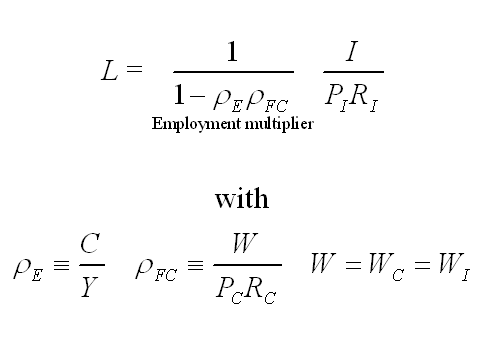
In the following, a sketch of the formally and empirically correct employment theory is given. A rather elementary version of the objective structural Employment Law is shown on Graphic AXEC62
From this equation follows inter alia
(i) An increase in the expenditure ratio ρE leads to higher employment (the letter ρ stands for ratio). An expenditure ratio ρE greater than 1 indicates credit expansion, a ratio ρE less than 1 indicates credit contraction.
(ii) Increasing investment expenditures I exert a positive influence on employment; a slowdown of growth does the opposite.
(iii) An increase in the factor cost ratio ρF≡W/PR leads to higher employment.

The complete AND testable Employment Law is a bit longer and contains, in addition, profit distribution, public deficit spending, and import/export.

Items (i) and (ii) cover Keynes’s arguments about the role of aggregate demand, which have been commonsensically right but formally defective. More precisely, Keynes’s multiplier is provably false. The factor cost ratio ρF, as defined in (iii), embodies the price mechanism which works very differently from what the representative economist falsely assumes. As a matter of fact, overall employment (in the world economy or a closed national economy) INCREASES if the average wage rate W INCREASES relative to the average price P and productivity R.

So, in simple terms, full employment (in any definition) can be achieved by increasing overall demand (expenditure ratio, investment expenditures, etc.) or by INCREASING the average wage rate or by a combination of the two.

Both the Walrasian and Keynesian approaches have produced misleading policy advice. Unemployment is ultimately the result of theory failure, that is, of the utter scientific incompetence of economists ― more precisely of orthodox AND heterodox economists.

By again and again recycling theories that have already been refuted, the pedagogy blog is treading water, keeps students away from the cutting edge of research, and ultimately hampers an effective employment policy.

Egmont Kakarot-Handtke


References
Kakarot-Handtke, E. (2012). Keynes’s Employment Function and the Gratuitous Phillips Curve Disaster. SSRN Working Paper Series, 2130421: 1–19. URL
Kakarot-Handtke, E. (2014). Mr. Keynes, Prof. Krugman, IS-LM, and the End of Economics as We Know It. SSRN Working Paper Series, 2392856: 1–19. URL
Kakarot-Handtke, E. (2015). Essentials of Constructive Heterodoxy: Employment. SSRN Working Paper Series, 2576867: 1–11. URL

#1 For details of the big picture, see cross-references New Curriculum

September 23, 2016

False hopes

Comment on Lars Syll on ‘Wren-Lewis trivializing Romer’s critique’

Blog-Reference

From the fact that DSGE/RBC is a failed research program does not follow that Keynesianism is a progressive alternative. Axel Leijonhufvud’s critique of neo-Walrasian Orthodoxy is spot on but he, too, is moving for three decades into the wrong direction, see The economic Sisyphus: Forever kicking the can down the wrong road.

Egmont Kakarot-Handtke


Related 'No future for axiomatically false economics'.