Showing posts sorted by relevance for query zero sum. Sort by date Show all posts

July 10, 2017

Zero-sum capitalism

Comment on Chris Dillow on ‘The crisis of positive-sum capitalism’

Blog-Reference and Blog-Reference and Blog-Reference

You say: “Is capitalism a positive-sum or zero-sum game? The answer is both: Smith and Marx both had a point.”

False answer. The correct answer is NEITHER because the profit theory is provably false since Adam Smith/Karl Marx. #1 And this 200+ years old blunder makes that economics will not even appear in a footnote of the history of sciences, or at best as a cautionary example.

In order to see this, one has to go back to the most elementary economic configuration, that is, the pure production-consumption economy, which consists only of the household and the business sector.

The elementary production-consumption economy is, for a start, defined by three macro axioms (Yw=WL, O=RL, C=PX), two conditions (X=O, C=Yw), and two definitions (Qm≡C−Yw, Sm≡Yw−C), and from this follows IMMEDIATELY that Qm≡−Sm. #2

This equation says that the business sector’s deficit (surplus) equals the household sector’s surplus (deficit). Put bluntly, monetary loss is the counterpart of monetary saving, and monetary profit is the counterpart of monetary dissaving. This is the most elementary form of the macroeconomic Profit Law. The elementary production-consumption economy clearly is a zero-sum system, i.e., Qm+Sm=0, but NOT a zero-profit game.

Profit for the economy as a WHOLE has NOTHING to do with productivity, the wage rate, the working hours, exploitation, competition, innovation, capital, power, monopoly, monopsony, waiting, risk, greed, the smartness/stupidity of capitalists, or any other subjective factors. Total profit/loss is, in the most elementary case, objectively determined with the precision of two decimal places by the change of the household sector’s debt.

The balances of the business sector, the household sector, the government sector, and the foreign trade sector are interrelated as follows: Qm≡−Sm+I+Yd+(G−T)+(X−M), and this is the Profit Law for an open economy (X−M) with a government sector (G−T) and with business investment I and distributed profit Yd.

Let Yd, I, X, M be zero for the moment, so Qm≡−Sm+(G−T). Then, the counterpart of an increased public deficit (G−T) is either increased saving of the household sector, Sm or increased profit of the business sector Qm or some combination of the two. In the past decades, the US households increased their debt, that is, they were dissaving, i.e., Sm was negative (−(−Sm) gives +). So, BOTH the private and public households ran deficits. From the equation above follows that this boosted monetary profit Qm TWICE. And this is exactly what has been observed and criticized as a catastrophic deterioration of the income distribution.

When the pivotal concept of profit is not properly understood, the rest of the analytical superstructure of economics falls apart, and there is NO USE AT ALL to stumble and mumble about capitalism as a zero-sum game. #3

Egmont Kakarot-Handtke


#1 The Profit Theory is False Since Adam Smith and Profit for Marxists
#2 For the complete verbal and graphics-supported description of the elementary production-consumption economy, see How the intelligent non-economist can refute every economist hands down
#3 For the far-reaching implications of systemic zero-sum, see Mathematical Proof of the Breakdown of Capitalism.

Related 'Profit theory in less than 5 minutes' and 'Economists: scientists or political clowns?' and 'Profit and stupidity' and cross-references Profit

***
COMMENT on Tom Hickey, peterc on Jul 10

Note that capitalism breaks down ― NOT for social reasons but for mathematical reasons. #1


#1 Mathematical Proof of the Breakdown of Capitalism

July 4, 2020

Economists: at the end of the wrong track

Comment on Barkley Rosser on ‘July 24 Society For Chaos Theory In Psychology And Life Sciences Conference’

Blog-Reference

As usual, Barkley Rosser promotes cargo cult stuff. Cargo cult was the name that Feynman gave the ‘social sciences’, in order to clearly distinguish them from genuine science. Here are some programmatic highlights from the ongoing aberration:

• "Applications of prisoner's dilemma modeling in search of a more socially just dominant strategy: Overcoming anxiety associated with group oppression: Lessons from a single case study"
• "Stability swtiching in Cournot duopoly games with three delays"
• "Covid-19 and the nonlinear dynamics of everyday life"

All this fits perfectly with Feynman's definition: “They’re doing everything right. The form is perfect. ... But it doesn’t work. ... So I call these things cargo cult science because they follow all the apparent precepts and forms of scientific investigation, but they’re missing something essential.”

The essential insight that economists are missing is that they are for 200+ years now on the wrong track, i.e., in the wrong Paradigm. Economics is not a 'social science' but a systems science.#1, #2

For Barkley Rosser, it is too late, but for those who are fed up with 200+ years of proto-scientific garbage and want to know what the Paradigm Shift looks like, there is now the first scientifically valid economics textbook available.#3

Egmont Kakarot-Handtke


#1 Wikipedia, economics, scientific knowledge, or political agenda pushing?
#2 Your economics is refuted on all counts: here is the real thing
#3 Sovereign Economics

Related 'Dilettantes at the end of the coal-pit' and 'Modern macro moronism' and 'Economics: 200+ years of scientific incompetence and fraud'.

***
REPLY to Fred C. Dobbs on Jul 5

You say, “Kanye West tweets he’s running for president this year.”

That’s a nice try to distract from the fact that Barkley Rosser is promoting the agenda of the Society for Chaos Theory in Psychology And Life Sciences. The title reminds one immediately of a $30 bill.

Note that economists do not know to this very day what profit is. They are simply too stupid for the elementary algebra that underlies macroeconomics. Just check the proof. #1 What do you think one can learn from failed economists about psychology or any other topic?

Nothing. Right.

By the way, if Caligula made his horse a Roman consul, Kanye West can be made president. What goes on in contemporary politics is old hat in academia. After all, Barkley Rosser has been made an economics professor. And he is not as smart as a horse.

#1 Wikipedia, economics, scientific knowledge, or political agenda pushing?
Section Provably false

***
REPLY to Barkley Rosser on Jul 6

Name-dropping again ... the world's leading blablahblah ... cited many tens of thousands of times ... Princeton ... RAND ... John von Neumann ... And almost all are best buddies of the academic busybody Barkley Rosser.

Yes, Barkley Rosser, you know a lot of people from the academic entertainment industry, too bad that you have no idea how the economy works.

You say, “It is true that economists have used game theory a lot, but they did not invent it, and people from many other disciplines have used it.” Did it ever occur to you that game theory is zero-sum and that the market economy is not zero-sum? For 200+ years now, macroeconomic profit is obviously greater than zero. So, to begin with, game theory does NOT apply to economics. Von Neumann’s Theory of Games and Economic Behavior is plain methodological BS because it gets the pivotal economic concept of profit wrong.

And you hang around in academia and all these pointless conferences and have not realized that something is deeply wrong with economics. Guess what, it has nothing to do with animal behavior or the nonlinear dynamics of armed groups in Yemen and Pakistan.

Learn economics, Barkley Rosser. The canonical textbook Sovereign Economics#1 is your last chance.


#1 Amazon or BoD

***
REPLY to Barkley Rosser on Jul 7

You say, “Wow, I have not seen you fall so spectacularly on your face practically ever. I do not know where you went to econ grad school, but apparently they did not teach you even the most elementary game theory.” and “Sorry, Egmont, but no, it is not in general zero sum. Indeed, the classic example of it not being zero sum is that most famous of cases you poked at: the prisoner's dilemma.”

Take notice first, Barkley Rosser, that the term game theory covers TWO different approaches, that of von Neumann and that of Nash. The prisoner's dilemma belongs to Nash. Von Neumann had only utter contempt for the Nash approach (see Mirowski, who has extensively dealt with the issue).

Here is the summary: “Finally, algorithmic rationality infected game theory itself, changing von Neumann’s original project considerably. The Nash Equilibrium, for Mirowski the paradigm case of the ‘rationality of the paranoid’ (p. 343), stands for him in marked contrast to von Neumann and Morgenstern’s earlier work. Mirowski points to various sources that report von Neumann’s rejection of the equilibrium concept; further, he finds in Nash’s work all of the ingredients that had beset the Cowles Commission: ‘hyper-individualism, non-accessible utility functions, constrained maximization, and cognition as a species of statistical inference’ (p. 348). The Nash equilibrium, Mirowski concludes, is to be seen as a ‘logical extension of the Walrasian general equilibrium tradition into the Cold War context’ (p. 339), but not as a continuation of von Neumann’s project.”#1

Obviously, it is you who is not familiar with the most elementary facts about game theory. No surprises here.

The term zero-sum game relates to the von Neumann approach and has nothing to do with the prisoner's dilemma.

Von Neumann was well aware that there are non-zero-sum n-person games, but he transformed them into zero-sum games with the introduction of the n+1th player.

Take notice, second, that von Neumann had no idea of what macroeconomic profit is. There are three references to profit in the index and they tell you that von Neumann did not understand the essence of economics. He simply redefined utility as profit for the entrepreneur, see footnote 2 on p. 33 ToG.

No way leads from game theory in any version to macroeconomic profit.#2 Game theory is essentially a new version of the old angels-on-a-pinpoint blather that is so beloved in scientifically incompetent academic circles, of which you are a card-carrying member.

Economics is a fake science, and you are living proof.


#1 Economica Till Gruene
#2 Wikipedia, economics, scientific knowledge, or political agenda pushing?

***
REPLY to Barkley Rosser on Jul 8

The lethal defect of game theory is that neither von Neumann nor Nash got the foundational economic concept of profit right. This defect they share with the representative economist to this very day.

So, this whole set-theoretical fireworks with Brower's and Kakutani's fixpoint theorems is scientifically beside the point and serves only to train mentally retarded economists to dance around false-hero memorials.

Von Neumann got his math from Hilbert in Göttingen. There, he was one of many talented mathematicians. He learned soon that he could sell his talent at a premium in the United States. In an environment that runs on the principles of show business, he hyped himself or was hyped to the status of mathematical demi-good (Mirowski, Machine Dreams).

Von Neumann was on the payroll of the military and he died as an alcoholic in the Institute for Advanced Salaries as he himself called it. In sum, von Neumann was instrumental in weaponizing mathematics and swapping the principles of science for the dictates of show business. In the history of science, von Neumann will feature as one of the corruptors of mathematics.

The sickest joke in the sick story of game theory is that the foundational blunder of economics lies on the level of elementary algebra.#1 So much for the achievements of mathematical economics. It is proto-scientific garbage, just like the rest of economics.

Here is the three-step program for the New Paradigm
1. Defund economics.
2. Fire economists.
3. Scrap the lot and start again. (J. Robinson)


#1 Your economics is refuted on all counts: here is the real thing

***
REPLY to Barkley Rosser on Jul 8

You say: “What? Joan Robinson accepted your wacko profit theory, Egmont? I never knew.”

Of course, you know nothing because you are not only stupid but also lazy. Go to the library and get Robinson, J. (1956). The Accumulation of Capital. London: Macmillan. See pp. 400-402.

“… an excess of investment over saving is an undistributed profit to the firm, …” (p. 402), and this corresponds formally to equation (32) in my 2011 working paper Keynes’s Missing Axioms.

Do you need more proof of your utter scientific incompetence, wacko Barkley?

***
REPLY to Barkley Rosser on Jul 9

You say, “I have never said that your theory is wrong, but rather that it is a vcuous tautology. Everybody knows about retained earnings, and it is a matter of no importance except slightly in determining investment.”

No, you did not say that my profit theory is wrong, you said that it is wacko.

You try to suggest that for me “… thinking about retained earnings is the most important thing in economics, …”.

No, the most important thing in economics is to get the foundational concept of profit right. And the fact of the matter is that economics is provably false on this all-decisive score for 200+ years.#1

Economics is NOT a science, economists are NOT scientists but clowns and useful idiots in the political Circus Maximus. The representative economist is stupid or corrupt or both. The economics Nobel is a fraud.


#1 Your economics is refuted on all counts: here is the real thing

***
REPLY to Barkley Rosser on Jul 10

You say, “The wacko part is that you think it is important. It is utterly trivial. It is rather like somebody deciding that the fundamental key to understanding all of mathematics is to realize that 7 + 2 = 9. This is certainly true, and it is also something that anybody who knows even basic arithmetic knows.”

By trying to trivialize the absolutely devastating proof that economists got profit wrong for 200+ years, you shoot yourself in the head.

Ultimately, the Profit Law for the investment economy, i.e., Qm≡I−Sm, is indeed trivial. It is elementary algebra. The point is that economists are too stupid for elementary algebra.#1 And because of this, they get profit for the elementary production-consumption economy, i.e. Qm≡−Sm, wrong, and then the more complex investment economy with profit distribution, i.e. Qm≡Yd+I−Sm, and so on. By consequence: because economists are too stupid for the elementary algebra of macroeconomic profit determination, the whole analytical superstructure of economics is provably false. As a consequence, economic policy guidance has never had sound scientific foundations.

This proven scientific incompetence does not only apply to Barkley Rosser, it applies also to his faculty. More, it applies to ALL economics faculties in the United States, and it applies to the American Economic Association and the peer-reviewers of its journals. ALL these folks get the trivial algebra of profit wrong.


#1 See section ‘Provably false’ in Wikipedia, economics, scientific knowledge, or political agenda pushing?

***
REPLY to Barkley Rosser on Jul 11

You say “Weil, Egmont, my evolutionary game theorist friend, Bill Sandhlm may have just blown his brains out, at least he did himself in somehow or other. Perhaps he read your recent writings and took them too cloaely to heart. Heck, he might even have come to believe that 2=7=10. ”

The University of Wisconsin–Madison says “Colleagues knew Bill as “a genuine scientist; detail-oriented, open-minded, and uncompromising in the pursuit of truth,” “a humble scholar with an enormous love for research,” “an exceptional human being, generous with his time,” “kind and supportive to all, and a cherished mentor.” and “After years of struggling with depression, Bill ended his life earlier this week.”

June 25, 2019

The Palgrave Dictionary ― a comprehensive collection of false-hero memorials

Comment on Barkley Rosser on ‘Learning The Origin Of “Duality”’

Blog-Reference

Barkley Rosser reports: “Yesterday I learned that the person who first used the term ‘duality’ in connection with linear programming, indeed with anything in economics, was John von Neumann in a private conversation with George Dantzig in 1947, the ‘father of linear programming.’ That was the year Dantzig published his paper showing the simplex method for solving linear programming problems, bot their primals and their duals. … It is not really surprising that it would be von Neumann as there are deep links between oprimizing programming and game theory.”

Yes, indeed, and the deep link is in the Walrasians axioms. The hardcore propositions of microeconomics are given with: “HC1 economic agents have preferences over outcomes; HC2 agents individually optimize subject to constraints; HC3 agent choice is manifest in interrelated markets; HC4 agents have full relevant knowledge; HC5 observable outcomes are coordinated, and must be discussed with reference to equilibrium states.” (Weintraub)

This axiom set contains a lot of NONENTITIES, a fact that did not escape the mathematicians: “Walras approached Poincaré for his approval. ... But Poincaré was devoutly committed to applied mathematics and did not fail to notice that utility is a nonmeasurable magnitude. ... He also wondered about the premises of Walras’s mathematics: It might be reasonable, as a first approximation, to regard men as completely self-interested, but the assumption of perfect foreknowledge ‘perhaps requires a certain reserve’.” (Porter)

The next mathematician to realize that Walrasian mathematics was not up to standards was von Neumann: “You know, Oskar, if those books are unearthed sometime a few hundred years hence, people will not believe they were written in our time. Rather, they will think that they are about contemporary with Newton, so primitive is their mathematics. Economics is simply still a million miles away from the state in which an advanced science is, such as physics.”

The two central issues the mathematicians addressed were HC2, i.e., constrained optimization, and HC5, i.e., equilibrium. The end result was General Equilibrium Theory, which is known today to be a failure. #1 The mathematicians fixed the economists’ mathematical blunders #2, #3, but von Neumann uncritically bought into the silly behavioral assumptions of mainstream economics. #4 So, the project of the proper formalization of economics had one fatal drawback: von Neumann left the foundational assumptions untouched: “But this [establishing the analytic mother-structure] required one very crucial maneuver that was nowhere stated explicitly: namely, that the model of Walrasian general equilibrium was the root structure from which all further work in economics would eventuate.” (Weintraub)

Because of this, the NONENTITIES HC2 and HC5 are still with us from choice theory to Game Theory. Strictly speaking, von Neumann messed up the Paradigm Shift, and this is where things stand to this day: “There is another alternative: to formulate a completely new research program and conceptual approach. As we have seen, this is often spoken of, but there is still no indication of what it might mean.” (Ingrao et al.)

Barkley Rosser does not fail to mention that economists have developed the habit to award themselves faux Nobels for their scientific failure and that “it has long been viewed by many as being one of the greatest mistakes and wrongs that when the Nobel Prize was given for linear programming, Dantzig was not one of the recipients, …” Indeed, False-Hero Memorials are the real problem of the cargo cult science economics.

Egmont Kakarot-Handtke


#1 “At long last, it can be said that the history of general theory from Walras to Arrow-Debreu has been a journey down a blind alley, and it is historians of economic thought who seem to have finally hammered down the nails in this coffin. It has been a dead alley because the most rigorous solution of the existence problem by Arrow and Debreu turns general theory into a mathematical puzzle applied to a virtual economy that can be imagined but could not possibly exist, while the extremely relevant ‘stability problem’ has never been solved either rigorously or sloppily. General theory is simply a research program that has run into the sands.” (Blaug)

#2 “The so-called ‘mathematical’ economists in the narrower sense ― Walras, Pareto, Fisher, Cassel, and hosts of other later ones ― especially, have completely failed even to see the task that was before them. Professor Hicks has to be added to this list, which is regrettable because he wrote several years after decisive work had been done ― in principle ― by J. von Neumann and A. Wald.” (Morgenstern)

#3 “Consequently, it was the von Neumann perspective that shaped general equilibrium theory and game theory, and thus reconstituted economic theory. Thus, David Hilbert was the spiritual grandfather of this new economics. (Weintraub) Interestingly, both von Neumann and Einstein got/took their advanced math from Hilbert and the Göttingen School.

#4 “In any event, it seems that Morgenstern finally convinced von Neumann that they must proceed tactically by means of the conciliatory move of phrasing the payoffs in terms of an entity called ‘utility’, but one that von Neumann would demonstrate was cardinal ― in other words, for all practical purposes indistinguishable from money . . .” (Mirowski)

***
REPLY to Barkley Rosser on Jun 26

When the classical economists for a moment stopped writing their silly propaganda pamphlets and watched what was going on in the triumphant sciences they could not fail to notice that calculus was a core element of analysis: “Already Maupertuis considered his minimum principle as proof that the world, where among many virtual movements the one leading to maximum effect with minimum effort is realized, is the ‘best of all worlds’ and work of a purposeful creator. Euler made a similar remark: ‘Since the construction of the whole world is the most eminent and since it originated from the wisest creator, nothing is found in the world which would not show a maximum or minimum characteristic.’ ...” (von Bertalanffy)

Economists had the presence of mind to adopt optimization as a foundational principle, and eventually it became HC2 of the Walrasian axiom set. This is how economics became marginalistic and remained so to this day: “most of what I and many others do is sorta-kinda neoclassical because it takes the maximization-and-equilibrium world as a starting point ...” (Krugman)

Constrained optimization is simple if the assumption of a well-behaved production function is added. In the course of time, mathematicians found solutions for more complicated problems of production, transport, warfare, and the like. This is where Dantzig and Kantorovich came in.

However, while mathematicians developed solutions for real-world problems, economists applied constrained optimization to human behavior. This is the foundational idiotism of microfoundations: “Throughout its history, the idea of some ‘Fundamental Assumption’, some basic ‘Economic Principle’ about human conduct, from which much or most of economics can ultimately be deduced, has been deeply rooted in the procedure of economic theory. Some such notion is still, in many quarters, dominant at the present time. For example, it has recently been stated that the task of economics is ‘to display the structure and working of the economic cosmos as an outgrowth of the maximum principle’.” (Hutchison)

The point is: no way leads from a behavioral assumption (optimization or otherwise) to the understanding of how the economy works. Standard economics is based on behavioral axioms, and this is not a solid enough foundation: “… if we wish to place economic science upon a solid basis, we must make it completely independent of psychological assumptions and philosophical hypotheses.” (Slutsky)

So, mathematicians have done a fine job of solving all kinds of complex optimization problems. This, though, does not alter the fact that microfoundations HC1 to HC5 are proto-scientific garbage and have to be replaced by macrofoundations. This is called a Paradigm Shift, which, as everyone knows by now, has been messed up by the waffling economist Keynes. Economists are simply too stupid for the elementary mathematics that underlies macroeconomics. #1, #2

Economists claim, since Adam Smith, that the free market economy is self-regulating and self-optimizing if left to itself. In reality, it is just the opposite: the real part of the economy is kept on life support by the government, and the monetary/financial part is kept on life support by the Central Bank. #3

Economics is a failed science, and the Bank of Sweden's fake Nobel is the most fraudulent of all False-Hero Memorials. #3


#1 Are economics professors really that incompetent? Yes!
#2 Econ 101: Economists flunk the intelligence test at the first hurdle
#3 The Levy/Kalecki Profit Equation is false

***
REPLY to Barkley Rosser on Jun 27

You say: “Sorry, but a lot of the people you label as ‘economists’ were or are really mathematicians, e.g., von Neumann, Nash, Kantorovich.”

No. My point is that it was mathematicians and not economists who cleared up the mathematical mess of economists and did all the heavy lifting that resulted in General Equilibrium Theory. See Mirowski’s More Heat Than Light for the finer points, especially how mathematically trained engineers who dabbled in economics desperately tried to make economists aware that they applied calculus incorrectly. To no avail, of course.

It is mathematicians who deserve most or all of the credit for solving the tricky optimization problems that were implicit in the (verbalized, i.e., not yet formalized) Walrasian axiom HC2. Solving optimization problems is mathematics and, strictly speaking, not economics. Economics is about how the economic system works. The simple fact of the matter is that General Equilibrium Theory, which is based on HC2, i.e., constrained optimization, and HC5, i.e., equilibrium, does NOT explain how the economy works. This showpiece of the mathematicians’ ingenuity has NO economic content at all. GET belongs to the “... crop of monster-structures, entirely without application.” (Bourbaki)

To award an economics “Nobel” to a mathematical achievement has to be seen as an attempt to give the cargo cult science economics the appearance of genuine science.

Von Neumann’s contribution has to be seen in the context of the ideological/physical war capitalism/USA vs communism/Russia, and the involvement of mathematicians/physicists in the development of the atom bomb. Von Neumann recommended himself to the US military with his famous statement: “If you say why not bomb them tomorrow, I say why not today? If you say today at five o’clock, I say why not one o’clock?” (Wikiquote)

The US military needed the most advanced mathematics available on the planet, so von Neumann was sent to Göttingen: “In 1926 von Neumann went to Göttingen on a Rockefeller fellowship to work as Hilbert’s assistant. Göttingen was not only one of the centers of mathematics, but it also was a mecca of theoretical physics; thus in Göttingen von Neumann could familiarize himself with the latest developments concerning quantum mechanics. Hilbert himself gave lectures on the mathematical foundations of quantum mechanics in the academic year 1926-1927. Von Neumann attended these lectures, and working out the lecture notes taken during those lectures led to a joint publication and eventually to von Neumann’s three ground breaking papers on the mathematical foundations of quantum mechanics that served as the basis of his book.” #1

Not to forget, Game Theory is not so much about parlor games or the problems of incarcerated mobsters or strategic economic behavior as about war games.

What von Neumann learned from Hilbert was the crucial importance of axiomatization: “When we assemble the facts of a definite, more-or-less comprehensive field of knowledge, we soon notice that these facts are capable of being ordered. This ordering always comes about with the help of a certain framework of concepts... The framework of concepts is nothing other than the theory of the field of knowledge. ... If we consider a particular theory more closely, we always see that a few distinguished propositions of the field of knowledge underlie the construction of the framework of concepts, and these propositions then suffice by themselves for the construction, in accordance with logical principles, of the entire framework. ... The procedure of the axiomatic method, as it is expressed here, amounts to a deepening of the foundations of the individual domains of knowledge — a deepening that is necessary for every edifice that one wishes to expand and to build higher while preserving its stability.” (Hilbert)

Note that the Theory of Games and Economic Behavior is axiomatized.

You say: “To the extent what they [the mathematicians] did id not good because of a failure to allow for a macrofoundatiions and that amounts to recognizing your silly profit accounting, your comments are just irrelevant and silly, Egmont.”

What I actually say is that ECONOMISTS are too stupid for the elementary mathematics that underlies macroeconomics. This is a provable fact.

Since Keynes, neither Post-Keynesians nor New Keynesians nor Anti-Keynesians have realized that I=S is false and has to be replaced by Q≡I−S, with Q representing macroeconomic profit. What Hilbert called “the framework of concepts” is false in economics to this day.

Needless to emphasize that you neither understand the problem of the proper axiomatization of economics nor the macroeconomic Profit Law. So, you are the ideal person to work on a new edition of the Palgrave collection of False-Hero-Memorials of the cargo cult science economics.

Economics is a failed/fake science, and the Palgrave Dictionary, and you are part of it. Economics needs a Paradigm Shift from false Walrasian microfoundations and false Keynesian macrofoundations to true macrofoundations.


#1 PDFs.semanticscholar Miklós Rédei, John von Neumann 1903-1957

***
REPLY to Barkley Rosser on Jun 28

Let’s return to the main point: “According to George Dantzig, the duality theorem for linear optimization was conjectured by John von Neumann immediately after Dantzig presented the linear programming problem. Von Neumann noted that he was using information from his game theory, and conjectured that two person zero sum matrix game was equivalent to linear programming.” #1

Von Neumann identified the Walrasian approach as given with the verbalized axioms HC1 to HC5 as petitio principii (TOG p. 15), that is, as methodologically unacceptable. #2 So, he introduced a new set of axioms: “An exact and exhaustive elaboration of these ideas requires the use of the axiomatic method.” (TOG p. 19) The formulation of a new set (TOG p. 24 f..) amounts to a Paradigm Shift.

Note, in particular, von Neumann’s general remark on axiomatization: “The axioms should not be too numerous, their system is to be as simple and transparent as possible, and each axiom should have an immediate intuitive meaning by which its appropriateness may be judged directly.” (TOG p. 25)

Generally speaking, von Neumann’s approach is (i) behavioral and (ii) bottom-up. In this, it resembles the Walrasian approach. Both may be put together under the label microfoundations. Now, the correct approach to economics is (i) structural and (ii) top-down. For good methodological reasons, economics has to be macrofounded.

Game Theory is predicated on von Neumann’s specification of utility (TOG p. 15) and this leads to the concept of zero-sum games: “In game theory and economic theory, a zero-sum game is a mathematical representation of a situation in which each participant’s gain or loss of utility is exactly balanced by the losses or gains of the utility of the other participants.” #3 Note that there is a quite subtle transition from utility (ordinal) to profit (cardinal): “In 1944, John von Neumann and Oskar Morgenstern proved that any non-zero-sum game for n players is equivalent to a zero-sum game with n+1 players; the (n+1)th player representing the global profit or loss.” #3

And exactly here is the lethal blunder: global profit or loss cannot be determined within the framework of Game Theory.

Here is the axiomatically correct proof. The elementary production-consumption economy is defined with this set of macroeconomic axioms: (A0) The economy consists of the household and the business sector, which, in turn, consists initially of one giant fully integrated firm. (A1) Yw=WL wage income Yw is equal to wage rate W times working hours. L, (A2) O=RL output O is equal to productivity R times working hours L, (A3) C=PX consumption expenditure C is equal to price P times quantity bought/sold X.

Note that this set satisfies von Neumann’s general criteria of proper axiomatization as quoted above.

Under the conditions of market-clearing X=O and budget-balancing C=Yw in each period, the price as the dependent variable is given by P=W/R. This is the macroeconomic Law of Supply and Demand.

The focus is here on the nominal/monetary balances. For the time being, real balances are excluded, i.e., it holds X=O. The condition of budget balancing, i.e., C=Yw, is now skipped. The monetary saving/dissaving of the household sector is defined as S≡Yw−C. The monetary profit/loss of the business sector is defined as Q≡C−Yw. Ergo Q≡−S.

The balances add up to zero. The mirror image of household sector saving S is the business sector loss (-Q). The mirror image of household sector dissaving (-S) is business sector profit Q. Q≡−S is the elementary version of the macroeconomic Profit Law.

From Q+S=0, one could conclude that economics is a zero-sum game between the business sector and the household sector. However, this is only the first half of the truth. From the fact that profit comes from dissaving, it follows that the household sector accumulates debt (overdrafts at the central bank) while the business sector accumulates money (deposits at the central bank). Now, debt has to be eventually repaid, and this inverts the whole game: profit Q in period t is exactly annihilated by loss (-Q) in period t+1. The mirror image is dissaving (-S) in t and saving S in t+1. The result of these interlocked zero-sum games is zero profit over all periods.

The monetary economy is an intertemporal zero-sum game, and the n+1th player is the future. This is the reason why capitalism will eventually break down and NOT Marx’s phony Revolution of the Proletariat. The intertemporal zero-sum theorem fully replaces folk psychology/ sociology. Note that the intertemporal zero-sum theorem holds for a monetary economy that is for capitalism AND communism, AND anything in between. Which in turn proves that political economics has NEVER been anything other than proto-scientific garbage of the worst sort.


#1 Wikipedia Duality (optimization)
#2 Petitio principii — economists’ biggest methodological mistake
#3 Wikipedia Zero-sum game
#4 The Levy/Kalecki Profit Equation is false

March 13, 2017

How Arrow pushed economics over the cliff

Comment on Lars Syll on ‘Kenneth Arrow (1921-2017)’

Blog-Reference and Blog-Reference on Apr 8 adapted to context

The inevitable failure of economics started with Jevons/Walras/Menger, but Arrow gave the final push with this fundamental methodological specification: “It is a touchstone of accepted economics that all explanations must run in terms of the actions and reactions of individuals. Our behavior in judging economic research, in peer review of papers and research, and in promotions, includes the criterion that in principle the behavior we explain and the policies we propose are explicable in terms of individuals, not of other social categories.” (Arrow, 1994)

The definition of the subject matter translates into the following hardcore propositions, a.k.a. axioms: “HC1 economic agents have preferences over outcomes; HC2 agents individually optimize subject to constraints; HC3 agent choice is manifest in interrelated markets; HC4 agents have full relevant knowledge; HC5 observable outcomes are coordinated, and must be discussed with reference to equilibrium states.” (Weintraub, 1985)

Obviously, this axiom set contains three NONENTITIES: (i) constrained optimization (HC2), (ii) rational expectations (HC4), (iii) equilibrium (HC5). Every theory/model that contains a NONENTITY is a priori false. As a consequence, the General Equilibrium Theory of the Arrow-Debreu type and its offspring down to DSGE/RBC/New Keynesianism is scientifically worthless.

Egmont Kakarot-Handtke


Related 'Where economics went wrong' and 'Economics is NOT a misunderstanding but cargo cultic crap' and 'Modern macro moronism' and 'There is no scientific elite in economics' and 'Note on Lars Syll on Axiomatization' and 'Economists ― medics or barber-surgeons?' and 'Microfoundations have been for 150+ years: high time t.o move on' and 'Show first your economic axioms or get out of the discussion' and 'The Logical Interface Between Objective Macrofoundations and Subjective Valuations' and cross-references Axiomatization and cross-references Paradigm Shift

***
REPLY to Norman L. Roth on Mar 15

You say: “You appear to be unaware of the great John Stuart Mill’s wisdom about the nature of axioms.”

What John Stuart Mill said about methodology is this: “In the definition which we have attempted to frame of the science of Political Economy, we have characterized it as essentially an abstract science, and its method as the method à priori.”

The foundational question for the application of what today is called the axiomatic-deductive method is what the axioms are: “What are the propositions which may reasonably be received without proof? That there must be some such propositions all are agreed, since there cannot be an infinite series of proof, a chain suspended from nothing. But to determine what these propositions are, is the opus magnum of the more recondite mental philosophy.” (Mill)

It was pretty obvious to Mill that the axiomatic-deductive method is NOT a formal exercise that is detached from reality, just the contrary: “The ground of confidence in any concrete deductive science is not the à priori reasoning itself, but the accordance between its results and those of observation à posteriori.”

Mill’s understanding of methodology is identical with that of modern physics: “He [Dirac] identified three revolutions in modern physics ― relativity, quantum mechanics, and cosmology ― and hinted that he expected them one day to be understood within a unified framework. Although he did not mention John Stuart Mill, Dirac was seeking to answer the same question posed in A System of Logic: ‘What are the fewest general propositions from which all the uniformities existing in nature could be deduced?’” (Farmelo)

The inexcusable scientific blunder of Arrow consists of messing up the axiomatic foundations of economics. More precisely, methodological individualism and the neo-Walrasian axiom set HC1/HC5 (above) are one of the greatest embarrassments in the history of the sciences. #1

Only scientific imbeciles like the representative economist accept green cheese behavioral assumptions like constrained optimization, rational expectations, and equilibrium as axiomatic foundations of economics. #2 General Equilibrium Theory is what Feynman called cargo cult science, and Arrow was a fake scientist. All this follows from the methodological wisdom of John Stuart Mill.


#1 Economics is NOT a misunderstanding but cargo cultic crap and Where economics went wrong
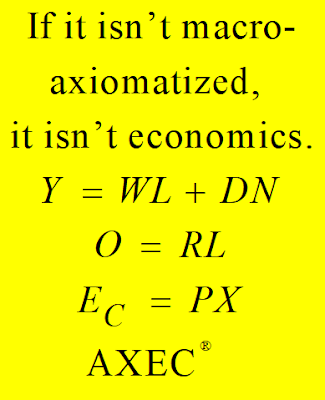
#2 If it isn’t macro-axiomatized, it isn’t economics


***
REPLY to mulp on Apr 9

To put equilibrium (HC5) into the premises/axioms is a methodological blunder that is known since antiquity as petitio principii. #1

Your argument: “Zero-sum is … one of the truest axioms in nature. Thus, economics must be zero-sum.” is beside the point because zero-sum and equilibrium are two entirely different things. #2

To be axiomatically false is the death sentence for a Paradigm. Therefore it holds: (i) because of material/formal inconsistency General Equilibrium Theory can never be admitted to the corpus of science; GET is cargo cult science, (ii) Arrow can never be admitted to the scientific community, (iii) because the representative economist does not understand what science is all about he has not realized (i)/(ii) until this very day.

GET and its acceptance by economists, is one of the greatest embarrassments in the history of science.


#1 For details, see here.
#2 The zero-sum requirement is satisfied, i.e., Qm+Sm=0, see also here.

***

Graphic AXEC121i

June 23, 2019

The Levy/Kalecki Profit Equation is false
Comment on Alex Barrow/Macro Ops on ‘Minsky and the Levy/Kalecki Profit Equation’

Blog-Reference (Link)

Alex Barrow comes directly to the point: “Let’s kick things off with the Levy/Kalecki Profit Equation. The Profit Equation is just a macroeconomic accounting identity for how the global economy actually operates. Specifically, it answers the question as to where ‘Profits’ come from and thus, growth.” #1

And this is the answer: “The actual accounting identity looks like this: Profits before tax = + Investment – Nonbusiness saving + Dividends + Corporate profits taxes. This accounting identity, which, like any identity, holds true under any circumstance, is just saying that corporate profits are the direct result of net investment minus nonbusiness (Households + Government + rest of world) saving before dividends and corporate taxes are paid out.”

And this is the rationale: “Well, if you pull back and look at the global economy as a whole, it’s a closed system. It's closed in the sense that profits aren’t magically appearing from anywhere outside of the global economy. But profits obviously aren’t a zero-sum game. If one company earns profits, it doesn’t necessarily mean that another company somewhere has to be operating at a loss. There wouldn’t be any growth if that was the case. So, where do profits come from then?”

Yes, where? “The answer is in net investment, which is a positive-sum game. If we divide the economy into our four aggregate entities (1) US Corporations (2) Households (3) All levels of US Government and (4) the Rest of the World (RoW) and look at them as a whole, there needs to be net positive investment as a whole for there to be profits. Profits are essentially the result of expanding balance sheets (increases in debt). The more balance sheets expand, the lower interest rates need to drop in order to decrease debt servicing costs and keep the cost of capital down for marginally profitable firms — essentially keep the economy from going into free fall.”

Alex Barrow, respectively his source, derives the Profit Equation with the help of the identity method. More specifically:

“II. FINDING THE SOURCES OF PROFITS: THE IDENTITY METHOD
Profits, Saving, and Investment
Aggregate profits, after corporate income taxes and dividends have been paid out, are the wealth the business sector accumulates during a period of time. Of course, businesses are not the only ones accumulating wealth ― households, government, and foreign entities also do so. The wealth the business sector accumulates is equal to the total new wealth created in the economy less that accumulated by the other sectors. In economics, the accumulation of wealth is called saving, and the creation of wealth is called investment. By common sense, the new wealth the economy accumulates equals the new wealth the economy creates; that is, saving equals investment.” and “But no matter what accounting system one uses, saving will always equal investment.” #2

This is NOT correct. On closer inspection, common sense gets the accounting identity mathematically wrong. #3 To make matters short, here is the proof. #4, #5

The elementary production-consumption economy is defined with this set of macroeconomic axioms: (A0) The economy consists of the household and the business sector, which, in turn, consists initially of one giant fully integrated firm. (A1) Yw=WL wage income Yw is equal to the wage rate W times working hours. L, (A2) O=RL output O is equal to productivity R times working hours L, (A3) C=PX consumption expenditure C is equal to price P times quantity bought/sold X.

Under the conditions of market-clearing X=O and budget-balancing C=Yw in each period, the price as the dependent variable is given by P=W/R. The elementary production-consumption economy is shown under the label Graphic. #6

The focus is here on the nominal/monetary balances. For the time being, real balances are excluded, i.e. it holds X=O. The condition of budget balancing, i.e., C=Yw, is now skipped. The monetary saving/dissaving of the household sector is defined as S≡Yw−C. The monetary profit/loss of the business sector is defined as Q≡C−Yw. Ergo Q≡−S.

The balances add up to zero. The mirror image of household sector saving S is business sector loss −Q. The mirror image of household sector dissaving (-S) is business sector profit Q. Q≡−S is the elementary version of the macroeconomic Profit Law.

In other words, saving is NOT equal to investment (because there is NO investment in the elementary production-consumption economy), but saving is equal to loss.

So, Alex Barrow’s assertion is false: “ it [the global economy as a whole] is a closed system. Its closed in the sense that profits aren’t magically appearing from anywhere outside of the global economy. But profits obviously aren’t a zero-sum game.” No, but profit/loss of the business sector and dissaving/saving of the household sector is a zero-sum game, i.e., Q+S=0.

When more sectors are added, the macroeconomic Profit Law reads with increasing complexity:
(i) Q≡−S in the elementary production-consumption economy,
(ii) Q≡I−S in the elementary investment economy,
(iii) Q≡(I−S)+(G−T)+Yd in the investment economy with government deficit/surplus (G−T), and distributed profit Yd.

The macroeconomic Profit Law fully replaces the false Profit Equations of Levy/Kalecki. #7-#12 The fact that the Profit Equation and the Profit Law look similar at the surface does not alter the fact that the Profit Equation is “educated common sense” (Stigum) and lacks proper scientific foundations.

Crucial conclusions: The monetary economy breaks down ― at the latest ― if macroeconomic profit Q turns negative. At the moment, the U.S. economy is on full life support of the government, i.e., the government deficit (G−T) is where the greater part of profit actually comes from. It is the government that prevents “the economy from going into free fall”.

The policy of deficit-spending/money-creation clearly benefits the Oligarchy because it increases macroeconomic profit according to the Profit Law, which entails Public Deficit = Private Profit. Thus, the Oligarchy’s financial wealth and public debt (currently $22 trillion) grow in lockstep. The Profit Law explains the extremely skewed distribution of income and financial wealth.

Economists claim, since Adam Smith, that the free market economy is self-regulating and self-optimizing if left to itself. In reality, it is just the opposite: the real part of the economy is kept on life support by the State, and the monetary/financial part is kept on life support by the Central Bank.

Economics has been proto-scientific garbage for 200+ years now because it does not get the foundational concept of profit right, and the Levy/Kalecki Profit Equation is an integral part of the overall failure.

Egmont Kakarot-Handtke


#1 Macro Ops
#2 The Jerome Levy Forecasting Center, Where Profits Come From
#3 Wikipedia and the promotion of economists’ idiotism (II)
#4 Controlled demolition of MMT ― an exercise in elementary logic
#5 For details of the big picture, see cross-references Refutation of I=S and cross-references Profit/Distribution
#6 Graphic AXEC31 Elementary production-consumption economy


#7 Profit: after 200+ years, economists are still in the woods
#8 Truth by definition? The Profit Theory has been axiomatically false for 200+ years
#9 MMT Progressives: The knife in the back of WeThePeople
#10 MMT and grassroots movements
#11 Kalecki and Keynes: The double macroeconomic false start
#12 MMT: How mathematical incompetence helps the Kelton-Fraud

Related 'Are economics professors really that incompetent? Yes!' and 'Refuting MMT’s  Macroeconomics Textbook' and '#DrainTheScientificSwamp' and 'Macroeconomics: Drain the scientific swamp' and 'Is Nick Rowe stupid or corrupt or both?' and 'Keynes, Kalecki, MMT, and the accidental invention of the perpetual profit machine' and 'The failure of Post-Keynesianism' and 'Kalecki got it wrong, Allais got it right' and 'Rethinking deficit spending' and 'MMT Progressives: The knife in the back of WeThePeople' and 'Keynes’s Missing Axioms'.

***

Graphic AXEC143g  Profit Law (with increasing complexity) and Balances Equation

October 23, 2016

Economics between science and magic

Comment on Anonymous on Noah Smith on ‘Do economists have physics envy?  Pt2’

Blog-Reference and Blog-Reference on Oct 26

You say: “Yes, magic is orders of magnitude more abundant in physics than in economics. But Economists make more money...uhmm, ...”.

The emotionally powerful common core of magic, physics, alchemy, biology, and economics is the idea of the creatio ex nihilo, the creation out of nothing, the making of gold out of dreck, life out of dead matter, the perpetual motion machine, the free lunch, something for nothing.

So, you are plainly wrong. In fact, magic and magical thinking are more abundant in economics than anywhere else. Actually, economists are occupied with nothing else. And, let us face it, it seems that economists have made the gold makers' dream come true. They have uncovered the magic formula, and it spells free-market economy.

The classical economists advertised themselves as gold makers: “... in the introduction to Book IV we read that Political Economy ‘proposes to enrich both the people and the sovereign,’ and it is this definition which expresses both what Smith wanted above everything and what interested his readers more than anything else.” (Schumpeter, 1994, p. 186)

Marx was a real spoilsport. He, too, was occupied with the magic formula M―C―M+ (alternatively written as M―C―M'), that is, how it is possible to make more money (= M+) out of money (= M). His answer is known as surplus theory, or in simple pejorative terms, exploitation. C in his formula stands for capital/capitalism.

Nowadays, the focus has moved from the sphere of production to the monetary sphere and more and more people get crazy about the fact that the Fed can create money out of nothing and that bankers can charge interest for this feat.

Ordinary people have discovered that home-sweet-home, too, creates wealth over time seemingly out of nothing and can, therefore, be turned into an ATM.

The magical phenomenon of the market economy is profit. And the true magician knows how to make it. However, there is a nagging problem. Physicists have shown that because of the law of energy conservation something like value creation, i.e. something out of nothing, is impossible in principle. Only energy transformation is possible. Physical reality is a zero-sum game (with entropy ignored).

This idea also occurred to economists: “... since it is impossible to have an economy where everyone is making profits. Aggregate profit for an entire (closed) economy must be zero, hence if any firm is making profits, some other firm must be making losses.” (Boland, 1992, p. 80)

On the other hand, one can point to the indisputable fact that the market economy is NOT a zero-sum game. In the last 200+ years, overall profit in the market economies has been greater than zero. Something is very strange and magical here: profit seems to prove that something can come out of nothing. This, though, is against the iron rule of all of economics: “There is no such thing as a free lunch.”

What is even more strange: economics claims to be a science but cannot explain profit, or as Mirowski put it: “... one of the most convoluted and muddled areas in economic theory: the theory of profit.”

According to scientific criteria, economics is a failure. Neither Walrasians, Keynesians, Marxians, nor Austrians have figured out what profit is or can tell the difference between profit and income.#1 Economics is a proto-science and still stands where physics stood in the Middle Ages before the elementary concepts of force, mass, and energy were properly defined and clearly understood.

Compared to physicists, economists have achieved virtually nothing of scientific value in the last 200+ years. How, then, does it come that they make more money than physicists, as Noah Smith gleefully points out to debunk the old cliche of physics envy?

Quite simply, economists are magicians and have found the formula for how to transmute scientific trash into gold.

Egmont Kakarot-Handtke


#1 The Profit Theory is False Since Adam Smith

Related 'Gold-making, wine from water, M―C―M+, perpetuum mobile, free lunch, beating the stock market, and the perennial human dream' and 'Mathematical Proof of the Breakdown of Capitalism'.

Related 'Economics between physics and psychiatry'

November 6, 2017

On the saying “We owe the debt to ourselves”

Own post, no external Blog-Reference

The best-known meme of Functional Finance and MMT with regard to internal public debt is “We owe it to ourselves” which is to say that there is nothing at all to worry about.

The growth of public debt is usually discussed within the Walrasian or the Keynesian framework. The problem is that both the microfoundations approach and the macrofoundations approach are axiomatically false. Methodologically, it holds: if the axioms are inconsistent, the whole analytical superstructure falls apart. Because of this, it is necessary to shift to the correct macrofoundations and to rethink the whole issue of public deficits/debt. #1

As the correct analytical starting point, the elementary production-consumption economy is defined with this set of macro axioms: (A0) The objectively given and most elementary configuration of the economy consists of the household and the business sector, which in turn consists initially of one giant fully integrated firm. (A1) Yw=WL wage income Yw is equal to wage rate W times working hours. L, (A2) O=RL output O is equal to productivity R times working hours L, (A3) C=PX consumption expenditure C is equal to price P times quantity bought/sold X.

Under the conditions of market-clearing X=O and budget-balancing C=Yw, the price is given by P=C/X=W/R, i.e., the market-clearing price is in the initial period equal to unit wage costs. This is the most elementary form of the macroeconomic Law of Supply and Demand. For the graphical representation, see Figure 1. #2

Monetary profit for the economy as a whole is defined as Qm≡C−Yw, and monetary saving as Sm≡Yw−C. It holds Qm≡−Sm, in other words, the business sector’s surplus = profit (deficit = loss) equals the household sector’s deficit = dissaving (surplus = saving). This is the most elementary form of the macroeconomic Profit Law. Under the condition of budget balancing, total monetary profit is zero.

There are three alternatives of how to redistribute output between the household and the government sector: (i) taxation, (ii) public deficit spending and compensatory household sector saving, (iii) public deficit spending with newly created money.

(i) The government needs, for some legitimate reason, a part of the output in period 1 and decides to tax the wage income receivers. Wage income is unchanged, Yw1=Yw, and disposable income is then Yw1−T1. The consumption expenditures of the household sector fall by the same amount under the condition of budget balancing, i.e., Ch1=Yw1−T1. Taken together, total expenditures of the household and government sector remain unchanged, i.e. Ch1+Cg1=C. The government sector’s budget is balanced, i.e., Cg1=T1. Accordingly, one has these three sectoral balances.

Qm1≡Ch1+Cg1−Yw   monetary profit/loss, business sector,
Sm1≡Yw−T1−Ch1     monetary saving/dissaving, household sector,
Bm1≡T1−Cg1           surplus/deficit, government sector,
----------------------
Qm1+Sm1+Bm1=0 with Qm1=0, Sm1=0, Bm1=0.

The market-clearing price remains unchanged, i.e. P1=P=W/R. The real share of the household sector is Oh1=Ch1/P1 and of the government sector Og1=Cg1/P1 with Oh1+Og1=O1=O.

Thus, the transfer of a share of current output from the household to the government sector is completed. In the following periods, government taxation and spending are again zero. Everything is as it was in the initial period.

(ii) The government needs a part of the current output but does not tax the wage income receivers. Instead, a group A of the households saves, thus that household sector saving Sm1≡Yw1−Ch1 is exactly equal to government spending, i.e., Sm1=Cg1. Total expenditures remain unchanged, i.e., C1=Ch1+Cg1=C. The real shares of output are exactly equal to the taxation variant (i). The balances now look as follows.

Qm1≡Ch1+Cg1−Yw   monetary profit,
Sm1≡Yw−Ch1          monetary saving,
Bm1≡−Cg1              government sector deficit,
---------------------
Qm1+Sm1+Bm1=0 with Qm1=0, Sm1>0, Bm1<0.

The public debt (= stock) has been zero and is at the end of the first period equal to the deficit Cg1. It may accumulate in subsequent periods or not. The household sector’s savings (= stock) have been zero and are at the end of the first period equal to Sm1. Both amounts are exactly equal, and it is assumed that the government debt is fully consolidated by selling bonds to group A of the households = savers = creditors.

All households are taxed beginning with period 2, thus that the total of lump-sum individual tax is equal to the total of interest payments that go to the creditor households A. As a result, the disposable income of the creditor households increases, and that of the complementary group B decreases. So, for the duration of the debt, an income redistribution takes place. It is NOT the case that “we” pay interest to “ourselves” but group A + B = “we” pay to group A = creditor households. The net income increase of group A is interest minus lump-sum tax of group A. Compared to the taxation case (i), group A is better off, and group B is worse off, depending on the interest rate and the duration of the debt.

Eventually, the public debt is redeemed. All households A+B are taxed in period t, and the sum goes to the creditor households A. The tax in period t, i.e., Tt, is equal to the public debt Cg1. The households spend their current income, i.e., Ct=Ywt, the lump-sum tax is paid by dissaving. The balances now look as follows.

Qmt≡Cht−Yw       monetary profit, Cht=Yw,
Smt≡Yw−Tt−Cht   monetary dissaving, Smt=−Tt,
Bmt≡Tt               government budget surplus,
------------------
Qmt+Smt+Bmt=0 with Qmt=0, Smt<0, Bmt>0.

At the end of period t, the public debt is again zero. The household sector as a whole ends up with total savings of zero, which are composed of deposits of group A and overdrafts of group B. The public debt becomes, in part, private debt = overdrafts at the central bank after the completion of the whole cycle. Group A can pay the tax out of savings and is left with deposits at the central bank. Group B is left with overdrafts of an equal amount.

So, public deficit spending plus compensatory household sector saving amounts to a deferred tax for the household sector as a whole. Instead of paying the tax in period 1, the household sector pays in period t. For the duration of the tax deferment, a redistribution of income from all taxpayers A+B to creditor households A takes place. The statement “We owe the debt to ourselves” is misleading. “We”, i.e. A+B, owe the debt to A. Compared to taxation, (i) deficit spending (ii) makes group B worse off. In addition, group B is left with private debt at the end of the process.

Only if all households A+B save the same amount and are taxed the same amount, the whole process is distributionally neutral.

(iii) The government again runs a budget deficit. Now, the households do not save but spend the whole period income Ch1=Yw1=Yw. Government spending is given with Cg1, and taxes T1 are zero. Total expenditures are now C1=Ch1+Cg1 and this yields a price hike: P1=C1/X=(Ch1+Cg1)/X=P+Cg1/X with market-clearing X=O.

The redistribution of output between the household sector and the government sector, that is, the REAL taxation, is now realized via the price mechanism and becomes thereby invisible. If deficit spending is exactly repeated period after period, the price remains at the elevated level; otherwise, it falls back to the initial level. The balances now look as follows.

Qm1≡Ch1+Cg1−Yw    monetary profit, Ch1=Yw, Qm1=Cg1,
Sm1≡Yw−Ch1           monetary saving,
Bm1≡−Cg1               government budget deficit,
---------------------
Qm1+Sm1+Bm1=0 with Qm1>0, Sm1=0, Bm1<0.

The amount Cg1 = government budget deficit comes from the central bank, i.e., is created out of nothing. The two sides of the central bank’s balance sheet, overdrafts and deposits, rise by the same amount. The newly created money ends in the ‘cash box’ of the business sector, i.e. government sector’s overdrafts = business sector’s deposits. It is assumed that the government consolidates its overdrafts by selling bonds to the business sector. So overdrafts and deposits at the central bank vanish completely.

The household sector is then taxed with a lump-sum tax, and the interest payments go to the business sector for the duration of the public debt. There is no redistribution of income between different groups within the household sector. The creditor is now the business sector. #3

Eventually, the public debt is redeemed. All households are taxed in period t, and the total of the lump-sum tax, Tt=Cg1, goes to the business sector. The tax reduces current spending Cht<Yw. This causes the market-clearing price to fall. The balances now look as follows.

Qmt≡Cht−Yw         monetary loss, Cht<Yw,
Smt≡Yw−Tt−Cht     monetary saving, Tt+Cht=Yw, Smt=0,
Bmt≡Tt                 government budget surplus,
-------------------
Qmt+Smt+Bmt=0 with Qmt<0, Smt=0, Bmt>0.

Monetary loss for the economy as a whole is now given by Qmt=Cht−Yw=−Tt. The loss in period t is exactly equal to the profit of period 1. Deficit spending again amounts to a tax deferment for the household sector. The difference to variant (ii) is that the tax is not paid by dissaving but by saving in period t, which causes the loss of the business sector. Eventually, the real taxation, i.e., the output transfer of period 1, is trailed in the nominal sphere. The household sector gains NOTHING by this delay. Just the opposite, the balanced budget case is the most advantageous for the household sector. Alternative (iii), i.e., budget deficit with money printing, is the most advantageous for the business sector. This is the version that is promoted by MMT and the other deficit spenders. #4

To argue in favor of deficit spending with the slogan “We owe the debt to ourselves” is either a testimonial of utter scientific incompetence or deliberate political deception of the general public.

Egmont Kakarot-Handtke


#1 10 steps to leave cargo cult economics behind for good
#2 Graphic AXEC31 Elementary production-consumption economy


#3 Gov-Deficits do NOT cause inflation
#4 Keynesianism as ultimate profit machine

Related 'Settling the Theory of Saving' and 'Meet the MMT smart arses' and 'No MMT illusions! YOU are going to pay for it' and 'How to pay for the war and to be bamboozled by economists' and 'Stephanie Kelton sells children into debt slavery'. For details of the big picture, see cross-references Profit/Distribution.

***

Graphic AXEC168

September 6, 2018

MMT and the single most stupid physicist

Comment on Charles Adams on ‘The single most important piece of economics that everyone should know.’

Blog-Reference and Blog-Reference and Blog-Reference on Sep 8

Charles Adams correctly states: “There are few things in economics that are true so when we find one we should cling on to that. Something that is true is that the sum of all sectors is zero. This is a simple accounting identity. Basically, someone (or sector) can only be in surplus because someone else (or another sector) has lent them the money.” and “If we aggregate all the sectors into only just two, public and private, then it follows summing to zero means that when we plot their respective surpluses or deficits they will be a mirror image of one another. In words, the public sector's deficit is the private sector's surplus or vice versa, or as Stephanie Kelton puts it succinctly in this video, the government's red ink is our black ink.”

The physicist Charles Adams is obviously just as stupid or corrupt or both as MMT's Stephanie Kelton. #1, #2 In fact, he is even worse because he has not realized that the MMT accounting identity/sectoral balances equation has already been refuted. #3, #4

To make matters short, here is the gist of the proof:

• The objectively given and most elementary systemic configuration of the economy consists of the household and the business sector, which in turn consists initially of one giant fully integrated firm.

• The elementary production-consumption economy is given with three axioms, two conditions, and two definitions, i.e., monetary profit/loss Qm≡Ec−Yw, monetary saving/dissaving Sm≡Yw−Ec. Legend: Ec consumption expenditures, Yw wage income.

• It always holds Qm≡−Sm, in other words, the business sector’s monetary profit/loss Qm equals the household sector’s monetary dissaving/saving −Sm.

• For the more complex economy, the axiomatically correct balances equation reads (X−M)+(G−T)+(I−Sm)−(Qm−Yd)=0, which reduces to Qm=G−T, that is, Public Deficit = Private Profit. #5, #6

• In marked contrast, the false MMT balances equation reads (X−M)+(G−T)+(I−S)=0, which reduces to S=G−T.

It is a curious fact that in Charles Adams’ The single most important piece of economics that everyone should know’ the word profit does not appear once despite the fact that profit is the single most important variable in economics. #7

This tells one that Charles Adams has NO idea of what he is talking about.

Egmont Kakarot-Handtke


#1 Down with idiocy!
#2 The Kelton-Fraud
#3 Wikipedia and the promotion of economists’ idiotism (II)
#4 For the full-spectrum refutation of MMT, see cross-references MMT
#5 MMT: How mathematical incompetence helps the Kelton-Fraud
#6 DSGE and profit―forget it! MMT and profit―forget it!
#7 MMT and the magical profit disappearance

***
REPLY to Ed Zimmer on Sep 9

You say: “E.K-H’s so-called axioms don’t even hold up to elementary common sense.”

In the meantime, even the most retarded folks should have realized that common sense never has been and never will be a valid argument in a scientific debate.

About the relationship between common sense and science, all has been said by the great methodologist J. S. Mill 150+ years ago: “People fancied they saw the sun rise and set, the stars revolve in circles round the pole. We now know that they saw no such thing; what they really saw was a set of appearances, equally reconcilable with the theory they held and with a totally different one. It seems strange that such an instance as this, ..., should not have opened the eyes of the bigots of common sense, and inspired them with a more modest distrust of the competency of mere ignorance to judge the conclusions of cultivated thought.” #1, #2, #3


#1 Why J. S. Mill had no friendly word for the bigots and votaries of common sense
#2 The bigots of common sense
#3 Misled by ordinary intuition and common sense

***
REPLY to Matt Franko on Sep  9

Charles Adams states: “There are few things in economics that are true so when we find one we should cling on to that. Something that is true is that the sum of all sectors is zero. This is a simple accounting identity.”

You say: “Anyone can regurgitate an accounting identity.”

I say: “The axiomatically correct accounting identity reads in the most elementary case Qm+Sm=0 and the MMT identity is provably false.” #1, #2

Can you now write down your accounting identity? This is the precondition for determining which one is true.

After all, we are dealing with ‘The single most important piece of economics that everyone should know.’


#1 Wikipedia and the promotion of economists’ idiotism (I)
#2 Wikipedia and the promotion of economists’ idiotism (II)

***
REPLY to Ed Zimmer, Tom Hickey on Sep 10

The axiomatically correct accounting identity reads in the most elementary case Qm≡−Sm, in words, macroeconomic profit/loss is the complement of dissaving/saving, or, as Charles Adams put it in general terms, “the sum of all sectors is zero”. The number of sectors is two, to begin with. This is the irreducible minimalist configuration. Analytically, this is the correct starting point.

The 3-bar symbol indicates a definition. A definition introduces a new variable that is composed of the axiomatically given variables, which are connected by mathematical operators. This technicality has been explained elsewhere and is of no importance in the present context.

The decisive point is that monetary profit for the business sector as a whole Qm depends alone on the dissaving of the household sector as a whole −Sm and NOT on productivity, the wage rate, exploitation, monopoly, market power, union strength, greed, profit maximization, etcetera which, in turn, means that the familiar microeconomic explanations of profit are false for 200+ years. And this, in turn, means that Distribution Theory is false. And this, in turn, means that economics is proto-scientific garbage from the founding fathers onward to MMT. #1

For the complex economy with more than two sectors follows the axiomatically correct balances equation (X−M)+(G−T)+(I−Sm)−(Qm−Yd)=0 #2, which is obviously different from the false MMT balances equation (X−M)+(G−T)+(I−S)=0. #3

The bottom line is that MMTers got the macroeconomic accounting identity wrong. This is a mathematical fact. #4 It tells the world that economists in general and MMTers, in particular, are too stupid for the elementary mathematics that underlies macroeconomic accounting. #5 It is a grave state of affairs when the elementary equation Qm+Sm=0 is beyond the understanding of academics.


#1 Ricardo, too, got profit theory wrong
#2 Go! ― test the Profit and Employment Law
#3 Rectification of MMT macro accounting
#4 Wikipedia and the promotion of economists’ idiotism (II)
#5 For details of the big picture, see cross-references Accounting

***

REPLY to Tom Hickey, Matt Franko on Sep 10

Charles Adams deals with ‘The single most important piece of economics that everyone should know.’

Charles Adams correctly states: “There are few things in economics that are true so when we find one we should cling on to that. Something that is true is that the sum of all sectors is zero. This is a simple accounting identity. Basically, someone (or sector) can only be in surplus because someone else (or another sector) has lent them the money.”

Up to this point, all is fine in general terms.

In concrete terms, it holds for the two-sector economy (business, household) Qm≡−Sm (i).

For the three-sector economy (business, household, government) holds Qm+Sm−(G−T)=0 or Qm+Sm=(G−T) (ii), i.e. business sector’s profit Qm plus the household sector’s saving Sm is equal to the government sector’s deficit (G−T). #1

Up to this point, all is fine in accounting terms. But now comes the MMT blunder/fraud. Charles Adams says: “If we aggregate all the sectors into only just two, public and private, then it follows summing to zero means that when we plot their respective surpluses or deficits they will be a mirror image of one another. In other words, the public sector's deficit is the private sector's surplus or as vice versa, or as Stephanie Kelton puts it succinctly in this video, the government's red ink is our black ink.”

The sleight of hand consists of the tacit introduction of an additional/redundant definition S≡Qm+Sm, i.e. private sector surplus S is the sum of the business sector’s profit Qm and the household sector’s saving Sm.

So, eq. (ii) Qm+Sm=(G−T) becomes S=(G−T) (iii), i.e., “our” black ink S is the government’s red ink (G−T). The MMT fraud consists of lumping “their” profit Qm and “our” saving Sm together to “our” black ink.#2 H okuspokus Simsalabim, profit is gone and then is heard no more when MMTers climb on a soapbox or advise Bernie Sanders and straightforwardly push their Wall Street/City of London agenda of deficit spending (G−T)>0, which results in “their” profit Qm for any given amount of “our” saving Sm, i.e., Public Deficit = Private Profit.

Outside academic economics, to let profit disappear is called accounting fraud, and accountants are sent to jail for it. This is ‘The single most important piece of economics that everyone should know.’


#1 Rectification of MMT macro accounting
#2 The Kelton-Fraud

***
REPLY to Ed Zimmer on Sep 10

You say: “E.K-H’s basic error is believing an ‘identity’ (3-bar symbol) is different from an ‘equality’ (2-bar symbol), which is simply not the case for numerical variables …”

The elementary production-consumption economy is given by three macroeconomic axioms (A1) Yw=WL wage income Yw is equal to wage rate W times working hours. L, (A2) O=RL output O is equal to productivity R times working hours L, (A3) Ec=PX consumption expenditure Ec is equal to price P times quantity bought/sold X.

The axiom set consists of 4 real variables L, R, O, X, and 4 nominal variables Yw, W, Ec, P.

From these variables, only a subset reappears in macroeconomic accounting, viz., the nominal flows Ec and Yw.

Now, two new variables are introduced. Monetary profit of the business sector Qm is defined as Qm≡Ec−Yw (i) and monetary saving of the household sector Sm as Sm≡Yw−Ec (ii).

The 3-bar symbol ≡ means in the given context “is defined as”. #1

It obviously holds Qm+Sm=0 when (i) and (ii) are inserted. In the words of Charles Adams, “Something that is true is that the sum of all sectors is zero.” #2

This statement follows logically from the axioms (A1) to (A3) and the definitions (i) and (ii).


#1 Wikipedia List of mathematical symbols
#2 In the comment section, Adams refers explicitly back to Stützel, see also Keenonomics, aggregate demand/change of debt, and some misleading critique.

For more about the balance mechanics of Stützel, see AXECquery.