Showing posts sorted by relevance for query label:I=S. Sort by date Show all posts

August 30, 2017

Keynesians ― terminally stupid or worse?

Comment on Dirk Ehnts on ‘Keynes on Savings and Investment’

Blog-Reference and Blog-Reference

Eighty years ago, Keynes got macro wrong and Keynesians did not notice it until this very day.

Dirk Ehnts cites Keynes: “S=I at all rates of investment.” and comments enthusiastically: “This is very enlightening. The ‘General Theory’ also contained the issue of savings and investment, but the quote above nails it. There is no ‘supply’ and ‘demand’ for capital, hence savings and investment do not need anything to move so that there can be equilibrium.”

There is no better proof of the abysmal scientific incompetence of economists in general and of Keynesians in particular than S=I.

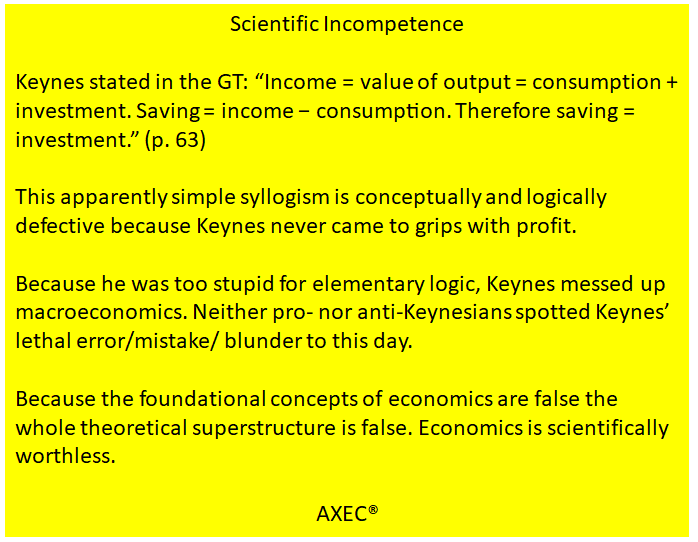
Here is the evidence from the General Theory: “Income = value of output = consumption + investment. Saving = income − consumption. Therefore saving = investment.” (p. 63)

This syllogism is conceptually and logically defective because Keynes did not come to grips with profit. “His Collected Writings show that he wrestled to solve the Profit Puzzle up till the semi-final versions of his GT but in the end he gave up and discarded the draft chapter dealing with it.” (Tómasson et al.)

Because profit is ill-defined, the whole theoretical superstructure of Keynesianism is false. #1 Let this sink in: Keynes had NO idea of the fundamental concepts of economics, viz., profit and income. Keynes, though, was not alone: “... one of the most convoluted and muddled areas in economic theory: the theory of profit.” (Mirowski) The fact is, the profit theory is false since Adam Smith. Economics is scientifically worthless for 200+ years.

What has to be done is to replace Keynes’s false macrofoundations with true macrofoundations. The elementary production-consumption economy is, for a start, defined by three macro axioms (Yw=WL, O=RL, C=PX), two conditions (X=O, C=Yw), and two definitions (monetary profit Qm≡C−Yw, monetary saving Sm≡Yw−C). The graphical representation is shown on Graphic. #2, #3


It always holds Qm≡−Sm, in other words, at the heart of the monetary economy is an identity: The business sector’s deficit equals the household sector’s surplus and vice versa. Put bluntly, the business sector's loss is the counterpart of the household sector's saving, and vice versa, profit is the counterpart of dissaving. This is the most elementary form of the macroeconomic Profit Law. It follows directly from the definition of the business sector’s monetary profit Qm≡C−Yw and the definition of the household sector’s monetary saving Sm≡Yw−C. From this immediately follows that Keynes’ foundational identity “Income = value of output” is false, and After-Keynesians have not realized it to this day.

For the investment economy, the Profit Law reads Qm≡I−Sm. Legend: Qm monetary profit, I investment expenditures, Sm monetary saving/dissaving. The business sector’s investment expenditures and the household sector’s saving/dissaving are completely INDEPENDENT and NEVER equal.

There is NO such thing as equality of investment and saving, neither ex-ante nor ex-post, and there is NO such thing as an equilibrium of I, and S. Keynes was too stupid to understand this, and After-Keynesians are even worse. #4

Egmont Kakarot-Handtke


#1 Why Post Keynesianism Is Not Yet a Science
#2 Graphic AXEC31 The elementary production-consumption economy
#3 How the intelligent non-economist can refute every economist hands down
#4 For details of the big picture, see cross-references Refutation of I=S and cross-references Keynesianism.

***
REPLY to Dirk Ehnts on Sep 1,3 see also here

You say: “I don’t understand your claim because it comes without any argument.”

The proof has been given that Qm≡−Sm in the pure production-consumption economy and Qm≡I−Sm in the elementary investment economy. In plain text, the proof says that saving and investment are NEVER equal. #1

You say: “Regarding wording, how about: ‘saving is the accounting record of investment’? I find it immensely useful!”

In their pathetic incompetence, economists got even the elementary mathematics of accounting wrong. #2 The wording ‘saving is the accounting record of investment’ is the very proof that economists cannot even put 2 and 2 together.

You say: “What I don’t find useful is the inclusion of profits in macroeconomic models.”

Macroeconomic profit exists, and economists should know and tell what it is. Neither orthodox nor heterodox economists do it, though, because they have no idea what the pivotal concept of their subject matter is. #3

You say: “Of course, the question of what drives investment needs to be attacked using the concept of profit, but that is a different question from what determines the level of unemployment, which was Keynes’ question in the GT!”

Keynes’ employment theory is false because I=S ― and, by implication, the multiplier ― is false, which, in turn, is false because Keynes never understood what profit is. #4

Because Keynes’ premise Income = value of output is false, ALL I=S/IS-LM models from Keynes/Hicks to Krugman/Ehnts are provably false. #5, #6

After-Keynesians are light-years behind the curve. The scientific level of economists in general and Dirk Ehnts, in particular, is worse than zero.

#1 How Keynes got macro wrong and Allais got it right and
The Three Fatal Mistakes of Yesterday Economics: Profit, I=S, Employment
#2 A tale of three accountants and cross-references Accounting
#3 Heterodoxy, too, is proto-scientific garbage
#4 Keynes’ Employment Function and the Gratuitous Phillips Curve Disaster
#5 Getting out of IS-LM = Getting out of despair
#6 Mr. Keynes, Prof. Krugman, IS-LM, and the End of Economics as We Know It

***
Graphic AXEC172


***

COMMENT on Nick Edmonds, Dirk Ehnts on Sep 5, see also here

Dirk Ehnts subscribes to: “S = I at all rates of investment. Y either definable as C+S or as C+I. S and I were opposite facets of the same phenomenon they did not need a rate of interest to bring them into equilibrium for they were at all times and in all conditions in equilibrium.”

Nick Edmonds maintains: “The expected real rate of interest is in some sense the price of savings and so, in principle, changes in this expected rate might be able to reconcile desired saving and desired investment. In a barter economy, goods for current delivery can be traded for promises of the same goods for future delivery.”

Keynes was right on two points: (i) he has to be credited for realizing that the economics of Jevons/Walras/Menger/Marshall was false at its core and that nothing less than a paradigm shift was needed, (ii) that economic analysis has to start with the ‘monetary theory of production’ and NOT with some silly barter economy of the Sraffa type. #1

From the analysis of the most elementary economic configuration, the pure production-consumption economy, follows for the balances Qm≡−Sm, in other words, at the heart of the monetary economy is an identity: the business sector’s deficit = loss (surplus = profit) equals the household sector’s surplus = saving (deficit = dissaving). Loss is the counterpart of saving, and profit is the counterpart of dissaving. This is the most elementary form of the macroeconomic Profit Law. #2

This, first of all, tells one that the profit theory is false since Smith and Ricardo. #3 And, secondly, this tells one that the theory of saving and investment is false by implication. It always holds Qm≡I−Sm, that is, investment and saving are NEVER equal, neither in accounting nor in reality. #4

All I=S/IS-LM models are provably false from Wicksell/Keynes/Hicks onward. Because MMT is built upon the false Keynesian balances equations it is false, too. #5


#1 The futile attempt to recycle Sraffa
#2 How the intelligent non-economist can refute every economist hands down
#3 When Ricardo Saw Profit, He Called It Rent: On the Vice of Parochial Realism
#4 Rectification of MMT macro accounting
#5 For the full-spectrum refutation of MMT, see cross-references MMT

January 6, 2019

Why is 0!=1? And why is I≠S? And why economics teaching is rotten

Comment on Lars Syll on ‘Why is 0!=1?’

Blog-Reference

The failed economics teacher Lars Syll indulges in self-promotion: “The single most important factor behind successful education ― from kindergarten to university ― is, and has always been — having a good teacher!”

True, but the situation in economics is this: textbooks and teaching are provably false from microeconomic supply-demand equilibrium to macroeconomic I=S.#1

Here is what good teaching looks like.

Keynes started macroeconomics with: “Income = value of output = consumption + investment. Saving = income − consumption. Therefore saving = investment.” (GT, p. 63)

This proposition is false. Where is the mistake?

The first thing to do is always to clearly state the premises. The elementary production-consumption economy is defined by a set of macroeconomic axioms.

(A0) The objectively given and most elementary systemic configuration of the economy consists of the household sector and the business sector, which, in turn, consists initially of one giant fully integrated firm.
(A1) Yw=WL wage income Yw is equal to wage rate W times working hours. L,
(A2) O=RL output O is equal to productivity R times working hours L,
(A3) C=PX consumption expenditures C is equal to price P times quantity bought/sold X.

In the elementary production-consumption economy, three configurations are logically possible: (i) consumption expenditures are equal to wage income C=Yw, (ii) C is less than Yw, (iii) C is greater than Yw.

In case (i), the saving of the household sector S≡Yw−C is zero, and the profit of the business sector Q≡C−Yw, too, is zero. The product market is cleared, i.e., X=O in all three cases. Accordingly, the market-clearing price as the dependent variable is given by P=W/R.
In case (ii), saving S is positive and the business sector makes a loss, i.e., Q is negative. The market-clearing price P is less than W/R.
In case (iii), saving S is negative, i.e., the household sector dissaves, and the business sector makes a profit, i.e., Q is positive. The market-clearing price P is greater than W/R.

It always holds Q≡−S, in other words, the business sector’s profit is equal to the household sector’s dissaving, and the business sector’s loss is equal to the household sector’s saving.

And that’s it. The mistake in Keynes’ argument lies in the premise that income = value of output. The fact is that the value of output C=PX can be less than wage income Yw. The balance of the two flows, C−Yw is called loss. Loss, as the difference of flows, is different from the flow of wage income. Loss is NOT income.

Analogous in the opposite case, i.e., C>Yw and Q>0. Profit is NOT income either.

In the elementary investment economy, it holds Q≡I−S. Simple algebra and a look at reality tell one that saving is NEVER equal to investment. However, economics teachers explain to their students 80+ years after Keynes why I=S. #2 And every student generation swallows it with a straight face.

Something is rotten with economics teaching.

Egmont Kakarot-Handtke


#1 The father of modern economics and his imbecile kids
#2 #DrainTheScientificSwamp

Related 'Trust in economics as a science?' and 'Fact of life: your econ prof is scientifically incompetent' and 'Textbooks and the mental cloning of dumb economists' and 'How to Get Rid of Supply-Demand-Equilibrium' and 'Economics: 200+ years of scientific incompetence and fraud'. For details of the big picture, see cross-references Econ 101/Old Curriculum/New Curriculum.

August 13, 2025

Occasional X: Economists still get saving/dissaving and loss/profit wrong (III)

October 28, 2015

I=S: Mark of the Incompetent

Comment on JKH and Roger Farmer on ‘Demand Creates its Own Supply’

Blog-Reference

I=S is provably false, but the representative economist never got the point. To some degree, this is understandable because the deeper conceptual problem is that the representative economist does not even know what profit is because, as the Palgrave Dictionairy summarizes “A satisfactory theory of profits is still elusive.” (Desai, 2008, p. 10)

In simple words, this means that all economic models are defective — except those that come explicitly to grips with the foundational economic concept of profit. None are known from Orthodoxy and Heterodoxy. And this, in turn, means that all economic policy advice lacks sound scientific foundations.

The I=S blunder is not a single or isolated event but a rather typical outcome of proto-scientific thinking and widespread misapprehension of scientific methodology. #1

The following economists are representatives of the general intellectual malaise that manifests itself in the longstanding I=S debate. The list could be easily extended. #2


For a crash course in profit theory, see The Profit Law.

Egmont Kakarot-Handtke


References
Desai, M. (2008). Profit and Profit Theory. In S. N. Durlauf, and L. E. Blume (Eds.), The New Palgrave Dictionary of Economics Online, 1–11. Palgrave Macmillan, 2nd edition. URL

#1 The axiomatically correct relationship between monetary profit Qm, distributed profit Yd, investment expenditures I, and monetary saving Sm is given by Qm≡Yd+I−Sm.
#2 For details of the big picture, see cross-references Refutation of I=S

Related 'Fundamentally flawed'.

***
Graphic AXEC172


Graphic AXEC143d


Graphic AXEC129f

December 30, 2014

A simple question

Comment on Lars Syll on  'Mainstream macroeconomics distorts our understanding of economic reality'

This is a thread about macroeconomics. The fundamental equations of macroeconomics have been formulated by Keynes in two lines:

Income = value of output = consumption + investment. Saving = income − consumption. Therefore saving = investment. (Keynes, 1973, p. 63)

Question to psychologists, sociologists, philosophers, soothsayers, econophysicists, engineers, political and theoretical economists of all camps: Is Keynes' elementary syllogism true or false?

Egmont Kakarot-Handtke


References
Keynes, J. M. (1973). The General Theory of Employment Interest and Money. The Collected Writings of John Maynard Keynes Vol. VII. London, Basingstoke: Macmillan.

June 21, 2015

More than two centuries of waffling in the dark

Comment on Nick Edmonds on ‘Keenonomics, aggregate demand/change of debt, and some misleading critique’

Blog-Reference

Nick Edmonds quotes me correctly: “…the business sector’s investment expenditures are never equal to the household sector’s saving..” and then asks: “Does anyone say they are generally equal?”

Yes, and this is well known among economists.

“As is well known, and taking over that argument from Smith, both Ricardo and Malthus in England and Say and Sismondi on the Continent always identified decisions to save with decisions to invest. Since they all considered as a fact that ‘what is annually saved is as regularly consumed as what is annually spent, and nearly in the same time too’ (Smith, 1776, vol. I, pp. 337–8), the question of a possible divergence between saving and investment was never asked.” (Bridel, 1987, p. 1)

Nick Edmonds is ignorant of the history of economic thought. Worse, he does not understand the significance of the question at issue. The I-equals-S assertion is not only more than 200 years old but there has always been an uneasy feeling that there must be something deeply wrong with the whole idea.

“For the best part of the last two centuries, this equality (and the ways by which it comes to be established) has been at the heart of long and protracted debates. Indeed, two of the most fruitful periods in the history of economic thought were entirely devoted to this riddle which, still today, is far from being satisfactorily solved. For all the participants in the ‘general glut controversy’ as well as for Keynes and all the leading economists of the interwar period, the saving-investment problem was the key to macroeconomic stability.” (Bridel, 1987, p. 1)

Some observers correctly noted that nothing had been solved and that the participants could not even rise above the level of senseless filibustering.

“Throughout the 1920s and 1930s the focus was increasingly on the role of the equality of saving and investment, but the semantic squabbles that dominated much of the debate (the distinctions between "ex-ante," and "ex-post," "planned" and "realized" saving and investment, the discussion of whether the equality of saving and investment was an identity or an equilibrium condition) reflected a deeper confusion. It was just not clear how shifts in saving and investment affected output.” (Blanchard, 2000, p. 1378)

Ok, this was in the old days. We have made tremendous progress recently. Nobody talks any more about the equality of saving and investment — except perhaps Paul Krugman: “An excess of desired investment over desired savings can lead to economic expansion, which drives up income. And since some of the rise in income will be saved – and assuming that investment demand doesn’t rise by as much – a sufficiently large rise in GDP can restore equality between desired savings and desired investment at the new interest rate.” (2011)

This is what Adam Smith told us already. The answer to the self-debunking question “Does anyone say they are generally equal?” should be pretty obvious by now.

What I have clearly stated is that all variants of IS stories are provably false and this includes Krugman's IS-LM versions and Wren-Lewis's inventory story and Edmonds definitional shell game (2014), (Wren-Lewis, 2012), (E.K-H, 2014).#1

The irrevocable conclusion is that I-equals-S has always been and still is the epitome of utter confusion and scientific incompetence. And here we can agree: this is all pretty standard stuff in economics.

This brings us to the crucial question: “In economics we should strive to proceed, wherever we can, exactly according to the standards of the other, more advanced, sciences, where it is not possible, once an issue has been decided, to continue to write about it as if nothing had happened.” (Morgenstern, 1941, pp. 369-370)

With Qre≡I−S the issue has been decided. How could Paul Krugman, Simon Wren-Lewis, Nick Edmonds, and not to forget Severin Reissl, be prompted to adhere to the standards of the more advanced sciences?

Egmont Kakarot-Handtke


References
Blanchard, O. (2000). What Do We Know about Macroeconomics that Fisher and Wicksell Did Not? Quarterly Journal of Economics, 115(4): 1375–1409. URL
Bridel, P. (1987). Saving equals Investment. In J. Eatwell, M. Milgate, and P. Newman (Eds.), The New Palgrave Dictionary of Economics Online, pp. 1–5. Palgrave Macmillan, 1st edition. URL
E.K-H (2014). The subtle distinction between storytelling and science. Blogpost. URL
Kakarot-Handtke, E. (2014). Mr. Keynes, Prof. Krugman, IS-LM, and the End of Economics as We Know It. SSRN Working Paper Series, 2392856: 1–19. URL
Krugman, P. (2011). IS-LMentary. New York Times, The Opinion Pages, Online, October 9. URL
Morgenstern, O. (1941). Professor Hicks on Value and Capital. Journal of Political Economy, 49(3): 361–393. URL
Wren-Lewis, S. (2012). Savings Equals Investment? Blog post. URL

#1 See the I=S cross-references for blog posts and the formal proof

March 16, 2017

Economics ― from attention and reputation management to science

Comment on David Glasner on ‘Samuelson Rules the Seas’

Blog-Reference

David Glasner starts his post as follows: “I think Nick Rowe is a great economist; I really do. And on top of that, he recently has shown himself to be a very brave economist, fearlessly claiming to have shown that Paul Samuelson’s classic 1980 takedown … of David Hume’s classic 1752 articulation of the price-specie-flow mechanism … was all wrong. Although I am a great admirer of Paul Samuelson, I am far from believing that he was error-free. But I would be very cautious about attributing an error in pure economic theory to Samuelson.”

What is wrong with this? First of all, it is a matter of indifference whether David Glasner thinks that Nick Rowe or Paul Samuelson is a great economist and which one of them is greater. This Top 10 shop talk may be appropriate in sports and entertainment, but it is entirely misplaced in science. The only thing we want to know about a scientist is whether her/his contribution fits the criteria of material and formal consistency and therefore can be accepted into the corpus of science.

The question of whether Archimedes or Euclid or Copernicus or Galileo or Newton or Schrödinger or Poincaré, or Hilbert has been the greatest scientist is pointless because the very characteristic of creative achievement is that it is unique and incomparable.

So, the real question is what Nick Rowe and Paul Samuelson contributed to science. The answer is NOTHING.

Nick Rowe fools around with silly models and has not even grasped that IS-LM is logically defective. #1

Samuelson messed up economics back in 1948 with his textbook, but his intellectual heirs did not realize it until this very day. In effect, Samuelson established economics as a cargo cult science. #2

In Samuelson’s synthesis, the defective Walrasian microfoundations and the defective Keynesian macrofoundations were cobbled together. #3 Samuelson’s textbook consisted of two halves: microeconomics and macroeconomics. Needless to emphasize that the whole thing was inconsistent.

Science is committed to material and formal consistency. Samuelson’s textbook had arguably the lowermost scientific content of all textbooks ever written. Standard supply-demand-equilibrium will forever stand out as the silliest model in the history of science.

And this is what we have today. There is Orthodoxy with behavioral microfoundations and Keynesianism with structural/systemic macrofoundations. Both these formal foundations are still conceptually and logically defective and incompatible. #4

By comparing the relative merits of what he introduces as great thinkers, David Glasner obscures the fact that neither Nick Rowe nor Paul Samuelson deserves the title of a scientist. In effect, David Glasner reinforces the false impression among the general public that economics is science, while it has never been anything else than cargo cult science. The hazard of proto-scientific economics is that well-meant cheerleading unwittingly turns into public support for scientific impostors.

Science is about true/false and NOTHING else. Economics is a failed science. David Glasner misrepresents the history of economic thought by setting up False-Hero Memorials.

Egmont Kakarot-Handtke


#1 Nick Rowe: Bury me at the end of coal-pit
#2 Wikipedia Cargo cult science
#3 The father of modern economics and his imbecile kids
#4 Where economics went wrong

For details of the big picture, see cross-references Failed/Fake Scientists and cross-references Political Economics/Stupidity/Corruption.

February 8, 2014

Mr. Keynes, Prof. Krugman, IS-LM, and the end of economics as we know it {53}

Working Paper at SSRN
Working paper at ARCHIVE

Abstract  Krugman has recently revitalized IS-LM with a number of succinct analytical pieces on his blog. The reverberations were remarkable. Economists, however, are known often not grasp the full content of their own and, a fortiori, of others' models. This happened to Keynes in the days of high theory and to Krugman these days. Keynes applied a defect formalism, which is here replaced by objective-structural axioms. This yields the correct relationship between retained profit, saving, and investment which in turn makes it clear after the event that the IS-part of the IS-LM construct had been logically defective ab initio.

December 31, 2014

Deflation, saving, and employment

Comment on Asad Zaman on  'Why does aggregate demand collapse?'

Blog-Reference

Of course, you are right that deflation may become a problem. The crucial point is that the popular idea of the functioning of the price mechanism is mistaken. What is needed first is the correct price theory (2014), which delivers the correct Employment Law (2014b, p. 9, eq. (22)). Roughly speaking, if the product price (for the economy as a whole) falls faster than the wage rate, the employment effect is positive under the condition that all other parameters remain unchanged. If the wage rate falls faster, the employment effect is negative. On closer inspection, it turns out that there are two types of deflation. As you rightly pointed out, there are also secondary effects on the real value of debt, but this is a separate issue. Resume: Neoclassical economics got the price mechanism wrong.

Of course, Wolfgang Waldner is also right. If the relation between saving and income increases, the employment effect is negative.

All these effects are captured by the Employment Law, see Graphic AXEC07 and (2014b, p. 9, eq. (22)).


Egmont Kakarot-Handtke


References
Kakarot-Handtke, E. (2014a). Economics for Economists. SSRN Working Paper Series, 2517242: 1–29. URL
Kakarot-Handtke, E. (2014b). The Three Fatal Mistakes of Yesterday Economics: Profit, I=S, Employment. SSRN Working Paper Series, 2489792: 1–13. URL

April 8, 2013

Flawed logic

Comment on Lars Syll on 'IS-LM is bad economics no matter what Krugman says'

Blog-Reference

Lars Syll and Paul Davidson argue (a) that IS-LM is bad economics and (b) that it has not much in common with Keynes' economic reasoning in the General Theory.

I agree with both points. My question is a more fundamental one. Does this clarification make the General Theory look much better?

Let me resume the point that I have made at length in: Why Post Keynesianism is Not Yet a Science, Economic Analysis and Policy, March 2013, pp. 95-106. There is no need to lose many words about equilibrium, ergodicity, or the finance motive because Keynes' formalism is logically defective. This is sufficient to refute it and with it all illegitimate IS-LM derivatives.

Hence, we have to go one step further: it is not so simple that IS-LM is bad economics and Keynes is good economics; both are bad economics and for the same reason.

Keynes' profit theory is false. The correct relation reads Qret≡I−S, i.e., retained profit is equal to the difference between the business sector's investment and the household sector's saving. Since retained profit for the economy as a whole is always different from zero, we have empirical proof that investment and saving are, as a corollary, never equal. The ex-ante/ex-post argument can be shown to be logically defective. Because the IS schedule of IS-LM is formally unacceptable, the whole argumentation built upon it is vacuous. Free association, interpreting IS-LM, or reading tea leaves is scientifically on the same level. What unites Keynes, Hicks, and Krugman, as well as their critics, is the same logical flaw in the formal foundations.

Egmont Kakarot-Handtke


Related 'How Keynes got macro wrong and Allais got it right'.

June 13, 2017

Simpleminded losers

Comment on Paul Krugman on ‘Macroeconomics: The Simple and the Fancy’

Blog-Reference and Direct-Link and Blog-Reference

“In order to tell the politicians and practitioners something about causes and best means, the economist needs the true theory or else he has not much more to offer than educated common sense or his personal opinion.” (Stigum)

The fact of the matter is that economists do NOT have the true theory. More precisely, economists do not know how the price- and profit mechanism works. The four main approaches ― Walrasianism, Keynesianism, Marxianism, Austrianism ― are mutually contradictory, axiomatically false, materially/formally inconsistent, and all got profit wrong.

In science, the primary question is NOT about the simple or the fancy but about the true and the false, with truth well-defined as material and formal consistency. The point is that BOTH the simple and the fancy models are provable false. This includes Paul Krugman’s IS-LM version.#1

Economics is a failed science and Paul Krugman is a failed scientist.#2 Since Adam Smith, economic policy guidance never has had sound scientific foundations. It is as simple as that.

Egmont Kakarot-Handtke


#1 Mr. Keynes, Prof. Krugman, IS-LM, and the End of Economics as We Know It
#2 For details see references Just another wreck.

November 23, 2024

Occasional X: Clueless economists / Profit (LXI)


March 28, 2016

Stanley Fischer: Rewarding scientific incompetence

Comment Stanley Fisher on ‘Reflections on Macroeconomics Then and Now’

Blog-Reference

Stanley Fischer starts the meaty part of his talk with: “I will start by briefly sketching the structure of a basic macro model. The building blocks of this model are similar to those used in many macro models, including FRB/US, the Fed staff's large-scale model, and a variety of DSGE models used at the Fed and other central banks and by academic researchers.
The structure of the model starts with the standard textbook equation for aggregate demand for domestically produced goods, namely:
1. AD = C + I + G + NX;
2. Next is the wage-price block, which is based on a wage or price Phillips curve.” (See intro)

We can stop already here because this is definitively the false start. In order to see where things went wrong one has to return to the very beginnings of macroeconomics. Keynes defined the formal foundations of the General Theory as follows: “Income = value of output = consumption + investment. Saving = income − consumption. Therefore saving = investment.” (1973, p. 63)

This elementary syllogism is conceptually and logically defective because Keynes never came to grips with profit and therefore “discarded the draft chapter dealing with it.” (Tómasson et al., 2010, p. 12). As a result, all I=S models including the Keynesian multiplier are false (2011; 2014). Neither the proponents nor the opponents of mainstream macro got this point to this day. Stanley Fischer is only one among the many.

When the foundational economic concept of profit is inconsistently defined then the whole theoretical superstructure is a flawed construction without any scientific value whatsoever. No policy recommendation can be drawn from such a model. Because of this, the macro policy discussions from Keynes/Hicks/Samuelson/Friedman onward have been surrealistic. All participants lacked the correct profit theory and this continues to this day.

First of all, Keynes’ fundamental equations of macroeconomics have to be fully replaced.#1 This yields (i) the correct Profit Law (2014, eq. (18)), and (ii), the correct Employment Law/ Phillips Curve (2012, eq. (33)).

Because the first two building blocks of Fischer’s ‘basic macro model’ are false the whole thing is worthless. During his long career, Fischer obviously did not get the point. He never understood the pivotal phenomenon of economics and, clearly, when one does not understand profit one cannot understand how the economy works.

Already J. S. Mill tried to excuse economics as ‘separate science’. Its distinctive features are (i) the foundational concepts profit/income are inconsistent for more than 200 years, (ii) the FRB/US, the Fed and other central banks, as well as academic researchers blindly apply false models, and (iii), evident scientific incompetence is not punished but rewarded.

As an urgent first step, economics has to be excluded from the sciences, and both orthodox and heterodox economists have to be thrown out of the scientific community.

Egmont Kakarot-Handtke


References
Kakarot-Handtke, E. (2011). Why Post Keynesianism is Not Yet a Science. SSRN Working Paper Series, 1966438: 1–20. URL
Kakarot-Handtke, E. (2012). Keynes’s Employment Function and the Gratuitous Phillips Curve Disaster. SSRN Working Paper Series, 2130421: 1–19. URL
Kakarot-Handtke, E. (2014). The Three Fatal Mistakes of Yesterday Economics: Profit, I=S, Employment. SSRN Working Paper Series, 2489792: 1–13. URL
Keynes, J. M. (1973). The General Theory of Employment Interest and Money. The Collected Writings of John Maynard Keynes Vol. VII. London, Basingstoke: Macmillan.
Tómasson, G., and Bezemer, D. J. (2010). What is the Source of Profit and Interest? A Classical Conundrum Reconsidered. MPRA Paper, 20557: 1–34. URL

#1 Finalizing the Keynesian Revolution and Toward the true economic axioms.

December 1, 2016

Rethinking deficit spending

Comment on Roger Farmer on ‘Three Facts about Debt and Deficits’

Blog-Reference

You say: “Economics has the reputation of being the dismal science.” The most dismal thing about economics is that it is NOT a science.#1

In order to understand the failure of economics in general and Walrasianism, Keynesianism, Marxianism, Austrianism in particular one has, first of all, to realize that there is political economics and theoretical economics. The founding fathers called themselves political economists, that is, they left no doubt that their main business was agenda pushing. Economists never got out of political economics. In other words, theoretical economics (= science) ultimately could not emancipate itself from political economics (= agenda-pushing).

It holds: “In order to tell the politicians and practitioners something about causes and best means, the economist needs the true theory or else he has not much more to offer than educated common sense or his personal opinion.” (Stigum)

Economists do NOT have the true theory. This holds also for Keynesianism and the concept of deficit-spending. What Keynes and the After-Keynesians never understood is the all-important relationship between deficit and profit.

Keynes defined the formal core of the General Theory as follows: “Income = value of output = consumption + investment. Saving = income − consumption. Therefore saving = investment.” (p. 63)

This syllogism is defective because Keynes never came to grips with profit: “His Collected Writings show that he wrestled to solve the Profit Puzzle up till the semi-final versions of his GT but in the end he gave up and discarded the draft chapter dealing with it.” (Tómasson et al.)

Keynes had NO idea of the fundamental concepts of economics, viz. profit and income. Because profit is ill-defined the whole theoretical superstructure of Keynesian macroeconomics falls apart.#2

But things are even worse. Because economists in general and Keynesians, in particular, do not understand profit they do not understand what deficit spending really means: “When government is added to the elementary production-consumption economy then it holds under the condition of zero investment of the business sector and zero saving of the household sector Qm=G−T, that is, the overall monetary profit of the business sector is positive if the government sector runs a deficit and negative if the government sector runs a surplus.”#3 In simple terms: Public Deficit = Private Profit.

Whatever Keynes intended or argued about deficit spending is irrelevant. Because he did not understand the elementary economic relationship between deficit and profit, he de facto initiated the greatest profit boost in the history of humankind. The actual distributional problems are ultimately the handiwork of Keynes. In fact, no economist has done more for the one-percenters than Keynes.#4

You cite three trivial facts about deficits and debt and have NO idea about the most important fact, that is, the relationship between deficit and profit.#5

Egmont Kakarot-Handtke


#1 FakeNews, FakeScience: economics in the information age
#2 From false micro to true macro: the new economic Paradigm
#3 Wikipedia and the promotion of economists’ idiotism
#4 Keynesianism as ultimate profit machine
#5 For details of the big picture see cross-references Incompetence

***
REPLY to franco on Dec 2

The paper you refer to (Levy et al., 2008) indeed addresses the fundamental issue of economics ‘Where Profits Come From’ but gives the wrong answer. For the formal refutation of the Levy approach, see the working paper ‘Keynes’s Missing Axioms’ (2011b)

For the correct explanation see ‘The Emergence of Profit and Interest in the Monetary Circuit’ (2011a).

The lethal error/mistake/blunder of the Levy approach consists in starting with Saving = Investment (2008, p. 6).

For the most elementary explanation of why Saving = Investment has ALWAYS been false and of why Saving = Loss resp. Dissaving = Profit is true see (2015).#1


References
Kakarot-Handtke, E. (2011a). The Emergence of Profit and Interest in the Monetary Circuit. SSRN Working Paper Series, 1973952: 1–22. URL
Kakarot-Handtke, E. (2011b). Keynes’ Missing Axioms. SSRN Working Paper Series, 1841408: 1–33. URL
Kakarot-Handtke, E. (2015). How the Intelligent Non-Economist Can Refute Every Economist Hands Down. SSRN Working Paper Series, 2705395: 1–6. URL
Levy, D. A., Farnham, M. P., and Rajan, S. (2008). Where Profits Come From. 1–28. URL

#1 For details of the big picture see cross-references Refutation of I=S and in particular The final implosion of MMT

April 11, 2016

No ground to lose

Comment on Brad DeLong on ‘Yes, in Some — Many — Ways Our Macro Debate has Lost Intellectual Ground since the 1930s. Why Do You Ask?’

Blog-Reference

The point of interest is not so much the economic policy debate or who said what. The core issue is that all that is said in macro has no sound foundation. Because economists lack the true theory, all arguments/proposals are hanging in midair. So, what Wren-Lewis, Friedman, Viner, Knight, etc. ever uttered about monetary/fiscal policy is not different from old Roman haruspicy, i.e., the reading of poultry entrails.

This starts with Keynesian macro. Keynes defined the formal foundations of the General Theory as follows: “Income = value of output = consumption + investment. Saving = income − consumption. Therefore saving = investment.” (1973, p. 63)

This two-liner is conceptually and logically defective because Keynes never came to grips with profit and therefore “discarded the draft chapter dealing with it.” (Tómasson et al., 2010, p. 12).

As a result, all I=S/IS-LM models are false since Hicks (2011; 2014). Among many others, Krugman, Wren-Lewis, and DeLong have not gotten the point to this day. Ignorance, though, is obviously no hindrance to busily dole out economic policy advice.

Let us leave this intellectual vale of tears behind and throw a glimpse into the true theory. The most elementary version of the correct Employment Law for the economy as a whole is shown under the label of Graphic AXEC62
From this equation follows
(i) An increase in the expenditure ratio ρE leads to higher employment L (the letter ρ stands for ratio). An expenditure ratio ρE>1 indicates credit expansion, a ratio ρE<1 indicates credit contraction of the household sector.
(ii) Increasing investment expenditures I exert a positive influence on employment; a slowdown of growth does the opposite.
(iii) An increase in the factor cost ratio ρF≡W/PR leads to higher employment.

The complete Employment Law is a bit longer and contains, in addition, profit distribution, public deficit spending, and import/export.

Items (i) and (ii) are familiar stuff since the 1930s. What is new is the ratio ρF as defined in (iii). This variable embodies the price mechanism. Curiously enough, economists were so occupied with sticky prices that they did not spend much thought on how the price mechanism could be used to get out of unemployment and deflation. Thus, items (i) and (ii) were most of the time in the foreground.

As (iii) shows, the price mechanism works such that overall employment INCREASES if the average wage rate W INCREASES relative to the average price P and productivity R. There is no policy instrument available to achieve this.

The crucial point to note is that the price mechanism does NOT work as standard economics hallucinates. So economists are groping in the dark with regard to the two most important features of the economy: (1) the profit mechanism, and (2) the price mechanism. The macro debate has not lost ground since the 1930s because it never had any.

“In order to tell the politicians and practitioners something about causes and best means, the economist needs the true theory or else he has not much more to offer than educated common sense or his personal opinion.” (Stigum, 1991, p. 30)

What has been offered by Keynes, Friedman, and all the rest up to Wren-Lewis is an interpretation of poultry entrails.

Egmont Kakarot-Handtke


References
Kakarot-Handtke, E. (2011). Why Post Keynesianism is Not Yet a Science. SSRN Working Paper Series, 1966438: 1–20. URL
Kakarot-Handtke, E. (2014). The Three Fatal Mistakes of Yesterday Economics: Profit, I=S, Employment. SSRN Working Paper Series, 2489792: 1–13. URL
Keynes, J. M. (1973). The General Theory of Employment Interest and Money.  London, Basingstoke: Macmillan.
Stigum, B. P. (1991). Toward a Formal Science of Economics: The Axiomatic Method in Economics and Econometrics. Cambridge: MIT Press.
Tómasson, G., and Bezemer, D. J. (2010). What is the Source of Profit and Interest? A Classical Conundrum Reconsidered. MPRA Paper, 20557: 1–34. URL

Ranking 'From microfoundations to macrofoundations'

January 13, 2015

Keeping the focus on the basic issue

Comment on modern-cikande on  'Saving Equals Investment?'

Blog-Reference

You are right to point out that the relationship between saving and investment gets a bit more complex as soon as government and foreign trade are included. I propose, however, to proceed according to this tried and tested methodological rule:

“There can be no doubt whatsoever that a problem which has not yet been solved in all its aspects under its simplest conditions will be still more difficult to tackle if other, 'more realistic' assumptions are being made.” (Morgenstern, 1941, p. 373)

So, let us take at first the special case M=X and G=T in your expanded formula then we are back to I=S. Now, in my comment of Nov 30 above I have given the proof that this formula is logically indefensible (see alternative link below). The deeper analysis shows that — in the most elementary case — the correct result is not saving equals investment but saving equals loss.

Clearly, when in the most elementary case saving is not equal to investment then your expanded formula does not hold either. So there is no need to consider it further.

The logical mistake in Wren-Lewis's formal argument is the following:
He says: “In the most simple model of a closed economy without government, income (Y) = consumption (C) + saving (S), but also expenditure (Y) = consumption (C) + investment (I). So S=I by definition. But here investment includes what is called ‘stockbuilding’ or ‘inventory accumulation’, which includes goods that firms wanted to sell but could not.”

Note first that Wren-Lewis pulls inventory accumulation out of the empty hat. Change of inventory presupposes a difference of quantity produced O and quantity bought/sold X, that is, O-X>0 or O-X<0. These real magnitudes do not appear in Wren-Lewis's formalism at all. And from the nominal magnitudes that do appear does not follow that the market is not cleared.

The statement 'investment includes what is called ‘stockbuilding’ or ‘inventory accumulation’' neither has a logical nor a real justification.

Note also that the real variables O and X appear in my formalism. Therefore, my formalism is complete while Wren-Lewis's formalism is incomplete. That is, his argument is unfounded.

From household sector saving does not follow that the market is not cleared and that there is an unsold quantity. Under the condition of market-clearing O=X follows that the market-clearing price falls and that the business sector makes a loss which is exactly equal to saving, i.e. -Qm=S.

Therefore, all I=S-models are false. This applies, of course, also to Keynes's General Theory (1973, p. 63) and to IS-LM (2014).

The deeper reason is that neither Keynes nor Wren-Lewis nor the representative economist can tell the difference between profit/loss and income. And this is why economics is a failed science.

Egmont Kakarot-Handtke


References
Kakarot-Handtke, E. (2014). Mr. Keynes, Prof. Krugman, IS-LM, and the End of
Economics as We Know It. SSRN Working Paper Series, 2392856: 1–19. URL
Keynes, J. M. (1973). The General Theory of Employment Interest and Money.
The Collected Writings of John Maynard Keynes Vol. VII. London, Basingstoke:
Macmillan. (1936).
Morgenstern, O. (1941). Professor Hicks on Value and Capital. Journal of Political
Economy, 49(3): 361–393. URL


Alternative link, i.e., full version, no space restriction
For cross-references see here.

November 20, 2015

Complementary time preferences and interest

Comment David Glasner on ‘Thinking about Interest and Irving Fisher’

Blog-Reference

The first rule of economic analysis says that all real models are fundamentally flawed because the economy constitutes itself through the interaction of real and nominal variables, and therefore the proper analytical framework is given by — what Keynes called — the ‘monetary theory of production’.

The most elementary economy is the production-consumption economy, and it consists of the business and the household sector. For a start, the consolidated business sector produces and sells one consumption good. #1

First period: the business sector pays 100 monetary units (€, $, etc. *10exp) as wage income to the household sector, and the household sector spends exactly this amount on the consumption good. There is no saving of the household sector. The business sector’s profit is zero, and the price of the consumption good is equal to unit wage costs. This configuration reproduces itself without any change of the real variables labor input L, productivity R, and output O for an indefinite number of periods.

Second period: one household saves 10 units (S=10) and intends to spend it after 20 periods, i.e., in t+20. If this happens without any dissaving from another household, the business sector makes a loss (Q=−10). The market-clearing price is, in this case, lower than constant unit wage costs.

Since we focus here on pure time preference, we have to make sure that the consumption expenditures of the household sector as a whole do not change. Hence, we need a second household that wants to dissave 10 units (=take up a loan) in this period and to pay it back after 20 periods. What is needed, then, is two households with exactly complementary time preferences.

In real terms, the saver household buys and consumes 10/P real units of the consumption good less in period t and exactly the same quantity more in period t+20. The dissaver household is complementary in real terms. Together, the two households execute a perfectly synchronous nominal and real-time transfer without affecting the rest of the economy. All possible but distracting side effects have been excluded.

The real exchange over time presupposes complementary time preferences. Complementarity is what constitutes the market in the first place. If all households unanimously prefer real consumption now over real consumption in t+x, there is no market for borrowing/lending, to begin with.

In order to focus on time preference alone, risk is excluded. Then, the situation for the saver is this: he may hide the 10 monetary units for 20 periods under his mattress or lend it to the complementary household. On the other side, the dissaver/borrower household needs the 10 units now in order to carry out its plan.

Obviously, the decision of the saver to hand the money over to the borrower has nothing to do with time preference. The saver has to make a second decision between keeping the money under the mattress or lending it (risk-free) to the potential dissaver.

It is this asymmetry that gives rise to the phenomenon of interest and not time preference as such. Time preference relates to the act of saving but not to the act of lending. Both are disconnected in time. And this means that — in principle — Keynes’ liquidity preference is a better explanation for the emergence of consumer interest than Fisher’s time preference (2013). Consumer interest, in turn, is disconnected from the rate of interest that the business sector pays for financing capital investment. Because of this, there is no relationship at all between the households’ time preferences and the so-called marginal productivity of capital (2011).

Methodologically correct thinking leads inescapably to the conclusion that thinking about interest and Irving Fisher is a pointless exercise.

Egmont Kakarot-Handtke


References
Kakarot-Handtke, E. (2011). Squaring the Investment Cycle. SSRN Working Paper Series, 1911796: 1–25. URL
Kakarot-Handtke, E. (2013). Settling the Theory of Saving. SSRN Working Paper Series, 2220651: 1–23. URL

#1 The elementary interrelation of real and nominal variables in the elementary production-consumption economy is shown with Graphic AXEC31


Related 'How economic thinkers think they think about interest'.

September 1, 2015

No culpa, only stultitia

Comment on Peter Radford on ‘Mea Culpa: Storytelling Part Two’

Blog-Reference

You say: “I also recognize that it is not possible to have just one idea or set of ideas as an explanation of human economic activity.”

As a matter of fact, the psycho-social-behavioral approach is methodologically doomed from the very beginning. “By having a vague theory it is possible to get either result. ... It is usually said when this is pointed out, ‘When you are dealing with psychological matters things can't be defined so precisely’. Yes, but then you cannot claim to know anything about it.” (Feynman, 1992, p. 159)

The fundamental methodological blunder is located in the commonsensical intuition that economics is first and foremost about human behavior.

Neither orthodox nor heterodox economists can get their heads around the fact that economics is about the behavior of the economic system. What the behaviorals are talking about belongs entirely to the realm of Sociology, Psychology, Anthropology, Political Science, History, etcetera. It is not economics at all.

The subject matter of economics has to be redefined. No way leads from the understanding of human behavior to the understanding of how the actual economy works.

Science is about logical and material consistency. Now, it can be rigorously demonstrated that economics lacks logical consistency and from this follows straightforwardly that it is outside of science.

It is sufficient to take Keynes as a concrete example and then to generalize. As a centerpiece of his General Theory, he formulated the foundational syllogism of macroeconomics. “Income = value of output = consumption + investment. Saving = income − consumption. Therefore saving = investment.” (1973, p. 63)

This elementary two-liner is conceptually and logically defective because Keynes did not come to grips with profit (Tómasson et al., 2010, pp. 12-13, 16).

The fault in Keynes' two-liner is in the premise income = value of output. This equality holds only in the limiting case of zero profit in both the consumption and investment good industry. Hence, Keynes dealt with a zero profit economy without being aware of it (2011). Curiously, Walras' original model has also been a zero profit economy. Clearly, both approaches are not very ‘realistic’. Yet, both orthodox and heterodox economists lived comfortably with this plain idiocy for over a century.#1

It holds in general: “A satisfactory theory of profits is still elusive.” (Desai, 2008, p. 10). It is pretty obvious that economists know nothing about how the actual monetary economy works when they cannot tell what profit is. A logically and materially consistent profit theory is the first scientific hurdle economics has to take. It did not, and this is a proven fact.

The problem of economics is not that this or that model is insufficient or unrealistic or oversimplified or whatever euphemism is used. The fact is that economics as a whole is a failure. And the ultimate methodological reason is that it is built upon false premises.

All theories/models that take one or more of the following concepts into the premises are worthless: utility, expected utility, rationality/bounded rationality/animal spirits, equilibrium, constrained optimization, well-behaved production functions/fixation on decreasing returns, supply/demand functions, simultaneous adaptation, rational expectation, total income=value of output/I=S, real-number quantities/prices, and ergodicity. All these items are economic NONENTITIES.

From an economist who accepts one of these NONENTITIES, nothing of scientific value is to be expected. And this is why economics is caught in the proto-scientific cul-de-sac. Economists have wasted more than 200 years second-guessing their fellow men’s behavior and telling stories that have less real-world content than a cartoon. Given this abysmal performance, neither Orthodoxy nor Heterodoxy as they stand now, nor the pluralism of defective theories, has a future.

You rejoice “Economics is wonderful” not realizing that economists in their manifest incompetence have become a plague to their fellow citizens.

Egmont Kakarot-Handtke


References
Desai, M. (2008). Profit and Profit Theory. In S. N. Durlauf, and L. E. Blume (Eds.), The New Palgrave Dictionary of Economics Online, 1–11. Palgrave Macmillan, 2nd edition. URL
Feynman, R. P. (1992). The Character of Physical Law. London: Penguin.
Kakarot-Handtke, E. (2011). Keynes’s Missing Axioms. SSRN Working Paper Series, 1841408: 1–33. URL
Keynes, J. M. (1973). The General Theory of Employment Interest and Money. The Collected Writings of John Maynard Keynes Vol. VII. London, Basingstoke: Macmillan.
Tómasson, G., and Bezemer, D. J. (2010). What is the Source of Profit and Interest? A Classical Conundrum Reconsidered. MPRA Paper, 20557: 1–34. URL

#1 Mental messies and loose losers