“inflation is always and everywhere a monetary phenomenon—milton friedman was correct” (Time Preference)
— AXEC (@EgmontHandtke) March 21, 2026
The axiomatically correct macroeconomic Law of Supply and Demand ⇓ tells one how ― in the elementary case ― the avg price P moves under the condition of market clearing as a… pic.twitter.com/zK63LqD9tJ
Showing posts sorted by relevance for query label:Austrianism. Sort by date Show all posts
Showing posts sorted by relevance for query label:Austrianism. Sort by date Show all posts
March 21, 2026
Occasional X: Clueless economists / Price Mechanism (XII)

November 26, 2016
The thing with profit and exploitation
Comment on Peter Dorman on ‘It’s Red Friday and Time to Discuss the Role of Exploitation in Profit’
Blog-Reference and Blog-Reference on Nov 28
The Palgrave Dictionary summarizes: “A satisfactory theory of profits is still elusive.” (Desai, 2008)
This perhaps surprises the general public: economists do not know to this day what profit is. As a consequence, they have NO idea about how the monetary economy works. More specifically, economics consists of four main approaches, Walrasianism, Keynesianism, Marxianism, and Austrianism, and NONE of them gets profit right. #1
As a consequence, economic policy guidance has never had sound scientific foundations. Because economists never captured the essence of the market economy, whatever they have said for or against capitalism, communism, or socialism has been based upon provably false theories about how the monetary economy works.
Since Ricardo and Marx, both orthodox and heterodox economists believe that there is a fundamental antagonism between the firm’s owners (= capitalists) and the employees/workers.
The idea that antagonism between classes is built into the economic system, though, rests on an optical illusion. And this optical illusion ultimately derives from the theory of the firm. It is obviously true that an individual firm can increase profit by lowering the wage rate. But this is NOT true for the economy as a whole. To generalize what is true for an isolated part of a system is known in methodology as the Fallacy of Composition.
In the most elementary case, the interdependencies of the economic system have the unintended effect that if firm A makes a profit by lowering the wage rate, firm B (= the rest of the economy) makes a loss under the initial macroeconomic condition that total consumption expenditure is equal to total wage income. #2 And, by the same token, the real wage of the workers of firm A decreases and that of the workers of firm B increases. So, what happens is that a redistribution of profit between firms and a redistribution of output between households takes place.
In political terms, this means that there are NO CLASSES with a common interest. Put differently, what appears as an exploitation of the workers of firm A is only part of the complete picture of a REDISTRIBUTION of profits WITHIN the business sector and a REDISTRIBUTION of output WITHIN the household sector. In other words, the exploitation of workers in firm A benefits the workers in firm B. And the profit increase of firm A’s capitalists comes from firm B’s capitalists. Taking all capitalists together, their profit does not change. Taking all workers together, their real share of output does not change.
Conclusion: the naive concept of exploitation has to be replaced by the concept of crossover exploitation.
Economists are supposed to be experts on the economy. So it is quite natural to think that they know how the profit mechanism works; after all, this is the foundational phenomenon of their subject matter. Yet, this is definitely not the case. Economists are incompetent scientists, and after 200+ years, they are still stuck in the Fallacy of Composition. So, economists have NOTHING to contribute to the discussion about how the economy, markets, and firms should be organized.
Economists have discussed the role of exploitation and profit without ever coming to the core of the matter. It is Red Friday, and time for them to retire now for good.
Egmont Kakarot-Handtke
#1 How the Intelligent Non-Economist Can Refute Every Economist Hands Down and
The Profit Theory is False Since Adam Smith. What About the True Distribution Theory? and Profit for Marxists.
#2 Essentials of Constructive Heterodoxy: Profit
Related 'How to end the Punch and Judy show about profit'
There are three things that are intertwined but have to be analytically kept apart: (i) Theory of Value, (ii) Theory of Profit for the economy as a whole, (iii) Distribution of overall profit between sub-sectors (production, banking, land use, etc.) and individual firms.
The Law of Value says that relative prices are inverse to productivities. #1 This Law replaces the Labour Theory of Value.
The Profit Law for the pure consumption economy says that OVERALL profit depends on the expenditure ratio and the distributed profit ratio. #2
It holds in particular:
• Overall profit does neither depend upon the agents’ personal qualities, motives, their ideas about what profit is, nor on profit-maximizing behavior.
• In order that profit comes into existence for the first time in the elementary production-consumption economy, the household sector must run a deficit for at least in one period.
• Profit is, in the simplest case, determined by the increase and decrease of the household sector’s debt. There is a close relation between profit/loss and the expansion/contraction of credit for the economy as a whole.
• Wage income is the factor remuneration of labor input. Profit is NOT a factor income. Since capital is nonexistent in the elementary production-consumption economy, profit is not functionally attributable to capital.
• There is no relation at all between profit, capital, marginal, or average productivity.
• Profit has no real counterpart in the form of a piece of the output cake. Profit has a monetary counterpart.
• The existence and magnitude of overall profit do not depend on the ownership of the firms that comprise the business sector.
• The value of output is, in the general case, different from the sum of factor incomes. This is the defining property of the monetary economy.
• Profit is a factor-independent residual and qualitatively different from wage income. Therefore, it is an elementary mistake to maintain that total income is the sum of wages and profits. #3
• There is no antagonism between total wages and total profits, and the distribution of consumption goods output has nothing at all to do with profit.
• Innovation and efficiency are irrelevant for the profit of the business sector as a WHOLE. It is a Fallacy of Composition to trivially generalize what can be observed in an individual firm.
In sum, the classical/neoclassical and Keynesian/Post-Keynesian Theories of Value/Profit are provably false.
#1 The Pure Logic of Value, Profit, Interest
#2 Essentials of Constructive Heterodoxy: Profit
#3 When Ricardo Saw Profit, He Called It Rent: On the Vice of Parochial Realism
You say: “A very interesting thing to me is that in the Bible profit is good but profit taking ISN’T(!) good ...”
It is common knowledge that the Bible belongs to the sphere of religion/belief/storytelling and that economics belongs to the sphere of science/knowledge/proof.
Both spheres do not mix, never have, and never will. Your post is out of place.
It is common knowledge that the content and level of economic discussion are far below zero. There is NO need for you or anybody else to deliver more examples.
For details, see FakeNews, FakeScience: economics in the information age.
You say: “I do have an issue with ‘trust me, I’m a scientist’.”
There is NO issue at all; there is only your abysmal ignorance and confusion. Science is NOT about trust or credibility or belief or authority, but only about proof, more specifically, about the logical and empirical consistency of a theory. A theory, in turn, is the best humanly possible mental representation of reality.
Since the ancient Greeks introduced the distinction between opinion (= doxa) and knowledge (= episteme), NO scientist has ever said Believe me. As Popper put it: “... a critical discussion is well-conducted if it is entirely devoted to one aim: to find a flaw in the claim that a certain theory presents a solution to a certain problem.”
So, there is NO issue at all. I have given you the Profit Law, and if you have qualms about it, you are invited to refute it. Of course, you cannot. But you can endlessly waffle about Love, the Divine, your Australian aboriginal brothers, and all the other good vibration stuff.
Here is the ultimate test to practically find out the difference between doxa and episteme for yourself: You have the choice to board an aircraft that has been designed/constructed by your good vibration folks and one that has been designed/constructed by scientists/ engineers. Who do you REALLY trust?
OK, and now get out of economics.
Blog-Reference and Blog-Reference on Nov 28
The Palgrave Dictionary summarizes: “A satisfactory theory of profits is still elusive.” (Desai, 2008)
This perhaps surprises the general public: economists do not know to this day what profit is. As a consequence, they have NO idea about how the monetary economy works. More specifically, economics consists of four main approaches, Walrasianism, Keynesianism, Marxianism, and Austrianism, and NONE of them gets profit right. #1
As a consequence, economic policy guidance has never had sound scientific foundations. Because economists never captured the essence of the market economy, whatever they have said for or against capitalism, communism, or socialism has been based upon provably false theories about how the monetary economy works.
Since Ricardo and Marx, both orthodox and heterodox economists believe that there is a fundamental antagonism between the firm’s owners (= capitalists) and the employees/workers.
The idea that antagonism between classes is built into the economic system, though, rests on an optical illusion. And this optical illusion ultimately derives from the theory of the firm. It is obviously true that an individual firm can increase profit by lowering the wage rate. But this is NOT true for the economy as a whole. To generalize what is true for an isolated part of a system is known in methodology as the Fallacy of Composition.
In the most elementary case, the interdependencies of the economic system have the unintended effect that if firm A makes a profit by lowering the wage rate, firm B (= the rest of the economy) makes a loss under the initial macroeconomic condition that total consumption expenditure is equal to total wage income. #2 And, by the same token, the real wage of the workers of firm A decreases and that of the workers of firm B increases. So, what happens is that a redistribution of profit between firms and a redistribution of output between households takes place.
In political terms, this means that there are NO CLASSES with a common interest. Put differently, what appears as an exploitation of the workers of firm A is only part of the complete picture of a REDISTRIBUTION of profits WITHIN the business sector and a REDISTRIBUTION of output WITHIN the household sector. In other words, the exploitation of workers in firm A benefits the workers in firm B. And the profit increase of firm A’s capitalists comes from firm B’s capitalists. Taking all capitalists together, their profit does not change. Taking all workers together, their real share of output does not change.
Conclusion: the naive concept of exploitation has to be replaced by the concept of crossover exploitation.
Economists are supposed to be experts on the economy. So it is quite natural to think that they know how the profit mechanism works; after all, this is the foundational phenomenon of their subject matter. Yet, this is definitely not the case. Economists are incompetent scientists, and after 200+ years, they are still stuck in the Fallacy of Composition. So, economists have NOTHING to contribute to the discussion about how the economy, markets, and firms should be organized.
Economists have discussed the role of exploitation and profit without ever coming to the core of the matter. It is Red Friday, and time for them to retire now for good.
Egmont Kakarot-Handtke
#1 How the Intelligent Non-Economist Can Refute Every Economist Hands Down and
The Profit Theory is False Since Adam Smith. What About the True Distribution Theory? and Profit for Marxists.
#2 Essentials of Constructive Heterodoxy: Profit
Related 'How to end the Punch and Judy show about profit'
***
REPLY to Tom Hickey on Nov 27There are three things that are intertwined but have to be analytically kept apart: (i) Theory of Value, (ii) Theory of Profit for the economy as a whole, (iii) Distribution of overall profit between sub-sectors (production, banking, land use, etc.) and individual firms.
The Law of Value says that relative prices are inverse to productivities. #1 This Law replaces the Labour Theory of Value.
The Profit Law for the pure consumption economy says that OVERALL profit depends on the expenditure ratio and the distributed profit ratio. #2
It holds in particular:
• Overall profit does neither depend upon the agents’ personal qualities, motives, their ideas about what profit is, nor on profit-maximizing behavior.
• In order that profit comes into existence for the first time in the elementary production-consumption economy, the household sector must run a deficit for at least in one period.
• Profit is, in the simplest case, determined by the increase and decrease of the household sector’s debt. There is a close relation between profit/loss and the expansion/contraction of credit for the economy as a whole.
• Wage income is the factor remuneration of labor input. Profit is NOT a factor income. Since capital is nonexistent in the elementary production-consumption economy, profit is not functionally attributable to capital.
• There is no relation at all between profit, capital, marginal, or average productivity.
• Profit has no real counterpart in the form of a piece of the output cake. Profit has a monetary counterpart.
• The existence and magnitude of overall profit do not depend on the ownership of the firms that comprise the business sector.
• The value of output is, in the general case, different from the sum of factor incomes. This is the defining property of the monetary economy.
• Profit is a factor-independent residual and qualitatively different from wage income. Therefore, it is an elementary mistake to maintain that total income is the sum of wages and profits. #3
• There is no antagonism between total wages and total profits, and the distribution of consumption goods output has nothing at all to do with profit.
• Innovation and efficiency are irrelevant for the profit of the business sector as a WHOLE. It is a Fallacy of Composition to trivially generalize what can be observed in an individual firm.
In sum, the classical/neoclassical and Keynesian/Post-Keynesian Theories of Value/Profit are provably false.
#1 The Pure Logic of Value, Profit, Interest
#2 Essentials of Constructive Heterodoxy: Profit
#3 When Ricardo Saw Profit, He Called It Rent: On the Vice of Parochial Realism
***
COMMENT on Andrew Anderson on Nov 28You say: “A very interesting thing to me is that in the Bible profit is good but profit taking ISN’T(!) good ...”
It is common knowledge that the Bible belongs to the sphere of religion/belief/storytelling and that economics belongs to the sphere of science/knowledge/proof.
Both spheres do not mix, never have, and never will. Your post is out of place.
***
REPLY to jrbarch on Nov 29It is common knowledge that the content and level of economic discussion are far below zero. There is NO need for you or anybody else to deliver more examples.
For details, see FakeNews, FakeScience: economics in the information age.
***
REPLY to jrbarch on Nov 30You say: “I do have an issue with ‘trust me, I’m a scientist’.”
There is NO issue at all; there is only your abysmal ignorance and confusion. Science is NOT about trust or credibility or belief or authority, but only about proof, more specifically, about the logical and empirical consistency of a theory. A theory, in turn, is the best humanly possible mental representation of reality.
Since the ancient Greeks introduced the distinction between opinion (= doxa) and knowledge (= episteme), NO scientist has ever said Believe me. As Popper put it: “... a critical discussion is well-conducted if it is entirely devoted to one aim: to find a flaw in the claim that a certain theory presents a solution to a certain problem.”
So, there is NO issue at all. I have given you the Profit Law, and if you have qualms about it, you are invited to refute it. Of course, you cannot. But you can endlessly waffle about Love, the Divine, your Australian aboriginal brothers, and all the other good vibration stuff.
Here is the ultimate test to practically find out the difference between doxa and episteme for yourself: You have the choice to board an aircraft that has been designed/constructed by your good vibration folks and one that has been designed/constructed by scientists/ engineers. Who do you REALLY trust?
OK, and now get out of economics.
March 6, 2026
Occasional X: Clueless economists / Science (CCLXXIII)
“Hayek said, 'Science is a wonderful thing, but society is not a science project.'” (Scott Atlas)
— AXEC (@EgmontHandtke) March 6, 2026
Friedrich Hayek never understood profit and, by logical consequence, how the economy works. This is self-disqualifying. He was not a scientist but a political populist for a low-IQ…
November 2, 2022
Occasional Tweets: The futile attempt to recycle Austrianism (X)
#Economics cannot be based on a behavioral #Axiom. #Praxeology is methodologically unacceptable. Because the axiomatic foundations of #Austrianism are false the whole analytical superstructure is scientifically worthless.
— E.K-H (@AXECorg) November 2, 2022
Austrianism ― axiomatically falsehttps://t.co/luMh1CLitk pic.twitter.com/Fz4yzf4lRZ
March 22, 2026
Occasional X: Clueless economists / Science (CCLXXXIII)
“Austrian economics isn't a single grand theory. It's a set of insights built up over a century by economists who started from one simple premise: economics must begin with the individual human being and work outward — not the other way around.” (Handre)
— AXEC (@EgmontHandtke) March 22, 2026
Economics is about how…
November 9, 2025
Occasional X: Economists’ eternal problem with methodology (XI)
#Economics#AllYouNeedToKnow
— AXEC (@EgmontHandtke) November 9, 2025
“Students of Austrian economics please read the first paragraph after the heading on ‘The Epistemological Import of Carl Menger’s Theory of the Origin of Money.’ Trace Mises’s argument back to Menger then forward to Hayek.” (Peter Boettke)
Authentic… pic.twitter.com/pq8VGUq7T4
March 26, 2025
Occasional X: The foul spirit of political economics (CXXVI)
#Economics#AllYouNeedToKnow
— AXEC (@EgmontHandtke) March 26, 2025
“[Anti-MMT] … this panel exposes flawed assumptions of Modern Monetary Theory.” (Mises Media)
MMT has been refuted on all counts, see cross-references ⇒https://t.co/eXlgPKrinA
The fact is, MMT is scientifically dead because it has been based on…
February 18, 2026
Occasional X: The foul spirit of political economics (CCXVI)
“Europa verliert nicht nur Talente, sondern Möglichkeitsräume. Gründer müssen hier oft zuerst regulierungsresilient sein und ein entmutigendes Klima der Risikoaversion aushalten. / Europe is losing not only talent, but also opportunities. Founders here often have to be resilient… pic.twitter.com/vtmogAqAAR
— AXEC (@EgmontHandtke) February 18, 2026
April 10, 2019
Scientific ignorance is political strength
Comment on Lars Syll on ‘Radical uncertainty ― a question of economic methodology’
Blog-Reference and Blog-Reference and Blog-Reference on Apr 14
Economics is a scientific failure for 200+ years. The major approaches ― Walrasianism, Keynesianism, Marxianism, Austrianism, and their derivatives ― are mutually contradictory, axiomatically false, materially/formally inconsistent, and all got the foundational concept of the subject matter ― profit ― wrong. Methodologically, economics can be described as pluralism of provably false theories.
Economists have many explanations/excuses about why they have not achieved much of real scientific value. Here is the classical answer: “Years ago I heard Mr. Cobden say at a League Meeting that ‘Political Economy was the highest study of the human mind, for that the physical sciences required by no means so hard an effort’.” (Bagehot, 1885)
In Lars Syll’s modern parlance, the chief difficulty is: “Radical uncertainty is feature of a complex adaptive system a chief characteristic of which is emergence. Emergence is at the heart of evolution theory. Emergence in this context means that there is no way to predict what will emerge from a complex adaptive system based on investigation of the past and present state of the system.” and “It’s long past time to admit that Keynes and Knight were correct …”
The fact of the matter is that it is sheer scientific incompetence that explains the persistent failure of economists. Uncertainty and complexity are, of course, real, but economists abuse them as excuses. It is particularly painful when cargo cult scientists, who have not managed in 200+ years to get their foundational concepts right, blather about methodology.
But lack of knowledge about how the economy works is not seen as a disgrace among economists; just the opposite, it is taken as proof that laissez-faire is the best economic policy. After all, who knows nothing cannot do anything.
For details see
► Failed economics: The losers’ long list of lame excuses
► How Keynes got macro wrong and Allais got it right
► To this day, economists have produced NOT ONE textbook that satisfies scientific standards
► Ontological uncertainty is NOT the problem but economists’ ontological stupidity
► What is dead certain in an uncertain world: economists’ abysmal incompetence
► Uncertainty: ‘Whereof one cannot speak, thereof one must be silent’
► Economists: Either stupid or corrupt or both
► Opinion, conversation, interpretation, blather: the economist’s major immunizing stratagems
► Economics as storytelling and entertainment for the masses
► Still beyond the reach of economists: The Holy Grail of Science
► Econogenics in action
Egmont Kakarot-Handtke
► How Keynes got macro wrong and Allais got it right
► Macroeconomics ― dead since Keynes
► From Keynes’ fatal blunder to the true economic model
► The general theory of scientific incompetence
► Dear idiots, time to get saving and investment straight (II)
► From Keynes’ fatal blunder to the true economic model
Blog-Reference and Blog-Reference and Blog-Reference on Apr 14
Economics is a scientific failure for 200+ years. The major approaches ― Walrasianism, Keynesianism, Marxianism, Austrianism, and their derivatives ― are mutually contradictory, axiomatically false, materially/formally inconsistent, and all got the foundational concept of the subject matter ― profit ― wrong. Methodologically, economics can be described as pluralism of provably false theories.
Economists have many explanations/excuses about why they have not achieved much of real scientific value. Here is the classical answer: “Years ago I heard Mr. Cobden say at a League Meeting that ‘Political Economy was the highest study of the human mind, for that the physical sciences required by no means so hard an effort’.” (Bagehot, 1885)
In Lars Syll’s modern parlance, the chief difficulty is: “Radical uncertainty is feature of a complex adaptive system a chief characteristic of which is emergence. Emergence is at the heart of evolution theory. Emergence in this context means that there is no way to predict what will emerge from a complex adaptive system based on investigation of the past and present state of the system.” and “It’s long past time to admit that Keynes and Knight were correct …”
The fact of the matter is that it is sheer scientific incompetence that explains the persistent failure of economists. Uncertainty and complexity are, of course, real, but economists abuse them as excuses. It is particularly painful when cargo cult scientists, who have not managed in 200+ years to get their foundational concepts right, blather about methodology.
But lack of knowledge about how the economy works is not seen as a disgrace among economists; just the opposite, it is taken as proof that laissez-faire is the best economic policy. After all, who knows nothing cannot do anything.
For details see
► Failed economics: The losers’ long list of lame excuses
► How Keynes got macro wrong and Allais got it right
► To this day, economists have produced NOT ONE textbook that satisfies scientific standards
► Ontological uncertainty is NOT the problem but economists’ ontological stupidity
► What is dead certain in an uncertain world: economists’ abysmal incompetence
► Uncertainty: ‘Whereof one cannot speak, thereof one must be silent’
► Economists: Either stupid or corrupt or both
► Opinion, conversation, interpretation, blather: the economist’s major immunizing stratagems
► Economics as storytelling and entertainment for the masses
► Still beyond the reach of economists: The Holy Grail of Science
► Econogenics in action
Egmont Kakarot-Handtke
***
LINKS on Lars Syll’s ‘John Maynard Keynes — an introduction’ on Apr 12► How Keynes got macro wrong and Allais got it right
► Macroeconomics ― dead since Keynes
► From Keynes’ fatal blunder to the true economic model
► The general theory of scientific incompetence
► Dear idiots, time to get saving and investment straight (II)
► From Keynes’ fatal blunder to the true economic model
***
#PointOfProof
Apr 11
July 22, 2019
The worthlessness of value theory
Comment on Matias Vernengo on ‘Why do we need a theory of value?’*
Blog-Reference and Blog-Reference
Matias Vernengo correctly observes: “The theory of value and distribution is at the heart of economics. … However, most economists have no clue about it, about the centrality of value.”
Then he summarizes the main approaches:
• “Let me start with the authors of the surplus approach. In fact, a bit earlier with the economists that would eventually be known as Mercantilists (if you can talk about a school). If we are allowed to generalize and simplify, the latter believed that the wealth of nations depended essentially on maintaining trade surpluses and accumulating precious metals. Profits were essentially the result of buying cheap and selling dear, or profits upon alienation, which indicates that, for Mercantilists, profits were generated in the exchange process.”
• “Classical political economy authors, starting with William Petty, emphasize the determination of profits in the process of production, as a residual of output, once the conditions for the reproduction of the productive system were satisfied. So profits are not the result of selling high and buying low, something that could result from the mere fluctuation of market prices, but from the ability to produce beyond what was needed for the simple material reproduction of society. … So the normal rate of profit is needed to determine prices, and prices are needed to determine the normal rate of profit. This was well understood by both Ricardo and Marx.”
• “In other words, for a coherent theory of output, accumulation, international trade, technological change and more (taxation, etc.) you need a theory of value and distribution. That is also the case in the mainstream. Marginalism developed in the last quarter of the 19th century, both as a result of the lack of analytical solution in that period for the problems of the LTV and as a reaction to radical revival of the theory (Marxism). The important distinction is that while classical political economy authors dealt only with objective factors, and considered demand as given when determined value and distribution, marginalism incorporated subjective preferences as central for the explanation of long term normal prices, and prices and quantities were determined simultaneously.”
Let us make it short here: the theory of value/profit/distribution is false since Adam Smith. #1, #2 However, Matias Vernengo, too, has no clue about what profit is and how the monetary economy works.
The elementary production-consumption economy is defined with this set of macroeconomic axioms: (A0) The economy consists of the household and the business sector, which, in turn, consists initially of one giant fully integrated firm. (A1) Yw=WL wage income Yw is equal to wage rate W times working hours. L, (A2) O=RL output O is equal to productivity R times working hours L, (A3) C=PX consumption expenditure C is equal to price P times quantity bought/sold X.
Under the conditions of market-clearing X=O and budget-balancing C=Yw in each period, the price as the dependent variable is given by P=W/R (1a). The price is determined by the wage rate W, which takes the role of the nominal numéraire, and the productivity R. The elementary production-consumption economy is shown in picture AXEC31. #2
The macroeconomic Law of Supply and Demand (1a) implies W/P=R (1b), i.e., the real wage is always equal to the productivity, no matter how the wage rate W is set. Labor gets the whole product.
The focus is here on the nominal/monetary balances. For the time being, real balances are excluded, i.e., it holds X=O. The condition of budget-balancing, i.e., C=Yw, is now skipped. The monetary saving/dissaving of the household sector is defined as S≡Yw−C. The monetary profit/loss of the business sector is defined as Q≡C−Yw. Ergo Q≡−S.
The balances add up to zero. The mirror image of household sector saving S is the business sector loss −Q. The mirror image of household sector dissaving (-S) is business sector profit Q. Q≡−S is the elementary version of the macroeconomic Profit Law.
Ramifications: (i) The business sector’s revenues can only be greater than costs if, in the simplest of all possible cases, consumption expenditures are greater than wage income. (ii) In order that profit comes into existence for the first time in the elementary production-consumption economy, the household sector must run a deficit at least in one period. This presupposes the existence of a credit-creating entity. (iii) Profit is, in the most elementary case, determined by the increase and decrease of the household sector’s debt. There is a close relation between profit/loss and the expansion/contraction of debt for the economy as a whole. (iv) Wage income is the factor remuneration of labor input. Profit is not a factor income. Since capital is nonexistent in the elementary production-consumption economy, profit is not functionally attributable to capital. (v) There is no relation at all between profit, capital, marginal, or average productivity. (vi) The value of output is, in the general case, different from the sum of factor incomes. This is the defining property of the monetary economy. (vii) Profit is a factor-independent residual and qualitatively different from wage income. Therefore, it is an elementary mistake to maintain that total income is the sum of wages and profits.
In brief, to this day, Walrasians, Keynesians, Marxians, Austrians, MMTers, and Matias Vernengo have no clue about profit and, as a consequence, about value and distribution. They will all be buried at the darkest corner of the Flat-Earth Cemetery.
Egmont Kakarot-Handtke
* Naked Keynesianism
#1 The Profit Theory is False Since Adam Smith. What About the True Distribution Theory?
#2 Economics ― nothing but claptrap, twaddle, drivel, slip-slop, wish-wash, waffle, and proto-scientific garbage
#3 Graphic AXEC31 Elementary production-consumption economy

Related 'The Logic of Value and the Value of Logic'.
You say: “Price is not directly related to costs, be it wages or any other costs. A theory that relies on relations between prices and costs is lacking, to put it mildly.”
Observing one firm and then generalizing for the economy as a whole is called the Fallacy of Composition. This fallacy is the main reason why economics is proto-scientific garbage to this day.
Take, for a start, the most elementary case that the households fully spend their wage income on consumption, i.e., C=Yw, and that there are two products. Under the condition of market clearing and W1=W2=W, the prices are given by P1=W/R1 and P2=W/R2. The profits in both firms are zero, i.e., Q1≡C1―Yw1=0, Q2≡C2―Yw2=0, C=C1+C2, Yw=Yw1+Yw2, C=Yw, Q=Q1+Q2=0.
For relative prices, i.e., the exchange relation, holds P1/P2=R2/R1 in the most elementary case with equal wages. The exchange relation between the two goods is determined by the objectively given productivities.
Now firm 1 increases the price P1. The households pay more for good 1 but keep total consumption expenditures unchanged, i.e., C=Yw, so they spend less on good 2. P2 falls under the condition of market-clearing. As a result, firm 1 now makes a profit and firm 2 makes a loss, and the total profit of the business sector Q is zero as before.
Alternatively. Firm 1 increases the price P1. The households pay more for good 1 but keep expenditures on good 2 constant, that is, total consumption expenditures C are now greater than wage income Yw. In other words, the household sector deficit-spends or dissaves. In this case, the profit of the business sector as a whole Q is greater than zero. It holds Q≡−S, i.e., the total profit of the business sector is equal to the total dissaving of the household sector. The balances of the two sectors add up to zero, i.e., Q+S=0. One may call this the Law of the Conservation of Value.
One cannot do Price Theory and Value Theory without taking the macroeconomic balances equation into account. #1 OK, you can because you are a scientifically incompetent blatherer, to put it mildly.
#1 The Pure Logic of Value, Profit, Interest
You say: “Price is not necessarily related to costs, and this is a fact. If you ignore facts, you are just like a mainstream economist - ie, no scientist at all.”
Indeed, price is not necessarily related to costs. This is a well-known triviality. I treat this case in the section that starts with “Now firm 1 increases the price P1.” and in the section that starts with “Alternatively. Firm 1 increases the price P1.”
So, the point at issue is that you make a trivial statement about the price-setting capacity of a single firm. This is not “realism” but dumb partial analysis. The Walrasians can be criticized for many things, but their point is valid that Marshallian partial analysis is worthless and has to be replaced by total analysis because of the interdependence of markets.
The interdependence of markets is a reality. It is nowhere to be found in your trivial examples. You simply do not get the essential point of price/value theory, to put it mildly.
Blog-Reference and Blog-Reference
Matias Vernengo correctly observes: “The theory of value and distribution is at the heart of economics. … However, most economists have no clue about it, about the centrality of value.”
Then he summarizes the main approaches:
• “Let me start with the authors of the surplus approach. In fact, a bit earlier with the economists that would eventually be known as Mercantilists (if you can talk about a school). If we are allowed to generalize and simplify, the latter believed that the wealth of nations depended essentially on maintaining trade surpluses and accumulating precious metals. Profits were essentially the result of buying cheap and selling dear, or profits upon alienation, which indicates that, for Mercantilists, profits were generated in the exchange process.”
• “Classical political economy authors, starting with William Petty, emphasize the determination of profits in the process of production, as a residual of output, once the conditions for the reproduction of the productive system were satisfied. So profits are not the result of selling high and buying low, something that could result from the mere fluctuation of market prices, but from the ability to produce beyond what was needed for the simple material reproduction of society. … So the normal rate of profit is needed to determine prices, and prices are needed to determine the normal rate of profit. This was well understood by both Ricardo and Marx.”
• “In other words, for a coherent theory of output, accumulation, international trade, technological change and more (taxation, etc.) you need a theory of value and distribution. That is also the case in the mainstream. Marginalism developed in the last quarter of the 19th century, both as a result of the lack of analytical solution in that period for the problems of the LTV and as a reaction to radical revival of the theory (Marxism). The important distinction is that while classical political economy authors dealt only with objective factors, and considered demand as given when determined value and distribution, marginalism incorporated subjective preferences as central for the explanation of long term normal prices, and prices and quantities were determined simultaneously.”
Let us make it short here: the theory of value/profit/distribution is false since Adam Smith. #1, #2 However, Matias Vernengo, too, has no clue about what profit is and how the monetary economy works.
The elementary production-consumption economy is defined with this set of macroeconomic axioms: (A0) The economy consists of the household and the business sector, which, in turn, consists initially of one giant fully integrated firm. (A1) Yw=WL wage income Yw is equal to wage rate W times working hours. L, (A2) O=RL output O is equal to productivity R times working hours L, (A3) C=PX consumption expenditure C is equal to price P times quantity bought/sold X.
Under the conditions of market-clearing X=O and budget-balancing C=Yw in each period, the price as the dependent variable is given by P=W/R (1a). The price is determined by the wage rate W, which takes the role of the nominal numéraire, and the productivity R. The elementary production-consumption economy is shown in picture AXEC31. #2
The macroeconomic Law of Supply and Demand (1a) implies W/P=R (1b), i.e., the real wage is always equal to the productivity, no matter how the wage rate W is set. Labor gets the whole product.
The focus is here on the nominal/monetary balances. For the time being, real balances are excluded, i.e., it holds X=O. The condition of budget-balancing, i.e., C=Yw, is now skipped. The monetary saving/dissaving of the household sector is defined as S≡Yw−C. The monetary profit/loss of the business sector is defined as Q≡C−Yw. Ergo Q≡−S.
The balances add up to zero. The mirror image of household sector saving S is the business sector loss −Q. The mirror image of household sector dissaving (-S) is business sector profit Q. Q≡−S is the elementary version of the macroeconomic Profit Law.
Ramifications: (i) The business sector’s revenues can only be greater than costs if, in the simplest of all possible cases, consumption expenditures are greater than wage income. (ii) In order that profit comes into existence for the first time in the elementary production-consumption economy, the household sector must run a deficit at least in one period. This presupposes the existence of a credit-creating entity. (iii) Profit is, in the most elementary case, determined by the increase and decrease of the household sector’s debt. There is a close relation between profit/loss and the expansion/contraction of debt for the economy as a whole. (iv) Wage income is the factor remuneration of labor input. Profit is not a factor income. Since capital is nonexistent in the elementary production-consumption economy, profit is not functionally attributable to capital. (v) There is no relation at all between profit, capital, marginal, or average productivity. (vi) The value of output is, in the general case, different from the sum of factor incomes. This is the defining property of the monetary economy. (vii) Profit is a factor-independent residual and qualitatively different from wage income. Therefore, it is an elementary mistake to maintain that total income is the sum of wages and profits.
In brief, to this day, Walrasians, Keynesians, Marxians, Austrians, MMTers, and Matias Vernengo have no clue about profit and, as a consequence, about value and distribution. They will all be buried at the darkest corner of the Flat-Earth Cemetery.
Egmont Kakarot-Handtke
* Naked Keynesianism
#1 The Profit Theory is False Since Adam Smith. What About the True Distribution Theory?
#2 Economics ― nothing but claptrap, twaddle, drivel, slip-slop, wish-wash, waffle, and proto-scientific garbage
#3 Graphic AXEC31 Elementary production-consumption economy

Related 'The Logic of Value and the Value of Logic'.
***
REPLY to André on Jul 23You say: “Price is not directly related to costs, be it wages or any other costs. A theory that relies on relations between prices and costs is lacking, to put it mildly.”
Observing one firm and then generalizing for the economy as a whole is called the Fallacy of Composition. This fallacy is the main reason why economics is proto-scientific garbage to this day.
Take, for a start, the most elementary case that the households fully spend their wage income on consumption, i.e., C=Yw, and that there are two products. Under the condition of market clearing and W1=W2=W, the prices are given by P1=W/R1 and P2=W/R2. The profits in both firms are zero, i.e., Q1≡C1―Yw1=0, Q2≡C2―Yw2=0, C=C1+C2, Yw=Yw1+Yw2, C=Yw, Q=Q1+Q2=0.
For relative prices, i.e., the exchange relation, holds P1/P2=R2/R1 in the most elementary case with equal wages. The exchange relation between the two goods is determined by the objectively given productivities.
Now firm 1 increases the price P1. The households pay more for good 1 but keep total consumption expenditures unchanged, i.e., C=Yw, so they spend less on good 2. P2 falls under the condition of market-clearing. As a result, firm 1 now makes a profit and firm 2 makes a loss, and the total profit of the business sector Q is zero as before.
Alternatively. Firm 1 increases the price P1. The households pay more for good 1 but keep expenditures on good 2 constant, that is, total consumption expenditures C are now greater than wage income Yw. In other words, the household sector deficit-spends or dissaves. In this case, the profit of the business sector as a whole Q is greater than zero. It holds Q≡−S, i.e., the total profit of the business sector is equal to the total dissaving of the household sector. The balances of the two sectors add up to zero, i.e., Q+S=0. One may call this the Law of the Conservation of Value.
One cannot do Price Theory and Value Theory without taking the macroeconomic balances equation into account. #1 OK, you can because you are a scientifically incompetent blatherer, to put it mildly.
#1 The Pure Logic of Value, Profit, Interest
***
REPLY to André on Jul 23You say: “Price is not necessarily related to costs, and this is a fact. If you ignore facts, you are just like a mainstream economist - ie, no scientist at all.”
Indeed, price is not necessarily related to costs. This is a well-known triviality. I treat this case in the section that starts with “Now firm 1 increases the price P1.” and in the section that starts with “Alternatively. Firm 1 increases the price P1.”
So, the point at issue is that you make a trivial statement about the price-setting capacity of a single firm. This is not “realism” but dumb partial analysis. The Walrasians can be criticized for many things, but their point is valid that Marshallian partial analysis is worthless and has to be replaced by total analysis because of the interdependence of markets.
The interdependence of markets is a reality. It is nowhere to be found in your trivial examples. You simply do not get the essential point of price/value theory, to put it mildly.
***
#PointOfProof
Jul 24
post still missing
post still missing
October 8, 2025
Occasional X: Clueless economists / Science (CCVI)
#Economics#AllYouNeedToKnow
— AXEC (@EgmontHandtke) October 8, 2025
“Baron John Maynard Keynes is not only the most famed and influential economist of our time; he was probably the most likeable one of his era.” (C.J. Maloney)
As is always the case in economics, it's all about appearances. In fact, Keynes was… pic.twitter.com/VudU19euG0
September 29, 2016
The real problem with the economics Nobel
Comment on Lars Syll on ‘The Nobel factor — the prize in economics that spearheaded the neoliberal revolution’
Blog-Reference and Blog-Reference on Oct 3 and Blog-Reference on Oct 10 and Blog-Reference on Jun 8, 2017, adapted to context
Lars Syll argues that the economics Nobel is politically biased: “... the prize was thought to take advantage of the connection with the true Nobel prizes and spearhead a market-oriented neoliberal reshaping of the world.” (See intro)
This is a minor problem, the real problem is in the title: “Bank of Sweden Prize in Economic Sciences in Memory of Alfred Nobel”.
The keyword is Science[s]. Why not simply “Bank of Sweden Prize in Economics”? The original title clearly communicates the claim that economics is a science. This claim is as old as Adam Smith/Karl Marx.
Science is well-defined by the criteria of formal and material consistency: “Research is, in fact, a continuous discussion of the consistency of theories: formal consistency insofar as the discussion relates to the logical cohesion of what is asserted in joint theories; material consistency insofar as the agreement of observations with theories is concerned.” (Klant, 1994)
Neither orthodox nor heterodox economics satisfies the criteria of formal and material consistency. It is a provable fact that neither Walrasianism, Keynesianism, Marxianism, nor Austrianism is materially/formally consistent.
Accordingly, economics is not a science (or sciences) but what Feynman famously called a cargo cult science.
The Bank of Sweden is legitimized to award prizes to whoever it wants and to push any political agenda it wants. The Bank, though, is NOT legitimized to declare economics as science well knowing that economics has not lived up to scientific standards since the founding fathers.
The scientific community has to see to it, firstly, that the word ‘sciences’ is eliminated from the “Bank of Sweden Prize in Economic Sciences”. The general public has to be informed that the 200-year-old claim and the actual state of economics do not match and that ALL economic policy guidance, i.e. independent of political orientation, lacks a sound scientific foundation. It follows, secondly, that economists have to be expelled from the scientific community. It follows, thirdly, that organizations like AEA, Royal Economic Society, Verein für Socialpolitik etcetera refrain from speaking in the name of science.
The real problem with the Bank of Sweden Prize is that it may give rise to a claim for damages in the case of severe depression/unemployment which is ultimately caused by provably false economic theory.
Egmont Kakarot-Handtke
Related 'Swedish muddle' and 'Swedish economists — what’s that?' and 'Economics: the simple logic of failure' and 'Scientists and science actors' and 'The economist as stand-up comedian' and 'Economists: the Trumps of science' and 'When fake scientists call out on fake politicians' and 'The economics Cargo Cult Prize' and 'Economics is NOT a science of behavior' and 'As Napoleon said: don’t listen to economists' and 'Why does Heterodoxy not abolish the fake Nobel?' and 'Legitimacy lost' and '10 steps to leave cargo cult economics behind for good' and ' Great souls’ methodology' and 'The trouble with economics prizes' and 'Links on the Economics Nobel'. For details of the big picture see cross-references Failed/Fake Scientists.
Economics is a failed science. Walrasianism, Keynesianism, Marxianism, and Austrianism are contradictory and axiomatically false. See The real problem with the economics Nobel.
In order NOT to mislead the general public, the word 'Sciences' has to be deleted from the “Bank of Sweden Prize in Economic Sciences in Memory of Alfred Nobel”.


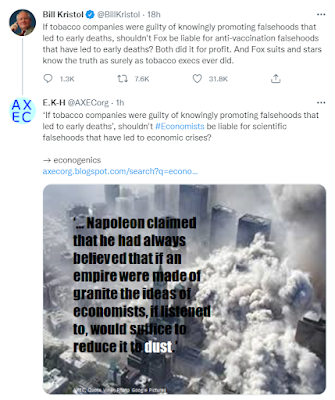
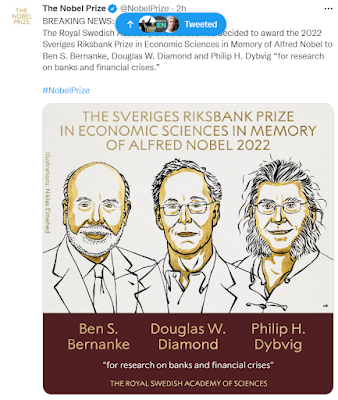
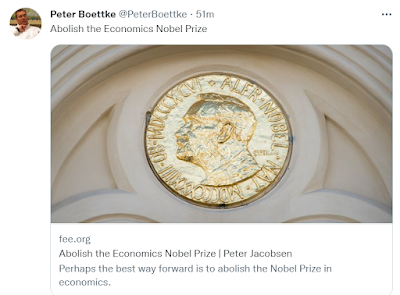
Blog-Reference and Blog-Reference on Oct 3 and Blog-Reference on Oct 10 and Blog-Reference on Jun 8, 2017, adapted to context
Lars Syll argues that the economics Nobel is politically biased: “... the prize was thought to take advantage of the connection with the true Nobel prizes and spearhead a market-oriented neoliberal reshaping of the world.” (See intro)
This is a minor problem, the real problem is in the title: “Bank of Sweden Prize in Economic Sciences in Memory of Alfred Nobel”.
The keyword is Science[s]. Why not simply “Bank of Sweden Prize in Economics”? The original title clearly communicates the claim that economics is a science. This claim is as old as Adam Smith/Karl Marx.
Science is well-defined by the criteria of formal and material consistency: “Research is, in fact, a continuous discussion of the consistency of theories: formal consistency insofar as the discussion relates to the logical cohesion of what is asserted in joint theories; material consistency insofar as the agreement of observations with theories is concerned.” (Klant, 1994)
Neither orthodox nor heterodox economics satisfies the criteria of formal and material consistency. It is a provable fact that neither Walrasianism, Keynesianism, Marxianism, nor Austrianism is materially/formally consistent.
Accordingly, economics is not a science (or sciences) but what Feynman famously called a cargo cult science.
The Bank of Sweden is legitimized to award prizes to whoever it wants and to push any political agenda it wants. The Bank, though, is NOT legitimized to declare economics as science well knowing that economics has not lived up to scientific standards since the founding fathers.
The scientific community has to see to it, firstly, that the word ‘sciences’ is eliminated from the “Bank of Sweden Prize in Economic Sciences”. The general public has to be informed that the 200-year-old claim and the actual state of economics do not match and that ALL economic policy guidance, i.e. independent of political orientation, lacks a sound scientific foundation. It follows, secondly, that economists have to be expelled from the scientific community. It follows, thirdly, that organizations like AEA, Royal Economic Society, Verein für Socialpolitik etcetera refrain from speaking in the name of science.
The real problem with the Bank of Sweden Prize is that it may give rise to a claim for damages in the case of severe depression/unemployment which is ultimately caused by provably false economic theory.
Egmont Kakarot-Handtke
Related 'Swedish muddle' and 'Swedish economists — what’s that?' and 'Economics: the simple logic of failure' and 'Scientists and science actors' and 'The economist as stand-up comedian' and 'Economists: the Trumps of science' and 'When fake scientists call out on fake politicians' and 'The economics Cargo Cult Prize' and 'Economics is NOT a science of behavior' and 'As Napoleon said: don’t listen to economists' and 'Why does Heterodoxy not abolish the fake Nobel?' and 'Legitimacy lost' and '10 steps to leave cargo cult economics behind for good' and ' Great souls’ methodology' and 'The trouble with economics prizes' and 'Links on the Economics Nobel'. For details of the big picture see cross-references Failed/Fake Scientists.
***
COMMENT and COMMENT on 'Oliver Hart, Laureate in Economic Sciences' on Dec 13Economics is a failed science. Walrasianism, Keynesianism, Marxianism, and Austrianism are contradictory and axiomatically false. See The real problem with the economics Nobel.
In order NOT to mislead the general public, the word 'Sciences' has to be deleted from the “Bank of Sweden Prize in Economic Sciences in Memory of Alfred Nobel”.
***
Twitter 2019 Oct 8
Twitter 2019 Oct 8

Twitter 2020 Nov 28

Richard S.J. Tol, 2020, Rise of the Kniesians: The professor-student network of Nobel laureates in economics
Twitter Jan 30, 2022
Twitter Oct 10, 2022 What the EconNobel rewards ― not science to be sure

Twitter Oct 15, 2020

June 17, 2021
Occasional Tweets: All one needs to know about economics
#FailedScience#FakeScience#Walrasianism, #Keynesianism, #Marxianism, #Austrianism, #MMT, #Pluralism are mutually contradictory, axiomatically false, materially/formally inconsistent, and all get #Profit wrong. That's #AllOneNeedsToKnow about the last 200+ years of #Economics.
— E.K-H (@AXECorg) June 17, 2021
***
Graphic AXEC109i

April 21, 2024
Occasional Xs: The futile attempt to recycle Austrianism (XXIX)
#Economics#FailedFakeScience#Economists#StupidOrCorruptOrBoth#Austrianism
— E.K-H (@AXECorg) April 21, 2024
von Mises: “In the imaginary construction of a stationary economy the total sum of all entrepreneurs’ profit equals the total sum of all entrepreneurs’ losses.”
This is provably false. Obviously, von…
February 22, 2026
Occasional X: The futile attempt to recycle Austrianism (LXXI)
“The Austrian economists predicted these failures decades ago because they understood that real prosperity comes from savings, investment, and market-driven resource allocation, not government spending financed by money printing.” (Handre van Heerden)
— AXEC (@EgmontHandtke) February 22, 2026
Keynesianism is failed/fake…
May 14, 2026
Occasional X: The foul spirit of political economics (CCLI)
“Hayek’s work on price theory is central to my thinking about how to manage the Wikipedia project. One can’t understand my ideas about Wikipedia without understanding Hayek.” (Jimmy Wales, Wikipedia co-founder)
— AXEC (@EgmontHandtke) May 14, 2026
The founding fathers have defined economics as a social science, and…
July 17, 2013
Keynes, Hayek, Kant
Comment on Fred Zaman on 'Rethinking Keynes’ non-Euclidian theory of the economy'
Blog-Reference
In the glorious days of economics, the great thinker Hayek was quipped by the great thinker Keynes: “... a remorseless logician can end up in Bedlam.” (Keynes, cited in Moggridge 1976, p. 36)
Economists in those days were already confused confusers (2013). This is not a lament but a statement of fact. Neither Keynes nor Hayek had a clear idea of the foundational concepts of income and profit. That's easy to prove.
We perfectly agree with Kant’s dictum: “Theory without empirical content is hollow. Empirical observations without [good & falsifiable] theory are directionless.”
Theory, though, starts with axioms, as Kant would have told you also.
Egmont Kakarot-Handtke
References
Kakarot-Handtke, E. (2013). Confused Confusers: How to Stop Thinking Like an Economist and Start Thinking Like a Scientist. SSRN Working Paper Series, 2207598: 1–16. URL
Moggridge, D. E. (1976). Keynes. London, Basingstoke: Macmillan.
Blog-Reference
In the glorious days of economics, the great thinker Hayek was quipped by the great thinker Keynes: “... a remorseless logician can end up in Bedlam.” (Keynes, cited in Moggridge 1976, p. 36)
Economists in those days were already confused confusers (2013). This is not a lament but a statement of fact. Neither Keynes nor Hayek had a clear idea of the foundational concepts of income and profit. That's easy to prove.
We perfectly agree with Kant’s dictum: “Theory without empirical content is hollow. Empirical observations without [good & falsifiable] theory are directionless.”
Theory, though, starts with axioms, as Kant would have told you also.
Egmont Kakarot-Handtke
References
Kakarot-Handtke, E. (2013). Confused Confusers: How to Stop Thinking Like an Economist and Start Thinking Like a Scientist. SSRN Working Paper Series, 2207598: 1–16. URL
Moggridge, D. E. (1976). Keynes. London, Basingstoke: Macmillan.

December 1, 2021
Occasional Tweets: The futile attempt to recycle Hayek (I)
#Economics#FailedScience#FakeScience#CargoCultScience
— E.K-H (@AXECorg) December 1, 2021
Since the founding fathers, #Economists are in the #DisInfoTainment business.
Hayek ― agenda pusher or scientist?https://t.co/7RwU9fuYpp pic.twitter.com/Gnv5Fcz6CZ
For more about Hayek see AXECquery.
December 14, 2022
Occasional Tweets: Hayek had no scientific knowledge about how the profit mechanism works
#FailedFakeScience#Austrianism
— E.K-H (@AXECorg) December 14, 2022
Hayek never understood the profit mechanism which is the essential feature of the #MarketEconomy. So, he was in NO position to say something meaningful about “Economics and Knowledge”.
Hayek ― agenda pusher or scientist?https://t.co/7RwU9fvweX
December 30, 2019
What’s the trouble with some Canadian economists?
Comment on Nick Rowe on ‘Increased Price Flexibility is Destabilising in New Keynesian Models’
Blog-Reference
The general trouble with economists is that they are either stupid or corrupt or both. The major approaches — Walrasianism, Keynesianism, Marxianism, Austrianism, MMT — are mutually contradictory, axiomatically false, materially/formally inconsistent and all got the foundational economic concept profit wrong. Economics is a failed science from Adam Smith/Karl Marx onward to New Keynesianism, DSGE, and MMT but economists cling desperately to their provably false proto-scientific garbage.
This is not only stupid but amounts to a violation of scientific standards: “In economics we should strive to proceed, wherever we can, exactly according to the standards of the other, more advanced, sciences, where it is not possible, once an issue has been decided, to continue to write about it as if nothing had happened.” (Morgenstern 1941) #1-#14
What is needed in economics is NOT repetitive critique and futile cosmetic repair but a Paradigm Shift. This is long known: “There is another alternative: to formulate a completely new research program and conceptual approach. As we have seen, this is often spoken of, but there is still no indication of what it might mean.” (Ingrao et al. 1990).
The specific trouble with some Canadian economists is (i) that they cling to false approaches and a failed methodology, (ii) that they have NO idea how to perform a Paradigm Shift, but (iii) that they prevent it by (a) stubbornly recycling provably false approaches, and (b), by actively suppressing critique and refutation in the econblogosphere.#15-#17
In this, though, the agenda-pushing Canadians are by no means alone but follow a widespread pattern.#18, #19
Egmont Kakarot-Handtke
References
#1 Is Nick Rowe stupid or corrupt or both?
#2 I is never equal S and even Nick Rowe will eventually grasp it
#3 Nick Rowe’s soapbubbling about money
#4 Worthless Canadian model bricolage
#5 It has been said before but economists still don’t get it
#6 Nick Rowe: Bury me at the end of coal-pit
#7 How economists missed out on the essential relationship of economics
#8 Another X-mas fantasy about IS curves
#9 Worthwhile Canadian filibuster?
#10 DSGE and profit―forget it! MMT and profit―forget it!
#11 How Keynes got macro wrong and Allais got it right
#12 Kalecki and Keynes: The double macroeconomic false start
#13 Are economics professors really that incompetent? Yes!
#14 Cryptoeconomics ― the best of Nick Rowe’s spam folder
#15 #EconBlocker Nick Rowe
#16 #EconBlocker George Selgin
#17 #EconBlocker
#18 Economists/MMTers: agenda pushers, distractors, blockers, muters, censors
#19 Economics ― the science that never was

Blog-Reference
The general trouble with economists is that they are either stupid or corrupt or both. The major approaches — Walrasianism, Keynesianism, Marxianism, Austrianism, MMT — are mutually contradictory, axiomatically false, materially/formally inconsistent and all got the foundational economic concept profit wrong. Economics is a failed science from Adam Smith/Karl Marx onward to New Keynesianism, DSGE, and MMT but economists cling desperately to their provably false proto-scientific garbage.
This is not only stupid but amounts to a violation of scientific standards: “In economics we should strive to proceed, wherever we can, exactly according to the standards of the other, more advanced, sciences, where it is not possible, once an issue has been decided, to continue to write about it as if nothing had happened.” (Morgenstern 1941) #1-#14
What is needed in economics is NOT repetitive critique and futile cosmetic repair but a Paradigm Shift. This is long known: “There is another alternative: to formulate a completely new research program and conceptual approach. As we have seen, this is often spoken of, but there is still no indication of what it might mean.” (Ingrao et al. 1990).
The specific trouble with some Canadian economists is (i) that they cling to false approaches and a failed methodology, (ii) that they have NO idea how to perform a Paradigm Shift, but (iii) that they prevent it by (a) stubbornly recycling provably false approaches, and (b), by actively suppressing critique and refutation in the econblogosphere.#15-#17
In this, though, the agenda-pushing Canadians are by no means alone but follow a widespread pattern.#18, #19
Egmont Kakarot-Handtke
References
#1 Is Nick Rowe stupid or corrupt or both?
#2 I is never equal S and even Nick Rowe will eventually grasp it
#3 Nick Rowe’s soapbubbling about money
#4 Worthless Canadian model bricolage
#5 It has been said before but economists still don’t get it
#6 Nick Rowe: Bury me at the end of coal-pit
#7 How economists missed out on the essential relationship of economics
#8 Another X-mas fantasy about IS curves
#9 Worthwhile Canadian filibuster?
#10 DSGE and profit―forget it! MMT and profit―forget it!
#11 How Keynes got macro wrong and Allais got it right
#12 Kalecki and Keynes: The double macroeconomic false start
#13 Are economics professors really that incompetent? Yes!
#14 Cryptoeconomics ― the best of Nick Rowe’s spam folder
#15 #EconBlocker Nick Rowe
 |
| Source: Twitter |
#16 #EconBlocker George Selgin
 |
| Source: Twitter |
#17 #EconBlocker
 |
| Source: Twitter |
#18 Economists/MMTers: agenda pushers, distractors, blockers, muters, censors
#19 Economics ― the science that never was
***
Graphic AXEC123e
Subscribe to:
Posts (Atom)