Comment on Barkley Rosser on ‘Comments on Profit and Capital’
Blog-Reference
If you do not like Desai’s assessment of theoretical economics, take Mirowski’s: “... one of the most convoluted and muddled areas in economic theory: the theory of profit.” Or take Wood: “Profit is a subject to which economists have addressed themselves for at least two hundred years but without much success. For there is at the moment no general theory of profits which commands anything approaching universal acceptance either among academic economists or among men of affairs.” Or take Obrinsky: “Nor do the modern variants add anything whatever on this score. For Debreu, profits are simply a non-issue, while Arrow and Hahn make only passing reference to profits ― and that only as a historical introduction. Whatever may be the usefulness of these idealized theoretical constructs, they cannot be said to throw any light on the profit issue; surely, therefore, they fail to capture the essence of a capitalist market economy.”
Repeat:
The representative economist fails to this day to capture the essence of a capitalist market economy. And these scientific nullities dare to open their mouths and give economic policy advice.
Your question “You think that Desai agrees with you and supports your views” is entirely beside the point. The only question is this: is the structural-systemic-macroeconomic Profit Law true or false, with truth defined as formal and material consistency. Scientific truth is NOT established by an opinion poll among economists.
The structural-systemic-macroeconomic Profit Law consists of measurable variables and is readily testable. There is no need at all to second-guess what commonsensers think about it, just as there is no need to second-guess what commonsensers think about the Law of the Lever. Everybody who thinks the structural-systemic-macro Profit Law is false can try to logically/empirically refute it. This is how science works. Only proof counts.
The opinion of commonsensers is traditionally the last thing a scientist is interested in: “People fancied they saw the sun rise and set, the stars revolve in circles round the pole. We now know that they saw no such thing; what they really saw was a set of appearances, equally reconcileable with the theory they held and with a totally different one. It seems strange that such an instance as this, …, should not have opened the eyes of the bigots of common sense, and inspired them with a more modest distrust of the competency of mere ignorance to judge the conclusions of cultivated thought.” (Mill)
What commonsensers or myopic capitalists and workers or incompetent economists hallucinate about profit is scientifically irrelevant. Overall monetary profit is given with
Qm≡−Sm in the most elementary case. This tiny formula turns whole economic libraries into waste paper.
You say about the heap of crappy profit theories: “That is my view. All of them have some degree of truth to them, all of them see different aspects, but indeed none of them are fully satisfactory.” It is a well-known fact that all false theories, including the flat earth theory, have “some truth” to them. Some truth is the same thing as worthless commonsensical plausibility which is the very opposite of scientific truth.
You will never hear a scientist saying that we have numerous concepts of energy and “all of them have some degree of truth to them”.
This is the defining difference between a cargo cult scientist and a scientist: the former tries to keep everything in the swamp of wish-wash where ‘nothing is clear and everything is possible’ (Keynes). A scientist drives every question to a final clear-cut true/false decision. This is what rigorous means and this is what all blatherers and storytellers and swamp creatures abhor and denounce most.
The pluralism of false profit theories has always been and will always be scientifically indefensible. Barkley Rosser’s methodologically confused anything-goes wish-wash is self-disqualifying.
The main issue of this thread is profit and not capital and not distribution. It should be immediately clear that traditional distribution theory falls apart because the underlying profit theory is provably false. So, there is absolutely no need to deal here in any detail with the marginal theory of distribution (the second-worst construct right after supply-demand-equilibrium) or with Piketty. #1
The profit theory is false since Adam Smith. Whether the representative economist understands the unassailable mathematical proof and its vast implications is a matter of indifference. The representative economist has always been outside of science and will never be admitted to it.
Not knowing what profit is, is scientifically lethal to an economist, and degrades him to a clown in the political Circus Maximus. Barkley Rosser is a living example.
Egmont Kakarot-Handtke
#1 For more details about these issues see
►
Non-existence of economic science
►
A particularly silly critique
►
The universal Profit Law and the multitude of unique historical circumstances
►
First Fundamental Law vs. Fundamental theorem of income distribution
►
The profit theory is false since Adam Smith. What can you expect from distribution theory?
►
Economic policy has gone wrong because economic theory has gone wrong
Immediately preceding
Profit and stupidity.
***
REPLY to Barkley Rosser on Jun 30
There are TWO issues:
(i) Desai, Mirowski, Wood, Obrinsky, you, and I agree that the profit theory is false for 200+ years, that is, the representative economist fails until this day to capture the essence of a capitalist market economy.
(ii) Whether the elementary objective-structural-systemic-behavior-free-macroeconomic Profit Law, i.e.
Qm≡−Sm, is scientifically true, i.e. materially and formally consistent.
Let us be content with the agreement on (i) and not get distracted by (ii). From (i) follows: the four main approaches ― Walrasianism, Keynesianism, Marxianism, Austrianism ― are mutually contradictory, axiomatically false, materially/formally inconsistent, #1, and ALL got profit wrong. With the pluralism of provable false theories, economics sits squarely at the proto-scientific level. Economics is NOT a science and neither orthodox nor heterodox economists qualify as scientists. #2
#1 “Research is, in fact, a continuous discussion of the consistency of theories: formal consistency insofar as the discussion relates to the logical cohesion of what is asserted in joint theories; material consistency insofar as the agreement of observations with theories is concerned.” (Klant)
#2
Economics: 200+ years of scientific incompetence and fraud
***
REPLY to Barkley Rosser on Jun 30
Isn’t it curious that in economics NOT ONE of the basic concepts ― profit, income, capital, money, etcetera ― is properly defined. A fact that did not escape the notice of von Neumann: “I think it is the lack of quite sharply defined concepts that the main difficulty lies, and not in any intrinsic difference between the fields of economics and other sciences.”
Needless to emphasize that economists have an explanation=excuse for their failure in general and in every particular case. #1 The Pavlovian argument is that in “other sciences”, too, things are not defined precisely (meteorology, biology, psychology etcetera). Stupid as they are, economists have never realized that with these excuses they catapult themselves out of science. Feynman killed this silly argument long ago: “By having a vague theory it is possible to get either result. ... It is usually said when this is pointed out, ‘When you are dealing with psychological matters things can’t be defined so precisely’. Yes, but then you cannot claim to know anything about it.”
Rule #1: When you cannot define your subject matter precisely you are
a priori OUTSIDE of science. This applies to the so-called social sciences which Feynman re-categorized as
cargo cult sciences. And this is why economics has to be re-defined as systems science.
This is the current state of economics: “economists cannot claim to know anything about it” or as Clower put it: “... we know little more now about ‘how the economy works,’ ... than we knew in 1790, after Adam Smith completed the last revision of
The Wealth of Nations.” What has been produced instead of scientific knowledge is endless blather, political hot air, folk philosophy=utilitarianism, folk psychology, folk sociology, silly semantic games, sitcom stories, and white noise.
Ask an economist what profit is and you get these answers:
Smith: Wages, profit, and rent, are the three original sources of all revenue as well as of all exchangeable value.
Ricardo: … profits would be high or low in proportion as wages were low or high.
Senior: In the second class we have the words Capital, Capitalist, and Profit. These terms express the instrument, the person who employs or exercises it, and his remuneration; but there is no familiar term to express the act, the conduct of which profit is the reward, and which bears the same relation to profit which labour does to wages. To this conduct we have already given the name of Abstinence.
Mill: The cause of profit is, that labour produces more than is required for its support.
Marx: Hence, if a commodity is sold at its value, a profit is realized, which is equal to the excess of its value over its cost-price, or equal to the entire surplus-value incorporated in the value of the commodity.
Jevons: I think that in the equation Produce=profit+wages, the quantity of produce is essentially variable, and that profit is the part to be first determined.
Marshall: The normal earnings of management are of course high in proportion to the capital, and therefore the rate of profits per annum on the capital is high, when the work of management is heavy in proportion to the capital.
Knight: The presence of true profit, therefore, depends on an absolute uncertainty in the estimation of the value of judgment, or on the absence of the requisite organization for combining a sufficient number of instances to secure certainty through consolidation.
Schumpeter: And since the new combinations which are carried out if there is ‘development’ are necessarily more advantageous than the old, total receipts must in this case be greater than total costs.
von Mises: The ultimate source from which entrepreneurial profit and losses are derived is the uncertainty of the future constellation of demand and supply.
Keynes: Thus the factor cost and the entrepreneur’s profit make up, between them, what we shall define as the total income resulting from the employment given by the entrepreneur.
Hicks: The curve IS can therefore be drawn showing the relation between Income and interest which must be maintained in order to make saving equal to investment.
Harrod: The relevant propositions may be stated in the form of truisms or tautologies, such as that the price of an article is equal to the sum of rewards to all persons contributing to its production, ...
Shackle: Thus it seems that we might select decision-making and uncertainty-bearing as the economic roles to perform which men come forward because of the prize of profit in the sense we have been discussing.
Samuelson: GDP, or gross domestic product, can be measured in two different ways: (1) as the flow of final products, or (2) as the total costs or earnings of inputs producing output. Because profit is a residual, both approaches will yield exactly the same total GDP.
Debreu: … the consumers own the resources and control the producers. Thus, the ith consumer receives the value of his resources … and the shares … of the profit of the 1st, …, jth, …, nth producer. … Consider a private ownership economy E . When the price system is p, the jth producer tries to maximize his profit on Yj. Suppose that yj does this; the profit pj(p) = p • yj is distributed to shareholders.
Arrow and Hahn: Given a set of prices for all commodities, it is possible to calculate for each activity its profit, the excess of the values of its outputs over the value of its inputs; … The assumptions of perfect competition imply that … each firm chooses an activity that yields it at least as much profit as any other possible.
Kaldor: Income may be divided into two broad categories, Wages and Profits (W and P), where the wage-category comprises not only manual labour but salaries as well, and Profits the income of property owners generally, and not only of entrepreneurs;
Kalecki: Gross profits = Gross private investment + Capitalists’ consumption.
Sraffa: This is because the surplus (or profit) must be distributed in proportion to the means of production (or capital) advanced in each industry; and such a proportion between two aggregates of heterogeneous goods (in other words, the rate of profits) cannot be determined before we know the prices of the goods.
Boland: The Walrasian prices correspond to the Marshallian long-run equilibrium prices where every producer is making zero excess profits. Thus, since in the short-run non-zero profit is possible, the actual short-run prices cannot always be used for aggregation. But, from the macro perspective of Walrasian general equilibrium, the total profits in this case cannot be other that zero (otherwise, we would need a Santa Claus to provide the aggregated positive profit) but this does not preclude the possibility of short-run profits and losses of individual firms canceling each other out.
Minsky: The simple equation ‘profit equals investment’ is the fundamental relation for a macroeconomics that aims to determine the behavior through time of a capitalist economy with a sophisticated, complex financial structure.
Barro: Households receive income in four forms: profit …, wage income, rental income, and interest income.
Wickens: Implicit measure of profits Πt = −kt+1 +(1+θ)kt.
Ljungqvist and Sargent: In each period, the representative firm takes (rt, wt) as given, rents capital and labor from the households, and maximizes profits: Π=F(kt, nt)−rtkt−wtnt.
Nadal: ... the budget constraint of consumers may be undetermined because it incorporates their share of firms’ profits, which may not be defined.
Keen: … net annual income in this simple model equals the sum of wages plus profits.
ALL, repeat ALL, these authors got it wrong and nothing proves the idiocy of economists better than the endless list of provably false profit definitions.
Overall profit is with the precision of two decimal places given by the macrofounded
Profit Law, which reads in the most elementary case
Qm≡−Sm. This formula immediately tells anyone who can read and think that the monetary economy is NOT an equilibrium system but will break down with mathematical necessity ― not because of human errors/mistakes/ misbehavior but BECAUSE of the inescapable Profit Law.
#1
Failed economics: The losers’ long list of lame excuses
***
REPLY to Barkley Rosser on Jul 1
(i) The ancient Greeks introduced the distinction between opinion (= doxa) and knowledge (= episteme).
(ii) Scientific knowledge is defined by material AND formal consistency. Accordingly, refutation consists of proof of empirical or logical inconsistency.
(iii) The guiding principle for establishing knowledge is the distinction true/false: “There are always many different opinions and conventions concerning any one problem or subject-matter (such as the gods). This shows that they are not all true. For if they conflict, then at best only one of them can be true. Thus it appears that Parmenides ... was the first to distinguish clearly between truth or reality on the one hand, and convention or conventional opinion (hearsay, plausible myth) on the other.” (Popper)
(iv) Knowledge takes the form of a materially/formally consistent theory which is the best mental representation of reality that is humanly possible.
(v) Barkley Rosser has never understood what science is all about. This, he has in common with the vast majority of economists who are 2000+ years behind the curve.
(vi) All human beings are born into an intellectual swamp. The vast majority stays there for the rest of their lives, only the tiny intellectual elite of scientists tries to get out: “We are lost in a swamp, the morass of our ignorance. … We have to find the roots and get ourselves out! … Braids or bootstraps are necessary for two purposes: to pull ourselves out of the swamp and, afterwards, to keep our bits and pieces together in an orderly fashion.” (Schmiechen) #1
(vii) The methodological bootstraps of science are formal and material consistency. Logical consistency is secured by applying the axiomatic-deductive method and empirical consistency is secured by applying state-of-the-art testing.
(viii) ALL profit theories since Adam Smith are logically/empirically false. Strictly speaking, this proto-scientific rubbish does not deserve the title theory. Laypeople constantly confound hypothesis (= guess, start of the process) with theory (= truth, end of the process). Profit theory never rose above the guessing stage. #2
(ix) There is only ONE true theory. The pluralism of false theories is scientifically indefensible: “It is, rather, the indication of a failure of reason to find suitable alternatives which might be used to transcend an accidental intermediate stage of our knowledge.” (Feyerabend)
(x) In their defense of the comfort zone of stupidity ‘where nothing is clear and everything is possible’ (Keynes) swampies regularly invoke Heisenberg’s uncertainty principle, Schrödinger’s cat, or Gödel’s proof. #3 Barkley Rosser is no exception. Needless to emphasize that his understanding of physics and logic is even worse than his understanding of profit.
(xi) By invoking quantum mechanics in order to defend the logical inconsistency of economics he again makes a fool of himself. Schrödinger’s cat is “The most misunderstood thought experiment in all of Science. The cat is used as an illustration of the fallacy in applying quantum mechanical principles to macroscopic objects. Cats cannot exist in a superposition of alive and dead.” #4
(xii) Because economics cannot exist in a superposition of true and false, all false profit theories have to be eliminated. Economists have failed at this task until this day. The four main approaches ― Walrasianism, Keynesianism, Marxianism, Austrianism ― are mutually contradictory, axiomatically false, materially/formally inconsistent and all got the pivotal economic concept profit wrong.
(xiii) Barkley Rosser is defending the indefensible. He always was and still is outside of science. #5
#1
Getting out of the economics swamp
#2
Economics: a science without scientists
#3
How economists shoot themselves non-stop in the methodological foot
#4
Source
#5
Economists: The Trumps of science
***
REPLY to anne on Jul 2
Economics in its four incarnations ― Walrasianism, Keynesianism, Marxianism, Austrianism ― is one of the worst scientific scandals in human history and you and Barkley Rosser are part of it. #1
#1 For details of the big picture see
cross-references Incompetence
***
REPLY to Dennis Pickard on Jul 3
You say: “It seems to me your equation relates to changes in inventory, not profits.”
This is NOT the case. Changes of inventory have been explicitly excluded with the condition X=O in footnote 2 above. #1 Inventories have been dealt with at length elsewhere. #2
Note that there is monetary profit and nonmonetary profit. In order to keep the discussion FOCUSED, inventories, nonmonetary profit, distributed profit, retained profit and related phenomena have ALL been left out here. Of course, they have been dealt with elsewhere. This is why references are given.
The sole point to PROVE here is that profit/loss is (in the most elementary case) the mirror image of dissaving/saving and that it has NOTHING to do with what capitalists, workers, laypeople, commonsensers, or scientifically incompetent economists have hallucinated since Adam Smith/Karl Marx it is.
Profit is NOT the income of capital.
Your attempt to de-focus the issue again by taking in a ‘surplus of utility’ and then making a measurement problem out of it is futile. Monetary profit is (in the most elementary case) tangible cash in the box and measurable with the precision of two decimal places.
Qm≡−Sm is a testable proposition #3, utility is a NONENTITY. To mix the two concepts is the sure way to scientific failure. #4 By putting utility into the Walrasian axioms=microfoundations economists are for 150+ years on the way to the inescapable final delirium.
#1
Link to footnote 2
#2
Primary and Secondary Markets
#3
The Common Error of Common Sense: An Essential Rectification of the Accounting Approach’
#4
Confused Confusers: How to Stop Thinking Like an Economist and Start Thinking Like a Scientist
***
LINKS at Angry Bear on Jul 4
The profit theory is false since Adam Smith. This is one of the greatest embarrassments in the history of the sciences. For the proof see:
Profit and stupidity
Economists: scientists or political clowns?
and
cross-references Profit
***
LINKS at Mike Norman Blog on Jul 4
The profit theory is false since Adam Smith. This is one of the greatest embarrassments in the history of the sciences. For the proof see:
Profit and stupidity
Economists: scientists or political clowns?
and
cross-references Profit
***
COMMENT on John Vertegaal, Dennis Pickard on Jul 5
Barkley Rosser takes it upon him to explain the macrofoundations approach. Needless to emphasize that he fails.
(i) He argues: “This implies certain things that neither you nor he mention, that such a firm would have enormous monopoly power, hence an ability to arbitrarily change price, and price certainly matters for all this.”
This is inaccurate. In the most elementary case, the conditions of market clearing and budget-balancing hold and in this case the price as the DEPENDENT variable is given as P=W/R. For details see
True macrofoundations: the reset of economics.
If the firm sets any other price then the quantity becomes the dependent variable. In this case, the market does NOT clear and inventory changes happen. Note that the macrofoundations approach deals with the systemic properties and the behavior of the economy. There is NO vacuous second-guessing of human behavior at all. This is the whole point of the paradigm shift.
(ii) He asserts: “Egmont claims inventories are irrelevant.” This is NOT the case. Inventories have been dealt with at length elsewhere. See for example
Essentials of Constructive Heterodoxy: The Market.
(iii) He asserts: “His accounting and axioms imply equilibrium conditions that he does not admit he is doing”. This is NOT the case. Equilibrium, clearly, is a NONENTITY and all theories/models that apply the equilibrium concept are a priori false. For details see
Equilibrium and the violation of a fundamental principle of science.
To apply the condition of market-clearing or budget balancing has NOTHING to do with equilibrium. It is the other way round, equilibrium implies market clearing and budget balancing. This is hard to understand for confused confusers.
(iv) He mentions: “… just as in fact the NIPA of the US simply impose the accounting identity that savings equal investment.” The proof has been given that the IS-identity is false. See
The Common Error of Common Sense: An Essential Rectification of the Accounting Approach and
The Three Fatal Mistakes of Yesterday Economics: Profit, I=S, Employment.
Barkley Rosser is lost in yesterday's economics and simply cannot get his head around the methodological imperative that economics has to be macrofounded.
***
COMMENT John Vertegaal, Dennis Pickard on Jul 5
Barkley Rosser does not get the simplest of all economic configurations. These three axioms constitute the macrofoundations:
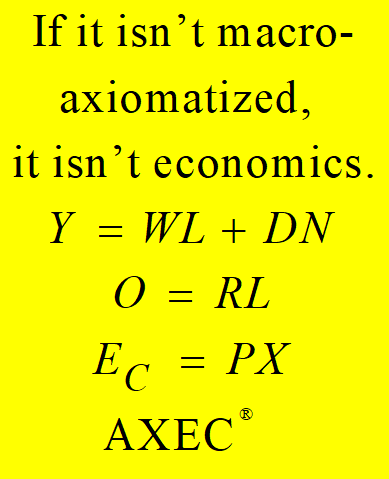
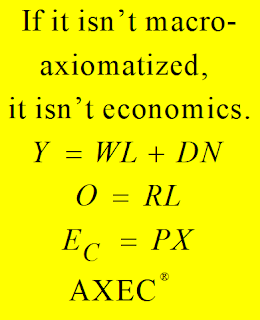
(A1) Yw=WL, (A2) O=RL, (A3) C=PX. For a start, two conditions hold: market-clearing X=O and budget-balancing C=Yw. This yields the price as dependent variable P=W/R. Monetary profit is defined as Qm≡C−Yw and is ZERO under the condition of budget balancing. Changes in the wage rate change the market-clearing price in the same direction but do NOT affect monetary profit. This is an unassailable mathematical fact that can be checked by national accounting. Note that ALL variables of the axioms are measurable.
The start configuration is a limiting case and the two conditions are lifted in the course of further analysis. Who does not understand the simplest case, though, is unfit for understanding the general case with non-market-clearing (= inventory changes) and non-budget-balancing (= saving/dissaving).
The interesting thing is that the two conditions market-clearing X=O and budget-balancing C=Yw also appear in equilibrium models and this means that equilibrium models are zero profit models. The representative economist is seldom aware of this implication.
“The Walrasian prices correspond to the Marshallian long-run equilibrium prices where every producer is making zero excess profits. Thus, since in the short-run non-zero profit is possible, the actual short-run prices cannot always be used for aggregation. But, from the macro perspective of Walrasian general equilibrium, the total profits, in this case, cannot be other than zero (otherwise, we would need a Santa Claus to provide the aggregated positive profit) but this does not preclude the possibility of short-run profits and losses of individual firms canceling each other out. (Boland)
“Some economists hold that although the profit motive is necessary in a business economy, actual profit is unnecessary, and that in fact pure profits are zero in a competitive economy.” (Murad)
Needless to emphasize that the manifest CONTRADICTION between zero profit in equilibrium models and non-zero macroeconomic profit/loss, in reality, has been buried under a gigantic heap of confused blather. In the real world, macroeconomic profit is NON-ZERO for hundreds of years because of the
Profit Law which says
Qm≡−Sm in the most elementary case.
Because the profit theory is false since Adam Smith ALL economics textbooks from Samuelson to Mankiw and Rodrik are false. #1 The logical blunder is right before everybody’s eyes. As Barkley Rosser recommends: “Look at any Principles of economics textbook.”
Because the profit theory is false Econ 101 is false. #2 Economics students, though, swallow this proto-scientific garbage generation after generation without turning a hair. This gives one a reliable and precise metric of the abysmal stupidity of the folks that populate the universities.
#1
The father of modern economics and his imbecile kids
#2 For details see
cross-references Econ 101
***
REPLY to Barkley Rosser on Jul 6
(i) Barkley Rosser misquotes: “So he identifies ‘market clearing’ which (ahem) he assumes, as being given by X=0.” Actually, it is X=O, that is, quantity bought X = output O. Barkley Rosser should have immediately recognized that X=0 makes NO sense at all. Obviously, he does NOT understand what he is commenting on.
(ii) The condition of market-clearing X=O does NOT imply equilibrium, while equilibrium implies market clearing. The idea of equilibrium entails that the system moves towards this end-state. Nothing of the sort happens in the economic system as defined by macrofoundations.
Equilibrium is a NONENTITY. The economic system evolves but neither towards a short-run nor a long-run equilibrium. In fact, the proof has been given that the market economy is INHERENTLY UNSTABLE. #1 There is NO such thing as general supply-demand-equilibrium. The whole of equilibrium economics from Marshall to DSGE is PROVABLE false. #2
(iii) I have NOT “discovered that profits are zero (in equilibrium)”. This is a feature of Walrasianism. I have indeed discovered that monetary profit is ALWAYS non-zero, i.e.
Qm≡−Sm in the most elementary case. Profit is zero in the analytical limiting case of household sector’s exact budget balancing, i.e. C=Yw, which practically never happens.
(iv) Barkley Rosser summarizes: “To close this out, aggregate profits in the US are currently about $1,8 trillion, about 10% of US GDP, and far above Egmont’s zero.” I NOWHERE said that profit is zero in the US or elsewhere. Just the contrary. The macrofounded profit theory unambiguously states that total monetary profit is given by
Qm≡Yd+(I−Sm)+(G−T)+(X−M). #2 This is a testable formula that holds also for the US.
In sum: Barkley Rosser cannot get out of his self-created confusion. Who cannot handle three simple equations (
Yw=WL, O=RL, C=PX), two conditions (
X=O, C=Yw) and the definition of total monetary profit (
Qm≡C−Yw) is forever outside of economics. Note that ALL variables in ALL equations are unambiguous and measurable. There is NO room for interpretation and blather.
#1
The market economy is inherently unstable and economists never grasped it
#2
First Lecture in New Economic Thinking
***
REPLY to Barkley Rosser on Jul 7
You say: “I find it weird that you seem to think it is a big mystery or might be extremely unusual that wages and profits might be inversely related.”
Now, this is as old as Ricardo: “… profits would be high or low in proportion as wages were low or high” and it is FALSE. It is the old mistake of mentally retarded economists to generalize the results of partial analysis. For a single firm, it is true that a reduction of the wage rate increases profit but for the economy as a whole this does NOT hold. #1
It is the
Fallacy of Composition all over again.
The most elementary economy is given with three equations
Yw=WL, O=RL, C=PX, two conditions X=O, C=Yw and the definition of total monetary profit Qm≡C−Yw. #2 This yields P=W/R (1), i.e. the market-clearing price is equal to unit wage costs. This is equivalent to W/P=R (2), i.e. the real wage is equal to productivity. This holds, no matter how the wage rate is set. A wage reduction leads to a proportional fall in the market-clearing price. Profit Qm does NOT change because the budget is balanced, i.e. C=Yw, and from this follows Qm=0.
So Ricardo was wrong: from a lower wage rate does NOT follow a higher profit for the economy as a whole. There is NO inverse relationship between wages and total profit in the most elementary economy. Where, then, does profit come from? Not from higher productivity either! Productivity changes lead to inverse changes in the market-clearing price according to (1).
It was Marx who asked the right question: “How can they continually draw 600 p. st. out of circulation, when they continually throw only 500 p. st. into it? From nothing comes nothing. The capitalist class as a whole cannot draw out of circulation what was not previously in it.”
Trivially true. #3 As long as the budget is balanced, i.e. C=Yw, total monetary profit Qm is zero. Because we know already that the macroeconomic
Profit Law states
Qm≡−Sm it is quite obvious that the business sector as a whole can only draw more out of the circulation, i.e. C greater Yw, if the household sector throws more into the circulation, in other words, if the household sector dissaves, i.e. if Sm≡Yw−C is negative, i.e. if C is greater than Yw.
From nothing comes nothing, even economists understand this.
So, Marx asked the right question but gave the wrong answer because he was fixated on the labor theory of value and not very good at logic and math. #1 Those who came after he was even worse.
#1
Profit for Marxists
#2 For details see
Profit theory in less than 5 minutes
#3
How the Intelligent Non-Economist Can Refute Every Economist Hands Down
***
REPLY to Anonymous on Jul 8
Your conclusion: “I’d hazard a guess that it’s founded on differences of subjective opinion rather than facts” is entirely beside the point. First of all, science is NOT a matter of opinion (= doxa) but of knowledge (= episteme). Scientific knowledge is well-defined by material and formal consistency.
Now, every economist knows the following:
(i) Economics is a failed science, that is, the four main approaches Walrasianism, Keynesianism, Marxianism, Austrianism are materially/formally inconsistent.
(ii) The foundational concept profit is ill-defined (see Desai and others)
(iii) The concept of capital is ill-defined (see Cambridge Capital Controversy)
(iv) The concept of equilibrium is ill-defined: “At long last, it can be said that the history of general theory from Walras to Arrow-Debreu has been a journey down a blind alley, and it is historians of economic thought who seem to have finally hammered down the nails in this coffin.” (Blaug), see also (Ingrao et al.), (Ackerman et al.)
Therefore, ALL theories/models that apply the traditional concepts of profit, capital, equilibrium are A PRIORI false. And this provides the implicit consensus of every worthwhile economic discussion: there is NO USE at all to stir this 200+-year-old rotten soup one more time. The only worthwhile task for the economist/scientist has been defined by Joan Robinson: “Scrap the lot and start again.”
Clearly, a paradigm shift is the last thing Barkley Rosser wants. Being a lifelong loudspeaker in the economics swamp where “nothing is clear and everything is possible” (Keynes) he attempts to defend his natural habitat with the tried and tested rhetorical means of a confused confuser.
What has been accomplished in this thread is:
(1) A paradigm shift from obsolete microfoundations to correct macrofoundations.
(2) The consistent derivation of total monetary profit from the most elementary set of macroeconomic axioms.
(3) The clarification of the OBJECTIVE nature of profit and the refutation of the familiar SUBJECTIVE interpretations.
(4) The irreversible final debunking of Barkley Rosser.
(5) The presentation of the complete macrofounded Profit Law
Qm≡Yd+(I−Sm)+(G−T)+(X−M). This is a testable equation that holds for all countries. Theoretical economics has done its job, now national econometricians can do theirs.
Everybody who wants to refute the macrofounded profit theory ― which fully replaces all profit theories since Adam Smith/Karl Marx ― has a straightforward task: to prove that the Profit Law is either logically or empirically inconsistent.
Science is NOT a matter of opinion but of proof. Everything else is brain-dead blather of soapbox economists.
***
REPLY to Barkley Rosser on Jul 9
(i) You say: “So, when Qm = Sm, they are positively related, but when you provide your more general equation, it is (1−Sm) that is entering on the right-hand side. This implies a negative relationship. So, are they positively related or negatively related, …”
This is a typo of your OWN making. It always holds and I always write Qm=−Sm. #1 As usual, the contradiction is only in your muddled head.
(ii) You say: “And that more complicated equation is very close to a Keynesian formulation, but, of course, you have denounced Keynesian economics as totally and utterly false.”
I have not only “denounced Keynesian economics as totally and utterly false” but I have PROVED it. #2 Allais has done this before #3: “Toutes ses [Keynes’s] deductions, à notre avis, manquent absolument de rigeur. … L’intuition de Keynes lui a fait sentir où se trouvaient les difficultés, mais son insuffisance logique ne lui a pas permis de résoudre les problèmes que son intuition lui avait fait entrevoir.” In plain English: Keynes was scientifically incompetent. Among economists, though, this defect is rarely noticed because it is the old normal since Adam Smith.
(iii) Standard economics is based on the Walrasian axiom set = microfoundations: “HC1 economic agents have preferences over outcomes; HC2 agents individually optimize subject to constraints; HC3 agent choice is manifest in interrelated markets; HC4 agents have full relevant knowledge; HC5 observable outcomes are coordinated, and must be discussed with reference to equilibrium states.” (Weintraub)
Everybody knows by now that equilibrium is a NONENTITY: “Just as classical General Equilibrium Theory has never been able to provide a definitive account of how equilibrium prices come to be established, so Rational Expectation Theory has not shown how, starting from relative ignorance, everything that can be learned comes to be learned.” (Hahn)
Because of this, microfoundations have to be fully replaced by macrofoundations. The most elementary version consists of the three axioms
(A1) Yw=WL, (A2) O=RL, (A3) C=PX. It is as clear as the day, except for the muddled head of Barkley Rosser, that macrofoundations (A1) to (A3) do NOT contain the concept of equilibrium in marked contrast to microfoundations HC1 to HC5.
So: “Because equilibrium is a NONENTITY, ALL equilibrium models fly out of the window, no matter whether they are Walrasian or Keynesian equilibrium models. From the fact that equilibrium is a NONENTITY follows logically that disequilibrium, too, is a NONENTITY. Because of this, all disequilibrium models, too, fly out of the window. The economy is an evolving system and neither the concept of equilibrium nor disequilibrium is applicable.” #4
Walrasianism and Keynesianism are materially/formally inconsistent proto-scientific garbage, and it is nowadays only defended by a rearguard of incorrigible muddleheads.
#1 You can check this with Ctrl+F and entering Qm in the search field
#2 For more details, see
Keynesianism ― the economists’ senile dementia
#3
How Keynes got macro wrong and Allais got it right
#4
Productivity and the zombie apocalypse
***
REPLY to Barkley Rosser on Jul 10
You say: “… but they are what get you from your three empty accounting identities to your wonderful condition of Qm = Sm, …”
Again. This is a typo of your OWN making. It always holds and I always write
Qm≡−Sm. The minus sign is easy to overlook, so perhaps this helps Qm = ―Sm.
But the real issue is not the typo; the issue is UNDERSTANDING. The verbalization of the equation reads: “It always holds Qm+Sm=0 or Qm=−Sm, in other words, at the heart of national income accounting is an identity — the business sector’s deficit (surplus) equals the household sector’s surplus (deficit). Put bluntly, loss is the counterpart of saving and profit is the counterpart of dissaving. This is the most elementary form of the Profit Law.”
Barkley Rosser cannot get out of his self-created muddle. Who cannot handle three macro axioms (Yw=WL, O=RL, C=PX), two conditions (X=O, C=Yw), and two definitions (Qm≡C−Yw, Sm≡Yw−C), and UNDERSTAND IMMEDIATELY that Qm≡−Sm, i.e., that business profit and household saving are NEGATIVELY related, is OUTSIDE of economics.
When the pivotal concept of profit is not properly understood, the rest of the analytical superstructure of economics falls apart, and there is NO use at all to filibuster about capital and equilibrium. The best the representative economist can do for the welfare of humanity is to get out of the way.
***
WRAP-UP for Barkley Rosser on Jul 13
Rewarding to see that you have drawn the consequence of a rare flash of insight and left economics altogether. #1
Your true competence has always been insightful comments on the sex life of the House of Sa’ud and other celebrities, as demonstrated in two recent pieces:
- Muhammed Bin Nayef Bin Abdulaziz Al Sa’ud Confined To His Palace
- Was Thomas Jefferson A Monstrous Rapist?
Economics has never been your thing. Good for society to learn that you have left profit, capital, equilibrium, and other NONENTITIES behind for good and dedicate your talent now fully to Sexual Research.
May the rest of the scientifically failed economists follow your example.
#1
Economists: scientists or political clowns?
***
REPLY to Barkley Rosser, vertegaa, Anonymous on Jul 14
Barkley Rosser argues: “You can read about this stuff in the book I already cited by me, as well as several of my other books, and also in standard grad level micro theory textbooks like Varian or Mas-Colell, Whinston, and Green.”
Note that standard economics is axiomatically false, and because of this, the textbooks mentioned are scientifically worthless. #1
The standard axiom set #2 consists of blatant nonentities, but each student generation has swallowed it for 150+ years without turning an eyelid. In order to be applicable HC2, which translates formally into calculus, requires a lot of auxiliary assumptions, most prominently a well-behaved production function. Taken together, all axioms and auxiliary assumptions crystallize to SS-DD-equilibrium or what Leijonhufvud famously called the Totem of Micro/Macro.
Needless to stress that ALL THREE elements of the standard tool (SS-function, DD-function, equilibrium) are NONENTITIES. Any discussion about forward- or backward-bending supply curves or stable/unstable equilibria is as vacuous and ridiculous as any discussion about dancing-angels-on-a-pinpoint. #3
All standard textbooks are false because microfoundations and the definition of profit/income are provably false ― there is NO NEED AT ALL to read or quote this stuff.
This is the challenge of economics: “There is another alternative: to formulate a completely new research program and conceptual approach. As we have seen, this is often spoken of, but there is still no indication of what it might mean.” (Ingrao et al.)
#1
The father of modern economics and his imbecile kids
#2 “HC1 economic agents have preferences over outcomes; HC2 agents individually optimize subject to constraints; HC3 agent choice is manifest in interrelated markets; HC4 agents have full relevant knowledge; HC5 observable outcomes are coordinated, and must be discussed with reference to equilibrium states.” (Weintraub)
#3
All models are false because all economists are stupid
***
REPLY to Anonymous on Jul 15
There is the quantity produced per period = output O. There is the quantity sold per period X. These two quantities are different. But it is logically and practically possible that they are equal. If they are not equal the stock of hitherto unsold output of the business sector (= inventory) changes.
To write down X=O is to say that the market is cleared in the given period. For the purpose of analysis, X=O can also be used as a condition.
The concept of the equality of two quantities is different from the concept of equilibrium. Equilibrium, IN ADDITION, implies that there is some force (= Invisible Hand) that makes the quantities eventually become equal.
This, though, is NOT the case for the economic system. It has NEVER been proven that the monetary economy is an equilibrium system. #1 The fixpoint theorem is an existence proof (i.e. it is possible that X = O) but does NOT prove that X = O is realizable.
Time to take notice that equilibrium is a dead concept; in fact, it has already been dead in the Jevons/Walras/Menger cradle 150+ years ago. This is common knowledge.
“The mathematical failure of general equilibrium is such a shock to established theory that it is hard for many economists to absorb its full impact.” (Ackerman)
“To conclude, the proof of existence concerns a state of the economy that cannot be attained by the individual actions of the self-aggrandizing and decentralized agents originally specified for the general equilibrium model.” (Nadal)
“Gerard Debreu in his classic
Theory of Value states that his theory is concerned with the explanation of prices. Others as distinguished as Kenneth Arrow and Frank Hahn deny that general equilibrium theories are explanatory. Moreover, some prominent economists and philosophers have argued that work in general equilibrium theory is not empirical science at all.” (Hausman)
“The fact that it has not been possible to build a process for the formation of equilibrium prices is disastrous when it is recalled that the fundamental task of theory is precisely to make coordination in the market intelligible.” (Benetti et al.)
“Just as classical General Equilibrium Theory has never been able to provide a definitive account of how equilibrium prices come to be established, so Rational Expectation Theory has not shown how, starting from relative ignorance, everything that can be learned comes to be learned.” (Hahn)
Equality X = O is NOT the same as equilibrium. Equality is logically and practically possible, but equilibrium is a NONENTITY. No competent economist applies it any longer. Somehow, this seems to have escaped Barkley Rosser and you.
#1 Just the contrary, see
Could we, please, all focus on the key question of economics?.
***
REPLY to Anonymous on Jul 16
PROVABLY false
• profit theory, for 200+ years,
• Walrasian microfoundations (including equilibrium), for 150+ years,
• Keynesian macrofoundations (including I=S, IS-LM), for 80+ years.
ALL theories/models that contain profit, maximization-and-equilibrium, or I=S/IS-LM are
a priori false and this is more than 90 percent of the content of peer-reviewed economic quality journals and 100 percent of textbooks of renowned authors since 1948.
By implication, ALL posts that contain these concepts are proto-scientific garbage. This includes your exchange with Barkley Rosser.
You may not have heard it, but Barkley Rosser has now left economics for good and dedicates his talent to sexual research, gossiping about academic celebrities, name-dropping, and reputation management.