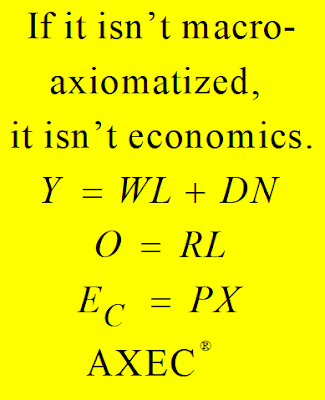
Comment on Tom Hickey on ‘Tim Worstall ― The End Game Of Modern Monetary Theory’
Blog-Reference
Economics has claimed to be a science since Adam Smith/Karl Marx, but it is NOT. Actually, it is political agenda-pushing that abuses the prestige of science. #1 However, in the political dogfight, the appeal to science can be counter-productive because a political argument must necessarily appeal to emotions and thus cut scientific thinking short.
So, the easiest method of ‘refutation’ is to take some bad examples from history and simply associate them with the other side. This is how Tim Worstall ‘refutes’ MMT: “And then we’ve this cautionary little tale about how the end game plays out. There’re more than just the one of those cautionary tales of course, Zimbabwe and Venezuela come to mind. Or perhaps Argentina.” #2
This annoys Tom Hickey: “This passes for serious criticism now? In addition, Tim Worstall doesn’t seem to realize that MMT is not a policy proposal but rather based on how the existing monetary system operates currently.”
In other words, MMT is a pure experience-based practice in the here and now. Here is the story of how Warren Mosler created what later became known as MMT: “The origin of MMT is ‘Soft Currency Economics’… which I wrote after spending an hour in the steam room with Don Rumsfeld at the Racquet Club in Chicago,… I had never read or even heard of Lerner, Knapp, Inness, Chartalism, and only knew Keynes by reading his quotes published by others. I ‘created’ what became known as ‘MMT’ entirely independently of prior economic thought. It came from my direct experience in actual monetary operations, much of which is also described in the book.” #3
The general public likes this steam-room approach and dislikes theory. Accordingly, the MMT propagandist Richard Murphy tries to make some bonus points by introducing himself as a practical realist who suffers from a false image: “Modern Monetary Theory does suffer from being called a theory.” #4
This annoys Bill Mitchell: “Specifically, there is a current out there that considers MMT to be incorrectly labeled because according to the argument, there is no theory involved. It’s hard to imagine why anyone would think that but the fact that they do tells me that I should write this blog post. As I noted yesterday, our Macroeconomics textbook … is full of theory. It has a lot of description, taxonomy, accounting, history, and philosophy, but also a lot of theory that ties some of those other components together in a meaningful way. The T in MMT is not a misnomer.” #5
Clearly, MMTers want to have it both ways. The salespeople say that MMT is operationally true and is nothing but a common-sense policy; the academics insist that MMT is a superior scientific approach. And they prove this by relentlessly exposing the idiotism and failure of mainstream economics.
Clearly, MMT has to be judged according to well-established scientific criteria. Worstall’s attempt to ‘refute’ MMT by referring to recent historical examples of inflation is silly polemics. Unfortunately, more cannot be expected from the Senior Fellow of the Adam Smith Institute.
MMT has to be refuted scientifically by proving that it is materially or formally inconsistent. This has already happened. #6, #7
Retarded folks like Tim Worstall always argue politically and never can get out of their tiny left-right box. In his utter ignorance, Tim Worstall swallows the MMTers’ self-description as Progressives hook, line, and sinker: “As we know Modern Monetary Theory is the latest great new plan from the left.”
Tim Worstall does not realize that MMT is, in fact, “the latest great new plan” from Wall Street. #8 If he had done his scientific homework, he would know how the monetary economy works and that the macroeconomic
Profit Law implies
Public Deficit = Private Profit. In other words, MMT is not left/progressive at all.
MMT policy does not benefit WeThePeople but the Oligarchy. That is, the noisy left-right wrestling show distracts from the plain fact that MMT and the Adam Smith Institute push the same agenda.
Egmont Kakarot-Handtke
#1
The real problem with the economics Nobel
#2 Continental Telegraph
The End Game Of Modern Monetary Theory
#3 The Johnsville News,
Modern Monetary Theory (MMT) in a Nutshell
#4
Richard Murphy: the MMT fraudster dressed up as realist
#5
Understanding what the T in MMT involves
#6
The final implosion of MMT
#7
MMT = Modern Monetary Trash
#8
How MMT enlightens Washington
Related '
MMT = Trumponomics' and '
MMT: for the record' and '
How MMT makes everybody happy' and '
MMT in a nutshell' and '
Fake religion, fake science, fake news, and false complaints' and '
Economics debate ― just another variant of hardcore wrestling' and '
Economists: Time to say goodbye'. For the full-spectrum refutation of MMT, see
cross-references MMT.
***
Graphic
AXEC106o Scientists are occupied with the Paradigm Shift
***
REPLY to Tim Worstall, Joe, Bob Roddis, etc on Nov 28
This thread started with the debt-inflation red-herring and ended with the allocation/calculation red-herring. Economists’ main function in society has always been to keep the audience entertained with angels-on-a-pinpoint talk shows and to prevent any economic issue from ever getting settled.
The lethal argument against the “guvmint can’t do nuthin right” imbeciles is that the business sector cannot exist without the government’s production of profit which shows itself empirically in the permanently growing public debt. In other words, the profitability of the business sector is NOT an indicator of productivity/efficiency but of deficit-spending/money-creation.
From the axiomatically correct macroeconomic Profit Law Qm≡Yd+(I−Sm)+(G−T)+(X−M) follows that Public Deficit = Private Profit if all other variables are taken out of the picture for a moment.
So, it is the public deficit that produces macroeconomic profit and NOT any allegedly superior allocation of resources or the smartness/greed of capitalists or the alleged self-regulation by supply-demand-equilibrium. These factors influence merely the DISTRIBUTION of macroeconomic profit BETWEEN firms and NOT the overall volume.
In the early phase of capitalism, growth, i.e., the excess of the business sector’s investment expenditures I over the household sector's saving Sm, produces macroeconomic profit Qm. In late capitalism, the government sector provides the life support of the business sector with deficit-spending, i.e., with G greater than T.
What the US government has done, in fact, for many years, is artificially prolonging the lifetime of an imploding economic system by steadily increasing the public debt. One collateral damage is that this also prolongs the blather-time of the “guvmint can’t do nuthin right” imbeciles.
The ongoing brain-dead blah blah of both MMTers and mainstreamers is incontrovertible proof that economists NEVER understood how the monetary economy works.
***
REPLY to Detroit Dan, Bob Roddis on Nov 28
Detroit Dan maintains: “Private businesses have brought us all sorts of marvelous technology, …”
This is the Waiter Fallacy. It is the cook who has produced a delicious meal; the waiter only transported it with more or less elegance to the table. The generous tip, though, goes to the smiling fool who cannot even prepare scrambled eggs.
All the marvelous things of civilization come from scientists/engineers and not from businessmen.
It was Tesla who invented AC and not businessmen: “The investors showed little interest in Tesla’s ideas for new types of alternating current motors and electrical transmission equipment. After the utility was up and running in 1886, they decided that the manufacturing side of the business was too competitive and opted to simply run an electric utility. They formed a new utility company, abandoning Tesla’s company and leaving the inventor penniless.” (Wikipedia)
The idea that “private businesses have brought us all sorts of marvelous technology” is the classical case of cultural misappropriation.
***
REPLY to Magpie, Tim Worstall on Nov 29
Now comes Magpie: “No red herrings. No bullshit. Forbes may accept that, we don’t. That’s no allowable critique here. You came here voluntarily, you play by our rules. Show us you know what you are talking about.”
As they say in Britain: “Keep your breath to cool your porridge”. The Senior Fellow of the Adam Smith Institute is not here for an exchange of profound economic knowledge but for another asinine dog and pony exercise.
Tim Worstall remains firmly in the tradition of the paradigmatic economist Adam Smith: “Smith ... disliked whatever went beyond plain common sense. He never moved above the heads of even the dullest readers. He led them on gently, encouraging them by trivialities and homely observations, making them feel comfortable all along.” (Schumpeter)
Nothing has changed since the founding fathers. The mission of the Senior Fellow of the Adam Smith Institute is to sell this message: The market economy/capitalism is the best of all possible economic worlds. Yes, there are crises, and unemployment, and corruption, and exploitation, and the distribution is perhaps a little biased, but, as everybody knows, the Soviets tried to implement a better system, and it didn’t work. End of mantra.
Now, Magpie tells Tim Worstall that he cannot sell his bullshit to the audience of MNE, here, “you play by our rules”.
What are those rules? At MNE, “we” sell the message that deficit-spending/money-creation benefits WeThePeople and that MMTers are Progressives who care for the unemployed, the environment, humanity, in particular, the health and happiness of children, the elderly, and the poor. Arguing against this amounts to self-exclusion from the worldwide community of good people.
“Our” rules include the small print that anyone who proves that MMT is, in fact, proto-scientific garbage and that the MMT sales team does not promote knowledge about how the monetary economy works but pushes the agenda of the Oligarchy in the cloak of social policy will be stopped in the tracks by a sky-high heap of political BS.
***
REPLY to Tim Worstall on Nov 29
You have been introduced as a Senior Fellow of the Adam Smith Institute: “The Adam Smith Institute is a neoliberal think tank and lobbying group based in the United Kingdom and named after Adam Smith, a Scottish moral philosopher and classical economist.” (Google profile)
A think tank has NOTHING to do with thinking. But, of course, nobody wants to characterize his type of business as brainwashing.
Everyone who rallies behind the False-Hero Memorial of Adam Smith exposes himself as an incompetent scientist. Adam Smith did not get the foundational concept of economics ― profit ― right, and this means that his final resting place in the history of scientific thought is a hole in the darkest corner of the Flat-Earth Cemetery. #1, #2
The fact of the matter is that, in 200+ years, economists have not made any progress towards an understanding of how the economy works. The Profit Theory is still false, and this means that the rest of the analytical superstructure is false. This holds for Classical Economics, Walrasianism, Keynesianism, Marxianism, Austrianism, and MMT. #3
So, the political proposals/solutions of both late-Smithians and MMTers lack sound scientific foundations. In the final analysis, both are political frauds.
This is the difference between scientific thinking and think-tank thinking: “A genuine inquirer aims to find out the truth of some question, whatever the color of that truth. … A pseudo-inquirer seeks to make a case for the truth of some proposition(s) determined in advance. There are two kinds of pseudo-inquirer, the sham and the fake. A sham reasoner is concerned, not to find out how things really are, but to make a case for some immovably-held preconceived conviction. A fake reasoner is concerned, not to find out how things really are, but to advance himself by making a case for some proposition to the truth-value of which he is indifferent.” (Haack)
You say, “How amazing that you know what I think.” I don’t know what you think. But I know that you cannot think.
***
REPLY to Tim Worstall on Nov 29
You say: “Seriously, don’t you people read any standard economics at all? Inflation from spending is just Keynes, inflation from increased money supply is Friedman.”
Are you really this far behind the curve? Keynes and Friedman are not quotable in an economic argument because they are scientifically long dead. #1, #2, #3
Take notice that there is NO relation between a growing public debt and inflation. #4, #5 The lethal consequence of MMT policy is NOT on inflation but on distribution.
***
REPLY to Tim Worstall on Nov 30
You say: “MMT says that, in certain circumstances, you should run a surplus. As does Keynes, as does Friedman.”
That’s not the point. The point is Zimbabwe, i.e., your argument that the MMT policy of deficit-spending/money-creation causes inflation. That is not the case. MMT policy causes the metrics of macroeconomic distribution, i.e. share of profit/financial wealth, to increase. In other words, MMT policy is money-making for the Oligarchy in the bluff package of social policy. #1
Both Keynes’ and Friedman’s inflation, distribution, employment, and profit theories are provably false. So, they are scientifically dead and only ignoramuses still quote them.
***
REPLY to Calgacus on Nov 30
Calgacus feels the urge to emphasize: “By the way, AXEC / E.K-H Egmont Kakarot-Handtke is not an MMTer, but a critic of MMT with his own theories.”
This is correct but irrelevant. In science, people are not much interested in membership cards or in opinions or in collecting likes/followers, or self-presentation, but rather in contributions to the growth of knowledge. The identity proof of a scientist is that he has something to say that helps to understand how the universe or a subdomain of it works.
So, it does not matter at all whether and why a person belongs to the MMT community or not. As Schumpeter put it: “Remember: occasionally, it may be an interesting question to ask why a man says what he says; but whatever the answer, it does not tell us anything about whether what he says is true or false.”
True, I am NOT a member/follower of MMT, I am NOT a mere critic of MMT, but have proved that MM-Theory does NOT satisfy the scientific criteria of material/formal consistency. #1 What I in addition say is that MMTers are too stupid for the elementary mathematics that underlies macroeconomics and that they have no idea of what science is all about. And I never forget to say that MMT is just another political fraud.
***
REPLY to Clint Ballinger, Tim Worstall on Dec 1
Clint Ballinger advises Tim Worstall: “Do the hard accounting, and you will see currency issuers don’t borrow their own tax credits, there is no money multiplier (and why that matters), why interest rate manipulation does not do what you think it does, and on and on.”
Yes, evidently, MMT is superior to the think-tank economics of the Senior Weasel of the Adam Smith Institute. In fact, anything is superior to mainstream economics because, in scientific terms, mainstream economics is absolute zero. You just cannot go deeper.
But, although better, MMT is still not good enough. MMT, too, gets the foundational macroeconomic relations wrong. It does not matter whether this is because of stupidity or fraud; MMT’s sectoral balances equation is provably false. #1 This is lethal to the whole approach.
So, the MMT Weasel Clint Ballinger has to be advised in turn: “Do the hard accounting, and you will see that Public Deficit = Private Profit #2, and why MMT policy guidance benefits the one-percenters and NOT the ninety-nine-percenters.” Effectively, that is, behind the theatrical hostilities, the MMT Weasel Clint Ballinger and the Senior Weasel Tim Worstall are on the same Oligarchy page.
For those who have suspected for a long time that Clint Ballinger is an incompetent scientist who suffers from multiple self-delusions, here is the proof. #3
***
REPLY to Detroit Dan, Tim Worstall, Andrew Anderson, Joe, Calgacus, etc. on Dec 2
You can blather on until you are blue in the face. This does not alter the fact that Walrasianism, Keynesianism, Marxianism, Austrianism, and MMT are mutually contradictory, axiomatically false, materially/formally inconsistent, and that all got the foundational concept of the subject matter ― profit ― wrong.
As a consequence, the policy guidance of all economic schools lacks sound scientific foundations. This makes it plain to the general public that economics is nothing more than political agenda pushing and economists are nothing more than useful political idiots.
Therefore, the first thing to do for the salvation of humanity is to flush failed economics and blather economists down the scientific drain.
***
REPLY to Clint Ballinger on Dec 2
Clint Ballinger parrots the foundational blunder of economics, i.e., that the “… distribution between households and business is _fundamentally_ political.”
What Clint Ballinger does not get is that Profit Theory is false and, by consequence, Distribution Theory. #1, #2
What Clint Ballinger does not get is that economics is a systems science. Retarded economists still think it is a social science. #3 The so-called social sciences are what Feynman called
cargo cult science. Economics has been hijacked and corrupted by the agenda pushers of Political Economy. #4 Since Adam Smith/Karl Marx, economics has not risen above the proto-scientific level.
The axiomatically correct macrofoundations approach is NOT for low-life political economists. They are beyond hope. For them, it is FLUSH. #5
***
REPLY to Clint Ballinger on Dec 3
That is the actual state of economics, messed up
• profit theory, for 200+ years,
• microfoundations, for 150+ years,
• macrofoundations, for 80+ years,
• the application of elementary logic and mathematics since the founding fathers.
The representative economist has swallowed the micro-crap supply-demand-equilibrium and the macro-crap I=S hook, line, and sinker and does not know what profit is. #1
MMTers are too stupid for the elementary mathematics that underlies macro-accounting.
Come on, Clint Ballinger, prove that you are not one of this sorry bunch of political idiots and tell the blog audience which of the two macroeconomic sectoral balances equations is true/false:
(i) (I−S)+(G−T)+(X−M)=0
(ii) (I−S)+(G−T)+(X−M)−(Qm−Yd)=0?
***
You say: “Take notice that EKHs answers always follows the same script: you’re too stupid....”
That is not quite correct. I say that MMTers are stupid or corrupt or both. For all with a deeper interest, links to the proofs are provided.
Your silly post confirms that the conclusion about MMTers is accurate. Therefore, it cannot often enough be repeated.
Try to refute the macroeconomic Profit Law, and if you cannot, you are out of economics.
***
REPLY to Detroit Dan, Clint Ballinger, Tim Worstall, S400 on Dec 4
You cannot answer the question of which of the sectoral balances equations is true/false
(i) (I−S)+(G−T)+(X−M)=0
(ii) (I−S)+(G−T)+(X−M)−(Qm−Yd)=0?
Obviously, you have no idea of how the monetary economy works and have never heard of the Ancient Greek Philosopher’s Rule of Human Communication: If you know nothing, say nothing.
Time for you to say goodbye.
***
***
REPLY to Detroit Dan, Tim Worstall, Clint Ballinger, Joe on Dec 5
“In order to tell the politicians and practitioners something about causes and best means, the economist needs the true theory or else he has not much more to offer than educated common sense or his personal opinion.” (Stigum)
Neither Walrasians, Keynesians, Marxians, Austrians, nor MMTers have the true theory. Just the opposite, these approaches are provably false. Economics is scientifically unacceptable.
With your continuing blather, you perfectly fit the definition of an economist as a person who talks out of his ass about things he does not know.
***
REPLY to Clint Ballinger on Dec 6
You say: “Give us an article of REAL criticism of MMT.”
Here it is.
MMT is scientifically worthless because it is based on a provably false sectoral balances equation. Because the foundational equation is false, the whole analytical superstructure is false. The MMT balances equation obscures the macroeconomic fact that Public Deficit = Private Profit. As a consequence, the MMT policy of deficit-spending/money-creation benefits the Oligarchy and NOT WeThePeople. The claim of MMTers to be the real Progressives is, therefore, a political fraud. #1
***
REPLY to Tim Worstall on Dec 6
There is the political sphere, and there is the scientific sphere. The political sphere is about agenda-pushing, and the scientific sphere is about knowledge.
In the political sphere, every imbecile is entitled to climb on a soapbox and vomit the contents of his dysfunctional brain all over the place.
In the scientific sphere, people are supposed to contribute something to the growth of knowledge. Scientific knowledge, in turn, is well-defined by material and formal consistency. Confused off-topic blather is NOT appreciated in the scientific sphere.
The most important thing is to keep the political and scientific spheres strictly apart. The mixing of politics and science always corrupts science. This starts with Smith/Marx and continues over the whole right/left spectrum from Hayek, Keynes, Friedman, Krugman, Keen, Mosler, Kelton, to Clint Ballinger, and Tim Worstall.
Take notice that in the political sphere, the Legitimate Sovereign makes the ultimate decision. The Spartans, for example, asked their Oracle whether they should go to war or not. If the Oracle said no, they simply went home. So, for them, the Oracle was the Legitimate Sovereign. To figure out who the Legitimate Sovereign is in a given historical situation is the business of Political Science and NOT of Economics.
You say: “We’ll end up with 45, 55% of GDP going through government. … Now, politically, I’d oppose this, I think that’s far too much of everything to be running through the political decision-making process.”
This statement, clearly, belongs to the political sphere. And it is as good as any other opinion. However, if the Legitimate Sovereign decides that the state’s share is 50% of GDP, then that’s it. That is what sovereignty means. It is a matter of indifference whether those who maintain that 10% is in order and those that 90% is in order are dissatisfied.
The task of economists as scientists is to figure out how the economy works and how the decisions of the Legitimate Sovereign can best be implemented. The task of economists is, metaphorically, to figure out the principles of flying and how to get something heavier than air off the ground and safely to a remote destination. The economist as a scientist has no more to say than anybody else about what the destination should be. #2
Needless to emphasize that blathering economists have got nothing off the ground in the past 200+ years. What they have produced instead is 1001 stories about flying carpets.
***
REPLY to Clint Ballinger on Dec 6
Learn reading. It has been explicitly stated above: “To figure out, who the Legitimate Sovereign is in a given historical situation is the business of Political Science and NOT of Economics.”
The task of economists as scientists is to figure out how the actual economy works. On this score, you are as bad a failure as one can get.
If you have not realized it, your so-called debate with Tim Worstall is absolutely vacuous. Re-read your own stuff and weep.
***
REPLY to Clint Ballinger on Dec 6
You detract from the point at issue and ask: “Yes, but why is the food so bad? And why can’t I get an upgrade to 1st class? And WHY do I always have to go though Atlanta!?”
Surely, the Freakonomics guy can easily answer those questions. But neither he nor you know which of the two sectoral balances equations is true/false
(i) (I−S)+(G−T)+(X−M)=0
(ii) (I−S)+(G−T)+(X−M)−(Qm−Yd)=0.
And this means that you cannot answer the fundamental question of how the monetary economy works. But lack of competence does not prevent you from blathering with the Senior Ignoramus of the Adam Smith Institute about economic policy.
Get it, the right policy depends on true theory. And both microfounded Neoclassics and macrofounded MMT are axiomatically false.
This is why economists’ policy advice is lethal, which did not go unnoticed: “Late in life, moreover, he [Napoleon] claimed that he had always believed that if an empire were made of granite the ideas of economists if listened to, would suffice to reduce it to dust.” (Viner)
And this is why economists are only admitted as clowns to the political Circus Maximus, where they keep the audience entertained with a profound debate about why everybody always has to go through Atlanta.
***
REPLY to Clint Ballinger on Dec 7
You again try to detract from the point at issue: “Tim ― totally agree that the important thing to look at in already developed countries are the details of taxation. Sure, a lot can be learned from Sweden, a lot seems to be about localism v national gov, but anyway, these are the issues we should be talking about.”
No, we should be talking about how MMTers are stupid and corrupt agenda pushers who sell a free-lunch policy for the Oligarchy in the bluff package of social policy, and how we can sue economists for 200+ years of economic damages, and how we can get rid of these failed/fake scientists, and how we can make economics a science.
***
REPLY to Clint Ballinger on Dec 7
You know nothing, and I know that you cannot tell which of the two sectoral balances equations is true/false
(i) (I−S)+(G−T)+(X−M)=0
(ii) (I−S)+(G−T)+(X−M)−(Qm−Yd)=0.
And you suffer from multiple self-delusions. For example, you hallucinate: “And I know for a fact that you cannot disprove the Cambridge UK position, nor the work of Pasinetti.”
The fact is that Cambridge, UK’s distribution theory has already been thoroughly disproved. #1
The Profit Theory is false from Smith/Ricardo #2, #3/Marx #4 onward to Keynes/Kaldor/ Kalecki/Pasinetti. All these sorry members of Cambridge School #5 go down the scientific drain. FLUSH. Oh, I forgot Clint Ballinger. FLUSH.
***
REPLY to Clint Ballinger on Dec 8
“Income = value of output = consumption + investment. Saving = income − consumption. Therefore saving = investment.” (Keynes, GT, p. 63) The formal core of the GT has been provably false for 80+ years, and this tells one all about economists’ scientific incompetence in general and the Cambridge School, in particular. #1
Pasinetti’s idiocy consists of not having realized Keynes’ foundational blunder. The Cambridge distribution theories are all predicated on “Investment = Savings”. #2
There is no escape for you, Clint Ballinger. FLUSH.
***
REPLY to Clint Ballinger on Dec 8
I am waiting until you give me the PRECISE summary of Pasinetti’s refutation of the axiomatically correct macroeconomic Profit Law. It should be an easy copy-paste for you.
In the meantime, I summarize your contribution to the point at issue: zero.
The point at issue is MMT and the unassailable proof of the stupidity/corruption of MMTers. #1
Because it is a sure bet that nobody will ever see your pertinent summary of Pasinetti, it's FLUSH for you, NOW.
***
REPLY to Clint Ballinger on Dec 8
This thread is about MMT. You have NOT realized that the foundational MMT sectoral balances equation (I−S)+(G−T)+(X−M)=0 is false and that the AXEC equation (I−S)+(G−T)+(X−M)−(Qm−Yd)=0 is true.
So you are out of any serious debate before it even starts.
In order to deflect from this embarrassment, you throw up the name of Pasinetti. But, of course, you cannot give a summary that proves that Pasinetti has said something sensible concerning the point at issue. In order to deflect from this embarrassment, you throw up the name of Sraffa without giving a summary that proves that Sraffa has said anything sensible concerning the point at issue.
Looks a bit desperate, your argumentation. But what is really bad for you is that Sraffa, too, has already been refuted. #1
You have not realized to this day that the Cambridge School of Loose Verbal Reasoning has NOT produced one piece of sound science, #2, so there is no hope for you. Perhaps in your next incarnation, you will be endowed with more than two brain cells. Then, perhaps, you could be admitted to serious debate.
***
REPLY to Clint Ballinger and the rest of the political agenda pushers on Dec 9
Clint Ballinger parrots Pasinetti’s paper: “It shows that it is impossible to axiomatize distribution and ‘demonstrated conclusively that there is no relationship between the productivity of various factors of production ― capital, labour, materials ― and the distribution of income in society’ as one comment summarizes it.”
Remember G. B. Shaw’s dictum: “People who say it cannot be done should not interrupt those who are doing it.”
I have derived the macroeconomic Profit Law Qm≡Yd−Sm+I+(G−T)+(X−M) from consistent macrofoundations a.k.a. axioms. Note that the Law is testable with an accuracy of two decimal places. With regard to the government’s budget, the Profit Law boils down to Public Deficit = Private Profit. This piece of pure economic analysis translates into the scientific insight that the MMT sectoral balances equation is false and into the political insight that MMT’s policy of deficit-spending/money-creation is nothing but a free lunch for the Oligarchy. In other words, that “progressive” MMT policy is a political fraud.
Everyone is free to try to empirically refute the Profit Law, which is the scientifically correct way to settle the matter.
Needless to emphasize that MMTers cannot refute the proof of political fraud, so they desperately try to bury it under a sky-high heap of BS about capitalism/communism, the healthcare systems in Sweden, the USA, Hong Kong, and elsewhere, chemical processes in the brain, property taxation in the OECD, social democracy and democratic socialism, Sanders, Corbyn, Lenin, carbon tax, plastic pollution, and finally the CCC, which is long known to have been nothing but a laughable dancing-angels-on-a-pinpoint debate. What the CCC has made unmistakably clear to everyone is that economists are, after 200+ years, still confused about the foundational concepts of their subject matter, i.e., profit and capital.
Obviously, MMTers’ mission has never been to contribute to scientific knowledge but to produce false promises, disinformation, misinformation, never-ending filibusters, silly claims, vacuous assertions, and talk show entertainment in order that everything remains where it has been since Adam Smith, that is, in the bottomless proto-scientific swamp of inconclusive blather. #1, #2
MMT is provably false, and that is the end of MMT ― except MMTers can empirically disprove the macroeconomic Profit Law. Everyone knows by now that this will never happen.
Political economists have never produced and will never produce anything of scientific value. So here is the final FLUSH for Clint Ballinger and the rest of the proto-scientific dumbshits, #3 useful political idiots, agenda pushers, and fraudsters.
It is high time to drain the swamp.
***
Graphic
AXEC143d Macroeconomic profit with increasing complexity
***
***
REPLY to Clint Ballinger on Dec 11
The point at issue is the proof that MMT is materially and formally inconsistent. Instead of accepting a clear-cut falsification, as a scientist is supposed to do, you desperately try to change the issue. This, basically, is the corrupt methodology of economics since the founding fathers: “In economics we should strive to proceed, wherever we can, exactly according to the standards of the other, more advanced, sciences, where it is not possible, once an issue has been decided, to continue to write about it as if nothing had happened.” (Morgenstern, 1941)
MMT stands firmly in this bad tradition with Walrasianism, Keynesianism, Marxianism, and Austrianism as precursors. This is why economics is still stuck at the proto-scientific level and merely recycles the same old topics without definitive conclusions and consequences. Economics is not a science but a heap of falsified theories.
There can be no progress when falsified theories are not discarded and replaced by superior theories, and there effectively has been no progress, as everyone can see when the fake science of economics is compared to the genuine sciences. Supply-demand-equilibrium, what idiocy for 200+ years!
Needless to emphasize that the traditional anti-scientific corruption of economists gained a new life in the econblogosphere. MMT academics are no exception with regard to censorship/suppression/disinformation/manipulation. #1, #2
After being back on track, the answer to your distracting question about taxation is: Any kindergartner can google it. #3
***
#DrainTheScientificSwamp
***
REPLY to Clint Ballinger on Dec 11
You ask, “So how do you know that ‘the Oligarchy’ is not the ‘Legitimate Sovereign’??”
This is NOT a question for economists to clarify, but for Political Science in a scientific way and for the people in a practical way.
You say, “Glad I asked the tax question.” Not really.
The Zero-Tax Economy* is the logical endpoint of the MMT agenda pushing. Behind the social smokescreen and the operational nitty-gritty, MMT policy guidance boils down to deficit-spending/money-creation. Zero-Tax means maximum deficit-spending. Because Public Deficit = Private Profit, Zero-Tax means maximum profit for the economy as a whole. If the economy is in the hands of the Oligarchy, then Zero-Tax means maximum profit for the Oligarchy, which is perfectly in order if the Oligarchy is the Legitimate Sovereign.
My guess is that up to this point, you are enthusiastic about the idea of a Zero-Tax economy. I understand that you are not at all enthusiastic about full profit distribution to the owner of the firm if the legitimate owner is not private but public. This would be a bit too “progressive” for an MMTer. After all, MMT’s fight for the cause of WeThePeople was never meant to be taken literally.
* Notice: The concept of a Zero-Tax Economy is protected by Copyright © and Trademark ®.
***
The number of followers has always been the wrong metric, see Twitter/X
Oct 18, 2025.