Comment on Timothy Taylor on ‘Alfred Marshall in 1885: The Present Position of Economics’*
Blog-Reference
Marshall got the subject matter of economics wrong. Economics is NOT about how humans behave but about how the economic system behaves. Time to bury Marshall in the darkest corner of the Flat-Earth-Cemetery. For details see
► Marshall: a monument of scientific incompetence
► A note on Marshall's Magic Wand
► From Marshall to Georgescu-Roegen
► Marshall and some skewed arguments
► What engine?
► Marshall and the Cambridge School of plain economic gibberish
► Misled by ordinary intuition and common sense
► Hooray! The formalization issue is finally settled
Egmont Kakarot-Handtke
* CONVERSABLE ECONOMIST
Related 'Show first your economic axioms or get out of the discussion' and 'The Cambridge crap curriculum'. For details of the big picture see cross-references Not a Science of Behavior.
Showing posts with label partial/total. Show all posts
Showing posts with label partial/total. Show all posts
August 20, 2019
March 23, 2019
Economists: “a bevy of camp-following whores”
Comment on David Glasner on ‘James Buchanan Calling the Kettle Black’
Blog-Reference and Blog-Reference on Mar 30
David Glasner cites James Buchanan: “The inverse relationship between quantity demanded and price is the core proposition in economic science, … Just as no physicist would claim that ‘water runs uphill,’ no self-respecting economist would claim that increases in the minimum wage increase employment. Such a claim, if seriously advanced, becomes equivalent to a denial that there is even minimal scientific content in economics, and that, in consequence, economists can do nothing but write as advocates for ideological interests. Fortunately, only a handful of economists are willing to throw over the teachings of two centuries; we have not yet become a bevy of camp-following whores.”
The fact is that economists are since the founding fathers “a bevy of camp-following whores”. It is of utmost importance to distinguish between political and theoretical economics. The main differences are: (i) The goal of political economics is to successfully push an agenda, the goal of theoretical economics is to successfully explain how the actual economy works. (ii) In political economics anything goes; in theoretical economics, the scientific standards of material and formal consistency are observed.
Theoretical economics has to be judged according to the criteria true/false and NOTHING else. The history of political economics from Adam Smith onward can be summarized as an utter scientific failure. Theoretical economics had been hijacked from the very beginning by the agenda pushers of political economics. The different camps of political economics have produced NOTHING of scientific value in the last 200+ years. The major approaches ― Walrasianism, Keynesianism, Marxianism, Austrianism ― are mutually contradictory, axiomatically false, materially/formally inconsistent and all got the pivotal concept of the subject matter ― profit ― wrong.
One of the most consequential failures is employment theory. From microfounded economics follows an inverse relationship between wage rate and employment. However, microfoundations are methodologically unacceptable. From the correct macrofoundations,#1 follows that there is a positive relationship between (average) wage rate and employment.#2, #3, #4, #5, #6
False theory leads to false policy guidance. With their defective microfounded employment theory, economists bear for 150+ years now the political responsibility for the social devastation of mass unemployment.
David Glasner concludes: “Buchanan was implicitly applying an inappropriate paradigm of price adjustment in a single market to the analysis of how wages adjust in the real world. The truth is we don’t have a good understanding of how wages adjust, and so we don’t have a good understanding of the effects of minimum wages. But in arrogantly and insultingly dismissing Krueger’s empirical research on the effects of minimum wage laws, Buchanan was unwittingly exposing not Krueger’s ideological advocacy but his own.”
Not quite right. Buchanan was exposing himself and his academic colleagues as incompetent scientists. Contrary to naive common sense, this is not at all a sorry fate. There are always excellent employment opportunities in the political sphere for failed/fake scientists. Lenin called them useful idiots.#7 False theories have great use-value in the political Circus Maximus where nobody cares much for scientific validity. Political economics does not work according to the principles of science. Fake scientists like Buchanan are sponsored by billionaires.#8 False theories are NOT eliminated in the peer-review process, just the opposite, they are eventually rewarded with the faux Nobel.
Since Adam Smith/Karl Marx economics claims to be a science. It is NOT. James Buchanan is not an example of an incompetent/corrupt outlier but the proof that economics has never been anything else than brain-dead political agenda-pushing.#9
Egmont Kakarot-Handtke
#1 From false microfoundations to true macrofoundations
#2 More on economists’ sticky brains
#3 Full employment through the price mechanism
#4 Employment theory as an example of proto-scientific soapbubbling
#5 Full employment, the Phillips Curve, and the end of Gaganomics
#6 Go! ― test the Profit and Employment Law
#7 The economist as stand-up comedian
#8 Lynn Parramore, Meet the Economist Behind the One Percent’s Stealth Takeover of America
#9 For details of the big picture see cross-references Political Economics/Stupidity/Corruption
Related 'Equilibrium and the violation of a fundamental principle of science' and 'Ground Control to David Glasner' and 'How economic thinkers think they think about interest' and 'Economics ― from attention and reputation management to science' and 'What’s wrong with Econ 101? Economists, of course!' and 'Equilirium' and 'The prime primer on equilibrium' and 'The Krugman curse' and 'NAIRU and economists’ lethal swampiness' and 'Modern macro moronism' and 'Sticky prices or sticky brains?' and 'Beware of the moralizing economist' and 'What is so great about cargo cult science? or, How economists learned to stop worrying about failure' and 'Econogenics in action' and 'Your economics is refuted on all counts: here is the real thing'.






Blog-Reference and Blog-Reference on Mar 30
David Glasner cites James Buchanan: “The inverse relationship between quantity demanded and price is the core proposition in economic science, … Just as no physicist would claim that ‘water runs uphill,’ no self-respecting economist would claim that increases in the minimum wage increase employment. Such a claim, if seriously advanced, becomes equivalent to a denial that there is even minimal scientific content in economics, and that, in consequence, economists can do nothing but write as advocates for ideological interests. Fortunately, only a handful of economists are willing to throw over the teachings of two centuries; we have not yet become a bevy of camp-following whores.”
The fact is that economists are since the founding fathers “a bevy of camp-following whores”. It is of utmost importance to distinguish between political and theoretical economics. The main differences are: (i) The goal of political economics is to successfully push an agenda, the goal of theoretical economics is to successfully explain how the actual economy works. (ii) In political economics anything goes; in theoretical economics, the scientific standards of material and formal consistency are observed.
Theoretical economics has to be judged according to the criteria true/false and NOTHING else. The history of political economics from Adam Smith onward can be summarized as an utter scientific failure. Theoretical economics had been hijacked from the very beginning by the agenda pushers of political economics. The different camps of political economics have produced NOTHING of scientific value in the last 200+ years. The major approaches ― Walrasianism, Keynesianism, Marxianism, Austrianism ― are mutually contradictory, axiomatically false, materially/formally inconsistent and all got the pivotal concept of the subject matter ― profit ― wrong.
One of the most consequential failures is employment theory. From microfounded economics follows an inverse relationship between wage rate and employment. However, microfoundations are methodologically unacceptable. From the correct macrofoundations,#1 follows that there is a positive relationship between (average) wage rate and employment.#2, #3, #4, #5, #6
False theory leads to false policy guidance. With their defective microfounded employment theory, economists bear for 150+ years now the political responsibility for the social devastation of mass unemployment.
David Glasner concludes: “Buchanan was implicitly applying an inappropriate paradigm of price adjustment in a single market to the analysis of how wages adjust in the real world. The truth is we don’t have a good understanding of how wages adjust, and so we don’t have a good understanding of the effects of minimum wages. But in arrogantly and insultingly dismissing Krueger’s empirical research on the effects of minimum wage laws, Buchanan was unwittingly exposing not Krueger’s ideological advocacy but his own.”
Not quite right. Buchanan was exposing himself and his academic colleagues as incompetent scientists. Contrary to naive common sense, this is not at all a sorry fate. There are always excellent employment opportunities in the political sphere for failed/fake scientists. Lenin called them useful idiots.#7 False theories have great use-value in the political Circus Maximus where nobody cares much for scientific validity. Political economics does not work according to the principles of science. Fake scientists like Buchanan are sponsored by billionaires.#8 False theories are NOT eliminated in the peer-review process, just the opposite, they are eventually rewarded with the faux Nobel.
Since Adam Smith/Karl Marx economics claims to be a science. It is NOT. James Buchanan is not an example of an incompetent/corrupt outlier but the proof that economics has never been anything else than brain-dead political agenda-pushing.#9
Egmont Kakarot-Handtke
#1 From false microfoundations to true macrofoundations
#2 More on economists’ sticky brains
#3 Full employment through the price mechanism
#4 Employment theory as an example of proto-scientific soapbubbling
#5 Full employment, the Phillips Curve, and the end of Gaganomics
#6 Go! ― test the Profit and Employment Law
#7 The economist as stand-up comedian
#8 Lynn Parramore, Meet the Economist Behind the One Percent’s Stealth Takeover of America
#9 For details of the big picture see cross-references Political Economics/Stupidity/Corruption
Related 'Equilibrium and the violation of a fundamental principle of science' and 'Ground Control to David Glasner' and 'How economic thinkers think they think about interest' and 'Economics ― from attention and reputation management to science' and 'What’s wrong with Econ 101? Economists, of course!' and 'Equilirium' and 'The prime primer on equilibrium' and 'The Krugman curse' and 'NAIRU and economists’ lethal swampiness' and 'Modern macro moronism' and 'Sticky prices or sticky brains?' and 'Beware of the moralizing economist' and 'What is so great about cargo cult science? or, How economists learned to stop worrying about failure' and 'Econogenics in action' and 'Your economics is refuted on all counts: here is the real thing'.
***
Twitter Feb 18, 2021

Twitter Jun 24, 2021 The default presumption is that economists are either directly or indirectly on the payroll of the Oligarchy.

Twitter Jul 1, Serge Benest, The Politics of Funding: The Rockefeller Foundation and French Economics, 1945-1955
Twitter 4 Jul Dark money

Jacobin 6 Jul, Doug Henwood, Take Me to Your Leader: The Rot of the American Ruling Class
Twitter Jan 19, 2022 One can also call it networking
Twitter Mar 28, 2020 Austrian Economists, the Rockefeller Foundation, and International Economics

Twitter/X Jan 24, 2024 One nitty-gritty example about funding in economics
Twitter/X Feb 13, 2026 Funding in the Humanities

Twitter/X Apr 1, 2026


March 17, 2016
“As goes GM, so goes America” — A rather ordinary Fallacy of Composition
Comment on David Ruccio on ‘"For years I thought what was good for our country was good for General Motors, and vice versa"’
Blog-Reference
Let us call it the Marshallian Vice. The vice consists in taking a firm or a sub-sector of the economy, to analyze the basic relationships under the condition of ceteris paribus, and then to generalize the result for the economy as a whole. As a rule, the generalization is false, despite the fact that the conclusions of partial analysis are, for all practical purposes, correct. Because of this, Walrasian total analysis is — in principle — the methodologically correct way. Marshallian partial analysis is — in principle — misleading and scientifically worthless.
To see this, let us make a simple example. Imagine two firms, GM and the rest of America. In the initial period, the respective prices are equal to unit wage costs, i.e., GM Pg=Wg/Rg and the rest of America Pr=Wr/Rr. Therefore, the profit in both firms is initially zero. The household sector spends total wage income on the two products, so there is neither saving nor dissaving (for details, see 2014).
Now GM slashes the wage rate from Wg to W'g. Total employment is kept constant. Thus, total wage income falls. Because total consumption expenditures are equal to total wage income, nominal demand for both firms falls. Because total employment remains unchanged, the output of both firms remains unchanged. Under the condition of market-clearing, the respective prices adapt accordingly — both fall.
GM now makes a profit because the difference between the new price P'g and the lower unit wage costs W'g/Rg is now positive: “And thus we arrive at Mr. Ricardo’s principle, that profits depend upon wages; rising as wages fall, and falling as wages rise.” (Mill, 1874, IV.12)
GM provides the clear-cut empirical proof that the profit theory of all economic half-wits from Ricardo via Marx to Marshall and beyond is true — except for the conclusion ‘As goes GM, so goes America’.
The second firm (= the rest of America) now makes a loss because the new price P'r is lower than the unchanged unit wage costs Wr/Rr. The loss of the second firm is exactly equal to the profit of GM. The overall profit of the American economy is exactly zero, just as it was in the initial period. Because of this redistribution of profit, the generalization ‘As goes GM, so goes America’ is patently false. The nuisance with economic half-wits is not that they are downright false but that they are at best half true. This is the fatal methodological flaw of all partial analyses. The proper subject matter of economics is the world economy as a whole and NOT the profit-maximizing firm or the utility-maximizing agent.
In the value-laden language of political economics, the complete picture is as follows. With the wage cut, W'g < Wg GM increases its profit and exploits the rest of the American business sector, which now makes a loss of equal magnitude. Because output remains unchanged, the real situation of the household sector as a whole remains unchanged in real terms. However, the employees of the second firm now absorb a greater part of the total output because of lower prices and an unchanged wage rate. They exploit the employees of GM, who can buy less now because of their lower wage rate. So, what we have as a result is a cross-over exploitation WITHIN the business and the household sector. The big picture is entirely different from what simple-minded partial analysis suggests.
What the big picture shows is that the fundamental concepts of profit, exploitation, and class — which are common to Ricardo, Marx, the president of GM, the union leaders, the Econ 101 students, and all the other half-wits of political economics — are simply false.
When the profit theory is false, then the rest of the economic theory is false, including the theory of international trade. And when economic theory is false, then the economic policy is wrong-headed, and then the economy eventually goes down the drain.
Egmont Kakarot-Handtke
References
Kakarot-Handtke, E. (2014). Profit for Marxists. SSRN Working Paper Series, 2414301: 1–25. URL
Mill, J. S. (1874). Essays on Some Unsettled Questions of Political Economy. On Profits and Interest. Library of Economics and Liberty. URL
For details of the big picture, see cross-references Profit.
Blog-Reference
Let us call it the Marshallian Vice. The vice consists in taking a firm or a sub-sector of the economy, to analyze the basic relationships under the condition of ceteris paribus, and then to generalize the result for the economy as a whole. As a rule, the generalization is false, despite the fact that the conclusions of partial analysis are, for all practical purposes, correct. Because of this, Walrasian total analysis is — in principle — the methodologically correct way. Marshallian partial analysis is — in principle — misleading and scientifically worthless.
To see this, let us make a simple example. Imagine two firms, GM and the rest of America. In the initial period, the respective prices are equal to unit wage costs, i.e., GM Pg=Wg/Rg and the rest of America Pr=Wr/Rr. Therefore, the profit in both firms is initially zero. The household sector spends total wage income on the two products, so there is neither saving nor dissaving (for details, see 2014).
Now GM slashes the wage rate from Wg to W'g. Total employment is kept constant. Thus, total wage income falls. Because total consumption expenditures are equal to total wage income, nominal demand for both firms falls. Because total employment remains unchanged, the output of both firms remains unchanged. Under the condition of market-clearing, the respective prices adapt accordingly — both fall.
GM now makes a profit because the difference between the new price P'g and the lower unit wage costs W'g/Rg is now positive: “And thus we arrive at Mr. Ricardo’s principle, that profits depend upon wages; rising as wages fall, and falling as wages rise.” (Mill, 1874, IV.12)
GM provides the clear-cut empirical proof that the profit theory of all economic half-wits from Ricardo via Marx to Marshall and beyond is true — except for the conclusion ‘As goes GM, so goes America’.
The second firm (= the rest of America) now makes a loss because the new price P'r is lower than the unchanged unit wage costs Wr/Rr. The loss of the second firm is exactly equal to the profit of GM. The overall profit of the American economy is exactly zero, just as it was in the initial period. Because of this redistribution of profit, the generalization ‘As goes GM, so goes America’ is patently false. The nuisance with economic half-wits is not that they are downright false but that they are at best half true. This is the fatal methodological flaw of all partial analyses. The proper subject matter of economics is the world economy as a whole and NOT the profit-maximizing firm or the utility-maximizing agent.
In the value-laden language of political economics, the complete picture is as follows. With the wage cut, W'g < Wg GM increases its profit and exploits the rest of the American business sector, which now makes a loss of equal magnitude. Because output remains unchanged, the real situation of the household sector as a whole remains unchanged in real terms. However, the employees of the second firm now absorb a greater part of the total output because of lower prices and an unchanged wage rate. They exploit the employees of GM, who can buy less now because of their lower wage rate. So, what we have as a result is a cross-over exploitation WITHIN the business and the household sector. The big picture is entirely different from what simple-minded partial analysis suggests.
What the big picture shows is that the fundamental concepts of profit, exploitation, and class — which are common to Ricardo, Marx, the president of GM, the union leaders, the Econ 101 students, and all the other half-wits of political economics — are simply false.
When the profit theory is false, then the rest of the economic theory is false, including the theory of international trade. And when economic theory is false, then the economic policy is wrong-headed, and then the economy eventually goes down the drain.
Egmont Kakarot-Handtke
References
Kakarot-Handtke, E. (2014). Profit for Marxists. SSRN Working Paper Series, 2414301: 1–25. URL
Mill, J. S. (1874). Essays on Some Unsettled Questions of Political Economy. On Profits and Interest. Library of Economics and Liberty. URL
For details of the big picture, see cross-references Profit.
June 17, 2015
Keenonomics, aggregate demand/change of debt, and some misleading critique
Thread on RWER
In a recent critique of Steve Keen's approach, Severin Reissl announces: “It is also shown that many weaknesses in Keen's argument stem from a lack of terminological clarity which originates in his interpretation of the works of Hyman Minsky.” (Reissl, 2015, Abstract)
This is true as I have shown with regard to Keen's definition of profit (2013), but Reissl argues from an unacceptable reference point, that is, from Stützel's version of balance mechanics. It has to be emphasized that balance mechanics is an indispensable tool of economic analysis; the crucial point is that Stützel got it not exactly right. For a start, a succinct summary of the different strands that treat the interconnection between the circular flow, the creation of credit/money, and balance mechanics is to be found in (Schmitt and Greppi, 1996).
Reissl summarizes Stützel's key methodological insight as follows “Partial statements are valid for groups, while global statements are valid for the aggregate economy. The application of a partial statement to the aggregate economy is very often only possible through the addition of highly restrictive assumptions; otherwise, it is an outright fallacy of composition.” (2015, p. 7)
In fact, the crippling methodological defect of the microeconomic approach is that partial truths are habitually but illegitimately generalized. Most conclusions of the standard supply-demand-equilibrium analysis are false when generalized. Stützel was correct and far ahead of his time on this score.
The socially most deleterious Fallacy of Composition is what has become known as Ricardo's principle. “... profits would be high or low in proportion as wages were low or high.” (Ricardo, 1981, p. 110) This is true for a single firm but not for the economy as a whole. Hence, it is not a great exaggeration to define the microfoundations-Orthodoxy as the proto-science that confuses logic and the Fallacy of Composition.
Reissl first correctly points out that it is important to distinguish between flows like consumption expenditures and income, which, in turn, affect the net worth, on the one hand, and receipts and payment,s which affect the household/business sector's stocks of money, on the other hand.
But then, directly after eq. (6), the fatal blunder occurs: “Saving here denotes the difference between all additions and all reductions in net worth during a period. Investment (that is, by definition, a change of the quantity of tangible assets) is hence only a subcategory of saving for any subset of economic actors.”
This misleads Reissl in the course of the argument, finally to: “These relations imply that, in a macroeconomic sense, investment is saving, but also that saving is investment.” (2015, p. 17)
And this, of course, is analytical garbage, but one that Reissl shares with the majority of economists. Keynes stated in his General Theory: “Income = value of output = consumption + investment. Saving = income − consumption. Therefore saving = investment.” (1973, p. 63)
Just like Reissl's balance mechanics, this elementary syllogism contains a fundamental conceptual error/mistake (2011) that invalidates all I=S-models without exception (see also the post E.K-H, 2015).
Where is the flaw in Reissl's critique of Keen? Reissl — just like Keen, Minsky, Keynes, Krugman, Wren-Lewis, Glasner, and the rest — got the foundational distinction between income and profit wrong. So, welcome to the party: “... one of the most convoluted and muddled areas in economic theory: the theory of profit.” (Mirowski, 1986, p. 234)
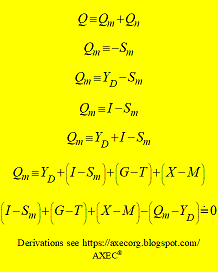
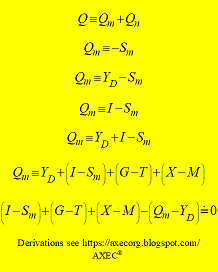
The correct relationship between the key variables is given by Qre≡I−S (2015, eq. (49)), that is, the business sector's investment expenditures are never equal to the household sector's saving, and their difference is always equal to the business sector's retained profit. Balance mechanics cannot possibly yield a different result.
While Keen's approach is formally deficient, his assertion that there is a straightforward connection between aggregate demand and the change of the household sector's debt is absolutely correct for the elementary production-consumption economy. For every economist, including Reissl, this is the firm ground in the conceptual swamp. The First Law of Balance Mechanics says saving = loss and NOT saving = investment.
Not to have realized this in more than 200 years is the scientific opprobrium of economics.
Egmont Kakarot-Handtke
References
E.K-H (2015). Tricky business. Blog post. URL
Kakarot-Handtke, E. (2011). Why Post Keynesianism is Not Yet a Science. SSRN Working Paper Series, 1966438: 1–20. URL
Kakarot-Handtke, E. (2013). Debunking Squared. SSRN Working Paper Series, 2357902: 1–5. URL
Kakarot-Handtke, E. (2015). Essentials of Constructive Heterodoxy: Financial Markets. SSRN Working Paper Series, 2607032: 1–33. URL
Keynes, J. M. (1973). The General Theory of Employment Interest and Money. The Collected Writings of John Maynard Keynes Vol. VII. London, Basingstoke: Macmillan.
Mirowski, P. (1986). Mathematical Formalism and Economic Explanation. In P. Mirowski (Ed.), The Reconstruction of Economic Theory, 179–240. Boston, Dordrecht, Lancaster: Kluwer-Nijhoff.
Reissl, S. (2015). The Return of Black Box Economics - a Critique of Keen on Effective Demand and Changes in Debt. IMK Working Paper, (149): 1–24. URL
Ricardo, D. (1981). On the Principles of Political Economy and Taxation. The Works and Correspondence of David Ricardo. Cambridge, New York, etc.: Cambridge University Press. URL
Schmitt, B., and Greppi, S. (1996). The National Economy Studied as a Whole: Aspects of Circular Flow Analysis in the German Language. In G. Deleplace and E. J. Nell (Eds.), Money in Motion, 341–364. Houndmills, Basingstoke, London: Macmillan. With reference to Föhl C. (1955), Geldschöpfung und Wirtschaftskreislauf, Berlin: Duncker & Humblot.
Related 'Where advanced Heterodoxy — represented by Steve Keen — took the wrong turn' and 'Heterodoxy, too, is proto-scientific garbage'. For details of the big picture, see cross-references Refutation of I=S and cross-references Profit and cross-references Accounting.
For more on Steve Keen, see AXECquery.
Graphic AXEC143d Macroeconomic Profit Law (with increasing complexity)


***
***
Twitter Oct 18, 2019 Balances mechanics

***
Twitter Oct 18, 2019 Stützel got the profit balance wrong

Wikipedia Oct 24 Saldenmechanik/Balances mechanics
Note that in the whole article, the word Profit/Gewinn does not appear once. Because profit/loss is the balance of the business sector, it is a foundational element of balances mechanics. The complementary element is the balance of the household sector, i.e., dissaving/saving. The fundamental law of balance mechanics says that all balances add up to zero. Therefrom follows for the elementary case of the 2-sector production-consumption economy (without profit distribution) that profit equals dissaving and loss equals saving. In the case of household sector dissaving, the business sector ends up with deposits at the Central Bank (= money) and the household sector with overdrafts. Both sides of the Central Bank's balance sheet are equal. Financial assets are equal to financial liabilities, and the net worth of the economy as a whole is zero.
Subscribe to:
Posts (Atom)