#Econ#FailedFakeScience
— E.K-H (@AXECorg) January 22, 2023
Apply Buchanan's Public-Choice approach to #Economics itself. This explains why #Economists might act in their own interest (= Axiom of individual #UtilityMaximization) rather than in the interest of #WeThePeople/#Science. ⇒https://t.co/tBQHMtyKpv
This blog connects to the AXEC Project which applies a superior method of economic analysis. The following comments have been posted on selected blogs as catalysts for the ongoing Paradigm Shift. The comments are brought together here for information. The full debates are directly accessible via the Blog-References. Scrap the lot and start again―that is what a Paradigm Shift is all about. Time to make economics a science.
January 22, 2023
Occasional Tweets: The economists' behavioral axiom explains why they might not act in the interest of WeThePeople
September 21, 2019
What’s wrong with DSGE models is the axiom set
Blog-Reference
“When the premises are certain, true, and primary, and the conclusion formally follows from them, this is demonstration, and produces scientific knowledge of a thing.” (Aristotle)
Standard microeconomics is based on these hardcore propositions, i.e., verbalized axioms: “HC1 economic agents have preferences over outcomes; HC2 agents individually optimize subject to constraints; HC3 agent choice is manifest in interrelated markets; HC4 agents have full relevant knowledge; HC5 observable outcomes are coordinated, and must be discussed with reference to equilibrium states.” (Weintraub)
Because this set of hardcore propositions is shock-full of NONENTITIES, all models that are based upon it are proto-scientific garbage. The whole of Marginalism derives ultimately from the core behavioral assumption HC2, i.e., constrained optimization, which is a NONENTITY like the Tooth Fairy or the Easter Bunny. From the Walrasian axioms, the triad SS-function―DD-function―equilibrium is derived. All ends up eventually in General Equilibrium Theory.
Because the behavioral axioms are false, the whole of mainstream economics is false. This includes DSGE because it is just a variant of HC1 to HC5. The common denominator is that the axioms are behavioral. For deeper methodological reasons, which have been discussed elsewhere, macroeconomics has to be based on objective, behavior/agency-free, systemic axioms.
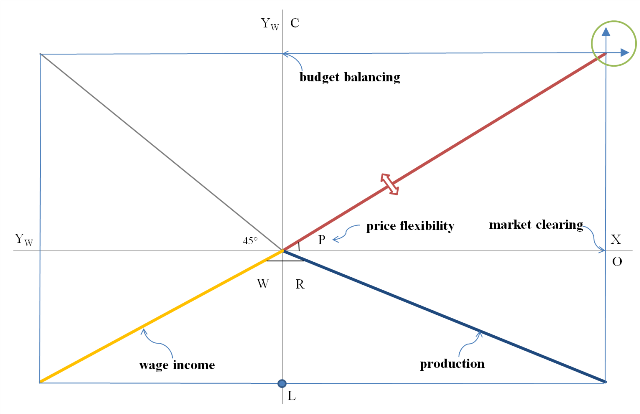
This is the correct core of premises: (A0) The objectively given and most elementary systemic configuration of the economy consists of the household and the business sector, which in turn consists initially of one giant fully integrated firm. (A1) Yw=WL wage income Yw is equal to wage rate W times working hours. L, (A2) O=RL output O is equal to productivity R times working hours L, (A3) C=PX consumption expenditure C is equal to price P times quantity bought/sold X.
These premises are “certain, true, and primary” and therefore satisfy all methodological requirements. The set is minimalistic; that is, Occam’s Razor has been applied, and the set cannot be reduced further, only expanded. The set contains no NONENTITIES like maximization or equilibrium and no normative assertions. All variables are measurable with the precision of two decimal places. Testability is built into the premises.
The price P follows as the dependent variable under the conditions of budget-balancing, i.e., C=Yw, and market-clearing, i.e., X=O, as P=W/R. This is the most elementary form of the macroeconomic Law of Supply and Demand. Accordingly, the real wage is W/P=R. The graphical representation of the macro-economy is given with AXEC31.
![]() |
| Elementary production-consumption economy |
The monetary saving/dissaving of the household sector is defined as S≡Yw−C. The monetary profit/loss of the business sector is defined as Q≡C−Yw. It always holds Q≡−S, in other words, the balances of the business and the household sector always add up to zero. This is the Fundamental Law of Macroeconomic Accounting.
The mirror image of household sector saving S is business sector loss (-Q). The mirror image of household sector dissaving (-S) is business sector profit Q. Q≡−S is the elementary version of the macroeconomic Profit Law.
Given the minimalist core propositions (A0) to (A3), one has to proceed top-down by successive DIFFERENTIATION of sectors and firms until one arrives at the individual agent. The bottom-up approach, also called microfoundations, is methodologically false because it is (i) behavioral, and (ii) runs with necessity into the Fallacy of Composition. (A0) to (A3) fully replaces HC1 to HC5.
Economics is in need of a Paradigm Shift from false Walrasian microfoundations and false Keynesian macrofoundations to “certain, true, and primary” macrofoundations. Or as the Financial Times has it, “Time for a reset.” #1
Egmont Kakarot-Handtke
#1 Links on “Capitalism. Time for a reset.”
Related 'DSGE and profit―forget it! MMT and profit―forget it!' and 'The Ur-Blunder of economics and its rectification' and 'Economics: How to stop mental pollution and global dumbing' and 'The curious non-existence of profit in economics' and 'Where economics went wrong (II)' and 'The GDP-death-blow for the economics profession'. For details of the big picture, see cross-references Axiomatization.
![]() |
| Source: Mike Norman Economics |
![]() |
| Source: Twitter |
January 18, 2010
September 12, 2010
February 26, 2023
Occasional Tweets: Why economists are spreading their love for economics and thereby self-contradict their axiom of utility/profit maximisation
The #ProfitLaw Q≡(G−T)+(I−S)+Yd implies #PublicDeficitIsPrivateProfit. So, #PrivateFinancialWealth grows in lockstep with #PublicDebt which is the interest #CashCow of the #Oligarchy. By reshuffling the #Debt (buy high, sell low) and taking losses the BoE acts as #ProfitPump. pic.twitter.com/grvP1KqUFP
— E.K-H (@AXECorg) February 26, 2023
November 29, 2010
January 13, 2010
September 13, 2010
October 6, 2010
February 9, 2010
May 20, 2010
October 6, 2024
Occasional Tweets: Time to get the axioms of economics right (II)
#Economics#FailedFakeScience#MicroFoundations#MacroFoundations
— E.K-H (@AXECorg) October 6, 2024
Economics claims to be science but is NOT. The major approaches (#Walrasianism, #Keynesianism, #Marxianism, #Austrianism, and their derivatives) are mutually contradictory & axiomatically false &… pic.twitter.com/KhrS5csuyP
May 20, 2010
April 3, 2025
Occasional X: Time to get the axioms of economics right (IV)
#Economics#AllYouNeedToKnow
— AXEC (@EgmontHandtke) April 3, 2025
“The first book is a perfect axiomatic statement—elegance like Euclid. The second has one of the most stunning theorems—originality like Archimedes.” (Kaushik Basu)
Economics is about how the economy works. It is a systems science and NOT a social… pic.twitter.com/tviO5gwJlH
November 17, 2025
Occasional X: Time to get the axioms of economics right (VI)
#Economics#AllYouNeedToKnow
— AXEC (@EgmontHandtke) November 17, 2025
“Why DSGE and NK Models Cannot Recover the Kalecki–Godley Identity ... they cannot reproduce the equivalence Kalecki (profits)=Godley (financing).” (James Young)
Almost true. But from the fact that DSGE/NK is proto-scientific garbage does not follow…
November 17, 2024
Occasional X: Time to get the axioms of economics right (III)
#Economics#FailedFakeScience
— E.K-H (@AXECorg) November 17, 2024
“You know what economists haven't thought enough about???” (Econlib)
“Thinking: Both Fundamental and Misunderstood” (Richard McKenzie)#Economics claims to be #Science but is NOT. The major approaches (Walrasianism, Keynesianism, Marxianism,… pic.twitter.com/67OMMUCL9J
May 21, 2010
July 8, 2022
Occasional Tweets: Time to get the axioms of economics right (I)
#Economics#FailedScience#FakeScience#ParadigmShift#MacroFoundations
— E.K-H (@AXECorg) July 8, 2022
It is obvious that the axioms of revealed preference are proto-scientific garbage. So, NOT to test them but replacing them is the right thing to do.
Toward the true economic axiomshttps://t.co/dxcMfC4ZJp pic.twitter.com/e4nuOUbcDp
December 31, 2014
Replacing the neoclassical axioms
Blog-Reference
You write: “F. Y. Edgeworth, founder of neoclassical economics expressed his 1st principle of economics in his Mathematical Physics as a “self interest” axiom based upon the premise that individuals seek maximizing returns.”
In fact, the attempts to axiomatize human behavior can be traced back to Hutcheson, Hume's and Smith's celebrated teacher (Redman, 1997, p. 116).
From whom did the Scottish philosophers and economists borrow? Of course, from Newton: “Smith certainly used the Principia as an analogy for finding laws of motion of the social world, ...” (Redman, 1997, p. 211)
And how did the Principia start? At the head of Book I stand the famous ‘Axioms or the Laws of motion.’
But as clueless epigones, the social scientists did not really grasp the Newtonian style. What should be obvious is that human behavior does not yield to the axiomatic method (2014).
Therefore, it is not sufficient to replace ‘unrealistic’ behavioral axioms with more ‘realistic’ ones.
The simple reason is that NO way leads from ANY behavioral assumption to the understanding of how the economy works. One has to go one step further: “... if we wish to place economic science upon a solid basis, we must make it completely independent of psychological assumptions and philosophical hypotheses.” (Slutzky, quoted in Mirowski, 1995, p. 362)
In other words, the methodological underpinning of economics is deficient (2013). That is: subjective-behavioral axioms have to be replaced by a set of objective-structural axioms. The latter defines the fundamental systemic relationships.
Human behavior should be left to psychology, sociology, and anthropology. Economists can only talk nonsense about it.
“The purpose ... is to criticise the notion that economics is a science of behaviour or that a science of behaviour is fundamental to economics. This plausible and, as I believe, mistaken idea has sometimes been called (methodological) psychologism, ... If it [my argument] is correct, then all the attempts to derive an adequate model of economic behaviour (as practised, for example, by the representatives of ‘behavioural’ or ‘psychological economics’) are misconceived.” (Hudík, 2011, p. 147)
A Paradigm Shift requires replacing the familiar behavioral axioms with structural axioms. Nothing else will do. The behavioral assumption of constrained optimization is not at all fundamental to economics.
Egmont Kakarot-Handtke
References
Hudík, M. (2011). Why Economics is Not a Science of Behaviour. Journal of Economic Methodology, 18(2): 147–162.
Kakarot-Handtke, E. (2013). Crisis and Methodology: Some Heterodox Misunderstandings. SSRN Working Paper Series, 2083519: 1–25. URL
Kakarot-Handtke, E. (2014). Objective Principles of Economics. SSRN Working Paper Series, 2418851: 1–19. URL
Mirowski, P. (1995). More Heat than Light. Cambridge: Cambridge University Press.
Redman, D. A. (1997). The Rise of Political Economy as Science. Methodology and the Classical Economists. Cambridge, London: MIT Press.
May 2, 2025
Occasional X: Time to get the axioms of economics right (V)
#Economics#AllYouNeedToKnow
— AXEC (@EgmontHandtke) May 2, 2025
“True, from an accounting perspective. Not necessarily true from a theoretical perspective.” (David Andolfatto)
Fact: Neither true from the accounting nor the theoretical perspective.
Reminder: Economics claims to be science but is NOT. The major…