#Economics#AllYouNeedToKnow
— AXEC (@EgmontHandtke) November 9, 2025
“Students of Austrian economics please read the first paragraph after the heading on ‘The Epistemological Import of Carl Menger’s Theory of the Origin of Money.’ Trace Mises’s argument back to Menger then forward to Hayek.” (Peter Boettke)
Authentic… pic.twitter.com/pq8VGUq7T4
Showing posts sorted by relevance for query title:Methodology. Sort by date Show all posts
Showing posts sorted by relevance for query title:Methodology. Sort by date Show all posts
November 9, 2025
Occasional X: Economists’ eternal problem with methodology (XI)

September 1, 2026
Occasional X: Discrete methodology
There seem to be two Pi: a mathematical and a physical. If there is the Planck minimum length and the circle can only be approximated with orthogonal horizontal-vertical steps, then physical Pi is 4 ⇓. As I recall, physical Pi has already been measured by Miles Mathis. It seems… pic.twitter.com/j2wJV2be2a
— AXEC (@EgmontHandtke) September 1, 2026
June 13, 2012
Crisis and Methodology: Some Heterodox Misunderstandings {31a}
Whether justified by the concrete circumstances or not, an economic crisis is, by simple association, taken as an implicit refutation of the invisible hand vision and the underlying theory. The fundamental heterodox critique locates the source of apparent theoretical difficulties at the level of methodology. Although acceptable in principle, this belief involves some actual misunderstandings with regard to the respective roles of deterministic laws and deductive reasoning. In order to clarify these, the present paper revisits some key episodes in the history of economic methodology.
April 3, 2024
Occasional Xs: Economists’ eternal problem with methodology (V)
#Economics#FailedFakeScience
— E.K-H (@AXECorg) April 3, 2024
“… because my view is that it is the unique methodology and analytics of the Austrian School that yields the powerful insights.”
For 200+ years, economics claims to be #Science but is NOT. The major approaches (Walrasianism, Keynesianism,…
January 27, 2016
Economists and methodology: the horror of all horrors
Comment on Lars Syll on ‘Deduction — induction — abduction’
Blog-Reference and Blog-Reference on Jan 28
Economists are feeble thinkers. We take Keynesians as an exemplary case here, but the argument applies in full generality to Walrasians, Marxians, and Austrians.
As a centerpiece of the General Theory Keynes formulated the foundational syllogism of macroeconomics. “Income = value of output = consumption + investment. Saving = income − consumption. Therefore saving = investment.” (1973, p. 63)
This elementary syllogism is conceptually and logically defective because Keynes did not come to grips with profit and therefore “discarded the draft chapter dealing with it” (Tómasson et al., 2010, p. 12). As a result, all I=S models including the Keynesian multiplier are provably false to this day (2011).
To see the enormity of intellectual failure one has to let this sink in: Keynes had no idea of the fundamental concepts of his discipline, viz. profit and income. This did not hinder him from talking a lot about Capitalism and Laissez-faire and, worst of all, economic methodology. Keynes’s economic policy proposals never had a sound theoretical foundation but were at best commonsensical. The scientific horror, though, did not stop there. After-Keynesians did not realize to this day that there is something fundamentally wrong with Keynes’s two-liner and I=S but still hallucinate about ex-ante/ ex-post (2014).#1
So we have two indicators of the logical incapacity of present-day economists: Keynesians are for more than 80 years in the dark. Sorta-kinda Neoclassicals, who are not aware that ‘maximization-and-equilibrium’ (Krugman) is a methodologically inadmissible axiomatic starting point, are for more than 150 years in the dark. This, though, is still not the worst.
Keynes was by no means an exception. Economists, in general, do not understand what profit is.#2 This means that all models in which profit appears or, worse, does not at all appear explicitly are definitely false. So, economists, in general, have since Adam Smith been in the dark. This, though, is still not the worst.
People who have no idea of the foundational concepts of their discipline, viz. profit and income, philosophize endlessly about methodology and mathiness and axiomatics and deduction/induction and probability. Because they have disqualified themselves on their own turf neither Keynesians nor sorta-kinda Neoclassicals nor the rest of the profession can be taken seriously for one split-second in matters of methodology.
All that an economist has to know about methodology is that every theory/model has to satisfy the conditions of both formal and material consistency (Klant, 1994, p. 31). Economic models do not satisfy these conditions. Because of this, economics is a failed science.
Egmont Kakarot-Handtke
References
Kakarot-Handtke, E. (2011). Why Post Keynesianism is Not Yet a Science. SSRN Working Paper Series, 1966438: 1–20. URL
Kakarot-Handtke, E. (2014). Mr. Keynes, Prof. Krugman, IS-LM, and the End of Economics as We Know It. SSRN Working Paper Series, 2392856: 1–19. URL
Keynes, J. M. (1973). The General Theory of Employment Interest and Money. The Collected Writings of John Maynard Keynes Vol. VII. London, Basingstoke: Macmillan.
Klant, J. J. (1994). The Nature of Economic Thought. Aldershot, Brookfield: Edward Elgar.
Tómasson, G., and Bezemer, D. J. (2010). What is the Source of Profit and Interest? A Classical Conundrum Reconsidered. MPRA Paper, 20557: 1–34. URL
#1 I=S: Mark of the Incompetent
#2 How the intelligent non-economist can refute every economist hands down
Related 'Economists’ proto-scientific methodology' and 'Agenda pushing or science?' and 'Why the Naked-Emperor-Zombie cannot die' and 'Lousy scientists' and 'Confused Orthodoxy vs. confused Heterodoxy'
ADDENDUM Unskilled users, comment on Lars Syll on Jan 27
You say: “The hypothetico-deductive method (in case we treat the hypothesis as absolutely sure/true, we rather talk of an axiomatic-deductive method) basically means that ...”
This is not quite correct. Popper describes the axiomatic-deductive method thus: “The attempt is made to collect all the assumptions, which are needed, but no more, to form the apex of the system. They are usually called the ‘axioms’ (or ‘postulates’, or ‘primitive propositions’; no claim of truth is implied in the term ‘axiom’ as here used). The axioms are chosen in such a way that all the other statements belonging to the theoretical system can be derived from the axioms by purely logical or mathematical transformations.” (1980, p. 71)
Axioms are defined by their role and, as Popper explicitly states “no claim of truth is implied” initially. So, to associate ‘absolutely true’ and ‘axiomatic-deductive method’ is false and misleading.
Schumpeter understood this very well and he, too, made no categorical distinction between hypothesis and axiom: “... the things (propositions) that we take for granted may be called indiscriminately either hypotheses or axioms or postulates or assumptions or even principles, and the things (propositions) that we think we have established by admissible procedure are called theorems.” (1994, p. 15)
As a rule, the proof of axioms is in the deductively derived conclusions. If what the theory says should be the case is actually the case, then the axioms are indirectly corroborated. If not, they are refuted qua modus tollens. This was already obvious to J. S. Mill. “The ground of confidence in any concrete deductive science is not the à priori reasoning itself, but the accordance between its results and those of observation à posteriori.” (2006, p. 896-897)
You say “In mathematics, the deductive-axiomatic method has worked just fine. But science is not mathematics. Conflating those two domains of knowledge has been one of the most fundamental mistakes made in the science of economics.”
It is obvious that economists misunderstood and misapplied mathematics. And it is trivially true, of course, that ‘science is not mathematics’. The point is that there is a ‘logical parallelism’ between the two. Einstein put the crucial methodological issue with perfect clarity thusly “A complete system of theoretical physics consists of concepts and basic laws to interrelate those concepts and of consequences to be derived by logical deduction. It is these consequences to which our particular experiences are to correspond, and it is the logical derivation of them which in a purely theoretical work occupies by far the greater part of the book. This is really exactly analogous to Euclidean geometry, except that in the latter the basic laws are called ‘axioms’; and, further, that in this field there is no question of the consequences having to correspond with any experiences. But if we conceive Euclidean geometry as the science of the possibilities of the relative placing of actual rigid bodies and accordingly interpret it as a physical science, and do not abstract from its original empirical content, the logical parallelism of geometry and theoretical physics is complete.” (Einstein, 1934, pp. 164-165)
Note that ‘axioms’ is in inverted commas to indicate that in physics its meaning is physical. Einstein knew already long before Lars Syll that ‘science is not mathematics’ but he knew how to merge them.
The logical parallelism between science and mathematics has puzzled many people “I find it quite amazing that it is possible to predict what will happen by mathematics, which is simply following rules which really have nothing to do with what is going on in the original thing.” (Feynman, 1992, p. 171) [note: the meaning of prediction is different from soothsaying]
There is no need here to discuss why this logical parallelism works so splendidly (Velupillai, 2005). Suffice it to say that there is no good reason whatever to maintain that — as a matter of principle — the axiomatic-deductive method cannot work in economics. Just the contrary “My opinion continues to be that axiomatics, like every other tool of science, is no better than its user, and not all users are skilled.” (Clower, 1995, p. 308)
The fact of the matter is that economists have not been very skilled users of the scientific method up to now. This is due to a lack of scientific competence which seems to be hereditary among both orthodox and heterodox economists.
References
Clower, R. W. (1995). Axiomatics in Economics. Southern Economic Journal, 62(2): 307–319. URL
Einstein, A. (1934). On the Method of Theoretical Physics. Philosophy of Science, 1(2): 163–169. URL
Feynman, R. P. (1992). The Character of Physical Law. London: Penguin.
Mill, J. S. (2006). A System of Logic Ratiocinative and Inductive. Being a Connected View of the Principles of Evidence and the Methods of Scientific Investigation, Vol. 8 of Collected Works of John Stuart Mill. Indianapolis: Liberty Fund.
Popper, K. R. (1980). The Logic of Scientific Discovery. London, Melbourne, Sydney: Hutchison, 10th edition.
Schumpeter, J. A. (1994). History of Economic Analysis. New York: Oxford University Press.
Velupillai, K. (2005). The Unreasonable Ineffectiveness of Mathematics in Economics. Cambridge Journal of Economics, 29: 849–872.
Blog-Reference and Blog-Reference on Jan 28
Economists are feeble thinkers. We take Keynesians as an exemplary case here, but the argument applies in full generality to Walrasians, Marxians, and Austrians.
As a centerpiece of the General Theory Keynes formulated the foundational syllogism of macroeconomics. “Income = value of output = consumption + investment. Saving = income − consumption. Therefore saving = investment.” (1973, p. 63)
This elementary syllogism is conceptually and logically defective because Keynes did not come to grips with profit and therefore “discarded the draft chapter dealing with it” (Tómasson et al., 2010, p. 12). As a result, all I=S models including the Keynesian multiplier are provably false to this day (2011).
To see the enormity of intellectual failure one has to let this sink in: Keynes had no idea of the fundamental concepts of his discipline, viz. profit and income. This did not hinder him from talking a lot about Capitalism and Laissez-faire and, worst of all, economic methodology. Keynes’s economic policy proposals never had a sound theoretical foundation but were at best commonsensical. The scientific horror, though, did not stop there. After-Keynesians did not realize to this day that there is something fundamentally wrong with Keynes’s two-liner and I=S but still hallucinate about ex-ante/ ex-post (2014).#1
So we have two indicators of the logical incapacity of present-day economists: Keynesians are for more than 80 years in the dark. Sorta-kinda Neoclassicals, who are not aware that ‘maximization-and-equilibrium’ (Krugman) is a methodologically inadmissible axiomatic starting point, are for more than 150 years in the dark. This, though, is still not the worst.
Keynes was by no means an exception. Economists, in general, do not understand what profit is.#2 This means that all models in which profit appears or, worse, does not at all appear explicitly are definitely false. So, economists, in general, have since Adam Smith been in the dark. This, though, is still not the worst.
People who have no idea of the foundational concepts of their discipline, viz. profit and income, philosophize endlessly about methodology and mathiness and axiomatics and deduction/induction and probability. Because they have disqualified themselves on their own turf neither Keynesians nor sorta-kinda Neoclassicals nor the rest of the profession can be taken seriously for one split-second in matters of methodology.
All that an economist has to know about methodology is that every theory/model has to satisfy the conditions of both formal and material consistency (Klant, 1994, p. 31). Economic models do not satisfy these conditions. Because of this, economics is a failed science.
Egmont Kakarot-Handtke
References
Kakarot-Handtke, E. (2011). Why Post Keynesianism is Not Yet a Science. SSRN Working Paper Series, 1966438: 1–20. URL
Kakarot-Handtke, E. (2014). Mr. Keynes, Prof. Krugman, IS-LM, and the End of Economics as We Know It. SSRN Working Paper Series, 2392856: 1–19. URL
Keynes, J. M. (1973). The General Theory of Employment Interest and Money. The Collected Writings of John Maynard Keynes Vol. VII. London, Basingstoke: Macmillan.
Klant, J. J. (1994). The Nature of Economic Thought. Aldershot, Brookfield: Edward Elgar.
Tómasson, G., and Bezemer, D. J. (2010). What is the Source of Profit and Interest? A Classical Conundrum Reconsidered. MPRA Paper, 20557: 1–34. URL
#1 I=S: Mark of the Incompetent
#2 How the intelligent non-economist can refute every economist hands down
Related 'Economists’ proto-scientific methodology' and 'Agenda pushing or science?' and 'Why the Naked-Emperor-Zombie cannot die' and 'Lousy scientists' and 'Confused Orthodoxy vs. confused Heterodoxy'
***
ADDENDUM Unskilled users, comment on Lars Syll on Jan 27
You say: “The hypothetico-deductive method (in case we treat the hypothesis as absolutely sure/true, we rather talk of an axiomatic-deductive method) basically means that ...”
This is not quite correct. Popper describes the axiomatic-deductive method thus: “The attempt is made to collect all the assumptions, which are needed, but no more, to form the apex of the system. They are usually called the ‘axioms’ (or ‘postulates’, or ‘primitive propositions’; no claim of truth is implied in the term ‘axiom’ as here used). The axioms are chosen in such a way that all the other statements belonging to the theoretical system can be derived from the axioms by purely logical or mathematical transformations.” (1980, p. 71)
Axioms are defined by their role and, as Popper explicitly states “no claim of truth is implied” initially. So, to associate ‘absolutely true’ and ‘axiomatic-deductive method’ is false and misleading.
Schumpeter understood this very well and he, too, made no categorical distinction between hypothesis and axiom: “... the things (propositions) that we take for granted may be called indiscriminately either hypotheses or axioms or postulates or assumptions or even principles, and the things (propositions) that we think we have established by admissible procedure are called theorems.” (1994, p. 15)
As a rule, the proof of axioms is in the deductively derived conclusions. If what the theory says should be the case is actually the case, then the axioms are indirectly corroborated. If not, they are refuted qua modus tollens. This was already obvious to J. S. Mill. “The ground of confidence in any concrete deductive science is not the à priori reasoning itself, but the accordance between its results and those of observation à posteriori.” (2006, p. 896-897)
You say “In mathematics, the deductive-axiomatic method has worked just fine. But science is not mathematics. Conflating those two domains of knowledge has been one of the most fundamental mistakes made in the science of economics.”
It is obvious that economists misunderstood and misapplied mathematics. And it is trivially true, of course, that ‘science is not mathematics’. The point is that there is a ‘logical parallelism’ between the two. Einstein put the crucial methodological issue with perfect clarity thusly “A complete system of theoretical physics consists of concepts and basic laws to interrelate those concepts and of consequences to be derived by logical deduction. It is these consequences to which our particular experiences are to correspond, and it is the logical derivation of them which in a purely theoretical work occupies by far the greater part of the book. This is really exactly analogous to Euclidean geometry, except that in the latter the basic laws are called ‘axioms’; and, further, that in this field there is no question of the consequences having to correspond with any experiences. But if we conceive Euclidean geometry as the science of the possibilities of the relative placing of actual rigid bodies and accordingly interpret it as a physical science, and do not abstract from its original empirical content, the logical parallelism of geometry and theoretical physics is complete.” (Einstein, 1934, pp. 164-165)
Note that ‘axioms’ is in inverted commas to indicate that in physics its meaning is physical. Einstein knew already long before Lars Syll that ‘science is not mathematics’ but he knew how to merge them.
The logical parallelism between science and mathematics has puzzled many people “I find it quite amazing that it is possible to predict what will happen by mathematics, which is simply following rules which really have nothing to do with what is going on in the original thing.” (Feynman, 1992, p. 171) [note: the meaning of prediction is different from soothsaying]
There is no need here to discuss why this logical parallelism works so splendidly (Velupillai, 2005). Suffice it to say that there is no good reason whatever to maintain that — as a matter of principle — the axiomatic-deductive method cannot work in economics. Just the contrary “My opinion continues to be that axiomatics, like every other tool of science, is no better than its user, and not all users are skilled.” (Clower, 1995, p. 308)
The fact of the matter is that economists have not been very skilled users of the scientific method up to now. This is due to a lack of scientific competence which seems to be hereditary among both orthodox and heterodox economists.
References
Clower, R. W. (1995). Axiomatics in Economics. Southern Economic Journal, 62(2): 307–319. URL
Einstein, A. (1934). On the Method of Theoretical Physics. Philosophy of Science, 1(2): 163–169. URL
Feynman, R. P. (1992). The Character of Physical Law. London: Penguin.
Mill, J. S. (2006). A System of Logic Ratiocinative and Inductive. Being a Connected View of the Principles of Evidence and the Methods of Scientific Investigation, Vol. 8 of Collected Works of John Stuart Mill. Indianapolis: Liberty Fund.
Popper, K. R. (1980). The Logic of Scientific Discovery. London, Melbourne, Sydney: Hutchison, 10th edition.
Schumpeter, J. A. (1994). History of Economic Analysis. New York: Oxford University Press.
Velupillai, K. (2005). The Unreasonable Ineffectiveness of Mathematics in Economics. Cambridge Journal of Economics, 29: 849–872.
June 1, 2019
Dialectic: the swampies’ methodology of choice
Comment on Matt Franko on ‘Dialectic Method’
Blog-Reference
Matt Franko observes: “Probably 99.99% of the Economics discipline is operating under the Dialectic Method and accordingly the material result is the manifest shit-show we are watching every day … a moron-fest goat rodeo … Its NOT the discipline of Economics that is the problem, we often can see the discipline taking a lot of heat … imo its unfair criticism of a discipline … its rather the dominant dialectic methodology commonly used within that discipline that is fucking everything all up.”
Matt Franko is not the first to realize that economics has a methodology problem. What he does not realize, though, is that this is not a bug but a feature. Economics has firmly established itself in the dialectical impasse of political economics and theoretical economics. The main differences are: (i) The goal of political economics is to successfully push an agenda; the goal of theoretical economics is to successfully explain how the actual economy works. (ii) In political economics, anything goes; in theoretical economics, the scientific standards of material and formal consistency are observed. The fact is that theoretical economics (= science) had been hijacked from the very beginning by political economists (= agenda pushers). Political economics has produced NOTHING of scientific value in the last 200+ years. The major approaches ― Walrasianism, Keynesianism, Marxianism, Austrianism, MMT ― are mutually contradictory, axiomatically false, and materially/formally inconsistent.
The dialectical impasse consists of the manifest contradiction between the claim that economics is a science and the fact that it is a political agenda pushing.
Science is digital=binary=true/false and NOTHING in between. There is NO such thing in science as roughly right or roughly wrong; it is only materially/formally true/false. The swamp between true/false, where “nothing is clear and everything is possible” (Keynes), is the natural habitat of morons, agenda pushers, confused confusers, blatherers, fraudsters, trolls, and incompetent scientists. #1, #2, #3, #4
Swampies euphemize their inability/unwillingness to resolve inconsistencies as dialectic method: “According to Kant … the ancient Greeks used the word ‘dialectic’ to signify the logic of false appearance or semblance. To the Ancients, ‘it was nothing but the logic of illusion. It was a sophistic art of giving to one’s ignorance, indeed even to one’s intentional tricks, the outward appearance of truth, by imitating the thorough, accurate method which logic always requires, and by using its topic as a cloak for every empty assertion.'” #5
The philosophical father of modern dialectics is Hegel. Schopenhauer had not much good to say about him: “If I were to say that the so-called philosophy of this fellow Hegel is a colossal piece of mystification which will yet provide posterity with an inexhaustible theme for laughter at our times, that it is a pseudo-philosophy paralyzing all mental powers, stifling all real thinking, and, by the most outrageous misuse of language, putting in its place the hollowest, most senseless, thoughtless, and, as is confirmed by its success, most stupefying verbiage, I should be quite right.” #6
In marked contrast to swampies, scientists drive the question under discussion to the point of a clear-cut decision between true and false: “Research is, in fact, a continuous discussion of the consistency of theories: formal consistency insofar as the discussion relates to the logical cohesion of what is asserted in joint theories; material consistency insofar as the agreement of observations with theories is concerned.” (Klant)
Formal consistency is secured by applying the axiomatic-deductive method, and empirical consistency is secured by applying state-of-the-art testing.
The profession of useful political idiots has no genuine interest in a clear-cut true/false outcome of research and debate but seeks to keep everything and everybody in the status quo swamp. Swampies subscribe to dialectical inconclusiveness, i.e., anything goes, truth is subjective and relative, reality is a social construct, nobody has the truth with a big T, everybody has some truth with a small t, and to the pluralism and peaceful coexistence of provably false theories.
As Popper summarized it: “Hegel’s intention is to operate freely with all contradictions. ‘All things are contradictory in themselves’, he insists, in order to defend a position which means the end not only of all science, but of all rational argument. And the reason why he wishes to admit contradictions is that he wants to stop rational argument, and with it scientific and intellectual progress.” #7
Political economists prevent scientific progress to this day. Economics is still at the proto-scientific stage, which is characterized by material/formal inconsistency.
Egmont Kakarot-Handtke
#1 It is better to be precisely right than roughly wrong
#2 Marshall and the Cambridge School of plain economic gibberish
#3 Confused Confusers: How to Stop Thinking Like an Economist and Start Thinking Like a Scientist
#4 Finally, the embarrassment of economics is over
#5 Wikipedia
#6 Goodreads
#7 A Free Left Blog
Related 'Profit: after 200+ years, economists are still in the woods' and 'A new curriculum for swampies?' and 'Getting out of the economics swamp' and 'Economics: The greatest scientific fraud in modern times' and 'Opinion, conversation, interpretation, blather: the economist’s major immunizing stratagems' and 'Economics, too, is pre-truth' and 'Links on capital-T Truth, stupidity, corruption' and 'Economics is locked in idiocy: How could this happen?' and 'Economists: scientists or political clowns?' and 'Economics as storytelling and entertainment for the masses' and 'And the answer is NCND ― economics after 200+ years of Glomarization'.


Blog-Reference
Matt Franko observes: “Probably 99.99% of the Economics discipline is operating under the Dialectic Method and accordingly the material result is the manifest shit-show we are watching every day … a moron-fest goat rodeo … Its NOT the discipline of Economics that is the problem, we often can see the discipline taking a lot of heat … imo its unfair criticism of a discipline … its rather the dominant dialectic methodology commonly used within that discipline that is fucking everything all up.”
Matt Franko is not the first to realize that economics has a methodology problem. What he does not realize, though, is that this is not a bug but a feature. Economics has firmly established itself in the dialectical impasse of political economics and theoretical economics. The main differences are: (i) The goal of political economics is to successfully push an agenda; the goal of theoretical economics is to successfully explain how the actual economy works. (ii) In political economics, anything goes; in theoretical economics, the scientific standards of material and formal consistency are observed. The fact is that theoretical economics (= science) had been hijacked from the very beginning by political economists (= agenda pushers). Political economics has produced NOTHING of scientific value in the last 200+ years. The major approaches ― Walrasianism, Keynesianism, Marxianism, Austrianism, MMT ― are mutually contradictory, axiomatically false, and materially/formally inconsistent.
The dialectical impasse consists of the manifest contradiction between the claim that economics is a science and the fact that it is a political agenda pushing.
Science is digital=binary=true/false and NOTHING in between. There is NO such thing in science as roughly right or roughly wrong; it is only materially/formally true/false. The swamp between true/false, where “nothing is clear and everything is possible” (Keynes), is the natural habitat of morons, agenda pushers, confused confusers, blatherers, fraudsters, trolls, and incompetent scientists. #1, #2, #3, #4
Swampies euphemize their inability/unwillingness to resolve inconsistencies as dialectic method: “According to Kant … the ancient Greeks used the word ‘dialectic’ to signify the logic of false appearance or semblance. To the Ancients, ‘it was nothing but the logic of illusion. It was a sophistic art of giving to one’s ignorance, indeed even to one’s intentional tricks, the outward appearance of truth, by imitating the thorough, accurate method which logic always requires, and by using its topic as a cloak for every empty assertion.'” #5
The philosophical father of modern dialectics is Hegel. Schopenhauer had not much good to say about him: “If I were to say that the so-called philosophy of this fellow Hegel is a colossal piece of mystification which will yet provide posterity with an inexhaustible theme for laughter at our times, that it is a pseudo-philosophy paralyzing all mental powers, stifling all real thinking, and, by the most outrageous misuse of language, putting in its place the hollowest, most senseless, thoughtless, and, as is confirmed by its success, most stupefying verbiage, I should be quite right.” #6
In marked contrast to swampies, scientists drive the question under discussion to the point of a clear-cut decision between true and false: “Research is, in fact, a continuous discussion of the consistency of theories: formal consistency insofar as the discussion relates to the logical cohesion of what is asserted in joint theories; material consistency insofar as the agreement of observations with theories is concerned.” (Klant)
Formal consistency is secured by applying the axiomatic-deductive method, and empirical consistency is secured by applying state-of-the-art testing.
The profession of useful political idiots has no genuine interest in a clear-cut true/false outcome of research and debate but seeks to keep everything and everybody in the status quo swamp. Swampies subscribe to dialectical inconclusiveness, i.e., anything goes, truth is subjective and relative, reality is a social construct, nobody has the truth with a big T, everybody has some truth with a small t, and to the pluralism and peaceful coexistence of provably false theories.
As Popper summarized it: “Hegel’s intention is to operate freely with all contradictions. ‘All things are contradictory in themselves’, he insists, in order to defend a position which means the end not only of all science, but of all rational argument. And the reason why he wishes to admit contradictions is that he wants to stop rational argument, and with it scientific and intellectual progress.” #7
Political economists prevent scientific progress to this day. Economics is still at the proto-scientific stage, which is characterized by material/formal inconsistency.
Egmont Kakarot-Handtke
#1 It is better to be precisely right than roughly wrong
#2 Marshall and the Cambridge School of plain economic gibberish
#3 Confused Confusers: How to Stop Thinking Like an Economist and Start Thinking Like a Scientist
#4 Finally, the embarrassment of economics is over
#5 Wikipedia
#6 Goodreads
#7 A Free Left Blog
Related 'Profit: after 200+ years, economists are still in the woods' and 'A new curriculum for swampies?' and 'Getting out of the economics swamp' and 'Economics: The greatest scientific fraud in modern times' and 'Opinion, conversation, interpretation, blather: the economist’s major immunizing stratagems' and 'Economics, too, is pre-truth' and 'Links on capital-T Truth, stupidity, corruption' and 'Economics is locked in idiocy: How could this happen?' and 'Economists: scientists or political clowns?' and 'Economics as storytelling and entertainment for the masses' and 'And the answer is NCND ― economics after 200+ years of Glomarization'.
***
Graphic AXEC176b Economics, Communication, Disinfotainment

Twitter/X May 12, 2026 Adrián Ramírez, LIBERALISM AND THE RISE OF ERISTICISM or the application of Schopenhauer's Die Kunst Recht zu behalten

March 25, 2013
Crisis and Methodology: Some Heterodox Misunderstandings {31b}
Abstract Whether justified by the concrete circumstances or not, an economic crisis is, by simple association, taken as an implicit refutation of the invisible hand vision and the underlying theory. The fundamental heterodox critique locates the source of apparent theoretical difficulties at the level of methodology. Although acceptable in principle, this belief involves some actual misunderstandings with regard to the respective roles of deterministic laws and deductive reasoning. In order to clarify these, the present paper revisits some key episodes in the history of economic methodology.
September 5, 2017
Economic methodology for the little guy
Comment on Lars Syll on ‘Methodological arrogance’
Blog-Reference and Blog-Reference
It is a fact that the little man has an ego problem. Worse, this psychological disadvantage is exploited in all kinds of discussions. To position oneself as the humble friend of the people and to call the opponent an arrogant elitist is a sure way to win standing ovations in every sitcom, no matter what the issue is.
These age-old rhetorical maneuvers, though, are entirely misplaced in a discussion about the methodology of economics. David Glasner disqualifies himself with this argument: “So what do I mean by methodological arrogance? I mean an attitude that invokes micro-foundations as a methodological principle — philosophical reductionism in Popper’s terminology — while dismissing non-microfounded macromodels as unscientific.” Note that the introduction of the psychological notion of arrogance adds nothing of relevance but merely emotionally distracts from the point at issue.
The point at issue is whether Walrasian microfoundations or Keynesian macrofoundations are the correct starting point of economic analysis. And the short and simple answer is, without humbleness or arrogance, that BOTH are unacceptable proto-scientific garbage.
Microfoundations are given with these verbalized Walrasian axioms: “HC1 economic agents have preferences over outcomes; HC2 agents individually optimize subject to constraints; HC3 agent choice is manifest in interrelated markets; HC4 agents have full relevant knowledge; HC5 observable outcomes are coordinated, and must be discussed with reference to equilibrium states.” (Weintraub)
From these premises follows supply-demand-equilibrium and all the rest of microeconomics.
Obviously, the Walrasian axiom set contains three NONENTITIES: (i) constrained optimization HC2, (ii) rational expectations HC4, (iii) equilibrium HC5. Every theory/model that contains a NONENTITY is a priory false. Consequently, the economics from Jevons/Walras/Menger to DSGE/RBC is false.
Keynes has to be credited for realizing that Orthodoxy was false at its core and that nothing less than a Paradigm Shift was needed.
The Keynesian Revolution, though, failed because Keynes messed up the move from microfoundations to macrofoundations. Keynes’ own methodological blunder can be exactly located in the General Theory: “Income = value of output = consumption + investment. Saving = income − consumption. Therefore saving = investment.” (p. 63)
This syllogism is conceptually and logically defective because Keynes NEVER came to grips with profit: “His Collected Writings show that he wrestled to solve the Profit Puzzle up till the semi-final versions of his GT but in the end he gave up and discarded the draft chapter dealing with it.” (Tómasson et al.)
Because profit and income are ill-defined, the whole theoretical superstructure of Keynesianism is false. It was Allais who identified and rectified Keynes’s lethal foundational blunder. #1 After-Keynesians have not noticed anything to this very day.
What the team Glasner/Syll has not realized is that BOTH Walrasian microfoundations and Keynesian macrofoundations have to be buried. The former is dead for 150+ years, the latter for 80+ years.
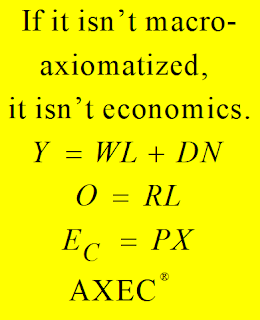
As a consequence, there is only ONE worthwhile task in today’s economics: the Paradigm Shift from false microfoundations and false macrofoundations to the true macrofoundations. #2 It holds: If it isn’t macro-axiomatized, it isn’t economics.
Do not expect this urgent Paradigm Shift from the self-declared champions of the little guy, long-standing proto-scientific blatherers, and cargo cult scientists David Glasner and Lars Syll.
Egmont Kakarot-Handtke
#1 How Keynes got macro wrong and Allais got it right
#2 First Lecture in New Economic Thinking
Blog-Reference and Blog-Reference
It is a fact that the little man has an ego problem. Worse, this psychological disadvantage is exploited in all kinds of discussions. To position oneself as the humble friend of the people and to call the opponent an arrogant elitist is a sure way to win standing ovations in every sitcom, no matter what the issue is.
These age-old rhetorical maneuvers, though, are entirely misplaced in a discussion about the methodology of economics. David Glasner disqualifies himself with this argument: “So what do I mean by methodological arrogance? I mean an attitude that invokes micro-foundations as a methodological principle — philosophical reductionism in Popper’s terminology — while dismissing non-microfounded macromodels as unscientific.” Note that the introduction of the psychological notion of arrogance adds nothing of relevance but merely emotionally distracts from the point at issue.
The point at issue is whether Walrasian microfoundations or Keynesian macrofoundations are the correct starting point of economic analysis. And the short and simple answer is, without humbleness or arrogance, that BOTH are unacceptable proto-scientific garbage.
Microfoundations are given with these verbalized Walrasian axioms: “HC1 economic agents have preferences over outcomes; HC2 agents individually optimize subject to constraints; HC3 agent choice is manifest in interrelated markets; HC4 agents have full relevant knowledge; HC5 observable outcomes are coordinated, and must be discussed with reference to equilibrium states.” (Weintraub)
From these premises follows supply-demand-equilibrium and all the rest of microeconomics.
Obviously, the Walrasian axiom set contains three NONENTITIES: (i) constrained optimization HC2, (ii) rational expectations HC4, (iii) equilibrium HC5. Every theory/model that contains a NONENTITY is a priory false. Consequently, the economics from Jevons/Walras/Menger to DSGE/RBC is false.
Keynes has to be credited for realizing that Orthodoxy was false at its core and that nothing less than a Paradigm Shift was needed.
The Keynesian Revolution, though, failed because Keynes messed up the move from microfoundations to macrofoundations. Keynes’ own methodological blunder can be exactly located in the General Theory: “Income = value of output = consumption + investment. Saving = income − consumption. Therefore saving = investment.” (p. 63)
This syllogism is conceptually and logically defective because Keynes NEVER came to grips with profit: “His Collected Writings show that he wrestled to solve the Profit Puzzle up till the semi-final versions of his GT but in the end he gave up and discarded the draft chapter dealing with it.” (Tómasson et al.)
Because profit and income are ill-defined, the whole theoretical superstructure of Keynesianism is false. It was Allais who identified and rectified Keynes’s lethal foundational blunder. #1 After-Keynesians have not noticed anything to this very day.
What the team Glasner/Syll has not realized is that BOTH Walrasian microfoundations and Keynesian macrofoundations have to be buried. The former is dead for 150+ years, the latter for 80+ years.
As a consequence, there is only ONE worthwhile task in today’s economics: the Paradigm Shift from false microfoundations and false macrofoundations to the true macrofoundations. #2 It holds: If it isn’t macro-axiomatized, it isn’t economics.
Do not expect this urgent Paradigm Shift from the self-declared champions of the little guy, long-standing proto-scientific blatherers, and cargo cult scientists David Glasner and Lars Syll.
Egmont Kakarot-Handtke
#1 How Keynes got macro wrong and Allais got it right
#2 First Lecture in New Economic Thinking
***
Graphic AXEC121i

November 3, 2025
Occasional X: Economists’ eternal problem with methodology (X)
#Economics#AllYouNeedToKnow
— AXEC (@EgmontHandtke) November 3, 2025
“In this paper, we focus on the semantics and relevance of ideology in economics. Correctly conceived, we argue, ideology is a distinct, irreplaceable category, which should not be identified, for instance, with value judgements.” (Cambridge Journal,… pic.twitter.com/FWtzTwHcZ5
For more about Lawson, see AXECquery.
September 27, 2023
Occasional Xs: Economists’ eternal problem with methodology (III)
#Economics#FailedFakeScience#Walrasianism, #Keynesianism, #Marxianism, #Austrianism et al. are axiomatically false & materially/formally inconsistent & ALL got #Profit wrong. To this day, #Methodologists have failed to figure that out. ⇒https://t.co/H2J8qUpgh9
— E.K-H (@AXECorg) September 27, 2023
For more about methodology see AXECquery.
October 26, 2023
Occasional Xs: Economists’ eternal problem with methodology (IV)
#Economics#FailedFakeScience
— E.K-H (@AXECorg) October 26, 2023
The history of economic thought is the history of scientific failure and #Methodologists are an integral part of it. The major approaches are axiomatically false & materially/formally inconsistent & ALL got #Profit wrong. ⇒https://t.co/QJycQUh0Uj
May 15, 2026
Occasional X: Economists’ eternal problem with methodology (XIII)
“The sectoral identity is true by definition after the fact.“ (NReadMoore)
— AXEC (@EgmontHandtke) May 15, 2026
This is one of the dumbest statements in all of methodology. It clearly shows the scientific incompetence of Austrians.
When an apple falls from the tree, science tells one exactly which distance it has…
September 2, 2026
Occasional X: Economists’ eternal problem with methodology (XVI)
“From a wonderful lecture by Richard Ebeling on methodological foundations of Austrian economics. Note a precondition of choice is uncertainty and time, and thus imagination.” (Mr.Keynes)
— AXEC (@EgmontHandtke) September 2, 2026
Since J. S. Mill, economists have tried to give economics a special status. Mill called…
June 11, 2015
Sloppiness as economic methodology
Comment on Lars Syll on ‘Ditch ‘ceteris paribus’!’
Blog-Reference
Bruce Edmonds asserts “Natural language accounts get around this [drawback of formal models] by utilizing the shared knowledge of the appropriate context ....”
This brings us almost verbatim back to Keynes who was a tireless proponent of the Cambridge School of Loose Verbal Reasoning: “Another danger is that you may ‘precise everything away’ and be left with only a comparative poverty of meaning. ... Such a problem was avoided, said Keynes, by Marshall who used loose definitions but allowed the reader to infer his meaning from ‘the richness of context’.” (Coates, 2007, p. 87)
In other words, the reader is encouraged to substitute almost any meaning he likes. The result is well-known. Keynes' loose verbal reasoning triggered an enthusiastic exegesis movement that circled for some decades around the question ‘What Keynes really meant?’ Predictably, the question has never been answered. The richness of meaning only generated a wealth of blah blah.
But Keynes made also one very precise statement in his General Theory, viz. “Income = value of output = consumption + investment. Saving = income − consumption. Therefore saving = investment.” (Keynes, 1973, p. 63)
Unfortunately, this simple syllogism contains a fundamental conceptual error (2011) which makes nonsense of all I=S-models beginning with Hicks' IS-LM and straightforwardly continuing to Krugman's and Wren-Lewis' confused blogs. After 80+ years Keynes' definitional sloppiness is still with us.
Since Adam Smith, economics has never been in any danger to ‘precise everything away.’ On the contrary, sloppiness enabled senseless productivity. Neither Walrasian pseudo-rigor nor Keynesian looseness has produced anything that satisfies the scientific standards of material and formal consistency.
The call for more natural-language economics can only prolong the agony.
Egmont Kakarot-Handtke
References
Coates, J. (2007). The Claims of Common Sense. Moore, Wittgenstein, Keynes and the Social Sciences. Cambridge, New York, etc.: Cambridge University Press.
Kakarot-Handtke, E. (2011). Why Post Keynesianism is Not Yet a Science. SSRN Working Paper Series, 1966438: 1–20. URL
Keynes, J. M. (1973). The General Theory of Employment Interest and Money. The Collected Writings of John Maynard Keynes Vol. VII. London, Basingstoke: Macmillan.
Blog-Reference
Bruce Edmonds asserts “Natural language accounts get around this [drawback of formal models] by utilizing the shared knowledge of the appropriate context ....”
This brings us almost verbatim back to Keynes who was a tireless proponent of the Cambridge School of Loose Verbal Reasoning: “Another danger is that you may ‘precise everything away’ and be left with only a comparative poverty of meaning. ... Such a problem was avoided, said Keynes, by Marshall who used loose definitions but allowed the reader to infer his meaning from ‘the richness of context’.” (Coates, 2007, p. 87)
In other words, the reader is encouraged to substitute almost any meaning he likes. The result is well-known. Keynes' loose verbal reasoning triggered an enthusiastic exegesis movement that circled for some decades around the question ‘What Keynes really meant?’ Predictably, the question has never been answered. The richness of meaning only generated a wealth of blah blah.
But Keynes made also one very precise statement in his General Theory, viz. “Income = value of output = consumption + investment. Saving = income − consumption. Therefore saving = investment.” (Keynes, 1973, p. 63)
Unfortunately, this simple syllogism contains a fundamental conceptual error (2011) which makes nonsense of all I=S-models beginning with Hicks' IS-LM and straightforwardly continuing to Krugman's and Wren-Lewis' confused blogs. After 80+ years Keynes' definitional sloppiness is still with us.
Since Adam Smith, economics has never been in any danger to ‘precise everything away.’ On the contrary, sloppiness enabled senseless productivity. Neither Walrasian pseudo-rigor nor Keynesian looseness has produced anything that satisfies the scientific standards of material and formal consistency.
The call for more natural-language economics can only prolong the agony.
Egmont Kakarot-Handtke
References
Coates, J. (2007). The Claims of Common Sense. Moore, Wittgenstein, Keynes and the Social Sciences. Cambridge, New York, etc.: Cambridge University Press.
Kakarot-Handtke, E. (2011). Why Post Keynesianism is Not Yet a Science. SSRN Working Paper Series, 1966438: 1–20. URL
Keynes, J. M. (1973). The General Theory of Employment Interest and Money. The Collected Writings of John Maynard Keynes Vol. VII. London, Basingstoke: Macmillan.
December 31, 2025
Occasional X: Economists’ eternal problem with methodology (XII)
#Economics#AllYouNeedToKnow
— AXEC (@EgmontHandtke) December 31, 2025
“AXEC does not show that Godley's stock-flow consistent (SFC) identities are internally inconsistent.” (James Young)
James Young cannot read, see the paper ⇒
The common error of common sense: an essential rectification of the accounting approach…
For more about stock-flow consistency, see AXECquery.
December 31, 2014
Shocking: methodology is a tricky business
Comment on Peter Radford on 'Study the shocks'
Blog-Reference
What is the core problem of economics? Bagehot made it clear back in 1885: “It [Political Economy] is an abstract science which labours under a special hardship. Those who are conversant with its abstractions are usually without a true contact with its facts; those who are in contact with its facts have usually little sympathy with and little cognisance of its abstractions. Literary men who write about it are constantly using what a great teacher calls 'unreal words,' ― that is, they are using expressions with which they have no complete vivid picture to correspond. They are like physiologists who have never dissected; like astronomers who have never seen the stars; and, in consequence, just when they seem to be reasoning at their best, their knowledge of the facts falls short. Their primitive picture fails them, and their deduction altogether misses the mark ― sometimes, indeed, goes astray so far, that those who live and move among the facts boldly say that they cannot comprehend 'how any one can talk such nonsense.' Yet, on the other hand, these people who live and move among the facts often, or mostly, cannot of themselves put together any precise reasonings about them.” (1885, PE.13)
Take-home message: There are two types of economists but neither has a clue.
This, indeed, was not news then because J. S. Mill reported already in 1874 about the two classes of inquirers: “It has been again and again demonstrated, that those who are accused of despising facts and disregarding experience build and profess to build wholly upon facts and experience; while those who disavow theory cannot make one step without theorizing. But, although both classes of inquirers do nothing but theorize, and both of them consult no other guide than experience, there is this difference between them, and a most important difference it is: that those who are called practical men require specific experience, and argue wholly upwards from particular facts to a general conclusion; while those who are called theorists aim at embracing a wider field of experience, and, having argued upwards from particular facts to a general principle including a much wider range than that of the question under discussion, then argue downwards from that general principle to a variety of specific conclusions.” (Mill, 1874, V. 43)
Take-home message: There are two types of economists, the upwarders and downwarders, but neither is particularly successful.
Mill was confronted with a quite unsatisfactory situation. He was well aware of the “backward state” of the social sciences in general and of economics in particular. Being one of the finest methodologists of his time he took sides: “Since, therefore, it is vain to hope that truth can be arrived at, either in Political Economy or in any other department of the social science, while we look at the facts in the concrete, clothed in all the complexity with which nature has surrounded them, and endeavour to elicit a general law by a process of induction from a comparison of details; there remains no other method than the à priori one, or that of "abstract speculation".” (Mill, 1874, V.55)
Mill had the great triumph of the downwarders before his eyes and he certainly concurred with Galileo: “I shall never be able to express strongly enough my admiration for the greatness of mind of these men who conceived this [heliocentric] hypothesis and held it to be true. In violent opposition to the evidence of their own senses and by sheer force of intellect, they preferred what reason told them to that which sense experience plainly showed them ...” (quoted in Popper, 1994, p. 84)
In contrast, the defeat of the upwarders was evident and their good advice rang hollow: “Bacon, the philosopher of science, was, quite consistently, an enemy of the Copernican hypothesis. Don't theorize, he said, but open your eyes and observe without prejudice, and you cannot doubt that the Sun moves and that the Earth is at rest.” (Popper, 1994, p. 84)
Take-home message: Common sense and open eyes can be very misleading in scientific matters.
Or, as Marx put it: “That in their appearances things are often presented in an inverted way is something fairly familiar in every science, apart from political economy.” (Marx, 1990, p. 677)
Mill knew quite well that methodology can point out errors, mistakes, nonentities, fallacies, and green cheese assumptionism but that it is beyond the means of the methodologist to tell researchers how to solve their scientific problems. And if any methodologist should ever think he knows how to do better there is a straightforward way to demonstrate it: “Doubtless, the most effectual mode of showing how the sciences of Ethics and Politics may be constructed, would be to construct them ...” (Mill, 2006, p. 834)
The downwarders of Orthodoxy have failed to explain how the actual economy works. This, however, does not prove that the methodology of the upwarders is superior. Heterodoxy cannot claim that it has performed better.
My good advice to Peter Radford could be: Never give good advice in methodological matters, but this would be much like one of these logically shocking ancient Greek paradoxes.
Egmont Kakarot-Handtke
References
Bagehot, W. (1885). The Postulates of English Political Economy. Library of Economics and Liberty. URL
Marx, K. (1990). Capital, Volume I. London: Penguin Classics.
Mill, J. S. (1874). Essays on Some Unsettled Questions of Political Economy. On the Definition of Political Economy; and on the Method of Investigation Proper To It. Library of Economics and Liberty. URL
Mill, J. S. (2006). A System of Logic Ratiocinative and Inductive. Being a Connected View of the Principles of Evidence and the Methods of Scientific Investigation, Vol. 8 of Collected Works of John Stuart Mill. Indianapolis: Liberty Fund.
Popper, K. R. (1994). The Myth of the Framework. In Defence of Science and Rationality., chapter Science: Problems, Aims, Responsibilities, 82–111. London, New York: Routledge.
Blog-Reference
What is the core problem of economics? Bagehot made it clear back in 1885: “It [Political Economy] is an abstract science which labours under a special hardship. Those who are conversant with its abstractions are usually without a true contact with its facts; those who are in contact with its facts have usually little sympathy with and little cognisance of its abstractions. Literary men who write about it are constantly using what a great teacher calls 'unreal words,' ― that is, they are using expressions with which they have no complete vivid picture to correspond. They are like physiologists who have never dissected; like astronomers who have never seen the stars; and, in consequence, just when they seem to be reasoning at their best, their knowledge of the facts falls short. Their primitive picture fails them, and their deduction altogether misses the mark ― sometimes, indeed, goes astray so far, that those who live and move among the facts boldly say that they cannot comprehend 'how any one can talk such nonsense.' Yet, on the other hand, these people who live and move among the facts often, or mostly, cannot of themselves put together any precise reasonings about them.” (1885, PE.13)
Take-home message: There are two types of economists but neither has a clue.
This, indeed, was not news then because J. S. Mill reported already in 1874 about the two classes of inquirers: “It has been again and again demonstrated, that those who are accused of despising facts and disregarding experience build and profess to build wholly upon facts and experience; while those who disavow theory cannot make one step without theorizing. But, although both classes of inquirers do nothing but theorize, and both of them consult no other guide than experience, there is this difference between them, and a most important difference it is: that those who are called practical men require specific experience, and argue wholly upwards from particular facts to a general conclusion; while those who are called theorists aim at embracing a wider field of experience, and, having argued upwards from particular facts to a general principle including a much wider range than that of the question under discussion, then argue downwards from that general principle to a variety of specific conclusions.” (Mill, 1874, V. 43)
Take-home message: There are two types of economists, the upwarders and downwarders, but neither is particularly successful.
Mill was confronted with a quite unsatisfactory situation. He was well aware of the “backward state” of the social sciences in general and of economics in particular. Being one of the finest methodologists of his time he took sides: “Since, therefore, it is vain to hope that truth can be arrived at, either in Political Economy or in any other department of the social science, while we look at the facts in the concrete, clothed in all the complexity with which nature has surrounded them, and endeavour to elicit a general law by a process of induction from a comparison of details; there remains no other method than the à priori one, or that of "abstract speculation".” (Mill, 1874, V.55)
Mill had the great triumph of the downwarders before his eyes and he certainly concurred with Galileo: “I shall never be able to express strongly enough my admiration for the greatness of mind of these men who conceived this [heliocentric] hypothesis and held it to be true. In violent opposition to the evidence of their own senses and by sheer force of intellect, they preferred what reason told them to that which sense experience plainly showed them ...” (quoted in Popper, 1994, p. 84)
In contrast, the defeat of the upwarders was evident and their good advice rang hollow: “Bacon, the philosopher of science, was, quite consistently, an enemy of the Copernican hypothesis. Don't theorize, he said, but open your eyes and observe without prejudice, and you cannot doubt that the Sun moves and that the Earth is at rest.” (Popper, 1994, p. 84)
Take-home message: Common sense and open eyes can be very misleading in scientific matters.
Or, as Marx put it: “That in their appearances things are often presented in an inverted way is something fairly familiar in every science, apart from political economy.” (Marx, 1990, p. 677)
Mill knew quite well that methodology can point out errors, mistakes, nonentities, fallacies, and green cheese assumptionism but that it is beyond the means of the methodologist to tell researchers how to solve their scientific problems. And if any methodologist should ever think he knows how to do better there is a straightforward way to demonstrate it: “Doubtless, the most effectual mode of showing how the sciences of Ethics and Politics may be constructed, would be to construct them ...” (Mill, 2006, p. 834)
The downwarders of Orthodoxy have failed to explain how the actual economy works. This, however, does not prove that the methodology of the upwarders is superior. Heterodoxy cannot claim that it has performed better.
My good advice to Peter Radford could be: Never give good advice in methodological matters, but this would be much like one of these logically shocking ancient Greek paradoxes.
Egmont Kakarot-Handtke
References
Bagehot, W. (1885). The Postulates of English Political Economy. Library of Economics and Liberty. URL
Marx, K. (1990). Capital, Volume I. London: Penguin Classics.
Mill, J. S. (1874). Essays on Some Unsettled Questions of Political Economy. On the Definition of Political Economy; and on the Method of Investigation Proper To It. Library of Economics and Liberty. URL
Mill, J. S. (2006). A System of Logic Ratiocinative and Inductive. Being a Connected View of the Principles of Evidence and the Methods of Scientific Investigation, Vol. 8 of Collected Works of John Stuart Mill. Indianapolis: Liberty Fund.
Popper, K. R. (1994). The Myth of the Framework. In Defence of Science and Rationality., chapter Science: Problems, Aims, Responsibilities, 82–111. London, New York: Routledge.
May 19, 2013
Key Issues: Euclid and economic methodology
We are therefore justified in saying that with Euclid's Elements the causa materialis of geometry underwent a radical transformation; from a more or less amorphous aggregate of propositions it acquired an anatomic structure. Geometry itself emerged as a living organism with its own physiology and teleology, .... And this true mutation represents not only the most valuable contribution of the Greek civilization to human thought but also a momentous landmark in the evolution of mankind comparable only to the discovery of speech or writing. (Georgescu-Roegen, 1966, p. 9)
***
In political economy, Ricardo and James Mill compared the certainty of the propositions they were advancing to the certainty of the propositions of Euclid. (Halévy, 1960, p. 494)
In the definition which we have attempted to frame of the science of Political Economy, we have characterized it as essentially an abstract science, and its method as the method à priori. Such is undoubtedly its character as it has been understood and taught by all its most distinguished teachers. It reasons, and, as we contend, must necessarily reason, from assumptions, not from facts. It is built upon hypotheses, strictly analogous to those which, under the name of definitions, are the foundations of other abstract sciences. (Mill, 2004, p. 110)
To Senior belongs the signal honor of having been the first to make the attempt to state, consciously and explicitly, the postulates that are necessary and sufficient in order to build up … that little analytic apparatus commonly known as economic theory, or to put it differently, to provide for it an axiomatic basis. (Schumpeter, 1994, p. 575)
... the theory here given may be described as the mechanics of utility and self-interest. Oversights may have been committed in tracing out its details, but in its main features this theory must be the true one. Its method is as sure and demonstrative as that of kinematics or statics, nay, almost as self-evident as are the elements of Euclid, when the real meaning of the formulæ is fully seized. (Jevons, 1911, p. 21)
Holbach put it thus: 'Morality is the science of the relations which exist between the minds, wills and actions of men, in the same manner as geometry is the science of the relations that are found between bodies. What is the geometry of ethics? What is the geometry of politics? How are we to reduce these sciences to the same degree of certainty and clarity as physics and geometry?' (Berlin, 2002, pp. 12-13)
***
The impression that one could build price theory up from basics in the image of Euclid was much more important than commitment to any particular proposed formalization. (Mirowski, 2004, pp. 348-349)
These economists were implicitly treating microeconomics as a pure axiomatic system, whose terms may or may not be instantiated in the real world, but which is of great interest, like Euclidean geometry, whether or not its objects actually exist. (Rosenberg, 1994, p. 229)
The essence of neoclassical economic theory is its exclusive use of a deductivist Euclidean methodology. A methodology – which Arnsperger & Varoufakis calls the neoclassical meta-axioms of “methodological individualism, methodological instrumentalism and methodological equilibration” – that is more or less imposed as constituting economics, and, usually, without a smack of argument. (Pålsson Syll, 2010, p. 24)
The classical theorists resemble Euclidean geometers in a non-Euclidean world who, discovering that in experience straight lines apparently parallel often meet, rebuke the lines for not keeping straight – as the only remedy for the unfortunate collisions which are occurring. Yet, in truth, there is no remedy except to throw over the axiom of parallels and to work out a non-Euclidean geometry. Something similar is required to-day in economics. (Keynes, 1973, p. 16)
The discipline of economics has so far successfully resisted all efforts to alter its character as an exercise in how to reason deductively from axiomatic principles. That is, it has insisted on remaining the Euclidean geometry of the social sciences. (Eichner, 1979, p. 172)
***
Like mathematics and physics, economics is proud of having an axiomatic foundation, and rightly so. (Helbing, 2013, p. 4)
The core problem is that conventional economics is based on behavioral axioms, and that cannot work. This, clearly, is not a fault of the axiomatic method. Orthodoxy misuses Euclid, and Heterodoxy refuses him for the wrong reasons. Ultimately, this is why conventional economics lacks the 'intellectual miracle of a logical system' (Einstein) with an identifiable counterpart in reality.
It is silly to be proud of behavioral axioms.
References
Berlin, I. (2002). Freedom and Its Betrayal. London: Chatto Windus.
Bourbaki, N. (2005). The Architecture of Mathematics. In W. Ewald (Ed.), From Kant to Hilbert. A Source Book in the Foundations of Mathematics, volume II, pages 1265–1276. Oxford, New York: Oxford University Press.
Eichner, A. S. (1979). A Look Ahead. In A. S. Eichner (Ed.), A Guide to Post-Keynesian Economics, pages 165–184. London, Basingstoke: Macmillan.
Georgescu-Roegen, N. (1966). Analytical Economics, chapter General Conclusions for the Economist, pages 92–129. Cambridge: Harvard University Press.
Halévy, E. (1960). The Growth of Philosophic Radicalism. Boston: Beacon Press.
Helbing, D. (2013). Economics 2.0: The Natural Step towards A Self-Regulating, Participatory Market Society. EconoPhysics Forum, pages 1–29. URL
Jevons, W. S. (1911). The Theory of Political Economy. London, Bombay, etc.: Macmillan, 4th edition.
Keynes, J. M. (1973). The General Theory of Employment Interest and Money. The Collected Writings of John Maynard Keynes Vol. VII. London: Macmillan.
Mill, J. S. (2004). Essays on Some Unsettled Questions of Political Economy, chapter On the Definition of Political Economy; and the Method of Investigation Proper to It., pages 93–125. Electronic Classic Series PA 18202: Pennsylvania State University. URL (1844).
Mirowski, P. (2004). The Effortless Economy of Science?, chapter Smooth Operator: How Marshall’s Demand and Supply Curves Made Neoclassicism Safe for Public Consumption but Unfit for Science. Dunham, London: Duke University Press.
Pålsson Syll, L. (2010). What is (Wrong With) Economic Theory? real-world economics review, (55): 23–57. URL
Rosenberg, A. (1994). What is the Cognitive Status of Economic Theory? In R. E. Backhouse (Ed.), New Directions in Economic Methodology, 216–235.
London, New York: Routledge.
Schumpeter, J. A. (1994). History of Economic Analysis. New York: Oxford University Press.
Viner, J. (1963). The Economist in History. American Economic Review, 53(2): 1–22. URL
See also Newton and Confused Confusers: How to Stop Thinking Like an Economist and Start Thinking Like a Scientist URL and Objective Principles of Economics URL
The icon above represents the special case of the golden ratio consumption economy with market-clearing and budget balancing. The market-clearing price is, in this case, equal to phi, and the wage rate is equal to phi times the productivity. The three coloured rays from the origin represent the first three structural axioms for the simplest case DN=0. The three angles represent wage rate, price, and productivity. With the real variables employment and productivity given, all other variables are then determined by the golden ratio condition, which can be read off from the segments on the x-axis. This geometrical condition, though, has no specific economic content. Economically, it is one feasible configuration among others. For the general case, see Geometrical Exposition of Structural Axiomatic Economics URL. The relevant aspect of Euclid with regard to economics is methodological and relates to axiomatization and not to geometry. The latter is here applied for the visualization of elementary economic relations.
© 2013_11, 2014_05_27 EKH, except original quotes
It is silly to be proud of behavioral axioms.
***
To Plato’s question, “Granted that there are means of reasoning from premises to conclusions, who has the privilege of choosing the premises?” the correct answer, I presume, is that anyone has this privilege who wishes to exercise it, but that everyone else has the privilege of deciding for himself what significance to attach to the conclusions, ... (Viner, 1963, p. 12)The criteria are material and logical consistency. Ultimately, these criteria drive out all arbitrariness in the selection and acceptance of axioms. However, ...
... we cannot over-emphasize the fundamental role played in his research by a special intuition, which is not the popular sense-intuition, but rather a kind of direct divination (ahead of all reasoning) ... (Bourbaki, 2005, p. 1272)Divination is quite different from the green cheese assumptionism of conventional economics. Subjective-behavioral axiomatization is a deterrent example of popular sense-intuition. Conventional economists, though, have been perfectly satisfied with this Euclidean look-alike.
References
Berlin, I. (2002). Freedom and Its Betrayal. London: Chatto Windus.
Bourbaki, N. (2005). The Architecture of Mathematics. In W. Ewald (Ed.), From Kant to Hilbert. A Source Book in the Foundations of Mathematics, volume II, pages 1265–1276. Oxford, New York: Oxford University Press.
Eichner, A. S. (1979). A Look Ahead. In A. S. Eichner (Ed.), A Guide to Post-Keynesian Economics, pages 165–184. London, Basingstoke: Macmillan.
Georgescu-Roegen, N. (1966). Analytical Economics, chapter General Conclusions for the Economist, pages 92–129. Cambridge: Harvard University Press.
Halévy, E. (1960). The Growth of Philosophic Radicalism. Boston: Beacon Press.
Helbing, D. (2013). Economics 2.0: The Natural Step towards A Self-Regulating, Participatory Market Society. EconoPhysics Forum, pages 1–29. URL
Jevons, W. S. (1911). The Theory of Political Economy. London, Bombay, etc.: Macmillan, 4th edition.
Keynes, J. M. (1973). The General Theory of Employment Interest and Money. The Collected Writings of John Maynard Keynes Vol. VII. London: Macmillan.
Mill, J. S. (2004). Essays on Some Unsettled Questions of Political Economy, chapter On the Definition of Political Economy; and the Method of Investigation Proper to It., pages 93–125. Electronic Classic Series PA 18202: Pennsylvania State University. URL (1844).
Mirowski, P. (2004). The Effortless Economy of Science?, chapter Smooth Operator: How Marshall’s Demand and Supply Curves Made Neoclassicism Safe for Public Consumption but Unfit for Science. Dunham, London: Duke University Press.
Pålsson Syll, L. (2010). What is (Wrong With) Economic Theory? real-world economics review, (55): 23–57. URL
Rosenberg, A. (1994). What is the Cognitive Status of Economic Theory? In R. E. Backhouse (Ed.), New Directions in Economic Methodology, 216–235.
London, New York: Routledge.
Schumpeter, J. A. (1994). History of Economic Analysis. New York: Oxford University Press.
Viner, J. (1963). The Economist in History. American Economic Review, 53(2): 1–22. URL
See also Newton and Confused Confusers: How to Stop Thinking Like an Economist and Start Thinking Like a Scientist URL and Objective Principles of Economics URL
The icon above represents the special case of the golden ratio consumption economy with market-clearing and budget balancing. The market-clearing price is, in this case, equal to phi, and the wage rate is equal to phi times the productivity. The three coloured rays from the origin represent the first three structural axioms for the simplest case DN=0. The three angles represent wage rate, price, and productivity. With the real variables employment and productivity given, all other variables are then determined by the golden ratio condition, which can be read off from the segments on the x-axis. This geometrical condition, though, has no specific economic content. Economically, it is one feasible configuration among others. For the general case, see Geometrical Exposition of Structural Axiomatic Economics URL. The relevant aspect of Euclid with regard to economics is methodological and relates to axiomatization and not to geometry. The latter is here applied for the visualization of elementary economic relations.
© 2013_11, 2014_05_27 EKH, except original quotes
October 4, 2016
Great souls’ methodology
Comment on Ken Zimmerman on ‘The Nobel factor — the prize in economics that spearheaded the neoliberal revolution’
Blog-Reference
The scientific method is well-defined: “Research is in fact a continuous discussion of the consistency of theories: formal consistency insofar as the discussion relates to the logical cohesion of what is asserted in joint theories; material consistency insofar as the agreement of observations with theories is concerned.” (Klant, 1994)
Logical consistency is secured by applying the axiomatic-deductive method and empirical consistency is secured by applying state-of-the-art testing.
NOBODY is obliged to do science. In fact, 99 percent of humanity live and die without the slightest idea of what science is all about. Science is embodied in their smartphones and not in their minds. This, though, is NOT a problem at all.
The problem starts as soon as somebody claims to do science but does not satisfy the criteria of material/formal consistency. This happened with economics. Economists claim to do science since Adam Smith/Karl Marx. What they, in fact, have done is cargo cult science or, more specifically, political economics. Political economics is agenda pushing and fundamentally different from theoretical economics (= science). The very signature of political economics is to give a shit about scientific standards: “As some one has said, it would seem that even the theorems of Euclid would be challenged and doubted if they should be appealed to by one political party as against another.” (Fisher, 1911)
Needless to emphasize that political economics has NOT produced anything of scientific value in the last 200 years. Economists are well aware of this and therefore try to question the standards and to ‘play tennis with the net down’ (Blaug).#1 Accordingly, the political economist’s methodology of choice is postmodern-new-age-pluralistic-anything-goes. Needless to emphasize that for any idiotism there is a philosopher who glorifies it: “A foolish consistency is the hobgoblin of little minds, adored by little statesmen and philosophers and divines. With consistency a great soul has simply nothing to do.” (Emerson)
Too bad that the great souls have run economics against the wall. Economists can no longer uphold the claim that what they do is science. In fact, Walrasianism, Keynesianism, Marxianism, Austrianism is PROVABLY inconsistent. And because of this the word “Sciences” has to be eliminated from “Bank of Sweden Prize in Economic Sciences in Memory of Alfred Nobel”.
Egmont Kakarot-Handtke
#1 Heterodox economists are NO exception see cross-references Heterodoxy
Immediately preceding The real problem with the economics Nobel.
Blog-Reference
The scientific method is well-defined: “Research is in fact a continuous discussion of the consistency of theories: formal consistency insofar as the discussion relates to the logical cohesion of what is asserted in joint theories; material consistency insofar as the agreement of observations with theories is concerned.” (Klant, 1994)
Logical consistency is secured by applying the axiomatic-deductive method and empirical consistency is secured by applying state-of-the-art testing.
NOBODY is obliged to do science. In fact, 99 percent of humanity live and die without the slightest idea of what science is all about. Science is embodied in their smartphones and not in their minds. This, though, is NOT a problem at all.
The problem starts as soon as somebody claims to do science but does not satisfy the criteria of material/formal consistency. This happened with economics. Economists claim to do science since Adam Smith/Karl Marx. What they, in fact, have done is cargo cult science or, more specifically, political economics. Political economics is agenda pushing and fundamentally different from theoretical economics (= science). The very signature of political economics is to give a shit about scientific standards: “As some one has said, it would seem that even the theorems of Euclid would be challenged and doubted if they should be appealed to by one political party as against another.” (Fisher, 1911)
Needless to emphasize that political economics has NOT produced anything of scientific value in the last 200 years. Economists are well aware of this and therefore try to question the standards and to ‘play tennis with the net down’ (Blaug).#1 Accordingly, the political economist’s methodology of choice is postmodern-new-age-pluralistic-anything-goes. Needless to emphasize that for any idiotism there is a philosopher who glorifies it: “A foolish consistency is the hobgoblin of little minds, adored by little statesmen and philosophers and divines. With consistency a great soul has simply nothing to do.” (Emerson)
Too bad that the great souls have run economics against the wall. Economists can no longer uphold the claim that what they do is science. In fact, Walrasianism, Keynesianism, Marxianism, Austrianism is PROVABLY inconsistent. And because of this the word “Sciences” has to be eliminated from “Bank of Sweden Prize in Economic Sciences in Memory of Alfred Nobel”.
Egmont Kakarot-Handtke
#1 Heterodox economists are NO exception see cross-references Heterodoxy
Immediately preceding The real problem with the economics Nobel.
May 1, 2024
Occasional Xs: Economists’ eternal problem with methodology (VII)
#Economics#FailedFakeScience#Methodology#Keynes got macroeconomic #Profit wrong because he was too stupid for elementary #Algebra. So, he messed up the #ParadigmShift from #MicroFoundations to #MacroFoundations. Because of this initial blunder, the whole of (#Micro & #Macro)… pic.twitter.com/bvodmjzbJR
— E.K-H (@AXECorg) May 1, 2024
July 1, 2022
Occasional Tweets: Economists’ eternal problem with methodology (I)
#Economics#FailedScience#FakeScience#Economists#StupidOrCorruptOrBoth
— E.K-H (@AXECorg) July 1, 2022
The history of economic thought is the history of scientific failure.
Economists’ eternal problem with methodologyhttps://t.co/luP7qmDfqr pic.twitter.com/InK8t7hg2e
Subscribe to:
Posts (Atom)