Comment on Lars Syll on ‘The tragedy of pseudoscientific and self-defeatingly arrogant economics’
Blog-Reference and Blog-Reference
Lars Syll reminds us that back in 1991, a commission of well-respected economists reported that “… graduate programs may be turning out a generation with too many idiot savants skilled in technique but innocent of real economic issues.”
The well-respected economists (Krueger, Arrow, Leamer, Stiglitz et al.) were themselves participants in one of the most annoying failures in the history of the sciences ― idiots savants instead of scientists.
“Science is a process that does lead to a broadly shared consensus. It is arguably the only social process that does. Consensus forms around theoretical and empirical statements that are true.” (Romer)
This did and does not happen in economics because the representative economist is an incompetent scientist. Incompetence comes in two forms. This is due to the fact that scientific research consists of two essential and inseparably linked elements: “Research is in fact a continuous discussion of the consistency of theories: formal consistency insofar as the discussion relates to the logical cohesion of what is asserted in joint theories; material consistency insofar as the agreement of observations with theories is concerned.” (Klant)
Formal consistency is established by the axiomatic-deductive method. Material consistency is established by state-of-the-art testing. Accordingly, the incompetence of economists consists of two blunders: (i) of vacuous theory, and (ii), of blind application of statistical tools to poorly defined data sets.
From the undeniable fact that economists have messed up both elements of science cannot be concluded that scientific methodology does not apply to economics or, as J. S. Mill put it, that economics is a ‘separate’ science. There is no such thing. There are only science and non-science. #1
To this day, economics belongs to the category of what Feynman called cargo cult science, that is, the outer appearance is perfect, but somehow it simply does not work. Theory is vacuous without empirical content, and data analysis is blind without guidance from theory.
Despite all the political sound and fury, there is no real difference between Walrasians, Keynesians, Marxians, Austrians, and their derivatives. All these approaches fail to satisfy the two criteria of science. The tragedy of Heterodoxy is that it is well aware of all blunders but that it has no idea of how to get out of the proto-scientific cul-de-sac.
Debunking Orthodoxy is good, yet a Paradigm Shift is better: “The moral of the story is simply this: it takes a new theory, and not just the destructive exposure of assumptions or the collection of new facts, to beat an old theory.” (Blaug)
There is nothing to choose between obsolete-arrogant Orthodoxy and clueless-humble Heterodoxy. Both are destined for the wastebasket. The Paradigm Shift is overdue. #2
Egmont Kakarot-Handtke
#1 Failed economics: The losers’ long list of lame excuses
#2 For details of the big picture, see cross-references Paradigm Shift
Showing posts sorted by relevance for query title:Heterodoxy. Sort by date Show all posts
Showing posts sorted by relevance for query title:Heterodoxy. Sort by date Show all posts
May 10, 2017
October 28, 2016
Orthodoxy vs Heterodoxy: the squabbling of quacks
Comment on Lars Syll on ‘Mainstream economists dissing people that want to rethink economics’
Blog-Reference and Blog-Reference on Oct 29
Pontus Rendahl argued: “... it would be wrong to teach heterodox theories as though they had equal validity. ‘In the same way, I don’t think heterodox engineering or alternative medicine should be taught’.”
Pontus Rendahl hit the nerve. Traditional Heterodoxy has one big point, viz. that orthodox economics has failed, but until now it has not replaced proto-scientific garbage with science but produced just another variant of proto-scientific garbage.
Science is well-defined: “Research is, in fact, a continuous discussion of the consistency of theories: formal consistency insofar as the discussion relates to the logical cohesion of what is asserted in joint theories; material consistency insofar as the agreement of observations with theories is concerned.” (Klant, 1994). It is pretty obvious that Heterodoxy does NOT satisfy the criteria of material/formal consistency. In its current state, it cannot be admitted to science.#1
Pontus Rendahl’s critique of traditional Heterodoxy as snake oil is accurate except for the fact that Orthodoxy is nothing else but snake oil. Orthodoxy does NOT satisfy scientific criteria either, but the representative economist has not realized it to this day. It is a remarkable fact that each student generation has swallowed the utterly silly supply-demand-equilibrium core model without turning an eyelid for 150+ years.#2
So, while Heterodoxy cannot be admitted to science, Orthodoxy has to be thrown out of it. This is the situation: there is NO such thing as scientifically valid economics. Both, orthodox and heterodox economists are selling snake oil.#3 That they are dissing each other has no scientific relevance at all.
Egmont Kakarot-Handtke
#1 When proto-scientific Heterodoxy calls Orthodoxy pseudo-scientific
#2 How to Get Rid of Supply-Demand-Equilibrium
#3 Nothing to choose between Orthodoxy and traditional Heterodoxy
Related 'Economics: 200+ years of scientific incompetence and fraud' and 'Economists: “a bevy of camp-following whores”'. For details of the big picture see cross-references Proto-Science/Cargo Cult Science/Science and cross-references Heterodoxy.
Blog-Reference and Blog-Reference on Oct 29
Pontus Rendahl argued: “... it would be wrong to teach heterodox theories as though they had equal validity. ‘In the same way, I don’t think heterodox engineering or alternative medicine should be taught’.”
Pontus Rendahl hit the nerve. Traditional Heterodoxy has one big point, viz. that orthodox economics has failed, but until now it has not replaced proto-scientific garbage with science but produced just another variant of proto-scientific garbage.
Science is well-defined: “Research is, in fact, a continuous discussion of the consistency of theories: formal consistency insofar as the discussion relates to the logical cohesion of what is asserted in joint theories; material consistency insofar as the agreement of observations with theories is concerned.” (Klant, 1994). It is pretty obvious that Heterodoxy does NOT satisfy the criteria of material/formal consistency. In its current state, it cannot be admitted to science.#1
Pontus Rendahl’s critique of traditional Heterodoxy as snake oil is accurate except for the fact that Orthodoxy is nothing else but snake oil. Orthodoxy does NOT satisfy scientific criteria either, but the representative economist has not realized it to this day. It is a remarkable fact that each student generation has swallowed the utterly silly supply-demand-equilibrium core model without turning an eyelid for 150+ years.#2
So, while Heterodoxy cannot be admitted to science, Orthodoxy has to be thrown out of it. This is the situation: there is NO such thing as scientifically valid economics. Both, orthodox and heterodox economists are selling snake oil.#3 That they are dissing each other has no scientific relevance at all.
Egmont Kakarot-Handtke
#1 When proto-scientific Heterodoxy calls Orthodoxy pseudo-scientific
#2 How to Get Rid of Supply-Demand-Equilibrium
#3 Nothing to choose between Orthodoxy and traditional Heterodoxy
Related 'Economics: 200+ years of scientific incompetence and fraud' and 'Economists: “a bevy of camp-following whores”'. For details of the big picture see cross-references Proto-Science/Cargo Cult Science/Science and cross-references Heterodoxy.

August 4, 2016
Heterodoxy’s scientific self-burial
Comment on Paul Spicker on ‘On economics as a science’
Blog-Reference
Since Adam Smith and Karl Marx, economics claims to be a science. And this claim is officially enshrined in the title: “Bank of Sweden Prize in Economic Sciences in Memory of Alfred Nobel”.
Now Paul Spicker tells us that economics is not a science as everybody thought until now but practical wisdom, an exercise in what Aristotle called phronesis: “It is all about judgment ― reading the situation, identifying patterns, applying conflicting principles, anticipating problems, spying opportunities. There are no certainties; there are tendencies, warnings, prescriptions and the recognition of trends or patterns, all subject to many reservations.”#1 This sounds sensible but, obviously, phronesis is very different from what Aristotle called episteme=knowledge=science.
The fact of the matter is that economics is a failed science and after more than 200 years there is proof enough that both orthodox AND heterodox economists are incompetent scientists (2013). Science is well-defined by formal and material consistency: “Research is, in fact, a continuous discussion of the consistency of theories: formal consistency insofar as the discussion relates to the logical cohesion of what is asserted in joint theories; material consistency insofar as the agreement of observations with theories is concerned.” (Klant, 1994, p. 31). Clearly, economics does NOT satisfy the criteria of formal and material consistency. Walrasianism, Keynesianism, Marxianism, Austrianism are mutually contradictory and each one is provably false. Strictly speaking, there is no economics only a heap of scientific garbage. The question is how to proceed from this incontrovertible fact? Phronesis has always been an attractive option and an easy way out of the calamity for the representative economist, but let us look at the bigger picture.
(i) First of all, the word sciences has to be eliminated from the title “Bank of Sweden Prize in Economic Sciences in Memory of Alfred Nobel”. The general public has to be promptly informed of the actual state of economics. Actually, economics is a failed science.
(ii) All attempts to redefine science and to soften the criteria so that a proto-science like economics fits in have to stop immediately. Science is well-defined and one is either in or out. There is nothing to negotiate, neither for economics in particular nor for the so-called social sciences in general.
(iii) There is no point in explaining again and again why economics is not and cannot be a science. Here is, once and for all, the exhaustive tick-box list of excuses: “Economics is a strange sort of discipline. The booby traps I mentioned often make it sound as it is all just a matter of opinion. That is not so. Economics is not a Science with a capital S. It lacks the experimental method as a way of testing hypotheses. . . . There are always differences of opinion at the cutting edge of a science, . . . . But they last longer in economics . . . and there are reasons for that. As already mentioned, rival theories cannot be put to an experimental test. All there is to observe is history, and history does not conduct experiments: too many things are always happening at once. The inferences that can be made from history are always uncertain, always disputable, . . . You can’t even count on a long and undisturbed run of history, because the ‘laws’ of behavior change and evolve. Excuses, excuses. But the point is not to provide excuses.” (Solow, 1998, pp. x-xi). Note well, that NONE of these arguments holds water, except for “Economics is not a Science with a capital S” which translates into the correct short variant “Economics is not a Science” which in turn contradicts all claims from Adam Smith onward.
(iv) With regard to the future, economists have to make up their minds whether they intend to comply with the immutable standards of science. If so they have to put forward an idea of how to perform the necessary Paradigm Shift. Otherwise, voluntary/involuntary retirement from academia/science is inevitable. What has been produced so far is scientifically forever unacceptable.
(v) All those who know at their hearts that they will never rise above the level of agenda-pushing and storytelling have only the option to follow the lead of Paul Spicker and to busy themselves with space/time specific practical problems without any understanding of the big picture. Their proper business is phronesis or what nowadays is called consultancy. Peirce nicely defined the difference between the scientist and the consultant: “True science is distinctively the study of useless things. For the useful things will get studied without the aid of scientific men.” (1931, 1.76)
The spirit of science is very different from the utilitarianism of the commonsensical and practical man. In a nutshell, the following anecdote highlights the clash of cultures: “At one point in that 100 years, Lord Ernest Rutherford was visited by a minister of the Queen. He proudly and busily demonstrated what he had learned about radio. The minister said, that’s all very good, but what is it good for. Lord Rutherford replied that he did not know, but he guaranteed that at some point the government would tax it.”#2
Accordingly, the task of the economist as a scientist is to figure out how the monetary economy works. Not more, not less. It is not his task to figure out how people behave (Hudík, 2011). This, indeed, is the subject matter of psychology, sociology, political science, and other so-called social sciences. Economics is NOT a social science but a systems science. A system is subject to objective systemic laws while human nature/behavior/action is contingent. Strictly speaking, for deeper methodological reasons there is no such thing as ― what Hume called ― a Science of Man.
Economics started as Political Economy and what economists never understood is that NO way leads from the understanding of human nature/behavior/action to the understanding of how the economic system works. The feeble thinkers and strong blatherers that call themselves economists have to this day not figured out how the monetary economy works, more specifically, how the price and profit mechanism works. This is not to say, of course, that economists know nothing. In fact, they know some easy to grasp practical, institutional, or historical details. This, though, is phronesis, as Aristotle made clear, but NOT episteme/science.
Political Economy is agenda pushing and economists from Smith, Ricardo, Marx, Keynes, Hayek, Friedman to the present were agenda pushers first and scientists second. As a matter of fact, they were lousy scientists because they never figured out how the monetary economy works. How do we know this? We know this for sure because the Profit Theory is provably false and without the correct profit theory, the economist cannot rise above the level of storytelling.
Economics is a failed science. The very task of Heterodoxy is to make economics a science. To this day, Heterodoxy did not succeed. What is needed is a Paradigm Shift, that is, a full replacement of the ridiculous behavioral axioms of standard economics. Phronesis, as proposed by Paul Spicker, is not a Paradigm Shift but scientific suicide and self-burial.
Egmont Kakarot-Handtke
References
Hudík, M. (2011). Why Economics is Not a Science of Behaviour. Journal of Economic Methodology, 18(2): 147–162.
Kakarot-Handtke, E. (2013). Confused Confusers: How to Stop Thinking Like an Economist and Start Thinking Like a Scientist. SSRN Working Paper Series, 2207598: 1–16. URL
Klant, J. J. (1994). The Nature of Economic Thought. Aldershot, Brookfield: Edward Elgar.
Peirce, C. S. (1931). Collected Papers of Charles Sanders Peirce, volume I. Cambridge: Harvard University Press. URL
Solow, R. M. (1998). Foreword, volume William Breit and Roger L. Ranson: The Academic Scribblers. Princeton: Princeton University Press, 3rd edition.
#1 See his RWER paper.
#2 Source PSW.
Blog-Reference
Since Adam Smith and Karl Marx, economics claims to be a science. And this claim is officially enshrined in the title: “Bank of Sweden Prize in Economic Sciences in Memory of Alfred Nobel”.
Now Paul Spicker tells us that economics is not a science as everybody thought until now but practical wisdom, an exercise in what Aristotle called phronesis: “It is all about judgment ― reading the situation, identifying patterns, applying conflicting principles, anticipating problems, spying opportunities. There are no certainties; there are tendencies, warnings, prescriptions and the recognition of trends or patterns, all subject to many reservations.”#1 This sounds sensible but, obviously, phronesis is very different from what Aristotle called episteme=knowledge=science.
The fact of the matter is that economics is a failed science and after more than 200 years there is proof enough that both orthodox AND heterodox economists are incompetent scientists (2013). Science is well-defined by formal and material consistency: “Research is, in fact, a continuous discussion of the consistency of theories: formal consistency insofar as the discussion relates to the logical cohesion of what is asserted in joint theories; material consistency insofar as the agreement of observations with theories is concerned.” (Klant, 1994, p. 31). Clearly, economics does NOT satisfy the criteria of formal and material consistency. Walrasianism, Keynesianism, Marxianism, Austrianism are mutually contradictory and each one is provably false. Strictly speaking, there is no economics only a heap of scientific garbage. The question is how to proceed from this incontrovertible fact? Phronesis has always been an attractive option and an easy way out of the calamity for the representative economist, but let us look at the bigger picture.
(i) First of all, the word sciences has to be eliminated from the title “Bank of Sweden Prize in Economic Sciences in Memory of Alfred Nobel”. The general public has to be promptly informed of the actual state of economics. Actually, economics is a failed science.
(ii) All attempts to redefine science and to soften the criteria so that a proto-science like economics fits in have to stop immediately. Science is well-defined and one is either in or out. There is nothing to negotiate, neither for economics in particular nor for the so-called social sciences in general.
(iii) There is no point in explaining again and again why economics is not and cannot be a science. Here is, once and for all, the exhaustive tick-box list of excuses: “Economics is a strange sort of discipline. The booby traps I mentioned often make it sound as it is all just a matter of opinion. That is not so. Economics is not a Science with a capital S. It lacks the experimental method as a way of testing hypotheses. . . . There are always differences of opinion at the cutting edge of a science, . . . . But they last longer in economics . . . and there are reasons for that. As already mentioned, rival theories cannot be put to an experimental test. All there is to observe is history, and history does not conduct experiments: too many things are always happening at once. The inferences that can be made from history are always uncertain, always disputable, . . . You can’t even count on a long and undisturbed run of history, because the ‘laws’ of behavior change and evolve. Excuses, excuses. But the point is not to provide excuses.” (Solow, 1998, pp. x-xi). Note well, that NONE of these arguments holds water, except for “Economics is not a Science with a capital S” which translates into the correct short variant “Economics is not a Science” which in turn contradicts all claims from Adam Smith onward.
(iv) With regard to the future, economists have to make up their minds whether they intend to comply with the immutable standards of science. If so they have to put forward an idea of how to perform the necessary Paradigm Shift. Otherwise, voluntary/involuntary retirement from academia/science is inevitable. What has been produced so far is scientifically forever unacceptable.
(v) All those who know at their hearts that they will never rise above the level of agenda-pushing and storytelling have only the option to follow the lead of Paul Spicker and to busy themselves with space/time specific practical problems without any understanding of the big picture. Their proper business is phronesis or what nowadays is called consultancy. Peirce nicely defined the difference between the scientist and the consultant: “True science is distinctively the study of useless things. For the useful things will get studied without the aid of scientific men.” (1931, 1.76)
The spirit of science is very different from the utilitarianism of the commonsensical and practical man. In a nutshell, the following anecdote highlights the clash of cultures: “At one point in that 100 years, Lord Ernest Rutherford was visited by a minister of the Queen. He proudly and busily demonstrated what he had learned about radio. The minister said, that’s all very good, but what is it good for. Lord Rutherford replied that he did not know, but he guaranteed that at some point the government would tax it.”#2
Accordingly, the task of the economist as a scientist is to figure out how the monetary economy works. Not more, not less. It is not his task to figure out how people behave (Hudík, 2011). This, indeed, is the subject matter of psychology, sociology, political science, and other so-called social sciences. Economics is NOT a social science but a systems science. A system is subject to objective systemic laws while human nature/behavior/action is contingent. Strictly speaking, for deeper methodological reasons there is no such thing as ― what Hume called ― a Science of Man.
Economics started as Political Economy and what economists never understood is that NO way leads from the understanding of human nature/behavior/action to the understanding of how the economic system works. The feeble thinkers and strong blatherers that call themselves economists have to this day not figured out how the monetary economy works, more specifically, how the price and profit mechanism works. This is not to say, of course, that economists know nothing. In fact, they know some easy to grasp practical, institutional, or historical details. This, though, is phronesis, as Aristotle made clear, but NOT episteme/science.
Political Economy is agenda pushing and economists from Smith, Ricardo, Marx, Keynes, Hayek, Friedman to the present were agenda pushers first and scientists second. As a matter of fact, they were lousy scientists because they never figured out how the monetary economy works. How do we know this? We know this for sure because the Profit Theory is provably false and without the correct profit theory, the economist cannot rise above the level of storytelling.
Economics is a failed science. The very task of Heterodoxy is to make economics a science. To this day, Heterodoxy did not succeed. What is needed is a Paradigm Shift, that is, a full replacement of the ridiculous behavioral axioms of standard economics. Phronesis, as proposed by Paul Spicker, is not a Paradigm Shift but scientific suicide and self-burial.
Egmont Kakarot-Handtke
References
Hudík, M. (2011). Why Economics is Not a Science of Behaviour. Journal of Economic Methodology, 18(2): 147–162.
Kakarot-Handtke, E. (2013). Confused Confusers: How to Stop Thinking Like an Economist and Start Thinking Like a Scientist. SSRN Working Paper Series, 2207598: 1–16. URL
Klant, J. J. (1994). The Nature of Economic Thought. Aldershot, Brookfield: Edward Elgar.
Peirce, C. S. (1931). Collected Papers of Charles Sanders Peirce, volume I. Cambridge: Harvard University Press. URL
Solow, R. M. (1998). Foreword, volume William Breit and Roger L. Ranson: The Academic Scribblers. Princeton: Princeton University Press, 3rd edition.
#1 See his RWER paper.
#2 Source PSW.
September 23, 2015
Heterodoxy, too, is proto-scientific garbage
Comment on Lars Syll on ‘What went wrong with economics?’
Blog-Reference and Blog-Reference and Blog-Reference on Jan 4, 2018, adapted to context
Science is defined by material and formal consistency. If a theory/model fails on one criterion, it is scientifically worthless. With regard to formal consistency, there is no way around “... he who contradicts himself proves nothing” (Klant, 1988, p. 113). But formal consistency alone also proves nothing.
The actual state of economics is this: Orthodoxy has failed on both counts. Therefore, all hopes rest on Heterodoxy. The crucial question is, does Heterodoxy satisfy the indispensable methodological criteria? Let us have a look at Profit Theory.
The profit theories of Keynes, Kalecki, Minsky, and Keen are different (Marx, Mises/Hayek, and others could be added). They cannot all be correct at the same time. As there is only one Law of the Lever, there can be only one objective Profit Law for the economy as a whole. This is not the case.
(i) Keynes: “His Collected Writings show that he wrestled to solve the Profit Puzzle up till the semi-final versions of his GT but in the end he gave up and discarded the draft chapter dealing with it.” (Tómasson et al., 2010, pp. 12-13, 16)
(ii) “Kalecki derived this relationship in an extremely concise, elegant, and intuitive way. He starts by making simplifications, which he later progressively eliminates. These assumptions are:
• Divide the whole economy into two groups: workers, who earn only wages, and capitalists, who earn only profits.
• Workers do not save.
• The economy is closed (there is no international trade) and there is no public sector.
With these assumptions, Kalecki derives the following accounting identity (Graphic AXEC217)
where P is the volume of gross profits (profits plus depreciation), W is the volume of total wages, Cp is capitalists' consumption, Cw is workers' consumption, and I is the gross investment that has been made in the economy. Since we have supposed workers who do not save (that is, to say in the preceding equation), we can simplify the two terms and arrive at (Graphic AXEC218)

This is the famous profits equation, which says that profits are equal to the sum of investment and capitalists’ consumption.” (Wikipedia: Kalecki, 2015)
(iii) Minsky: “The simple equation 'profit equals investment' is the fundamental relation for a macroeconomics that aims to determine the behavior through time of a capitalist economy with a sophisticated, complex financial structure.” (2008, p. 161)
(iv) Keen: “Total income = Wages plus Profits” (2011, pp. 366, 146) and “... national income resolves itself into wages and profits” (2010, p. 12).
It is quite obvious that heterodox economists, like their orthodox counterparts, have NO idea of what profit is (2014). Hence, they fail to capture the essence of the market economy. Because of this, economists have nothing to offer in the way of scientifically founded advice.
“In order to tell the politicians and practitioners something about causes and best means, the economist needs the true theory or else he has not much more to offer than educated common sense or his personal opinion.” (Stigum, 1991, p. 30)
The true theory satisfies the criteria of material/formal consistency. All that Orthodoxy and Heterodoxy have currently to offer are contradicting opinions; neither has ever come to grips with science, with profit, and with the working of the economy we happen to live in.
Egmont Kakarot-Handtke
References
Kakarot-Handtke, E. (2014). The Profit Theory is False Since Adam Smith. What About the True Distribution Theory? SSRN Working Paper Series, 2511741: 1–23. URL
Kalecki, M. (2015). The Profit Equation. Wikipedia. URL
Keen, S. (2010). Solving the Paradox of Monetary Profits. Economics E-Journal, 4(2010-31). URL
Keen, S. (2011). Debunking Economics. London, New York: Zed Books, rev. edition.
Klant, J. J. (1988). The Natural Order. In N. de Marchi (Ed.), The Popperian Legacy in Economics, 87–117. Cambridge: Cambridge University Press.
Minsky, H. P. (2008). Stabilizing an Unstable Economy. New York, Chicago, San Francisco: McGraw-Hill, 2nd edition.
Stigum, B. P. (1991). Toward a Formal Science of Economics: The Axiomatic Method in Economics and Econometrics. Cambridge: MIT Press.
Tómasson, G., and Bezemer, D. J. (2010). What is the Source of Profit and Interest? A Classical Conundrum Reconsidered. MPRA Paper, 20557: 1–34. URL
Related 'Economics is an abysmal failure of reason'.
Related 'PsySoc — the scourge of economics' and 'Economics: ‘a tale told by an idiot, full of sound and fury’?' For details of the big picture, see cross-references Profit in particular 'Keynesianism as ultimate profit machine' and cross-references Heterodoxy.
You say: “The approach, I think, is simply to determine that economics is a defunct discipline like alchemy.”
The problem with incompetent folks and mainstream basher like Lars Syll and you is that traditional Heterodoxy has failed for 150+ years to develop a suitable alternative to the maximization-and-equilibrium phantasm: “... we may say that ... the omnipresence of a certain point of view is not a sign of excellence or an indication that the truth or part of the truth has at last been found. It is, rather, the indication of a failure of reason to find suitable alternatives which might be used to transcend an accidental intermediate stage of our knowledge.” (Feyerabend)
As Nell put it: “As will become evident, there is more agreement on the defects of orthodox theory than there is on what theory is to replace it: but all agreed that the point of the criticism is to clear the ground for construction.”
Neither Lars Syll nor you has ever constructed anything of scientific value. #1, #2, #3
#1 Say hello to Lars Syll, Keynes’ last parrot
#2 Don Lars and the axiomatic windmill
#3 The stupidity of Heterodoxy is the life insurance of Orthodoxy
Blog-Reference and Blog-Reference and Blog-Reference on Jan 4, 2018, adapted to context
Science is defined by material and formal consistency. If a theory/model fails on one criterion, it is scientifically worthless. With regard to formal consistency, there is no way around “... he who contradicts himself proves nothing” (Klant, 1988, p. 113). But formal consistency alone also proves nothing.
The actual state of economics is this: Orthodoxy has failed on both counts. Therefore, all hopes rest on Heterodoxy. The crucial question is, does Heterodoxy satisfy the indispensable methodological criteria? Let us have a look at Profit Theory.
The profit theories of Keynes, Kalecki, Minsky, and Keen are different (Marx, Mises/Hayek, and others could be added). They cannot all be correct at the same time. As there is only one Law of the Lever, there can be only one objective Profit Law for the economy as a whole. This is not the case.
(i) Keynes: “His Collected Writings show that he wrestled to solve the Profit Puzzle up till the semi-final versions of his GT but in the end he gave up and discarded the draft chapter dealing with it.” (Tómasson et al., 2010, pp. 12-13, 16)
(ii) “Kalecki derived this relationship in an extremely concise, elegant, and intuitive way. He starts by making simplifications, which he later progressively eliminates. These assumptions are:
• Divide the whole economy into two groups: workers, who earn only wages, and capitalists, who earn only profits.
• Workers do not save.
• The economy is closed (there is no international trade) and there is no public sector.
With these assumptions, Kalecki derives the following accounting identity (Graphic AXEC217)

where P is the volume of gross profits (profits plus depreciation), W is the volume of total wages, Cp is capitalists' consumption, Cw is workers' consumption, and I is the gross investment that has been made in the economy. Since we have supposed workers who do not save (that is, to say in the preceding equation), we can simplify the two terms and arrive at (Graphic AXEC218)

This is the famous profits equation, which says that profits are equal to the sum of investment and capitalists’ consumption.” (Wikipedia: Kalecki, 2015)
(iii) Minsky: “The simple equation 'profit equals investment' is the fundamental relation for a macroeconomics that aims to determine the behavior through time of a capitalist economy with a sophisticated, complex financial structure.” (2008, p. 161)
(iv) Keen: “Total income = Wages plus Profits” (2011, pp. 366, 146) and “... national income resolves itself into wages and profits” (2010, p. 12).
It is quite obvious that heterodox economists, like their orthodox counterparts, have NO idea of what profit is (2014). Hence, they fail to capture the essence of the market economy. Because of this, economists have nothing to offer in the way of scientifically founded advice.
“In order to tell the politicians and practitioners something about causes and best means, the economist needs the true theory or else he has not much more to offer than educated common sense or his personal opinion.” (Stigum, 1991, p. 30)
The true theory satisfies the criteria of material/formal consistency. All that Orthodoxy and Heterodoxy have currently to offer are contradicting opinions; neither has ever come to grips with science, with profit, and with the working of the economy we happen to live in.
Egmont Kakarot-Handtke
References
Kakarot-Handtke, E. (2014). The Profit Theory is False Since Adam Smith. What About the True Distribution Theory? SSRN Working Paper Series, 2511741: 1–23. URL
Kalecki, M. (2015). The Profit Equation. Wikipedia. URL
Keen, S. (2010). Solving the Paradox of Monetary Profits. Economics E-Journal, 4(2010-31). URL
Keen, S. (2011). Debunking Economics. London, New York: Zed Books, rev. edition.
Klant, J. J. (1988). The Natural Order. In N. de Marchi (Ed.), The Popperian Legacy in Economics, 87–117. Cambridge: Cambridge University Press.
Minsky, H. P. (2008). Stabilizing an Unstable Economy. New York, Chicago, San Francisco: McGraw-Hill, 2nd edition.
Stigum, B. P. (1991). Toward a Formal Science of Economics: The Axiomatic Method in Economics and Econometrics. Cambridge: MIT Press.
Tómasson, G., and Bezemer, D. J. (2010). What is the Source of Profit and Interest? A Classical Conundrum Reconsidered. MPRA Paper, 20557: 1–34. URL
Related 'Economics is an abysmal failure of reason'.
Related 'PsySoc — the scourge of economics' and 'Economics: ‘a tale told by an idiot, full of sound and fury’?' For details of the big picture, see cross-references Profit in particular 'Keynesianism as ultimate profit machine' and cross-references Heterodoxy.
***
REPLY to Neil Wilson on Jan 5, 2018You say: “The approach, I think, is simply to determine that economics is a defunct discipline like alchemy.”
The problem with incompetent folks and mainstream basher like Lars Syll and you is that traditional Heterodoxy has failed for 150+ years to develop a suitable alternative to the maximization-and-equilibrium phantasm: “... we may say that ... the omnipresence of a certain point of view is not a sign of excellence or an indication that the truth or part of the truth has at last been found. It is, rather, the indication of a failure of reason to find suitable alternatives which might be used to transcend an accidental intermediate stage of our knowledge.” (Feyerabend)
As Nell put it: “As will become evident, there is more agreement on the defects of orthodox theory than there is on what theory is to replace it: but all agreed that the point of the criticism is to clear the ground for construction.”
Neither Lars Syll nor you has ever constructed anything of scientific value. #1, #2, #3
#1 Say hello to Lars Syll, Keynes’ last parrot
#2 Don Lars and the axiomatic windmill
#3 The stupidity of Heterodoxy is the life insurance of Orthodoxy
January 26, 2017
Traditional Heterodoxy’s paradigmatic impotence
Comment on Editor on ‘The static analysis of the supply and demand model’
Blog-Reference
Editor quotes Stuart Birks’s critique: “Note that the supply and demand model is, like much of economics, based on static analysis. Consequently, the focus will be on the market equilibrium. It is based on the idea that you have a scenario within which you can have as much costless adjustment as required to achieve some final end state which will be the equilibrium (issues of existence and uniqueness aside). This does not reflect the real world. In reality, there is a starting point, A. This is more than just an initial resource endowment. It also specifies an application of those resources, for example producing and consuming goods and services at some rate of output (as we are actually moving through time). There is also a path to be taken to the endpoint.”
This critique is absolutely correct. Economists think they can answer any question by painting the triad SS-function―DD-function―equilibrium. Leijonhufvud called this analytical tool Totem of the Micro/Totem of the Macro. What the representative economist does not understand to this day is that there is NO such thing as an economic equilibrium and NO such thing as SS and DD functions. The Totem of Micro/Macro is a NONENTITY like the Tooth Fairy or the Easter Bunny.
While traditional Heterodoxy has correctly identified the core of every economic textbook as proto-scientific garbage, it has failed to provide the methodologically correct replacement of the methodologically unacceptable supply-demand-equilibrium construct. This is the methodological imperative: "The problem is not just to say that something might be wrong, but to replace it by something — and that is not so easy." (Feynman) In other words, traditional Heterodoxy failed at its mission to bring about the necessary Paradigm Shift.
The Paradigm Shift has been accomplished by Constructive Heterodoxy/Metadoxy, see
► Essentials of Constructive Heterodoxy: The Market
► The Law of Supply and Demand: Here It Is Finally
► How to Get Rid of Supply-Demand-Equilibrium
What both orthodox and heterodox economists, in their innate scientific incompetence, have failed to realize is that the economy as a system is defined by the interrelationship of a number of elementary variables. Every model, no matter how differentiated, must contain these objective SYSTEMIC interrelationships as its formal hardcore. This is an imperative methodological necessity.
The false Walrasian microfoundations and the false Keynesian macrofoundations have to be replaced with the true macrofoundations. The graphical representation of this absolute formal minimum is given on Graphic AXEC31

This chart replaces the hare-brained Totem of SS-function―DD-function―equilibrium. A detailed description of the elementary macro relationships has been given in the papers referenced above.
It is time now for traditional Heterodoxy, which has exhausted itself in repetitive critique, to get out of the way and no longer hamper Constructive Heterodoxy.
Egmont Kakarot-Handtke
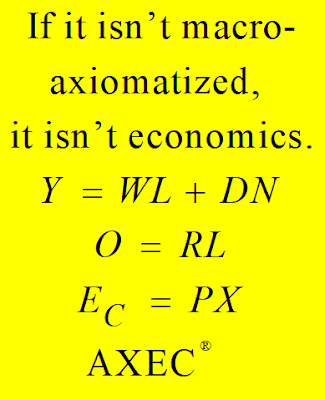
Blog-Reference
Editor quotes Stuart Birks’s critique: “Note that the supply and demand model is, like much of economics, based on static analysis. Consequently, the focus will be on the market equilibrium. It is based on the idea that you have a scenario within which you can have as much costless adjustment as required to achieve some final end state which will be the equilibrium (issues of existence and uniqueness aside). This does not reflect the real world. In reality, there is a starting point, A. This is more than just an initial resource endowment. It also specifies an application of those resources, for example producing and consuming goods and services at some rate of output (as we are actually moving through time). There is also a path to be taken to the endpoint.”
This critique is absolutely correct. Economists think they can answer any question by painting the triad SS-function―DD-function―equilibrium. Leijonhufvud called this analytical tool Totem of the Micro/Totem of the Macro. What the representative economist does not understand to this day is that there is NO such thing as an economic equilibrium and NO such thing as SS and DD functions. The Totem of Micro/Macro is a NONENTITY like the Tooth Fairy or the Easter Bunny.
While traditional Heterodoxy has correctly identified the core of every economic textbook as proto-scientific garbage, it has failed to provide the methodologically correct replacement of the methodologically unacceptable supply-demand-equilibrium construct. This is the methodological imperative: "The problem is not just to say that something might be wrong, but to replace it by something — and that is not so easy." (Feynman) In other words, traditional Heterodoxy failed at its mission to bring about the necessary Paradigm Shift.
The Paradigm Shift has been accomplished by Constructive Heterodoxy/Metadoxy, see
► Essentials of Constructive Heterodoxy: The Market
► The Law of Supply and Demand: Here It Is Finally
► How to Get Rid of Supply-Demand-Equilibrium
What both orthodox and heterodox economists, in their innate scientific incompetence, have failed to realize is that the economy as a system is defined by the interrelationship of a number of elementary variables. Every model, no matter how differentiated, must contain these objective SYSTEMIC interrelationships as its formal hardcore. This is an imperative methodological necessity.
The false Walrasian microfoundations and the false Keynesian macrofoundations have to be replaced with the true macrofoundations. The graphical representation of this absolute formal minimum is given on Graphic AXEC31

This chart replaces the hare-brained Totem of SS-function―DD-function―equilibrium. A detailed description of the elementary macro relationships has been given in the papers referenced above.
It is time now for traditional Heterodoxy, which has exhausted itself in repetitive critique, to get out of the way and no longer hamper Constructive Heterodoxy.
Egmont Kakarot-Handtke
For details of the big picture, see cross-references Paradigm Shift.
For more about Heterodoxy, see AXECquery.
***
Graphic AXEC121i

March 4, 2016
Lawson’s fundamental methodological error and the failure of Heterodoxy
Comment on Lars Syll on ‘Critical realism and scientific explanation’
Blog-Reference and Blog-Reference on Mar 5
As far as the critique of orthodox economics is concerned, critical realism is correct. Yet, the fundamental error of critical realism is to assume that economics is about ‘how society works’. No! This is the subject matter of sociology. Economics is about ‘how the economy works.’ Society and economy are intertwined but must be separated analytically.
Since Adam Smith, economics claims to be a science. Methodologically, it started as a mixture of sociology and political science: “The science which traces the laws of such of the phenomena of society as arise from the combined operations of mankind for the production of wealth, in so far as those phenomena are not modified by the pursuit of any other object.” (Mill, 1874, V.39)
With respect to the subject matter, there is no difference between Mill and Marx: “My stand-point, from which the evolution of the economic formation of society is viewed as a process of natural history, ...” (Marx, 1906, M.9)
With Jevons/Walras/Menger, the focus shifted to methodological individualism, and economics became a mixture of dilettantish psychology, sociology, and political science. This approach has failed abysmally.
Economics is NOT a science of individual/social/political behavior but of the behavior of the monetary economy. Accordingly, the correct definition of the subject matter is objective/ structural/systemic: “Economics is the science which studies how the monetary economy works.”
As a consequence, the long-overdue Copernican turn in economics consists of the methodological switch from behavior-centered bottom-up, i.e., subjective microfoundation, to structure-centered top-down, i.e., objective macrofoundations. All Human-Nature issues are the subject matter of other disciplines (psychology, sociology, anthropology, biology/Darwinism, political science, history, philosophy, etcetera) and are taken in from these by way of multidisciplinary cooperation. To paraphrase J. S. Mill: ‘Economics as a systems science presupposes all the physical and social sciences; it takes for granted all such of the truths of those sciences as are concerned with the working of the economic system.’ (cf. Mill 1874, V.29)
Lars Syll summarizes Tony Lawson: “We have to maintain the Enlightenment tradition of thinking of reality as principally independent of our views of it and of the main task of science as studying the structure of this reality. Perhaps the most important contribution a researcher can make is reveal what this reality that is the object of science actually looks like.”
Exactly so.
Therefore, economics has to drop these axioms/microfoundations:
HC1 There exist economic agents.
HC2 Agents have preferences over outcomes.
HC3 Agents independently optimize subject to constraints.
HC4 Choices are made in interrelated markets.
HC5 Agents have full relevant knowledge.
HC6 Observable economic outcomes are coordinated, so they must be discussed with reference to equilibrium states.” (Weintraub, 1985, p. 109)
Lawson’s critique fully applies to the theoretical superstructure that has been built upon HC1 (= methodological individualism) to HC6 (= closure).
The proper object of economics is neither the individual nor society but the economy. So we have to move on and, first of all, describe the structure of the monetary economy.
(A0) The most elementary configuration of the (world-) economy consists of the household and the business sector, which in turn consists initially of one giant fully integrated firm and is given by three objective structural axioms/macrofoundations:
(A1) Yw=WL wage income Yw is equal to wage rate W times working hours L,
(A2) O=RL output O is equal to productivity R times working hours L,
(A3) C=PX consumption expenditure C is equal to price P times quantity bought/sold X.
These premises are certain, true, and primary, and therefore satisfy all methodological requirements (2014). In the words of Lars Syll: “Science is made possible by the fact that there are structures that are durable and are independent of our knowledge or beliefs about them. There exists a reality beyond our theories and concepts of it. It is this independent reality that our theories in some way deal with.”
Society has no durable structures, but the monetary economy has, and they are given in the most elementary case by (A1) to (A3). Economics is not a social science but a systems science, and it deals not with the defects of society but with systemic defects that produce what every superficial observer can see but not understand (2015).
The fundamental flaw of Lawson’s methodology is that he defines economics as a social science.
Egmont Kakarot-Handtke
References
Kakarot-Handtke, E. (2014). Objective Principles of Economics. SSRN Working Paper Series, 2418851: 1–19. URL
Kakarot-Handtke, E. (2015). Major Defects of the Market Economy. SSRN Working Paper Series, 2624350: 1–40. URL
Marx, K. (1906). Capital: A Critique of Political Economy, Vol. I. The Process of Capitalist Production. Library of Economics and Liberty. URL
Mill, J. S. (1874). Essays on Some Unsettled Questions of Political Economy. On the Definition of Political Economy; and on the Method of Investigation Proper To It. Library of Economics and Liberty. URL
Weintraub, E. R. (1985). General Equilibrium Analysis. Cambridge, London, New York, etc.: Cambridge University Press.
Related 'Economists’ three-layered scientific incompetence'. For details of the big picture, see cross-references Heterodoxy and cross-references Paradigm Shift and cross-references Axiomatization.
Blog-Reference and Blog-Reference on Mar 5
As far as the critique of orthodox economics is concerned, critical realism is correct. Yet, the fundamental error of critical realism is to assume that economics is about ‘how society works’. No! This is the subject matter of sociology. Economics is about ‘how the economy works.’ Society and economy are intertwined but must be separated analytically.
Since Adam Smith, economics claims to be a science. Methodologically, it started as a mixture of sociology and political science: “The science which traces the laws of such of the phenomena of society as arise from the combined operations of mankind for the production of wealth, in so far as those phenomena are not modified by the pursuit of any other object.” (Mill, 1874, V.39)
With respect to the subject matter, there is no difference between Mill and Marx: “My stand-point, from which the evolution of the economic formation of society is viewed as a process of natural history, ...” (Marx, 1906, M.9)
With Jevons/Walras/Menger, the focus shifted to methodological individualism, and economics became a mixture of dilettantish psychology, sociology, and political science. This approach has failed abysmally.
Economics is NOT a science of individual/social/political behavior but of the behavior of the monetary economy. Accordingly, the correct definition of the subject matter is objective/ structural/systemic: “Economics is the science which studies how the monetary economy works.”
As a consequence, the long-overdue Copernican turn in economics consists of the methodological switch from behavior-centered bottom-up, i.e., subjective microfoundation, to structure-centered top-down, i.e., objective macrofoundations. All Human-Nature issues are the subject matter of other disciplines (psychology, sociology, anthropology, biology/Darwinism, political science, history, philosophy, etcetera) and are taken in from these by way of multidisciplinary cooperation. To paraphrase J. S. Mill: ‘Economics as a systems science presupposes all the physical and social sciences; it takes for granted all such of the truths of those sciences as are concerned with the working of the economic system.’ (cf. Mill 1874, V.29)
Lars Syll summarizes Tony Lawson: “We have to maintain the Enlightenment tradition of thinking of reality as principally independent of our views of it and of the main task of science as studying the structure of this reality. Perhaps the most important contribution a researcher can make is reveal what this reality that is the object of science actually looks like.”
Exactly so.
Therefore, economics has to drop these axioms/microfoundations:
HC1 There exist economic agents.
HC2 Agents have preferences over outcomes.
HC3 Agents independently optimize subject to constraints.
HC4 Choices are made in interrelated markets.
HC5 Agents have full relevant knowledge.
HC6 Observable economic outcomes are coordinated, so they must be discussed with reference to equilibrium states.” (Weintraub, 1985, p. 109)
Lawson’s critique fully applies to the theoretical superstructure that has been built upon HC1 (= methodological individualism) to HC6 (= closure).
The proper object of economics is neither the individual nor society but the economy. So we have to move on and, first of all, describe the structure of the monetary economy.
(A0) The most elementary configuration of the (world-) economy consists of the household and the business sector, which in turn consists initially of one giant fully integrated firm and is given by three objective structural axioms/macrofoundations:
(A1) Yw=WL wage income Yw is equal to wage rate W times working hours L,
(A2) O=RL output O is equal to productivity R times working hours L,
(A3) C=PX consumption expenditure C is equal to price P times quantity bought/sold X.
These premises are certain, true, and primary, and therefore satisfy all methodological requirements (2014). In the words of Lars Syll: “Science is made possible by the fact that there are structures that are durable and are independent of our knowledge or beliefs about them. There exists a reality beyond our theories and concepts of it. It is this independent reality that our theories in some way deal with.”
Society has no durable structures, but the monetary economy has, and they are given in the most elementary case by (A1) to (A3). Economics is not a social science but a systems science, and it deals not with the defects of society but with systemic defects that produce what every superficial observer can see but not understand (2015).
The fundamental flaw of Lawson’s methodology is that he defines economics as a social science.
Egmont Kakarot-Handtke
References
Kakarot-Handtke, E. (2014). Objective Principles of Economics. SSRN Working Paper Series, 2418851: 1–19. URL
Kakarot-Handtke, E. (2015). Major Defects of the Market Economy. SSRN Working Paper Series, 2624350: 1–40. URL
Marx, K. (1906). Capital: A Critique of Political Economy, Vol. I. The Process of Capitalist Production. Library of Economics and Liberty. URL
Mill, J. S. (1874). Essays on Some Unsettled Questions of Political Economy. On the Definition of Political Economy; and on the Method of Investigation Proper To It. Library of Economics and Liberty. URL
Weintraub, E. R. (1985). General Equilibrium Analysis. Cambridge, London, New York, etc.: Cambridge University Press.
Related 'Economists’ three-layered scientific incompetence'. For details of the big picture, see cross-references Heterodoxy and cross-references Paradigm Shift and cross-references Axiomatization.
For more about Lawson, see AXECquery.
February 22, 2015
Heterodoxy, too, is still in the wood
Comment on José A. Tapia on 'Money and Say’s law: on the macroeconomic models of Kalecki, Keen, and Marx'
Blog-Reference
José Tapia sets out to clarify the interrelations between aggregate income, aggregate demand, money, credit, profit, and Say's Law in Kalecki's, Keen's, and Marx's respective approaches. This is an absolute theoretical necessity because Heterodoxy cannot claim that Orthodoxy is false and then present a motley of heterodox approaches that do not fit together or are even contradictory. Heterodoxy has to prove its superiority.
It is remarkable that, for example, the profit theories of the Top 20 heterodox economists (link below) are quite different. Clearly, they cannot all be correct at the same time. As a matter of fact, they are all false. This has been demonstrated in a formally rigorous way for Marx (2014a), Keynes (2011b), Kalecki (2011a), and Keen (2013).
This is why not only the orthodox but also the heterodox stories about the functioning of the market system are false (2014b). For the correct heterodox version of Say's Law, see (2015b).
The general relationship between monetary profit Qm, distributed profit Yd, investment I, and saving Sm is given by the formula on Graphic AXEC09c.
It is easy to see that Minsky, too, is contained in this equation as a limiting case for Yd=0 and S=0. To recall “For Minsky, the notion that profits equal investment was ‘a profound insight into how a capitalist economy works’.” (Tapia, 2015, p. 110)
For the formally correct interrelation between aggregate demand and money, see (2015a).
The general relationship between employment, aggregate demand, and changes in money/credit is given with the formula on Graphic AXEC07.
This equation contains Keen's relationship between changes in employment and changes in debt.
José Tapia has shown how major heterodox economists have treated the relationships between aggregate income, aggregate demand, money, credit, profit, and Say's Law in their idiosyncratic approaches. What is lacking is a consistent synthesis, so he leaves Heterodoxy in the woods.
In marked contrast, the structural axiomatic approach puts the essential building blocks in a formally rigorous way. This is the prerequisite for a successful Paradigm Shift.
Given the failure of Orthodoxy, there cannot be the slightest doubt that a Paradigm Shift is overdue.
Egmont Kakarot-Handtke
References
Kakarot-Handtke, E. (2011a). What is Wrong With Heterodox Economics? Kalecki’s Profit Theory as an Example. SSRN Working Paper Series, 1845803: 1–9. URL
Kakarot-Handtke, E. (2011b). Why Post Keynesianism is Not Yet a Science. SSRN Working Paper Series, 1966438: 1–15. URL
Kakarot-Handtke, E. (2013). Debunking Squared. SSRN Working Paper Series, 2357902: 1–5. URL
Kakarot-Handtke, E. (2014a). Profit for Marxists. SSRN Working Paper Series, 2414301: 1–25. URL
Kakarot-Handtke, E. (2014b). The Three Fatal Mistakes of Yesterday Economics: Profit, I=S, Employment. SSRN Working Paper Series, 2489792: 1–13. URL
Kakarot-Handtke, E. (2015a). Essentials of Constructive Heterodoxy: Aggregate Demand. SSRN Working Paper Series, 2564590: 1–23. URL
Kakarot-Handtke, E. (2015b). Essentials of Constructive Heterodoxy: Say’s Law. SSRN Working Paper Series, 2556434: 1–10. URL
Tapia, J. A. (2015). Money and Say’s Law: On the Macroeconomic Models of Kalecki, Keen, and Marx. real-world economics review, (70): 110–120. URL
Link to Top 20 Heterodox Economics Books here.
Blog-Reference
José Tapia sets out to clarify the interrelations between aggregate income, aggregate demand, money, credit, profit, and Say's Law in Kalecki's, Keen's, and Marx's respective approaches. This is an absolute theoretical necessity because Heterodoxy cannot claim that Orthodoxy is false and then present a motley of heterodox approaches that do not fit together or are even contradictory. Heterodoxy has to prove its superiority.
It is remarkable that, for example, the profit theories of the Top 20 heterodox economists (link below) are quite different. Clearly, they cannot all be correct at the same time. As a matter of fact, they are all false. This has been demonstrated in a formally rigorous way for Marx (2014a), Keynes (2011b), Kalecki (2011a), and Keen (2013).
This is why not only the orthodox but also the heterodox stories about the functioning of the market system are false (2014b). For the correct heterodox version of Say's Law, see (2015b).
The general relationship between monetary profit Qm, distributed profit Yd, investment I, and saving Sm is given by the formula on Graphic AXEC09c.

It is easy to see that Minsky, too, is contained in this equation as a limiting case for Yd=0 and S=0. To recall “For Minsky, the notion that profits equal investment was ‘a profound insight into how a capitalist economy works’.” (Tapia, 2015, p. 110)
For the formally correct interrelation between aggregate demand and money, see (2015a).
The general relationship between employment, aggregate demand, and changes in money/credit is given with the formula on Graphic AXEC07.

This equation contains Keen's relationship between changes in employment and changes in debt.
José Tapia has shown how major heterodox economists have treated the relationships between aggregate income, aggregate demand, money, credit, profit, and Say's Law in their idiosyncratic approaches. What is lacking is a consistent synthesis, so he leaves Heterodoxy in the woods.
In marked contrast, the structural axiomatic approach puts the essential building blocks in a formally rigorous way. This is the prerequisite for a successful Paradigm Shift.
Given the failure of Orthodoxy, there cannot be the slightest doubt that a Paradigm Shift is overdue.
Egmont Kakarot-Handtke
References
Kakarot-Handtke, E. (2011a). What is Wrong With Heterodox Economics? Kalecki’s Profit Theory as an Example. SSRN Working Paper Series, 1845803: 1–9. URL
Kakarot-Handtke, E. (2011b). Why Post Keynesianism is Not Yet a Science. SSRN Working Paper Series, 1966438: 1–15. URL
Kakarot-Handtke, E. (2013). Debunking Squared. SSRN Working Paper Series, 2357902: 1–5. URL
Kakarot-Handtke, E. (2014a). Profit for Marxists. SSRN Working Paper Series, 2414301: 1–25. URL
Kakarot-Handtke, E. (2014b). The Three Fatal Mistakes of Yesterday Economics: Profit, I=S, Employment. SSRN Working Paper Series, 2489792: 1–13. URL
Kakarot-Handtke, E. (2015a). Essentials of Constructive Heterodoxy: Aggregate Demand. SSRN Working Paper Series, 2564590: 1–23. URL
Kakarot-Handtke, E. (2015b). Essentials of Constructive Heterodoxy: Say’s Law. SSRN Working Paper Series, 2556434: 1–10. URL
Tapia, J. A. (2015). Money and Say’s Law: On the Macroeconomic Models of Kalecki, Keen, and Marx. real-world economics review, (70): 110–120. URL
Link to Top 20 Heterodox Economics Books here.
December 7, 2022
Occasional Tweets: Heterodoxy, too, goes down the scientific drain
#Econ
— E.K-H (@AXECorg) December 7, 2022
Both #Orthodoxy & #Heterodoxy are axiomatically false & materially/formally inconsistent. #Economics is #FailedFakeScience.
Heterodoxy ― an axiomatic failure just like Orthodoxyhttps://t.co/oDXO24G1w6
The #ParadigmShift is inescapable. pic.twitter.com/mvc5UjZhno
For details of the big picture see cross-references Heterodoxy.
April 11, 2016
Heterodoxy, too, is no longer what it once was
Comment on Lars Syll on ‘When science becomes dogmatism’
Blog-Reference
It is of utmost importance that heterodox methodologists regain the heights of Georgescu-Roegen: “Arithmomorphic models, to repeat, are indispensable in economics, no less than in other scientific domains. That does not mean also that they can do all there is to be done in economics.”
Georgescu-Roegen had neither sympathy for the low-IQ political blather nor for the misplaced math that counted in his time as economics and he certainly understood methodology, and in particular the axiomatic-deductive method, better than heterodox methodologists like Asad Zaman do today: “We are therefore justified in saying that with Euclid’s Elements the causa materialis of geometry underwent a radical transformation; from a more or less amorphous aggregate of propositions it acquired an anatomic structure. .... And this true mutation represents not only the most valuable contribution of the Greek civilization to human thought but also a momentous landmark in the evolution of mankind comparable only to the discovery of speech or writing.”
This is certainly not an advocacy for anything-goes, storytelling, the pluralism of false theories, and the ‘more or less amorphous aggregate’ of garbage to which economics has come down in our days.
Egmont Kakarot-Handtke
Blog-Reference
It is of utmost importance that heterodox methodologists regain the heights of Georgescu-Roegen: “Arithmomorphic models, to repeat, are indispensable in economics, no less than in other scientific domains. That does not mean also that they can do all there is to be done in economics.”
Georgescu-Roegen had neither sympathy for the low-IQ political blather nor for the misplaced math that counted in his time as economics and he certainly understood methodology, and in particular the axiomatic-deductive method, better than heterodox methodologists like Asad Zaman do today: “We are therefore justified in saying that with Euclid’s Elements the causa materialis of geometry underwent a radical transformation; from a more or less amorphous aggregate of propositions it acquired an anatomic structure. .... And this true mutation represents not only the most valuable contribution of the Greek civilization to human thought but also a momentous landmark in the evolution of mankind comparable only to the discovery of speech or writing.”
This is certainly not an advocacy for anything-goes, storytelling, the pluralism of false theories, and the ‘more or less amorphous aggregate’ of garbage to which economics has come down in our days.
Egmont Kakarot-Handtke
April 19, 2016
Where advanced Heterodoxy — represented by Steve Keen — took the wrong turn
Comment on Lars Syll on ‘Physics and economics’
Blog-Reference and Blog-Reference
“... economics is a big omnibus which contains many passengers of incommensurable interests and abilities.” (Schumpeter, 1994, p. 827)
Roughly speaking, the economic omnibus contains four sects: (i) Walrasians, (ii) Keynesians, (iii) Marxians, and (iv) Austrians/Others. Because they contradict each other, as a matter of logic, only one can be true, yet all can be false.
Heterodoxy comes in different flavors, but normally it means approaches (ii) to (iv) in opposition to Orthodoxy (i). Constructive Heterodoxy goes one step further and proves that all four approaches are false, that is, traditional Heterodoxy (ii) to (iv) also. In other words, after more than 200 years, there is NO scientifically valid economic theory. Economics is a failed science. Economic policy guidance is worthless or even counterproductive.
A false theory is never obviously false but contains propositions that are partially true, commonsensical, descriptively correct, realistic, or plausible. Moreover, a false theory is corroborated by selected evidence/examples and is rhetorically fortified with widely accepted platitudes or tautologies. False theories contain many elements that are convincing at first sight. This is the main reason why they can survive for a long time: “The truth is, most persons, not excepting professional economists, are satisfied with very hazy notions.” (Fisher, quoted in Mirowski, 1995, p. 86). This is why social reality consists of 99 percent storytelling and 1 percent scientific knowledge.
The common denominator of Heterodoxy is that Orthodoxy is unacceptable. Starting with this broad consensus, there are different ways to proceed. Here we follow the path of Steve Keen. His approach is one of the most advanced in the heterodox camp. He has gone through extensive debunking of Orthodoxy, and he has correctly identified the methodological root cause of obvious failure.
Orthodoxy is committed to methodological individualism. This is the foundational error/mistake. After more than 140 years since Jevons/Walras/Menger, the representative economist still has not gotten the point that the formal foundations of Orthodoxy are defective. The microfoundations approach is defined by six axioms (Weintraub, 1985, p. 109), which have been loosely summarized by Krugman as “most of what I and many others do is sorta-kinda neoclassical because it takes the maximization-and-equilibrium world as a starting point”.
This must be taken as the confession of a confused mind (2013) because the starting point is provably false, and this requires a paradigm shift from microfoundations to macrofoundations (see link #1).
Each theory/model is built upon a set of foundational propositions, a.k.a. axioms. Steve Keen follows the example of Goodwin and chooses ‘a logically incontestable starting point’ which consists of three elementary definitions. Then he goes on to build a complex simulation upon these foundations by adding variables and functions. #2
Keen’s approach is methodologically correct, except for the fact that his definitions are still not elementary enough. Because of this, they have to be replaced by deeper macrofoundations as follows.
(A0) The objectively given and most elementary configuration of the (world-) economy consists of the household and the business sector, which in turn consists initially of one giant fully integrated firm.
(A1) Yw=WL wage income Yw is equal to wage rate W times working hours. L,
(A2) O=RL output O is equal to productivity R times working hours L,
(A3) C=PX consumption expenditure C is equal to price P times quantity bought/sold X.
These premises are certain, true, and primary, and therefore satisfy ALL methodological requirements. The new axiom set contains NO NONENTITIES like utility, maximization, or equilibrium. The graphical representation of the absolute formal minimum set is given under the label Graphic. #3

At any given level of employment L, the wage income Yw that is generated in the consolidated business sector follows by multiplication with the wage rate W. On the real side, output O follows by multiplication with the productivity R. Finally, the price P follows as the dependent variable under the conditions of budget balancing, i.e., C=Yw, and market clearing, i.e., X=O. Note that the ray in the southeastern quadrant is NOT a linear production function; the ray tracks ANY underlying production function. Note also that the wage rate W is an AVERAGE if the individual wage rates are different among the employees, which is normally the case. These details are not needed at the beginning.
Under the conditions of (i) market-clearing and (ii) budget-balancing in each period, the price is derived as P=W/R (1), i.e., the market-clearing price is, in the most elementary case, equal to unit wage costs. This is the elementary form of the macroeconomic Law of Supply and Demand, which, in a second step, has to be generalized for an arbitrary number of markets.
If the wage rate W is lowered, the market-clearing price P falls. If the number of working hours L is increased, the price remains constant, provided productivity R does not change. If productivity decreases, the price P rises. If productivity increases, the price falls. In any case, labor gets the whole product, the real wage W/P is invariably equal to the productivity R according to (1), and profit for the business sector as a whole is invariably zero. So, the next question is, where does profit come from?
All changes in the system are reflected by the market-clearing price. The most elementary economy is REPRODUCIBLE for an indefinite number of periods under the interim condition of no external limitations.
The time evolution of any variable is formally given by the 4th axiom (see link #4), which is nothing other than the familiar mathematical growth formula (the three dots indicate a DISCRETE rate of change, e.g., 3,7 %, in contradistinction to the first derivative, which is usually symbolized with one dot).
With the final step, we again depart from Keen as we do NOT introduce deterministic functions (like the Phillips curve) because, at this early stage of the analysis, we do not possess such functions. What has to be strictly avoided is the usual assumptionism.
At this stage, there is only one legitimate assumption about the rates of change of the independent variables: “The simplest hypothesis is that variation is random until the contrary is shown, the onus of the proof resting on the advocate of the more complicated hypothesis (...).” (Kreuzenkamp et al., 1995, p. 12)
Now, the minimal set of premises is complete. The four axioms and the random rates of change constitute the simulation of the elementary production-consumption economy (see link #5), which is the formally correct starting point of ALL economic analysis. The exemplary outcome of a simulation is shown in #6.
Note that NONE of the ridiculous behavioral assumptions (utility, maximization, bounded rationality, rational expectation, equilibrium, etc.) is applied. For a start, the simulation yields a drifting production-consumption economy that neither collapses nor explodes nor approaches an equilibrium. The elementary production-consumption economy simply evolves stochastically with a balanced budget and a cleared product market. Note in passing that the dynamic properties of Keen’s simulation of the capitalist economy are ultimately determined by his assumptions of deterministic functional relationships. These assumptions are methodologically inadmissible.
For more details about the axiomatically correct and stock-flow consistent price, profit, money, and market theory, see (2015).
Conclusion: Orthodoxy is a failed approach. Constructive Heterodoxy goes beyond debunking and dead-horse beating. The paradigm shift consists of the move from microfoundations to macrofoundations. The correct macrofoundations are given with the structural axioms (A1) to (A3). Strictly speaking, current economics consists of Constructive Heterodoxy (#7). Orthodoxy and traditional Heterodoxy, and Keen's advanced heterodox approach, are manifest proto-scientific garbage.
Egmont Kakarot-Handtke
References
Kakarot-Handtke, E. (2013). Confused Confusers: How to Stop Thinking Like an Economist and Start Thinking Like a Scientist. SSRN Working Paper Series, 2207598: 1–16. URL
Kakarot-Handtke, E. (2015). Major Defects of the Market Economy. SSRN Working Paper Series, 2624350: 1–40. URL
Kreuzenkamp, H. A., and McAleer, M. (1995). Simplicity, Scientific Inference, and Econometric Modeling. Economic Journal, 105: 1–21. URL
Mirowski, P. (1995). More Heat than Light. Cambridge: Cambridge University Press.
Schumpeter, J. A. (1994). History of Economic Analysis. New York: Oxford University Press.
Weintraub, E. R. (1985). General Equilibrium Analysis. Cambridge, London, New York, etc.: Cambridge University Press.
#1 From microfoundations to macrofoundations
#2 YouTube, Steve Keen, Transcending the Lucas Critique with Minsky
#3 Graphic AXEC31 Elementary production-consumption economy with market-clearing and budget balancing
#4 Graphic AXEC10a Discrete-time evolution and Graphic AXEC25 Economics God Equation
#5 Simulation, Download of the Excel spreadsheet from Dropbox
#6 Graphic AXEC76 Exemplary depiction of the drifting production-consumption economy
#7 See New Curriculum
Related 'Keenonomics, aggregate demand/change of debt, and some misleading critique' and 'Putting the production function back on its feet' and 'The key relationship between employment and growing/shrinking debt' and 'The key to macro and Keen's debt-employment model' and 'When numbers don't add up' and 'Nothing to choose between Orthodoxy and traditional Heterodoxy'. For details of the big picture, see cross-references Failure of Heterodoxy and cross-references Failed/Fake Scientists and cross-references Paradigm Shift.
(i) The core of your methodological blather is the Baconian research program: “Bacon, the philosopher of science, was, quite consistently, an enemy of the Copernican hypothesis. Don’t theorize, he said, but open your eyes and observe without prejudice, and you cannot doubt that the Sun moves and that the Earth is at rest.” (Popper)
Note that observationism was dead in the cradle back in 1600.
(ii) The proof of a method is in the application. Apply your own advice and show results that fit the scientific criteria of material and formal consistency.
(iii) Economics is neither physics nor psychology/sociology/history but a systems science. Because of this, Steve Keen’s approach is way ahead of Ken Zimmerman’s observationism of 1600.
Blog-Reference and Blog-Reference
“... economics is a big omnibus which contains many passengers of incommensurable interests and abilities.” (Schumpeter, 1994, p. 827)
Roughly speaking, the economic omnibus contains four sects: (i) Walrasians, (ii) Keynesians, (iii) Marxians, and (iv) Austrians/Others. Because they contradict each other, as a matter of logic, only one can be true, yet all can be false.
Heterodoxy comes in different flavors, but normally it means approaches (ii) to (iv) in opposition to Orthodoxy (i). Constructive Heterodoxy goes one step further and proves that all four approaches are false, that is, traditional Heterodoxy (ii) to (iv) also. In other words, after more than 200 years, there is NO scientifically valid economic theory. Economics is a failed science. Economic policy guidance is worthless or even counterproductive.
A false theory is never obviously false but contains propositions that are partially true, commonsensical, descriptively correct, realistic, or plausible. Moreover, a false theory is corroborated by selected evidence/examples and is rhetorically fortified with widely accepted platitudes or tautologies. False theories contain many elements that are convincing at first sight. This is the main reason why they can survive for a long time: “The truth is, most persons, not excepting professional economists, are satisfied with very hazy notions.” (Fisher, quoted in Mirowski, 1995, p. 86). This is why social reality consists of 99 percent storytelling and 1 percent scientific knowledge.
The common denominator of Heterodoxy is that Orthodoxy is unacceptable. Starting with this broad consensus, there are different ways to proceed. Here we follow the path of Steve Keen. His approach is one of the most advanced in the heterodox camp. He has gone through extensive debunking of Orthodoxy, and he has correctly identified the methodological root cause of obvious failure.
Orthodoxy is committed to methodological individualism. This is the foundational error/mistake. After more than 140 years since Jevons/Walras/Menger, the representative economist still has not gotten the point that the formal foundations of Orthodoxy are defective. The microfoundations approach is defined by six axioms (Weintraub, 1985, p. 109), which have been loosely summarized by Krugman as “most of what I and many others do is sorta-kinda neoclassical because it takes the maximization-and-equilibrium world as a starting point”.
This must be taken as the confession of a confused mind (2013) because the starting point is provably false, and this requires a paradigm shift from microfoundations to macrofoundations (see link #1).
Each theory/model is built upon a set of foundational propositions, a.k.a. axioms. Steve Keen follows the example of Goodwin and chooses ‘a logically incontestable starting point’ which consists of three elementary definitions. Then he goes on to build a complex simulation upon these foundations by adding variables and functions. #2
Keen’s approach is methodologically correct, except for the fact that his definitions are still not elementary enough. Because of this, they have to be replaced by deeper macrofoundations as follows.
(A0) The objectively given and most elementary configuration of the (world-) economy consists of the household and the business sector, which in turn consists initially of one giant fully integrated firm.
(A1) Yw=WL wage income Yw is equal to wage rate W times working hours. L,
(A2) O=RL output O is equal to productivity R times working hours L,
(A3) C=PX consumption expenditure C is equal to price P times quantity bought/sold X.
These premises are certain, true, and primary, and therefore satisfy ALL methodological requirements. The new axiom set contains NO NONENTITIES like utility, maximization, or equilibrium. The graphical representation of the absolute formal minimum set is given under the label Graphic. #3

At any given level of employment L, the wage income Yw that is generated in the consolidated business sector follows by multiplication with the wage rate W. On the real side, output O follows by multiplication with the productivity R. Finally, the price P follows as the dependent variable under the conditions of budget balancing, i.e., C=Yw, and market clearing, i.e., X=O. Note that the ray in the southeastern quadrant is NOT a linear production function; the ray tracks ANY underlying production function. Note also that the wage rate W is an AVERAGE if the individual wage rates are different among the employees, which is normally the case. These details are not needed at the beginning.
Under the conditions of (i) market-clearing and (ii) budget-balancing in each period, the price is derived as P=W/R (1), i.e., the market-clearing price is, in the most elementary case, equal to unit wage costs. This is the elementary form of the macroeconomic Law of Supply and Demand, which, in a second step, has to be generalized for an arbitrary number of markets.
If the wage rate W is lowered, the market-clearing price P falls. If the number of working hours L is increased, the price remains constant, provided productivity R does not change. If productivity decreases, the price P rises. If productivity increases, the price falls. In any case, labor gets the whole product, the real wage W/P is invariably equal to the productivity R according to (1), and profit for the business sector as a whole is invariably zero. So, the next question is, where does profit come from?
All changes in the system are reflected by the market-clearing price. The most elementary economy is REPRODUCIBLE for an indefinite number of periods under the interim condition of no external limitations.
The time evolution of any variable is formally given by the 4th axiom (see link #4), which is nothing other than the familiar mathematical growth formula (the three dots indicate a DISCRETE rate of change, e.g., 3,7 %, in contradistinction to the first derivative, which is usually symbolized with one dot).
With the final step, we again depart from Keen as we do NOT introduce deterministic functions (like the Phillips curve) because, at this early stage of the analysis, we do not possess such functions. What has to be strictly avoided is the usual assumptionism.
At this stage, there is only one legitimate assumption about the rates of change of the independent variables: “The simplest hypothesis is that variation is random until the contrary is shown, the onus of the proof resting on the advocate of the more complicated hypothesis (...).” (Kreuzenkamp et al., 1995, p. 12)
Now, the minimal set of premises is complete. The four axioms and the random rates of change constitute the simulation of the elementary production-consumption economy (see link #5), which is the formally correct starting point of ALL economic analysis. The exemplary outcome of a simulation is shown in #6.
Note that NONE of the ridiculous behavioral assumptions (utility, maximization, bounded rationality, rational expectation, equilibrium, etc.) is applied. For a start, the simulation yields a drifting production-consumption economy that neither collapses nor explodes nor approaches an equilibrium. The elementary production-consumption economy simply evolves stochastically with a balanced budget and a cleared product market. Note in passing that the dynamic properties of Keen’s simulation of the capitalist economy are ultimately determined by his assumptions of deterministic functional relationships. These assumptions are methodologically inadmissible.
For more details about the axiomatically correct and stock-flow consistent price, profit, money, and market theory, see (2015).
Conclusion: Orthodoxy is a failed approach. Constructive Heterodoxy goes beyond debunking and dead-horse beating. The paradigm shift consists of the move from microfoundations to macrofoundations. The correct macrofoundations are given with the structural axioms (A1) to (A3). Strictly speaking, current economics consists of Constructive Heterodoxy (#7). Orthodoxy and traditional Heterodoxy, and Keen's advanced heterodox approach, are manifest proto-scientific garbage.
Egmont Kakarot-Handtke
References
Kakarot-Handtke, E. (2013). Confused Confusers: How to Stop Thinking Like an Economist and Start Thinking Like a Scientist. SSRN Working Paper Series, 2207598: 1–16. URL
Kakarot-Handtke, E. (2015). Major Defects of the Market Economy. SSRN Working Paper Series, 2624350: 1–40. URL
Kreuzenkamp, H. A., and McAleer, M. (1995). Simplicity, Scientific Inference, and Econometric Modeling. Economic Journal, 105: 1–21. URL
Mirowski, P. (1995). More Heat than Light. Cambridge: Cambridge University Press.
Schumpeter, J. A. (1994). History of Economic Analysis. New York: Oxford University Press.
Weintraub, E. R. (1985). General Equilibrium Analysis. Cambridge, London, New York, etc.: Cambridge University Press.
#1 From microfoundations to macrofoundations
#2 YouTube, Steve Keen, Transcending the Lucas Critique with Minsky
#3 Graphic AXEC31 Elementary production-consumption economy with market-clearing and budget balancing
#4 Graphic AXEC10a Discrete-time evolution and Graphic AXEC25 Economics God Equation
#5 Simulation, Download of the Excel spreadsheet from Dropbox
#6 Graphic AXEC76 Exemplary depiction of the drifting production-consumption economy
#7 See New Curriculum
Related 'Keenonomics, aggregate demand/change of debt, and some misleading critique' and 'Putting the production function back on its feet' and 'The key relationship between employment and growing/shrinking debt' and 'The key to macro and Keen's debt-employment model' and 'When numbers don't add up' and 'Nothing to choose between Orthodoxy and traditional Heterodoxy'. For details of the big picture, see cross-references Failure of Heterodoxy and cross-references Failed/Fake Scientists and cross-references Paradigm Shift.
***
REPLY to Ken Zimmerman on Apr 20(i) The core of your methodological blather is the Baconian research program: “Bacon, the philosopher of science, was, quite consistently, an enemy of the Copernican hypothesis. Don’t theorize, he said, but open your eyes and observe without prejudice, and you cannot doubt that the Sun moves and that the Earth is at rest.” (Popper)
Note that observationism was dead in the cradle back in 1600.
(ii) The proof of a method is in the application. Apply your own advice and show results that fit the scientific criteria of material and formal consistency.
(iii) Economics is neither physics nor psychology/sociology/history but a systems science. Because of this, Steve Keen’s approach is way ahead of Ken Zimmerman’s observationism of 1600.

July 7, 2015
Heterodoxy's big fat Greek error
Comment on Paul Schächterle on ‘In Greece, NO is the answer’
Blog-Reference
You say: “I am by no means against theorising as a part of an economic science.”
Theorizing is not a nice add-on, it is the very task of science. What we expect from physics is the correct theory of how Nature works, from the universe down to the smallest particle. Along the same line, we expect from economics the correct theory of how the economy works. Theory is not some exotic and inconsequential speculation, it is the incorporation of knowledge — the best thing we can achieve as humans.
The situation in economics is this: what has been produced in the last 200+ years has objectively not much scientific value. Take Newton and Smith as the baseline, then physics has arrived in the meantime at quantum theory while economics has not even produced something like the law of the lever.
Could economists have been too much occupied with playing political games and writing pamphlets instead of doing serious scientific work?
The crucial point is this: “Whatever knowledge we possess is either knowledge of particular facts or scientific knowledge.” (Russel, 1961, p. 620)
What you can learn in business schools and most universities is knowledge of particular facts, eg. how the Federal Reserve System or the gold standard works. This is all good and fine and useful but it is not science.
Heterodoxy criticizes Orthodoxy, and rightfully so. But here care has to be taken. Is it on political grounds or on scientific grounds?
My point is that both Orthodoxy and Heterodoxy are mired in political agenda-pushing. What they have both produced so far is good political ammunition = bad proto-scientific garbage.
In my view, Heterodoxy is not another political movement, nor a charity for the Greeks that suffer much from financial deficits but most from deficiencies in institution-building which cannot be repaired by throwing money at it. In my view, Heterodoxy's task is to get economics out of the political swamp and to make it a science.
You say “I mean, we should try, but we should not see it as an easy task.”
No, it's not easy — to become another quacking frog in the swamp is much easier.
Egmont Kakarot-Handtke
References
Russel, B. (1961). The Basic Writings of Bertrand Russel, chapter Limitations of Scientific Method, 620–627. London: Routledge.
Blog-Reference
You say: “I am by no means against theorising as a part of an economic science.”
Theorizing is not a nice add-on, it is the very task of science. What we expect from physics is the correct theory of how Nature works, from the universe down to the smallest particle. Along the same line, we expect from economics the correct theory of how the economy works. Theory is not some exotic and inconsequential speculation, it is the incorporation of knowledge — the best thing we can achieve as humans.
The situation in economics is this: what has been produced in the last 200+ years has objectively not much scientific value. Take Newton and Smith as the baseline, then physics has arrived in the meantime at quantum theory while economics has not even produced something like the law of the lever.
Could economists have been too much occupied with playing political games and writing pamphlets instead of doing serious scientific work?
The crucial point is this: “Whatever knowledge we possess is either knowledge of particular facts or scientific knowledge.” (Russel, 1961, p. 620)
What you can learn in business schools and most universities is knowledge of particular facts, eg. how the Federal Reserve System or the gold standard works. This is all good and fine and useful but it is not science.
Heterodoxy criticizes Orthodoxy, and rightfully so. But here care has to be taken. Is it on political grounds or on scientific grounds?
My point is that both Orthodoxy and Heterodoxy are mired in political agenda-pushing. What they have both produced so far is good political ammunition = bad proto-scientific garbage.
In my view, Heterodoxy is not another political movement, nor a charity for the Greeks that suffer much from financial deficits but most from deficiencies in institution-building which cannot be repaired by throwing money at it. In my view, Heterodoxy's task is to get economics out of the political swamp and to make it a science.
You say “I mean, we should try, but we should not see it as an easy task.”
No, it's not easy — to become another quacking frog in the swamp is much easier.
Egmont Kakarot-Handtke
References
Russel, B. (1961). The Basic Writings of Bertrand Russel, chapter Limitations of Scientific Method, 620–627. London: Routledge.
August 21, 2016
Nothing to choose between Orthodoxy and traditional Heterodoxy
Comment on Noah Smith on ‘Heterodox macro ― a reply to some replies’
Blog-Reference and Blog-Reference on Aug 22, adapted to context, and Blog-Reference on Sep 17
All that has to be said about formalization/mathiness has already been said by the great heterodox economist Georgescu-Roegen: “Lest this position is misinterpreted again by some casual reader, let me repeat that my point is not that arithmetization of science is undesirable. Whenever arithmetization can be worked out, its merits are above all words of praise. My point is that wholesale arithmetization is impossible, that there is valid knowledge even without arithmetization, and that mock arithmetization is dangerous if peddled as genuine.” (1971, p. 15)
There are heterodox AND orthodox economists who cannot get their heads around this still-valid summary. These are the retarded folks who do not understand that there is an essential difference between science and non-science. The former is the realm where the criterion true/false applies and NOTHING else (= theoretical economics), and the latter is the vast realm of storytelling where anything goes (= political economics). So there are TWO kinds of Orthodoxy and TWO kinds of Heterodoxy which have to be kept apart. For an overview of current economics, see (2016b) plus description (2016a).
True/false in turn has TWO inseparable aspects: “Research is in fact a continuous discussion of the consistency of theories: formal consistency insofar as the discussion relates to the logical cohesion of what is asserted in joint theories; material consistency insofar as the agreement of observations with theories is concerned.” (Klant, 1994, p. 31)
Logical consistency is methodologically secured by the axiomatic-deductive method. This method presupposes firm ground to start with or, as Aristotle put it, “When the premises are certain, true, and primary, and the conclusion formally follows from them, this is demonstration, and produces scientific knowledge of a thing.”
The fact of the matter is that BOTH orthodox microfoundations and heterodox macrofoundations are false. Because of this, traditional Heterodoxy is not an acceptable replacement for Orthodoxy. The current state of economics is this: Walrasianism, Keynesianism, Marxianism, and Austrianism are materially/formally inconsistent. Economics is a failed/fake science. This calls for a Paradigm Shift.
Heterodox macro has been formalized. This is praiseworthy. The problem is that there are different versions of heterodox macro, e.g., Keynes, Kalecki, Minsky, and Keen, which are INCONSISTENT. So traditional macrofounded Heterodoxy is formal garbage (2015) (2016c) just as microfounded Orthodoxy. Because there cannot be a pluralism of false theories BOTH approaches have to be replaced with the correct macrofoundations. Nothing less will do. Inconsistency is lethal in science. Game over for Orthodoxy and traditional Heterodoxy.
Egmont Kakarot-Handtke
References
E.K-H (2015). Heterodoxy, too, is proto-scientific garbage. Blog post. URL
E.K-H (2016a). From Orthodoxy to Heterodoxy to Metadoxy. Blog post. URL
E.K-H (2016b). From proto-science to science. Graphic AXEC83.
E.K-H (2016c). Where advanced Heterodoxy — represented by Steve Keen — took the wrong turn. Blog post. URL
Georgescu-Roegen, N. (1971). The Entropy Law and the Economic Process. Cambridge: Cambridge University Press.
Klant, J. J. (1994). The Nature of Economic Thought. Aldershot, Brookfield: Edward Elgar.

Georgescu-Roegen said: “What particular reality is described by a given theory can be ascertained only from that theory’s axiomatic foundation.” (1966, p. 361)
And: “In fact, the history of every science, including that of economics, teaches us that the elementary is the hotbed of the errors that count most.” (1970, p. 9)
Georgescu-Roegen was well aware that the axiomatic foundations of economics are defective. Neither Orthodoxy nor Heterodoxy has gotten this pivotal methodological point until this day.
Georgescu-Roegen was also well aware of his fellow economists’ utter scientific incompetence: “Knight lamented that there are many members of the economics profession who are ‘mathematicians first and economists afterwards.’ The situation since Knights' time has become much worse. There are endeavors that now pass for the most desirable kind of economic contributions, although they are just plain mathematical exercises, not only without any economic substance but also without mathematical value. Their authors are not something first and something else afterwards; they are neither mathematicians nor economists.” (1979, p. 317)
This is the very definition of economics as cargo cult science. The situation since Georgescu-Roegen’s time has become even worse.
References
Georgescu-Roegen, N. (1966). Analytical Economics, chapter Economic Theory and Agrarian Economics, 359–397. Cambridge: Harvard University Press.
Georgescu-Roegen, N. (1970). The Economics of Production. American Economic Review, Papers and Proceedings, 60(2): 1–9. URL
Georgescu-Roegen, N. (1979). Methods in Economic Science. Journal of Economic Issues, 13(2): 317–328. URL
Your argument is entirely beside the point because Science does NOT predict the future.
You write: “First of all, lots of economists, even including some fairly mainstream ones, are aware that a lot of the axioms of economics are flawed.”
Famously, Keynes was very aware of this 80 years ago. “The classical theorists resemble Euclidean geometers in a non-Euclidean world ...” (1973, p. 16). And he knew that the fault was in what today is called microfoundations: “For if orthodox economics is at fault, the error is to be found not in the superstructure, ... but ... in the premises. (1973, p. xxi)
Consequently, Keynes started the macrofoundations research program in the General Theory formally as follows: “Income = value of output = consumption + investment. Saving = income − consumption. Therefore saving = investment.” (1973, p. 63)
These formal foundations are conceptually and logically defective because Keynes never came to grips with profit and therefore “discarded the draft chapter dealing with it.” (Tómasson et al., 2010, p. 12).
This was how Heterodoxy started in earnest. The original task of Heterodoxy is NOT to criticize Orthodoxy and to improve it here and there, but to REPLACE indefensible scientific garbage and to become the legitimate Orthodoxy. As we know today, Heterodoxy messed up the necessary Paradigm Shift.
Keynes’ original blunder kicked off a chain reaction of errors/mistakes: (i) all I=S/IS-LM models are false since Keynes and Hicks, (ii) Keynes’ profit conundrum has not been solved by After-Keynesians, (iii) employment and monetary theory is still false.
On the other hand, Orthodoxy went on with its flawed axioms. As Krugman nicely put it, “most of what I and many others do is sorta-kinda neoclassical because it takes the maximization-and-equilibrium world as a starting point.”
This is the current state of economics: the orthodox microfoundations have been flawed for 150+ years, and the heterodox macrofoundations have been flawed for 80+ years. As a consequence, all models that contain maximization-and-equilibrium or I=S/IS-LM are a priori false, and together this is roughly 90 percent of the content of peer-reviewed economic quality journals and 100 percent of textbooks. Economic policy guidance has NO sound scientific foundations but is plucked from thin air.
From this follows, firstly, that the word ‘sciences’ has to be eliminated from the “Bank of Sweden Prize in Economic Sciences in Memory of Alfred Nobel”. The general public has to be informed that the 200-year-old claim and the actual state of economics do not match. It follows, secondly, that incompetent scientists have to be expelled from economics regardless of their affiliation to either Walrasianism, Keynesianism, Marxianism, Austrianism, or any other failed approach. It follows, thirdly, that the pathetic cargo cult ping-pong between brain-dead Orthodoxy and silly Heterodoxy ends: “So we really ought to look into theories that don’t work, and science that isn’t science.” (Feynman)
And this is what one REALLY sees: The orthodox microfoundations are flawed. The heterodox macrofoundations are flawed. Economics is a failed science. Economists are incompetent scientists.
References
Keynes, J. M. (1973). The General Theory of Employment Interest and Money. London, Basingstoke: Macmillan.
Tómasson, G., and Bezemer, D. J. (2010). What is the Source of Profit and Interest? A Classical Conundrum Reconsidered. MPRA Paper, 20557: 1–34. URL

Blog-Reference and Blog-Reference on Aug 22, adapted to context, and Blog-Reference on Sep 17
All that has to be said about formalization/mathiness has already been said by the great heterodox economist Georgescu-Roegen: “Lest this position is misinterpreted again by some casual reader, let me repeat that my point is not that arithmetization of science is undesirable. Whenever arithmetization can be worked out, its merits are above all words of praise. My point is that wholesale arithmetization is impossible, that there is valid knowledge even without arithmetization, and that mock arithmetization is dangerous if peddled as genuine.” (1971, p. 15)
There are heterodox AND orthodox economists who cannot get their heads around this still-valid summary. These are the retarded folks who do not understand that there is an essential difference between science and non-science. The former is the realm where the criterion true/false applies and NOTHING else (= theoretical economics), and the latter is the vast realm of storytelling where anything goes (= political economics). So there are TWO kinds of Orthodoxy and TWO kinds of Heterodoxy which have to be kept apart. For an overview of current economics, see (2016b) plus description (2016a).
True/false in turn has TWO inseparable aspects: “Research is in fact a continuous discussion of the consistency of theories: formal consistency insofar as the discussion relates to the logical cohesion of what is asserted in joint theories; material consistency insofar as the agreement of observations with theories is concerned.” (Klant, 1994, p. 31)
Logical consistency is methodologically secured by the axiomatic-deductive method. This method presupposes firm ground to start with or, as Aristotle put it, “When the premises are certain, true, and primary, and the conclusion formally follows from them, this is demonstration, and produces scientific knowledge of a thing.”
The fact of the matter is that BOTH orthodox microfoundations and heterodox macrofoundations are false. Because of this, traditional Heterodoxy is not an acceptable replacement for Orthodoxy. The current state of economics is this: Walrasianism, Keynesianism, Marxianism, and Austrianism are materially/formally inconsistent. Economics is a failed/fake science. This calls for a Paradigm Shift.
Heterodox macro has been formalized. This is praiseworthy. The problem is that there are different versions of heterodox macro, e.g., Keynes, Kalecki, Minsky, and Keen, which are INCONSISTENT. So traditional macrofounded Heterodoxy is formal garbage (2015) (2016c) just as microfounded Orthodoxy. Because there cannot be a pluralism of false theories BOTH approaches have to be replaced with the correct macrofoundations. Nothing less will do. Inconsistency is lethal in science. Game over for Orthodoxy and traditional Heterodoxy.
Egmont Kakarot-Handtke
References
E.K-H (2015). Heterodoxy, too, is proto-scientific garbage. Blog post. URL
E.K-H (2016a). From Orthodoxy to Heterodoxy to Metadoxy. Blog post. URL
E.K-H (2016b). From proto-science to science. Graphic AXEC83.
E.K-H (2016c). Where advanced Heterodoxy — represented by Steve Keen — took the wrong turn. Blog post. URL
Georgescu-Roegen, N. (1971). The Entropy Law and the Economic Process. Cambridge: Cambridge University Press.
Klant, J. J. (1994). The Nature of Economic Thought. Aldershot, Brookfield: Edward Elgar.
***
Graphic AXEC83a

Related 'New Economic Thinking: the 10 crucial points' and 'How to restart economics' and 'If it isn’t macro-axiomatized, it isn’t economics' and 'Economics: The greatest scientific fraud in modern times' and 'Economists: “a bevy of camp-following whores”'. For details of the big picture, see cross-references Failed/Fake Scientists and cross-references Heterodoxy and cross-references Political Economics/Stupidity/Corruption and cross-references Paradigm Shift.
***
COMMENT on Barkley Rosser on Aug 22Georgescu-Roegen said: “What particular reality is described by a given theory can be ascertained only from that theory’s axiomatic foundation.” (1966, p. 361)
And: “In fact, the history of every science, including that of economics, teaches us that the elementary is the hotbed of the errors that count most.” (1970, p. 9)
Georgescu-Roegen was well aware that the axiomatic foundations of economics are defective. Neither Orthodoxy nor Heterodoxy has gotten this pivotal methodological point until this day.
Georgescu-Roegen was also well aware of his fellow economists’ utter scientific incompetence: “Knight lamented that there are many members of the economics profession who are ‘mathematicians first and economists afterwards.’ The situation since Knights' time has become much worse. There are endeavors that now pass for the most desirable kind of economic contributions, although they are just plain mathematical exercises, not only without any economic substance but also without mathematical value. Their authors are not something first and something else afterwards; they are neither mathematicians nor economists.” (1979, p. 317)
This is the very definition of economics as cargo cult science. The situation since Georgescu-Roegen’s time has become even worse.
References
Georgescu-Roegen, N. (1966). Analytical Economics, chapter Economic Theory and Agrarian Economics, 359–397. Cambridge: Harvard University Press.
Georgescu-Roegen, N. (1970). The Economics of Production. American Economic Review, Papers and Proceedings, 60(2): 1–9. URL
Georgescu-Roegen, N. (1979). Methods in Economic Science. Journal of Economic Issues, 13(2): 317–328. URL
***
COMMENT on Frances Coppola on Aug 22Your argument is entirely beside the point because Science does NOT predict the future.
***
REPLY to Barkley Rosser on Aug 23You write: “First of all, lots of economists, even including some fairly mainstream ones, are aware that a lot of the axioms of economics are flawed.”
Famously, Keynes was very aware of this 80 years ago. “The classical theorists resemble Euclidean geometers in a non-Euclidean world ...” (1973, p. 16). And he knew that the fault was in what today is called microfoundations: “For if orthodox economics is at fault, the error is to be found not in the superstructure, ... but ... in the premises. (1973, p. xxi)
Consequently, Keynes started the macrofoundations research program in the General Theory formally as follows: “Income = value of output = consumption + investment. Saving = income − consumption. Therefore saving = investment.” (1973, p. 63)
These formal foundations are conceptually and logically defective because Keynes never came to grips with profit and therefore “discarded the draft chapter dealing with it.” (Tómasson et al., 2010, p. 12).
This was how Heterodoxy started in earnest. The original task of Heterodoxy is NOT to criticize Orthodoxy and to improve it here and there, but to REPLACE indefensible scientific garbage and to become the legitimate Orthodoxy. As we know today, Heterodoxy messed up the necessary Paradigm Shift.
Keynes’ original blunder kicked off a chain reaction of errors/mistakes: (i) all I=S/IS-LM models are false since Keynes and Hicks, (ii) Keynes’ profit conundrum has not been solved by After-Keynesians, (iii) employment and monetary theory is still false.
On the other hand, Orthodoxy went on with its flawed axioms. As Krugman nicely put it, “most of what I and many others do is sorta-kinda neoclassical because it takes the maximization-and-equilibrium world as a starting point.”
This is the current state of economics: the orthodox microfoundations have been flawed for 150+ years, and the heterodox macrofoundations have been flawed for 80+ years. As a consequence, all models that contain maximization-and-equilibrium or I=S/IS-LM are a priori false, and together this is roughly 90 percent of the content of peer-reviewed economic quality journals and 100 percent of textbooks. Economic policy guidance has NO sound scientific foundations but is plucked from thin air.
From this follows, firstly, that the word ‘sciences’ has to be eliminated from the “Bank of Sweden Prize in Economic Sciences in Memory of Alfred Nobel”. The general public has to be informed that the 200-year-old claim and the actual state of economics do not match. It follows, secondly, that incompetent scientists have to be expelled from economics regardless of their affiliation to either Walrasianism, Keynesianism, Marxianism, Austrianism, or any other failed approach. It follows, thirdly, that the pathetic cargo cult ping-pong between brain-dead Orthodoxy and silly Heterodoxy ends: “So we really ought to look into theories that don’t work, and science that isn’t science.” (Feynman)
And this is what one REALLY sees: The orthodox microfoundations are flawed. The heterodox macrofoundations are flawed. Economics is a failed science. Economists are incompetent scientists.
References
Keynes, J. M. (1973). The General Theory of Employment Interest and Money. London, Basingstoke: Macmillan.
Tómasson, G., and Bezemer, D. J. (2010). What is the Source of Profit and Interest? A Classical Conundrum Reconsidered. MPRA Paper, 20557: 1–34. URL
***
Graphic AXEC106n
February 27, 2015
Essentials of Constructive Heterodoxy: money, credit, interest {68}
Working paper at SSRN
Working paper at ARCHIVE
Abstract The goal of theoretical economics is to explain how the monetary economy works. The fatal methodological defect of Orthodoxy is that it is based on behavioral axioms. Yet, no specific behavioral assumption whatever can serve as a starting point for economic analysis. From this follows for Constructive Heterodoxy that the subjective axiomatic foundations have to be replaced. This amounts to a paradigm shift. Nobody can rest content with a pluralism of false theories. Based on a set of objective axioms all economic conceptions have to be reconstructed from scratch. In the following, this is done for the theory of money.
For cross-references, see here
Abstract The goal of theoretical economics is to explain how the monetary economy works. The fatal methodological defect of Orthodoxy is that it is based on behavioral axioms. Yet, no specific behavioral assumption whatever can serve as a starting point for economic analysis. From this follows for Constructive Heterodoxy that the subjective axiomatic foundations have to be replaced. This amounts to a paradigm shift. Nobody can rest content with a pluralism of false theories. Based on a set of objective axioms all economic conceptions have to be reconstructed from scratch. In the following, this is done for the theory of money.
For cross-references, see here
September 11, 2016
The end of traditional Heterodoxy in the Malmö coal pit
Comment on Lars Syll on ‘The Bourbaki-Debreu delusion of axiomatic economics’
Blog-Reference
“... but when the road ends at a coal-pit, he [the traveler] doesn’t need much judgment to know that he has gone wrong, and perhaps to find out what has led him astray.” (Hume)
It is known for a long time now that Orthodoxy is a degenerate research program. The problem is (i) that Heterodoxy spotted a myriad of faults and flaws but never the crucial foundational defect, and (ii), that Heterodoxy never inaugurated an independent and self-reliant PROGRESSIVE research program.
So traditional Heterodoxy followed as the at-all-times critical sidekick faithfully behind the orthodox Rocinante towards the end of the coal pit. To the quite natural question of what has gone wrong, the Malmö branch of traditional Heterodoxy answers that axiomatics had been the original sin of economics: “Mathematical axiomatic systems lead to analytic truths, which do not require empirical verification, since they are true by virtue of definitions and logic. It is a startling discovery of the twentieth century that sufficiently complex axiomatic systems are undecidable and incomplete.” (Asad Zaman)
This is as far beside the point as one can get because every methodologist knows that: “Formal axiomatic systems must be interpreted in some domain ... to become an empirical science.” (Boylan et al., 1995, p. 198)
And: “... a theory should be accurate within its domain, that is, consequences deducible from a theory should be in demonstrated agreement with the results of existing experiments and observations.” (Kuhn, quoted in Redman, 1993, p. 3)
Exactly at this critical juncture Debreu’s foundational error/mistake is located, viz. the complete DISCONNECT from the economic domain: “Allegiance to rigor dictates the axiomatic form of the analysis where the theory, in the strict sense, is logically entirely disconnected from its interpretations.” (1959, p. x)
Debreu’s application of axiomatics lacks a deeper understanding of the scientific method. There is some irony/absurdity in the fact that the great heterodox economist Georgescu-Roegen had been quite clear about the relationship between axioms and reality: “What particular reality is described by a given theory can be ascertained only from that theory’s axiomatic foundation.” (1966, p. 361)
Debreu missed the crucial point of Bourbaki’s axiomatics. “From the axiomatic point of view, mathematics appears thus as a storehouse of abstract forms — the mathematical structures; and it so happens — without our knowing why — that certain aspects of empirical reality fit themselves into these forms, as if through a kind of preadaptation. ... It is only in this sense of the word ‘form’ that one can call the axiomatic method a ‘formalism’.” (Bourbaki, 2005, p. 1276)
It was quite clear to Bourbaki that NOT ALL mathematical structures incorporate ‘… certain aspect of empirical reality’, which means, that there is a “... whole crop of monster-structures, entirely without application” (Bourbaki, 2005, p. 1275, fn. 9).
Hence, Debreu’s axiomatization of Walrasian General Equilibrium is a monster structure that is due to Debreu’s misunderstanding of Bourbaki. It is NOT the axiomatic-deductive method that is wrong, it is the neo-Walrasian axioms that are false.#1
“My opinion continues to be that axiomatics, like every other tool of science, is no better than its user, and not all users are skilled.” (Clower, 1995, p. 308)
‘Unskilled’ needs here be taken as a euphemism for utter scientific incompetence. It is this incompetence that brought Orthodoxy and its sidekick traditional Heterodoxy to the end of the coal pit.
Let us leave them there in their hopeless darkness.
Egmont Kakarot-Handtke
References
Bourbaki, N. (2005). The Architecture of Mathematics. In W. Ewald (Ed.), From Kant to Hilbert. A Source Book in the Foundations of Mathematics, Volume II, 1265–1276. Oxford, New York: Oxford University Press. (1948).
Boylan, T. A., and O’Gorman, P. F. (1995). Beyond Rhetoric and Realism in Economics. Towards a Reformulation of Economic Methodology. London: Routledge.
Clower, R. W. (1995). Axiomatics in Economics. Southern Economic Journal, 62(2): 307–319. URL
Debreu, G. (1959). Theory of Value. An Axiomatic Analysis of Economic Equilibrium. New Haven, London: Yale University Press.
Georgescu-Roegen, N. (1966). Analytical Economics, chapter Economic Theory and Agrarian Economics, 359–397. Cambridge: Harvard University Press.
Redman, D. A. (1993). Economics and the Philosophy of Science. New York, Oxford: Oxford University Press.
#1 The whole theoretical superstructure of Orthodoxy is based upon this forever unacceptable set of hardcore propositions a.k.a. axioms:
HC1 There exist economic agents.
HC2 Agents have preferences over outcomes.
HC3 Agents independently optimize subject to constraints.
HC4 Choices are made in interrelated markets.
HC5 Agents have full relevant knowledge.
HC6. Observable economic outcomes are coordinated, so they must be discussed
with reference to equilibrium states. (Weintraub, 1985)
The mission of constructive Heterodoxy is to fully REPLACE this set with a superior set, i.e. to perform the Paradigm Shift.
Related 'From Orthodoxy to Heterodoxy to Metadoxy' and 'Economists and the economy ― a nonstarter since 200 years' and 'How incompetent are economic methodologists? Very!' and 'Macroeconomics: Economists are too stupid for science' and 'The canonical macroeconomic model'.
Blog-Reference
“... but when the road ends at a coal-pit, he [the traveler] doesn’t need much judgment to know that he has gone wrong, and perhaps to find out what has led him astray.” (Hume)
It is known for a long time now that Orthodoxy is a degenerate research program. The problem is (i) that Heterodoxy spotted a myriad of faults and flaws but never the crucial foundational defect, and (ii), that Heterodoxy never inaugurated an independent and self-reliant PROGRESSIVE research program.
So traditional Heterodoxy followed as the at-all-times critical sidekick faithfully behind the orthodox Rocinante towards the end of the coal pit. To the quite natural question of what has gone wrong, the Malmö branch of traditional Heterodoxy answers that axiomatics had been the original sin of economics: “Mathematical axiomatic systems lead to analytic truths, which do not require empirical verification, since they are true by virtue of definitions and logic. It is a startling discovery of the twentieth century that sufficiently complex axiomatic systems are undecidable and incomplete.” (Asad Zaman)
This is as far beside the point as one can get because every methodologist knows that: “Formal axiomatic systems must be interpreted in some domain ... to become an empirical science.” (Boylan et al., 1995, p. 198)
And: “... a theory should be accurate within its domain, that is, consequences deducible from a theory should be in demonstrated agreement with the results of existing experiments and observations.” (Kuhn, quoted in Redman, 1993, p. 3)
Exactly at this critical juncture Debreu’s foundational error/mistake is located, viz. the complete DISCONNECT from the economic domain: “Allegiance to rigor dictates the axiomatic form of the analysis where the theory, in the strict sense, is logically entirely disconnected from its interpretations.” (1959, p. x)
Debreu’s application of axiomatics lacks a deeper understanding of the scientific method. There is some irony/absurdity in the fact that the great heterodox economist Georgescu-Roegen had been quite clear about the relationship between axioms and reality: “What particular reality is described by a given theory can be ascertained only from that theory’s axiomatic foundation.” (1966, p. 361)
Debreu missed the crucial point of Bourbaki’s axiomatics. “From the axiomatic point of view, mathematics appears thus as a storehouse of abstract forms — the mathematical structures; and it so happens — without our knowing why — that certain aspects of empirical reality fit themselves into these forms, as if through a kind of preadaptation. ... It is only in this sense of the word ‘form’ that one can call the axiomatic method a ‘formalism’.” (Bourbaki, 2005, p. 1276)
It was quite clear to Bourbaki that NOT ALL mathematical structures incorporate ‘… certain aspect of empirical reality’, which means, that there is a “... whole crop of monster-structures, entirely without application” (Bourbaki, 2005, p. 1275, fn. 9).
Hence, Debreu’s axiomatization of Walrasian General Equilibrium is a monster structure that is due to Debreu’s misunderstanding of Bourbaki. It is NOT the axiomatic-deductive method that is wrong, it is the neo-Walrasian axioms that are false.#1
“My opinion continues to be that axiomatics, like every other tool of science, is no better than its user, and not all users are skilled.” (Clower, 1995, p. 308)
‘Unskilled’ needs here be taken as a euphemism for utter scientific incompetence. It is this incompetence that brought Orthodoxy and its sidekick traditional Heterodoxy to the end of the coal pit.
Let us leave them there in their hopeless darkness.
Egmont Kakarot-Handtke
References
Bourbaki, N. (2005). The Architecture of Mathematics. In W. Ewald (Ed.), From Kant to Hilbert. A Source Book in the Foundations of Mathematics, Volume II, 1265–1276. Oxford, New York: Oxford University Press. (1948).
Boylan, T. A., and O’Gorman, P. F. (1995). Beyond Rhetoric and Realism in Economics. Towards a Reformulation of Economic Methodology. London: Routledge.
Clower, R. W. (1995). Axiomatics in Economics. Southern Economic Journal, 62(2): 307–319. URL
Debreu, G. (1959). Theory of Value. An Axiomatic Analysis of Economic Equilibrium. New Haven, London: Yale University Press.
Georgescu-Roegen, N. (1966). Analytical Economics, chapter Economic Theory and Agrarian Economics, 359–397. Cambridge: Harvard University Press.
Redman, D. A. (1993). Economics and the Philosophy of Science. New York, Oxford: Oxford University Press.
#1 The whole theoretical superstructure of Orthodoxy is based upon this forever unacceptable set of hardcore propositions a.k.a. axioms:
HC1 There exist economic agents.
HC2 Agents have preferences over outcomes.
HC3 Agents independently optimize subject to constraints.
HC4 Choices are made in interrelated markets.
HC5 Agents have full relevant knowledge.
HC6. Observable economic outcomes are coordinated, so they must be discussed
with reference to equilibrium states. (Weintraub, 1985)
The mission of constructive Heterodoxy is to fully REPLACE this set with a superior set, i.e. to perform the Paradigm Shift.
Related 'From Orthodoxy to Heterodoxy to Metadoxy' and 'Economists and the economy ― a nonstarter since 200 years' and 'How incompetent are economic methodologists? Very!' and 'Macroeconomics: Economists are too stupid for science' and 'The canonical macroeconomic model'.
January 9, 2015
Essentials of Constructive Heterodoxy: the market {65}
Working paper on SSRN
Working paper at ARCHIVE
Abstract The consensus is that orthodox economics is a failure in three dimensions: conceptual, methodological, and empirical. Heterodoxy has meticulously sorted out the multitude of errors, mistakes, and distortions. Yet, this alone does not help out of stagnation. Economists have now to go into the constructive mode. The most urgent task is to replace the misleading supply-demand-equilibrium representation of the market. The reconstruction of the centerpiece of the market system from scratch paves the way to the new paradigm. Nobody can talk about the market system without a correct idea of how the market works. Heterodox economists must take the innovative lead.
Abstract The consensus is that orthodox economics is a failure in three dimensions: conceptual, methodological, and empirical. Heterodoxy has meticulously sorted out the multitude of errors, mistakes, and distortions. Yet, this alone does not help out of stagnation. Economists have now to go into the constructive mode. The most urgent task is to replace the misleading supply-demand-equilibrium representation of the market. The reconstruction of the centerpiece of the market system from scratch paves the way to the new paradigm. Nobody can talk about the market system without a correct idea of how the market works. Heterodox economists must take the innovative lead.
October 1, 2016
Heterodoxy’s scientific self-deception
Comment on Lars Syll on ‘Paul Romer’s assault on ‘post-real’ economics’
Blog-Reference and Blog-Reference
The scientific method is well-defined and well-known since the ancient Greeks: “Research is in fact a continuous discussion of the consistency of theories: formal consistency insofar as the discussion relates to the logical cohesion of what is asserted in joint theories; material consistency insofar as the agreement of observations with theories is concerned.” (Klant, 1994)
Logical consistency is secured by applying the axiomatic-deductive method, and empirical consistency is secured by applying state-of-the-art testing.
Economics is a failed science because economists care NEITHER much about conceptual #1 NOR empirical consistency. This is why economics never got out of the proto-scientific cul-de-sac: “An indifferent tolerance of obvious error is even more corrosive to science than committed advocacy of error.” (Romer)
Economics never rose above logically and empirically inconsistent storytelling. This is true for Orthodoxy AND Heterodoxy. The self-deception of Heterodoxy consists in idealizing inconsistency as pluralism or realism: “It is better to be roughly right than precisely wrong!” #2
Science, though, is digital=binary=true/false and NOTHING in between. There is NO such thing as roughly right or roughly wrong; there is only materially/formally true/false. Just because Orthodoxy misapplies mathematics does not mean that Heterodoxy's informal blather is methodologically superior. #3
Romer concluded his assault on post-real economics: “There is trouble ahead for ALL of economics.” ALL means all logically/empirically inconsistent approaches, that is, Walrasianism, Keynesianism, Marxianism, Austrianism., and their derivatives. #4
Egmont Kakarot-Handtke
#1 Humpty Dumpty is back again
#2 Heterodoxy, too, is proto-scientific garbage
#3 All models are false because all economists are stupid
#4 Outside of science and How Keynes got macro wrong and Allais got it right

Blog-Reference and Blog-Reference
The scientific method is well-defined and well-known since the ancient Greeks: “Research is in fact a continuous discussion of the consistency of theories: formal consistency insofar as the discussion relates to the logical cohesion of what is asserted in joint theories; material consistency insofar as the agreement of observations with theories is concerned.” (Klant, 1994)
Logical consistency is secured by applying the axiomatic-deductive method, and empirical consistency is secured by applying state-of-the-art testing.
Economics is a failed science because economists care NEITHER much about conceptual #1 NOR empirical consistency. This is why economics never got out of the proto-scientific cul-de-sac: “An indifferent tolerance of obvious error is even more corrosive to science than committed advocacy of error.” (Romer)
Economics never rose above logically and empirically inconsistent storytelling. This is true for Orthodoxy AND Heterodoxy. The self-deception of Heterodoxy consists in idealizing inconsistency as pluralism or realism: “It is better to be roughly right than precisely wrong!” #2
Science, though, is digital=binary=true/false and NOTHING in between. There is NO such thing as roughly right or roughly wrong; there is only materially/formally true/false. Just because Orthodoxy misapplies mathematics does not mean that Heterodoxy's informal blather is methodologically superior. #3
Romer concluded his assault on post-real economics: “There is trouble ahead for ALL of economics.” ALL means all logically/empirically inconsistent approaches, that is, Walrasianism, Keynesianism, Marxianism, Austrianism., and their derivatives. #4
Egmont Kakarot-Handtke
#1 Humpty Dumpty is back again
#2 Heterodoxy, too, is proto-scientific garbage
#3 All models are false because all economists are stupid
#4 Outside of science and How Keynes got macro wrong and Allais got it right
***
AXEC139f

April 28, 2017
The stupidity of Heterodoxy is the life insurance of Orthodoxy
Comment on Lars Syll on ‘The dangers of neglecting methodology’
Blog-Reference and Blog-Reference on May 1 adapted to context
A theory is the best mental representation of reality that is humanly possible. As Kant put it in 1793: “There is nothing as practical as a good theory.” A good theory is defined by material and formal consistency: “Research is, in fact, a continuous discussion of the consistency of theories: formal consistency insofar as the discussion relates to the logical cohesion of what is asserted in joint theories; material consistency insofar as the agreement of observations with theories is concerned.” (Klant) A theory is the embodiment of knowledge. Knowledge is the very opposite of opinion. Knowledge is valuable, opinion is worthless. Knowledge is the currency in the realm of science, and opinion is the currency in the realm of politics. Both realms are disjunct. How does one eventually arrive at knowledge?: “When the premises are certain, true, and primary, and the conclusion formally follows from them, this is demonstration, and produces scientific knowledge of a thing.” (Aristotle)
All this has been known for more than 2300 years ― except among economists. Economists have talked volumes about methodology but reality is the final arbiter in science. The reality of economics is that it is a failed science, and from this follows that what economists preach and practice as methodology, i.e. the proverbial ‘thinking like an economist’, #1 is plain proto-scientific garbage. The fact is that the major approaches ― Walrasianism, Keynesianism, Marxianism, Austrianism ― are mutually contradictory, axiomatically false, and materially/formally inconsistent.
Heterodoxy is NOT methodologically superior to Orthodoxy it merely talks more about methodology. #2 The bottom line of Heterodox methodology is the pluralism of false theories, which, of course, is scientifically forever unacceptable.
The methodological blunder of Orthodoxy and Heterodoxy is basically the same. Both suffer from social science delusion. The fundamental methodological error/mistake has been codified by Arrow: “… all explanations must run in terms of the actions and reactions of individuals”. Heterodoxy replaces classes for individuals, and that’s it. What the representative economist fails to realize is that NO way leads from the understanding of Human Nature/motives/interests/behavior/action/interaction to the understanding of how the economic system works.
The representative economist focuses on the wrong aspect of economic reality which is the result of human-system interaction. An example makes this clear.
Imagine someone is shown an airplane taking off for Paris. Now the person is asked to explain how it so happens that planes fly. The scientifically incompetent commonsenser explains that this flight takes place because the passengers have a variety of motives to go to Paris, and the crew and the pilot have theirs, and that the airline wants to make big profits, and so on. This is how the Human-Nature explanation of psychology and sociology works. It is proto-scientific garbage but people are perfectly happy with it.
The competent scientist, in contradistinction, avoids all Human-Nature blah blah and explains flight by the interaction of a bunch of physical laws, e.g. aerodynamics, thermodynamics, gravity, and so on. #3
Methodologically, the lethal blunder of Orthodoxy consists of starting from behavioral axioms: “… most of what I and many others do is sorta-kinda neoclassical because it takes the maximization-and-equilibrium world as a starting point.” (Krugman) #4
The heterodox critique of Orthodoxy (unrealism, mathiness, ignorance of uncertainty/ reflexivity, etcetera) is not false but remains on the surface. There is only ONE effective critique of a false paradigm and this is a new paradigm. As long as Heterodoxy is unable to provide the new paradigm the orthodox zombie cannot be buried. Because of proven scientific incompetence, though, the way forward is to bury BOTH Orthodoxy and Heterodoxy.
Egmont Kakarot-Handtke
#1 Confused Confusers: How to Stop Thinking Like an Economist and Start Thinking Like a Scientist
#2 Heterodoxy, too, is proto-scientific garbage
#3 Economics is NOT a social science
#4 The Krugman curse
Related 'True macrofoundations: the reset of economics' and '10 steps to leave cargo cult economics behind for good' and 'The end of political economics' and 'Microfoundations have been for 150+ years: high time to move on' and 'Get it econ suckers: behavioral microfoundations ⇒ false, systemic macrofoundations ⇒ true'. For details of the big picture see cross-references Heterodoxy and cross-references Failed/Fake Scientists and cross-references Methodology and cross-references Paradigm Shift.
Blog-Reference and Blog-Reference on May 1 adapted to context
A theory is the best mental representation of reality that is humanly possible. As Kant put it in 1793: “There is nothing as practical as a good theory.” A good theory is defined by material and formal consistency: “Research is, in fact, a continuous discussion of the consistency of theories: formal consistency insofar as the discussion relates to the logical cohesion of what is asserted in joint theories; material consistency insofar as the agreement of observations with theories is concerned.” (Klant) A theory is the embodiment of knowledge. Knowledge is the very opposite of opinion. Knowledge is valuable, opinion is worthless. Knowledge is the currency in the realm of science, and opinion is the currency in the realm of politics. Both realms are disjunct. How does one eventually arrive at knowledge?: “When the premises are certain, true, and primary, and the conclusion formally follows from them, this is demonstration, and produces scientific knowledge of a thing.” (Aristotle)
All this has been known for more than 2300 years ― except among economists. Economists have talked volumes about methodology but reality is the final arbiter in science. The reality of economics is that it is a failed science, and from this follows that what economists preach and practice as methodology, i.e. the proverbial ‘thinking like an economist’, #1 is plain proto-scientific garbage. The fact is that the major approaches ― Walrasianism, Keynesianism, Marxianism, Austrianism ― are mutually contradictory, axiomatically false, and materially/formally inconsistent.
Heterodoxy is NOT methodologically superior to Orthodoxy it merely talks more about methodology. #2 The bottom line of Heterodox methodology is the pluralism of false theories, which, of course, is scientifically forever unacceptable.
The methodological blunder of Orthodoxy and Heterodoxy is basically the same. Both suffer from social science delusion. The fundamental methodological error/mistake has been codified by Arrow: “… all explanations must run in terms of the actions and reactions of individuals”. Heterodoxy replaces classes for individuals, and that’s it. What the representative economist fails to realize is that NO way leads from the understanding of Human Nature/motives/interests/behavior/action/interaction to the understanding of how the economic system works.
The representative economist focuses on the wrong aspect of economic reality which is the result of human-system interaction. An example makes this clear.
Imagine someone is shown an airplane taking off for Paris. Now the person is asked to explain how it so happens that planes fly. The scientifically incompetent commonsenser explains that this flight takes place because the passengers have a variety of motives to go to Paris, and the crew and the pilot have theirs, and that the airline wants to make big profits, and so on. This is how the Human-Nature explanation of psychology and sociology works. It is proto-scientific garbage but people are perfectly happy with it.
The competent scientist, in contradistinction, avoids all Human-Nature blah blah and explains flight by the interaction of a bunch of physical laws, e.g. aerodynamics, thermodynamics, gravity, and so on. #3
Methodologically, the lethal blunder of Orthodoxy consists of starting from behavioral axioms: “… most of what I and many others do is sorta-kinda neoclassical because it takes the maximization-and-equilibrium world as a starting point.” (Krugman) #4
The heterodox critique of Orthodoxy (unrealism, mathiness, ignorance of uncertainty/ reflexivity, etcetera) is not false but remains on the surface. There is only ONE effective critique of a false paradigm and this is a new paradigm. As long as Heterodoxy is unable to provide the new paradigm the orthodox zombie cannot be buried. Because of proven scientific incompetence, though, the way forward is to bury BOTH Orthodoxy and Heterodoxy.
Egmont Kakarot-Handtke
#1 Confused Confusers: How to Stop Thinking Like an Economist and Start Thinking Like a Scientist
#2 Heterodoxy, too, is proto-scientific garbage
#3 Economics is NOT a social science
#4 The Krugman curse
Related 'True macrofoundations: the reset of economics' and '10 steps to leave cargo cult economics behind for good' and 'The end of political economics' and 'Microfoundations have been for 150+ years: high time to move on' and 'Get it econ suckers: behavioral microfoundations ⇒ false, systemic macrofoundations ⇒ true'. For details of the big picture see cross-references Heterodoxy and cross-references Failed/Fake Scientists and cross-references Methodology and cross-references Paradigm Shift.
Subscribe to:
Posts (Atom)