Comment on Brian Romanchuk on ‘The Curious Profit Accounting Of DSGE Models’
Blog-Reference and
Blog-Reference
Everybody knows that DSGE, as the actual version of the microfoundations approach, is dead. From this follows that a
Paradigm Shift is needed: “There is another alternative: to formulate a completely new research program and conceptual approach. As we have seen, this is often spoken of, but there is still no indication of what it might mean.” (Ingrao et al.)
One of the most conspicuous blunders of DSGE is the profit theory. Brian Romanchuk observes: “One of the more puzzling aspects of neo-classical economic theory is the assertion that profits are zero in equilibrium under the conditions that are assumed for many models. One should re-interpret this statement as ‘excess profits’ are zero, but there are still some awkward aspects to the treatment of profits in standard macro models.”
Indeed, there has been something deeply wrong with the profit theory since Adam Smith. Conventional ‘wisdom’ asserts: “The consensus to date has been that it is mathematically impossible for capitalists in the aggregate to make profits.” (Keen) And: “But, from the macro perspective of Walrasian general equilibrium, the total profits, in this case, cannot be other than zero (otherwise, we would need a Santa Claus to provide the aggregated positive profit) but this does not preclude the possibility of short-run profits and losses of individual firms canceling each other out.” (Boland) #1
The curious thing is that macroeconomic profit has been greater than zero for most of the time in most of the known market economies up to the present. This is an empirical fact. Obviously, there is something wrong with conventional profit theory, and Brian Romanchuk is not the first to notice it. As the
Palgrave Dictionary puts it: “A satisfactory theory of profits is still elusive.” (Desai)
This, indeed, is the most damning verdict about economics, which claims to be a science: after 200+ years, economists still cannot tell what the pivotal magnitude of their subject matter ― profit ― is. This does not only apply to DSGE but to the four main approaches: Walrasianism, Keynesianism, Marxianism, and Austrianism are mutually contradictory, axiomatically false, materially/formally inconsistent, and all got the pivotal economic concept of profit wrong.
While Brian Romanchuk notes that DSGE profit theory must be false, he passes over the fact that MMT, the approach he pushes, is not one iota better.
To make matters short, the axiomatically correct relationships are given here without further explanation.#2 It holds, with Qm monetary profit/loss, Sm monetary saving/dissaving, I investment expenditures, G government spending, T taxes, X export, M import, Yd distributed profit:
(i)
Qm≡−Sm in the elementary production-consumption economy,
(ii)
Qm≡I−Sm in the elementary investment economy,
(iii)
Qm≡(G−T)+(I−Sm) in the investment economy with government deficit/surplus,
(iv)
Qm≡Yd+(X−M)+(G−T)+(I−Sm) in the open economy with distributed profit.
From (iii) follows that ― given business sector investment I and household sector monetary saving Sm ―
Public Deficit = Private Profit. This tells one that the MMT policy of deficit spending/money creation benefits only the one-percenters.
It
never follows the MMT tripartite balances equation (I−S)+(G−T)+(X−M)=0. The comparison with the axiomatically correct Profit Law (iv) makes it clear that MMT ― just like DSGE ― in effect deals with a zero profit economy, i.e., Qm, Yd = 0.
Because the foundational sectoral balances equation of MMT is provably false the whole of MMT is worthless, just like DSGE.
Egmont Kakarot-Handtke
#1
Debunking Squared
#2
MMT is idiocy and fraud
#3
Macro for retarded economists
***
REPLY to Brian Romanchuk and Anonymous on Mar 16 and
Blog-Reference
Take notice that what you call “normal definition of income” is one of the worst methodological idiocies of economics. Needless to emphasize that the “normal economist” in his incurable scientific incompetence does not realize it.
Here, for intelligent non-economists, the
Humpty Dumpty Fallacy in full detail.
In the elementary investment economy, macroeconomic profit Q is defined as the sum of profit in the consumer goods industry, i.e., Qc≡C−Ywc, and the investment goods industry, i.e., Qi≡I−Ywi, that is, Q≡(C−Ywc)+(I−Ywi) or Q≡C+I−Yw (i). Profit Q is greater than zero if the value of output C+I is greater than the total wage income Yw.
Now, Humpty Dumpty introduces a redundant definition by saying that profit may be called “income of the business sector” and that this “income” can be added up with the wage income of the household sector to “total income” Ψ, thus
(a) Ψ≡Q+Yw and now (i) is rewritten
(b) Q+Yw ≡C+I and then, hey presto,
(c) Ψ≡C+I that is, “total income” is “by definition” identical to “value of output” or in the usual sloppy parlance “income = value of output” which obviously contradicts (i) and ― strangely enough ― makes profit disappear.
This definitional idiocy can be traced back to Keynes “Income = value of output = consumption + investment. Saving = income − consumption. Therefore saving = investment.” (GT, p. 63)
Take notice that “income” is NEVER equal to “value of output” and by implication that “saving” is NEVER equal to “investment” because profit is NOT “income”.
In accounting terms, wage income Yw is a flow from the business to the household sector, and consumption expenditures C is a flow in the opposite direction, and profit is the difference between the two flows Q≡C−Yw. To add a flow and a balance together is a category mistake. No accountant worth his salt would ever do it, but economists are Humpty Dumpties who do not even understand the elementary mathematics that underlies accounting. #1, #2
The analogous flow to wage income Yw is distributed profit Yd. It is methodologically CORRECT to add the two flows Yw and Yd together to total income, but it is INCORRECT to add the flow Yw and the balance Q together. #3
All this is way above the head of the “normal economist” who misspecifies the foundational economic concepts of profit/income/saving/distributed profit from Adam Smith onward to DSGE and MMT.
To argue that the “normal economist” treats profit for 200+ years without any qualms as “income” is to confirm that the “normal economist” is an incurable idiot, and this, in turn, explains the indisputable fact that economics is a failed/fake science.
#1
A tale of three accountants
#2
The Common Error of Common Sense: An Essential Rectification of the Accounting Approach
#3
How Keynes got macro wrong and Allais got it right
***
REPLY to Brian Romanchuk on Mar 16
“There are always many different opinions and conventions concerning any one problem or subject-matter …. This shows that they are not all true. For if they conflict, then at best only one of them can be true. Thus it appears that Parmenides … was the first to distinguish clearly between truth or reality on the one hand, and convention or conventional opinion (hearsay, plausible myth) on the other.” (Popper)
This exactly is the task of the scientist: to figure out which of the conflicting ‘opinions and conventions’ is true. Economists have badly failed at this task.
Keynes is a case in point. He was entirely clueless: “His
Collected Writings show that he wrestled to solve the Profit Puzzle up till the semi-final versions of his
GT, but in the end he gave up and discarded the draft chapter dealing with it.” (Tómasson et al.). And: “Keynes related his definition of income expressly to ‘the practices of the Income Tax Commissioners.’ He was in grave doubt whether ‘it might be better to employ the term windfalls for what I call profits.’ But he was quite sure that ‘saving and investment are, necessarily and by definition, equal ― which after all, is in full harmony with common sense and the common usage of the world.’” (Coates) #1
After-Keynesians are no better: Kalecki defined profit as P=Cp+I, Minsky as P=I, and Keen applies the commonsensical but provably false Humpty Dumpty definition of total income = wages plus profits.#2
And so it goes on. Ricardo’s profit theory is false,#3 same as Marx,#4 same as MMT. Your assertion “there is general agreement on how to define profits in simpler cases (such as in a mathematical model)” is laughable.
Nothing shows better the scientific incompetence of economists than the fact that every half-wit applies his own confused definition of profit.
Physics has one definition of energy, and this magnitude is an element of a consistent set of foundational magnitudes. Economics has a wild variety of inconsistent profit definitions. And this is why economists never get above the level of confused blather.
The MMT balances equation reads (I−S)+(G−T)+(X−M)=0, the AXEC balances equation reads
(I−S)+(G−T)+(X−M)−(Q−Yd)=0. Only one equation can be true. As someone with applied mathematics training, you can certainly spontaneously tell which one.#5
#1
Marshall and the Cambridge School of plain economic gibberish
#2
Heterodoxy, too, is proto-scientific garbage
#3
Ricardo, too, got profit theory wrong
#4
Profit for Marxists
#5
Rectification of MMT macro accounting
***
REPLY to Roger Sparks on Mar 17 and
Blog-Reference MNE
DSGE is the most recent actualization of the microfoundations approach, which was kicked off 150+ years ago by Jevons/Walras/Menger. DSGE is based on the neo-Walrasian axiom set: “HC1 economic agents have preferences over outcomes; HC2 agents individually optimize subject to constraints; HC3 agent choice is manifest in interrelated markets; HC4 agents have full relevant knowledge; HC5 observable outcomes are coordinated, and must be discussed with reference to equilibrium states.” (Weintraub)
The representative economist has not realized it, but methodologically, these premises are forever unacceptable. It should be pretty obvious that the neo-Walrasian hardcore contains three NONENTITIES: (i) constrained optimization (HC2), (ii) rational expectations (HC4), (iii) equilibrium (HC5).
Methodologically, the microfoundations approach has already been dead in the cradle. It was Keynes who realized this and tried to move to macrofoundations. However, in his bottomless incompetence, Keynes messed up the
Paradigm Shift. This is why the proto-scientific maximization-and-equilibrium rubbish is still around.
But Neoclassicals did not only get the axiomatic foundations of economics wrong, but also the mathematics. The proof has been given by the mathematician Jonathan Barzilai. #1
Whoever discusses in our days a DSGE model proves that he has no grasp whatsoever of science/mathematics. DSGE is the economics analog of the Flat Earth Theory and is considered worthy of discussion only by some simpletons.
#1 See
An Open Letter to the President of the American Economic Association and An Open Letter to the President of the Canadian Economics Association
***
REPLY to Roger Sparks on Mar 17
Congratulations! It seems that you have reanimated Brian Romanchuk’s defunct brain cells. And what revolutionary insights they have produced in the shortest time:
• “You need gasoline to power your car; you cannot fill it up with dollar bills and have it run.”
• “… we need to distinguish financial assets from real ones.”
Who has ever thought such bold thoughts? I am looking forward to the continuation of this mind-boggling dialogue of imbeciles.
***
REPLY to Tom Hickey
You ask: “I wonder whether Nordhaus ever responded.”
Wrong question.
Right question: What follows from Jonathan Barzilai’s proof that economists never understood the mathematics they applied?
Right answer: Mr. Nordhaus is the representative of an association of failed/fake scientists. Whether he answered the Open Letter is a matter of indifference. Being the co-author of a supply-demand-equilibrium economics textbook tells everyone that he never had anything worthwhile to say.#1
#1
The father of modern economics and his imbecile kids
***
REPLY to Brian Romanchuk, Roger Sparks on March 19, and
Blog-Reference MNE
Brian Romanchuk characterizes the DSGE profit equation: “The firm’s pure profit (Π) in real terms is given by (16.2.17): Π(t)=F(t, kb, n)−r(t)kb(t)−w(t)n(t), where w is the real wage, and r is the rental cost of capital.”
Because both of you have never understood what profit is, you do not know that there is
no such thing as “profit in real terms”. Take notice that profit is a feature of the monetary economy and that it cannot be captured by a real model.
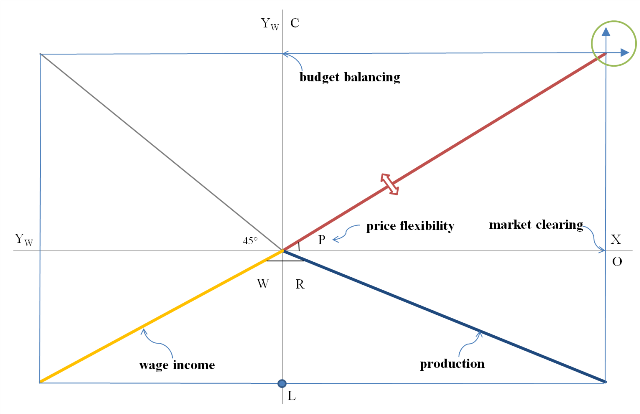
In order to see this, one has to go back to the most elementary economic configuration, that is, the pure production-consumption economy, which consists of the household and the business sector.#1
In this elementary economy, three configurations are logically possible: (i) consumption expenditures are equal to wage income C=Yw, (ii) C is less than Yw, (iii) C is greater than Yw.
• In case (i), the monetary saving of the household sector Sm≡Yw−C is zero, and the monetary profit of the business sector Qm≡C−Yw, too, is zero. The product market is cleared, i.e., X=O in all three cases.
• In case (ii), monetary saving Sm is positive, and the business sector makes a loss, i.e., Qm is negative. The market-clearing price is lower than in (i).
• In case (iii), monetary saving Sm is negative, i.e., the household sector dissaves, and the business sector makes a profit, i.e., Qm is positive. The market-clearing price is higher than in (i).
It always holds Qm+Sm=0 or
Qm≡−Sm, in other words, at the heart of the monetary economy is an identity: the business sector’s surplus = profit equals the household sector’s deficit = dissaving. And vice versa, the business sector’s deficit = loss equals the household sector’s surplus = saving. This is the most elementary form of the macroeconomic
Profit Law.
Profit is a purely nominal magnitude: NO share of output O corresponds to it. Under the condition of market clearing, the output always goes in full to the household sector. The correspondence of profit is an increase of money in the business sector’s cashbox, as every economist knows from Marx’s famous formula M―C―M’.
That no share of output corresponds to profit is logically obvious because the correspondence of loss would be a negative share of output, and that is a NONENTITY.
There is
no such thing as a “real” profit. Profit is a nominal variable and the counterpart of dissaving. The DSGE concept of profit is as brain-dead as can be, and one has to be a brain-dead economist to take it seriously for more than one second. #2, #3
#1 The elementary production-consumption economy is given by three macro axioms:
(A1) Yw=WL wage income Yw is equal to wage rate W times working hours. L, (A2) O=RL output O is equal to productivity R times working hours L, (A3) C=PX consumption expenditure C is equal to price P times quantity bought/sold X.
#2
The Profit Theory is False Since Adam Smith
#3
How the intelligent non-economist can refute every economist hands down
***
REPLY to Brian Romanchuk on Mar 19 and
Blog-Reference MNE
You say: “In this case, all that it done is divide through by the price level. As long as prices are non-zero, that is a legitimate mathematical operation.”
This is simply NOT the case. Nobody, in fact, divides anything by the price level. The DSGE profit equation reads Π(t)=F(t, kb, n)−r(t)kb(t)−w(t)n(t) where F(·) is the “real” production function, where w is the “real” wage, and r is the “real” rental cost of capital. There is NO nominal variable in the equation and NO division through P.
The “real” DSGE profit formula is pure methodological BS and only good for the demonstration of the galactic dimension of economists' scientific incompetence.#1 Because you cannot even read the profit equation, you do not realize that it is all in real variables, while profit is a nominal variable that has to be determined by National Accounting.
Nobody in their right mind applies a Cobb-Douglas production function to determine profit.
#1
The futile attempt to recycle Sraffa
***
REPLY to Roger Sparks on Mar 19 and
Blog-Reference MNE
You say, “I think the logical gaps between our three positions are very wide.”
Then, we have to determine in earnest who is right and who is wrong. As Popper said, if statements contradict, this shows that they are not all true.
You do not even understand the problem of macroeconomic profit. Marx did: “How can they continually draw 600 p. st. out of circulation, when they continually throw only 500 p. st. into it? From nothing comes nothing. The capitalist class as a whole cannot draw out of circulation what was not previously in it.”
This led to the conclusion: “The consensus to date has been that it is mathematically impossible for capitalists in the aggregate to make profits.” (Keen) And this zero-profit conclusion is obviously NOT in accordance with the empirical evidence for 200+ years.
Exactly at this point resides the logical gap = black hole of economists in general, and you and Brian Romanchuk in particular.
The mathematical solution to Marx’s problem of the very existence of macroeconomic profit reads
Q≡−S, that is, the business sector as a whole can only draw more out of circulation if the household sector throws more into it; in plain English, profit = dissaving.
This is the core of the life formula of the economic system we happen to live in. Needless to emphasize that neither you, Brian Romanchuk, Walrasians, Keynesians, Marxians, nor Austrians ever understood it.
***
REPLY to Brian Romanchuk
To take DSGE seriously for longer than one minute and to wonder whether market-clearing is assumed (of course, this defines equilibrium in GE) is a sure indicator of substandard intellectual performance.
***
REPLY to Roger Sparks on Mar 20 and
Blog-Reference MNE
You repeat the core of the axiomatically correct Profit Law, profit = dissaving, and then you go on saying, “Profits do you no good unless they can be used to improve your life and (hopefully) the life of others.”
You obviously do not grasp the implication of what I called the “life formula of the economic system we happen to live in”. Since profit is the very condition of the functioning of the economy, the life formula also tells you when the economy we happen to live in will break down.
This is something that neither DSGE nor MMT nor any other approach will tell you because economists do not know what profit is since economics was established as a proto-science by the silly blatherer Adam Smith.#1
The market economy breaks down as soon as macroeconomic profit turns into loss, and this is, in the most elementary case, when dissaving stops. The macroeconomic Profit Law for the general case reads Qm=Yd+(X−M)+(G−T)+(I−Sm), and you can figure out for yourself the conditions that turn profit eventually into loss.
If you do not understand the life-and-death formula of the monetary economy, there is no need to stop emanating blatant nonsense ― you can still have an absolutely senseless conversation about the crappy DSGE profit formula with Brian Romanchuk or, what amounts to the same, channel your grandma.
#1
Mathematical Proof of the Breakdown of Capitalism
***
REPLY to ANC Driver on Mar 24 and
Blog-Reference MNE
To sum up. In their DSGE textbook, Recursive Macroeconomic Theory, Lars Ljungqvist and Thomas J. Sargent define macroeconomic profit in real terms. This is methodologically as idiotic as one can get because profit is a nominal variable. The DSGE model suffers from a dimensional inconsistency. Alone, for this reason, it is scientifically worthless.
Neither DSGEers themselves nor their critics have realized that the whole approach is proto-scientific garbage. On second thought, however, this is not really astounding because the representative economist swallows garbage like utility maximization and supply-demand-equilibrium already for 150+ years as if it were manna.
The alternative to microfounded DSGE is macrofounded Post-Keynesianism. It is not one iota better. The macro profit theory is provably false since Keynes.#1 This is the false MMT balances equation (X−M)+(G−T)+(I−S)=0, and this is the true equation
(X−M)+(G−T)+(I−S)−(Q−Yd)=0 with profit and distributed profit greater zero.#2
Will Lars Ljungqvist, Thomas Sargent, Brian Romanchuk, Roger Sparks, and the rest of the mentally retarded microfounded macroeconomists ever get it? No chance, these folks have been lost in vacuous proto-scientific space for centuries.
#1
Forget Keynes
#2
True macrofoundations: the reset of economics
***
REPLY to Brian Romanchuk on Mar 25 and
Blog-Reference MNE
You say, “The equation has been divided through by the price level … that’s a valid mathematical operation.”
The problem is that you are a substandard mathematician. Because of this, you do not realize that DSGE is materially and formally flawed.
The analytical superstructure of DSGE is based upon this set of hardcore propositions a.k.a. axioms:
HC1 There exist economic agents.
HC2 Agents have preferences over outcomes.
HC3 Agents independently optimize subject to constraints.
HC4 Choices are made in interrelated markets.
HC5 Agents have full relevant knowledge.
HC6 Observable economic outcomes are coordinated, so they must be discussed with reference to equilibrium states. (Weintraub, p. 109) #1
HC3 introduces marginalism, which is the all-pervasive principle of standard economics. There are two methodological flaws here: (i) HC3 is an idiotic behavioral assumption, and (ii) constrained optimization of an ordinal preference order is an invalid mathematical operation, as the mathematician Jonathan Barzilai has proven (link has been given above).
Marginalism has been proto-scientific garbage from the very start.#2 DSGE is proof that economists are so stupid that they have not realized in 150+ years that their axiomatic foundations HC1/HC6 are invalid on all methodological counts.
The microfoundations approach is dead. Standard economics is dead. DSGE is dead. Nothing less than a
Paradigm Shift will do. Methodologically, it holds: If it isn’t macro-axiomatized, it isn’t economics.
#1 Weintraub, E. R. (1985). General Equilibrium Analysis. Cambridge, London, New York, etc.: Cambridge University Press.
#2
Putting the production function back on its feet
***
AXEC143d Profit Law (with increasing complexity) and Sectoral Balances Equation ®