Comment on Lars Syll on 'Adam Smith’s visible hand'
Blog-Reference
The classicals called themselves Political Economists and they never left anybody in doubt what agenda they pushed. However, there was an ambiguity right from the beginning. The classicals also had high scientific ambitions. They were aware that with simple good/bad moralizing, they were in the same boat with religion — a no-go in the Age of Enlightenment.
“The backward state of the Moral Sciences can only be remedied by applying to them the methods of Physical Science, duly extended and generalized.” (Mill, 2006, p. 833)
There was a political need to formulate a new moral philosophy and Adam Smith responded to it: “Adam Smith, when he wrote his Wealth of Nations ... understood by political economy a branch of the science of the statesman or legislator, ...” (Halévy, 1960, p. 104)
To get economics off the ground as science made it imperative to say something general about human behavior in the economic realm. J. S. Mill was the first to state a behavioral axiom: “Just in the same manner [as geometry] does Political Economy presuppose an arbitrary definition of man, as a being who invariably does that by which he may obtain the greatest amount of necessaries, conveniences, and luxuries, with the smallest quantity of labour and physical self-denial with which they can be obtained in the existing state of knowledge.” (Mill, 1874, V.46)
Mill regarded this proposition as an empirical law that resembles but has to be carefully distinguished from, universal deterministic physical laws. Empirical laws are neither deterministic nor universal, they express merely a local and temporary tendency: “In political economy, for instance, empirical laws of human nature are tacitly assumed by English thinkers, which are calculated only for Great Britain and the United States.” (Mill, 2006, p. 906)
This can be taken as a real-world description of human behavior in a concrete historical setting. Mill always remained within the confines of empirical science. However, the question is, what has this rather dull philosophy/psychology/sociology to do with economics and, more importantly, with science?
After 200+ years we know that to build economics upon the behavioral assumption of utility maximization leads only to general equilibrium theory — one of the greatest scientific embarrassments of all time.
The preoccupation with philosophy/psychology/sociology somehow took economists down the wrong path. After more than two hundred years they still do not know how the monetary economy works.
Does the world expect economists to find out how people behave? No, this is the proper job of psychology, sociology, anthropology etcetera. Does the world expect economists to figure out what profit is? Yes, of course, no philosopher, physicist, biologist, or sociologist will ever try to figure this out.
Have economists done their proper job? No (2014). The profit theory is false since Adam Smith gave his contemporaries the moral sentiments they urgently needed.
Egmont Kakarot-Handtke
References
Halévy, E. (1960). The Growth of Philosophic Radicalism. Boston: Beacon Press.
Kakarot-Handtke, E. (2014). The Three Fatal Mistakes of Yesterday Economics: Profit, I=S, Employment. SSRN Working Paper Series, 2489792: 1–13. URL
Mill, J. S. (1874). Essays on Some Unsettled Questions of Political Economy. On the Definition of Political Economy; and on the Method of Investigation Proper To It. Library of Economics and Liberty. URL
Mill, J. S. (2006). A System of Logic Ratiocinative and Inductive. Being a Connected View of the Principles of Evidence and the Methods of Scientific Investigation, Vol. 8 of Collected Works of John Stuart Mill. Indianapolis: Liberty Fund.
Showing posts sorted by relevance for query Mill. Sort by date Show all posts
Showing posts sorted by relevance for query Mill. Sort by date Show all posts
May 28, 2015
January 15, 2017
Economics: Poor philosophy, poor psychology, poor science
Comment on Lars Syll/Tom Hickey on ‘A philosophical look at economics’
Blog-Reference
The Classicals called themselves Political Economists, and they never left anybody in doubt what agenda they pushed. However, there was an ambiguity right from the beginning. The Classicals also had high scientific ambitions. They were aware that with simple good/bad moralizing, they were in the same boat with religion ― a no-go in the age of enlightenment: “The backward state of the Moral Sciences can only be remedied by applying to them the methods of Physical Science, duly extended and generalized.” (Mill, 2006, p. 833)
There was a political need to formulate a new moral philosophy, and Adam Smith responded to it: “Adam Smith, when he wrote his Wealth of Nations ... understood by political economy a branch of the science of the statesman or legislator, ...” (Halévy, 1960, p. 104)
To get economics off the ground as a science, it is imperative to say something general about human behavior in the economic realm. John Stuart Mill was the first to state a behavioral axiom: “Just in the same manner [as geometry] does Political Economy presuppose an arbitrary definition of man, as a being who invariably does that by which he may obtain the greatest amount of necessaries, conveniences, and luxuries, with the smallest quantity of labour and physical self-denial with which they can be obtained in the existing state of knowledge.” (Mill, 1874, V.46)
Mill regarded this proposition, which includes what today is called rent-seeking, as a limiting case, as an empirical law that resembles, but has to be carefully distinguished from, universal deterministic physical laws. Empirical laws are neither deterministic nor universal; they express merely a local and temporary tendency: “In political economy, for instance, empirical laws of human nature are tacitly assumed by English thinkers, which are calculated only for Great Britain and the United States.” (Mill, 2006, p. 906)
This can be taken as a real-world description of human Nature/behavior in a concrete historical setting. In other words, it says that people in the UK/US subscribe to the philosophy of utilitarianism. Mill always remained within the confines of empirical science. However, the methodological question is, what has this rather dull philosophy to do with economics and, more importantly, with science?
After 200+ years, we know that to build economics upon the behavioral assumption of utility maximization leads only to general equilibrium theory ― one of the greatest failures in the history of scientific thought.
The preoccupation with utilitarian folk philosophy, folk psychology, and folk sociology somehow took economists down the wrong path. After 200+ years, they still do not know how the monetary economy works.
Does the world expect economists to find out how people think and behave? No, this is the proper job of psychology, sociology, anthropology, etc. Does the world expect economists to figure out what profit is? Yes, of course, no philosopher, physicist, biologist, or sociologist will ever try to figure this out.
Have economists done their proper job? NO! (2014). The profit theory is false since Adam Smith gave his contemporaries the moral sentiments and the utilitarian folk philosophy they so urgently needed.
Economists have always been lousy philosophers; what is worse, they have always been the most incompetent scientists. Today, everybody knows that economics is a failed/fake science.
Egmont Kakarot-Handtke
References
Halévy, E. (1960). The Growth of Philosophic Radicalism. Boston: Beacon Press.
Kakarot-Handtke, E. (2014). The Profit Theory is False Since Adam Smith. What About the True Distribution Theory? SSRN Working Paper Series, 2511741: 1–23. URL
Mill, J. S. (1874). Essays on Some Unsettled Questions of Political Economy. On the Definition of Political Economy; and on the Method of Investigation Proper To It. Library of Economics and Liberty. URL
Mill, J. S. (2006). A System of Logic Ratiocinative and Inductive. Being a Connected View of the Principles of Evidence and the Methods of Scientific Investigation, Vol. 8 of Collected Works of John Stuart Mill. Indianapolis: Liberty Fund.
Related ‘Failed economics: The losers’ long list of lame excuses’ and 'True macrofoundations: the reset of economics' and 'Does economics matter more for bread or for circuses?'
Blog-Reference
The Classicals called themselves Political Economists, and they never left anybody in doubt what agenda they pushed. However, there was an ambiguity right from the beginning. The Classicals also had high scientific ambitions. They were aware that with simple good/bad moralizing, they were in the same boat with religion ― a no-go in the age of enlightenment: “The backward state of the Moral Sciences can only be remedied by applying to them the methods of Physical Science, duly extended and generalized.” (Mill, 2006, p. 833)
There was a political need to formulate a new moral philosophy, and Adam Smith responded to it: “Adam Smith, when he wrote his Wealth of Nations ... understood by political economy a branch of the science of the statesman or legislator, ...” (Halévy, 1960, p. 104)
To get economics off the ground as a science, it is imperative to say something general about human behavior in the economic realm. John Stuart Mill was the first to state a behavioral axiom: “Just in the same manner [as geometry] does Political Economy presuppose an arbitrary definition of man, as a being who invariably does that by which he may obtain the greatest amount of necessaries, conveniences, and luxuries, with the smallest quantity of labour and physical self-denial with which they can be obtained in the existing state of knowledge.” (Mill, 1874, V.46)
Mill regarded this proposition, which includes what today is called rent-seeking, as a limiting case, as an empirical law that resembles, but has to be carefully distinguished from, universal deterministic physical laws. Empirical laws are neither deterministic nor universal; they express merely a local and temporary tendency: “In political economy, for instance, empirical laws of human nature are tacitly assumed by English thinkers, which are calculated only for Great Britain and the United States.” (Mill, 2006, p. 906)
This can be taken as a real-world description of human Nature/behavior in a concrete historical setting. In other words, it says that people in the UK/US subscribe to the philosophy of utilitarianism. Mill always remained within the confines of empirical science. However, the methodological question is, what has this rather dull philosophy to do with economics and, more importantly, with science?
After 200+ years, we know that to build economics upon the behavioral assumption of utility maximization leads only to general equilibrium theory ― one of the greatest failures in the history of scientific thought.
The preoccupation with utilitarian folk philosophy, folk psychology, and folk sociology somehow took economists down the wrong path. After 200+ years, they still do not know how the monetary economy works.
Does the world expect economists to find out how people think and behave? No, this is the proper job of psychology, sociology, anthropology, etc. Does the world expect economists to figure out what profit is? Yes, of course, no philosopher, physicist, biologist, or sociologist will ever try to figure this out.
Have economists done their proper job? NO! (2014). The profit theory is false since Adam Smith gave his contemporaries the moral sentiments and the utilitarian folk philosophy they so urgently needed.
Economists have always been lousy philosophers; what is worse, they have always been the most incompetent scientists. Today, everybody knows that economics is a failed/fake science.
Egmont Kakarot-Handtke
References
Halévy, E. (1960). The Growth of Philosophic Radicalism. Boston: Beacon Press.
Kakarot-Handtke, E. (2014). The Profit Theory is False Since Adam Smith. What About the True Distribution Theory? SSRN Working Paper Series, 2511741: 1–23. URL
Mill, J. S. (1874). Essays on Some Unsettled Questions of Political Economy. On the Definition of Political Economy; and on the Method of Investigation Proper To It. Library of Economics and Liberty. URL
Mill, J. S. (2006). A System of Logic Ratiocinative and Inductive. Being a Connected View of the Principles of Evidence and the Methods of Scientific Investigation, Vol. 8 of Collected Works of John Stuart Mill. Indianapolis: Liberty Fund.
Related ‘Failed economics: The losers’ long list of lame excuses’ and 'True macrofoundations: the reset of economics' and 'Does economics matter more for bread or for circuses?'

December 31, 2014
Shocking: methodology is a tricky business
Comment on Peter Radford on 'Study the shocks'
Blog-Reference
What is the core problem of economics? Bagehot made it clear back in 1885: “It [Political Economy] is an abstract science which labours under a special hardship. Those who are conversant with its abstractions are usually without a true contact with its facts; those who are in contact with its facts have usually little sympathy with and little cognisance of its abstractions. Literary men who write about it are constantly using what a great teacher calls 'unreal words,' ― that is, they are using expressions with which they have no complete vivid picture to correspond. They are like physiologists who have never dissected; like astronomers who have never seen the stars; and, in consequence, just when they seem to be reasoning at their best, their knowledge of the facts falls short. Their primitive picture fails them, and their deduction altogether misses the mark ― sometimes, indeed, goes astray so far, that those who live and move among the facts boldly say that they cannot comprehend 'how any one can talk such nonsense.' Yet, on the other hand, these people who live and move among the facts often, or mostly, cannot of themselves put together any precise reasonings about them.” (1885, PE.13)
Take-home message: There are two types of economists but neither has a clue.
This, indeed, was not news then because J. S. Mill reported already in 1874 about the two classes of inquirers: “It has been again and again demonstrated, that those who are accused of despising facts and disregarding experience build and profess to build wholly upon facts and experience; while those who disavow theory cannot make one step without theorizing. But, although both classes of inquirers do nothing but theorize, and both of them consult no other guide than experience, there is this difference between them, and a most important difference it is: that those who are called practical men require specific experience, and argue wholly upwards from particular facts to a general conclusion; while those who are called theorists aim at embracing a wider field of experience, and, having argued upwards from particular facts to a general principle including a much wider range than that of the question under discussion, then argue downwards from that general principle to a variety of specific conclusions.” (Mill, 1874, V. 43)
Take-home message: There are two types of economists, the upwarders and downwarders, but neither is particularly successful.
Mill was confronted with a quite unsatisfactory situation. He was well aware of the “backward state” of the social sciences in general and of economics in particular. Being one of the finest methodologists of his time he took sides: “Since, therefore, it is vain to hope that truth can be arrived at, either in Political Economy or in any other department of the social science, while we look at the facts in the concrete, clothed in all the complexity with which nature has surrounded them, and endeavour to elicit a general law by a process of induction from a comparison of details; there remains no other method than the à priori one, or that of "abstract speculation".” (Mill, 1874, V.55)
Mill had the great triumph of the downwarders before his eyes and he certainly concurred with Galileo: “I shall never be able to express strongly enough my admiration for the greatness of mind of these men who conceived this [heliocentric] hypothesis and held it to be true. In violent opposition to the evidence of their own senses and by sheer force of intellect, they preferred what reason told them to that which sense experience plainly showed them ...” (quoted in Popper, 1994, p. 84)
In contrast, the defeat of the upwarders was evident and their good advice rang hollow: “Bacon, the philosopher of science, was, quite consistently, an enemy of the Copernican hypothesis. Don't theorize, he said, but open your eyes and observe without prejudice, and you cannot doubt that the Sun moves and that the Earth is at rest.” (Popper, 1994, p. 84)
Take-home message: Common sense and open eyes can be very misleading in scientific matters.
Or, as Marx put it: “That in their appearances things are often presented in an inverted way is something fairly familiar in every science, apart from political economy.” (Marx, 1990, p. 677)
Mill knew quite well that methodology can point out errors, mistakes, nonentities, fallacies, and green cheese assumptionism but that it is beyond the means of the methodologist to tell researchers how to solve their scientific problems. And if any methodologist should ever think he knows how to do better there is a straightforward way to demonstrate it: “Doubtless, the most effectual mode of showing how the sciences of Ethics and Politics may be constructed, would be to construct them ...” (Mill, 2006, p. 834)
The downwarders of Orthodoxy have failed to explain how the actual economy works. This, however, does not prove that the methodology of the upwarders is superior. Heterodoxy cannot claim that it has performed better.
My good advice to Peter Radford could be: Never give good advice in methodological matters, but this would be much like one of these logically shocking ancient Greek paradoxes.
Egmont Kakarot-Handtke
References
Bagehot, W. (1885). The Postulates of English Political Economy. Library of Economics and Liberty. URL
Marx, K. (1990). Capital, Volume I. London: Penguin Classics.
Mill, J. S. (1874). Essays on Some Unsettled Questions of Political Economy. On the Definition of Political Economy; and on the Method of Investigation Proper To It. Library of Economics and Liberty. URL
Mill, J. S. (2006). A System of Logic Ratiocinative and Inductive. Being a Connected View of the Principles of Evidence and the Methods of Scientific Investigation, Vol. 8 of Collected Works of John Stuart Mill. Indianapolis: Liberty Fund.
Popper, K. R. (1994). The Myth of the Framework. In Defence of Science and Rationality., chapter Science: Problems, Aims, Responsibilities, 82–111. London, New York: Routledge.
Blog-Reference
What is the core problem of economics? Bagehot made it clear back in 1885: “It [Political Economy] is an abstract science which labours under a special hardship. Those who are conversant with its abstractions are usually without a true contact with its facts; those who are in contact with its facts have usually little sympathy with and little cognisance of its abstractions. Literary men who write about it are constantly using what a great teacher calls 'unreal words,' ― that is, they are using expressions with which they have no complete vivid picture to correspond. They are like physiologists who have never dissected; like astronomers who have never seen the stars; and, in consequence, just when they seem to be reasoning at their best, their knowledge of the facts falls short. Their primitive picture fails them, and their deduction altogether misses the mark ― sometimes, indeed, goes astray so far, that those who live and move among the facts boldly say that they cannot comprehend 'how any one can talk such nonsense.' Yet, on the other hand, these people who live and move among the facts often, or mostly, cannot of themselves put together any precise reasonings about them.” (1885, PE.13)
Take-home message: There are two types of economists but neither has a clue.
This, indeed, was not news then because J. S. Mill reported already in 1874 about the two classes of inquirers: “It has been again and again demonstrated, that those who are accused of despising facts and disregarding experience build and profess to build wholly upon facts and experience; while those who disavow theory cannot make one step without theorizing. But, although both classes of inquirers do nothing but theorize, and both of them consult no other guide than experience, there is this difference between them, and a most important difference it is: that those who are called practical men require specific experience, and argue wholly upwards from particular facts to a general conclusion; while those who are called theorists aim at embracing a wider field of experience, and, having argued upwards from particular facts to a general principle including a much wider range than that of the question under discussion, then argue downwards from that general principle to a variety of specific conclusions.” (Mill, 1874, V. 43)
Take-home message: There are two types of economists, the upwarders and downwarders, but neither is particularly successful.
Mill was confronted with a quite unsatisfactory situation. He was well aware of the “backward state” of the social sciences in general and of economics in particular. Being one of the finest methodologists of his time he took sides: “Since, therefore, it is vain to hope that truth can be arrived at, either in Political Economy or in any other department of the social science, while we look at the facts in the concrete, clothed in all the complexity with which nature has surrounded them, and endeavour to elicit a general law by a process of induction from a comparison of details; there remains no other method than the à priori one, or that of "abstract speculation".” (Mill, 1874, V.55)
Mill had the great triumph of the downwarders before his eyes and he certainly concurred with Galileo: “I shall never be able to express strongly enough my admiration for the greatness of mind of these men who conceived this [heliocentric] hypothesis and held it to be true. In violent opposition to the evidence of their own senses and by sheer force of intellect, they preferred what reason told them to that which sense experience plainly showed them ...” (quoted in Popper, 1994, p. 84)
In contrast, the defeat of the upwarders was evident and their good advice rang hollow: “Bacon, the philosopher of science, was, quite consistently, an enemy of the Copernican hypothesis. Don't theorize, he said, but open your eyes and observe without prejudice, and you cannot doubt that the Sun moves and that the Earth is at rest.” (Popper, 1994, p. 84)
Take-home message: Common sense and open eyes can be very misleading in scientific matters.
Or, as Marx put it: “That in their appearances things are often presented in an inverted way is something fairly familiar in every science, apart from political economy.” (Marx, 1990, p. 677)
Mill knew quite well that methodology can point out errors, mistakes, nonentities, fallacies, and green cheese assumptionism but that it is beyond the means of the methodologist to tell researchers how to solve their scientific problems. And if any methodologist should ever think he knows how to do better there is a straightforward way to demonstrate it: “Doubtless, the most effectual mode of showing how the sciences of Ethics and Politics may be constructed, would be to construct them ...” (Mill, 2006, p. 834)
The downwarders of Orthodoxy have failed to explain how the actual economy works. This, however, does not prove that the methodology of the upwarders is superior. Heterodoxy cannot claim that it has performed better.
My good advice to Peter Radford could be: Never give good advice in methodological matters, but this would be much like one of these logically shocking ancient Greek paradoxes.
Egmont Kakarot-Handtke
References
Bagehot, W. (1885). The Postulates of English Political Economy. Library of Economics and Liberty. URL
Marx, K. (1990). Capital, Volume I. London: Penguin Classics.
Mill, J. S. (1874). Essays on Some Unsettled Questions of Political Economy. On the Definition of Political Economy; and on the Method of Investigation Proper To It. Library of Economics and Liberty. URL
Mill, J. S. (2006). A System of Logic Ratiocinative and Inductive. Being a Connected View of the Principles of Evidence and the Methods of Scientific Investigation, Vol. 8 of Collected Works of John Stuart Mill. Indianapolis: Liberty Fund.
Popper, K. R. (1994). The Myth of the Framework. In Defence of Science and Rationality., chapter Science: Problems, Aims, Responsibilities, 82–111. London, New York: Routledge.
May 12, 2015
Einstein, Mill, and the Starting Problem
Comment on Lars Syll on ‘Why the ergodic theorem is not applicable in economics’
Blog-Reference
Thank you [Fred Zaman] for the link to the Lehmkuhl article.
Einstein, of course, is significant for economics — yet it is not his physics that is of importance but his methodology. And here comes the big surprise, Einstein got his ideas from an economist. Indeed, physicists understood J. S. Mill better than the hordes of economists from his time onwards.
“They [Einstein and Dirac] agreed that science was fundamentally about explaining more and more phenomena in terms of fewer and fewer theories, a view they had read in Mill's A System of Logic.” (Farmelo, 2009, p. 137)
Mill, in turn, was quite clear that the first task of every science is to get the fundamentals right. This is Mill's Starting Problem.
“What are the propositions which may reasonably be received without proof? That there must be some such propositions all are agreed, since there cannot be an infinite series of proof, a chain suspended from nothing. But to determine what these propositions are, is the opus magnum of the more recondite mental philosophy.” (Mill, 2006, p. 746)
And now all is pretty obvious: you cannot put utility maximization, equilibrium, ergodicity, or any other physical or psychological assumption into the premises. After the failure of Orthodoxy, it falls to Heterodoxy to spell out the economic propositions ‘which may reasonably be received without proof.’
This is what Constructive Heterodoxy is all about.
Egmont Kakarot-Handtke
References
Farmelo, G. (2009). The Strangest Man. The Hidden Life of Paul Dirac, Quantum Genius. London: Faber and Faber.
Mill, J. S. (2006). Principles of Political Economy With Some of Their Applications to Social Philosophy, volume 3, Books III-V of Collected Works of John Stuart Mill. Indianapolis: Liberty Fund. URL
* For the short list of propositions see Answer to Fred Zaman
Blog-Reference
Thank you [Fred Zaman] for the link to the Lehmkuhl article.
Einstein, of course, is significant for economics — yet it is not his physics that is of importance but his methodology. And here comes the big surprise, Einstein got his ideas from an economist. Indeed, physicists understood J. S. Mill better than the hordes of economists from his time onwards.
“They [Einstein and Dirac] agreed that science was fundamentally about explaining more and more phenomena in terms of fewer and fewer theories, a view they had read in Mill's A System of Logic.” (Farmelo, 2009, p. 137)
Mill, in turn, was quite clear that the first task of every science is to get the fundamentals right. This is Mill's Starting Problem.
“What are the propositions which may reasonably be received without proof? That there must be some such propositions all are agreed, since there cannot be an infinite series of proof, a chain suspended from nothing. But to determine what these propositions are, is the opus magnum of the more recondite mental philosophy.” (Mill, 2006, p. 746)
And now all is pretty obvious: you cannot put utility maximization, equilibrium, ergodicity, or any other physical or psychological assumption into the premises. After the failure of Orthodoxy, it falls to Heterodoxy to spell out the economic propositions ‘which may reasonably be received without proof.’
This is what Constructive Heterodoxy is all about.
Egmont Kakarot-Handtke
References
Farmelo, G. (2009). The Strangest Man. The Hidden Life of Paul Dirac, Quantum Genius. London: Faber and Faber.
Mill, J. S. (2006). Principles of Political Economy With Some of Their Applications to Social Philosophy, volume 3, Books III-V of Collected Works of John Stuart Mill. Indianapolis: Liberty Fund. URL
* For the short list of propositions see Answer to Fred Zaman
November 19, 2015
The utter senselessness of political economics
Comment on Peter Radford on ‘Disbelief as Belief’
Blog-Reference
Keynes famously remarked that ‘if economists could manage to get themselves thought of as humble, competent people, on a level with dentists, that would be splendid.’
Keynes, as we know, did not follow his own advice but became a better-known member of the species of political economists, that is, a busy agenda pusher but an incompetent scientist.
Economists are natural-born schizophrenics. They cannot make up their minds whether their proper subject matter is society or the economy or something in between. J. S. Mill positioned economics as follows: "The science which traces the laws of such of the phenomena of society as arise from the combined operations of mankind for the production of wealth, in so far as those phenomena are not modified by the pursuit of any other object." (Mill, 1874, V.39)
This is a rather coarse delineation and economists did not hesitate and took the opportunity to dabble in Psychology, Sociology, Political Sciences, History, Anthropology, Law, Ethics, Philosophy, Pedagogics, etcetera. What got entirely lost was that the focus of economics should be on the economy. The subject matter of economics is the economic system. Economics is NOT a social science but a systems science.
The present state of economics is that neither Orthodoxy nor Heterodoxy has an idea of how the economy we happen to live in works. J. S. Mill defined economics as science but what we actually have — a hodgepodge of incoherent models and verbiage — does not satisfy the scientific criteria of material and formal consistency.
It is of utmost importance to distinguish between political and theoretical economics. The main differences are (i) The goal of political economics is to push an agenda, the goal of theoretical economics is to explain how the actual economy works. (ii) In political economics anything goes, in theoretical economics, scientific standards are observed.
The fact of the matter is that theoretical economics has been hijacked by the agenda pushers of political economics. Smith and Ricardo defined themselves as political economists, Marx and Keynes were agenda pushers, so were Hayek and Friedman, and so are Krugman and Varoufakis.
Political economists speak in the name of economics as science but derive their arguments, advice, and policy guidance from theories that are provably false. What the public has not yet realized is that economics is a failed science.
“In order to tell the politicians and practitioners something about causes and best means, the economist needs the true theory or else he has not much more to offer than educated common sense or his personal opinion.” (Stigum, 1991, p. 30)
Economists have no true theory, only opinions. This is bad enough. Things, however, become abysmal when economics degenerates to pure politics. The last thing a genuine scientist is interested in is a sitcom about funny presidential candidates who compete for the privilege to execute the volonté générale of a borderline society.
This brings us back to the idea of economists as competent people, on a level with dentists, or as J. S. Mill had it: “A scientific observer or reasoner, merely as such, is not an adviser for practice. His part is only to show that certain consequences follow from certain causes, and that to obtain certain ends, certain means are the most effectual. Whether the ends themselves are such as ought to be pursued, and if so, in what cases and to how great a length, it is no part of his business as a cultivator of science to decide, and science alone will never qualify him for the decision.” (Mill, 2006, p. 950)
This presupposes that economists, in fact, know how the economy works — which is NOT the case. Could it be that economists have been too occupied with agenda-pushing in the last 200 years?
It is high time for economists to get out of political agenda-pushing and do their science homework.
Egmont Kakarot-Handtke
References
Mill, J. S. (1874). Essays on Some Unsettled Questions of Political Economy. On the Definition of Political Economy; and on the Method of Investigation Proper To It. Library of Economics and Liberty. URL
Mill, J. S. (2006). A System of Logic Ratiocinative and Inductive. Being a Connected View of the Principles of Evidence and the Methods of Scientific Investigation, Vol. 8 of Collected Works of John Stuart Mill. Indianapolis: Liberty Fund.
Stigum, B. P. (1991). Toward a Formal Science of Economics: The Axiomatic Method in Economics and Econometrics. Cambridge: MIT Press.
Related 'Profit and the poverty of economics' and 'Free academia from economics' and 'How to be a good scientist' and 'PsySoc — the scourge of economics' and 'Confounding Is and Ought: the economist as moralist' and 'The case for pure economics' and 'Separation of politics and economics'. For details of the big picture see cross-references Political Economics/Stupidity/Corruption.
Blog-Reference
Keynes famously remarked that ‘if economists could manage to get themselves thought of as humble, competent people, on a level with dentists, that would be splendid.’
Keynes, as we know, did not follow his own advice but became a better-known member of the species of political economists, that is, a busy agenda pusher but an incompetent scientist.
Economists are natural-born schizophrenics. They cannot make up their minds whether their proper subject matter is society or the economy or something in between. J. S. Mill positioned economics as follows: "The science which traces the laws of such of the phenomena of society as arise from the combined operations of mankind for the production of wealth, in so far as those phenomena are not modified by the pursuit of any other object." (Mill, 1874, V.39)
This is a rather coarse delineation and economists did not hesitate and took the opportunity to dabble in Psychology, Sociology, Political Sciences, History, Anthropology, Law, Ethics, Philosophy, Pedagogics, etcetera. What got entirely lost was that the focus of economics should be on the economy. The subject matter of economics is the economic system. Economics is NOT a social science but a systems science.
The present state of economics is that neither Orthodoxy nor Heterodoxy has an idea of how the economy we happen to live in works. J. S. Mill defined economics as science but what we actually have — a hodgepodge of incoherent models and verbiage — does not satisfy the scientific criteria of material and formal consistency.
It is of utmost importance to distinguish between political and theoretical economics. The main differences are (i) The goal of political economics is to push an agenda, the goal of theoretical economics is to explain how the actual economy works. (ii) In political economics anything goes, in theoretical economics, scientific standards are observed.
The fact of the matter is that theoretical economics has been hijacked by the agenda pushers of political economics. Smith and Ricardo defined themselves as political economists, Marx and Keynes were agenda pushers, so were Hayek and Friedman, and so are Krugman and Varoufakis.
Political economists speak in the name of economics as science but derive their arguments, advice, and policy guidance from theories that are provably false. What the public has not yet realized is that economics is a failed science.
“In order to tell the politicians and practitioners something about causes and best means, the economist needs the true theory or else he has not much more to offer than educated common sense or his personal opinion.” (Stigum, 1991, p. 30)
Economists have no true theory, only opinions. This is bad enough. Things, however, become abysmal when economics degenerates to pure politics. The last thing a genuine scientist is interested in is a sitcom about funny presidential candidates who compete for the privilege to execute the volonté générale of a borderline society.
This brings us back to the idea of economists as competent people, on a level with dentists, or as J. S. Mill had it: “A scientific observer or reasoner, merely as such, is not an adviser for practice. His part is only to show that certain consequences follow from certain causes, and that to obtain certain ends, certain means are the most effectual. Whether the ends themselves are such as ought to be pursued, and if so, in what cases and to how great a length, it is no part of his business as a cultivator of science to decide, and science alone will never qualify him for the decision.” (Mill, 2006, p. 950)
This presupposes that economists, in fact, know how the economy works — which is NOT the case. Could it be that economists have been too occupied with agenda-pushing in the last 200 years?
It is high time for economists to get out of political agenda-pushing and do their science homework.
Egmont Kakarot-Handtke
References
Mill, J. S. (1874). Essays on Some Unsettled Questions of Political Economy. On the Definition of Political Economy; and on the Method of Investigation Proper To It. Library of Economics and Liberty. URL
Mill, J. S. (2006). A System of Logic Ratiocinative and Inductive. Being a Connected View of the Principles of Evidence and the Methods of Scientific Investigation, Vol. 8 of Collected Works of John Stuart Mill. Indianapolis: Liberty Fund.
Stigum, B. P. (1991). Toward a Formal Science of Economics: The Axiomatic Method in Economics and Econometrics. Cambridge: MIT Press.
Related 'Profit and the poverty of economics' and 'Free academia from economics' and 'How to be a good scientist' and 'PsySoc — the scourge of economics' and 'Confounding Is and Ought: the economist as moralist' and 'The case for pure economics' and 'Separation of politics and economics'. For details of the big picture see cross-references Political Economics/Stupidity/Corruption.
May 2, 2016
Heterodoxy, you have a problem
Comment on Zimmerman, Roth et al. on ‘Market Reflex’
Blog-Reference
Economics is a science without scientists.
The first peculiarity of science is that, strictly speaking, humans do not need it. Common-sensical people know that when they walk over the cliff, they will move downwards with considerable speed and, in most cases, will be dead after hitting the ground. That is all one had to know in the business of survival since cave-dweller times. Common-sensical people do not need the Law of the Falling Bodies or the concepts of gravity/mass/acceleration, or the inverse square formula.
Accordingly, commonsensical economists insist that all there is to know about the economy can be known by going to the supermarket, reading the business press, and studying the history of how all developed from cowrie shells to electronic money, in one word, by looking at the naked facts.
Not much can be said against this except that it is like looking at the sunrise and telling the rest of humanity that the sun rises. This is sufficient for all practical purposes, but it is NOT science. It never ever leads to the absolutely counterintuitive heliocentric theory.
This is what Zimmerman and Roth and most failed economists, including Marshall, Keynes, Hayek, and Friedman, think is science: “Science is about observing and concluding. And scientists do it over and over and over with the hope of building an accurate representation of what is shown by the observations.”
This is absolutely beside the point, and everybody can know this from the inventors of science, the ancient Greeks. Take the atom as an example. Did the ancient Greeks observe atoms? No! An atom is an abstract concept, and, lo and behold, the observation came more than 2000 years LATER. And so it goes in the three-step perception-theory-observation with all other scientific concepts.
The subject matter of economics is the (world-) economy, and this is an abstract entity that is NOT observable with the two natural eyes but only with the third eye of theory. Every economist can know this from J. S. Mill: “Since, therefore, it is vain to hope that truth can be arrived at, either in Political Economy or in any other department of the social science, while we look at the facts in the concrete, clothed in all the complexity with which nature has surrounded them, and endeavour to elicit a general law by a process of induction from a comparison of details; there remains no other method than the à priori one, or that of ‘abstract speculation’.” (1874, V.55)
With ‘speculation’ is NOT meant waffling about NONENTITIES like dancing angels on a pinpoint. Ultimately, all scientific speculation returns to the hard ground of reality. This, too, is clear since Mill: “The ground of confidence in any concrete deductive science is not the à priori reasoning itself, but the accordance between its results and those of observation à posteriori.” (2006, p. 896-897)
Mill’s methodology has NOT been borrowed from physics, just the other way round: “They [Einstein and Dirac] agreed that science was fundamentally about explaining more and more phenomena in terms of fewer and fewer theories, a view they had read in Mill’s A System of Logic.” (Farmelo, 2009, p. 137)
Einstein and Dirac understood Mill, but heterodox economists still subscribe to the methodological junk of observationism, naive empiricism, common sense, better-roughly-right sloppiness, misplaced realism, and the ant perspective of partial analysis.
Light bulb 1: You cannot understand the universe by empirical observation of your backyard.
Light bulb 2: The fault of Walrasianism is NOT abstract speculation but VACUOUS speculation. The key foundational concepts (utility, constrained optimization, equilibrium, demand function, etc) are NONENTITIES. In other words, the axiomatic foundations of Walrasianism have NO real content. This is the ultimate cause of failure because of Garbage in ― Garbage out or NONENTITIES in ― Nonsense out.
Light bulb 3: The critique of model bricolage, mathiness, unrealism, physics envy, etc., is justified but superficial. The foundational error/mistake of standard economics is methodological individualism.
Light bulb 4: NO way leads from the understanding of individual behavior, or more generally from partial analysis, to the understanding of the economic system as a whole. This is why economics is a failed science.
Light bulb 5: Economics has to move from microfoundations to macrofoundations.
Light bulb 6: To dabble in Psychology, Sociology, Politics, or History is NOT economics. Economics is about the economy, and this is an ABSTRACT but REAL entity that is beyond the horizon of BOTH orthodox and heterodox economists.
The main problem of economics is how to get out of the proto-scientific stalemate between vacuous orthodox modeling and clueless heterodox debunking. Heterodoxy has the SAME problem as Orthodoxy: a dearth of scientists and an overabundance of half-witted windbags. #1
Egmont Kakarot-Handtke
References
Farmelo, G. (2009). The Strangest Man. The Hidden Life of Paul Dirac, Quantum Genius. London: Faber and Faber.
Mill, J. S. (1874). Essays on Some Unsettled Questions of Political Economy. On the Definition of Political Economy; and on the Method of Investigation Proper To It. Library of Economics and Liberty. URL
Mill, J. S. (2006). A System of Logic Ratiocinative and Inductive. Being a Connected View of the Principles of Evidence and the Methods of Scientific Investigation, Vol. 8 of Collected Works of John Stuart Mill. Indianapolis: Liberty Fund.
#1 How the intelligent non-economist can refute every economist hands down

Blog-Reference
Economics is a science without scientists.
The first peculiarity of science is that, strictly speaking, humans do not need it. Common-sensical people know that when they walk over the cliff, they will move downwards with considerable speed and, in most cases, will be dead after hitting the ground. That is all one had to know in the business of survival since cave-dweller times. Common-sensical people do not need the Law of the Falling Bodies or the concepts of gravity/mass/acceleration, or the inverse square formula.
Accordingly, commonsensical economists insist that all there is to know about the economy can be known by going to the supermarket, reading the business press, and studying the history of how all developed from cowrie shells to electronic money, in one word, by looking at the naked facts.
Not much can be said against this except that it is like looking at the sunrise and telling the rest of humanity that the sun rises. This is sufficient for all practical purposes, but it is NOT science. It never ever leads to the absolutely counterintuitive heliocentric theory.
This is what Zimmerman and Roth and most failed economists, including Marshall, Keynes, Hayek, and Friedman, think is science: “Science is about observing and concluding. And scientists do it over and over and over with the hope of building an accurate representation of what is shown by the observations.”
This is absolutely beside the point, and everybody can know this from the inventors of science, the ancient Greeks. Take the atom as an example. Did the ancient Greeks observe atoms? No! An atom is an abstract concept, and, lo and behold, the observation came more than 2000 years LATER. And so it goes in the three-step perception-theory-observation with all other scientific concepts.
The subject matter of economics is the (world-) economy, and this is an abstract entity that is NOT observable with the two natural eyes but only with the third eye of theory. Every economist can know this from J. S. Mill: “Since, therefore, it is vain to hope that truth can be arrived at, either in Political Economy or in any other department of the social science, while we look at the facts in the concrete, clothed in all the complexity with which nature has surrounded them, and endeavour to elicit a general law by a process of induction from a comparison of details; there remains no other method than the à priori one, or that of ‘abstract speculation’.” (1874, V.55)
With ‘speculation’ is NOT meant waffling about NONENTITIES like dancing angels on a pinpoint. Ultimately, all scientific speculation returns to the hard ground of reality. This, too, is clear since Mill: “The ground of confidence in any concrete deductive science is not the à priori reasoning itself, but the accordance between its results and those of observation à posteriori.” (2006, p. 896-897)
Mill’s methodology has NOT been borrowed from physics, just the other way round: “They [Einstein and Dirac] agreed that science was fundamentally about explaining more and more phenomena in terms of fewer and fewer theories, a view they had read in Mill’s A System of Logic.” (Farmelo, 2009, p. 137)
Einstein and Dirac understood Mill, but heterodox economists still subscribe to the methodological junk of observationism, naive empiricism, common sense, better-roughly-right sloppiness, misplaced realism, and the ant perspective of partial analysis.
Light bulb 1: You cannot understand the universe by empirical observation of your backyard.
Light bulb 2: The fault of Walrasianism is NOT abstract speculation but VACUOUS speculation. The key foundational concepts (utility, constrained optimization, equilibrium, demand function, etc) are NONENTITIES. In other words, the axiomatic foundations of Walrasianism have NO real content. This is the ultimate cause of failure because of Garbage in ― Garbage out or NONENTITIES in ― Nonsense out.
Light bulb 3: The critique of model bricolage, mathiness, unrealism, physics envy, etc., is justified but superficial. The foundational error/mistake of standard economics is methodological individualism.
Light bulb 4: NO way leads from the understanding of individual behavior, or more generally from partial analysis, to the understanding of the economic system as a whole. This is why economics is a failed science.
Light bulb 5: Economics has to move from microfoundations to macrofoundations.
Light bulb 6: To dabble in Psychology, Sociology, Politics, or History is NOT economics. Economics is about the economy, and this is an ABSTRACT but REAL entity that is beyond the horizon of BOTH orthodox and heterodox economists.
The main problem of economics is how to get out of the proto-scientific stalemate between vacuous orthodox modeling and clueless heterodox debunking. Heterodoxy has the SAME problem as Orthodoxy: a dearth of scientists and an overabundance of half-witted windbags. #1
Egmont Kakarot-Handtke
References
Farmelo, G. (2009). The Strangest Man. The Hidden Life of Paul Dirac, Quantum Genius. London: Faber and Faber.
Mill, J. S. (1874). Essays on Some Unsettled Questions of Political Economy. On the Definition of Political Economy; and on the Method of Investigation Proper To It. Library of Economics and Liberty. URL
Mill, J. S. (2006). A System of Logic Ratiocinative and Inductive. Being a Connected View of the Principles of Evidence and the Methods of Scientific Investigation, Vol. 8 of Collected Works of John Stuart Mill. Indianapolis: Liberty Fund.
#1 How the intelligent non-economist can refute every economist hands down
***
Graphic AXEC70
March 13, 2017
How Arrow pushed economics over the cliff
Comment on Lars Syll on ‘Kenneth Arrow (1921-2017)’
Blog-Reference and Blog-Reference on Apr 8 adapted to context
The inevitable failure of economics started with Jevons/Walras/Menger, but Arrow gave the final push with this fundamental methodological specification: “It is a touchstone of accepted economics that all explanations must run in terms of the actions and reactions of individuals. Our behavior in judging economic research, in peer review of papers and research, and in promotions, includes the criterion that in principle the behavior we explain and the policies we propose are explicable in terms of individuals, not of other social categories.” (Arrow, 1994)
The definition of the subject matter translates into the following hardcore propositions, a.k.a. axioms: “HC1 economic agents have preferences over outcomes; HC2 agents individually optimize subject to constraints; HC3 agent choice is manifest in interrelated markets; HC4 agents have full relevant knowledge; HC5 observable outcomes are coordinated, and must be discussed with reference to equilibrium states.” (Weintraub, 1985)
Obviously, this axiom set contains three NONENTITIES: (i) constrained optimization (HC2), (ii) rational expectations (HC4), (iii) equilibrium (HC5). Every theory/model that contains a NONENTITY is a priori false. As a consequence, the General Equilibrium Theory of the Arrow-Debreu type and its offspring down to DSGE/RBC/New Keynesianism is scientifically worthless.
Egmont Kakarot-Handtke
Related 'Where economics went wrong' and 'Economics is NOT a misunderstanding but cargo cultic crap' and 'Modern macro moronism' and 'There is no scientific elite in economics' and 'Note on Lars Syll on Axiomatization' and 'Economists ― medics or barber-surgeons?' and 'Microfoundations have been for 150+ years: high time t.o move on' and 'Show first your economic axioms or get out of the discussion' and 'The Logical Interface Between Objective Macrofoundations and Subjective Valuations' and cross-references Axiomatization and cross-references Paradigm Shift
You say: “You appear to be unaware of the great John Stuart Mill’s wisdom about the nature of axioms.”
What John Stuart Mill said about methodology is this: “In the definition which we have attempted to frame of the science of Political Economy, we have characterized it as essentially an abstract science, and its method as the method à priori.”
The foundational question for the application of what today is called the axiomatic-deductive method is what the axioms are: “What are the propositions which may reasonably be received without proof? That there must be some such propositions all are agreed, since there cannot be an infinite series of proof, a chain suspended from nothing. But to determine what these propositions are, is the opus magnum of the more recondite mental philosophy.” (Mill)
It was pretty obvious to Mill that the axiomatic-deductive method is NOT a formal exercise that is detached from reality, just the contrary: “The ground of confidence in any concrete deductive science is not the à priori reasoning itself, but the accordance between its results and those of observation à posteriori.”
Mill’s understanding of methodology is identical with that of modern physics: “He [Dirac] identified three revolutions in modern physics ― relativity, quantum mechanics, and cosmology ― and hinted that he expected them one day to be understood within a unified framework. Although he did not mention John Stuart Mill, Dirac was seeking to answer the same question posed in A System of Logic: ‘What are the fewest general propositions from which all the uniformities existing in nature could be deduced?’” (Farmelo)
The inexcusable scientific blunder of Arrow consists of messing up the axiomatic foundations of economics. More precisely, methodological individualism and the neo-Walrasian axiom set HC1/HC5 (above) are one of the greatest embarrassments in the history of the sciences. #1
Only scientific imbeciles like the representative economist accept green cheese behavioral assumptions like constrained optimization, rational expectations, and equilibrium as axiomatic foundations of economics. #2 General Equilibrium Theory is what Feynman called cargo cult science, and Arrow was a fake scientist. All this follows from the methodological wisdom of John Stuart Mill.
#1 Economics is NOT a misunderstanding but cargo cultic crap and Where economics went wrong
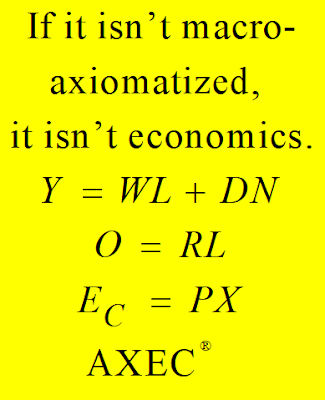
#2 If it isn’t macro-axiomatized, it isn’t economics
To put equilibrium (HC5) into the premises/axioms is a methodological blunder that is known since antiquity as petitio principii.#1
Your argument: “Zero-sum is … one of the truest axioms in nature. Thus, economics must be zero-sum.” is beside the point because zero-sum and equilibrium are two entirely different things. #2
To be axiomatically false is the death sentence for a Paradigm. Therefore it holds: (i) because of material/formal inconsistency General Equilibrium Theory can never be admitted to the corpus of science; GET is cargo cult science, (ii) Arrow can never be admitted to the scientific community, (iii) because the representative economist does not understand what science is all about he has not realized (i)/(ii) until this very day.
GET and its acceptance by economists, is one of the greatest embarrassments in the history of science.
#1 For details, see here.
#2 The zero-sum requirement is satisfied, i.e., Qm+Sm=0, see also here.
Blog-Reference and Blog-Reference on Apr 8 adapted to context
The inevitable failure of economics started with Jevons/Walras/Menger, but Arrow gave the final push with this fundamental methodological specification: “It is a touchstone of accepted economics that all explanations must run in terms of the actions and reactions of individuals. Our behavior in judging economic research, in peer review of papers and research, and in promotions, includes the criterion that in principle the behavior we explain and the policies we propose are explicable in terms of individuals, not of other social categories.” (Arrow, 1994)
The definition of the subject matter translates into the following hardcore propositions, a.k.a. axioms: “HC1 economic agents have preferences over outcomes; HC2 agents individually optimize subject to constraints; HC3 agent choice is manifest in interrelated markets; HC4 agents have full relevant knowledge; HC5 observable outcomes are coordinated, and must be discussed with reference to equilibrium states.” (Weintraub, 1985)
Obviously, this axiom set contains three NONENTITIES: (i) constrained optimization (HC2), (ii) rational expectations (HC4), (iii) equilibrium (HC5). Every theory/model that contains a NONENTITY is a priori false. As a consequence, the General Equilibrium Theory of the Arrow-Debreu type and its offspring down to DSGE/RBC/New Keynesianism is scientifically worthless.
Egmont Kakarot-Handtke
Related 'Where economics went wrong' and 'Economics is NOT a misunderstanding but cargo cultic crap' and 'Modern macro moronism' and 'There is no scientific elite in economics' and 'Note on Lars Syll on Axiomatization' and 'Economists ― medics or barber-surgeons?' and 'Microfoundations have been for 150+ years: high time t.o move on' and 'Show first your economic axioms or get out of the discussion' and 'The Logical Interface Between Objective Macrofoundations and Subjective Valuations' and cross-references Axiomatization and cross-references Paradigm Shift
***
REPLY to Norman L. Roth on Mar 15You say: “You appear to be unaware of the great John Stuart Mill’s wisdom about the nature of axioms.”
What John Stuart Mill said about methodology is this: “In the definition which we have attempted to frame of the science of Political Economy, we have characterized it as essentially an abstract science, and its method as the method à priori.”
The foundational question for the application of what today is called the axiomatic-deductive method is what the axioms are: “What are the propositions which may reasonably be received without proof? That there must be some such propositions all are agreed, since there cannot be an infinite series of proof, a chain suspended from nothing. But to determine what these propositions are, is the opus magnum of the more recondite mental philosophy.” (Mill)
It was pretty obvious to Mill that the axiomatic-deductive method is NOT a formal exercise that is detached from reality, just the contrary: “The ground of confidence in any concrete deductive science is not the à priori reasoning itself, but the accordance between its results and those of observation à posteriori.”
Mill’s understanding of methodology is identical with that of modern physics: “He [Dirac] identified three revolutions in modern physics ― relativity, quantum mechanics, and cosmology ― and hinted that he expected them one day to be understood within a unified framework. Although he did not mention John Stuart Mill, Dirac was seeking to answer the same question posed in A System of Logic: ‘What are the fewest general propositions from which all the uniformities existing in nature could be deduced?’” (Farmelo)
The inexcusable scientific blunder of Arrow consists of messing up the axiomatic foundations of economics. More precisely, methodological individualism and the neo-Walrasian axiom set HC1/HC5 (above) are one of the greatest embarrassments in the history of the sciences. #1
Only scientific imbeciles like the representative economist accept green cheese behavioral assumptions like constrained optimization, rational expectations, and equilibrium as axiomatic foundations of economics. #2 General Equilibrium Theory is what Feynman called cargo cult science, and Arrow was a fake scientist. All this follows from the methodological wisdom of John Stuart Mill.
#1 Economics is NOT a misunderstanding but cargo cultic crap and Where economics went wrong
#2 If it isn’t macro-axiomatized, it isn’t economics
***
REPLY to mulp on Apr 9To put equilibrium (HC5) into the premises/axioms is a methodological blunder that is known since antiquity as petitio principii.#1
Your argument: “Zero-sum is … one of the truest axioms in nature. Thus, economics must be zero-sum.” is beside the point because zero-sum and equilibrium are two entirely different things. #2
To be axiomatically false is the death sentence for a Paradigm. Therefore it holds: (i) because of material/formal inconsistency General Equilibrium Theory can never be admitted to the corpus of science; GET is cargo cult science, (ii) Arrow can never be admitted to the scientific community, (iii) because the representative economist does not understand what science is all about he has not realized (i)/(ii) until this very day.
GET and its acceptance by economists, is one of the greatest embarrassments in the history of science.
#1 For details, see here.
#2 The zero-sum requirement is satisfied, i.e., Qm+Sm=0, see also here.
***
Graphic AXEC121i
February 14, 2016
Success is the best method
Comment on Lars Syll on ‘Why science necessarily involves a logical fallacy’
Blog-Reference and Blog-Reference on Feb 15, adapted to context
When economists, who after more than 200 years have not figured out what exactly the difference between profit and income is, talk about science and logic things become a bit surreal.
One outstanding characteristic of Heterodoxy, in particular, is that deductivism or the axiomatic-deductive method is abhorred. Consequently, other methods are proposed. One among others is abduction.
This, to be sure, is perfectly legitimate. The question is this: if the abductive method is indeed superior, why not apply it and present concrete results? Success is the best argument. To recall, it was the discoveries of Galileo, Newton, or Einstein which cemented the reputation of the axiomatic-deductive method. This method sums up the personal experience of genuine scientists and postulates the primacy of theory over naive empiricism: “This indicates that any attempt logically to derive the basic concepts and laws of mechanics from the ultimate data of experience is doomed to failure.” (Einstein, 1934, p. 166)
It is a remarkable coincidence that Einstein deduced gravity waves from his theory in 1916 and in our days, 100 years later, they are observed. This success is a fine specimen for the primacy of theory and a smashing refutation of naive empiricism.
In marked contrast, abduction postulates the primacy of empiricism: “In inference to the best explanation we start with a body of (purported) data/facts/evidence and search for explanations that can account for these data/facts/evidence.” (See intro)
Now, the fundamental problem is that this may even work satisfactorily on a small scale, but the subject matter of economics is the economy, or more precisely, the world economy. Clearly, the world economy as such cannot be seen or experienced, so there is no other way than to start with a theoretical picture as a first approximation. And this is exactly what Popper has said “And in the social sciences it is even more obvious than in the natural sciences that we cannot see and observe our objects before we have thought about them. For most of the objects of social science, if not all of them, are abstract objects; they are theoretical constructions.” (1960, p. 135)
Here again, we have the primacy of theory. Popper, of course, was not the first to realize this, he got it from an economist: “Since, therefore, it is vain to hope that truth can be arrived at, either in Political Economy or in any other department of the social science, while we look at the facts in the concrete, clothed in all the complexity with which nature has surrounded them, and endeavour to elicit a general law by a process of induction from a comparison of details; there remains no other method than the à priori one, or that of ‘abstract speculation’." (J. S. Mill, 1874, V.55)
Like nothing else, ‘abstract speculation’ puts the heterodox economist’s teeth on edge. The horror association is the absolutely vacuous formal exercise of general equilibrium theory. This green cheese nonentity, though, is clearly NOT what Mill had in mind when he spoke of ‘abstract speculation’. For him, facts had always the last word “The ground of confidence in any concrete deductive science is not the à priori reasoning itself, but the accordance between its results and those of observation à posteriori.” (Mill, 2006, p. 896-897)
The axiomatic-deductive method implies that the ultimate criterion for the assessment of a theory is empirical proof/refutation. The methodological blunder of standard economics has never been ‘abstract speculation’ but ‘empirically vacuous speculation’ of the type how-many-angels-can-dance-on-a-pinpoint.
The axiomatic-deductive method was never meant to be a fact-free logical exercise. It was Debreu who pushed it down this blind alley. It is fully justified to reject Debreu’s misapplication, but this gives one no good reason to relinquish the method.
So there is no real need to invent a new method for economics. The scientific method is well-defined and applies here as well “Research is in fact a continuous discussion of the consistency of theories: formal consistency insofar as the discussion relates to the logical cohesion of what is asserted in joint theories; material consistency insofar as the agreement of observations with theories is concerned.” (Klant, 1994, p. 31)
Logical consistency is secured by applying the axiomatic-deductive method and empirical consistency is secured by applying state-of-the-art testing.
Economics never rose above logically and empirically inconsistent speculation and storytelling.
Egmont Kakarot-Handtke
References
Einstein, A. (1934). On the Method of Theoretical Physics. Philosophy of Science, 1(2): 163–169. URL
Klant, J. J. (1994). The Nature of Economic Thought. Aldershot, Brookfield: Edward Elgar.
Mill, J. S. (1874). Essays on Some Unsettled Questions of Political Economy. On the Definition of Political Economy; and on the Method of Investigation Proper To It. Library of Economics and Liberty. URL
Mill, J. S. (2006). A System of Logic Ratiocinative and Inductive. Being a Connected View of the Principles of Evidence and the Methods of Scientific Investigation, Vol. 8 of Collected Works of John Stuart Mill. Indianapolis: Liberty Fund.
Popper, K. R. (1960). The Poverty of Historicism. London, Henley: Routledge and Kegan Paul.
As the economist and methodologist J. S. Mill already knew: Doubtless, the most effectual mode of showing how the Science of Economics may be constructed would be to construct it.
The Paradigm Shift has already taken off.#1 You missed it.
#1 For an overview see cross-references Paradigm Shift.
Blog-Reference and Blog-Reference on Feb 15, adapted to context
When economists, who after more than 200 years have not figured out what exactly the difference between profit and income is, talk about science and logic things become a bit surreal.
One outstanding characteristic of Heterodoxy, in particular, is that deductivism or the axiomatic-deductive method is abhorred. Consequently, other methods are proposed. One among others is abduction.
This, to be sure, is perfectly legitimate. The question is this: if the abductive method is indeed superior, why not apply it and present concrete results? Success is the best argument. To recall, it was the discoveries of Galileo, Newton, or Einstein which cemented the reputation of the axiomatic-deductive method. This method sums up the personal experience of genuine scientists and postulates the primacy of theory over naive empiricism: “This indicates that any attempt logically to derive the basic concepts and laws of mechanics from the ultimate data of experience is doomed to failure.” (Einstein, 1934, p. 166)
It is a remarkable coincidence that Einstein deduced gravity waves from his theory in 1916 and in our days, 100 years later, they are observed. This success is a fine specimen for the primacy of theory and a smashing refutation of naive empiricism.
In marked contrast, abduction postulates the primacy of empiricism: “In inference to the best explanation we start with a body of (purported) data/facts/evidence and search for explanations that can account for these data/facts/evidence.” (See intro)
Now, the fundamental problem is that this may even work satisfactorily on a small scale, but the subject matter of economics is the economy, or more precisely, the world economy. Clearly, the world economy as such cannot be seen or experienced, so there is no other way than to start with a theoretical picture as a first approximation. And this is exactly what Popper has said “And in the social sciences it is even more obvious than in the natural sciences that we cannot see and observe our objects before we have thought about them. For most of the objects of social science, if not all of them, are abstract objects; they are theoretical constructions.” (1960, p. 135)
Here again, we have the primacy of theory. Popper, of course, was not the first to realize this, he got it from an economist: “Since, therefore, it is vain to hope that truth can be arrived at, either in Political Economy or in any other department of the social science, while we look at the facts in the concrete, clothed in all the complexity with which nature has surrounded them, and endeavour to elicit a general law by a process of induction from a comparison of details; there remains no other method than the à priori one, or that of ‘abstract speculation’." (J. S. Mill, 1874, V.55)
Like nothing else, ‘abstract speculation’ puts the heterodox economist’s teeth on edge. The horror association is the absolutely vacuous formal exercise of general equilibrium theory. This green cheese nonentity, though, is clearly NOT what Mill had in mind when he spoke of ‘abstract speculation’. For him, facts had always the last word “The ground of confidence in any concrete deductive science is not the à priori reasoning itself, but the accordance between its results and those of observation à posteriori.” (Mill, 2006, p. 896-897)
The axiomatic-deductive method implies that the ultimate criterion for the assessment of a theory is empirical proof/refutation. The methodological blunder of standard economics has never been ‘abstract speculation’ but ‘empirically vacuous speculation’ of the type how-many-angels-can-dance-on-a-pinpoint.
The axiomatic-deductive method was never meant to be a fact-free logical exercise. It was Debreu who pushed it down this blind alley. It is fully justified to reject Debreu’s misapplication, but this gives one no good reason to relinquish the method.
So there is no real need to invent a new method for economics. The scientific method is well-defined and applies here as well “Research is in fact a continuous discussion of the consistency of theories: formal consistency insofar as the discussion relates to the logical cohesion of what is asserted in joint theories; material consistency insofar as the agreement of observations with theories is concerned.” (Klant, 1994, p. 31)
Logical consistency is secured by applying the axiomatic-deductive method and empirical consistency is secured by applying state-of-the-art testing.
Economics never rose above logically and empirically inconsistent speculation and storytelling.
Egmont Kakarot-Handtke
References
Einstein, A. (1934). On the Method of Theoretical Physics. Philosophy of Science, 1(2): 163–169. URL
Klant, J. J. (1994). The Nature of Economic Thought. Aldershot, Brookfield: Edward Elgar.
Mill, J. S. (1874). Essays on Some Unsettled Questions of Political Economy. On the Definition of Political Economy; and on the Method of Investigation Proper To It. Library of Economics and Liberty. URL
Mill, J. S. (2006). A System of Logic Ratiocinative and Inductive. Being a Connected View of the Principles of Evidence and the Methods of Scientific Investigation, Vol. 8 of Collected Works of John Stuart Mill. Indianapolis: Liberty Fund.
Popper, K. R. (1960). The Poverty of Historicism. London, Henley: Routledge and Kegan Paul.
***
COMMENT on Geoff Davies on Feb 18As the economist and methodologist J. S. Mill already knew: Doubtless, the most effectual mode of showing how the Science of Economics may be constructed would be to construct it.
The Paradigm Shift has already taken off.#1 You missed it.
#1 For an overview see cross-references Paradigm Shift.
August 1, 2015
Appearances and evidence
Comment on Fredrick Welfare on ‘The Keynes-Ramsey-Savage debate on probability’
Blog-Reference
There are two types of evidence. Let us call them common-sense evidence and theory-guided evidence. John Stuart Mill had no good word for the first type.
“People fancied they saw the sun rise and set, the stars revolve in circles round the pole. We now know that they saw no such thing; what they really saw was a set of appearances, equally reconcileable with the theory they held and with a totally different one. It seems strange that such an instance as this, ... , should not have opened the eyes of the bigots of common sense, and inspired them with a more modest distrust of the competency of mere ignorance to judge the conclusions of cultivated thought.” (Mill, 2006, p. 783)
Accordingly, I do not naively ‘claim that science is not about evidence’ but that economists apply — more often than not — the wrong type of evidence.
“... it is precisely the task of science to supersede crude common-sense notions by critical analysis, and further that it is the unsatisfactory state of the foundations beneath the common-sense surface which is the most serious and crippling deficiency of contemporary economic science, ...” (Hutchison, 1960, p. 18)
The deficiency of economics consists, in other words, in the lack of sound theoretical foundations. This, in turn, is due to the fact that the interplay of induction and deduction is generally not well understood.
“Since, therefore, it is vain to hope that truth can be arrived at, either in Political Economy or in any other department of the social science, while we look at the facts in the concrete, clothed in all the complexity with which nature has surrounded them, and endeavour to elicit a general law by a process of induction from a comparison of details; there remains no other method than the à priori one, or that of ‘abstract speculation’." (Mill, 1874, V.55)
Keynes’ problem with regard to inductivism/deductivism was that he eventually hit a wall. “In the early thirties he [Keynes] confessed to Roy Harrod that he was ‘returning to an age-long tradition of common sense’.” (Coates, 2007, p. 11)
It has to be emphasized that, compared to the vacuous green cheese assumptionism of the so-called Classicals, Keynes's common sense was a big step forward. However, methodologically Post Keynesians still have some way to go (2011).
At the moment, Post Keynesians are caught in Bacon's common sense trap. “Bacon, the philosopher of science, was, quite consistently, an enemy of the Copernican hypothesis. Don't theorize, he said, but open your eyes and observe without prejudice, and you cannot doubt that the Sun moves and that the Earth is at rest.” (Popper, 1994, p. 84)
Egmont Kakarot-Handtke
References
Coates, J. (2007). The Claims of Common Sense. Moore, Wittgenstein, Keynes and the Social Sciences. Cambridge, New York, etc.: Cambridge University Press.
Hutchison, T.W. (1960). The Significance and Basic Postulates of Economic Theory. New York: Kelley.
Kakarot-Handtke, E. (2011). Why Post Keynesianism is Not Yet a Science. SSRN Working Paper Series, 1966438: 1–20. URL
Mill, J. S. (1874). Essays on Some Unsettled Questions of Political Economy. On the Definition of Political Economy; and on the Method of Investigation Proper To It. Library of Economics and Liberty. URL
Mill, J. S. (2006). A System of Logic Ratiocinative and Inductive. Being a Connected View of the Principles of Evidence and the Methods of Scientific Investigation, Vol. 8 of Collected Works of John Stuart Mill. Indianapolis: Liberty Fund.
Popper, K. R. (1994). The Myth of the Framework. In Defence of Science and Rationality., chapter Science: Problems, Aims, Responsibilities, 82–111. London, New York: Routledge.
Related 'Stubbornly in the wrong research program' and 'We simply do not know — so let us move on' and 'How to consistently start off on the wrong foot'
Blog-Reference
There are two types of evidence. Let us call them common-sense evidence and theory-guided evidence. John Stuart Mill had no good word for the first type.
“People fancied they saw the sun rise and set, the stars revolve in circles round the pole. We now know that they saw no such thing; what they really saw was a set of appearances, equally reconcileable with the theory they held and with a totally different one. It seems strange that such an instance as this, ... , should not have opened the eyes of the bigots of common sense, and inspired them with a more modest distrust of the competency of mere ignorance to judge the conclusions of cultivated thought.” (Mill, 2006, p. 783)
Accordingly, I do not naively ‘claim that science is not about evidence’ but that economists apply — more often than not — the wrong type of evidence.
“... it is precisely the task of science to supersede crude common-sense notions by critical analysis, and further that it is the unsatisfactory state of the foundations beneath the common-sense surface which is the most serious and crippling deficiency of contemporary economic science, ...” (Hutchison, 1960, p. 18)
The deficiency of economics consists, in other words, in the lack of sound theoretical foundations. This, in turn, is due to the fact that the interplay of induction and deduction is generally not well understood.
“Since, therefore, it is vain to hope that truth can be arrived at, either in Political Economy or in any other department of the social science, while we look at the facts in the concrete, clothed in all the complexity with which nature has surrounded them, and endeavour to elicit a general law by a process of induction from a comparison of details; there remains no other method than the à priori one, or that of ‘abstract speculation’." (Mill, 1874, V.55)
Keynes’ problem with regard to inductivism/deductivism was that he eventually hit a wall. “In the early thirties he [Keynes] confessed to Roy Harrod that he was ‘returning to an age-long tradition of common sense’.” (Coates, 2007, p. 11)
It has to be emphasized that, compared to the vacuous green cheese assumptionism of the so-called Classicals, Keynes's common sense was a big step forward. However, methodologically Post Keynesians still have some way to go (2011).
At the moment, Post Keynesians are caught in Bacon's common sense trap. “Bacon, the philosopher of science, was, quite consistently, an enemy of the Copernican hypothesis. Don't theorize, he said, but open your eyes and observe without prejudice, and you cannot doubt that the Sun moves and that the Earth is at rest.” (Popper, 1994, p. 84)
Egmont Kakarot-Handtke
References
Coates, J. (2007). The Claims of Common Sense. Moore, Wittgenstein, Keynes and the Social Sciences. Cambridge, New York, etc.: Cambridge University Press.
Hutchison, T.W. (1960). The Significance and Basic Postulates of Economic Theory. New York: Kelley.
Kakarot-Handtke, E. (2011). Why Post Keynesianism is Not Yet a Science. SSRN Working Paper Series, 1966438: 1–20. URL
Mill, J. S. (1874). Essays on Some Unsettled Questions of Political Economy. On the Definition of Political Economy; and on the Method of Investigation Proper To It. Library of Economics and Liberty. URL
Mill, J. S. (2006). A System of Logic Ratiocinative and Inductive. Being a Connected View of the Principles of Evidence and the Methods of Scientific Investigation, Vol. 8 of Collected Works of John Stuart Mill. Indianapolis: Liberty Fund.
Popper, K. R. (1994). The Myth of the Framework. In Defence of Science and Rationality., chapter Science: Problems, Aims, Responsibilities, 82–111. London, New York: Routledge.
Related 'Stubbornly in the wrong research program' and 'We simply do not know — so let us move on' and 'How to consistently start off on the wrong foot'
July 13, 2013
Vaguely right could simply be vaguely wrong
Comment on Fred Zaman on 'Rethinking Keynes’ non-Euclidian theory of the economy'
Blog-Reference
(a) It is not the question of what I prefer or like; it is the question of what is a scientific proposition.
(b) It is important to distinguish between method and actual application. Spinoza used the axiomatic method to prove the existence of God. This, obviously, is a misapplication. This misapplication is no argument against the method. By defending the method, I do not defend the neoclassical axioms. That is a shortcut of your own making.
(c) If you prefer the vague right, you must already know what is right. However, there is no criterion to discriminate between vaguely right and vaguely wrong. Finally, if you already know what is right, why are you content with vaguely right? The argument is silly because it presupposes what it tries to prove.
(d) The first rule of science is that there is no such thing as a pure and simple fact.
(e) You can look out of the window and say the sun rises. That's not science, that is common sense. As J. S. Mill put it: “People fancied they saw the sun rise and set, the stars revolve in circles round the pole. We now know that they saw no such thing; what they really saw was a set of appearances, equally reconcileable with the theory they held and with a totally different one. It seems strange that such an instance as this, ..., should not have opened the eyes of the bigots of common sense, and inspired them with a more modest distrust of the competency of mere ignorance to judge the conclusions of cultivated thought.” (Mill, 2006, p. 783). It certainly did not open the eyes of Paul Schächterle.
(f) If Malthus refreshes you, that's ok. Unfortunately, you are in the wrong movie. Science is not about wellness but about knowledge.
(g) Neither Malthus, nor Keynes, nor you, nor anybody else can grasp the essence of real economic movements and relations by looking out of the window: “Since, therefore, it is vain to hope that truth can be arrived at, either in Political Economy or in any other department of the social science, while we look at the facts in the concrete, clothed in all the complexity with which nature has surrounded them, and endeavour to elicit a general law by a process of induction from a comparison of details; there remains no other method than the à priori one, or that of ‘abstract speculation.’” (Mill, 2004, pp. 113-114)
Egmont Kakarot-Handtke
References
Mill, J. S. (2004). Essays on Some Unsettled Questions of Political Economy, chapter On the Definition of Political Economy; and the Method of Investigation Proper to It, 93–125. Electronic Classic Series PA 18202: Pennsylvania State University. URL
Mill, J. S. (2006). A System of Logic Ratiocinative and Inductive. Being a Connected View of the Principles of Evidence and the Methods of Scientific Investigation, Vol. 8 of Collected Works of John Stuart Mill. Indianapolis: Liberty Fund.
Blog-Reference
(a) It is not the question of what I prefer or like; it is the question of what is a scientific proposition.
(b) It is important to distinguish between method and actual application. Spinoza used the axiomatic method to prove the existence of God. This, obviously, is a misapplication. This misapplication is no argument against the method. By defending the method, I do not defend the neoclassical axioms. That is a shortcut of your own making.
(c) If you prefer the vague right, you must already know what is right. However, there is no criterion to discriminate between vaguely right and vaguely wrong. Finally, if you already know what is right, why are you content with vaguely right? The argument is silly because it presupposes what it tries to prove.
(d) The first rule of science is that there is no such thing as a pure and simple fact.
(e) You can look out of the window and say the sun rises. That's not science, that is common sense. As J. S. Mill put it: “People fancied they saw the sun rise and set, the stars revolve in circles round the pole. We now know that they saw no such thing; what they really saw was a set of appearances, equally reconcileable with the theory they held and with a totally different one. It seems strange that such an instance as this, ..., should not have opened the eyes of the bigots of common sense, and inspired them with a more modest distrust of the competency of mere ignorance to judge the conclusions of cultivated thought.” (Mill, 2006, p. 783). It certainly did not open the eyes of Paul Schächterle.
(f) If Malthus refreshes you, that's ok. Unfortunately, you are in the wrong movie. Science is not about wellness but about knowledge.
(g) Neither Malthus, nor Keynes, nor you, nor anybody else can grasp the essence of real economic movements and relations by looking out of the window: “Since, therefore, it is vain to hope that truth can be arrived at, either in Political Economy or in any other department of the social science, while we look at the facts in the concrete, clothed in all the complexity with which nature has surrounded them, and endeavour to elicit a general law by a process of induction from a comparison of details; there remains no other method than the à priori one, or that of ‘abstract speculation.’” (Mill, 2004, pp. 113-114)
Egmont Kakarot-Handtke
References
Mill, J. S. (2004). Essays on Some Unsettled Questions of Political Economy, chapter On the Definition of Political Economy; and the Method of Investigation Proper to It, 93–125. Electronic Classic Series PA 18202: Pennsylvania State University. URL
Mill, J. S. (2006). A System of Logic Ratiocinative and Inductive. Being a Connected View of the Principles of Evidence and the Methods of Scientific Investigation, Vol. 8 of Collected Works of John Stuart Mill. Indianapolis: Liberty Fund.
May 31, 2015
At the Robinson Line
Comment on Lars Syll on ‘Consistency and validity is not enough!’
Blog-Reference
There are political economics and theoretical economics. People see a problem or are shocked by a great evil and begin to move heaven and earth to improve the situation. This is political economics, and basically, there is nothing wrong with it.
Science is different — it tries to find out how things work from the universe via society and the economy to the quark — and nothing is wrong with this either.
Confusion results when the realms of political and theoretical economics are not properly kept apart. What the history of economic thought from Smith to Marx to Hayek or Keynes shows is that political economics has more or less successfully tried to hijack theoretical economics. This is the main reason why economics is a failed science.
The goal of theoretical economics is to understand how the actual economy works. Every theory has an architectural structure which can be described as follows (the keywords are fact and logic):
“When we assemble the facts of a definite, more-or-less comprehensive field of knowledge, we soon notice that these facts are capable of being ordered. This ordering always comes about with the help of a certain framework of concepts... The framework of concepts is nothing other than the theory of the field of knowledge. ... If we consider a particular theory more closely, we always see that a few distinguished propositions of the field of knowledge underlie the construction of the framework of concepts, and these propositions then suffice by themselves for the construction, in accordance with logical principles, of the entire framework.” (Hilbert, 2005, p. 1107)
This necessarily leads to J. S. Mill's Starting Problem: “For it can fairly be insisted that no advance in the elegance and comprehensiveness of the theoretical superstructure can make up for the vague and uncritical formulation of the basic concepts and postulates, and sooner or later ... attention will have to return to the foundations.” (Hutchison, 1960, p. 5)
This, then, is the crucial question of theoretical economics: “What are the propositions which may reasonably be received without proof? That there must be some such propositions all are agreed, since there cannot be an infinite series of proof, a chain suspended from nothing. But to determine what these propositions are, is the opus magnum of the more recondite mental philosophy. (Mill, 2006, p. 746)
The propositions that may reasonably be received without proof are called axioms. Orthodoxy starts with behavioral axioms (McKenzie, 2008). In order to go beyond failed Orthodoxy, behavioral axioms have to be replaced. This was Keynes' most valuable methodological insight: “The classical theorists resemble Euclidean geometers in a non-Euclidean world who, discovering that in experience straight lines apparently parallel often meet, rebuke the lines for not keeping straight — as the only remedy for the unfortunate collisions which are occurring. Yet, in truth, there is no remedy except to throw over the axiom of parallels and to work out a non-Euclidean geometry. Something similar is required to-day in economics.” (Keynes, 1973, p. 16)
Unfortunately, Keynes's own formal foundations are also defective (2011); there is nothing to choose between Walrasianism and Keynesianism. With regard to the accustomed approaches, it incontrovertibly holds what Joan Robinson concluded: “Scrap the lot and start again.”
Nobody accepts Orthodoxy because it is true beyond a reasonable doubt, but because traditional Heterodoxy is even more clueless: “The main reason for the considerable acceptance of the approach is that fundamental rule of scientific combat: it takes a theory to beat a theory.” (Stigler, 1983, p. 541)
This leads back to Mill's Starting Problem.
The formal foundations of Constructive Heterodoxy consist of seven propositions #1, which can be reduced for a start to the following three axioms:
(A1) Wage income of the household sector Yw in period t is the product of wage rate W and working hours L: Yw=WL
(A2) Output of the business sector O is the product of productivity R and working hours: O=RL. Productivity R depends on the underlying production process. The 2nd axiom should therefore not be misinterpreted as a linear production function.
(A3) Consumption expenditure C of the household sector is the product of price P and quantity bought/sold X: C=PX.
Theoretical economics must satisfy the criteria of material and formal consistency. The Robinson Line demarcates science from non-science. To go on with the obsolete approaches is not an option.
Egmont Kakarot-Handtke
References
Hilbert, D. (2005). Axiomatic Thought. In W. Ewald (Ed.), From Kant to Hilbert. A Source Book in the Foundations of Mathematics, Vol. II, 1107–1115. Oxford, New York: Oxford University Press.
Hutchison, T.W. (1960). The Significance and Basic Postulates of Economic Theory. New York: Kelley.
Kakarot-Handtke, E. (2011). Keynes’s Missing Axioms. SSRN Working Paper Series, 1841408: 1–33. URL
Keynes, J. M. (1973). The General Theory of Employment Interest and Money. The Collected Writings of John Maynard Keynes Vol. VII. London, Basingstoke: Macmillan.
McKenzie, L. W. (2008). General Equilibrium. In S. N. Durlauf, and L. E. Blume (Eds.), The New Palgrave Dictionary of Economics Online, 1–18. Palgrave Macmillan, 2nd edition. URL
Mill, J. S. (2006). Principles of Political Economy With Some of Their Applications to Social Philosophy, Vol. 3, Books III-V of Collected Works of John Stuart Mill. Indianapolis: Liberty Fund. URL
Stigler, G. J. (1983). The Process and Progress of Economics. Journal of Political Economy, 91(4): 529–545. URL
#1 The complete and consistent set of foundational equations — six structural axioms
and one behavioral function — is shown with Graphic AXEC137b
Blog-Reference
There are political economics and theoretical economics. People see a problem or are shocked by a great evil and begin to move heaven and earth to improve the situation. This is political economics, and basically, there is nothing wrong with it.
Science is different — it tries to find out how things work from the universe via society and the economy to the quark — and nothing is wrong with this either.
Confusion results when the realms of political and theoretical economics are not properly kept apart. What the history of economic thought from Smith to Marx to Hayek or Keynes shows is that political economics has more or less successfully tried to hijack theoretical economics. This is the main reason why economics is a failed science.
The goal of theoretical economics is to understand how the actual economy works. Every theory has an architectural structure which can be described as follows (the keywords are fact and logic):
“When we assemble the facts of a definite, more-or-less comprehensive field of knowledge, we soon notice that these facts are capable of being ordered. This ordering always comes about with the help of a certain framework of concepts... The framework of concepts is nothing other than the theory of the field of knowledge. ... If we consider a particular theory more closely, we always see that a few distinguished propositions of the field of knowledge underlie the construction of the framework of concepts, and these propositions then suffice by themselves for the construction, in accordance with logical principles, of the entire framework.” (Hilbert, 2005, p. 1107)
This necessarily leads to J. S. Mill's Starting Problem: “For it can fairly be insisted that no advance in the elegance and comprehensiveness of the theoretical superstructure can make up for the vague and uncritical formulation of the basic concepts and postulates, and sooner or later ... attention will have to return to the foundations.” (Hutchison, 1960, p. 5)
This, then, is the crucial question of theoretical economics: “What are the propositions which may reasonably be received without proof? That there must be some such propositions all are agreed, since there cannot be an infinite series of proof, a chain suspended from nothing. But to determine what these propositions are, is the opus magnum of the more recondite mental philosophy. (Mill, 2006, p. 746)
The propositions that may reasonably be received without proof are called axioms. Orthodoxy starts with behavioral axioms (McKenzie, 2008). In order to go beyond failed Orthodoxy, behavioral axioms have to be replaced. This was Keynes' most valuable methodological insight: “The classical theorists resemble Euclidean geometers in a non-Euclidean world who, discovering that in experience straight lines apparently parallel often meet, rebuke the lines for not keeping straight — as the only remedy for the unfortunate collisions which are occurring. Yet, in truth, there is no remedy except to throw over the axiom of parallels and to work out a non-Euclidean geometry. Something similar is required to-day in economics.” (Keynes, 1973, p. 16)
Unfortunately, Keynes's own formal foundations are also defective (2011); there is nothing to choose between Walrasianism and Keynesianism. With regard to the accustomed approaches, it incontrovertibly holds what Joan Robinson concluded: “Scrap the lot and start again.”
Nobody accepts Orthodoxy because it is true beyond a reasonable doubt, but because traditional Heterodoxy is even more clueless: “The main reason for the considerable acceptance of the approach is that fundamental rule of scientific combat: it takes a theory to beat a theory.” (Stigler, 1983, p. 541)
This leads back to Mill's Starting Problem.
The formal foundations of Constructive Heterodoxy consist of seven propositions #1, which can be reduced for a start to the following three axioms:
(A1) Wage income of the household sector Yw in period t is the product of wage rate W and working hours L: Yw=WL
(A2) Output of the business sector O is the product of productivity R and working hours: O=RL. Productivity R depends on the underlying production process. The 2nd axiom should therefore not be misinterpreted as a linear production function.
(A3) Consumption expenditure C of the household sector is the product of price P and quantity bought/sold X: C=PX.
Theoretical economics must satisfy the criteria of material and formal consistency. The Robinson Line demarcates science from non-science. To go on with the obsolete approaches is not an option.
Egmont Kakarot-Handtke
References
Hilbert, D. (2005). Axiomatic Thought. In W. Ewald (Ed.), From Kant to Hilbert. A Source Book in the Foundations of Mathematics, Vol. II, 1107–1115. Oxford, New York: Oxford University Press.
Hutchison, T.W. (1960). The Significance and Basic Postulates of Economic Theory. New York: Kelley.
Kakarot-Handtke, E. (2011). Keynes’s Missing Axioms. SSRN Working Paper Series, 1841408: 1–33. URL
Keynes, J. M. (1973). The General Theory of Employment Interest and Money. The Collected Writings of John Maynard Keynes Vol. VII. London, Basingstoke: Macmillan.
McKenzie, L. W. (2008). General Equilibrium. In S. N. Durlauf, and L. E. Blume (Eds.), The New Palgrave Dictionary of Economics Online, 1–18. Palgrave Macmillan, 2nd edition. URL
Mill, J. S. (2006). Principles of Political Economy With Some of Their Applications to Social Philosophy, Vol. 3, Books III-V of Collected Works of John Stuart Mill. Indianapolis: Liberty Fund. URL
Stigler, G. J. (1983). The Process and Progress of Economics. Journal of Political Economy, 91(4): 529–545. URL
#1 The complete and consistent set of foundational equations — six structural axioms
and one behavioral function — is shown with Graphic AXEC137b
January 25, 2016
Every thinking economist is heterodox by default, but how do we proceed from here?
Comment on Asad Zaman on ‘Is there a core of heterodox economics that we can all believe in?’
Blog-Reference
Economists do not understand how the market system works. Every interested non-economist gets this intuitively by reading one of the popular textbooks: “What is now taught as standard economic theory will eventually disappear, no trace of it will remain in the universities or boardrooms because it simply doesn’t work: were it engineering, the bridge would collapse.” (McCauley, 2006, p. 17)
Because of this, every thinking economist finds himself by default in the heterodox camp. But here only one obvious fact is agreed upon, the rest is blank “As will become evident, there is more agreement on the defects of orthodox theory than there is on what theory is to replace it: but all agreed that the point of the criticism is to clear the ground for construction.” (Nell, 1980, p. 1)
Construction, though, never happened. What we have is an incoherent multitude of individual approaches. Heterodoxy never rose above naive empirical/historical/partial/ sociological commonsense analysis and never formulated anything in the way of a general theory of how the monetary economy works.
Asad Zaman poses the all-decisive question ‘What is the core of Heterodoxy?’ and he gives tentative answers. Asad Zaman is right, Heterodoxy is at a crossroads and has to define itself and its future.
Therefore, it is of the utmost importance to distinguish between political and theoretical economics. The main differences are: (i) The goal of political economics is to push an agenda; the goal of theoretical economics is to explain how the actual economy works. (ii) In political economics, anything goes; in theoretical economics, scientific standards are observed.
Theoretical economics has to be judged according to the criteria true/false and nothing else. What the fundamental decision between theoretical and political economics implies is well-known since the founding fathers: “Mill had grasped clearly in the Logic the distinction between positive and normative propositions, writing that ‘a scientific observer or reasoner, merely as such, is not an adviser for practice. His part is only to show that certain consequences follow from certain causes, and that to obtain certain ends, certain means are the most effectual. Whether the ends themselves are such as ought to be pursued, and if so, in what cases and to how great a length, it is no part of his business as a cultivator of science to decide, and science alone will never qualify him for the decision’.” (Whitaker, 1975, p. 1047)
What Mill and all methodologists say is that there is a fundamental difference between politics and science and that, by consequence, both should be kept apart. This separation is analogous to the separation of church and state, or the separation of legislative, judiciary, and executive, or the separation of state and economy.
The classicals defined themselves as Political Economists and their task as: “The fundamental problem, therefore, of the social science, is to find the laws according to which any state of society produces the state which succeeds it and takes its place.” (J. S. Mill, 2006, p. 912)
Now, this is the definition of sociology and political science but not of economics. The task of economics is to find out how the actual economy works. Economics is not a social science but a systems science. The current state of economics is that of a failed science.
The core problem of economics as a science is, of course, that it is traditionally closely entangled with politics. The biggest threat to theoretical economics is that it gets hijacked by those with a political agenda. It does not matter whether this agenda is good or bad in predetermined moral terms. Science is committed to its own criteria, or it ceases to be science.
“In order to tell the politicians and practitioners something about causes and best means, the economist needs the true theory or else he has not much more to offer than educated common sense or his personal opinion.” (Stigum, 1991, p. 30)
Since the classicals, economics has failed to develop the true theory. This means in concrete terms that the economic policy proposals of Walrasians, Keynesians, Marxians, and Austrians have no valid scientific foundations. This is (i) a violation of scientific standards and ethics, and (ii) explains why economic problems cannot, as a rule, be solved but only shifted.
In sum: Zaman’s proposals remain in the sphere of political economics and amount to the replacement of Agenda O by Agenda H. My proposal is to leave the sphere of political economics altogether, to focus on theoretical economics, and to make economics a science.
The proper task of economics is to develop the true theory. Whatever the political goals are, without the true theory, economic policy is pointless, i.e., ineffective or even counter-productive. The separation of politics and economics implies that the overarching economic goals are determined in the political sphere according to agreed-upon rules. The economist qua economist is not legitimized to determine the overarching economic goals.
There is neither a political nor moral justification for an economist to give economic policy advice without valid scientific foundations. Economists owe society the true theory, not less, not more. As long as they do not have the true theory, the political sects of Walrasians, Keynesians, Marxians, Austrians, or Orthodoxy/Heterodoxy better shut up.
At the moment, neither orthodox nor heterodox economists have a core of scientific knowledge they can rely upon. They are loosely held together by political opinion. This is neither an acceptable nor tenable situation.
Egmont Kakarot-Handtke
References
McCauley, J. L. (2006). Response to "Worrying Trends in EconoPhysics". EconoPhysics Forum, 0601001: 1–26. URL
Mill, J. S. (2006). A System of Logic Ratiocinative and Inductive. Being a Connected View of the Principles of Evidence and the Methods of Scientific Investigation, Vol. 8 of Collected Works of John Stuart Mill. Indianapolis: Liberty Fund.
Nell, E. J. (1980). Growth, Profits, and Property, chapter Cracks in the Neoclassical Mirror: On the Break-Up of a Vision, 1–16. Cambridge, New York, Melbourne: Cambridge University Press.
Stigum, B. P. (1991). Toward a Formal Science of Economics: The Axiomatic Method in Economics and Econometrics. Cambridge: MIT Press.
Whitaker, J. K. (1975). John Stuart Mill’s Methodology. Chicago Journals, 83(5): 1033–1050. URL
Blog-Reference
Economists do not understand how the market system works. Every interested non-economist gets this intuitively by reading one of the popular textbooks: “What is now taught as standard economic theory will eventually disappear, no trace of it will remain in the universities or boardrooms because it simply doesn’t work: were it engineering, the bridge would collapse.” (McCauley, 2006, p. 17)
Because of this, every thinking economist finds himself by default in the heterodox camp. But here only one obvious fact is agreed upon, the rest is blank “As will become evident, there is more agreement on the defects of orthodox theory than there is on what theory is to replace it: but all agreed that the point of the criticism is to clear the ground for construction.” (Nell, 1980, p. 1)
Construction, though, never happened. What we have is an incoherent multitude of individual approaches. Heterodoxy never rose above naive empirical/historical/partial/ sociological commonsense analysis and never formulated anything in the way of a general theory of how the monetary economy works.
Asad Zaman poses the all-decisive question ‘What is the core of Heterodoxy?’ and he gives tentative answers. Asad Zaman is right, Heterodoxy is at a crossroads and has to define itself and its future.
Therefore, it is of the utmost importance to distinguish between political and theoretical economics. The main differences are: (i) The goal of political economics is to push an agenda; the goal of theoretical economics is to explain how the actual economy works. (ii) In political economics, anything goes; in theoretical economics, scientific standards are observed.
Theoretical economics has to be judged according to the criteria true/false and nothing else. What the fundamental decision between theoretical and political economics implies is well-known since the founding fathers: “Mill had grasped clearly in the Logic the distinction between positive and normative propositions, writing that ‘a scientific observer or reasoner, merely as such, is not an adviser for practice. His part is only to show that certain consequences follow from certain causes, and that to obtain certain ends, certain means are the most effectual. Whether the ends themselves are such as ought to be pursued, and if so, in what cases and to how great a length, it is no part of his business as a cultivator of science to decide, and science alone will never qualify him for the decision’.” (Whitaker, 1975, p. 1047)
What Mill and all methodologists say is that there is a fundamental difference between politics and science and that, by consequence, both should be kept apart. This separation is analogous to the separation of church and state, or the separation of legislative, judiciary, and executive, or the separation of state and economy.
The classicals defined themselves as Political Economists and their task as: “The fundamental problem, therefore, of the social science, is to find the laws according to which any state of society produces the state which succeeds it and takes its place.” (J. S. Mill, 2006, p. 912)
Now, this is the definition of sociology and political science but not of economics. The task of economics is to find out how the actual economy works. Economics is not a social science but a systems science. The current state of economics is that of a failed science.
The core problem of economics as a science is, of course, that it is traditionally closely entangled with politics. The biggest threat to theoretical economics is that it gets hijacked by those with a political agenda. It does not matter whether this agenda is good or bad in predetermined moral terms. Science is committed to its own criteria, or it ceases to be science.
“In order to tell the politicians and practitioners something about causes and best means, the economist needs the true theory or else he has not much more to offer than educated common sense or his personal opinion.” (Stigum, 1991, p. 30)
Since the classicals, economics has failed to develop the true theory. This means in concrete terms that the economic policy proposals of Walrasians, Keynesians, Marxians, and Austrians have no valid scientific foundations. This is (i) a violation of scientific standards and ethics, and (ii) explains why economic problems cannot, as a rule, be solved but only shifted.
In sum: Zaman’s proposals remain in the sphere of political economics and amount to the replacement of Agenda O by Agenda H. My proposal is to leave the sphere of political economics altogether, to focus on theoretical economics, and to make economics a science.
The proper task of economics is to develop the true theory. Whatever the political goals are, without the true theory, economic policy is pointless, i.e., ineffective or even counter-productive. The separation of politics and economics implies that the overarching economic goals are determined in the political sphere according to agreed-upon rules. The economist qua economist is not legitimized to determine the overarching economic goals.
There is neither a political nor moral justification for an economist to give economic policy advice without valid scientific foundations. Economists owe society the true theory, not less, not more. As long as they do not have the true theory, the political sects of Walrasians, Keynesians, Marxians, Austrians, or Orthodoxy/Heterodoxy better shut up.
At the moment, neither orthodox nor heterodox economists have a core of scientific knowledge they can rely upon. They are loosely held together by political opinion. This is neither an acceptable nor tenable situation.
Egmont Kakarot-Handtke
References
McCauley, J. L. (2006). Response to "Worrying Trends in EconoPhysics". EconoPhysics Forum, 0601001: 1–26. URL
Mill, J. S. (2006). A System of Logic Ratiocinative and Inductive. Being a Connected View of the Principles of Evidence and the Methods of Scientific Investigation, Vol. 8 of Collected Works of John Stuart Mill. Indianapolis: Liberty Fund.
Nell, E. J. (1980). Growth, Profits, and Property, chapter Cracks in the Neoclassical Mirror: On the Break-Up of a Vision, 1–16. Cambridge, New York, Melbourne: Cambridge University Press.
Stigum, B. P. (1991). Toward a Formal Science of Economics: The Axiomatic Method in Economics and Econometrics. Cambridge: MIT Press.
Whitaker, J. K. (1975). John Stuart Mill’s Methodology. Chicago Journals, 83(5): 1033–1050. URL
September 18, 2015
How to start off on the right foot
Comment on Bill Mitchell on ‘When one false starting premise leads to progressive confusion’
Blog-Reference
You say “... a current article ... shows that if one starts from a wrong premise the conclusions will lead one astray no matter how noble the intentions are. Progressives have to get the basics of macroeconomics correct before they launch into critiques of this and that.” (See intro)
This, indeed, is the crucial point of all of theoretical economics and, in turn, becomes the precondition of economic policy: “In order to tell the politicians and practitioners something about causes and best means, the economist needs the true theory or else he has not much more to offer than educated common sense or his personal opinion.” (Stigum, 1991, p. 30)
Successful economic policy critically depends on the correct economic theory and the whole theoretical superstructure ultimately hinges on a handful of foundational premises. As you say, wrong premises lead straight away to utter confusion (see also 2013).
In order to avoid the Garbage-in-Garbage-out Fallacy, the most important task of the economist is to see to it that his premises are true. And this is what the great methodologist and economist J. S. Mill has told his utterly disoriented fellows.
“What are the propositions which may reasonably be received without proof? That there must be some such propositions all are agreed, since there cannot be an infinite series of proof, a chain suspended from nothing. But to determine what these propositions are, is the opus magnum of the more recondite mental philosophy.” (Mill, 2006, p. 746)
Standard economics has been built upon wrong premises and it is pretty obvious by now that it is a failed approach. Every economic analysis must start with the definition of the objective structure of the monetary economy because it is this structure, a.k.a. reality, that determines the outcome of individual and collective human action (2014). The monetary economy is the meta-context of every partial analysis.
Standard economics starts with the behavioral assumption of constrained optimization and this means getting off on the wrong foot. MMT starts with the objective structure of the monetary economy. This, clearly, is the right foot. However, what is still missing is an explicit and formally consistent definition of the set of foundational propositions that constitutes the new approach.
This task is of overriding importance. As you say: “You can see that if you start off with a false premise ... how quickly one descends into a flawed analysis.” Or, as J. S. Mill and the methodologists of all times have said: mind your axioms. The representative economist never got this crucial point.
Egmont Kakarot-Handtke
References
Kakarot-Handtke, E. (2013). Confused Confusers: How to Stop Thinking Like an Economist and Start Thinking Like a Scientist. SSRN Working Paper Series, 2207598: 1–16. URL
Kakarot-Handtke, E. (2014). Objective Principles of Economics. SSRN Working Paper Series, 2418851: 1–19. URL
Mill, J. S. (2006). Principles of Political Economy With Some of Their Applications to Social Philosophy, Volume 3, Books III-V of Collected Works of John Stuart Mill. Indianapolis: Liberty Fund. URL
Stigum, B. P. (1991). Toward a Formal Science of Economics: The Axiomatic Method in Economics and Econometrics. Cambridge: MIT Press.
Related 'Modern Moronomic Theory'
For details of the big picture see cross-references Axiomatization
Blog-Reference
You say “... a current article ... shows that if one starts from a wrong premise the conclusions will lead one astray no matter how noble the intentions are. Progressives have to get the basics of macroeconomics correct before they launch into critiques of this and that.” (See intro)
This, indeed, is the crucial point of all of theoretical economics and, in turn, becomes the precondition of economic policy: “In order to tell the politicians and practitioners something about causes and best means, the economist needs the true theory or else he has not much more to offer than educated common sense or his personal opinion.” (Stigum, 1991, p. 30)
Successful economic policy critically depends on the correct economic theory and the whole theoretical superstructure ultimately hinges on a handful of foundational premises. As you say, wrong premises lead straight away to utter confusion (see also 2013).
In order to avoid the Garbage-in-Garbage-out Fallacy, the most important task of the economist is to see to it that his premises are true. And this is what the great methodologist and economist J. S. Mill has told his utterly disoriented fellows.
“What are the propositions which may reasonably be received without proof? That there must be some such propositions all are agreed, since there cannot be an infinite series of proof, a chain suspended from nothing. But to determine what these propositions are, is the opus magnum of the more recondite mental philosophy.” (Mill, 2006, p. 746)
Standard economics has been built upon wrong premises and it is pretty obvious by now that it is a failed approach. Every economic analysis must start with the definition of the objective structure of the monetary economy because it is this structure, a.k.a. reality, that determines the outcome of individual and collective human action (2014). The monetary economy is the meta-context of every partial analysis.
Standard economics starts with the behavioral assumption of constrained optimization and this means getting off on the wrong foot. MMT starts with the objective structure of the monetary economy. This, clearly, is the right foot. However, what is still missing is an explicit and formally consistent definition of the set of foundational propositions that constitutes the new approach.
This task is of overriding importance. As you say: “You can see that if you start off with a false premise ... how quickly one descends into a flawed analysis.” Or, as J. S. Mill and the methodologists of all times have said: mind your axioms. The representative economist never got this crucial point.
Egmont Kakarot-Handtke
References
Kakarot-Handtke, E. (2013). Confused Confusers: How to Stop Thinking Like an Economist and Start Thinking Like a Scientist. SSRN Working Paper Series, 2207598: 1–16. URL
Kakarot-Handtke, E. (2014). Objective Principles of Economics. SSRN Working Paper Series, 2418851: 1–19. URL
Mill, J. S. (2006). Principles of Political Economy With Some of Their Applications to Social Philosophy, Volume 3, Books III-V of Collected Works of John Stuart Mill. Indianapolis: Liberty Fund. URL
Stigum, B. P. (1991). Toward a Formal Science of Economics: The Axiomatic Method in Economics and Econometrics. Cambridge: MIT Press.
Related 'Modern Moronomic Theory'
For details of the big picture see cross-references Axiomatization
June 5, 2015
Methiness
Comment on Lars Syll on ‘Ditch ‘ceteris paribus’!’
Blog-Reference
Lars Syll writes: “When applying deductivist thinking to economics, neoclassical economists usually set up “as if” models based on a set of tight axiomatic assumptions from which consistent and precise inferences are made. The beauty of this procedure is of course that if the axiomatic premises are true, the conclusions necessarily follow.” (See intro)
Exactly so. Now, it is not breaking news that the neoclassical premises are green-cheese assumptions. The neo-Walrasian approach takes, among other nonentities, constrained optimization and equilibrium into the premises (Weintraub, 1985, p. 147). Only for the representative economist, it comes as a surprise that the logical conclusions from these premises have never found a correspondence in reality. Yet, as we all know since J. S. Mill, this, and nothing else, is the point of the whole exercise.
“The ground of confidence in any concrete deductive science is not the à priori reasoning itself, but the accordance between its results and those of observation à posteriori.” (Mill, 2006, p. 896)
Reality is the final arbiter of the deductive method. Absolutely nothing has changed between the classical economist Mill and the modern physicist Feynman.
“It does not matter that moos and goos cannot appear in the guess. You can have as much junk in the guess as you like, provided that the consequences can be compared with experiment.” (Feynman, 1992, p. 164)
What the representative economist never understood is that his green-cheese assumptions have no testable consequences and therefore are inadmissible in the first place.
Alternatively, if it turns out that there is no accordance between ‘results and observation’ modus tollens applies, that is, one can be sure that at least one of the premises is false. This is the built-in error-correction mechanism that guarantees progress. The wrong premise has to be found and eliminated.
Having dealt long enough with the neoclassical approach, it is obvious that all premises are false. Therefore, there remains but one consequence: all neoclassical premises have to be replaced. Debunking Orthodoxy is the easy part; to spell out the heterodox axiom set is the real task.
Let us face the facts: since Veblen's fundamental critique of Orthodoxy, Heterodoxy has failed at this task. What is worse, many heterodox economists simply have no clue how to use the axiomatic-deductive method to their advantage. #1
The methiness of economics consists of two interlocked mistakes: (i) to spoil the deductive method with green-cheese assumptionism (= Orthodoxy) and (ii) not to apply it at all (= Heterodoxy).
Egmont Kakarot-Handtke
References
Feynman, R. P. (1992). The Character of Physical Law. London: Penguin.
Mill, J. S. (2006). A System of Logic Ratiocinative and Inductive. Being a Connected View of the Principles of Evidence and the Methods of Scientific Investigation, Vol. 8 of Collected Works of John Stuart Mill. Indianapolis: Liberty Fund.
Weintraub, E. R. (1985). Joan Robinson’s Critique of Equilibrium: An Appraisal. American Economic Review, Papers and Proceedings, 75(2): 146–149. URL
#1 See the references to the discussions on this blog
Blog-Reference
Lars Syll writes: “When applying deductivist thinking to economics, neoclassical economists usually set up “as if” models based on a set of tight axiomatic assumptions from which consistent and precise inferences are made. The beauty of this procedure is of course that if the axiomatic premises are true, the conclusions necessarily follow.” (See intro)
Exactly so. Now, it is not breaking news that the neoclassical premises are green-cheese assumptions. The neo-Walrasian approach takes, among other nonentities, constrained optimization and equilibrium into the premises (Weintraub, 1985, p. 147). Only for the representative economist, it comes as a surprise that the logical conclusions from these premises have never found a correspondence in reality. Yet, as we all know since J. S. Mill, this, and nothing else, is the point of the whole exercise.
“The ground of confidence in any concrete deductive science is not the à priori reasoning itself, but the accordance between its results and those of observation à posteriori.” (Mill, 2006, p. 896)
Reality is the final arbiter of the deductive method. Absolutely nothing has changed between the classical economist Mill and the modern physicist Feynman.
“It does not matter that moos and goos cannot appear in the guess. You can have as much junk in the guess as you like, provided that the consequences can be compared with experiment.” (Feynman, 1992, p. 164)
What the representative economist never understood is that his green-cheese assumptions have no testable consequences and therefore are inadmissible in the first place.
Alternatively, if it turns out that there is no accordance between ‘results and observation’ modus tollens applies, that is, one can be sure that at least one of the premises is false. This is the built-in error-correction mechanism that guarantees progress. The wrong premise has to be found and eliminated.
Having dealt long enough with the neoclassical approach, it is obvious that all premises are false. Therefore, there remains but one consequence: all neoclassical premises have to be replaced. Debunking Orthodoxy is the easy part; to spell out the heterodox axiom set is the real task.
Let us face the facts: since Veblen's fundamental critique of Orthodoxy, Heterodoxy has failed at this task. What is worse, many heterodox economists simply have no clue how to use the axiomatic-deductive method to their advantage. #1
The methiness of economics consists of two interlocked mistakes: (i) to spoil the deductive method with green-cheese assumptionism (= Orthodoxy) and (ii) not to apply it at all (= Heterodoxy).
Egmont Kakarot-Handtke
References
Feynman, R. P. (1992). The Character of Physical Law. London: Penguin.
Mill, J. S. (2006). A System of Logic Ratiocinative and Inductive. Being a Connected View of the Principles of Evidence and the Methods of Scientific Investigation, Vol. 8 of Collected Works of John Stuart Mill. Indianapolis: Liberty Fund.
Weintraub, E. R. (1985). Joan Robinson’s Critique of Equilibrium: An Appraisal. American Economic Review, Papers and Proceedings, 75(2): 146–149. URL
#1 See the references to the discussions on this blog
December 30, 2014
Think faster
Comment on Lars Syll on 'Mainstream macroeconomics distorts our understanding of economic reality'
You write: “Polanyi and Keynes both read the real world first and then used explanatory descriptive terms that had tangible (asset based) terms.”
Being social scientists, Polanyi and Keynes looked at the world and then gave a description. This is what most people understand as realism: it is commonsensical and convincing. Unfortunately, this kind of realism leads straight to Flat-earth theories.
J. S. Mill, still the greatest methodologist among economists, said about the real-world-readers: “People fancied they saw the sun rise and set, the stars revolve in circles round the pole. We now know that they saw no such thing; what they really saw was a set of appearances, equally reconcileable with the theory they held and with a totally different one. It seems strange that such an instance as this, ..., should not have opened the eyes of the bigots of common sense, and inspired them with a more modest distrust of the competency of mere ignorance to judge the conclusions of cultivated thought.” (Mill, 2006, p. 783)
Marx, too, looked at the world and then gave a description. His description of the dynamics of the capitalist system is far superior to General Equilibrium Theory. However, Marx was quite explicit that science goes beyond description: “That in their appearances things are often presented in an inverted way is something fairly familiar in every science, apart from political economy.” (Marx, 1990, p. 677)
Mill and Marx knew what science was all about seeing through appearances. Keynes, too, tried but did not succeed.
Bruce E. Woych as an outspoken 'bigot of common sense' has some way to go until he can contribute something useful to a discussion about the “greater universal question of what “ECONOMY” substantively and universally entails over and above the business model?”
The greater universal question entails in any case that the representative economist can tell the difference between profit and income. Economists are late by more than two hundred years.
Egmont Kakarot-Handtke
References
Marx, K. (1990). Capital, Vol. I. London: Penguin Classics.
Mill, J. S. (2006). A System of Logic Ratiocinative and Inductive. Being a Connected View of the Principles of Evidence and the Methods of Scientific Investigation,
Vol. 8 of Collected Works of John Stuart Mill. Indianapolis: Liberty Fund.
You write: “Polanyi and Keynes both read the real world first and then used explanatory descriptive terms that had tangible (asset based) terms.”
Being social scientists, Polanyi and Keynes looked at the world and then gave a description. This is what most people understand as realism: it is commonsensical and convincing. Unfortunately, this kind of realism leads straight to Flat-earth theories.
J. S. Mill, still the greatest methodologist among economists, said about the real-world-readers: “People fancied they saw the sun rise and set, the stars revolve in circles round the pole. We now know that they saw no such thing; what they really saw was a set of appearances, equally reconcileable with the theory they held and with a totally different one. It seems strange that such an instance as this, ..., should not have opened the eyes of the bigots of common sense, and inspired them with a more modest distrust of the competency of mere ignorance to judge the conclusions of cultivated thought.” (Mill, 2006, p. 783)
Marx, too, looked at the world and then gave a description. His description of the dynamics of the capitalist system is far superior to General Equilibrium Theory. However, Marx was quite explicit that science goes beyond description: “That in their appearances things are often presented in an inverted way is something fairly familiar in every science, apart from political economy.” (Marx, 1990, p. 677)
Mill and Marx knew what science was all about seeing through appearances. Keynes, too, tried but did not succeed.
Bruce E. Woych as an outspoken 'bigot of common sense' has some way to go until he can contribute something useful to a discussion about the “greater universal question of what “ECONOMY” substantively and universally entails over and above the business model?”
The greater universal question entails in any case that the representative economist can tell the difference between profit and income. Economists are late by more than two hundred years.
Egmont Kakarot-Handtke
References
Marx, K. (1990). Capital, Vol. I. London: Penguin Classics.
Mill, J. S. (2006). A System of Logic Ratiocinative and Inductive. Being a Connected View of the Principles of Evidence and the Methods of Scientific Investigation,
Vol. 8 of Collected Works of John Stuart Mill. Indianapolis: Liberty Fund.
January 28, 2016
End of a storyteller
Comment on Lars Syll on ‘Krugman — a Vichy Left coward?’
Blog-Reference and Blog-Reference
Krugman is accused of supporting “political figures he likes, notably Hillary Clinton.” What could possibly be wrong with that? Nothing, of course, except that Krugman is an economist. What is indeed wrong is that economics is a science and, as a scientist, Krugman has no political mandate. Most people do not get the point because they think science is just another sitcom format.
Long before the hijacking of economics by morons, J. S. Mill, the economist and methodologist, was well aware that there is a categorical difference between politics and science: “A scientific observer or reasoner, merely as such, is not an adviser for practice. His part is only to show that certain consequences follow from certain causes, and that to obtain certain ends, certain means are the most effectual. Whether the ends themselves are such as ought to be pursued, and if so, in what cases and to how great a length, it is no part of his business as a cultivator of science ....” (Mill, 2006, p. 950)
In no uncertain terms, Mill told his fellow economists that politics and science have to be separated and there is no revolving door between the two. The first thing to notice is that this message was obviously wasted on Krugman.
To speak of economics tout court is always misleading because there are political and theoretical economics and there are storytelling and something like the true theory. The crucial distinction is:
(i) The goal of political economics is to push an agenda; the goal of theoretical economics is to explain how the actual economy works.
(ii) In political economics, anything goes; in theoretical economics, scientific standards are observed. The standards are well-defined as material and formal consistency.
Theoretical economics has to be judged according to the criteria true/false and nothing else. The criteria of political economics are good/bad or like/dislike. Political economics has produced nothing of scientific value in the last 200+ years.
Accordingly, Krugman has to be criticized for having made the wrong choice between political economics (= agenda-pushing and storytelling) and theoretical economics (= science) and for trespassing the line between the two. He has to be criticized for being an incompetent scientist (2014) and thrown out of the scientific community. Being outside of science, he can no longer be criticized for preferring one politician above the other.
Political economics is when one lousy scientist calls the other lousy scientist a Vichy Left coward. To make economics a science, one has to get rid of all this garbage.
Egmont Kakarot-Handtke
References
Kakarot-Handtke, E. (2014). Mr. Keynes, Prof. Krugman, IS-LM, and the End of Economics as We Know It. SSRN Working Paper Series, 2392856: 1–19. URL
Mill, J. S. (2006). A System of Logic Ratiocinative and Inductive. Being a Connected View of the Principles of Evidence and the Methods of Scientific Investigation, Vol. 8 of Collected Works of John Stuart Mill. Indianapolis: Liberty Fund.
The proper task of economics is to develop the true theory. Whatever the political goals are, without the true theory, economic policy is pointless, i.e., ineffective or even counter-productive. The separation of politics and economics implies that the overarching economic goals are determined in the political sphere according to agreed-upon rules. The economist qua economist is not legitimized to determine the overarching economic goals.
There is neither a political nor moral justification for an economist to give economic policy advice without sound scientific foundations. Economists owe society the true theory, not less, not more. As long as they do not have the true theory, the political sects of Walrasians, Keynesians, Marxians, and Austrians better shut up.
Krugman's policy proposals have no sound scientific foundations. His models are provably false. Economists should simply resist the temptation to say what ought to be. It suffices to say what is, i.e., how the economy works.
Blog-Reference and Blog-Reference
Krugman is accused of supporting “political figures he likes, notably Hillary Clinton.” What could possibly be wrong with that? Nothing, of course, except that Krugman is an economist. What is indeed wrong is that economics is a science and, as a scientist, Krugman has no political mandate. Most people do not get the point because they think science is just another sitcom format.
Long before the hijacking of economics by morons, J. S. Mill, the economist and methodologist, was well aware that there is a categorical difference between politics and science: “A scientific observer or reasoner, merely as such, is not an adviser for practice. His part is only to show that certain consequences follow from certain causes, and that to obtain certain ends, certain means are the most effectual. Whether the ends themselves are such as ought to be pursued, and if so, in what cases and to how great a length, it is no part of his business as a cultivator of science ....” (Mill, 2006, p. 950)
In no uncertain terms, Mill told his fellow economists that politics and science have to be separated and there is no revolving door between the two. The first thing to notice is that this message was obviously wasted on Krugman.
To speak of economics tout court is always misleading because there are political and theoretical economics and there are storytelling and something like the true theory. The crucial distinction is:
(i) The goal of political economics is to push an agenda; the goal of theoretical economics is to explain how the actual economy works.
(ii) In political economics, anything goes; in theoretical economics, scientific standards are observed. The standards are well-defined as material and formal consistency.
Theoretical economics has to be judged according to the criteria true/false and nothing else. The criteria of political economics are good/bad or like/dislike. Political economics has produced nothing of scientific value in the last 200+ years.
Accordingly, Krugman has to be criticized for having made the wrong choice between political economics (= agenda-pushing and storytelling) and theoretical economics (= science) and for trespassing the line between the two. He has to be criticized for being an incompetent scientist (2014) and thrown out of the scientific community. Being outside of science, he can no longer be criticized for preferring one politician above the other.
Political economics is when one lousy scientist calls the other lousy scientist a Vichy Left coward. To make economics a science, one has to get rid of all this garbage.
Egmont Kakarot-Handtke
References
Kakarot-Handtke, E. (2014). Mr. Keynes, Prof. Krugman, IS-LM, and the End of Economics as We Know It. SSRN Working Paper Series, 2392856: 1–19. URL
Mill, J. S. (2006). A System of Logic Ratiocinative and Inductive. Being a Connected View of the Principles of Evidence and the Methods of Scientific Investigation, Vol. 8 of Collected Works of John Stuart Mill. Indianapolis: Liberty Fund.
***
REPLY to anneThe proper task of economics is to develop the true theory. Whatever the political goals are, without the true theory, economic policy is pointless, i.e., ineffective or even counter-productive. The separation of politics and economics implies that the overarching economic goals are determined in the political sphere according to agreed-upon rules. The economist qua economist is not legitimized to determine the overarching economic goals.
There is neither a political nor moral justification for an economist to give economic policy advice without sound scientific foundations. Economists owe society the true theory, not less, not more. As long as they do not have the true theory, the political sects of Walrasians, Keynesians, Marxians, and Austrians better shut up.
Krugman's policy proposals have no sound scientific foundations. His models are provably false. Economists should simply resist the temptation to say what ought to be. It suffices to say what is, i.e., how the economy works.
August 5, 2015
Freshwater, saltwater, scientific dishwater
Comment on nanikore on ‘Macroeconomic ad hocery’
Blog-Reference
It is a foregone conclusion to single out Lucas, Krugman, Romer, Woodford, Eggertsson, or Rogoff for not applying the scientific method correctly because all of Orthodoxy is a misapplication. This is not exactly breaking news.
“Suffice it to say that, in my opinion, what we presently possess by way of so-called pure economic theory is objectively indistinguishable from what the physicist Richard Feynman, in an unflattering sketch of nonsense ‘science,’ called ‘cargo cult science’.” (Clower, 1994, p. 809) #1
Unfortunately, your idea of the scientific method is also squarely beside the point. You say. “But a scientific method ... achieves an explanation by meticulously piecing together the evidence.”
No, the sequence of evidence and theory is just the other way around. “Indeed, there is no such thing as an uninterpreted observation, an observation which is not theory-impregnated.” (Popper, 1994, p. 58) #2
Economists should know this because already J. S. Mill told them that naive empiricism is bound to fail: “Since, therefore, it is vain to hope that truth can be arrived at, either in Political Economy or in any other department of the social science, while we look at the facts in the concrete, clothed in all the complexity with which nature has surrounded them, and endeavour to elicit a general law by a process of induction from a comparison of details; there remains no other method than the à priori one, or that of ‘abstract speculation’.” (Mill, 1874, V.55)
With ‘abstract speculation,’ Mill did, of course, not advocate the green cheese assumptionism that is characteristic of Orthodoxy. Think of all those NONENTITIES like utility, equilibrium, well-behaved production functions, decreasing returns, rational expectations, supply/demand functions, etcetera. These items are not the object of abstract scientific speculation but of hallucination.
Concerning methodology, J. S. Mill understood already what neither the freshwater nor the saltwater cargo cult scientists understand to this day.
Egmont Kakarot-Handtke
References
Clower, R. W. (1994). Economics as an Inductive Science. Southern Economic Journal, 60(4): 805–814.
Mill, J. S. (1874). Essays on Some Unsettled Questions of Political Economy. On the Definition of Political Economy; and on the Method of Investigation Proper To It. Library of Economics and Liberty. URL
Popper, K. R. (1994). The Myth of the Framework. In Defence of Science and Rationality, Ch. Science: Problems, Aims, Responsibilities, 82–111. London, New York: Routledge.
#1 The Farce That Is Economics: Richard Feynman On The Social Sciences
#2 Appearances and evidence see alternatively here
Blog-Reference
It is a foregone conclusion to single out Lucas, Krugman, Romer, Woodford, Eggertsson, or Rogoff for not applying the scientific method correctly because all of Orthodoxy is a misapplication. This is not exactly breaking news.
“Suffice it to say that, in my opinion, what we presently possess by way of so-called pure economic theory is objectively indistinguishable from what the physicist Richard Feynman, in an unflattering sketch of nonsense ‘science,’ called ‘cargo cult science’.” (Clower, 1994, p. 809) #1
Unfortunately, your idea of the scientific method is also squarely beside the point. You say. “But a scientific method ... achieves an explanation by meticulously piecing together the evidence.”
No, the sequence of evidence and theory is just the other way around. “Indeed, there is no such thing as an uninterpreted observation, an observation which is not theory-impregnated.” (Popper, 1994, p. 58) #2
Economists should know this because already J. S. Mill told them that naive empiricism is bound to fail: “Since, therefore, it is vain to hope that truth can be arrived at, either in Political Economy or in any other department of the social science, while we look at the facts in the concrete, clothed in all the complexity with which nature has surrounded them, and endeavour to elicit a general law by a process of induction from a comparison of details; there remains no other method than the à priori one, or that of ‘abstract speculation’.” (Mill, 1874, V.55)
With ‘abstract speculation,’ Mill did, of course, not advocate the green cheese assumptionism that is characteristic of Orthodoxy. Think of all those NONENTITIES like utility, equilibrium, well-behaved production functions, decreasing returns, rational expectations, supply/demand functions, etcetera. These items are not the object of abstract scientific speculation but of hallucination.
Concerning methodology, J. S. Mill understood already what neither the freshwater nor the saltwater cargo cult scientists understand to this day.
Egmont Kakarot-Handtke
References
Clower, R. W. (1994). Economics as an Inductive Science. Southern Economic Journal, 60(4): 805–814.
Mill, J. S. (1874). Essays on Some Unsettled Questions of Political Economy. On the Definition of Political Economy; and on the Method of Investigation Proper To It. Library of Economics and Liberty. URL
Popper, K. R. (1994). The Myth of the Framework. In Defence of Science and Rationality, Ch. Science: Problems, Aims, Responsibilities, 82–111. London, New York: Routledge.
#1 The Farce That Is Economics: Richard Feynman On The Social Sciences
#2 Appearances and evidence see alternatively here
September 9, 2016
Economists: No legitimacy whatever
Comment on David Ruccio on ‘Capitalism vs. Democracy’
Blog-Reference
David Ruccio resumes: “I have been arguing for some time on this blog that contemporary capitalism faces a profound legitimation crisis.”
There is a problem here because, as an economist, David Ruccio has NO legitimacy to speak on political matters. Economists do not understand this because there have always been political economics and theoretical economics. The founding fathers were straightforward people and called themselves political economists; that is, they left no doubt that their main business was agenda pushing.
It was already clear to the economist and methodologist J. S. Mill, however, that it is fraudulent to use theoretical economics, which is committed to the well-defined scientific standards of true/false, as a fig leaf for political agenda pushing: “A scientific observer or reasoner, merely as such, is not an adviser for practice. His part is only to show that certain consequences follow from certain causes, and that to obtain certain ends, certain means are the most effectual. Whether the ends themselves are such as ought to be pursued, and if so, in what cases and to how great a length, it is no part of his business as a cultivator of science to decide, and science alone will never qualify him for the decision.” (Mill, 2006, p. 950)
Political economists, who are rather stupid folks, never understood Mill’s straightforward application of scientific ethics to economics. A good example is Hayek, who even volunteered as a useful idiot for Thatcher, who was in need of a scientific legitimation for her union-crushing agenda.
Political economics produced nothing of scientific value in the last 200 years. This is blatantly at odds with the claim that economics is a science, which in turn is as old as Adam Smith/Karl Marx. Economists always placed great emphasis on scientific legitimacy.
But things are, in fact, far worse. Not only do economists in their capacity as scientists have no legitimacy to speak on political matters, but as it turns out, they do not even have sufficient professional competence.
It is a provable fact that neither Walrasians, Keynesians, Marxians, nor Austrians have any clue about what profit is (2014). Now, an economist who does not understand the pivotal phenomenon of his subject matter cannot, by any stretch of the imagination, understand how the actual economy works.
Lacking the true theory, the representative economist does not even have the professional legitimacy to give economic policy advice. Economists are like quacks who do not know how the human body works.
When non-economists hear an economist speaking about capitalism and democracy, they should immediately recall what political economics is all about: It isn’t science, it isn’t true, it is just another astounding piece of garbage from Econ 101.
Egmont Kakarot-Handtke
References
Kakarot-Handtke, E. (2014). The Profit Theory is False Since Adam Smith. What About the True Distribution Theory? SSRN Working Paper Series, 2511741: 1–23. URL
Mill, J. S. (2006). A System of Logic Ratiocinative and Inductive. Being a Connected View of the Principles of Evidence and the Methods of Scientific Investigation, Vol. 8 of Collected Works of John Stuart Mill. Indianapolis: Liberty Fund.
Stigum, B. P. (1991). Toward a Formal Science of Economics: The Axiomatic Method in Economics and Econometrics. Cambridge: MIT Press.
Related 'Legitimacy lost' and 'Economics’ lack of scientific legitimacy' and 'MMT and the overall political corruption of economics' and 'Economists cannot do the simple math of profit — better keep them out of politics' and 'Schizonomics' and 'There is NO such thing as an economic expert' and 'Why does Heterodoxy not abolish the fake Nobel?' and 'Profit and the collective failure of economists' and 'The end of political economics (II)'
After you have answered all open questions about WW2, it seems that you are in a position to crack some tough nuts
― Did Mr. Oswald assassinate Mr. Kennedy?
― Did Jesus really exist?
― Should we save mankind? Why? How?
Since this is an economics blog, it would also be fine to solve the perennial profit conundrum (Tómasson et al., 2010) ― but only if you can spare a few minutes from saving the world.
References
Tómasson, G., and Bezemer, D. J. (2010). What is the Source of Profit and Interest? A Classical Conundrum Reconsidered. MPRA Paper, 20557: 1–34. URL
Graphic AXEC109i

Blog-Reference
David Ruccio resumes: “I have been arguing for some time on this blog that contemporary capitalism faces a profound legitimation crisis.”
There is a problem here because, as an economist, David Ruccio has NO legitimacy to speak on political matters. Economists do not understand this because there have always been political economics and theoretical economics. The founding fathers were straightforward people and called themselves political economists; that is, they left no doubt that their main business was agenda pushing.
It was already clear to the economist and methodologist J. S. Mill, however, that it is fraudulent to use theoretical economics, which is committed to the well-defined scientific standards of true/false, as a fig leaf for political agenda pushing: “A scientific observer or reasoner, merely as such, is not an adviser for practice. His part is only to show that certain consequences follow from certain causes, and that to obtain certain ends, certain means are the most effectual. Whether the ends themselves are such as ought to be pursued, and if so, in what cases and to how great a length, it is no part of his business as a cultivator of science to decide, and science alone will never qualify him for the decision.” (Mill, 2006, p. 950)
Political economists, who are rather stupid folks, never understood Mill’s straightforward application of scientific ethics to economics. A good example is Hayek, who even volunteered as a useful idiot for Thatcher, who was in need of a scientific legitimation for her union-crushing agenda.
Political economics produced nothing of scientific value in the last 200 years. This is blatantly at odds with the claim that economics is a science, which in turn is as old as Adam Smith/Karl Marx. Economists always placed great emphasis on scientific legitimacy.
But things are, in fact, far worse. Not only do economists in their capacity as scientists have no legitimacy to speak on political matters, but as it turns out, they do not even have sufficient professional competence.
It is a provable fact that neither Walrasians, Keynesians, Marxians, nor Austrians have any clue about what profit is (2014). Now, an economist who does not understand the pivotal phenomenon of his subject matter cannot, by any stretch of the imagination, understand how the actual economy works.
“In order to tell the politicians and practitioners something about causes and best means, the economist needs the true theory or else he has not much more to offer than educated common sense or his personal opinion.” (Stigum, 1991, p. 30)
Lacking the true theory, the representative economist does not even have the professional legitimacy to give economic policy advice. Economists are like quacks who do not know how the human body works.
When non-economists hear an economist speaking about capitalism and democracy, they should immediately recall what political economics is all about: It isn’t science, it isn’t true, it is just another astounding piece of garbage from Econ 101.
Egmont Kakarot-Handtke
References
Kakarot-Handtke, E. (2014). The Profit Theory is False Since Adam Smith. What About the True Distribution Theory? SSRN Working Paper Series, 2511741: 1–23. URL
Mill, J. S. (2006). A System of Logic Ratiocinative and Inductive. Being a Connected View of the Principles of Evidence and the Methods of Scientific Investigation, Vol. 8 of Collected Works of John Stuart Mill. Indianapolis: Liberty Fund.
Stigum, B. P. (1991). Toward a Formal Science of Economics: The Axiomatic Method in Economics and Econometrics. Cambridge: MIT Press.
Related 'Legitimacy lost' and 'Economics’ lack of scientific legitimacy' and 'MMT and the overall political corruption of economics' and 'Economists cannot do the simple math of profit — better keep them out of politics' and 'Schizonomics' and 'There is NO such thing as an economic expert' and 'Why does Heterodoxy not abolish the fake Nobel?' and 'Profit and the collective failure of economists' and 'The end of political economics (II)'
***
COMMENT on robert locke, Ken Zimmerman, Vladimir A. Masch, gracchibros et.al.After you have answered all open questions about WW2, it seems that you are in a position to crack some tough nuts
― Did Mr. Oswald assassinate Mr. Kennedy?
― Did Jesus really exist?
― Should we save mankind? Why? How?
Since this is an economics blog, it would also be fine to solve the perennial profit conundrum (Tómasson et al., 2010) ― but only if you can spare a few minutes from saving the world.
References
Tómasson, G., and Bezemer, D. J. (2010). What is the Source of Profit and Interest? A Classical Conundrum Reconsidered. MPRA Paper, 20557: 1–34. URL
***
Graphic AXEC109i

June 16, 2015
Lost between pure fiction and parochial realism
Comment on Lars Syll on ‘Why economic models constantly crash’
Blog-Reference
Think for a second of an apple tree. Each falling apple is a unique historical event. There are arbitrary many causes for an apple to fall: a hailstorm, playing children, an exploding meteorite, material fatigue, an earthquake, and so on. In almost all cases the singular event is uncertain and unpredictable. That is so obvious that no physicist ever lost much thought about the historicity and uncertainty of falling apples.
What scientists figured out instead was the Law of gravity. This Law does not predict when a concrete apple falls but is rather abstract and predicts the exact position and velocity of any mass m at some time t and applies also admirably to apples.
It is obvious that the scientist and the layperson have different modes of looking at reality. The layperson never gets above parochial realism, historicity, uncertainty, and storytelling about this or that apple.
Economists are different from both the scientist and the layperson. They ask the wrong questions, formulate the wrong hypotheses, and build the wrong models.
Orthodox economists simply hypothesize uncertainty away: “The hypothesis that all markets for all future times exist today is, of course, unrealistic, but is equivalent to the assumption that all individuals correctly anticipate all future prices, the so-called rational-expectation hypothesis.” (Arrow, 1988, p. 276)
Heterodox economists are glued to the historical surface and endlessly reiterate the obvious.
“The sense in which I am using the term [uncertainty] is that in which the prospect of a European war is uncertain, or the price of copper and the rate of interest twenty years hence, or the obsolescence of a new invention … About these matters there is no scientific basis on which to form any calculable probability whatever. We simply do not know.” (Keynes, 1937, p. 214)
It was J. S. Mill who drew the right methodological conclusion: “Since, therefore, it is vain to hope that truth can be arrived at, either in Political Economy or in any other department of the social science, while we look at the facts in the concrete, clothed in all the complexity with which nature has surrounded them, and endeavour to elicit a general law by a process of induction from a comparison of details; there remains no other method than the à priori one, or that of ‘abstract speculation’.” (Mill, 1874, V.55)
Curiously, it was physicists and not economists who successfully applied Mill's methodology.
There is uncertainty, but there are also economic laws. Economic laws relate to the economic system and they have the same methodological status as physical laws (see for example the Profit Law: 2015, eq. (29)). Because of the reasons given by J. S. Mill they are not immediately recognizable. Traditionally, economists have not looked for them because both orthodox and heterodox economists have a distorted view of reality. This is the ultimate reason why their models crash.
Egmont Kakarot-Handtke
References
Arrow, K. J. (1988). Workshop on the Economy as an Evolving Complex System: Summary. In P. W. Anderson, K. J. Arrow, and D. Pines (Eds.), The Economy as an Evolving Complex System, pp. 275–281. Redwood City, Menlo Park, etc.: Addison-Wesley.
Kakarot-Handtke, E. (2015). Essentials of Constructive Heterodoxy: Profit. SSRN Working Paper Series, 2575110: 1–18. URL
Keynes, J. M. (1937). The General Theory of Employment. Quarterly Journal of Economics, 51(2): 209–223. URL
Mill, J. S. (1874). Essays on Some Unsettled Questions of Political Economy. On the Definition of Political Economy; and on the Method of Investigation Proper To It. Library of Economics and Liberty. URL
Blog-Reference
Think for a second of an apple tree. Each falling apple is a unique historical event. There are arbitrary many causes for an apple to fall: a hailstorm, playing children, an exploding meteorite, material fatigue, an earthquake, and so on. In almost all cases the singular event is uncertain and unpredictable. That is so obvious that no physicist ever lost much thought about the historicity and uncertainty of falling apples.
What scientists figured out instead was the Law of gravity. This Law does not predict when a concrete apple falls but is rather abstract and predicts the exact position and velocity of any mass m at some time t and applies also admirably to apples.
It is obvious that the scientist and the layperson have different modes of looking at reality. The layperson never gets above parochial realism, historicity, uncertainty, and storytelling about this or that apple.
Economists are different from both the scientist and the layperson. They ask the wrong questions, formulate the wrong hypotheses, and build the wrong models.
Orthodox economists simply hypothesize uncertainty away: “The hypothesis that all markets for all future times exist today is, of course, unrealistic, but is equivalent to the assumption that all individuals correctly anticipate all future prices, the so-called rational-expectation hypothesis.” (Arrow, 1988, p. 276)
Heterodox economists are glued to the historical surface and endlessly reiterate the obvious.
“The sense in which I am using the term [uncertainty] is that in which the prospect of a European war is uncertain, or the price of copper and the rate of interest twenty years hence, or the obsolescence of a new invention … About these matters there is no scientific basis on which to form any calculable probability whatever. We simply do not know.” (Keynes, 1937, p. 214)
It was J. S. Mill who drew the right methodological conclusion: “Since, therefore, it is vain to hope that truth can be arrived at, either in Political Economy or in any other department of the social science, while we look at the facts in the concrete, clothed in all the complexity with which nature has surrounded them, and endeavour to elicit a general law by a process of induction from a comparison of details; there remains no other method than the à priori one, or that of ‘abstract speculation’.” (Mill, 1874, V.55)
Curiously, it was physicists and not economists who successfully applied Mill's methodology.
There is uncertainty, but there are also economic laws. Economic laws relate to the economic system and they have the same methodological status as physical laws (see for example the Profit Law: 2015, eq. (29)). Because of the reasons given by J. S. Mill they are not immediately recognizable. Traditionally, economists have not looked for them because both orthodox and heterodox economists have a distorted view of reality. This is the ultimate reason why their models crash.
Egmont Kakarot-Handtke
References
Arrow, K. J. (1988). Workshop on the Economy as an Evolving Complex System: Summary. In P. W. Anderson, K. J. Arrow, and D. Pines (Eds.), The Economy as an Evolving Complex System, pp. 275–281. Redwood City, Menlo Park, etc.: Addison-Wesley.
Kakarot-Handtke, E. (2015). Essentials of Constructive Heterodoxy: Profit. SSRN Working Paper Series, 2575110: 1–18. URL
Keynes, J. M. (1937). The General Theory of Employment. Quarterly Journal of Economics, 51(2): 209–223. URL
Mill, J. S. (1874). Essays on Some Unsettled Questions of Political Economy. On the Definition of Political Economy; and on the Method of Investigation Proper To It. Library of Economics and Liberty. URL
Subscribe to:
Posts (Atom)