Comment on Paul Krugman on ‘VAT of Deplorables’
Blog-Reference
Paul Krugman argues: “This says that if he [Trump] somehow becomes president, and decides to take the job seriously, it won’t help — because his judgment in advisers, his notion of who constitutes an expert, is as bad as his judgment on the fly.”
What exactly is an economic expert?
“In order to tell the politicians and practitioners something about causes and best means, the economist needs the true theory or else he has not much more to offer than educated common sense or his personal opinion.” (Stigum, 1991)
Economists have no true theory. Economics is a failed science. What economists have to offer is political opinion without sound scientific foundation.
Paul Krugman still applies IS-LM* and this proves that his scientific judgment is “as bad as his judgment on the fly”.
Egmont Kakarot-Handtke
* See ‘Mr. Keynes, Prof. Krugman, IS-LM, and the End of Economics as We Know It’
September 30, 2016
September 29, 2016
The real problem with the economics Nobel
Comment on Lars Syll on ‘The Nobel factor — the prize in economics that spearheaded the neoliberal revolution’
Blog-Reference and Blog-Reference on Oct 3 and Blog-Reference on Oct 10 and Blog-Reference on Jun 8, 2017, adapted to context
Lars Syll argues that the economics Nobel is politically biased: “... the prize was thought to take advantage of the connection with the true Nobel prizes and spearhead a market-oriented neoliberal reshaping of the world.” (See intro)
This is a minor problem, the real problem is in the title: “Bank of Sweden Prize in Economic Sciences in Memory of Alfred Nobel”.
The keyword is Science[s]. Why not simply “Bank of Sweden Prize in Economics”? The original title clearly communicates the claim that economics is a science. This claim is as old as Adam Smith/Karl Marx.
Science is well-defined by the criteria of formal and material consistency: “Research is, in fact, a continuous discussion of the consistency of theories: formal consistency insofar as the discussion relates to the logical cohesion of what is asserted in joint theories; material consistency insofar as the agreement of observations with theories is concerned.” (Klant, 1994)
Neither orthodox nor heterodox economics satisfies the criteria of formal and material consistency. It is a provable fact that neither Walrasianism, Keynesianism, Marxianism, nor Austrianism is materially/formally consistent.
Accordingly, economics is not a science (or sciences) but what Feynman famously called a cargo cult science.
The Bank of Sweden is legitimized to award prizes to whoever it wants and to push any political agenda it wants. The Bank, though, is NOT legitimized to declare economics as science well knowing that economics has not lived up to scientific standards since the founding fathers.
The scientific community has to see to it, firstly, that the word ‘sciences’ is eliminated from the “Bank of Sweden Prize in Economic Sciences”. The general public has to be informed that the 200-year-old claim and the actual state of economics do not match and that ALL economic policy guidance, i.e. independent of political orientation, lacks a sound scientific foundation. It follows, secondly, that economists have to be expelled from the scientific community. It follows, thirdly, that organizations like AEA, Royal Economic Society, Verein für Socialpolitik etcetera refrain from speaking in the name of science.
The real problem with the Bank of Sweden Prize is that it may give rise to a claim for damages in the case of severe depression/unemployment which is ultimately caused by provably false economic theory.
Egmont Kakarot-Handtke
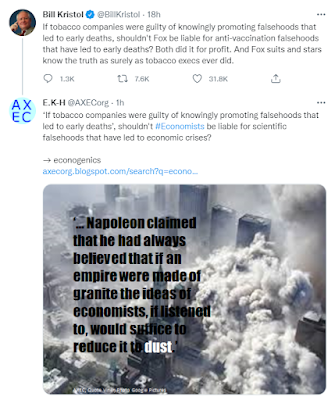
Related 'Swedish muddle' and 'Swedish economists — what’s that?' and 'Economics: the simple logic of failure' and 'Scientists and science actors' and 'The economist as stand-up comedian' and 'Economists: the Trumps of science' and 'When fake scientists call out on fake politicians' and 'The economics Cargo Cult Prize' and 'Economics is NOT a science of behavior' and 'As Napoleon said: don’t listen to economists' and 'Why does Heterodoxy not abolish the fake Nobel?' and 'Legitimacy lost' and '10 steps to leave cargo cult economics behind for good' and ' Great souls’ methodology' and 'The trouble with economics prizes' and 'Links on the Economics Nobel'. For details of the big picture see cross-references Failed/Fake Scientists.
Economics is a failed science. Walrasianism, Keynesianism, Marxianism, and Austrianism are contradictory and axiomatically false. See The real problem with the economics Nobel.
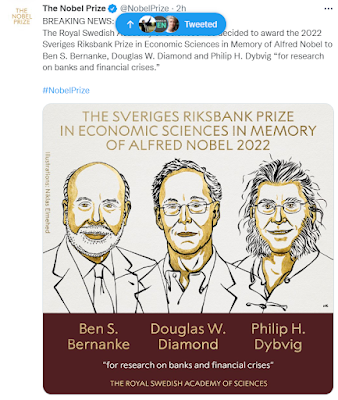
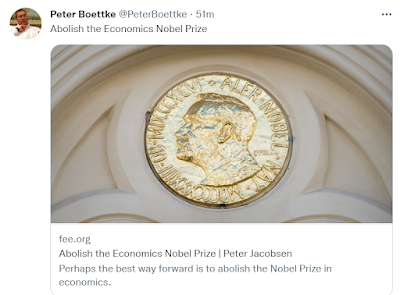
In order NOT to mislead the general public, the word 'Sciences' has to be deleted from the “Bank of Sweden Prize in Economic Sciences in Memory of Alfred Nobel”.


Blog-Reference and Blog-Reference on Oct 3 and Blog-Reference on Oct 10 and Blog-Reference on Jun 8, 2017, adapted to context
Lars Syll argues that the economics Nobel is politically biased: “... the prize was thought to take advantage of the connection with the true Nobel prizes and spearhead a market-oriented neoliberal reshaping of the world.” (See intro)
This is a minor problem, the real problem is in the title: “Bank of Sweden Prize in Economic Sciences in Memory of Alfred Nobel”.
The keyword is Science[s]. Why not simply “Bank of Sweden Prize in Economics”? The original title clearly communicates the claim that economics is a science. This claim is as old as Adam Smith/Karl Marx.
Science is well-defined by the criteria of formal and material consistency: “Research is, in fact, a continuous discussion of the consistency of theories: formal consistency insofar as the discussion relates to the logical cohesion of what is asserted in joint theories; material consistency insofar as the agreement of observations with theories is concerned.” (Klant, 1994)
Neither orthodox nor heterodox economics satisfies the criteria of formal and material consistency. It is a provable fact that neither Walrasianism, Keynesianism, Marxianism, nor Austrianism is materially/formally consistent.
Accordingly, economics is not a science (or sciences) but what Feynman famously called a cargo cult science.
The Bank of Sweden is legitimized to award prizes to whoever it wants and to push any political agenda it wants. The Bank, though, is NOT legitimized to declare economics as science well knowing that economics has not lived up to scientific standards since the founding fathers.
The scientific community has to see to it, firstly, that the word ‘sciences’ is eliminated from the “Bank of Sweden Prize in Economic Sciences”. The general public has to be informed that the 200-year-old claim and the actual state of economics do not match and that ALL economic policy guidance, i.e. independent of political orientation, lacks a sound scientific foundation. It follows, secondly, that economists have to be expelled from the scientific community. It follows, thirdly, that organizations like AEA, Royal Economic Society, Verein für Socialpolitik etcetera refrain from speaking in the name of science.
The real problem with the Bank of Sweden Prize is that it may give rise to a claim for damages in the case of severe depression/unemployment which is ultimately caused by provably false economic theory.
Egmont Kakarot-Handtke
Related 'Swedish muddle' and 'Swedish economists — what’s that?' and 'Economics: the simple logic of failure' and 'Scientists and science actors' and 'The economist as stand-up comedian' and 'Economists: the Trumps of science' and 'When fake scientists call out on fake politicians' and 'The economics Cargo Cult Prize' and 'Economics is NOT a science of behavior' and 'As Napoleon said: don’t listen to economists' and 'Why does Heterodoxy not abolish the fake Nobel?' and 'Legitimacy lost' and '10 steps to leave cargo cult economics behind for good' and ' Great souls’ methodology' and 'The trouble with economics prizes' and 'Links on the Economics Nobel'. For details of the big picture see cross-references Failed/Fake Scientists.
***
COMMENT and COMMENT on 'Oliver Hart, Laureate in Economic Sciences' on Dec 13Economics is a failed science. Walrasianism, Keynesianism, Marxianism, and Austrianism are contradictory and axiomatically false. See The real problem with the economics Nobel.
In order NOT to mislead the general public, the word 'Sciences' has to be deleted from the “Bank of Sweden Prize in Economic Sciences in Memory of Alfred Nobel”.
***
Twitter 2019 Oct 8
Twitter 2019 Oct 8

Twitter 2020 Nov 28

Richard S.J. Tol, 2020, Rise of the Kniesians: The professor-student network of Nobel laureates in economics
Twitter Jan 30, 2022
Twitter Oct 10, 2022 What the EconNobel rewards ― not science to be sure

Twitter Oct 15, 2020


Sticky prices or sticky brains?
Comment on David Glasner on ‘Price Stickiness Is a Symptom not a Cause’
Blog-Reference and Blog-Reference on Sep 30
The discussion between Nick Rowe and David Glasner suffers from the obvious fact that they have no common and well-articulated model of the economy at the back of their minds. The arguments are drawn either from the Walrasian general-equilibrium-theory pool or from the Keynesian monetary-theory-of-production pool. What makes the discussion surreal is that both Walrasianism and Keynesianism are known to be failed approaches.
The elementary Walrasian story of the market economy goes roughly as follows. There are different types of markets (basically product, labor, money, real assets, financial assets) which function according to what Leijonhufvud called the totem of economics, that is, supply-function-demand-function-equilibrium and interact such that under the ideal condition of full price flexibility in each market all markets clear. It has ALWAYS been admitted that in the real world conditions are not ideal. The claim is that this does not affect the benchmark function of the Walrasian model. The elementary story is backed up by general equilibrium theory which provides the formal proof of the existence of a market-clearing price vector.
The proof of the Walrasian story is worthless because its premises are false. Fact is that (i) the different market types work on DIFFERENT principles (2011), (ii) all three analytical elements of “the” market, i.e. supply function, demand function, equilibrium, are nonentities, (iii) the underlying behavioral assumptions are false.
In sum, the Walrasian story of the market economy is axiomatically false. The axioms are given with this set: “HC1 economic agents have preferences over outcomes; HC2 agents individually optimize subject to constraints; HC3 agent choice is manifest in interrelated markets; HC4 agents have full relevant knowledge; HC5 observable outcomes are coordinated, and must be discussed with reference to equilibrium states.” (Weintraub, 1985, p. 147)
Axiomatically false means that the theory/model is BEYOND repair and has to be fully REPLACED. The replacement of the axiomatic foundations is what methodologists call a paradigm shift. Nothing less will do.
Nick Rowe has not realized this and reiterates the Walrasian story with a new spin which is as senseless as adding epicycles to the geocentric model.
David Glasner is already enlightened: “Most of all, they represent an uncritical transfer of partial-equilibrium microeconomic thinking to a problem that requires a system-wide macroeconomic approach. That approach should not ignore microeconomic reasoning, but it has to transcend both partial-equilibrium supply-demand analysis and the mathematics of intertemporal optimization.” This crucial insight is beyond sticky Nick and others of the Walrasian ilk.
To rise above Walrasian and Keynesian drivel requires a Paradigm Shift from Walrasian microfoundations and Keynes’ flawed macrofoundations to entirely new macrofoundations (2014).#1 New macrofoundations deliver the materially/formally consistent general theory of profit, employment, interest, and money.
Egmont Kakarot-Handtke
References
Kakarot-Handtke, E. (2011). Primary and Secondary Markets. SSRN Working Paper Series, 1917012: 1–26. URL
Kakarot-Handtke, E. (2014). Objective Principles of Economics. SSRN Working Paper Series, 2418851: 1–19. URL
Weintraub, E. R. (1985). Joan Robinson’s Critique of Equilibrium: An Appraisal. American Economic Review, Papers and Proceedings, 75(2): 146–149. URL
#1 See also From Orthodoxy to Heterodoxy to Metadoxy’ and ‘How to restart economics.
Immediately following A brief rectification employment theory.
September 27, 2016
The choice between Friedmanian pest and Keynesian cholera
Comment on Brad DeLong on ‘The Stakes of the Helicopter Money Debate: A Primer’
Blog-Reference
Brad DeLong summarizes: “The Great Moderation of the business cycle from 1984-2007 was a rich enough pudding to be proof, for the rough consensus of mainstream economists at least, that Keynes had been wrong and Friedman had been right. But in the aftermath of 2007, it became very clear that they — or, rather, we, ... — were very, tragically, dismally and grossly wrong.”
And then he continues: “Now we face a choice ...”
No, there never has been a choice between the Friedmanians and Keynesians because BOTH are wrong. Both are groping in the dark about the two most important features of the market economy: the profit mechanism and the price mechanism. Because of this, the discussion about monetary and fiscal policy, or helicopter money, never had more scientific content than a free ink-blot association.
“In order to tell the politicians and practitioners something about causes and best means, the economist needs the true theory or else he has not much more to offer than educated common sense or his personal opinion.” (Stigum, 1991, p. 30)
Economists have no true theory. Economics is a failed science. What Friedmanians and Keynesians have to offer is political opinion without sound scientific foundations.
For the proof, let us very briefly turn to the formally and empirically correct employment theory (2012; 2014). The basic version of the objective structural Employment Law is shown on Graphic AXEC62a:

From this equation follows inter alia:
(i) An increase in the expenditure ratio ρE leads to higher employment (the letter ρ stands for ratio).
(ii) Increasing investment expenditures I, exert a positive influence on employment,
(iii) An increase in the factor cost ratio ρF≡W/PR leads to higher employment.
The complete AND testable Employment Law is a bit longer and contains, in addition, profit distribution, public deficit spending, and import/export.
Items (i) and (ii) cover Keynes' arguments about the role of aggregate demand, which have been commonsensical right, but formally defective. The factor cost ratio ρF, as defined in (iii), embodies the price mechanism which works very differently from what the representative economist hallucinates. As a matter of fact, overall employment (in the world economy or a closed national economy) INCREASES if the average wage rate W INCREASES relative to the average price P and productivity R.
So, in simple terms, full employment (in any definition) can be achieved by increasing aggregate demand or by INCREASING the average wage rate (or by a combination of the two).
The second alternative is preferable to Keynesian deficit spending#1, but it is the very opposite of what the broad consensus always told the world: “We economists have all learned, and many of us teach, that the remedy for excess supply in any market is a reduction in price. If this is prevented by combinations in restraint of trade or by government regulations, then those impediments to competition should be removed.” (Tobin, 1997, p. 11)
Both the Friedmanian and Keynesian approaches have produced misleading policy advice. Unemployment is ultimately the result of theory failure. Before economists can hope to be taken seriously, they have to do some scientific homework.
Egmont Kakarot-Handtke
References
Kakarot-Handtke, E. (2012). Keynes’s Employment Function and the Gratuitous Phillips Curve Disaster. SSRN Working Paper Series, 2130421: 1–19. URL
Kakarot-Handtke, E. (2014). Towards Full Employment Through Applied Algebra and Counter-Intuitive Behavior. SSRN Working Paper Series, 2456184: 1–25. URL
Stigum, B. P. (1991). Toward a Formal Science of Economics: The Axiomatic Method in Economics and Econometrics. Cambridge: MIT Press.
Tobin, J. (1997). An Overview of the General Theory. In G. C. Harcourt and P. A. Riach (Eds.), The ’Second Edition’ of The General Theory, Vol. 2, 3–27. Oxon: Routledge.
#1 Keynesianism as ultimate profit machine
You say: “I get the sense that you expect too much from the ‘dismal science’.”
I get the sense that you have some trouble with clear thinking. It is very well known and communicated each year in no uncertain terms that economics is a science: “Bank of Sweden Prize in Economic Sciences in Memory of Alfred Nobel”.
Science is well-defined by the criteria of formal and material consistency: “Research is in fact a continuous discussion of the consistency of theories: formal consistency insofar as the discussion relates to the logical cohesion of what is asserted in joint theories; material consistency insofar as the agreement of observations with theories is concerned.” (Klant, 1994)
It is a provable fact that neither Walrasianism, nor Keynesianism, nor Marxianism, nor Austrianism is materially/formally consistent. All these approaches are axiomatically false, that is, beyond repair.#1
If you think that it is ‘too much’ to demand from economics to live up to scientific standards, then you have to see to it, firstly, that the word ‘sciences’ is eliminated from the “Bank of Sweden Prize in Economic Sciences”. The general public has to be informed that the 200-year-old claim and the actual state of economics do not match. It follows, secondly, that economists have to be expelled from the scientific community. It follows, thirdly, that organizations like the AEA refrain from speaking in the name of science.
Your argument misses the point. I expect nothing from the currently active and failed economists other than to drop the claim that they are doing science. This claim is ‘too much’.
#1 All models are false because all economists are stupid
(i) An increase in the expenditure ratio ρE leads to higher employment (the letter ρ stands for ratio).
(ii) Increasing investment expenditures I, exert a positive influence on employment,
(iii) An increase in the factor cost ratio ρF≡W/PR leads to higher employment.
The complete AND testable Employment Law is a bit longer and contains, in addition, profit distribution, public deficit spending, and import/export.
Items (i) and (ii) cover Keynes' arguments about the role of aggregate demand, which have been commonsensical right, but formally defective. The factor cost ratio ρF, as defined in (iii), embodies the price mechanism which works very differently from what the representative economist hallucinates. As a matter of fact, overall employment (in the world economy or a closed national economy) INCREASES if the average wage rate W INCREASES relative to the average price P and productivity R.
So, in simple terms, full employment (in any definition) can be achieved by increasing aggregate demand or by INCREASING the average wage rate (or by a combination of the two).
The second alternative is preferable to Keynesian deficit spending#1, but it is the very opposite of what the broad consensus always told the world: “We economists have all learned, and many of us teach, that the remedy for excess supply in any market is a reduction in price. If this is prevented by combinations in restraint of trade or by government regulations, then those impediments to competition should be removed.” (Tobin, 1997, p. 11)
Both the Friedmanian and Keynesian approaches have produced misleading policy advice. Unemployment is ultimately the result of theory failure. Before economists can hope to be taken seriously, they have to do some scientific homework.
Egmont Kakarot-Handtke
References
Kakarot-Handtke, E. (2012). Keynes’s Employment Function and the Gratuitous Phillips Curve Disaster. SSRN Working Paper Series, 2130421: 1–19. URL
Kakarot-Handtke, E. (2014). Towards Full Employment Through Applied Algebra and Counter-Intuitive Behavior. SSRN Working Paper Series, 2456184: 1–25. URL
Stigum, B. P. (1991). Toward a Formal Science of Economics: The Axiomatic Method in Economics and Econometrics. Cambridge: MIT Press.
Tobin, J. (1997). An Overview of the General Theory. In G. C. Harcourt and P. A. Riach (Eds.), The ’Second Edition’ of The General Theory, Vol. 2, 3–27. Oxon: Routledge.
#1 Keynesianism as ultimate profit machine
***
REPLY to Ray LaPan-Love on Sep 28You say: “I get the sense that you expect too much from the ‘dismal science’.”
I get the sense that you have some trouble with clear thinking. It is very well known and communicated each year in no uncertain terms that economics is a science: “Bank of Sweden Prize in Economic Sciences in Memory of Alfred Nobel”.
Science is well-defined by the criteria of formal and material consistency: “Research is in fact a continuous discussion of the consistency of theories: formal consistency insofar as the discussion relates to the logical cohesion of what is asserted in joint theories; material consistency insofar as the agreement of observations with theories is concerned.” (Klant, 1994)
It is a provable fact that neither Walrasianism, nor Keynesianism, nor Marxianism, nor Austrianism is materially/formally consistent. All these approaches are axiomatically false, that is, beyond repair.#1
If you think that it is ‘too much’ to demand from economics to live up to scientific standards, then you have to see to it, firstly, that the word ‘sciences’ is eliminated from the “Bank of Sweden Prize in Economic Sciences”. The general public has to be informed that the 200-year-old claim and the actual state of economics do not match. It follows, secondly, that economists have to be expelled from the scientific community. It follows, thirdly, that organizations like the AEA refrain from speaking in the name of science.
Your argument misses the point. I expect nothing from the currently active and failed economists other than to drop the claim that they are doing science. This claim is ‘too much’.
#1 All models are false because all economists are stupid
The trouble with Naked Keynesianism
Comment on Matias Vernengo on ‘The Trouble with Paul Romer’s Angriness’
Blog-Reference
In his recent paper, ‘The Trouble With Macroeconomics’ Paul Romer put DSGE and its main proponents ― Lucas, Sargent, Prescott ― to rest. From the fact that microfounded macro is an officially buried research program, though, does not follow that Keynesian macro can now be taken seriously.
Keynes, too, based macroeconomics on logically and conceptually defective foundations, and neither Post Keynesians nor New Keynesians nor Anti-Keynesians have realized his foundational blunder in 80+ years.
For details see How Keynes got macro wrong and Allais got it right and All models are false because all economists are stupid.
Egmont Kakarot-Handtke
September 26, 2016
How Keynes got macroeconomics wrong and Allais got it right
Comment on Lars Syll on ‘Good advice to aspiring economists’
Blog-Reference and Blog-Reference on Sep 28 and Blog-Reference on Nov 28, Blog-Reference on Dec 2, 2019, adapted to context, and Blog-Reference on Dec 4
Keynes based macroeconomics on logically and conceptually defective foundations and neither Post Keynesians nor New Keynesians nor Anti-Keynesians have realized his foundational blunder in 80+ years (2014).
Keynes defined the formal core of the General Theory as follows: “Income = value of output = consumption + investment. Saving = income − consumption. Therefore saving = investment.” (1973, p. 63)
This syllogism is defective because Keynes never came to grips with profit: “His Collected Writings show that he wrestled to solve the Profit Puzzle up till the semi-final versions of his GT but in the end he gave up and discarded the draft chapter dealing with it.” (Tómasson et al., 2010, p. 12)
Keynes had NO idea of the fundamental concepts of economics, viz., profit and income. Because profit is ill-defined, the whole theoretical superstructure of macroeconomics is false, in particular, ALL I=S/IS-LM models (2011; 2013).
Allais clearly identified Keynes’s major fault: “... mais son [Keynes’] insuffisance logique ne lui a pas permis de résoudre les problèmes que son intuition lui avait fait entrevoir.” (1993, p. 70). In other words, Keynes saw the problems but could not solve them because of his logical insufficiency.
The correct relationship is given by Qre≡I−S (Allais, 1993, p. 69). Legend: Qre retained profit, S household sector's saving, I business sector's investment expenditures.
It is pretty obvious from this equation that I and S are NEVER equal, neither ex-ante nor ex-post. The argument that I=S is merely an accounting identity proves only that, as a general rule, economists are too stupid to understand the elementary mathematics of accounting (2012). Allais understood it.
Egmont Kakarot-Handtke
References
Allais, M. (1993). Les Fondements Comptables de la Macro-Économie. Paris: Presses Universitaires de France, 2nd edition.
Kakarot-Handtke, E. (2011). Squaring the Investment Cycle. SSRN Working Paper Series, 1911796: 1–25. URL
Kakarot-Handtke, E. (2012). The Common Error of Common Sense: An Essential Rectification of the Accounting Approach. SSRN Working Paper Series, 2124415: 1–23. URL
Kakarot-Handtke, E. (2013). Settling the Theory of Saving. SSRN Working Paper Series, 2220651: 1–23. URL
Kakarot-Handtke, E. (2014). The Three Fatal Mistakes of Yesterday Economics: Profit, I=S, Employment. SSRN Working Paper Series, 2489792: 1–13. URL
Keynes, J. M. (1973). The General Theory of Employment Interest and Money. London, Basingstoke: Macmillan.
Tómasson, G., and Bezemer, D. J. (2010). What is the Source of Profit and Interest? A Classical Conundrum Reconsidered. MPRA Paper, 20557: 1–34. URL
Related 'Wikipedia and the promotion of economists’ idiotism' and 'Macro for dummies' and 'Rectification of MMT macro accounting' and 'A tale of three accountants' and 'Review of the economics troops' and 'Keynesianism as ultimate profit machine' and 'Profit and the collective failure of economists' and 'Wikipedia and the promotion of economists’ idiotism (II)' and 'Flow-Balance-Inconsistency ― inscription on the gravestone of economics' and 'The GDP-death-blow for the economics profession'. For details of the big picture, see cross-references Refutation of I=S and cross-references Accounting.
***
Graphic AXEC172

Graphic AXEC143d

From gossip to the correct employment theory
Comment on ProGrowthLiberal on ‘The New Men Without Jobs Conservative Excuse’
Blog-Reference
Economists love to psychologize about their fellow citizens. A long-standing topos is that the unemployed are drunkards, sluggards, criminals, social parasites, or smart optimizers who simply prefer leisure over work.
It is pretty obvious that NO way leads from this brain-dead folk psychological gossip to the explanation of employment/unemployment for the economy as a whole. Nonetheless, economists are quite sure how to cure unemployment: “We economists have all learned, and many of us teach, that the remedy for excess supply in any market is a reduction in price. If this is prevented by combinations in restraint of trade or by government regulations, then those impediments to competition should be removed. Applied to economy-wide unemployment, this doctrine places the blame on trade unions and governments, not on any failure of competitive markets.” (Tobin, 1997, p. 11)
In more than 200 years, employment theory has not risen above this substandard intellectual level. Time for a sketch of the formally and empirically correct employment theory (2012; 2014). The basic version of the objective structural Employment Law is shown with Graphic AXEC62

From this equation follows inter alia:
(i) An increase in the expenditure ratio ρE leads to higher employment (the letter rho ρ stands for ratio). An expenditure ratio ρE greater than 1 indicates credit expansion, a ratio ρE less than 1 indicates credit contraction.
(i) An increase in the expenditure ratio ρE leads to higher employment (the letter rho ρ stands for ratio). An expenditure ratio ρE greater than 1 indicates credit expansion, a ratio ρE less than 1 indicates credit contraction.
(ii) Increasing investment expenditures I exert a positive influence on employment; a slowdown of growth does the opposite.
(iii) An increase in the factor cost ratio ρF≡W/PR leads to higher employment.
The complete AND testable Employment Law is a bit longer and contains, in addition, profit distribution, public deficit spending, and import/export.
Items (i) and (ii) cover Keynes’ arguments about the role of aggregate demand, which have been commonsensically right but formally defective. More precisely, Keynes’s multiplier is provably false. The factor cost ratio ρF, as defined in (iii), embodies the price mechanism which works very differently from what the representative economist hallucinates. As a matter of fact, overall employment (in the world economy or a closed national economy) INCREASES if the average wage rate W INCREASES relative to the average price P and productivity R.
So, in simple terms, full employment (in any definition) can be achieved by increasing overall demand (expenditure ratio, investment expenditures, etc.) or by INCREASING the average wage rate or by a combination of the two.
Both the Walrasian and Keynesian approaches have produced misleading policy advice. Unemployment is ultimately the result of theory failure, that is, of the utter scientific incompetence of economists who are mainly occupied with gossiping about whether the new men without jobs are floated by wives, girlfriends, relatives, or by Uncle Sam. It is only a question of time before these new men get the idea to tar and feather the ‘throng of superfluous economists’ (Joan Robinson).
Egmont Kakarot-Handtke
References
Kakarot-Handtke, E. (2012). Keynes’s Employment Function and the Gratuitous Phillips Curve Disaster. SSRN Working Paper Series, 2130421: 1–19. URL
Kakarot-Handtke, E. (2014). Towards Full Employment Through Applied Algebra and Counter-Intuitive Behavior. SSRN Working Paper Series, 2456184: 1–25. URL
Tobin, J. (1997). An Overview of the General Theory. In G. C. Harcourt and P. A. Riach (Eds.), The ’Second Edition’ of The General Theory, volume 2, pages 3–27. Oxon: Routledge.
Subscribe to:
Posts (Atom)