Comment on Noah Smith on ‘A new age of economics imperialism is coming’
Blog-Reference
• Economics is a failed science. It consists actually of political and theoretical economics. Political economics is scientifically worthless.
• Psychology, sociology, behaviorism, political science, geopolitics, history, anthropology, evolutionary theory, institutionalism, law, ethics, and philosophy are NOT economics. The valid results of these independent disciplines are taken into economics by way of multidisciplinary cooperation if needed.
• Economics is NOT about Human Nature/behavior/action but about the evolution of the economic system as a whole.
• Partial analysis is of extremely limited value and, in most cases, runs directly into the Fallacy of Composition. Microfoundation will therefore be replaced by macrofoundations.
• Systemic (= new) economics determines first of all the objective Profit Law because it is pivotal to all of economics. Those who do not understand what profit is have no idea how the actual economy works.
• Walrasianism, Keynesianism, Marxianism, and Austrianism — all four got profit wrong. These approaches are scientifically worthless.
• Economics has nothing to offer to other disciplines because it has produced not much, if anything, of scientific value since Adam Smith. The representative economist cannot even tell the essential difference between income and profit.
• The ongoing Paradigm Shift consists methodologically of the move from the behavioral axiomatic foundations of the four failed approaches to structural axiomatic foundations.
• People who have not realized in the old age that maximization-and-equilibrium is proto-scientific garbage will not be admitted to the new age because of proven scientific incompetence.
• Scientific imperialism will put an end to economics as cargo cult science.
Egmont Kakarot-Handtke
Related 'From mathiness to empiriness: forget it!'

April 8, 2016
From mathiness to empiriness: forget it!
Comment on Noah Smith on ‘A new age of economics imperialism is coming’
Blog-Reference
Since Adam Smith, economists are too incompetent for science but smart enough to borrow manners and tools from successful disciplines. The result comes as no surprise: “Suffice it to say that, in my opinion, what we presently possess by way of so-called pure economic theory is objectively indistinguishable from what the physicist Richard Feynman, in an unflattering sketch of nonsense ‘science,’ called ‘cargo cult science’.” (Clower, 1994, p. 809)
Pure economic theory in all variants from General Equilibrium to RBC and DSGE, and from Keynes to post-Keynesianism, is a failure. Yet, science consists of TWO elements: “Research is in fact a continuous discussion of the consistency of theories: formal consistency insofar as the discussion relates to the logical cohesion of what is asserted in joint theories; material consistency insofar as the agreement of observations with theories is concerned.” (Klant, 1994, p. 31)
Eureka! there seems to be a way out of the impasse: fact-free model bricolage has not worked, so let us try the theory-free application of sophisticated statistical tools. True to form, economists mess it up again because the ONLY way to get out of a failed approach is a Paradigm Shift.
But, the fact of the matter is: “A new idea is extremely difficult to think of. It takes a fantastic imagination.” (Feynman, 1992, p. 172) Economists have lacked scientific imagination since Adam Smith, but they are just smart enough to use tools that have been developed elsewhere.
Economists have no clue at all about what the new Paradigm could look like: “There is another alternative: to formulate a completely new research program and conceptual approach. As we have seen, this is often spoken of, but there is still no indication of what it might mean.” (Ingrao et al., 1990, p. 362)
To apply the latest powerful statistics package on the latest powerful hardware is NOT a Paradigm Shift. It is just another dog and pony show for the general public, signaling ‘we are at the forefront of research’. This is tried and tested crisis communication since the gold makers: Yes, sadly, the last big idea exploded into our face like all the others before, but NOW the breakthrough is just around the corner.
For everybody who is aware of economists’ track record of consistent failure, Noah Smith’s hallucination of future triumph is an empty promise/threat that can merely serve as pep-talk for disoriented losers.
The economics Paradigm Shift will not come from scientifically retarded people who reveal themselves with “most of what I and many others do is sorta-kinda neoclassical because it takes the maximization-and-equilibrium world as a starting point” (Krugman).
Dear sociologists, you have nothing to fear. Economists cannot tell until this day how the economy works and you can beat them on their own turf before they even get their new-age pants on (2015).
Egmont Kakarot-Handtke
References
Clower, R. W. (1994). Economics as an Inductive Science. Southern Economic Journal, 60(4): 805–814.
Feynman, R. P. (1992). The Character of Physical Law. London: Penguin.
Ingrao, B., and Israel, G. (1990). The Invisible Hand. Economic Equilibrium in the History of Science. Cambridge, London: MIT Press.
Kakarot-Handtke, E. (2015). How the Intelligent Non-Economist Can Refute Every Economist Hands Down. SSRN Working Paper Series, 2705395: 1–6. URL
Klant, J. J. (1994). The Nature of Economic Thought. Aldershot, Brookfield: Edward Elgar.
Related 'Scientific imperialism ― new age economics in 10 bullet points'.

April 6, 2016
The monstrous utility-supply-demand-equilibrium failure
Comment on Edward Fullbrook on ‘The Fisher-Becker Curio’
Blog-Reference
Economics is committed to methodological individualism. This is the foundational error/ mistake. After more than 150 years since Jevons/Walras/Menger, the representative economist still has not got the point.
The methodological individualism of Orthodoxy, a.k.a. microfoundations, is formally encapsulated in this axiom set: "HC1 There exist economic agents. HC2 Agents have preferences over outcomes. HC3 Agents independently optimize subject to constraints. HC4 Choices are made in interrelated markets. HC5 Agents have full relevant knowledge. HC6 Observable economic outcomes are coordinated, so they must be discussed with reference to equilibrium states." (Weintraub, 1985, p. 109)
From this axiom set, the whole of marginalism, utility-supply-demand-equilibrium, and the narrative of optimal market coordination is derived. Needless to emphasize that this whole theoretical superstructure is scientifically worthless because the foundational propositions HC1 to HC6 are false. The story of the welfare-producing performance of the market system is — just a story.
The microfoundations have to be discarded and fully replaced by these macrofoundations
(A0) The objectively given and most elementary configuration of the (world-) economy consists of the household and the business sector, which in turn consists initially of one giant fully integrated firm.
(A1) Yw=WL wage income Yw is equal to wage rate W times working hours L,
(A2) O=RL output O is equal to productivity R times working hours L,
(A3) C=PX consumption expenditure C is equal to price P times quantity bought/sold X.
These premises are certain, true, and primary, and therefore satisfy all methodological requirements. The new axiom set contains no NONENTITIES like utility, maximization, or equilibrium. For the graphical representation, see under Graphic AXEC31

At any given level of employment L, the wage income Yw that is generated in the consolidated business sector is obtained by multiplication by the wage rate W. On the real side, output O is followed by multiplication with the productivity R. Finally, the price P follows as the dependent variable under the conditions of budget balancing, i.e., C=Yw, and market clearing, i.e., X=O. Note that the ray in the southeastern quadrant is NOT a linear production function; the ray tracks ANY underlying production function. Note also that the wage rate W is an AVERAGE if the individual wage rates are different among the employees, which is normally the case.
Under the conditions of (i) market-clearing and (ii) budget-balancing in each period, the price is derived as P=W/R (1), i.e., the market-clearing price is, in the most elementary case, equal to unit wage costs. This is the elementary form of the macroeconomic Law of Supply and Demand, which, in a second step, has to be generalized for an arbitrary number of markets.
If the wage rate W is lowered, the market-clearing price P falls. If the number of working hours L is increased, the price remains constant, provided productivity R does not change. If productivity decreases, the price P rises. If productivity increases, the price falls. In any case, labor gets the whole product, the real wage W/P is invariably equal to the productivity R according to (1), and profit for the business sector as a whole is zero. All changes in the system are reflected by the market-clearing price. The most elementary economy is reproducible for an indefinite number of periods.
Defining a reproducible minimal economy and making its properties absolutely transparent is the FIRST step. From this step follows that the market price is determined by the three OBJECTIVE axioms (A1) to (A3) and by the two OBJECTIVE conditions of market clearing and budget balancing. That is, NO behavioral assumptions of any kind (utility, maximization, bounded rationality, rational expectation, etc.) are needed. Just the contrary, they are inadmissible because they would over-determine the formalism which is given with (A1)/(A3) and (i)/(ii).
The two conditions (i)/(ii) are part of every orthodox model. Since the three axioms must hold for ALL economic models without exception, that is, also for orthodox models, one arrives at the conclusion of Becker and Fisher that orthodox models are behaviorally over-determined.
For more details about the axiomatically correct price and market theory, see (2015; 2014; 2013; and 2022)
Note for Econ 101 students: supply-demand equilibrium is an intelligence test; whoever accepts this construct as an explanation of how markets work has flunked the test and is irrevocably outside of science. This applies first and foremost to your teacher.
Egmont Kakarot-Handtke
References
Kakarot-Handtke, E. (2013). How to Get Rid of Supply-Demand-Equilibrium. SSRN Working Paper Series, 2263172: 1–24. URL
Kakarot-Handtke, E. (2014). The Law of Supply and Demand: Here it is Finally. SSRN Working Paper Series, 2481840: 1–17. URL
Kakarot-Handtke, E. (2015). Essentials of Constructive Heterodoxy: The Market. SSRN Working Paper Series, 2547098: 1–10. URL
Kakarot-Handtke, E. (2022). The Logical Interface Between Objective Macrofoundations and Subjective Valuations. SSRN Working Paper Series, 4018155: 1–12. URL
Weintraub, E. R. (1985). General Equilibrium Analysis. Cambridge, London, New York, etc.: Cambridge University Press.
Weintraub, E. R. (1985). General Equilibrium Analysis. Cambridge, London, New York, etc.: Cambridge University Press.
For more about supply-demand-equilibrium see AXECquery.
April 4, 2016
As Napoleon said: don’t listen to economists
Comment on Robert Waldmann on ‘Brad DeLong Marks His Beliefs about "The Return of Depression Economics" to Market’
Blog-Reference and Blog-Reference on Apr 5
Before starting the discussion of several model variants, you say: “I am going to be dumb (I am not playing dumb — I just worked through each step) and consider different less elegant models of aggregate supply.” (See intro)
The futility of the whole exercise derives from the fact that the models of Krugman and DeLong to which you refer are flawed since Keynes. Not to have realized this is indeed the manifest dimwittedness of Paul, Brad, and Robert. No need to play dumb.
Keynes defined the formal foundations of the General Theory as follows: “Income = value of output = consumption + investment. Saving = income − consumption. Therefore saving = investment.” (1973, p. 63)
This elementary syllogism is conceptually and logically defective because Keynes never came to grips with profit and therefore “discarded the draft chapter dealing with it.” (Tómasson et al., 2010, p. 12).
The three main points of the correct approach are:
• All I=S/IS-LM models are false since Hicks (2011; 2014b). The refutation of Krugman is to be found here (2014a), and the refutation of DeLong is to be found in It’s the price mechanism, stupid!
• The axiomatically correct Profit Law for the investment economy reads Qm≡Yd+I−Sm (2014b, p. 8, eq. (18)). Legend: Qm monetary profit, Yd distributed profit, I investment expenditures, Sm monetary saving. Sm establishes the connection to the money/credit market.
• The correct Employment Law/Phillips Curve is given here (2012).
To cut the meticulous formal derivation short, the most elementary version of the correct Employment Law for the economy as a whole is shown with Graphic AXEC62

From this equation follows:
(i) An increase in the expenditure ratio ρE leads to higher employment L (the letter ρ stands for the ratio). An expenditure ratio ρE>1 indicates credit expansion, a ratio ρE<1 indicates credit contraction of the household sector.
(ii) Increasing investment expenditures I exert a positive influence on employment; a slowdown of growth does the opposite.
(iii) An increase in the factor cost ratio ρF≡W/PR leads to higher employment.
The complete Employment Law is a bit longer and contains, in addition, profit distribution, public deficit spending, and import/export. The Employment Law contains only measurable real and nominal variables (and NO expectations and other nonentities).
Items (i) and (ii) are familiar since Keynes. What is new is the ratio ρF as defined in (iii). This variable embodies the price mechanism. It works such that overall employment INCREASES if the average wage rate W INCREASES relative to the average price P and productivity R.
This translates into the recipe: if the central bank wants an inflation rate of, say, 2 percent and the actual productivity growth is, say, 1.5 percent, then the AVERAGE wage rate must rise by 3.5 percent. The crucial point is that the price mechanism does NOT work as standard economics hallucinates.
The bottom line is that the models you use are defective; therefore, your whole supply-demand equilibrium exercise falls flat. It is to be hoped that politicians remember Napoleon and do not take Paul, Brad, and Robert seriously: “Late in life, moreover, he [Napoleon] claimed that he had always believed that if an empire were made of granite the ideas of economists if listened to, would suffice to reduce it to dust.” (Viner, 1963, p. 1)
Egmont Kakarot-Handtke
References
Kakarot-Handtke, E. (2011). Why Post Keynesianism is Not Yet a Science. SSRN Working Paper Series, 1966438: 1–20. URL
Kakarot-Handtke, E. (2012). Keynes’ Employment Function and the Gratuitous Phillips Curve Disaster. SSRN Working Paper Series, 2130421: 1–19. URL
Kakarot-Handtke, E. (2014a). Mr. Keynes, Prof. Krugman, IS-LM, and the End of Economics as We Know It. SSRN Working Paper Series, 2392856: 1–19. URL
Kakarot-Handtke, E. (2014b). The Three Fatal Mistakes of Yesterday Economics: Profit, I=S, Employment. SSRN Working Paper Series, 2489792: 1–13. URL
Keynes, J. M. (1973). The General Theory of Employment Interest and Money. London, Basingstoke: Macmillan.
Tómasson, G., and Bezemer, D. J. (2010). What is the Source of Profit and Interest? A Classical Conundrum Reconsidered. MPRA Paper, 20557: 1–34. URL
Viner, J. (1963). The Economist in History. American Economic Review, 53(2): 1–22. URL
Related 'Econogenics in action' and 'Learn economics ― but not from scientific losers'.
Krugman says: “The idea that inflation promises might go directly into prices is a hope, not a worry.”
Rising prices (relative to wages and productivity) INCREASE unemployment. Because of this, every policy that aims directly at price increases WORSENS the employment situation.
Krugman’s underlying model of the price mechanism is provably false. For details, see the comment on Waldmann As Napoleon said: don’t listen to economists.
Paul Krugman argues: “The idea that inflation promises might go directly into prices is a hope, not a worry.”
Rising prices (relative to wages and productivity) INCREASE unemployment. Because of this, every policy that aims DIRECTLY at price increases WORSENS the overall situation.
Krugman’s underlying model of the price mechanism is provably false. The formal proof is not sloganizable and outsizes a succinct post. For more details and wonkish references, see the comment on Waldmann As Napoleon said: don’t listen to economists.
The correct economic model yields the elementary Employment Law, i.e., Graphic AXEC62.
In simple terms, it says:
(i) An increase in the expenditure ratio leads to higher employment. An expenditure ratio >1 indicates credit expansion, a ratio <1 indicates credit contraction.
(ii) Increasing investment expenditures exert a positive influence on employment; a slowdown of growth does the opposite.
(iii) An increase in the factor cost ratio ρF≡W/PR leads to higher employment.
The factor-cost ratio embodies the price mechanism. It works such that overall employment INCREASES if the average wage rate INCREASES relative to the average price and productivity. The standard models of the price mechanism are PROVABLY false.
If Japan applies Krugman’s advice she commits economic hara-kiri.
COMMENT on Paul Krugman NYT on Apr 7
The problem is not at all located at the level of economic policy. Hence, it does not matter much what Paul Krugman, Greg Mankiw, Brad DeLong, Larry Summers, or Robert Waldmann propose.
The problem is located at the level of economic theory. Because economists lack the true theory/model, ALL policy proposals are hanging in midair. Without sound scientific foundations, what Paul and Greg and Brad and Larry and Robert say is not different from old Roman haruspicy, i.e., the reading of poultry entrails.

(i) An increase in the expenditure ratio ρE leads to higher employment L (the letter ρ stands for the ratio). An expenditure ratio ρE>1 indicates credit expansion, a ratio ρE<1 indicates credit contraction of the household sector.
(ii) Increasing investment expenditures I exert a positive influence on employment; a slowdown of growth does the opposite.
(iii) An increase in the factor cost ratio ρF≡W/PR leads to higher employment.
The complete Employment Law is a bit longer and contains, in addition, profit distribution, public deficit spending, and import/export. The Employment Law contains only measurable real and nominal variables (and NO expectations and other nonentities).
Items (i) and (ii) are familiar since Keynes. What is new is the ratio ρF as defined in (iii). This variable embodies the price mechanism. It works such that overall employment INCREASES if the average wage rate W INCREASES relative to the average price P and productivity R.
This translates into the recipe: if the central bank wants an inflation rate of, say, 2 percent and the actual productivity growth is, say, 1.5 percent, then the AVERAGE wage rate must rise by 3.5 percent. The crucial point is that the price mechanism does NOT work as standard economics hallucinates.
The bottom line is that the models you use are defective; therefore, your whole supply-demand equilibrium exercise falls flat. It is to be hoped that politicians remember Napoleon and do not take Paul, Brad, and Robert seriously: “Late in life, moreover, he [Napoleon] claimed that he had always believed that if an empire were made of granite the ideas of economists if listened to, would suffice to reduce it to dust.” (Viner, 1963, p. 1)
Egmont Kakarot-Handtke
References
Kakarot-Handtke, E. (2011). Why Post Keynesianism is Not Yet a Science. SSRN Working Paper Series, 1966438: 1–20. URL
Kakarot-Handtke, E. (2012). Keynes’ Employment Function and the Gratuitous Phillips Curve Disaster. SSRN Working Paper Series, 2130421: 1–19. URL
Kakarot-Handtke, E. (2014a). Mr. Keynes, Prof. Krugman, IS-LM, and the End of Economics as We Know It. SSRN Working Paper Series, 2392856: 1–19. URL
Kakarot-Handtke, E. (2014b). The Three Fatal Mistakes of Yesterday Economics: Profit, I=S, Employment. SSRN Working Paper Series, 2489792: 1–13. URL
Keynes, J. M. (1973). The General Theory of Employment Interest and Money. London, Basingstoke: Macmillan.
Tómasson, G., and Bezemer, D. J. (2010). What is the Source of Profit and Interest? A Classical Conundrum Reconsidered. MPRA Paper, 20557: 1–34. URL
Viner, J. (1963). The Economist in History. American Economic Review, 53(2): 1–22. URL
Related 'Econogenics in action' and 'Learn economics ― but not from scientific losers'.
***
COMMENT on anne on Apr 5Krugman says: “The idea that inflation promises might go directly into prices is a hope, not a worry.”
Rising prices (relative to wages and productivity) INCREASE unemployment. Because of this, every policy that aims directly at price increases WORSENS the employment situation.
Krugman’s underlying model of the price mechanism is provably false. For details, see the comment on Waldmann As Napoleon said: don’t listen to economists.
***
COMMENT on Paul Krugman NYT on Apr 5Paul Krugman argues: “The idea that inflation promises might go directly into prices is a hope, not a worry.”
Rising prices (relative to wages and productivity) INCREASE unemployment. Because of this, every policy that aims DIRECTLY at price increases WORSENS the overall situation.
Krugman’s underlying model of the price mechanism is provably false. The formal proof is not sloganizable and outsizes a succinct post. For more details and wonkish references, see the comment on Waldmann As Napoleon said: don’t listen to economists.
***
COMMENT on Paul Krugman NYT on Apr 6The correct economic model yields the elementary Employment Law, i.e., Graphic AXEC62.
In simple terms, it says:
(i) An increase in the expenditure ratio leads to higher employment. An expenditure ratio >1 indicates credit expansion, a ratio <1 indicates credit contraction.
(ii) Increasing investment expenditures exert a positive influence on employment; a slowdown of growth does the opposite.
(iii) An increase in the factor cost ratio ρF≡W/PR leads to higher employment.
The factor-cost ratio embodies the price mechanism. It works such that overall employment INCREASES if the average wage rate INCREASES relative to the average price and productivity. The standard models of the price mechanism are PROVABLY false.
If Japan applies Krugman’s advice she commits economic hara-kiri.
***
The problem is not at all located at the level of economic policy. Hence, it does not matter much what Paul Krugman, Greg Mankiw, Brad DeLong, Larry Summers, or Robert Waldmann propose.
The problem is located at the level of economic theory. Because economists lack the true theory/model, ALL policy proposals are hanging in midair. Without sound scientific foundations, what Paul and Greg and Brad and Larry and Robert say is not different from old Roman haruspicy, i.e., the reading of poultry entrails.
***
Graphic AXEC117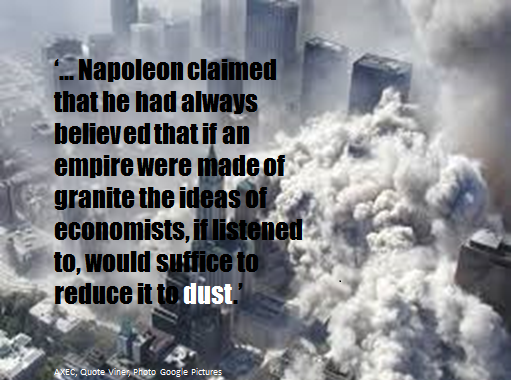
The New Republic, October 25, 2022, Timothy Noah, May God Save Us From Economists
April 3, 2016
The zombie wars are over
Comment on Scott Sumner on ‘Fiscal multiplier studies far worse than I thought’
Blog-Reference
Economics is a failed science. In more detail, this means that the major approaches — Walrasianism, Keynesianism, Marxianism, Austrianism — have not produced much scientific value, if anything, in more than 200 years.
Economists have not risen above supply-demand-equilibrium and have still not realized that this is poor science. Schumpeter already came close to a thumbs-down, but then made this concession: “The primitive apparatus of the theory of supply and demand is scientific. But the scientific achievement is so modest, and common sense and scientific knowledge are logically such close neighbors in this case, that any assertion about the precise point at which the one turned into the other must of necessity remain arbitrary.” (1994, p. 9), see also (2013)
Lacking sound scientific foundations (= episteme), economic debate up to the present consists of an inconclusive exchange of opinions (= doxa) between the four approaches. In other words, economics hitherto took place at the proto-scientific level, yet: “In order to tell the politicians and practitioners something about causes and best means, the economist needs the true theory or else he has not much more to offer than educated common sense or his personal opinion.” (Stigum, 1991, p. 30)
Economists obviously lack the true theory; Walrasianism, Keynesianism, Marxianism, Austrianism, and their derivatives are provably false. So, what is needed is a termination of the senseless cross-talk among the four zombie approaches, because “There is another alternative: to formulate a completely new research program and conceptual approach. As we have seen, this is often spoken of, but there is still no indication of what it might mean. (Ingrao et al., 1990, p. 362)
At the moment, economists produce mindlessly inconsistent models according to accustomed templates: “… most of what I and many others do is sorta-kinda neoclassical because it takes the maximization-and-equilibrium world as a starting point” (Krugman). No penny-drop, no realization that maximization and equilibrium are NONENTITIES.
In methodological terms, a Paradigm Shift means to completely replace the obsolete axiom sets of the four failed approaches with an entirely new set. To make this concrete, here is the axiom set of Walrasianism:
HC1 There exist economic agents.
HC2 Agents have preferences over outcomes.
HC3 Agents independently optimize subject to constraints.
HC4 Choices are made in interrelated markets.
HC5 Agents have full relevant knowledge.
HC6 Observable economic outcomes are coordinated, so they must be discussed with reference to equilibrium states.” (Weintraub, 1985, p. 109)
HC1 is just another expression of methodological individualism. Except for HC6, which is a petitio principii, all axioms are subjective-behavioral, which is to say, much too swampy.
Because the subjective-behavioral approaches have been a detour from the very start (as more than 150 years of blather since Jevons/Walras/Menger prove) they have now to be replaced by the objective-structural approach.
The most elementary configuration of the economy consists of the household and the business sector, which in turn consists initially of one giant fully integrated firm and is given by these three objective structural axioms:
(A1) Yw=WL wage income Yw is equal to wage rate W times working hours L,
(A2) O=RL output O is equal to productivity R times working hours L,
(A3) C=PX consumption expenditure C is equal to price P times quantity bought/sold X.
From this minimal set, which is composed of measurable real and nominal variables, follow propositions that are testable. The nonentities of methodological individualism are gone.
Methodologically correct economics starts with the SYSTEMIC axioms of the monetary economy. This yields objective systemic laws, expressed, for example, as Profit Law or Employment Law. Systemic laws are readily testable, and this is the ONLY way to settle questions according to scientific standards.
Useful input to the continuing discussion of the new paradigm is not to be expected from Walrasianism, Keynesianism, Marxianism, and Austrianism. So, let these scientific zombies go: “What is now taught as standard economic theory will eventually disappear, no trace of it will remain in the universities or boardrooms because it simply doesn’t work ...” (McCauley, 2006, p. 17)
Egmont Kakarot-Handtke
References
Ingrao, B., and Israel, G. (1990). The Invisible Hand. Economic Equilibrium in the History of Science. Cambridge, London: MIT Press.
Kakarot-Handtke, E. (2013). How to Get Rid of Supply-Demand-Equilibrium. SSRN Working Paper Series, 2263172: 1–24. URL
McCauley, J. L. (2006). Response to "Worrying Trends in EconoPhysics". EconoPhysics Forum, 0601001: 1–26. URL
Schumpeter, J. A. (1994). History of Economic Analysis. New York: Oxford University Press.
Stigum, B. P. (1991). Toward a Formal Science of Economics: The Axiomatic Method in Economics and Econometrics. Cambridge: MIT Press.
Weintraub, E. R. (1985). General Equilibrium Analysis. Cambridge, London, New York, etc.: Cambridge University Press.
Immediately preceding Austrian blather
(i) von Mises says: “The ultimate source from which entrepreneurial profit and losses are derived is the uncertainty of the future constellation of demand and supply.” (2007, p. 293)
This is a vacuous Austrian waffle.
Profit is ultimately determined by the Profit Law, which states for the investment economy Qm≡Yd+I−Sm. Legend: Qm monetary profit, Yd distributed profit, Sm monetary saving, I investment expenditure. This equation is testable with the precision of two decimal places.
(ii) von Mises says: “Economics is not about goods and services, it is about the action of living men.” (2007, p. 357)
This is how Austrians missed the subject matter of economics altogether and got lost in the woods of psychologism, thought-reading, second-guessing other people’s actions, and silly gossiping and storytelling. Because of this: Austrianism = gossip economics.
Correct definition: “Economics is the science that studies how the monetary economy works.”
(iii) von Mises says: “In the imaginary construction of a stationary economy, the total sum of all entrepreneurs’ profit equals the total sum of all entrepreneurs’ losses. (2007, p. 294)
This is provably false. In the stationary economy, it holds Qm≡Yd. #1
References
von Mises, L. (2007). Human Action. A Treatise on Economics, Vol. II. Indianapolis: Liberty Fund.
#1 The proofs are to be found in the working papers on SSRN
(i) You ask, “What are you trying to accomplish by your continual evasions?” For someone who has an irrefutable theory of human action, this is a stupid question. It is well known: “... observed acts of behavior allow an indefinite number of interpretations regarding the plans from which they are assumed to have sprung.” (Morgenstern, 1941, p. 381)
So you certainly can interpret my behavior until you are blue in the face. Obviously, you are missing the subject matter: economics is NOT about economists but about the economy.
Economists try to figure out the objective systemic laws of the monetary economy. Speculation about other people’s behavior/actions and ad hominem argumentation is a moronic pursuit. Austrians are no economists. #1
(ii) You ask, “Did you know that the GDP equation, Y = G + I + C + (X−M), can be “predicted” to 14 million decimal places, provided that people trade goods at prices to within that accuracy?”
Did you know that the GDP equation is false? For proof, see (2012). Austrians have not figured this out to this day, but swallowed the underlying logical defect hook, line, and sinker. The GDP equation is an intelligence test for economists, and Austrians flunked it.
(iii) You say: “All Mises is saying is that entrepreneurial profit, not profit per se as in your childish equation above, exists because of uncertainty.”
Uncertainty is a psychological state, and it does not produce profit just like wishful thinking or greed does not produce a profit. Mises’ explanation is at the level of voodoo thinking. For the correct explanation of profit, see (2011).
(iv) Imagine for a moment an aircraft flying from, say, New York to Paris. Now we can ask why? One way to answer the question is to speculate about the motives and reasons of the passengers, the pilot, the crew, the flight controllers, and the managers and stockholders of the airline. The other way to look at flight is to think about the laws of aerodynamics, thermodynamics, and so forth.
The first way of explanation is the Austrian way, and it yields the same trivial psychologistic crap over and over again. Notice: Whatever the subjective motives and actions of passengers are, they do — as a matter of principle — NOT explain the phenomenon of flight.
The second way is the scientific method. Thinking people, this excludes Austrians, know that there is no such thing as an irrefutable law of human action that could explain flying.
So, just as flying is explained by the objective laws of physics, the economy is explained by the objective laws of economics.
Needless to say, Austrians never got the point: “Mises’ contribution was very simple and at the same time extremely profound. He pointed out that the whole economy is the result of what individuals do.” (Foreword, von Mises, 2007, p. v)
This is as extremely profound as ‘the sun goes up’.
(v) You have already declared that you have won the debate. Do you realize that 'to win every debate' has been the selling proposition of the ancient Sophists, whom Plato famously criticized? Plato made it clear that a SCIENTIFIC debate is about episteme=knowledge and NOT about doxa=opinion and to twist an audience, or what Popper characterized as demonstration of ‘the bad taste of a finicky scholasticism’.
(vi) I agree that the action axiom is just as irrefutable as ‘Zeus threw the thunderbolt because he was angry’. What I say is that with your behavior/action approach, you will never come up with something helpful like the lightning conductor. And that is rather bad because you have won the debate, but Zeus hit you with the thunderbolt. Rest in peace, Austrians.
References
Kakarot-Handtke, E. (2011). The Emergence of Profit and Interest in the Monetary Circuit. SSRN Working Paper Series, 1973952: 1–22. URL
Kakarot-Handtke, E. (2012). The Common Error of Common Sense: An Essential Rectification of the Accounting Approach. SSRN Working Paper Series, 2124415: 1–23. URL
Morgenstern, O. (1941). Professor Hicks on Value and Capital. Journal of Political Economy, 49(3): 361–393. URL
von Mises, L. (2007). Human Action. A Treatise on Economics, Vol. I. Indianapolis: Liberty Fund.
#1 Hayek was not an economist.
(i) Any discussion about the character of interlocutors leads away from the point at issue: “Remember: occasionally, it may be an interesting question to ask why a man says what he says; but whatever the answer, it does not tell us anything about whether what he says is true or false. (Schumpeter, 1994, p. 11)
The question at issue is whether Austrianism is true or false, and not whether Major.Freedom is a tape recorder or a broken record.
(ii) Refutation is necessary but insufficient. Effective refutation consists of developing the new paradigm: “The moral of the story is simply this: it takes a new theory, and not just the destructive exposure of assumptions or the collection of new facts, to beat an old theory." (Blaug, 1998, p. 703)
And, by the way, it is not only Austrianism that is obsolete. Walrasianism, Keynesianism, and Marxianism have to be left behind the curve, too. From the huge heap of scientific garbage called economics, Austrianism is only an insignificant part. It goes down the drain with the whole of methodological individualism.
References
Blaug, M. (1998). Economic Theory in Retrospect. Cambridge: Cambridge University Press, 5th edition.
Schumpeter, J. A. (1994). History of Economic Analysis. New York: Oxford University Press.
(i) Physicists long ago proved that, given the laws of physics, a perpetual motion machine is impossible. This did not stop some people from submitting patent applications for perpetual motion machines to this very day.
It is the same thing with Austrians and other pseudo-scientific economists. “In economics, we should strive to proceed, wherever we can, exactly according to the standards of the other, more advanced, sciences, where it is not possible, once an issue has been decided, to continue to write about it as if nothing had happened. (Morgenstern, 1941, pp. 369-370)
Austrians are ignoring/violating scientific standards.
(ii) Austrianism subscribes to methodological individualism, which claims: “It is a touchstone of accepted economics that all explanations must run in terms of the actions and reactions of individuals. Our behavior in judging economic research, in peer review of papers and research, and in promotions, includes the criterion that, in principle, the behavior we explain and the policies we propose are explicable in terms of individuals, not of other social categories.” (Arrow, 1994, p. 1)
Methodological individualism is (i) unacceptable for cogent methodological reasons, and (ii) has failed for everyone to see. General equilibrium theory in all variants (RBC, DSGE, etc) is indefensible, and the same holds for Austrianism as a fellow traveler of methodological individualism.
(iii) The major claim of Austrianism is that it solved the mind-body problem. Clearly, Austrians are in the wrong movie. Philosophy/psychology/metaphysics is NOT economics. The first problem to solve for an economist is the profit-income problem and NOT the mind-body problem.
(iv) NO way leads from the subjective action axiom to the objective Profit Law. It is irrelevant whether the action axiom is irrefutable or not. Austrians do not know what profit is, and by consequence, they have no idea how the economy works. The profit theory is the pivot of all of economics.
(v) The profit theory must be testable. This brings us back to the starting point of this thread. Vacuous theories like Austrianism are not testable and therefore not of interest for the point at issue.
(vi) You say, “I will declare for a third time that you lost the debate.” Did it ever occur to you that as a party to the debate, you have nothing to declare?
(vii) Austrianism is a zombie approach for more than 150 years, just like Walrasianism and everything else that subscribes to methodological individualism.
(viii) Economics needs a Paradigm Shift.
References
Arrow, K. J. (1994). Methodological Individualism and Social Knowledge. American Economic Review, Papers and Proceedings, 84(2): 1–9. URL
Morgenstern, O. (1941). Professor Hicks on Value and Capital. Journal of Political Economy, 49(3): 361–393. URL
Science was there before economics was there. Economists either conform to scientific standards or are outside of science: they are in NO position to redefine scientific criteria.
Because economics — as represented by the four failed sects Walrasians, Keynesians, Marxians, Austrians — has never risen above the level of a proto-science, it has become popular among economists to question the standards, to lower them or, as Blaug aptly put it, ‘to play tennis with the net down’. When this is pointed out, economists make the somersault backward: ‘Economics is not a Science with a capital S’ (Solow).
The scientific method is well-defined: “Research is, in fact, a continuous discussion of the consistency of theories: formal consistency insofar as the discussion relates to the logical cohesion of what is asserted in joint theories; material consistency insofar as the agreement of observations with theories is concerned.” (Klant)
Logical consistency is secured by applying the axiomatic-deductive method, and empirical consistency is secured by applying state-of-the-art testing.
Economics fails on both counts: the axiomatic foundations are provably false, and testing is regularly inconclusive. So, economics has happily established itself in the swamp between true and false where ‘nothing is clear and everything is possible’ (Keynes).
The swamp between the hard rocks of true and false is the natural habitat of blathering frogs, of which there are four species, which are clearly identifiable by their respective axiom sets. The funniest species is the Austrian, which is in the possession of an irrefutable magic axiom but never managed to produce a testable proposition. So, there is NO WAY to get an Austrian frog ever out of the swamp. And of this, they are very proud.
No problem with this, of course. What has to be made crystal clear is that Austrians have never produced anything of scientific value. For proof, re-read Major.Freedom’s posts. With this stuff, the poor souls in scientific hell are tortured.
Time to become constructive now: let’s proceed with the paradigm shift.
Science was there before economics was there; that is, Newton was there before Adam Smith was there. Newton is famous for his ‘hypotheses non fingo’, which means, I do not waffle but prove.
“But he [A. Smith] had no such ambitions; in fact he disliked whatever went beyond plain common sense. He never moved above the heads of even the dullest readers. He led them on gently, encouraging them by trivialities and homely observations, making them feel comfortable all along.” (Schumpeter)
While physics has evolved exponentially, economics is stuck at the proto-scientific level of storytelling. The key narrative is supply-demand-equilibrium and it has been false already in Smith’s days. After 200+ years, compare the entirely vacuous General Equilibrium Theory with General Relativity Theory — is there any doubt that economics is a failed science?
It seems that the irrefutable magic action axiom somehow did not work.
Economists are confused confusers, and Austrians are the worst of them. See Confused Confusers: How to Stop Thinking Like an Economist and Start Thinking Like a Scientist.
Related 'From microfoundations to macrofoundations'
Blog-Reference
Economics is a failed science. In more detail, this means that the major approaches — Walrasianism, Keynesianism, Marxianism, Austrianism — have not produced much scientific value, if anything, in more than 200 years.
Economists have not risen above supply-demand-equilibrium and have still not realized that this is poor science. Schumpeter already came close to a thumbs-down, but then made this concession: “The primitive apparatus of the theory of supply and demand is scientific. But the scientific achievement is so modest, and common sense and scientific knowledge are logically such close neighbors in this case, that any assertion about the precise point at which the one turned into the other must of necessity remain arbitrary.” (1994, p. 9), see also (2013)
Lacking sound scientific foundations (= episteme), economic debate up to the present consists of an inconclusive exchange of opinions (= doxa) between the four approaches. In other words, economics hitherto took place at the proto-scientific level, yet: “In order to tell the politicians and practitioners something about causes and best means, the economist needs the true theory or else he has not much more to offer than educated common sense or his personal opinion.” (Stigum, 1991, p. 30)
Economists obviously lack the true theory; Walrasianism, Keynesianism, Marxianism, Austrianism, and their derivatives are provably false. So, what is needed is a termination of the senseless cross-talk among the four zombie approaches, because “There is another alternative: to formulate a completely new research program and conceptual approach. As we have seen, this is often spoken of, but there is still no indication of what it might mean. (Ingrao et al., 1990, p. 362)
At the moment, economists produce mindlessly inconsistent models according to accustomed templates: “… most of what I and many others do is sorta-kinda neoclassical because it takes the maximization-and-equilibrium world as a starting point” (Krugman). No penny-drop, no realization that maximization and equilibrium are NONENTITIES.
In methodological terms, a Paradigm Shift means to completely replace the obsolete axiom sets of the four failed approaches with an entirely new set. To make this concrete, here is the axiom set of Walrasianism:
HC1 There exist economic agents.
HC2 Agents have preferences over outcomes.
HC3 Agents independently optimize subject to constraints.
HC4 Choices are made in interrelated markets.
HC5 Agents have full relevant knowledge.
HC6 Observable economic outcomes are coordinated, so they must be discussed with reference to equilibrium states.” (Weintraub, 1985, p. 109)
HC1 is just another expression of methodological individualism. Except for HC6, which is a petitio principii, all axioms are subjective-behavioral, which is to say, much too swampy.
Because the subjective-behavioral approaches have been a detour from the very start (as more than 150 years of blather since Jevons/Walras/Menger prove) they have now to be replaced by the objective-structural approach.
The most elementary configuration of the economy consists of the household and the business sector, which in turn consists initially of one giant fully integrated firm and is given by these three objective structural axioms:
(A1) Yw=WL wage income Yw is equal to wage rate W times working hours L,
(A2) O=RL output O is equal to productivity R times working hours L,
(A3) C=PX consumption expenditure C is equal to price P times quantity bought/sold X.
From this minimal set, which is composed of measurable real and nominal variables, follow propositions that are testable. The nonentities of methodological individualism are gone.
Methodologically correct economics starts with the SYSTEMIC axioms of the monetary economy. This yields objective systemic laws, expressed, for example, as Profit Law or Employment Law. Systemic laws are readily testable, and this is the ONLY way to settle questions according to scientific standards.
Useful input to the continuing discussion of the new paradigm is not to be expected from Walrasianism, Keynesianism, Marxianism, and Austrianism. So, let these scientific zombies go: “What is now taught as standard economic theory will eventually disappear, no trace of it will remain in the universities or boardrooms because it simply doesn’t work ...” (McCauley, 2006, p. 17)
Egmont Kakarot-Handtke
References
Ingrao, B., and Israel, G. (1990). The Invisible Hand. Economic Equilibrium in the History of Science. Cambridge, London: MIT Press.
Kakarot-Handtke, E. (2013). How to Get Rid of Supply-Demand-Equilibrium. SSRN Working Paper Series, 2263172: 1–24. URL
McCauley, J. L. (2006). Response to "Worrying Trends in EconoPhysics". EconoPhysics Forum, 0601001: 1–26. URL
Schumpeter, J. A. (1994). History of Economic Analysis. New York: Oxford University Press.
Stigum, B. P. (1991). Toward a Formal Science of Economics: The Axiomatic Method in Economics and Econometrics. Cambridge: MIT Press.
Weintraub, E. R. (1985). General Equilibrium Analysis. Cambridge, London, New York, etc.: Cambridge University Press.
Immediately preceding Austrian blather
***
REPLY to Major.Freedom on Apr 3(i) von Mises says: “The ultimate source from which entrepreneurial profit and losses are derived is the uncertainty of the future constellation of demand and supply.” (2007, p. 293)
This is a vacuous Austrian waffle.
Profit is ultimately determined by the Profit Law, which states for the investment economy Qm≡Yd+I−Sm. Legend: Qm monetary profit, Yd distributed profit, Sm monetary saving, I investment expenditure. This equation is testable with the precision of two decimal places.
(ii) von Mises says: “Economics is not about goods and services, it is about the action of living men.” (2007, p. 357)
This is how Austrians missed the subject matter of economics altogether and got lost in the woods of psychologism, thought-reading, second-guessing other people’s actions, and silly gossiping and storytelling. Because of this: Austrianism = gossip economics.
Correct definition: “Economics is the science that studies how the monetary economy works.”
(iii) von Mises says: “In the imaginary construction of a stationary economy, the total sum of all entrepreneurs’ profit equals the total sum of all entrepreneurs’ losses. (2007, p. 294)
This is provably false. In the stationary economy, it holds Qm≡Yd. #1
References
von Mises, L. (2007). Human Action. A Treatise on Economics, Vol. II. Indianapolis: Liberty Fund.
#1 The proofs are to be found in the working papers on SSRN
***
REPLY to Major.Freedom on Apr 4(i) You ask, “What are you trying to accomplish by your continual evasions?” For someone who has an irrefutable theory of human action, this is a stupid question. It is well known: “... observed acts of behavior allow an indefinite number of interpretations regarding the plans from which they are assumed to have sprung.” (Morgenstern, 1941, p. 381)
So you certainly can interpret my behavior until you are blue in the face. Obviously, you are missing the subject matter: economics is NOT about economists but about the economy.
Economists try to figure out the objective systemic laws of the monetary economy. Speculation about other people’s behavior/actions and ad hominem argumentation is a moronic pursuit. Austrians are no economists. #1
(ii) You ask, “Did you know that the GDP equation, Y = G + I + C + (X−M), can be “predicted” to 14 million decimal places, provided that people trade goods at prices to within that accuracy?”
Did you know that the GDP equation is false? For proof, see (2012). Austrians have not figured this out to this day, but swallowed the underlying logical defect hook, line, and sinker. The GDP equation is an intelligence test for economists, and Austrians flunked it.
(iii) You say: “All Mises is saying is that entrepreneurial profit, not profit per se as in your childish equation above, exists because of uncertainty.”
Uncertainty is a psychological state, and it does not produce profit just like wishful thinking or greed does not produce a profit. Mises’ explanation is at the level of voodoo thinking. For the correct explanation of profit, see (2011).
(iv) Imagine for a moment an aircraft flying from, say, New York to Paris. Now we can ask why? One way to answer the question is to speculate about the motives and reasons of the passengers, the pilot, the crew, the flight controllers, and the managers and stockholders of the airline. The other way to look at flight is to think about the laws of aerodynamics, thermodynamics, and so forth.
The first way of explanation is the Austrian way, and it yields the same trivial psychologistic crap over and over again. Notice: Whatever the subjective motives and actions of passengers are, they do — as a matter of principle — NOT explain the phenomenon of flight.
The second way is the scientific method. Thinking people, this excludes Austrians, know that there is no such thing as an irrefutable law of human action that could explain flying.
So, just as flying is explained by the objective laws of physics, the economy is explained by the objective laws of economics.
Needless to say, Austrians never got the point: “Mises’ contribution was very simple and at the same time extremely profound. He pointed out that the whole economy is the result of what individuals do.” (Foreword, von Mises, 2007, p. v)
This is as extremely profound as ‘the sun goes up’.
(v) You have already declared that you have won the debate. Do you realize that 'to win every debate' has been the selling proposition of the ancient Sophists, whom Plato famously criticized? Plato made it clear that a SCIENTIFIC debate is about episteme=knowledge and NOT about doxa=opinion and to twist an audience, or what Popper characterized as demonstration of ‘the bad taste of a finicky scholasticism’.
(vi) I agree that the action axiom is just as irrefutable as ‘Zeus threw the thunderbolt because he was angry’. What I say is that with your behavior/action approach, you will never come up with something helpful like the lightning conductor. And that is rather bad because you have won the debate, but Zeus hit you with the thunderbolt. Rest in peace, Austrians.
References
Kakarot-Handtke, E. (2011). The Emergence of Profit and Interest in the Monetary Circuit. SSRN Working Paper Series, 1973952: 1–22. URL
Kakarot-Handtke, E. (2012). The Common Error of Common Sense: An Essential Rectification of the Accounting Approach. SSRN Working Paper Series, 2124415: 1–23. URL
Morgenstern, O. (1941). Professor Hicks on Value and Capital. Journal of Political Economy, 49(3): 361–393. URL
von Mises, L. (2007). Human Action. A Treatise on Economics, Vol. I. Indianapolis: Liberty Fund.
#1 Hayek was not an economist.
***
COMMENT on Don Geddis on Apr 5(i) Any discussion about the character of interlocutors leads away from the point at issue: “Remember: occasionally, it may be an interesting question to ask why a man says what he says; but whatever the answer, it does not tell us anything about whether what he says is true or false. (Schumpeter, 1994, p. 11)
The question at issue is whether Austrianism is true or false, and not whether Major.Freedom is a tape recorder or a broken record.
(ii) Refutation is necessary but insufficient. Effective refutation consists of developing the new paradigm: “The moral of the story is simply this: it takes a new theory, and not just the destructive exposure of assumptions or the collection of new facts, to beat an old theory." (Blaug, 1998, p. 703)
And, by the way, it is not only Austrianism that is obsolete. Walrasianism, Keynesianism, and Marxianism have to be left behind the curve, too. From the huge heap of scientific garbage called economics, Austrianism is only an insignificant part. It goes down the drain with the whole of methodological individualism.
References
Blaug, M. (1998). Economic Theory in Retrospect. Cambridge: Cambridge University Press, 5th edition.
Schumpeter, J. A. (1994). History of Economic Analysis. New York: Oxford University Press.
***
REPLY to Major.Freedom on Apr 6(i) Physicists long ago proved that, given the laws of physics, a perpetual motion machine is impossible. This did not stop some people from submitting patent applications for perpetual motion machines to this very day.
It is the same thing with Austrians and other pseudo-scientific economists. “In economics, we should strive to proceed, wherever we can, exactly according to the standards of the other, more advanced, sciences, where it is not possible, once an issue has been decided, to continue to write about it as if nothing had happened. (Morgenstern, 1941, pp. 369-370)
Austrians are ignoring/violating scientific standards.
(ii) Austrianism subscribes to methodological individualism, which claims: “It is a touchstone of accepted economics that all explanations must run in terms of the actions and reactions of individuals. Our behavior in judging economic research, in peer review of papers and research, and in promotions, includes the criterion that, in principle, the behavior we explain and the policies we propose are explicable in terms of individuals, not of other social categories.” (Arrow, 1994, p. 1)
Methodological individualism is (i) unacceptable for cogent methodological reasons, and (ii) has failed for everyone to see. General equilibrium theory in all variants (RBC, DSGE, etc) is indefensible, and the same holds for Austrianism as a fellow traveler of methodological individualism.
(iii) The major claim of Austrianism is that it solved the mind-body problem. Clearly, Austrians are in the wrong movie. Philosophy/psychology/metaphysics is NOT economics. The first problem to solve for an economist is the profit-income problem and NOT the mind-body problem.
(iv) NO way leads from the subjective action axiom to the objective Profit Law. It is irrelevant whether the action axiom is irrefutable or not. Austrians do not know what profit is, and by consequence, they have no idea how the economy works. The profit theory is the pivot of all of economics.
(v) The profit theory must be testable. This brings us back to the starting point of this thread. Vacuous theories like Austrianism are not testable and therefore not of interest for the point at issue.
(vi) You say, “I will declare for a third time that you lost the debate.” Did it ever occur to you that as a party to the debate, you have nothing to declare?
(vii) Austrianism is a zombie approach for more than 150 years, just like Walrasianism and everything else that subscribes to methodological individualism.
(viii) Economics needs a Paradigm Shift.
References
Arrow, K. J. (1994). Methodological Individualism and Social Knowledge. American Economic Review, Papers and Proceedings, 84(2): 1–9. URL
Morgenstern, O. (1941). Professor Hicks on Value and Capital. Journal of Political Economy, 49(3): 361–393. URL
***
COMMENT on Don Geddis on Apr 7Science was there before economics was there. Economists either conform to scientific standards or are outside of science: they are in NO position to redefine scientific criteria.
Because economics — as represented by the four failed sects Walrasians, Keynesians, Marxians, Austrians — has never risen above the level of a proto-science, it has become popular among economists to question the standards, to lower them or, as Blaug aptly put it, ‘to play tennis with the net down’. When this is pointed out, economists make the somersault backward: ‘Economics is not a Science with a capital S’ (Solow).
The scientific method is well-defined: “Research is, in fact, a continuous discussion of the consistency of theories: formal consistency insofar as the discussion relates to the logical cohesion of what is asserted in joint theories; material consistency insofar as the agreement of observations with theories is concerned.” (Klant)
Logical consistency is secured by applying the axiomatic-deductive method, and empirical consistency is secured by applying state-of-the-art testing.
Economics fails on both counts: the axiomatic foundations are provably false, and testing is regularly inconclusive. So, economics has happily established itself in the swamp between true and false where ‘nothing is clear and everything is possible’ (Keynes).
The swamp between the hard rocks of true and false is the natural habitat of blathering frogs, of which there are four species, which are clearly identifiable by their respective axiom sets. The funniest species is the Austrian, which is in the possession of an irrefutable magic axiom but never managed to produce a testable proposition. So, there is NO WAY to get an Austrian frog ever out of the swamp. And of this, they are very proud.
No problem with this, of course. What has to be made crystal clear is that Austrians have never produced anything of scientific value. For proof, re-read Major.Freedom’s posts. With this stuff, the poor souls in scientific hell are tortured.
Time to become constructive now: let’s proceed with the paradigm shift.
***
FAREWELL to Major.Freedom on Apr 8Science was there before economics was there; that is, Newton was there before Adam Smith was there. Newton is famous for his ‘hypotheses non fingo’, which means, I do not waffle but prove.
“But he [A. Smith] had no such ambitions; in fact he disliked whatever went beyond plain common sense. He never moved above the heads of even the dullest readers. He led them on gently, encouraging them by trivialities and homely observations, making them feel comfortable all along.” (Schumpeter)
While physics has evolved exponentially, economics is stuck at the proto-scientific level of storytelling. The key narrative is supply-demand-equilibrium and it has been false already in Smith’s days. After 200+ years, compare the entirely vacuous General Equilibrium Theory with General Relativity Theory — is there any doubt that economics is a failed science?
It seems that the irrefutable magic action axiom somehow did not work.
Economists are confused confusers, and Austrians are the worst of them. See Confused Confusers: How to Stop Thinking Like an Economist and Start Thinking Like a Scientist.
Related 'From microfoundations to macrofoundations'
For more about von Mises, see AXECquery.
April 2, 2016
Austrian blather
Reply to Major.Freedom on 'Fiscal multiplier studies — it's far worse than I thought'
Blog-Reference
(i) I did not ask you for a “good piece of advice”, so do not pester me with it.
(ii) My pivotal point is that there is no such thing as a specific BEHAVIORAL axiom in economics because axioms have to be ‘certain, true, and primary’. This is definitively not the case with the maximization axiom HC3 of Neoclassics and the action axiom of Praxeology.
Strictly speaking, a ‘behavioral axiom’ is an oxymoron. This has been known to scientists of all ages: “The bifurcation of motion into two fundamentally different types, one for natural motions of non-living objects and another for acts of human volition ... is obviously related to the issue of free will, and demonstrates the strong tendency of scientists in all ages to exempt human behavior from the natural laws of physics, and to regard motions resulting from human actions as original, in the sense that they need not be attributed to other motions.” (Brown, 2011, p. 211)
From the general proposition that human action is original or, alternatively, target-oriented with any number of possible targets NOTHING specific follows. So, after the first step, one is already at the end of the road.
This, in turn, explains why Praxeology is a failed approach: “Now, at any rate, we have an explanation for why the assumptions of economic theory about individual action have not been improved, corrected, sharpened, specified, or conditioned in ways that would improve the predictive power of the theory. None of these things have been done by economists because they cannot be done. The intentional nature of the fundamental explanatory variables of economic theory prohibits such improvement.” (Rosenberg, 1992, p. 149)
For cogent methodological reasons: (1) economic theory cannot be built upon a behavioral assumption like the maximization axiom or the action axiom or any other, for that matter, and (2), as a matter of principle, NO way leads from the explanation of individual human behavior to the explanation of how the monetary economy works. Because of this, ALL subjective-behavioral approaches are bound to fail.
(iii) You say about the action axiom “It is IMPOSSIBLE for it to be proven false.” Obviously, you did not realize that this is NOT a strong point but, just the contrary, the very antithesis of science: “But a method that can explain everything that might happen explains nothing.” (Popper, 1960, p. 154)
To recall, when the ancient Greek thinkers, who invented science, heard a man saying “I can explain everything, Zeus did it, and you cannot prove me wrong” they showed him the way to the temple and threw him out of the academy.
(iv) This thread is about testing. As long as Austrians cannot produce a testable proposition about the overall profit of the monetary economy they have nothing worthwhile to say. Who does not understand profit understands nothing. Folk psychology is not economics.
(v) I do not engage in criticizing Praxeology or Austrianism. I understand that there must be something like economics for the scientifically retarded and I am quite content that you faithfully stick to it.
(vi) If you wish to prove the structural-axiomatic approach wrong it suffices to empirically refute the Profit Law. All else is obsolete Austrian blather.
References
Brown, K. (2011). Reflections on Relativity. Raleigh: Lulu.com.
Popper, K. R. (1960). The Poverty of Historicism. London, Henley: Routledge and Kegan Paul.
Rosenberg, A. (1992). Economics ― Mathematical Politics or Science of Diminishing Returns? Chicago: University of Chicago Press.
Related 'The futility of testing economics blather' and 'Hayek was not an economist' and 'Both Austrianism and MMT are proto-scientific garbage' and 'Austrians, too, are either stupid or corrupt or both'.
For more about Austrianism see AXECquery.
You say: “It [Praxeology] is strictly a theory of human action.” It is obviously beyond your horizon that human action is the realm of the so-called social sciences (psychology, sociology, anthropology, political science, history, etc.). Economics is about the behavior of the monetary economy. So, economics is a system science (2014). The so-called social sciences have been accurately characterized by Feynman as cargo cult sciences (see Wikipedia). Praxeology is a case in point.
So there is no need at all to clarify the finer points of Praxeology just as there is no need to quarrel about whether geocentrism worked with 20 or 25 epicycles because geocentrism has been buried long ago and everybody — except Flat-Earthers and Austrians — understands by now that epicycles are NONENTITIES like angels and the Easter Bunny.
You say: “But we are not God, and we are not superhuman. We are human.” Trivially true, but not much follows from brain-dead tautologies.
Folk psychology and the "subtle and sophisticated process of self-reflection" are not economics. Praxeology is proto-scientific garbage and more is not to say about it.
Science is well-defined as formal and empirical consistency (Klant, 1994, p. 31). No genuine scientist ever had a problem with this definition. Curiously, those who are known not to have produced one tiny piece of science can exactly explain why the scientific method does not work.
Here is the collection of the most ridiculous excuses: “Economics is a strange sort of discipline. The booby traps I mentioned often make it sound as if it is all just a matter of opinion. That is not so. Economics is not a Science with a capital S. It lacks the experimental method as a way of testing hypotheses. . . . There are always differences of opinion at the cutting edge of a science, . . . . But they last longer in economics . . . and there are reasons for that. As already mentioned, rival theories cannot be put to an experimental test. All there is to observe is history, and history does not conduct experiments: too many things are always happening at once. The inferences that can be made from history are always uncertain, always disputable, . . . You can’t even count on a long and undisturbed run of history, because the ‘laws’ of behavior change and evolve. Excuses, excuses. But the point is not to provide excuses. (Solow, 1998, x-xi)
The obvious explanation is missing: the scientific incompetence of economists. The first thing to understand is that there are no ‘laws of behavior’ but that there are objective and testable systemic laws.
After more than 200 years economists can still not tell the difference between profit and income. Economics is at the level of medieval physics before the concept of potential and kinetic energy was properly understood. Austrians, too, cannot explain how the economy works but they have any number of excuses for why they have achieved nothing of scientific value.
You say: “We’re pigeons playing chess, pooping on the board, and flying away.” Again trivially true, dear Austrians, but now take your poop and play somewhere else. As Shaw put it "People who say it cannot be done should not interrupt those who are doing it."
References
Kakarot-Handtke, E. (2014). Objective Principles of Economics. SSRN Working Paper Series, 2418851: 1–19. URL
Klant, J. J. (1994). The Nature of Economic Thought. Aldershot, Brookfield: Edward Elgar.
Solow, R. M. (1998). Foreword, volume William Breit and Roger L. Ranson: The Academic Scribblers. Princeton: Princeton University Press, 3rd edition.
Related 'The zombie wars are over'.
Blog-Reference
(i) I did not ask you for a “good piece of advice”, so do not pester me with it.
(ii) My pivotal point is that there is no such thing as a specific BEHAVIORAL axiom in economics because axioms have to be ‘certain, true, and primary’. This is definitively not the case with the maximization axiom HC3 of Neoclassics and the action axiom of Praxeology.
Strictly speaking, a ‘behavioral axiom’ is an oxymoron. This has been known to scientists of all ages: “The bifurcation of motion into two fundamentally different types, one for natural motions of non-living objects and another for acts of human volition ... is obviously related to the issue of free will, and demonstrates the strong tendency of scientists in all ages to exempt human behavior from the natural laws of physics, and to regard motions resulting from human actions as original, in the sense that they need not be attributed to other motions.” (Brown, 2011, p. 211)
From the general proposition that human action is original or, alternatively, target-oriented with any number of possible targets NOTHING specific follows. So, after the first step, one is already at the end of the road.
This, in turn, explains why Praxeology is a failed approach: “Now, at any rate, we have an explanation for why the assumptions of economic theory about individual action have not been improved, corrected, sharpened, specified, or conditioned in ways that would improve the predictive power of the theory. None of these things have been done by economists because they cannot be done. The intentional nature of the fundamental explanatory variables of economic theory prohibits such improvement.” (Rosenberg, 1992, p. 149)
For cogent methodological reasons: (1) economic theory cannot be built upon a behavioral assumption like the maximization axiom or the action axiom or any other, for that matter, and (2), as a matter of principle, NO way leads from the explanation of individual human behavior to the explanation of how the monetary economy works. Because of this, ALL subjective-behavioral approaches are bound to fail.
(iii) You say about the action axiom “It is IMPOSSIBLE for it to be proven false.” Obviously, you did not realize that this is NOT a strong point but, just the contrary, the very antithesis of science: “But a method that can explain everything that might happen explains nothing.” (Popper, 1960, p. 154)
To recall, when the ancient Greek thinkers, who invented science, heard a man saying “I can explain everything, Zeus did it, and you cannot prove me wrong” they showed him the way to the temple and threw him out of the academy.
(iv) This thread is about testing. As long as Austrians cannot produce a testable proposition about the overall profit of the monetary economy they have nothing worthwhile to say. Who does not understand profit understands nothing. Folk psychology is not economics.
(v) I do not engage in criticizing Praxeology or Austrianism. I understand that there must be something like economics for the scientifically retarded and I am quite content that you faithfully stick to it.
(vi) If you wish to prove the structural-axiomatic approach wrong it suffices to empirically refute the Profit Law. All else is obsolete Austrian blather.
References
Brown, K. (2011). Reflections on Relativity. Raleigh: Lulu.com.
Popper, K. R. (1960). The Poverty of Historicism. London, Henley: Routledge and Kegan Paul.
Rosenberg, A. (1992). Economics ― Mathematical Politics or Science of Diminishing Returns? Chicago: University of Chicago Press.
Related 'The futility of testing economics blather' and 'Hayek was not an economist' and 'Both Austrianism and MMT are proto-scientific garbage' and 'Austrians, too, are either stupid or corrupt or both'.
For more about Austrianism see AXECquery.
***
REPLY to Major.Freedom on Apr 2You say: “It [Praxeology] is strictly a theory of human action.” It is obviously beyond your horizon that human action is the realm of the so-called social sciences (psychology, sociology, anthropology, political science, history, etc.). Economics is about the behavior of the monetary economy. So, economics is a system science (2014). The so-called social sciences have been accurately characterized by Feynman as cargo cult sciences (see Wikipedia). Praxeology is a case in point.
So there is no need at all to clarify the finer points of Praxeology just as there is no need to quarrel about whether geocentrism worked with 20 or 25 epicycles because geocentrism has been buried long ago and everybody — except Flat-Earthers and Austrians — understands by now that epicycles are NONENTITIES like angels and the Easter Bunny.
You say: “But we are not God, and we are not superhuman. We are human.” Trivially true, but not much follows from brain-dead tautologies.
Folk psychology and the "subtle and sophisticated process of self-reflection" are not economics. Praxeology is proto-scientific garbage and more is not to say about it.
Science is well-defined as formal and empirical consistency (Klant, 1994, p. 31). No genuine scientist ever had a problem with this definition. Curiously, those who are known not to have produced one tiny piece of science can exactly explain why the scientific method does not work.
Here is the collection of the most ridiculous excuses: “Economics is a strange sort of discipline. The booby traps I mentioned often make it sound as if it is all just a matter of opinion. That is not so. Economics is not a Science with a capital S. It lacks the experimental method as a way of testing hypotheses. . . . There are always differences of opinion at the cutting edge of a science, . . . . But they last longer in economics . . . and there are reasons for that. As already mentioned, rival theories cannot be put to an experimental test. All there is to observe is history, and history does not conduct experiments: too many things are always happening at once. The inferences that can be made from history are always uncertain, always disputable, . . . You can’t even count on a long and undisturbed run of history, because the ‘laws’ of behavior change and evolve. Excuses, excuses. But the point is not to provide excuses. (Solow, 1998, x-xi)
The obvious explanation is missing: the scientific incompetence of economists. The first thing to understand is that there are no ‘laws of behavior’ but that there are objective and testable systemic laws.
After more than 200 years economists can still not tell the difference between profit and income. Economics is at the level of medieval physics before the concept of potential and kinetic energy was properly understood. Austrians, too, cannot explain how the economy works but they have any number of excuses for why they have achieved nothing of scientific value.
You say: “We’re pigeons playing chess, pooping on the board, and flying away.” Again trivially true, dear Austrians, but now take your poop and play somewhere else. As Shaw put it "People who say it cannot be done should not interrupt those who are doing it."
References
Kakarot-Handtke, E. (2014). Objective Principles of Economics. SSRN Working Paper Series, 2418851: 1–19. URL
Klant, J. J. (1994). The Nature of Economic Thought. Aldershot, Brookfield: Edward Elgar.
Solow, R. M. (1998). Foreword, volume William Breit and Roger L. Ranson: The Academic Scribblers. Princeton: Princeton University Press, 3rd edition.
Related 'The zombie wars are over'.
April 1, 2016
How the American working class can bring overall profits down to zero without bloody revolution
Comment on anne on ‘Corporate profits are near record highs. That’s a problem’
Blog-Reference
Thank you for the reproduction of Summers’s article about his troubles with profits: “This is an apparent problem for the secular stagnation hypothesis I have been advocating for some time ...” It has to be emphasized that the real problem of Larry Summers is that he has been advocating scientific garbage for too long a time.
In his article, Larry Summers evaluates several logically possible explanations for the record high of profit, among others, productivity and monopoly power. Now, these factors are indeed effective for a SINGLE firm or a sub-sector. But what is true in partial analysis is NOT true for the economy as a whole. This false generalization is known as the Fallacy of Composition. Most of the standard economics consists of this fallacy. Economists are feeble thinkers.
For the economy as a whole, neither productivity nor monopoly power plays a role; overall profit for the closed investment economy is given by Qm≡Yd+I−Sm. Legend: Qm monetary profit, Yd distributed profit, I investment expenditures, Sm monetary saving. With the trade balance and government added, the equation becomes a bit longer.
The structural-axiomatic Profit Law says that for the economy as a whole, it is NOT wages that are the antagonist of profits but monetary saving Sm (see the minus sign). Put the other way round: it is deficit spending/dissaving of the household sector (and the government sector) that is a major profit determinant. Distributed profit, investment, and an export surplus are the others. None of these factors appears in Larry Summers’s musings.
So, the height of OVERALL profit is not an indicator that American firms are particularly productive or that American businesspeople are particularly smart or greedy or monopolistically. Overall profits are, in the main, the mirror image of GROWING private and public debt. #1
The Profit Law tells the working class how to bring down overall monetary profits: save and pay back your debt. No further action is needed if prices fall proportionally; if not, falling employment complicates the situation.
Larry Summers is groping in the dark because ALL commonsensical partial profit theories are false, and he has not grasped this since Econ 101. #2
Egmont Kakarot-Handtke
#1 See chart St. Louis Fed
#2 The Profit Theory is False Since Adam Smith. What About the True Distribution Theory?
Immediately preceding Profit, marginalism, and other anomalies.
Related 'Profit' and 'No future for Socialism and Capitalism'. For details of the big picture, see cross-references Profit.
Subscribe to:
Posts (Atom)