Working paper at SSRN
Abstract Unemployment is usually explained with reference to the equilibrium of supply and demand in the labor market. This approach rests on specific behavioral assumptions that are formally expressed as axioms. The standard set of axioms is replaced in the present paper by a set of structural axioms. This approach yields the objective determinants of employment. They consist of effective demand, the actual outcome of price formation, structural stress as determined by the heterogeneity within the business sector, and the income distribution. Sudden changes in employment are effected by latent relative switchers that are hard to spot empirically.
Showing posts sorted by relevance for query label:Employment. Sort by date Show all posts
Showing posts sorted by relevance for query label:Employment. Sort by date Show all posts
July 14, 2011
February 18, 2023
Occasional Tweets: Clueless economists / Phillips Curve (III)
#FailedFakeScience
— E.K-H (@AXECorg) February 18, 2023
Bc of his scientific incompetence, Samuelson, et al. messed up the #PhillipsCurve.
NAIRU, wage-led growth, and Samuelson's Dyscalculiahttps://t.co/qDrdo8Hdey
Keynes’ Employment Function and the Gratuitous Phillips Curve Disasterhttps://t.co/fYComRqFX3

September 27, 2016
The choice between Friedmanian pest and Keynesian cholera
Comment on Brad DeLong on ‘The Stakes of the Helicopter Money Debate: A Primer’
Blog-Reference
Brad DeLong summarizes: “The Great Moderation of the business cycle from 1984-2007 was a rich enough pudding to be proof, for the rough consensus of mainstream economists at least, that Keynes had been wrong and Friedman had been right. But in the aftermath of 2007, it became very clear that they — or, rather, we, ... — were very, tragically, dismally and grossly wrong.”
And then he continues: “Now we face a choice ...”
No, there never has been a choice between the Friedmanians and Keynesians because BOTH are wrong. Both are groping in the dark about the two most important features of the market economy: the profit mechanism and the price mechanism. Because of this, the discussion about monetary and fiscal policy, or helicopter money, never had more scientific content than a free ink-blot association.
“In order to tell the politicians and practitioners something about causes and best means, the economist needs the true theory or else he has not much more to offer than educated common sense or his personal opinion.” (Stigum, 1991, p. 30)
Economists have no true theory. Economics is a failed science. What Friedmanians and Keynesians have to offer is political opinion without sound scientific foundations.
For the proof, let us very briefly turn to the formally and empirically correct employment theory (2012; 2014). The basic version of the objective structural Employment Law is shown on Graphic AXEC62a:

Blog-Reference
Brad DeLong summarizes: “The Great Moderation of the business cycle from 1984-2007 was a rich enough pudding to be proof, for the rough consensus of mainstream economists at least, that Keynes had been wrong and Friedman had been right. But in the aftermath of 2007, it became very clear that they — or, rather, we, ... — were very, tragically, dismally and grossly wrong.”
And then he continues: “Now we face a choice ...”
No, there never has been a choice between the Friedmanians and Keynesians because BOTH are wrong. Both are groping in the dark about the two most important features of the market economy: the profit mechanism and the price mechanism. Because of this, the discussion about monetary and fiscal policy, or helicopter money, never had more scientific content than a free ink-blot association.
“In order to tell the politicians and practitioners something about causes and best means, the economist needs the true theory or else he has not much more to offer than educated common sense or his personal opinion.” (Stigum, 1991, p. 30)
Economists have no true theory. Economics is a failed science. What Friedmanians and Keynesians have to offer is political opinion without sound scientific foundations.
For the proof, let us very briefly turn to the formally and empirically correct employment theory (2012; 2014). The basic version of the objective structural Employment Law is shown on Graphic AXEC62a:

From this equation follows inter alia:
(i) An increase in the expenditure ratio ρE leads to higher employment (the letter ρ stands for ratio).
(ii) Increasing investment expenditures I, exert a positive influence on employment,
(iii) An increase in the factor cost ratio ρF≡W/PR leads to higher employment.
The complete AND testable Employment Law is a bit longer and contains, in addition, profit distribution, public deficit spending, and import/export.
Items (i) and (ii) cover Keynes' arguments about the role of aggregate demand, which have been commonsensical right, but formally defective. The factor cost ratio ρF, as defined in (iii), embodies the price mechanism which works very differently from what the representative economist hallucinates. As a matter of fact, overall employment (in the world economy or a closed national economy) INCREASES if the average wage rate W INCREASES relative to the average price P and productivity R.
So, in simple terms, full employment (in any definition) can be achieved by increasing aggregate demand or by INCREASING the average wage rate (or by a combination of the two).
The second alternative is preferable to Keynesian deficit spending#1, but it is the very opposite of what the broad consensus always told the world: “We economists have all learned, and many of us teach, that the remedy for excess supply in any market is a reduction in price. If this is prevented by combinations in restraint of trade or by government regulations, then those impediments to competition should be removed.” (Tobin, 1997, p. 11)
Both the Friedmanian and Keynesian approaches have produced misleading policy advice. Unemployment is ultimately the result of theory failure. Before economists can hope to be taken seriously, they have to do some scientific homework.
Egmont Kakarot-Handtke
References
Kakarot-Handtke, E. (2012). Keynes’s Employment Function and the Gratuitous Phillips Curve Disaster. SSRN Working Paper Series, 2130421: 1–19. URL
Kakarot-Handtke, E. (2014). Towards Full Employment Through Applied Algebra and Counter-Intuitive Behavior. SSRN Working Paper Series, 2456184: 1–25. URL
Stigum, B. P. (1991). Toward a Formal Science of Economics: The Axiomatic Method in Economics and Econometrics. Cambridge: MIT Press.
Tobin, J. (1997). An Overview of the General Theory. In G. C. Harcourt and P. A. Riach (Eds.), The ’Second Edition’ of The General Theory, Vol. 2, 3–27. Oxon: Routledge.
#1 Keynesianism as ultimate profit machine
You say: “I get the sense that you expect too much from the ‘dismal science’.”
I get the sense that you have some trouble with clear thinking. It is very well known and communicated each year in no uncertain terms that economics is a science: “Bank of Sweden Prize in Economic Sciences in Memory of Alfred Nobel”.
Science is well-defined by the criteria of formal and material consistency: “Research is in fact a continuous discussion of the consistency of theories: formal consistency insofar as the discussion relates to the logical cohesion of what is asserted in joint theories; material consistency insofar as the agreement of observations with theories is concerned.” (Klant, 1994)
It is a provable fact that neither Walrasianism, nor Keynesianism, nor Marxianism, nor Austrianism is materially/formally consistent. All these approaches are axiomatically false, that is, beyond repair.#1
If you think that it is ‘too much’ to demand from economics to live up to scientific standards, then you have to see to it, firstly, that the word ‘sciences’ is eliminated from the “Bank of Sweden Prize in Economic Sciences”. The general public has to be informed that the 200-year-old claim and the actual state of economics do not match. It follows, secondly, that economists have to be expelled from the scientific community. It follows, thirdly, that organizations like the AEA refrain from speaking in the name of science.
Your argument misses the point. I expect nothing from the currently active and failed economists other than to drop the claim that they are doing science. This claim is ‘too much’.
#1 All models are false because all economists are stupid
(i) An increase in the expenditure ratio ρE leads to higher employment (the letter ρ stands for ratio).
(ii) Increasing investment expenditures I, exert a positive influence on employment,
(iii) An increase in the factor cost ratio ρF≡W/PR leads to higher employment.
The complete AND testable Employment Law is a bit longer and contains, in addition, profit distribution, public deficit spending, and import/export.
Items (i) and (ii) cover Keynes' arguments about the role of aggregate demand, which have been commonsensical right, but formally defective. The factor cost ratio ρF, as defined in (iii), embodies the price mechanism which works very differently from what the representative economist hallucinates. As a matter of fact, overall employment (in the world economy or a closed national economy) INCREASES if the average wage rate W INCREASES relative to the average price P and productivity R.
So, in simple terms, full employment (in any definition) can be achieved by increasing aggregate demand or by INCREASING the average wage rate (or by a combination of the two).
The second alternative is preferable to Keynesian deficit spending#1, but it is the very opposite of what the broad consensus always told the world: “We economists have all learned, and many of us teach, that the remedy for excess supply in any market is a reduction in price. If this is prevented by combinations in restraint of trade or by government regulations, then those impediments to competition should be removed.” (Tobin, 1997, p. 11)
Both the Friedmanian and Keynesian approaches have produced misleading policy advice. Unemployment is ultimately the result of theory failure. Before economists can hope to be taken seriously, they have to do some scientific homework.
Egmont Kakarot-Handtke
References
Kakarot-Handtke, E. (2012). Keynes’s Employment Function and the Gratuitous Phillips Curve Disaster. SSRN Working Paper Series, 2130421: 1–19. URL
Kakarot-Handtke, E. (2014). Towards Full Employment Through Applied Algebra and Counter-Intuitive Behavior. SSRN Working Paper Series, 2456184: 1–25. URL
Stigum, B. P. (1991). Toward a Formal Science of Economics: The Axiomatic Method in Economics and Econometrics. Cambridge: MIT Press.
Tobin, J. (1997). An Overview of the General Theory. In G. C. Harcourt and P. A. Riach (Eds.), The ’Second Edition’ of The General Theory, Vol. 2, 3–27. Oxon: Routledge.
#1 Keynesianism as ultimate profit machine
***
REPLY to Ray LaPan-Love on Sep 28You say: “I get the sense that you expect too much from the ‘dismal science’.”
I get the sense that you have some trouble with clear thinking. It is very well known and communicated each year in no uncertain terms that economics is a science: “Bank of Sweden Prize in Economic Sciences in Memory of Alfred Nobel”.
Science is well-defined by the criteria of formal and material consistency: “Research is in fact a continuous discussion of the consistency of theories: formal consistency insofar as the discussion relates to the logical cohesion of what is asserted in joint theories; material consistency insofar as the agreement of observations with theories is concerned.” (Klant, 1994)
It is a provable fact that neither Walrasianism, nor Keynesianism, nor Marxianism, nor Austrianism is materially/formally consistent. All these approaches are axiomatically false, that is, beyond repair.#1
If you think that it is ‘too much’ to demand from economics to live up to scientific standards, then you have to see to it, firstly, that the word ‘sciences’ is eliminated from the “Bank of Sweden Prize in Economic Sciences”. The general public has to be informed that the 200-year-old claim and the actual state of economics do not match. It follows, secondly, that economists have to be expelled from the scientific community. It follows, thirdly, that organizations like the AEA refrain from speaking in the name of science.
Your argument misses the point. I expect nothing from the currently active and failed economists other than to drop the claim that they are doing science. This claim is ‘too much’.
#1 All models are false because all economists are stupid
September 28, 2026
Occasional X: Clueless economists / Employment (XXXVIII)
“A few days ago, I responded to florianederer on James Buchanan and his minimum wage take by pointing out an earlier paper of Buchanan in the AER. I re-read it with more details and I think its fun. Its core question is simple: what happens when inputs with different opportunity… pic.twitter.com/6qqKV5UohC
— AXEC (@EgmontHandtke) September 28, 2026
August 24, 2015
It’s the wage-price-productivity mechanism, stupid!
Comment on Mark Thoma on ‘The Fed Looks Set to Make a Dangerous Mistake’
Blog-Reference
The current situation is a clear refutation of both employment and quantity theory. It is an eerie déjà-vu: when things get tough, it becomes self-evident that economists have no idea how the economy works.
There is not much use in discussing defunct theories any further. The most elementary version of the correct Employment Law is summarized with Graphic AXEC62 #1
Blog-Reference
The current situation is a clear refutation of both employment and quantity theory. It is an eerie déjà-vu: when things get tough, it becomes self-evident that economists have no idea how the economy works.
There is not much use in discussing defunct theories any further. The most elementary version of the correct Employment Law is summarized with Graphic AXEC62 #1

This equation tells us three things:
(i) An increase in the expenditure ratio ρE leads to higher employment. A ratio ρE>1 means deficit spending. This option has been exhausted.
(ii) Increasing investment expenditures exert a positive influence on employment. This option, too, has been exhausted.
(iii) An increase in the factor cost ratio ρF≡W/PR leads to higher employment.
The factor cost ratio formally represents the price mechanism, which, however, works quite differently from what standard economics assumes. As a matter of fact, overall employment increases if the average wage rate W increases relative to average price P and productivity R. This is a systemic law and not a behavioral assumption. With price inflation greater than wage inflation, unemployment increases. Translated into a political slogan: price inflation is a bad thing, wage inflation is a good thing.
The core of the employment problem is that the price mechanism does not work as the textbook cliche says. It is contrary to habitual economic intuition (which rests on the Fallacy of Composition), yet there is no way around it: UPward wage rate stickiness produces unemployment and deflation. It is the wage rate and not the interest rate that is crucial in the current situation. Courtesy of the U.S., we now participate in the biggest real-life test in economic history and the most expensive refutation of silly economic theories.
Egmont Kakarot-Handtke
#1 Major Defects of the Market Economy
(i) An increase in the expenditure ratio ρE leads to higher employment. A ratio ρE>1 means deficit spending. This option has been exhausted.
(ii) Increasing investment expenditures exert a positive influence on employment. This option, too, has been exhausted.
(iii) An increase in the factor cost ratio ρF≡W/PR leads to higher employment.
The factor cost ratio formally represents the price mechanism, which, however, works quite differently from what standard economics assumes. As a matter of fact, overall employment increases if the average wage rate W increases relative to average price P and productivity R. This is a systemic law and not a behavioral assumption. With price inflation greater than wage inflation, unemployment increases. Translated into a political slogan: price inflation is a bad thing, wage inflation is a good thing.
The core of the employment problem is that the price mechanism does not work as the textbook cliche says. It is contrary to habitual economic intuition (which rests on the Fallacy of Composition), yet there is no way around it: UPward wage rate stickiness produces unemployment and deflation. It is the wage rate and not the interest rate that is crucial in the current situation. Courtesy of the U.S., we now participate in the biggest real-life test in economic history and the most expensive refutation of silly economic theories.
Egmont Kakarot-Handtke
#1 Major Defects of the Market Economy
For details of the big picture, see cross-references Employment/Phillips Curve.
June 20, 2018
Nietzsche, entropy, full employment, and NO class war
Comment on David Ruccio on ‘Utopia and work’
Blog-Reference
David Ruccio resumes: “The goal of mainstream economists is to get everybody to work. As a result, they celebrate capitalism for creating full employment — and worry that capitalism will falter if not enough people are working.” However, philosophers have long been aware that full employment is not such a good idea: “According to Friedrich Nietzsche …, the dignity of labor was invented as one of the ‘needy products of slavedom hiding itself from itself.’ That’s because, in Nietzsche’s view (following the Greeks), labor is only a ‘painful means’ for existence and existence (as against art) has no value in itself. Therefore, ‘labour is a disgrace’.”
Let us, first of all, take folk psychology out of the issue. Labor must be seen against the background of entropy. Entropy brings humans eventually down to zero. The intake of goods, energy, etc., slows this process down. The production of goods, though, requires labor input.
Imagine the following initial state. Every living person gets a plot of land in the form of a hexagon. This land delivers all that the person needs. We can put as many hexagons together as we like. Hexagonland is large and symmetrical. There is no scarcity of land or resources. Each occupant works Li=9 hours per day, has 1 hour of leisure, and needs 14 hours for regeneration. The necessary and sufficient output is Oi per day. There is no boss, no exploitation, no slavedom, no government. Whether the Hexagonians think that labor is a disgrace is a matter of indifference. If they stop working, they produce no output, entropy takes over, and they drop dead in a little while. This is the original material human condition. Labor is a means to counteract entropy. Without external limitations or disturbances, it can go on for an indefinite time.
Now, we switch to the monetary economy. The elementary production-consumption economy is given with this set of macroeconomic axioms: (A0) The objectively given and most elementary systemic configuration consists of the household and the business sector, which in turn consists initially of one giant fully integrated firm. (A1) Yw=WL wage income Yw is equal to wage rate W times working hours L, (A2) O=RL output O is equal to productivity R times working hours L, (A3) C=PX consumption expenditure C is equal to price P times quantity bought/sold X.
Under the conditions of market-clearing X=O and budget-balancing C=Yw in each period, the price is given as P=W/R (1), i.e., the market-clearing price is always equal to unit wage costs. This is the most elementary form of the macroeconomic Law of Supply and Demand.
From (1) follows the real wage as W/P=R (2). The output of the i-th worker is Oi=RLi. For a start, it is assumed that individual labor time Li and output Oi are exactly identical to the situation in Hexagonland. Up to this point, the material situation of the people of Hexagonland has not changed. What has changed is that they work in a firm, get an income, and spend it on consumption goods.
The graphical representation of the elementary production-consumption economy is shown under the label of Graphic. #1

Monetary profit of the business sector is defined as Qm≡C−Yw and monetary saving of the household sector is defined as Sm≡Yw−C. It always holds Qm+Sm=0, or Qm=−Sm, in other words, the business sector’s surplus = profit equals the household sector’s deficit = dissaving. Vice versa, the business sector’s deficit = loss equals the household sector’s surplus = saving. This is the most elementary form of the macroeconomic Profit Law. Under the condition of budget balancing C=Yw total monetary profit is zero.
So, the profit of the business sector is zero, the workers get the whole output O, and the real wage is equal to the productivity.
Now, the organization of the production process is improved through the division of labor, and the productivity increases. With unchanged individual and total labor time, total output O increases. The market-clearing price falls according to (1) and the real wage increases according to (2). The profit of the business sector is still zero because of C=Yw.
From the observer standpoint, the economy has two limiting paths open, (i) individual labor time Li is kept unchanged and output Oi increases, or (ii) output Oi is kept constant and labor time Li is reduced. If productivity is increasing over time, individual labor time Li goes asymptotically to zero.
Let us call this the Diogenes Solution. Curiously, Nietzsche, when he speaks of ‘the’ Greeks in the preface to The Greek State, never mentions Diogenes. In order not to erect another False-Hero-Memorial, though, it should be mentioned that Diogenes was also a practical economist who was banished from Sinope “when he took to debasement of currency” (Wikipedia). Money creation is NOT meant with the Diogenes Solution, but fixing the output Oi at some cultural minimum = maximum.
It holds for both limiting paths and all combinations in between that the real wage is equal to the productivity, the workers get the whole output, and macroeconomic profit is zero. So, as productivity increases, the Legitimate Sovereign can choose between more material wealth or more leisure or a combination of the two. For the business sector, all combinations are indifferent because profit is zero in all cases as long as the household sector’s budget is balanced, i.e., C=Yw. Macroeconomic profit depends neither on labor time nor on productivity. This is a bit surprising for economists and philosophers who are still stuck in the old world of Walrasian, Keynesian, Marxian, and Austrian economics, exploitation, and class war. #2
Egmont Kakarot-Handtke
#1 Graphic AXEC31 The elementary production-consumption economy
#2 Ricardo and the invention of class war
Related 'Capitalism, poverty, exploitation, and cross-over exploitation' and 'Employment theory as an example of proto-scientific soapbubbling' and 'The set screws of overall and individual employment' and 'True macrofoundations: the reset of economics.
The Lump-of-Labor Fallacy is NOT solvable by comparing/confronting the statements of politicians on the issue of full employment, as you do in your post War is Peace, Freedom is Slavery, Ignorance is Strength.
For the scientifically/philosophically correct answer, see the Diogenes Solution in Nietzsche, Entropy, Full Employment, and NO Class War
Blog-Reference
David Ruccio resumes: “The goal of mainstream economists is to get everybody to work. As a result, they celebrate capitalism for creating full employment — and worry that capitalism will falter if not enough people are working.” However, philosophers have long been aware that full employment is not such a good idea: “According to Friedrich Nietzsche …, the dignity of labor was invented as one of the ‘needy products of slavedom hiding itself from itself.’ That’s because, in Nietzsche’s view (following the Greeks), labor is only a ‘painful means’ for existence and existence (as against art) has no value in itself. Therefore, ‘labour is a disgrace’.”
Let us, first of all, take folk psychology out of the issue. Labor must be seen against the background of entropy. Entropy brings humans eventually down to zero. The intake of goods, energy, etc., slows this process down. The production of goods, though, requires labor input.
Imagine the following initial state. Every living person gets a plot of land in the form of a hexagon. This land delivers all that the person needs. We can put as many hexagons together as we like. Hexagonland is large and symmetrical. There is no scarcity of land or resources. Each occupant works Li=9 hours per day, has 1 hour of leisure, and needs 14 hours for regeneration. The necessary and sufficient output is Oi per day. There is no boss, no exploitation, no slavedom, no government. Whether the Hexagonians think that labor is a disgrace is a matter of indifference. If they stop working, they produce no output, entropy takes over, and they drop dead in a little while. This is the original material human condition. Labor is a means to counteract entropy. Without external limitations or disturbances, it can go on for an indefinite time.
Now, we switch to the monetary economy. The elementary production-consumption economy is given with this set of macroeconomic axioms: (A0) The objectively given and most elementary systemic configuration consists of the household and the business sector, which in turn consists initially of one giant fully integrated firm. (A1) Yw=WL wage income Yw is equal to wage rate W times working hours L, (A2) O=RL output O is equal to productivity R times working hours L, (A3) C=PX consumption expenditure C is equal to price P times quantity bought/sold X.
Under the conditions of market-clearing X=O and budget-balancing C=Yw in each period, the price is given as P=W/R (1), i.e., the market-clearing price is always equal to unit wage costs. This is the most elementary form of the macroeconomic Law of Supply and Demand.
From (1) follows the real wage as W/P=R (2). The output of the i-th worker is Oi=RLi. For a start, it is assumed that individual labor time Li and output Oi are exactly identical to the situation in Hexagonland. Up to this point, the material situation of the people of Hexagonland has not changed. What has changed is that they work in a firm, get an income, and spend it on consumption goods.
The graphical representation of the elementary production-consumption economy is shown under the label of Graphic. #1

Monetary profit of the business sector is defined as Qm≡C−Yw and monetary saving of the household sector is defined as Sm≡Yw−C. It always holds Qm+Sm=0, or Qm=−Sm, in other words, the business sector’s surplus = profit equals the household sector’s deficit = dissaving. Vice versa, the business sector’s deficit = loss equals the household sector’s surplus = saving. This is the most elementary form of the macroeconomic Profit Law. Under the condition of budget balancing C=Yw total monetary profit is zero.
So, the profit of the business sector is zero, the workers get the whole output O, and the real wage is equal to the productivity.
Now, the organization of the production process is improved through the division of labor, and the productivity increases. With unchanged individual and total labor time, total output O increases. The market-clearing price falls according to (1) and the real wage increases according to (2). The profit of the business sector is still zero because of C=Yw.
From the observer standpoint, the economy has two limiting paths open, (i) individual labor time Li is kept unchanged and output Oi increases, or (ii) output Oi is kept constant and labor time Li is reduced. If productivity is increasing over time, individual labor time Li goes asymptotically to zero.
Let us call this the Diogenes Solution. Curiously, Nietzsche, when he speaks of ‘the’ Greeks in the preface to The Greek State, never mentions Diogenes. In order not to erect another False-Hero-Memorial, though, it should be mentioned that Diogenes was also a practical economist who was banished from Sinope “when he took to debasement of currency” (Wikipedia). Money creation is NOT meant with the Diogenes Solution, but fixing the output Oi at some cultural minimum = maximum.
It holds for both limiting paths and all combinations in between that the real wage is equal to the productivity, the workers get the whole output, and macroeconomic profit is zero. So, as productivity increases, the Legitimate Sovereign can choose between more material wealth or more leisure or a combination of the two. For the business sector, all combinations are indifferent because profit is zero in all cases as long as the household sector’s budget is balanced, i.e., C=Yw. Macroeconomic profit depends neither on labor time nor on productivity. This is a bit surprising for economists and philosophers who are still stuck in the old world of Walrasian, Keynesian, Marxian, and Austrian economics, exploitation, and class war. #2
Egmont Kakarot-Handtke
#1 Graphic AXEC31 The elementary production-consumption economy
#2 Ricardo and the invention of class war
Related 'Capitalism, poverty, exploitation, and cross-over exploitation' and 'Employment theory as an example of proto-scientific soapbubbling' and 'The set screws of overall and individual employment' and 'True macrofoundations: the reset of economics.
***
REPLY to Sandwichman on Jun 21The Lump-of-Labor Fallacy is NOT solvable by comparing/confronting the statements of politicians on the issue of full employment, as you do in your post War is Peace, Freedom is Slavery, Ignorance is Strength.
For the scientifically/philosophically correct answer, see the Diogenes Solution in Nietzsche, Entropy, Full Employment, and NO Class War
December 15, 2022
Occasional Tweets: There is no trade-off between inflation and recession
The axiomatically correct macroeconomic #EmploymentLaw tells one that #Employment L
— E.K-H (@AXECorg) December 15, 2022
• decreases if the product price P rises faster than the wage rate W
• increases if #DeficitSpendingMoneyCreation ρE increases.
So one will ALWAYS have #Inflation AND #Recession. NO trade-off. pic.twitter.com/rrpbShgm84
For details of the big picture see cross-references Employment/Phillips Curve.
June 18, 2014
Towards full employment through applied algebra and counter-intuitive behavior {58}
Working paper at SSRN
Working paper at ARCHIVE
Abstract It is common knowledge that neither Walrasians nor Keynesians nor Marxians nor Institutionalists nor Austrians nor Sraffaians came to grips with profit. The reason is a defective formal basis. In the present paper, the formal foundations are first renewed. When the profit theory is false the rest of an approach is questionable. What is reexamined next because of its vital practical implications is the theory of employment. One remarkable result is that the popular recipe to eliminate unemployment, viz. downward wage rate flexibility, is self-defeating because it does not take the objective systemic properties of the monetary economy into account.
For the correct foundational equations — structural axioms, definitions, and behavioral propensity function — see Graphic AXEC61.
Abstract It is common knowledge that neither Walrasians nor Keynesians nor Marxians nor Institutionalists nor Austrians nor Sraffaians came to grips with profit. The reason is a defective formal basis. In the present paper, the formal foundations are first renewed. When the profit theory is false the rest of an approach is questionable. What is reexamined next because of its vital practical implications is the theory of employment. One remarkable result is that the popular recipe to eliminate unemployment, viz. downward wage rate flexibility, is self-defeating because it does not take the objective systemic properties of the monetary economy into account.
For the correct foundational equations — structural axioms, definitions, and behavioral propensity function — see Graphic AXEC61.
January 16, 2019
False economic theory makes bad economic policy
Comment on Mish Shedlock on ‘Yet Another Fed Study Concludes Phillip’s Curve is Nonsense’
Blog-Reference and Blog-Reference and Blog-Reference
Mish Shedlock summarizes: “Proponents of the Phillips Curve keep looking for ways in which it works. Yet, another study concludes it doesn’t. The Phillips Curve, an economic model developed by A. W. Phillips, purports that inflation and unemployment have a stable and inverse relationship. This has been a fundamental guiding economic theory used by the Fed for decades to set interest rates. Various studies have proven the theory is bogus, yet proponents keep believing.”
The Phillips Curve (better: bastard Phillips Curve) is the centerpiece of standard employment theory. Economists have gotten employment theory wrong for 200+ years. The Phillips Curve has always been the highly visible landmark of economists’ scientific incompetence.
“In order to tell the politicians and practitioners something about causes and best means, the economist needs the true theory or else he has not much more to offer than educated common sense or his personal opinion.” (Stigum)
The materially/formally inconsistent Phillips Curve has to be replaced by the correct macroeconomic Employment Law. For details see
• NAIRU, wage-led growth, and Samuelson’s Dyscalculia
• Keynes’ Employment Function and the Gratuitous Phillips Curve Disaster
• NAIRU and the scientific incompetence of Orthodoxy and Heterodoxy
• Full employment, the Phillips Curve, and the end of Gaganomics
Egmont Kakarot-Handtke
REPLY to Stuki on Jan 16
Economists claim to do science from Adam Smith/Karl Marx onward to the “Bank of Sweden Prize in Economic Sciences in Memory of Alfred Nobel”. The fact is, though, that economics is a failed/fake science or what Feynman called a cargo cult science.
The problem does NOT lie in the subject matter but in the fact that economics is a science without scientists. Economics has been hijacked early on by political agenda pushers. These stupid/corrupt folks have produced NOTHING of scientific value in the last 200+ years. They do not understand to this day the elementary mathematics that underlies macroeconomic accounting. #1
Economists can always explain why they are still at the proto-scientific level. You, too, repeat merely worn-out slogans from the long list of lame excuses. #2
The scientific incompetence of economists consists of the fact that it is beyond their means to realize that NO way leads from the understanding of Human Nature/motives/behavior/ action to the understanding of how the economic system works. What makes things worse is that there is NO scientifically valid knowledge of Human Nature/motives/behavior/ action, to begin with.#3
What has to be done is (i) to get rid of all stupid/corrupt agenda pushers, (ii) to execute the Paradigm Shift from false Walrasian microfoundations and false Keynesian macrofoundations to true macrofoundations.
#1 DrainTheScientificSwamp
#2 Failed economics: The losers’ long list of lame excuses
#3 Economics is NOT about Human Nature but the economic system
REPLY to Bob Roddis on Jan 18
You say: “I want money that maintains its value over the years.”
Economic theory can show you the way, but of course, neither Austrianism nor MMT.
Let us start with the simplest possible economic configuration. The elementary production-consumption economy is defined with this set of macroeconomic axioms: (A0) The economy consists of the household and the business sector, which in turn consists initially of one giant fully integrated firm. (A1) Yw=WL wage income Yw is equal to wage rate W times working hours. L, (A2) O=RL output O is equal to productivity R times working hours L, (A3) C=PX consumption expenditure C is equal to price P times quantity bought/sold X.
Under the conditions of market-clearing X=O and budget-balancing C=Yw in each period, the price is given by P=W/R (1), i.e., the market-clearing price is equal to unit wage costs. This is the most elementary form of the macroeconomic Law of Supply and Demand.
The price is determined by the wage rate, which takes the role of the nominal anchor, and the productivity. From (1) follows W/P=R (2), i.e., the real wage is equal to productivity. Productivity determines the real value of money.
If one wants absolute price stability in the elementary production-consumption economy from beginning to eternity, one has to apply the simple rule: change of wage rate = change of productivity.
Needless to emphasize that things become a bit more complex if investment, saving, government, and foreign trade are added. This, though, does NOT alter the core rule that the wage rate has to move synchronously with the productivity.
A fiat money system with perfect price stability is possible. Austrians have been too stupid to figure this out.
You say: “However, for a particular sale, cost is irrelevant to the subjective valuation of the ultimate buyer. ”
Oh no, the Austrian value theory. Take notice that the derivation of the market-clearing price above relates to the economy as a whole and NOT to a particular sale. The argument is based on objective-systemic macroeconomic axioms and not on silly Austrian individualistic subjectivism.
The macroeconomic profit Q≡C−Yw in the elementary production-consumption is zero because of the condition of budget balancing. This is fully compatible with, for example, the film industry making a huge profit and the rest of the economy making a loss of equal magnitude.
Macroeconomic profit, too, is an objectively given and well-defined magnitude. It does not come of wishful thinking or individual necessity but from dissaving, i.e., C greater Yw. Microeconomics in all variants is known by now as a methodological failure.
Get it, Austrianism is dead since its inception. The fact that it still appeals to brain-dead blatherers has to be taken as supporting evidence.
The Austrian core assertion is that laissez-faire would result in a stable economy with overall optimal outcomes. This assertion has never been proven. The provable fact of the matter is that the market economy is inherently unstable. #1
So, the very premise of Austrian economics is false, and because of this, the whole verbal superstructure is false. Austrian economics is scientifically worthless, and Austrians’ vacuous blather is only good for political agenda pushing.
You say: “There is no such thing as the ‘macro economy’.” You are a casualty of the methodological blunder called the Fallacy of Insufficient Abstraction. Macroeconomic profit, for example, is measurable with the precision of two decimal places. Austrians cannot tell to this day what profit is.
It is macroeconomics that is objective. Microeconomics, on the other hand, has never been anything but psychological/behavioral blather and pointless motive speculation. #2 Austrianism is a case in point.
#1 Proof of the inherent instability of the market economy
#2 The economist as second-guesser, mind reader, and folk psychologist
REPLY to Stuki on Jan 19
You say that economics cannot be a science. This is simply false.
Economics has been hijacked early on by political agenda pushers. These stupid/corrupt folks have produced NOTHING of scientific value in the last 200+ years.
The problem with economics is that it is a science without scientists. For details of the big picture, see cross-references Failed/Fake Scientists.
LINKS on Roger Farmer’s ‘Replacing the Phillips Curve: I showed you my macro model. Now show me your macro model’ on Apr 22 and Blog-Reference EV
► NAIRU, wage-led growth, and Samuelson’s Dyscalculia
► Keynes’ Employment Function and the Gratuitous Phillips Curve Disaster
► Full employment, the Phillips Curve, and the end of Gaganomics
► NAIRU: an exhaustive dancing-angels-on-a-pinpoint blather
► The Three Fatal Mistakes of Yesterday Economics: Profit, I=S, Employment
► NAIRU and the scientific incompetence of Orthodoxy and Heterodoxy
► False economic theory makes bad economic policy
► The five pathetic blunders of Roger Farmer
► Modern macro moronism
► For more details of the big picture, see cross-references Employment/Phillips Curve
Source: Real-World Economics Review Blog on Apr 27
Blog-Reference and Blog-Reference and Blog-Reference
Mish Shedlock summarizes: “Proponents of the Phillips Curve keep looking for ways in which it works. Yet, another study concludes it doesn’t. The Phillips Curve, an economic model developed by A. W. Phillips, purports that inflation and unemployment have a stable and inverse relationship. This has been a fundamental guiding economic theory used by the Fed for decades to set interest rates. Various studies have proven the theory is bogus, yet proponents keep believing.”
The Phillips Curve (better: bastard Phillips Curve) is the centerpiece of standard employment theory. Economists have gotten employment theory wrong for 200+ years. The Phillips Curve has always been the highly visible landmark of economists’ scientific incompetence.
“In order to tell the politicians and practitioners something about causes and best means, the economist needs the true theory or else he has not much more to offer than educated common sense or his personal opinion.” (Stigum)
The materially/formally inconsistent Phillips Curve has to be replaced by the correct macroeconomic Employment Law. For details see
• NAIRU, wage-led growth, and Samuelson’s Dyscalculia
• Keynes’ Employment Function and the Gratuitous Phillips Curve Disaster
• NAIRU and the scientific incompetence of Orthodoxy and Heterodoxy
• Full employment, the Phillips Curve, and the end of Gaganomics
Egmont Kakarot-Handtke
***
REPLY to Stuki on Jan 16
Economists claim to do science from Adam Smith/Karl Marx onward to the “Bank of Sweden Prize in Economic Sciences in Memory of Alfred Nobel”. The fact is, though, that economics is a failed/fake science or what Feynman called a cargo cult science.
The problem does NOT lie in the subject matter but in the fact that economics is a science without scientists. Economics has been hijacked early on by political agenda pushers. These stupid/corrupt folks have produced NOTHING of scientific value in the last 200+ years. They do not understand to this day the elementary mathematics that underlies macroeconomic accounting. #1
Economists can always explain why they are still at the proto-scientific level. You, too, repeat merely worn-out slogans from the long list of lame excuses. #2
The scientific incompetence of economists consists of the fact that it is beyond their means to realize that NO way leads from the understanding of Human Nature/motives/behavior/ action to the understanding of how the economic system works. What makes things worse is that there is NO scientifically valid knowledge of Human Nature/motives/behavior/ action, to begin with.#3
What has to be done is (i) to get rid of all stupid/corrupt agenda pushers, (ii) to execute the Paradigm Shift from false Walrasian microfoundations and false Keynesian macrofoundations to true macrofoundations.
#1 DrainTheScientificSwamp
#2 Failed economics: The losers’ long list of lame excuses
#3 Economics is NOT about Human Nature but the economic system
***
You say: “I want money that maintains its value over the years.”
Economic theory can show you the way, but of course, neither Austrianism nor MMT.
Let us start with the simplest possible economic configuration. The elementary production-consumption economy is defined with this set of macroeconomic axioms: (A0) The economy consists of the household and the business sector, which in turn consists initially of one giant fully integrated firm. (A1) Yw=WL wage income Yw is equal to wage rate W times working hours. L, (A2) O=RL output O is equal to productivity R times working hours L, (A3) C=PX consumption expenditure C is equal to price P times quantity bought/sold X.
Under the conditions of market-clearing X=O and budget-balancing C=Yw in each period, the price is given by P=W/R (1), i.e., the market-clearing price is equal to unit wage costs. This is the most elementary form of the macroeconomic Law of Supply and Demand.
The price is determined by the wage rate, which takes the role of the nominal anchor, and the productivity. From (1) follows W/P=R (2), i.e., the real wage is equal to productivity. Productivity determines the real value of money.
If one wants absolute price stability in the elementary production-consumption economy from beginning to eternity, one has to apply the simple rule: change of wage rate = change of productivity.
Needless to emphasize that things become a bit more complex if investment, saving, government, and foreign trade are added. This, though, does NOT alter the core rule that the wage rate has to move synchronously with the productivity.
A fiat money system with perfect price stability is possible. Austrians have been too stupid to figure this out.
***
REPLY to Bob Roddis on Jan 18You say: “However, for a particular sale, cost is irrelevant to the subjective valuation of the ultimate buyer. ”
Oh no, the Austrian value theory. Take notice that the derivation of the market-clearing price above relates to the economy as a whole and NOT to a particular sale. The argument is based on objective-systemic macroeconomic axioms and not on silly Austrian individualistic subjectivism.
The macroeconomic profit Q≡C−Yw in the elementary production-consumption is zero because of the condition of budget balancing. This is fully compatible with, for example, the film industry making a huge profit and the rest of the economy making a loss of equal magnitude.
Macroeconomic profit, too, is an objectively given and well-defined magnitude. It does not come of wishful thinking or individual necessity but from dissaving, i.e., C greater Yw. Microeconomics in all variants is known by now as a methodological failure.
Get it, Austrianism is dead since its inception. The fact that it still appeals to brain-dead blatherers has to be taken as supporting evidence.
***
REPLY to Bob Roddis on Jan 18The Austrian core assertion is that laissez-faire would result in a stable economy with overall optimal outcomes. This assertion has never been proven. The provable fact of the matter is that the market economy is inherently unstable. #1
So, the very premise of Austrian economics is false, and because of this, the whole verbal superstructure is false. Austrian economics is scientifically worthless, and Austrians’ vacuous blather is only good for political agenda pushing.
You say: “There is no such thing as the ‘macro economy’.” You are a casualty of the methodological blunder called the Fallacy of Insufficient Abstraction. Macroeconomic profit, for example, is measurable with the precision of two decimal places. Austrians cannot tell to this day what profit is.
It is macroeconomics that is objective. Microeconomics, on the other hand, has never been anything but psychological/behavioral blather and pointless motive speculation. #2 Austrianism is a case in point.
#1 Proof of the inherent instability of the market economy
#2 The economist as second-guesser, mind reader, and folk psychologist
***
REPLY to Stuki on Jan 19
You say that economics cannot be a science. This is simply false.
Economics has been hijacked early on by political agenda pushers. These stupid/corrupt folks have produced NOTHING of scientific value in the last 200+ years.
The problem with economics is that it is a science without scientists. For details of the big picture, see cross-references Failed/Fake Scientists.
***
LINKS on Roger Farmer’s ‘Replacing the Phillips Curve: I showed you my macro model. Now show me your macro model’ on Apr 22 and Blog-Reference EV
► NAIRU, wage-led growth, and Samuelson’s Dyscalculia
► Keynes’ Employment Function and the Gratuitous Phillips Curve Disaster
► Full employment, the Phillips Curve, and the end of Gaganomics
► NAIRU: an exhaustive dancing-angels-on-a-pinpoint blather
► The Three Fatal Mistakes of Yesterday Economics: Profit, I=S, Employment
► NAIRU and the scientific incompetence of Orthodoxy and Heterodoxy
► False economic theory makes bad economic policy
► The five pathetic blunders of Roger Farmer
► Modern macro moronism
► For more details of the big picture, see cross-references Employment/Phillips Curve
***
 |
| Source: Real-World Economics Blog |
January 25, 2021
Occasional Tweets: The Employment Law
#Economics#FailedScience#Employment
— E.K-H (@AXECorg) January 25, 2021
Your approach is as false as one can get. ⇒
S-D-E employment theory as an example of proto-scientific soapbubblinghttps://t.co/U9TWVQPnbN
The minimum wage debate: a showpiece of economists’ hereditary idiocyhttps://t.co/HuflN06ske
Employment
- NAIRU, wage-led growth, and Samuelson's Dyscalculia
- The minimum wage debate: a showpiece of economists’ hereditary idiocy
- Rethinking the Phillips Curve (II)
- Unemployment ― the fatal consequence of economists’ scientific incompetence
- Macrofounded labor market theory
- The role of labor and business in a well-organized society
- Cross-references Employment/Phillips Curve
So, in the final analysis, who pays for the minimum wage increase? In real terms, the complementary group pays, i.e. all those who do not get the increase. The wage increase does NOT affect the business sector's profit as a whole if the expenditure ratio = 1.
November 6, 2023
Occasional Xs: How it works (CIII)
#Employment#Wages#Inflation
— E.K-H (@AXECorg) November 6, 2023
The axiomatically correct macroeconomic #EmploymentLaw tells one that #Employment L decreases if the avg product price P rises faster than the avg wage rate W. For details see Cross-ref. ⇒https://t.co/gjD0JomQtf pic.twitter.com/3vi20QHyko
June 21, 2017
Attention ― there are THREE types of inflation
Comment on Simon Wren-Lewis on ‘UK monetary policy: you cannot be serious?’
Blog-Reference and Blog-Reference on Jun 22
Simon Wren-Lewis clarifies: “When I recently wrote about increasing the inflation target, I knew I would get at least one comment saying wouldn’t this reduce real wages even further. As I always do, I explained that raising the inflation target should raise the rate of increase of all nominal quantities by the same amount, which is what economists mean by inflation. But it seems the same basic point has to be made to these three members of the MPC too: inflation is not just the rate of change of the consumer price index.”
What economists mean by inflation is false, and this is relevant to the relationship between inflation and employment.
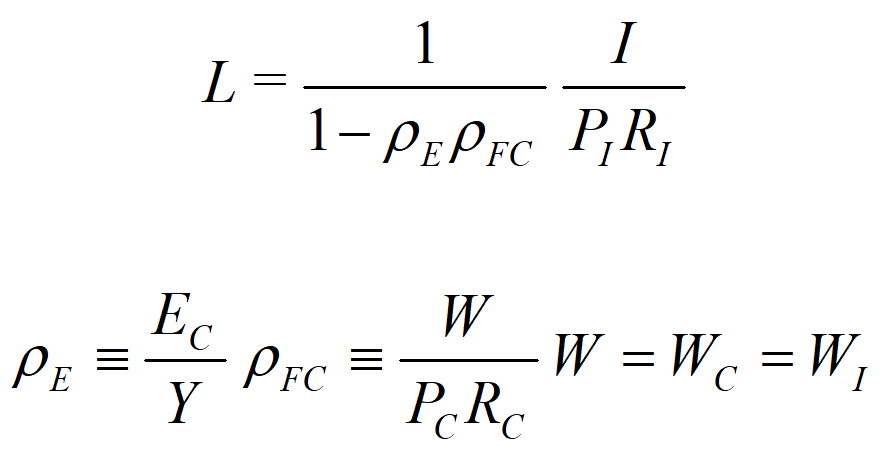
From the axiomatically correct macroeconomic Employment Law #1 follows that employment L depends (i) on aggregate demand, which is here given with the expenditure ratio ρE and investment expenditures I, and (ii), on the price mechanism, which is formally embodied in the macro-ratio ρF≡W/PR with W = average wage rate, P = average price, and R = average productivity.
Let ρE, and I be fixed, and the rate of change of productivity R for simplicity be zero, i.e., r=0, then there are three logical cases:
(i) The rate of change of the wage rate W is equal to the rate of change of the price P, i.e., w=p, then employment does NOT change, NO MATTER how big or small the rates of change are.
(ii) If the rate of change of the wage rate is greater than the rate of change of the price, then employment INCREASES.
(iii) If the rate of change in the wage rate is lower than the rate of change in the price, then employment DECREASES.
So, it is DIFFERENCES in the rates of change in wage rate and price, and NOT the absolute magnitude of change that affects employment. Every perfectly SYNCHRONOUS inflation/deflation is employment-neutral, that is, employment sticks indefinitely where it actually is.
Perfectly synchronous inflation/deflation is, according to Simon Wren-Lewis, “what economists mean by inflation”. Synchronous=employment neutral inflation, though, is a LIMITING case that occurs with a probability close to ZERO.
In general terms, the neutrality condition reads w=p+r+pr. Therefore, it is a matter of indifference whether the wage rate falls or rises, or whether wages are sticky or not. It ALL depends on relative changes. Employment increases if w is greater than p+r+pr and decreases in the opposite case.
So, what is needed in the present situation is asynchronous inflation, more specifically, w greater than r and p=0. This also increases the multiplier effect of expansive fiscal policy. Increases in the average wage rate have to take the lead.
Egmont Kakarot-Handtke
#1 The elementary version of the correct (objective, systemic, behavior-free, macrofounded) Employment Law is given with Graphic AXEC62b
Blog-Reference and Blog-Reference on Jun 22
Simon Wren-Lewis clarifies: “When I recently wrote about increasing the inflation target, I knew I would get at least one comment saying wouldn’t this reduce real wages even further. As I always do, I explained that raising the inflation target should raise the rate of increase of all nominal quantities by the same amount, which is what economists mean by inflation. But it seems the same basic point has to be made to these three members of the MPC too: inflation is not just the rate of change of the consumer price index.”
What economists mean by inflation is false, and this is relevant to the relationship between inflation and employment.
From the axiomatically correct macroeconomic Employment Law #1 follows that employment L depends (i) on aggregate demand, which is here given with the expenditure ratio ρE and investment expenditures I, and (ii), on the price mechanism, which is formally embodied in the macro-ratio ρF≡W/PR with W = average wage rate, P = average price, and R = average productivity.
Let ρE, and I be fixed, and the rate of change of productivity R for simplicity be zero, i.e., r=0, then there are three logical cases:
(i) The rate of change of the wage rate W is equal to the rate of change of the price P, i.e., w=p, then employment does NOT change, NO MATTER how big or small the rates of change are.
(ii) If the rate of change of the wage rate is greater than the rate of change of the price, then employment INCREASES.
(iii) If the rate of change in the wage rate is lower than the rate of change in the price, then employment DECREASES.
So, it is DIFFERENCES in the rates of change in wage rate and price, and NOT the absolute magnitude of change that affects employment. Every perfectly SYNCHRONOUS inflation/deflation is employment-neutral, that is, employment sticks indefinitely where it actually is.
Perfectly synchronous inflation/deflation is, according to Simon Wren-Lewis, “what economists mean by inflation”. Synchronous=employment neutral inflation, though, is a LIMITING case that occurs with a probability close to ZERO.
In general terms, the neutrality condition reads w=p+r+pr. Therefore, it is a matter of indifference whether the wage rate falls or rises, or whether wages are sticky or not. It ALL depends on relative changes. Employment increases if w is greater than p+r+pr and decreases in the opposite case.
So, what is needed in the present situation is asynchronous inflation, more specifically, w greater than r and p=0. This also increases the multiplier effect of expansive fiscal policy. Increases in the average wage rate have to take the lead.
Egmont Kakarot-Handtke
#1 The elementary version of the correct (objective, systemic, behavior-free, macrofounded) Employment Law is given with Graphic AXEC62b
May 3, 2023
Occasional Tweets: Stupidity is not funny ― time to get Employment Theory right
#DearIdiots#LearnEcon#Employment
— E.K-H (@AXECorg) May 3, 2023
The axiomatically correct macroeconomic #EmploymentLaw tells one that #Employment L increases with #DeficitSpendingMoneyCreation ρE>1 & decreases if the avg price P rises faster than the avg wage rate W. → cross-refhttps://t.co/gjD0JomQtf pic.twitter.com/C6MkuTjpn8
August 31, 2021
Occasional Tweets: Employment theory ― proto-scientific garbage for 200+ years
#Economics#FailedScience#FakeScience#Economists#StupidOrCorruptOrBoth#EmploymentTheory is proto-scientific garbage for 200+ years.
— E.K-H (@AXECorg) August 31, 2021
Keynes’ Employment Function and the Gratuitous Phillips Curve Disasterhttps://t.co/fYComRqFX3
For details of the big picture see cross-references Employment/Phillips Curve and cross-references Scientific Incompetence.
June 25, 2017
Economics and the Fallacy of Insufficient Abstraction
Comment on Sandwichman on ‘'If There Is Any Such Thing': Why read Hoxie on theory?’
Blog-Reference
What is the core problem of economics? Bagehot made it clear back in 1885: “It [Political Economy] is an abstract science which labours under a special hardship. Those who are conversant with its abstractions are usually without a true contact with its facts; those who are in contact with its facts have usually little sympathy with and little cognisance of its abstractions. Literary men who write about it are constantly using what a great teacher calls ‘unreal words,’ ― that is, they are using expressions with which they have no complete vivid picture to correspond. They are like physiologists who have never dissected; like astronomers who have never seen the stars; and, is consequence, just when they seem to be reasoning at their best, their knowledge of the facts falls short. Their primitive picture fails them, and their deduction altogether misses the mark ― sometimes, indeed, goes astray so far, that those who live and move among the facts boldly say that they cannot comprehend ‘how any one can talk such nonsense.’ Yet, on the other hand, these people who live and move among the facts often, or mostly, cannot of themselves put together any precise reasonings about them.”
This, though, was not news because J. S. Mill already reported in 1874 about the two classes of inquirers.
“It has been again and again demonstrated, that those who are accused of despising facts and disregarding experience build and profess to build wholly upon facts and experience; while those who disavow theory cannot make one step without theorizing. But, although both classes of inquirers do nothing but theorize, and both of them consult no other guide than experience, there is this difference between them, and a most important difference it is: that those who are called practical men require specific experience, and argue wholly upwards from particular facts to a general conclusion; while those who are called theorists aim at embracing a wider field of experience, and, having argued upwards from particular facts to a general principle including a much wider range than that of the question under discussion, then argue downwards from that general principle to a variety of specific conclusions.”
Bottom line: There are two types of economists, the upwarders and downwarders. This distinction overlaps with the distinction between induction and deduction, which in turn overlaps with the distinction between practitioners and theoreticians.
The core problem of economics is that neither upwarders nor downwarders were particularly successful. After 200+ years, economics is still at the proto-scientific level.
Methodologically, unionists are upwarders: “Unionists are not theorists; unionism is an eminently practical thing.” (Hoxie). “Theory and trade unionism are almost contradictory terms.” (Arnos) As a result, unionists have no true theory of how the economy works and how the aggregate labor and product markets interact. In other words, union policy never had sound scientific foundations but always remained glued to the phenomenological surface. Unionists did not realize what Marx already clearly saw: “That in their appearances things are often presented in an inverted way is something fairly familiar in every science, apart from political economy.”
Because they have always been glued to the immediately practical of the here and now, unionists have never figured out what profit is. #1 As collateral damage, they got stuck at the naive concept of exploitation and never arrived at the concept of crossover exploitation. #2
The fact is that the myopic upwarders, i.e., ‘these people who live and move among the facts’, i.e., labor and business, never arrived at a consistent profit and employment theory. But, and this is one of the worst scientific scandals in human history, neither did Walrasians, Keynesians, Marxians, nor Austrians. #3
Both the upwarders and downwarders fell victim to the Fallacy of Insufficient Abstraction and failed to explain how the actual economy and the labor market work. Time to throw Hoxi’s and Marshall’s and Walras’ and Keynes’ employment theories on the big heap of proto-scientific garbage. #4
Egmont Kakarot-Handtke
#1 Profit for Marxists
#2 The thing with profit and exploitation
#3 Unemployment ― the fatal consequence of economists’ scientific incompetence and Have data, lack theory
#4 For the correct approach, see The role of labor and business in a well-organized society
Related 'Rethinking the Phillips curve' and 'Attention: there are THREE types of inflation' and 'Economic bungee jumping without cord'. For details of the big picture, see cross-references Employment.
It is a characteristic trait of economics that problems are never solved but endlessly recycled. This explains why economics made no progress since Adam Smith: “... we know little more now about ‘how the economy works,’ ... than we knew in 1790, after Adam Smith completed the last revision of The Wealth of Nations.” (Clower).
Economics is a bit like Nietzsche’s Éternel Retour de la pensée la plus lourde. Among the best-known examples are capital theory, I=S, Lump of Labor Theory, Say’s Law, and Profit Theory. These are monuments of the scientific incompetence of economists.
Your recycling of these issues is a waste of time. Obviously, it escaped your attention that the correct profit and employment theory is available on EconoSpeak and elsewhere. For analytical entry points, see:
Economics and the Fallacy of Insufficient Abstraction
The role of labor and business in a well-organized society
Essentials of Constructive Heterodoxy: Say's Law
The Three Fatal Mistakes of Yesterday Economics: Profit, I=S, Employment
Blog-Reference
What is the core problem of economics? Bagehot made it clear back in 1885: “It [Political Economy] is an abstract science which labours under a special hardship. Those who are conversant with its abstractions are usually without a true contact with its facts; those who are in contact with its facts have usually little sympathy with and little cognisance of its abstractions. Literary men who write about it are constantly using what a great teacher calls ‘unreal words,’ ― that is, they are using expressions with which they have no complete vivid picture to correspond. They are like physiologists who have never dissected; like astronomers who have never seen the stars; and, is consequence, just when they seem to be reasoning at their best, their knowledge of the facts falls short. Their primitive picture fails them, and their deduction altogether misses the mark ― sometimes, indeed, goes astray so far, that those who live and move among the facts boldly say that they cannot comprehend ‘how any one can talk such nonsense.’ Yet, on the other hand, these people who live and move among the facts often, or mostly, cannot of themselves put together any precise reasonings about them.”
This, though, was not news because J. S. Mill already reported in 1874 about the two classes of inquirers.
“It has been again and again demonstrated, that those who are accused of despising facts and disregarding experience build and profess to build wholly upon facts and experience; while those who disavow theory cannot make one step without theorizing. But, although both classes of inquirers do nothing but theorize, and both of them consult no other guide than experience, there is this difference between them, and a most important difference it is: that those who are called practical men require specific experience, and argue wholly upwards from particular facts to a general conclusion; while those who are called theorists aim at embracing a wider field of experience, and, having argued upwards from particular facts to a general principle including a much wider range than that of the question under discussion, then argue downwards from that general principle to a variety of specific conclusions.”
Bottom line: There are two types of economists, the upwarders and downwarders. This distinction overlaps with the distinction between induction and deduction, which in turn overlaps with the distinction between practitioners and theoreticians.
The core problem of economics is that neither upwarders nor downwarders were particularly successful. After 200+ years, economics is still at the proto-scientific level.
Methodologically, unionists are upwarders: “Unionists are not theorists; unionism is an eminently practical thing.” (Hoxie). “Theory and trade unionism are almost contradictory terms.” (Arnos) As a result, unionists have no true theory of how the economy works and how the aggregate labor and product markets interact. In other words, union policy never had sound scientific foundations but always remained glued to the phenomenological surface. Unionists did not realize what Marx already clearly saw: “That in their appearances things are often presented in an inverted way is something fairly familiar in every science, apart from political economy.”
Because they have always been glued to the immediately practical of the here and now, unionists have never figured out what profit is. #1 As collateral damage, they got stuck at the naive concept of exploitation and never arrived at the concept of crossover exploitation. #2
The fact is that the myopic upwarders, i.e., ‘these people who live and move among the facts’, i.e., labor and business, never arrived at a consistent profit and employment theory. But, and this is one of the worst scientific scandals in human history, neither did Walrasians, Keynesians, Marxians, nor Austrians. #3
Both the upwarders and downwarders fell victim to the Fallacy of Insufficient Abstraction and failed to explain how the actual economy and the labor market work. Time to throw Hoxi’s and Marshall’s and Walras’ and Keynes’ employment theories on the big heap of proto-scientific garbage. #4
Egmont Kakarot-Handtke
#1 Profit for Marxists
#2 The thing with profit and exploitation
#3 Unemployment ― the fatal consequence of economists’ scientific incompetence and Have data, lack theory
#4 For the correct approach, see The role of labor and business in a well-organized society
Related 'Rethinking the Phillips curve' and 'Attention: there are THREE types of inflation' and 'Economic bungee jumping without cord'. For details of the big picture, see cross-references Employment.
***
ADDENDUM to Sandwichman on Jun 26It is a characteristic trait of economics that problems are never solved but endlessly recycled. This explains why economics made no progress since Adam Smith: “... we know little more now about ‘how the economy works,’ ... than we knew in 1790, after Adam Smith completed the last revision of The Wealth of Nations.” (Clower).
Economics is a bit like Nietzsche’s Éternel Retour de la pensée la plus lourde. Among the best-known examples are capital theory, I=S, Lump of Labor Theory, Say’s Law, and Profit Theory. These are monuments of the scientific incompetence of economists.
Your recycling of these issues is a waste of time. Obviously, it escaped your attention that the correct profit and employment theory is available on EconoSpeak and elsewhere. For analytical entry points, see:
Economics and the Fallacy of Insufficient Abstraction
The role of labor and business in a well-organized society
Essentials of Constructive Heterodoxy: Say's Law
The Three Fatal Mistakes of Yesterday Economics: Profit, I=S, Employment
December 31, 2014
Deflation, saving, and employment
Comment on Asad Zaman on 'Why does aggregate demand collapse?'
Blog-Reference
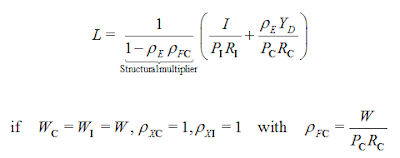
Of course, you are right that deflation may become a problem. The crucial point is that the popular idea of the functioning of the price mechanism is mistaken. What is needed first is the correct price theory (2014), which delivers the correct Employment Law (2014b, p. 9, eq. (22)). Roughly speaking, if the product price (for the economy as a whole) falls faster than the wage rate, the employment effect is positive under the condition that all other parameters remain unchanged. If the wage rate falls faster, the employment effect is negative. On closer inspection, it turns out that there are two types of deflation. As you rightly pointed out, there are also secondary effects on the real value of debt, but this is a separate issue. Resume: Neoclassical economics got the price mechanism wrong.
Of course, Wolfgang Waldner is also right. If the relation between saving and income increases, the employment effect is negative.
All these effects are captured by the Employment Law, see Graphic AXEC07 and (2014b, p. 9, eq. (22)).
Blog-Reference
Of course, Wolfgang Waldner is also right. If the relation between saving and income increases, the employment effect is negative.
All these effects are captured by the Employment Law, see Graphic AXEC07 and (2014b, p. 9, eq. (22)).

July 30, 2019
Right policy depends on true theory
Comment on Barkley Rosser on ‘Origin of the 2 Percent Inflation Target’
Blog-Reference and Blog-Reference
Barkley Rosser reports: “In the mid-90s the US grew better than it had previously, and in the middle of the decade there was an important moment regarding policy. There was no inflation directive but Fed Chair Greenspan was facing a de facto such directive based on central Fed estimates that there was a known ‘natural rate of unemployment (= NAIRU)’ that must not be passed. As it was then Fed Gov Janet Yellen in the mid 90s convinced Greenspan not to raise interest rates partly because of a paper by her husband, Noblelist George Akerlof.”
The NAIRU Phillips Curve is the centerpiece of standard employment theory. Economists have been getting employment theory wrong for 200+ years now. This has dire consequences for economic policy and ultimately for WeThePeople.
“In order to tell the politicians and practitioners something about causes and best means, the economist needs the true theory or else he has not much more to offer than educated common sense or his personal opinion.” (Stigum)
Economists do not have the true theory. By consequence, economic policy guidance has NO sound scientific foundations. This holds from Adam Smith onward to the policy of the Federal Reserve.
The NAIRU Phillips Curve has always been proto-scientific garbage. #1 The correct (macrofounded, systemic, behavior-free, testable) employment theory boils down to the structural-systemic Phillips Curve, which is shown here. #2

The equation says that unemployment u is the dependent variable, and the expenditure ratio ρE≡C/Y, the factor cost ratio ρF≡W/PR, investment expenditures I, (average) productivity R, and (average) price P in the consumption and investment goods industries are the independent variables. The variables ρE and I are, in turn, influenced by interest rates. Translated into policy, the equation says that in order to control employment, the independent variables have to be controlled.
From the macroeconomic Employment Law follows:
(i) An increase in the expenditure ratio ρE leads to higher employment L.
(ii) Increasing investment expenditures I exert a positive influence on employment.
(iii) An increase in the factor cost ratio ρE≡W/PR leads to higher employment.
The complete Employment Law contains, in addition, profit distribution, the public sector, and foreign trade.
Items (i) and (ii) cover the familiar arguments about aggregate demand/deficit spending. The factor cost ratio ρF, as defined in (iii), embodies the macroeconomic price mechanism. The fact of the matter is that overall employment INCREASES if the average wage rate W INCREASES relative to the average price P and productivity R. Or, the other way round, overall employment DECREASES if the average price P INCREASES relative to the average wage rate W with productivity R unchanged. Roughly speaking, price inflation is bad for employment, and wage inflation is good.
This is the exact opposite of what standard economics teaches: “We economists have all learned, and many of us teach, that the remedy for excess supply in any market is a reduction in price. If this is prevented by combinations in restraint of trade or by government regulations, then those impediments to competition should be removed. Applied to economy-wide unemployment, this doctrine places the blame on trade unions and governments, not on any failure of competitive markets.” (Tobin)
The testable Employment Law tells one that the best policy to stabilize employment at a high level is price inflation of zero and wage inflation equal to productivity increases. The 2 percent inflation target has always been political idiocy.
Egmont Kakarot-Handtke
#1 For details of the big picture, see cross-references Employment/Phillips Curve
#2 Graphic AXEC36 Structural-systemic Phillips Curve
Continuing your theatrical performance, you exclaim: “Oh, Egmont, in the end you say all this is empirically testable, but you simply do not cite a single empirical test that has been done, …”
From Samuelson’s bastard ‘Phillips’ Curve to the NAIRU ‘Phillips’ Curve, economists got employment theory wrong. #1, #2, #3
There were tons of tests of these misspecified curves, but there never was a test of the correct structural-systemic Phillips Curve for the simple reason that economists had no idea of it. #4 More specifically, economists never realized that the macroeconomic relationship between employment and (average) wage rate is positive despite the fact that this is what the original Phillips Curve said based on “more than a century’s worth of data for the United Kingdom” (Phillips).
Because economists without exception have tested misspecified ‘Phillips’ Curves, it is impossible for anyone to cite a valid test. For the same reason, you cannot cite a single test that refutes the objective-structural-systemic-behavior-free-macrofounded Phillips Curve, which implies the positive relationship between employment and wage rate of the empirically derived original Phillips Curve. #5
Note that Samuelson’s ‘Phillips’ Curve is a fake. #1 Phillips “had not made an explicit link between inflation and unemployment” (Ormerod). Phillips had empirically found a link between wage rate and unemployment that reappears in the structural-systemic Phillips Curve.
So, the original Phillips Curve delivers the strongest empirical support for the structural-systemic Phillips Curve that is available at the moment.
#1 NAIRU, wage-led growth, and Samuelson’s Dyscalculia
#2 NAIRU and the scientific incompetence of Orthodoxy and Heterodoxy
#3 NAIRU: an exhaustive dancing-angels-on-a-pinpoint blather
#4 Keynes’ Employment Function and the Gratuitous Phillips Curve Disaster
#5 Go! ― test the Profit and Employment Law
You say: “… the original Phillips Curve was a negative relationship between the rate of unemployment and the rate of change of wages, not the level of wages.”
Yes, indeed, and Samuelson messed the whole thing up: “The original curve was transformed by Samuelson with the simple formula: rate of inflation = rate of wage growth − rate of productivity growth (Samuelson and Nordhaus, 1998, p. 590); in our notation P'=W'−R'. This formula, according to Samuelson an ‘important piece of inflation arithmetic’, says that price inflation runs in tandem with wage inflation and that both have basically the same effect on employment, respectively, the rate of unemployment. The difference between the original and the bastard Phillips curve consists of a 1 percent productivity growth. This naïve arithmetical exercise led to the far-reaching policy conclusion that there exists an exploitable trade-off between inflation and unemployment.” #1 page 13, #2
The correct relationship between the rates of change is W'/P'R', which roughly says that an increasing wage rate W' increases employment/decreases unemployment, and that price increases P' reduce employment/increase unemployment. This means that there is NO trade-off between inflation and unemployment, just the opposite. The complete formula is derived in #1.
The axiomatically correct structural-systemic Phillips Curve (i) refutes the Bastard/NAIRU Phillips Curve, (ii) contains NO methodological idiocies like rational expectations, (iii) consists exclusively of measurable variables, and (iii) is testable.
From the fact that economists have not yet tested the correct curve follows only that economists are either stupid or corrupt, or both. Of course, if you are NOT committed to scientific standards, you are free to ignore the refutation and to stay at the proto-scientific level and to continue to mislead students and to give counter-productive policy advice and remain a hazard to your fellow citizens.
#1 Keynes’ Employment Function and the Gratuitous Phillips Curve Disaster
#2 NAIRU, wage-led growth, and Samuelson’s Dyscalculia
Blog-Reference and Blog-Reference
Barkley Rosser reports: “In the mid-90s the US grew better than it had previously, and in the middle of the decade there was an important moment regarding policy. There was no inflation directive but Fed Chair Greenspan was facing a de facto such directive based on central Fed estimates that there was a known ‘natural rate of unemployment (= NAIRU)’ that must not be passed. As it was then Fed Gov Janet Yellen in the mid 90s convinced Greenspan not to raise interest rates partly because of a paper by her husband, Noblelist George Akerlof.”
The NAIRU Phillips Curve is the centerpiece of standard employment theory. Economists have been getting employment theory wrong for 200+ years now. This has dire consequences for economic policy and ultimately for WeThePeople.
“In order to tell the politicians and practitioners something about causes and best means, the economist needs the true theory or else he has not much more to offer than educated common sense or his personal opinion.” (Stigum)
Economists do not have the true theory. By consequence, economic policy guidance has NO sound scientific foundations. This holds from Adam Smith onward to the policy of the Federal Reserve.
The NAIRU Phillips Curve has always been proto-scientific garbage. #1 The correct (macrofounded, systemic, behavior-free, testable) employment theory boils down to the structural-systemic Phillips Curve, which is shown here. #2

From the macroeconomic Employment Law follows:
(i) An increase in the expenditure ratio ρE leads to higher employment L.
(ii) Increasing investment expenditures I exert a positive influence on employment.
(iii) An increase in the factor cost ratio ρE≡W/PR leads to higher employment.
The complete Employment Law contains, in addition, profit distribution, the public sector, and foreign trade.
Items (i) and (ii) cover the familiar arguments about aggregate demand/deficit spending. The factor cost ratio ρF, as defined in (iii), embodies the macroeconomic price mechanism. The fact of the matter is that overall employment INCREASES if the average wage rate W INCREASES relative to the average price P and productivity R. Or, the other way round, overall employment DECREASES if the average price P INCREASES relative to the average wage rate W with productivity R unchanged. Roughly speaking, price inflation is bad for employment, and wage inflation is good.
This is the exact opposite of what standard economics teaches: “We economists have all learned, and many of us teach, that the remedy for excess supply in any market is a reduction in price. If this is prevented by combinations in restraint of trade or by government regulations, then those impediments to competition should be removed. Applied to economy-wide unemployment, this doctrine places the blame on trade unions and governments, not on any failure of competitive markets.” (Tobin)
The testable Employment Law tells one that the best policy to stabilize employment at a high level is price inflation of zero and wage inflation equal to productivity increases. The 2 percent inflation target has always been political idiocy.
Egmont Kakarot-Handtke
#1 For details of the big picture, see cross-references Employment/Phillips Curve
#2 Graphic AXEC36 Structural-systemic Phillips Curve
***
REPLY to Barkley Rosser on Jul 31Continuing your theatrical performance, you exclaim: “Oh, Egmont, in the end you say all this is empirically testable, but you simply do not cite a single empirical test that has been done, …”
From Samuelson’s bastard ‘Phillips’ Curve to the NAIRU ‘Phillips’ Curve, economists got employment theory wrong. #1, #2, #3
There were tons of tests of these misspecified curves, but there never was a test of the correct structural-systemic Phillips Curve for the simple reason that economists had no idea of it. #4 More specifically, economists never realized that the macroeconomic relationship between employment and (average) wage rate is positive despite the fact that this is what the original Phillips Curve said based on “more than a century’s worth of data for the United Kingdom” (Phillips).
Because economists without exception have tested misspecified ‘Phillips’ Curves, it is impossible for anyone to cite a valid test. For the same reason, you cannot cite a single test that refutes the objective-structural-systemic-behavior-free-macrofounded Phillips Curve, which implies the positive relationship between employment and wage rate of the empirically derived original Phillips Curve. #5
Note that Samuelson’s ‘Phillips’ Curve is a fake. #1 Phillips “had not made an explicit link between inflation and unemployment” (Ormerod). Phillips had empirically found a link between wage rate and unemployment that reappears in the structural-systemic Phillips Curve.
So, the original Phillips Curve delivers the strongest empirical support for the structural-systemic Phillips Curve that is available at the moment.
#1 NAIRU, wage-led growth, and Samuelson’s Dyscalculia
#2 NAIRU and the scientific incompetence of Orthodoxy and Heterodoxy
#3 NAIRU: an exhaustive dancing-angels-on-a-pinpoint blather
#4 Keynes’ Employment Function and the Gratuitous Phillips Curve Disaster
#5 Go! ― test the Profit and Employment Law
***
REPLY to Barkley Rosser on Aug 1You say: “… the original Phillips Curve was a negative relationship between the rate of unemployment and the rate of change of wages, not the level of wages.”
Yes, indeed, and Samuelson messed the whole thing up: “The original curve was transformed by Samuelson with the simple formula: rate of inflation = rate of wage growth − rate of productivity growth (Samuelson and Nordhaus, 1998, p. 590); in our notation P'=W'−R'. This formula, according to Samuelson an ‘important piece of inflation arithmetic’, says that price inflation runs in tandem with wage inflation and that both have basically the same effect on employment, respectively, the rate of unemployment. The difference between the original and the bastard Phillips curve consists of a 1 percent productivity growth. This naïve arithmetical exercise led to the far-reaching policy conclusion that there exists an exploitable trade-off between inflation and unemployment.” #1 page 13, #2
The correct relationship between the rates of change is W'/P'R', which roughly says that an increasing wage rate W' increases employment/decreases unemployment, and that price increases P' reduce employment/increase unemployment. This means that there is NO trade-off between inflation and unemployment, just the opposite. The complete formula is derived in #1.
The axiomatically correct structural-systemic Phillips Curve (i) refutes the Bastard/NAIRU Phillips Curve, (ii) contains NO methodological idiocies like rational expectations, (iii) consists exclusively of measurable variables, and (iii) is testable.
From the fact that economists have not yet tested the correct curve follows only that economists are either stupid or corrupt, or both. Of course, if you are NOT committed to scientific standards, you are free to ignore the refutation and to stay at the proto-scientific level and to continue to mislead students and to give counter-productive policy advice and remain a hazard to your fellow citizens.
#1 Keynes’ Employment Function and the Gratuitous Phillips Curve Disaster
#2 NAIRU, wage-led growth, and Samuelson’s Dyscalculia
February 24, 2023
Occasional Tweets: Inflation ― the Fed has no idea how the economic system works
#LearnEconomics#Employment#Price#Wage
— E.K-H (@AXECorg) February 24, 2023
The axiomatically correct macroeconomic #EmploymentLaw tells one that #Employment L decreases (#UnEmployment increases) if the product price P rises faster than the wage rate W. See cross-referenceshttps://t.co/gjD0JomQtf pic.twitter.com/uC6gnMulFI
March 10, 2015
Economists: stop dreaming and waffling and do your scientific homework
Comment on John Komlos on ‘America can be a full-employment economy once again’
Blog-Reference
John Komlos writes: “Isn’t it strange that full employment has to be a dream, even a quarter millennium after the beginning of our stupendous surge in wealth with the Industrial Revolution? But what is full employment? Well, it’s simple enough, isn’t it? An economy in which there are enough jobs to go around for everyone.”
In a well-functioning market economy, all factors, including labor, are fully employed. This is what standard economic theory asserts. Obviously, this is regularly not the case, meaning that the theory of employment is empirically refuted.
Being non-genuine scientists, economists simply ignore refutation. This has been a normal operating procedure since time immemorial, and more than one methodologist has condemned it.
“In economics we should strive to proceed, wherever we can, exactly according to the standards of the other, more advanced, sciences, where it is not possible, once an issue has been decided, to continue to write about it as if nothing had happened.” (Morgenstern, 1941, pp. 369-370)
This is exactly what we observe: endless writing and waffling about the natural rate of unemployment.
The empirically testable Employment Law for the investment economy is shown with Graphic AXEC07

Employment L depends mainly on investment expenditures I, the expenditure ratio rhoE, and on the price mechanism, which is embodied in the factor cost ratio rhoF. If this ratio increases, employment increases (all other variables held constant).
The price mechanism, i.e., the factor cost ratio, which consists of wage rate, price, and productivity, should regulate itself, such that full employment results under the condition that I and rhoE (= aggregate demand) are given. The fact of the matter is that the price mechanism does not work as the representative economist thinks it works, and this has nothing to do with market imperfections, or stickiness, expectations, or uncertainty (for details see 2014a; 2014b; 2012).
Orthodox employment theory is false and has to be replaced.
Egmont Kakarot-Handtke
References Kakarot-Handtke, E. (2012). Keynes’s Employment Function and the Gratuitous Phillips Curve Disaster. SSRN Working Paper Series, 2130421: 1–19. URL
Kakarot-Handtke, E. (2014a). The Three Fatal Mistakes of Yesterday Economics: Profit, I=S, Employment. SSRN Working Paper Series, 2489792: 1–13. URL
Kakarot-Handtke, E. (2014b). Towards Full Employment Through Applied Algebra and Counter-Intuitive Behavior. SSRN Working Paper Series, 2456184: 1–25. URL
Morgenstern, O. (1941). Professor Hicks on Value and Capital. Journal of Political Economy, 49(3): 361–393. URL
Blog-Reference
John Komlos writes: “Isn’t it strange that full employment has to be a dream, even a quarter millennium after the beginning of our stupendous surge in wealth with the Industrial Revolution? But what is full employment? Well, it’s simple enough, isn’t it? An economy in which there are enough jobs to go around for everyone.”
In a well-functioning market economy, all factors, including labor, are fully employed. This is what standard economic theory asserts. Obviously, this is regularly not the case, meaning that the theory of employment is empirically refuted.
Being non-genuine scientists, economists simply ignore refutation. This has been a normal operating procedure since time immemorial, and more than one methodologist has condemned it.
“In economics we should strive to proceed, wherever we can, exactly according to the standards of the other, more advanced, sciences, where it is not possible, once an issue has been decided, to continue to write about it as if nothing had happened.” (Morgenstern, 1941, pp. 369-370)
This is exactly what we observe: endless writing and waffling about the natural rate of unemployment.
The empirically testable Employment Law for the investment economy is shown with Graphic AXEC07

Employment L depends mainly on investment expenditures I, the expenditure ratio rhoE, and on the price mechanism, which is embodied in the factor cost ratio rhoF. If this ratio increases, employment increases (all other variables held constant).
The price mechanism, i.e., the factor cost ratio, which consists of wage rate, price, and productivity, should regulate itself, such that full employment results under the condition that I and rhoE (= aggregate demand) are given. The fact of the matter is that the price mechanism does not work as the representative economist thinks it works, and this has nothing to do with market imperfections, or stickiness, expectations, or uncertainty (for details see 2014a; 2014b; 2012).
Orthodox employment theory is false and has to be replaced.
Egmont Kakarot-Handtke
References Kakarot-Handtke, E. (2012). Keynes’s Employment Function and the Gratuitous Phillips Curve Disaster. SSRN Working Paper Series, 2130421: 1–19. URL
Kakarot-Handtke, E. (2014a). The Three Fatal Mistakes of Yesterday Economics: Profit, I=S, Employment. SSRN Working Paper Series, 2489792: 1–13. URL
Kakarot-Handtke, E. (2014b). Towards Full Employment Through Applied Algebra and Counter-Intuitive Behavior. SSRN Working Paper Series, 2456184: 1–25. URL
Morgenstern, O. (1941). Professor Hicks on Value and Capital. Journal of Political Economy, 49(3): 361–393. URL
July 30, 2023
Occasional Tweets: How it works (XIV)
#Economics#FailedFakeScience
— E.K-H (@AXECorg) July 29, 2023
'Look, I am an #Economist, & we folks do not understand for 200+ yrs that the macroeconomic #EmploymentLaw implies higher prices P = lower employment L & I am interested in how you're are feeling about that.' Cross-ref ⇒https://t.co/gjD0JomQtf pic.twitter.com/rEHfGg19qa
Subscribe to:
Posts (Atom)