September 8, 2016

Putting the production function back on its feet

Comment on Steve Keen on ‘Incorporating energy into production functions’

Blog-Reference

Orthodox economics messed up the theory of production, but Heterodoxy never developed a viable replacement despite the fact that, with Georgescu-Roegen’s approach, it had already been on the right track (1970; 1971). Georgescu-Roegen was quite clear about “... the completely faulty form by which standard economics represents a production process” (1979, p. 318), but he failed to see that it was not enough to rectify the theory of production. What had to be replaced then and still has to be done is to scrap standard economics as a WHOLE. Partial improvements are as pointless as adding just another epicycle to the geocentric model. Nothing less than a Paradigm Shift will do.

The whole analytical superstructure of Orthodoxy is based upon this set of hardcore propositions a.k.a. axioms:
HC1 There exist economic agents.
HC2 Agents have preferences over outcomes.
HC3 Agents independently optimize subject to constraints.
HC4 Choices are made in interrelated markets.
HC5 Agents have full relevant knowledge.
HC6 Observable economic outcomes are coordinated, so they must be discussed with reference to equilibrium states. (Weintraub, 1985, p. 109)

HC3 introduces marginalism, which is the all-pervasive principle of Orthodoxy. Needless to emphasize that marginalism is proto-scientific garbage.

In order to be applicable, marginalism requires some auxiliary assumptions. One of them is the concept of a well-behaved production function. This concept implicitly excludes increasing returns (2011a). As every economist knows from Adam Smith’s pin factory, though, the beauty and triumph of capitalism consist exactly of increasing returns due to the division of labor and the mechanization of a growing number of sub-processes.

Thus, the green-cheese behavioral assumption HC3 ultimately determines the analytical representation of the physically objective production process: “Indeed, here we find the neoclassical economist dictating the laws of physics to the physicist!” (Mirowski, 1995, p. 328). It is impossible to surpass the scientific incompetence of economists.

Steve Keen is perfectly right: “Arguably, therefore, the production functions used in economic theory — whether spouted by mainstream Neoclassical or non-orthodox Post Keynesians — deserve to ‘collapse in deepest humiliation.’" In very practical terms, this means that NO economic journal can accept papers that contain a Cobb-Douglas or any other well-behaved production function without violating scientific standards.

All these half measures, though, do not cut much ice. The very task of constructive Heterodoxy is to fully replace Orthodoxy as defined by HC1/HC6 and by implication the obsolete production function. For the correct approach and the correct sequential production function, see (2011b, Sec. 4).

Egmont Kakarot-Handtke


References
Georgescu-Roegen, N. (1970). The Economics of Production. American Economic Review, Papers and Proceedings, 60(2): 1–9. URL
Georgescu-Roegen, N. (1971). The Entropy Law and the Economic Process. Cambridge: Cambridge University Press.
Georgescu-Roegen, N. (1979). Methods in Economic Science. Journal of Economic
Issues, 13(2): 317–328. URL
Kakarot-Handtke, E. (2011a). Increasing Returns and Stability. SSRN Working Paper Series, 1921267: 1–19. URL
Kakarot-Handtke, E. (2011b). Matter Matters: Productivity, Resources, and Prices. SSRN Working Paper Series, 1946874: 1–21. URL
Mirowski, P. (1995). More Heat than Light. Cambridge: Cambridge University Press.
Weintraub, E. R. (1985). General Equilibrium Analysis. Cambridge, London, New York, etc.: Cambridge University Press.

For more about the production function, see AXECquery.

***

Graphic AXEC106m


***

Twitter/X Oct 22, 2026 Joan Robinson about the methodological idiocy of the legacy production function

September 7, 2016

Causa finita: the end of I=S/IS-LM

Comment on Lars Syll on ‘Hicks’ misrepresentation of Keynes — the Wicksellian connection’

Blog-Reference and Blog-Reference on Sep 11 and Blog-Reference on Sep 23 adapted to context 

Keynes formulated the formal core of the General Theory as follows: “Income = value of output = consumption + investment. Saving = income − consumption. Therefore saving = investment.” (1973, p. 63)

This elementary syllogism is conceptually defective because Keynes never came to grips with profit (Tómasson et al., 2010, p. 12). As a result, (i) all I=S models and the Keynesian multiplier are false (2011), (ii) the Wicksellian interest rate mechanism is false, (iii) the theory of interest is false, and (iv) Hicks’s/Krugman’s/Farmer's IS-LM models are false (2014).

The periodic rewarming of the I=S/IS-LM debate of the 1930s is only good for one thing: to demonstrate the abysmal scientific incompetence of both orthodox and heterodox economists. For details, see cross-references Refutation of I=S.

Egmont Kakarot-Handtke


References
Kakarot-Handtke, E. (2011). Why Post Keynesianism is Not Yet a Science. SSRN Working Paper Series, 1966438: 1–20. URL
Kakarot-Handtke, E. (2014). Mr. Keynes, Prof. Krugman, IS-LM, and the End of Economics as We Know It. SSRN Working Paper Series, 2392856: 1–19. URL
Keynes, J. M. (1973). The General Theory of Employment Interest and Money. Basingstoke: Macmillan.
Tómasson, G., and Bezemer, D. J. (2010). What is the Source of Profit and Interest? A Classical Conundrum Reconsidered. MPRA Paper, 20557: 1–34. URL

Related 'Wikipedia, economics, scientific knowledge, or political agenda pushing?' and Ch. 13, The indelible scientific disgrace of economics, in Sovereign Economics

For more about I=S see AXECquery.

***
Graphic AXEC172

September 6, 2016

False and true economic laws

Comment on Sandwichman on ‘The Outlaws of Political Economy’

Blog-Reference

The founding fathers were straightforward people and called themselves political economists; that is, they left no doubt that their main business was agenda pushing. They were, though, well aware that it helps much to back up one’s soapbox arguments with some authority.

Moses established the prototype of political communication by claiming that God personally had spoken to him. Knowing his goat herders, the lawgiver did not forget to hint at severe punishment in case of violation. Thus, the meme of behavioral/social law was firmly implanted. Things changed fundamentally when the Greeks invented science and drew the demarcation line between belief/opinion/doxa and knowledge/episteme, which referred to the laws of Nature/Logic. After Newton and his wildly successful Law of Gravitation, it became clear to economists that the standards of argumentation had risen: storytelling had to be replaced by proof.

“Now there is simply no doubt that whatever was the source of inspiration for Jevons, Menger and Walras, all three invoked whatever physics they knew to lend prestige to their theoretical innovations. ... Adam Smith, Ricardo, James Mill and McCulloch had been just as eager in earlier days to invoke the name of Newton to legitimise their theoretical claims.” (Blaug, 1989, p. 1226)

Lacking a genuine understanding of science, though, economists borrowed only the outer form and thus established what Feynman famously called a cargo cult science. This is how the use of the concept of law became purely rhetorical in economics.

The foundational blunder of economics consists of applying the idea of scientific law to human behavior. There is NO such thing as behavioral law and this has been known to genuine scientists in all ages: “The bifurcation of motion into two fundamentally different types, one for natural motions of non-living objects and another for acts of human volition ... is obviously related to the issue of free will, and demonstrates the strong tendency of scientists in all ages to exempt human behavior from the natural laws of physics, and to regard motions resulting from human actions as original, in the sense that they need not be attributed to other motions.” (Brown, 2011, p. 211)

Economists are incompetent scientists and therefore never had much compunction to postulate/accept constrained optimization as their foundational behavioral law. The other methodological lunacy has been to take equilibrium into the set of foundational propositions a.k.a. axioms (Weintraub, 1985, p. 147).

Economics is NOT a science of behavior (Hudík, 2011). Economics is NOT a so-called social science like psychology/sociology, and NOT a natural science like physics. Economics is a systems science. A system is subject to systemic laws that have the same status as physical laws. The First Economic Law (2014b, eq. (12)) is shown by AXEC06:


There are systemic laws of different degrees of complexity, for instance, the Profit Law or the structural Law of Supply and Demand (2014a), but NO behavioral laws.

The representative economist never got the crucial methodological point, and this is why economics is a failed science. The provable fact of the matter is that the monetary economy is governed by systemic laws which are comprehensible to the scientific mind, which in turn EXCLUDES Walrasians, Keynesians, Marxians, Austrians in general, and Sandwichman in particular.

Egmont Kakarot-Handtke


References
Blaug, M. (1989). Review. Economic Journal, 99(398): 1225–1226. URL
Brown, K. (2011). Reflections on Relativity. Raleigh: Lulu.com.
Hudík, M. (2011). Why Economics is Not a Science of Behaviour. Journal of Economic Methodology, 18(2): 147–162.
Kakarot-Handtke, E. (2014a). The Law of Supply and Demand: Here it is Finally. SSRN Working Paper Series, 2481840: 1–17. URL
Kakarot-Handtke, E. (2014b). The Synthesis of Economic Law, Evolution, and History. SSRN Working Paper Series, 2500696: 1–22. URL
Weintraub, E. R. (1985). Joan Robinson’s Critique of Equilibrium: An Appraisal.American Economic Review, Papers and Proceedings, 75(2): 146–149. URL


***
REPLY to Roger on Sep 7

I did not say that Aristotle found all laws of physics, I said that the Greeks invented science which means, roughly speaking, they showed the difference between brainless political/religious blather and scientific truth and how to arrive at the latter: “When the premises are certain, true, and primary, and the conclusion formally follows from them, this is demonstration, and produces scientific knowledge of a thing. (Aristotle)

Here are the premises of orthodox economics: “HC1. There exist economic agents. HC2. Agents have preferences over outcomes. HC3. Agents independently optimize subject to constraints. HC4. Choices are made in interrelated markets. HC5. Agents have full relevant knowledge. HC6. Observable economic outcomes are coordinated, so they must be discussed with reference to equilibrium states.” (Weintraub, 1985)

These premises are provably false and cannot, by any stretch of the imagination produce scientific knowledge of how the actual economy works. The representative economist, though, swallows this rather obvious junk hook, line, and sinker for about 150 years. What he then produces are lengthy but pointless sitcoms like lump-of-labor, the capital controversy, saving-equals-investment, Say’s law, voluntary/involuntary unemployment, and so on.

The only thing the informed layperson has to know when she/he tries to make sense of the representative economist’s argument is: It isn’t science, it isn’t true, it is just another astounding rubbish from Econ 101. #1

#1 A paraphrase of K. Humphreys' standing bottom line.

September 4, 2016

Krugman is not an economist

Comment on Lars Syll on ‘Krugman’s gadget interpretation of economics’

Blog-Reference

Krugman has been refuted (2014). Keynes and the Post Keynesians have been refuted (2011). Traditional Heterodoxy has failed to replace these degenerate research programs with a progressive program. Economists have a realistic self-perception and know well that they will never get out from under the self-produced heap of scientific rubbish: “Yet most economists neither seek alternative theories nor believe that they can be found.” (Hausman, 1992, p. 248). The Malmö branch of Heterodoxy has even fallen into total apathy and reduced itself to the endless repetition of: ‘We know that we know nothing.’

Whether Krugman is entitled to call himself a New Keynesian is a matter of indifference outside the economics kindergarten. Krugman has nothing to offer in the way of scientific insights about how the actual economy works. He is a political economist, and political economics has not produced anything of scientific value in the last 200 years.

Walrasianism, Keynesianism, Marxianism, and Austrianism are materially/formally inconsistent, that is, provably false. The problem is that all four approaches are tied to political groups/interests and are used as a means of persuasion/propaganda/justification. The current versions of economics have no scientific raison d’être, merely some political utility.

When Krugman supports the Democrats, when Wren-Lewis and Keen support Corbyn, when Varoufakis fights for democratizing the Eurozone, does this have anything to do with science? What do they and Hayek and Keynes and Friedman have in common? NEITHER of these so-called economists has a scientifically valid theory about how the economy works.

Political economists have made economics a banana science. Krugman is a prominent representative of this aberration. From the position of constructive Heterodoxy, Krugman is outside of science, and his contributions to economics are sitcom stuff. #1 Science and politics do not mix, never have, and never will. Political economics is NOT economics.

Egmont Kakarot-Handtke


References
Hausman, D. M. (1992). The Inexact and Separate Science of Economics. Cambridge: Cambridge University Press.
Kakarot-Handtke, E. (2011). Why Post Keynesianism is Not Yet a Science. SSRN Working Paper Series, 1966438: 1–20. URL
Kakarot-Handtke, E. (2014). Mr. Keynes, Prof. Krugman, IS-LM, and the End of Economics as We Know It. SSRN Working Paper Series, 2392856: 1–19. URL

#1 For a map of current/future economics, see Graphic AXEC85

Related 'Links on Paul Krugman, proto-scientific impresario'. For details of the big picture, see cross-references Political Economics/Stupidity/Corruption and cross-references Scientific Incompetence.

For the after-election sequel, see Zero Hedge

***
COMMENT on Vladimir A. Masch on Sep 5

You overlooked what Napoleon said about economists: “Late in life, moreover, he claimed that he had always believed that if an empire were made of granite, the ideas of economists, if listened to, would suffice to reduce it to dust.” (Viner, 1963)

Economists in their abysmal incompetence were a public danger then, and in the interim, things have worsened. You say “Truth, untruth, who knows and cares.” This has always been the motto of political economists.

Newton stood on the shoulders of scientific giants, and economists stand since Adam Smith on the shoulders of political busybodies.#1 It suffices to look at who has achieved what in the last 200 years.


#1 For details of the big picture, see cross-references Scientific Incompetence.

September 3, 2016

Unemployment is the outcome of political economics

Comment on Sandwichman on ‘Did Jonathan Portes Cause Brexit?’

Blog-Reference

Sandwichman characterizes the lump-of-labor fallacy as follows: “The alleged belief is indeed false, as is the claim that support for the policy in question is motivated by it. The bogus fallacy claim was a staple of 19th-century anti-trades union propaganda.” (See intro)

The key point is that there is political economics and theoretical economics, and ALL political economics is proto-scientific dung.

To poke fun at the lump-of-labor fallacy is only a distraction from the real embarrassment, viz., that until this day, economists have no valid employment theory. Worse, most economists still believe that the wage rate must fall in order to establish full employment: “We economists have all learned, and many of us teach, that the remedy for excess supply in any market is a reduction in price.” (Tobin, 1997, p. 11)

Walrasian, Keynesian, Marxian, and Austrian economists are groping in the dark with regard to the two most important features of the market economy: the price mechanism and the profit mechanism. The fault lies in the fact that economists argue from false premises, that is, Walrasianism in all shapes and forms (DSGE, RBC, AD/AS, etc.) argues from unacceptable microfoundations, and Keynesianism in all shapes and forms argues from false macrofoundations. To get out of failed economics requires nothing less than a paradigm shift.

In the following, a sketch of the formally and empirically correct employment theory is given. A rather elementary version of the objective structural Employment Law (2012) is shown on Graphic AXEC62


From this equation follows inter alia:
(i) An increase in the expenditure ratio ρE leads to higher employment (the letter ρ stands for ratio). An expenditure ratio ρE greater than 1 indicates credit expansion, a ratio ρE less than 1 indicates credit contraction.
(ii) Increasing investment expenditures I exert a positive influence on employment; a slowdown of growth does the opposite.
(iii) An increase in the factor cost ratio ρF≡W/PR leads to higher employment.

The complete AND testable Employment Law is a bit longer and contains, in addition, profit distribution, public deficit spending, and import/export.

Items (i) and (ii) cover Keynes’ arguments about aggregate demand, which have been commonsensically right but formally defective. More precisely, Keynes’s multiplier is provably false (see 2012). The factor cost ratio ρF, as defined in (iii), embodies the price mechanism which works very differently from what the representative economist falsely assumes. As a matter of fact, overall employment (in the world economy or a closed national economy) INCREASES if the average wage rate W INCREASES relative to the average price P and productivity R.

For the relationship between real wage, productivity, profit, and real shares, see (2015, Sec. 10).

So, in simple terms, full employment (in any definition) can be achieved by increasing overall demand (expenditure ratio, investment expenditures, etc.) or by INCREASING the average wage rate or by a combination of the two.

Both the Walrasian and Keynesian approaches have produced COUNTERPRODUCTIVE policy advice. Unemployment is ultimately the result of theory failure, that is, of the utter scientific incompetence of economists.

Egmont Kakarot-Handtke


References
Kakarot-Handtke, E. (2012). Keynes’ Employment Function and the Gratuitous Phillips Curve Disaster. SSRN Working Paper Series, 2130421: 1–19. URL
Kakarot-Handtke, E. (2015). Major Defects of the Market Economy. SSRN Working Paper Series, 2624350: 1–40. URL
Tobin, J. (1997). An Overview of the General Theory. In G. C. Harcourt and P. A. Riach (Eds.), The ’Second Edition’ of The General Theory, Vol. 2, pages 3–27. Oxon: Routledge.

September 2, 2016

Economists and the economy ― a nonstarter for 200+ years

Comment on Peter Radford on ‘Basics’

Blog-Reference

Economics is a failed science. Neither orthodox economists nor their heterodox critics understand how the economy works. One tends to think that heterodox economists are smarter because they regularly debunk Orthodoxy, but the fact of the matter is that both factions are caught in the deep woods ― without any clue of how to get out.

This, for example, is Peter Radford’s idea of what the economy is: “Economies are people doing stuff: stuff we all do. They are not time-series, accounting conventions, lines on charts, or equations in models. They are people going about ordinary life. How that activity then gets expressed — some of it — in the collective we call a market is something to talk about. Why is some activity in that collective and not in another collective such as a family? And so on.” (See intro)

This description (which dovetails with Marshall’s “... economics is a study of mankind in the ordinary business of life”) certainly appeals to ordinary people, the commonsensers, and the often-cited little guy. This populism, clearly, is a bit silly.

Let us face the facts: what we call ‘the economy’ is an abstract mental construct. Nobody can see or touch or experience ‘the economy’. From the history of science, though, it is known that abstraction/idealization can go badly wrong. This happened in economics as almost everybody has realized by now. But this does not mean that the populist’s approach is better or preferable.

Peter Radford realizes that economics has a starting problem: “... economics, when it is taught, ought to begin with a discussion of what an economy is.” Orthodox economists have done this, of course. As Krugman put it “most of what I and many others do is sorta-kinda neoclassical because it takes the maximization-and-equilibrium world as a starting point.” In more detail, the orthodox starting point is defined by these hardcore propositions, a.k.a. axioms, a.k.a. basics:
HC1 There exist economic agents.
HC2 Agents have preferences over outcomes.
HC3 Agents independently optimize subject to constraints.
HC4 Choices are made in interrelated markets.
HC5 Agents have full relevant knowledge.
HC6 Observable economic outcomes are coordinated, so they must be discussed with reference to equilibrium states. (Weintraub, 1985, p. 109)

Orthodoxy, it has to be admitted, has clearly stated: “what an economy is.” However, the methodological blunder that suffices to make this axiom set forever unacceptable is that HC3 and HC5 introduce NONENTITIES and that HC6 is a petitio principii.

So, the microfoundations approach as defined by the basics HC1/HC6 is dead.

Keynes made an attempt to switch from microfoundations to macrofoundations, but he, too, failed methodologically (2011).

So Walrasianism and Keynesianism have provided a clear definition of their subject matter. Traditional Heterodoxy, on the other hand, never went above criticism and has never delivered a consistent definition of “what the economy is.” Everybody is here entitled to apply their own definition, and this is why Heterodoxy is an anything-goes heap of garbage.

Needless to say, Heterodoxy is not in the position to replace Orthodoxy despite the fact that even orthodox economists admit the obvious, i.e., that the microfoundations approach has failed.

What is required, therefore, is a Paradigm Shift, and this, in turn, requires the switch from behavior-centered bottom-up, i.e., subjective microfoundations, to structure-centered top-down, i.e., objective macrofoundations.

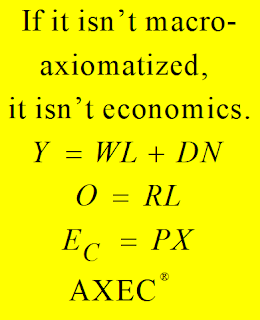
The most elementary configuration of the economy consists of the household and the business sector, which in turn consists initially of one giant fully integrated firm and is given by these three objective structural axioms:
(A1) Yw=WL wage income Yw is equal to wage rate W times working hours L,
(A2) O=RL output O is equal to productivity R times working hours L,
(A3) Ec=PX consumption expenditure Ec is equal to price P times quantity bought/sold X.

The investment goods sector comes in at a later stage. So, what we have with the minimalist set (A1) to (A3) is the pure consumption economy as the most elementary economic structure. This structure is the core of what Keynes called the monetary theory of production, and it fully replaces silly real exchange models, silly Walrasian equilibrium models, silly Post Keynesian models, and silly heterodox populism.

The ordinary business of life is the subject matter of psychology, sociology, and Hollywood soaps. Economics is the science that studies how the monetary economy works. The ultimate economic basics are given in the set (A1) to (A3), which replaces Orthodoxy and traditional Heterodoxy. #1

Egmont Kakarot-Handtke


References
Kakarot-Handtke, E. (2011). Why Post Keynesianism is Not Yet a Science. SSRN Working Paper Series, 1966438: 1–20. URL
Weintraub, E. R. (1985). General Equilibrium Analysis. Cambridge, London, New
York, etc.: Cambridge University Press.

#1 For details of the big picture, see cross-references Paradigm Shift

Equilibrium is stone dead — and now?

Comment on Lars Syll on ‘General equilibrium — the art of denying the obvious’

Blog-Reference and Blog-Reference on Sep 6 adapted to context

Frank Ackerman resumes: “If the foundation of everyone’s favourite economics story is now known to be unsound — and according to some, uninteresting as well — then the profession owes the world a bit of an explanation.” (See intro)

Heavens no! Nobody needs pointless excuses for why things got messed up. The one interesting question is how to get out of the mess as fast as possible. But here is the crux of the matter: “There is another alternative: to formulate a completely new research program and conceptual approach. As we have seen, this is often spoken of, but there is still no indication of what it might mean.” (Ingrao et al., 1990, p. 362)

Economists know quite well that equilibrium is an inadmissible concept. The representative economist's schizophrenia consists of the fact that equilibrium is firmly built into the axiomatic foundations. Orthodoxy is defined by these hardcore propositions:
HC1 There exist economic agents.
HC2 Agents have preferences over outcomes.
HC3 Agents independently optimize subject to constraints.
HC4 Choices are made in interrelated markets.
HC5 Agents have full relevant knowledge.
HC6 Observable economic outcomes are coordinated, so they must be discussed with reference to equilibrium states. (Weintraub, 1985, p. 109)

The methodological blunder that suffices to make this axiom set forever unacceptable is that HC3 and HC5 introduce NONENTITIES, and that HC6 is a petitio principii.

So, the microfoundations approach, as defined by HC1 to HC6, is dead. In fact, it has already been dead in the cradle since Jevons/Walras/Menger. In their bottomless incompetence and ignorance, economists have busily produced SS-DD-equilibrium models as a one-size-fits-all explanation for more than 150 years.

ALL articles in peer-reviewed quality journals that contain the concepts of equilibrium/ disequilibrium are proto-scientific garbage.  What does this tell you about the quality of economic quality journals? Or their editors and reviewers? Or the scientific competence of authors and readers?

Keynes made an attempt to switch from microfoundations to macrofoundations, but he, too, failed methodologically. Note well that Post Keynesians, too, busily apply equilibrium (2011).

The Paradigm Shift in economics requires the switch from behavior-centered bottom-up, i.e., subjective microfoundations, to structure-centered top-down, i.e., objective macrofoundations. The new Paradigm is defined as follows
(A0) The most elementary configuration of the economy consists of the household and the business sector, which in turn consists initially of one giant fully integrated firm.
(A1) Yw=WL wage income Yw is equal to wage rate W times working hours L,
(A2) O=RL output O is equal to productivity R times working hours L,
(A3) Ec=PX consumption expenditure Ec is equal to price P times quantity bought/sold X.

The investment goods sector comes in at a later stage. So, what we have with the minimalist and equilibrium-free set (A1) to (A3) is the pure production-consumption economy as the most elementary economic structure. This structure is the core of what Keynes called the monetary theory of production, and it fully replaces silly real exchange models, silly Walrasian equilibrium models, and silly Post Keynesian models.#1

Economists are unable to get their heads around the fact that economics is a systems science. A system can be unambiguously defined. This is an indispensable condition to do science. Walrasians, Keynesians, Marxians, and Austrians are like houseflies who bang their heads incessantly against the window without ever changing their modus operandi. Nothing else than the fly swatter can bring this pathetic spectacle to an end.

Never ask stupidity to explain itself.

Egmont Kakarot-Handtke


References
Ingrao, B., and Israel, G. (1990). The Invisible Hand. Economic Equilibrium in the History of Science. Cambridge, London: MIT Press.
Kakarot-Handtke, E. (2011). Why Post Keynesianism is Not Yet a Science. SSRN Working Paper Series, 1966438: 1–20. URL
Weintraub, E. R. (1985). General Equilibrium Analysis. Cambridge, London, New York, etc.: Cambridge University Press.

#1 For details of the big picture, see cross-references Paradigm Shift.

For more about equilibrium see AXECquery.

***

Graphic AXEC121i