November 3, 2015

Pointer: Theory of interest

Interest rate mania by Peter Radford on RWER-blog

Blog-Reference

Imagine, you ask a meteorologist what the natural temperature is and he answers: Well, that’s simple: it’s the temperature at which the weather settles into its Goldilocks comfort zone. Not too hot. Not too cold. Just right.

Somehow, the sentence makes sense, but by reading it a second and third time it becomes clear that you still don't know in degrees Celsius what the natural temperature is. The same holds for the natural rate of interest (See intro).

Why does the sentence make sense? Because it is a prolix tautology and a tautology is always true — true but worthless. Life is life, and tomorrow it either rains or it does not rain are the best-known tautologies.

Standard economics is essentially endless vacuous tautologous sitcom talk about various natural rates and the equilibrium of this or that market which comes about by ‘demand and supply’ which is the ultimate tautology.

Heterodoxy is meant to go beyond this standard wish-wash and not to repeat it. All the more so, because the underlying intuition of the interest rate as equilibrating/equalizing saving and investment is utterly false, to begin with.

As it happens, there is a debate focusing on Keynes’ I=S on David Glasner’s blog Uneasy Money, see Keynes on the Theory of Interest and Keynes and Accounting Identities.

What we in fact have is not so much an interest rate mania but an analytical interest rate black hole that devours even Peter Radford.

Down and out

Comment on Henry of Nov 3 on ‘Keynes on the Theory of Interest’

Blog-Reference

You bring in a seemingly new aspect “As a matter of interest, Keynes in his ‘Treatise on Money’, did actually develop a model using entrepreneur’s income — he ended up with a relationship similar to yours, i.e. saving − investment = normal enterprise profit − actual enterprise profit. He discarded this approach in the GT. See p. 60-61 of GT.”

Correct, Keynes caught a glimpse of the solution and then went the other way. But, as is obvious from the General Theory, in this direction, he did not come to grips with profit. Let this sink in: Keynes had no idea of the essential phenomenon of the market economy! An economist who does not understand how the actual economy works lectures politicians who know even less.

Now, the new aspect you bring in is not new at all. I have dealt with it in Section 16 ‘Treatise and General Theory as limiting cases’ in the working paper Keynes’s Missing Axioms.

And I have refuted your redundant definition of “economy-wide aggregate saving” in Section 17. There is, though, no need to read or understand the paper because staying behind the curve is the natural place for After-Keynesians.

You ask rhetorically, “You define income as household income. Why not use wages income? Why not use entrepreneur’s income?” Because the definition of income and profit is by no means arbitrary. It is known since Senior that it is all-important to state ‘consciously and explicitly’ the basic concepts: “To Senior belongs the signal honor of having been the first to make the attempt to state, consciously and explicitly, the postulates that are necessary and sufficient in order to build up … that little analytic apparatus commonly known as economic theory, or to put it differently, to provide for it an axiomatic basis.” (Schumpeter, 1994, p. 575)

Only dilettantes think that they can define whatever seems convenient. “In fact, the history of every science, including that of economics, teaches us that the elementary is the hotbed of the errors that count most.” (Georgescu-Roegen, 1970, p. 9)

These errors are fatal because they bring down the whole theoretical superstructure: “For it can fairly be insisted that no advance in the elegance and comprehensiveness of the theoretical superstructure can make up for the vague and uncritical formulation of the basic concepts and postulates, and sooner or later ... attention will have to return to the foundations.” (Hutchison, 1960, p. 5)

The irony is that Keynes understood the crucial methodological point better than the After-Keynesians. “Yet, in truth, there is no remedy except to throw over the axiom of parallels and to work out a non-Euclidean geometry. Something similar is required to-day in economics.” (1973, p. 16) and “For if orthodox economics is at fault, the error is to be found not in the superstructure, which has been erected with great care for logical consistency, but in a lack of clearness and of generality in the premises.” (1973, p. xxi)

The unfortunate fact of the matter is that Keynes messed up his ‘non-Euclidean’ axioms. Again: the formal foundations of Keynesianism are provably false until this very day. #1

This is not a minor point but has consequences for the scientific status of Keynesianism in particular and economics in general. Because economics does not satisfy the scientific criteria of material and formal consistency and cannot even tell what income and profit are it has to leave the academic community of sciences. #2

Egmont Kakarot-Handtke


References
Georgescu-Roegen, N. (1970). The Economics of Production. American Economic Review, Papers and Proceedings, 60(2): 1–9. URL
Hutchison, T.W. (1960). The Significance and Basic Postulates of Economic Theory. New York: Kelley.
Keynes, J. M. (1973). The General Theory of Employment Interest and Money. The Collected Writings of John Maynard Keynes Vol. VII. London, Basingstoke: Macmillan.
Schumpeter, J. A. (1994). History of Economic Analysis. New York: Oxford University Press.

#1 It is recommended that Keynesians make a full mental reset and start with this New curriculum, which correctly applies the axiomatic-deductive method.
#2 Free academia from economics

Related 'Humpty Dumpty is back again'


***

ICYMI (comment on Henry of Nov 3 on Nov 4)

Theories do not consist of a heap of statements that describe a certain part of reality; they have an architectonic structure. In purely formal terms, they consist of premises and logical conclusions. The well-structured whole has to meet the criteria of material and formal consistency. “The chief demerit is inconsistency, including inconsistency with the results of experiments that a competing theory can explain.” (Popper, 1994, p. 160)

Methodologically, therefore, J. S. Mill’s Starting Problem has always to be dealt with first. The crucial question is: “What are the propositions which may reasonably be received without proof? That there must be some such propositions all are agreed, since there cannot be an infinite series of proof, a chain suspended from nothing. But to determine what these propositions are, is the opus magnum of the more recondite mental philosophy.” (2006, p. 746)

At present, economics is not built upon a set of acceptable premises or axioms. Orthodoxy is based on the behavioral axiom of constrained optimization. Heterodoxy lacks a consistent foundation. That is, both approaches do not meet the formal minimum standards of theoretical economics. #1 There is nothing to choose from.

Conclusion: “Scrap the lot and start again!” (Joan Robinson). The Paradigm Shift is not to be delayed. #2 The correct formal foundations of economics are given under the label of Graphics AXEC04c.

The next step is to reconstruct the theoretical superstructure. In the course of reconstruction, it turns out that the Keynesian I=S is untenable and has to be replaced by  Q≡I−S, respectively Q≡Yd+I−S (see preceding posts). This immediately affects the theory of interest.

Whether the new axiomatic foundations are acceptable is not to be decided by argument but by empirical testing of propositions that are deductively derived from the axioms (the employment multiplier, for example, or the Profit Law).

Keynes explicitly addressed (with his call for ‘non-Euclidean’ axioms) but failed to solve J. S. Mill’s Starting Problem. Because its formal basis is defective, Keynesianism is irrevocably outside of science. Keynesian policy proposals have no sound theoretical foundations.


References
Mill, J. S. (2006). Principles of Political Economy With Some of Their Applications to Social Philosophy, Volume 3, Books III-V of Collected Works of John Stuart Mill. Indianapolis: Liberty Fund. URL
Popper, K. R. (1994). The Myth of the Framework. In Defence of Science and Rationality, Chap. Models, Instruments, and Truth,154–184. London, New York: Routledge.


#1 How Orthodoxy buffaloed Heterodoxy
#2 Replacing sand with granite

Related 'Are economists methodological retards?'

The key relationship between employment and wage rate

Comment on Lars Syll on ‘Wage cuts — the ultimate atomistic fallacy’

Blog-Reference

Orthodox economists know it, heterodox economists know it: the market economy does not work as standard economics says. This holds — with damaging consequences — in particular for the labor market.

The core of labor market theory, purified from the myriad of idiosyncratic variants, goes as follows “We economists have all learned, and many of us teach, that the remedy for excess supply in any market is a reduction in price. If this is prevented by combinations in restraint of trade or by government regulations, then those impediments to competition should be removed. Applied to economy-wide unemployment, this doctrine places the blame on trade unions and governments, not on any failure of competitive markets.” (Tobin, 1997, p. 11)

Until this day, the representative economist has not realized that the overall systemic interdependencies establish a positive feedback loop between ‘the’ product and ‘the’ labor market, that is, wage rate down → employment down → wage rate down → and so on. Vice versa with an increasing average wage rate. The market system is not an equilibrium system. All equilibrium models are a priori false.

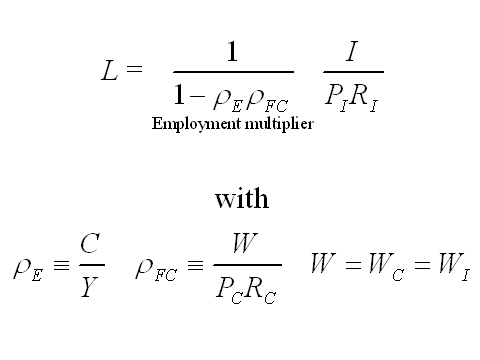
The most elementary version of the axiomatically correct Employment Law is given on Graphic AXEC62
From this equation follows inter alia:
(i) An increase in the expenditure ratio ρE leads to higher employment.
(ii) Increasing investment expenditures I exert a positive influence on employment; a slowdown of growth does the opposite.
(iii) An increase in the factor cost ratio ρF≡W/PR leads to higher employment. This implies that a higher average wage rate W leads to higher employment. This is, of course, contrary to conventional economic wisdom. It is, though, easy to prove that conventional wisdom is a mere Fallacy of Composition (2015).
(iv) The complete Employment Law is a bit longer and contains, in addition, profit distribution, public deficit spending, and the trade balance with the rest of the world. As a matter of principle, the structural Employment Law contains only measurable variables and is testable. Hence, matters can be settled once and for all.

Points (i) and (ii) are well-known Keynesian stuff. Let us focus here alone on the factor cost ratio ρF as defined in (iii). This variable embodies the macroeconomic price mechanism, which, however, does not work as the representative economist hallucinates. As a matter of fact, overall employment increases if the average wage rate W increases relative to the average price P and productivity R.

The correct employment theory states that the average wage rate must rise in order to prevent unemployment and deflation. For the relationship between real wage, productivity, profit, and real shares, see (2015, Sec. 10)

With the provably false standard employment theory, economists bear the intellectual responsibility for the social devastation of unemployment. Since Keynes gave his diagnosis in ‘The Great Slump of 1930’, every economist could know that ‘what we economists have all learned, and many of us teach’ is dead wrong.

Egmont Kakarot-Handtke


References
Kakarot-Handtke, E. (2015). Major Defects of the Market Economy. SSRN Working Paper Series, 2624350: 1–40. URL
Tobin, J. (1997). An Overview of the General Theory. In G. C. Harcourt and P. A. Riach (Eds.), The ’Second Edition’ of The General Theory, Vol. 2, 3–27. Oxon: Routledge.

November 2, 2015

Free academia from economics

Comment on David Ruccio on ‘Academic unfreedom in economics’

Blog-Reference

You say, “Most departments of economics [in North America] offer — in the classroom and in terms of research and policy advice — only mainstream economics. By that, I mean they hire economists who only teach, conduct research, and offer policy advice defined by one or another version of mainstream (neoclassical and Keynesian) economics. Other approaches to economics — generally, these days, referred to as heterodox economics — simply aren’t recognized by or represented within those departments.” (See intro)

There is a big problem here. Imagine the followers of geocentrism complain that academia is dominated by the followers of heliocentrism. Or that the Astrologers and Alchemists complain that there is no place for them in academia. Would anyone seriously conclude from these facts that there is unfreedom in physics, astronomy, or chemistry?

The real problem is this. Academia is, loosely speaking, committed to science — this is the original idea. And science is well-defined by material and formal consistency (Klant, 1994, p. 31). To recall, when Plato founded the first academy, he explicitly excluded what he considered nonscientists: "Let None But Geometers Enter Here." (See Wikipedia)

The practical problem is that it is not always easy to establish material and formal consistency, and this is what the demarcation problem has always been about: how to draw a clear line between science and non-science. “The problem of finding a criterion which would enable us to distinguish between the empirical sciences on the one hand, and mathematics and logic as well as ‘metaphysical’ systems on the other, I call the problem of demarcation. This problem was known to Hume who attempted to solve it. With Kant, it became the central problem in the theory of knowledge.” (Popper, 1980, p. 34)

As a good sophist, McCloskey has given the whole topic a social spin, insinuating that demarcation is the same as discrimination: “In practice methodology serves chiefly to demarcate Us from Them, demarcating science from nonscience. Once the modernists have found a Bantustan for nonscience, such as astrology, psychoanalysis, acupuncture, nutritional medicine, Marxist economics, spoonbending, or anything else they do not wish to discuss, they can get on with the business at hand with a clear head. Methodology and its corollary, the Demarcation Problem (What is Science? How is It to be distinguished from nonscience?), are ways at stopping conversation by limiting conversation to people on our side of the demarcation line.” (1998, p. 161)

Contrary to this subtle redefinition, it has to be affirmed that demarcation is not only legitimate but necessary in order to protect the integrity of science, which consists in upholding the distinction between true and false regardless of any other criteria.

It is pretty clear who should be in and who should be out: “A genuine inquirer aims to find out the truth of some question, whatever the color of that truth. ... A pseudo-inquirer seeks to make a case for the truth of some proposition(s) determined in advance. There are two kinds of pseudo-inquirer, the sham and the fake. A sham reasoner is concerned, not to find out how things really are, but to make a case for some immovably-held preconceived conviction. A fake reasoner is concerned, not to find out how things really are, but to advance himself by making a case for some proposition to the truth-value of which he is indifferent. (Haack, 1997, p. 1)

Therefore, it is of the utmost importance to distinguish between political and theoretical economics. The main differences are:
(i) The goal of political economics is to push an agenda; the goal of theoretical economics is to explain how the actual economy works.
(ii) In political economics, anything goes; in theoretical economics, scientific standards are observed.

Theoretical economics has to be judged according to the criteria true/false and nothing else. The history of political economics, on the other hand, can be summarized as the perpetual violation of well-defined scientific standards.

The fact of the matter is that theoretical economics has, from the very beginning, been dominated by the agenda pushers of political economics. Smith and Mill fought against the precapitalistic order; Marx and Keynes were agenda pushers, so were Hayek and Friedman, and so are Krugman and Varoufakis.

Political economics is scientifically worthless. Economics is a failed science. Orthodox economics does not satisfy scientific criteria, and neither does Heterodoxy (see, for example, 2011).

Theoretical economics has been hijacked by politics and instrumentalized. Political economics, in turn, has occupied academia. Academic freedom means not only getting rid of Neoclassical economics but of all of economics as far as it is political economics. There can be no freedom and pluralism of false theories. Academic freedom does not include the freedom to push a political agenda, nor to talk plain proto-scientific garbage. Both current Orthodoxy and Heterodoxy have to go the way of astrology.

Egmont Kakarot-Handtke


References
Haack, S. (1997). Science, Scientism, and Anti-Science in the Age of Preposterism. Skeptical Inquirer, 21(6): 1–7. URL
Kakarot-Handtke, E. (2011). Why Post Keynesianism is Not Yet a Science. SSRN Working Paper Series, 1966438: 1–20. URL
Klant, J. J. (1994). The Nature of Economic Thought. Aldershot, Brookfield: Edward Elgar.
McCloskey, D. N. (1998). The Rhetoric of Economics. Madison, London: University of Wisconsin, 2nd edition.
Popper, K. R. (1980). The Logic of Scientific Discovery. London, Melbourne, Sydney: Hutchison, 10th edition.

Related ‘The case for pure economics’ and ‘Time to get rid of political economics’ and ‘Heterodoxy: promising or hopeless?’ and 'How to be a good scientist' and 'A rough business plan for science'

November 1, 2015

Humpty Dumpty is back again

Comment on Henry/David Glasner on ‘Keynes on the Theory of Interest’

Blog-Reference

“Research is, in fact, a continuous discussion of the consistency of theories: formal consistency insofar as the discussion relates to the logical cohesion of what is asserted in joint theories; material consistency insofar as the agreement of observations with theories is concerned.” (Klant, 1994, p. 31)

So, science is about formal and material consistency. Economists fail on both counts since Adam Smith, and for this reason, economics is not a science. It is as simple as that.

What has the outer appearance of science is, in fact, a proto-science to this very day. This includes Orthodoxy and Heterodoxy and Keynesianism in particular. With regard to consistency, Keynesians have conveniently defined their own methodological rules: “For Keynes as for Post Keynesians, the guiding motto is ‘it is better to be roughly right than precisely wrong!’” (Davidson, 1984, p. 574)

With regard to definitions, the representative economist easily takes sides with Humpty Dumpty: "‘When I use a word,’ Humpty Dumpty said in rather a scornful tone, ‘it means just what I choose it to mean — neither more nor less.’ ‘The question is,’ said Alice, ‘whether you can make words mean so many different things.’ ‘The question is,’ said Humpty Dumpty, ‘which is to be master — that's all.’” (Carroll Through the Looking-Glass)

That is not how science works. The freedom or arbitrariness of definition is a methodological illusion. It applies only to the first definition. Subsequently, one has to make sure that every new definition is consistent with the preceding ones. Overall consistency cannot be achieved in the economist's cavalier fashion: “The only way to arrive at coherent languages is to set up axiomatic systems implicitly defining the basic concepts.” (Schmiechen, 2009, p. 344)

Keynes got the fundamental concepts of income and profit wrong. The formal core of the General Theory is given with: “Income = value of output = consumption + investment. Saving = income − consumption. Therefore saving = investment.” (1973, p. 63)

This is rather elementary mathematics, and it should not be too hard to get it right. Actually, Keynes got it wrong, and neither Keynesians, nor Post-Keynesians, nor New Keynesians, nor the Anti-Keynesians ever spotted the logical blunder.

The axiomatically correct relationship is given on Graphic AXEC143d. It says: the business sector's monetary profit Qm is equal to distributed profit Yd plus investment expenditure I minus the household sector's monetary saving Sm (2014, Sec. 3). Alternatively, the business sector's retained profit Qm−Yd is equal to the difference between investment and saving. In short, household sector saving is NEVER equal to business sector investment, that is, all I=S models, including IS-LM are provably false. And this, in turn, means that all theories of interest that are predicated on the equalization/ equilibrium of investment and saving are false. All attempts to filibuster this fact away are self-defeating.

It is pretty obvious that Henry goes straight off into a parallel universe with what Keynes rightly condemned as ‘method of blind manipulation’ (1973, p. 297).

As mentioned above, there is no such thing as freedom or arbitrariness of definition. This freedom is restricted by the requirement of consistency. The fault in Henry's argument lies in the redundant on-top definitions of total income and total saving St which actually yield I=St. What Henry does not notice is that St is different from S, so the intended proof of I=S fails. This has already been demonstrated in Section 17 of Keynes’s Missing Axioms.

There is no hope that the Keynesian Humpty Dumpties will ever understand what formal consistency is all about. After all, they did not get it in the last 80+ years.

Egmont Kakarot-Handtke


References
Davidson, P. (1984). Reviving Keynes’s Revolution. Journal of Post Keynesian Economics, 6(4): 561–575. URL
Kakarot-Handtke, E. (2014). The Three Fatal Mistakes of Yesterday Economics: Profit, I=S, Employment. SSRN Working Paper Series, 2489792: 1–13. URL
Keynes, J. M. (1973). The General Theory of Employment Interest and Money. The Collected Writings of John Maynard Keynes Vol. VII. London, Basingstoke: Macmillan.
Klant, J. J. (1994). The Nature of Economic Thought. Aldershot, Brookfield: Edward Elgar.
Schmiechen, M. (2009). Newton’s Principia and Related ‘Principles’ Revisited, Vol. 1. Norderstedt: Books on Demand BoD, 2nd edition. URL

Immediately preceding Accounting basics.

***

ICYMI (comment on FedUp of Nov 1 on Nov 2)

Imagine that, starting at zero, the national accountant records every single transaction between the business sector and the household sector in the investment economy. At any arbitrary point in time, he may close the books and draw the balances. What the balances show is with mathematical certainty Q≡Yd+I−S. Let us simplify matters with Yd=0, then the accountant ends up with Q≡I−S. Accounting is the natural measurement instrument in economics, and the underlying math is indeed elementary. The sad fact is that the representative economist does not even understand the principles of accounting.

With closing the books and arriving at Q equals I−S, the accountant’s job is done. Like a physicist, he has taken a correct measurement with the precision of two decimal places. Every time he makes his measurement, i.e., entirely independent of the period length, he verifies the formula.

Enters the representative economist in his full smartness and says: Let’s play with the symbols and make a new definition, that is, let total saving Σ be the sum of household sector saving S and profit Q, which we rename as the business sector's saving, so Σ≡S+Q. Note in passing that renaming profit as saving is semantic idiotism, hence the concept of total saving is a NONENTITY.

But now, look what we get: I≡Σ, i.e., total saving is invariably equal to investment. Yes, but look carefully, this is different from I=S. What this formal shell game amounts to is a substitution of Σ and S and an unnoticed verbal equalization of saving and "total saving".

Every accountant who carries out the economist’s redundant add-on book entry is either fired for incompetence or jailed for cooking the books.


***

ICYMI comment on JKH of Nov 2

In Keynes' derivation of I=S neither profit nor retained profit appears (Keynes, 1973, p. 63).

Now, you assert “Saving by firms amounts to their retained profit.” This add-on definition is nowhere to be found in the General Theory. The simple reason is that Keynes never understood what profit is: “His Collected Writings show that he wrestled to solve the Profit Puzzle up till the semi-final versions of his GT but in the end he gave up and discarded the draft chapter dealing with it.” (Tómasson and Bezemer, 2010, pp. 12-13, 16)

Because Keynes never came clear with either profit, distributed profit, or retained profit — not to speak of those who came after him — one will not find a correct definition of these concepts in all of Keynesianism. Yet, one can find the consistent definitions in Allais or in my paper, Keynes's Missing Axioms.

The final result of correct accounting is invariably Qre≡I−S. Your definitions are (i) a superfluous add-on, (ii) formally illegitimate, (iii) a semantic shell game that proves, if anything, a complete lack of understanding of the mechanisms of profit generation and distribution.

Keynesianism has been formally deficient from the very beginning. Because the multiplier and IS-LM rely on Keynes's profitless I=S all Keynesian policy advice has been nothing more to this very day than reading tea leaves and telling the silly ex-ante/ex-post story. Monetary policy that relies on the familiar interest mechanism has no theoretically sound foundation.

The equality/equilibrium of saving and investment has been academically declared dead with Allais’ publication of 1993. In the history of science, I=S will forever stand out as a monument of utter scientific incompetence.


References
Keynes, J. M. (1973). The General Theory of Employment Interest and Money. The Collected Writings of John Maynard Keynes Vol. VII. London, Basingstoke: Macmillan.
Tómasson, G., and Bezemer, D. J. (2010). What is the Source of Profit and Interest? A Classical Conundrum Reconsidered. MPRA Paper, 20557: 1–34. URL

Related 'Down and out'

***

Graphic AXEC129d The Humpty Dumpty Fallacy "Income"


Graphic AXEC128b The Humpty Dumpty Fallacy "Saving"

October 31, 2015

Getting out of proto-scientific garbage

Comment on Lars Syll on ‘Postmodern discourse mumbo jumbo’

Blog-Reference

Above, Jan Milch quotes Chomsky with what can be taken here as a definition of Postmodernism: “... a lot of it is simply illiterate, based on extraordinary misreading of texts ..., argument that is appalling in its casual lack of elementary self-criticism, lots of statements that are trivial ... or false; and a good deal of plain gibberish.”

According to this definition, economists literally invented Postmodernism: “The currently prevailing pattern of economic theorizing exhibits the following three characteristics: (1) a syncopated style of argument fluctuating back and forth between literary and symbolic modes of expression, (2) naive translation, or the loose paraphrasing of formulae into sentences, and (3) loose verbal reasoning for certain aspects of theoretical argumentation where explicit symbolic formulation is lacking.” (Dennis, 1982, p. 698)

What Dennis meant with “loose verbal reasoning” is the same as Chomsky’s “plain gibberish”, and this is the realm where, as Keynes said, “nothing is clear and everything is possible” (1973, p. 292). This vast realm between true and false is traditionally occupied and vigilantly defended by the Cambridge School of Loose Verbal Reasoning: “Another danger is that you may ‘precise everything away’ and be left with only a comparative poverty of meaning. ... Such a problem was avoided, said Keynes, by Marshall who used loose definitions but allowed the reader to infer his meaning from ‘the richness of context’.” (Coates, 2007, p. 87)

Keynes’ postmodern methodology — each reader is free to impute his meaning or to guess what Keynes/Marshall meant — became the postkeynesianic gospel: “For Keynes as for Post Keynesians the guiding motto is ‘it is better to be roughly right than precisely wrong!’” (Davidson, 1984, p. 574)

This allows us now to precisely position economics in general and Postkeynesianism in particular: “More recently, Walter Truett Anderson described postmodernism as belonging to one of four typological worldviews, which he identifies as either (a) Postmodern-ironist, which sees truth as socially constructed, (b) Scientific-rational, in which truth is found through methodical, disciplined inquiry, (c) Social-traditional, in which truth is found in the heritage of ... civilization, or (d) Neo-romantic, in which truth is found through attaining harmony with nature and/or spiritual exploration of the inner self.” (Wikipedia)

Postmodern economics is anything except (b), i.e., methodical, disciplined inquiry, but in fact, as Dow nicely put it ‘Babylonian incoherent babble’ (2005, p. 385).

Since Senior’s first attempt of a ‘methodical, disciplined inquiry’ economists have consistently failed to get out of moronomics.

“To Senior belongs the signal honor of having been the first to make the attempt to state, consciously and explicitly, the postulates that are necessary and sufficient in order to build up … that little analytic apparatus commonly known as economic theory, or to put it differently, to provide for it an axiomatic basis.” (Schumpeter, 1994, p. 575)

There is no such thing as a scientifically valid economic theory because Orthodoxy got the axiomatic foundations wrong and Heterodoxy has none at all.#1

Egmont Kakarot-Handtke


References
Coates, J. (2007). The Claims of Common Sense. Moore, Wittgenstein, Keynes and the Social Sciences. Cambridge, New York, NY, etc.: Cambridge University Press.
Davidson, P. (1984). Reviving Keynes’s Revolution. Journal of Post Keynesian Economics, 6(4): 561–575. URL
Dennis, K. (1982). Economic Theory and the Problem of Translation (I). Journal of Economic Issues, 16(3): 691–712. URL
Dow, S. C. (2005). Axioms and Babylonian Thought: A Reply. Journal of Post Keynesian Economics, 27(3): 385–391. URL
Keynes, J. M. (1973). The General Theory of Employment Interest and Money. The Collected Writings of John Maynard Keynes Vol. VII. London, Basingstoke: Macmillan.
Schumpeter, J. A. (1994). History of Economic Analysis. New York, NY: Oxford University Press.

#1 But see for Constructive Heterodoxy

Related 'Stop knowing nothing, start knowing something' and 'Moronomics'

October 30, 2015

The key relationship between employment and growing/shrinking debt

Comment on Steve Keen on ‘The unnatural rate of interest’

Blog-Reference

Orthodox economists know it, heterodox economists know it, and Marx, too, knew it: economics is a failed science. Economists have no idea how the monetary economy works. The ultimate reason is that the representative economist cannot tell the difference between profit and income, or as the Palgrave Dictionary summarized “A satisfactory theory of profits is still elusive.” (Desai, 2008, p. 10)

In simple words, Economists fail to capture the essence of the market economy.

That is particularly embarrassing in Marx’s case because profit is the core concept of the whole approach. For the overdue rectification, see (2014a).

Unfortunately, Keen’s approach also rests on a false profit definition. For the overdue rectification, see (2013).

Needless to emphasize that the standard approach is wanting. For the overdue rectification, see (2014b).

When the profit theory is false, then, by logical necessity, employment theory is affected. To cut a meticulous formal derivation short, the most elementary version of the macroeconomic Employment Law is given with Graphic AXEC62


From this equation follows inter alia
(i) An increase in the expenditure ratio ρE leads to higher employment. An expenditure ratio ρE>1 indicates credit expansion, a ratio ρE<1 indicates credit contraction/debt repayment of private households.
(ii) Increasing investment expenditures I exert a positive influence on employment; a slowdown in growth does the opposite.
(iii) An increase in the factor cost ratio ρF≡W/PR leads to higher employment.
(iv) The complete Employment Law is a bit longer and contains, in addition, profit distribution, public deficit spending, and the trade balance with the rest of the world. As a matter of principle, the Employment Law contains only measurable variables and is testable.

Points (i) and (ii) are well-known Keynesian stuff. What is missing in the original Keynesian employment multiplier is the factor cost ratio ρF as defined in (iii). This variable embodies the price mechanism, which, however, does not work as the representative economist hallucinates. As a matter of fact, overall employment increases if the average wage rate W increases relative to the average price P and productivity R. This is the key to solving the employment problem.

The second important property of the Employment Law is that it establishes an explicit formal link between credit expansion/contraction and employment via the expenditure ratio ρE.

Conclusion: the Employment Law delivers the testable formal underpinning of the empirical correlations found by Keen. Both elements support each other nicely.

The relationship between employment and the interest rate is indirect and needs the formal inclusion of the consolidated banking sector. As a first approximation, this harmonizes with Keen’s empirical findings. For the actual discussion, see the thread ‘Keynes on the Theory of Interest’ on David Glasner’s blog Uneasy Money.

Standard interest theory suffers from the traditional delusion that there is a mechanism — interest rate or multiplier — that equalizes saving and investment. The provable fact of the matter is that there is no such thing as equilibrium/identity of saving and investment. What has to be realized first is that saving and investment are never equal. Because of this, traditional interest theory (including Bernanke and Krugman) is completely hanging in the air.

It is absolutely necessary to develop — as Keen attempts — a superior alternative to the defunct approaches. This requires, first of al,l the rectification of profit theory. This is the primary task of Constructive Heterodoxy (2015). Without the correct profit theory, the theory of employment and the theory of interest is a priori false.

Egmont Kakarot-Handtke


References
Desai, M. (2008). Profit and Profit Theory. In S. N. Durlauf, and L. E. Blume (Eds.), The New Palgrave Dictionary of Economics Online, 1–11. Palgrave Macmillan, 2nd edition. URL
Kakarot-Handtke, E. (2013). Debunking Squared. SSRN Working Paper Series, 2357902: 1–5. URL
Kakarot-Handtke, E. (2014a). Profit for Marxists. SSRN Working Paper Series, 2414301: 1–25. URL
Kakarot-Handtke, E. (2014b). The Three Fatal Mistakes of Yesterday Economics: Profit, I=S, Employment. SSRN Working Paper Series, 2489792: 1–13. URL
Kakarot-Handtke, E. (2015). Essentials of Constructive Heterodoxy: Profit. SSRN Working Paper Series, 2575110: 1–18. URL