Keynes got macroeconomic profit wrong because he was too stupid for the elementary algebra that underlies macroeconomic accounting.
— AXEC (@EgmontHandtke) March 31, 2026
As a consequence, the whole of macroeconomics is scientifically worthless. After-Keynesians NEVER got it.
For details, see
How Keynes messed up… pic.twitter.com/j5aY5TCQ9I
Showing posts sorted by date for query title:accounting. Sort by relevance Show all posts
Showing posts sorted by date for query title:accounting. Sort by relevance Show all posts
March 31, 2026
Occasional X: Economists are too stupid for macro accounting (X)

March 22, 2026
Occasional X: Economists are too stupid for macro accounting (IX)
“At its fundamental level, MMT is based on accurate accounting.” (Dr. Steve Keen)
— AXEC (@EgmontHandtke) March 22, 2026
Wrong. At its fundamental level, macroeconomic accounting in general and MMT accounting, in particular, is provably false. For details, see
Accounting for dummieshttps://t.co/Fzy8whg6qc
Because… pic.twitter.com/eWcEbMhIZP
May 26, 2025
Occasional X: Economists are too stupid for macro accounting (VIII)
#Economics#AllYouNeedToKnow
— AXEC (@EgmontHandtke) May 26, 2025
“But without the government deficit the businesses and households would not enjoy the surplus to save and spend. Thus “national debt” is really the “national savings”. (Quarterly Balances quoted by Malcolm Reavell)
There is no such thing as the… pic.twitter.com/ovgRFA1I5l
Related 'Down with idiocy!'
May 1, 2025
Occasional X: Economists are too stupid for macro accounting (VII)
#Economics#AllYouNeedToKnow
— AXEC (@EgmontHandtke) May 1, 2025
“BTW, this confusion is partly due to the misleading representation of national income accounting identity in textbooks (and elsewhere). It is more clear if the identity is presented as: GDP + Im = C + I + G +Ex.” (Roozbeh Hosseini)
“Why are we… pic.twitter.com/TTIs0iguuk
April 28, 2025
Occasional X: Economists are too stupid for macro accounting (VI)
#MMT#BadScienceBadPolicyBadPeople
— AXEC (@EgmontHandtke) April 28, 2025
“if the federal government has lots of red ink, somebody must have lots of black ink. It's called accounting” (whispers)
Yes, the government sector's red ink is the business sector's black ink. It's called macroeconomic profit. For details see… pic.twitter.com/BKqd4pRr1Z
September 28, 2024
Occasional X: Economists are too stupid for macro accounting (V)
#Economics#FailedFakeScience
— E.K-H (@AXECorg) September 28, 2024
Economics claims to be #Science but is NOT. The major approaches (#Walrasianism, #Keynesianism, #Marxianism, #Austrianism, and their derivatives) are mutually contradictory & axiomatically false & materially/formally inconsistent & ALL got #Profit… pic.twitter.com/cRFpRaWSCr
December 14, 2023
Occasional Tweets: Economists are too stupid for macro accounting (IV)
#FailedFakeScience
— E.K-H (@AXECorg) December 14, 2023
The #ProfitLaw implies #PublicDeficitIsPrivateProfit Q≡G−T. So, #PrivateFinancialWealth grows with #PublicDebt. This has NOTHING to do with domestic #Saving S. #Economists NEVER understood the simple #Algebra of #MacroAccounting. ⇒https://t.co/0t1vz3XnEB pic.twitter.com/9aQ7XxJxNR
For more about macro accounting see AXECquery.
February 25, 2023
Occasional Tweets: Economists are too stupid for macro accounting (III)
#Economics#FailedFakeScience#Economists are too stupid for the elementary #Algebra that underlies macroeconomic #Accounting. Because of this, the whole of economics is scientifically worthless.
— E.K-H (@AXECorg) February 25, 2023
A crash course in macro accountinghttps://t.co/ra68RI5GgM
December 14, 2022
Occasional Tweets: Economics is failed/fake science because economists never understood the simple math that underlies accounting
#Economics#FailedFakeScience#Economists#StupidOrCorruptOrBoth
— E.K-H (@AXECorg) December 14, 2022
Economists are too stupid for the elementary #Algebra that underlies macroeconomic #Accounting.
National Accounting: scientific incompetence or political fraud?https://t.co/0t1vz3XnEB#DefundEconomics
For details of the big picture see cross-references Accounting.
January 26, 2022
Occasional Tweets: Economists are too stupid for macro accounting (II)
Since #Keynes #Economists are too stupid for the elementary #Algebra that underlies #MacroEconomics. Macro accounting tells one #PublicDeficitIsPrivateProfit.
— E.K-H (@AXECorg) January 25, 2022
A crash course in macro accountinghttps://t.co/ra68RI5GgM
For more on accounting see the queryhttps://t.co/sOLeafaakF pic.twitter.com/Cj5qSVdW40
For details of the big picture, see cross-references Accounting.
August 28, 2021
Occasional Tweets: Accounting identities ― false since Keynes
#MMT#BadScienceBadPolicyBadPeople
— E.K-H (@AXECorg) August 28, 2021
When #MMTers talk of an accounting identity one should always be aware that #Economists, in general, are too stupid for the elementary #Algebra that underlies macroeconomic accounting.
MMTers: too stupid for simple mathhttps://t.co/7qhGPGzjew pic.twitter.com/4gBpWs49Qm
For details of the big picture see cross-references Accounting and cross-references Math/Mathiness.
August 6, 2021
Occasional Tweets: Economists are too stupid for macro accounting (I)
#LearnEconomics
— E.K-H (@AXECorg) August 6, 2021
Basic macroeconomic #Accounting [i.e. #Profit Q≡(G−T)+(I−S)+Yd] implies #PublicDeficitIsPrivateProfit. Thus, #DeficitSpendingMoneyCreation is a #FreeLunch for the #Oligarchy and Private financial assets of the #Oligarchy ≈ Public debt of #WeThePeople.
For more about macroeconomic accounting see AXECquery.
For more about math see AXECquery.
September 25, 2017
National Accounting: scientific incompetence or political fraud?
Comment on David Graeber on ‘Accounting error spells chaos for global economy’
Blog-Reference and Blog-Reference
You say “Last month I noticed what appears to be a glaring error in the UK’s Office of Budget Responsibilities’ calculations of household debt levels — one with potentially frightening implications for the stability of the financial system as a whole.”
You have indeed identified a foundational error of macroeconomics. It exists already since Keynes and relates to profit theory. In simple terms, Keynes never understood what profit is and neither pro-Keynesians nor anti-Keynesians realized the blunder in Keynes’ foundational macro equations. Thus, the blunder sneaked into National Accounting and became eventually an essential part of MMT. For details see
• Economists: just too stupid for counting
• The Common Error of Common Sense: An Essential Rectification of the Accounting Approach
• Rectification of MMT macro accounting
Egmont Kakarot-Handtke
Related 'Some fatal flaws of MMT' and 'Economists’ perennial trouble with accounting' and 'Profit' and 'The GDP-death-blow for the economics profession'. For more details of the big picture see cross-references Accounting.
(i) Compared to the entirely faulty MMT accounting#1 the UK’s Office of Budget Responsibilities graphics at least includes the business sector explicitly.
(ii) The correct balances equation for total profit reads Qm≡Yd+(I−Sm)+(G−T)+(X−M) [1] or rearranged (I−Qm)+(Yd−Sm)+(G−T)+(X−M)=0 [2] which says that the balances of the business sector, the household sector, the government sector, and the Rest of World add up to zero.#2 Hence, the sum of positive balances is always symmetrical to the sum of negative balances. This rearranged equation (I−Sm)+(G−T)+(X−M)−(Qm−Yd)=0 finally compares to the false MMT equation (I−S)+(G−T)+(X−M)=0. The difference (Qm−Yd) denotes retained profit.

(iii) It is doubtful whether the UK’s Office of Budget Responsibilities got the balances equation [2] right.#3
(iv) That much is sure: the MMT balances equations are as false as can be. Because of this, the analytical superstructure of MMT is scientifically worthless. MMT policy has NO sound scientific foundations.
#1 MMT and the magical profit disappearance
#2 For more details see cross-references MMT
#3 The Common Error of Common Sense: An Essential Rectification of the Accounting Approach
The correct four-sector balances equation for the business sector’s total monetary profit reads Qm≡Yd+I−Sm+G−T+X−M. Profit is the pivotal magnitude of the market economy. This magnitude does NOT appear in the MMT balances equations. So, MMT misses the essence of economics. MMTers have not realized until this very day that their approach is lethally flawed.* MMTers have zero scientific/mathematical/accounting competence.
As a self-declared specialist in Accounting Science it should be easy for you to refute the equation above. Of course, you cannot — and nobody else of the scum of sciences called MMT can.
* For the full-spectrum refutation see cross-references MMT
You say “They [MMTers] don’t see the ‘business sector’s total monetary profit’ as the ‘essence of economics’.... and they don’t have to... they are more interested in the general economic welfare ....”
If you do not know that 2+2=4 you are out as a mathematician. If you do not know what energy is you are out as a physicist. If you do not know what profit is you are out as an economist. In all cases, it does not help you much to pretend to be mainly interested in general human welfare.
Non-swimmers are not hired by Baywatch even if they assert that their highest ambition is to save fellow humans from drowning.
The fact is that MMTers do not understand the foundational concept of economics. Worse, because they do not understand that Public Deficit = Private Profit they do not realize that MMT policy is directly AGAINST general human welfare.
Macro accounting is the faithful recording of all economic transactions between the business and the household sector, the application of elementary mathematics, and the drawing of balances after the conclusion of a period of predetermined length. If done by intelligent persons, this yields the total monetary profit of the business sector in the most elementary case as Qm≡−Sm which is identical with the auditable real quantity in the aggregate cash box. This formula is the core of profit theory and the indelible shame of economics is that economists in general and MMTers, in particular, do not understand after 200+ years what any person of average intelligence is supposed to understand in 20 minutes.*
* How the intelligent non-economist can refute every economist hands down
You say “I could understand E K-H’s argument that business profitability is a prerequisite for survival in a competitive situation; I do not understand why profitability is a prerequisite for a desirable economic system to be constructed.”
The point is NOT what people think about profit or that profit is needed for survival or that the profit motive is morally good/bad. All this is the subjective side of profit. The point is to figure out the objective Profit Law and to verify it with the help of National Accounting, which is one of the most important measurement tools in economics. This is the objective side of profit.
The subjective side of profit is the proper business of psychology, sociology, and other so-called social sciences. The objective side of profit is the subject matter of economics.
The scandal of economics is that none of the main approaches, including MMT, can give you the Profit Law. Or, as Mirowski put it, “... one of the most convoluted and muddled areas in economic theory: the theory of profit.” Economists simply do not know what profit is. And this means that the whole of economics, including MMT, is proto-scientific garbage.
You cannot construct the Good Society if you do not know how the economy works and what the economic laws are just as you cannot get three hundred coffee-sipping dullards in an aluminum box off the ground without knowing the laws of aerodynamics and thermodynamics. Psychology and sociology are not of much help.
The claim that economists in general or MMTers, in particular, contribute to the realization of the Good Society is one of the worst jokes of all time.
Blog-Reference and Blog-Reference
You say “Last month I noticed what appears to be a glaring error in the UK’s Office of Budget Responsibilities’ calculations of household debt levels — one with potentially frightening implications for the stability of the financial system as a whole.”
You have indeed identified a foundational error of macroeconomics. It exists already since Keynes and relates to profit theory. In simple terms, Keynes never understood what profit is and neither pro-Keynesians nor anti-Keynesians realized the blunder in Keynes’ foundational macro equations. Thus, the blunder sneaked into National Accounting and became eventually an essential part of MMT. For details see
• Economists: just too stupid for counting
• The Common Error of Common Sense: An Essential Rectification of the Accounting Approach
• Rectification of MMT macro accounting
Egmont Kakarot-Handtke
Related 'Some fatal flaws of MMT' and 'Economists’ perennial trouble with accounting' and 'Profit' and 'The GDP-death-blow for the economics profession'. For more details of the big picture see cross-references Accounting.
***
REPLY to Tom Hickey, MRW, Matt Franko on Sep 25(i) Compared to the entirely faulty MMT accounting#1 the UK’s Office of Budget Responsibilities graphics at least includes the business sector explicitly.
(ii) The correct balances equation for total profit reads Qm≡Yd+(I−Sm)+(G−T)+(X−M) [1] or rearranged (I−Qm)+(Yd−Sm)+(G−T)+(X−M)=0 [2] which says that the balances of the business sector, the household sector, the government sector, and the Rest of World add up to zero.#2 Hence, the sum of positive balances is always symmetrical to the sum of negative balances. This rearranged equation (I−Sm)+(G−T)+(X−M)−(Qm−Yd)=0 finally compares to the false MMT equation (I−S)+(G−T)+(X−M)=0. The difference (Qm−Yd) denotes retained profit.

(iii) It is doubtful whether the UK’s Office of Budget Responsibilities got the balances equation [2] right.#3
(iv) That much is sure: the MMT balances equations are as false as can be. Because of this, the analytical superstructure of MMT is scientifically worthless. MMT policy has NO sound scientific foundations.
#1 MMT and the magical profit disappearance
#2 For more details see cross-references MMT
#3 The Common Error of Common Sense: An Essential Rectification of the Accounting Approach
***
REPLY to Matt Franko on Sep 26The correct four-sector balances equation for the business sector’s total monetary profit reads Qm≡Yd+I−Sm+G−T+X−M. Profit is the pivotal magnitude of the market economy. This magnitude does NOT appear in the MMT balances equations. So, MMT misses the essence of economics. MMTers have not realized until this very day that their approach is lethally flawed.* MMTers have zero scientific/mathematical/accounting competence.
As a self-declared specialist in Accounting Science it should be easy for you to refute the equation above. Of course, you cannot — and nobody else of the scum of sciences called MMT can.
* For the full-spectrum refutation see cross-references MMT
***
REPLY to Matt Franko on Sep 26You say “They [MMTers] don’t see the ‘business sector’s total monetary profit’ as the ‘essence of economics’.... and they don’t have to... they are more interested in the general economic welfare ....”
If you do not know that 2+2=4 you are out as a mathematician. If you do not know what energy is you are out as a physicist. If you do not know what profit is you are out as an economist. In all cases, it does not help you much to pretend to be mainly interested in general human welfare.
Non-swimmers are not hired by Baywatch even if they assert that their highest ambition is to save fellow humans from drowning.
The fact is that MMTers do not understand the foundational concept of economics. Worse, because they do not understand that Public Deficit = Private Profit they do not realize that MMT policy is directly AGAINST general human welfare.
Macro accounting is the faithful recording of all economic transactions between the business and the household sector, the application of elementary mathematics, and the drawing of balances after the conclusion of a period of predetermined length. If done by intelligent persons, this yields the total monetary profit of the business sector in the most elementary case as Qm≡−Sm which is identical with the auditable real quantity in the aggregate cash box. This formula is the core of profit theory and the indelible shame of economics is that economists in general and MMTers, in particular, do not understand after 200+ years what any person of average intelligence is supposed to understand in 20 minutes.*
* How the intelligent non-economist can refute every economist hands down
***
REPLY to wilwon32 on Sep 26You say “I could understand E K-H’s argument that business profitability is a prerequisite for survival in a competitive situation; I do not understand why profitability is a prerequisite for a desirable economic system to be constructed.”
The point is NOT what people think about profit or that profit is needed for survival or that the profit motive is morally good/bad. All this is the subjective side of profit. The point is to figure out the objective Profit Law and to verify it with the help of National Accounting, which is one of the most important measurement tools in economics. This is the objective side of profit.
The subjective side of profit is the proper business of psychology, sociology, and other so-called social sciences. The objective side of profit is the subject matter of economics.
The scandal of economics is that none of the main approaches, including MMT, can give you the Profit Law. Or, as Mirowski put it, “... one of the most convoluted and muddled areas in economic theory: the theory of profit.” Economists simply do not know what profit is. And this means that the whole of economics, including MMT, is proto-scientific garbage.
You cannot construct the Good Society if you do not know how the economy works and what the economic laws are just as you cannot get three hundred coffee-sipping dullards in an aluminum box off the ground without knowing the laws of aerodynamics and thermodynamics. Psychology and sociology are not of much help.
The claim that economists in general or MMTers, in particular, contribute to the realization of the Good Society is one of the worst jokes of all time.
September 3, 2017
Rectification of MMT macro accounting
Comment on Peter Cooper on ‘Short & Simple 19 ― Sectoral Balances in a Closed, Demand-Determined Economy’
Blog-Reference
MMTers and other incompetent economists apply this sectoral balances equation (S−I)+(T−G)=0, which says that the non-government sector’s surplus, i.e., S−I greater zero, is equal to the government sector’s budget deficit G−T, respectively, that the non-government sector’s deficit, i.e., I−S greater zero, is equal to the government sector’s budget surplus T−G. This sectoral balances equation is used to demonstrate that a government deficit is advantageous for the non-government sector.
The MMT sectoral balances equation violates the rules of accounting. #1 What should be self-evident is that macroeconomic profit is entirely missing.
In the following, the correct relationships are derived by successively increasing the complexity. The pure production-consumption economy is the most elementary economic configuration and therefore the point to start from.
Qm≡C−Yw profit/loss Qm is the household sector’s spending C minus wages Yw,
Sm≡Yw−C saving/dissaving Sm is wage income Yw minus expenditures C,
--------------------------
Qm≡−Sm.
It always holds for the balances Qm≡−Sm or Qm+Sm=0, in other words, at the heart of the monetary economy is an identity: the business sector’s deficit=loss (surplus=profit) equals the household sector’s surplus=saving (deficit=dissaving). Loss is the counterpart of saving, and profit is the counterpart of dissaving. This is the most elementary form of the macroeconomic Profit Law.
Qm≡C+G−Yw profit Qm is HS and GS spending C+G minus wages Yw,
Sm≡(Yw−T)−C saving Sm is net income (Yw–T) minus expenditures C,
Bm≡T−G budget surplus/deficit Bm is taxes T minus government expenditures G,
------------------------------------
Qm≡−Sm+(G−T).
The business sector’s profit is equal to the household sector’s dissaving and the government sector’s budget deficit. Or, given the household sector’s saving/dissaving the business sector’s profit is equal to the government sector’s deficit. In a neat formula, Public Deficit = Private Profit.
Qmc≡C−Ywc profit of the consumption good industry is spending C minus wages Ywc,
Qmi≡I−Ywi profit of investment good industry is investment minus wages Ywi,
Sm≡(Ywc+Ywi)−C saving/dissaving Sm is wage income minus expenditures C,
Äc≡−I change of the asset side of the consumption sector’s balance sheet
------------------------
Qmc+Qmi+Sm+Äc=0
Qm≡Qmc+Qmi
Qm≡I−Sm.
The business sector’s profit/loss is equal to the difference between the business sector’s investment expenditures and the household sector’s saving/dissaving.
Qmc≡C+G−Ywc profit of CGI is HS and GS spending C+G minus wages Ywc,
Qmi≡I−Ywi profit of IGI is investment expenditures minus wages Ywi,
Sm≡(Ywc+Ywi−T)−C saving Sm is net wage income minus expenditures C,
Bm≡T−G budget surplus Bm is taxes T minus government expenditures G,
Äc≡−I change of the asset side of the consumption sector’s balance sheet,
-----------------------------
Qmc+Qmi+Sm+Bm+Äc=0
Qm≡Qmc+Qmi
Qm≡(I−Sm)+(G−T).
Given the difference between the business sector’s investment expenditures and the household sector’s saving/dissaving (I−Sm) the monetary profit of the business sector Qm is equal to the government sector’s deficit (G−T).
The original MMT balances equation (S−I)+(T−G)=0, rewritten as 0=(I−S)+(G−T), compares to the correct equation Qm≡(I−Sm)+(G−T). Formally, the original MMT balances equation covers a zero-profit economy. Overall monetary profit has NOT been zero in the last 200+ years and will NOT be zero in the future. What is MMT talking about?
When macroeconomic profit is factored into the balances equations according to the elementary mathematics that underlies double-entry accounting, then it becomes obvious that public and private deficit spending determines the overall profit of the business sector. More specifically, public deficits are always advantageous to the business sector. #3 Whether they also have a positive employment effect depends on the absence or presence of synchronous price increases. #4
Because the MMT sectoral balances equations are false, the whole analytical superstructure vaporizes, and therefore, MMT policy guidance has no sound scientific core. MMT is brain-dead soapbox economics, just like Walrasianism, Keynesianism, Marxianism, and Austrianism.
Egmont Kakarot-Handtke
#1 A tale of three accountants
#2 The elementary production-consumption economy is, for a start, defined by three macro axioms (Yw=WL, O=RL, C=PX), two conditions (X=O, C=Yw), and two definitions (monetary profit Qm≡C–Yw, monetary saving Sm≡Yw–C). For details, see ‘How to restart economics’
#3 Keynesianism as ultimate profit machine and Who or what exactly did Keynes save?
#4 Keynes’ Employment Function and the Gratuitous Phillips Curve Disaster
Related 'MMT: NO sound scientific foundations'
Related 'Keynesians ― terminally stupid or worse?' and 'MMT and the magical profit disappearance' and 'MMT, fake science' and 'MMT ― the economics moron as problem solver' and 'MMT: The one deadly error/fraud of Warren Mosler'. For details of the big picture, see cross-references MMT.
The MMT sectoral balances equations violate the rules of accounting. See ‘Rectification of MMT macro accounting’
As Popper said, science proceeds by conjecture and refutation.
This does not happen in economics. Morgenstern reminded his fellow economists back in 1941: “In economics we should strive to proceed, wherever we can, exactly according to the standards of the other, more advanced, sciences, where it is not possible, once an issue has been decided, to continue to write about it as if nothing had happened.”
Economics is a failed science because it does not get either conjecture or refutation right. This applies obviously to Peter Cooper.
• To begin with, he does not realize that the MMT balances equations are false since Keynes.
• When given the explicit mathematical refutation* he does understand it but presents the same analytical garbage in graphical form, “as if nothing had happened”.
For the record: Not only Walrasians, Keynesians, Marxians, and Austrians violate scientific standards on a daily basis, but MMTers, too.
* Rectification of MMT macro accounting
The Wikipedia entry ‘Modern Monetary Theory’ states:
“Therefore, budget deficits add net financial assets to the private sector; whereas budget surpluses remove financial assets from the private sector. This is widely represented in macroeconomic theory by the national income identity:
The conclusion that MMT draws from this is that it is only possible for the non-government sector to accumulate a surplus if the government runs budget deficits. The non-government sector can be further split into foreign users of the currency and domestic users.”
Let us ignore foreign trade here, i.e., NX=0, and regroup the MMT equation, then one gets
0= (G−T)+(I−S). This compares to Qm=(G−T)+(I−Sm) above which is simplified to
Q≡(G−T)+(I−S).
The MMT balance equation applies only to a zero-profit economy, i.e., Q=0. This follows in detail from the rectification above. The point to notice is that Q is the balance of the business sector.
Because the fundamental balances equation in the Wikipedia entry is false, most of the content is worthless or even misleading.
Compilation: Graphic AXEC143d Profit Law (with increasing complexity) and Balances Equation

Blog-Reference
MMTers and other incompetent economists apply this sectoral balances equation (S−I)+(T−G)=0, which says that the non-government sector’s surplus, i.e., S−I greater zero, is equal to the government sector’s budget deficit G−T, respectively, that the non-government sector’s deficit, i.e., I−S greater zero, is equal to the government sector’s budget surplus T−G. This sectoral balances equation is used to demonstrate that a government deficit is advantageous for the non-government sector.
The MMT sectoral balances equation violates the rules of accounting. #1 What should be self-evident is that macroeconomic profit is entirely missing.
In the following, the correct relationships are derived by successively increasing the complexity. The pure production-consumption economy is the most elementary economic configuration and therefore the point to start from.
(i) Elementary production-consumption economy, #2 two sectors, balances
Qm≡C−Yw profit/loss Qm is the household sector’s spending C minus wages Yw,
Sm≡Yw−C saving/dissaving Sm is wage income Yw minus expenditures C,
--------------------------
Qm≡−Sm.
It always holds for the balances Qm≡−Sm or Qm+Sm=0, in other words, at the heart of the monetary economy is an identity: the business sector’s deficit=loss (surplus=profit) equals the household sector’s surplus=saving (deficit=dissaving). Loss is the counterpart of saving, and profit is the counterpart of dissaving. This is the most elementary form of the macroeconomic Profit Law.
(ii) Production-consumption economy with government sector GS, three sectors, balances
Qm≡C+G−Yw profit Qm is HS and GS spending C+G minus wages Yw,
Sm≡(Yw−T)−C saving Sm is net income (Yw–T) minus expenditures C,
Bm≡T−G budget surplus/deficit Bm is taxes T minus government expenditures G,
------------------------------------
Qm≡−Sm+(G−T).
The business sector’s profit is equal to the household sector’s dissaving and the government sector’s budget deficit. Or, given the household sector’s saving/dissaving the business sector’s profit is equal to the government sector’s deficit. In a neat formula, Public Deficit = Private Profit.
(iii) Investment economy, two sectors with business sector differentiated, balances
Qmc≡C−Ywc profit of the consumption good industry is spending C minus wages Ywc,
Qmi≡I−Ywi profit of investment good industry is investment minus wages Ywi,
Sm≡(Ywc+Ywi)−C saving/dissaving Sm is wage income minus expenditures C,
Äc≡−I change of the asset side of the consumption sector’s balance sheet
------------------------
Qmc+Qmi+Sm+Äc=0
Qm≡Qmc+Qmi
Qm≡I−Sm.
The business sector’s profit/loss is equal to the difference between the business sector’s investment expenditures and the household sector’s saving/dissaving.
(iv) Investment economy with government sector, three sectors with business sector differentiated, balances
Qmc≡C+G−Ywc profit of CGI is HS and GS spending C+G minus wages Ywc,
Qmi≡I−Ywi profit of IGI is investment expenditures minus wages Ywi,
Sm≡(Ywc+Ywi−T)−C saving Sm is net wage income minus expenditures C,
Bm≡T−G budget surplus Bm is taxes T minus government expenditures G,
Äc≡−I change of the asset side of the consumption sector’s balance sheet,
-----------------------------
Qmc+Qmi+Sm+Bm+Äc=0
Qm≡Qmc+Qmi
Qm≡(I−Sm)+(G−T).
Given the difference between the business sector’s investment expenditures and the household sector’s saving/dissaving (I−Sm) the monetary profit of the business sector Qm is equal to the government sector’s deficit (G−T).
The original MMT balances equation (S−I)+(T−G)=0, rewritten as 0=(I−S)+(G−T), compares to the correct equation Qm≡(I−Sm)+(G−T). Formally, the original MMT balances equation covers a zero-profit economy. Overall monetary profit has NOT been zero in the last 200+ years and will NOT be zero in the future. What is MMT talking about?
When macroeconomic profit is factored into the balances equations according to the elementary mathematics that underlies double-entry accounting, then it becomes obvious that public and private deficit spending determines the overall profit of the business sector. More specifically, public deficits are always advantageous to the business sector. #3 Whether they also have a positive employment effect depends on the absence or presence of synchronous price increases. #4
Because the MMT sectoral balances equations are false, the whole analytical superstructure vaporizes, and therefore, MMT policy guidance has no sound scientific core. MMT is brain-dead soapbox economics, just like Walrasianism, Keynesianism, Marxianism, and Austrianism.
Egmont Kakarot-Handtke
#1 A tale of three accountants
#2 The elementary production-consumption economy is, for a start, defined by three macro axioms (Yw=WL, O=RL, C=PX), two conditions (X=O, C=Yw), and two definitions (monetary profit Qm≡C–Yw, monetary saving Sm≡Yw–C). For details, see ‘How to restart economics’
#3 Keynesianism as ultimate profit machine and Who or what exactly did Keynes save?
#4 Keynes’ Employment Function and the Gratuitous Phillips Curve Disaster
Related 'MMT: NO sound scientific foundations'
Related 'Keynesians ― terminally stupid or worse?' and 'MMT and the magical profit disappearance' and 'MMT, fake science' and 'MMT ― the economics moron as problem solver' and 'MMT: The one deadly error/fraud of Warren Mosler'. For details of the big picture, see cross-references MMT.
***
LINK at Bill Mitchell – billy blog on Sep 3The MMT sectoral balances equations violate the rules of accounting. See ‘Rectification of MMT macro accounting’
***
COMMENT on Short & Simple 20 on Sep 5As Popper said, science proceeds by conjecture and refutation.
This does not happen in economics. Morgenstern reminded his fellow economists back in 1941: “In economics we should strive to proceed, wherever we can, exactly according to the standards of the other, more advanced, sciences, where it is not possible, once an issue has been decided, to continue to write about it as if nothing had happened.”
Economics is a failed science because it does not get either conjecture or refutation right. This applies obviously to Peter Cooper.
• To begin with, he does not realize that the MMT balances equations are false since Keynes.
• When given the explicit mathematical refutation* he does understand it but presents the same analytical garbage in graphical form, “as if nothing had happened”.
For the record: Not only Walrasians, Keynesians, Marxians, and Austrians violate scientific standards on a daily basis, but MMTers, too.
* Rectification of MMT macro accounting
***
ADDENDUM on Oct 2The Wikipedia entry ‘Modern Monetary Theory’ states:
“Therefore, budget deficits add net financial assets to the private sector; whereas budget surpluses remove financial assets from the private sector. This is widely represented in macroeconomic theory by the national income identity:
G−T=S−I−NX
where G is government spending, T is taxes, S is savings, I is investment, and NX is net exports.The conclusion that MMT draws from this is that it is only possible for the non-government sector to accumulate a surplus if the government runs budget deficits. The non-government sector can be further split into foreign users of the currency and domestic users.”
Let us ignore foreign trade here, i.e., NX=0, and regroup the MMT equation, then one gets
0= (G−T)+(I−S). This compares to Qm=(G−T)+(I−Sm) above which is simplified to
Q≡(G−T)+(I−S).
The MMT balance equation applies only to a zero-profit economy, i.e., Q=0. This follows in detail from the rectification above. The point to notice is that Q is the balance of the business sector.
Because the fundamental balances equation in the Wikipedia entry is false, most of the content is worthless or even misleading.
***
Compilation: Graphic AXEC143d Profit Law (with increasing complexity) and Balances Equation

July 27, 2017
A tale of three accountants
Comment on Brian Romanchuk on ‘Book Review: GDP’
Blog-Reference
Imagine we have two accountants, one for the business sector, Mr. B, and one for the household sector, Mrs. H. Mr. B is supposed to make an entry every time the firm makes a wage payment and every time the firm sells its output. To make matters simple, the condition of market-clearing holds, that is, quantity sold X = output O, that is, there is no change of inventory. Mrs. H is supposed to make an entry every time one of the households receives wage income and every time a household buys the firm’s product.
At the end of the first period, they meet at the Honest Accountant Bar and compare their numbers, which are shown in the form of accounts.
(a) Graphic AXEC94, National accounts, elementary production-consumption economy, two sectors, initial period, consumption expenditures = wage income, C=Yw.
 The accountants are pleased that their respective numbers are exactly equal. This means that both have captured reality, that is, every single transaction in the period under consideration.
Before they depart, they sum up loosely: The sum of all expenditures in the domestic economy has been equal to the sum of all incomes.
At the end of the second period, they meet again at the Honest Accountant Bar and compare their numbers. This time they have:
(b) Graphic AXEC95, National accounts, consumption expenditures greater than wage income, C>Yw.

The accountants are again pleased that their respective numbers are exactly equal but this time their accounts show balances.
Says Mr. B, I call my balance profit or loss, as the case may be, more specifically I define monetary profit as Qm≡C−Yw.
Well, says Mrs. H, I call my balance saving or dissaving, as the case may be, more specifically I define monetary saving as Sm≡Yw−C.
Then they calculate their respective balances and find out, to nobody’s surprise, that Qm≡−Sm or Qm+Sm=0. Note that NO real transactions and transaction entries correspond to the balances. To draw the balances is an ex-post exercise.
Before they depart, they sum up loosely: The sum of all expenditures in the domestic economy has been greater than the sum of all incomes, and accordingly, the profit of the business sector has been equal to the dissaving of the household sector.
The next day, the two accountants hand their numbers = Figure (b), over to the economist. Says the economist, hmm, for my purposes, I have to rearrange the accounts, after all, profit has to be treated as the income of capital, analogous to wage income. I define Gross Domestic Income as GDI≡Yw+Qm. He does not realize that he puts a flow and a balance together, something no accountant worth his salt would ever do. Now the accounts look like this:
(c) Graphic AXEC97, National accounts, consumption expenditures greater than wage income, with profit redefined as a kind of income.

The economist now says to himself, obviously, Gross Domestic Income GDI is equal to consumption expenditures, which follows from the definitions GDI≡Yw+Qm and Qm≡C−Yw, so GDI≡C by indirect definition. Let us call the right-hand side of the business sector’s account Gross Domestic Product GDP for the general case of the sum of consumption expenditures C and investment expenditures I, i.e. GDP≡C+I. Then we have always, lo and behold, GDI≡GDP. This is the fundamental macroeconomic accounting identity; after all, accounts must always be balanced. Yes? NO! The balances must always add up to zero, i.e., Qm+Sm=0.
The economist’s exercise is futile because profit is NOT the income of capital but the mirror image of dissaving, i.e., the household sector’s increase of debt. Income is a flow, and profit is a balance of flows; to lump the two together is sheer accounting madness. #1
From the graphics, it is immediately obvious that Keynes’s foundational identity “Income = value of output” is false. This seemingly commonsensical identity leads to I=S, which is one of the biggest methodological blunders in all of economics.
Because the profit theory is false since Adam Smith, economics has become the failed science that it is today. The scientific incompetence of the representative economist is documented by the fact that he cannot tell the difference between profit and income to this very day. The concept of total income or GDI as the sum of wage income and profit is of unsurpassable mathematical idiocy.
Egmont Kakarot-Handtke
#1 See also The Common Error of Common Sense: An Essential Rectification of the Accounting Approach.
Related 'How money emerges out of nothing ― the functional account' and 'How the intelligent non-economist can refute every economist hands down' and 'Economists: just too stupid for counting'. For details of the bigger picture, see cross-references Accounting and cross-references Refutation of I=S.


Blog-Reference
Imagine we have two accountants, one for the business sector, Mr. B, and one for the household sector, Mrs. H. Mr. B is supposed to make an entry every time the firm makes a wage payment and every time the firm sells its output. To make matters simple, the condition of market-clearing holds, that is, quantity sold X = output O, that is, there is no change of inventory. Mrs. H is supposed to make an entry every time one of the households receives wage income and every time a household buys the firm’s product.
At the end of the first period, they meet at the Honest Accountant Bar and compare their numbers, which are shown in the form of accounts.
(a) Graphic AXEC94, National accounts, elementary production-consumption economy, two sectors, initial period, consumption expenditures = wage income, C=Yw.

Before they depart, they sum up loosely: The sum of all expenditures in the domestic economy has been equal to the sum of all incomes.
At the end of the second period, they meet again at the Honest Accountant Bar and compare their numbers. This time they have:
(b) Graphic AXEC95, National accounts, consumption expenditures greater than wage income, C>Yw.

The accountants are again pleased that their respective numbers are exactly equal but this time their accounts show balances.
Says Mr. B, I call my balance profit or loss, as the case may be, more specifically I define monetary profit as Qm≡C−Yw.
Well, says Mrs. H, I call my balance saving or dissaving, as the case may be, more specifically I define monetary saving as Sm≡Yw−C.
Then they calculate their respective balances and find out, to nobody’s surprise, that Qm≡−Sm or Qm+Sm=0. Note that NO real transactions and transaction entries correspond to the balances. To draw the balances is an ex-post exercise.
Before they depart, they sum up loosely: The sum of all expenditures in the domestic economy has been greater than the sum of all incomes, and accordingly, the profit of the business sector has been equal to the dissaving of the household sector.
The next day, the two accountants hand their numbers = Figure (b), over to the economist. Says the economist, hmm, for my purposes, I have to rearrange the accounts, after all, profit has to be treated as the income of capital, analogous to wage income. I define Gross Domestic Income as GDI≡Yw+Qm. He does not realize that he puts a flow and a balance together, something no accountant worth his salt would ever do. Now the accounts look like this:
(c) Graphic AXEC97, National accounts, consumption expenditures greater than wage income, with profit redefined as a kind of income.

The economist now says to himself, obviously, Gross Domestic Income GDI is equal to consumption expenditures, which follows from the definitions GDI≡Yw+Qm and Qm≡C−Yw, so GDI≡C by indirect definition. Let us call the right-hand side of the business sector’s account Gross Domestic Product GDP for the general case of the sum of consumption expenditures C and investment expenditures I, i.e. GDP≡C+I. Then we have always, lo and behold, GDI≡GDP. This is the fundamental macroeconomic accounting identity; after all, accounts must always be balanced. Yes? NO! The balances must always add up to zero, i.e., Qm+Sm=0.
The economist’s exercise is futile because profit is NOT the income of capital but the mirror image of dissaving, i.e., the household sector’s increase of debt. Income is a flow, and profit is a balance of flows; to lump the two together is sheer accounting madness. #1
From the graphics, it is immediately obvious that Keynes’s foundational identity “Income = value of output” is false. This seemingly commonsensical identity leads to I=S, which is one of the biggest methodological blunders in all of economics.
Because the profit theory is false since Adam Smith, economics has become the failed science that it is today. The scientific incompetence of the representative economist is documented by the fact that he cannot tell the difference between profit and income to this very day. The concept of total income or GDI as the sum of wage income and profit is of unsurpassable mathematical idiocy.
Egmont Kakarot-Handtke
#1 See also The Common Error of Common Sense: An Essential Rectification of the Accounting Approach.
Related 'How money emerges out of nothing ― the functional account' and 'How the intelligent non-economist can refute every economist hands down' and 'Economists: just too stupid for counting'. For details of the bigger picture, see cross-references Accounting and cross-references Refutation of I=S.
***
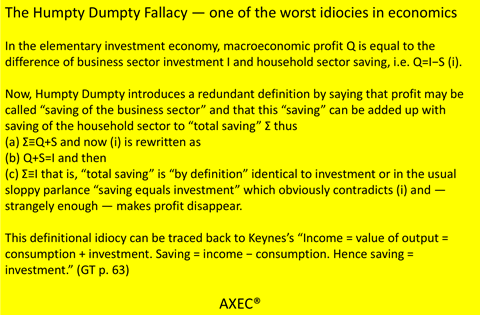
Graphic AXEC129f The Humpty Dumpty Fallacy ― How Economists define

Graphic AXEC128c
July 6, 2017
A crash course in macro accounting
Comment on Peter Cooper on ‘Fiscal Policy, Sectoral Balances, and Financial Sustainability’
Blog-Reference and Blog-Reference
You say: “PRIVATE Balance + GOVT Balance + FOREIGN Balance = 0” and “This is an accounting identity, which means it always holds true.”
This is NOT the case because you messed up the elementary mathematics of accounting. #1 To see this, one has to go back to the MOST ELEMENTARY economic configuration, that is, the pure production-consumption economy, which consists of the household sector and the business sector. #2
In this elementary economy, three configurations are logically possible: (i) consumption expenditures are equal to wage income Ec=Yw, (ii) Ec is less than Yw, (iii) Ec is greater than Yw.
In case (i), the monetary saving of the household sector Sm≡Yw−Ec is zero, and the monetary profit of the business sector Qm≡Ec−Yw, too, is zero.
In case (ii), monetary saving Sm is positive, and the business sector makes a loss, i.e., Qm is negative.
In case (iii), monetary saving Sm is negative, i.e., the household sector dissaves, and the business sector makes a profit, i.e., Qm is positive.
It always holds Qm≡−Sm, in other words, at the heart of national income accounting is an identity — the business sector’s deficit (surplus) equals the household sector’s surplus (deficit). Put bluntly, loss is the counterpart of saving, and profit is the counterpart of dissaving. This is the most elementary form of the macroeconomic Profit Law.
The balances of the business sector, the household sector, the government sector, and the rest of the world are interrelated as follows: Qm≡−Sm+I+Yd+(G−T)+(X−M), and THIS is the correct accounting identity for an open economy (X−M) with a government sector (G−T) and with the business investment I and distributed profit Yd.
Your accounting blunder consists of lumping together the business sector and the household sector. This makes the crucial relation between profit, distributed profit, saving, and investment invisible #3, which amounts to an intended/unintended destruction of valuable information, which in turn is contrary to the very purpose of accounting.
Egmont Kakarot-Handtke
#1 The Common Error of Common Sense: An Essential Rectification of the Accounting Approach
#2 (A0) The objectively given and most elementary configuration of the economy consists of the household and the business sector, which in turn consists initially of one giant fully integrated firm. (A1) Yw=WL wage income Yw is equal to wage rate W times working hours. L, (A2) O=RL output O is equal to productivity R times working hours L, (A3) Ec=PX consumption expenditure Ec is equal to price P times quantity bought/sold X. For a start, it holds X=O. Note that ALL variables are measurable. Ec and Yw appear in National Accounting.
#3 How Keynes got macro wrong and Allais got it right
Related 'Rectification of MMT macro accounting' and 'Down with idiocy!' and 'Is Nick Rowe stupid or corrupt or both?' and 'A tale of three accountants'. For details of the big picture, see cross-references Accounting
You say: “Therefore it makes perfect sense to sum businesses and households as the ‘private sector’ who hold these tax credits.”
It makes a real difference whether what you call tax credits are held by the households or by the firms. By lumping both together in what Peter Cooper calls the "private sector" this difference is made invisible. #1
If this is done unintentionally, it is sheer scientific incompetence; if this is done intentionally, it is what people call cooking the books. If one is not committed to science, though, it is merely brain-dead blather.
#1 For the political implications, see Austerity and the idiocy of political economists.
Peter Cooper argues: “For the economy to grow in a financially sustainable way, the private sector should normally be allowed to maintain a financial surplus (spending less than its income). For many countries (the majority with current account deficits), this means government needs to spend more than it taxes under normal circumstances.”
Because ‘spending less than income’ is the definition of saving, the condensed form of the argument reads: because the households should be allowed to save, the government must dissave, because from accounting follows with mathematical certainty that for any surplus there must be a deficit of equal magnitude somewhere else in the economy.
The problem with this argument is that economists in general and Peter Cooper, in particular, do not understand the elementary mathematics of accounting.
The balances of the business sector, the household sector, the government sector, and the rest of the world are interrelated as follows: Qm≡−Sm+I+Yd+(G−T)+(X−M). This boils down to Qm=−Sm+(G−T) for I, Yd, X, M = 0.
So, there are two limiting cases: (i) If the household sector’s saving Sm goes up and the government’s deficit (G−T) goes up by the same amount, the profit of the business sector Qm remains unchanged. (ii) If the household sector’s saving Sm remains unchanged and the government’s deficit (G−T) goes up, the profit of the business sector Qm goes up by the same amount. It holds that Public Deficit = Private Profit.
So, the counterpart of an increased public deficit is either increased saving of the households or increased profits of the firms, or some combination of the two. Therefore, to say that the counterpart of an increased public deficit is an increased surplus of the “private sector” obscures important real-world differences.
Worse. In the past decades, US households increased their debt; that is, they were dissaving. So, BOTH private and public households ran deficits. From the formula above follows that this boosts profit Qm TWICE. And this is exactly what has been observed and criticized as a catastrophic deterioration of the income distribution.
So, by arguing for government deficits because the “private sector should normally be allowed to maintain a financial surplus,” Peter Cooper is de facto arguing for profit increases of the business sector. #1 He obscures this fact by lumping together the business sector and the household sector into the “private sector”. #2
#1 See also Keynesianism as ultimate profit machine.
You say: “So, to me, you are all on the same page, but with different concepts.” You are simply ill-informed. The formal foundations of MMT are logically defective, and because of this, MMT policy guidance has NO sound scientific foundations. For more details, see these comments
You say: “you have asked me to move logically from the sectoral balances framework to your own, but I can see no reason to do so?”
There is obviously a gross misunderstanding on your side.
The purpose of my post is to inform Peter Cooper that the accounting identity he starts with is defective and that, as a consequence, the rest of his intro is garbage.
The purpose of my post is NOT to educate jrbarch. And if you “can see no reason” to think logically, then simply do not. There is NO need to tell me.
Peter Cooper’s accounting identity is mathematically false. Whether you understand this or not is a matter of indifference.

Blog-Reference and Blog-Reference
You say: “PRIVATE Balance + GOVT Balance + FOREIGN Balance = 0” and “This is an accounting identity, which means it always holds true.”
This is NOT the case because you messed up the elementary mathematics of accounting. #1 To see this, one has to go back to the MOST ELEMENTARY economic configuration, that is, the pure production-consumption economy, which consists of the household sector and the business sector. #2
In this elementary economy, three configurations are logically possible: (i) consumption expenditures are equal to wage income Ec=Yw, (ii) Ec is less than Yw, (iii) Ec is greater than Yw.
In case (i), the monetary saving of the household sector Sm≡Yw−Ec is zero, and the monetary profit of the business sector Qm≡Ec−Yw, too, is zero.
In case (ii), monetary saving Sm is positive, and the business sector makes a loss, i.e., Qm is negative.
In case (iii), monetary saving Sm is negative, i.e., the household sector dissaves, and the business sector makes a profit, i.e., Qm is positive.
It always holds Qm≡−Sm, in other words, at the heart of national income accounting is an identity — the business sector’s deficit (surplus) equals the household sector’s surplus (deficit). Put bluntly, loss is the counterpart of saving, and profit is the counterpart of dissaving. This is the most elementary form of the macroeconomic Profit Law.
The balances of the business sector, the household sector, the government sector, and the rest of the world are interrelated as follows: Qm≡−Sm+I+Yd+(G−T)+(X−M), and THIS is the correct accounting identity for an open economy (X−M) with a government sector (G−T) and with the business investment I and distributed profit Yd.
Your accounting blunder consists of lumping together the business sector and the household sector. This makes the crucial relation between profit, distributed profit, saving, and investment invisible #3, which amounts to an intended/unintended destruction of valuable information, which in turn is contrary to the very purpose of accounting.
Egmont Kakarot-Handtke
#1 The Common Error of Common Sense: An Essential Rectification of the Accounting Approach
#2 (A0) The objectively given and most elementary configuration of the economy consists of the household and the business sector, which in turn consists initially of one giant fully integrated firm. (A1) Yw=WL wage income Yw is equal to wage rate W times working hours. L, (A2) O=RL output O is equal to productivity R times working hours L, (A3) Ec=PX consumption expenditure Ec is equal to price P times quantity bought/sold X. For a start, it holds X=O. Note that ALL variables are measurable. Ec and Yw appear in National Accounting.
#3 How Keynes got macro wrong and Allais got it right
Related 'Rectification of MMT macro accounting' and 'Down with idiocy!' and 'Is Nick Rowe stupid or corrupt or both?' and 'A tale of three accountants'. For details of the big picture, see cross-references Accounting
***
REPLY to jrbarch on Jul 7You say: “Therefore it makes perfect sense to sum businesses and households as the ‘private sector’ who hold these tax credits.”
It makes a real difference whether what you call tax credits are held by the households or by the firms. By lumping both together in what Peter Cooper calls the "private sector" this difference is made invisible. #1
If this is done unintentionally, it is sheer scientific incompetence; if this is done intentionally, it is what people call cooking the books. If one is not committed to science, though, it is merely brain-dead blather.
#1 For the political implications, see Austerity and the idiocy of political economists.
***
REPLY to jrbarch on Jul 8Peter Cooper argues: “For the economy to grow in a financially sustainable way, the private sector should normally be allowed to maintain a financial surplus (spending less than its income). For many countries (the majority with current account deficits), this means government needs to spend more than it taxes under normal circumstances.”
Because ‘spending less than income’ is the definition of saving, the condensed form of the argument reads: because the households should be allowed to save, the government must dissave, because from accounting follows with mathematical certainty that for any surplus there must be a deficit of equal magnitude somewhere else in the economy.
The problem with this argument is that economists in general and Peter Cooper, in particular, do not understand the elementary mathematics of accounting.
The balances of the business sector, the household sector, the government sector, and the rest of the world are interrelated as follows: Qm≡−Sm+I+Yd+(G−T)+(X−M). This boils down to Qm=−Sm+(G−T) for I, Yd, X, M = 0.
So, there are two limiting cases: (i) If the household sector’s saving Sm goes up and the government’s deficit (G−T) goes up by the same amount, the profit of the business sector Qm remains unchanged. (ii) If the household sector’s saving Sm remains unchanged and the government’s deficit (G−T) goes up, the profit of the business sector Qm goes up by the same amount. It holds that Public Deficit = Private Profit.
So, the counterpart of an increased public deficit is either increased saving of the households or increased profits of the firms, or some combination of the two. Therefore, to say that the counterpart of an increased public deficit is an increased surplus of the “private sector” obscures important real-world differences.
Worse. In the past decades, US households increased their debt; that is, they were dissaving. So, BOTH private and public households ran deficits. From the formula above follows that this boosts profit Qm TWICE. And this is exactly what has been observed and criticized as a catastrophic deterioration of the income distribution.
So, by arguing for government deficits because the “private sector should normally be allowed to maintain a financial surplus,” Peter Cooper is de facto arguing for profit increases of the business sector. #1 He obscures this fact by lumping together the business sector and the household sector into the “private sector”. #2
#1 See also Keynesianism as ultimate profit machine.
***
REPLY to jrbarch on Jul 9You say: “So, to me, you are all on the same page, but with different concepts.” You are simply ill-informed. The formal foundations of MMT are logically defective, and because of this, MMT policy guidance has NO sound scientific foundations. For more details, see these comments
- Macrofounded labor market theory
- Economics is NOT about Human Nature but the economic system
- Where MMT got macro wrong
- Rectification and generalization of MMT
- Economics as poultry entrails reading
- Rethinking MMT
- Hobson got full employment policy almost right
- How to start off on the right foot
- Australian upside-down economics
- Modern Moronomic Theory
***
REPLY to jrbarch on Jul 10You say: “you have asked me to move logically from the sectoral balances framework to your own, but I can see no reason to do so?”
There is obviously a gross misunderstanding on your side.
The purpose of my post is to inform Peter Cooper that the accounting identity he starts with is defective and that, as a consequence, the rest of his intro is garbage.
The purpose of my post is NOT to educate jrbarch. And if you “can see no reason” to think logically, then simply do not. There is NO need to tell me.
Peter Cooper’s accounting identity is mathematically false. Whether you understand this or not is a matter of indifference.
***
Graphic AXEC143d

February 19, 2016
Economists’ perennial trouble with accounting
Comment on Steve Keen on ‘Hey Joe, banks can’t lend out reserves’
Blog-Reference
Steve Keen says: “... the useful stuff accountants know is double-entry bookkeeping. Why don’t economists know this themselves? Today’s economists simply don’t study it ... Economists of Joe’s generation often did learn accounting as undergraduates ... but very few of them ever integrated accounting concepts with their economics.”
Accounting is elementary mathematics, and, true, it is regularly beyond the capacities of economists (2012). Unfortunately, also heterodox economists. This includes Steve Keen.
The matrix is not the best tool to present the accounting interrelationships, so I present my refutation of Keen’s argument in an alternative format under the label Graphic AXEC68.

1. In the beginning, there is only the central bank that creates overdrafts and deposits uno actu out of nothing. Overdrafts stand here for all forms of direct loans to the household or the business sector. The deposits of the central bank are money and are used for transactions between the household and the business sector. Other forms of money are kept out of the picture.
2. The banking sector is now split between the central bank and commercial banks. The central bank creates 10 monetary units (million, billion, trillion, Euro, Dollar, Yuan) of overdrafts and deposits for the commercial banks only.
3. The commercial banks start their lending business and create 100 monetary units of overdrafts and deposits for the business sector. The deposits of the commercial banks are the transaction money used by the business sector to pay wages and by the household sector to buy consumption goods. The ratio of central bank deposits (= reserves) to business overdrafts is here 10 %, i.e., 10/100 units) and it is assumed that this is the maximal ratio. So, the commercial banks have here reached their limit of money creation. It is the central bank’s turn to act.
4. In the course of quantitative easing, the central bank takes over 5 monetary units of business sector overdrafts (= loans) from the commercial banks. The ratio of central bank deposits to business overdrafts is now 15.8 %, i.e., 15/95. So the commercial banks have excess reserves. With regard to the 10 % limit, they need 9.5 units of central bank deposits but have 15.
5. The commercial banks now again take up their lending business and increase overdrafts to the business sector by 55 units. Of course, the same increase takes place on the debit side (= business deposits +55). The ratio of central bank deposits to business overdrafts is now again 10 %, i.e., 15/150).
In a strict sense, it is misleading to say that commercial banks lend out reserves. In an elementary credit economy, the commercial banks create overdrafts and deposits uno actu out of nothing. The reserve ratio is not a practical but a legal limit.
So, literally, it is right to say that commercial banks do not lend out reserves. But it is obvious that between step 4 and step 5, the banks have excess reserves and therefore are in the position to create money in the form of bank deposits for the business and the household sector. Between steps 4 and 5, the credit multiplier is indeed greater than 0. Steve Keen’s conclusion, “Therefore, the $1.4 trillion of excess reserves that QE has created in the USA alone has added precisely $0 to the lending power of banks” is false.
The lending power is there, but of no use if the household and business sectors prefer to deleverage (Koo, 2009).
The real problem of QE is that the central bank takes toxic loans off the commercial/ investment banks' balance sheets and thus protects them from losses.
Egmont Kakarot-Handtke
References
Kakarot-Handtke, E. (2012). The Common Error of Common Sense: An Essential Rectification of the Accounting Approach. SSRN Working Paper Series, 2124415: 1–23. URL
Koo, R. C. (2009). The Holy Grail of Macroeconomics. Lessons from Japan’s Great Recession. Singapore: Wiley.
Related 'Accounting for dummies' and 'Accounting basics' and 'End of confusion' and 'Either stupid or duplicitous' and 'Unaccountable' and cross-references Accounting
COMMENT on Asad Zaman and John Hermann on Feb 21
The two criteria of science are formal and material consistency (Klant, 1994, p. 31). The latter is established by empirical testing. How important this is for genuine scientists, one may glean from the fact that physicists have built ‘the world’s most expensive and complex experimental facilities to date’ (CERN, Wikipedia) in order to test a hypothesis that was put forth around 1964 by six theoretical physicists.
This vividly contrasts with the silly methodological motto of most economists, i.e., “it is better to be roughly right than precisely wrong!” (Davidson, 1984, p. 574)
The analog to the physicists’ fervor of measurement would be to install a giant facility that records every economic transaction in real-time according to the principles of accounting. This facility then delivers the exact numbers (two digits) of total income per period, consumption expenditures, saving, and so on. And these numbers are the rock-solid foundation of empirical testing.
Curiously, economists have never shown any ambition to build such a facility. Worse, economic theory is not even built upon concepts that correspond with what could actually be produced with such a gigantic bookkeeping machine. Just the contrary, economic theory has been built upon concepts like utility or equilibrium, and it should have been evident from the very start that there is no testable correspondence to these green cheese concepts in the real world. Thus, the scientific failure of economics was methodologically pre-programmed 150 years ago.
What most economists have not realized to this day is that accounting is pivotal to their discipline. Their manifest incompetence consists of not understanding the elementary mathematics that underlies accounting (2012). This is the real mathiness problem.
“Somewhere between the Political Arithmetician, alias the National Income Accountant, and the Financial Analyst, alias the Accountant, lies the task of the quantitative economist’s analytical role and none of the theoretical or applied tasks of these two pragmatic and paradigmatic figures requires anything more than arithmetic, statistics, and the rules of compound interest. These, in turn, require nothing more than an understanding of the conditions under which systems of equations can and cannot be solved. But what kind of quantities do these equations encapsulate as parameters, constants, and variables? Surely, the kind of quantities that enter the equations of the Political Arithmetician and the Accountant cannot be other than rational or natural numbers — negative and non-negative? Eminent theorists, working in core areas of economic theory — price theory and monetary theory — have made this point in interesting ways over the past half a century.” (Velupillai, 2005, pp. 866-867)
To be sure, accounting is not all of economics. But make no mistake, above the entrance to economics as a science is inscribed the phrase: “Let None But Those Who Mastered The Elementary Mathematics of Accounting Enter Here.”
References
Davidson, P. (1984). Reviving Keynes’s Revolution. Journal of Post Keynesian Economics, 6(4): 561–575. URL
Kakarot-Handtke, E. (2012). The Common Error of Common Sense: An Essential Rectification of the Accounting Approach. SSRN Working Paper Series, 2124415: 1–23. URL
Klant, J. J. (1994). The Nature of Economic Thought. Aldershot, Brookfield: Edward Elgar.
Velupillai, K. (2005). The Unreasonable Ineffectiveness of Mathematics in Economics. Cambridge Journal of Economics, 29: 849–872.
Blog-Reference
Steve Keen says: “... the useful stuff accountants know is double-entry bookkeeping. Why don’t economists know this themselves? Today’s economists simply don’t study it ... Economists of Joe’s generation often did learn accounting as undergraduates ... but very few of them ever integrated accounting concepts with their economics.”
Accounting is elementary mathematics, and, true, it is regularly beyond the capacities of economists (2012). Unfortunately, also heterodox economists. This includes Steve Keen.
The matrix is not the best tool to present the accounting interrelationships, so I present my refutation of Keen’s argument in an alternative format under the label Graphic AXEC68.

1. In the beginning, there is only the central bank that creates overdrafts and deposits uno actu out of nothing. Overdrafts stand here for all forms of direct loans to the household or the business sector. The deposits of the central bank are money and are used for transactions between the household and the business sector. Other forms of money are kept out of the picture.
2. The banking sector is now split between the central bank and commercial banks. The central bank creates 10 monetary units (million, billion, trillion, Euro, Dollar, Yuan) of overdrafts and deposits for the commercial banks only.
3. The commercial banks start their lending business and create 100 monetary units of overdrafts and deposits for the business sector. The deposits of the commercial banks are the transaction money used by the business sector to pay wages and by the household sector to buy consumption goods. The ratio of central bank deposits (= reserves) to business overdrafts is here 10 %, i.e., 10/100 units) and it is assumed that this is the maximal ratio. So, the commercial banks have here reached their limit of money creation. It is the central bank’s turn to act.
4. In the course of quantitative easing, the central bank takes over 5 monetary units of business sector overdrafts (= loans) from the commercial banks. The ratio of central bank deposits to business overdrafts is now 15.8 %, i.e., 15/95. So the commercial banks have excess reserves. With regard to the 10 % limit, they need 9.5 units of central bank deposits but have 15.
5. The commercial banks now again take up their lending business and increase overdrafts to the business sector by 55 units. Of course, the same increase takes place on the debit side (= business deposits +55). The ratio of central bank deposits to business overdrafts is now again 10 %, i.e., 15/150).
In a strict sense, it is misleading to say that commercial banks lend out reserves. In an elementary credit economy, the commercial banks create overdrafts and deposits uno actu out of nothing. The reserve ratio is not a practical but a legal limit.
So, literally, it is right to say that commercial banks do not lend out reserves. But it is obvious that between step 4 and step 5, the banks have excess reserves and therefore are in the position to create money in the form of bank deposits for the business and the household sector. Between steps 4 and 5, the credit multiplier is indeed greater than 0. Steve Keen’s conclusion, “Therefore, the $1.4 trillion of excess reserves that QE has created in the USA alone has added precisely $0 to the lending power of banks” is false.
The lending power is there, but of no use if the household and business sectors prefer to deleverage (Koo, 2009).
The real problem of QE is that the central bank takes toxic loans off the commercial/ investment banks' balance sheets and thus protects them from losses.
Egmont Kakarot-Handtke
References
Kakarot-Handtke, E. (2012). The Common Error of Common Sense: An Essential Rectification of the Accounting Approach. SSRN Working Paper Series, 2124415: 1–23. URL
Koo, R. C. (2009). The Holy Grail of Macroeconomics. Lessons from Japan’s Great Recession. Singapore: Wiley.
Related 'Accounting for dummies' and 'Accounting basics' and 'End of confusion' and 'Either stupid or duplicitous' and 'Unaccountable' and cross-references Accounting
***
COMMENT on Asad Zaman and John Hermann on Feb 21
The two criteria of science are formal and material consistency (Klant, 1994, p. 31). The latter is established by empirical testing. How important this is for genuine scientists, one may glean from the fact that physicists have built ‘the world’s most expensive and complex experimental facilities to date’ (CERN, Wikipedia) in order to test a hypothesis that was put forth around 1964 by six theoretical physicists.
This vividly contrasts with the silly methodological motto of most economists, i.e., “it is better to be roughly right than precisely wrong!” (Davidson, 1984, p. 574)
The analog to the physicists’ fervor of measurement would be to install a giant facility that records every economic transaction in real-time according to the principles of accounting. This facility then delivers the exact numbers (two digits) of total income per period, consumption expenditures, saving, and so on. And these numbers are the rock-solid foundation of empirical testing.
Curiously, economists have never shown any ambition to build such a facility. Worse, economic theory is not even built upon concepts that correspond with what could actually be produced with such a gigantic bookkeeping machine. Just the contrary, economic theory has been built upon concepts like utility or equilibrium, and it should have been evident from the very start that there is no testable correspondence to these green cheese concepts in the real world. Thus, the scientific failure of economics was methodologically pre-programmed 150 years ago.
What most economists have not realized to this day is that accounting is pivotal to their discipline. Their manifest incompetence consists of not understanding the elementary mathematics that underlies accounting (2012). This is the real mathiness problem.
“Somewhere between the Political Arithmetician, alias the National Income Accountant, and the Financial Analyst, alias the Accountant, lies the task of the quantitative economist’s analytical role and none of the theoretical or applied tasks of these two pragmatic and paradigmatic figures requires anything more than arithmetic, statistics, and the rules of compound interest. These, in turn, require nothing more than an understanding of the conditions under which systems of equations can and cannot be solved. But what kind of quantities do these equations encapsulate as parameters, constants, and variables? Surely, the kind of quantities that enter the equations of the Political Arithmetician and the Accountant cannot be other than rational or natural numbers — negative and non-negative? Eminent theorists, working in core areas of economic theory — price theory and monetary theory — have made this point in interesting ways over the past half a century.” (Velupillai, 2005, pp. 866-867)
To be sure, accounting is not all of economics. But make no mistake, above the entrance to economics as a science is inscribed the phrase: “Let None But Those Who Mastered The Elementary Mathematics of Accounting Enter Here.”
References
Davidson, P. (1984). Reviving Keynes’s Revolution. Journal of Post Keynesian Economics, 6(4): 561–575. URL
Kakarot-Handtke, E. (2012). The Common Error of Common Sense: An Essential Rectification of the Accounting Approach. SSRN Working Paper Series, 2124415: 1–23. URL
Klant, J. J. (1994). The Nature of Economic Thought. Aldershot, Brookfield: Edward Elgar.
Velupillai, K. (2005). The Unreasonable Ineffectiveness of Mathematics in Economics. Cambridge Journal of Economics, 29: 849–872.
February 12, 2016
Accounting for dummies
Comment on David Ruccio/Liam on ‘Why is slow growth a problem?’
Blog-Reference
You say, “This is a cost-accounting problem. Period. End of story. Any attempt to make it more complicated than that is intellectual masturbation IMO.”
Agreed, let us treat it as an accounting problem. And let us de-complicate the economy to the bare bones. #1
The most elementary economy is the production-consumption economy, and it consists of the business and the household sectors. For a start, the business sector produces and sells one consumption good. The business sector is fully integrated from the intake of raw material to the output of the final product. With one giant firm, we have the simplest of all possible cases.
First period: the business sector pays 100 monetary units (million, billion, trillion Euro, Dollar, Yuan) to the household sector, and the household sector spends exactly this amount on consumption goods. There is no saving of the household sector. The business sector’s profit is zero, and the price of the consumption good is equal to unit wage costs. The real wage is equal to productivity.
For the economy as a whole, there is no gap. The business sector fully recovers its wage costs. This can happen at ANY level of employment, so full employment is no problem. However, problems can arise on the monetary side. If employment is doubled, for instance, then wage income doubles and this means that transaction money must double. In a well-designed economy, the central bank can provide the necessary transaction balances out of nothing.
Interim result: It is possible in principle to run the elementary production-consumption economy at any level of employment and to grow or shrink at will, provided the central bank finances the wage bill, whatever it is. The business sector makes neither profit nor loss. The economy is reproducible for an indefinite number of periods.
Second period: the household sector saves 10 monetary units (S=10) and spends 90 units. Now, the business sector makes a loss (Q=−10). The market-clearing price is lower than unit wage costs. There is no change in inventory.
Accounting result: saving = loss [Q≡−S]. The complementary notion of saving is NOT investment but loss. If the household sector dissaves 10 monetary units (S=−10), i.e., spends 110, then the business sector makes a profit (Q=10). So growing household sector debt is the ULTIMATE source of profit (NOT productivity increases, NOT risk-taking, NOT wage-cutting, NOT firing people, NOT the other brain-dead common sense explanations from the microeconomic ant-perspective).
At the central bank’s balance sheet, we have, in the case of pure credit money, at the end of the 2nd period, 10 units of current deposits of the household sector and an equal amount of current overdrafts of the business sector in the case of saving. Without going further into details, it should be obvious that the rate of interest on the asset side and the rate of interest on the liability side must be such that their difference covers the wage costs of the central bank under the condition of zero profit. Again, there is no gap or problem if the economy is well-designed. Needless to emphasize that it is actually NOT well-designed.
How to organize a well-functioning economy is a question neither orthodox nor heterodox economists have figured out in more than 200 years. No question, if there is something like a scientific hell, Walrasians, Keynesians, Marxians, and Austrians will be dammed to discuss their proto-scientific garbage in eternity with dull Econ 101 students as the sole audience.
Takeaway: You have to thoroughly rework your website. Flag-waving is not a substitute for thinking or proper accounting.
Egmont Kakarot-Handtke
#1 For the formal underpinning, see the post Economists cannot do the simple math of profit — better keep them out of politics or the SSRN working paper Economics for Economists
Related 'Have data, lack theory' and 'The common error of common sense: An essential rectification of the accounting approach' and 'A tale of three accountants'. For details of the big picture, see cross-references Accounting.
REPLY to Liam of Feb 12 on Feb 13
First, you say, “This is a cost-accounting problem. Period. End of story. Any attempt to make it more complicated than that is intellectual masturbation IMO.”
Next, you say, “I won’t agree to your FIRST model because it is so far from reality that it is hardly worth commenting on.”
So, you first ask for a simple picture of the economy, and when you get the simplest possible picture, you complain that a lot of details are missing. This is the outworn catch-22 schizo that is endemic in economic discussions (2013).
If you had done your homework and looked into some of my working papers, you would have realized that the elementary consumption economy has already been differentiated in ALL directions. So, (i) your ‘realism vs. abstraction’ kindergarten game falls flat, and (ii), you make it quite clear that you are not aware of the basics of methodology: “There can be no doubt whatsoever that a problem which has not yet been solved in all its aspects under its simplest conditions will be still more difficult to tackle if other, ‘more realistic’ assumptions are being made.” (Morgenstern, 1941, p. 373)
With regard to your challenge, the error/mistake is already in the first line. You write “A = all cost components of price comprised of wages, earnings, or dividends.” Note that dividends are not a cost component. Better if you get your price theory right first (2011).
Advocating social credit is one thing, and claiming that it is based on sound economic theory is quite another thing — in your case, it is definitely not.
You make the same mistake as standard economics, that is, to start with an agent/firm and to go bottom-up, i.e., microfoundations, leads to nowhere, yet to start with the economy as a whole and then to go top-down, i.e., macrofoundations, yields consistent and testable propositions. Every economist could know this by now from the evident failure of Walrasianism.
References
Kakarot-Handtke, E. (2011). The Emergence of Profit and Interest in the Monetary Circuit. SSRN Working Paper Series, 1973952: 1–22. URL
Kakarot-Handtke, E. (2013). Confused Confusers: How to Stop Thinking Like an Economist and Start Thinking Like a Scientist. SSRN Working Paper Series, 2207598: 1–16. URL
Morgenstern, O. (1941). Professor Hicks on Value and Capital. Journal of Political Economy, 49(3): 361–393. URL
REPLY to Liam on Feb 14
I have no problem at all with CH Douglas’s political program; I have only a problem with his underlying economic theory. The point is: right policy depends on true theory. If you intend to fly to the moon, you first have to figure out the law of gravity (and some others). If you want to improve the economy, you first have to figure out how it works.
This is an economics blog, and in my understanding, the ultimate goal is to replace standard economics, which is provably false, with the true economic theory.
“In order to tell the politicians and practitioners something about causes and best means, the economist needs the true theory or else he has not much more to offer than educated common sense or his personal opinion.” (Stigum)
Economists do not have the true theory. Neither Walrasians, nor Keynesians, nor Marxians, nor Austrians, nor Douglasians know how the economy works. So they are in no position to promise a ‘better’ economy. Worse, with false economic theories in their scientifically incompetent micro brains, economists actually cause or worsen crises.
How convincing are economists who promise to create the Good Society but cannot do elementary accounting? To recall, the profit theory has been false since Adam Smith. Economists literally do not know what they are talking about.
So: first get economics right, then get the economy right.
REPLY to Liam on Feb 16
“...the tens of thousands (millions over the past century) of people” who stand with you are certainly a veritable political force but they have no say in scientific matters. Science is about logical and empirical proof.
If you can refute my main point, let me know.
And this is the main point: You cannot tell the difference between profit, income, and distributed profit, and because of this, you have no idea about how the actual economy works.
Blog-Reference
You say, “This is a cost-accounting problem. Period. End of story. Any attempt to make it more complicated than that is intellectual masturbation IMO.”
Agreed, let us treat it as an accounting problem. And let us de-complicate the economy to the bare bones. #1
The most elementary economy is the production-consumption economy, and it consists of the business and the household sectors. For a start, the business sector produces and sells one consumption good. The business sector is fully integrated from the intake of raw material to the output of the final product. With one giant firm, we have the simplest of all possible cases.
First period: the business sector pays 100 monetary units (million, billion, trillion Euro, Dollar, Yuan) to the household sector, and the household sector spends exactly this amount on consumption goods. There is no saving of the household sector. The business sector’s profit is zero, and the price of the consumption good is equal to unit wage costs. The real wage is equal to productivity.
For the economy as a whole, there is no gap. The business sector fully recovers its wage costs. This can happen at ANY level of employment, so full employment is no problem. However, problems can arise on the monetary side. If employment is doubled, for instance, then wage income doubles and this means that transaction money must double. In a well-designed economy, the central bank can provide the necessary transaction balances out of nothing.
Interim result: It is possible in principle to run the elementary production-consumption economy at any level of employment and to grow or shrink at will, provided the central bank finances the wage bill, whatever it is. The business sector makes neither profit nor loss. The economy is reproducible for an indefinite number of periods.
Second period: the household sector saves 10 monetary units (S=10) and spends 90 units. Now, the business sector makes a loss (Q=−10). The market-clearing price is lower than unit wage costs. There is no change in inventory.
Accounting result: saving = loss [Q≡−S]. The complementary notion of saving is NOT investment but loss. If the household sector dissaves 10 monetary units (S=−10), i.e., spends 110, then the business sector makes a profit (Q=10). So growing household sector debt is the ULTIMATE source of profit (NOT productivity increases, NOT risk-taking, NOT wage-cutting, NOT firing people, NOT the other brain-dead common sense explanations from the microeconomic ant-perspective).
At the central bank’s balance sheet, we have, in the case of pure credit money, at the end of the 2nd period, 10 units of current deposits of the household sector and an equal amount of current overdrafts of the business sector in the case of saving. Without going further into details, it should be obvious that the rate of interest on the asset side and the rate of interest on the liability side must be such that their difference covers the wage costs of the central bank under the condition of zero profit. Again, there is no gap or problem if the economy is well-designed. Needless to emphasize that it is actually NOT well-designed.
How to organize a well-functioning economy is a question neither orthodox nor heterodox economists have figured out in more than 200 years. No question, if there is something like a scientific hell, Walrasians, Keynesians, Marxians, and Austrians will be dammed to discuss their proto-scientific garbage in eternity with dull Econ 101 students as the sole audience.
Takeaway: You have to thoroughly rework your website. Flag-waving is not a substitute for thinking or proper accounting.
Egmont Kakarot-Handtke
#1 For the formal underpinning, see the post Economists cannot do the simple math of profit — better keep them out of politics or the SSRN working paper Economics for Economists
Related 'Have data, lack theory' and 'The common error of common sense: An essential rectification of the accounting approach' and 'A tale of three accountants'. For details of the big picture, see cross-references Accounting.
***
REPLY to Liam of Feb 12 on Feb 13
First, you say, “This is a cost-accounting problem. Period. End of story. Any attempt to make it more complicated than that is intellectual masturbation IMO.”
Next, you say, “I won’t agree to your FIRST model because it is so far from reality that it is hardly worth commenting on.”
So, you first ask for a simple picture of the economy, and when you get the simplest possible picture, you complain that a lot of details are missing. This is the outworn catch-22 schizo that is endemic in economic discussions (2013).
If you had done your homework and looked into some of my working papers, you would have realized that the elementary consumption economy has already been differentiated in ALL directions. So, (i) your ‘realism vs. abstraction’ kindergarten game falls flat, and (ii), you make it quite clear that you are not aware of the basics of methodology: “There can be no doubt whatsoever that a problem which has not yet been solved in all its aspects under its simplest conditions will be still more difficult to tackle if other, ‘more realistic’ assumptions are being made.” (Morgenstern, 1941, p. 373)
With regard to your challenge, the error/mistake is already in the first line. You write “A = all cost components of price comprised of wages, earnings, or dividends.” Note that dividends are not a cost component. Better if you get your price theory right first (2011).
Advocating social credit is one thing, and claiming that it is based on sound economic theory is quite another thing — in your case, it is definitely not.
You make the same mistake as standard economics, that is, to start with an agent/firm and to go bottom-up, i.e., microfoundations, leads to nowhere, yet to start with the economy as a whole and then to go top-down, i.e., macrofoundations, yields consistent and testable propositions. Every economist could know this by now from the evident failure of Walrasianism.
References
Kakarot-Handtke, E. (2011). The Emergence of Profit and Interest in the Monetary Circuit. SSRN Working Paper Series, 1973952: 1–22. URL
Kakarot-Handtke, E. (2013). Confused Confusers: How to Stop Thinking Like an Economist and Start Thinking Like a Scientist. SSRN Working Paper Series, 2207598: 1–16. URL
Morgenstern, O. (1941). Professor Hicks on Value and Capital. Journal of Political Economy, 49(3): 361–393. URL
***
REPLY to Liam on Feb 14
I have no problem at all with CH Douglas’s political program; I have only a problem with his underlying economic theory. The point is: right policy depends on true theory. If you intend to fly to the moon, you first have to figure out the law of gravity (and some others). If you want to improve the economy, you first have to figure out how it works.
This is an economics blog, and in my understanding, the ultimate goal is to replace standard economics, which is provably false, with the true economic theory.
“In order to tell the politicians and practitioners something about causes and best means, the economist needs the true theory or else he has not much more to offer than educated common sense or his personal opinion.” (Stigum)
Economists do not have the true theory. Neither Walrasians, nor Keynesians, nor Marxians, nor Austrians, nor Douglasians know how the economy works. So they are in no position to promise a ‘better’ economy. Worse, with false economic theories in their scientifically incompetent micro brains, economists actually cause or worsen crises.
How convincing are economists who promise to create the Good Society but cannot do elementary accounting? To recall, the profit theory has been false since Adam Smith. Economists literally do not know what they are talking about.
So: first get economics right, then get the economy right.
***
REPLY to Liam on Feb 16
“...the tens of thousands (millions over the past century) of people” who stand with you are certainly a veritable political force but they have no say in scientific matters. Science is about logical and empirical proof.
If you can refute my main point, let me know.
And this is the main point: You cannot tell the difference between profit, income, and distributed profit, and because of this, you have no idea about how the actual economy works.
November 30, 2015
Accounting: cross-references
Posts
Working paper
- The GDP-death-blow for the economics profession here
- Wikipedia, economics, scientific knowledge, or political agenda pushing? here
- Profit here
- MMT and the canonical macroeconomic model here
- Dear idiots, government deficits do NOT fund private savings here
- To this day, economists have produced NOT ONE textbook that satisfies scientific standards here
- Dear idiots, time to get saving and investment straight (II) here
- Dear idiots, Marx got profit and exploitation wrong here
- Misrepresenting MMT here
- Still beyond the reach of economists: The Holy Grail of Science here
- Understanding public deficits, money, and profit here
- “But economics is not pure mathematics or logic” No, it is pure blather here
- Why is 0!=1? And why is I≠S? And why economics teaching is rotten here
- #DrainTheScientificSwamp here
- Kalecki and Keynes: The double macroeconomic false start here
- MMT in a nutshell here
- Brian Romanchuk’s Post-Keynesian idiocy here
- Heterodox economics: When stupidity becomes a public danger here
- Stephanie and Noah ― economics at the intellectual zero lower bound here
- Both mainstream economics and MMT are axiomatically false here
- MMT and the single most stupid physicist here
- Economics: Math is NOT the problem, scientific incompetence is here
- The present non-existence of economics here
- Wikipedia and the promotion of economists’ idiotism (II) here
- Truth by definition? The Profit Theory has been axiomatically false for 200+ years here
- MMT: How mathematical incompetence helps the Kelton-Fraud here
- The first to leave the sinking MMT ship? here
- Additional proof of MMT’s inconsistency here
- Bill Mitchell, MMT’s fake scientist here
- DSGE and profit―forget it! MMT and profit―forget it! here
- Ricardo, too, got profit theory wrong here
- National Accounting: scientific incompetence or political fraud? here
- Solving Mill’s starting problem here
- MMT: scientific incompetence or political fraud? here
- Why economists don’t know what profit is here
- Rectification of MMT macro accounting here
- MMT and the magical profit disappearance here
- Loanable funds ― no hoax, just breathtaking stupidity here
- Economists: just too stupid for counting here
- A tale of three accountants here
- How money emerges out of nothing ― the functional account here
- Intellectual deficit spending here
- Macro for dummies (ii) here
- A crash course in macro accounting here
- Profit theory in less than 5 minutes here
- Morons on math here
- First Lecture in New Economic Thinking here
- Economics between mathiness, dyscalculia, and idiocy here
- Macro for dummies (i) here
- Why economists know nothing here
- Economists still don’t get Econ 101 right here
- Wikipedia and the promotion of economists’ idiotism here
- The final implosion of MMT here
- A new episode of one of the worst blunders of economics here
- Keynesian macrofoundations are defective here
- Note on saving and investment here
- From subjective weighing of motives to objective systemic properties here
- The tiny little problem with economics here
- Economists’ perennial trouble with accounting here
- Accounting for dummies here
- It is shrinking debt which eventually explodes the market economy here
- The substandard standards of distribution theory here
- A new fall back into old thinking here
- Humpty Dumpty is back again here
- Accounting basics here
- End of confusion here
- Keynes and the logical brilliance of Bedlam here
- Corbynomics here
- Note on Accounting for **** here
- Either stupid or duplicitous here
- Accounting matters here
- Unaccountable here
- The trouble with counting to 3 here
- When numbers don't add up here
- Keenonomics, aggregate demand/change of debt, and some misleading critique here
- Tricky business here
- Hold the handle, not the blade here
- The Common Error of Common Sense: An Essential Rectification of the Accounting Approach here
Related see cross-references Math/Mathiness and cross-references Incompetence and cross-references Refutation of I=S.
Subscribe to:
Posts (Atom)