Comment on Barkley Rosser on ‘Is Doing Environmental Economics Especially Depressing?’
Blog-Reference
What exactly is environmental economics and why is it even more depressing than ordinary economics? In a previous post, Barkley Rosser told the world: “I have just learned via his New York Times obit that Marty Weitzman hanged himself, a suicide, reportedly depressed at his not gwtting the Nobel Prize and making a math error in an unpublished, circulates paper this spring. This is just too depressing.”#1
So, it was NOT so much environmental degradation that depressed Martin Weitzman but that he did not get the Nobel.#1 However, at this point, all is just speculation. Perhaps Martin Weitzman realized that economics is a failed/fake science and that he had taken an active part in the greatest scientific fraud of modern times. This, though, contradicts what his colleagues say about him: “Marty Weitzman was the pre-eminent environmental economist of the modern era, which is to say of all times,” (Nordhaus)*
In the NYT obituary, Martin Weitzman is quoted with: “Most everything we know tells us climate change is bad,” and “Most everything we don’t know tells us it’s probably much worse.” There is nothing of economics in this statement. In fact, many scientists and laypeople have come to this opinion long before Martin Weitzman.**
The age-old problem with economists is that they are strong on opinion but weak on knowledge and that they suffer from mental incontinence, that is, the unstoppable urge to blather about any issue between heaven and earth, that is, from crime, addiction, psychology, sociology, philosophy, religion, literature, ethics#2 to Mohammed bin Salman bin Abdulaziz al Sa'ud and the Khashoggi affair (“He is guilty guilty guuilty”).#3 The depressing fact for non-economists about economics is that economists have to this day NO idea of how the economy works. The major approaches ― Walrasianism, Keynesianism, Marxianism, Austrianism, MMT ― are mutually contradictory, axiomatically false, materially/formally inconsistent and all got the foundational economic concept of profit wrong.
Economists have NO scientific knowledge about their own subject matter. They wonder whether the ecosystem will eventually break down but claim that the market economy is a self-optimizing stable equilibrium system. The fact is that the economic system will probably break down earlier than the ecosystem.#4 But no economist ever gets depressed about that.
Permanently growing public debt is an indicator that the system is broken. So-called free-market economies like the USA are on the full life support of the State. The Oligarchy is continuously fed by deficit-spending/money-creation. The Oligarchy’s financial wealth grows in lockstep with public debt. People are told that they have nothing to fear because the sovereign state cannot go bankrupt. The Oligarchy, in turn, uses the opulent free lunches to corrupt what remains of the state’s legislative, executive, and judiciary institutions.
Curiously, economists are neither depressed about the run-away economy nor about the proto-scientific state of their discipline. They simply declare themselves as the best scientists of all time and reward themselves with oligarchy-sponsored faux Nobels. On average, among all failed/fake scientists economists have the most fun. If economists are depressed the reason most probably lies elsewhere.
Egmont Kakarot-Handtke
* New York Times
** For example, Dane Wigington YouTube
#1 No False-Hero Memorials
#2 Economists: Jacks-of-all-trades ― except economics
#3 Urgent: Taking politics out of economics
#4 What comes first: eco-self-destruction or oeco-self-destruction?
September 7, 2019
September 5, 2019
The end of Mankiw and his Phillips Curve
Comment on David Glasner on ‘Mankiw’s Phillips-Curve Agonistes’
Blog-Reference and Blog-Reference and Blog-Reference
Gregory Mankiw starts his history of the Phillips Curve with gossiping and name-dropping: “The economist George Akerlof, a Nobel laureate and the husband of the former Federal Reserve chair Janet Yellen, once called the Phillips curve ‘probably the single most important macroeconomic relationship.’ So it is worth recalling what the Phillips curve is, why it plays a central role in mainstream economics and why it has so many critics. The story begins in 1958, when the economist A. W. Phillips published an article reporting an inverse relationship between unemployment and inflation in Britain. He reasoned that when unemployment is high, workers are easy to find, so employers hardly raise wages, if they do so at all. But when unemployment is low, employers have trouble attracting workers, so they raise wages faster. Inflation in wages soon turns into inflation in the prices of goods and services.”
David Glasner immediately spots the fatal mistake of Mankiw’s account: “I must note parenthetically that, as I have written recently, a supply-demand framework (aka partial equilibrium analysis) is not really the appropriate way to think about unemployment, because the equilibrium level of wages and the rates of unemployment must be analyzed, as, using different terminology, Keynes argued, in a general equilibrium, not a partial equilibrium, framework.” Unfortunately, David Glasner then gets lost in supply-demand-equilibrium blather.
The Phillips Curve (better: bastard or NAIRU Phillips Curve) is the centerpiece of standard employment theory. Economists have gotten employment theory wrong for 200+ years. #1-#5
The materially/formally inconsistent NAIRU Phillips Curve has to be replaced by the correct macroeconomic Employment Law, which is shown here. #6

From this equation follows:
(i) An increase in the expenditure ratio ρE leads to higher employment L (the Greek letter ρ stands for ratio). An expenditure ratio ρE greater than 1 indicates a budget deficit = credit expansion, a ratio ρE less than 1 indicates credit contraction.
(ii) Increasing investment expenditures I exert a positive influence on employment.
(iii) An increase in the factor cost ratio ρF≡W/PR leads to higher employment.
The complete Employment Law contains, in addition profit, distribution, the public sector, and foreign trade.
Items (i) and (ii) cover Keynes’ familiar arguments about aggregate demand. The factor cost ratio ρF, as defined in (iii), embodies the macroeconomic price mechanism. The fact of the matter is that overall employment L INCREASES if the AVERAGE wage rate W INCREASES relative to the average price P and productivity R. Roughly speaking, price inflation is bad for employment, and wage inflation is good. This is the exact opposite of what microfounded supply-demand-equilibrium economics teaches.
The testable macrofounded Employment Law tells one that the best policy to stabilize employment on a high level is price inflation of zero and wage inflation equal to productivity increases. The 2 percent inflation target has always been political idiocy based on defective theory.
Egmont Kakarot-Handtke
#1 NAIRU, wage-led growth, and Samuelson’s Dyscalculia
#2 Keynes’ Employment Function and the Gratuitous Phillips Curve Disaster
#3 NAIRU and the scientific incompetence of Orthodoxy and Heterodoxy
#4 Full employment, the Phillips Curve, and the end of Gaganomics
#5 For more details of the big picture, see cross-references Employment/Phillips Curve
#6 Graphic AXEC62 Employment Law
You say “… a supply-demand framework (aka partial equilibrium analysis) is not really the appropriate way to think about unemployment, because the equilibrium level of wages and the rates of unemployment must be analyzed, as, using different terminology, Keynes argued, in a general equilibrium, not a partial equilibrium, framework.”
In methodological terms, this means that economics has to perform a Paradigm Shift. However, a move from partial to total equilibrium analysis is NOT the right thing to do. Economic analysis has to advance from microfoundations to macrofoundations. This is what Keynes attempted 80 years ago. He failed, and the exact point of failure is in the GT on p. 63: “Income = value of output = consumption + investment. Saving = income − consumption. Therefore saving = investment.” Keynes moved to false macrofoundations, but economists have not realized it to this day.
In order to go back to basics, the elementary production-consumption economy is, for a star,t defined by three macroeconomic axioms (Yw=WL, O=RL, C=PX), two conditions (X=O, C=Yw), and two definitions (profit/loss Q≡C−Yw, saving/dissaving S≡Yw−C).
Money is needed by the business sector to pay the workers who receive the wage income Yw per period. The workers spend C per period. Given the two conditions, the market-clearing price is derived as P=W/R (1) for any level of employment L. So, the macroeconomic price P is, under the condition of market-clearing X=O, determined by the wage rate W, which has to be fixed as a numéraire, and the productivity R. This is the most elementary case of the macroeconomic Law of Supply and Demand.
The average stock of transaction money follows for a start as M=κYw, with κ determined by the payment pattern. In other words, the average quantity of money M is determined by the AUTONOMOUS transactions of the household and business sector and created out of nothing by the Central Bank. This, to begin with, refutes the commonplace Quantity Theory because M is NOT among the determinants of P in (1).
In the general case, consumption expenditures C are not equal to wage income Yw. Accordingly, the market-clearing price is now given by P=ρEW/R (2), with ρE≡C/Yw.#1 An expenditure ratio ρE greater than 1 indicates credit expansion = dissaving, a ratio ρE less than 1 indicates the opposite. The ratio ρE establishes the link between the product market and the money/capital market.
Now we have deficit-spending, i.e., ρE greater than 1, which yields a one-off price hike. If deficit-spending is repeated period after period, the price remains at the elevated level, and there is NO inflation. No matter how long the household sector’s debt increases, there is NO further price increase. The same holds for the government sector. A constant government deficit does NOT cause inflation. Because macroeconomic profit is given by Q=(G−T)−S, the financial wealth of the Oligarchy grows in lockstep with the public debt, if S is set to 0 for a moment. So, the negative effect of private/public deficit spending is NOT on inflation but on distribution.
The macroeconomic Law of Supply and Demand makes it clear that inflation only occurs if the wage rate W increases in successive periods faster than productivity R. As a matter of principle, this can happen at ANY employment level. It is NOT a precondition that employment is close to the capacity limit. This is merely a false interpretation of the original Phillips Curve.
Methodologically, it is NOT the case that economic analysis has to apply general equilibrium instead of partial equilibrium. Microfoundations in any shape or form are a lethal methodological blunder. Economics has to move from false Marshallian/Walrasian microfoundations and false Keynesian macrofoundations to true macrofoundations. Both Keynes and Hawtrey have to be buried for good at the Flat-Earth-Cemetery.
#1 Graphic AXEC101b Macroeconomic Law of Supply and Demand

Blog-Reference and Blog-Reference and Blog-Reference
Gregory Mankiw starts his history of the Phillips Curve with gossiping and name-dropping: “The economist George Akerlof, a Nobel laureate and the husband of the former Federal Reserve chair Janet Yellen, once called the Phillips curve ‘probably the single most important macroeconomic relationship.’ So it is worth recalling what the Phillips curve is, why it plays a central role in mainstream economics and why it has so many critics. The story begins in 1958, when the economist A. W. Phillips published an article reporting an inverse relationship between unemployment and inflation in Britain. He reasoned that when unemployment is high, workers are easy to find, so employers hardly raise wages, if they do so at all. But when unemployment is low, employers have trouble attracting workers, so they raise wages faster. Inflation in wages soon turns into inflation in the prices of goods and services.”
David Glasner immediately spots the fatal mistake of Mankiw’s account: “I must note parenthetically that, as I have written recently, a supply-demand framework (aka partial equilibrium analysis) is not really the appropriate way to think about unemployment, because the equilibrium level of wages and the rates of unemployment must be analyzed, as, using different terminology, Keynes argued, in a general equilibrium, not a partial equilibrium, framework.” Unfortunately, David Glasner then gets lost in supply-demand-equilibrium blather.
The Phillips Curve (better: bastard or NAIRU Phillips Curve) is the centerpiece of standard employment theory. Economists have gotten employment theory wrong for 200+ years. #1-#5
The materially/formally inconsistent NAIRU Phillips Curve has to be replaced by the correct macroeconomic Employment Law, which is shown here. #6

From this equation follows:
(i) An increase in the expenditure ratio ρE leads to higher employment L (the Greek letter ρ stands for ratio). An expenditure ratio ρE greater than 1 indicates a budget deficit = credit expansion, a ratio ρE less than 1 indicates credit contraction.
(ii) Increasing investment expenditures I exert a positive influence on employment.
(iii) An increase in the factor cost ratio ρF≡W/PR leads to higher employment.
The complete Employment Law contains, in addition profit, distribution, the public sector, and foreign trade.
Items (i) and (ii) cover Keynes’ familiar arguments about aggregate demand. The factor cost ratio ρF, as defined in (iii), embodies the macroeconomic price mechanism. The fact of the matter is that overall employment L INCREASES if the AVERAGE wage rate W INCREASES relative to the average price P and productivity R. Roughly speaking, price inflation is bad for employment, and wage inflation is good. This is the exact opposite of what microfounded supply-demand-equilibrium economics teaches.
The testable macrofounded Employment Law tells one that the best policy to stabilize employment on a high level is price inflation of zero and wage inflation equal to productivity increases. The 2 percent inflation target has always been political idiocy based on defective theory.
Egmont Kakarot-Handtke
#1 NAIRU, wage-led growth, and Samuelson’s Dyscalculia
#2 Keynes’ Employment Function and the Gratuitous Phillips Curve Disaster
#3 NAIRU and the scientific incompetence of Orthodoxy and Heterodoxy
#4 Full employment, the Phillips Curve, and the end of Gaganomics
#5 For more details of the big picture, see cross-references Employment/Phillips Curve
#6 Graphic AXEC62 Employment Law
***
REPLY to David Glasner on Sep 9 and Blog-Reference on Sep 10You say “… a supply-demand framework (aka partial equilibrium analysis) is not really the appropriate way to think about unemployment, because the equilibrium level of wages and the rates of unemployment must be analyzed, as, using different terminology, Keynes argued, in a general equilibrium, not a partial equilibrium, framework.”
In methodological terms, this means that economics has to perform a Paradigm Shift. However, a move from partial to total equilibrium analysis is NOT the right thing to do. Economic analysis has to advance from microfoundations to macrofoundations. This is what Keynes attempted 80 years ago. He failed, and the exact point of failure is in the GT on p. 63: “Income = value of output = consumption + investment. Saving = income − consumption. Therefore saving = investment.” Keynes moved to false macrofoundations, but economists have not realized it to this day.
In order to go back to basics, the elementary production-consumption economy is, for a star,t defined by three macroeconomic axioms (Yw=WL, O=RL, C=PX), two conditions (X=O, C=Yw), and two definitions (profit/loss Q≡C−Yw, saving/dissaving S≡Yw−C).
Money is needed by the business sector to pay the workers who receive the wage income Yw per period. The workers spend C per period. Given the two conditions, the market-clearing price is derived as P=W/R (1) for any level of employment L. So, the macroeconomic price P is, under the condition of market-clearing X=O, determined by the wage rate W, which has to be fixed as a numéraire, and the productivity R. This is the most elementary case of the macroeconomic Law of Supply and Demand.
The average stock of transaction money follows for a start as M=κYw, with κ determined by the payment pattern. In other words, the average quantity of money M is determined by the AUTONOMOUS transactions of the household and business sector and created out of nothing by the Central Bank. This, to begin with, refutes the commonplace Quantity Theory because M is NOT among the determinants of P in (1).
In the general case, consumption expenditures C are not equal to wage income Yw. Accordingly, the market-clearing price is now given by P=ρEW/R (2), with ρE≡C/Yw.#1 An expenditure ratio ρE greater than 1 indicates credit expansion = dissaving, a ratio ρE less than 1 indicates the opposite. The ratio ρE establishes the link between the product market and the money/capital market.
Now we have deficit-spending, i.e., ρE greater than 1, which yields a one-off price hike. If deficit-spending is repeated period after period, the price remains at the elevated level, and there is NO inflation. No matter how long the household sector’s debt increases, there is NO further price increase. The same holds for the government sector. A constant government deficit does NOT cause inflation. Because macroeconomic profit is given by Q=(G−T)−S, the financial wealth of the Oligarchy grows in lockstep with the public debt, if S is set to 0 for a moment. So, the negative effect of private/public deficit spending is NOT on inflation but on distribution.
The macroeconomic Law of Supply and Demand makes it clear that inflation only occurs if the wage rate W increases in successive periods faster than productivity R. As a matter of principle, this can happen at ANY employment level. It is NOT a precondition that employment is close to the capacity limit. This is merely a false interpretation of the original Phillips Curve.
Methodologically, it is NOT the case that economic analysis has to apply general equilibrium instead of partial equilibrium. Microfoundations in any shape or form are a lethal methodological blunder. Economics has to move from false Marshallian/Walrasian microfoundations and false Keynesian macrofoundations to true macrofoundations. Both Keynes and Hawtrey have to be buried for good at the Flat-Earth-Cemetery.
#1 Graphic AXEC101b Macroeconomic Law of Supply and Demand

August 31, 2019
No false-hero memorials (II)
Comment on Barkley Rosser on ‘Martin Weitzman RIP’
Blog-Reference and Blog-Reference
The failed scientist and applause troll, attention/reputation manager, political agenda pusher, crime hunter, academic busybody, storyteller, and falsifier of the history of economic thought, Barkley Rosser takes the opportunity to erect the next false-hero memorial.
These are Barkley Rosser’s quality criteria: “But he was always further out on the edge of respectability, even though his career always looked respectable on the surface: a PhD from MIT under Robert Solow and holding positions at Yale, MIT, and Harvard since 1989, as well as regularly publishing in top journals from 1965 on.”
This translates into: During his academic career, he was most of the time either indirectly or directly on the payroll of billionaire-sponsors. #1
What about the contributions of real scientific worth?
“This famous paper reasonably argued that in a world of non-certainty regarding costs and benefits of environmental policies, the use of a tax versus a quantity control, such as cap and trade depended on the relative slopes of the marginal cost and marginal damage functions. If the former is steeper then a price-oriented policy such as a tax is preferred whereas if the marginal damage function is steeper than a quantity-oriented policy such as cap and trade would be preferred.”
This translates into Martin Weitzman never realizing that Marginalism and the Totem-of-the-Micro are proto-scientific garbage since Jevons/Walras/Menger. #2
With all these credentials, Martin Weitzman was, of course, a worthy candidate for the faux Nobel: “Several of us here had long advocated that he share the first Nobel Prize to be given for environmental economics.” #3
Yes, obituaries have always been the best place to plant myths. And nobody does this better than Barkley Rosser, the promoter of fake science and suppressor of genuine science.
For the scientific community, it holds vis-à-vis all cargo cult scientists: RIP at the Flat-Earth Cemetery.
Egmont Kakarot-Handtke
#1 “MIT is giving Jeffrey Epstein’s tainted donation to a charity, but Harvard says it won’t do the same”. Twitter
#2 What is so great about cargo cult science? or, How economists learned to stop worrying about failure
#3 Links on the Economics Nobel
Related 'The Palgrave Dictionary ― a comprehensive collection of false-hero memorials' and 'Economics textbooks ― tombstones at the Flat-Earth-Cemetery' and '“I never learned maths, so I had to think” ― another false-hero memorial' and 'What comes first: eco-self-destruction or oeco-self-destruction?'.
You say: “Egmont, your vacuous profit law is completely irrelevant to whether or not marginal social cost curves or marginal social damage curves regarding environmental problems are useful or meaningful concepts.”
The Profit Law is not at issue in the given context. What is at issue is the irrelevance of Marginalism, which is already dead for 150+ years because it consists of plain NONENTITIES. So, the question “whether global warming is better addressed by using taxes or some kind of quantity control” is at the same level as How many angels can dance on a pinpoint?
Standard economics is based on these hardcore propositions: “HC1 economic agents have preferences over outcomes; HC2 agents individually optimize subject to constraints; HC3 agent choice is manifest in interrelated markets; HC4 agents have full relevant knowledge; HC5 observable outcomes are coordinated, and must be discussed with reference to equilibrium states.” (Weintraub)
This set is chock-full of NONENTITIES. The whole of Marginalism derives from the core behavioral assumption HC2, which is a NONENTITY like the Tooth Fairy or the Easter Bunny. From the Walrasian axioms, the triad SS-function―DD-function―equilibrium is derived. Leijonhufvud called this defective analytical tool the Totem of the Micro/Totem of the Macro. Because there is NO such thing as supply-demand-equilibrium the whole of economics is vacuous.
It is plain to every person with more than two brain cells that any analysis that crosses an upward-sloping and a downward-sloping curve is proto-scientific idiocy. So, every economist who blunders about “relative slopes of the marginal cost and marginal damage functions” is either stupid or corrupt or both.
Global warming is an issue for scientists. It is generally known by now that economists are fake scientists, so they have NOTHING to contribute to the discussion. Actually, global warming is used by academic economists under the label of the Green New Deal to deceive WeThePeople. #1, #2 Instead of defunct microfoundations, MMTers apply macrofoundations that are dead since Keynes. Both microfoundations and macrofoundations are provably false, so economists have NOTHING to add to a scientific discussion.
If you were a scientist, you would not push for the erection of false-hero memorials but instead, push for the end of the 200+ years of mob rule of incompetent scientists and political fraudsters.
#1 MMT and the Green New Deal: Where is the snag? (I)+(II)
#2 Bill Mitchell’s dishonorable discharge from the sciences
“In order to tell the politicians and practitioners something about causes and best means, the economist needs the true theory or else he has not much more to offer than educated common sense or his personal opinion.” (Stigum)
The fact is that both microfounded and macrofounded economics are provably false. Economists do not know how the monetary economy works. There is no valid Employment-, Profit-, Distribution-, or Money Theory. So, economic policy guidance has NEVER had sound scientific foundations since the days of Adam Smith.
The fact is that the so-called free market economy is on the life support of the State, and Wall Street is on the life support of the Central Bank. Macroeconomic profit is, in the main, produced by public deficits. Financial wealth grows in lockstep with public debt. The Oligarchy, in turn, uses the opulent free lunches to corrupt what remains of the State’s legislative, executive, and judiciary institutions.
The proof has been given that economists are too stupid for the elementary math that underlies macroeconomics. #1 Because macroeconomics and microeconomics are materially/formally inconsistent, economists have NOTHING to contribute to the solution of any problems between unemployment and global warming.
So, what is lacking in economics is the true theory. Economics is a scientific failure. This is bad enough. But then comes the absurdity on top of all the proto-scientific garbage, which consists of rewarding fake scientists with the faux Nobel. #2
#1 Deficit cheerleaders ― the Oligarchy’s useful idiots, Aug 27
#2 Links on the Economics Nobel
You say: “Let us get real. There is a very serious problem known as global warming. Do you deny that it exists?”
I say: Let us get real. There is a very serious problem in economics of scientific failure/fake/fraud. Do you deny that it exists?
You abuse an obituary to distract from the fact that economists have to this day no valid theory about how the economy works, and that they are too stupid for the elementary math that underlies macroeconomics, and that their policy guidance has no sound scientific foundations since Adam Smith. Instead, you portray economists as saviors of the planet and humanity.
Economics is not a science. Economists are incompetent scientists. Martin Weitzman was part of an institutional system that is rigged from textbooks to peer reviews to the faux Nobel. Do you deny that it exists and that you, too, are part of it?
Blog-Reference and Blog-Reference
The failed scientist and applause troll, attention/reputation manager, political agenda pusher, crime hunter, academic busybody, storyteller, and falsifier of the history of economic thought, Barkley Rosser takes the opportunity to erect the next false-hero memorial.
These are Barkley Rosser’s quality criteria: “But he was always further out on the edge of respectability, even though his career always looked respectable on the surface: a PhD from MIT under Robert Solow and holding positions at Yale, MIT, and Harvard since 1989, as well as regularly publishing in top journals from 1965 on.”
This translates into: During his academic career, he was most of the time either indirectly or directly on the payroll of billionaire-sponsors. #1
What about the contributions of real scientific worth?
“This famous paper reasonably argued that in a world of non-certainty regarding costs and benefits of environmental policies, the use of a tax versus a quantity control, such as cap and trade depended on the relative slopes of the marginal cost and marginal damage functions. If the former is steeper then a price-oriented policy such as a tax is preferred whereas if the marginal damage function is steeper than a quantity-oriented policy such as cap and trade would be preferred.”
This translates into Martin Weitzman never realizing that Marginalism and the Totem-of-the-Micro are proto-scientific garbage since Jevons/Walras/Menger. #2
With all these credentials, Martin Weitzman was, of course, a worthy candidate for the faux Nobel: “Several of us here had long advocated that he share the first Nobel Prize to be given for environmental economics.” #3
Yes, obituaries have always been the best place to plant myths. And nobody does this better than Barkley Rosser, the promoter of fake science and suppressor of genuine science.
For the scientific community, it holds vis-à-vis all cargo cult scientists: RIP at the Flat-Earth Cemetery.
Egmont Kakarot-Handtke
#1 “MIT is giving Jeffrey Epstein’s tainted donation to a charity, but Harvard says it won’t do the same”. Twitter
#2 What is so great about cargo cult science? or, How economists learned to stop worrying about failure
#3 Links on the Economics Nobel
Related 'The Palgrave Dictionary ― a comprehensive collection of false-hero memorials' and 'Economics textbooks ― tombstones at the Flat-Earth-Cemetery' and '“I never learned maths, so I had to think” ― another false-hero memorial' and 'What comes first: eco-self-destruction or oeco-self-destruction?'.
***
REPLY to Barkley Rosser on Sep 1You say: “Egmont, your vacuous profit law is completely irrelevant to whether or not marginal social cost curves or marginal social damage curves regarding environmental problems are useful or meaningful concepts.”
The Profit Law is not at issue in the given context. What is at issue is the irrelevance of Marginalism, which is already dead for 150+ years because it consists of plain NONENTITIES. So, the question “whether global warming is better addressed by using taxes or some kind of quantity control” is at the same level as How many angels can dance on a pinpoint?
Standard economics is based on these hardcore propositions: “HC1 economic agents have preferences over outcomes; HC2 agents individually optimize subject to constraints; HC3 agent choice is manifest in interrelated markets; HC4 agents have full relevant knowledge; HC5 observable outcomes are coordinated, and must be discussed with reference to equilibrium states.” (Weintraub)
This set is chock-full of NONENTITIES. The whole of Marginalism derives from the core behavioral assumption HC2, which is a NONENTITY like the Tooth Fairy or the Easter Bunny. From the Walrasian axioms, the triad SS-function―DD-function―equilibrium is derived. Leijonhufvud called this defective analytical tool the Totem of the Micro/Totem of the Macro. Because there is NO such thing as supply-demand-equilibrium the whole of economics is vacuous.
It is plain to every person with more than two brain cells that any analysis that crosses an upward-sloping and a downward-sloping curve is proto-scientific idiocy. So, every economist who blunders about “relative slopes of the marginal cost and marginal damage functions” is either stupid or corrupt or both.
Global warming is an issue for scientists. It is generally known by now that economists are fake scientists, so they have NOTHING to contribute to the discussion. Actually, global warming is used by academic economists under the label of the Green New Deal to deceive WeThePeople. #1, #2 Instead of defunct microfoundations, MMTers apply macrofoundations that are dead since Keynes. Both microfoundations and macrofoundations are provably false, so economists have NOTHING to add to a scientific discussion.
If you were a scientist, you would not push for the erection of false-hero memorials but instead, push for the end of the 200+ years of mob rule of incompetent scientists and political fraudsters.
#1 MMT and the Green New Deal: Where is the snag? (I)+(II)
#2 Bill Mitchell’s dishonorable discharge from the sciences
***
REPLY to Barkley Rosser on Sep 2“In order to tell the politicians and practitioners something about causes and best means, the economist needs the true theory or else he has not much more to offer than educated common sense or his personal opinion.” (Stigum)
The fact is that both microfounded and macrofounded economics are provably false. Economists do not know how the monetary economy works. There is no valid Employment-, Profit-, Distribution-, or Money Theory. So, economic policy guidance has NEVER had sound scientific foundations since the days of Adam Smith.
The fact is that the so-called free market economy is on the life support of the State, and Wall Street is on the life support of the Central Bank. Macroeconomic profit is, in the main, produced by public deficits. Financial wealth grows in lockstep with public debt. The Oligarchy, in turn, uses the opulent free lunches to corrupt what remains of the State’s legislative, executive, and judiciary institutions.
The proof has been given that economists are too stupid for the elementary math that underlies macroeconomics. #1 Because macroeconomics and microeconomics are materially/formally inconsistent, economists have NOTHING to contribute to the solution of any problems between unemployment and global warming.
So, what is lacking in economics is the true theory. Economics is a scientific failure. This is bad enough. But then comes the absurdity on top of all the proto-scientific garbage, which consists of rewarding fake scientists with the faux Nobel. #2
#1 Deficit cheerleaders ― the Oligarchy’s useful idiots, Aug 27
#2 Links on the Economics Nobel
***
REPLY to Barkley Rosser on Sep 5You say: “Let us get real. There is a very serious problem known as global warming. Do you deny that it exists?”
I say: Let us get real. There is a very serious problem in economics of scientific failure/fake/fraud. Do you deny that it exists?
You abuse an obituary to distract from the fact that economists have to this day no valid theory about how the economy works, and that they are too stupid for the elementary math that underlies macroeconomics, and that their policy guidance has no sound scientific foundations since Adam Smith. Instead, you portray economists as saviors of the planet and humanity.
Economics is not a science. Economists are incompetent scientists. Martin Weitzman was part of an institutional system that is rigged from textbooks to peer reviews to the faux Nobel. Do you deny that it exists and that you, too, are part of it?
August 30, 2019
Links on the Economics Nobel
Comment on Philip Mirowski on ‘Why Is There a Nobel Memorial Prize in Economics?’*
Own post, no external Blog-Reference and Blog-Link, and Blog-Reference
Economics claims to be science from Adam Smith/Karl Marx onward to the “Bank of Sweden Prize in Economic Sciences in Memory of Alfred Nobel”. Yet, everyone who looks closely into the matter eventually arrives at the conclusion that economics is a failure/ fake/fraud or what Feynman called a cargo cult science: “They’re doing everything right. The form is perfect. ... But it doesn’t work. ... So I call these things cargo cult science because they follow all the apparent precepts and forms of scientific investigation, but they’re missing something essential.”
The major approaches ― Walrasianism, Keynesianism, Marxianism, Austrianism, and their derivatives ― are mutually contradictory, axiomatically false, materially/formally inconsistent, and all got the foundational economic concept of profit wrong.
All appearances to the contrary, economics is NOT a science but political agenda-pushing. Since the founding fathers, economists have violated the principle of the separation of science and politics. Political economics has produced NOTHING of scientific value in the last 200+ years. As a result, neither right-wing nor left-wing economic policy guidance ever had sound scientific foundations. Economic controversies should not be seen as a struggle for scientific progress but as turf wars of the billionaires-sponsored academic mob.
Economics is failure/fake/fraud from the curriculum to the peer review of journals to the Nobel Prize, and orthodox/heterodox/pluralist economists are part of it, not to forget methodologists and the historians of economic thought. For details of the big picture, see
Egmont Kakarot-Handtke
* The Mint Magazine





Own post, no external Blog-Reference and Blog-Link, and Blog-Reference
Economics claims to be science from Adam Smith/Karl Marx onward to the “Bank of Sweden Prize in Economic Sciences in Memory of Alfred Nobel”. Yet, everyone who looks closely into the matter eventually arrives at the conclusion that economics is a failure/ fake/fraud or what Feynman called a cargo cult science: “They’re doing everything right. The form is perfect. ... But it doesn’t work. ... So I call these things cargo cult science because they follow all the apparent precepts and forms of scientific investigation, but they’re missing something essential.”
The major approaches ― Walrasianism, Keynesianism, Marxianism, Austrianism, and their derivatives ― are mutually contradictory, axiomatically false, materially/formally inconsistent, and all got the foundational economic concept of profit wrong.
All appearances to the contrary, economics is NOT a science but political agenda-pushing. Since the founding fathers, economists have violated the principle of the separation of science and politics. Political economics has produced NOTHING of scientific value in the last 200+ years. As a result, neither right-wing nor left-wing economic policy guidance ever had sound scientific foundations. Economic controversies should not be seen as a struggle for scientific progress but as turf wars of the billionaires-sponsored academic mob.
Economics is failure/fake/fraud from the curriculum to the peer review of journals to the Nobel Prize, and orthodox/heterodox/pluralist economists are part of it, not to forget methodologists and the historians of economic thought. For details of the big picture, see
- The economist as storyteller
- Media-fake-farce-fraud-storytelling-macro
- Economics as storytelling and entertainment for the masses
- If religion is opium of the people, economics is crack of the people
- Economics: The greatest scientific fraud in modern times
- Macroeconomics ― dead since Keynes
- Economists simply don’t get it
- If you can’t make it, fake it
- Bill Mitchell’s dishonorable discharge from the sciences
- The real problem with the economics Nobel
- Why does Heterodoxy not abolish the fake Nobel?
- The economics Cargo Cult Prize
- Swedish muddle
- Swedish economists — what’s that?
- Scientists and science actors
- Throw them out! Orthodox and heterodox economists are unfit for science
- How economists murdered the economy and got away with it
- Econogenics in action
- To this day‡, economists have produced NOT ONE textbook that satisfies scientific standards
- Econ 101: Economists flunk the intelligence test at the first hurdle
- Are economics professors really that incompetent? Yes!
- How Heterodoxy became the venue for science’s scum
- Economics ― not science, not ideology, just useful idiocy
- Great souls’ methodology
- How to spot economics trolls
- Wikipedia, economics, scientific knowledge, or political agenda pushing?
- Economists: “a bevy of camp-following whores”
- Economists: No legitimacy whatever
- Scrap the EconNobel
- Time to make economics a science
- Confused Confusers: How to Stop Thinking Like an Economist and Start Thinking Like a Scientist
- No False-Hero Memorials
- The trouble with economics prizes
- Cross-references Failed/Fake Scientists
The EconNobel is NOT a recognition of genuine scientific merits ― there are none in economics ― but a reward for successful agenda-pushing handed out by the Bank of Sweden on behalf of the Oligarchy. The Bank of Sweden is in NO position to pass judgment in matters of science.
Egmont Kakarot-Handtke
* The Mint Magazine
***
Real-World Economics Review Ken Patterson Sep 22
Twitter Sep 2, 2020

Clearly, these 81 Nobelists are NOT aware of what science is all about and what scientific ethics implies. They are but clowns and useful idiots in the political Circus Maximus. Science, too, has become part of a shitshow.
Philip Mirowski, The Neoliberal Ersatz Nobel Prize, in Nine Lives of Neoliberalism
Twitter Mar 12, 2021, Another False-Hero Memorial

Twitter Mar 19, 2021 Fake Nobel Prize?

Twitter Oct 11, 2021 For the "greatest benefit to humankind" is not quite correct because economics is proto-scientific garbage to this day → econogenics

Twitter Nov 2, 2021

Twitter Nov 12, 2021 This is what Nobel prize-winning economists are supposed to do

Twitter Mar 4, 2022
Twitter/X Apr 1, 2024 The political weaponization of science

Twitter/X Jun 28, 2024 Funny Laureates
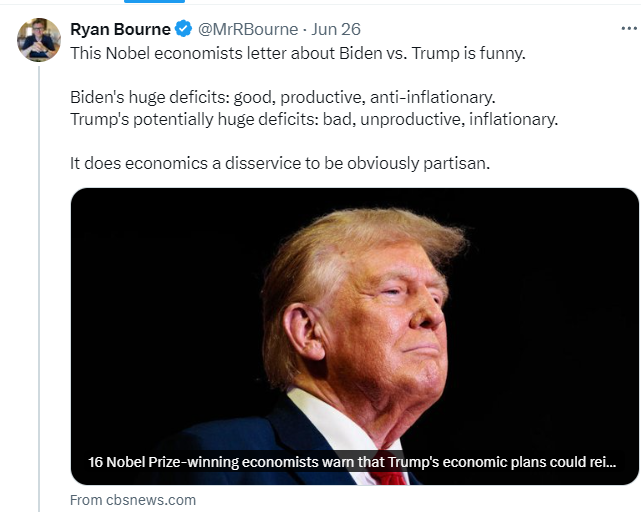
Twitter/X Oct 25, 2024, 23 Nobel Laureates as campaigners ― the ultimate betrayal of science

Twitter/X Dec 11, 2024, The role of the Nobel Prize in the increasing weaponization of science

Twitter/X Feb 24, 2026 Some Nobel Prizes have lost their meaning, if they ever had one

Bill Mitchell’s dishonorable discharge from the sciences
Comment on Bill Mitchell on ‘Spending equals income whether it comes from government or non-government’
Blog-Reference and Blog-Reference
The well-known problem of economics is that it is a failed/fake science. The major approaches ― Walrasianism, Keynesianism, Marxianism, Austrianism ― are mutually contradictory, axiomatically false, materially/formally inconsistent, and all have gotten the foundational economic concept of profit wrong.
Bill Mitchell is right in summarizing that not only the credibility of the mainstream is “in tatters” but also that of the “self-proclaimed Left”. How does MMT fit into this picture of overall academic failure/fake/fraud?
MMT, too, has no sound scientific foundations, and therefore MMT’s economic policy guidance, too, is nothing but brain-dead agenda-pushing. From the scientific standpoint, MMT is not qualitatively different from mainstream garbage. MMT shares the lethal methodological blunder with the rest of economics.
Bill Mitchell enumerates the basics of MMT as follows:
“1. Aggregate demand is total spending in the economy.
2. Given the way we measure economic activity (as an aggregate of output and income produced per period), nominal (money) values of spending must equal income as an accounting statement.
3. If inflation is stable, then increased spending equals increased real income.
4. …”
The blunder is in “nominal (money) values of spending must equal income as an accounting statement.” NO! Economists are too stupid for the elementary math that underlies macroeconomic accounting. Keynes is the most prominent example. He wrote in the GT: “Income = value of output = consumption + investment. Saving = income − consumption. Therefore saving = investment.” (p. 63)
Income is NEVER equal to the “nominal (money) values of spending”. Here is the proof.
1. Premises: The elementary production-consumption economy is given by three macroeconomic axioms: (A1) Yw=WL wage income Yw is equal to wage rate W times working hours. L, (A2) O=RL output O is equal to productivity R times working hours L, (A3) C=PX consumption expenditures C is equal to price P times quantity bought/sold X.
2. Logical implications: In the elementary production-consumption economy, THREE configurations are logically possible: (i) consumption expenditures are equal to wage income C=Yw, (ii) C is less than Yw, (iii) C is greater than Yw.
• In case (i), the monetary saving of the household sector S≡Yw−C is zero, and the monetary profit of the business sector Q≡C−Yw, too, is zero. The product market is cleared, i.e., X=O in all three cases. For a start, the market-clearing price as the dependent variable is given by P=C/X=W/R for any employment level.
• In case (ii), saving S is positive and the business sector makes a loss, i.e., Q is negative. The market-clearing price P is less than W/R.
• In case (iii), saving S is negative and the business sector makes a profit, i.e., Q is positive.
It always holds Q≡−S, in other words, the balances of the business and the household sector always add up to zero. This is the Fundamental Law of Macroeconomic Accounting. #1
In other words, the business sector’s loss is equal to the household sector’s saving. Vice versa, the business sector’s profit is equal to the household sector’s dissaving, i.e., the growth of the household sector’s debt. The non-equality of “nominal (money) values of spending” and wage income is the very cause of profit/loss. Profit/loss is the difference between flows and not a flow like wage income. Wage income and profit are NOT two different forms of income. So the lethal methodological blunder of the representative economist consists of confusing a balance with a flow.
3. Conclusion: Elementary algebra tells one that the premise of macroeconomics, i.e., “nominal (money) values of spending must equal income as an accounting statement”, is provably false since Keynes.
Because MMTers in general and Bill Mitchell, in particular, are too stupid for elementary math, they have to be expelled from the sciences just like their mainstream colleagues. Economics, including MMT, is failure/fake/fraud from the curriculum to the peer-review of journals to the faux Nobel Prize.
Egmont Kakarot-Handtke
#1 Macro for dummies (II)
Related 'Economists/MMTers: agenda pushers, distractors, blockers, muters, censors' and 'Mission accomplished: Economists as useful idiots of the Oligarchy' and 'Economics ― the science that never was'.
Blog-Reference and Blog-Reference
The well-known problem of economics is that it is a failed/fake science. The major approaches ― Walrasianism, Keynesianism, Marxianism, Austrianism ― are mutually contradictory, axiomatically false, materially/formally inconsistent, and all have gotten the foundational economic concept of profit wrong.
Bill Mitchell is right in summarizing that not only the credibility of the mainstream is “in tatters” but also that of the “self-proclaimed Left”. How does MMT fit into this picture of overall academic failure/fake/fraud?
MMT, too, has no sound scientific foundations, and therefore MMT’s economic policy guidance, too, is nothing but brain-dead agenda-pushing. From the scientific standpoint, MMT is not qualitatively different from mainstream garbage. MMT shares the lethal methodological blunder with the rest of economics.
Bill Mitchell enumerates the basics of MMT as follows:
“1. Aggregate demand is total spending in the economy.
2. Given the way we measure economic activity (as an aggregate of output and income produced per period), nominal (money) values of spending must equal income as an accounting statement.
3. If inflation is stable, then increased spending equals increased real income.
4. …”
The blunder is in “nominal (money) values of spending must equal income as an accounting statement.” NO! Economists are too stupid for the elementary math that underlies macroeconomic accounting. Keynes is the most prominent example. He wrote in the GT: “Income = value of output = consumption + investment. Saving = income − consumption. Therefore saving = investment.” (p. 63)
Income is NEVER equal to the “nominal (money) values of spending”. Here is the proof.
1. Premises: The elementary production-consumption economy is given by three macroeconomic axioms: (A1) Yw=WL wage income Yw is equal to wage rate W times working hours. L, (A2) O=RL output O is equal to productivity R times working hours L, (A3) C=PX consumption expenditures C is equal to price P times quantity bought/sold X.
2. Logical implications: In the elementary production-consumption economy, THREE configurations are logically possible: (i) consumption expenditures are equal to wage income C=Yw, (ii) C is less than Yw, (iii) C is greater than Yw.
• In case (i), the monetary saving of the household sector S≡Yw−C is zero, and the monetary profit of the business sector Q≡C−Yw, too, is zero. The product market is cleared, i.e., X=O in all three cases. For a start, the market-clearing price as the dependent variable is given by P=C/X=W/R for any employment level.
• In case (ii), saving S is positive and the business sector makes a loss, i.e., Q is negative. The market-clearing price P is less than W/R.
• In case (iii), saving S is negative and the business sector makes a profit, i.e., Q is positive.
It always holds Q≡−S, in other words, the balances of the business and the household sector always add up to zero. This is the Fundamental Law of Macroeconomic Accounting. #1
In other words, the business sector’s loss is equal to the household sector’s saving. Vice versa, the business sector’s profit is equal to the household sector’s dissaving, i.e., the growth of the household sector’s debt. The non-equality of “nominal (money) values of spending” and wage income is the very cause of profit/loss. Profit/loss is the difference between flows and not a flow like wage income. Wage income and profit are NOT two different forms of income. So the lethal methodological blunder of the representative economist consists of confusing a balance with a flow.
3. Conclusion: Elementary algebra tells one that the premise of macroeconomics, i.e., “nominal (money) values of spending must equal income as an accounting statement”, is provably false since Keynes.
Because MMTers in general and Bill Mitchell, in particular, are too stupid for elementary math, they have to be expelled from the sciences just like their mainstream colleagues. Economics, including MMT, is failure/fake/fraud from the curriculum to the peer-review of journals to the faux Nobel Prize.
Egmont Kakarot-Handtke
#1 Macro for dummies (II)
Related 'Economists/MMTers: agenda pushers, distractors, blockers, muters, censors' and 'Mission accomplished: Economists as useful idiots of the Oligarchy' and 'Economics ― the science that never was'.
August 29, 2019
Links on Diane Coyle
Comment on Diane Coyle’s ‘Once upon a time’
Blog-Reference
All appearances to the contrary, economics is NOT a science but political agenda pushing. The format of popular propaganda is, of course, NOT the abstract theory but a concrete narrative. For a narrative, there is NO need to satisfy the scientific criteria of material and formal consistency. Doing away with semantic smoke what remains is the plain fact that narrative is just another word for political fraud. The self-styled enlightened economist Diane Coyle herself is a talented producer of proto-scientific garbage.
► The economist as storyteller
► Media-fake-farce-fraud-storytelling-macro
► Economics as storytelling and entertainment for the masses
► If religion is opium of the people, economics is crack of the people
► Economists simply don’t get it
► Macroeconomics ― dead since Keynes
► Knowledge only — no opinion
► How to be a good scientist
► Lazy or stupid or both?
► Circus Maximus: Economics as entertainment, personality gossip, virtue signaling, and lifestyle promotion
Egmont Kakarot-Handtke
Related 'Narrative economics and the imperatives of the sitcom' and 'Economics: stories, narratives, and disinformation'.
Blog-Reference
All appearances to the contrary, economics is NOT a science but political agenda pushing. The format of popular propaganda is, of course, NOT the abstract theory but a concrete narrative. For a narrative, there is NO need to satisfy the scientific criteria of material and formal consistency. Doing away with semantic smoke what remains is the plain fact that narrative is just another word for political fraud. The self-styled enlightened economist Diane Coyle herself is a talented producer of proto-scientific garbage.
► The economist as storyteller
► Media-fake-farce-fraud-storytelling-macro
► Economics as storytelling and entertainment for the masses
► If religion is opium of the people, economics is crack of the people
► Economists simply don’t get it
► Macroeconomics ― dead since Keynes
► Knowledge only — no opinion
► How to be a good scientist
► Lazy or stupid or both?
► Circus Maximus: Economics as entertainment, personality gossip, virtue signaling, and lifestyle promotion
Egmont Kakarot-Handtke
Related 'Narrative economics and the imperatives of the sitcom' and 'Economics: stories, narratives, and disinformation'.
August 28, 2019
On the deliberate creation of institutional shitholes
Comment on Brian Romanchuk/Matt Franko on ‘So Are We All MMTists Now?’
Blog-Reference
Matt Franko recaps: “No there was a policy change post GFC which created different regulatory conditions... ie depositories are required to possess $Ts more as % total assets of Tier1 QUALITY assets in order to comply with the CCAR... TODAY... So the effect of rate increases TODAY UNDER DIFFERENT REGULATORY CONDITIONS has a differing effect than under previous conditions.”
Life insurers, for example, have a demand for very long-term government securities. What they have done in the past is to buy bonds and to put them with the actual purchase prices on the books and to hold them until maturity. This type of buy-and-hold investor did not up-value the bonds when the interest rate fell and accordingly needed no down-valuation in the opposite case. These corporations normally sat on a buffer of hidden reserves that could be activated in case of emergency.
The same holds for banks with a significant share of bonds in their portfolio.
Now, with the continuous decrease of interest rates since the Volcker heights, these buy-and-hold investors were told to be a bit retarded. Why not apply mark-to-market valuation and show the paper profits in the profit and loss account as a sign of the success of a smart investment strategy? And why not increase profit distribution to the shareholders? Quite naturally, mark-to-market was pushed by hedge funds, Wall Street, and other folks with a short time horizon and a commitment to shareholder value.
The drawback of this strategy makes itself felt when the Central Bank eventually switches to a policy of rising interest rates. In this case, paper losses show up in the profit and loss accounts, and the structural balance relations deteriorate.
The effect is that the Central Bank is now practically locked in at the zero interest level. Interest rate increases tend to automatically put the whole finance sector at risk, with spill-overs to the real economy. Mark-to-market eventually shows its ugly face.
All these problems were perfectly foreseeable and could have been avoided by sticking to the tried and tested principles of prudent valuation that were and still are characteristic of an institutionally sound finance sector.
There has been a general trend in the political, social, and economic realm of throwing the principles of sound institution-building overboard, with the unsurprising result that a growing number of states have finally turned into institutional shitholes.
MMT’s policy of deficit-spending/money-creation has been and still is a driver of this development. #1
Egmont Kakarot-Handtke
#1 MMT undermines democracy
Twitter Sep 5, 2019

Blog-Reference
Matt Franko recaps: “No there was a policy change post GFC which created different regulatory conditions... ie depositories are required to possess $Ts more as % total assets of Tier1 QUALITY assets in order to comply with the CCAR... TODAY... So the effect of rate increases TODAY UNDER DIFFERENT REGULATORY CONDITIONS has a differing effect than under previous conditions.”
Life insurers, for example, have a demand for very long-term government securities. What they have done in the past is to buy bonds and to put them with the actual purchase prices on the books and to hold them until maturity. This type of buy-and-hold investor did not up-value the bonds when the interest rate fell and accordingly needed no down-valuation in the opposite case. These corporations normally sat on a buffer of hidden reserves that could be activated in case of emergency.
The same holds for banks with a significant share of bonds in their portfolio.
Now, with the continuous decrease of interest rates since the Volcker heights, these buy-and-hold investors were told to be a bit retarded. Why not apply mark-to-market valuation and show the paper profits in the profit and loss account as a sign of the success of a smart investment strategy? And why not increase profit distribution to the shareholders? Quite naturally, mark-to-market was pushed by hedge funds, Wall Street, and other folks with a short time horizon and a commitment to shareholder value.
The drawback of this strategy makes itself felt when the Central Bank eventually switches to a policy of rising interest rates. In this case, paper losses show up in the profit and loss accounts, and the structural balance relations deteriorate.
The effect is that the Central Bank is now practically locked in at the zero interest level. Interest rate increases tend to automatically put the whole finance sector at risk, with spill-overs to the real economy. Mark-to-market eventually shows its ugly face.
All these problems were perfectly foreseeable and could have been avoided by sticking to the tried and tested principles of prudent valuation that were and still are characteristic of an institutionally sound finance sector.
There has been a general trend in the political, social, and economic realm of throwing the principles of sound institution-building overboard, with the unsurprising result that a growing number of states have finally turned into institutional shitholes.
MMT’s policy of deficit-spending/money-creation has been and still is a driver of this development. #1
Egmont Kakarot-Handtke
#1 MMT undermines democracy
***
 |
| Source: Bloomberg |
Twitter/X Feb 4, 2026 Down from the Volcker heights

Subscribe to:
Posts (Atom)