Showing posts with label zNYT. Show all posts

March 7, 2019

The clock runs down on economics

Comment on Stephanie Kelton on ‘The Clock Runs Down on Mainstream Keynesianism’*

Blog-Reference

Almost everybody knows by now that mainstream economics is dead. As a matter of fact, mainstream economics was already dead in the cradle 150+ years ago. The real wonder is why it is still around and why failed scientists like Paul Krugman are still producing proto-scientific garbage. For some reason, the basic methodological principle of science, i.e., to discard falsified theories, does not work in economics. The simple idea of scientific progress is that theories that have been proven materially/formally inconsistent are unceremoniously buried at the Flat-Earth-Cemetery and the attention turns to a more promising research program.

Applied to economics, this means that mainstream folks like Krugman are done. #1 However, there is a snag: “… it takes a new theory, and not just the destructive exposure of assumptions or the collection of new facts, to beat an old theory.” (Blaug)

Stephanie Kelton claims that MMT is the new theory that hammers the final nail in Paul Krugman’s coffin: “No economist is going to get everything right. But the odds of getting things right improve dramatically when you’re working with a macro framework that doesn’t lead you astray. The IS-LM framework is a gadget that will often align with sensible real-world analysis. It may perform better than a stopped clock, but it is no match for MMT.” and “The [IS-LM] model remains the workhorse for many mainstream Keynesians. MMT considers it fundamentally flawed.” #2

On this point, Stephanie Kelton is absolutely right: IS-LM is refuted on all counts #3, and only stupid or corrupt economists still apply it.

However, therefrom this does not follow that MMT is the long-awaited replacement for mainstream economics. Although MMT is way better than IS-LM it is still flawed. The curious thing is that IS-LM and MMT share the same foundational blunder, which can be traced back to Keynes’ General Theory. #4

From the methodological standpoint, both New Keynesianism and MMT are empirically/ logically inconsistent and not much more than commonsensical storytelling. Neither Paul Krugman’s nor Stephanie Kelton’s policy guidance has sound scientific foundations.

In order to make her point, Stephanie Kelton cites Galbraith: “There are two ways to get the increase in total spending that we call ‘economic growth.’ One way is for the government to [deficit] spend. The other is for banks to lend. For ordinary people, public budget deficits, despite their bad reputation, are much better than private loans. Deficits put money in private pockets…This is called an increase in ‘net financial wealth’… In contrast, when a bank makes a loan, the cash is not owned free and clear.”

This is a hard-to-disentangle analytical half-truth and a full political fraud. Because it holds Public Deficit = Private Profit, MMT deficit-spending/money-creation puts money in the pockets of the Oligarchy. The fundamental law of Capitalism is the macroeconomic Profit Law, and it says Q≡Yd+(I−S)+(G−T)+(X−M), which boils down to Q≡(G−T), i.e., profit Q is equal to the government’s deficit spending G>T.

The claim that MMT policy is for the benefit of WeThePeople is provably false. Because MMT gets the foundational concept of profit wrong, the whole theory is scientifically worthless. Politically, MMT is for the benefit of the Oligarchy. #5, #6 In the final analysis, MMTers are either stupid or corrupt ― just like mainstream economists. #7, #8, #9

The clock runs down not only on Paul Krugman’s New Keynesianism but also on Stephanie Kelton’s MMT.

Egmont Kakarot-Handtke


* BloombergOpinion, The clock runs down and BloombergOpinion, 4 Answers
#1 Enough! Economists, retire now!
#2 How to finally hammer down the nails in the coffin of Monty Python economics
#3 Mr. Keynes, Prof. Krugman, IS-LM, and the End of Economics as We Know It
#4 Krugman vs MMT ― like the blind talking about colors
#5 Keynes, Lerner, MMT, Trump, Biden, and exploding profit
#6 MMTers make Capitalism work
#7 The Kelton-Fraud
#8 MMT: The one deadly error/fraud of Warren Mosler
#9 Bill Mitchell, MMT’s fake scientist

Related 'Paul’s and Stephanie’s economic delirium talk'

***

Short version: The clock runs down on economics

Blog-Reference Mar 8

Almost everybody knows by now that mainstream economics is dead. As a matter of fact, mainstream economics was already dead in the cradle 150+ years ago. The real wonder is why it is still around and why failed scientists like Paul Krugman are still producing proto-scientific garbage. For some reason, the basic methodological principle of science, i.e., to discard falsified theories, does not work in economics. The simple idea of scientific progress is that theories that have been proven materially/formally inconsistent are unceremoniously buried at the Flat-Earth-Cemetery and the attention turns to a more promising research program.

Applied to economics, this means that mainstream folks like Krugman are done. However, there is a snag: “… it takes a new theory, and not just the destructive exposure of assumptions or the collection of new facts, to beat an old theory.” (Blaug)

Stephanie Kelton claims that MMT is the new theory that hammers the final nail in Paul Krugman’s coffin.

For the full 3618-character post, see here

The claim that MMT policy is for the benefit of WeThePeople is provably false. Because MMT gets the foundational concept of profit wrong, the whole theory is scientifically worthless.

The clock runs down not only on Paul Krugman’s New Keynesianism but also on Stephanie Kelton’s MMT.

***

LINKS on Mario Seccareccia/Marc Lavoie’s ‘Sir John and Maynard Would Have Rejected the IS-LM Framework for Conducting Macroeconomic Analysis’ on Mar 11

Keynes messed up macroeconomics. IS-LM is proto-scientific garbage for 80+ years. For details see
► How Keynes got macro wrong and Allais got it right
► Dear idiots, time to get saving and investment straight
► Mr. Keynes, Prof. Krugman, IS-LM, and the End of Economics as We Know It
► Getting out of IS-LM = Getting out of despair
► Where modern macroeconomics went wrong
► John Hicks, fake scientist

June 13, 2017

Simpleminded losers

Comment on Paul Krugman on ‘Macroeconomics: The Simple and the Fancy’

Blog-Reference and Direct-Link and Blog-Reference

“In order to tell the politicians and practitioners something about causes and best means, the economist needs the true theory or else he has not much more to offer than educated common sense or his personal opinion.” (Stigum)

The fact of the matter is that economists do NOT have the true theory. More precisely, economists do not know how the price- and profit mechanism works. The four main approaches ― Walrasianism, Keynesianism, Marxianism, Austrianism ― are mutually contradictory, axiomatically false, materially/formally inconsistent, and all got profit wrong.

In science, the primary question is NOT about the simple or the fancy but about the true and the false, with truth well-defined as material and formal consistency. The point is that BOTH the simple and the fancy models are provable false. This includes Paul Krugman’s IS-LM version.#1

Economics is a failed science and Paul Krugman is a failed scientist.#2 Since Adam Smith, economic policy guidance never has had sound scientific foundations. It is as simple as that.

Egmont Kakarot-Handtke


#1 Mr. Keynes, Prof. Krugman, IS-LM, and the End of Economics as We Know It
#2 For details see references Just another wreck.

June 22, 2016

Not a question of simplicity but of stupidity

Comment on Paul Krugman on ‘Tl;dr and Modern Macroeconomics’

Blog-Reference and Blog-Reference

Krugman defends the simplicity of IS-LM against more elaborate modeling approaches: “What worries me is the effective prohibition on simple, ad hoc models that sometimes yield most of the insight ... in a form that is much more useful for real-world policy discussion.”

The core issue, though, is NOT about simple or elaborate but about true or false. And the crucial point is that IS-LM is provably false. What is worse, it is false since Keynes/Hicks and neither the After-Keynesians in general nor Krugman, in particular, have realized this until this day (2014).

Keynes formulated the formal core of the General Theory as follows: “Income = value of output = consumption + investment. Saving = income − consumption. Therefore saving = investment.” (1973, p. 63)

This elementary syllogism is conceptually defective because Keynes never came to grips with profit (Tómasson et al., 2010, p. 12). As a result, all I=S/IS-LM models and the Keynesian multiplier and Post-Keynesianism and New Keynesianism are false (2011).

Because neither IS-LMers nor DSGEers have the true theory their economic policy advice has NO scientific foundation whatsoever but is at the same level as poultry entrails reading. Hence, Paul Krugman has ONE valid point: to read from simple entrails is for all communicative purposes better than to read from more elaborate entrails. This, though, should not distract from the fact that simple scientific garbage is still garbage. To do economics without an idea of what profit is is a hopeless undertaking and a reliable indicator of utter scientific incompetence of economists in general and Paul Krugman, in particular.#1

Egmont Kakarot-Handtke


References
Kakarot-Handtke, E. (2011). Why Post Keynesianism is Not Yet a Science. SSRN Working Paper Series, 1966438: 1–20. URL
Kakarot-Handtke, E. (2014). Mr. Keynes, Prof. Krugman, IS-LM, and the End of Economics as We Know It. SSRN Working Paper Series, 2392856: 1–19. URL
Keynes, J. M. (1973). The General Theory of Employment Interest and Money.  London, Basingstoke: Macmillan.
Tómasson, G., and Bezemer, D. J. (2010). What is the Source of Profit and Interest? A Classical Conundrum Reconsidered. MPRA Paper, 20557: 1–34. URL

#1 I=S: Mark of the Incompetent

***
REPLY to Paul Mathis on Jun 22

Your examples relate to microeconomic profit. Keynes, of course, mentioned profit in the General Theory but never understood it: “His Collected Writings show that he wrestled to solve the Profit Puzzle up till the semi-final versions of his GT but in the end he gave up and discarded the draft chapter dealing with it.” (Tómasson et al., 2010, pp. 12-13, 16)

Keynes, though, is not alone as one can glean from the Palgrave Dictionary: “A satisfactory theory of profits is still elusive.” (Desai, 2008, p. 10)

The fact of the matter is that economists have no idea since Adam Smith what profit is (2014). This includes Paul Krugman and this is why his IS-LM based economic policy analysis is scientifically worthless.#1


References
Desai, M. (2008). Profit and Profit Theory. In S. N. Durlauf, and L. E. Blume (Eds.), The New Palgrave Dictionary of Economics Online, pp. 1–11. Palgrave Macmillan, 2nd edition. URL
Kakarot-Handtke, E. (2014). The Profit Theory is False Since Adam Smith. What About the True Distribution Theory? SSRN Working Paper Series, 2511741: 1–23. URL
Tómasson, G., and Bezemer, D. J. (2010). What is the Source of Profit and Interest? A Classical Conundrum Reconsidered. MPRA Paper, 20557: pp. 1–34. URL

#1 Profit and the collective failure of economists.

***
REPLY to Peter on Jun 23

Compared to IS-LM the quantity of credit theory of Werner is clearly superior. See also Loanable Funds vs. Endogenous Money: Krugman is Wrong, Keen is Right.

***
REPLY to nastyboy on Jun 23

The idea that wages and profits are antagonists quite naturally emerges from the observation of a single firm but is patently false when generalized for the economy as a whole. This elementary logical blunder (Fallacy of Composition) started with Smith, Mill, Ricardo, Marx and is still alive in modern macroeconomics. See also Profit for Marxists.

April 4, 2016

As Napoleon said: don’t listen to economists

Comment on Robert Waldmann on ‘Brad DeLong Marks His Beliefs about "The Return of Depression Economics" to Market’

Blog-Reference and Blog-Reference on Apr 5

Before starting the discussion of several model variants, you say: “I am going to be dumb (I am not playing dumb — I just worked through each step) and consider different less elegant models of aggregate supply.” (See intro)

The futility of the whole exercise derives from the fact that the models of Krugman and DeLong to which you refer are flawed since Keynes. Not to have realized this is indeed the manifest dimwittedness of Paul, Brad, and Robert. No need to play dumb.

Keynes defined the formal foundations of the General Theory as follows: “Income = value of output = consumption + investment. Saving = income − consumption. Therefore saving = investment.” (1973, p. 63)

This elementary syllogism is conceptually and logically defective because Keynes never came to grips with profit and therefore “discarded the draft chapter dealing with it.” (Tómasson et al., 2010, p. 12).

The three main points of the correct approach are:
• All I=S/IS-LM models are false since Hicks (2011; 2014b). The refutation of Krugman is to be found here (2014a), and the refutation of DeLong is to be found in It’s the price mechanism, stupid!
• The axiomatically correct Profit Law for the investment economy reads Qm≡Yd+I−Sm (2014b, p. 8, eq. (18)). Legend: Qm monetary profit, Yd distributed profit, I investment expenditures, Sm monetary saving. Sm establishes the connection to the money/credit market.
• The correct Employment Law/Phillips Curve is given here (2012).

To cut the meticulous formal derivation short, the most elementary version of the correct Employment Law for the economy as a whole is shown with Graphic AXEC62
From this equation follows:
(i) An increase in the expenditure ratio ρE leads to higher employment L (the letter ρ stands for the ratio). An expenditure ratio ρE>1 indicates credit expansion, a ratio ρE<1 indicates credit contraction of the household sector.
(ii) Increasing investment expenditures I exert a positive influence on employment; a slowdown of growth does the opposite.
(iii) An increase in the factor cost ratio ρF≡W/PR leads to higher employment.

The complete Employment Law is a bit longer and contains, in addition, profit distribution, public deficit spending, and import/export. The Employment Law contains only measurable real and nominal variables (and NO expectations and other nonentities).

Items (i) and (ii) are familiar since Keynes. What is new is the ratio ρF as defined in (iii). This variable embodies the price mechanism. It works such that overall employment INCREASES if the average wage rate W INCREASES relative to the average price P and productivity R.

This translates into the recipe: if the central bank wants an inflation rate of, say, 2 percent and the actual productivity growth is, say, 1.5 percent, then the AVERAGE wage rate must rise by 3.5 percent. The crucial point is that the price mechanism does NOT work as standard economics hallucinates.

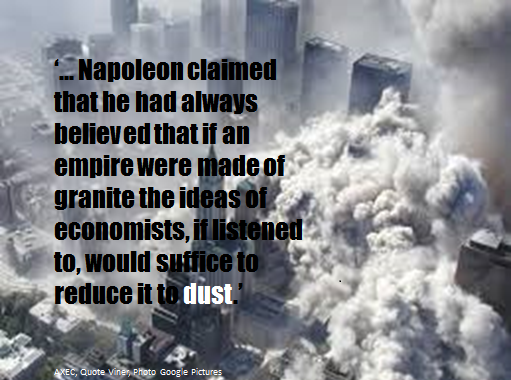
The bottom line is that the models you use are defective; therefore, your whole supply-demand equilibrium exercise falls flat. It is to be hoped that politicians remember Napoleon and do not take Paul, Brad, and Robert seriously: “Late in life, moreover, he [Napoleon] claimed that he had always believed that if an empire were made of granite the ideas of economists if listened to, would suffice to reduce it to dust.” (Viner, 1963, p. 1)

Egmont Kakarot-Handtke


References
Kakarot-Handtke, E. (2011). Why Post Keynesianism is Not Yet a Science. SSRN Working Paper Series, 1966438: 1–20. URL
Kakarot-Handtke, E. (2012). Keynes’ Employment Function and the Gratuitous Phillips Curve Disaster. SSRN Working Paper Series, 2130421: 1–19. URL
Kakarot-Handtke, E. (2014a). Mr. Keynes, Prof. Krugman, IS-LM, and the End of Economics as We Know It. SSRN Working Paper Series, 2392856: 1–19. URL
Kakarot-Handtke, E. (2014b). The Three Fatal Mistakes of Yesterday Economics: Profit, I=S, Employment. SSRN Working Paper Series, 2489792: 1–13. URL
Keynes, J. M. (1973). The General Theory of Employment Interest and Money. London, Basingstoke: Macmillan.
Tómasson, G., and Bezemer, D. J. (2010). What is the Source of Profit and Interest? A Classical Conundrum Reconsidered. MPRA Paper, 20557: 1–34. URL
Viner, J. (1963). The Economist in History. American Economic Review, 53(2): 1–22. URL

Related 'Econogenics in action' and 'Learn economics ― but not from scientific losers'.

***
COMMENT on anne on Apr 5

Krugman says: “The idea that inflation promises might go directly into prices is a hope, not a worry.”

Rising prices (relative to wages and productivity) INCREASE unemployment. Because of this, every policy that aims directly at price increases WORSENS the employment situation.

Krugman’s underlying model of the price mechanism is provably false. For details, see the comment on Waldmann As Napoleon said: don’t listen to economists.

***
COMMENT on Paul Krugman NYT on Apr 5

Paul Krugman argues: “The idea that inflation promises might go directly into prices is a hope, not a worry.”

Rising prices (relative to wages and productivity) INCREASE unemployment. Because of this, every policy that aims DIRECTLY at price increases WORSENS the overall situation.

Krugman’s underlying model of the price mechanism is provably false. The formal proof is not sloganizable and outsizes a succinct post. For more details and wonkish references, see the comment on Waldmann As Napoleon said: don’t listen to economists.

***
COMMENT on Paul Krugman NYT on Apr 6

The correct economic model yields the elementary Employment Law, i.e., Graphic AXEC62.

In simple terms, it says:
(i) An increase in the expenditure ratio leads to higher employment. An expenditure ratio >1 indicates credit expansion, a ratio <1 indicates credit contraction.
(ii) Increasing investment expenditures exert a positive influence on employment; a slowdown of growth does the opposite.
(iii) An increase in the factor cost ratio ρF≡W/PR leads to higher employment.

The factor-cost ratio embodies the price mechanism. It works such that overall employment INCREASES if the average wage rate INCREASES relative to the average price and productivity. The standard models of the price mechanism are PROVABLY false.

If Japan applies Krugman’s advice she commits economic hara-kiri.

***

COMMENT on Paul Krugman NYT on Apr 7

The problem is not at all located at the level of economic policy. Hence, it does not matter much what Paul Krugman, Greg Mankiw, Brad DeLong, Larry Summers, or Robert Waldmann propose.

The problem is located at the level of economic theory. Because economists lack the true theory/model, ALL policy proposals are hanging in midair. Without sound scientific foundations, what Paul and Greg and Brad and Larry and Robert say is not different from old Roman haruspicy, i.e., the reading of poultry entrails.

***
Graphic AXEC117


The New Republic, October 25, 2022, Timothy Noah, May God Save Us From Economists