#Inflation#Profit#Deficit
— E.K-H (@AXECorg) October 12, 2023
The macroeconomic #LawOfSupplyAndDemand and the #ProfitLaw tell one exactly how avg #Price P & total #Profit Qm move as a function of avg #WageRate W, avg #Productivity R & overall #DeficitSpendingMoneyCreation ρE ― which is the common cause. pic.twitter.com/NlEZtuAFMN
Showing posts sorted by relevance for query label:Inflation. Sort by date Show all posts
Showing posts sorted by relevance for query label:Inflation. Sort by date Show all posts
October 12, 2023
Occasional Xs: How it works (LXXII)

February 18, 2023
Occasional Tweets: Clueless economists / Phillips Curve (III)
#FailedFakeScience
— E.K-H (@AXECorg) February 18, 2023
Bc of his scientific incompetence, Samuelson, et al. messed up the #PhillipsCurve.
NAIRU, wage-led growth, and Samuelson's Dyscalculiahttps://t.co/qDrdo8Hdey
Keynes’ Employment Function and the Gratuitous Phillips Curve Disasterhttps://t.co/fYComRqFX3
December 15, 2022
Occasional Tweets: There is no trade-off between inflation and recession
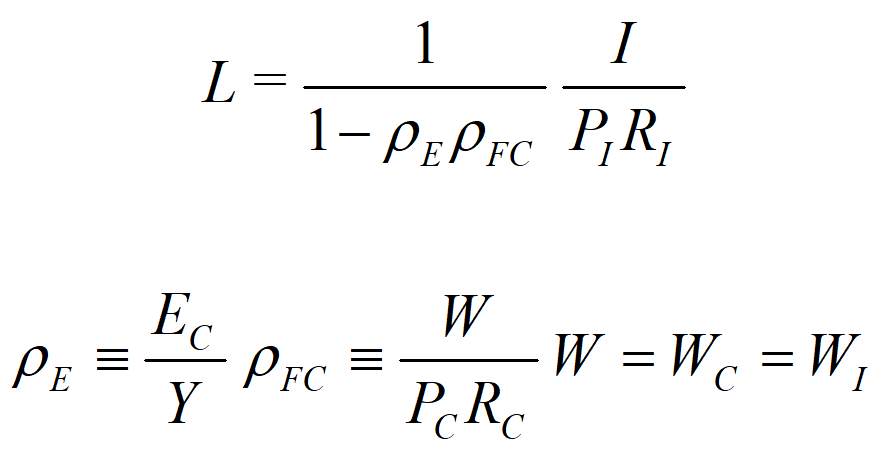
The axiomatically correct macroeconomic #EmploymentLaw tells one that #Employment L
— E.K-H (@AXECorg) December 15, 2022
• decreases if the product price P rises faster than the wage rate W
• increases if #DeficitSpendingMoneyCreation ρE increases.
So one will ALWAYS have #Inflation AND #Recession. NO trade-off. pic.twitter.com/rrpbShgm84
For details of the big picture see cross-references Employment/Phillips Curve.
August 5, 2025
Occasional X: Clueless economists / Inflation / Deflation (XLVII)
#Economics#AllYouNeedToKnow
— AXEC (@EgmontHandtke) August 5, 2025
The axiomatically correct macroeconomic Law of Supply and Demand ⇓ tells one how ― in the elementary case ― the avg price P moves under the condition of market clearing as a function of avg wage rate W, inverse avg productivity R, and… pic.twitter.com/YLfivKEqHG
March 23, 2023
Occasional Tweets: The basics about inflation (II)
#LearnEconomics
— E.K-H (@AXECorg) March 23, 2023
The macroeconomic #LawOfSupplyAndDemand and the #ProfitLaw tell one exactly how #Price P & #Profit Qm move as a function of #WageRate W, Productivity R & #DeficitSpendingMoneyCreation ρE. pic.twitter.com/bzY0LbQICJ
For more about inflation see AXECquery.
April 12, 2018
MMT and the inflation-red-herring
Comment on Richard Murphy on ‘Modern monetary theory provides the best mechanism for controlling inflation we now have’
Blog-Reference and Blog-Reference
Inflation theory is wrong; it is essentially the commonplace Quantity Theory that is at the back of people’s minds.#1
The lethal flaw of MMT policy is NOT inflation but distribution. #2 The government can replace taxation and, in addition, increase spending at any time for any consumptive purpose by deficit-spending/money-creation. This has two effects
The replacement of taxation by deficit spending clearly benefits the one-percenters. In essence, MMT argues that public deficit is good for the ninety-nine percenters and for democracy. The fact of the matter is that public deficit is good for the one-percenters and the Oligarchy. #3
The whole inflation issue has never been anything but a red herring. #4
Egmont Kakarot-Handtke
#1 Economists never understood how the price mechanism works
#2 Gov-Deficits do NOT cause inflation
#3 Keynes, Lerner, MMT, Trump, and exploding profit
#4 For the full-spectrum refutation of MMT, see cross-references MMT
Related 'The Third Way: Towards the Happy Zero-Tax economy' and 'Gov-Deficits do NOT cause inflation' and 'Attention: there are THREE types of inflation' and 'A la recherche de l'inflation perdue' and 'Deficit-spending/money-creation is ALWAYS a bad deal for WeThePeople' and 'Inflation: back to basics' and 'How some MMTers got inflation wrong'.
You cite Marx, “In studying such transformations it is always necessary to distinguish between the material transformation of the economic conditions of production, which can be determined with the precision of natural science, and the legal, political, religious, artistic or philosophic – in short, ideological forms in which men become conscious of this conflict and fight it out.”
The philosopher and sociologist Marx never understood the “material transformation of the economic conditions of production, which can be determined with the precision of natural science”, that is, how the price- and profit mechanism works. #1, #2, #3
Marx was a soapbox economist, and this excludes him forever from science and any scientific debate. The same applies to the philosopher Tom Hickey.
#1 Capitalism, poverty, exploitation, and cross-over exploitation
#2 Profit for Marxists
#3 For the basic economic Laws, see Graphic AXEC112c.

Blog-Reference and Blog-Reference
Inflation theory is wrong; it is essentially the commonplace Quantity Theory that is at the back of people’s minds.#1
The lethal flaw of MMT policy is NOT inflation but distribution. #2 The government can replace taxation and, in addition, increase spending at any time for any consumptive purpose by deficit-spending/money-creation. This has two effects
- The household sector = ninety-nine-percenters is taxed in real terms by a one-off price hike (NOT inflation). Open taxation turns into stealth taxation, and in real terms, NOTHING changes.
- Because Public Deficit = Private Profit, the one-percenters enjoy an immediate profit boost. In addition, part or all of the increased public debt can become a long-term source of interest income depending on whether and how the public debt is consolidated.
The replacement of taxation by deficit spending clearly benefits the one-percenters. In essence, MMT argues that public deficit is good for the ninety-nine percenters and for democracy. The fact of the matter is that public deficit is good for the one-percenters and the Oligarchy. #3
The whole inflation issue has never been anything but a red herring. #4
Egmont Kakarot-Handtke
#1 Economists never understood how the price mechanism works
#2 Gov-Deficits do NOT cause inflation
#3 Keynes, Lerner, MMT, Trump, and exploding profit
#4 For the full-spectrum refutation of MMT, see cross-references MMT
Related 'The Third Way: Towards the Happy Zero-Tax economy' and 'Gov-Deficits do NOT cause inflation' and 'Attention: there are THREE types of inflation' and 'A la recherche de l'inflation perdue' and 'Deficit-spending/money-creation is ALWAYS a bad deal for WeThePeople' and 'Inflation: back to basics' and 'How some MMTers got inflation wrong'.
***
REPLY to Tom Hickey on Apr 15You cite Marx, “In studying such transformations it is always necessary to distinguish between the material transformation of the economic conditions of production, which can be determined with the precision of natural science, and the legal, political, religious, artistic or philosophic – in short, ideological forms in which men become conscious of this conflict and fight it out.”
The philosopher and sociologist Marx never understood the “material transformation of the economic conditions of production, which can be determined with the precision of natural science”, that is, how the price- and profit mechanism works. #1, #2, #3
Marx was a soapbox economist, and this excludes him forever from science and any scientific debate. The same applies to the philosopher Tom Hickey.
#1 Capitalism, poverty, exploitation, and cross-over exploitation
#2 Profit for Marxists
#3 For the basic economic Laws, see Graphic AXEC112c.

November 7, 2023
Occasional Xs: How it works (CIV)
#Inflation#Profit#Deficit
— E.K-H (@AXECorg) November 7, 2023
The macroeconomic #LawOfSupplyAndDemand and the #ProfitLaw tell one exactly how avg #Price P & total #Profit Qm move as a function of avg #WageRate W, avg #Productivity R & overall #DeficitSpendingMoneyCreation ρE ― which is the common cause. pic.twitter.com/AVCddN48I3
June 21, 2017
Attention ― there are THREE types of inflation
Comment on Simon Wren-Lewis on ‘UK monetary policy: you cannot be serious?’
Blog-Reference and Blog-Reference on Jun 22
Simon Wren-Lewis clarifies: “When I recently wrote about increasing the inflation target, I knew I would get at least one comment saying wouldn’t this reduce real wages even further. As I always do, I explained that raising the inflation target should raise the rate of increase of all nominal quantities by the same amount, which is what economists mean by inflation. But it seems the same basic point has to be made to these three members of the MPC too: inflation is not just the rate of change of the consumer price index.”
What economists mean by inflation is false, and this is relevant to the relationship between inflation and employment.
From the axiomatically correct macroeconomic Employment Law #1 follows that employment L depends (i) on aggregate demand, which is here given with the expenditure ratio ρE and investment expenditures I, and (ii), on the price mechanism, which is formally embodied in the macro-ratio ρF≡W/PR with W = average wage rate, P = average price, and R = average productivity.
Let ρE, and I be fixed, and the rate of change of productivity R for simplicity be zero, i.e., r=0, then there are three logical cases:
(i) The rate of change of the wage rate W is equal to the rate of change of the price P, i.e., w=p, then employment does NOT change, NO MATTER how big or small the rates of change are.
(ii) If the rate of change of the wage rate is greater than the rate of change of the price, then employment INCREASES.
(iii) If the rate of change in the wage rate is lower than the rate of change in the price, then employment DECREASES.
So, it is DIFFERENCES in the rates of change in wage rate and price, and NOT the absolute magnitude of change that affects employment. Every perfectly SYNCHRONOUS inflation/deflation is employment-neutral, that is, employment sticks indefinitely where it actually is.
Perfectly synchronous inflation/deflation is, according to Simon Wren-Lewis, “what economists mean by inflation”. Synchronous=employment neutral inflation, though, is a LIMITING case that occurs with a probability close to ZERO.
In general terms, the neutrality condition reads w=p+r+pr. Therefore, it is a matter of indifference whether the wage rate falls or rises, or whether wages are sticky or not. It ALL depends on relative changes. Employment increases if w is greater than p+r+pr and decreases in the opposite case.
So, what is needed in the present situation is asynchronous inflation, more specifically, w greater than r and p=0. This also increases the multiplier effect of expansive fiscal policy. Increases in the average wage rate have to take the lead.
Egmont Kakarot-Handtke
#1 The elementary version of the correct (objective, systemic, behavior-free, macrofounded) Employment Law is given with Graphic AXEC62b
Blog-Reference and Blog-Reference on Jun 22
Simon Wren-Lewis clarifies: “When I recently wrote about increasing the inflation target, I knew I would get at least one comment saying wouldn’t this reduce real wages even further. As I always do, I explained that raising the inflation target should raise the rate of increase of all nominal quantities by the same amount, which is what economists mean by inflation. But it seems the same basic point has to be made to these three members of the MPC too: inflation is not just the rate of change of the consumer price index.”
What economists mean by inflation is false, and this is relevant to the relationship between inflation and employment.
From the axiomatically correct macroeconomic Employment Law #1 follows that employment L depends (i) on aggregate demand, which is here given with the expenditure ratio ρE and investment expenditures I, and (ii), on the price mechanism, which is formally embodied in the macro-ratio ρF≡W/PR with W = average wage rate, P = average price, and R = average productivity.
Let ρE, and I be fixed, and the rate of change of productivity R for simplicity be zero, i.e., r=0, then there are three logical cases:
(i) The rate of change of the wage rate W is equal to the rate of change of the price P, i.e., w=p, then employment does NOT change, NO MATTER how big or small the rates of change are.
(ii) If the rate of change of the wage rate is greater than the rate of change of the price, then employment INCREASES.
(iii) If the rate of change in the wage rate is lower than the rate of change in the price, then employment DECREASES.
So, it is DIFFERENCES in the rates of change in wage rate and price, and NOT the absolute magnitude of change that affects employment. Every perfectly SYNCHRONOUS inflation/deflation is employment-neutral, that is, employment sticks indefinitely where it actually is.
Perfectly synchronous inflation/deflation is, according to Simon Wren-Lewis, “what economists mean by inflation”. Synchronous=employment neutral inflation, though, is a LIMITING case that occurs with a probability close to ZERO.
In general terms, the neutrality condition reads w=p+r+pr. Therefore, it is a matter of indifference whether the wage rate falls or rises, or whether wages are sticky or not. It ALL depends on relative changes. Employment increases if w is greater than p+r+pr and decreases in the opposite case.
So, what is needed in the present situation is asynchronous inflation, more specifically, w greater than r and p=0. This also increases the multiplier effect of expansive fiscal policy. Increases in the average wage rate have to take the lead.
Egmont Kakarot-Handtke
#1 The elementary version of the correct (objective, systemic, behavior-free, macrofounded) Employment Law is given with Graphic AXEC62b
October 12, 2023
Occasional Xs: Clueless economists / Inflation (XIV)
#Inflation is the #RateOfChange of the avg #Price. If it goes to zero the problems are NOT over because one is now on a higher #PriceLevel. A negative rate of change is required to fully compensate for the previous price increase. It's the #HigherLevel that kills the #Economy.
— E.K-H (@AXECorg) October 12, 2023
June 2, 2023
Occasional Tweets: The basics about inflation (VI)
#LearnEconomics
— E.K-H (@AXECorg) June 2, 2023
The macroeconomic #LawOfSupplyAndDemand and the #ProfitLaw tell one exactly how avg #Price P & total #Profit Qm move as a function of avg #WageRate W, avg Productivity R & overall #DeficitSpendingMoneyCreation ρE ― which is the common cause. pic.twitter.com/XbNavzhWNh
August 7, 2017
Inflation: back to basics
Comment on David Andolfatto on ‘A monetary-fiscal theory of inflation’
Blog-Reference and Blog-Reference on Aug 8
David Andolfatto argues from a sophisticated model: “In my formal model, I have a parameter that indexes the growth rate in the demand for real money/bond balances (where money and bonds take the form of USDs and USTs, respectively). In the open-economy version of my model, I have a ‘money demand growth regime’ originating from the foreign sector. In the model, this regime translates into persistent U.S. trade deficits, representing the foreign sector's desire to acquire USD/UST at an elevated pace.”
Basically, in this model, deflation/inflation is driven by what happens on the UST market. This is in line with the commonplace Quantity Theory, which holds that a smaller or broader composite called ‘quantity of money’ determines the price level.
Now, it is well-known that the familiar models, which are either from the Walrasian type (= microfoundations) or the Keynesian type (= macrofoundations), are axiomatically false. Because of this, monetary theory has to be based upon entirely new macrofoundations. #1
In order to go back to the basics, the elementary production-consumption economy is, for a start, clearly defined by three macro axioms (Yw=WL, O=RL, C=PX), two conditions (X=O, C=Yw), and two definitions (profit/loss Qm≡C−Yw, saving/dissaving Sm≡Yw−C). #2
Money is needed by the business sector to pay the workers who receive the wage income Yw per period. The workers spend C per period. Given the two conditions, the market-clearing price is derived for a start as P=C/X=W/R. So, the price P is determined by the wage rate W, which has to be fixed as a numéraire, and the productivity R. From this follows the average stock of transaction money as M=κYw, with k determined by the payment pattern. In other words, the quantity of money M is determined by the AUTONOMOUS transactions of the household and business sector and created out of nothing by the central bank. The economy never runs out of money if the Central Bank does a good job.
The transaction formula reads M=κ sup(1, ρE) PX= κ (sup(1, ρE) RL) P, with the ratio ρE defined as C/Yw, and this yields the commonplace correlation between the quantity of money M and price P, except for the fact that M is the DEPENDENT variable.
The market-clearing price is given in the general case with the price formula, a.k.a. Law of Supply and Demand
 An expenditure ratio ρE greater than 1 indicates credit expansion = dissaving, a ratio ρE less than 1 indicates credit contraction = saving. In the initial period ρE = 1, i.e., the household sector’s budget is balanced. The ratio ρE establishes the link between the product market and the money/capital market.
Now we have deficit spending, i.e., ρE greater than 1, which yields a price hike. If deficit spending is repeated period after period, the price remains on the elevated level, but there is NO inflation. No matter how long the household sector’s debt increases, there is NO accelerated price increase.
The price formula makes it clear that inflation only occurs if the wage rate W increases in successive periods faster than productivity R. This can happen at ANY employment level. It is NOT a precondition that employment is close to the capacity limit. This is merely a false interpretation of the Phillips Curve.
The current deflationary trend is caused by the fact that (worldwide) wages lag behind productivity growth. To turn this trend around, it does not matter much what happens on the market for UST, what matters is that governments/central banks engineer a coordinated worldwide increase of the average wage rate.
Egmont Kakarot-Handtke
#1 First Lecture in New Economic Thinking
#2 For the detailed description, see How the intelligent non-economist can refute every economist hands down
Related 'Essentials of Constructive Heterodoxy: Money, Credit, Interest' and 'Essentials of Constructive Heterodoxy: Financial Markets' and 'Forget Friedman, forget the Quantity Theory' and 'Gov-Deficits do NOT cause inflation' and 'Links on Inflation' and 'A la recherche de l'inflation perdue' and 'Going beyond No-Idea economics' and 'Putting economic policy on scientific foundations'
Blog-Reference and Blog-Reference on Aug 8
David Andolfatto argues from a sophisticated model: “In my formal model, I have a parameter that indexes the growth rate in the demand for real money/bond balances (where money and bonds take the form of USDs and USTs, respectively). In the open-economy version of my model, I have a ‘money demand growth regime’ originating from the foreign sector. In the model, this regime translates into persistent U.S. trade deficits, representing the foreign sector's desire to acquire USD/UST at an elevated pace.”
Basically, in this model, deflation/inflation is driven by what happens on the UST market. This is in line with the commonplace Quantity Theory, which holds that a smaller or broader composite called ‘quantity of money’ determines the price level.
Now, it is well-known that the familiar models, which are either from the Walrasian type (= microfoundations) or the Keynesian type (= macrofoundations), are axiomatically false. Because of this, monetary theory has to be based upon entirely new macrofoundations. #1
In order to go back to the basics, the elementary production-consumption economy is, for a start, clearly defined by three macro axioms (Yw=WL, O=RL, C=PX), two conditions (X=O, C=Yw), and two definitions (profit/loss Qm≡C−Yw, saving/dissaving Sm≡Yw−C). #2
Money is needed by the business sector to pay the workers who receive the wage income Yw per period. The workers spend C per period. Given the two conditions, the market-clearing price is derived for a start as P=C/X=W/R. So, the price P is determined by the wage rate W, which has to be fixed as a numéraire, and the productivity R. From this follows the average stock of transaction money as M=κYw, with k determined by the payment pattern. In other words, the quantity of money M is determined by the AUTONOMOUS transactions of the household and business sector and created out of nothing by the central bank. The economy never runs out of money if the Central Bank does a good job.
The transaction formula reads M=κ sup(1, ρE) PX= κ (sup(1, ρE) RL) P, with the ratio ρE defined as C/Yw, and this yields the commonplace correlation between the quantity of money M and price P, except for the fact that M is the DEPENDENT variable.
The market-clearing price is given in the general case with the price formula, a.k.a. Law of Supply and Demand

Now we have deficit spending, i.e., ρE greater than 1, which yields a price hike. If deficit spending is repeated period after period, the price remains on the elevated level, but there is NO inflation. No matter how long the household sector’s debt increases, there is NO accelerated price increase.
The price formula makes it clear that inflation only occurs if the wage rate W increases in successive periods faster than productivity R. This can happen at ANY employment level. It is NOT a precondition that employment is close to the capacity limit. This is merely a false interpretation of the Phillips Curve.
The current deflationary trend is caused by the fact that (worldwide) wages lag behind productivity growth. To turn this trend around, it does not matter much what happens on the market for UST, what matters is that governments/central banks engineer a coordinated worldwide increase of the average wage rate.
Egmont Kakarot-Handtke
#1 First Lecture in New Economic Thinking
#2 For the detailed description, see How the intelligent non-economist can refute every economist hands down
Related 'Essentials of Constructive Heterodoxy: Money, Credit, Interest' and 'Essentials of Constructive Heterodoxy: Financial Markets' and 'Forget Friedman, forget the Quantity Theory' and 'Gov-Deficits do NOT cause inflation' and 'Links on Inflation' and 'A la recherche de l'inflation perdue' and 'Going beyond No-Idea economics' and 'Putting economic policy on scientific foundations'
February 26, 2025
Occasional X: Clueless economists / Inflation (XLIII)
#Economics#AllYouNeedToKnow
— AXEC (@EgmontHandtke) February 26, 2025
The axiomatically correct macroeconomic Law of Supply and Demand ⇓ tells one how ― in the elementary case ― the avg price P moves under the condition of market clearing as a function of avg wage rate W, inverse avg productivity R, and… pic.twitter.com/m78iuOXovE
For more about inflation see AXECquery.
March 4, 2025
Occasional X: Clueless economists / Inflation (XLIV)
#Economics#AllYouNeedToKnow
— AXEC (@EgmontHandtke) March 4, 2025
The axiomatically correct macroeconomic Law of Supply and Demand ⇓ tells one how ― in the elementary case ― the avg price P moves under the condition of market clearing as a function of avg wage rate W, inverse avg productivity R, and… pic.twitter.com/JoCiSW6RV7
July 30, 2019
Right policy depends on true theory
Comment on Barkley Rosser on ‘Origin of the 2 Percent Inflation Target’
Blog-Reference and Blog-Reference
Barkley Rosser reports: “In the mid-90s the US grew better than it had previously, and in the middle of the decade there was an important moment regarding policy. There was no inflation directive but Fed Chair Greenspan was facing a de facto such directive based on central Fed estimates that there was a known ‘natural rate of unemployment (= NAIRU)’ that must not be passed. As it was then Fed Gov Janet Yellen in the mid 90s convinced Greenspan not to raise interest rates partly because of a paper by her husband, Noblelist George Akerlof.”
The NAIRU Phillips Curve is the centerpiece of standard employment theory. Economists have been getting employment theory wrong for 200+ years now. This has dire consequences for economic policy and ultimately for WeThePeople.
“In order to tell the politicians and practitioners something about causes and best means, the economist needs the true theory or else he has not much more to offer than educated common sense or his personal opinion.” (Stigum)
Economists do not have the true theory. By consequence, economic policy guidance has NO sound scientific foundations. This holds from Adam Smith onward to the policy of the Federal Reserve.
The NAIRU Phillips Curve has always been proto-scientific garbage. #1 The correct (macrofounded, systemic, behavior-free, testable) employment theory boils down to the structural-systemic Phillips Curve, which is shown here. #2

The equation says that unemployment u is the dependent variable, and the expenditure ratio ρE≡C/Y, the factor cost ratio ρF≡W/PR, investment expenditures I, (average) productivity R, and (average) price P in the consumption and investment goods industries are the independent variables. The variables ρE and I are, in turn, influenced by interest rates. Translated into policy, the equation says that in order to control employment, the independent variables have to be controlled.
From the macroeconomic Employment Law follows:
(i) An increase in the expenditure ratio ρE leads to higher employment L.
(ii) Increasing investment expenditures I exert a positive influence on employment.
(iii) An increase in the factor cost ratio ρE≡W/PR leads to higher employment.
The complete Employment Law contains, in addition, profit distribution, the public sector, and foreign trade.
Items (i) and (ii) cover the familiar arguments about aggregate demand/deficit spending. The factor cost ratio ρF, as defined in (iii), embodies the macroeconomic price mechanism. The fact of the matter is that overall employment INCREASES if the average wage rate W INCREASES relative to the average price P and productivity R. Or, the other way round, overall employment DECREASES if the average price P INCREASES relative to the average wage rate W with productivity R unchanged. Roughly speaking, price inflation is bad for employment, and wage inflation is good.
This is the exact opposite of what standard economics teaches: “We economists have all learned, and many of us teach, that the remedy for excess supply in any market is a reduction in price. If this is prevented by combinations in restraint of trade or by government regulations, then those impediments to competition should be removed. Applied to economy-wide unemployment, this doctrine places the blame on trade unions and governments, not on any failure of competitive markets.” (Tobin)
The testable Employment Law tells one that the best policy to stabilize employment at a high level is price inflation of zero and wage inflation equal to productivity increases. The 2 percent inflation target has always been political idiocy.
Egmont Kakarot-Handtke
#1 For details of the big picture, see cross-references Employment/Phillips Curve
#2 Graphic AXEC36 Structural-systemic Phillips Curve
Continuing your theatrical performance, you exclaim: “Oh, Egmont, in the end you say all this is empirically testable, but you simply do not cite a single empirical test that has been done, …”
From Samuelson’s bastard ‘Phillips’ Curve to the NAIRU ‘Phillips’ Curve, economists got employment theory wrong. #1, #2, #3
There were tons of tests of these misspecified curves, but there never was a test of the correct structural-systemic Phillips Curve for the simple reason that economists had no idea of it. #4 More specifically, economists never realized that the macroeconomic relationship between employment and (average) wage rate is positive despite the fact that this is what the original Phillips Curve said based on “more than a century’s worth of data for the United Kingdom” (Phillips).
Because economists without exception have tested misspecified ‘Phillips’ Curves, it is impossible for anyone to cite a valid test. For the same reason, you cannot cite a single test that refutes the objective-structural-systemic-behavior-free-macrofounded Phillips Curve, which implies the positive relationship between employment and wage rate of the empirically derived original Phillips Curve. #5
Note that Samuelson’s ‘Phillips’ Curve is a fake. #1 Phillips “had not made an explicit link between inflation and unemployment” (Ormerod). Phillips had empirically found a link between wage rate and unemployment that reappears in the structural-systemic Phillips Curve.
So, the original Phillips Curve delivers the strongest empirical support for the structural-systemic Phillips Curve that is available at the moment.
#1 NAIRU, wage-led growth, and Samuelson’s Dyscalculia
#2 NAIRU and the scientific incompetence of Orthodoxy and Heterodoxy
#3 NAIRU: an exhaustive dancing-angels-on-a-pinpoint blather
#4 Keynes’ Employment Function and the Gratuitous Phillips Curve Disaster
#5 Go! ― test the Profit and Employment Law
You say: “… the original Phillips Curve was a negative relationship between the rate of unemployment and the rate of change of wages, not the level of wages.”
Yes, indeed, and Samuelson messed the whole thing up: “The original curve was transformed by Samuelson with the simple formula: rate of inflation = rate of wage growth − rate of productivity growth (Samuelson and Nordhaus, 1998, p. 590); in our notation P'=W'−R'. This formula, according to Samuelson an ‘important piece of inflation arithmetic’, says that price inflation runs in tandem with wage inflation and that both have basically the same effect on employment, respectively, the rate of unemployment. The difference between the original and the bastard Phillips curve consists of a 1 percent productivity growth. This naïve arithmetical exercise led to the far-reaching policy conclusion that there exists an exploitable trade-off between inflation and unemployment.” #1 page 13, #2
The correct relationship between the rates of change is W'/P'R', which roughly says that an increasing wage rate W' increases employment/decreases unemployment, and that price increases P' reduce employment/increase unemployment. This means that there is NO trade-off between inflation and unemployment, just the opposite. The complete formula is derived in #1.
The axiomatically correct structural-systemic Phillips Curve (i) refutes the Bastard/NAIRU Phillips Curve, (ii) contains NO methodological idiocies like rational expectations, (iii) consists exclusively of measurable variables, and (iii) is testable.
From the fact that economists have not yet tested the correct curve follows only that economists are either stupid or corrupt, or both. Of course, if you are NOT committed to scientific standards, you are free to ignore the refutation and to stay at the proto-scientific level and to continue to mislead students and to give counter-productive policy advice and remain a hazard to your fellow citizens.
#1 Keynes’ Employment Function and the Gratuitous Phillips Curve Disaster
#2 NAIRU, wage-led growth, and Samuelson’s Dyscalculia
Blog-Reference and Blog-Reference
Barkley Rosser reports: “In the mid-90s the US grew better than it had previously, and in the middle of the decade there was an important moment regarding policy. There was no inflation directive but Fed Chair Greenspan was facing a de facto such directive based on central Fed estimates that there was a known ‘natural rate of unemployment (= NAIRU)’ that must not be passed. As it was then Fed Gov Janet Yellen in the mid 90s convinced Greenspan not to raise interest rates partly because of a paper by her husband, Noblelist George Akerlof.”
The NAIRU Phillips Curve is the centerpiece of standard employment theory. Economists have been getting employment theory wrong for 200+ years now. This has dire consequences for economic policy and ultimately for WeThePeople.
“In order to tell the politicians and practitioners something about causes and best means, the economist needs the true theory or else he has not much more to offer than educated common sense or his personal opinion.” (Stigum)
Economists do not have the true theory. By consequence, economic policy guidance has NO sound scientific foundations. This holds from Adam Smith onward to the policy of the Federal Reserve.
The NAIRU Phillips Curve has always been proto-scientific garbage. #1 The correct (macrofounded, systemic, behavior-free, testable) employment theory boils down to the structural-systemic Phillips Curve, which is shown here. #2

From the macroeconomic Employment Law follows:
(i) An increase in the expenditure ratio ρE leads to higher employment L.
(ii) Increasing investment expenditures I exert a positive influence on employment.
(iii) An increase in the factor cost ratio ρE≡W/PR leads to higher employment.
The complete Employment Law contains, in addition, profit distribution, the public sector, and foreign trade.
Items (i) and (ii) cover the familiar arguments about aggregate demand/deficit spending. The factor cost ratio ρF, as defined in (iii), embodies the macroeconomic price mechanism. The fact of the matter is that overall employment INCREASES if the average wage rate W INCREASES relative to the average price P and productivity R. Or, the other way round, overall employment DECREASES if the average price P INCREASES relative to the average wage rate W with productivity R unchanged. Roughly speaking, price inflation is bad for employment, and wage inflation is good.
This is the exact opposite of what standard economics teaches: “We economists have all learned, and many of us teach, that the remedy for excess supply in any market is a reduction in price. If this is prevented by combinations in restraint of trade or by government regulations, then those impediments to competition should be removed. Applied to economy-wide unemployment, this doctrine places the blame on trade unions and governments, not on any failure of competitive markets.” (Tobin)
The testable Employment Law tells one that the best policy to stabilize employment at a high level is price inflation of zero and wage inflation equal to productivity increases. The 2 percent inflation target has always been political idiocy.
Egmont Kakarot-Handtke
#1 For details of the big picture, see cross-references Employment/Phillips Curve
#2 Graphic AXEC36 Structural-systemic Phillips Curve
***
REPLY to Barkley Rosser on Jul 31Continuing your theatrical performance, you exclaim: “Oh, Egmont, in the end you say all this is empirically testable, but you simply do not cite a single empirical test that has been done, …”
From Samuelson’s bastard ‘Phillips’ Curve to the NAIRU ‘Phillips’ Curve, economists got employment theory wrong. #1, #2, #3
There were tons of tests of these misspecified curves, but there never was a test of the correct structural-systemic Phillips Curve for the simple reason that economists had no idea of it. #4 More specifically, economists never realized that the macroeconomic relationship between employment and (average) wage rate is positive despite the fact that this is what the original Phillips Curve said based on “more than a century’s worth of data for the United Kingdom” (Phillips).
Because economists without exception have tested misspecified ‘Phillips’ Curves, it is impossible for anyone to cite a valid test. For the same reason, you cannot cite a single test that refutes the objective-structural-systemic-behavior-free-macrofounded Phillips Curve, which implies the positive relationship between employment and wage rate of the empirically derived original Phillips Curve. #5
Note that Samuelson’s ‘Phillips’ Curve is a fake. #1 Phillips “had not made an explicit link between inflation and unemployment” (Ormerod). Phillips had empirically found a link between wage rate and unemployment that reappears in the structural-systemic Phillips Curve.
So, the original Phillips Curve delivers the strongest empirical support for the structural-systemic Phillips Curve that is available at the moment.
#1 NAIRU, wage-led growth, and Samuelson’s Dyscalculia
#2 NAIRU and the scientific incompetence of Orthodoxy and Heterodoxy
#3 NAIRU: an exhaustive dancing-angels-on-a-pinpoint blather
#4 Keynes’ Employment Function and the Gratuitous Phillips Curve Disaster
#5 Go! ― test the Profit and Employment Law
***
REPLY to Barkley Rosser on Aug 1You say: “… the original Phillips Curve was a negative relationship between the rate of unemployment and the rate of change of wages, not the level of wages.”
Yes, indeed, and Samuelson messed the whole thing up: “The original curve was transformed by Samuelson with the simple formula: rate of inflation = rate of wage growth − rate of productivity growth (Samuelson and Nordhaus, 1998, p. 590); in our notation P'=W'−R'. This formula, according to Samuelson an ‘important piece of inflation arithmetic’, says that price inflation runs in tandem with wage inflation and that both have basically the same effect on employment, respectively, the rate of unemployment. The difference between the original and the bastard Phillips curve consists of a 1 percent productivity growth. This naïve arithmetical exercise led to the far-reaching policy conclusion that there exists an exploitable trade-off between inflation and unemployment.” #1 page 13, #2
The correct relationship between the rates of change is W'/P'R', which roughly says that an increasing wage rate W' increases employment/decreases unemployment, and that price increases P' reduce employment/increase unemployment. This means that there is NO trade-off between inflation and unemployment, just the opposite. The complete formula is derived in #1.
The axiomatically correct structural-systemic Phillips Curve (i) refutes the Bastard/NAIRU Phillips Curve, (ii) contains NO methodological idiocies like rational expectations, (iii) consists exclusively of measurable variables, and (iii) is testable.
From the fact that economists have not yet tested the correct curve follows only that economists are either stupid or corrupt, or both. Of course, if you are NOT committed to scientific standards, you are free to ignore the refutation and to stay at the proto-scientific level and to continue to mislead students and to give counter-productive policy advice and remain a hazard to your fellow citizens.
#1 Keynes’ Employment Function and the Gratuitous Phillips Curve Disaster
#2 NAIRU, wage-led growth, and Samuelson’s Dyscalculia
February 24, 2023
Occasional Tweets: Inflation ― the Fed has no idea how the economic system works
#LearnEconomics#Employment#Price#Wage
— E.K-H (@AXECorg) February 24, 2023
The axiomatically correct macroeconomic #EmploymentLaw tells one that #Employment L decreases (#UnEmployment increases) if the product price P rises faster than the wage rate W. See cross-referenceshttps://t.co/gjD0JomQtf pic.twitter.com/uC6gnMulFI
February 6, 2024
Occasional Xs: How it works (CXXVI)
The macro #LawOfSupplyAndDemand ⇓ shows how #Inflation can be engineered. The increase of P in the aftermath of COV i.e. ρE>1 was too high, so the #Fed got a call from higher up to fix it. Bc the #InterestMechanism failed, “transitory” does not happen in time for the election. pic.twitter.com/nG62QNHCoO
— E.K-H (@AXECorg) February 6, 2024
February 15, 2026
Occasional X: Clueless economists / Inflation / Deflation (XLXVI)
“China is stuck in its longest deflationary streak in decades: …” (Kobeissi Letter)
— AXEC (@EgmontHandtke) February 15, 2026
The axiomatically correct macroeconomic Law of Supply and Demand ⇓ tells one how ― in the elementary case ― the avg price P moves under the condition of market clearing as a function of avg… pic.twitter.com/6PrIam82cB
August 15, 2023
Occasional Xs: Clueless economists / Inflation (II)
#LearnEconomics
— E.K-H (@AXECorg) August 15, 2023
The macroeconomic #LawOfSupplyAndDemand tells one how the avg #Price P moves for any #Employment level under the condition of #MarketClearing as a function of avg #WageRate W, avg #Productivity R, & #DeficitSpendingMoneyCreation ρE. pic.twitter.com/v7zBbRjWub
March 25, 2024
Occasional Xs: Clueless economists / Phillips Curve (XI)
#LearnRealEconomics
— E.K-H (@AXECorg) March 25, 2024
Samuelson/Solow messed up the original #PhillipsCurve back in 1960.
NAIRU, wage-led growth, and Samuelson's Dyscalculiahttps://t.co/qDrdo8Hdey
The axiomatically correct macrofounded Phillips Curve 3.0 is shown below ⇓. pic.twitter.com/vkR7Xx9TXU
September 8, 2015
Lack of understanding
Comment on David Beckworth on ‘Revealed Preferences: Fed Inflation Target Edition’
Blog-Reference
You quote: “A recent Wall Street Journal article reporting from the Jackson Hole Fed meetings led with this opening sentence: ‘central bankers aren't sure they understand how inflation works anymore’."
The fact of the matter is that central bankers never really understood inflation. This was not a problem, however, as long as their naive quantity theory seemed to work. We know from the history of science that false theories — e.g., Aristotle’s theory of motion — work satisfactorily in everyday situations. Most of the time, the falseness of false theories is invisible to the naked eye.
The current economic situation is a clear refutation of both the commonplace employment and quantity theory. The core of the unemployment/deflation problem is that the price mechanism does not work as standard economics suggests.
This theory failure cannot be overcome by speculation about the Fed’s motives. This second-guessing invariably ends with the aha-insight ‘they’ serve themselves or their buddies.
This misplaced psychologism obviously cannot explain inflation/deflation. Science works differently. The correct formula for the market-clearing price in the simplified consumption good industry is shown with Graphic AXEC41.
Roughly, the formula says that the consumer price index declines if (i) the average expenditure ratio falls, (ii) the wage rate falls, (iii) the productivity increases, and (iv) the employment in the investment good industry shrinks relative to the employment in the consumption goods industry. The formula follows from (2014, Sec. 5).
The crucial message is that the wage rate is the nominal numéraire of the price system. If at all, the quantity of money plays an indirect role via the expenditure ratio and the employment relation of the investment good and the consumption good industry.
The rule of thumb says: if wage increases for the business sector as a whole lag behind productivity increases, deflation occurs (the rest of the price formula kept constant).
Science is not about producing pointless behavioral speculation but about producing testable systemic laws. This is how economists could really help the clueless Fed to understand inflation/deflation better.
Egmont Kakarot-Handtke
References
Kakarot-Handtke, E. (2014). The Three Fatal Mistakes of Yesterday Economics: Profit, I=S, Employment. SSRN Working Paper Series, 2489792: 1–13. URL
Blog-Reference
You quote: “A recent Wall Street Journal article reporting from the Jackson Hole Fed meetings led with this opening sentence: ‘central bankers aren't sure they understand how inflation works anymore’."
The fact of the matter is that central bankers never really understood inflation. This was not a problem, however, as long as their naive quantity theory seemed to work. We know from the history of science that false theories — e.g., Aristotle’s theory of motion — work satisfactorily in everyday situations. Most of the time, the falseness of false theories is invisible to the naked eye.
The current economic situation is a clear refutation of both the commonplace employment and quantity theory. The core of the unemployment/deflation problem is that the price mechanism does not work as standard economics suggests.
This theory failure cannot be overcome by speculation about the Fed’s motives. This second-guessing invariably ends with the aha-insight ‘they’ serve themselves or their buddies.
This misplaced psychologism obviously cannot explain inflation/deflation. Science works differently. The correct formula for the market-clearing price in the simplified consumption good industry is shown with Graphic AXEC41.
Roughly, the formula says that the consumer price index declines if (i) the average expenditure ratio falls, (ii) the wage rate falls, (iii) the productivity increases, and (iv) the employment in the investment good industry shrinks relative to the employment in the consumption goods industry. The formula follows from (2014, Sec. 5).
The crucial message is that the wage rate is the nominal numéraire of the price system. If at all, the quantity of money plays an indirect role via the expenditure ratio and the employment relation of the investment good and the consumption good industry.
The rule of thumb says: if wage increases for the business sector as a whole lag behind productivity increases, deflation occurs (the rest of the price formula kept constant).
Science is not about producing pointless behavioral speculation but about producing testable systemic laws. This is how economists could really help the clueless Fed to understand inflation/deflation better.
Egmont Kakarot-Handtke
References
Kakarot-Handtke, E. (2014). The Three Fatal Mistakes of Yesterday Economics: Profit, I=S, Employment. SSRN Working Paper Series, 2489792: 1–13. URL
Subscribe to:
Posts (Atom)