Comment on Lars Syll on 'Proper use of math in economics'
Blog-Reference
Mathematics, it is trivial, can be misapplied and abused. But in this case, the misapplication has to be criticized and not mathematics per se. Equally trivial, a false theory cannot be repaired by formalization. For example, the supply-demand-equilibrium model is an inappropriate representation of what happens in a market, and this conceptual defect does not disappear by writing f(S)=f(D). Equally trivial: mathematics is sometimes not applicable to the problem at hand. And finally, being a tool, mathematics should not dominate the argument but be kept in the background.
So, mathematics can be applied for the wrong reasons, but, and this is important for Heterodoxy, it can also be rejected for the wrong reasons. It is pretty apparent that Marshall did so: “Indeed the fact that leading theorists such as Marshall openly downgraded the role of mathematics enabled the largely innumerate rank and file of professional economists to retain a sense of confidence in their own scientific contribution.” (Deane, 1983, pp. 6-7)
The second wrong reason is to keep the discussion deliberately on the level of loose verbal reasoning. “Another danger is that you may ‘precise everything away’ and be left with only a comparative poverty of meaning. ... Such a problem was avoided, said Keynes, by Marshall who used loose definitions but allowed the reader to infer his meaning from ‘the richness of context’.” (Coates, 2007, p. 87)
Here, the obstinate self-deception of the so-called social sciences makes itself felt. Vagueness is a means to say something without knowing anything: “By having a vague theory it is possible to get either result. ... It is usually said when this is pointed out, ‘When you are dealing with psychological matters, things can't be defined so precisely’. Yes, but then you cannot claim to know anything about it.” (Feynman, 1992, p. 159)
The precision and rigor of mathematics are a good prophylaxis against self-deception: “Precision and rigor in the statement of premises and proofs can be expected to have a sobering effect on our beliefs about the reach of the propositions we have developed.” (Hutchison, 1960, p. xxiii)
With his burn phrase, Marshall still helps political economics and hinders theoretical economics. Political economics is, as everybody knows, scientifically worthless: “I refer to the considerable haziness of economic theorizing, to the regrettable fact that concepts are frequently ambiguous, often used in different manners, that their interrelations are not made clear, and, foremost, that the assumptions seldom show a clear relationship either to the facts of everyday life or to those specifically collected and examined.” (Morgenstern, 1941, pp. 361-362)
Marshall has become the patron saint of all confused confusers of economics (2013). Heterodoxy has NO good reason to idealize him.
Egmont Kakarot-Handtke
References
Coates, J. (2007). The Claims of Common Sense. Moore, Wittgenstein, Keynes and the Social Sciences. Cambridge, New York, etc.: Cambridge University Press.
Deane, P. (1983). The Scope and Method of Economic Science. Economic Journal, 93(369): 1–12. URL
Feynman, R. P. (1992). The Character of Physical Law. London: Penguin.
Hutchison, T.W. (1960). The Significance and Basic Postulates of Economic Theory. New York: Kelley.
Kakarot-Handtke, E. (2013). Confused Confusers: How to Stop Thinking Like an Economist and Start Thinking Like a Scientist. SSRN Working Paper Series,
2207598: 1–16. URL
Morgenstern, O. (1941). Professor Hicks on Value and Capital. Journal of Political Economy, 49(3): 361–393. URL
December 30, 2014
From Marshall to Georgescu-Roegen
Third comment on Lars Syll on 'Proper use of math in economics'
Blog-Reference
Above, Norman L. Roth gave a fine characterization of Marshall. I have nothing to add, except that nobody doubts Marshall's personal qualities. However, they are not relevant to the question of why Marshall openly downgraded mathematics.
Marshall was well acquainted with the Cambridge version of mathematics, which focused on geometry. Now, you cannot study geometry and Newton without coming across Euclid. In my mind, nobody who understands only a little of Euclid's role in the history of science can ever say ‘Burn the mathematics.’
Newton's Principia starts with the famous 'Axioms, or the Laws of motion', and the role of Euclidean geometry in Newtonian physics cannot be overestimated. “During five years, Humphrey saw Newton laugh only once. He had loaned an acquaintance a copy of Euclid. The acquaintance asked what use its study would be to him. ‘Upon which Sir Isaac was very merry.’ (Westfall, 2008, p. 192)
There is a direct line of highest praise from Newton to Einstein: “We honour ancient Greece as the cradle of western science. She, for the first time, created the intellectual miracle of a logical system, the assertions of which followed one from another with such rigor that not one of the demonstrated propositions admitted of the slightest doubt -- Euclid's geometry. This marvellous accomplishment of reason gave to the human spirit the confidence it needed for its future achievements. The man who was not enthralled in youth by this work was not born to be a scientific theorist.” (Einstein, 1934, p. 164)
And this last sentence contains my argument against Marshall's mathematical competence.
Curiously, there is one among the Top 20 heterodox economists who understood better than Marshall what mathematics was all about: “We are therefore justified in saying that with Euclid's Elements the causa materialis of geometry underwent a radical transformation; from a more or less amorphous aggregate of propositions it acquired an anatomic structure. Geometry itself emerged as a living organism with its own physiology and teleology,... And this true mutation represents not only the most valuable contribution of the Greek civilization to human thought but also a momentous landmark in the evolution of mankind comparable only to the discovery of speech or writing.” (Georgescu-Roegen, 1966, p. 9)
There is no better way to run Heterodoxy into the ground than to forget what Georgescu-Roegen has said about mathematics and to praise what Marshall has said.
Paul Schächterle correctly observes: “In economics, the hard part is to get reasonable axioms. So any modeling in economics should be based on very thorough reasoning what assumptions were made, why they were made, what was possibly omitted etc.”
Exactly so!
The claim of Heterodoxy to replace Orthodoxy with something better implies the replacement of the accustomed behavioral axioms with something better. This is called a Paradigm Shift. There is no way around this.
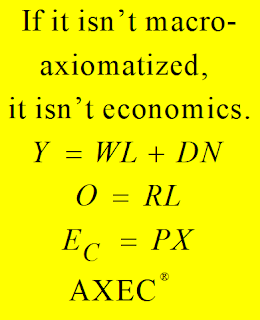
Burn the neoclassical axioms! And then take these, i.e., GraphicAXEC121i
Egmont Kakarot-Handtke
References
Einstein, A. (1934). On the Method of Theoretical Physics. Philosophy of Science, 1(2): 163–169. URL
Georgescu-Roegen, N. (1966). Analytical Economics, chapter General Conclusions for the Economist, 92–129. Cambridge: Harvard University Press.
Westfall, R. S. (2008). Never at Rest. A Biography of Isaac Newton. Cambridge: Cambridge University Press, 17th edition.
Blog-Reference
Above, Norman L. Roth gave a fine characterization of Marshall. I have nothing to add, except that nobody doubts Marshall's personal qualities. However, they are not relevant to the question of why Marshall openly downgraded mathematics.
Marshall was well acquainted with the Cambridge version of mathematics, which focused on geometry. Now, you cannot study geometry and Newton without coming across Euclid. In my mind, nobody who understands only a little of Euclid's role in the history of science can ever say ‘Burn the mathematics.’
Newton's Principia starts with the famous 'Axioms, or the Laws of motion', and the role of Euclidean geometry in Newtonian physics cannot be overestimated. “During five years, Humphrey saw Newton laugh only once. He had loaned an acquaintance a copy of Euclid. The acquaintance asked what use its study would be to him. ‘Upon which Sir Isaac was very merry.’ (Westfall, 2008, p. 192)
There is a direct line of highest praise from Newton to Einstein: “We honour ancient Greece as the cradle of western science. She, for the first time, created the intellectual miracle of a logical system, the assertions of which followed one from another with such rigor that not one of the demonstrated propositions admitted of the slightest doubt -- Euclid's geometry. This marvellous accomplishment of reason gave to the human spirit the confidence it needed for its future achievements. The man who was not enthralled in youth by this work was not born to be a scientific theorist.” (Einstein, 1934, p. 164)
And this last sentence contains my argument against Marshall's mathematical competence.
Curiously, there is one among the Top 20 heterodox economists who understood better than Marshall what mathematics was all about: “We are therefore justified in saying that with Euclid's Elements the causa materialis of geometry underwent a radical transformation; from a more or less amorphous aggregate of propositions it acquired an anatomic structure. Geometry itself emerged as a living organism with its own physiology and teleology,... And this true mutation represents not only the most valuable contribution of the Greek civilization to human thought but also a momentous landmark in the evolution of mankind comparable only to the discovery of speech or writing.” (Georgescu-Roegen, 1966, p. 9)
There is no better way to run Heterodoxy into the ground than to forget what Georgescu-Roegen has said about mathematics and to praise what Marshall has said.
Paul Schächterle correctly observes: “In economics, the hard part is to get reasonable axioms. So any modeling in economics should be based on very thorough reasoning what assumptions were made, why they were made, what was possibly omitted etc.”
Exactly so!
The claim of Heterodoxy to replace Orthodoxy with something better implies the replacement of the accustomed behavioral axioms with something better. This is called a Paradigm Shift. There is no way around this.
Burn the neoclassical axioms! And then take these, i.e., GraphicAXEC121i

Egmont Kakarot-Handtke
References
Einstein, A. (1934). On the Method of Theoretical Physics. Philosophy of Science, 1(2): 163–169. URL
Georgescu-Roegen, N. (1966). Analytical Economics, chapter General Conclusions for the Economist, 92–129. Cambridge: Harvard University Press.
Westfall, R. S. (2008). Never at Rest. A Biography of Isaac Newton. Cambridge: Cambridge University Press, 17th edition.

What engine?
Fourth comment Lars Syll on 'Proper use of math in economics'
Blog-Reference
The utilitarian's view of mathematics: “Use mathematics as a short-hand language, rather than as an engine of inquiry.” (Marshall, see intro)
The scientist's view of mathematics/formalization/axiomatization: “Formalisation was not to be merely a mechanical check on the integrity of scientific reasoning, but through the process of axiomatisation, mathematics was to be an engine of discovery.” (Weintraub, 1998, p. 1844), see also (Suppes, 1968, p. 653)
Having declined the tried and tested ‘engine of inquiry’ it does not come as a surprise that Marshall discovered nothing of scientific value but instead became the hero of those who are enthusiastic about the Cambridge methodology of common sense and loose verbal reasoning.
What Marshall took home from the Tripos was that mathematics is good for saving ink. This is as far beside the point as can be. The whole question is about methodology and the point of mathematics/formalization/axiomatization is: “The procedure of the axiomatic method, as it is expressed here, amounts to a deepening of the foundations of the individual domains of knowledge – a deepening that is necessary for every edifice that one wishes to expand and to build higher while preserving its stability.” (Hilbert, 2005, p. 1109)
I, too, agree with Paul Schächterle. Those who do not intend to build higher but are happy in the bottomless scientific swamp do not need any mathematics/formalization/axiomatization. All others are indeed happy that they do not get out from there but gather around the Marshall Memorial.
Egmont Kakarot-Handtke
References
Hilbert, D. (2005). Axiomatic Thought. In W. Ewald (Ed.), From Kant to Hilbert. A Source Book in the Foundations of Mathematics, volume II, 1107–1115. Oxford, New York: Oxford University Press.
Suppes, P. (1968). The Desirability of Formalization in Science. Journal of Philosophy, 65(20): 651–664.
Weintraub, E. R. (1998). Controversy: Axiomatisches Mißverständnis. Economic Journal, 108(451): 1837–1847. URL
Blog-Reference
The utilitarian's view of mathematics: “Use mathematics as a short-hand language, rather than as an engine of inquiry.” (Marshall, see intro)
The scientist's view of mathematics/formalization/axiomatization: “Formalisation was not to be merely a mechanical check on the integrity of scientific reasoning, but through the process of axiomatisation, mathematics was to be an engine of discovery.” (Weintraub, 1998, p. 1844), see also (Suppes, 1968, p. 653)
Having declined the tried and tested ‘engine of inquiry’ it does not come as a surprise that Marshall discovered nothing of scientific value but instead became the hero of those who are enthusiastic about the Cambridge methodology of common sense and loose verbal reasoning.
What Marshall took home from the Tripos was that mathematics is good for saving ink. This is as far beside the point as can be. The whole question is about methodology and the point of mathematics/formalization/axiomatization is: “The procedure of the axiomatic method, as it is expressed here, amounts to a deepening of the foundations of the individual domains of knowledge – a deepening that is necessary for every edifice that one wishes to expand and to build higher while preserving its stability.” (Hilbert, 2005, p. 1109)
I, too, agree with Paul Schächterle. Those who do not intend to build higher but are happy in the bottomless scientific swamp do not need any mathematics/formalization/axiomatization. All others are indeed happy that they do not get out from there but gather around the Marshall Memorial.
Egmont Kakarot-Handtke
References
Hilbert, D. (2005). Axiomatic Thought. In W. Ewald (Ed.), From Kant to Hilbert. A Source Book in the Foundations of Mathematics, volume II, 1107–1115. Oxford, New York: Oxford University Press.
Suppes, P. (1968). The Desirability of Formalization in Science. Journal of Philosophy, 65(20): 651–664.
Weintraub, E. R. (1998). Controversy: Axiomatisches Mißverständnis. Economic Journal, 108(451): 1837–1847. URL
Over the cliff
Comment on Lars Syll on 'Proper use of math in economics' with special reference to Asad Zaman
Blog-Reference
You write: “Math and Science have ENTIRELY different methodologies which are suitable to them.”
True. And it is exactly one of the great wonders how in the end this fits together so nicely: “I find it quite amazing that it is possible to predict what will happen by mathematics, which is simply following rules which really have nothing to do with what is going on in the original thing.” (Feynman, 1992, p. 171)
A famous paper by Wigner is titled ‘The Unreasonable Effectiveness of Mathematics in the Natural Sciences’ (1979). And this led Velupillai to wonder about ‘The Unreasonable Ineffectiveness of Mathematics in Economics.’ (2005)
One possible answer could be that the cause of this unreasonable ineffectiveness lies in the scientific incompetence of economists. This hypothesis has been advanced by a well-known representative of the real sciences. See: ‘The Farce That Is Economics: Richard Feynman On The Social Sciences’ More on zerohedge.
Not only physicists have wondered about unreasonable effectiveness, but mathematicians, too:
“From the axiomatic point of view, mathematics appears thus as a storehouse of abstract forms — the mathematical structures; and it so happens — without our knowing why — that certain aspects of empirical reality fit themselves into these forms, as if through a kind of preadaptation. ... It is only in this sense of the word ‘form’ that one can call the axiomatic method a ‘formalism’.” (Bourbaki, 2005, p. 1276)
You write: “The scientific method involves making observations about nature and then GUESSING at laws which generate the observed patterns — that is induction.”
This is simply false, and inductivists should know this by now. The real question is this: “If then it is the case that the axiomatic basis of theoretical physics cannot be an inference from experience, but must be a free invention, have we any right to hope that we shall find the correct way?” (Einstein, 1934, p. 167)
You write: “Consider the Pythagorean Theorem. It would make no sense to draw triangles and measure their sides to verify it, or to attempt to find a counterexample to the law.”
This is simply false.
“One of the most famous stories about Gauss depicts him measuring the angles of the great triangle formed by the mountain peaks of Hohenhagen, Inselberg, and Brocken for evidence that the geometry of space is non-Euclidean.” (Brown, 2011, p. 565)
You write: “As Popper put it, if there is no potential observation which could conflict with the law, then it is not a scientific law.”
True. And this is why theoretical economics deals only with testable propositions. And this, in turn, is the reason why the structural axiomatic paradigm is superior to both the orthodox and heterodox approaches (2014).
You write: “The observational and empirical aspect of science means that it cannot be axiomatic.”
This, again, is simply false.
“But the axioms Science is the attempt to make the chaotic diversity of our sense-experience correspond to a logically uniform system of thought” ... (Einstein, quoted in Clower, 1998, p. 409)
You write: “GREAT progress in science resulted PRECISELY from dropping the axiomatic methodology and switching to an observational and inductive process which led to scientific laws which could never be proven, UNLIKE mathematical laws.”
Exactly the opposite is true.
“It is my conviction that pure mathematical construction enables us to discover the concepts and the laws connecting them which give us the key to the understanding of the phenomena of Nature. Experience can, of course, guide us in our choice of serviceable mathematical concepts; it cannot possibly be the source from which they are derived; experience, of course, remains the sole criterion of the serviceability of a mathematical construction for physics, but the truly creative principle resides in mathematics. In a certain sense, therefore, I hold it to be true that pure thought is competent to comprehend the real, as the ancients dreamed.” (Einstein, 1934, p. 167)
You write: “The failure of economics is due to the use of the axiomatic method, which is eminently unsuitable for natural science, as was proven in the course of history.”
The incorrectness of this conclusion is unsurpassable.
The fact of the matter is that economics is a failed science because Orthodoxy got the axiomatic foundations wrong, and Heterodoxy has none at all.
The absurdity of the situation consists in the plain fact that Orthodoxy at least understands the crucial importance of axiomatization, while heterodox economists do not even see the task before them.
At first sight, it looks tragic, but then it is only a slapstick: All those who are marching to the tunes of Marshall's Burn-Hymn are directly going over the scientific cliff.
Egmont Kakarot-Handtke
References
Bourbaki, N. (2005). The Architecture of Mathematics. In W. Ewald (Ed.), From Kant to Hilbert. A Source Book in the Foundations of Mathematics, Vol. II, 1265–1276. Oxford, New York: Oxford University Press. (1948).
Brown, K. (2011). Reflections on Relativity. Raleigh: Lulu.com.
Clower, R. W. (1998). New Microfoundations for the Theory of Economic Growth? In G. Eliasson, C. Green, and C. R. McCann (Eds.), Microfoundations of Economic Growth, 409–423. Ann Arbour: University of Michigan Press.
Einstein, A. (1934). On the Method of Theoretical Physics. Philosophy of Science, 1(2): 163–169. URL.
Feynman, R. P. (1992). The Character of Physical Law. London: Penguin.
Ingrao, B., and Israel, G. (1990). The Invisible Hand. Economic Equilibrium in the History of Science. Cambridge, London: MIT Press.
Kakarot-Handtke, E. (2014). The Three Fatal Mistakes of Yesterday Economics: Profit, I=S, Employment. SSRN Working Paper Series, 2489792: 1–13. URL
Velupillai, K. (2005). The Unreasonable Ineffectiveness of Mathematics in Economics. Cambridge Journal of Economics, 29: 849–872.
Wigner, E. P. (1979). Symmetries and Reflections, chapter The Unreasonable Effectiveness of Mathematics in the Natural Sciences, 222–237. Woodbridge: Ox Bow Press.
Blog-Reference
You write: “Math and Science have ENTIRELY different methodologies which are suitable to them.”
True. And it is exactly one of the great wonders how in the end this fits together so nicely: “I find it quite amazing that it is possible to predict what will happen by mathematics, which is simply following rules which really have nothing to do with what is going on in the original thing.” (Feynman, 1992, p. 171)
A famous paper by Wigner is titled ‘The Unreasonable Effectiveness of Mathematics in the Natural Sciences’ (1979). And this led Velupillai to wonder about ‘The Unreasonable Ineffectiveness of Mathematics in Economics.’ (2005)
One possible answer could be that the cause of this unreasonable ineffectiveness lies in the scientific incompetence of economists. This hypothesis has been advanced by a well-known representative of the real sciences. See: ‘The Farce That Is Economics: Richard Feynman On The Social Sciences’ More on zerohedge.
Not only physicists have wondered about unreasonable effectiveness, but mathematicians, too:
“From the axiomatic point of view, mathematics appears thus as a storehouse of abstract forms — the mathematical structures; and it so happens — without our knowing why — that certain aspects of empirical reality fit themselves into these forms, as if through a kind of preadaptation. ... It is only in this sense of the word ‘form’ that one can call the axiomatic method a ‘formalism’.” (Bourbaki, 2005, p. 1276)
You write: “The scientific method involves making observations about nature and then GUESSING at laws which generate the observed patterns — that is induction.”
This is simply false, and inductivists should know this by now. The real question is this: “If then it is the case that the axiomatic basis of theoretical physics cannot be an inference from experience, but must be a free invention, have we any right to hope that we shall find the correct way?” (Einstein, 1934, p. 167)
You write: “Consider the Pythagorean Theorem. It would make no sense to draw triangles and measure their sides to verify it, or to attempt to find a counterexample to the law.”
This is simply false.
“One of the most famous stories about Gauss depicts him measuring the angles of the great triangle formed by the mountain peaks of Hohenhagen, Inselberg, and Brocken for evidence that the geometry of space is non-Euclidean.” (Brown, 2011, p. 565)
You write: “As Popper put it, if there is no potential observation which could conflict with the law, then it is not a scientific law.”
True. And this is why theoretical economics deals only with testable propositions. And this, in turn, is the reason why the structural axiomatic paradigm is superior to both the orthodox and heterodox approaches (2014).
You write: “The observational and empirical aspect of science means that it cannot be axiomatic.”
This, again, is simply false.
“But the axioms Science is the attempt to make the chaotic diversity of our sense-experience correspond to a logically uniform system of thought” ... (Einstein, quoted in Clower, 1998, p. 409)
You write: “GREAT progress in science resulted PRECISELY from dropping the axiomatic methodology and switching to an observational and inductive process which led to scientific laws which could never be proven, UNLIKE mathematical laws.”
Exactly the opposite is true.
“It is my conviction that pure mathematical construction enables us to discover the concepts and the laws connecting them which give us the key to the understanding of the phenomena of Nature. Experience can, of course, guide us in our choice of serviceable mathematical concepts; it cannot possibly be the source from which they are derived; experience, of course, remains the sole criterion of the serviceability of a mathematical construction for physics, but the truly creative principle resides in mathematics. In a certain sense, therefore, I hold it to be true that pure thought is competent to comprehend the real, as the ancients dreamed.” (Einstein, 1934, p. 167)
You write: “The failure of economics is due to the use of the axiomatic method, which is eminently unsuitable for natural science, as was proven in the course of history.”
The incorrectness of this conclusion is unsurpassable.
The fact of the matter is that economics is a failed science because Orthodoxy got the axiomatic foundations wrong, and Heterodoxy has none at all.
The absurdity of the situation consists in the plain fact that Orthodoxy at least understands the crucial importance of axiomatization, while heterodox economists do not even see the task before them.
At first sight, it looks tragic, but then it is only a slapstick: All those who are marching to the tunes of Marshall's Burn-Hymn are directly going over the scientific cliff.
Egmont Kakarot-Handtke
References
Bourbaki, N. (2005). The Architecture of Mathematics. In W. Ewald (Ed.), From Kant to Hilbert. A Source Book in the Foundations of Mathematics, Vol. II, 1265–1276. Oxford, New York: Oxford University Press. (1948).
Brown, K. (2011). Reflections on Relativity. Raleigh: Lulu.com.
Clower, R. W. (1998). New Microfoundations for the Theory of Economic Growth? In G. Eliasson, C. Green, and C. R. McCann (Eds.), Microfoundations of Economic Growth, 409–423. Ann Arbour: University of Michigan Press.
Einstein, A. (1934). On the Method of Theoretical Physics. Philosophy of Science, 1(2): 163–169. URL.
Feynman, R. P. (1992). The Character of Physical Law. London: Penguin.
Ingrao, B., and Israel, G. (1990). The Invisible Hand. Economic Equilibrium in the History of Science. Cambridge, London: MIT Press.
Kakarot-Handtke, E. (2014). The Three Fatal Mistakes of Yesterday Economics: Profit, I=S, Employment. SSRN Working Paper Series, 2489792: 1–13. URL
Velupillai, K. (2005). The Unreasonable Ineffectiveness of Mathematics in Economics. Cambridge Journal of Economics, 29: 849–872.
Wigner, E. P. (1979). Symmetries and Reflections, chapter The Unreasonable Effectiveness of Mathematics in the Natural Sciences, 222–237. Woodbridge: Ox Bow Press.
Who is afraid of axioms?
Joint comment on Lars Syll on ‘Proper use of math in economics’ and ‘The failure of economics is due to the use of axiomatic method’
Blog-Reference
With the example of general equilibrium theory directly before their eyes, heterodox economists seem to have settled on the opinion that a theory is a logical exercise that is based on arbitrary assumptions called axioms that have no empirical content whatsoever. It is therefore important to recall briefly what a theory is.
“A theory consists of a number of assumptions which logically function as axioms. Through specification and by introducing initial conditions, we may deduce predictions from them. If the predictions prove to be valid, we may also say that the assumptions are realistic.” (Klant, 1994, p. 75)
Contrary to the impression received from orthodox economics, a theory is not a self-contained fictional construct but refers to reality, more, it is the best humanly possible representation of reality. And exactly here comes the ambiguity. As a matter of fact, equilibrium theory has explicitly cut the tie to reality: “Allegiance to rigor dictates the axiomatic form of the analysis where the theory, in the strict sense, is logically entirely disconnected from its interpretations.” (Debreu, 1959, p. x)
This is true for mathematics proper. It is completely false when axiomatization is applied outside mathematics: “Formal axiomatic systems must be interpreted in some domain ... to become an empirical science.” (Boylan and O'Gorman, 1995, p. 198)
The assessment that orthodox economics is not much more than a formalized shell game with economic terms is therefore fully justified: “... GE theory is explicitly defended as a purely formal presentation of the determination of economic equilibrium in a decentralized competitive economy, having no practical value except as a benchmark ...” (Blaug, 1994, p. 126)
By consequence, equilibrium economics is not a theory in the proper sense: “Suffice it to say that, in my opinion, what we presently possess by way of so-called pure economic theory is objectively indistinguishable from what the physicist Richard Feynman, in an unflattering sketch of nonsense ‘science,’ called ‘cargo cult science’.” (Clower, 1994, p. 809)
The fundamental defect of orthodox economics does NOT consist in axiomatization but in applying the WRONG axioms: “Much of economic theory is based on three questionable assumptions: (1) the world is deterministic; (2) decision makers act as if they know the values of all relevant parameters; and (3) consumers and firms respectively, act as if they were maximizing utility and profit.” (Stigum, 1991, p. 29)
The first task of Heterodoxy is therefore to formulate a theory that is based on a different set of axioms. Axioms, though, do not follow simply from looking at what appears as reality: “Indeed, there is no such thing as an uninterpreted observation, an observation which is not theory-impregnated.” (Popper, 1994, p. 58)
Therefore, the old induction/deduction chestnut has to be put aside: “... there is not and cannot be any fundamental opposition between ‘theory’ and ‘fact finding,’ let alone between deduction and induction.” (Schumpeter, 1994, p. 45)
Heterodox economists are mistaken to think that because the orthodox axioms are false axiomatization is dispensable: “It would be a mistake to lower the level of analysis and clarification. The only way possible is a thorough reexamination of the theory’s basic hypotheses, i.e., a true paradigmatic revolution.” (Ingrao et al., 1990, p. 362)
And this brings us directly to J. S. Mill's Starting Problem: “What are the propositions which may reasonably be received without proof? That there must be some such propositions all are agreed, since there cannot be an infinite series of proof, a chain suspended from nothing. But to determine what these propositions are, is the opus magnum of the more recondite mental philosophy.” (Mill, 2006, p. 746)
Based on undisputable methodological reasons, I propose to move from subjective-behavioral to objective-systemic axiomatic foundations (see here). As things stand at present, there are no other materially/formally consistent macrofoundations available.
Egmont Kakarot-Handtke
References
Blaug, M. (1994). Why I am Not a Constructivist. Confessions of an Unrepentant Popperian. In R. E. Backhouse (Ed.), New Directions in Economic Methodology, 109–136. London, New York: Routledge.
Boylan, T. A., and O’Gorman, P. F. (1995). Beyond Rhetoric and Realism in Economics. Towards a Reformulation of Economic Methodology. London: Routledge.
Clower, R. W. (1994). Economics as an Inductive Science. Southern Economic Journal, 60(4): 805–814.
Debreu, G. (1959). Theory of Value. An Axiomatic Analysis of Economic Equilibrium. New Haven, London: Yale University Press.
Ingrao, B., and Israel, G. (1990). The Invisible Hand. Economic Equilibrium in the History of Science. Cambridge, London: MIT Press.
Klant, J. J. (1994). The Nature of Economic Thought. Aldershot, Brookfield: Edward Elgar.
Mill, J. S. (2006). Principles of Political Economy With Some of Their Applications to Social Philosophy, Volume 3, Books III-V of Collected Works of John Stuart Mill. Indianapolis: Liberty Fund. URL
Popper, K. R. (1994). The Myth of the Framework. In Defence of Science and Rationality, Ch. Science: Problems, Aims, Responsibilities, 82–111. London, New York: Routledge.
Schumpeter, J. A. (1994). History of Economic Analysis. New York: Oxford University Press.
Stigum, B. P. (1991). Toward a Formal Science of Economics: The Axiomatic Method in Economics and Econometrics. Cambridge: MIT Press.
Related 'First Lecture in New Economic Thinking' and '10 steps to leave cargo cult economics behind for good' and 'Don Lars and the axiomatic windmill' and 'The axiomatic method is impeccable'. For details of the big picture, see cross-references Paradigm Shift.

Blog-Reference
With the example of general equilibrium theory directly before their eyes, heterodox economists seem to have settled on the opinion that a theory is a logical exercise that is based on arbitrary assumptions called axioms that have no empirical content whatsoever. It is therefore important to recall briefly what a theory is.
“A theory consists of a number of assumptions which logically function as axioms. Through specification and by introducing initial conditions, we may deduce predictions from them. If the predictions prove to be valid, we may also say that the assumptions are realistic.” (Klant, 1994, p. 75)
Contrary to the impression received from orthodox economics, a theory is not a self-contained fictional construct but refers to reality, more, it is the best humanly possible representation of reality. And exactly here comes the ambiguity. As a matter of fact, equilibrium theory has explicitly cut the tie to reality: “Allegiance to rigor dictates the axiomatic form of the analysis where the theory, in the strict sense, is logically entirely disconnected from its interpretations.” (Debreu, 1959, p. x)
This is true for mathematics proper. It is completely false when axiomatization is applied outside mathematics: “Formal axiomatic systems must be interpreted in some domain ... to become an empirical science.” (Boylan and O'Gorman, 1995, p. 198)
The assessment that orthodox economics is not much more than a formalized shell game with economic terms is therefore fully justified: “... GE theory is explicitly defended as a purely formal presentation of the determination of economic equilibrium in a decentralized competitive economy, having no practical value except as a benchmark ...” (Blaug, 1994, p. 126)
By consequence, equilibrium economics is not a theory in the proper sense: “Suffice it to say that, in my opinion, what we presently possess by way of so-called pure economic theory is objectively indistinguishable from what the physicist Richard Feynman, in an unflattering sketch of nonsense ‘science,’ called ‘cargo cult science’.” (Clower, 1994, p. 809)
The fundamental defect of orthodox economics does NOT consist in axiomatization but in applying the WRONG axioms: “Much of economic theory is based on three questionable assumptions: (1) the world is deterministic; (2) decision makers act as if they know the values of all relevant parameters; and (3) consumers and firms respectively, act as if they were maximizing utility and profit.” (Stigum, 1991, p. 29)
The first task of Heterodoxy is therefore to formulate a theory that is based on a different set of axioms. Axioms, though, do not follow simply from looking at what appears as reality: “Indeed, there is no such thing as an uninterpreted observation, an observation which is not theory-impregnated.” (Popper, 1994, p. 58)
Therefore, the old induction/deduction chestnut has to be put aside: “... there is not and cannot be any fundamental opposition between ‘theory’ and ‘fact finding,’ let alone between deduction and induction.” (Schumpeter, 1994, p. 45)
Heterodox economists are mistaken to think that because the orthodox axioms are false axiomatization is dispensable: “It would be a mistake to lower the level of analysis and clarification. The only way possible is a thorough reexamination of the theory’s basic hypotheses, i.e., a true paradigmatic revolution.” (Ingrao et al., 1990, p. 362)
And this brings us directly to J. S. Mill's Starting Problem: “What are the propositions which may reasonably be received without proof? That there must be some such propositions all are agreed, since there cannot be an infinite series of proof, a chain suspended from nothing. But to determine what these propositions are, is the opus magnum of the more recondite mental philosophy.” (Mill, 2006, p. 746)
Based on undisputable methodological reasons, I propose to move from subjective-behavioral to objective-systemic axiomatic foundations (see here). As things stand at present, there are no other materially/formally consistent macrofoundations available.
Egmont Kakarot-Handtke
References
Blaug, M. (1994). Why I am Not a Constructivist. Confessions of an Unrepentant Popperian. In R. E. Backhouse (Ed.), New Directions in Economic Methodology, 109–136. London, New York: Routledge.
Boylan, T. A., and O’Gorman, P. F. (1995). Beyond Rhetoric and Realism in Economics. Towards a Reformulation of Economic Methodology. London: Routledge.
Clower, R. W. (1994). Economics as an Inductive Science. Southern Economic Journal, 60(4): 805–814.
Debreu, G. (1959). Theory of Value. An Axiomatic Analysis of Economic Equilibrium. New Haven, London: Yale University Press.
Ingrao, B., and Israel, G. (1990). The Invisible Hand. Economic Equilibrium in the History of Science. Cambridge, London: MIT Press.
Klant, J. J. (1994). The Nature of Economic Thought. Aldershot, Brookfield: Edward Elgar.
Mill, J. S. (2006). Principles of Political Economy With Some of Their Applications to Social Philosophy, Volume 3, Books III-V of Collected Works of John Stuart Mill. Indianapolis: Liberty Fund. URL
Popper, K. R. (1994). The Myth of the Framework. In Defence of Science and Rationality, Ch. Science: Problems, Aims, Responsibilities, 82–111. London, New York: Routledge.
Schumpeter, J. A. (1994). History of Economic Analysis. New York: Oxford University Press.
Stigum, B. P. (1991). Toward a Formal Science of Economics: The Axiomatic Method in Economics and Econometrics. Cambridge: MIT Press.
Related 'First Lecture in New Economic Thinking' and '10 steps to leave cargo cult economics behind for good' and 'Don Lars and the axiomatic windmill' and 'The axiomatic method is impeccable'. For details of the big picture, see cross-references Paradigm Shift.
For more about axiom, see AXECquery.
For more about macrofoundations, see AXECquery.
Twitter/Y May 16, 2026 Math and the Scientific Revolution

Still in the woods
Comment Lars Syll on 'Proper use of math in economics'
Blog-Reference
In my post of Dec 22, I introduced the Prophets of Preemptive Vanitization. More often than not, these prophets populate the social sciences, and from all theorems that have ever been developed in mathematics or physics, the impossibility theorems are closest to their hearts because they are equally good for both inhibition and excuse.
So, one cannot mention the word axiom in the social sciences without the Pavlovian reflex: Oh, you know, Gödel has proved that a complete and consistent set of axioms is impossible (see Wikipedia). Yes, and now? Is Newtonian physics wrong because the Euclidean axioms are incomplete? And, by the way, one can always expand a set of axioms if necessary, so Gödel is not of practical concern at all outside mathematics.
For a snail, it is irrelevant that it cannot, in principle, surpass the speed of light. By the same token, are the impossibility theorems from cutting-edge physics and logic irrelevant to economic methodology? By no stretch of the imagination can Gödel's proof be used to argue against axiomatization. Heterodox economists could know this from one of the great heterodox economists.
“Lest this position is misinterpreted again by some casual reader, let me repeat that my point is not that arithmetization [= axiomatization] of science is undesirable. Whenever arithmetization can be worked out, its merits are above all words of praise. My point is that wholesale arithmetization is impossible, that there is valid knowledge even without arithmetization, and that mock arithmetization is dangerous if peddled as genuine.” (Georgescu-Roegen, 1971, p. 15)
We can easily agree on this. Thus, to argue against axiomatization amounts for all practical purposes to the conservation of manifest logical and conceptual defects in the theoretical edifice of economics. And there are many of them. Economists are known as sloppy thinkers.
“The truth is, most persons, not excepting professional economists, are satisfied with very hazy notions.” (Fisher, quoted in Mirowski, 1995, p. 86)
This goes some way in explaining the secular stagnation of economics. “I think it is the lack of quite sharply defined concepts that the main difficulty lies, and not in any intrinsic difference between the fields of economics and other sciences.” (von Neumann, quoted in Mirowski, 2002, p. 146 fn. 49)
The arguments of the Prophets of Preemptive Vanitization against axiomatization have always been far off the mark. Axiomatization is a very effective tool, and the fact that it is not exactly 100 percent effective is no argument against it. How effective is the Verstehen of the so-called social sciences?
This said, my key argument is not so much methodological but indeed very practical. In order to replace the neoclassical approach, which is axiomatized, Heterodoxy must replace the axiomatic foundations of neoclassical theory. Hence, there is no urgent need to discuss axiomatization in the abstract. According to well-established scientific practice, there is no other way.
“The moral of the story is simply this: it takes a new theory, and not just the destructive exposure of assumptions or the collection of new facts, to beat an old theory.” (Blaug, 1998, p. 703)
And each theory is built upon some clearly stated premises. It is as straightforward as this.
“When the premises are certain, true, and primary, and the conclusion formally follows from them, this is demonstration, and produces scientific knowledge of a thing.” (Resume of Aristotle's Analytica).
It has often been argued that scientists do not proceed axiomatically in their research. This, of course, is well-known in the history of science. But clearly, the moment they apply some piece of mathematics, they do so indirectly. And in the end, the whole theoretical edifice must be logically coherent. This goes without saying.
“I am of the opinion that, certainly, for the purposes of research it is always necessary to combine the intuition with the axioms.” (Felix Klein, quoted in Weintraub, 2002, p. 25), see also (2013, Sec. 6).
From the fact that physics is not completely axiomatized at the moment does not logically follow that economics cannot or should not be axiomatized.
“Some day, when physics is complete and we know all the laws, we may be able to start with some axioms, and no doubt somebody will figure out a particular way of doing it so that everything else can be deduced.” (Feynman, 1992, p. 50)
Asad Zaman correctly remarks that all methodology, in the end, boils down to empirical testing: “For example, Egmont keeps arguing that his axiomatization is better than others, and that others are wrong while his is correct. To me, it seems that this requires demonstration on practical grounds ...”
This, indeed, is the all-decisive argument.
As it happens, this argument has already been answered on this blog and elsewhere. For example, see my comment 'Going beyond error and distortion' of Dec 12.
In this comment, I have refuted the Keynesian I=S and presented the correct formula, which is testable. See also my refutation of Keen's profit theory (2013). The fact of the matter is that all logical implications of the structural axiom set are testable because the axioms contain only measurable variables. And this is why structural axioms are methodologically superior to the behavioral axioms of Orthodoxy.
To answer Asad Zaman's key argument, there are as many testable propositions available as one could wish. See the working papers on SSRN.
See also the comment of Dec 21 above: “If anybody thinks that the structural axiom set is false, he is invited to refute one proposition that follows deductively from it.”
From the structural axioms follows the Profit Law. And this makes it possible to empirically refute other approaches, e.g., (2011).
My claim is that the objective-structural axiom set is superior to the familiar formal starting points of economic analysis. This claim is open to scrutiny according to the criteria of formal and material consistency. One is not obligated to apply the structural axiom set provided one already possesses the correct formal foundations, which is improbable given the unacceptable state of orthodox and heterodox economics.
Axiomatization means clarity. As self-defined social scientists, economists traditionally prefer the twilight zone where “.. nothing is clear and everything is possible.” (Keynes, 1973, p. 292). And after they have muddled everything up to the point of inconclusiveness, they invariably excuse the mess with the complexity of the subject matter. This has already gone on for a while. Here we have Duhem-Quine:
“Knight accuses the positivists of overlooking the complexity and uncertainty of testing in all sciences and argues at length that positivist views of science are particularly inappropriate to economics, which, like all sciences of human action, must concern itself with reasons, motives, values, and errors, not just causes and regularities.” (Hausman, 1989, p. 118)
Concerning methodology, Asad Zaman stands firmly in the neoclassical tradition.
“Post-Kuhnian understanding of science and axiomatics is rather complex, with no obvious and simple theory of knowledge attached.”
After Kuhn's schematic account of a paradigm shift, the Prophets of Preemptive Vanitization tried hard to get back into their natural habitat, the twilight zone of human all too human messiness. However, nobody needs a theory of knowledge to convince themselves that BOTH Orthodoxy and Heterodoxy do not satisfy scientific standards.
It is not a big issue when Asad Zaman does not understand the merits and chances of axiomatization. It is, though, of utmost importance that he refrains from silly statements like: “The failure of economics is due to the use of the axiomatic method,” or, even worse: “Thus, any axiomatization can only make a LIMITED set of claims. For example, Egmont’s axioms may provide an explanation for the role of money, but have nothing to say about the global financial crisis. Indeed, since so far the best explanation come from behavioral finance, while Egmont’s axioms bypass behavior, it would seem that his axiom CANNOT say anything about this crisis.”
This looks pretty much like an impossibility assertion out of thin air. It is obvious that Asad Zaman prefers to stay in the woods of psychology and sociology. This personal decision has to be accepted. But it cannot be accepted that he ignores facts. These are:
(i) From the fact that behavioral assumptions (like utility maximization) are denied the status of an axiom does not logically follow that no behavioral assumptions can be applied. Just the contrary: structural axiomatization is compatible with ANY behavioral assumption, that is, it is fully compatible with behavioral finance.
(ii) From the structural axiom set, indeed, follows quite a lot about financial crises. For those who can read and think, it is all on SSRN.
Asad Zaman is right, axiomatization makes only limited claims ― grandiose vacuousness is left to the so-called social sciences ― yet these claims are as certain as can be. The first important result of structural axiomatization is:
Neither Classicals, nor Walrasians, nor Marshallians, nor Marxians, nor Keynesians, nor Institutionalists, nor Monetary Economists, nor Austrians, nor Sraffaians, nor Evolutionists, nor Game theorists, nor Econophysicists, nor RBCers, nor New Keynesians, nor New Classicals ever came to grips with profit. Hence, they fail to capture the essence of a capitalist market economy.
In its present state, Heterodoxy is unacceptable according to scientific criteria. The options are: move on or move out.
Egmont Kakarot-Handtke
References
Blaug, M. (1998). Economic Theory in Retrospect. Cambridge: Cambridge University Press, 5th edition.
Feynman, R. P. (1992). The Character of Physical Law. London: Penguin.
Georgescu-Roegen, N. (1971). The Entropy Law and the Economic Process. Cambridge: Cambridge University Press.
Hausman, D. M. (1989). Economic Methodology in a Nutshell. Journal of Economic Perspectives, 3(2): 115–127. URL
Kakarot-Handtke, E. (2011). Why Post Keynesianism is Not Yet a Science. SSRN Working Paper Series, 1966438: 1–15. URL
Kakarot-Handtke, E. (2013a). Crisis and Methodology: Some Heterodox Misunderstandings. SSRN Working Paper Series, 2083519: 1–25. URL
Kakarot-Handtke, E. (2013b). Debunking Squared. SSRN Working Paper Series, 2357902: 1–5. URL
Keynes, J. M. (1973). The General Theory of Employment Interest and Money. The Collected Writings of John Maynard Keynes Vol. VII. London, Basingstoke: Macmillan.
Mirowski, P. (1995). More Heat than Light. Cambridge: Cambridge University Press.
Mirowski, P. (2002). Machine Dreams. Cambridge: Cambridge University Press.
Weintraub, E. R. (2002). How Economics Became a Mathematical Science. Durham, London: Duke University Press.

Blog-Reference
In my post of Dec 22, I introduced the Prophets of Preemptive Vanitization. More often than not, these prophets populate the social sciences, and from all theorems that have ever been developed in mathematics or physics, the impossibility theorems are closest to their hearts because they are equally good for both inhibition and excuse.
So, one cannot mention the word axiom in the social sciences without the Pavlovian reflex: Oh, you know, Gödel has proved that a complete and consistent set of axioms is impossible (see Wikipedia). Yes, and now? Is Newtonian physics wrong because the Euclidean axioms are incomplete? And, by the way, one can always expand a set of axioms if necessary, so Gödel is not of practical concern at all outside mathematics.
For a snail, it is irrelevant that it cannot, in principle, surpass the speed of light. By the same token, are the impossibility theorems from cutting-edge physics and logic irrelevant to economic methodology? By no stretch of the imagination can Gödel's proof be used to argue against axiomatization. Heterodox economists could know this from one of the great heterodox economists.
“Lest this position is misinterpreted again by some casual reader, let me repeat that my point is not that arithmetization [= axiomatization] of science is undesirable. Whenever arithmetization can be worked out, its merits are above all words of praise. My point is that wholesale arithmetization is impossible, that there is valid knowledge even without arithmetization, and that mock arithmetization is dangerous if peddled as genuine.” (Georgescu-Roegen, 1971, p. 15)
We can easily agree on this. Thus, to argue against axiomatization amounts for all practical purposes to the conservation of manifest logical and conceptual defects in the theoretical edifice of economics. And there are many of them. Economists are known as sloppy thinkers.
“The truth is, most persons, not excepting professional economists, are satisfied with very hazy notions.” (Fisher, quoted in Mirowski, 1995, p. 86)
This goes some way in explaining the secular stagnation of economics. “I think it is the lack of quite sharply defined concepts that the main difficulty lies, and not in any intrinsic difference between the fields of economics and other sciences.” (von Neumann, quoted in Mirowski, 2002, p. 146 fn. 49)
The arguments of the Prophets of Preemptive Vanitization against axiomatization have always been far off the mark. Axiomatization is a very effective tool, and the fact that it is not exactly 100 percent effective is no argument against it. How effective is the Verstehen of the so-called social sciences?
This said, my key argument is not so much methodological but indeed very practical. In order to replace the neoclassical approach, which is axiomatized, Heterodoxy must replace the axiomatic foundations of neoclassical theory. Hence, there is no urgent need to discuss axiomatization in the abstract. According to well-established scientific practice, there is no other way.
“The moral of the story is simply this: it takes a new theory, and not just the destructive exposure of assumptions or the collection of new facts, to beat an old theory.” (Blaug, 1998, p. 703)
And each theory is built upon some clearly stated premises. It is as straightforward as this.
“When the premises are certain, true, and primary, and the conclusion formally follows from them, this is demonstration, and produces scientific knowledge of a thing.” (Resume of Aristotle's Analytica).
It has often been argued that scientists do not proceed axiomatically in their research. This, of course, is well-known in the history of science. But clearly, the moment they apply some piece of mathematics, they do so indirectly. And in the end, the whole theoretical edifice must be logically coherent. This goes without saying.
“I am of the opinion that, certainly, for the purposes of research it is always necessary to combine the intuition with the axioms.” (Felix Klein, quoted in Weintraub, 2002, p. 25), see also (2013, Sec. 6).
From the fact that physics is not completely axiomatized at the moment does not logically follow that economics cannot or should not be axiomatized.
“Some day, when physics is complete and we know all the laws, we may be able to start with some axioms, and no doubt somebody will figure out a particular way of doing it so that everything else can be deduced.” (Feynman, 1992, p. 50)
Asad Zaman correctly remarks that all methodology, in the end, boils down to empirical testing: “For example, Egmont keeps arguing that his axiomatization is better than others, and that others are wrong while his is correct. To me, it seems that this requires demonstration on practical grounds ...”
This, indeed, is the all-decisive argument.
As it happens, this argument has already been answered on this blog and elsewhere. For example, see my comment 'Going beyond error and distortion' of Dec 12.
In this comment, I have refuted the Keynesian I=S and presented the correct formula, which is testable. See also my refutation of Keen's profit theory (2013). The fact of the matter is that all logical implications of the structural axiom set are testable because the axioms contain only measurable variables. And this is why structural axioms are methodologically superior to the behavioral axioms of Orthodoxy.
To answer Asad Zaman's key argument, there are as many testable propositions available as one could wish. See the working papers on SSRN.
See also the comment of Dec 21 above: “If anybody thinks that the structural axiom set is false, he is invited to refute one proposition that follows deductively from it.”
From the structural axioms follows the Profit Law. And this makes it possible to empirically refute other approaches, e.g., (2011).
My claim is that the objective-structural axiom set is superior to the familiar formal starting points of economic analysis. This claim is open to scrutiny according to the criteria of formal and material consistency. One is not obligated to apply the structural axiom set provided one already possesses the correct formal foundations, which is improbable given the unacceptable state of orthodox and heterodox economics.
Axiomatization means clarity. As self-defined social scientists, economists traditionally prefer the twilight zone where “.. nothing is clear and everything is possible.” (Keynes, 1973, p. 292). And after they have muddled everything up to the point of inconclusiveness, they invariably excuse the mess with the complexity of the subject matter. This has already gone on for a while. Here we have Duhem-Quine:
“Knight accuses the positivists of overlooking the complexity and uncertainty of testing in all sciences and argues at length that positivist views of science are particularly inappropriate to economics, which, like all sciences of human action, must concern itself with reasons, motives, values, and errors, not just causes and regularities.” (Hausman, 1989, p. 118)
Concerning methodology, Asad Zaman stands firmly in the neoclassical tradition.
“Post-Kuhnian understanding of science and axiomatics is rather complex, with no obvious and simple theory of knowledge attached.”
After Kuhn's schematic account of a paradigm shift, the Prophets of Preemptive Vanitization tried hard to get back into their natural habitat, the twilight zone of human all too human messiness. However, nobody needs a theory of knowledge to convince themselves that BOTH Orthodoxy and Heterodoxy do not satisfy scientific standards.
It is not a big issue when Asad Zaman does not understand the merits and chances of axiomatization. It is, though, of utmost importance that he refrains from silly statements like: “The failure of economics is due to the use of the axiomatic method,” or, even worse: “Thus, any axiomatization can only make a LIMITED set of claims. For example, Egmont’s axioms may provide an explanation for the role of money, but have nothing to say about the global financial crisis. Indeed, since so far the best explanation come from behavioral finance, while Egmont’s axioms bypass behavior, it would seem that his axiom CANNOT say anything about this crisis.”
This looks pretty much like an impossibility assertion out of thin air. It is obvious that Asad Zaman prefers to stay in the woods of psychology and sociology. This personal decision has to be accepted. But it cannot be accepted that he ignores facts. These are:
(i) From the fact that behavioral assumptions (like utility maximization) are denied the status of an axiom does not logically follow that no behavioral assumptions can be applied. Just the contrary: structural axiomatization is compatible with ANY behavioral assumption, that is, it is fully compatible with behavioral finance.
(ii) From the structural axiom set, indeed, follows quite a lot about financial crises. For those who can read and think, it is all on SSRN.
Asad Zaman is right, axiomatization makes only limited claims ― grandiose vacuousness is left to the so-called social sciences ― yet these claims are as certain as can be. The first important result of structural axiomatization is:
Neither Classicals, nor Walrasians, nor Marshallians, nor Marxians, nor Keynesians, nor Institutionalists, nor Monetary Economists, nor Austrians, nor Sraffaians, nor Evolutionists, nor Game theorists, nor Econophysicists, nor RBCers, nor New Keynesians, nor New Classicals ever came to grips with profit. Hence, they fail to capture the essence of a capitalist market economy.
In its present state, Heterodoxy is unacceptable according to scientific criteria. The options are: move on or move out.
Egmont Kakarot-Handtke
References
Blaug, M. (1998). Economic Theory in Retrospect. Cambridge: Cambridge University Press, 5th edition.
Feynman, R. P. (1992). The Character of Physical Law. London: Penguin.
Georgescu-Roegen, N. (1971). The Entropy Law and the Economic Process. Cambridge: Cambridge University Press.
Hausman, D. M. (1989). Economic Methodology in a Nutshell. Journal of Economic Perspectives, 3(2): 115–127. URL
Kakarot-Handtke, E. (2011). Why Post Keynesianism is Not Yet a Science. SSRN Working Paper Series, 1966438: 1–15. URL
Kakarot-Handtke, E. (2013a). Crisis and Methodology: Some Heterodox Misunderstandings. SSRN Working Paper Series, 2083519: 1–25. URL
Kakarot-Handtke, E. (2013b). Debunking Squared. SSRN Working Paper Series, 2357902: 1–5. URL
Keynes, J. M. (1973). The General Theory of Employment Interest and Money. The Collected Writings of John Maynard Keynes Vol. VII. London, Basingstoke: Macmillan.
Mirowski, P. (1995). More Heat than Light. Cambridge: Cambridge University Press.
Mirowski, P. (2002). Machine Dreams. Cambridge: Cambridge University Press.
Weintraub, E. R. (2002). How Economics Became a Mathematical Science. Durham, London: Duke University Press.
***
Twitter/X May 7, 2026 Why Gödel is irrelevant for economics

December 29, 2014
Time to get out of gossip economics
Comment on Asad Zaman on ‘The failure of economics is due to the use of axiomatic method’
Blog-Reference
There are political economics and theoretical economics. Only the latter satisfies scientific standards: “... it is a central aim of science to come to knowledge of how the world really is, that correspondence between theories and reality is a central aim of science as an epistemic enterprise and crucial to whatever objectivity scientific knowledge enjoys ...” (Suppe, 1977, p. 649)
As a first approximation, one can agree on the general characteristic that the economy is a complex system. Under this perspective, theoretical economics is a variant of General Systems Theory (G.S.T): “To argue that G.S.T. is inapplicable to economics is to negate claims that economics is a science.” (Weintraub, 1979, p. 72)
However, with the term system, we usually associate a structure with components that are non-human. In order to stress the fact that humans are an essential component of the economy we could perhaps better say that the economy is a complex hybrid human/system entity.’ This balanced view given, however, there are still different views about primacy.
The subjectivists hold: “It is evident, that all the sciences have a relation, greater or less, to human nature: and that however wide any of them may seem to run from it, they still return back by one passage or another. Even. Mathematics, Natural Philosophy, and Natural Religion, are in some measure dependent on the science of MAN; since they lie under the cognizance of men, and are judged of by their powers and faculties.” (Hume, 2012, Introduction)
“And as the science of man is the-only solid foundation for the other sciences, so the only solid foundation we can give to this science itself must be laid on experience and observation.” (Hume, 2012, Introduction)
The objectivists hold: “Perhaps it is because their horizons are limited in this way that some people are able to imagine that the centre of the universe is man.” (Feynman, 1992, p. 58)
“Like Plank, Einstein viewed the human element of any physical theory as essentially arbitrary, something that should be purged on realization of the final true theory.” (Mirowski, 2004, p. 159)
With regard to physical reality, objectivity is rather convincing, with regard to social reality most people intuitively subscribe to subjectivity. Even some methodologists do: “... since we are all humans everything reduces to psychology.” (Boland, 2003, p. 107)
Psychologism is the most congenial mode of explanation. The ancient Greeks regarded myths as ‘true stories’ and distinguished them from fables as ‘false stories’. Xenophanes made his contemporaries aware that their true stories were what is now called a projection.
With this, the problem of demarcation between science and non-science arose for the first time. And it was easily solved. The Pre-Socratics rejected the mythological explanations of the world because they saw that EVERYTHING could be explained by the human-like actions of almighty gods which meant on closer inspection: nothing. This methodological insight set science on its track.
Myth, well told, is still the most convincing way to explain how the world and humankind came to be in their present form. To recall, Zeus was the god of sky and thunder. He oversaw the universe, assigned the various gods their roles, and was known for his erotic escapades. Zeus was emotional, spontaneous and had a lot of trouble with other gods, goddesses, and humans. At Prometheus, for example, he was angry for three things: being tricked on sacrifices, stealing fire for man, and for refusing to tell him which of his children would dethrone him. To handle his problems, Zeus regularly fell back to chicanery, force, and violence (for an overview see Wikipedia). Since antiquity, everybody "understands" Zeus and he easily provokes like/dislike. Replace his name with a real-world head of state and the story fits by and large.
Purified from all religious connotations, Greek myth is the stuff psychology, literature, soap operas, blogs, newspapers, and history are made of until today. Let us call this all-embracing panorama of human motives and actions the gossip model of the world. It affords immediate access to subjective understanding which, however, is barely distinguishable from a projection. With the gossip model, everything and its opposite can be explained. That makes it both popular and preposterous.
Science started the very day when Greek philosophers threw the gossip model out of the window.
The subjectivist methodology is commonsensical. The problem is: compared to the objectivist methodology it has achieved nothing: “... there has been no progress in developing laws of human behavior for the last twenty-five hundred years.” (Hausman, 1992, p. 320), (Rosenberg, 1980, pp. 2-3)
Second-guessing human behavior and storytelling are entertaining but pointless: “... observed acts of behavior allow an indefinite number of interpretations regarding the plans from which they are assumed to have sprung.” (Morgenstern, 1941, p. 381)
This explains the failure of psychological/sociological approaches.
“Now, at any rate, we have an explanation for why the assumptions of economic theory about individual action have not been improved, corrected, sharpened, specified, or conditioned in ways that would improve the predictive power of the theory. None of these things have been done by economists because they cannot be done. The intentional nature of the fundamental explanatory variables of economic theory prohibits such improvement.” (Rosenberg, 1992, p. 149)
Science deals only with propositions that can in principle be decided by objective means. The rest is opinion, faith, second-guessing, phantasy, motive speculation, allegation, interpretation, hallucination, myth, paranoia, suspicion, ink-blot association, vituperation, philosophy, storytelling, etcetera.
There is only one way to get out of the scientific slums of political economics, and that is: to move from subjective to objective axiomatic foundations. Click here for a preview. But consider first the possibility that your ideas about what a set of economic axioms should look like could be far off the mark. To check this, some testing is needed.
Egmont Kakarot-Handtke
References
Boland, L. A. (2003). The Foundations of Economic Method. A Popperian Perspective. London, New York: Routledge, 2nd edition.
Feynman, R. P. (1992). The Character of Physical Law. London: Penguin.
Hausman, D. M. (1992). The Inexact and Separate Science of Economics. Cambridge: Cambridge University Press.
Hume, D. (2012). A Treatise of Human Nature. Project Gutenberg EBook. URL
Mirowski, P. (2004). The Effortless Economy of Science? Durham, London: Duke University Press.
Morgenstern, O. (1941). Professor Hicks on Value and Capital. Journal of Political Economy, 49(3): 361–393. URL
Rosenberg, A. (1980). Sociobiology and the Preemption of Social Science. Oxford: Blackwell.
Rosenberg, A. (1992). Economics - Mathematical Politics or Science of Diminishing Returns? Chicago: University of Chicago Press.
Suppe, F. (1977). Afterword. In F. Suppe (Ed.), The Structure of Scientific Theories, 615–730. Urbana, Chicago: University of Illinois Press.
Weintraub, E. R. (1979). Microfoundations. Cambridge, London, New York, etc.: Cambridge University Press.
Blog-Reference
There are political economics and theoretical economics. Only the latter satisfies scientific standards: “... it is a central aim of science to come to knowledge of how the world really is, that correspondence between theories and reality is a central aim of science as an epistemic enterprise and crucial to whatever objectivity scientific knowledge enjoys ...” (Suppe, 1977, p. 649)
As a first approximation, one can agree on the general characteristic that the economy is a complex system. Under this perspective, theoretical economics is a variant of General Systems Theory (G.S.T): “To argue that G.S.T. is inapplicable to economics is to negate claims that economics is a science.” (Weintraub, 1979, p. 72)
However, with the term system, we usually associate a structure with components that are non-human. In order to stress the fact that humans are an essential component of the economy we could perhaps better say that the economy is a complex hybrid human/system entity.’ This balanced view given, however, there are still different views about primacy.
The subjectivists hold: “It is evident, that all the sciences have a relation, greater or less, to human nature: and that however wide any of them may seem to run from it, they still return back by one passage or another. Even. Mathematics, Natural Philosophy, and Natural Religion, are in some measure dependent on the science of MAN; since they lie under the cognizance of men, and are judged of by their powers and faculties.” (Hume, 2012, Introduction)
“And as the science of man is the-only solid foundation for the other sciences, so the only solid foundation we can give to this science itself must be laid on experience and observation.” (Hume, 2012, Introduction)
The objectivists hold: “Perhaps it is because their horizons are limited in this way that some people are able to imagine that the centre of the universe is man.” (Feynman, 1992, p. 58)
“Like Plank, Einstein viewed the human element of any physical theory as essentially arbitrary, something that should be purged on realization of the final true theory.” (Mirowski, 2004, p. 159)
With regard to physical reality, objectivity is rather convincing, with regard to social reality most people intuitively subscribe to subjectivity. Even some methodologists do: “... since we are all humans everything reduces to psychology.” (Boland, 2003, p. 107)
Psychologism is the most congenial mode of explanation. The ancient Greeks regarded myths as ‘true stories’ and distinguished them from fables as ‘false stories’. Xenophanes made his contemporaries aware that their true stories were what is now called a projection.
With this, the problem of demarcation between science and non-science arose for the first time. And it was easily solved. The Pre-Socratics rejected the mythological explanations of the world because they saw that EVERYTHING could be explained by the human-like actions of almighty gods which meant on closer inspection: nothing. This methodological insight set science on its track.
Myth, well told, is still the most convincing way to explain how the world and humankind came to be in their present form. To recall, Zeus was the god of sky and thunder. He oversaw the universe, assigned the various gods their roles, and was known for his erotic escapades. Zeus was emotional, spontaneous and had a lot of trouble with other gods, goddesses, and humans. At Prometheus, for example, he was angry for three things: being tricked on sacrifices, stealing fire for man, and for refusing to tell him which of his children would dethrone him. To handle his problems, Zeus regularly fell back to chicanery, force, and violence (for an overview see Wikipedia). Since antiquity, everybody "understands" Zeus and he easily provokes like/dislike. Replace his name with a real-world head of state and the story fits by and large.
Purified from all religious connotations, Greek myth is the stuff psychology, literature, soap operas, blogs, newspapers, and history are made of until today. Let us call this all-embracing panorama of human motives and actions the gossip model of the world. It affords immediate access to subjective understanding which, however, is barely distinguishable from a projection. With the gossip model, everything and its opposite can be explained. That makes it both popular and preposterous.
Science started the very day when Greek philosophers threw the gossip model out of the window.
The subjectivist methodology is commonsensical. The problem is: compared to the objectivist methodology it has achieved nothing: “... there has been no progress in developing laws of human behavior for the last twenty-five hundred years.” (Hausman, 1992, p. 320), (Rosenberg, 1980, pp. 2-3)
Second-guessing human behavior and storytelling are entertaining but pointless: “... observed acts of behavior allow an indefinite number of interpretations regarding the plans from which they are assumed to have sprung.” (Morgenstern, 1941, p. 381)
This explains the failure of psychological/sociological approaches.
“Now, at any rate, we have an explanation for why the assumptions of economic theory about individual action have not been improved, corrected, sharpened, specified, or conditioned in ways that would improve the predictive power of the theory. None of these things have been done by economists because they cannot be done. The intentional nature of the fundamental explanatory variables of economic theory prohibits such improvement.” (Rosenberg, 1992, p. 149)
Science deals only with propositions that can in principle be decided by objective means. The rest is opinion, faith, second-guessing, phantasy, motive speculation, allegation, interpretation, hallucination, myth, paranoia, suspicion, ink-blot association, vituperation, philosophy, storytelling, etcetera.
There is only one way to get out of the scientific slums of political economics, and that is: to move from subjective to objective axiomatic foundations. Click here for a preview. But consider first the possibility that your ideas about what a set of economic axioms should look like could be far off the mark. To check this, some testing is needed.
Egmont Kakarot-Handtke
References
Boland, L. A. (2003). The Foundations of Economic Method. A Popperian Perspective. London, New York: Routledge, 2nd edition.
Feynman, R. P. (1992). The Character of Physical Law. London: Penguin.
Hausman, D. M. (1992). The Inexact and Separate Science of Economics. Cambridge: Cambridge University Press.
Hume, D. (2012). A Treatise of Human Nature. Project Gutenberg EBook. URL
Mirowski, P. (2004). The Effortless Economy of Science? Durham, London: Duke University Press.
Morgenstern, O. (1941). Professor Hicks on Value and Capital. Journal of Political Economy, 49(3): 361–393. URL
Rosenberg, A. (1980). Sociobiology and the Preemption of Social Science. Oxford: Blackwell.
Rosenberg, A. (1992). Economics - Mathematical Politics or Science of Diminishing Returns? Chicago: University of Chicago Press.
Suppe, F. (1977). Afterword. In F. Suppe (Ed.), The Structure of Scientific Theories, 615–730. Urbana, Chicago: University of Illinois Press.
Weintraub, E. R. (1979). Microfoundations. Cambridge, London, New York, etc.: Cambridge University Press.
Subscribe to:
Posts (Atom)