Comment on Anonymous on ‘Why is MMT so popular?’
Blog-Reference
You say, “the real story is savings equals investment plus net production.”
THIS is the real story: Keynes got the Paradigm Shift from microfoundations to macrofoundations wrong. His methodological blunder can be exactly located in the GT: “Income = value of output = consumption + investment. Saving = income − consumption. Therefore saving = investment.” (p. 63)
This two-liner is conceptually and logically defective because Keynes did not come to grips with profit: “His Collected Writings show that he wrestled to solve the Profit Puzzle up till the semi-final versions of his GT but in the end he gave up and discarded the draft chapter dealing with it.” (Tómasson et al.) #1, #2
The axiomatically correct macro relationships are:
Qm≡−Sm in the case of the production-consumption economy,
Qm≡I−Sm in the case of the investment economy,
Qm≡(I−Sm)+Yd+(G−T)+(X−M) in the general case.
Legend: Qm monetary profit, Sm monetary saving, I investment expenditures, Yd distributed profit, G government expenditures, T taxes, X export, M import.
All I=S and IS-LM models are provably false. #3
Egmont Kakarot-Handtke
#1 How Keynes got macro wrong and Allais got it right
#2 The Three Fatal Mistakes of Yesterday Economics: Profit, I=S, Employment
#3 For the details of the big picture, see cross-references Refutation of I=S
Related 'Why is MMT so false?'
October 5, 2017
October 4, 2017
Gov-Deficits do NOT cause inflation
Comment on Simon Wren-Lewis on ‘Why is MMT so popular?’
Blog-Reference
The quasi-automatic Pavlovian argument against MMT is that ‘sustained reliance on printing money to finance deficits can lead to escalating price inflation’. #1 This view is based on the commonplace Quantity Theory, which is provably false. #2
MMT has gone to great lengths to demonstrate that the inflation fear is unfounded. What the layperson cannot see, though, is that not only Orthodoxy but MMT, too, has NO sound scientific foundations. The MMT policy proposals are based on Keynesian macroeconomics, which was refuted long ago. #3, #4 Both Walrasian microfoundations and Keynesian macrofoundations are provably false and have to be fully replaced.
As the correct analytical starting point, the pure production-consumption economy is defined with this set of macro axioms: (A0) The objectively given and most elementary configuration of the economy consists of the household and the business sector, which in turn consists initially of one giant fully integrated firm. (A1) Yw=WL wage income Yw is equal to wage rate W times working hours. L, (A2) O=RL output O is equal to productivity R times working hours L, (A3) C=PX consumption expenditure C is equal to price P times quantity bought/sold X.
Under the conditions of market-clearing X=O and budget-balancing C=Yw, the price is given by P=C/X=W/R, i.e., the market-clearing price is in the initial period equal to unit wage costs. This is the most elementary form of the macroeconomic Law of Supply and Demand. For the graphical representation, see Figure 1. #5

The market-clearing price is determined by the wage rate W, which takes the role of the nominal numéraire, and the productivity. The quantity of money is NOT among the price determinants. This puts the commonplace Quantity Theory FOREVER to rest.
Monetary profit for the economy as a whole is defined as Qm≡C−Yw, and monetary saving as Sm≡Yw−C. It always holds Qm+Sm=0, in other words, the business sector’s surplus = profit (deficit = loss) equals the household sector’s deficit = dissaving (surplus = saving). This is the most elementary form of the macroeconomic Profit Law. Under the condition of budget balancing, total monetary profit is zero.
Now, the sovereign government decides to run a budget deficit in the next period. Government spending is given by Cg and taxes T are initially zero. Total expenditures are now C1=Ch+Cg and this yields a price hike: P1=C1/X=(Ch+Cg)/X=P0+Cg/X with market-clearing X=O. If deficit spending is exactly repeated period after period, the price remains at the elevated level, but there is NO inflation. No matter how long the government sector’s debt increases by Cg, there is NO further price increase.
Monetary profit for the economy as a whole is now given by Qm1≡(Ch+Cg)−Yw. Because of the household sector’s budget-balancing, i.e., Ch=Yw, profit is Qm1=Cg. It always holds Public Deficit = Private Profit.
The amount Cg = government budget deficit comes from the central bank, i.e. is created out of nothing. The two sides of the central bank’s balance sheet, overdrafts and deposits, rise by the same amount. The combined transaction pattern of the household and government sector is shown in Figure 2. #6
 Through deficit spending, the business sector’s pile of money rises continuously and is, at the end of the period, equal to profit, which in turn is equal to the deficit Cg. The newly created money ends in the ‘cash box’ of the business sector, i.e. government sector’s overdrafts = business sector’s deposits.
This can go on for an indefinite time with the quantity of money = deposits at the central bank rising continuously ― but with no further price increase.
It is assumed now that the government consolidates its overdrafts by selling bonds to the business sector. The quantity of money in Figure 2 drops back to zero exactly at period-end. Thus, the newly created money = deposits of the business sector are mopped up. The government sector’s debt rises period after period, and the business sector’s stock of bonds, too, as an exact mirror image. This can go on for an indefinite time with no inflation.
The problem arises at another corner. The bonds bear interest, and in order to pay the interest, the government has to raise taxes. For simplicity, it is assumed that taxes T are exactly equal to total interest and interest payments starting in period 2.
The net income of the wage income receivers is Yw−T. Under the condition of budget balancing, consumption expenditure falls, i.e,. Ch2=Yw−T. This causes the market-clearing price to fall, i.e. P2=C2/X=(Ch2+Cg)/X=(Yw−T+Cg)/X. The tax T has a deflationary effect under the condition that employment is kept constant for a while.
The profit of the business sector was zero in the initial period, i.e., Qm=C−Yw=0 because of C=Yw, and is now Qm2=C2+T−Yw. The business sector now receives interest, which is here equal to the household sector’s taxes T. Because of C2=(Yw−T)+Yg this yields again Qm=Yg. So, total profit remains unchanged, but the profit from selling the output goes down. This effect of the falling price is exactly compensated by interest revenues. This can go on for a while. Problems arise when the profit from normal business operations approaches zero, and total profit consists entirely of interest revenues.
This, in turn, depends on the development of the interest rate. If it is constant interest payments on bonds increase with the continuously growing public sector’s debt. The necessary increase in taxes eventually drives profit from normal production to zero. This, in conjunction with deflation, is the real hazard of growing public debt and NOT inflation. It is no wild guess to assume that business will react to falling operating profits by curtailing employment. The problems can be pushed into the indefinite future with a parallel reduction of the interest rate on the public debt, preferably to zero. The central bank can support this process by buying bonds and thus increasing the liquidity in the system. This has NO effect on the price P.
As long as the debt is revolved, everything is fine. Interest for the public debt is taken from the household sector via taxes and transferred to the bond-holding business/banking sector. The ensuing deflation and the decline of profit from consumption good production ― NOT inflation ― is the real damage of MMT's economic policy. The orthodox critique has always been way beside the point. There is nothing to choose from; both Orthodoxy and MMT are failed approaches.
Egmont Kakarot-Handtke
#1 Cited from Scott T. Fullwiler, Interest Rates and Fiscal Sustainability, p. 3
#2 Forget Friedman, forget the Quantity Theory
#3 How Keynes got macro wrong and Allais got it right
#4 For the full-spectrum refutation of MMT, see cross-references MMT
#5 Figure 1 Graphic AXEC31 Elementary production-consumption economy
#6 Figure 2 Graphic AXEC100 Transaction pattern, household sector, dissaving
Related 'MMT: Redistribution as wellness program' and 'Why is MMT so false?' and 'MMT: Just political heat, no scientific light' and 'MMT: Money-making for the one-percenters' and 'The profit effect of a Job Guarantee' and 'NAIRU and economists’ lethal swampiness' and 'Forget Friedman, forget the Quantity Theory' and 'How some MMTers got inflation wrong' and 'Inflation: back to basics' and 'Links on Inflation'.
(i) You say: “What you do get correct is the potential consequence of price increases from increased deficit spending. Congratulations, you have discovered MMT’s inflationary constraint …”
There is NO such thing as an inflationary constraint. Both Orthodoxy AND MMT get the inflation issue wrong.#1 Both Orthodoxy AND MMT is proto-scientific garbage. Both Orthodoxy AND MMT are refuted according to the scientific standards of material and formal consistency.
(ii) You say: “Every MMTer will spend substantial energy chastising federal debt/deficit hysteria and the budget constraint mythology, but give only lip service to the inflationary constraint…. What most will say is that they are just economists, or that MMT needs to be pure, an operational description, a school of economic thought; must remain aloof of policy and politics …”
There are political economics and theoretical economics. The main differences are: (a) The goal of political economics is to successfully push an agenda, and the goal of theoretical economics is to successfully explain how the actual economy works. (b) In political economics, anything goes; in theoretical economics, the scientific standards of material and formal consistency are observed.#2
Theoretical economics (= science) has been body-snatched by political economists (= agenda pushers). Political economics has produced NOTHING of scientific value in the last 200+ years. MMT is part of political economics. More precisely, MMT advances the cause of the one-percenters under various populist social pretexts, of which Stephanie Kelton's Pony for every American is the most recent example. MMT policy proposals have NO scientific foundations at all.#2
(iii) MMT is scientifically unacceptable. MMTers are scientifically incompetent. MMT is refuted on all counts.#3 The only thing MMTers can do for human progress is to get out of the way.
#1 Gov-Deficits do NOT cause inflation
#2 MMT: scientific incompetence or political fraud?
#3 For details, see cross-references MMT
You cite me: "MMT has gone to great lengths to demonstrate that the inflation fear is unfounded."
You say: “Can you provide an actual quote from an actual well-known MMTer (or actually any MMTer) that inflation is NOT the penultimate constraint to their basic notion that there could be much more central government spending?”
In his multi-part series Modern monetary theory and inflation Bill Mitchell concludes: “First, unemployment is always a greater problem than inflation in almost any dimension you want to define it, and which are calibrated by metrics that different ideological persuasions agree on – such as lost GDP. There is nothing ideological in the statement that the losses from unemployment dwarf those associated with inflation. Even mainstream textbooks struggle to come up with large estimates of the costs of inflation that they itemise.”
By and large, MMT says, as long as there is unemployment, inflation is not a problem. It may become the penultimate constraint eventually. But this is not the burning issue.
So, perhaps I should have been more explicit: “… that the inflation fear is unfounded under the prevailing conditions.”
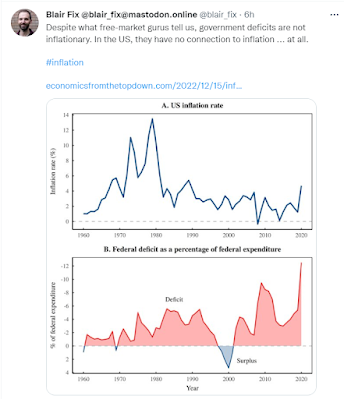

Blog-Reference
The quasi-automatic Pavlovian argument against MMT is that ‘sustained reliance on printing money to finance deficits can lead to escalating price inflation’. #1 This view is based on the commonplace Quantity Theory, which is provably false. #2
MMT has gone to great lengths to demonstrate that the inflation fear is unfounded. What the layperson cannot see, though, is that not only Orthodoxy but MMT, too, has NO sound scientific foundations. The MMT policy proposals are based on Keynesian macroeconomics, which was refuted long ago. #3, #4 Both Walrasian microfoundations and Keynesian macrofoundations are provably false and have to be fully replaced.
As the correct analytical starting point, the pure production-consumption economy is defined with this set of macro axioms: (A0) The objectively given and most elementary configuration of the economy consists of the household and the business sector, which in turn consists initially of one giant fully integrated firm. (A1) Yw=WL wage income Yw is equal to wage rate W times working hours. L, (A2) O=RL output O is equal to productivity R times working hours L, (A3) C=PX consumption expenditure C is equal to price P times quantity bought/sold X.
Under the conditions of market-clearing X=O and budget-balancing C=Yw, the price is given by P=C/X=W/R, i.e., the market-clearing price is in the initial period equal to unit wage costs. This is the most elementary form of the macroeconomic Law of Supply and Demand. For the graphical representation, see Figure 1. #5

The market-clearing price is determined by the wage rate W, which takes the role of the nominal numéraire, and the productivity. The quantity of money is NOT among the price determinants. This puts the commonplace Quantity Theory FOREVER to rest.
Monetary profit for the economy as a whole is defined as Qm≡C−Yw, and monetary saving as Sm≡Yw−C. It always holds Qm+Sm=0, in other words, the business sector’s surplus = profit (deficit = loss) equals the household sector’s deficit = dissaving (surplus = saving). This is the most elementary form of the macroeconomic Profit Law. Under the condition of budget balancing, total monetary profit is zero.
Now, the sovereign government decides to run a budget deficit in the next period. Government spending is given by Cg and taxes T are initially zero. Total expenditures are now C1=Ch+Cg and this yields a price hike: P1=C1/X=(Ch+Cg)/X=P0+Cg/X with market-clearing X=O. If deficit spending is exactly repeated period after period, the price remains at the elevated level, but there is NO inflation. No matter how long the government sector’s debt increases by Cg, there is NO further price increase.
Monetary profit for the economy as a whole is now given by Qm1≡(Ch+Cg)−Yw. Because of the household sector’s budget-balancing, i.e., Ch=Yw, profit is Qm1=Cg. It always holds Public Deficit = Private Profit.
The amount Cg = government budget deficit comes from the central bank, i.e. is created out of nothing. The two sides of the central bank’s balance sheet, overdrafts and deposits, rise by the same amount. The combined transaction pattern of the household and government sector is shown in Figure 2. #6

This can go on for an indefinite time with the quantity of money = deposits at the central bank rising continuously ― but with no further price increase.
It is assumed now that the government consolidates its overdrafts by selling bonds to the business sector. The quantity of money in Figure 2 drops back to zero exactly at period-end. Thus, the newly created money = deposits of the business sector are mopped up. The government sector’s debt rises period after period, and the business sector’s stock of bonds, too, as an exact mirror image. This can go on for an indefinite time with no inflation.
The problem arises at another corner. The bonds bear interest, and in order to pay the interest, the government has to raise taxes. For simplicity, it is assumed that taxes T are exactly equal to total interest and interest payments starting in period 2.
The net income of the wage income receivers is Yw−T. Under the condition of budget balancing, consumption expenditure falls, i.e,. Ch2=Yw−T. This causes the market-clearing price to fall, i.e. P2=C2/X=(Ch2+Cg)/X=(Yw−T+Cg)/X. The tax T has a deflationary effect under the condition that employment is kept constant for a while.
The profit of the business sector was zero in the initial period, i.e., Qm=C−Yw=0 because of C=Yw, and is now Qm2=C2+T−Yw. The business sector now receives interest, which is here equal to the household sector’s taxes T. Because of C2=(Yw−T)+Yg this yields again Qm=Yg. So, total profit remains unchanged, but the profit from selling the output goes down. This effect of the falling price is exactly compensated by interest revenues. This can go on for a while. Problems arise when the profit from normal business operations approaches zero, and total profit consists entirely of interest revenues.
This, in turn, depends on the development of the interest rate. If it is constant interest payments on bonds increase with the continuously growing public sector’s debt. The necessary increase in taxes eventually drives profit from normal production to zero. This, in conjunction with deflation, is the real hazard of growing public debt and NOT inflation. It is no wild guess to assume that business will react to falling operating profits by curtailing employment. The problems can be pushed into the indefinite future with a parallel reduction of the interest rate on the public debt, preferably to zero. The central bank can support this process by buying bonds and thus increasing the liquidity in the system. This has NO effect on the price P.
As long as the debt is revolved, everything is fine. Interest for the public debt is taken from the household sector via taxes and transferred to the bond-holding business/banking sector. The ensuing deflation and the decline of profit from consumption good production ― NOT inflation ― is the real damage of MMT's economic policy. The orthodox critique has always been way beside the point. There is nothing to choose from; both Orthodoxy and MMT are failed approaches.
Egmont Kakarot-Handtke
#1 Cited from Scott T. Fullwiler, Interest Rates and Fiscal Sustainability, p. 3
#2 Forget Friedman, forget the Quantity Theory
#3 How Keynes got macro wrong and Allais got it right
#4 For the full-spectrum refutation of MMT, see cross-references MMT
#5 Figure 1 Graphic AXEC31 Elementary production-consumption economy
#6 Figure 2 Graphic AXEC100 Transaction pattern, household sector, dissaving
Related 'MMT: Redistribution as wellness program' and 'Why is MMT so false?' and 'MMT: Just political heat, no scientific light' and 'MMT: Money-making for the one-percenters' and 'The profit effect of a Job Guarantee' and 'NAIRU and economists’ lethal swampiness' and 'Forget Friedman, forget the Quantity Theory' and 'How some MMTers got inflation wrong' and 'Inflation: back to basics' and 'Links on Inflation'.
***
REPLY to Salsabob on Oct 5(i) You say: “What you do get correct is the potential consequence of price increases from increased deficit spending. Congratulations, you have discovered MMT’s inflationary constraint …”
There is NO such thing as an inflationary constraint. Both Orthodoxy AND MMT get the inflation issue wrong.#1 Both Orthodoxy AND MMT is proto-scientific garbage. Both Orthodoxy AND MMT are refuted according to the scientific standards of material and formal consistency.
(ii) You say: “Every MMTer will spend substantial energy chastising federal debt/deficit hysteria and the budget constraint mythology, but give only lip service to the inflationary constraint…. What most will say is that they are just economists, or that MMT needs to be pure, an operational description, a school of economic thought; must remain aloof of policy and politics …”
There are political economics and theoretical economics. The main differences are: (a) The goal of political economics is to successfully push an agenda, and the goal of theoretical economics is to successfully explain how the actual economy works. (b) In political economics, anything goes; in theoretical economics, the scientific standards of material and formal consistency are observed.#2
Theoretical economics (= science) has been body-snatched by political economists (= agenda pushers). Political economics has produced NOTHING of scientific value in the last 200+ years. MMT is part of political economics. More precisely, MMT advances the cause of the one-percenters under various populist social pretexts, of which Stephanie Kelton's Pony for every American is the most recent example. MMT policy proposals have NO scientific foundations at all.#2
(iii) MMT is scientifically unacceptable. MMTers are scientifically incompetent. MMT is refuted on all counts.#3 The only thing MMTers can do for human progress is to get out of the way.
#1 Gov-Deficits do NOT cause inflation
#2 MMT: scientific incompetence or political fraud?
#3 For details, see cross-references MMT
***
REPLY to Salsabob on Oct 6You cite me: "MMT has gone to great lengths to demonstrate that the inflation fear is unfounded."
You say: “Can you provide an actual quote from an actual well-known MMTer (or actually any MMTer) that inflation is NOT the penultimate constraint to their basic notion that there could be much more central government spending?”
In his multi-part series Modern monetary theory and inflation Bill Mitchell concludes: “First, unemployment is always a greater problem than inflation in almost any dimension you want to define it, and which are calibrated by metrics that different ideological persuasions agree on – such as lost GDP. There is nothing ideological in the statement that the losses from unemployment dwarf those associated with inflation. Even mainstream textbooks struggle to come up with large estimates of the costs of inflation that they itemise.”
By and large, MMT says, as long as there is unemployment, inflation is not a problem. It may become the penultimate constraint eventually. But this is not the burning issue.
So, perhaps I should have been more explicit: “… that the inflation fear is unfounded under the prevailing conditions.”
***
Twitter Dec 12, 2022

Twitter/X Dec 1, 2023


October 2, 2017
Why is MMT so false?
Comment on Simon Wren-Lewis on ‘Why is MMT so popular?’
Blog-Reference and Blog-Reference and Blog-Reference and Blog-Reference on Oct 3
Simon Wren-Lewis positions himself as follows: “Policymakers following austerity when they clearly should not annoys me a great deal, and I am very happy to join common cause with MMT on this. By comparison, the things that annoy me about MMT are trivial, like a failure to use equations and their wordplay.”
When the all-pervasive cloud of blather is blown away the hard formal core of MMT emerges in the form of the familiar sectoral balances equations.#1 These equations can be traced back to Keynes’ General Theory and they are provably false since then. Here is the mother of all false macro relationships: “Income = value of output = consumption + investment. Saving = income − consumption. Therefore saving = investment.” (p. 63)
Being scientifically incompetent, After-Keynesians did not spot the lethal blunder in this syllogism. The fact is that Keynes got macroeconomic profit wrong. Because the formal core as given with the two-line syllogism is false the whole analytical superstructure of Keynesianism, Post Keynesianism, New Keynesianism, and MMT is false. All share the same foundational defect. This means that MMT policy proposals are plucked out of the thin air of common sense and populism.
For the general public, the essential points are:
• MMT has NO sound scientific foundations,#2
• MMT’s sectoral balances equations are mathematically false,
• MMTer violate scientific standards on a daily basis,
• MMTer camouflage the profit effects of their economic policy agenda,#3
• MMT policy advances the cause of the one-percenters,
• MMT is political agenda pushing in a scientific bluff package.#4
Egmont Kakarot-Handtke
#1 Wikipedia Modern Monetary Theory and Sectoral balances
#2 For the full-spectrum refutation of MMT see cross-references MMT
#3 MMT and the magical profit disappearance
#4 MMT: Just political heat, no scientific light
In their Working Paper No. 37 ‘The Natural Rate of Interest is Zero’ Warren Mosler and Mathew Forstater state:
“The government budget deficit is also ‘normal’ in the sense that it is the mirror image of the non-Government surplus in the basic macroeconomic accounting identity:
Government deficit = non-Government surplus
where non-Government surplus includes both the domestic (or resident) private sector and the foreign (non-resident) sector, which includes foreign firms, households, and governments. It is therefore equivalent to the well-known identity:
(G–T)=(S–I)+(M–X)
Government budget deficit = domestic private sector surplus + foreign sector surplus where the foreign sector surplus is another way of expressing the trade deficit. The government budget deficit permits both the domestic private sector and the foreign sector to ‘net save’ in the government’s unit of account. Only a domestic government budget deficit permits the domestic private sector and foreign sector to actualize their combined desired net saving.” (p. 8)
Let us ignore foreign trade here, i.e. M, X = 0, then MMT asserts
Government deficit = non-Government surplus
This is false because non-Government consists of the household sector and the business sector. Therefore, for any given level of household sector saving/dissaving holds:#1
Government deficit = Business surplus or Public Deficit = Private Profit.
Because the fundamental balances equation of Mosler/Forstater is false most of the paper’s content is worthless or misleading or mere descriptive/historical storytelling.
#1 Rectification of MMT macro accounting
Immediately following Saving NEVER equals investment.
Also following MMT was always right: Gov-Deficits do NOT cause inflation.
Immediately preceding MMT: Just political heat, no scientific light.
Blog-Reference and Blog-Reference and Blog-Reference and Blog-Reference on Oct 3
Simon Wren-Lewis positions himself as follows: “Policymakers following austerity when they clearly should not annoys me a great deal, and I am very happy to join common cause with MMT on this. By comparison, the things that annoy me about MMT are trivial, like a failure to use equations and their wordplay.”
When the all-pervasive cloud of blather is blown away the hard formal core of MMT emerges in the form of the familiar sectoral balances equations.#1 These equations can be traced back to Keynes’ General Theory and they are provably false since then. Here is the mother of all false macro relationships: “Income = value of output = consumption + investment. Saving = income − consumption. Therefore saving = investment.” (p. 63)
Being scientifically incompetent, After-Keynesians did not spot the lethal blunder in this syllogism. The fact is that Keynes got macroeconomic profit wrong. Because the formal core as given with the two-line syllogism is false the whole analytical superstructure of Keynesianism, Post Keynesianism, New Keynesianism, and MMT is false. All share the same foundational defect. This means that MMT policy proposals are plucked out of the thin air of common sense and populism.
For the general public, the essential points are:
• MMT has NO sound scientific foundations,#2
• MMT’s sectoral balances equations are mathematically false,
• MMTer violate scientific standards on a daily basis,
• MMTer camouflage the profit effects of their economic policy agenda,#3
• MMT policy advances the cause of the one-percenters,
• MMT is political agenda pushing in a scientific bluff package.#4
Egmont Kakarot-Handtke
#1 Wikipedia Modern Monetary Theory and Sectoral balances
#2 For the full-spectrum refutation of MMT see cross-references MMT
#3 MMT and the magical profit disappearance
#4 MMT: Just political heat, no scientific light
***
ADDENDUM on Oct 3, also on MainlyMacroIn their Working Paper No. 37 ‘The Natural Rate of Interest is Zero’ Warren Mosler and Mathew Forstater state:
“The government budget deficit is also ‘normal’ in the sense that it is the mirror image of the non-Government surplus in the basic macroeconomic accounting identity:
Government deficit = non-Government surplus
where non-Government surplus includes both the domestic (or resident) private sector and the foreign (non-resident) sector, which includes foreign firms, households, and governments. It is therefore equivalent to the well-known identity:
(G–T)=(S–I)+(M–X)
Government budget deficit = domestic private sector surplus + foreign sector surplus where the foreign sector surplus is another way of expressing the trade deficit. The government budget deficit permits both the domestic private sector and the foreign sector to ‘net save’ in the government’s unit of account. Only a domestic government budget deficit permits the domestic private sector and foreign sector to actualize their combined desired net saving.” (p. 8)
Let us ignore foreign trade here, i.e. M, X = 0, then MMT asserts
Government deficit = non-Government surplus
This is false because non-Government consists of the household sector and the business sector. Therefore, for any given level of household sector saving/dissaving holds:#1
Government deficit = Business surplus or Public Deficit = Private Profit.
Because the fundamental balances equation of Mosler/Forstater is false most of the paper’s content is worthless or misleading or mere descriptive/historical storytelling.
#1 Rectification of MMT macro accounting
Immediately following Saving NEVER equals investment.
Also following MMT was always right: Gov-Deficits do NOT cause inflation.
Immediately preceding MMT: Just political heat, no scientific light.
MMT: Just political heat, no scientific light
Comment on Stephanie Kelton/Op-Ed on ‘Congress can give every American a pony (if it breeds enough ponies)’
Blog-Reference
The selling proposition of MMT is that the government can solve all economic problems because, as a sovereign currency issuer, it is not financially in any way restricted. In other words, in contradistinction to private households or firms, the government can run deficits without any risk of going bankrupt. This is true in principle, but leads to some unintended consequences, which are due to the fact that MMTers do not know how the economy works. In other words, MMTers lack the true economic theory. This is rather bad for people who claim to be scientists: “In order to tell the politicians and practitioners something about causes and best means, the economist needs the true theory or else he has not much more to offer than educated common sense or his personal opinion.” (Stigum)
What the layperson cannot see is that MMT has NO sound scientific foundations. The MMT policy proposals are based on Keynesian macroeconomics, which has been refuted long ago. #1
As the correct analytical starting point, the pure production-consumption economy is defined with this set of macro axioms: (A0) The objectively given and most elementary configuration of the economy consists of the household and the business sector, which in turn consists initially of one giant fully integrated firm. (A1) Yw=WL wage income Yw is equal to wage rate W times working hours. L, (A2) O=RL output O is equal to productivity R times working hours L, (A3) C=PX consumption expenditure C is equal to price P times quantity bought/sold X.
Under the conditions of market-clearing X=O and budget-balancing C=Yw, the price is given by P=C/X=W/R, i.e., the market-clearing price is in the initial period equal to unit wage costs. This is the most elementary form of the macroeconomic Law of Supply and Demand. For the graphical representation, see Figure 1. #2

Monetary profit for the economy as a whole is defined as Qm≡C−Yw, and monetary saving as Sm≡Yw−C. It always holds Qm+Sm=0, in other words, the business sector’s surplus = profit (deficit = loss) equals the household sector’s deficit = dissaving (surplus = saving). This is the most elementary form of the Profit Law. Under the condition of budget balancing, total monetary profit is zero.
Now, the sovereign government decides that in the next period wage income is taxed and that a certain number of hitherto unemployed are taken into a Job Guarantee Program. So, net wage income is now Yw−T, and the hitherto unemployed receive the guarantee income Yg. Total income is Y1=(Yw−T)+Yg, and if the government’s budget is balanced, i.e., T=Yg, then total income does not change; it is only redistributed. Under the condition of budget-balancing C1=Y1=Y, consumption expenditures remain unchanged, and so does the market-clearing price P1=C1/X=W/R=P. What changes is the distribution of output O. The real share of wage income receivers is Ow1=(Yw−T)/P, and that of Job Guarantee participants is Og1=Yg/P. So, what is achieved with income redistribution is a proportional output redistribution.
MMTers maintain that for the sovereign government, there is no need to balance the budget, and they propose a tax reduction for wage income recipients. Under the condition T=0, total income changes from Y1=(Yw−T)+Yg to Y2=Yw+Yg. The amount Yg = government budget deficit comes from the central bank, i.e., is created out of nothing. Under the condition of C2=Y2 consumption expenditures rise with total income. This leads to an increase in the market-clearing price P2=C2/X=C2/O. This, in turn, reduces the share of real output for the wage income receivers from Ow1=Yw/P in the initial period to Ow2=Yw/P2.
In the MMT variant, the wage income receivers are now taxed in real terms via the price increase, that is, Ow1=(Yw−T)/P compares to Ow2=Yw/P2. Let us assume for simplicity that both variants lead to the same outcome, i.e., Ow1=Ow2. Hence, in real terms, the wage income receivers do NOT benefit from the tax reduction.
The profit of the business sector was zero in the initial period, i.e., Qm≡C−Yw=0 because of C=Yw, and is now positive Qm2≡C2−Yw=Yg because of C2=Yw+Yg. So, the identical redistribution of output O creates a profit for the business sector. It always holds Public Deficit = Private Profit.
This can go on for an indefinite time with public debt vis-a-vis the central bank rising continuously, and with the business sector’s pile of cash rising continuously, and with no inflation. As long as the debt is revolved, all is fine. Interest for the public debt is reliably taken from the household sector via taxes and transferred to the bond-holding business/banking sector. This is an additional benefit for the one-percenters of the MMT way of doing things.
Compared to the redistribution via a balanced budget, the same real redistribution via budget deficits has only the optical advantage of T=0 for the wage income recipients, yet palatable and long-lasting advantages for the one-percenters in the form of higher profits and subsequent interest incomes.
The snag of the MMT policy agenda is that it simply shifts taxes into the indefinite future. Those people who suspect that the MMT economic policy agenda is too good to be true have fine instincts. MMT is not a new economic school with a superior problem-solving capacity. Instead ― intended or unintended does not matter ― scientifically retarded MMTers actually do the PR for the economic policy agenda of the one-percenters.
Egmont Kakarot-Handtke
#1 For the full-spectrum refutation of MMT, see cross-references
#2 Graphic AXEC31 Elementary production-consumption economy
Related 'The profit effect of a Job Guarantee'
(i) I interpreted Wray’s statement “money is a cross-balance sheet RELATIONSHIP” as a reference to the development of double-entry bookkeeping in medieval Europe. If the credits for the correct definition of money actually go to Mitchell-Innes, I appreciate your clarification.
(ii) You say: “Computer science in education today plays a similar role to Euclid for millennia ― providing intellectual rigor and discipline.” I fully agree, as you could infer from the fact that I strictly apply the axiomatic-deductive method. #1
(iii) You say: “These errors are due, like all errors, to not subjecting one's thought to discipline like mathematical proof, the discipline of writing programs that work or of testing theory by experiments. Another mistake is in debating technique ― if you want to say MMT is wrong, you have to quote an MMT statement, try to read it as the author meant, and show that it is wrong by logic, leads to a conclusion universally held to be wrong.”
I agree. From the fact that you obviously have not realized that the proofs have already been given #2,#3 I conclude that you do not heed your own advice. Take notice that it is proven that MMT is axiomatically false. Because the foundational premises of MMT are false, the whole analytical superstructure is false. MMT is scientifically worthless.#4
(iv) You say: the lack of slow and careful reasoning leads to making flatly false, indeed absurd statements like ‘budget surpluses are needed to pay off earlier deficits.’ Do you really believe this?” This is not a question of belief but of logic. Money is a credit relationship, a generalized IOU that is continuously created and destroyed. If the government runs a deficit in period 1, this takes the form of overdrafts on the asset side of the balance sheet of the central bank and of deposits = money on the liability side. This is the creatio ex nihilo step. Being a credit relationship, there must LOGICALLY be the inverse operation. Practically, the government can redeem its overdrafts at the central bank if it taxes the household sector, that is, by running a budget surplus. What the government can also practically do, though, is to indefinitely postpone the logically inverse operation to money creation. It is self-contradictory of MMTers to say money is basically an IOU without taking into consideration that IOUs have to be redeemed in finite time. Practically, this has NOT been done yet, of course, and the proof is in the continuously growing public debt. But logically, it has to be done. It is one of the political dishonesties of MMT to assert that money is a debt that has never been paid back and never will. Money that is created by government deficits has eventually to be destroyed by government surpluses. What we have historically seen is only the first part of the whole story. Note that this is NOT an obsession with balanced budgets but follows logically from the concept of money as a credit relationship. If it is credit, it has to be paid back eventually. But logic has never been the strong point of MMT.
(v) As the example above shows, MMT policy makes the household sector WORSE off. In real terms, the wage income receivers’ part of output is reduced in period 1, and it does NOT matter whether this happens via a tax or via a price increase. But with immediate taxation, the matter is settled in real AND financial terms in period 1. With government deficit spending, the matter is NOT settled in financial terms. The wage income receivers have to pay via taxes the interest for the government debt as long as it is revolved. The government taxes on behalf of the business sector, which holds part or all of the government debt in the form of securities. Ultimately, the household sector has to pay the tax of period 1 because the government debt has to be redeemed. MMT policy simply amounts to a tax deference program with income redistribution via interest over a very long time. Seen from the beginning to the logical end, MMT policy makes the household sector worse off compared to immediate taxation. ALL benefits are clearly on the side of the business sector. To sell MMT as a social program to Sanders/Corbyn is either self-deceptive stupidity or fraud.
(vi) Deficit spendinghas been, since Keynes, the main cause of the declining share of wage income. #5
(vii) MMT is simply the wrong way to boost employment and to realize all the other social improvements MMT claims to bring. For the correct macro employment theory, see #6.
(viii) Stated MMT policy goals are one thing. They are NOT the issue here. The point is that MMT policy guidance has no sound scientific foundations. MMT economic theory is axiomatically false. Scientifically, MMT is not different from the flat-earth theory. MMT has NO truth value, only some political use-value. All poofs can be found in #4.
Time for all MMTers to stop blathering and advancing the cause of the one-percenters under a social pretext and finally to do their scientific homework.
#1 From Marshall to Georgescu-Roegen
#2 Rectification of MMT macro accounting
#3 Solving Mill’s starting problem
#4 For the details of the big picture, see cross-references MMT
#5 Keynesianism as ultimate profit machine
#6 Macrofounded labor market theory
You say: “There is a tendency to see economic issues and solely or chiefly economic. This is a huge mistake, since the economy is the life support system of society and society has social and political aspects in addition to economic. … Conventional macroeconomics is junk science and involves special pleading when used for justification in policy formulation.”
Both micro and macro are junk science. And MMT is a prolific junk producer because it is based on provably false macrofoundations. Because MMT lacks the true theory, it is no more than soapbox economics.
It holds: “In order to tell the politicians and practitioners something about causes and best means, the economist needs the true theory or else he has not much more to offer than educated common sense or his personal opinion.” (Stigum)
There is political economics and theoretical economics. The main differences are: (a) The goal of political economics is to successfully push an agenda, and the goal of theoretical economics is to successfully explain how the actual economy works. (b) In political economics, anything goes; in theoretical economics, the scientific standards of material and formal consistency are observed.
Theoretical economics (= science) has been body-snatched by political economists (= agenda pushers). Political economics has produced NOTHING of scientific value in the last 200+ years. MMT is part of political economics.
Methodologically, it holds: If it isn’t macro-axiomatized, it isn’t economics. #1 Because of this, neither Walrasianism, Keynesianism/MMT, Marxianism, nor Austrianism is economics. The four main approaches have no truth value, merely some political use-value. Politics needs no true theory, only some populist rhetoric and some pseudo-scientific make-up.
MMT is refuted on all counts. #2 There is NO place for MMTers in science. Politics and science have to be strictly separated, and MMT has to be given the marching orders because of proven scientific incompetence.
#1 The ethics of science is consistency ― economics is inconsistent
#2 See cross-references MMT
References 'MMT: Money-making for the one-percenters' and 'Why is MMT so false?' and 'Gov-Deficits do NOT cause inflation.
Blog-Reference
The selling proposition of MMT is that the government can solve all economic problems because, as a sovereign currency issuer, it is not financially in any way restricted. In other words, in contradistinction to private households or firms, the government can run deficits without any risk of going bankrupt. This is true in principle, but leads to some unintended consequences, which are due to the fact that MMTers do not know how the economy works. In other words, MMTers lack the true economic theory. This is rather bad for people who claim to be scientists: “In order to tell the politicians and practitioners something about causes and best means, the economist needs the true theory or else he has not much more to offer than educated common sense or his personal opinion.” (Stigum)
What the layperson cannot see is that MMT has NO sound scientific foundations. The MMT policy proposals are based on Keynesian macroeconomics, which has been refuted long ago. #1
As the correct analytical starting point, the pure production-consumption economy is defined with this set of macro axioms: (A0) The objectively given and most elementary configuration of the economy consists of the household and the business sector, which in turn consists initially of one giant fully integrated firm. (A1) Yw=WL wage income Yw is equal to wage rate W times working hours. L, (A2) O=RL output O is equal to productivity R times working hours L, (A3) C=PX consumption expenditure C is equal to price P times quantity bought/sold X.
Under the conditions of market-clearing X=O and budget-balancing C=Yw, the price is given by P=C/X=W/R, i.e., the market-clearing price is in the initial period equal to unit wage costs. This is the most elementary form of the macroeconomic Law of Supply and Demand. For the graphical representation, see Figure 1. #2

Monetary profit for the economy as a whole is defined as Qm≡C−Yw, and monetary saving as Sm≡Yw−C. It always holds Qm+Sm=0, in other words, the business sector’s surplus = profit (deficit = loss) equals the household sector’s deficit = dissaving (surplus = saving). This is the most elementary form of the Profit Law. Under the condition of budget balancing, total monetary profit is zero.
Now, the sovereign government decides that in the next period wage income is taxed and that a certain number of hitherto unemployed are taken into a Job Guarantee Program. So, net wage income is now Yw−T, and the hitherto unemployed receive the guarantee income Yg. Total income is Y1=(Yw−T)+Yg, and if the government’s budget is balanced, i.e., T=Yg, then total income does not change; it is only redistributed. Under the condition of budget-balancing C1=Y1=Y, consumption expenditures remain unchanged, and so does the market-clearing price P1=C1/X=W/R=P. What changes is the distribution of output O. The real share of wage income receivers is Ow1=(Yw−T)/P, and that of Job Guarantee participants is Og1=Yg/P. So, what is achieved with income redistribution is a proportional output redistribution.
MMTers maintain that for the sovereign government, there is no need to balance the budget, and they propose a tax reduction for wage income recipients. Under the condition T=0, total income changes from Y1=(Yw−T)+Yg to Y2=Yw+Yg. The amount Yg = government budget deficit comes from the central bank, i.e., is created out of nothing. Under the condition of C2=Y2 consumption expenditures rise with total income. This leads to an increase in the market-clearing price P2=C2/X=C2/O. This, in turn, reduces the share of real output for the wage income receivers from Ow1=Yw/P in the initial period to Ow2=Yw/P2.
In the MMT variant, the wage income receivers are now taxed in real terms via the price increase, that is, Ow1=(Yw−T)/P compares to Ow2=Yw/P2. Let us assume for simplicity that both variants lead to the same outcome, i.e., Ow1=Ow2. Hence, in real terms, the wage income receivers do NOT benefit from the tax reduction.
The profit of the business sector was zero in the initial period, i.e., Qm≡C−Yw=0 because of C=Yw, and is now positive Qm2≡C2−Yw=Yg because of C2=Yw+Yg. So, the identical redistribution of output O creates a profit for the business sector. It always holds Public Deficit = Private Profit.
This can go on for an indefinite time with public debt vis-a-vis the central bank rising continuously, and with the business sector’s pile of cash rising continuously, and with no inflation. As long as the debt is revolved, all is fine. Interest for the public debt is reliably taken from the household sector via taxes and transferred to the bond-holding business/banking sector. This is an additional benefit for the one-percenters of the MMT way of doing things.
Compared to the redistribution via a balanced budget, the same real redistribution via budget deficits has only the optical advantage of T=0 for the wage income recipients, yet palatable and long-lasting advantages for the one-percenters in the form of higher profits and subsequent interest incomes.
The snag of the MMT policy agenda is that it simply shifts taxes into the indefinite future. Those people who suspect that the MMT economic policy agenda is too good to be true have fine instincts. MMT is not a new economic school with a superior problem-solving capacity. Instead ― intended or unintended does not matter ― scientifically retarded MMTers actually do the PR for the economic policy agenda of the one-percenters.
Egmont Kakarot-Handtke
#1 For the full-spectrum refutation of MMT, see cross-references
#2 Graphic AXEC31 Elementary production-consumption economy
Related 'The profit effect of a Job Guarantee'
***
REPLY to Calgacus on Oct 2(i) I interpreted Wray’s statement “money is a cross-balance sheet RELATIONSHIP” as a reference to the development of double-entry bookkeeping in medieval Europe. If the credits for the correct definition of money actually go to Mitchell-Innes, I appreciate your clarification.
(ii) You say: “Computer science in education today plays a similar role to Euclid for millennia ― providing intellectual rigor and discipline.” I fully agree, as you could infer from the fact that I strictly apply the axiomatic-deductive method. #1
(iii) You say: “These errors are due, like all errors, to not subjecting one's thought to discipline like mathematical proof, the discipline of writing programs that work or of testing theory by experiments. Another mistake is in debating technique ― if you want to say MMT is wrong, you have to quote an MMT statement, try to read it as the author meant, and show that it is wrong by logic, leads to a conclusion universally held to be wrong.”
I agree. From the fact that you obviously have not realized that the proofs have already been given #2,#3 I conclude that you do not heed your own advice. Take notice that it is proven that MMT is axiomatically false. Because the foundational premises of MMT are false, the whole analytical superstructure is false. MMT is scientifically worthless.#4
(iv) You say: the lack of slow and careful reasoning leads to making flatly false, indeed absurd statements like ‘budget surpluses are needed to pay off earlier deficits.’ Do you really believe this?” This is not a question of belief but of logic. Money is a credit relationship, a generalized IOU that is continuously created and destroyed. If the government runs a deficit in period 1, this takes the form of overdrafts on the asset side of the balance sheet of the central bank and of deposits = money on the liability side. This is the creatio ex nihilo step. Being a credit relationship, there must LOGICALLY be the inverse operation. Practically, the government can redeem its overdrafts at the central bank if it taxes the household sector, that is, by running a budget surplus. What the government can also practically do, though, is to indefinitely postpone the logically inverse operation to money creation. It is self-contradictory of MMTers to say money is basically an IOU without taking into consideration that IOUs have to be redeemed in finite time. Practically, this has NOT been done yet, of course, and the proof is in the continuously growing public debt. But logically, it has to be done. It is one of the political dishonesties of MMT to assert that money is a debt that has never been paid back and never will. Money that is created by government deficits has eventually to be destroyed by government surpluses. What we have historically seen is only the first part of the whole story. Note that this is NOT an obsession with balanced budgets but follows logically from the concept of money as a credit relationship. If it is credit, it has to be paid back eventually. But logic has never been the strong point of MMT.
(v) As the example above shows, MMT policy makes the household sector WORSE off. In real terms, the wage income receivers’ part of output is reduced in period 1, and it does NOT matter whether this happens via a tax or via a price increase. But with immediate taxation, the matter is settled in real AND financial terms in period 1. With government deficit spending, the matter is NOT settled in financial terms. The wage income receivers have to pay via taxes the interest for the government debt as long as it is revolved. The government taxes on behalf of the business sector, which holds part or all of the government debt in the form of securities. Ultimately, the household sector has to pay the tax of period 1 because the government debt has to be redeemed. MMT policy simply amounts to a tax deference program with income redistribution via interest over a very long time. Seen from the beginning to the logical end, MMT policy makes the household sector worse off compared to immediate taxation. ALL benefits are clearly on the side of the business sector. To sell MMT as a social program to Sanders/Corbyn is either self-deceptive stupidity or fraud.
(vi) Deficit spendinghas been, since Keynes, the main cause of the declining share of wage income. #5
(vii) MMT is simply the wrong way to boost employment and to realize all the other social improvements MMT claims to bring. For the correct macro employment theory, see #6.
(viii) Stated MMT policy goals are one thing. They are NOT the issue here. The point is that MMT policy guidance has no sound scientific foundations. MMT economic theory is axiomatically false. Scientifically, MMT is not different from the flat-earth theory. MMT has NO truth value, only some political use-value. All poofs can be found in #4.
Time for all MMTers to stop blathering and advancing the cause of the one-percenters under a social pretext and finally to do their scientific homework.
#1 From Marshall to Georgescu-Roegen
#2 Rectification of MMT macro accounting
#3 Solving Mill’s starting problem
#4 For the details of the big picture, see cross-references MMT
#5 Keynesianism as ultimate profit machine
#6 Macrofounded labor market theory
***
REPLY to Tom Hickey on Oct 6You say: “There is a tendency to see economic issues and solely or chiefly economic. This is a huge mistake, since the economy is the life support system of society and society has social and political aspects in addition to economic. … Conventional macroeconomics is junk science and involves special pleading when used for justification in policy formulation.”
Both micro and macro are junk science. And MMT is a prolific junk producer because it is based on provably false macrofoundations. Because MMT lacks the true theory, it is no more than soapbox economics.
It holds: “In order to tell the politicians and practitioners something about causes and best means, the economist needs the true theory or else he has not much more to offer than educated common sense or his personal opinion.” (Stigum)
There is political economics and theoretical economics. The main differences are: (a) The goal of political economics is to successfully push an agenda, and the goal of theoretical economics is to successfully explain how the actual economy works. (b) In political economics, anything goes; in theoretical economics, the scientific standards of material and formal consistency are observed.
Theoretical economics (= science) has been body-snatched by political economists (= agenda pushers). Political economics has produced NOTHING of scientific value in the last 200+ years. MMT is part of political economics.
Methodologically, it holds: If it isn’t macro-axiomatized, it isn’t economics. #1 Because of this, neither Walrasianism, Keynesianism/MMT, Marxianism, nor Austrianism is economics. The four main approaches have no truth value, merely some political use-value. Politics needs no true theory, only some populist rhetoric and some pseudo-scientific make-up.
MMT is refuted on all counts. #2 There is NO place for MMTers in science. Politics and science have to be strictly separated, and MMT has to be given the marching orders because of proven scientific incompetence.
#1 The ethics of science is consistency ― economics is inconsistent
#2 See cross-references MMT
References 'MMT: Money-making for the one-percenters' and 'Why is MMT so false?' and 'Gov-Deficits do NOT cause inflation.
September 30, 2017
MMT: Money-making for the one-percenters
Comment on Stephanie Kelton/Op-Ed on ‘Congress can give every American a pony (if it breeds enough ponies)’
Blog-Reference
Stephanie Kelton explains how the economy works. For laypersons, the point to grasp is that government spending comes before taxation:
“1. Congress approves the spending, and the money gets spent (S)
2. The government collects some of that money in the form of taxes (T)
3. If 1>2, Treasury allows the difference to be swapped for government bonds (B).”
The point is, of course, that it does NOT matter much whether (S) comes before (T) or vice versa, this is merely a question of cash management, the point is whether total spending (S) is greater, equal, or less than total taxes (T) in the period under consideration, i.e. whether one has a government deficit, a zero balance, or a surplus at the end of the current budget period.
The crucial point is NOT that the government can make money appear out of nowhere like magic, which has always been trivial; the crucial point is what happens in the economy. Stephanie Kelton does not tell us, most probably because she has no idea.
What the layperson cannot see is that MMT has NO sound scientific foundations. The MMT models are based on Keynesian macroeconomics, which was refuted long ago. #1 Because it is defective, the MMT macro has to be fully replaced.
As the correct analytical starting point, the pure production-consumption economy is defined with this set of macro axioms: (A0) The objectively given and most elementary configuration of the economy consists of the household and the business sector, which in turn consists initially of one giant fully integrated firm. (A1) Yw=WL wage income Yw is equal to wage rate W times working hours. L, (A2) O=RL output O is equal to productivity R times working hours L, (A3) C=PX consumption expenditure C is equal to price P times quantity bought/sold X.
Under the conditions of market-clearing X=O and budget-balancing C=Yw, the price is given by P=C/X=W/R, i.e., the market-clearing price is in the initial period equal to unit wage costs. This is the most elementary form of the macroeconomic Law of Supply and Demand. For the graphical representation, see Figure 1. #2
Monetary profit for the economy as a whole is defined as Qm≡C−Yw, and monetary saving as Sm≡Yw−C. It always holds Qm+Sm=0 or Qm≡−Sm, in other words, the business sector’s surplus = profit (deficit = loss) equals the household sector’s deficit = dissaving (surplus = saving). This is the most elementary form of the macroeconomic Profit Law. Under the condition of budget balancing, total monetary profit is zero.
Now, the government decides that in the next period, every American should get a pony. So, government expenditures in period 1 are Cg1, and taxes T are zero. The government runs a deficit; the money comes from the Central Bank, i.e., is created out of nothing.
It is assumed for simplicity that the business sector doubles initial employment L0, i.e. L1=2L0. The wage rate W remains unchanged, and therefore total wage income doubles, i.e. Yw1=W2L0. Under the condition of budget balancing, the household sector’s consumption expenditures, too, double Ch1=Yw1=2WL0.
So, total expenditures are Ch1+Cg1=2Ch0+Cg1, that is, are more than double the expenditures in the initial period. On the other hand, output exactly doubles O1=RL1=R2L0. The market-clearing price is now P1=C1/X1=(2Ch0+Cg1)/2X0=P0+Cg1/2X0, that is, the market-clearing price rises while employment and output double. This is a one-shot increase and has NOTHING to do with inflation. The price increase affects the redistribution of real output between the household and the government sector.
The profit of the business sector was zero in the initial period and is now positive, i.e. Qm=Cg1, i.e., equal to the budget deficit. It always holds Public Deficit = Private Profit. This configuration can go on for an indefinite time with public debt vis-a-vis the central bank rising continuously, with the business sector’s pile of cash rising continuously, and with the number of ponies rising continuously and with price stability. Quite obviously, nobody has any reason to complain. In Stephanie Kelton’s words: “Just imagine how high those poll numbers would climb if everyone understood how easy it would be for Congress to pony up.”
It is remarkable that the word profit does not appear once in Stephanie Kelton’s op-ed, but the word pony appears eight times. Never were more ponies used to propagate a profit booster program for the one-percenters. #3
Egmont Kakarot-Handtke
#1 How Keynes got macro wrong and Allais got it right
#2 Graphic AXEC31 Elementary production-consumption economy
#3 For the full-spectrum refutation of MMT, see cross-references MMT
Related 'MMT: The one deadly error/fraud of Warren Mosler' and 'Selling public debt with Ricardo’s tear gland rhetoric' and 'Down with idiocy!' and 'Political economics: Who hijacks British Labour?' and 'MMT: Just another political fraud'.
You say: “The govt bond accounting is Cash Basis (see US Daily Treasury Statement) while I don’t think the other terms in your equations are accounted for in Cash Basis ... they are accounted using a Modified Accrual Basis.”
The difference between Cash Basis and Accrual Basis plays no role in the present context. Monetary profit Qm is equal to the increase of the business sector’s deposits at the central bank, which, in turn, is equal to the increase of the government sector’s overdrafts at the central bank because both sides of the central bank’s balance sheet are ALWAYS equal (as everyone knows from their accounting course, except Matt Franko). If and when the government consolidates its debt by selling bonds or T-bills, or whatever to the business sector is independent of the development of the debt in a certain period. In the present context is important to realize that Public Deficit = Private Profit. It is of NO interest here if and how the deficit = increase of overdrafts is ultimately funded. #1, #2
Needless to emphasize that the household sector will be taxed somewhere in the future in order to pay back the government’s debt. So, the households get their ponies on credit without realizing it, while the business sector gets its profit for good. The payback part is entirely missing from the pony story. Stephanie Kelton’s wonderful proposal is like the auto dealer saying I give you this brand new car for free, please confirm my generosity with your signature at the end of this credit agreement.
Stephanie Kelton is a scientifically incompetent economist, and MMT is Trump University economics.
#1 Fixing the loanable funds blunder
#2 Reconstructing the Quantity Theory (I)
Each government entity, each firm, and each bank around the world has incoming payments and outgoing payments. These are not synchronized, and therefore, there is a smart guy, let us call him the cash or liquidity manager or treasurer, whose main task is to maintain constant financial solvency.
Imagine the following situation. The cash manager knows that the government spends the amount G on ponies on Jan 1 and that taxes T are paid on Dec 31. It holds G=T. So, the cash manager has to take up credit for one year either from the banking system or by selling some short-term paper. Vice versa, the taxes come in on Jan 1, and the ponies are bought on Dec 31. So, the cash manager can buy some ultra-safe paper and hold it for one year. No cash manager in this world has any problem with handling both situations. At the end of the year, both cases amount to the SAME, except for the interest. The cash manager has NO long-term financing problem.
Things are different if T is less than G. If this happens year after year, government debt increases continuously, and the cash manager eventually starts to issue government bonds of different maturities and to roll them over again and again. The growing government debt is the problem that alarms people, and NOT the bridging of the short-term gaps between outgoing payments and incoming taxes.
The obvious mistake of Stephanie Kelton’s op-ed is to confound the two cases of short-term cash deficits and long-term budget deficits. Short-term cash deficits become budget deficits if T < G.
Why Stephanie Kelton forgets to mention that Public Deficit = Private Profit and that people have to pay for the ponies in the form of deferred budget surpluses, which are needed to eventually redeem the accumulated public debt, is a bit mysterious. But then, perhaps this is absolutely normal at Trump University.
You quote Wray, “money is a cross-balance sheet RELATIONSHIP”. Yes, trivially true and known since the Middle Ages, but MMTers are too stupid to do the accounting properly. For the proof, see #1, #2.
It is the most remarkable feature of MMT that macro profit does not appear in the balance equations. By consequence, MMTers miss the most important “cross-balance sheet relationship”, that is, Government Deficit = Profit of the business sector. The fact is that MMTers got profit theory wrong, and this is disqualifying for every economist. #3
Accounting is elementary mathematics, and one needs no Theoretical Computer Scientists to do it. The signature of arithmetic consists of addition, multiplication, and successor function symbols, the equality and less-than relation symbols, and a constant symbol for 0. (Wikipedia) That’s all, but MMTers fail already at the level of elementary logic.
You say “The government does not need a cash manager because the job of the government is to be financially INsolvent.” The cash manager of the government coordinates and bridges the gaps between outgoing and incoming payments. As long as the budget is balanced, i.e. G=T, the job of the government’s cash manager is essentially the same as the non-government’s cash manager. Their deficits = overdrafts at the credit side of the central bank’s balance sheet create uno actu deposits at the debit side = money. The only difference between the non-government cash manager and the government’s cash manager is that the central bank cannot limit the deficit creation = money creation of the latter. The point is, though, that the newly created money lands one-to-one as profit on the accounts of the business sector. Take all the technicalities of cash management away, then MMT’s pony program turns out to be a profit booster program. It seems that some Wall Street folks understand this better than Stephanie Kelton.
At the end of the whole exercise, a sub-group of the general public is left with some ponies, and all of the general public is indirectly left with the government’s debt. Whether the debt takes the form of overdrafts-deposits (= money) at the central bank or assets-liabilities in the form of bonds is a separate issue. Overdrafts-deposits (= money) is the most convenient and cheapest form of government debt.
The accumulated debt can be carried over for an indefinite time, but this makes it only invisible but not disappear. The household sector is ― indirectly via the government ― left with the debt, and the business sector is left with profit, which is held either in cash = deposits at the central bank/banking sector or in government paper. Government paper is Triple-A quality and carries interest, which makes the folks in the business/banking sector even happier.
As long as the debt is revolved, all is fine. Interest for the public debt is reliably taken from the household sector and transferred to the bond-holding business/banking sector. But the market economy breaks down as soon as the household sector starts to redeem private or/and public debt, which must happen eventually because this is the very nature of debt. #4
What Stephanie Kelton is ― knowingly or unknowingly does not matter ― actually doing under the banner of social programs is to boost the profit of the business/banking sector and to postpone the breakdown of the economy. In political terms, this is what the MMT dog & pony act in the LA Times is all about. MMT is just another example of the scientifically degenerate state of economics.
#1 Rectification of MMT macro accounting
#2 A tale of three accountants
#3 Why economists don’t know what profit is
#4 Mathematical Proof of the Breakdown of Capitalism
You say: “G−T does not equal the net amount of Treasuries issued... G is Accrual, and T is Accrual... Treasury issuance is Cash...”
Roughly speaking, G and T are the sums of transactions that take place during one period on the Income Statement/Profit-Loss Accounts, while the buying and selling of government securities are transactions that are recorded on the balance sheet.
G and T are flows, while cash and the amounts of diverse government securities are stocks. The difference of flows Δ=G−T of the government sector changes the stock of money by Δ.
All this has NOTHING to do with the difference between Accrual Basis and Cash Basis Accounting. For the interrelationship between macro flows, their balances, and stocks, see #1, #2. For the basics of National Accounting, see Wikipedia.#3
#1 Essentials of Constructive Heterodoxy: Money, Credit, Interest
#2 Essentials of Constructive Heterodoxy: Financial Markets
#3 Wikipedia “National accounts broadly present output, expenditure, and income activities of the economic actors (households, corporations, government) in an economy, including their relations with other countries’ economies, and their wealth (net worth). They present both flows (measured over a period) and stocks (measured at the end of a period), ensuring that the flows are reconciled with the stocks.”
Related 'MMT: Just political heat, no scientific light' and 'The profit effect of a Job Guarantee'
Blog-Reference
Stephanie Kelton explains how the economy works. For laypersons, the point to grasp is that government spending comes before taxation:
“1. Congress approves the spending, and the money gets spent (S)
2. The government collects some of that money in the form of taxes (T)
3. If 1>2, Treasury allows the difference to be swapped for government bonds (B).”
The point is, of course, that it does NOT matter much whether (S) comes before (T) or vice versa, this is merely a question of cash management, the point is whether total spending (S) is greater, equal, or less than total taxes (T) in the period under consideration, i.e. whether one has a government deficit, a zero balance, or a surplus at the end of the current budget period.
The crucial point is NOT that the government can make money appear out of nowhere like magic, which has always been trivial; the crucial point is what happens in the economy. Stephanie Kelton does not tell us, most probably because she has no idea.
What the layperson cannot see is that MMT has NO sound scientific foundations. The MMT models are based on Keynesian macroeconomics, which was refuted long ago. #1 Because it is defective, the MMT macro has to be fully replaced.
As the correct analytical starting point, the pure production-consumption economy is defined with this set of macro axioms: (A0) The objectively given and most elementary configuration of the economy consists of the household and the business sector, which in turn consists initially of one giant fully integrated firm. (A1) Yw=WL wage income Yw is equal to wage rate W times working hours. L, (A2) O=RL output O is equal to productivity R times working hours L, (A3) C=PX consumption expenditure C is equal to price P times quantity bought/sold X.
Under the conditions of market-clearing X=O and budget-balancing C=Yw, the price is given by P=C/X=W/R, i.e., the market-clearing price is in the initial period equal to unit wage costs. This is the most elementary form of the macroeconomic Law of Supply and Demand. For the graphical representation, see Figure 1. #2
Monetary profit for the economy as a whole is defined as Qm≡C−Yw, and monetary saving as Sm≡Yw−C. It always holds Qm+Sm=0 or Qm≡−Sm, in other words, the business sector’s surplus = profit (deficit = loss) equals the household sector’s deficit = dissaving (surplus = saving). This is the most elementary form of the macroeconomic Profit Law. Under the condition of budget balancing, total monetary profit is zero.
Now, the government decides that in the next period, every American should get a pony. So, government expenditures in period 1 are Cg1, and taxes T are zero. The government runs a deficit; the money comes from the Central Bank, i.e., is created out of nothing.
It is assumed for simplicity that the business sector doubles initial employment L0, i.e. L1=2L0. The wage rate W remains unchanged, and therefore total wage income doubles, i.e. Yw1=W2L0. Under the condition of budget balancing, the household sector’s consumption expenditures, too, double Ch1=Yw1=2WL0.
So, total expenditures are Ch1+Cg1=2Ch0+Cg1, that is, are more than double the expenditures in the initial period. On the other hand, output exactly doubles O1=RL1=R2L0. The market-clearing price is now P1=C1/X1=(2Ch0+Cg1)/2X0=P0+Cg1/2X0, that is, the market-clearing price rises while employment and output double. This is a one-shot increase and has NOTHING to do with inflation. The price increase affects the redistribution of real output between the household and the government sector.
The profit of the business sector was zero in the initial period and is now positive, i.e. Qm=Cg1, i.e., equal to the budget deficit. It always holds Public Deficit = Private Profit. This configuration can go on for an indefinite time with public debt vis-a-vis the central bank rising continuously, with the business sector’s pile of cash rising continuously, and with the number of ponies rising continuously and with price stability. Quite obviously, nobody has any reason to complain. In Stephanie Kelton’s words: “Just imagine how high those poll numbers would climb if everyone understood how easy it would be for Congress to pony up.”
It is remarkable that the word profit does not appear once in Stephanie Kelton’s op-ed, but the word pony appears eight times. Never were more ponies used to propagate a profit booster program for the one-percenters. #3
Egmont Kakarot-Handtke
#1 How Keynes got macro wrong and Allais got it right
#2 Graphic AXEC31 Elementary production-consumption economy
#3 For the full-spectrum refutation of MMT, see cross-references MMT
Related 'MMT: The one deadly error/fraud of Warren Mosler' and 'Selling public debt with Ricardo’s tear gland rhetoric' and 'Down with idiocy!' and 'Political economics: Who hijacks British Labour?' and 'MMT: Just another political fraud'.
***
REPLY to Matt Franko on Sep 30You say: “The govt bond accounting is Cash Basis (see US Daily Treasury Statement) while I don’t think the other terms in your equations are accounted for in Cash Basis ... they are accounted using a Modified Accrual Basis.”
The difference between Cash Basis and Accrual Basis plays no role in the present context. Monetary profit Qm is equal to the increase of the business sector’s deposits at the central bank, which, in turn, is equal to the increase of the government sector’s overdrafts at the central bank because both sides of the central bank’s balance sheet are ALWAYS equal (as everyone knows from their accounting course, except Matt Franko). If and when the government consolidates its debt by selling bonds or T-bills, or whatever to the business sector is independent of the development of the debt in a certain period. In the present context is important to realize that Public Deficit = Private Profit. It is of NO interest here if and how the deficit = increase of overdrafts is ultimately funded. #1, #2
Needless to emphasize that the household sector will be taxed somewhere in the future in order to pay back the government’s debt. So, the households get their ponies on credit without realizing it, while the business sector gets its profit for good. The payback part is entirely missing from the pony story. Stephanie Kelton’s wonderful proposal is like the auto dealer saying I give you this brand new car for free, please confirm my generosity with your signature at the end of this credit agreement.
Stephanie Kelton is a scientifically incompetent economist, and MMT is Trump University economics.
#1 Fixing the loanable funds blunder
#2 Reconstructing the Quantity Theory (I)
***
REPLY to Matt Franko on Oct 1Each government entity, each firm, and each bank around the world has incoming payments and outgoing payments. These are not synchronized, and therefore, there is a smart guy, let us call him the cash or liquidity manager or treasurer, whose main task is to maintain constant financial solvency.
Imagine the following situation. The cash manager knows that the government spends the amount G on ponies on Jan 1 and that taxes T are paid on Dec 31. It holds G=T. So, the cash manager has to take up credit for one year either from the banking system or by selling some short-term paper. Vice versa, the taxes come in on Jan 1, and the ponies are bought on Dec 31. So, the cash manager can buy some ultra-safe paper and hold it for one year. No cash manager in this world has any problem with handling both situations. At the end of the year, both cases amount to the SAME, except for the interest. The cash manager has NO long-term financing problem.
Things are different if T is less than G. If this happens year after year, government debt increases continuously, and the cash manager eventually starts to issue government bonds of different maturities and to roll them over again and again. The growing government debt is the problem that alarms people, and NOT the bridging of the short-term gaps between outgoing payments and incoming taxes.
The obvious mistake of Stephanie Kelton’s op-ed is to confound the two cases of short-term cash deficits and long-term budget deficits. Short-term cash deficits become budget deficits if T < G.
Why Stephanie Kelton forgets to mention that Public Deficit = Private Profit and that people have to pay for the ponies in the form of deferred budget surpluses, which are needed to eventually redeem the accumulated public debt, is a bit mysterious. But then, perhaps this is absolutely normal at Trump University.
***
REPLY to Calgacus on Oct 1You quote Wray, “money is a cross-balance sheet RELATIONSHIP”. Yes, trivially true and known since the Middle Ages, but MMTers are too stupid to do the accounting properly. For the proof, see #1, #2.
It is the most remarkable feature of MMT that macro profit does not appear in the balance equations. By consequence, MMTers miss the most important “cross-balance sheet relationship”, that is, Government Deficit = Profit of the business sector. The fact is that MMTers got profit theory wrong, and this is disqualifying for every economist. #3
Accounting is elementary mathematics, and one needs no Theoretical Computer Scientists to do it. The signature of arithmetic consists of addition, multiplication, and successor function symbols, the equality and less-than relation symbols, and a constant symbol for 0. (Wikipedia) That’s all, but MMTers fail already at the level of elementary logic.
You say “The government does not need a cash manager because the job of the government is to be financially INsolvent.” The cash manager of the government coordinates and bridges the gaps between outgoing and incoming payments. As long as the budget is balanced, i.e. G=T, the job of the government’s cash manager is essentially the same as the non-government’s cash manager. Their deficits = overdrafts at the credit side of the central bank’s balance sheet create uno actu deposits at the debit side = money. The only difference between the non-government cash manager and the government’s cash manager is that the central bank cannot limit the deficit creation = money creation of the latter. The point is, though, that the newly created money lands one-to-one as profit on the accounts of the business sector. Take all the technicalities of cash management away, then MMT’s pony program turns out to be a profit booster program. It seems that some Wall Street folks understand this better than Stephanie Kelton.
At the end of the whole exercise, a sub-group of the general public is left with some ponies, and all of the general public is indirectly left with the government’s debt. Whether the debt takes the form of overdrafts-deposits (= money) at the central bank or assets-liabilities in the form of bonds is a separate issue. Overdrafts-deposits (= money) is the most convenient and cheapest form of government debt.
The accumulated debt can be carried over for an indefinite time, but this makes it only invisible but not disappear. The household sector is ― indirectly via the government ― left with the debt, and the business sector is left with profit, which is held either in cash = deposits at the central bank/banking sector or in government paper. Government paper is Triple-A quality and carries interest, which makes the folks in the business/banking sector even happier.
As long as the debt is revolved, all is fine. Interest for the public debt is reliably taken from the household sector and transferred to the bond-holding business/banking sector. But the market economy breaks down as soon as the household sector starts to redeem private or/and public debt, which must happen eventually because this is the very nature of debt. #4
What Stephanie Kelton is ― knowingly or unknowingly does not matter ― actually doing under the banner of social programs is to boost the profit of the business/banking sector and to postpone the breakdown of the economy. In political terms, this is what the MMT dog & pony act in the LA Times is all about. MMT is just another example of the scientifically degenerate state of economics.
#1 Rectification of MMT macro accounting
#2 A tale of three accountants
#3 Why economists don’t know what profit is
#4 Mathematical Proof of the Breakdown of Capitalism
***
REPLY to Matt Franko on Oct 1You say: “G−T does not equal the net amount of Treasuries issued... G is Accrual, and T is Accrual... Treasury issuance is Cash...”
Roughly speaking, G and T are the sums of transactions that take place during one period on the Income Statement/Profit-Loss Accounts, while the buying and selling of government securities are transactions that are recorded on the balance sheet.
G and T are flows, while cash and the amounts of diverse government securities are stocks. The difference of flows Δ=G−T of the government sector changes the stock of money by Δ.
All this has NOTHING to do with the difference between Accrual Basis and Cash Basis Accounting. For the interrelationship between macro flows, their balances, and stocks, see #1, #2. For the basics of National Accounting, see Wikipedia.#3
#1 Essentials of Constructive Heterodoxy: Money, Credit, Interest
#2 Essentials of Constructive Heterodoxy: Financial Markets
#3 Wikipedia “National accounts broadly present output, expenditure, and income activities of the economic actors (households, corporations, government) in an economy, including their relations with other countries’ economies, and their wealth (net worth). They present both flows (measured over a period) and stocks (measured at the end of a period), ensuring that the flows are reconciled with the stocks.”
Related 'MMT: Just political heat, no scientific light' and 'The profit effect of a Job Guarantee'

September 29, 2017
John Hicks, fake scientist
Comment on Lars Syll on ‘Hicks on neoclassical ‘uncertainty laundering’’
Blog-Reference and Blog-Reference and Blog-Reference on Oct 3
After 200+ years, it is obvious to even the dullest news consumer that economics is a failed science. The major approaches ― Walrasianism, Keynesianism, Marxianism, Austrianism ― are mutually contradictory, axiomatically false, materially/formally inconsistent, and all got the pivotal economic concept of profit wrong.
What we have today is the pluralism of provably false theories. #1 This, of course, is no accident. Economists are fake scientists. The crucial point is this: the genuine scientist drives every problem he chooses to solve relentlessly to a clear-cut true/false answer, with truth defined as material and formal consistency. The fake scientist solves nothing but keeps everything in the swamp of inconclusiveness, where "nothing is clear and everything is possible" (Keynes). Inconclusiveness is what Popper called an immunizing stratagem because: “Another thing I must point out is that you cannot prove a vague theory wrong.” (Feynman) This, of course, is good news for fake scientists.
If it so happens that a theory has been proven wrong, the follow-up stratagem is ignorance and business as usual. This malpractice has been addressed by Morgenstern already in 1941: “In economics we should strive to proceed, wherever we can, exactly according to the standards of the other, more advanced, sciences, where it is not possible, once an issue has been decided, to continue to write about it as if nothing had happened.”
These two stratagems could produce nothing else than the observable pluralism of false theories, which, in turn, brings another stratagem into play: excuses and rationalizations. #2
It is not too hard to identify a genuine scientist and a fake scientist. The genuine scientist speaks thus: “We must not believe those, who today, with philosophical bearing and deliberative tone, prophesy the fall of culture and accept the ignorabimus. For us, there is no ignorabimus, and in my opinion none whatever in natural science. In opposition to the foolish ignorabimus, our slogan shall be: We must know — we will know!” (Hilbert)
The fake scientist speaks thus: “As far as I can make out, there are relevant and important senses in which all these statements are each of them right and each of them wrong.” (Hicks) Feynman pointed out the benefit of inconclusiveness: “By having a vague theory it is possible to get either result.” Because of this, fake scientists subscribe to the methodology of anything-goes and the faux humility of ‘I know that I know nothing’.
The benefit of wish-wash and clueless filibuster is much appreciated by Post Keynesians: “It is better to be roughly right than precisely wrong.” This false dichotomy has its deep roots in the Cambridge School of Loose Verbal Reasoning: “Another danger is that you may ‘precise everything away’ and be left with only a comparative poverty of meaning. . . . Such a problem was avoided, said Keynes, by Marshall who used loose definitions but allowed the reader to infer his meaning from ‘the richness of context’.” (Coates)
This is good news, in economics everybody is entitled to his own multiple truths: “What a tricky business this all is! In his Treatise on Money, Mr. Keynes told the world that savings and investment are only equal in conditions of equilibrium; that an excess of investment over saving means rising prices, and vice versa. In his General Theory, he told us that saving and investment are always equal, and that this is a mere identity or truism, without significance for the determination of prices. As far as I can make out, there are relevant and important senses in which all these statements are each of them right and each of them wrong.” (Hicks)
In his utter scientific incompetence, Hicks did not realize the blunder in Keynes’ premises: “Income = value of output = consumption + investment. Saving = income − consumption. Therefore saving = investment.” (GT, p. 63) but incorporated I=S into IS-LM, which became one of the most extensively used silly constructs in the history of the failed science economics. #3
Egmont Kakarot-Handtke
#1 Getting out of the economics swamp
#2 Failed economics: The losers’ long list of lame excuses
#3 Mr. Keynes, Prof. Krugman, IS-LM, and the End of Economics as We Know It
For details of the big picture, see cross-references Refutation of I=S

Blog-Reference and Blog-Reference and Blog-Reference on Oct 3
After 200+ years, it is obvious to even the dullest news consumer that economics is a failed science. The major approaches ― Walrasianism, Keynesianism, Marxianism, Austrianism ― are mutually contradictory, axiomatically false, materially/formally inconsistent, and all got the pivotal economic concept of profit wrong.
What we have today is the pluralism of provably false theories. #1 This, of course, is no accident. Economists are fake scientists. The crucial point is this: the genuine scientist drives every problem he chooses to solve relentlessly to a clear-cut true/false answer, with truth defined as material and formal consistency. The fake scientist solves nothing but keeps everything in the swamp of inconclusiveness, where "nothing is clear and everything is possible" (Keynes). Inconclusiveness is what Popper called an immunizing stratagem because: “Another thing I must point out is that you cannot prove a vague theory wrong.” (Feynman) This, of course, is good news for fake scientists.
If it so happens that a theory has been proven wrong, the follow-up stratagem is ignorance and business as usual. This malpractice has been addressed by Morgenstern already in 1941: “In economics we should strive to proceed, wherever we can, exactly according to the standards of the other, more advanced, sciences, where it is not possible, once an issue has been decided, to continue to write about it as if nothing had happened.”
These two stratagems could produce nothing else than the observable pluralism of false theories, which, in turn, brings another stratagem into play: excuses and rationalizations. #2
It is not too hard to identify a genuine scientist and a fake scientist. The genuine scientist speaks thus: “We must not believe those, who today, with philosophical bearing and deliberative tone, prophesy the fall of culture and accept the ignorabimus. For us, there is no ignorabimus, and in my opinion none whatever in natural science. In opposition to the foolish ignorabimus, our slogan shall be: We must know — we will know!” (Hilbert)
The fake scientist speaks thus: “As far as I can make out, there are relevant and important senses in which all these statements are each of them right and each of them wrong.” (Hicks) Feynman pointed out the benefit of inconclusiveness: “By having a vague theory it is possible to get either result.” Because of this, fake scientists subscribe to the methodology of anything-goes and the faux humility of ‘I know that I know nothing’.
The benefit of wish-wash and clueless filibuster is much appreciated by Post Keynesians: “It is better to be roughly right than precisely wrong.” This false dichotomy has its deep roots in the Cambridge School of Loose Verbal Reasoning: “Another danger is that you may ‘precise everything away’ and be left with only a comparative poverty of meaning. . . . Such a problem was avoided, said Keynes, by Marshall who used loose definitions but allowed the reader to infer his meaning from ‘the richness of context’.” (Coates)
This is good news, in economics everybody is entitled to his own multiple truths: “What a tricky business this all is! In his Treatise on Money, Mr. Keynes told the world that savings and investment are only equal in conditions of equilibrium; that an excess of investment over saving means rising prices, and vice versa. In his General Theory, he told us that saving and investment are always equal, and that this is a mere identity or truism, without significance for the determination of prices. As far as I can make out, there are relevant and important senses in which all these statements are each of them right and each of them wrong.” (Hicks)
In his utter scientific incompetence, Hicks did not realize the blunder in Keynes’ premises: “Income = value of output = consumption + investment. Saving = income − consumption. Therefore saving = investment.” (GT, p. 63) but incorporated I=S into IS-LM, which became one of the most extensively used silly constructs in the history of the failed science economics. #3
Egmont Kakarot-Handtke
#1 Getting out of the economics swamp
#2 Failed economics: The losers’ long list of lame excuses
#3 Mr. Keynes, Prof. Krugman, IS-LM, and the End of Economics as We Know It
For details of the big picture, see cross-references Refutation of I=S
***
Graphic AXEC172

September 28, 2017
Setting the history of economic non-thought right
Comment on Barkley Rosser on ‘How I Came To No Longer Be A Kaldorian Economist’
Blog-Reference and Blog-Reference and Blog-Reference
Keynes has to be credited for realizing that the economics of Jevons/Walras/Menger/ Marshall was false at its core and that nothing less than a Paradigm Shift was needed: “The [neo-]classical theorists resemble Euclidean geometers in a non-Euclidean world who, discovering that in experience straight lines apparently parallel often meet, rebuke the lines for not keeping straight ― as the only remedy for the unfortunate collisions which are occurring. Yet, in truth, there is no remedy except to throw over the axiom of parallels and to work out a non-Euclidean geometry. Something similar is required to-day in economics.”
After Keynes, every economist who still does not see the necessity of a Paradigm Shift is a moron. One loudspeaker of this prevailing majority is Krugman who debunks himself with: “… most of what I and many others do is sorta-kinda neoclassical because it takes the maximization-and-equilibrium world as a starting point.”
The fact is that maximization-and-equilibrium economics has already been dead in the cradle 150+ years ago.
Keynes, though, messed up the shift from microfoundations to macrofoundations. His lethal blunder can be exactly located in the GT: “Income = value of output = consumption + investment. Saving = income − consumption. Therefore saving = investment.” (p. 63) This two-liner is conceptually and logically defective because Keynes never came to grips with profit. (Tómasson et al.)
Because profit is ill-defined, the whole analytical superstructure of Keynesianism is false.#1 Yet one of the outstanding characteristics of the cargo cult science economics is that refutation is simply ignored: “In economics we should strive to proceed, wherever we can, exactly according to the standards of the other, more advanced, sciences, where it is not possible, once an issue has been decided, to continue to write about it as if nothing had happened.” (Morgenstern)
As a result of the continuous violation of scientific standards, the history of economic thought boils down to a history of incompetence and/or corruption. What we have today is the indefensible pluralism of provably false theories.
After-Keynesians never realized Keynes’ foundational blunder and thereby became part of the abysmal failure of what was meant as a Paradigm Shift.#2 Barkley Rosser, of course, had his finger in every After-Keynesian pie but, like the rest, cannot define macroeconomic profit until this very day.#3 He concludes his synopsis of After-Keynesianism: “Anyway, probably this is all just picking at minor niggling and unimportant divisions and wrangles, but standing back from it I find it curious, both in terms of the development of these labels and controversies, as well as what the heck is going on with the Wikipedia accounts of all this.”
Every account that characterizes the history of economic non-thought as anything other than a history of incompetence or/and fraud misleads the general public just as the “Bank of Sweden Prize in Economic Sciences in Memory of Alfred Nobel” belies the general public year after year.
Egmont Kakarot-Handtke
#1 How Keynes got macro wrong and Allais got it right
#2
► Why Post Keynesianism Is Not Yet a Science
► Heterodoxy, too, is proto-scientific garbage
► The futile attempt to recycle Sraffa
► For the full-spectrum refutation of MMT see cross-references MMT
#3 Economists: scientists or political clowns?
Related 'The Profit Theory is False Since Adam Smith. What About the True Distribution Theory?' and 'Ricardo, too, got profit theory wrong' and 'Ricardian vice and Keynesian confusedness' and 'Profit for Marxists' and 'Capitalism, poverty, exploitation, and cross-over exploitation' and 'Economics, math, pluralism, and corruption' and 'Scrap the EconNobel'.
Let us agree on the essentials:
(i) Keynes defined the macroeconomic premises in the GT as follows “Income = value of output = consumption + investment. Saving = income − consumption. Therefore saving = investment.” (p. 63)
(ii) The first proposition is provably false. Thus, all I=S/IS-LM models are false. Worse, the whole theoretical superstructure of Keynesianism is false. Worst, the whole of After-Keynesianism is false.
(iii) The valid formal refutation of Keynes’ false premises has been given by Allais (Nobel Memorial Prize in Economics 1988)
(iv) The correct macro profit formula, inclusive distributed profit, reads according to Allais Qre≡I−Sm. This formula obviously refutes the Keynesian I=S/IS=LM.
(v) During his whole professional life as a cargo cult economist, Barkley Rosser never realized that there was something fundamentally wrong with both Walrasianism and Keynesianism. Neither did he resolve any contradictions nor rectify anything, except perhaps the family tree of the House of Sa’ud.
(vi) The significance of Barkley Rosser consists of being a living example of the scientifically degenerate state of economics.

Blog-Reference and Blog-Reference and Blog-Reference
Keynes has to be credited for realizing that the economics of Jevons/Walras/Menger/ Marshall was false at its core and that nothing less than a Paradigm Shift was needed: “The [neo-]classical theorists resemble Euclidean geometers in a non-Euclidean world who, discovering that in experience straight lines apparently parallel often meet, rebuke the lines for not keeping straight ― as the only remedy for the unfortunate collisions which are occurring. Yet, in truth, there is no remedy except to throw over the axiom of parallels and to work out a non-Euclidean geometry. Something similar is required to-day in economics.”
After Keynes, every economist who still does not see the necessity of a Paradigm Shift is a moron. One loudspeaker of this prevailing majority is Krugman who debunks himself with: “… most of what I and many others do is sorta-kinda neoclassical because it takes the maximization-and-equilibrium world as a starting point.”
The fact is that maximization-and-equilibrium economics has already been dead in the cradle 150+ years ago.
Keynes, though, messed up the shift from microfoundations to macrofoundations. His lethal blunder can be exactly located in the GT: “Income = value of output = consumption + investment. Saving = income − consumption. Therefore saving = investment.” (p. 63) This two-liner is conceptually and logically defective because Keynes never came to grips with profit. (Tómasson et al.)
Because profit is ill-defined, the whole analytical superstructure of Keynesianism is false.#1 Yet one of the outstanding characteristics of the cargo cult science economics is that refutation is simply ignored: “In economics we should strive to proceed, wherever we can, exactly according to the standards of the other, more advanced, sciences, where it is not possible, once an issue has been decided, to continue to write about it as if nothing had happened.” (Morgenstern)
As a result of the continuous violation of scientific standards, the history of economic thought boils down to a history of incompetence and/or corruption. What we have today is the indefensible pluralism of provably false theories.
After-Keynesians never realized Keynes’ foundational blunder and thereby became part of the abysmal failure of what was meant as a Paradigm Shift.#2 Barkley Rosser, of course, had his finger in every After-Keynesian pie but, like the rest, cannot define macroeconomic profit until this very day.#3 He concludes his synopsis of After-Keynesianism: “Anyway, probably this is all just picking at minor niggling and unimportant divisions and wrangles, but standing back from it I find it curious, both in terms of the development of these labels and controversies, as well as what the heck is going on with the Wikipedia accounts of all this.”
Every account that characterizes the history of economic non-thought as anything other than a history of incompetence or/and fraud misleads the general public just as the “Bank of Sweden Prize in Economic Sciences in Memory of Alfred Nobel” belies the general public year after year.
Egmont Kakarot-Handtke
#1 How Keynes got macro wrong and Allais got it right
#2
► Why Post Keynesianism Is Not Yet a Science
► Heterodoxy, too, is proto-scientific garbage
► The futile attempt to recycle Sraffa
► For the full-spectrum refutation of MMT see cross-references MMT
#3 Economists: scientists or political clowns?
Related 'The Profit Theory is False Since Adam Smith. What About the True Distribution Theory?' and 'Ricardo, too, got profit theory wrong' and 'Ricardian vice and Keynesian confusedness' and 'Profit for Marxists' and 'Capitalism, poverty, exploitation, and cross-over exploitation' and 'Economics, math, pluralism, and corruption' and 'Scrap the EconNobel'.
***
REPLY to Barkley Rosser on Sep 28Let us agree on the essentials:
(i) Keynes defined the macroeconomic premises in the GT as follows “Income = value of output = consumption + investment. Saving = income − consumption. Therefore saving = investment.” (p. 63)
(ii) The first proposition is provably false. Thus, all I=S/IS-LM models are false. Worse, the whole theoretical superstructure of Keynesianism is false. Worst, the whole of After-Keynesianism is false.
(iii) The valid formal refutation of Keynes’ false premises has been given by Allais (Nobel Memorial Prize in Economics 1988)
(iv) The correct macro profit formula, inclusive distributed profit, reads according to Allais Qre≡I−Sm. This formula obviously refutes the Keynesian I=S/IS=LM.
(v) During his whole professional life as a cargo cult economist, Barkley Rosser never realized that there was something fundamentally wrong with both Walrasianism and Keynesianism. Neither did he resolve any contradictions nor rectify anything, except perhaps the family tree of the House of Sa’ud.
(vi) The significance of Barkley Rosser consists of being a living example of the scientifically degenerate state of economics.
***
Twitter Aug 11, 2022

Repeat after me "The history of economic thought is the history of scientific failure."
Subscribe to:
Posts (Atom)