Comment on Edward Fullbrook on 'Dr. X'
Blog-Reference
Myth, well told, is still the most convincing way to explain how the world and humankind came to be in their present form. To recall, Zeus was the god of sky and thunder. He oversaw the universe, assigned the various gods their roles, and was known for his erotic escapades. Zeus was emotional and spontaneous and had a lot of trouble with other gods, goddesses, and humans. At Prometheus, for example, he was angry for three things: being tricked on sacrifices, stealing fire for Man, and refusing to tell him which of his children would dethrone him. To handle his problems, Zeus regularly fell back on chicanery, force, and violence (for details, see Wikipedia). Purified from all religious connotations, this is the stuff soap operas are made of until today. Let us call this the gossip model of the world.
The ancient Greeks regarded myths as ‘true stories’ and distinguished them from fables as ‘false stories’. Xenophanes made his contemporaries aware that their ‘true stories’ were what is now called a projection (Popper, 1994, p. 39).
With this, the problem of demarcation arose for the first time. And it was easily solved. The pre-Socratics rejected any mythological explanations of the world because they saw that everything could be explained by the actions of gods, which meant, on closer inspection, nothing. This methodological insight set science on its track.
Popper, for one, put the demarcation criterion to work. He rejected psychoanalysis because it could explain everything, even why it did not work as intended. He rejected Marxism because it could explain post factum why the Revolution happened in a less advanced country instead of in the most advanced, which should have happened according to Marx's best-known prediction.
It might seem that the original demarcation is a matter of history. This is not so. When Dawkins refuses to discuss with a creationist, we are back at the fundamental methodological decision that constituted science. Demarcation is a question that reappears continuously in new settings.
Economics faces the following alternative. If it wants to be accepted as science, it has to stick to the rules. The rules are quite simple: material and logical consistency (Klant, 1994, p. 31). No excuses (complexity, Duhem-Quine, etcetera), no pork sausage (inexact, separate). If economics cannot deliver on principle, as Robert Locke maintains, it has to join the Geisteswissenschaften and try its luck with Verstehen (see Drechsler's article). Verstehen, however, cannot lead to much more than a gossip model of the world. People like this kind of stuff, but that's not science. Everybody can understand why Zeus throws the thunderbolt, but no way leads from there to the lightning rod.
Egmont Kakarot-Handtke
References
Klant, J. J. (1994). The Nature of Economic Thought. Aldershot, Brookfield: Edward Elgar.
Popper, K. R. (1994). The Myth of the Framework. In Defence of Science and Rationality. London, New York: Routledge.
July 5, 2013
July 3, 2013
Where is profit?
Comment on Edward Fullbrook on 'Dr. X'
Blog-Reference
What a coincidence! You sum up: To say it with a Keynes quip: “It is better to be vaguely right than precisely wrong.” In #26 I referred Paul Davidson to a paper of mine which starts on p. 96 with the quote: “For Keynes as for Post Keynesians the guiding motto is ‘it is better to be roughly right than precisely wrong!’ (Davidson, 1984, p. 574).” The title of the paper is: Why Post Keynesianism is Not Yet a Science.
Let us start with a point that is beyond the slightest doubt. Keynes’ formal groundwork consisted in the main of two equations, i.e., Y=C+I and S=Y–C. (1973, p. 63). From this follows I=S immediately, and later the multiplier.
The first question is: Where is profit? How can Keynes present a formalization of the economy we happen to live in without mentioning profit? Keynes, of course, was fully aware that profit is the pivotal magnitude in the market system, and he defined on p. 23 that total income is the sum of factor costs and profit. The problem is that this definition does not harmonize with the formal groundwork above. Keynes knew this.
“His [Keynes's] Collected Writings show that he wrestled to solve the Profit Puzzle up till the semi-final versions of his GT but in the end he gave up and discarded the draft chapter dealing with it.” (Tómasson and Bezemer, 2010, pp. 12-13, 16)
My paper is a formal demonstration that the correct relation reads Qm≡I−Sm+Yd, i.e., total monetary profit in period t is given by the difference of the business sector’s investment expenditures and the household sector’s monetary saving plus distributed profits of the business sector. This implies that Keynes' I=S or the ex-ante/ex-post rationalization is untenable.‡
In sum, Keynes's profit theory is wrong, and because of this, the investment-equals-saving proposition is false. Now, there is no need to go any further, because: “Even if we cannot prove a theory or model is true, at the very minimum to be true it must be logically consistent.” (Boland, 2003, p. 24).
The General Theory is inconsistent, and Keynes's intellectual heirs never rectified it. Therefore, neither original Keynesianism nor its modern reincarnations or bastardizations can be accepted as a successor to neoclassics, which has debunked itself recently.
How does Davidson comment on this fatal situation in #29? “You can define anything you want, but as a sage once said, ‘A rose by any other name will smell as sweet!’”
Economics could be a real science if economists were real scientists.
Egmont Kakarot-Handtke
References
Boland, L. A. (2003). The Foundations of Economic Method. A Popperian Perspective. London, New York: Routledge, 2nd edition.
Davidson, P. (1984). Reviving Keynes’s Revolution. Journal of Post Keynesian Economics, 6(4): 561–575. URL
Keynes, J. M. (1973). The General Theory of Employment, Interest and Money. The Collected Writings of John Maynard Keynes Vol. VII. London, Basingstoke: Macmillan.
Tómasson, G., and Bezemer, D. J. (2010). What is the Source of Profit and Interest? A Classical Conundrum Reconsidered. MPRA Paper, 20557: 1–34. URL

Graphic AXEC129f

Blog-Reference
What a coincidence! You sum up: To say it with a Keynes quip: “It is better to be vaguely right than precisely wrong.” In #26 I referred Paul Davidson to a paper of mine which starts on p. 96 with the quote: “For Keynes as for Post Keynesians the guiding motto is ‘it is better to be roughly right than precisely wrong!’ (Davidson, 1984, p. 574).” The title of the paper is: Why Post Keynesianism is Not Yet a Science.
Let us start with a point that is beyond the slightest doubt. Keynes’ formal groundwork consisted in the main of two equations, i.e., Y=C+I and S=Y–C. (1973, p. 63). From this follows I=S immediately, and later the multiplier.
The first question is: Where is profit? How can Keynes present a formalization of the economy we happen to live in without mentioning profit? Keynes, of course, was fully aware that profit is the pivotal magnitude in the market system, and he defined on p. 23 that total income is the sum of factor costs and profit. The problem is that this definition does not harmonize with the formal groundwork above. Keynes knew this.
“His [Keynes's] Collected Writings show that he wrestled to solve the Profit Puzzle up till the semi-final versions of his GT but in the end he gave up and discarded the draft chapter dealing with it.” (Tómasson and Bezemer, 2010, pp. 12-13, 16)
My paper is a formal demonstration that the correct relation reads Qm≡I−Sm+Yd, i.e., total monetary profit in period t is given by the difference of the business sector’s investment expenditures and the household sector’s monetary saving plus distributed profits of the business sector. This implies that Keynes' I=S or the ex-ante/ex-post rationalization is untenable.‡
In sum, Keynes's profit theory is wrong, and because of this, the investment-equals-saving proposition is false. Now, there is no need to go any further, because: “Even if we cannot prove a theory or model is true, at the very minimum to be true it must be logically consistent.” (Boland, 2003, p. 24).
The General Theory is inconsistent, and Keynes's intellectual heirs never rectified it. Therefore, neither original Keynesianism nor its modern reincarnations or bastardizations can be accepted as a successor to neoclassics, which has debunked itself recently.
How does Davidson comment on this fatal situation in #29? “You can define anything you want, but as a sage once said, ‘A rose by any other name will smell as sweet!’”
Economics could be a real science if economists were real scientists.
Egmont Kakarot-Handtke
References
Boland, L. A. (2003). The Foundations of Economic Method. A Popperian Perspective. London, New York: Routledge, 2nd edition.
Davidson, P. (1984). Reviving Keynes’s Revolution. Journal of Post Keynesian Economics, 6(4): 561–575. URL
Keynes, J. M. (1973). The General Theory of Employment, Interest and Money. The Collected Writings of John Maynard Keynes Vol. VII. London, Basingstoke: Macmillan.
Tómasson, G., and Bezemer, D. J. (2010). What is the Source of Profit and Interest? A Classical Conundrum Reconsidered. MPRA Paper, 20557: 1–34. URL
***
‡ For an early forerunner of this equation, see Gerhard Michael Ambrosi Carl Föhl on Economic Activity and Money, eq. 1.
***
Graphic AXEC128c Humpty Dumpty's lethal methodological mistake: "You can define anything you want."


The moral of the story (I)
Comment on Edward Fullbrook on 'Dr. X'
Blog-Reference
ad #31
Here is the acknowledgment: “... theorists all over the world have become aware that anything based on this mock-up is unlikely to fly since it neglects some crucial aspects of the world, the recognition of which will force some drastic re-designing.” (Hahn, 1981, p. 1036)
This acknowledgment, however, does not help much: “The moral of the story is simply this: it takes a new theory, and not just the destructive exposure of assumptions or the collection of new facts, to beat an old theory.” (Blaug, 1998, p. 703)
There is no way around it, what is needed is a convincing alternative.
Heterodoxy does a good and indispensable job of debunking. However, there are two forms of debunking:
(a) debunking a theory
(b) debunking a person or a group.
We certainly agree that (b) is inadmissible in scientific discourse. With conspiracy theories and moralizing (post #33, #35, and others) Heterodoxy debunks itself. In addition, economics is not mainly about the job problems of economists.
ad # 30
Theory entails the ambition to explain how the economy works including all phenomena like price, real wage, distribution, full employment, growth, depression, inflation/deflation, financial meltdown, etc. In this sense, we speak of Classical, Marxian, Walrasian, or Keynesian theory. To explain correctly why the consumer buys strawberry yogurt instead of raspberry yogurt is certainly desirable but no alternative to neoclassical theory. A heap of correct partial models is not a theory.
“The most intellectually exciting question of our subject remains: is it true that the pursuit of private interest produces not chaos but coherence, and if so, how is it done?” (Hahn, 1984, p. 102)
“Even if we cannot prove a theory or model is true, at the very minimum to be true it must be logically consistent.” (Boland, 2003, p. 24)
Egmont Kakarot-Handtke
References
Blaug, M. (1998). Economic Theory in Retrospect. Cambridge: Cambridge University Press, 5th edition.
Hahn, F. H. (1981). Review: A Neoclassical Analysis of Macroeconomic Policy. Economic Journal, 91(364): 1036–1039. URL
Hahn, F. H. (1984). Equilibrium and Macroeconomics. Cambridge: MIT Press.
Blog-Reference
ad #31
Here is the acknowledgment: “... theorists all over the world have become aware that anything based on this mock-up is unlikely to fly since it neglects some crucial aspects of the world, the recognition of which will force some drastic re-designing.” (Hahn, 1981, p. 1036)
This acknowledgment, however, does not help much: “The moral of the story is simply this: it takes a new theory, and not just the destructive exposure of assumptions or the collection of new facts, to beat an old theory.” (Blaug, 1998, p. 703)
There is no way around it, what is needed is a convincing alternative.
Heterodoxy does a good and indispensable job of debunking. However, there are two forms of debunking:
(a) debunking a theory
(b) debunking a person or a group.
We certainly agree that (b) is inadmissible in scientific discourse. With conspiracy theories and moralizing (post #33, #35, and others) Heterodoxy debunks itself. In addition, economics is not mainly about the job problems of economists.
ad # 30
Theory entails the ambition to explain how the economy works including all phenomena like price, real wage, distribution, full employment, growth, depression, inflation/deflation, financial meltdown, etc. In this sense, we speak of Classical, Marxian, Walrasian, or Keynesian theory. To explain correctly why the consumer buys strawberry yogurt instead of raspberry yogurt is certainly desirable but no alternative to neoclassical theory. A heap of correct partial models is not a theory.
“The most intellectually exciting question of our subject remains: is it true that the pursuit of private interest produces not chaos but coherence, and if so, how is it done?” (Hahn, 1984, p. 102)
“Even if we cannot prove a theory or model is true, at the very minimum to be true it must be logically consistent.” (Boland, 2003, p. 24)
Egmont Kakarot-Handtke
References
Blaug, M. (1998). Economic Theory in Retrospect. Cambridge: Cambridge University Press, 5th edition.
Hahn, F. H. (1981). Review: A Neoclassical Analysis of Macroeconomic Policy. Economic Journal, 91(364): 1036–1039. URL
Hahn, F. H. (1984). Equilibrium and Macroeconomics. Cambridge: MIT Press.
July 2, 2013
Beside the point
Comment on Edward Fullbrook on 'Doctor X, “pure shit” and the Royal Society’s motto'
Blog-Reference
The Dr. X story is reminiscent of Joan Robinson: “Indeed, in the higher reaches of the profession, there was something of the atmosphere of the augurs touching their noses behind the altar. Amongst themselves, they admitted it was not really like that. But their pupils took it all literally. They formed an official opinion deeply influenced by the conception of equilibrium which could be relied upon to establish itself provided that no one tried to interfere.” (1972, p. 3)
Why are stories like these told and retold again? We know from history that conspiracy theories are stupid in the best case and harmful in all others. There is no excuse in the political realm to bring these kinds of arguments into circulation, much less so in scientific discourse. As Schumpeter put it:
“Remember: occasionally, it may be an interesting question to ask why a man says what he says; but whatever the answer, it does not tell us anything about whether what he says is true or false.” (Schumpeter, 1994, p. 11)
Yes, neoclassical economics is a failure. How can we be sure of it? Because neoclassicals themselves told us: “The enemies, on the other hand, have proved curiously ineffective and they have very often aimed their arrows at the wrong targets. Indeed, if it is the case that today General Equilibrium Theory is in some disarray, this is largely due to the work of General Equilibrium theorists, and not to any successful assault from outside.” (Hahn, 1980, p. 127)
Hence, neoclassicals stick to the scientific code of 'conjecture and refutation.' They have explicitly put forth hypotheses and followed their logic until the final conclusion of Sonnenschein-Mantel-Debreu.
It is well known that science is a trial-and-error process. Therefore, it is quite “legitimate” to put forth and defend a “wrong” theory because we cannot know in advance whether a theory is true or false.
The problem in economics is peculiar because we know that the standard theory, as codified in the textbooks, is wrong, but we have had no alternative until now. Heterodoxy has been occupied with debunking since Veblen. There is nothing wrong with this, but obviously, from this has not emerged a convincing alternative: “... we may say that the long-lasting success of our categories and the omnipresence of a certain point of view is not a sign of excellence or an indication that the truth or part of the truth has at last been found. It is, rather, the indication of a failure of reason to find suitable alternatives which might be used to transcend an accidental intermediate stage of our knowledge.” (Feyerabend, 2004, p. 72)
The provisional predominance of neoclassics in the classroom is neither due to scientific superiority nor to a conspiracy, but to a failure of reason to find a convincing alternative.
Egmont Kakarot-Handtke
References
Feyerabend, P. K. (2004). Problems of Empiricism. Cambridge: Cambridge University Press.
Hahn, F. H. (1980). General Equilibrium Theory. Public Interest. Special Issue: The Crisis in Economic Theory, 123–138.
Robinson, J. (1972). The Second Crisis of Economic Theory. American Economic Review, 62(1/2): 1–10. URL
Schumpeter, J. A. (1994). History of Economic Analysis. New York: Oxford University Press.
Blog-Reference
The Dr. X story is reminiscent of Joan Robinson: “Indeed, in the higher reaches of the profession, there was something of the atmosphere of the augurs touching their noses behind the altar. Amongst themselves, they admitted it was not really like that. But their pupils took it all literally. They formed an official opinion deeply influenced by the conception of equilibrium which could be relied upon to establish itself provided that no one tried to interfere.” (1972, p. 3)
Why are stories like these told and retold again? We know from history that conspiracy theories are stupid in the best case and harmful in all others. There is no excuse in the political realm to bring these kinds of arguments into circulation, much less so in scientific discourse. As Schumpeter put it:
“Remember: occasionally, it may be an interesting question to ask why a man says what he says; but whatever the answer, it does not tell us anything about whether what he says is true or false.” (Schumpeter, 1994, p. 11)
Yes, neoclassical economics is a failure. How can we be sure of it? Because neoclassicals themselves told us: “The enemies, on the other hand, have proved curiously ineffective and they have very often aimed their arrows at the wrong targets. Indeed, if it is the case that today General Equilibrium Theory is in some disarray, this is largely due to the work of General Equilibrium theorists, and not to any successful assault from outside.” (Hahn, 1980, p. 127)
Hence, neoclassicals stick to the scientific code of 'conjecture and refutation.' They have explicitly put forth hypotheses and followed their logic until the final conclusion of Sonnenschein-Mantel-Debreu.
It is well known that science is a trial-and-error process. Therefore, it is quite “legitimate” to put forth and defend a “wrong” theory because we cannot know in advance whether a theory is true or false.
The problem in economics is peculiar because we know that the standard theory, as codified in the textbooks, is wrong, but we have had no alternative until now. Heterodoxy has been occupied with debunking since Veblen. There is nothing wrong with this, but obviously, from this has not emerged a convincing alternative: “... we may say that the long-lasting success of our categories and the omnipresence of a certain point of view is not a sign of excellence or an indication that the truth or part of the truth has at last been found. It is, rather, the indication of a failure of reason to find suitable alternatives which might be used to transcend an accidental intermediate stage of our knowledge.” (Feyerabend, 2004, p. 72)
The provisional predominance of neoclassics in the classroom is neither due to scientific superiority nor to a conspiracy, but to a failure of reason to find a convincing alternative.
Egmont Kakarot-Handtke
References
Feyerabend, P. K. (2004). Problems of Empiricism. Cambridge: Cambridge University Press.
Hahn, F. H. (1980). General Equilibrium Theory. Public Interest. Special Issue: The Crisis in Economic Theory, 123–138.
Robinson, J. (1972). The Second Crisis of Economic Theory. American Economic Review, 62(1/2): 1–10. URL
Schumpeter, J. A. (1994). History of Economic Analysis. New York: Oxford University Press.
May 29, 2013
Profit is the key
Comment on Lars Syll on 'The great IS-LM obfuscation.'
Blog-Reference:
It is laudable to direct students away from irrelevant economic models.
Orthodox economics is irrelevant from Jevons to DSGE. The problem is that Heterodoxy from Veblen to Minsky is only slightly better. With a critical stance, it is easy to identify and avoid the worst blunders of standard theory. Davidson is a case in point. Of course, the ergodic hypothesis is inapplicable in economics. Keynes was right word-for-word in what he said about uncertainty (1937, p. 214). The point is that this was only revolutionary vis-à-vis the 'classical' economists. Outside this intellectually closed sphere, the argument is trivial. The next taxi driver can tell you that ‘the price of copper and the rate of interest twenty years hence’ is uncertain. If this is scientific progress, it is not terribly impressive. It is a sad fact that heterodox economists have a strong bias to draw the wrong conclusions from correct observations. This brings us to Minsky.
Minsky (2008, p. 160) states correctly, “What determines profits? is a key question for understanding how our economy works.” Clearly, it is irresponsible to give economic advice without a proper understanding of profit. With his zero-profit economy, Walras demonstrated a complete lack of understanding. Therefore, he and the neo-Walrasians are out. However, the General Theory is also based on a false profit theory (Tómasson and Bezemer, 2010), which has not been rectified by the Post Keynesians (Kakarot-Handtke, 2013), (Desai, 2008, p. 10). Therefore, Keynesian models, including bastardizations like IS-LM, are out, too.
What about Minsky in particular? He tells us: “The simple equation 'profit equals investment' is the fundamental relation for macroeconomics that aims to determine the behavior through time of a capitalist economy with a sophisticated, complex financial structure.” (2008, p. 161)
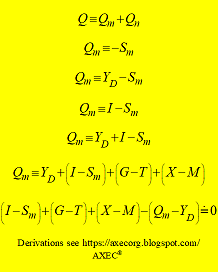
Unfortunately, this simple equation covers only a limiting case. This is not much in absolute terms, but considerably more than what IS-LM, which is a zero-profit model, ever had to offer. Minsky, too, got macroeconomic profit wrong. The axiomatically correct formula for the elementary case reads Qm≡I−Sm Legend: Qm business sector's monetary profit, I investment expenditures, Sm household sector's monetary saving. Minsky implies Sm=0, IS-LM implies Qm=0. Macroeconomics has been proto-scientific garbage since Keynes.
It is a mission impossible these days to direct students to relevant economic models because there are none.
Egmont Kakarot-Handtke
References
Desai, M. (2008). Profit and Profit Theory. In S. N. Durlauf, and L. E. Blume (Eds.), The New Palgrave Dictionary of Economics Online, 1–11. Palgrave Macmillan, 2nd edition. URL
Kakarot-Handtke, E. (2013). Why Post Keynesianism is Not Yet a Science. Economic Analysis and Policy, 43(1): 97–106. URL
Keynes, J. M. (1937). The General Theory of Employment. Quarterly Journal of Economics, 51(2): 209–223. URL
Minsky, H. P. (2008). Stabilizing an Unstable Economy. New York, Chicago, San Francisco: McGraw-Hill, 2nd edition.
Tómasson, G., and Bezemer, D. J. (2010). What is the Source of Profit and Interest? A Classical Conundrum Reconsidered. MPRA Paper, 20557: 1–34. URL
Blog-Reference:
It is laudable to direct students away from irrelevant economic models.
Orthodox economics is irrelevant from Jevons to DSGE. The problem is that Heterodoxy from Veblen to Minsky is only slightly better. With a critical stance, it is easy to identify and avoid the worst blunders of standard theory. Davidson is a case in point. Of course, the ergodic hypothesis is inapplicable in economics. Keynes was right word-for-word in what he said about uncertainty (1937, p. 214). The point is that this was only revolutionary vis-à-vis the 'classical' economists. Outside this intellectually closed sphere, the argument is trivial. The next taxi driver can tell you that ‘the price of copper and the rate of interest twenty years hence’ is uncertain. If this is scientific progress, it is not terribly impressive. It is a sad fact that heterodox economists have a strong bias to draw the wrong conclusions from correct observations. This brings us to Minsky.
Minsky (2008, p. 160) states correctly, “What determines profits? is a key question for understanding how our economy works.” Clearly, it is irresponsible to give economic advice without a proper understanding of profit. With his zero-profit economy, Walras demonstrated a complete lack of understanding. Therefore, he and the neo-Walrasians are out. However, the General Theory is also based on a false profit theory (Tómasson and Bezemer, 2010), which has not been rectified by the Post Keynesians (Kakarot-Handtke, 2013), (Desai, 2008, p. 10). Therefore, Keynesian models, including bastardizations like IS-LM, are out, too.
What about Minsky in particular? He tells us: “The simple equation 'profit equals investment' is the fundamental relation for macroeconomics that aims to determine the behavior through time of a capitalist economy with a sophisticated, complex financial structure.” (2008, p. 161)
Unfortunately, this simple equation covers only a limiting case. This is not much in absolute terms, but considerably more than what IS-LM, which is a zero-profit model, ever had to offer. Minsky, too, got macroeconomic profit wrong. The axiomatically correct formula for the elementary case reads Qm≡I−Sm Legend: Qm business sector's monetary profit, I investment expenditures, Sm household sector's monetary saving. Minsky implies Sm=0, IS-LM implies Qm=0. Macroeconomics has been proto-scientific garbage since Keynes.
It is a mission impossible these days to direct students to relevant economic models because there are none.
Egmont Kakarot-Handtke
References
Desai, M. (2008). Profit and Profit Theory. In S. N. Durlauf, and L. E. Blume (Eds.), The New Palgrave Dictionary of Economics Online, 1–11. Palgrave Macmillan, 2nd edition. URL
Kakarot-Handtke, E. (2013). Why Post Keynesianism is Not Yet a Science. Economic Analysis and Policy, 43(1): 97–106. URL
Keynes, J. M. (1937). The General Theory of Employment. Quarterly Journal of Economics, 51(2): 209–223. URL
Minsky, H. P. (2008). Stabilizing an Unstable Economy. New York, Chicago, San Francisco: McGraw-Hill, 2nd edition.
Tómasson, G., and Bezemer, D. J. (2010). What is the Source of Profit and Interest? A Classical Conundrum Reconsidered. MPRA Paper, 20557: 1–34. URL
***
Graphic AXEC143d Macroeconomic profit with increasing complexity

May 19, 2013
Key Issues: Logic and platitude
Deductive logic is one pattern of rationality in reasoning, but it is not the only one; good reasoning in science typically yields conclusions that go beyond the logical entailments of deductive logic. (Suppe, 1977, p. 657)
The economists of the twentieth century, by pushing the neoclassical model to its logical conclusions, and thereby illuminating the absurdities of the world which they had created, have made an invaluable contribution to the economics of the coming century: they have set the agenda, work on which has already begun. (Stiglitz, 1991, p. 136)
For if orthodox economics is at fault, the error is to be found not in the superstructure, which has been erected with great care for logical consistency, but in a lack of clearness and of generality in the premises. (Keynes, 1973, p. xxi)
***
For Keynes as for Post Keynesians the guiding motto is "it is better to be roughly right than precisely wrong!" (Davidson, 1984, p. 574)
Marshall followed the maxim: Better to be ambigous and relevant than precise and irrelevant. (Colander, 1995, p. 283)
It is well known that John Maynard was born anew every morning; for this reason, his colleagues at Bretton Woods commented that he was too intelligent to be consistent. (Valentino, 1988, p. 239)
... a remorseless logician can end up in Bedlam. (Keynes, quoted in Moggridge, 1976, p. 36)
But Keynes, too, sometimes gave the impression of not having fully grasped the logic of his own system. (Laidler, 1999, p. 281)
Toutes ses [Keynes’s] deductions, à notre avis, manquent absolument de rigeur. ... L’intuition de Keynes lui a fait sentir où se trouvaient les difficultés, mais son insuffisance logique ne lui a pas permis de résoudre les problèmes que son intuition lui avait fait entrevoir. (Allais, 1993, p. 70)
***
Even if we cannot prove a theory or model is true, at the very minimum to be true it must be logically consistent. (Boland, 2003, p. 24)When we define the ambition of science as getting it precisely right, then the guiding motto of Post Keynesianism amounts to an invitation to ‘Babylonian incoherent babble’ and leads, predictably, to a loss of theoretical coherence. Confronted with the phony alternative relevance vs. rigor or truth vs. precision, the non-Keynesians opted for rigor: "Mathematical economics, it seems, had the great virtue of demonstrable irrelevance, which was morally preferable to spurious relevance." (Porter, 1994, p. 155)
... each chief step in science has been a lesson in logic. (Peirce, 1992, p. 111)
Research is in fact a continuous discussion of the consistency of theories: formal consistency insofar as the discussion relates to the logical cohesion of what is asserted in joint theories; material consistency insofar as the agreement of observations with theories is concerned. (Klant, 1994, p. 31)
Economists today do not wish to discuss the ‘truth’ of economic theories but only examine their logical validity. (Boland, 1992, p. 36)
Logical validity is indispensable. However, if the premises are false, the logical validity of the conclusions is pointless. Truth resides in the axioms, not in the deductive process. Because of a logical blind spot — the place one stands on is, for the moment, invisible — economists today cannot see that they operate with inadmissible axioms. Logical validity is indispensable but not sufficient.
And so — faithful to the theory's conceptual cornerstones and hoping against all hope that the unthinkable may still be achieved (i.e., a satisfactory theory of the price mechanism) — the tormented upholders of the validity of the paradigmatic core of economic equilibrium theory appear singularly reluctant to face the problem of comparing expectations and results and assessing the consistency of the theory. (Ingrao and Israel, 1990, p. 346)Formal consistency does not count for much if the axioms lack material consistency. Realism does not count for much if it cannot be properly formalized.
***
We are lost in a swamp, the morass of our ignorance. ... We have to find the roots and get ourselves out! ... Braids or bootstraps are necessary for two purposes: to pull ourselves out of the swamp and, afterwards, to keep our bits and pieces together in an orderly fashion. (Schmiechen, 2009, p. 11)Logical bootstrapping is what axiomatization is all about. Therefore, one has to jump to new premises to see the defects of the previous premises. There is no path between them. Axiom Sets are incommensurable; there is no synthesis and no continuity; the previous set is simply abandoned. In practical terms, this means that both Walrasians and Keynesians are left behind the curve for good. Both approaches can still fulfill a useful role as practical examples of how not to do science.
References
Allais, M. (1993). Les Fondements Comptables de la Macro-Économie. Paris: Presses Universitaires de France, 2nd edition.
Boland, L. A. (1992). The Principles of Economics. Some Lies My Teacher Told Me. London, New York: Routledge.
Boland, L. A. (2003). The Foundations of Economic Method. A Popperian Perspective. London, New York: Routledge, 2nd edition.
Colander, D. (1995). Marshallian General Equilibrium Analysis. Eastern Economic Journal, 21(3): 281–293. URL
Davidson, P. (1984). Reviving Keynes’s Revolution. Journal of Post Keynesian Economics, 6(4): 561–575. URL
Hudson, M. (2010). The Use and Abuse of Mathematical Economics. real-world economics review, (55): 2–22. URL
Ingrao, B., and Israel, G. (1990). The Invisible Hand. Economic Equilibrium in the History of Science. Cambridge, London: MIT Press.
Keynes, J. M. (1973). The General Theory of Employment Interest and Money. The Collected Writings of John Maynard Keynes Vol. VII. London: Macmillan.
Klant, J. J. (1994). The Nature of Economic Thought. Aldershot, Brookfield: Edward Elgar.
Laidler, D. (1999). Fabricating the Keynesian Revolution. Cambridge: Cambridge University Press.
Moggridge, D. E. (1976). Keynes. London, Basingstoke: Macmillan.
Peirce, C. S. (1992). The Fixation of Belief. In N. Houser and C. Kloesel (Eds.), The Essential Peirce. Selected Philosophical Writings, Vol. 1,109–123. Bloomington: Indiana University Press.
Porter, T. M. (1994). Rigor and Practicality: Rival Ideals of Quantification in Nineteenth-Century Economics. In P. Mirowski (Ed.), Natural Images in Economic Thought, 128–170. Cambridge: Cambridge University Press.
Schmiechen, M. (2009). Newton’s Principia and Related ‘Principles’ Revisited, volume 1. Norderstedt: Books on Demand, 2nd edition.
Stiglitz, J. E. (1991). Another Century of Economic Science. Economic Journal, 101(404): 134–141. URL
Suppe, F. (1977). Afterword. In F. Suppe (Ed.), The Structure of Scientific Theories, 615–730. Urbana, Chicago: University of Illinois Press.
Valentino, R. (1988). Discussion. In H. Hanusch (Ed.), Evolutionary Economics. Applications of Schumpeter’s Ideas, 238–249. Cambridge, New York, etc.: Cambridge University Press.
Related 'Why Post Keynesianism is Not Yet a Science URL' and 'Crisis and Methodology, Sec. 3 URL' and 'Objective Principles of Economics URL'.
© 2013 EKH, except original quotes
Allais, M. (1993). Les Fondements Comptables de la Macro-Économie. Paris: Presses Universitaires de France, 2nd edition.
Boland, L. A. (1992). The Principles of Economics. Some Lies My Teacher Told Me. London, New York: Routledge.
Boland, L. A. (2003). The Foundations of Economic Method. A Popperian Perspective. London, New York: Routledge, 2nd edition.
Colander, D. (1995). Marshallian General Equilibrium Analysis. Eastern Economic Journal, 21(3): 281–293. URL
Davidson, P. (1984). Reviving Keynes’s Revolution. Journal of Post Keynesian Economics, 6(4): 561–575. URL
Hudson, M. (2010). The Use and Abuse of Mathematical Economics. real-world economics review, (55): 2–22. URL
Ingrao, B., and Israel, G. (1990). The Invisible Hand. Economic Equilibrium in the History of Science. Cambridge, London: MIT Press.
Keynes, J. M. (1973). The General Theory of Employment Interest and Money. The Collected Writings of John Maynard Keynes Vol. VII. London: Macmillan.
Klant, J. J. (1994). The Nature of Economic Thought. Aldershot, Brookfield: Edward Elgar.
Laidler, D. (1999). Fabricating the Keynesian Revolution. Cambridge: Cambridge University Press.
Moggridge, D. E. (1976). Keynes. London, Basingstoke: Macmillan.
Peirce, C. S. (1992). The Fixation of Belief. In N. Houser and C. Kloesel (Eds.), The Essential Peirce. Selected Philosophical Writings, Vol. 1,109–123. Bloomington: Indiana University Press.
Porter, T. M. (1994). Rigor and Practicality: Rival Ideals of Quantification in Nineteenth-Century Economics. In P. Mirowski (Ed.), Natural Images in Economic Thought, 128–170. Cambridge: Cambridge University Press.
Schmiechen, M. (2009). Newton’s Principia and Related ‘Principles’ Revisited, volume 1. Norderstedt: Books on Demand, 2nd edition.
Stiglitz, J. E. (1991). Another Century of Economic Science. Economic Journal, 101(404): 134–141. URL
Suppe, F. (1977). Afterword. In F. Suppe (Ed.), The Structure of Scientific Theories, 615–730. Urbana, Chicago: University of Illinois Press.
Valentino, R. (1988). Discussion. In H. Hanusch (Ed.), Evolutionary Economics. Applications of Schumpeter’s Ideas, 238–249. Cambridge, New York, etc.: Cambridge University Press.
Related 'Why Post Keynesianism is Not Yet a Science URL' and 'Crisis and Methodology, Sec. 3 URL' and 'Objective Principles of Economics URL'.
© 2013 EKH, except original quotes
Key Issues: Profit
Neither orthodox nor heterodox economists have a clear idea of the fundamental concepts of income and profit. What is known with certainty from the elementary macro-axiomatic analysis is that the conventional approaches are logically deficient.
The first important conclusion of the macro-axiomatic analysis is that profit is a factor-independent residual and qualitatively different from wage income. Therefore, it is an elementary mistake to maintain that total income is the sum of wages and profits. The second conclusion is that there is a close relation between profit/loss and the expansion/contraction of credit for the economy as a whole. Therefore, it is an elementary mistake to identify profit with a physical surplus. The third conclusion is that there is no antagonism between total wages and total profits, and that the distribution of output has nothing at all to do with the behavioral concept of marginal productivity. The fourth conclusion is that innovation and efficiency are irrelevant for the profit of the business sector as a whole. It is a Fallacy of Composition to trivially generalize what can be observed in an individual firm. This applies to many other microeconomic observations.
The crucial point is that profit for the economy as a whole cannot be derived from the behavior of the individual firm. That is, the standard microeconomic approach cannot, as a matter of principle, deliver the correct profit theory. And when the profit theory is false, the other parts of a comprehensive approach are open to doubt. What is immediately obvious is that, as collateral damage, the familiar theories of income distribution and wealth distribution are wrong by logical implication.
A correct theory is the precondition of economic policy. This, of course, is not new: “We have long known that the conduct of economic policy requires the policy-maker to have a theory of how the economy works.” (D. Laidler). The conventional economist's combination of a sense of mission, flawed theory, and self-delusion is not of great help, if any.

Dear representative economist, if you apply a conception of total monetary profit that is, in the elementary case, different from Qm≡EC−Y+DN ⇓, your theory is demonstrably false and therefore inappropriate for the solution of real-world problems. The definition of profit is not a matter of personal taste but of logical and material consistency. Ultimately, the selection of axioms determines analytical success or failure.
If you are a businessman, you know the particular profit determinants of your firm, but this does not give you the determinants of total profit for the business sector as a whole. The generalization of partial truths is prone to the Fallacy of Composition. From individual experience, no correct profit theory follows. Because of this, business people do not know better than average citizens how the economy works.
If you are a consultant or advisor and your background knowledge contains assertions like: the value of the product equals the value of factor incomes, total income is the sum of wages and profits, distributed profit is equal to profit, or saving equals investment, your advice is not based on state-of-the-art analysis and is, at best, useless.
If you are a student, you are expected to find out whether your teacher's theory is true or false, or incomplete. Growth of knowledge is what science is all about. The acceptance of basic tenets of conventional economics is indicative of a lack of scientific acumen. From a student who has accepted supply-demand-equilibrium as an explanation, not much is to be expected.
With regard to the formal foundations of a Paradigm, it is not the case that anything goes. John Stuart Mill clearly stated the key question:
What are the propositions which may reasonably be received without proof? That there must be some such propositions all are agreed, since there cannot be an infinite series of proof, a chain suspended from nothing. But to determine what these propositions are, is the opus magnum of the more recondite mental philosophy.
Neither Orthodoxy nor Heterodoxy has accomplished the opus magnum. Economics is still at the stage of a proto-science. A 'sequence of models' (Koopmans) is no substitute for a comprehensive theory that realizes both formal and material consistency.
By looking at a single firm, it seems that profit depends on (List A):
- exploitation of the workforce
- innovation
- risk-taking
- capital accumulation
- monopolistic practices
- market imperfections
- the combination of the factors of production
- wage rate and employment
- the talent of managers and the motivation of the workforce
- aggressive expansion at home and abroad
- bamboozling the consumer
- speculation, financial manipulation, fraud, cheating
- corruption, cronyism, gaming the system
- the loss of other firms.
These factors play a role when it comes to the distribution of profits between firms. But these factors cannot explain the profit of the business sector as a whole. The conventional view is that total profit must be zero in equilibrium under the condition of perfect competition. This is an analytical conclusion because one cannot directly observe this limiting case in the real world. The conclusion depends, as with every theory, logically upon the premises. Hence, it all depends on whether the axioms are true or false.
- by the relation of consumption expenditures to total income,
- by distributed profits in the period under consideration.
The first important conclusion of the macro-axiomatic analysis is that profit is a factor-independent residual and qualitatively different from wage income. Therefore, it is an elementary mistake to maintain that total income is the sum of wages and profits. The second conclusion is that there is a close relation between profit/loss and the expansion/contraction of credit for the economy as a whole. Therefore, it is an elementary mistake to identify profit with a physical surplus. The third conclusion is that there is no antagonism between total wages and total profits, and that the distribution of output has nothing at all to do with the behavioral concept of marginal productivity. The fourth conclusion is that innovation and efficiency are irrelevant for the profit of the business sector as a whole. It is a Fallacy of Composition to trivially generalize what can be observed in an individual firm. This applies to many other microeconomic observations.
The crucial point is that profit for the economy as a whole cannot be derived from the behavior of the individual firm. That is, the standard microeconomic approach cannot, as a matter of principle, deliver the correct profit theory. And when the profit theory is false, the other parts of a comprehensive approach are open to doubt. What is immediately obvious is that, as collateral damage, the familiar theories of income distribution and wealth distribution are wrong by logical implication.
A correct theory is the precondition of economic policy. This, of course, is not new: “We have long known that the conduct of economic policy requires the policy-maker to have a theory of how the economy works.” (D. Laidler). The conventional economist's combination of a sense of mission, flawed theory, and self-delusion is not of great help, if any.
Profit is the pivotal concept for the analysis of how the economy works. Without a correct profit theory, economics is vacuous. The conventional profit theory is logically indefensible. It is a unique fact of the history of economic thought that neither Classicals, nor Walrasians, nor Marshallians, nor Keynesians, nor Marxians, nor Institutionalists, nor Monetary Economists, nor Austrians, nor Sraffaians, nor Evolutionists, nor Game theorists, nor Econophysicists, nor RBCers, nor New Keynesians, nor New Classicals ever came to grips with profit. Hence, they 'fail to capture the essence'. There are many opinions but no scientific understanding of the market economy, neither on the national nor on the global level. Rational economic policy or the implementation of a rational economic order is, therefore, a priori impossible. Economists have no true conception of the most important phenomenon in their universe.Profit is a subject to which economists have addressed themselves for at least two hundred years, but without much success. For there is at the moment no general theory of profits which commands anything approaching universal acceptance either among academic economists or among men of affairs. (A. Wood)
His Collected Writings show that Keynes wrestled to solve the Profit Puzzle up till the semi-final versions of his General Theory but in the end he gave up and discarded the draft chapter dealing with it. (G. Tómasson and D. Bezemer)
A satisfactory theory of profits is still elusive. (M. Desai, New Palgrave Dictionary)
In the practical affairs of trade, industry and finance no concept is more fundamental or more familiar than profit. Yet to the questions what profit is, and by what causes it is shaped and determined, economic science has not as yet supplied answers which command general agreement. (R. G. Hawtrey)
"What determines profits?" is a key question for understanding how our economy works. (H. Minsky)
... one of the most convoluted and muddled areas in economic theory: the theory of profit. (P. Mirowski)
We need to know what profits have been, how they have been made, to what uses they have been put, ...: no light on these matters is shed by the analyses of value, of utility and disutility, that have preoccupied so many of us for so long. (C. Parry)
Much of what is usually offered as profit theory will be seen to be without merit. (M. Obrinsky)
But in my opinion contemporary profit theory is floundering in eclecticism and has lost touch with the major economic changes of the past twenty-five years. Until we have clearly established what it is we are talking about, what we say is not going to have much value. (P. Bernstein)
Profit theory has been largely concerned with specifying and isolating the 'function' for which profit is the 'reward.' This is scientifically irrelevant. (A. Murad)
Of all the traditional branches of economics, the theory of profits has had the greatest difficulty in attaining the "safe path of a science." Our knowledge of the causes determining value, or wages, is indeed incomplete; but in these fields we do not find, and have not found for some considerable time, that fundamental disagreement among competent writers about the mere direction of approach, or that utter failure of promising lines of inquiry to yield results of any great importance, which Kant declared to be the marks of a science still groping in the dark. (J. R. Hicks)
Nor do the modern variants add anything whatever on this score. For Debreu profits are simply a nonissue, while Arrow and Hahn make only passing reference to profits — and that only as a historical introduction. Whatever may be the usefulness of these idealized theoretical constructs, they cannot be said to throw any light on the profit issue; surely, therefore, they fail to capture the essence of a capitalist market economy. (M. Obrinsky)
***
Graphic AXEC204

Subscribe to:
Posts (Atom)